


TDS on Year-End Provisions: Mere Crediting Triggers Liability
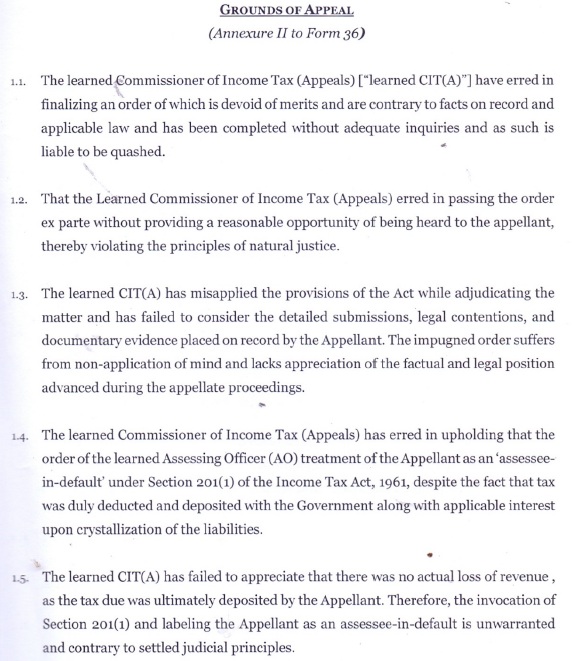
In this significant ruling, the Income Tax Appellate Tribunal (ITAT) / Court (2025/2026) has clarified the interplay between year-end accounting provisions and TDS obligations. The court held that even if a vendor’s invoice has not been received, the creation of a provision for “ascertained liabilities” in the books of account is sufficient to trigger the liability to deduct tax at source (TDS).
I. The Core Dispute: “Provision for Expenses” vs. TDS
The assessee, a real estate developer, followed the mercantile system of accounting. At the end of the financial year (AY 2017-18), it created provisions for expenses totaling ₹58.06 crores.
-
Assessee’s Argument: TDS is only deductible when the expenditure “crystallizes”—i.e., when a formal invoice is received from the vendor. Since invoices were not yet received, they credited the “Provision for Expenses” account instead of individual vendor accounts.
-
Revenue’s Stand: Under Section 194C, TDS must be deducted at the time of payment OR credit, whichever is earlier. Crediting a “Provision” or “Suspense” account is legally deemed a credit to the payee.
II. Why TDS was Held Mandatory
The Court ruled in favour of the Revenue, relying on the following legal principles:
-
Identifiable Payees: The nature and quantum of expenses were realistically estimated based on existing contracts. Since the parties (vendors) were identifiable and the liability was ascertained, it was not a “contingent” or “vague” provision.
-
Mercantile System: Under this system, an expense “accrues” as soon as the liability to pay is recognized, regardless of whether a bill is issued.
-
Section 194C Explanation: The Act specifically states that crediting an amount to a “Suspense Account” or any other name (like “Provision for Expenses”) triggers the TDS obligation if the income is attributable to a specific payee.
III. Section 40(a)(ia) vs. Section 201: The “Double Impact”
A critical aspect of this case is the distinction between two different penalties for non-deduction:
| Section | Nature of Consequence | Court’s Observation |
| Section 40(a)(ia) | Disallowance of Expense: 30% of the expense is added back to business income, increasing tax. | The assessee had already “suo motu” (voluntarily) disallowed 30%. |
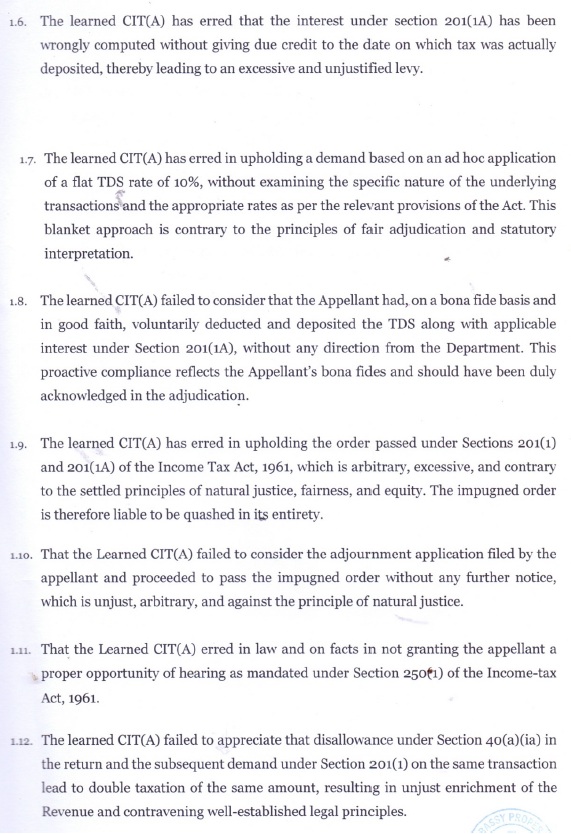
| Section 201(1)/(1A) | Assessee in Default: The payer is forced to pay the actual tax not deducted + interest. | The Court held that voluntarily disallowing the expense does not exempt the payer from the recovery of tax and interest. |
Legal Maxim: Compliance with one punitive provision (disallowance) does not wash away the default under the other (recovery of tax).
IV. Final Outcome: The Remand
While the Court upheld that the assessee was “in default,” it remanded the matter back to the DCIT (TDS) for recomputation. The authorities must now check:
-
Whether the payees (vendors) have already paid tax on this income in their own returns (per the Hindustan Coca Cola principle). If they have, the tax cannot be recovered again from the deductor, though interest will still apply.
Key Takeaways for Businesses
-
Year-End Caution: If you are booking “Provision for Expenses” at the end of March for identifiable vendors (Auditors, Contractors, Consultants), you must calculate and deposit TDS on that provision.
-
The “Identifiability” Test: If the provision is a “bulk estimate” where the specific vendor is unknown, TDS might not apply. However, in real estate contracts, vendors are almost always identifiable.
-
Interest Liability: Even if you pay the TDS later when the invoice arrives, the Department can charge interest under Section 201(1A) from the date the provision was first made.
and Waseem Ahmed, Accountant Member
[Assessment year 2017-18]
| Sl.No. | Particulars | Amount |
| 1. | Amount of provision for disallowance made u/s 40(a)(ia) of Rs.58,06,03,613/- | 58,06,03,613/- |
| 2. | Default u/s 201(1) | 5,80,60,361/- |
| 3. | Interest u/s 201(1A) for 96 months | 5,57,37,946/- |
| Total demand payable | 11,37,98,307/- |
“A Provision should be recognised when:-
(a) an enterprise has a present obligation as a result of past event.
(b) it is probable that an outflow of resources embodying economic benefits will be required to settle the obligation; and
(c) a reliable estimate can be made of the amount of the obligation.”
| (a) | Situation I:- In the subsequent year, the assessee receives bill for Rs. 1000/-. Accordingly, when the payment is made “Provision for expenses” account shall be debited with Rs. 1000/-. In this situation, the Provision for expenses a/c will show NIL balance after the payment. There will not be any impact on the Profit and Loss account of the succeeding year. |
| (b) | Situation II:- In the subsequent year, the assessee receives bill for Rs. 1,200/-, meaning thereby, the provision created was short by Rs. 200/-. When the payment is made, the Provision for expenses account shall be debited with Rs. 1000/- and the concerned expenses account shall be debited with remaining amount ofRs.200/-. In this situation also, the Provision for expenses a/c will show NIL balance after the payment. There will be impact on the Profit and Loss account of the succeeding year by way of increase in expenses by Rs. 200/-. |
| (c) | Situation III:- In the subsequent year, the assessee receives bill for Rs. 750/- only, meaning thereby, the provision created was in excess by Rs. 250/-. When the payment is made, the Provision for expenses account shall be debited with Rs. 750/-, which will leave a credit balance of Rs. 250/- in the Provision for Expenses account. This remaining credit balance will be transferred to the Profit and Loss account. Accordingly, the Provision for expenses account will show NIL balance and there will be an impact on the Profit and Loss account of the succeeding year by way of income of Rs. 250/-. |
| (d) | Situation IV:- The assessee finds that it is not liable to pay the provision amount. Accordingly, the entire amount of Rs. 1000/- outstanding to the credit of Provision for expenses account shall be transferred to the Profit and Loss account. Accordingly, the Provision for expenses a/c will show NIL balance and there will be an impact on the Profit and Loss account of the succeeding year by way of income of Rs. 1000/-. |
“Where any sum referred to in sub-section (1) is credited to any account whether called “Suspense account” or by any other name, in the books of account of the person liable to pay such income, such crediting shall be deemed to be credit of such income to the account of the payee and the provisions of this section shall apply accordingly.”
“29. sec. 194C applies when payment is made to contractor. The point of time at which tax had to be deducted at source is at the time of credit to the Account of contractor or payment in cash or cheque, whoever is earlier. subsection (2) of sec. 194-C lays down that where any sum referred to in subsection (1) is credited to any account, whether called “Suspense account” or by any other name, in the books of account of the person liable to pay such income, such crediting shall be deemed to be credit of such income to the account of the payee and the provisions of this section shall apply accordingly. Similar provision such as sec. 194(2) exists in sec. 194H Explanation (ii) of the Act which applies when the payment made is in the nature of commission or brokerage, in sec. 194J Explanation(c) when payment made is Fees for Technical Service and Sec. 195 Expln.-1 when payment is made to nonresident. The reason for introduction of provisions such as Sec. 194(2) of the Act has been explained in CBDT circular No. 550 dated 1-1-1990 as follows:-
“26.3 Under the existing provisions of section 193 of the Income-tax Act, tax has to be deducted at source by the person responsible for making any payment in the nature of interest on securities at the time of payment. The liability to deduct tax at source was being postponed by making a provision for such payment. In order to prevent the postponement of liability to deduct tax and payment to the credit of the Central Government, the Finance Act has provided that tax will be deducted at source either at the time of credit to the account of the payee or at the time of payment thereof, whichever is earlier. For this purpose, credit to any suspense account or any other account, by whatever name called, shall be deemed to be a credit of such income to the account of the payee.”
30. It is thus clear from the statutory provisions that the liability to tax at source exists when the amount in question is credited to a ‘suspense Account’ or any other account by whatever name called, which will also include “Provision” created in the books of accounts. Therefore it is not possible for the Assessee to argue that there was no accrual of expenditure in accordance with the mercantile system of account and therefore the TDS obligations do not get triggered.”
“19. We have carefully considered the rival contentions and perused the orders of the lower authorities. Assessee has made provision for Airport expenses of Rs. 32314535/-, Airport Handling expenses Rs. 14115000/-, Crew Accommodation expense Rs. 694000/-, IT Communication charges Rs. 7021580/- and provision for other expenses Rs. 74335080/-. Admittedly assessee has not deducted tax and source on the above sum stating that it is yearend provision and the payees are not identified. It is not the case of the assessee that these are we are not ascertained liabilities. According to the provisions of the income tax act the tax is required to be deducted as and when assessee becomes responsible for payment of above sum to other parties. The claim of the assessee is that it is maintaining its books of account on accrual basis of accounting and therefore the amount is required to be provided for. When the expenditure incurred by the assessee, the corresponding liability definitely arises for payment of such expenditure. The amount of expenditure incurred can be determined only if, there is a recipient identified of the sum, there is a methodology available for working out the amount payable by the assessee to the recipient, there is a corresponding liability arising out of the existing contract or customs by the assessee with the recipient. If generally these ingredients are not satisfied assessee cannot be said to have incurred the expenditure. In absence of one of one of these criteria, if provision is made, it is not an ascertained liability but an unascertained liability, which does not satisfied the concept of accrual of expenditure. There may be reasons for receiving the bills by the service providers after certain time lag but that does not absolve the assessee from the liability of deduction of tax at source. In the present case the provision is made under the specified head, provision is also made to on certain basis thereby ascertaining the amount. It is not the case of the assessee that it has made an ad hoc provision. Thus it cannot be said that the payee is not identified. Therefore, according to us, the tax is required to be deducted on the year-end provisions made by the assessee which are ascertained liabilities. No doubt, the learned CIT(A) has given the benefit of the assessee if tax is deducted by the assessee subsequently. Therefore we do not find any infirmity in the order of the learned CIT(A) in holding that assessee has failed to deducted tax at source on year-end provisions. Thus the order of the learned CIT(A) is upheld to that extent.”
“5.2 The liability to deduct tax at source on the interest payments is prescribed u/s 194A of the Act. Sub-section (1) of sec. 194A reads as under:-
194A. (1) Any person, not being an individual or a Hindu Undivided family, who is responsible for paying to a resident any income by way of interest other than income by way of interest on securities, shall, at the time of credit of such income to the account of payee or at the time of payment thereof in cash or by issue of a cheque or draft or by any other mode, whichever is earlier, deduct income tax thereon at the rates in force.”
Explanation:- For the purposes of this section, where any income by way of interest as aforesaid is credited to any account, whether called “Interest payable account” or “Suspense account” or by any other name, in the books of account of the person liable to pay such income, such crediting shall be deemed to be credit of such income to the account of payee and the provisions of this section shall apply accordingly.”
A plain reading of above provision clearly shows that the person responsible to pay the interest is liable to deduct tax at source at the time of credit or payment, whichever is earlier. It is pertinent to note that the section uses the term “any income by way of interest”. The interest payment may constitute expenditure in the hands of the person making the payment, while it may constitute income in the hands of the payee/recipient. Since the section uses the term “any income by way of interest”, in our view, it should be viewed from the angle of the recipient/payee and not from the angle of the person making the payment. Accordingly, the accounting/tax treatment given by the payer in respect of interest paid by him may not be relevant at all for the purposes of sec. 194A of the Act. So long as the interest amount constitutes “income” in the hands of recipient, the payer shall be liable to deduct tax at source on the interest amount so paid. Accordingly, even if the payer has disallowed the expenditure u/s 40(a)(ia) of the Act or did not claim the same as expenditure at all, he shall still be liable to deduct tax at source u/s 194A of the Act on the interest amount so paid, if the said payment is liable for tax deduction at source. We notice that the Mumbai bench of Tribunal, in the case of Pfizer Ltd. (supra) did not consider the express provisions contained in sec. 194A of the Act. Further we notice that the provisions of sec. 40(a)(ia) does not override the provisions of sec. 201 of the Act. We notice that provisions of sec. 40(a)(ia) do not provide for absolute disallowance as in the case of say, sec. 40A(3) of the Act. The amount disallowed u/s 40(a)(ia) in one year can be claimed as deduction in the year in which the TDS provisions are complied with. Thus, in our view, the provisions of sec. 40(a)(ia) provide only for deferment of the allowance and it does not provide for absolute disallowance. The objective of sec. 40(a)(ia) appears to be to compel the assessee to deduct tax at source in order to claim the relevant expenditure as deduction.”
“27. We have carefully considered rival submissions. Provisions of Sec.40 of the Act start with a non-obstante clause and provides that, “Notwithstanding anything to the contrary in sections 30 to 38, the following amounts shall not be deducted in computing the income chargeable under the head “Profits and gains of business or profession.” Sec.40(a)(i) and 40(a)(ia) of the Act lists of certain items of expenditure and categories payees as “Residents” “Non Residents”. In respect of the items of such expenditure there if there is an obligation to deduct tax at source under Chapter XVII-B and such tax has not been deducted or after deduction, has not been paid during the previous year, then the expenditure cannot be claimed as a deduction. Sec. 200(1) appears in Chapter XVII-B of the Act and it provides that any person deducting any sum in accordance with the foregoing provisions of this Chapter i.e., Chapter-XVII-B shall pay within the prescribed time, the sum so deducted to the credit of the Central Government or as the Board directs. Sec.201(1) of the Act is triggered when if any such person referred to in section 200 does not deduct the whole or any part of the tax or after deducting fails to pay the tax as required by or under this Act, he or it shall, without prejudice to any other consequences which he or it may incur, be deemed to be an assessee in default in respect of the tax. The contention of the learned DR that the assessee having admitted its default u/s 40(a)(i) & 40(a)(ia) of the Act, cannot in proceedings u/s 201(1) of the Act, be heard to say that there was no default under Chapter XVII-B of the Act is therefore correct. The disability u/s 40(a)(i) & 40(a)(ia) of the Act and the liability u/s 201(1) of the Act cannot be different and they arise out of the same default. Once there is disallowance u/s 40(a)(i) & 40(a)(ia) of the Act, it is not possible to argue that there was no liability under Chapter XVII-B of the Act and therefore the provisions of Sec.201(1) of the Act will not be attracted.
| (a) | disallowance of expenses should be made u/s 40(a)(i)/40(a)(ia); |
| (b) | assessee shall be deemed to be an assessee in default and hence the demand u/s 201(1)/201(1A) could be raised upon the assessee. |
| (c) | penalty can be levied u/s 271C/271CA and |
| (d) | prosecution can be launched/s 276B of the Act. |
Explanation.—For the removal of doubts, it is hereby declared that if any person including the principal officer of a company,—
(a) who is required to deduct any sum in accordance with the provisions of this Act; or
(b) referred to in sub-section (1A) of section 192, being an employer, does not deduct, or after so deducting fails to pay, or does not pay, the whole or any part of the tax, as required by or under this Act, and where the assessee has also failed to pay such tax directly, then, such person shall, without prejudice to any other consequences which he may incur, be deemed to be an assessee in default within the meaning of sub-section (1) of section 201, in respect of such tax.
| (a) | Contract expenses covered by sec. 194C |
| (b) | Professional fees covered by sec. 194J |
| (c) | Rent expenses covered by sec. 194I |
| (d) | Commission expenses covered by sec.194H |
| (e) | Payments to non-residents covered by sec. 195 |
“4.2 With regard to the appellant’s claim that the identity of the recipients was not known and, hence, it could not have deducted tax on the provisioned amounts, I find that the facts and probability largely belie this claim. It is commonsensical to expect that the appellant’s creation of the provision for the services received by the year end to obtain a correct view of its profit at year end was not based on any arbitrary or whimsical estimate. It is clear from the provisioned expenses that the estimate has followed from pre-existing contracts with known parties for identified services and, hence, the accounting of amounts liable to be paid to these parties for services availed as per known terms of transaction is a specific exercise which carries with it the statutory responsibility for deducting tax at source also. The appellant cannot wriggle out of this responsibility by holding that the provisions were made without any basis towards unidentified parties for unascertained liabilities.”
| (a) | The first decision is that of Honourable Delhi High Court in case of UCO Bank (369 ITR 335). The facts prevailing in this case are that the Court had directed one of the parties to the suit to deposit certain sums in the High Court. The amount was invested in Fixed deposit by the Registrar General of the High Court with UCO Bank. The High Court dealt with the question as to whether the bank is liable to deduct TDS on the interest income credited to the above said Fixed deposit. The bank’s case was that the Registrar General was merely a custodian of the funds on behalf of the High Court and the Registrar General per se was neither an assessee nor he was beneficiary entitled to receive any interest on the fixed deposits. Under these facts, the Hon’ble Delhi High Court held that if TDS is deducted that would amount to recovery of tax without corresponding income being assessed in the hands of any assessee. In the absence of ascertainable assessee, the machinery of recovering tax by deduction of tax at source breaks down because it does not aid the charge of tax u/s 4 of the Act, but takes a form of a separate levy, independent of other provisions of the Act, which is not permissible. Therefore, it can be seen that the decision of the Hon”ble Delhi High Court has been rendered in the peculiar facts prevailing in that case. |
| (b) | The next decision is of Hon”ble Karnataka High Court in the case of Karnataka Power Transmission Corporation Ltd (383 ITR 59). In this case, the assessee before Hon’ble High Court of Karnataka made provision towards interest payable on delayed payments. However, subsequently assessee noticed that interest is not payable in view of understanding reached between the parties. Accordingly it reversed the provision entries in books of account. Under these set of facts, the Hon’ble Karnataka High Court held that the interest which partakes the character of income alone is liable for deduction of tax at source u/s 194A of the Act. |
| (c) | The Mumbai bench of Tribunal, in the case of Industrial Development Bank of India v. ITO (2007) (107 ITD 45) has examined the aspect of liability to deduct tax at source, when the payees could not be identified. The question before Mumbai bench of Tribunal was whether or not Section. 193 of the Act requires tax deducted at source in respect of the provision for interest accrued but not due made by an assessee where the ultimate recipient of such interest accrued but not due cannot be ascertained at the point of time when the provision is made. In this case, the assessee issued ‘Regular Return Bond-Series II’, which carried interest rate of 16 per cent p.a. payable annually. The interest was payable on 9th of June every year. However, the assessee closed its accounting year on 31st March. Accordingly, it made provision of interest accrued upto 31st March, which however has not become due. This issue was adjudicated in a detailed manner. The discussions made by the Tribunal in lucid manner are extracted below:- |
9. The above terms and conditions, so far as material for the purposes of our adjudication, can be summarized as follows:
| (a) | The assessee is liable to pay interest @ 16 per cent annually in respect of regular return bondholders. |
| (b) | The interest is payable on 9th June of each calendar year, except in the year of maturity, when interest is payable on maturity. |
| (c) | The interest, except at the time of maturity, is paid to the person whose name is registered in the records of the assessee-company as on 15th May of each calendar year. |
| (d) | The bonds are transferable by endorsement and delivery, and the assessee does not, in any way, control such transfer of ownership. |
Let us now appreciate the impact of the above terms and condition so far the issue in appeal before us is concerned. As on 31st March of the year, the assessee’s liability for ‘interest accrued but not due’ because interest is payable only once annually on a date other than the date of closure of accounts but the assessee will have no means to find out as to who could be the recipients of ‘interest due but not payable’ in respect of ‘regular return bonds’ because while assessee’s liability to pay interest @ 16 per cent is certain and is to be made as on 31st March, i.e., on the end of the relevant accounting year, the bonds in question being freely transferable, it cannot ascertain as to who will be the registered bondholder as on 15th May of that year. The assessee cannot be expected to have clairvoyance of knowing, as on 31st March, as to who will own the bonds on 15th May of that year. Therefore, in such a situation while the assessee certainly has the liability to pay the interest for the period till the end of the relevant accounting year, the assessee certainly does not know for sure as to who will be entitled to receive this interest. In our humble understanding, conceptually, liability of TDS is in the nature of a vicarious or substitutionary liability which presupposes existence of a principal or primary liability. Chapter XVII-B is titled ‘Collection and recovery of tax–Deduction of tax at source” and this title also indicates that the nature of TDS obligations are obligations for collection and recovery of tax. Under the IT Act, tax is on the income and it is in the hands of the person who receives such income, except in the case of dividend distribution tax which is levied under Section. 115-0–a Section outside the chapter providing for collection and recovery mechanism and set out under a separate chapter ‘Determination of tax in certain special cases-Special provision relating to tax on distributed profits of domestic companies’. A plain reading of section. 190 and section. 191, which are first two sections under the Chapter XVII, and of sections 199, 202 and 203(1) would show this underlying feature of the TDS mechanism.
Section 190 makes it clear that the scheme of TDS is one of the methods of recovering the tax due from a person and it is notwithstanding the fact that the tax liability may only arise in a later assessment year. The tax liability is obviously in the hands of the person who earns the income and TDS mechanism provides for method to recover tax under such liability. Therefore, this TDS liability is, as we begun by taking note of, a sort of substitutionary liability. Section 191 further makes this position clear when it lays down that in a situation TDS mechanism is not provided for a particular type of income or when the taxes have not been deducted at source in accordance with the provisions of Chapter XVII, income-tax shall be payable by the assessee directly. This provision thus shows that TDS liability is a vicarious liability and the principal liability is of the person who is taxable in respect of such income. Section 199 makes it even more clear by laying down that the credit for taxes deducted at source can only be given to the person from whose income the taxes are so deducted. Therefore, when tax deductor cannot ascertain beneficiaries of a credit, the tax deduction mechanism cannot be put into service. Section 202 lays down that TDS provisions are without any prejudice to any other mode of recovery from the assessee, which again points out to the tax deduction liability being vicarious liability in nature. Section 203(1) then lays down that for all tax deductions at source the tax deductor has to “furnish to the person to whose account such credit is given or to whom such payment is made or the cheque or warrant is issued” which presupposes that at the stage of tax deduction the tax deductor knows the name of person to whom the credit is to be given though whether by way of credit to the account of such person or by way of credit to some other account. This again shows that TDS liability is a vicarious liability to pay tax on behalf of the person who is to be beneficiary of the payment or credit, with a corresponding right to recover such tax payable from the person to whom credit is afforded or payment is made. It would be thus seen that the whole scheme of TDS proceeds on the assumption that the person whose liability is to pay an income knows the identity of the beneficiary or the recipient of the income. It is a sine qua non for a vicarious tax deduction liability that there has to be a principal tax liability in respect of the relevant income first, and a principal tax liability can come into existence when it can be ascertained as to who will receive or earn that income because the tax on the income and in the hands of the person who earns that income. In this view of the matter, TDS mechanism cannot be put into practice until identity of the person in whose hands, it is includible as income can be ascertained.
18. It is indeed correct that Explanation to section. 193 lays down that even when an income is credited to any account in the books of account of the person liable to pay such income, such crediting shall be deemed to be credit of such income to the account of the payee and the provisions of this section shall apply accordingly, but the fact that the credit to any account is to be deemed to be credit to the payee’s account also presupposes that payee can be ascertained. Therefore, this deeming fiction can only be activated when the identity of the payee can be ascertained. To illustrate, in the example that we had taken in para 4 above as long as assessee knows the identity of lenders, whether the assessee credits the interest accrued but not due in the account of the assessee or in some other account, tax would continue to be deductible under section 193 by the virtue of deeming fiction set out in the Explanation to Section. 193. The liability to pay in such a case would crystallise later, i.e., on due date of 31st December, and the corresponding credit to the lender’s account will also be given on 31st December, but the assessee will still have tax deduction liability in respect of interest accrued but not due as on 31st March. However, on the facts of the present case, this Explanation cannot be put into practice because the payee is not known at the stage of provision for ‘interest accrued but not due’ being made. It is not difficult to visualize that Explanation to Section. 193, which was introduced w.e.f. 1st June, 1989, was apparently to take care of a situation in which instead of crediting the account of the payee, some other proxy account was credited, to avoid the TDS liability being invoked. For example, if at the end of the accounting year, the assessee is to make a provision for interest of Rs. 10,000 payable to Mr. X, but he creates the provision by way of credit to ‘interest payable account’. In such a situation ‘interest payable account’ is de facto a proxy account for Mr. X, either fully or to the extent of the amount payable to Mr. X. However, it could have been argued, in the absence of the Explanation to Section. 193, that since the credit is not to the account of Mr. X, the tax deduction liability cannot be invoked. The Explanation itself makes it clear that even when such a practice is adopted the credit will be deemed to be credit to the payee’s account. In our considered view, fiction embodied in the Explanation is only applicable in situations in which tax deduction liability is sought to be escaped by crediting interest to some other account other than that of recipient of interest. In our considered view, Explanation to Section. 193 cannot be invoked in a case where the person who is to receive the interest cannot be identified at the stage at which the provision for interest accrued but not due is made. This position is also accepted by the CBDT, as evident from its letter dt. 5th July, 1996 addressed to the Tata Iron and Steel Co. Ltd. (Letter No. 275/126/96 IT (B)], which, inter alia, states as follows:
I am directed to refer to your letter ref. 3A 13-21/1460 dt. 23rd May, 1996, on the above subject, and to say that difference between the issue price of Rs. 5,000 and face value of Rs. 25,500 is in the nature of interest subject to provisions of Sections 193/193A. Although the company would be making provisions for interest on year to year basis in their books of account, there will be no deduction of tax at source in each such year as the payee is not known.
(Emphasis, italicised in print, supplied by us now) We agree with the merits of the stand so taken by the CDBT. The deduction of tax at source can only be effected when payee is known. As far as the situation before us is concerned, the regular return bonds being transferable on simple endorsement and delivery and the relevant registration date being a date subsequent to the closure of books of account, the assessee could not have ascertained the payees at the point of time when the provision for interest accrued but not due was made. Accordingly, no tax was required to be deducted at source in respect of the provision for interest payable made by the assessee which reflected provision for ‘interest accrued but not due’ in a situation where the ultimate recipient of such ‘interest accrued but not due’ could not have been ascertained at the point of time when the provision is made. In the present case, interest to such bondholders is to be paid as are registered with the assessee-company as on 15th May, 1994 but there could not have been any method of ascertaining, as at the time of making the provision for ‘interest accrued but not due’, i.e., on 31st March, 1994, as to who will be registered bondholders as on 15th May, 1994. It is also important to bear in mind that taxes were duly deducted at source at the time of payment, i.e., on 9th June, 1994 and that there is no loss of revenue as such. In the light of these discussions, we hold that the assessee did not have any liability to deduct tax at source, in respect of provision for ‘interest accrued but not due’, in respect of regular return bonds made on 31st March, 1994. When there was no obligation of deduct tax at source, there cannot be any question of levy of penalty or interest. The appellant, therefore, must succeed.”
| (a) | The actual payment made in the succeeding year is more than the provision amount. |
| (b) | The actual payment made in the succeeding year is less than the provision amount. |
| (c) | No payment is required to be made, since it was ascertained that there is no liability to pay the Amount. Accordingly, entire amount of provision is reversed in the succeeding year. |
| (d) | Payment has not yet been made in the succeeding year, even though the liability is acknowledged. However, the TDS was deducted/paid in the succeeding year. |
| (e) | Payment has not yet been made in the succeeding year, even though the liability was acknowledged. However TDS was not deducted in the succeeding year. |