ORDER
George George K, Vice President. – These six appeals filed by the Revenue are directed against different orders of Commissioner of Income Tax (Appeal), Chennai-19, passed under section 250 of the Income Tax Act, 1961 (hereinafter called ‘the Act’). The orders of CIT(A) arise out of orders of AO imposing penalties u/s.271(1)(c) / 270A / 271AA of the Act. The relevant Assessment Years are 2015-16, 2017-18, to 2021-22. The details of the respective appeals preferred by the Revenue are as under:-
| s. No. |
ITA No. |
AY |
Date of order of CIT(A) |
Date of order of AO |
Penalty levied by the AO u/s. |
Amount of penalty levied (Rs.) |
| 1 |
1650/Chny/2025 |
2015-16 |
13.03.2025 |
30.09.2022 |
271(l)(c) |
1,11,89,533 |
| 2 |
1651/Chny/2025 |
2017-18 |
12.03.2025 |
28.09.2022 |
270A |
62,74,154 |
| 3 |
1652/Chny/2025 |
2018-19 |
12.03.2025 |
28.09.2022 |
270A |
92,46,838 |
| 4 |
1653/Chny/2025 |
2019-20 |
12.03.2025 |
27.09.2022 |
270A |
1,09,97,688 |
| 5 |
1654/Chny/2025 |
2020-21 |
12.03.2025 |
28.09.2022 |
270A |
1,46,69,968 |
| 6 |
1655/Chny/2025 |
2021-22 |
13.03.2025 |
22.09.2022 |
271AAB |
2,39,98,544 |
2. There is a delay of 5 days in filing the above appeals. The AO has filed an affidavit in each of the appeals, stating therein the reasons for belated filing of these appeals. On perusal of the reasons stated in the affidavit, we are of the view that there is ‘sufficient cause’ and no latches can be attributed to the Department. Hence, we condone the delay of 5 days in filing these appeals and proceed to dispose off the same on merits.
3. Common issues are raised in these appeals, hence they were heard together and are being disposed off by this consolidated order. We shall first adjudicate the appeal preferred by the Revenue in ITA No.1650/Chny/2025 pertaining to the A.Y.2015-16, which arises out of the order passed by the CIT(A), whereby the penalty levied by the AO u/s.271(1)(c) of the Act has been deleted.
ITA No.1650/CHNY/2025 (AY 2015-16)
4. The brief facts of the case are that the assessee is an individual and a partner in various partnership firms engaged in the finance business. For the A.Y.2015-16, the assessee filed his return of income u/s.139(1) of the Act on 23.11.2015, declaring a total income of Rs.34,01,220/-. The case was selected for scrutiny and the assessment was completed u/s.143(3) of the Act on 16.08.2017, determining the total income at Rs.42,26,220/-.
5. A search and seizure operation u/s.132 of the Act was conducted in the case of M/s.Arunai Group & Others on 25.03.2021. The assessee was also subjected to search. During the course of the search, certain loose sheets in the form of nonjudicial stamp papers were found and seized from the premises of the assessee. Among the seized documents was an undertaking executed on non-judicial stamp paper dated 11.07.2011, signed by Shri Kalidas, a sculptor. In the said undertaking, Shri Kalidas confirmed his agreement to construct a temple tower for Shri Paramananda Trust at Mathur for a consideration of Rs.56,00,000/-. He further acknowledged the receipt of (i) Rs.30,00,000/-, (ii) Rs.10,00,000/-, and (iii) Rs.2,00,000/- in cash on 03.06.2014, and also consented to receive the balance of Rs.10,50,000/- at a later date. Additionally, vide a plain paper document dated 24.09.2014, he acknowledged having received another Rs.5,00,000/- in cash.
6. Based on the aforesaid seized documents, the AO initiated proceedings u/s.153A of the Act for the A.Y. 2015-16 by issuing notice dated 10.12.2021. In compliance, the assessee filed return of income on 07.03.2022 declaring total income of Rs.3,68,15,120/-, which included an additional income of Rs.3,25,88,900/- offered as under:
| Sl, No |
Particulars |
Amount (Rs.) |
| 1 |
Interest and cover amount on the basis of day book impounded during the course of survey from the premises of M/s. Life Line Auto Finance. |
09,37,500 |
| 2 |
Income voluntarily offered without any incriminating material seized in the course of search |
2,00,51,400 |
| Total |
3,25,88,900 |
7. The AO thereafter issued notice u/s.143(2) of the Act on 09.03.2022, followed by several notices u/s.142(1) of the Act. During the course of assessment proceedings, the AO observed that the temple had been constructed at a cost of Rs.56,00,000/-and that Shri Kalidas, the sculptor, had confirmed the receipt of Rs.47,00,000/-. The AO issued a show cause notice requiring the assessee to explain why the said expenditure of Rs.56,00,000/-should not be treated as undisclosed income for the A.Y. 2015-16.
8. The assessee objected to the proposed addition. The AO, however, rejected the objections on the grounds that the temple is situated behind the Arunai College campus and there is no evidence of contributions or crowd-funding from the public for the temple construction. Further, AO observed that the incriminating documents evidencing the transactions were seized from the residence of the assessee. The AO accordingly concluded that the entire expenditure of Rs.56,00,000/- towards the temple construction was borne by the assessee out of undisclosed income. Consequently, the AO added the said amount to the income returned by the assessee and completed the assessment u/s.143(3) r.w.s 153A of the Act on 24.03.2022, assessing the total income at Rs.4,24,15,120/-.
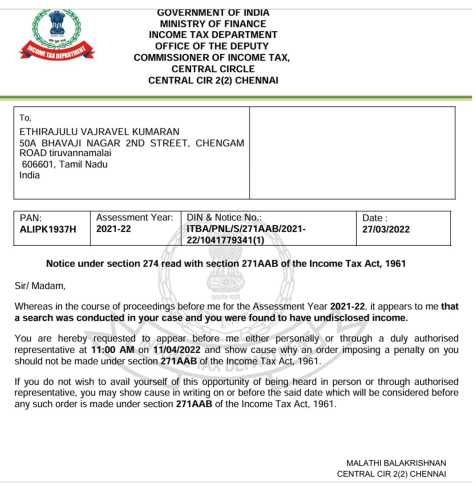
9. In the assessment order, the AO recorded a finding that penalty proceedings u/s.271(1)(c) of the Act will be initiated for concealment of particulars of income. Pursuant thereto, the AO, vide notice dated 27.03.2022 issued u/s.274 r.w.s 271(1)(c) of the Act, called upon the assessee to show cause as to why penalty should not be levied for concealment of particulars of income.
10. The assessee, in reply to the show cause notice issued by the AO submitted that no incriminating material, documents, or valuable articles evidencing any undisclosed income relatable to A.Y.2015-16 were found or seized during the course of the search and seizure operation conducted u/s.132 of the Act at the premises of the assessee.
11. With regard to the proposed addition of Rs.56,00,000/-, the assessee contended that the said addition was made solely on the basis of certain seized material which neither pertained to nor belonged to the assessee. It was further submitted that the impugned transactions were not referable to the relevant assessment year, i.e., A.Y. 2015-16. Accordingly, the assessee requested the AO to keep the penalty proceedings initiated u/s.271(1)(c) of the Act be kept in abeyance, inasmuch as the very quantum addition is sub judice before the first appellate authority.
12. The assessee further submitted that the returned income of Rs.3,68,15,120/-, as declared in the return of income furnished u/s.153A of the Act, was accepted by the AO without any variation or addition. Consequently, in respect of the said returned income, there was no occasion for initiation of penalty proceedings u/s.271(1)(c) of the Act.
13. It was also submitted by the assessee that the deeming provisions contained in Explanation 5A to section 271(1)(c) of the Act were not applicable to the facts of the present case. The assessee submitted that during the course of search proceedings, he was neither found to be the owner of any money, bullion, jewellery or other valuable article or thing, nor was there any detection of undisclosed income based on entries in books of account, documents or transactions, which had been admitted in any statement recorded u/s.132(4) of the Act as representing undisclosed income of any previous year.
14. The assessee, relying upon various judicial pronouncements, contended that for invoking Explanation 5A to section 271(1)(c) of the Act, it is a condition precedent that incriminating material or documents must be unearthed during the course of search, and that such material must form the very foundation of the assessment framed u/s.153A of the Act. It was stated that in the absence of any such incriminating material discovered during the course of search at the premises of the assessee, the deeming provisions of Explanation 5A were not attracted. In light of aforesaid submission, the assessee requested the AO to drop the penalty proceedings initiated u/s.271(1)(c) of the Act.
15. The AO upon consideration of the assessee’s submissions, refrained from levying penalty in respect of the addition of Rs.56,00,000/- made in the assessment proceedings, as the said addition was contested by the assessee before the first appellate authority. However, with regard to the additional income of Rs.3,25,88,900/- declared by the assessee in the return of income filed u/s.153A of the Act, the AO rejected the explanation furnished by the assessee and held that penalty u/s.271(1)(c) of the Act was exigible thereon, as the said income was not in dispute.
16. The AO observed that the assessee had earned interest income and cover amount in respect of his investment in M/s. Life Line Auto Finance, which came to light during the course of survey proceedings conducted in the case of the said entity. The AO held that the assessee had understated his income to the extent of Rs.3,25,88,900/- in the return of income originally filed u/s.139 of the Act, and that the said income was subsequently offered only in the return of income filed u/s.153A of the Act. The AO further recorded that the assessee would not have disclosed such additional income but for the search action carried out at his premises on 25.03.2021. Accordingly, the AO was of the view that, since the additional income declared was not in dispute, such income admitted in the return furnished on or after the date of search is deemed to represent concealed income within the meaning of section 271(1)(c) of the Act. In support of this finding, the AO placed reliance on the judgment of the Hon’ble Kerala High Court in P. Rajaswamy, Raja Jewellery v. CIT (Kerala), wherein it was held that a declaration to avoid penalty must be voluntary and prior to the detection of concealed income by the Department. On the basis of the aforesaid findings, the AO concluded that the additional income of Rs.3,25,88,900/- offered by the assessee was admitted solely as a consequence of the search and is, therefore, deemed to be concealed income. Consequently, by order dated 30.09.2022 passed u/s.271(1)(c) of the Act, the AO imposed a penalty of Rs.1,11,89,533/-, being 100% of the tax sought to be evaded on the said sum of Rs.3,25,88,900/-.
17. Aggrieved by the above penalty order, assessee carried the matter before the CIT(A). The assessee submitted before the CIT(A) that the assessment order in the present case was passed on 24.03.2022, whereas the show cause notice u/s.274 r.w.s section 271(1)(c) of the Act was issued on 27.03.2022. It was, therefore, contended by the assessee that the penalty proceedings were not initiated during the course of the assessment proceedings as mandated under the provisions of the Act. Consequently, the assessee urged that the show cause notice issued by the AO u/s.274 r.w.s 271(1)(c) of the Act, dated 27.03.2022, is invalid in law, and therefore, the consequential penalty order dated 30.09.2022 is also without jurisdiction and liable to be quashed. In support of this contention, assessee placed reliance on various judicial precedents before the CIT(A).
18. The assessee further submitted that the provisions of Explanation 5A to section 271(1)(c) of the Act are attracted only where income is admitted on the basis of incriminating material unearthed during the course of a search under the Act. The assessee submitted that in the present case, the additional income of Rs.3,25,88,900/- was offered voluntarily and not on account of any incriminating material discovered during the course of a search, and therefore, the deeming fiction of concealment under Explanation 5A is not applicable. It was further submitted that once the returned income has been accepted by the AO, there can be no concealment with respect to such income. Accordingly, the assessee contended that the penalty imposed u/s.271(1)(c) of the Act is not sustainable in law.
19. The CIT(A), upon due consideration of the submissions advanced on behalf of the assessee, deleted the penalty levied by the AO holding that neither Explanation 5A(i) nor 5A(ii) to section 271(1)(c) of the Act is applicable to the facts of the assessee’s case. The CIT(A) observed that initiation of penalty proceedings under Explanation 5A was outside the permissible scope, since the assessee was not found to be in possession of any undisclosed money, bullion, jewellery, or other valuable articles as contemplated under Explanation 5A(i). It was further noted that the income surrendered by the assessee was voluntary and suo motu, without reference to or discovery of any incriminating material during the course of search. Consequently, the CIT(A) held that invocation of Explanation 5A to section 271(1)(c) could not justify imposition of penalty.
20. The CIT(A) further distinguished the reliance placed by the AO on the decision of the Hon’ble Kerala High Court in P. Rajaswamy, Raja Jewellery (supra), holding that the said decision pertained to a period prior to the introduction of Explanation 5A (effective from 01.06.2007) and was, therefore, inapplicable to the present case, which falls within the ambit of the post amendment regime.
21. The CIT(A) also recorded that while the assessment order for the impugned assessment year was passed on 24.03.2022, the penalty notice u/s.271(1)(c) of the Act was issued only thereafter, on 27.03.2022. The CIT(A) took the view that such issuance of notice was not in consonance with the settled legal position. In support of this conclusion, reliance was placed upon the decision of the coordinate bench of this Tribunal in Srinivasan Chandrasekara Chandilya v. ACIT [IT Appeal Nos.1478 to 1487/Chny/2024, dated 30.08.2024].
22. On the basis of the aforesaid findings, the CIT(A) proceeded to delete the penalty of Rs.1,11,89,533/- levied by the AO u/s.271(1)(c) of the Act. The relevant observations of the CIT(A) in deleting the penalty levied by the AO are as under:
“6.2.6 As evident in the assessment order, it can be seen that the AO in the assessment order had no occasion to record any findings about the deliberate concealment of income by the Appellant warranting to initiate penalty proceedings u/s 271 (1) (c) of the Act. The AO in the assessment order while initiating penalty proceedings has merely observed “penalty proceedings u/s 271 (1) (c) will be initiated for concealment of particulars of income.”
6.2.7 The above finding made by the A.O. implies that the Appellant had concealed income. The Penalty leviable u/s 271(1)(c) of the Act is Penal in nature. It is distinct from the regular order passed by the A.O. u/s 143(3) r.w.s 153A of the Act, where the Assessment is made to collect the Tax due to the Exchequer. On the other hand, the Penal Provisions are contemplated as a deterrent. Thus, while imposing the penalty the A.O. being a quasi-judicial authority must be confident enough to make a recording in the assessment order as to how the appellant has concealed income and the relevant provisions of the Act that is violated by the assessee and the necessity that warrant the levy of Penalty. Making a simple observation, that “penalty proceedings u/s 271 (1) (c) will be initiated separately for concealment of particulars of income.” definitely cannot be the basis for arriving a conclusion to levy the penalty. Before levying the penalty the A.O. must establish in unequivocal term about the existence of concealment and make a speaking order.
6.2.9 Further during the course of appellate proceedings, the AR has clearly demonstrated that neither Explanation 5A(i) nor (ii) applies to the case. This omission undermines the validity of the penalty proceedings as there is no clarity on the basis for their initiation. If the penalty was initiated under Explanation 5A, the AO failed to appreciate that the appellant was not found to own any undisclosed money, bullion, jewellery, or other valuable articles (as required under Explanation 5A(i)). Further, if the surrender of income by the appellant was voluntary and suo moto, in such cases it has been consistently held that the same is outside the purview of Explanation 5A in various cases including such as Ajay Traders, Financial technologies (I) Ltd and Radhey Shyam Mittal as referred by the appellant in the written submission. These cases establish that penalty under Explanation 5A requires incriminating evidence, which was absent in the appellant’s case.
6.2.10 The appellant has further claimed that the AO erred in dismissing the appellant’s detailed explanations and valid grounds without providing any reasoning. The penalty order merely states that the explanations were “not acceptable”, without addressing the specific arguments raised or the judicial precedents cited by the appellant. This lack of reasoning further weakens the validity of the penalty imposed. Additionally, the AO relied on the decision in P. Rajaswamy, Raja Jewellery v. CIT (Kerala), which pertains to a period prior to the introduction of explanation 5A (effective from 01.06.2007). This decision is not applicable to the appellant’s case, as Explanation 5A governs penalty proceedings for search-related cases post-2007. The reliance on this outdated precedent highlights the AO’s failure to apply the correct legal framework.
6.2.11 Besides the appellant claimed that judicial precedents, such as Ajay Traders v. DCIT [ITA No. 296/JP/2014 dated 06.05. 2016 reported in (2016) 179 TTJ_UO (JP)(UO) 51] and Radhey Shyam Mittal, which emphasize that penalties under Explanation 5A require incriminating documents to be found during the course of the search. In the appellant’s case, no such incriminating documents were found during the course of search. The AO also failed to address or distinguish these decisions in the penalty order, further undermining the validity of the penalty.
6.2.12 The undersigned has carefully examined the issue under consideration. As evident from the records, it can be seen that the penalty notice issued by the AO u/s 271(1)(c) of the Act is for concealment of income. The penalty notice issuance process must follow specific procedural requirements under the Act, and any deviation from these processes can render the penalty invalid. The undersigned observes the various aspects of the penalty notice issuance, its implications and on the order passed in this case viz.
| • |
|
The returned income filed u/s 153A was accepted without any deviation. |
| • |
|
The additional income declared was not out of any incriminating materials found during the search in the case of the appellant. |
| • |
|
The AO passed the assessment order for AY 2016-17 on 24.03.2022. However, the penalty notice u/s 271(1)(c) of the Act was issued three days later, i.e. on 27.03.2022. This is against the legal position of law as held by the Jurisdictional Hon’ble ITAT, ‘A’ Bench, Chennai on 30.08.2024 in the case of Srinivasan Chandrasekara Chandilya v. Asst. Commissioner of Income Tax, in ITA Nos. 1478 to 1487/Chny/2024. |
| • |
|
The provisions of section 271(1)(c) of the Act requires the AO to form an opinion regarding the concealment of income or furnishing of inaccurate particulars of income during the course of the assessment proceedings. The notice u/s 274 r.w.s 271(1)(c) of the Act is typically issued if the AO is satisfied during the course of assessment that the taxpayer has concealed income. |
| • |
|
In Para 5.1 of the order imposing penalty, the AO has observed that it is pertinent mention that the assessee has understated his income… and however, the penalty notices u/s 274 r.w.s 271(1)(c) was issued for ‘concealed the particulars of income’. Thus, the penalty levied is in contradiction to the show cause notice issued. As claimed and demonstrated by the appellant, neither Explanation 5A(i) nor 5A(ii) applies to the case to fall within the ambit of penalty. |
6.2.13. In view of the above findings and relying on the judicial pronouncements as discussed above, the penalty levied consequence to the issue of notice u/s 271(1)(c) of the Act is not sustainable in the eyes of law. Therefore, all the grounds raised by the appellant upon the levy of the penalty are hereby treated as allowed and the AO is directed to delete the penalty levied amounting Rs.1,11,89,533/- for the AY 2015-16.”
23. Aggrieved by the order of the CIT(A) in deleting the penalty of Rs.1,11,89,533/- imposed by the AO u/s.271(1)(c) of the Act, the Revenue is in appeal before us, raising the following grounds of appeal:
| 1. |
|
“The order of the learned Commissioner of Income Tax (Appeals) is erroneous on facts of the case and in law. |
| 2. |
|
The Ld.CIT(A) erred in deleting the penalty without appreciating the assessee did not declare the additional income voluntarily but had declared the same only after the proceedings of the search unearthed the undisclosed income, thereby rendering it not voluntary to claim immunity from penalty proceedings. |
| 3. |
|
The Ld.CIT(A) erred in giving relief to the assessee by not appreciating that Explanation 5A provided to the section 271, that in cases of search initiated on or after 1 June 2007, if the assessee is found to be owner of any income based on any entry in any books of accounts or other documents or any other transactions and he claims that the entry in the books of accounts or other documents or transactions represent his income for any previous year which had ended before the search and where he had not included such income in his return of income furnished before the due date, he shall be deemed to have concealed the particulars of income or furnished inaccurate particulars of such income for the purposes of levy of penalty u/s 271(1)(c). |
| 4. |
|
The Ld.CIT(A) failed to take cognizance of the decision of the Hon’ble Supreme Court in the case of MAK Data Pvt Ltd V CIT (SC)/MAK Data (P.) Ltd. v. CIT (SC)/[2013] 358 ITR 593 (SC) wherein the Hon’ble Supreme Court held that where surrender of income not being voluntary in nature, authorities below were justified in levying penalty under section 271(1)(c). |
| 5. |
|
For these grounds and any other ground including amendment of grounds that may be raised during the course of the appeal proceedings, the order of learned CIT (Appeals) may be set aside and that of the Assessing Officer be restored.” |
24. The Ld.DR, in support of the grounds of appeal, contended that the assessee had disclosed an additional income of Rs.3,25,88,900/- only pursuant to the search proceedings, and that such income would have otherwise escaped assessment but for the said search. It was further submitted that the additional income, though voluntarily offered, is liable to be regarded as deemed concealment of income for the purposes of imposition of penalty u/s.271(1)(c) of the Act. The Ld.DR, therefore, prayed that the order of the CIT(A) be set aside and the penalty levied by the AO u/s.271(1)(c) of the Act be upheld.
25. Per contra, the Ld.AR supported the order of the CIT(A) contending that the said order is a reasoned and legally correct. It was submitted that the CIT(A), after duly considering various judicial precedents, has correctly held that the levy of penalty u/s.271(1)(c) of the Act is unwarranted in the facts of the assessee’s case. According to the Ld.AR, the impugned order suffers from no infirmity and accordingly deserves to be upheld.
26. The Ld.AR further invited our attention to the fact that the quantum assessment order u/s.143(3) r.w.s 153A of the Act for the A.Y.2015-16 was passed on 24.03.2022, whereas the show cause notice for levy of penalty u/s.274 r.w.s 271(1)(c) of the Act was issued only on 27.03.2022, i.e., subsequent to the assessment order, and not contemporaneously. It was submitted that the initiation of penalty proceedings must be in the course of assessment proceedings and not thereafter. Consequently, since the penalty notice was issued only after completion of assessment, the said notice cannot be regarded as validly initiated in the course of assessment proceedings. Thus, the notice dated 27.03.2022 issued by the AO is bad in law and vitiates the entire penalty proceedings. In support, reliance was placed on the judgment of the Hon’ble Delhi High Court in CIT v. Rajinder Kumar Somani (Delhi), as well as the decision of the coordinate bench of this Tribunal in Srinivasan Chandrasekara Chandilya (supra). It was further contended that the Revenue’s appeal itself is infructuous since no specific grounds of challenge have been raised against the CIT(A)’s finding that the penalty notice dated 27.03.2022 is invalid in law.
27. The Ld.AR further relied upon the judgement of the Hon’ble Delhi High Court in Pr. CIT v. Neeraj Jindal ITR 1 (Delhi), to contend that once the AO accepts the revised return filed u/s.153A of the Act, no reference can be made to the earlier return filed u/s.139 of the Act and for all purposes, including levy of penalty u/s.271(1)(c) of the Act, the return to be considered is the one filed u/s.153A of the Act. It was submitted that once the AO accepts the return u/s.153A of the Act, the original return u/s.139 stands abated and becomes non est. Thus, concealment, if any, has to be examined only with reference to the section 153A return. In the present case, since the assessee voluntarily disclosed an additional income of Rs.3,25,88,900/- in the return filed u/s.153A of the Act, which was duly accepted by the AO, such disclosure cannot be construed as concealment attracting penalty u/s.271(1)(c) of the Act. Accordingly, the Ld.AR prayed for affirming the order of the CIT(A) on this count also.
28. The Ld. AR also placed reliance upon various judicial precedents considered by the CIT(A) to argue that post-search penalty u/s.271(1)(c) of the Act is governed by Explanation 5A thereto. However, such explanation is attracted only when the additional income disclosed is directly linked to incriminating material unearthed during the course of search. In the present case, the additional income of Rs.3,25,88,900/- offered by the assessee comprised of (i) Rs.29,37,500/- offered pursuant to a statement recorded during survey in the case of M/s. Life Line Auto Finance; and (ii) the balance sum of Rs.2,96,51,400/-voluntarily offered by the assessee, unconnected with any incriminating material. Thus, it was submitted that the disclosure was not attributable to any incriminating material found during search, and consequently Explanation 5A to section 271(1)(c) is inapplicable. Thus, the Ld.AR submitted that the CIT(A) was therefore justified in deleting the penalty levied by the AO.
29. In rejoinder, the Ld.DR fairly conceded that although the assessee has offered additional income in the return filed u/s.153A of the Act, such disclosure is not on account of any incriminating material found for the year under consideration. Further, the Ld.DR also candidly admitted that no grounds are raised by the Revenue challenging the CIT(A) findings that penalty notice dated 27.03.2022 is invalid in law.
30. We have heard rival submissions and perused the material on record. We note that a search and seizure operation u/s.132 of the Act was conducted at the premises of the assessee on 25.03.2021. Consequent thereto, notice u/s.153A of the Act was issued by the AO on 10.12.2021. In compliance, the assessee filed his return of income on 07.03.2022, admitting a total income of Rs.3,68,15,120/- u/s.153A of the Act, which included an additional income of Rs.3,25,88,900/-. The AO, while completing the assessment, accepted the additional income so declared by the assessee. However, the AO proceeded to levy penalty u/s.271(1)(c) of the Act amounting to Rs.1,11,89,533/-, being 100% of the tax allegedly sought to be evaded on the said additional income. The AO’s reasoning was that the additional income would not have been offered but for the search action, thereby attracting the deeming fiction of concealment of income u/s.271(1)(c) of the Act.
31. On appeal, the CIT(A) deleted the penalty, holding that the additional income voluntarily disclosed by the assessee was not relatable to any incriminating material discovered during the course of the search proceedings. The CIT(A) further observed that the deeming provisions contained in Explanation 5A to section 271(1)(c) of the Act were not applicable to the assessee’s case, as no incriminating material was found at the assessee’s premises. In addition, the CIT(A) held that the show-cause notice issued by the AO u/s.274 r.w.s 271(1)(c) of the Act, dated 27.03.2022, was issued subsequent to the completion of the assessment proceedings and, therefore, was legally untenable.
32. The issue that arises for our adjudication is whether the CIT(A) was justified in deleting the penalty of Rs.1,11,89,533/-levied by the AO u/s.271(1)(c) of the Act. The assessee pursuant to a search u/s.132 of the Act offered an additional sum of Rs.3,25,88,900/- in the return of income furnished u/s.153A of the Act. The said sum has been duly accepted by the AO in completing the assessment. Admittedly, the aforesaid additional income offered by the assessee was not attributable to, nor did it emanate from, any incriminating material unearthed during the course of search operations carried out at the assessee’s premises. The AO, however, has recorded that the disclosure of such additional income in the return filed u/s.153A of the Act was occasioned by the factum of the search itself, and therefore, in his opinion, the disclosure could not be regarded as voluntary. On this basis, the AO inferred that the assessee had concealed income within the meaning of Section 271(1)(c) of the Act.
33. It is a settled position, supported by numerous judicial pronouncements, that the mere fact of an assessee offering a higher income in a return filed u/s.153A of the Act when compared to the return originally filed u/s.139 of the Act does not, in itself, constitute concealment of income so as to justify the imposition of penalty u/s.271(1)(c) of the Act. In the absence of any specific incriminating evidence unearthed during the search pointing towards suppression or concealment, the higher disclosure by itself cannot be construed as a deliberate act of concealment.
34. The scheme of assessment u/s.153A of the Act is governed by a non obstante clause, which, inter alia, overrides the provisions of Section 139 of the Act. Consequently, the return filed u/s.153A of the Act is to be treated, for all practical and legal purposes, as the return of income furnished u/s.139 of the Act. Thus, once the assessee furnishes a return in compliance with Section 153A, such return supplants and substitutes the original return filed u/s.139 of the Act, rendering the latter non est in the eyes of law. For the purposes of determining concealment or furnishing of inaccurate particulars of income u/s.271(1)(c) of the Act, the return filed u/s.153A of the Act must be taken into consideration, if the additional income disclosed in the said return of income is not based on any incriminating material found during the course of search.
35. In the present case, since the assessee has duly disclosed the additional income of Rs. 3,25,88,900/- in the return filed u/s.153A of the Act, and the said return has been accepted by the AO without any variation, there arises no occasion to allege concealment vis-a-vis the earlier return filed under Section 139 of the Act. The concealment, if any, has to be assessed only with reference to the return filed under Section 153A, and in the facts of the instant case, there exists no concealment in such return, since the said additional income was not on the basis of any incriminating material found for the impugned assessment year during the course of search at the premises of the assessee. Accordingly, we are of the considered view that the penalty sought to be imposed u/s.271(1)(c) of the Act is unwarranted and unsustainable in law. Therefore, we hold that the CIT(A) has rightly deleted the penalty imposed by the AO u/s.271(1)(c) of the Act.
36. Our above view is supported by the judgment of the Hon’ble Delhi High Court in the case of Neeraj Jindal (supra). In the said judgment, the Hon’ble Court categorically held that where an assessee has furnished a revised return of income subsequent to the conduct of a search, and such revised return has been duly accepted by the AO, the mere fact that the revised return reflects a higher income than what was originally declared does not, by itself, warrant the automatic levy of penalty u/s.271(1)(c) of the Act. The relevant extract of the judgment is reproduced hereunder for ready reference:
“16. Thus, despite the fact that there is no requirement of proving mens rea specifically, it is clear that the word “conceal” inherently carries with it the requirement of establishing that there was a conscious act or omission on the part of the assessee to hide his true income. This was also the conclusion of the Supreme Court in the case of Dilip N. Shroff v. Jt. CIT . In a later decision in Union of India v. Dharmendra Textile Processors [2008] 13 SCC 369, the Supreme Court overruled its decision in Dilip N. Shroff (supra). Thereafter, in CIT v. Reliance Petroproducts (P.) Ltd. (SC) the Court clarified that Dilip N. Shroff (supra) stood overruled only to the extent that it imposed the requirement of mens rea in Section 271(1)(c); however, no fault was found with the meaning of “conceal” laid down in Dilip N. Shroff’s case (supra). Thus, as the law stands, the word “conceal” in Section 271(1)(c), would require the A.O. to prove that specifically there was some conduct on part of the assessee which would show that the assessee consciously intended to hide his income.
17. In this case, the A.O. in his order noted that the disclosure of higher income in the return filed by the assessee was a consequence of the search conducted and hence, such disclosure cannot be said to be “voluntary”. Hence, in the A.O.’s opinion, the assessee had “concealed” his income. However, the mere fact that the assessee has filed revised returns disclosing higher income than in the original return, in the absence of any other incriminating evidence, does not show that the assessee has “concealed” his income for the relevant assessment years. On this point, several High Courts have also opined that the mere increase in the amount of income shown in the revised return is not sufficient to justify a levy of penalty.
18. The Punjab & Haryana High Court in CIT v. Suraj Bhan , held that when an assessee files a revised return showing higher income, penalty cannot be imposed merely on account of such higher income filed in the revised return. Similarly, the Karnataka High Court in the case of Bhadra Advancing (P.) Ltd v. Asstt. CIT , held that merely because the assessee has filed a revised return and withdrawn some claim of depreciation penalty is not leviable. The additions in assessment proceedings will not automatically lead to inference of levying penalty. The Calcutta High Court in the case of CIT v. Suresh Chand Bansal [2010] 329 ITR 330 held that where there was an offer of additional income in the revised return filed by the assessee and such offer is in consequence of a search action, then if the assessment order accepts the offer of the assessee, levy of penalty on such offer is not justified without detailed discussion of the documents and their explanation which compelled the offer of additional income. The Madras High Court in the case of S.M.J. Housing v. CIT held that where after a search was conducted, the assessee filed the return of his income and the Department had accepted such return, then levy of penalty under Section 271(1)(c) was not justified. From the above cases it would be clear that when an assessee has filed revised returns after search has been conducted, and such revised return has been accepted by the A.O., then merely by virtue of the fact that such return showed a higher income, penalty under Section 271(1)(c) cannot be automatically imposed.
19. The whole matter can be examined from a different perspective as well. Section 153A provides the procedure for completion of assessment where a search is initiated under Section 132 or books of account, or other documents or any assets are requisitioned under Section 132A after 31.05.2003. In such cases, the Assessing Officer shall issue notice to such person requiring him to furnish, within such period as may be specified in the notice, return of income in respect of six assessment years immediately preceding the assessment year relevant to the previous year in which the search was conducted under Section 132 or requisition was made under
Section 132A. The Assessing Officer shall assess or reassess the total income of each of these six assessment years. Assessment or reassessment, if any, relating to any assessment year falling within the period of six assessment years pending on the date of initiation of the search under Section 132 or requisition under Section 132A, as the case may be, shall abate. [Ref to Memorandum accompanying the Finance Bill, 2003] Section 153A opens with a non-obstante clause relating to normal assessment procedure covered by Sections 139, 147, 148, 149, 151 and 153 in respect of searches made after May 31, 2003. The sections, so excluded, relate to returns, assessment and reassessment provisions. However, the provisions that are saved are those under Section 153B and 153C, so that these three Sections 153A, 153B and 153C are intended to be a complete code for post- search assessments. Considering that the non-obstante clause under Section 153A excludes the application of, inter alia, Section 139, it is clear that the revised return filed under Section 153A takes the place of the original return under Section 139, for the purposes of all other provisions of the Act. This is further buttressed by Section 153A (1)(a) which reads:
“Notwithstanding anything contained in section 139, section 147, section 148, section 149, section 151 and section 153, in the case of a person where a search is initiated under section 132 or books of account, other documents or any assets are requisitioned under section 132A after the 31st day of May, 2003, the Assessing Officer shall
(a) issue notice to such person requiring him to furnish within such period, as may be specified in the notice, the return of income in respect of each assessment year falling within six assessment years referred to in clause (b), in the prescribed form and verified in the prescribed manner and setting forth such other particulars as may be prescribed and the provisions of this Act shall, so far as may be, apply accordingly as if such return were a return required to be furnished under section 139.”
20. Therefore, the position that emerges from the above-mentioned provision is that once the assessee files a revised return under Section 153A, for all other provisions of the Act, the revised return will be treated as the original return filed under Section 139. On similar lines, the Gujarat High Court in the case of Kirit Dahyabhai Patel v. Asstt. CIT [2015] 280 CTR 216, held that: “In view of specific provision of s. 153A of the I.T. Act. the return of income filed in response to notice under s. 153A of the I.T. Act is to be considered as return filed under s. 139 of the Act, as the AO has made assessment on the said return and therefore, the return is to be considered for the purpose of penalty under s. 271(1)(c) of the I.T. Act and the penalty is to be levied on the income assessed over and above the income returned under s. 153A, if any.”
21. Thus, it is clear that when the A.O. has accepted the revised return filed by the assessee under Section 153A, no occasion arises to refer to the previous return filed under Section 139 of the Act. For all purposes, including for the purpose of levying penalty under Section 271(1)(c) of the Act, the return that has to be looked at is the one filed under Section 153A. In fact, the second proviso to Section 153A(1) provides that “assessment or reassessment, if any, relating to any assessment year falling within the period of six assessment years referred to in this subsection pending on the date of initiation of the search under Section 132 or making of requisition under Section 132A, as the case may be, shall abate.” What is clear from this is that Section 153A is in the nature of a second chance given to the assessee, which incidentally gives him an opportunity to make good omission, if any, in the original return. Once the A.O. accepts the revised return filed under Section 153A, the original return under Section 139 abates and becomes non-est. Now, it is trite to say that the “concealment” has to be seen with reference to the return that it is filed by the assessee. Thus, for the purpose of levying penalty under Section 271(1)(c), what has to be seen is whether there is any concealment in the return filed by the assessee under Section 153A, and not vis-a vis the original return under Section 139.”
37. The ratio of the above judgment of the Hon’ble Delhi High Court has been accepted by the Hon’ble Madras High Court in the case of R.P. Darrmalingam v. ACIT (Madras)/CRL.O.P.No.28572 of 2018 and Crl.M.P.No.16630 of 2018 dated 09.11.2023, wherein their Lordships have observed as under:
“14. The learned counsel appearing for the petitioner also cited the judgment of the Hon’ble High Court of Delhi in the case of Principal Commissioner of Income Tax-19 v. Neeraj Jindal reported in (Delhi), in which it is held that once the assessee files a revised return under Section 153A, for all other provisions of the Act, the revised return will be treated as the original return filed under Section 139. Further held that when the assessment officer has accepted the revised return filed by the assessee under Section 153A, no occasion arises to refer to the previous return filed under Section 139 of the Act for all purposes, including for the purpose of levying penalty under Section 271(1)(c) of the Act, the return that has to be looked at is the one filed under Section 153A. In fact, the second proviso to Section 153A(1) provides that “assessment or reassessment, if any, relating to any assessment year falling within the period of six assessment years referred to in this sub-section pending on the date of initiation of the search under Section 132 or making of requisition under Section 132A, as the case may be, shall abate.” Therefore, Section 153A is in the nature of a second chance given to the assessee, which incidentally gives him an opportunity to make good omission, if any, in the original return. Once the assessment officer accepts the revised return filed under Section 153A, the original return under Section 139 abates and becomes non-est. Now, it is trite to say that the “concealment” has to be seen with reference to the return that it is filed by the assessee. Thus, for the purpose of levying penalty under Section 271(1)(c), what has to be seen is whether there is any concealment in the return filed by the assessee under Section 153A, and not vis-a vis the original return under Section 139.
15. No quarrel that once the assessment officer accepts the revised return filed under Section 153A, the original return filed under Section 139 abates and becomes non est. Therefore, no penalty can be levied under Section 271(1)(c) of the Income Tax Act. Whereas in the case on hand, there was concealment by the petitioner while filing his first return of income for the assessment year 2012-2013. In fact, the levying of penalty was already dropped in view of the order passed by the tribunal. However, the petitioner is now facing prosecution under Section 276CC of Income Tax Act. That apart, the mens rea of the petitioner is clearly established by the respondent and as such, the above judgment is also not helpful to the case on hand.”
38. We are of the considered opinion that the ratio laid down by the Hon’ble Supreme Court in MAK Data (P.) Ltd. v. CIT (SC) is clearly distinguishable on facts and, therefore, does not govern the present case of the assessee. In MAK Data (P.) Ltd. (supra), the Hon’ble Supreme Court categorically noted that the surrender of income by the assessee therein was not voluntary in nature, but was made only after detection by the Department, on the basis of incriminating documents and material seized during a search conducted in the premises of a sister concern. The Court, in that context, held that such a surrender, made under compulsion of adverse material, could not absolve the assessee from the charge of concealment of income. In contradistinction, the factual matrix of the present case is materially different. In the assessee’s case, there is no discovery or seizure of incriminating material that evidence or suggests concealment of income. The proceedings do not reveal any adverse documents or findings which could attribute suppression or misrepresentation of income to the assessee. Consequently, the element of compulsion or discovery of concealed material, which formed the foundation of the Hon’ble Supreme Court’s decision in MAK Data Pvt. Ltd., is entirely absent in the present matter. Accordingly, the principle laid down in MAK Data (P.) Ltd. (supra) cannot be applied to the facts and circumstances of the instant case.
39. We also concur with the finding of the CIT(A) that the judgment of the Hon’ble Kerala High Court in P. Rajaswamy, Raja Jewellery (supra), as relied upon by the AO, pertains to a period prior to the insertion of Explanation 5A to section 271(1)(c) of the Act, which came into effect from 01.06.2007. Accordingly, the said judgment has no application to the present case of the assessee, since the penalty proceedings arising out of search operations subsequent to the aforesaid date are squarely governed by Explanation 5A.
40. Therefore, we are of the considered view that even the provisions of Explanation 5A to Section 271(1)(c) of the Act are not attracted to the present case of the assessee. This is for the reason that the additional income has been offered by the assessee voluntarily, and such disclosure is not founded upon or traceable to any incriminating material discovered or seized during the course of search proceedings. It is a well-settled principle, fortified by several pronouncements of the Coordinate Benches of this Tribunal, that the deeming fiction embedded in Explanation 5A to Section 271(1)(c) of the Act can be invoked only when the addition or disclosure of income is directly relatable to incriminating evidence unearthed during the course of search. In the absence of such incriminating material, the provisions of Explanation 5A cannot be pressed into service for the imposition of penalty u/s.271(1)(c) of the Act. Thus, in view of the judicial precedents and the legislative scheme, it follows that in the present case, where the assessee’s voluntary disclosure of additional income is not supported by any seized or incriminating document, the penalty provisions u/s.271(1)(c) of the Act stand inapplicable. In support of this proposition, we place reliance on the following judicial pronouncements.
| (i) |
|
The Jaipur Bench of this Tribunal in Ajay Traders v. Dy. CIT (Jaipur-Trib.)/[ITA No.296/JP/2014, dated 06.05.2016] has held as under: |
“4.3. We have heard rival contentions and perused the material on record. It is undisputed fact that during the course of search, no incriminating documents were found and seized. The assessee surrendered the additional income under section 132(4) at Rs. 15 lacs and requested not to impose penalty u/s 271(1)(c) of the IT Act. The ld. AO imposed the penalty by invoking the Explanation 5A to section 271(1)(c) of the Act, which has been confirmed by ld. CIT (A) by considering the judgment of Hon’ble Supreme Court in the case of MAK Data Pvt. Ltd. (supra). But for imposing the penalty under Explanation 5A on the basis of statement recorded during the course of search, it is necessary to be found incriminating documents and is to be considered at the time of assessment framed under section 153A of the Act. The issue has been considered by various High Courts as well as by ITAT as relied upon by the assessee, which are squarely applicable to the case of the assessee. As no incriminating documents were found during the course of search, therefore, Explanation 5A to section 271(1)(c) is not applicable. Accordingly, we delete the penalty confirmed by ld. CIT (A).”
| (ii) |
|
The Mumbai Bench of this Tribunal in Financial Technologies (I) Ltd. v. Asstt. CIT (Mumbai) has held as under: |
“23. When we analyse the expressions used in clause (i) to Explanation 5A, we find that the expressions used are definite to use the words “any money, bullion, jewellery or other valuable article or thing (hereafter in this Explanation referred to as assets) and the assessee claims that such assets have been acquired by him by utilising (wholly or in part) his income for any previous year”. In the instant cases, no addition/disallowance had been made on any money, bullion, jewellery or other article or thing found in the search. Factually, it is not the case of the Revenue as well, because none of the above expressions was a result of the search or have been pointed out by the Revenue authorities.
24. Even when we analyse expressions used in clause (ii) to Explanation, “any income based on any entry in any books of account or other documents or transactions and he claims that such entry in the books of account or other documents or transactions represents his income (wholly or in part) for any previous year”,…, we find that even this shall not apply for the following reasons. ”
41. In view of the aforesaid judicial precedents, and further taking into consideration the fact that the assessee, in compliance with the notice issued u/s.153A of the Act, had offered an additional income of Rs.3,25,88,900/- and since such additional income was not offered on the basis of any incriminating material found during the course of search conducted at the premises of the assessee but rather represents a voluntary disclosure by the assessee, we find no reason to interfere with the findings of the CIT(A) in deleting the penalty of Rs.1,11,89,533/- levied by the AO u/s.271(1)(c) of the Act for the A.Y.2015-16.
42. Since we have affirmed the order of the CIT(A) on multiple substantive grounds, we are of the considered view that the technical issue relating to the issuance of the show cause notice u/s.274 r.w.s 271(1)(c) of the Act, subsequent to the date of the assessment order, is merely of academic relevance. Accordingly, we refrain from rendering any finding thereon.
43. Furthermore, it is pertinent to observe that the Revenue has failed to raise a specific ground of appeal challenging the finding of the CIT(A) that the show cause notice dated 27.03.2022 was invalid, having been issued after the assessment order. Such omission, in our view, renders the entire appeal filed by the Revenue infructuous and devoid of any merit. Accordingly, the grounds of appeal raised by the Revenue for the A.Y.2015-16 are dismissed. In the result, the appeal filed by the Revenue in ITA No.1650/Chny/2025 stands dismissed.
ITA Nos.1651 to 1654/Chny/2025 (AYs.2017-18 to 2020-21)
44. These four appeals of the Revenue are directed against the common order of the CIT(A) dated 12.03.2025, wherein he deleted the penalty imposed by the AO u/s.270A of the Act on account of under-reporting of income consequent to misreporting.
45. The assessee was subjected to a search action u/s.132 of the Act on 25.03.2021. Consequent thereto, the AO issued notices u/s.153A of the Act for the assessment years under consideration. The material facts emerging from the record, relevant for our adjudication, are as under:
| Particulars |
AY 2017-18 |
AY 2018-19 |
AY 2019-20 |
AY 2020-21 |
| Date of filing of ROI u/s.139 of the Act |
31.10.2017 |
31.10.2018 |
26.09.2019 |
12.02.2021 |
| Total Income returned originally (Rs.) |
98,53,470 |
1,17,64,060 |
19,29,180 |
20,90,670 |
| Date of issuance of notice u/s.153A of the Act |
10.12.2021 |
10.12.2021 |
10.12.2021 |
10.12.2021 |
| Date of filing of ROI u/s.153A of the Act |
07.03.2022 |
07.03.2022 |
07.03.2022 |
07.03.2022 |
| Total Income returned in the ROI filed u/s.153Aof the Act (Rs.) |
1,76,52,420 |
2,47,74,950 |
1,70,35,810 |
2,07,91,320 |
| Additional Income offered in the ROI filed u/s.153A of the Act (Rs.) |
77,98,950 |
1,30,10,890 |
1,51,06,630 |
1,87,00,650 |
| Basis for offering of additional income by the assessee |
Offered voluntarily without the existence of any incriminating material found for the assessment years under consideration |
| Date of completion of the |
24.03.2022 |
24.03.2022 |
24.03.2022 |
24.03.2022 |
| assessment u/s. 143(3) r.w.s 153Aof the Act |
|
|
|
|
| Assessed Income (Rs.) |
1,76,52,420 |
2,47,74,950 |
1,70,35,810 |
2,07,91,320 |
| Outcome of quantum assessment |
Returned Income by the assessee including the additional income offered has been accepted by the AO without any variation |
| Penalty initiated by the AO |
270A of the Act |
| Nature of charge/default recorded by the AO in the assessment order relating to initiation of penalty u/s.270A of the Act |
Under Reporting of Income |
| Date of issuance of first show cause notice by the AO u/s.274 r.w.s 270A of the Act |
27.03.2022 |
| Nature of charge/default specified by the AO in the show cause supra |
Under Reporting of Income |
| Dates of issuance of subsequent show cause notices u/s.274 r.w.s 270A of the Act by the AO |
29.07.2022 & 26.08.2022 |
| Nature of charge/default specified by the AO in the subsequent show cause notices |
Under Reporting of Income |
| Date of issuance of final show cause notice u/s.274 r.w.s 270A of the Act by the AO |
15.09.2022 |
| Nature of charge/default specified by the AO in the final show cause notice |
Under Reporting of Income in consequence of misreporting thereof |
| Date of passing of penalty order u/s.270A of the Act by the AO |
28.09.2022 |
28.09.2022 |
27.09.2022 |
28.09.2022 |
| Amount of penalty levied (Rs.) |
62,74,154 |
92,46,838 |
1,09,97,688 |
1,46,69,968 |
| Conclusion of the AO and basis for levying penalty u/s.270A of the Act |
Under Reporting of Income in consequence of misreporting thereof in view of the additional income offered by the assessee in the return of income filed u/s.153A of the Act.
Penalty levied was 200% of the tax sought to be evaded being the difference between the tax on assessed and returned income
|
46. Aggrieved by the above penalty orders levying penalty u/s.270A of the Act, assessee preferred appeals before the CIT(A). The CIT(A) vide common order dated 12.03.2025 deleted the penalty imposed by the AO for the impugned assessment years. With the consent of both the parties, A.Y.2017-18 is taken as the lead case, as the facts and issues involved in all the assessment years under consideration are identical. Accordingly, our findings rendered in respect of A.Y.2017-18 shall, mutatis mutandis, apply to the other assessment years.
47. The relevant findings of the CIT(A) in deleting the penalty levied by the AO u/s.270A of the Act are as under:
“6.5. 2 It can be seen from the above that as per subsection (2) of section 270A of the Act, a person is considered to have under-reported his income under six different situations. One among them is that the income assessed is greater than the income tax return processed under clause (a) of sub section (1) of section 143(1) of the Act. In simple term, the clause deals with the situation that result in addition in assessments.
6.5.3 The question of misreporting will arise only when the underreporting of income has been established. The under-reporting and misreporting of income are mutually inextricably linked. It may be appreciated that in the instant case the AO has accepted the return of income and assessment has not resulted in determination of an income greater than the income returned by the appellant.
6.5.4 As the income returned was accepted in total, obviously, there is no transgression of the provisions of section 270A(2) of the Act. In the absence of any such transgression arriving at a conclusion that the Appellant has under-reported income is erroneous. Further the AO in the assessment order has not made any findings as to how the Appellant has misrepresented or suppressed the facts.
6.5.5 In fact, the AO in the assessment order has simply narrated that “Penalty proceedings u/s 270A will be initiated separately for underreporting of income” for all the years under consideration. In the instant case, when the return of income was accepted in total by the AO there can be no case for under-reporting of income and there exists no case of any mis-representation.
6.5.6 Further, to support the above findings, the following judicial decisions are relied upon viz.
In the case of Enrica Enterprises Pvt Ltd v. DCIT (Chennai – Trib.) the Hon’ble Jurisdictional Tribunal had observed as follows:
It could be seen from the assessment order that there is no observation of ‘under reporting of income and under reporting as a consequence of misreporting of income’ either in the assessment order or in the show cause notice u/s.274 r.w.s.270A of the Act specifying the limb of misreporting of income. The addition in the assessment is purely based on sworn statement u/s.132(4) of the Act, but nothing else. Form the above, it is undisputedly clear that the AO has not made out a case of ‘under reporting of income and under reporting as a consequence of misreporting of income’, which falls under Clauses (c) & (d) of sub-section 9 of sec.270A of the Act.
it is undisputedly clear that the appellant has not misrepresented facts with regard to marketing expenditure. Therefore, we are of the considered view that it is not a case of misrepresentation or suppression of facts based on any evidences, but admission of additional income is purely on the basis of statement recorded u/s.134 of the Act, without any reference to incriminating material found as a result of search. Therefore, in our considered view, Clause-(C) of sub-sec.9 to sec.270A, is not applicable.
As regards Clause-(d) of sub-section 9 of section 270A of the Act, which speaks about failure to record investment in the books of accounts. In our considered view, it is not a case of any investment which is not recorded in the books of accounts. Therefore, said Clause is not applicable. In our considered view, the AO is completely erred in invoking said section and levied penalty u/s.270A of the Act. As regards sub Clause (e) to section 270A(9) of the Act, invoked by the Ld.CIT(A), in our considered view, there is no allegation from the AO regarding failure to record any receipt in books of accounts of the assessee having a bearing on total income in so far as estimated disallowance of proportionate marketing expenses. The additional income has been quantified by the Revenue on the basis of estimated disallowance of marketing expenses and such estimation is ad hoc without there being any specific findings with regard to year for which the assessee has inflated expenditure. In absence of any findings as to quantification of inflated expenditure qua each assessment year with reference to total purchase from each party, amount of inflated expenditure, actual cash received back by the assessee. in our considered view, merely because addition was made on the basis of voluntary surrender of income by the assessee, penalty for ‘under reporting of income’ or ‘misreporting of income’ cannot be fastened on the assessee. Therefore, we are of the considered view that even on merits, penalty levied by the AO u/s 270A of the Act, cannot be sustained. Therefore the Tribunal finally held that In our considered view, income voluntarily admitted by the assessee does not constitute ‘under reporting of income’ or ‘misreporting of income’, and thus, in our considered view, penalty levied u/s.270A of the Act is unsustainable in law on merits, and thus, we quashed the order passed by the AO imposing penalty u/s.270A(9) of the Act
In the case on hand the survey took place before the income tax returns were filed by the appellant and there is no case for even a voluntary surrender as the appellant had during the survey informed about his source of income which was subsequently disclosed in his return of income.
In the case of Greenwoods Govt. Officers Welfare Society v. DCIT (Delhi – Trib.) the Hon’ble Delhi Tribunal had held that Where fact of earning interest income and miscellaneous income had been duly disclosed by assessee in its accounts and in original return with full details, it could not be alleged that assessee was guilty of under-reporting and/or misreporting of income penalty under section 270A was not exigible
In the case of Kavita Jasjit Singh v. CIT(A) (Mumbai – Trib.) the Honble Mumbai Tribunal had held that Where during scrutiny assessment proceedings, assessee suo moto furnished a revised computation and offered interest on income tax refund to tax, non-declaration of interest on income tax refund while filing return of income could not be said to be under-reporting of income by assessee within meaning of section270A and, thus, penalty levied under section 270A was to be deleted
In the case of PCIT v. Prafulbhai Vallabhdas Fuletran (Gujarat) the Honble Gujarat High Court had held that Where assessee had offered Long Term Capital Gain (LTCG) in his return of income filed under section 139 on basis of seized papers and Assessing Officer completed assessment by accepting said LTCG, since income assessed was not greater than income determined in return processed under section 143(1)(a),there was no case of under reporting of income as per provisions of section 270A(2)and (3) and, thus, penalty under section 270A was to be deleted.
In the case of Saltwater Studio LLP v. NFAC, Delhi the Hon’ble Mumbai Tribunal vide order dated 22.5.2023 in I.T.A. No.13/Mum/2023 had held that since AO failed to bring the addition/disallowance he made in quantum assessment, under the ken of (a) to (f) of the sub-section(9) of section 270A of the Act, the penalty levied for misreporting @ 200% cannot be sustained because it is trite law that penalty provisions have to be strictly interpreted. And therefore, taking into consideration, the facts and circumstances of the case, we find that the levy of penalty by the AO u/s 270A of the Act suffers from the vice of nonapplication of mind as well as violates principles of natural justice.
In the case of Schneider Electric South East Asia (HQ) Pte. Ltd. v. ACIT (Delhi) the Hon’ble Delhi High Court had held that Where in penalty notice, Assessing Officer failed to specify limb of’ underreporting’ or ‘misreporting’ of income, under which penalty proceedings had been initiated, penalty notice was erroneous and arbitrary and, thus, petitioner was to be granted immunity under section 270AA
6.5.7 The undersigned upon examination of the various decisions relied upon supra, the decision of the jurisdictional tribunal in the case of Enrica Enterprises Pvt Ltd v. DCIT (Chennai – Trib.) is more relevant and squarely applies to the case of the appellant. The jurisdictional tribunal in its order dated 30.05.2024 has categorically explained that ‘under reporting of income’ and ‘misreporting of income’ shall not be used interchangeably, nor are they synonymous, but each operates under strict definition and do not overlap each other, thus the department, before initiating penalty proceedings, should specifically arrive at a satisfaction to the effect that, for which charge, AO has initiated penalty proceedings u/s.270A;
6.5.8 While explaining the above the Hon’ble Tribunal relied upon the decision of the Hon’ble Apex Court in the case of SSA’s Emerald Meadows, Madras HC judgment in Babuji Jacob, Karnataka HC in Manjunatha Cotton & Ginning Factory, Delhi HC judgment in Prem Brothers Infrastructure wherein it was held that in view of vague notice without any whisper as to which limb of section 270A is attracted and how ingredients of Section 270A(9) is specified, initiation of penalty under Section 270A for ‘under-reporting of income’ is not only erroneous, but also arbitrary and bereft of any reason.
6.5.9 The undersigned also relies upon the recent decision of the Hon’ble ITAT Bengaluru rendered in the case of Nateshan Sampath v. DCIT in ITA No. 1779/Bang/2024, dated 22.1.2025 where in the Hon’ble Tribunal held as under.
“5.2 On plain reading of the same, we are of the opinion that when a notice u/s 270A of the Act is issued, the following step ladder should be followed by the AO while levying penalty u/s 270A of the Act.
| 1. |
|
Underreporting – First the onus is on the AO to establish whether any of the contingency spoken of in clauses (a) to (g) of Section 270A(2) in the case of the assessee are attracted or not. If Yes, under which clause (limb) the assessee has underreported the income? |
| 2. |
|
Now the onus shifted on the assessee to refute by establishing that the assessee falls within any of the clauses (a) to (e) of section 270A(6) of the Act & hence there is no underreporting of income & the proceedings end there. Section 270A(6) is a window given by the legislature to give a leave to the Assessee. |
| 3. |
|
If the assessee is not able to controvert the charge of under reporting, the under reporting gets confirmed. |
| 4. |
|
Once the charge of underreporting is confirmed, then the AO has to establish whether the underreporting is in consequence of any of the clauses (a) to (f) of Section 270A(9) of misreporting. If Yes, under which clause (limb) the assessee has misreported the income? |
5.3 Therefore, we are of the considered opinion that without the charge of under reporting of income, the AO cannot straightaway jump with the charge of misreporting of income. In the present case the AO without even a whisper as to how the ingredient of sub-section (2) of section 270A is satisfied, has also not specifically mentioned the exact limb of misreporting as per section 270A(9) of the Act. Further, the AO stated under reported income amounting to Rs.91,47,331/- in his penalty order but levied 200% penalty.
5.4 By respectfully following the judgment of Hon’ble High court of Delhi in the case of Schneider Electric South East Asia (HQ) PTE Ltd. V. Commissioner of Income Tax (International Taxation) & Ors. (2022) 443 ITR 186, we are of the considered view that failure on the part of the AO to show cause which of the specific action of the assessee company from clause (a) to (f) of Section 270A(9) was determinant before imposing penalty u/s 270A of the Act has rendered the proceedings invalid and thus untenable in the eyes of law.”
6.5.10 In the present case, on examination of the assessment order, it has been found that the AO has not specifically mentioned as to which limb of section 270A of the Act is attracted and how the ingredients of Section 270A(9) of the Act is specified. In view of this, the satisfaction arrived by the AO in initiating proceedings u/s 270A of the Act is only ambiguous. Further as evident in the records, the AO at the first instance initiated penalty proceedings u/s 270A of the Act for under reporting of income vide notice dated 27.03.2022 and continued in the subsequent show cause notice (s) issued on 29.07.2022 & 26.08.2022. However, the AO suddenly shifted the stand and issued show cause notice u/s 270A of the Act for underreporting in consequence of mis-reporting for the first time on 15.09.2022. This sudden shift in stand by the AO affirms the fact that the AO was not clear as to the right levy of charge in the case of the appellant. Therefore, the levy of penalty u/s 270A of the Act for under-reporting of income in consequence of mis-reporting of income is not legally tenable as per various judicial decision(s) discussed as supra.
6.5.11 In view of the above discussion and judicial precedents relied upon, the undersigned is of the considered view that there exists no prima facie case when the AO failed to bring on record of any findings that the appellant has under-reported income in consequence of mis-reporting of income, when the return of income was accepted in toto. Accordingly, all the grounds raised by the Appellant upon the levy of penalty u/s 270A of the Act are hereby treated as allowed and the AO is hereby directed to delete the penalty levied u/s. 270A of the Act amounting Rs.62,74,154/-, Rs.92,46,838/-, Rs.1,09,97,688/- & Rs.1,46,69,968/- for the AY(s) 2017-18, 2018-19, 2019-20 & 2020-21.”
48. Aggrieved of the above order of the CIT(A) in deleting the penalty levied u/s.270A of the Act, the Revenue is in appeal before us raising the following grounds of appeal:
| 1. |
|
“The order of the learned Commissioner of Income Tax (Appeals) is erroneous on facts of the case and in law. |
| 2. |
|
The Ld.CIT(A) erred in deleting the penalty without appreciating the assessee did not declare the additional income voluntarily but had declared the same only after the proceedings of the search unearthed the undisclosed income, thereby rendering it not voluntary to claim immunity from penalty proceedings. |
| 3. |
|
The Ld.CIT(A) failed to take cognizance of the decision of the Hon’ble Supreme Court in the case of MAK Data (P.) Ltd. (supra) wherein the Hon’ble Supreme Court held that where surrender of income not being voluntary in nature, authorities below were justified in levying penalty under section 271(1)(c). |
| 4. |
|
For these grounds and any other ground including amendment of grounds that may be raised during the course of the appeal proceedings, the order of learned CIT (Appeals) may be set aside and that of the Assessing Officer be restored.” |
49. The Ld.DR submitted that the additional income disclosed by the assessee during the course of post-search proceedings, and further admitted by way of inclusion in the Return of Income filed u/s.153A of the Act, is an admitted fact and remains undisputed. In such circumstances, the Ld.DR contended that irrespective of whether such income was declared voluntarily by the assessee in any return of income filed subsequent to the date of search, the legal consequence u/s.270A of the Act is that the assessee has misreported his income. Further, the Ld.DR placing reliance upon the judgment of the Hon’ble Supreme Court in the case of MAK Data (P.) Ltd. (supra) submitted that penalty proceedings are not dependent on the voluntary disclosure of income and that penalty is leviable notwithstanding the voluntary admission of concealed income by the assessee. Placing further reliance on the findings recorded in the penalty order, the Ld.DR vehemently contended that the AO has correctly and lawfully invoked the provisions of Section 270A(9) of the Act to levy penalty on account of underreporting of income consequent to misreporting. It was further argued that the Ld.CIT(A) has erred in law and on facts in deleting the penalty, without properly appreciating the nature of misreporting. In light of the above submissions, the Ld.DR prayed that the impugned order of the CIT(A) deleting the penalty be set aside, and the penalty levied by the AO u/s.270A of the Act be restored and confirmed in toto.
50. Per contra, the Ld.AR placed strong reliance upon the order of the CIT(A) and submitted that the said order is a reasoned and well-founded order. It was argued that the CIT(A), after duly considering and following various judicial precedents, has rightly deleted the penalty levied by the AO u/s.270A of the Act. According to the ld.AR, the act of the CIT(A) in deleting the penalty by relying upon binding judicial precedents cannot, by any stretch, be regarded as erroneous. Accordingly, the ld.AR urged that the order of the CIT(A) deserves to be sustained.
51. The Ld.AR further submitted that the CIT(A) has deleted the penalty on the legal ground holding that the preliminary as well as the final show cause notices issued by the AO are defective, as they fail to specify the precise charge/default in terms of section 270A(2)/(9) of the Act. It was further contended that the Revenue, in its memorandum of appeal, has not raised any ground challenging the aforesaid legal finding of the CIT(A). In such circumstances, according to the ld.AR, the present appeals preferred by the Revenue are rendered infructuous and liable to be dismissed in limine.
52. The Ld.AR further contended that, in terms of the provisions of Section 270A(1) of the Act, penalty proceedings u/s.270A of the Act can be initiated only “during the course of any proceedings” under the Act. It was argued that such initiation necessarily implies that the penalty show-cause notice u/s.274 r.w.s Section 270A of the Act ought to be issued and served simultaneously with the assessment order. According to the Ld.AR, any penalty show-cause notice issued subsequent to the passing of the assessment order cannot be regarded as a valid notice in the eyes of law, and consequently, no penalty can be sustained on the strength of such invalid initiation.
53. In support of the above argument, Ld.AR placed reliance on the judgment of the Hon’ble Delhi High Court in CIT v. Rajinder Kumar Somani (Delhi), as well as on the decision of the Coordinate Bench of this Tribunal in Srinivasan Chandrasekara Chandilya (supra).
54. Adverting to the facts of the present case, the ld.AR pointed out that the assessment orders for the assessment years under consideration were passed on 24.03.2022, whereas the first penalty show-cause notice u/s.274 r.w.s 270A of the Act was issued only on 27.03.2022, i.e., three days subsequent to the completion of the assessment. It was therefore emphasized that, as the initiation of penalty proceedings occurred after the conclusion of assessment proceedings, the statutory requirement of initiation “during the course of any proceedings” was not satisfied. Accordingly, the ld. AR submitted that the penalty proceedings are invalid in law and no penalty can survive against the assessee.
55. The ld.AR submitted that the first show cause notice issued by the AO on 27.03.2022 specified the charge for levy of penalty as “under-reporting of income” within the meaning of Section 270A of the Act. However, in the subsequent and final show cause notice dated 15.09.2022, which was issued merely 13 days prior to the passing of the penalty order, the AO materially altered the charge by stating the proposed default as “under-reporting of income in consequence of misreporting”, and thereafter proceeded to levy penalty on the said modified charge. It was contended by the Ld.AR that the jurisdiction to initiate penalty proceedings emanates only from the first show cause notice, and it is the charge specified therein which governs the scope of penalty proceedings. Any subsequent modification of such charge, as attempted by the AO in the final notice, is legally untenable and cannot confer jurisdiction upon the AO to levy penalty for a ground distinct from what was originally initiated.
56. The ld.AR further submitted that the initial notice dated 27.03.2022 initiated penalty proceedings exclusively for underreporting of income. However, the penalty has ultimately been levied on the ground of misreporting of income, which is a qualitatively different default u/s.270A of the Act and carries substantially higher consequences. This, according to the Ld.AR, vitiates the entire proceedings, as the assessee was never put to notice regarding the specific charge of misreporting at the stage of initiation. Such a course of action, where the penalty is initiated on one charge and levied on another, renders the show cause notice defective and invalid in law.
57. Consequently, it was submitted that the first show cause notice dated 27.03.2022, issued u/s.274 r.w.s 270A of the Act, being defective and lacking in jurisdiction, invalidates the entire penalty proceedings, and therefore the penalty order ultimately passed by the AO u/s.270A of the Act is liable to be quashed as null and void.
58. In support of the aforesaid propositions, the ld.AR placed reliance upon the decisions of the coordinate benches of this Tribunal in Landcraft Developers (P.) Ltd. v. ACIT [IT Appeal No. 1062/Del/2019, dated 08.01.2024], and Samiappagounder Dharmaraj v. Addl. CIT [ITA No. 1415/Chny/2023, dated 29.05.2024], wherein it has been consistently held that the charge specified in the initial show cause notice alone is relevant for conferring jurisdiction upon the AO, and any subsequent modification or substitution of the charge cannot sustain the penalty proceedings.
59. The Ld.AR further contended that even the final show cause notice dated 15.09.2022 suffers from a fundamental defect, inasmuch as it fails to specify the particular limb or clause of Section 270A(9) of the Act under which the penalty proceedings were sought to be initiated. It was argued that the omission to mention the relevant clause renders the notice inherently vague, invalid, and bad in law. Consequently, any penalty imposed pursuant to such a defective notice cannot be sustained in the eyes of law.
60. The Ld.AR emphasized that Section 270A(9) of the Act enumerates six distinct circumstances/limbs wherein misreporting of income attracts penal consequences. The AO, being statutorily bound, is under a legal obligation to clearly indicate in the notice the precise clause of sub-section (9) sought to be invoked. In the present case, however, the notice is wholly ambiguous and fails to apprise the assessee of the specific allegation of misreporting.
61. It was further submitted that the vagueness of the notice has caused serious prejudice to the assessee, as he was left in a state of uncertainty and confusion, unable to discern the exact default alleged and, consequently, deprived of an effective opportunity to defend himself. In other words, the assessee was kept in the dark as to the precise charge that necessitated a reply, thereby vitiating the very foundation of the penalty proceedings.
62. In light of the above, the Ld. AR submitted that the CIT(A) has correctly appreciated the legal infirmity and rightly deleted the penalty levied by the AO u/s.270A of the Act on the basis of an invalid and unsustainable show cause notice. Accordingly, the ld. AR prayed that the appeals filed by the Revenue be dismissed and the order of the Ld. CIT(A) be upheld in toto.
63. We have carefully considered the rival submissions and perused the material on record. The solitary issue for our adjudication is whether the ld.CIT(A) was justified in deleting the penalty imposed by the AO u/s.270A of the Act for the impugned assessment years. Before proceeding to adjudicate upon the issue under consideration, it is observed that the judgment of the Hon’ble Supreme Court in MAK Data (P.) Ltd. (supra) does not hold applicability to the facts and circumstances of the present case. This is for the reason that, in respect of the impugned assessment years, no incriminating material has been brought on record which could have constituted the basis for the assessee’s offer of additional income.
64. It is an admitted position that the assessee had, in the course of proceedings consequent to search, offered additional income in the returns of income filed u/s.153A of the Act. The said additional income was duly accepted by the AO while completing the assessments without making any variation to the returned income. Subsequent thereto, the AO initiated penalty proceedings u/s.270A of the Act stating under-reporting of income, and issued a preliminary show cause notice to the assessee in this regard. However, in the final show cause notice, the AO altered the charge and proposed to levy penalty not merely for under-reporting, but for under-reporting in consequence of misreporting, and accordingly proceeded to levy penalty at 200%, holding that the additional income declared by the assessee in the returns filed pursuant to search constituted “misreporting” within the meaning of section 270A of the Act.
65. In appeal, the CIT(A) held that the additional income voluntarily offered by the assessee in the return filed u/s.153A of the Act, and which stood accepted by the AO without modification, cannot, by any stretch, be characterized as “misreporting of income.” Consequently, the ld. CIT(A) observed that no penalty u/s.270A of the Act was exigible on such disclosure. The CIT(A) further recorded that the show cause notice issued by the AO was vitiated in law, inasmuch as it was vague and defective, having failed to clearly specify the exact charge for which penalty was sought to be levied. In view of the aforesaid defects, as well as on merits, the CIT(A) proceeded to delete the penalty levied by the AO u/s.270A of the Act.
66. It is a settled proposition of law that initiation of penalty proceedings must be in strict conformity with the statutory mandate prescribed u/s.274 of the Act. The procedural safeguard embodied in Section 274 of the Act is not a mere formality but a mandatory requirement, intended to secure compliance with the principles of natural justice. It obligates the competent authority to afford the assessee a fair and reasonable opportunity to present his case and to demonstrate why penalty ought not to be imposed. In this context, the issuance of a proper and legally sustainable notice u/s.274 of the Act is sine qua non for the valid assumption of jurisdiction to impose penalty. A proper or legally valid notice necessarily connotes that the assessee must be clearly apprised of the precise default, contravention, or charge forming the foundation of the proposed penalty proceedings. Failure to specify the relevant charge or default reflects nonapplication of mind on the part of the authority and thereby vitiates the very initiation of penalty proceedings.
67. A show cause notice couched in omnibus or vague terms, without delineating the specific charge defeats the purpose of Section 274 of the Act. Such a notice does not enable the assessee to effectively exercise his right of defence, thereby violating the principle of audi alteram partem. Consequently, the imposition of penalty on the basis of such a defective notice is rendered unsustainable in law. Judicial pronouncements of the Hon’ble Courts have consistently held that where the notice issued u/s.274 of the Act is vague, ambiguous, or fails to strike at the specific charge, the proceedings stand vitiated and the notice itself must be held to be invalid in law. Thus, it follows that the foundation of any valid penalty proceeding rests on the issuance of a clear, unambiguous, and legally tenable notice that sets forth the exact nature of the alleged default.
68. Now let us examine the final show cause notice issued by the AO on 15.09.2022 which is extracted below for ready reference:
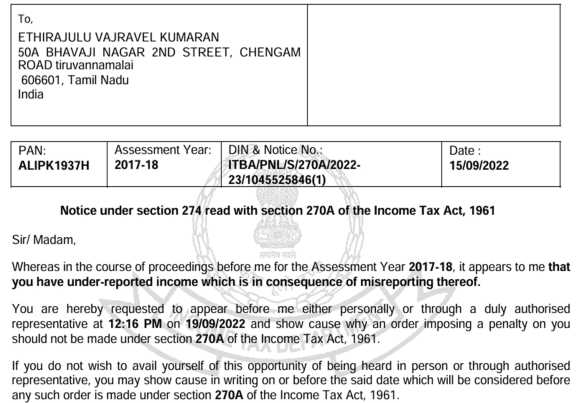
69. On a careful perusal of the above show cause notice, it is evident that the show-cause notice issued by the AO suffers from a fundamental defect inasmuch as it is vague, uncertain, and lacking in the requisite particulars. The penalty proposed therein is stated to be u/s.270A of the Act, specifically on the ground of “underreporting of income in consequence of misreporting of income” as contemplated under sub-section (9) of section 270A of the Act. It is trite law that where a statute provides for the imposition of a penal liability, the person against whom such liability is sought to be enforced must be informed with clarity and certainty regarding the precise nature of the allegation. The show-cause notice is the foundation of the penalty proceedings; therefore, the AO is duty-bound to specify with exactitude the charge alleged against the assessee so that the assessee may effectively meet and rebut the same. A vague or omnibus notice, which merely reproduces the language of the provision without indicating the specific default committed, cannot be sustained in law.
70. In the present case, the impugned notice does not delineate which particular limb or clause of section 270A(9) of the Act is attracted. Sub-section (9) of section 270A of the Act enumerates various instances that amount to “misreporting of income,” such as misrepresentation or suppression of facts, failure to record investments, recording of false entries, or claim of expenditure not substantiated, etc. Each of these instances constitutes a distinct and independent ground, carrying serious penal consequences. It was incumbent upon the AO to state in clear and unambiguous terms which of these specific defaults was being attributed to the assessee, along with the manner in which the ingredients of the alleged default stood satisfied in the facts of the case. The failure to so specify renders the notice fundamentally defective. It deprives the assessee of a fair and reasonable opportunity to defend himself, thereby vitiating the entire penalty proceedings. The requirement of issuing a valid and precise notice is not a mere procedural formality but goes to the very root of jurisdiction for levy of penalty. A defective notice cannot confer valid jurisdiction upon the AO to impose penalty.
71. We find that the Hon’ble Delhi High Court in the case of Prem Brothers Infrastructure LLP v. National Faceless Assessment Centre (Delhi)/W.P.(C) 7092/2022 dated 31.05.2022 has observed as under:-
“8. This Court also finds that there is not even a whisper as to which limb of Section 270A of the Act is attracted and how the ingredient of subsection (9) of Section 270A is satisfied. In the absence of such particulars, the mere reference to the word “misreporting” by the Respondents in the penalty order to deny immunity from imposition of penalty and prosecution makes the impugned order manifestly arbitrary.
9. Consequently, the impugned penalty order dated 28th March, 2022 passed by Respondent No.1 under Section 270A of the Act is quashed and Respondent No.1 is directed to grant immunity under Section 270AA of the Act to the Petitioner.”
72. Further, the Hon’ble Delhi High Court in Schneider Electric South East Asia (HQ) Pte. Ltd. v. ACIT (Delhi)/W.P.(C) No. 5111/2022 vide judgment dated 28.03.2022 observed as under:-
“6. Having perused the impugned order dated 9th March, 2022, this Court is of the view that the Respondents’ action of denying the benefit of immunity on the ground that the penalty was initiated under Section 270A of the Act for misreporting of income is not only erroneous but also arbitrary and bereft of any reason as in the penalty notice the Respondents have failed to specify the limb – “underreporting” or “misreporting” of income, under which the penalty proceedings had been initiated.
7. This Court also finds that there is not even a whisper as to which limb of Section 270A of the Act is attracted and how the ingredient of sub-section (9) of Section 270A is satisfied. In the absence of such particulars, the mere reference to the word “misreporting” by the Respondents in the assessment order to deny immunity from imposition of penalty and prosecution makes the impugned order manifestly arbitrary.
8. This Court is of the opinion that the entire edifice of the assessment order framed by Respondent No.1 was actually voluntary computation of income filed by the Petitioner to buy peace and avoid litigation, which fact has been duly noted and accepted in the assessment order as well and consequently, there is no question of any misreporting.
9. This Court is further of the view that the impugned action of Respondent No.1 is contrary to the avowed Legislative intent of Section 270AA of the Act to encourage/incentivize a taxpayer to (i) fast-track settlement of issue, (ii) recover tax demand; and (iii) reduce protracted litigation.
10. Consequently, the impugned order dated 09th March, 2022 passed by Respondent No.1 under Section 270AA (4) of the Act is set aside and Respondent No.1 is directed to grant immunity under Section 270AA of the Act to the Petitioner.”
73. We find that the similar issue had come up for consideration before the co-ordinate bench of this Tribunal in Prakashchand Jain v. Dy. CIT [IT Appeal No.68/Chny/2024, dated 07.03.2025], wherein following the another decision of the co-ordinate bench of this Tribunal in Enrica Enterprises (P.) Ltd. v. Dy. CIT (Chennai–Trib.)/ITA Nos. 1166 & 1167/Chny/2023 dated 06.06.2024, it was held as under:-
“9. According to us, the assessee should be informed in the show-cause notice with certainty and accuracy of the exact nature of the fault alleged against him. In this case, it has been noted that the impugned notice issued by the Assessing Officer is silent about which limb/clause of subsection (9) of section 270A of the Act has been attracted in the facts of the case so as to deserve levy of penalty, and how the ingredients of subsection (9) of section 270A are satisfied. Therefore, the show-cause notice proposing penalty is found to be vague and does not meet the requirement of law to legally impose penalty. Consequently, the levy of penalty is fragile in the eyes of law and is held to be ab initio bad in law.”
74. Respectfully following the precedent laid down by the Hon’ble Delhi High Court in Prem Brothers Infrastructure LLP (supra) and Schneider Electric South East Asia (HQ) PTE Ltd. (supra), as well as the coordinate bench decisions of this Tribunal in Prakashchand Jain (supra) and Enrica Enterprises (P.) Ltd. (supra), we are of the considered view that the show cause notice dated 15.09.2022 issued by the AO u/s.274 r.w.s 270A of the Act, is ex facie vague and suffers from a fundamental infirmity in law inasmuch as it fails to clearly and specifically delineate the precise charge for which penalty proceedings were initiated. A notice which does not indicate the specific limb or ground under which penalty is proposed to be levied is not only violative of the principles of natural justice but also renders the entire penalty proceedings void ab initio. In the absence of such specificity, the assessee is deprived of an effective opportunity to rebut the charge, thereby vitiating the proceedings. Consequently, the said notice cannot be sustained in law and is hereby quashed. As a corollary, the penalty orders passed by the AO u/s.270A of the Act for the AYs 2017-18 to 2020-21, being consequential in nature, are unsustainable in the eyes of law and are also liable to be set aside. We further note that the CIT(A), having appreciated the aforesaid legal position, has rightly deleted the penalty levied by the AO u/s.270A of the Act for the impugned assessment years. We find no error, infirmity, or perversity in the order so passed by the CIT(A). It is further observed that the omission on the part of the Revenue to raise any specific grounds of appeal assailing the order of the CIT(A) in deleting the penalty on account of defective notices renders the Revenue’s entire appeal infructuous. Accordingly, we see no reason to interfere with the order of the CIT(A). In the result, the grounds of appeal raised by the Revenue for the AYs 2017-18 to 2020-21 are devoid of merit and are dismissed. Consequently, all the four appeals of the Revenue in ITA Nos.1651 to 1654/Chny/2025 stands dismissed.
ITA No.1655/Chny/2025 (A.Y.2021-22)
75. The present appeal of the Revenue arises from the order dated 13.03.2025 passed by the CIT(A), whereby the CIT(A) has deleted the penalty of Rs.2,39,98,544/- levied by the AO u/s.271AAB(1A) of the Act.
76. The brief facts of the case are that the assessee filed his return of income for the impugned assessment year on 10.03.2022, declaring a total income of Rs.4,24,28,640/-. Pursuant to the search and seizure action conducted in the case of the assessee on 25.03.2021, the assessment for the year under consideration was mandatorily selected for scrutiny. Accordingly, notice u/s.143(2) of the Act was issued on 10.03.2022. Subsequently, notices u/s.142(1) of the Act were issued by the AO. In response to which the assessee duly furnished the requisite information and details as called for.
77. During the course of the search proceedings, a Sale Agreement dated 29.06.2020, pertaining to the proposed sale of an immovable property, was recovered. In terms of the said agreement, the assessee had undertaken to transfer a property situated at Thirukoilur for a total consideration of Rs.1,83,01,500/-, out of which a sum of Rs.1,00,00,000/- was received in cash from the purchaser, as duly acknowledged therein.
78. Subsequently, in the course of post-search proceedings, the assessee, in a sworn statement recorded on 20.07.2021, admitted that the property was conveyed for the originally agreed consideration of Rs.1,83,01,500/-. However, for the purposes of registration, the sale consideration was recorded at Rs.21,03,000/- under two separate instruments, thereby resulting in a gain of Rs.1,62,00,000/-. The assessee further admitted to offering the said gain as additional income for the A.Y.2021-22.
79. In consonance with the aforesaid admission, the assessee declared capital gains of Rs.1,67,41,574/- in the return of income filed for the relevant assessment year, which has been duly accepted by the AO while completing the assessment.
80. Further, it was observed during the course of search proceedings that M/s.Arunai Medical College had received donations aggregating to Rs.2,32,50,000/- from its employees and known people during the assessment year under consideration. In this connection, sworn depositions were recorded from Shri P. Suresh Kumar, Purchase Manager, and Smt. Vasanthi, Cashier, wherein they deposed that the management had provided cash to employees and other associated persons of the group, who, in turn, remitted the amounts to the Trust through cheques and/or other banking channels. Further, a sworn statement was recorded from the assessee on 20.07.2021, wherein the assessee is stated to have admitted to arranging the aforesaid funds and also agreed to offer the same to taxation.
81. Subsequently, during the course of assessment proceedings, the assessee contended that the statement of Shri P. Suresh Kumar had been made under stress and coercion. It was further submitted that the staff members had voluntarily contributed the said donations. The assessee, in his capacity as Vice Chairman, had facilitated the mobilization of such contributions towards the noble cause of supporting the institution. The assessee further submitted before the AO that the aforesaid contributions were genuine donations made by the staff of the Medical College. However, in order to extend co-operation and with a view to buy peace of mind, the assessee voluntarily offered the said sum of Rs.2,32,50,000/- to tax in the return of income filed for the relevant assessment year. Upon due consideration, the AO found the explanation of the assessee to be acceptable and accordingly completed the assessment on that basis.
82. The AO observed, upon analysis of the forensic extraction of the mobile phone of Shri Sathiaseelan, that certain WhatsApp communications existed between Shri Zubair of M/s JBA and Shri Sathiaseelan. These communications evidenced cash payments made to M/s JBA in respect of materials supplied for the construction of M/s Arunai Medical College. In his sworn statement, Shri Sathiaseelan admitted the veracity of the contents of the messages but disclaimed knowledge of further particulars.
83. When confronted with this material, the assessee was called upon to offer an explanation. In his statement dated 20.07.2021, the assessee admitted to having made cash payments amounting to Rs.19,19,500/- and Rs.50,00,000/-, respectively. He further stated that the said payments were effected out of an advance of Rs.1,00,00,000/-, which had been received in cash towards the proposed sale of immovable property.
84. The AO was of the view that although the assessee had sought to attribute payments aggregating to Rs.69,19,500/-towards M/s JBA from the said advance of Rs.1,00,00,000/-, the assessee had failed to explain the source of further cash transactions of Rs.32,23,000/- (dated 08.05.2020) and Rs.9,95,315/- (dated 19.06.2020), both recorded against M/s JBA. Consequently, the assessee was issued a show cause notice requiring him to explain the source of the aforesaid sum of Rs.42,18,315/- (i.e., Rs.32,23,000/- + Rs.9,95,315/-).
85. In reply, the assessee, contended before the AO that the said sum of Rs.42,18,315/- was met out of his personal sources of income. However, the AO, not being satisfied with the explanation furnished, held that the said amount represented unexplained and undisclosed income of the assessee. Accordingly, the AO added the sum of Rs.42,18,315/- to the returned income of the assessee.
86. Thus, the assessment of the assessee for the impugned assessment year was completed by the AO u/s.143(3) of the Act on 24.03.2022, assessing the total income at Rs.4,66,46,955/-including the addition of Rs.42,18,315/- made on account of undisclosed income in respect of cash payments made to M/s. JBA. Consequently, the AO initiated penalty proceedings u/s.271AAB(1A) of the Act by issuing show cause notice u/s.274 r.w.s 271AAB of the Act on 27.03.2022.
87. The AO show caused the assessee requiring to explain as to why penalty u/s.271AAB(1A) of the Act should not be levied in respect of the undisclosed income amounting to Rs.4,42,15,889/-, which formed part of the assessed income.
88. In response, the assessee submitted that the penalty proceedings be kept in abeyance, as the quantum appeal was pending adjudication before the CIT(A). Consequently, the AO refrained from levying penalty on the addition of Rs.42,18,315/-made in the assessment proceedings, since the same was a subject matter of appeal before the CIT(A). However, the AO observed that the balance sum of Rs.3,99,97,574/-[i.e.,Rs.4,42,15,889/- minus Rs.42,18,315/-], which was offered by the assessee and included in the return of income, was not under dispute. The AO further held that such income would not have been offered by the assessee but for the search and seizure operation conducted on 25.03.2021.
89. The AO noted that the assessee had not admitted the aforesaid undisclosed income of Rs.3,99,97,574/- in the statement recorded u/s.132(4) of the Act during the course of search, but had admitted the same only during post-search proceedings. Accordingly, the AO concluded that the conditions stipulated under clause (a) of Section 271AAB(1A) were not satisfied, thereby attracting clause (b) thereof, which prescribes levy of penalty at the rate of 60% of the undisclosed income.
90. In view of the above, the AO passed the impugned penalty order u/s.271AAB(1A) of the Act, vide order dated 22.09.2022, levying penalty of Rs.2,39,98,544/-, being 60% of the undisclosed income of Rs.3,99,97,574/-.
91. Aggrieved of the above order levying penalty u/s.271AAB(1A) of the Act, assessee preferred appeal before the CIT(A). The assessee, in the course of appellate proceedings before the CIT(A), contended that the show cause notice dated 27.03.2022 issued by the AO u/s.271 r.w.s 271AAB of the Act was invalid, inasmuch as the said notice failed to specify the precise limb of section 271AAB under which the penalty proceedings were proposed to be initiated. It was therefore urged that the said show cause notice was defective and consequently, the penalty order passed by the AO u/s.271AAB(1A) of the Act was liable to be quashed.
92. The assessee further submitted that the penalty notice was issued on 27.03.2022, whereas the assessment order had already been passed on 24.03.2022. Since the initiation of penalty proceedings u/s.271AAB of the Act was not made in the course of the assessment proceedings, but subsequent thereto, the assessee contended that the penalty notice itself was invalid and the penalty order passed in pursuance thereof was without jurisdiction and bad in law.
93. On merits, the assessee submitted that the condition precedent for levy of penalty u/s.271AAB(1A) of the Act is that the income offered by the assessee must fall within the definition of “undisclosed income” as provided in clause (c) of section 271AAB of the Act. According to the assessee, the basis for determining such “undisclosed income” is the maintenance of books of account and the entries recorded therein. The assessee, however, was neither maintaining books of account nor was statutorily obliged to maintain such books of account for the A.Y.2021-22, including as on the date of the search. In these circumstances, it was argued that the income offered could not be characterized as “undisclosed income” within the meaning of section 271AAB of the Act, which is a sine qua non for invoking penalty u/s.271AAB(1A) of the Act. Consequently, the levy of penalty by the AO was unjustified and unsustainable in law.
94. In light of the above, the assessee prayed before the CIT(A) for deletion of the penalty amounting to Rs.2,39,98,544/- levied by the AO u/s.271AAB(1A) of the Act.
95. Upon consideration of the submissions by the assessee, the CIT(A), vide order dated 13.03.2025, deleted the penalty imposed by the AO under section 271AAB(1A) of the Act. The relevant finding of CIT(A) reads as follows:-
“
.
.
.
6.3.5 On examination of the ground and the relevant written submission made it can be seen that the notice issued for the imposition of penalty is vague and does not specify the exact clause or sub-clause of Section 271AAB under which the penalty is sought to be levied. It is a fundamental requirement that when initiating penalty proceedings, the notice must clearly specify the charge under the relevant provisions of the law to ensure the assessee is aware of the specific violation or conduct that is being penalized. As per the provisions of section 274(1) of the Act, the assessee must be given a reasonable opportunity to respond to the charge levelled against him. However, the notice in this case does not identify the particular clause of Section 271AAB of the Act that the appellant is being charged with, nor does it provide any context about the alleged undisclosed income. This results in the violation of the principles of natural justice, as the assessee is not apprised of the exact grounds on which the penalty is being levied, depriving him of the opportunity to put forth an effective defence.
6.3.6 Furthermore, the assessment order also fails to provide any clarity upon this issue, as it does not specify the circumstances under which penalty proceedings u/s.271AAB of the Act is initiated. The absence of such a discussion further highlights that the AO did not apply his mind before issuing the penalty notice. As such, this show cause notice issued by the AO lacks the requisite specificity and details that are necessary for initiating penalty proceedings, and thus renders the entire penalty action invalid.
6.3.7 Now the issue before the undersigned is whether the AO is right in issuing a show cause notice u/s 271AAB of the Act without specifying the limp under which the specific charge is levelled against the appellant.
6.3.8 In this regard it is appropriate to rely upon the decisions of the Hon’ble High Court of Judicature at Madras in the case of DCIT v. Shri R. Elangovan (Tax Case Appeal Nos.770 & 771 of 2018, Dated: 30.03.2021) wherein the Hon’ble jurisdictional High Court emphasized “the necessity of specifying the exact clause of Section 271AAB in the notice, stating that the failure to do so results in the notice being defective. The High Court observed that penalty proceedings cannot be upheld if the assessee has not been provided with a clear understanding of which particular clause or sub-clause of Section 271AAB the penalty is being imposed under.”
6.3.9 In this case the jurisdictional tribunal had deleted the penalty, and the High Court upheld this ruling of the jurisdictional tribunal. The Hon’ble High Court noted that penalty proceedings are independent of the assessment proceedings, and the procedures to be followed for the imposition of penalties must be strictly adhered to. This ruling is directly applicable to the present case at hand, where the issued notice failed to specify the exact penalty provision.
6.3.10 Further, judicial precedents from the Karnataka High Court in cases such as CIT v. Manjunatha Cotton & Ginning Factory and SSA’s Emerald Meadows have repeatedly held that penalty notices must be specific.
6.3.11 Further, the rulings from various other ITAT benches that further bolster the contention that the penalty notice issued in this case is defective are as under:-
| • |
|
Gopal Das Sonkia v. Dy. CIT, Jaipur (ITA No. 306.Jp 2018, order dated 11th April, 2019): The ITAT held that the show cause notice for initiating penalty proceedings was vague as it did not specify the default or the undisclosed income for which the penalty was being levied. The bench followed the ruling in the Manjunatha Cotton & Ginning Factory case and quashed the penalty order. |
| • |
|
Mukund Sharan Goyal v. Dy. CIT, Jaipur (ITA No. 293/Jp/2018, order dated 23rd September, 2019): On similar facts, the ITAT again held that penalty proceedings initiated without specifying the default attracting the penalty under Section 271AAB were invalid. The notice in that case did not mention the clause under which the penalty was being proposed, thus leading to the penalty being quashed. |
6.3.12 These rulings demonstrate a consistent approach across different Benches of the ITAT and courts, reinforcing the view that a penalty notice that fails to mention the relevant provisions under which the penalty is being imposed cannot be sustained. Further several other judgments across different jurisdictions also align with the appellant’s contention.
| • |
|
Vimal Chand Surana v. DCIT, ITAT Jaipur (ITA No. 304/JP/2018, Decision dated 30th May, 2019). |
| • |
|
Shiv Bhagwan Gupta v. ACIT, ITAT Patna (ITA No. 194/pat/2019, Decision dated 11th February, 2021). |
| • |
|
Happy Steel (P) Ltd. v. DCIT, ITAT Chandigarh (ITA No. 398/Chd/2023, Decision dated 5th June, 2024). |
6.3.13 In each of these cases, the Hon’ble ITAT held that the penalty notice issued was legally defective as it did not specify the clause of Section 271AAB under which the penalty was sought to be imposed. The consistent judicial view is that such defects invalidate the penalty proceedings and warrant their quashing.
6.3.14 Further, the order u/s 271AAB dated 22.09.2022 levying the penalty also fails to specify as to how the appellant has fulfilled the conditions of clause (a) of section 271AAB (1A) of the Act while declaring the total income in the return of income e-filed u/s 139 of the Act for the AY 2021-22. In view of the above discussions and judicial precedence(s), the undersigned is of the view that the AO is not clear about the specific charge to levy penalty u/s 271AAB of the Act, neither in the assessment order nor in the show cause notice issued to levy the said penalty. The penalty order also does not speak about the same. Accordingly, the grounds raised by the appellant upon this issue are hereby treated as allowed.
6.5.3 The undersigned has examined the issue raised in the grounds of appeal. The primary issue to be determined is whether the returned income of Rs. 4,24,28,640/- filed u/s 139(1) of the Act, which includes Rs. 2,32,50,000/- admitted to settle matters with the department and Rs. 1,67,41,574/- arising from capital gains, totalling Rs. 3,99,97,574/-, constitutes “undisclosed income” as per the provisions of the Act.
6.5.4 The term “undisclosed income” defined in the provisions of section 271AAB(1A) of the Act is reproduced here as under for a better understanding of the term.
Quote
(c) “undisclosed income” means-
(i) any income of the specified previous year represented, either wholly or partly, by any money, bullion, jewellery or other valuable article or thing or any entry in the books of account or other documents or transactions found in the course of a search under section 132, which has-
(A) not been recorded on or before the date of search in the books of account or other documents maintained in the normal course relating to such previous year; or
(B) otherwise not been disclosed to the Principal Chief Commissioner, Chief Commissioner or Principal Commissioner or Commissioner before the date of search; or
(ii) any income of the specified previous year represented, either wholly or partly, by any entry in respect of an expense recorded in the books of account or other documents maintained in the normal course relating to the specified previous year which is found to be false and would not have been found to be so had the search not been conducted.
Unquote
6.5.5 At the outset, the provisions of Section 271AAB of the Act is applicable when “undisclosed income” is found during a search, and the taxpayer either fails to explain it or provides an explanation that is deemed unsatisfactory. The penalty under this section is imposed when there is a clear finding of “undisclosed income.” However, in the present case of the appellant it can be seen that the appellant filed his return of income within the stipulated time frame and disclosed the income voluntarily u/s 139(1) of the Act. The only finding made by the AO in the penalty order vide para 6 is that ” it is evident that the assessee would not have offered undisclosed income of Rs. 3,99,97,574/- but for the search conducted on 25.03.2021″ As evident in the assessment order and the penalty order passed, the AO failed to demonstrate as to how the income declared by the appellant in the return of income filed u/s 139(1) of the Act bears the character of undisclosed income.
6.5.6 The appellant asserts that the income in question does not meet the criteria of “undisclosed income” as defined under Section 271AAB. Specifically, the income consists of capital gains arising from the sale of an asset, which was disclosed voluntarily in the return of income filed by the appellant. The sale consideration of Rs. 1,83,01,500/- was clearly documented, and the capital gains arising from it were disclosed at the earliest opportunity, that is, on 10.03.2022, when the appellant filed his return of income. The appellant further claims that no “undisclosed income” is present in the case, as there were no findings during the course of the search that money, bullion, jewellery, or any other valuable asset were concealed. The sale transaction of the personal asset in question was disclosed in the return of income, and thus, cannot be treated as undisclosed income merely because it was revealed during a subsequent search.
6.5.7 A critical aspect of the appellant’s defence is the distinction between agreeing to offer income and undisclosed income. In the present case, the appellant agreed to offer additional income of Rs. 2,32,50,000/- to the tax authorities, primarily to avoid further inquiry into donations made by employees to the Trust. However, this offer was made to settle ongoing litigation and prevent prolonged investigations, and it was disclosed voluntarily in the statement of total income filed before the AO. The appellant claims that such an offer, made under the pressure of litigation, cannot be automatically classified as “undisclosed income.”
6.5.8 The appellant’s claim is supported by the judgment of the Madhya Pradesh High Court in CIT v. Suresh Chandra Mittal (2000), wherein the Hon’ble High Court held that an agreement to offer income does not automatically imply that the income represents undisclosed income. This decision was affirmed by the Supreme Court, reinforcing the principle that voluntary disclosures made to avoid litigation cannot automatically be deemed as undisclosed income for the purpose of imposing a penalty under Section 271AAB.
6.5.9 The action of AO in imposing penalty is ill placed on account of the lack of concrete evidence to demonstrate that the income was actually received or undisclosed. The undersigned is of the view that undisclosed income typically refers to amounts that are concealed from the tax, such as unexplained investments or expenditures. In this case, the appellant asserts that there is no evidence to suggest that the amount of Rs. 2,32,50,000/- was actually received or that the appellant had concealed it. There was no unrecorded transaction or entry that would qualify this income as “undisclosed income.” At this juncture it is appropriate to rely upon the decision in Padam Chand Pungliya v. ACIT (ITA No. 112/Jp/2018), which highlights that mere disclosure of income during the investigation or in response to a query is not sufficient for the imposition of a penalty under Section 271AAB. The AO must assess the facts thoroughly and ensure that the income disclosed meets the criteria of “undisclosed income” before levying the penalty.
6.5.10 In the recent case of Future Gaming and Hotel Services Pvt. Ltd. v. ACIT (2025), the jurisdictional Tribunal emphasized that the mere offer or disclosure of income to avoid litigation does not automatically constitute “undisclosed income” for the purposes of imposing a penalty under Section 271AAB. The judgment underscored that penalties can only be imposed when the income genuinely qualifies as “undisclosed income,” as defined in the Explanation to Section 271AAB. This decision also fortifies that the finding of undisclosed income should be based on actual evidence found during the search, rather than on voluntary disclosures made by the assessee to resolve disputes or avoid prolonged litigation.
6.5.11 Even though certain documents relating to the sale of property were found, the appellant had ample time to file the return u/s 139(1) of the Act for the AY 2021 22, as the time to filed return of income for the AY 2021-22 was not yet over when the search action was initiated. Therefore, the allegation of “undisclosed income” is unfounded, and the appellant has fully complied with the legal requirement of declaring all income in the return filed u/s 139(1) of the Act. Therefore, the income admitted for taxation in the return of income cannot be classified as “undisclosed income” u/s 271AAB of the Act as provided in the Act. In the present case, the AO failed to demonstrate how the income disclosed by the appellant could be categorized as undisclosed income under the provisions of the Act. Accordingly, all the grounds raised by the appellant upon this issue are hereby treated as allowed and the AO is hereby directed to delete the penalty amounting Rs. 2,39,98,544/- for the AY 2021-22.”
96. Aggrieved of the above order of the CIT(A), Revenue is in appeal before us raising the following grounds of appeal:-
| 1. |
|
“The order of the learned Commissioner of Income Tax (Appeals) is erroneous on facts of the case and in law. |
| 2. |
|
The Ld.CIT(A) erred in deleting the penalty without appreciating the assessee did not declare the additional income voluntarily but had declared the same only after the proceedings of the search unearthed the undisclosed income, thereby rendering it not voluntarily to claim immunity from penalty proceedings. |
| 3. |
|
The Ld.CIT(A) erred in giving relief to the assessee by not appreciating that the impugned cash transactions did not form part of books of the assessee on the day of search and did not constitute a part of the total income for the relevant year but for the search & therefore they fall under the ambit of ‘undisclosed income’ as specified in the section 271AAB(1A).” |
| 4. |
|
For these grounds and any other ground including amendment of grounds that may be raised during the course of the appeal proceedings, the order of learned CIT(Appeals) may be set aside and that of the Assessing Officer be restored.” |
97. The Ld.DR, strongly relied on the penalty order passed by the AO. It was contended by Ld.DR that the undisclosed income declared by the assessee was solely consequent to the search proceedings and would not have been voluntarily disclosed otherwise. It was accordingly submitted that the AO had rightly invoked and imposed penalty u/s.271AAB(1A) of the Act. The Ld.DR, therefore, prayed that the order of the Ld.CIT(A) be set aside and the penalty order passed by the AO be restored.
98. Per contra, the Ld.AR raised a preliminary objection contending that the present appeal preferred by the Revenue is rendered infructuous, and any further adjudication thereon would be an exercise in futility. It was submitted that the Revenue has failed to assail the specific finding of the CIT(A) whereby the appeal of the assessee had been allowed on the fundamental legal ground relating to the defective show cause notice dated 27.03.2022, issued by the AO u/s.274 r.w.s 271AAB(1A) of the Act. The Ld.AR further submitted that the CIT(A), after due appreciation of facts and in reliance upon various binding judicial precedents, has deleted the penalty levied by the AO u/s.271AAB(1A) of the Act. The said appellate order, according to the ld. AR, is well-reasoned, legally sustainable, and free from perversity or patent error. The ld.AR prayed that the order passed by the ld.CIT(A) deleting the penalty of Rs.2,39,98,544/- imposed u/s.271AAB(1A) of the Act be upheld, and that the appeal of the Revenue be dismissed.
99. We have heard rival submissions and perused the material on record. The total income declared by the assessee includes a sum of Rs.3,99,97,574/-, comprising of (i) Rs.1,67,41,574/-representing long-term capital gains arising from the sale of property disclosed by the assessee on the basis of a sale agreement unearthed during the course of search proceedings, and (ii) Rs.2,32,50,000/- being a sum voluntarily offered by the assessee on account of donations received by M/s.Arunai Medical College, where the assessee is serving as Vice Chairman. The AO treated the aforesaid amount of Rs.3,99,97,574/- as “undisclosed income” of the assessee for the purposes of imposition of penalty u/s.271AAB(1A)(b) of the Act. Consequently, the AO levied a penalty of Rs.2,39,98,544/-, being 60% of the said income, u/s.271AAB(1A) of the Act. On appeal, the CIT(A) deleted the penalty, inter alia, on the grounds that the show cause notice dated 27.03.2022 issued u/s.274 r.w.s 271AAB of the Act failed to specify the relevant limb of section 271AAB(1A), rendering the notice legally defective. Further, the CIT(A) held that a mere voluntary disclosure of income does not automatically qualify as “undisclosed income” so as to attract the rigours of penalty u/s.271AAB(1A) of the Act. Aggrieved of the order of the CIT(A), the Revenue is in appeal before us. The solitary issue that arises for our consideration is whether the CIT(A) was justified in deleting the penalty of Rs.2,39,98,544/- levied by the AO u/s.271AAB(1A) of the Act.
100. We find the provisions of section 271AAB(1A) read as under:-
“(1A) The Assessing Officer [or the Commissioner (Appeals)] may, notwithstanding anything contained in any other provisions of this Act, direct that, in a case where search has been initiated under section 132 on or after the date on which the Taxation Laws (Second Amendment) Bill, 2016 receives the assent of the President, the assessee shall pay by way of penalty, in addition to tax, if any, payable by him,—
| (a) |
|
a sum computed at the rate of thirty per cent of the undisclosed income of the specified previous year, if the assessee— |
| (i) |
|
in the course of the search, in a statement under sub-section (4) of section 132, admits the undisclosed income and specifies the manner in which such income has been derived; |
| (ii) |
|
substantiates the manner in which the undisclosed income was derived; and |
| (iii) |
|
on or before the specified date— |
| (A) |
|
pays the tax, together with interest, if any, in respect of the undisclosed income; and |
| (B) |
|
furnishes the return of income for the specified previous year declaring such undisclosed income therein; |
| (b) |
|
a sum computed at the rate of sixty per cent of the undisclosed income of the specified previous year, if it is not covered under the provisions of clause (a).” |
101. We find that the show cause notice issued u/s.274 r.w.s. 271AAB of the Act dated 27.03.2022 issued by the AO is as under:-
102. A careful examination of the impugned notice reveals that the AO has failed to specify the particular limb of Section 271AAB(1A) of the Act, which is sought to be invoked against the assessee. The legal issue that therefore arises for our consideration is whether, in the absence of such specification, the penalty notice issued u/s.271AAB(1A) of the Act is rendered invalid, and consequently, whether the subsequent proceedings based thereon also stand vitiated.
103. We note that an identical question came up for consideration before the Hon’ble Madras High Court in Pr. CIT v. R. Elangovan [Tax Case Appeal Nos. 770 & 771 of 2018, dated 30.03.2021], wherein the Hon’ble High Court held as under:-
“14. In our considered view, the Tribunal is fully right in vacating the penalty on the ground that the notice was defective. The provisions of the Act have clearly laid down the procedure to be followed and adhered to while imposing the penalty. The proposal for such penalty proceedings was separately initiated upon completion of assessment and there may be cases where the assessee would not even contest the order of assessment. But, that would not preclude the assessee from challenging the penalty proceedings, as penalty proceedings are independent and the procedure required to be followed cannot be dispensed with.
15. As rightly pointed out by the learned counsel appearing for the assessee, Section 271AAB of the Act, which deals with penalty consists of three contingencies. Therefore, the Assessing Officer should point out to the assessee as to under which of the three clauses, he chooses to proceed against the assessee so as to enable the assessee to give an effective reply. Since the same has not been mentioned, the assessee has been denied reasonable opportunity to put forth their submissions. The Tribunal, in paragraph 5 of the impugned order, has verbatim reproduced the penalty notice and we find that the notice is absolutely vague and none of the irrelevant portions had been struck off nor the relevant portions had been marked or indicated. Hence, the Tribunal is right in observing that the penalty could not have been levied based on such defective notice and more particularly, when the assessee has been strenuously canvassing the jurisdictional issue from the inception.
16. In so far as the decision of the Allahabad High Court in the case of Sandeep Chandak is concerned, the factual position is slightly different. This decision is for the principle that where the assessee, in the course of search, makes a statement, in which, he admits the undisclosed income and specifies the manner, in which, such income has been derived, then the provisions of Section 271AAB of the Act would automatically get attracted. There can be no quarrel over this proposition. But, once the provisions get attracted, it is incumbent on the part of the Assessing Officer to specify as to under which clause in Section 271AAB(1) of the Act, he intends to proceed against the assessee. In the instant case, in the absence of such material in the penalty notice, it has to be held that the notice is defective.
17. The decisions of the Karnataka High Court in the cases of Manjunatha Cotton and Ginning Factory and SSA’s Emerald Meadows and the decision of this Court in the case of Babuji Jacob clearly support our above conclusion. For all the above reasons, we find no grounds to interfere with the common order passed by the Tribunal.
18. Accordingly, the above tax case appeals are dismissed confirming the common impugned order passed by the Tribunal. No costs. Consequently, the connected CMP is also dismissed.”
104. We observe that the provisions contained in Section 271AAB(1A) of the Act are structured into two distinct limbs. As per the said sub-section, the imposition of penalty is contemplated either under clause (a) or clause (b). Clause (a) prescribes a penalty at the rate of 30% of the undisclosed income, subject to the fulfilment of specific statutory conditions enumerated therein. Conversely, clause (b) provides for a more stringent penalty at the rate of 60% of the undisclosed income, which becomes applicable in the event of non-fulfilment of the conditions stipulated under clause (a). It necessarily follows that the AO, while initiating penalty proceedings u/s.271AAB(1A) of the Act, is legally bound to clearly specify, in the show-cause notice, the precise limb i.e., whether clause (a) or clause (b), under which the proposed penalty is sought to be levied. Such specification is essential, as the consequences of each clause differ both in terms of rate and the underlying conditions of applicability.
105. In the present case, however, the AO has failed to discharge this mandatory obligation, inasmuch as the show-cause notice dated 27.03.2022 issued to the assessee does not delineate whether the penalty is proposed under clause (a) or under clause (b) of Section 271AAB(1A) of the Act. This omission, in our considered view, renders the penalty proceedings fundamentally defective.
106. We draw support from the judgment of the Hon’ble Madras High Court in PCIT v. Shri R. Elangovan (supra), wherein it was held that the failure of the AO to specify the relevant limb of the penal provision vitiates the entire penalty proceedings. The Revenue failed to bring on record any contrary judgments from the Hon’ble Madras High Court on the issue and accordingly the same is binding on the Revenue.
107. We further place reliance upon the binding precedents rendered by the Co-ordinate Benches of this Hon’ble Tribunal, wherein it has been consistently held that the failure of the AO to specify, in the show-cause notice issued u/s.271AAB(1)/(1A) of the Act, the precise limb, clause, or sub-provision under which penalty proceedings are proposed to be initiated, vitiates the very foundation of such notice. It has been categorically laid down in the below mentioned judicial pronouncements that a notice bereft of such specification suffers from incurable infirmity, as it deprives the assessee of a fair and reasonable opportunity to meet the charge. Consequently, any penalty order passed pursuant thereto stands rendered unsustainable in law, liable to be quashed as invalid and void ab initio.
| i. |
|
Rahul Jain v. Dy. CIT [ITA No.1219/CHANDI/2024, dated 18.08.2025] |
| ii. |
|
Pr. CIT v. Industrial Safety Products (P.) Ltd. (Calcutta))/2023 (7) TMI 241 |
| iii. |
|
Giriraj Enterprises v. Dy. CIT (Pune – Trib.) |
| iv. |
|
St. Joseph’s Educational Trust v. Dy. CIT (Chennai – Trib.) |
| v. |
|
Krishnappa Gowder Kalyanasundaram v. Dy. CIT [IT Appeal No. 1678 (CHNY) of 2024, dated 21-5-2025] |
| vi. |
|
Prakash Asphalting & Toll Highways (India) Ltd. v. ACIT [IT Appeal No. 720/Ind/2024, dated 24.02.2025] |
| vii. |
|
Suresh Kumar v. ACIT [IT Appeal No.1880/Del/2023, dated 31.01.2025] |
| viii. |
|
Smt. Sonia Singla v. ACIT [IT Appeal No.1202/Del/2024, dated 30.12.2024] |
108. In view of the aforesaid reasoning and relying on judicial pronouncements cited supra, we hold that the penalty order dated 22.09.2022 passed by the AO u/s.271AAB(1A) of the Act, imposing a penalty of Rs.2,39,98,544/-, is legally unsustainable and stands vitiated on account of the defective show cause notice dated 27.03.2022 issued by the AO. The CIT(A) has, therefore, rightly deleted the said penalty. We find no infirmity in the impugned order passed by the CIT(A) and accordingly, the same is upheld. Consequently, the grounds of appeal raised by the Revenue are dismissed. Furthermore, as rightly submitted by the ld.AR, the failure of the Revenue to raise specific grounds challenging the findings of the CIT(A) in deleting the penalty on legal grounds renders the entire appellate exercise futile and infructuous. Therefore, the appeal of the Revenue in ITA No.1655/Chny/2025 stands dismissed.
109. In the result, all the six appeals of the Revenue are dismissed.