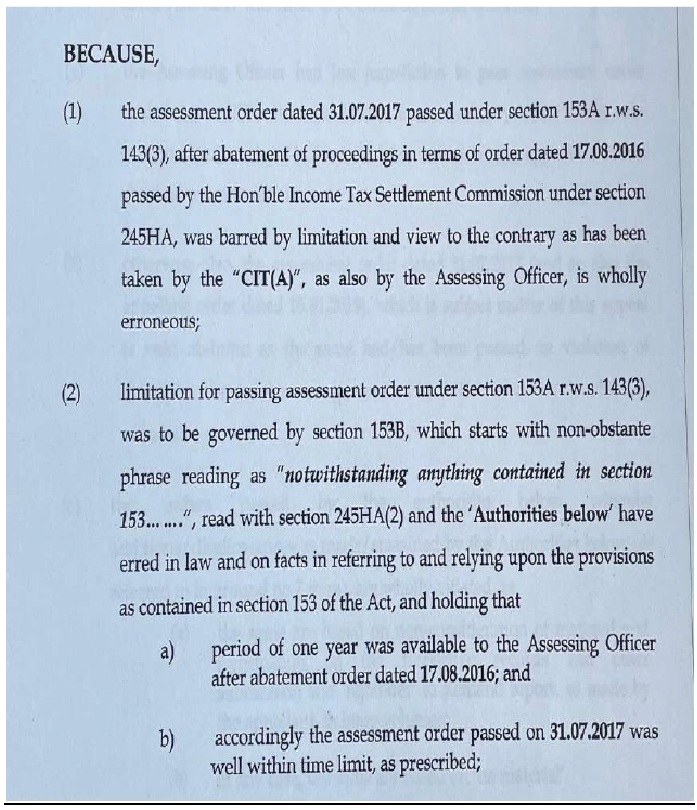
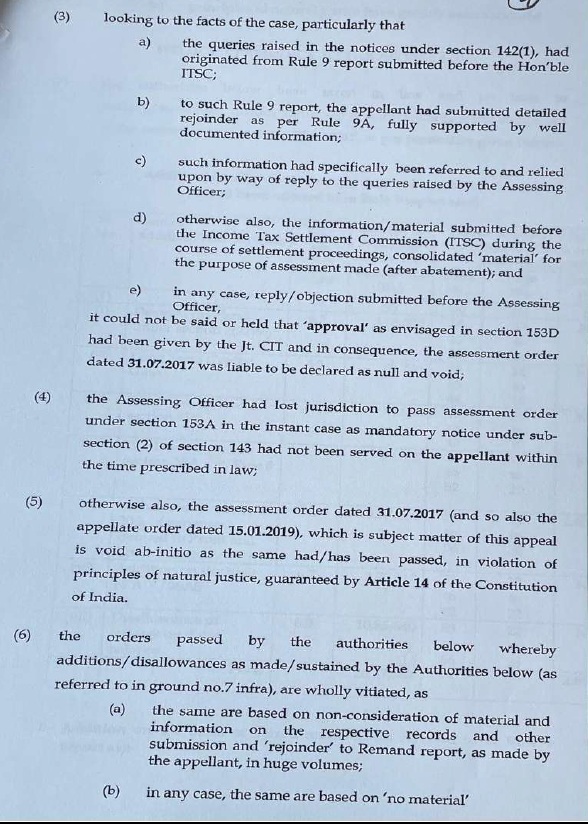
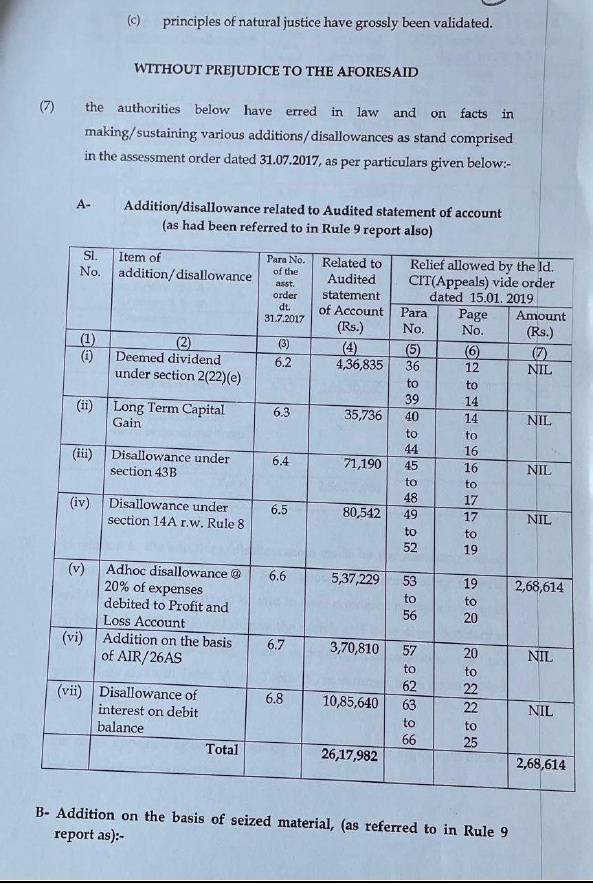
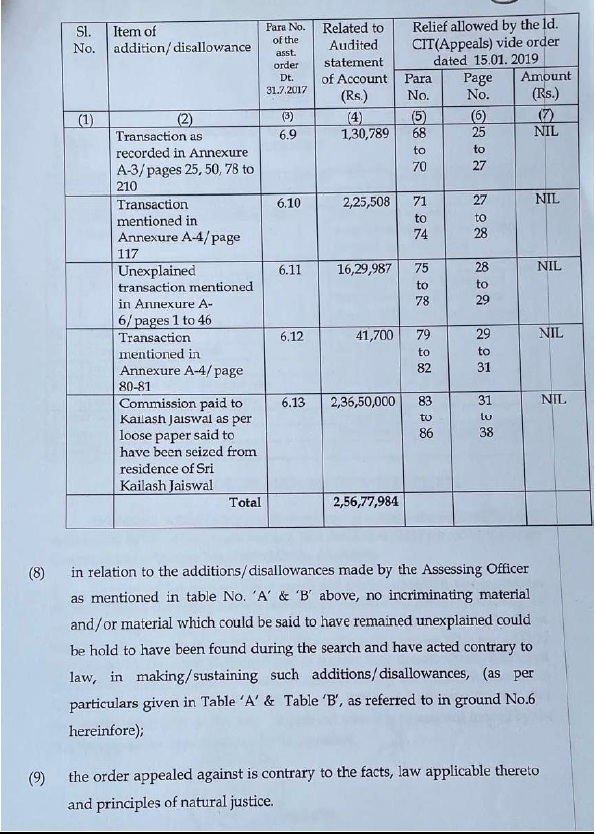
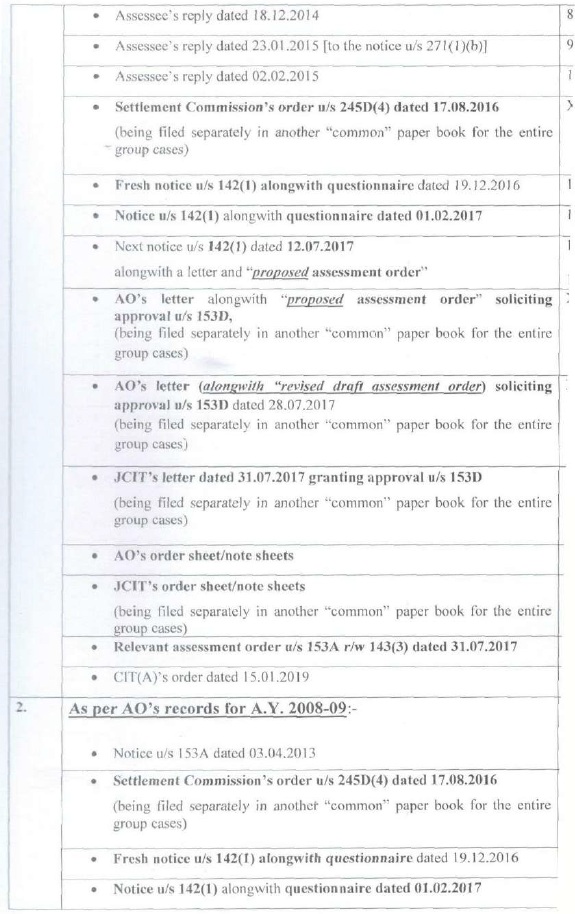
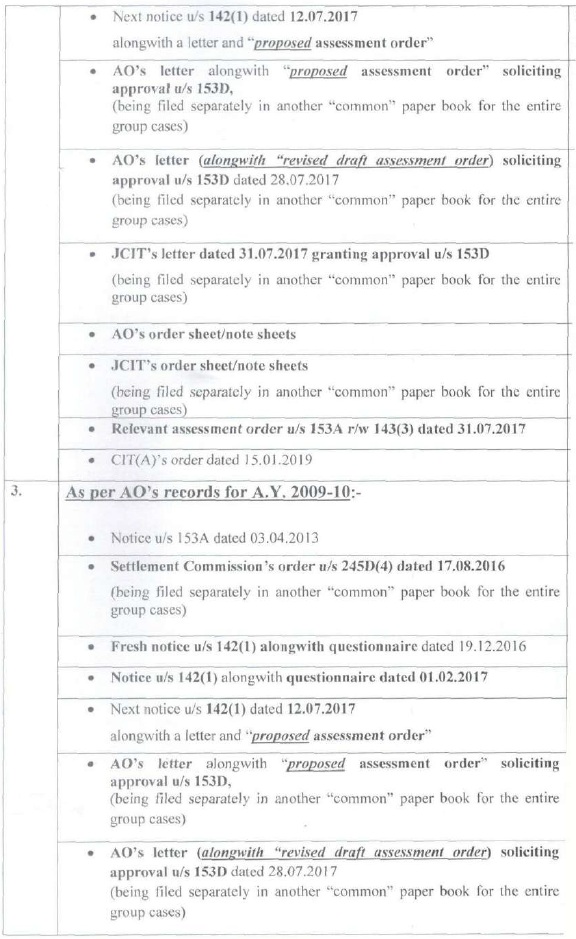
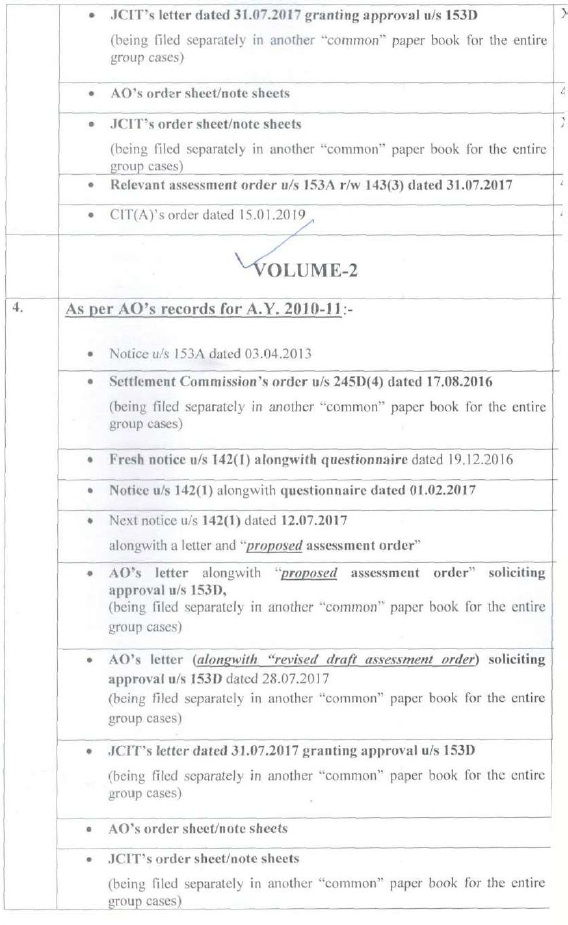
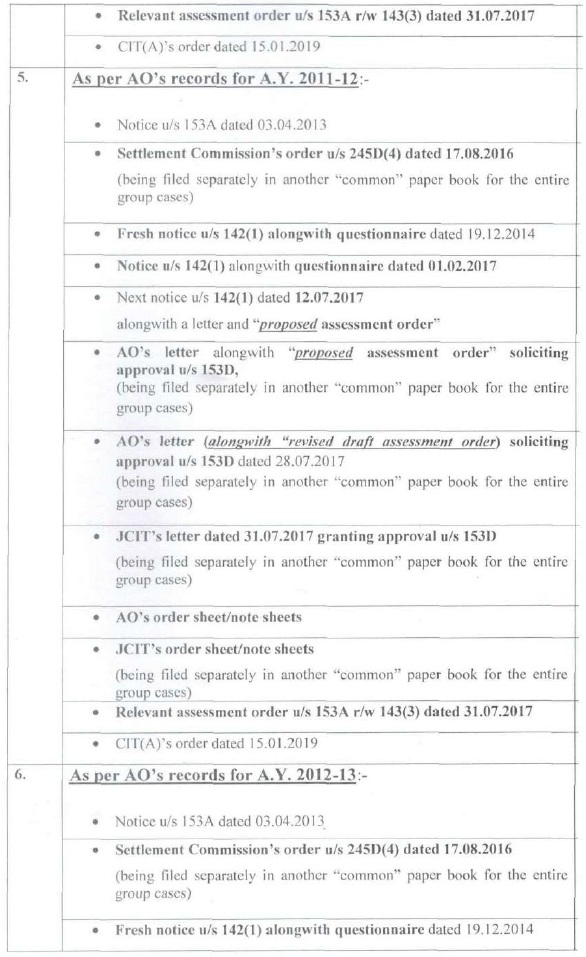
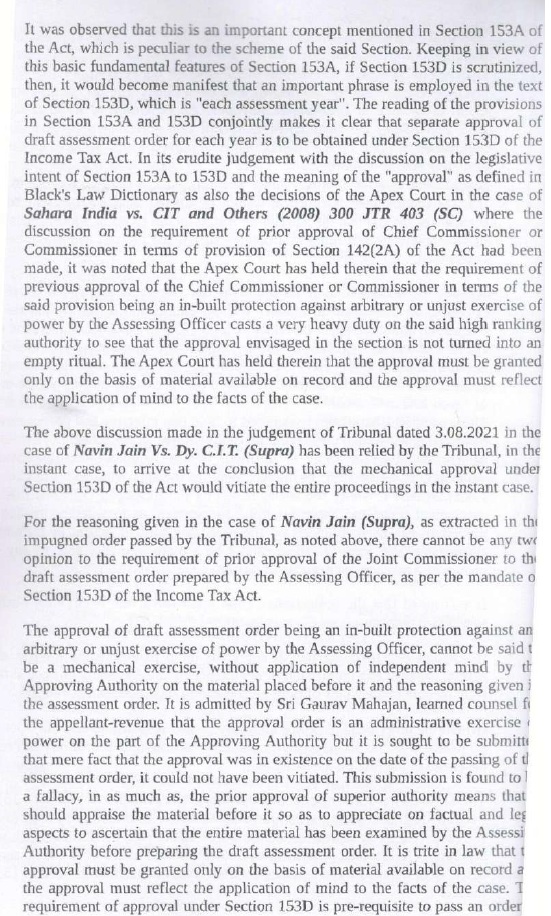
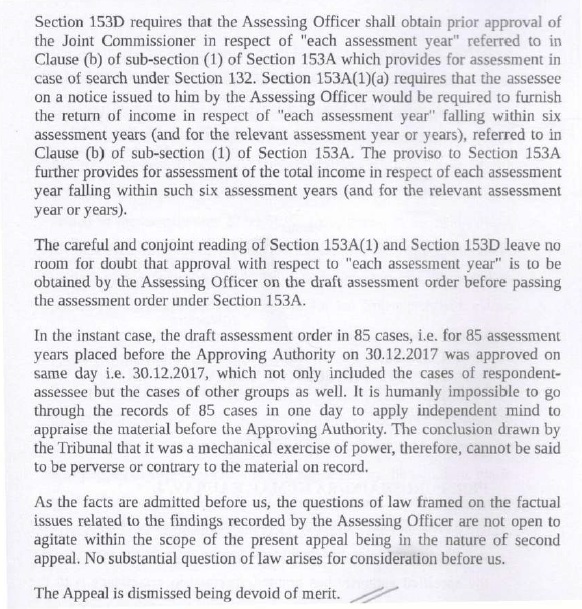
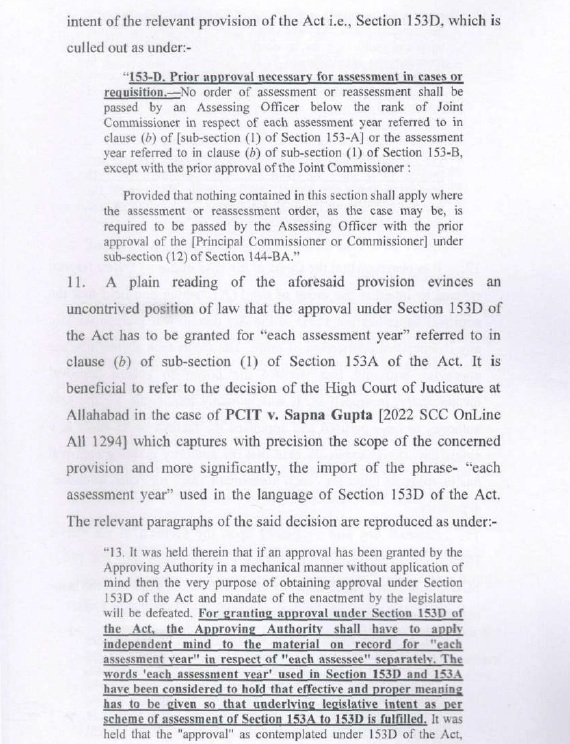
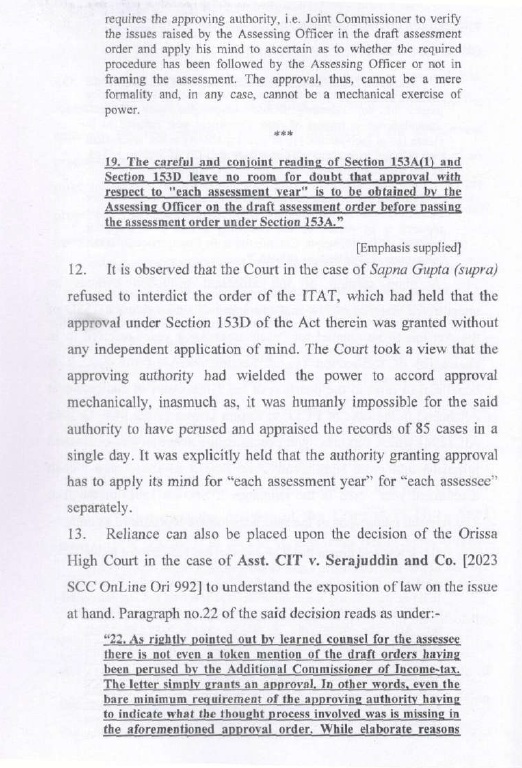
ORDER
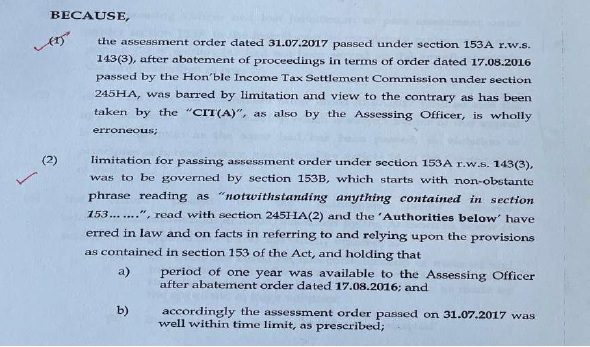
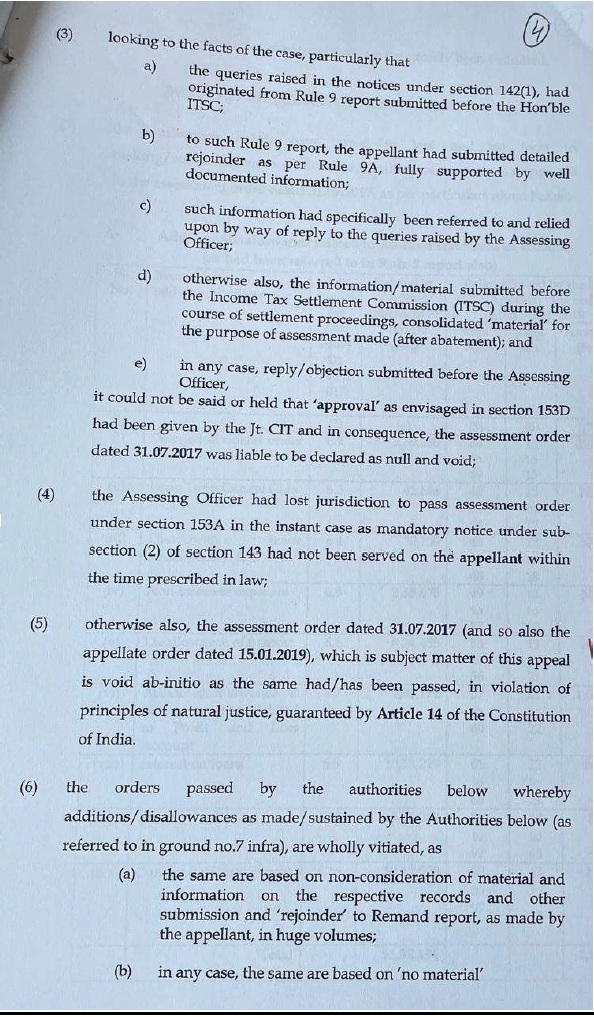
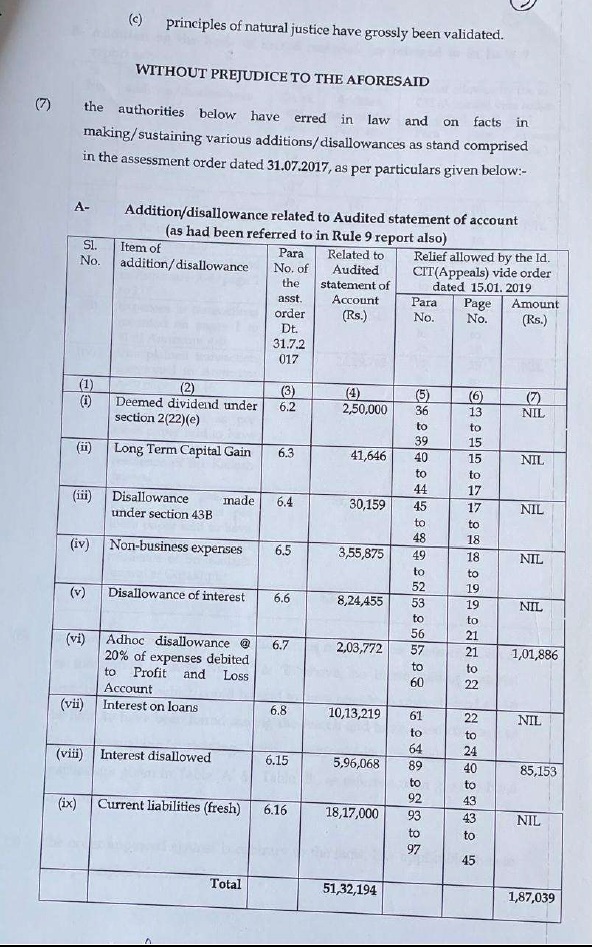
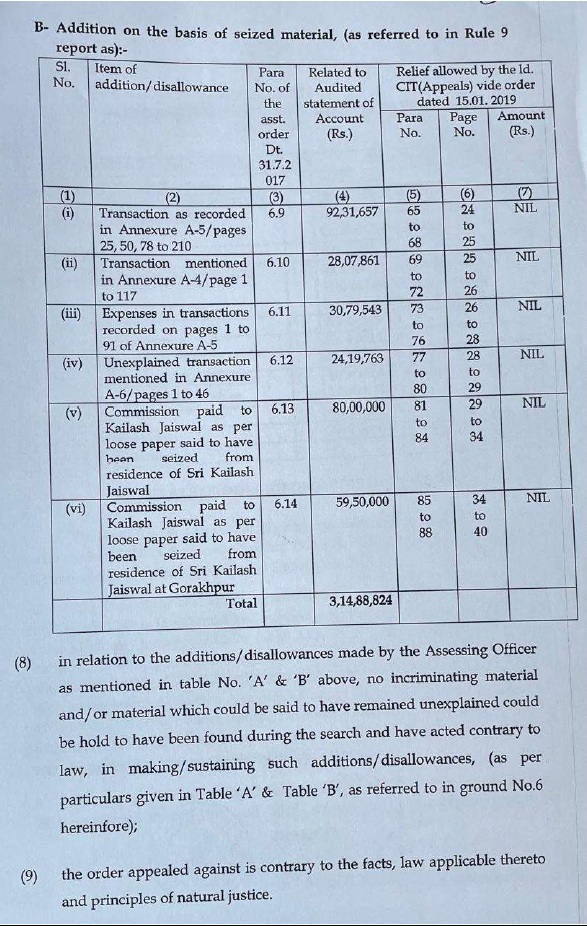
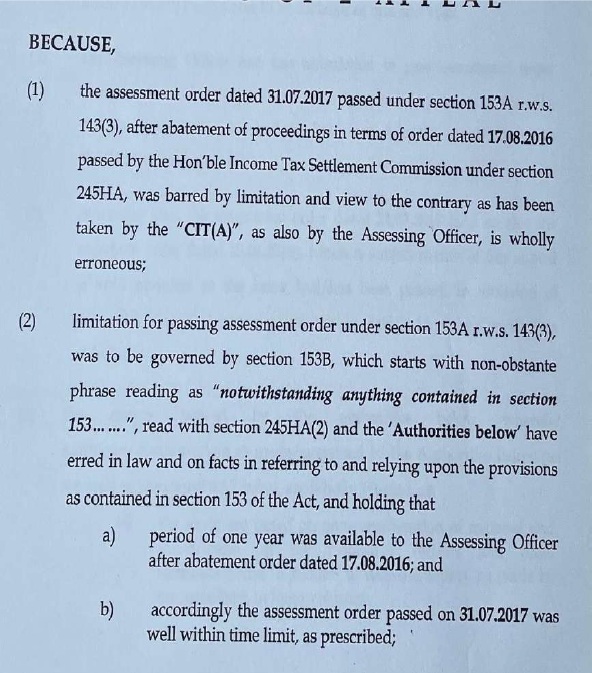
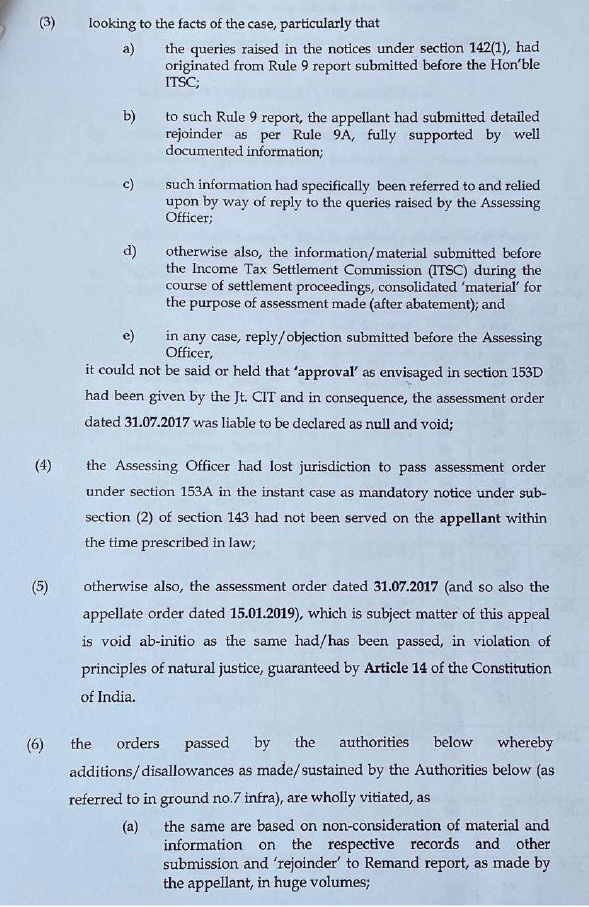
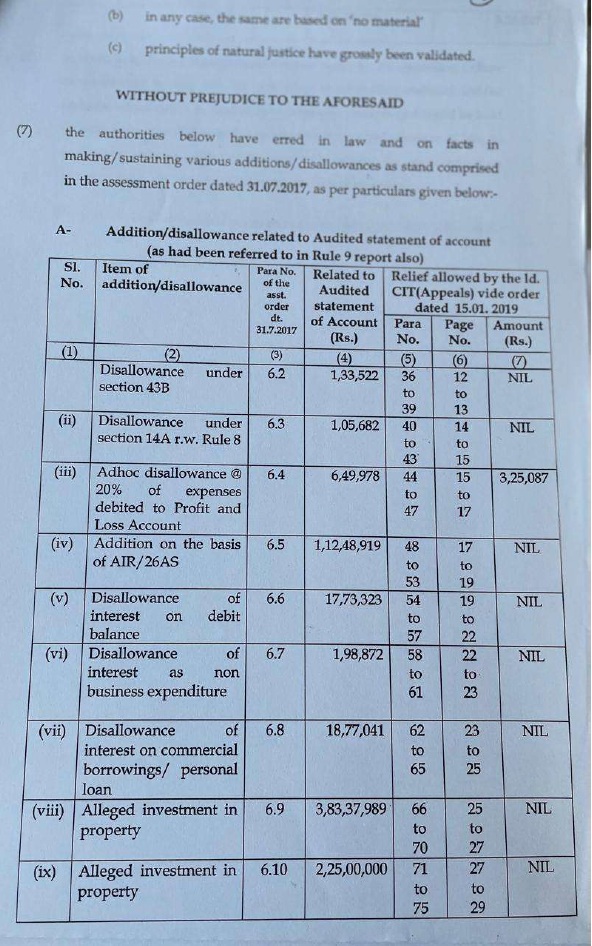
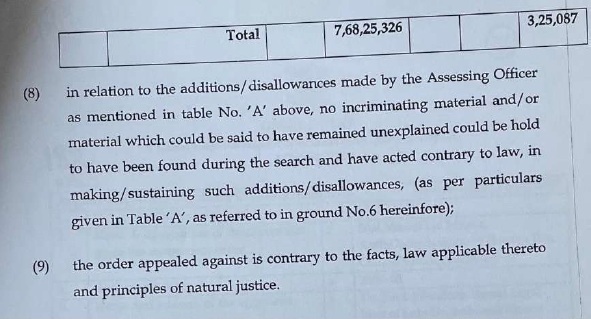
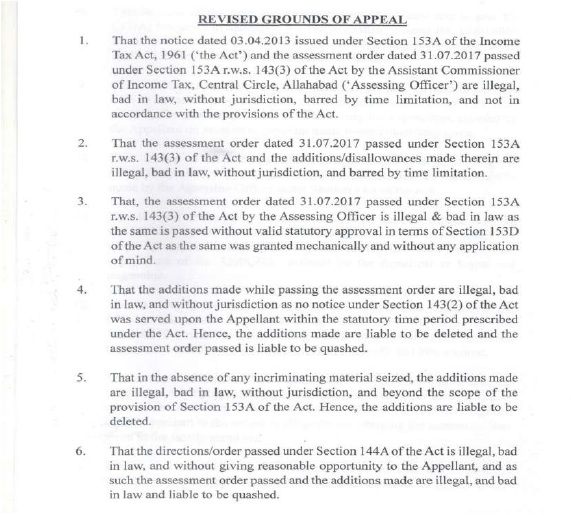
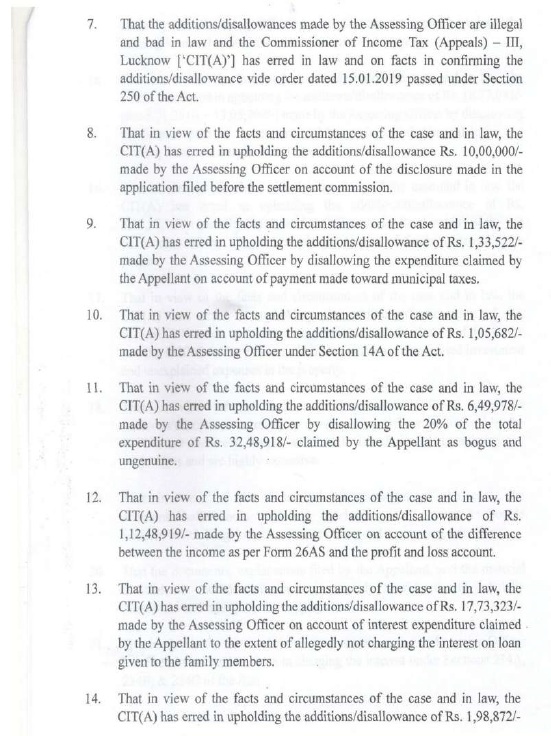
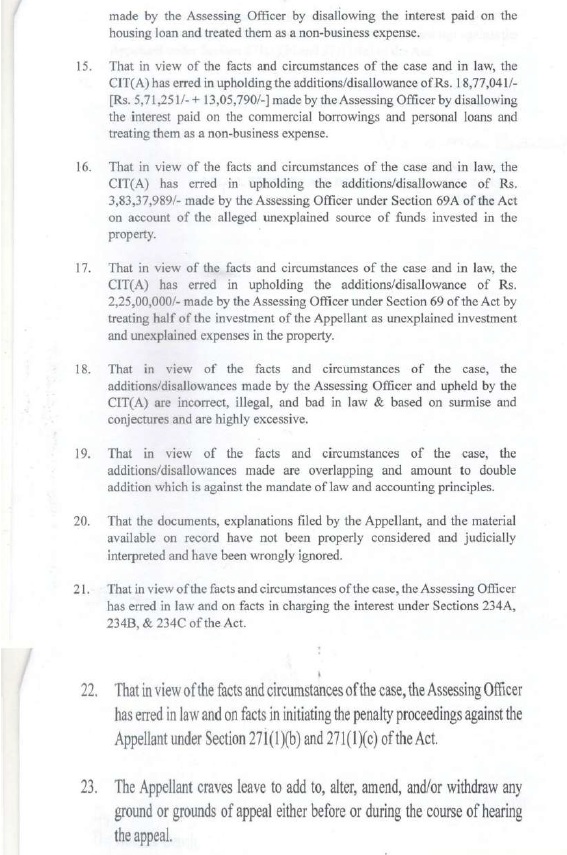
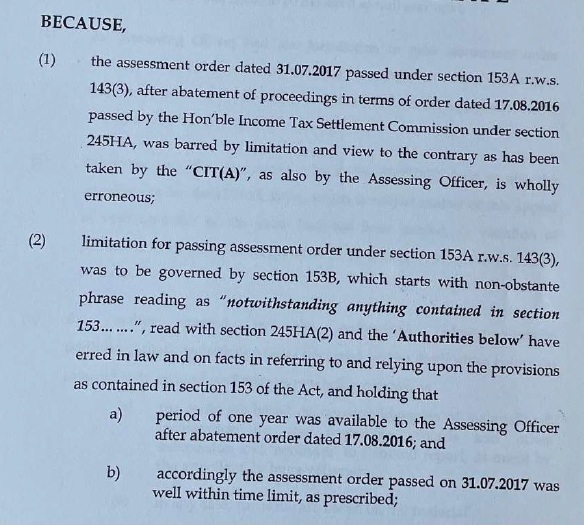
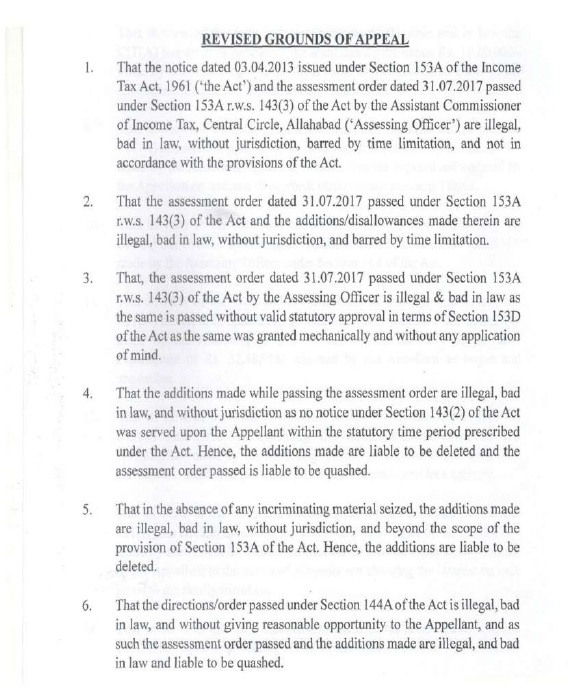
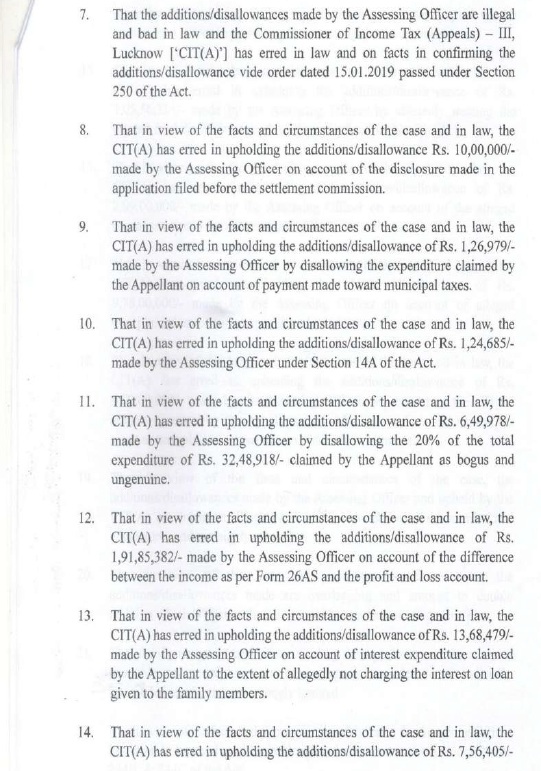
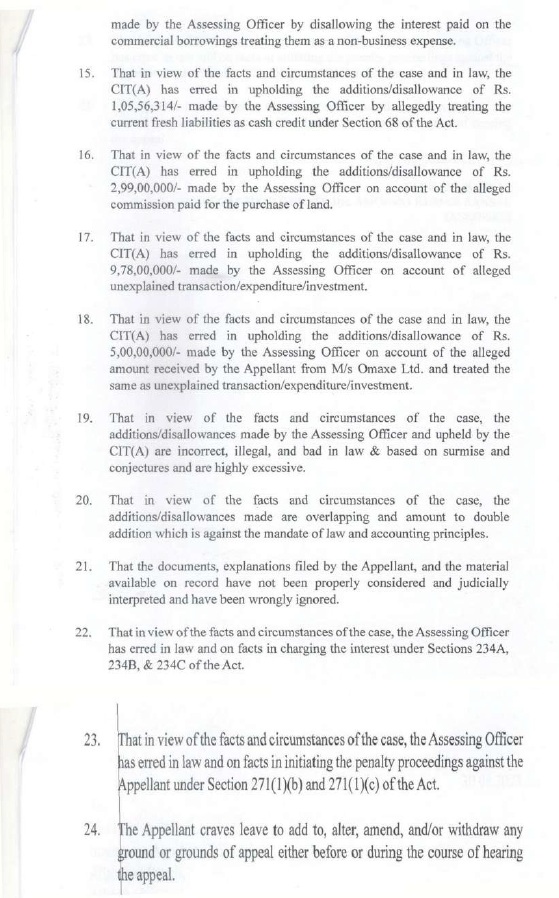
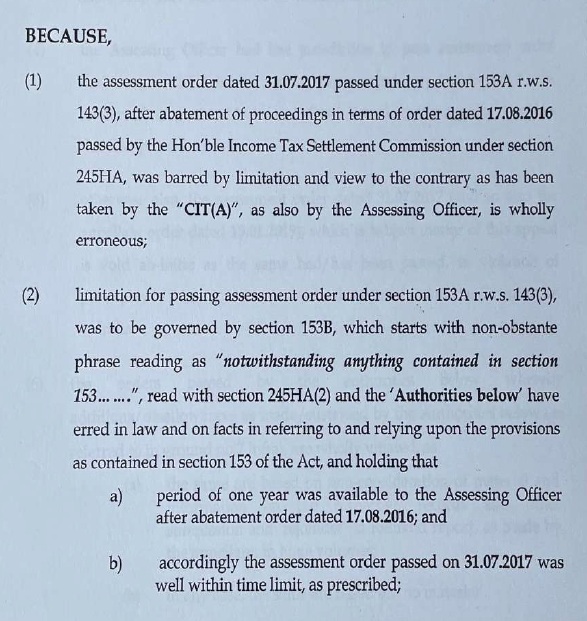
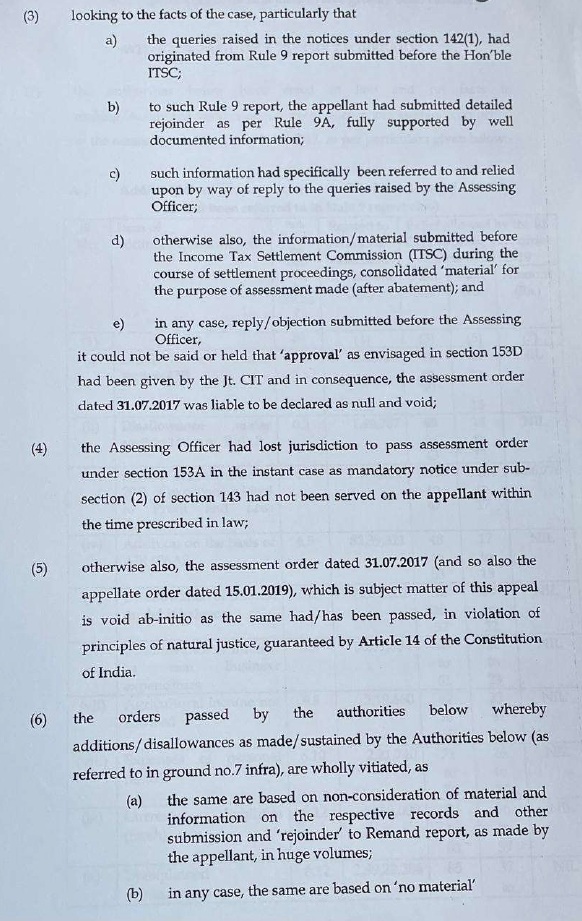
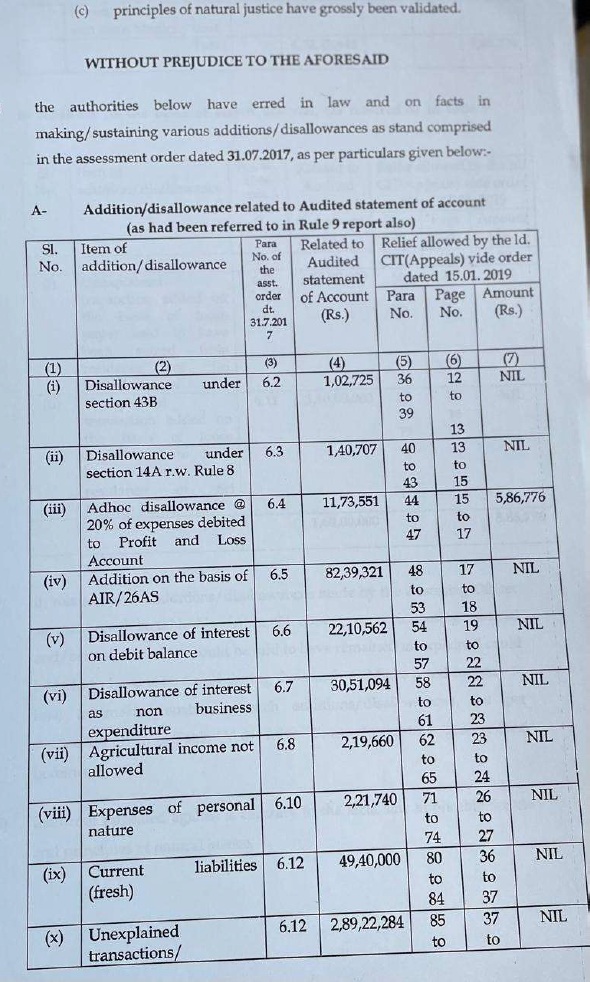
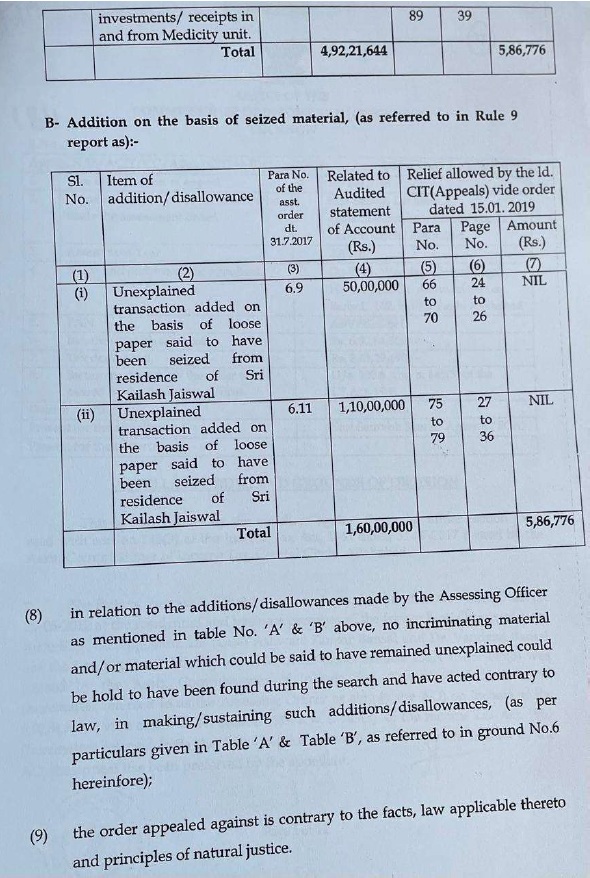
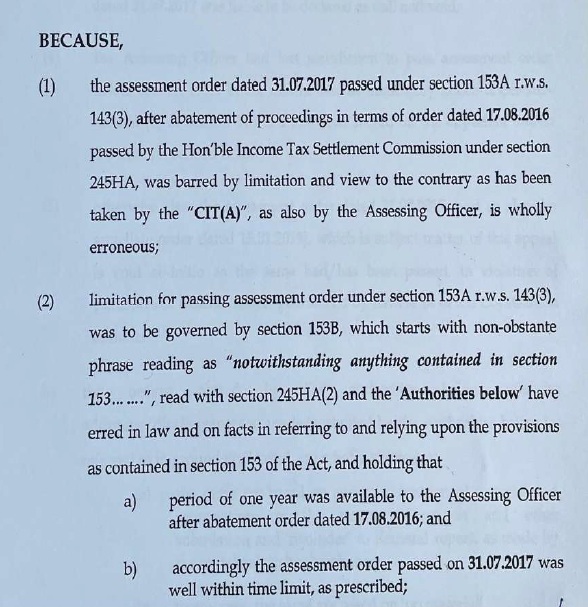
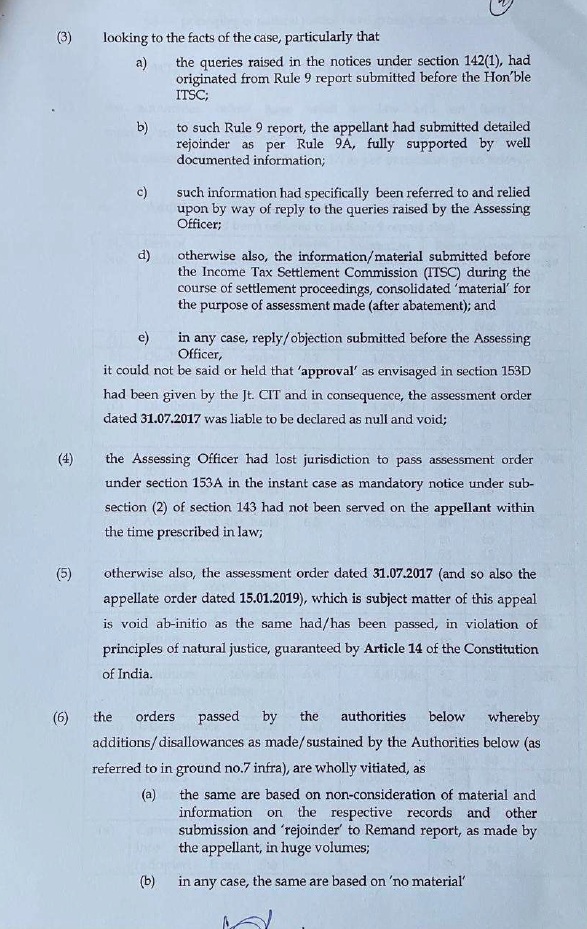
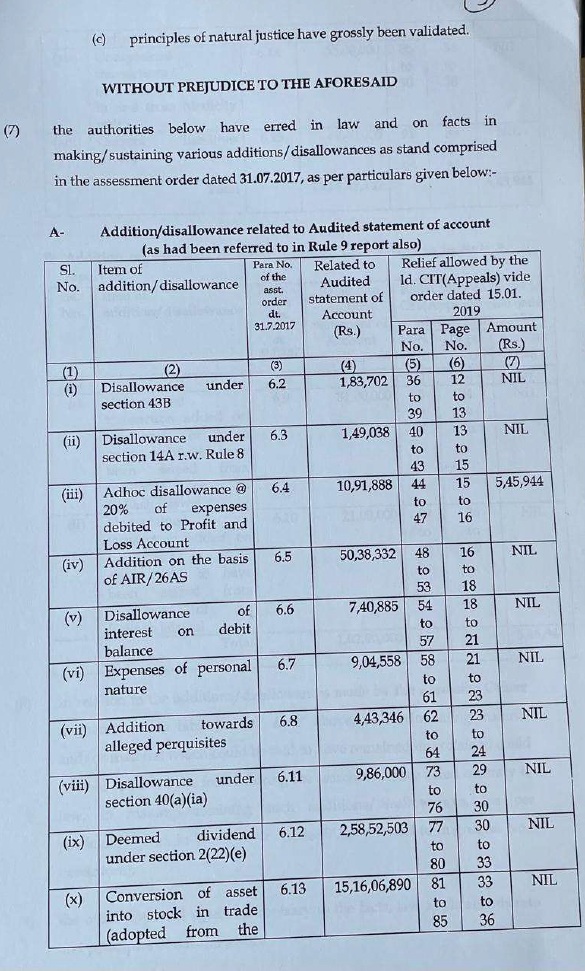
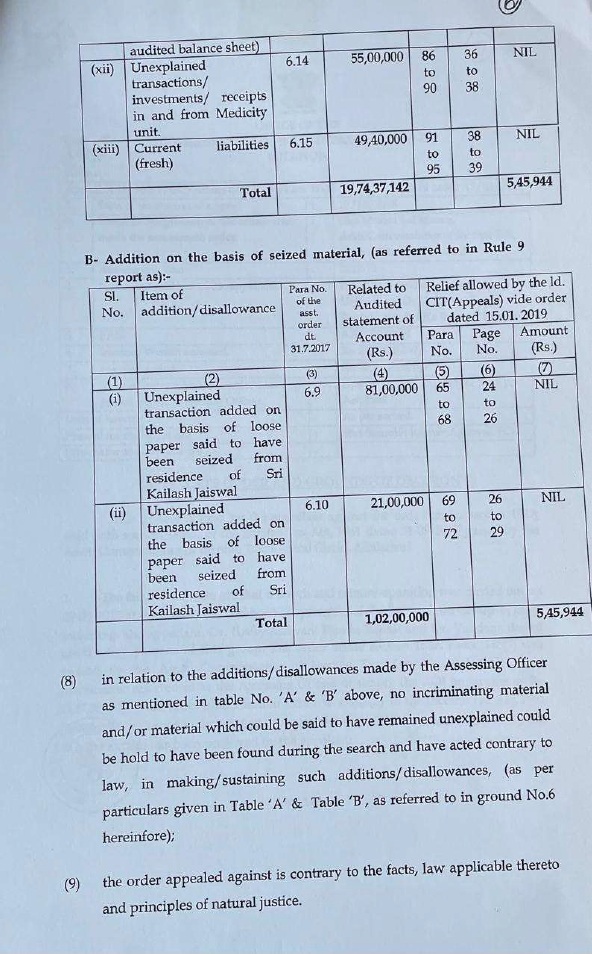
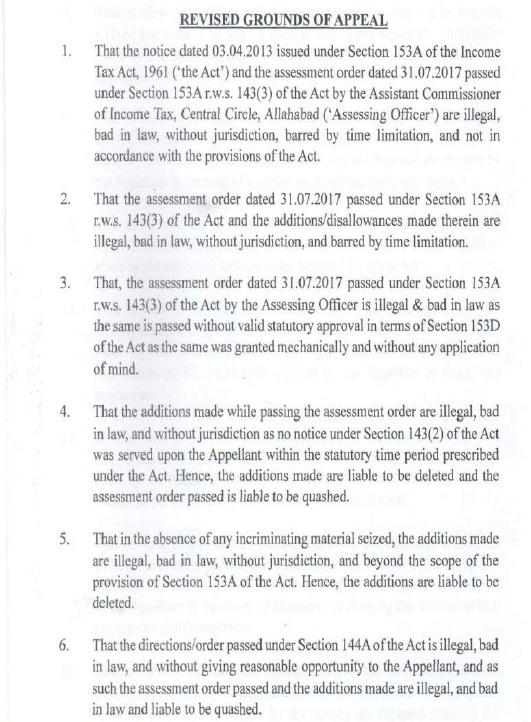
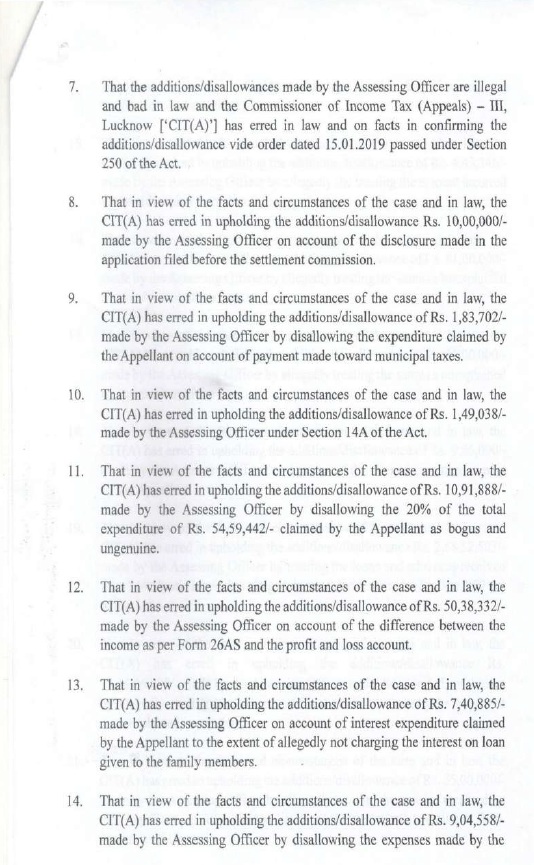
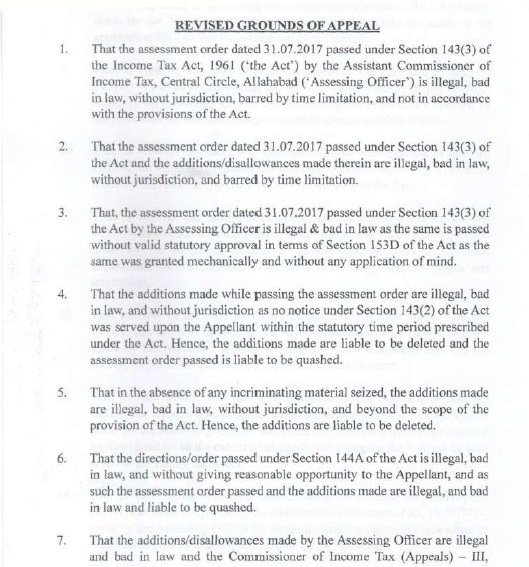
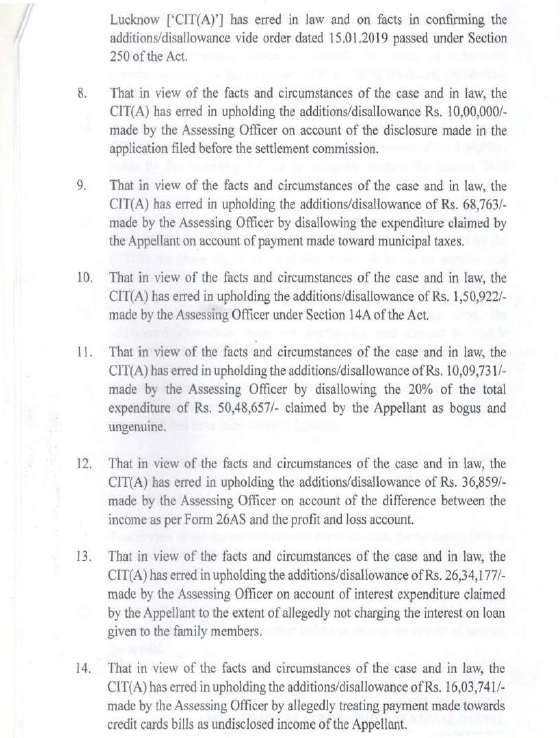
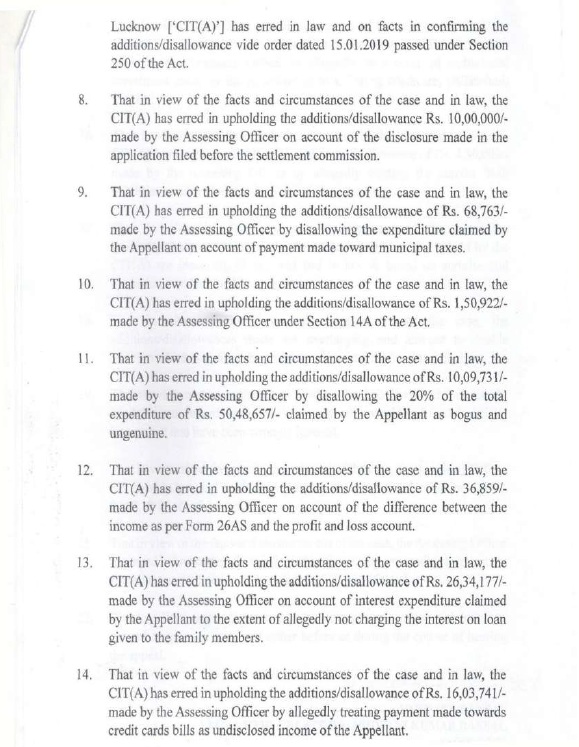
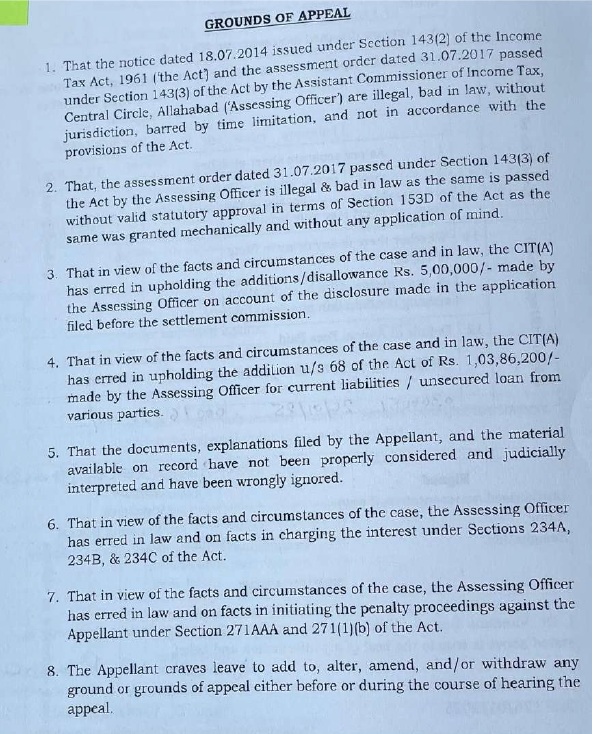
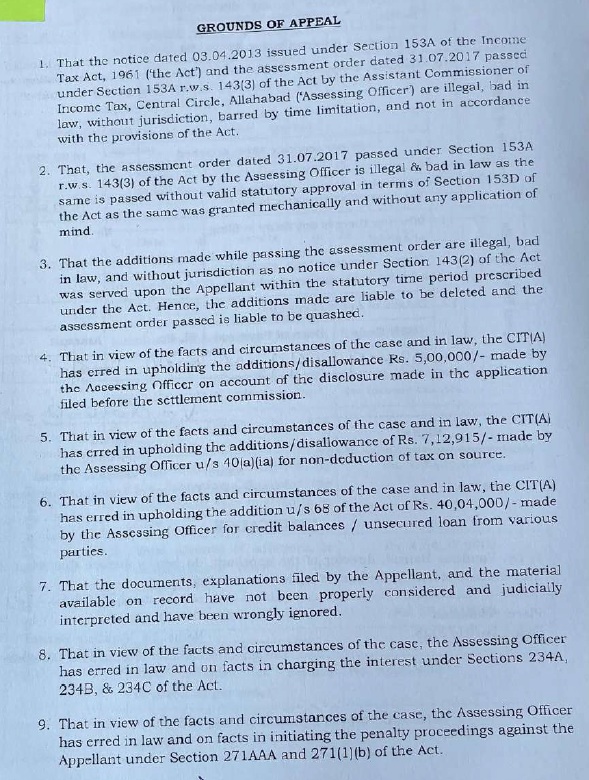
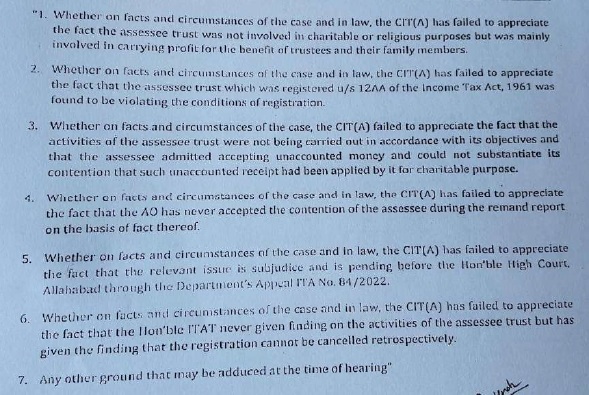
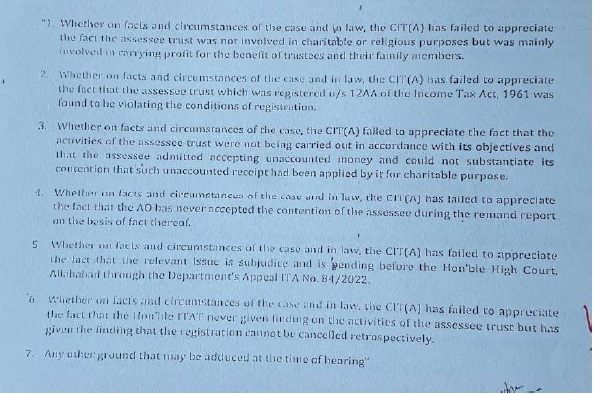
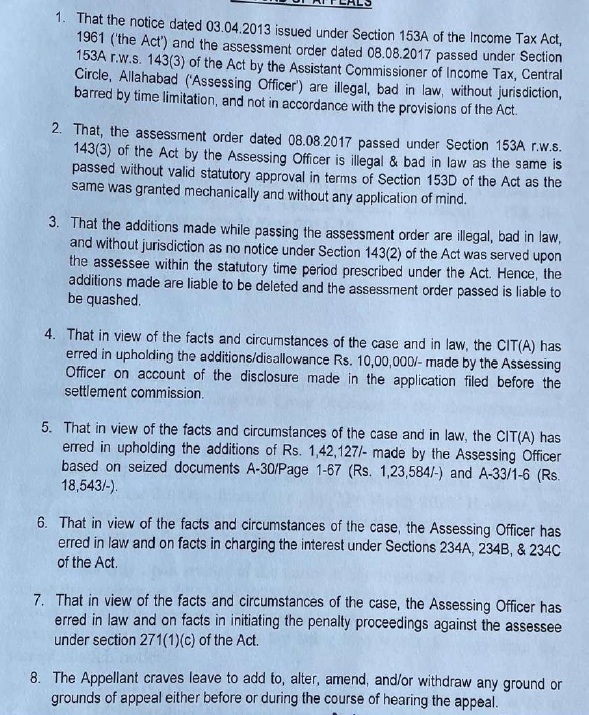
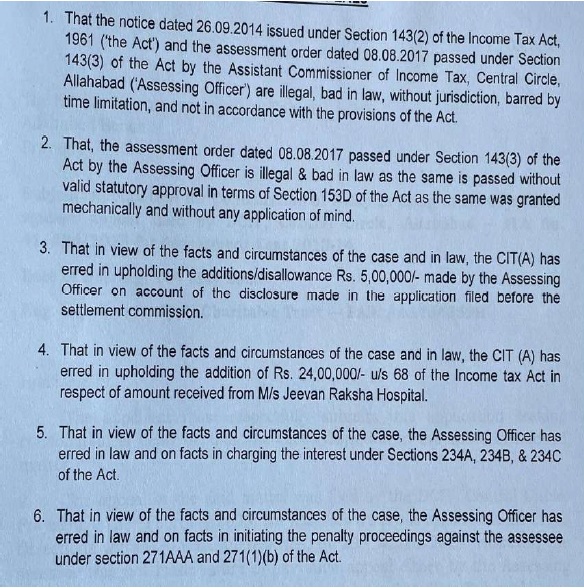
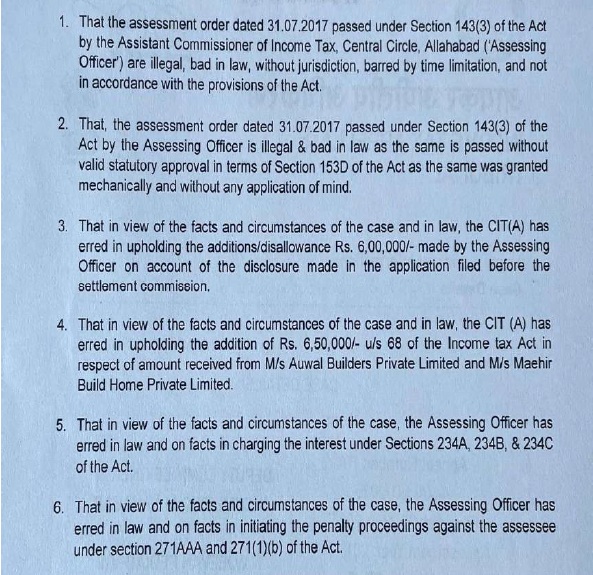
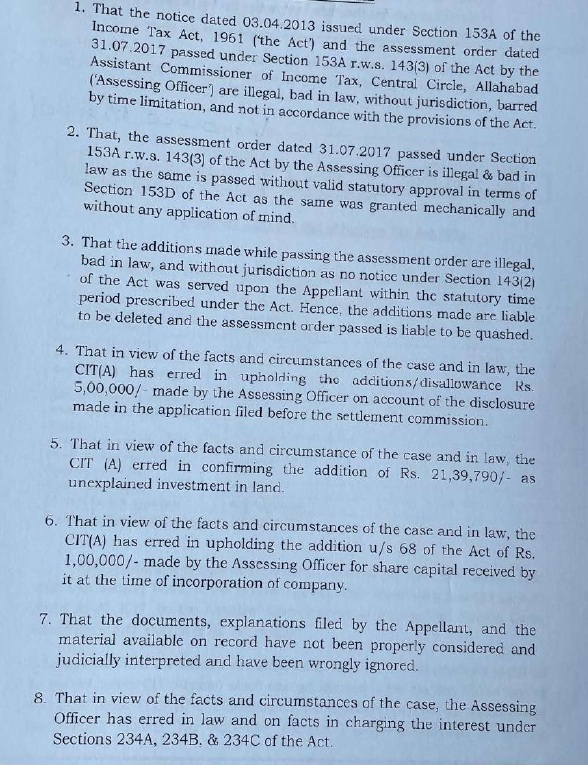
Anadee Nath Misshra, Accountant Member.- These appeals and Cross Objections pertaining to Jeevan Jyoti Group of cases are being disposed of through this consolidated order. Grounds taken in appeals and Cross Objections are as under:
I.T.A. No.337/Alld/2018 (Assessment year 2009-10)
I.T.A. No.34/Alld/2019 (Assessment year 2007-08)
I.T.A. No.35/Alld/2019 (Assessment year 2008-09)
I.T.A. No.36/Alld/2019 (Assessment year 2009-10)
REVISED GROUNDS IN I.T.A. No.36/Allahabad/2019
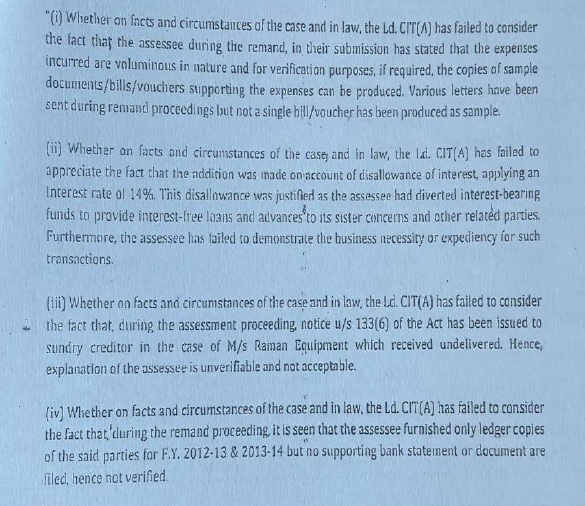
I.T.A. No.37/Alld/2019 (Assessment year 2010-11)
REVISED GROUNDS IN I.T.A. No.37/Alld/2019
I.T.A. No.38/Alld/2019 (Assessment year 2011-12)
I.T.A. No.39/Alld/2019 (Assessment year 2012-13)
REVISED GROUNDS IN I.T.A. No.39/Alld/2019
I.T.A. No.40/Alld/2019 (Assessment year 2013-14)
REVISED GROUNDS IN I.T.A. No.40/Alld/2019
I.T.A. No.13/Alld/2025 (Assessment year 2011-12)
I.T.A. No.14/Alld/2025 (Assessment year 2013-14)
I.T.A. No.39/Alld/2025 (Assessment year 2011-12)
I.T.A. No.40/Lkw/2025 (Assessment year 2012-13)
I.T.A. No.41/Alld/2025 (Assessment year 2013-14)
C.O. NO.02/Alld/2025 (in I.T.A. No.39/Alld/2025)
C.O.No.03/Alld/2025 (in I.T.A. No.40/Allahabad/2025)
C.O.No.04/Alld/2025 (in I.T.A. No.41/Alld/2025)
I.T.A. No.44/Alld/2025 (Assessment year 2013-14)
C.O.No.05/Alld/2025 (in I.T.A. No.44/Alld/2025)
I.T.A. No.54/Alld/2025 (Assessment year 2009-10)
I.T.A. No.55/Alld/2025 (Assessment year 2012-13)
I.T.A. No.56/Allahabad/2025 (Assessment year 2012-13)
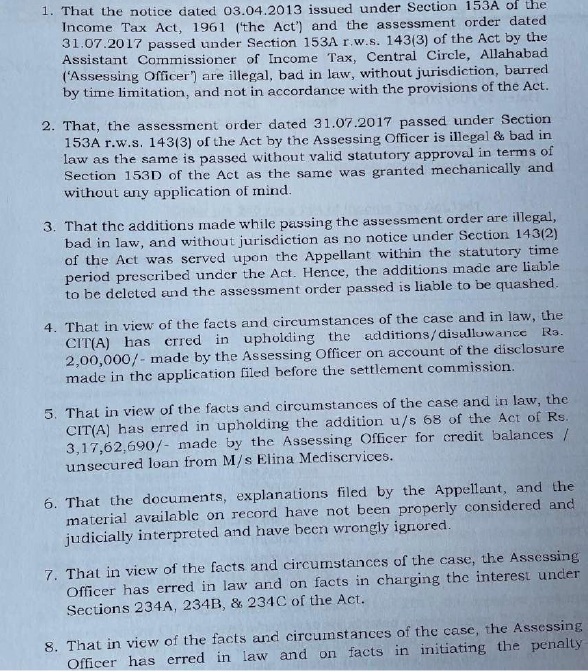
(B) In the case of aforesaid appeals/Cross Objections, pertaining to Arpit Hospital Pvt. Ltd., Jeevan Jyoti Charitable Trust, Navjeevan Pediatrics Pvt. Ltd., Minto Developers Pvt. Ltd. and Jeevan Jyoti Infrastructure Company Private Limited, this is the second round of appeal in Income Tax Appellate Tribunal. In first round of appeal, a consolidated order dated 21/12/2018 was passed by Coordinate Bench of the Income Tax Appellate Tribunal, Allahabad Bench, Allahabad for the aforesaid along with other cases of Jeevan Jyoti Group. In the aforesaid order dated 21/12/2018 of the Tribunal, all the appeals of all the assessees were remitted back to the learned CIT(A), to be decided afresh in accordance with law, on affording due and adequate opportunity of hearing to the assessees and on taking into consideration all the materials filed or to be filed by the assessees. It was further held in the aforesaid order dated 21/12/2018 that all pleas available under the law shall remain so available to the assessees. The appeals of the assessees in Income Tax Appellate Tribunal were remitted back to the learned CIT(A) vide the aforesaid order dated 21/12/2018 on the ground that a few issues were not decided by the learned CIT(A). For the ease of reference, the relevant part of the aforesaid order dated 21/12/2018 of the Income Tax Appellate Tribunal, is reproduced as under:
“4. Apropos grounds No.1 and 2, the assessee contended before the ld. CIT(A) that for the purpose of time limit for framing of assessment order in its case, section 153B of the Income Tax Act, 1961 is the governing provision. The assessee filed written submissions before the ld. CIT(A). These written submissions have been reproduced by the ld. CIT(A) in para 13, at pages 7 to 9 of the impugned order, as follows:-
“4. Coming to the ground relating to assessment being barred by limitation, the appellant begs to state that the assessment orders dated 31.07.2017 which are subject matter of appeals before your honour, are barred by limitation. The said objection had been raised before the Assessing Officer and to take the same to a logical conclusion the appellant had filed a petition under section 144A also before the Jt. CIT, Central, Varanasi. The Id. Assessing Officer has discussed the issue in paras 4, 4.2 and 4.3 of the assessment order.
5. Crux of the said discussion of the Assessing Officer is that after the case was abated under section 245HA(1)(iiia) of the Act vide order dated 17.08.2016 (it is wrong at the part of the Assessing Officer to say that the application of the assessee was rejected by the Hon’ble Settlement Commission, in opening line of para 4), copy appearing in the paper book nomenclatured as ‘papers filed before Hon’ble Settlement Commission’, that is being submitted before your honour; the time limit for completion of assessment will have to be reckoned as per section 153 of the Act.
6. As against this the appellant’s contention is that time limit for completion of assessment would be governed by the provisions contained in sub-section (2) of section 274HA with section 153B which starts with non-obstante phrase “(i) Notwithstanding anything contained in section 153….” To elaborate this issue, it is submitted that by virtue of abatement under clause (iiia) of sub-section (1) of ‘section 245HA the appellant got relegated to the stage at which it was at the time of filing the application for settlement of case on 11.02.2015 as per specific provision contained in sub-section (2). On the date of filing the application 48 days were available to the Assessing Officer for completion of assessment (31st March 2015 being the date of time barring). Therefore, as per sub-section (2) only 48 days were available to the Assessing Officer to complete the assessment under section 153A, after abatement. Such period of 48 days had expired on 04.10.2016. It means that latest by 04.10.2016, the assessment should have been completed (after abatement). It is a matter of record that even proceedings for assessment (after abatement) had not been initiated by that date and first notice under section 142(1) was served on the appellant was 19.12.2016. Therefore, the assessment orders dated 31.07.2017 are barred by limitation.
7. The authorities below differed on this issue by relying on the following proviso below section 153:-
Provided further that where a proceeding before the Settlement Commission abates under section 245HA, the period of limitation available under this section to the Assessing Officer for making an order of assessment, reassessment or re-computation, as the case may be, shall, after the exclusion of the period under sub-section (4) of section 245HA, be not less than one year; and where such period or limitation is less than one year, it shall be deemed to have been extended to one year; and for the purposes of determining the period of limitation under sections 149, 153B, 154, 155, 158BE and 231 and for the purposes of payment of interest under section 243 or section 244 or, as the case may be, section 244A, this-proviso shall also apply accordingly.
8. It is submitted with great respect that the non-obstante clause as appearing in section 153B as referred to above shall prevail over section 153 and “time limit of one year would not become available to the Assessing Officer for completion of assessment after abatement under clause (iiia) of section 245HA. Further, in support of appellant’s contention the appellant begs to refer and rely upon legal opinion (as has been submitted before the authorities below also) copy of which appears in the paper book which are being filed separately along with this written submission, description of which is appearing at the end of this submission.
9. In short, the appellant’s submission is that fallacy in rejection is evident by the fact that the same was based on the provision contained in section 153 of the Act and it bus been very conveniently ignored (by the Assessing Officer as well as by your Ld. joint CIT, Central Varanasi) that sections 153A, 153B, 153C and 153D represented ‘complete code’ to deal with search related assessments and, therefore, limitation for completion of assessment as has been specifically provided in section 153B read with section 245HA(2), was liable to be strictly adhered to. it is evident from a plain reading of section 153B itself, which starts with non-obstante phrase reading as “(i) notwithstanding anything contained in section 153”. Thus, there was no ambiguity in the Act for computing time limit for completion of assessment and the only provision contained in section 153B was required to be looked into and nothing beyond this.”
5. The ld. CIT(A) has held as follows:-
“16. In this ground the appellant has contended that once the case got abated in terms of order under section 245HA dated 17/08/2016, passed by Hon’ble ITSC, New Delhi, assessment under section 153A was liable to be completed within the period of 48 days which has expired on 04/10/2016, hence the assessment order dated 31/07/2017 u/s 153A was barred by limitation.
17. On examination, I find that the appellant along with 12 Group cases of “jeevan Jyoti Group” has filed an application before the ITSC, New Delhi in Feb, 2015. After considering the submission of the appellant and the reports of the department, Hon’ble ITSC, New Delhi has passed order u/s 245D(4) of the Act, dated 17/08/201.6. In the said order, Hon’ble ITSC has given finding in Para 30, as under-
“It is clean in this background that the mandate cast upon the commission u/s. 245HA(1)(iiia.) for providing terms of settlement, cannot be discharged. We accordingly allow proceedings pending before us to abate. The matters stand restored to the file of the AO.”
18. On bare reading the provisions of section 153 of the Act, relating to limitation of assessment in cases abated before Settlement Commission, it is clearly evident that The period available to me AO for making assessment, reassessment or re-computation shall be one year from the date of receipt of order passed by the Settlement Commission. The proviso to Explanation 1 of section 153 of the Act is reproduced as under:-
“Provided also that where a proceeding before the Settlement Commission abates under section 245HA, the period of limitation available under this section to the Assessing Officer for making an order of assessment, reassessment or re-computation, as the case may be, shall, after the exclusion of the period under sub-section (4) of section 245HA, be not less than one year; and where such period of limitation is less than one year, it shall be deemed to have been extended to one year; and or the purpose of determining the period of limitation under sections 149, 153B, 154, 155 and 158BE and for the purposes of payment of interest under section 144A, this proviso shall also apply accordingly.”
“19. In view of proviso to Explanation 1 of section 153 of the Act, the period of limitation for assessment, reassessment or re-computation in cases abated before the Commission shall not be less than one year after excluding period under sub-section (4) of section 245HA of the Act, i.e. the period, commencing on and from the dale of the application to the Settlement Commission u/s 245C and ending on the specified date referred in sub-section (1). The instant case falls within the ambit of section 245HA(1)(iiia) of the Act. Hence, specified date shall be the date on which the order under sub-section (4) of section 245D was passed for not providing for the terms of the settlement.
20. Therefore on examining the provisions as hereinabove, relating to the limitation of assessment in cases abated before Settlement Commission, it is clearly evident that the period available to the AO for making assessment, reassessment or re-computation shall be one year from the date of receipt of order of passed by the Settlement Commission. Since the order u/s 245D(4) was passed by the Settlement Commission on 17/08/2016 therefore the case shall not be barred by limitation before 16/08/2017, i.e. one year from the date of order of the Settlement Commission not providing for the settlement.
21. In view of the above, Appellant’s contention that the assessment made by the AO u/s 153A of the Act on 31/07/2017 was barred by limitation is found to be totally unjustitied, Hence Ground no. 3 raised by the appellant are hereby rejected.”
6. The assessee’s grievance is that its contention of applicability of section 153B of the Act as the only provision governing limitation for framing of assessment order, has not been considered, much less decided by the ld. CIT(A).
7. The Department, on the other hand, contends as follows:-
| (i) |
|
As per second proviso of section 153(4) the Assessing Officer has passed the order as per the time and this proviso was inserted from 01.06.2007. The order has been passed by the commission u/s 245D(4) after considering the application of the applicant and it is very speaking order. The applicant has submitted that the settlement application was filed much earlier therefore settlement commission cannot apply the section 245H(A)(iiia) and the time limit for the exclusion clause will not be applicable in this case. The issue has been argued in length wherein it has been shown to the Bench that the exclusion clause is available from 01.06.2007 although section 245(h)(iiia) came in the statute from 01.06.2015. |
| (ii) |
|
The argument of the appellant is that the notwithstanding clause of section 153(B) debar the assessing officer to take the shelter of the second proviso of section 153(4) and the order has been time barred. Section 153 is explaining of the exclusion clause and if the notwithstanding as argued by the appellant may be accepted then whole section 153 may become redundant. |
| (iii) |
|
The appellant has tried to submit before the Bench to persuade that sections 148 and 153 are perimaterial’. But the fact of the matter is that the language of the sections 148 and 153A are not the same and even the purposes of both the sections are different to assess the income of assessee. The appellant has read the case law of Rajiv Sharma of Allahabad High Court 336 ITR 678 and relied on para 19 of the order where it has been held that While computing escaped assessment, return filed in response to notice under section 148, shall be deemed to be furnished under section 139 of the Act. Meaning thereby, procedure of section 139 of the Act shall be followed while dealing with the case of escaped assessment under section 148 of the Act. This para itself speaking about escaped income and written filed in response to notice u/s 148 shall be deemed to furnish u/s 139 of the Act and section 139 of the act shall be followed while dealing with the case u/s 148. 153A has nothing to do with escaped income described in section 147. The purpose of both the sections are altogether are different and this case pertains to A.Yrs. 1994, 1995 and 1996 when the concept of 153A was not in the statute. The section 153A starts with “Notwithstanding anything contained in sections 139, 147, 148…….. it means 153A has a separate jurisdiction and separate concept to assessment in the case of search action.” |
8. Section 153 concerns time limit for completion of assessment and re-assessment under sections 143 and 144 of the Act. Section 153A of the Act deals with the assessment in case of search or requisition. Section 153B of the Act relates to time limit for completion of assessment under section 153A of the Act. The assessment order in the present case is dated 31/7/2017. It has been passed under section 153A read with 143(3) of the Act. The Assessing Officer has applied the provisions of section 153 to compute the limitation for passing of the assessment order. The assessee’s plea that it is the provisions of section 153B of the Act and not those of 153 thereof, has, evidently, not been taken into consideration, or decided. Therefore, indeed, the grievance of the assessee that its such contention has not been dealt with by the ld. CIT(A), is correct. The impugned order in this regard is, therefore, non-speaking and has caused prejudice to the assessee. Accordingly, this matter is remitted to the file of the ld. CIT(A), to be decided afresh in accordance with law, on affording due and adequate opportunity of hearing to the assessee and on considering the material filed/to be filed by the assessee before the ld. CIT(A). The assessee, no doubt, shall co-operate in the fresh proceedings before the ld. CIT(A).
9. As per ground No.3, the assessment order is void ab-initio, since no mandatory approval of the JCIT, within the meaning of section 153B of the Act, was obtained. In this regard, the Department contends that “The appellant without any material having in its possession submitted before the Bench that the Joint CIT/Addl.CIT has not applied its mind while according approval u/s 153(B). This issue was raised first time before the tribunal therefore at outset it is being submitted here that it need not to be entertained and Hon’ble Bench may consider to reject it. The assessment order is very speaking and approval of the Joint CIT is with full application of mind.”
10. The Assessing Officer, in the last para of the assessment order, states as follows:-
“This order is passed with the prior approval of the Joint Commissioner of Income Tax, Central Range, Varanasi. (Vide F.No.JtCIT/CR/VNS/Approval u/s 153D/JJGroup/2017-18/304 dated 31.07.2017.”
11. Since the issue concerning ground Nos.1 and 2 has been remitted to the file of the ld. CIT(A) as above, this matter is also remitted to the file of the ld. CIT(A), to be decided in accordance with law, on ascertaining the facts with regard to the approval under section 153D of the Act.”
On perusal of the aforesaid order dated 21/12/2018 of the ITAT, it is obvious that therein, the assessees had raised the issue in appeals that the assessment orders were barred by limitation. Further, the assessees had also taken the ground that the assessments were void ab initio as the assessments had been passed without valid approval of Jt. Commissioner of Income Tax (“JCIT” for short) within the meaning of section 153D of the Act.
(B.1) The learned CIT(A) passed consequential orders in pursuance of the aforesaid order dated 21/12/2018 of the ITAT in the case of Arpit Hospital Pvt. Ltd., Jeevan Jyoti Charitable Trust, Navjeevan Pediatrics Pvt. Ltd., Minto Developers Pvt. Ltd. and Jeevan Jyoti Infrastructure Company Private Limited. In the consequential appellate order, the learned CIT(A) took the view that the assessments were not barred by limitation. She further took a view, agreeing with her predecessor, that the JCIT had given prior approval to the assessment order after due application of mind and examining facts of the case and records. The predecessor CIT(A) had observed, holding that the assessees’ contention to the effect that approval was done in mechanical manner, was totally unjustified: “I find that the JCIT has given prior approval to the order passed u/s 153A read with section 143(3) of the Act by the Assessing Officer after due application of mind and examining the facts of the case and records. Therefore, appellant’s contention that the approval was done in a mechanical manner is found to be totally unjustified and is hereby rejected” (Quoted). Aggrieved, Arpit Hospital Pvt. Ltd. (for assessment years 2012-13 and 2013-14), Minto Developers Pvt. Ltd. (for assessment years 2009-10 and 2012-13) and Jeevan Jyoti Infrastructure Company Private Limited (for assessment year 2012-13) are in appeal against the consequential appellate order of learned CIT(A). Revenue is in appeal in the case of Jeevan Jyoti Charitable Trust (for assessment years 2011-12 to 2013-14) and Navjeevan Pediatrics Pvt. Ltd. (for assessment year 2013-14) against the consequential appellate orders of the learned CIT(A) in respect of relief granted by the learned CIT(A).
(C) There was search & seizure operation u/s 132 of the Act conducted in Jeevan Jyoti Group of cases on 29/05/2012. During the subsequent assessment proceedings, the assessees filed applications u/s 245C of the Act in Income Tax Settlement Commission (“ITSC” for short). The applications of the assessees were admitted vide orders dated 01/05/2015 passed u/s 245D of the Act. Reports of the Pr.CIT, Kanpur under Rule 9 of Income Tax Settlement Commission (Procedure) Rules, 1997 [”ITSC(P) Rules” for short] were obtained by ITSC. The response of the assessees under Rule 9A of ITSC(P) Rules were also obtained by ITSC. Later, ITSC passed orders dated 17/08/2016 u/s 245HA(iiia) of the Act, allowing proceedings before the ITSC to abate. The ITSC restored the matters to the file of the Assessing Officer. Therefore, the Assessing Officer passed assessment orders, the validity of which are under challenge in the appeals/Cross Objections filed by the respective assessees in the present set of appeals.
(D) During appellate proceedings in Income Tax Appellate Tribunal, the learned D.R. for Revenue adduced additional evidence in the paper books filed by them, such as an affidavit of the Assessing Officer and also personal testimony of Mr. Agrahari, Inspector working in Income Tax Department, who was produced in person before us. The learned Counsel for the assessees expressed no objection to admission of the same. In view of the foregoing, the additional evidences adduced by Revenue are admitted.
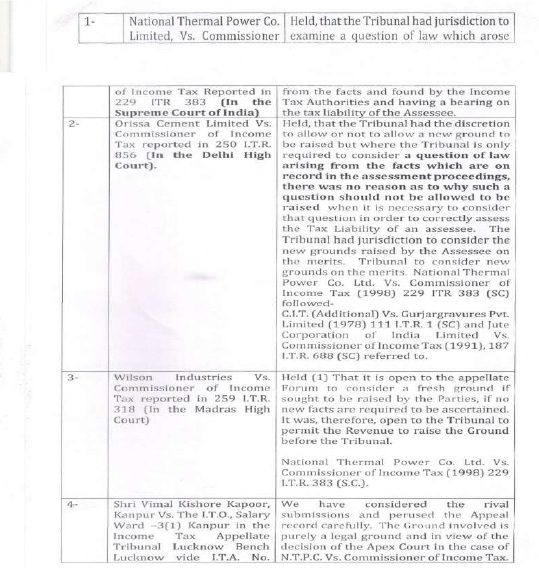
(D.1) In the common paper book (Volume-I); the learned Departmental Representatives objected to the admission of additional grounds filed by the assessee. Although, no serious objection was expressed by them against admission of additional grounds, at the time of oral hearing before us; we deem it fit to decide the admissibility of additional grounds. The assessees relied on the Supreme Court order in the case of National Thermal Power Co. Ltd. v. CIT ITR 383 (SC) and Jute Corpn. of India Ltd. v. CIT ITR 688 (SC). Further as discussed earlier, while passing the aforesaid order dated 21/12/2018, Coordinate Bench of the ITAT, Allahabad had already decided grounds pertaining to whether the assessment was barred by limitation and whether the approvals given by the JCIT u/s 153D of the Act were valid. These issues permeate through all the cases in the appeals before us. On identical facts, the learned CIT(A) has already passed two rounds of orders in impugned group cases [as discussed in foregoing paragraphs (B) and (B.1) of this order] wherein the issue regarding validity of approval u/s 153D of the I.T. Act has been decided. No fresh investigation of facts is required as the issues have been examined by learned CIT(A) in the appellate proceedings in the group cases in earlier rounds of appellate orders passed by the learned CIT(A). Further, perusal of grounds of Cross Objections filed by the assessee, show that specific ground has been taken with regard to approval of the JCIT u/s 153D of the Act. Furthermore, in the aforesaid consolidated order dated 21/12/2018 of Coordinate Bench of the Tribunal, it is seen that the assessees had raised the issue regarding the approval u/s 153D of the Act, which were also adjudicated in the aforesaid order dated 21/12/2018 and the matter was set aside to the file of the Ld. CIT(A). Moreover, on perusal of the original and the consequential orders passed by the learned CIT(A), as referred to in foregoing paragraphs No. (B) and (B.1) of this order, it is found that the issue regarding approval of JCIT u/s 153D of the Act was specifically adjudicated in both the orders by the learned CIT(A). In view of the foregoing, the grounds taken in the present appeals/Cross Objections of the assessees are not strictly in the nature of “additional grounds”, as alleged by the learned D.R. The issue regarding the approval given by learned JCIT u/s 153D of the Act, thus specifically arises from the orders passed by the learned CIT(A). Moreover, Rule 11 of Income Tax (Appellate Tribunal) Rules, 1963 (“ITAT Rules” for short) authorizes the ITAT to admit additional grounds of appeal.
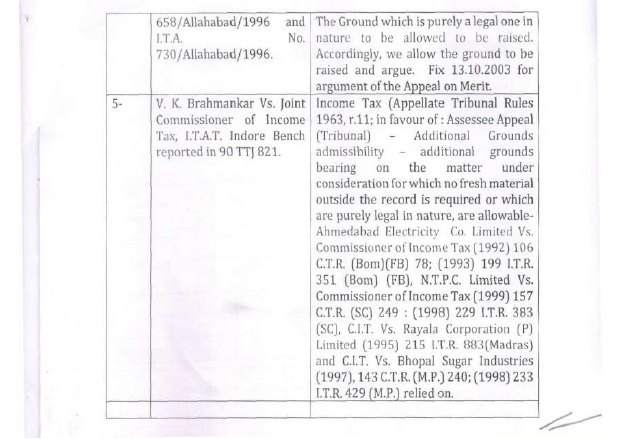
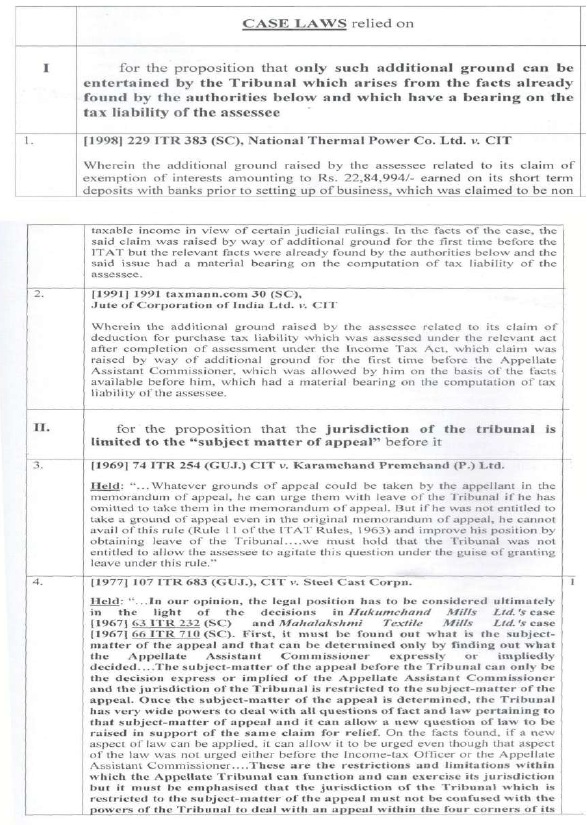
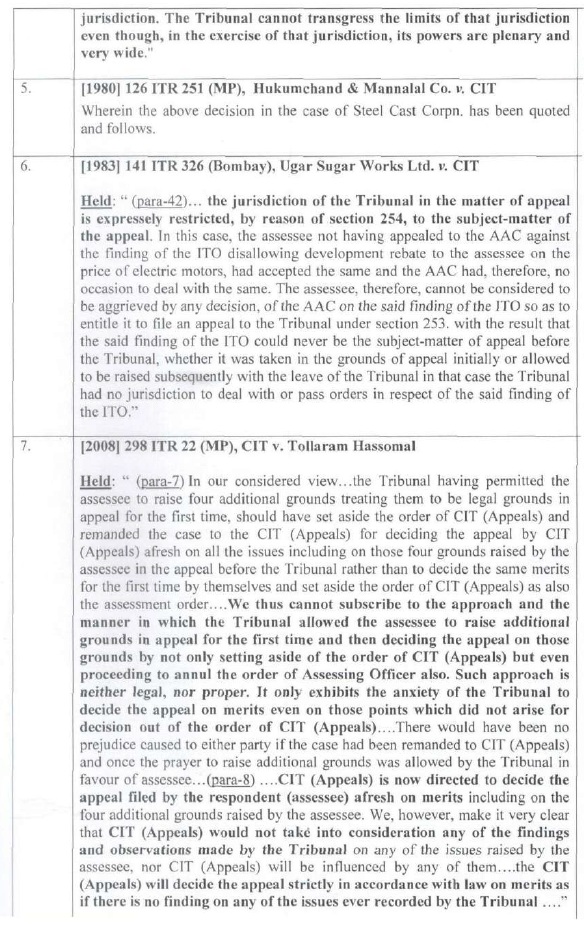
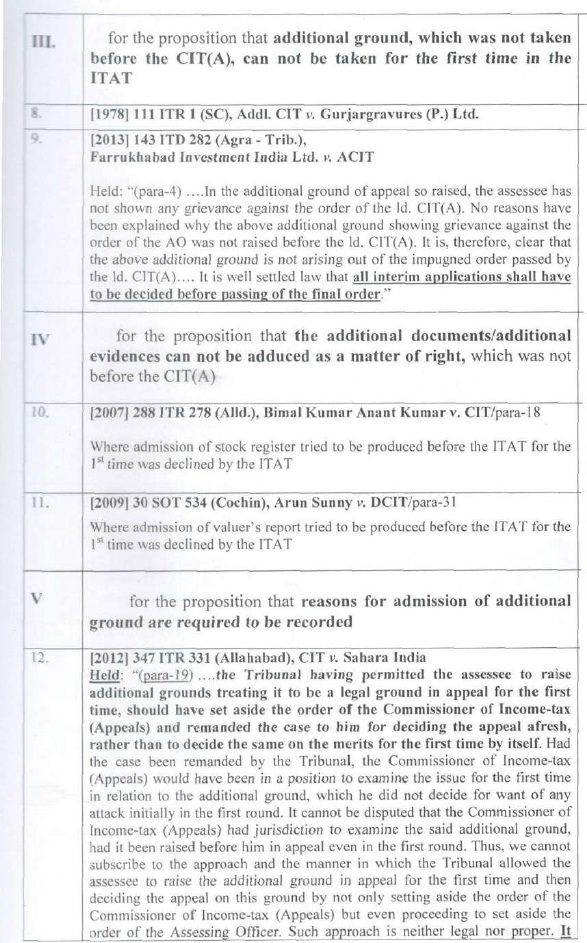
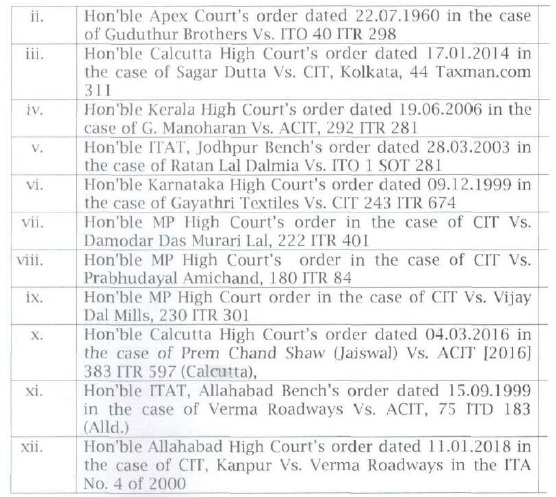
(D.2) Moreover, it is well settled in numerous precedents that the Tribunal can admit additional grounds of appeal. Some such decision are as under:
(D.2.1) In view of the foregoing, the grounds of the assessees, taken in appeals/Cross Objections regarding validity of approval granted u/s 153D of the I.T. Act, are being admitted.
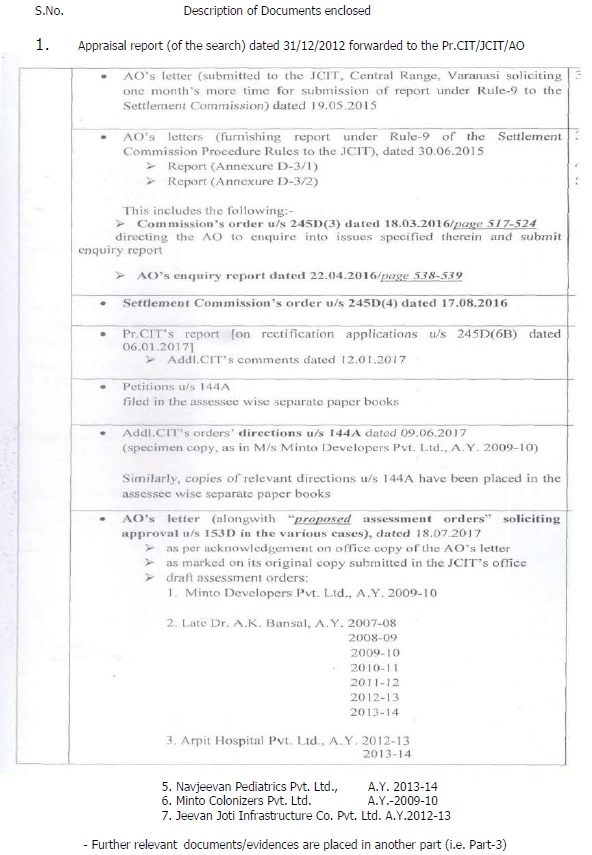
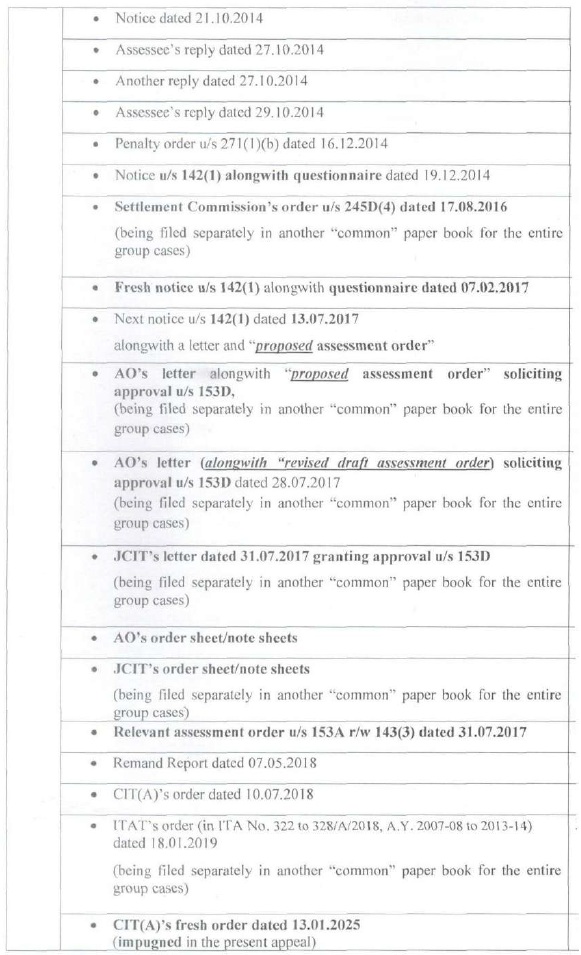
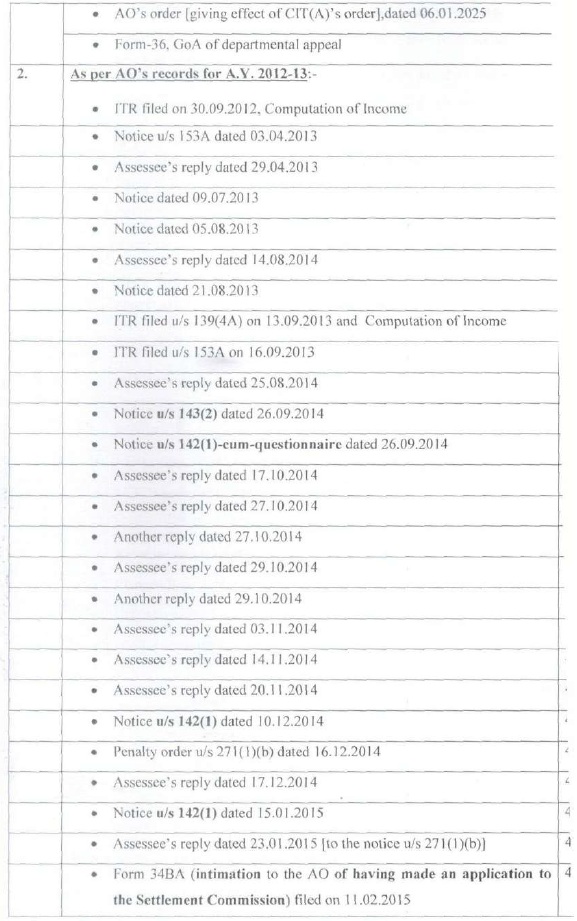
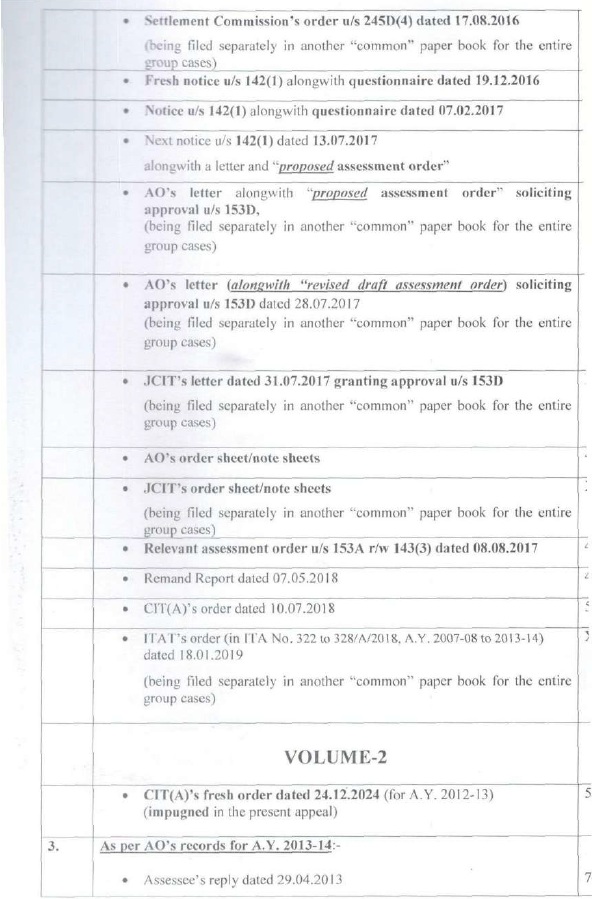
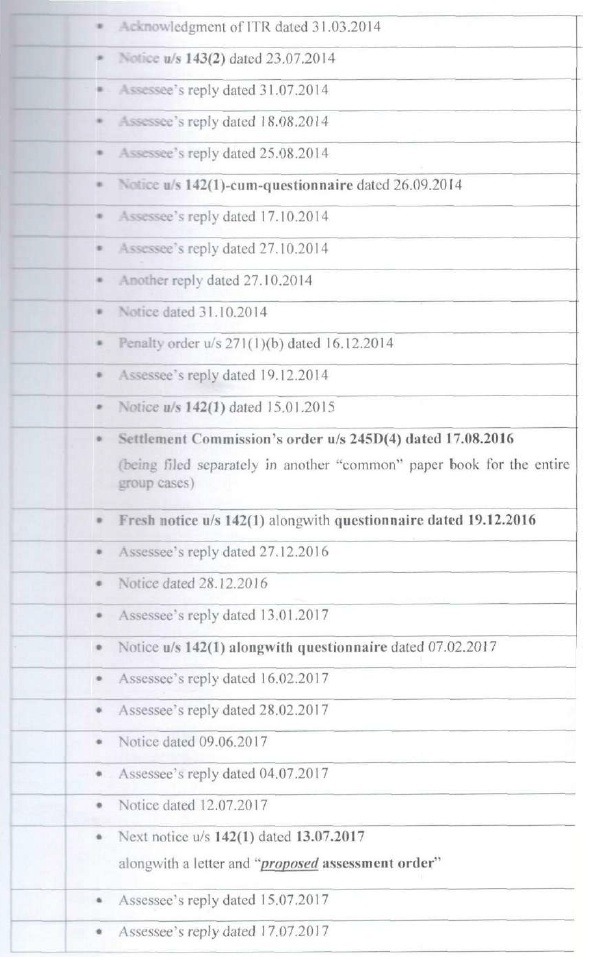
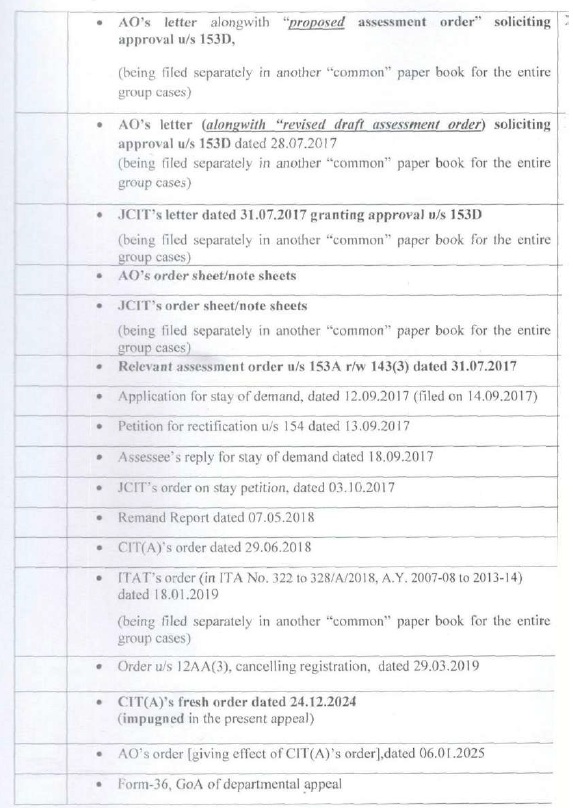
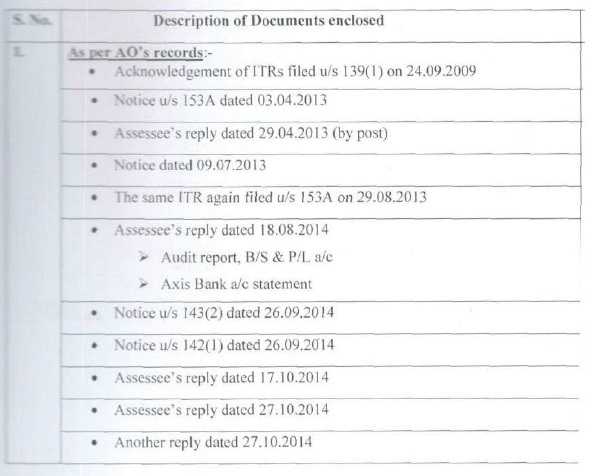
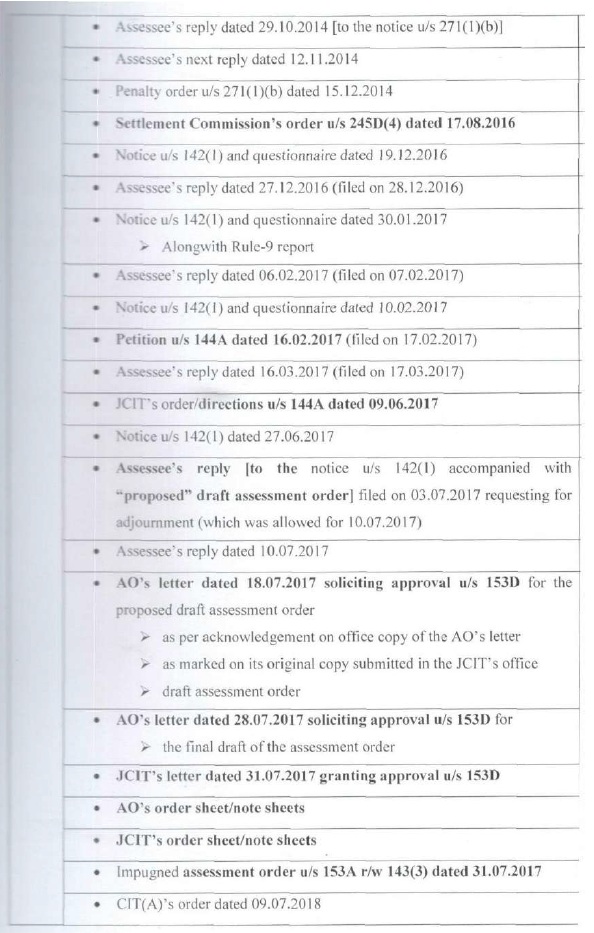
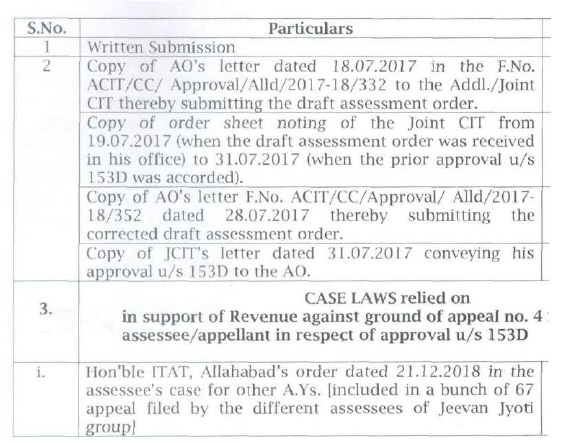
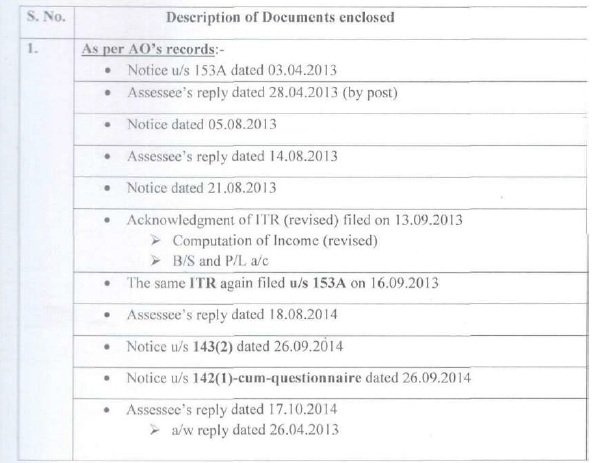
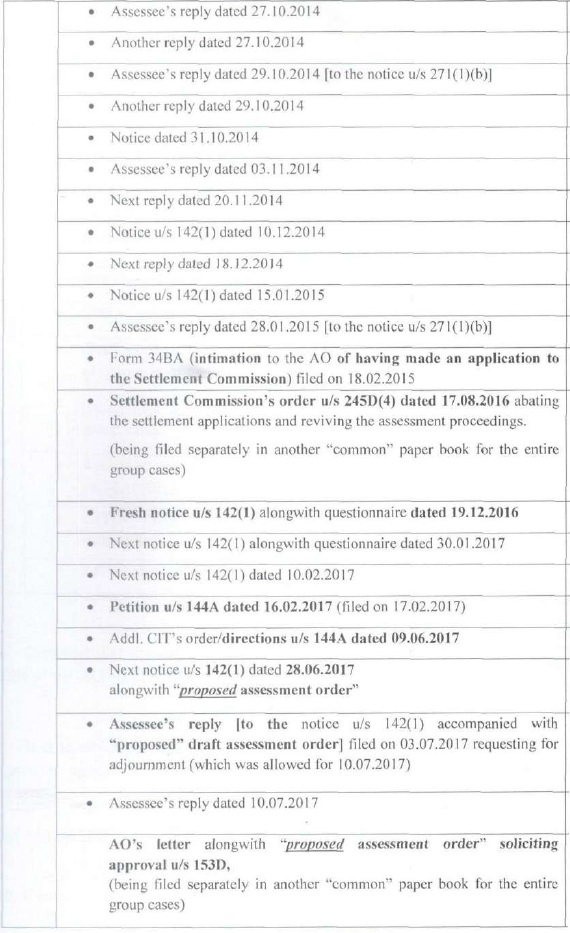
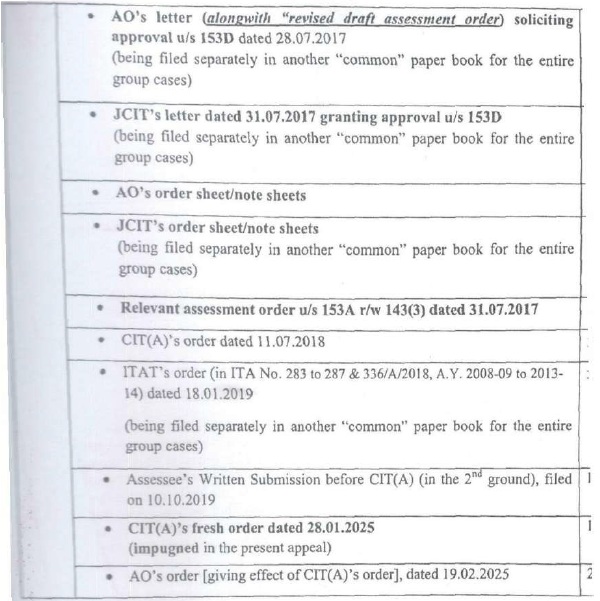
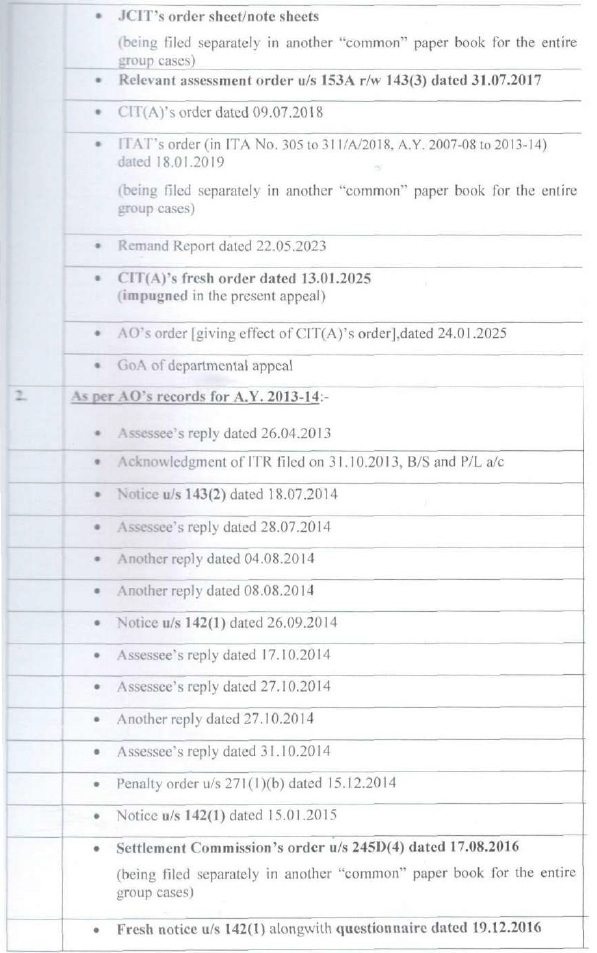
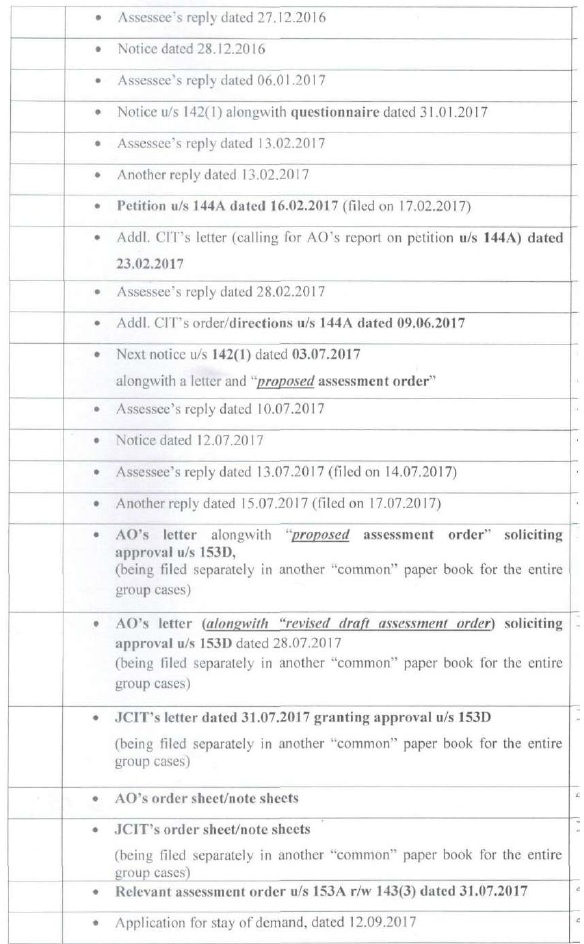
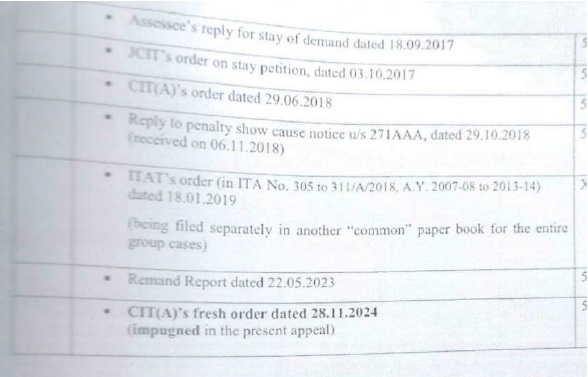
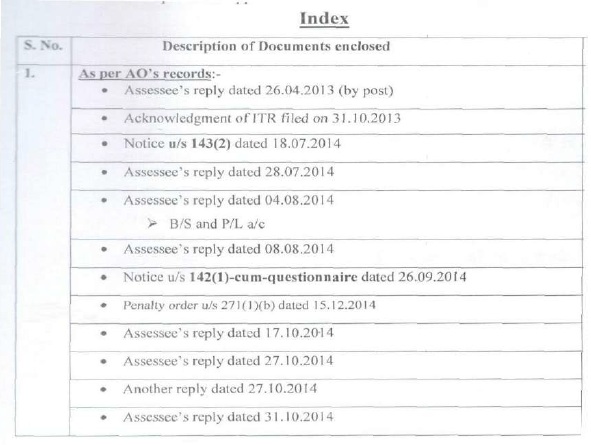
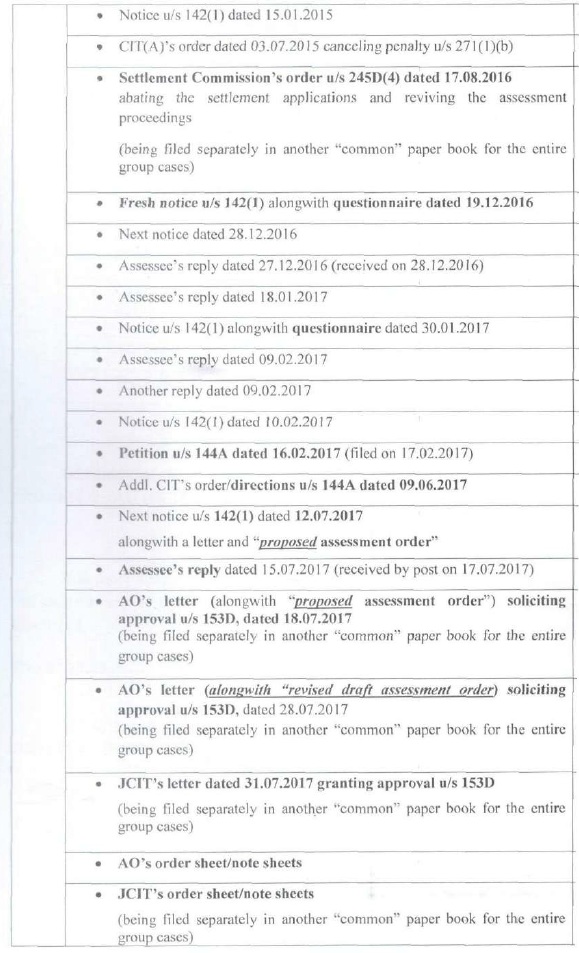
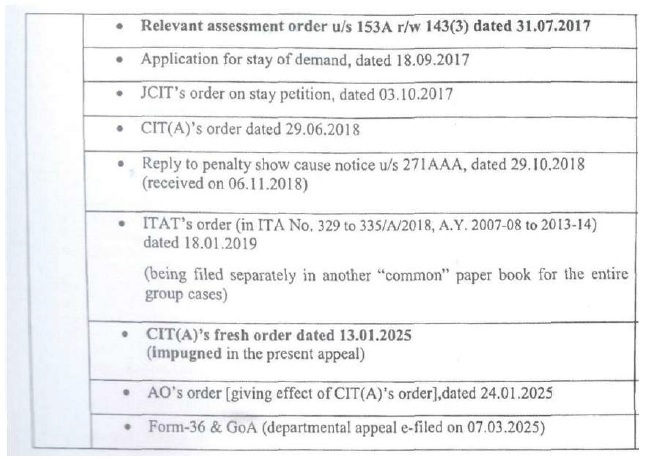
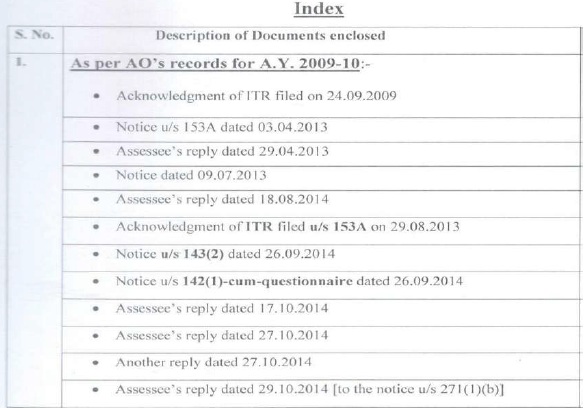
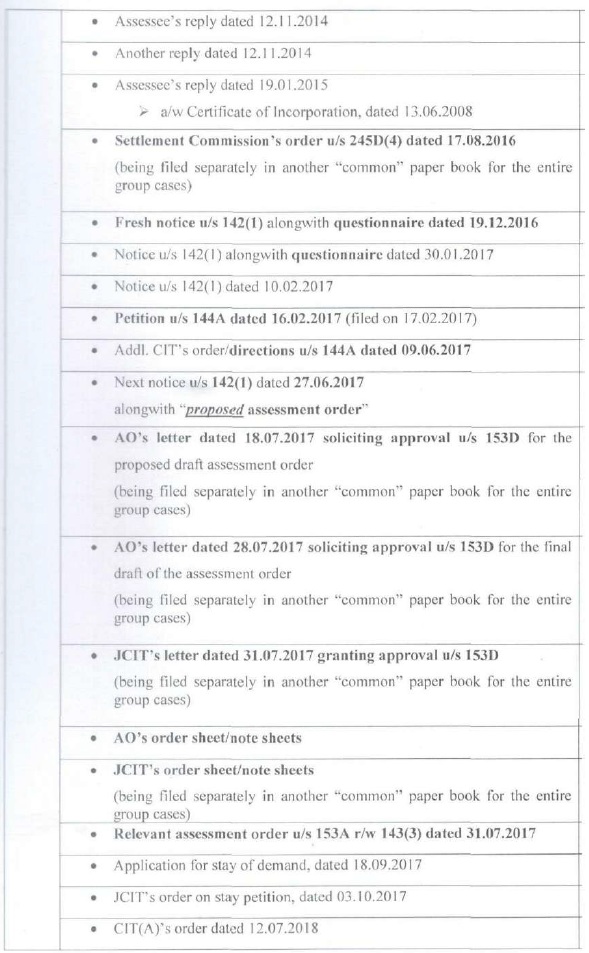
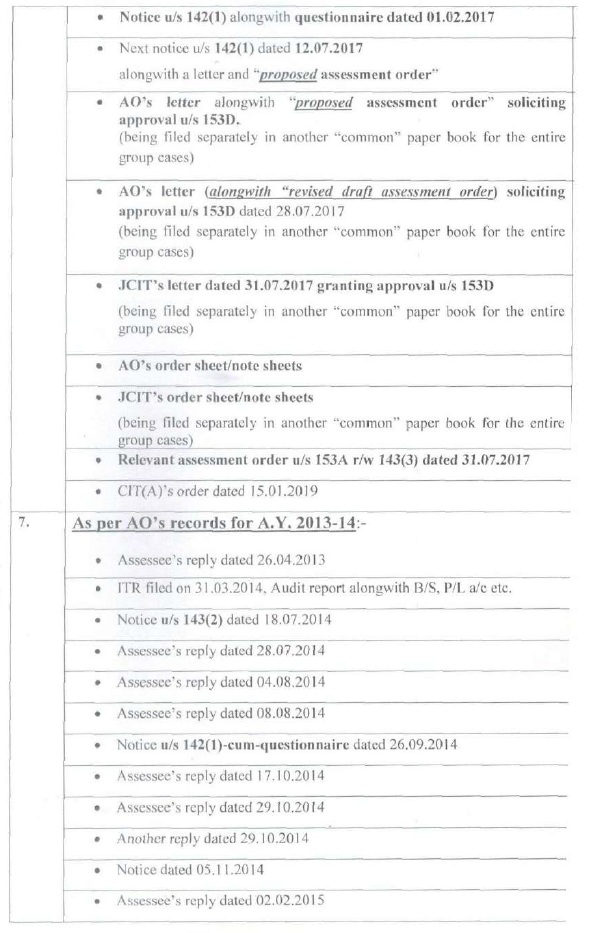
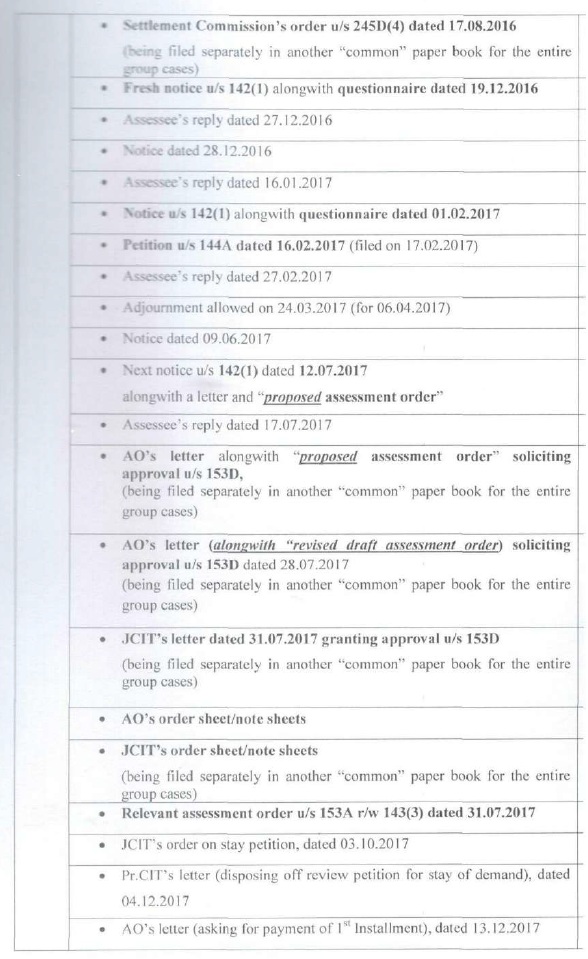
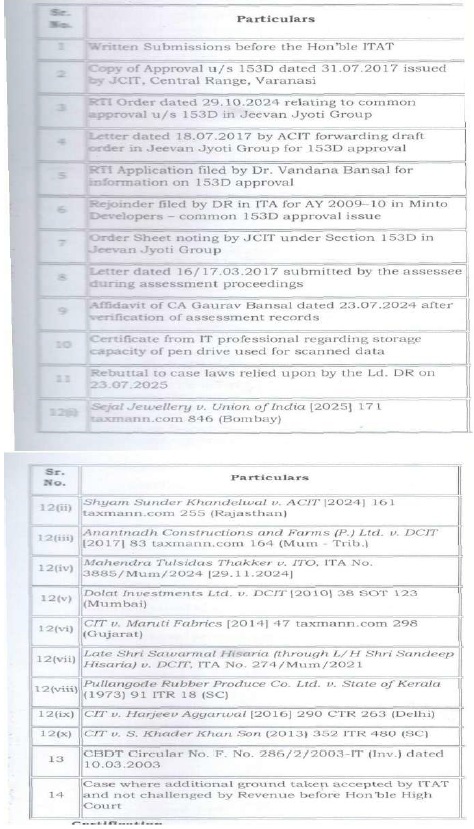
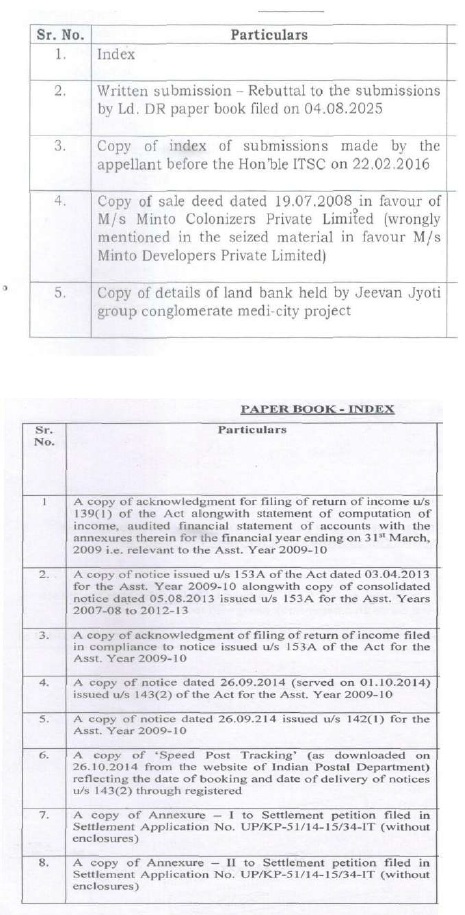
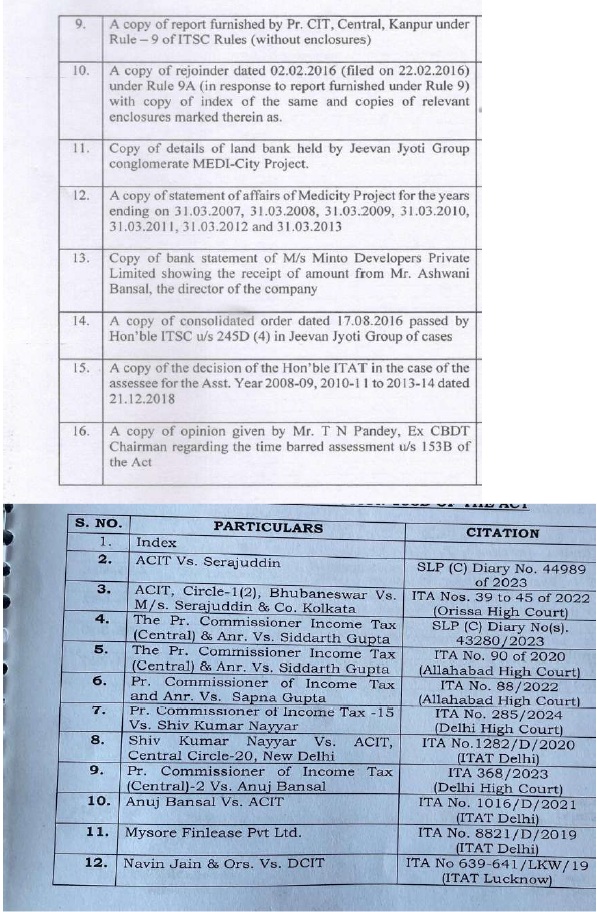
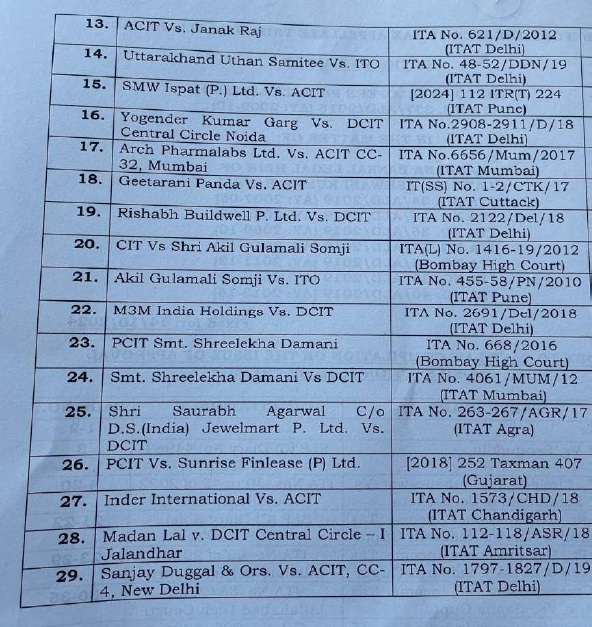
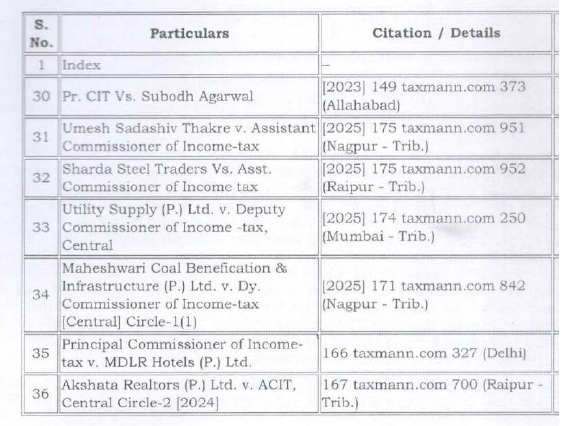
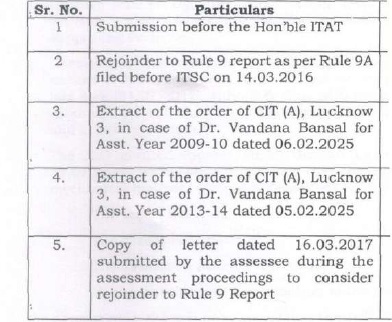
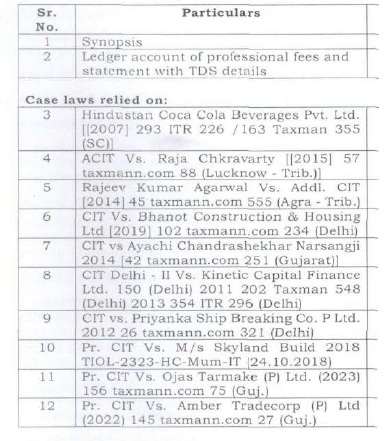
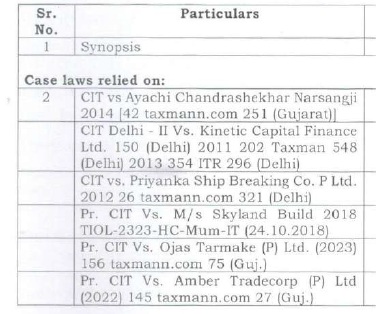
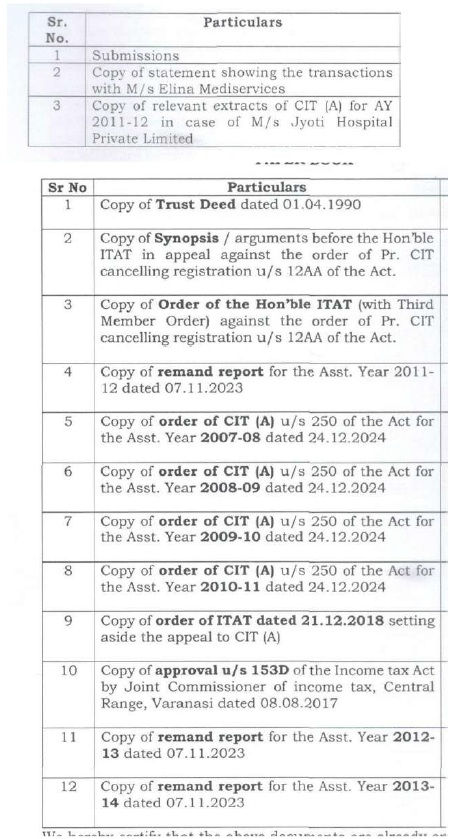
(E) In the course of appellate proceedings in Income Tax Appellate Tribunal, written submissions/paper books were filed by Revenue and by the assessees as per following details:
COMMON PAPER BOOK – PART-I
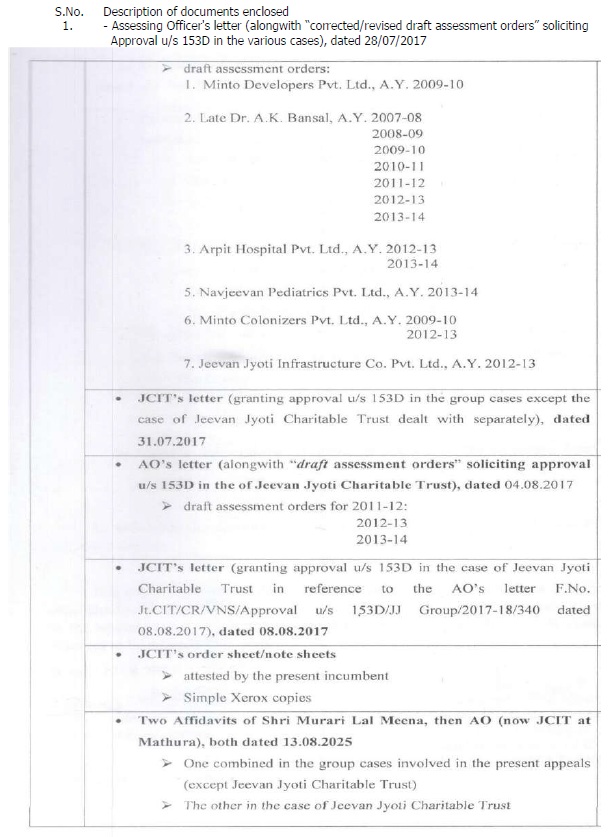
COMMON PAPER BOOK – PART-2
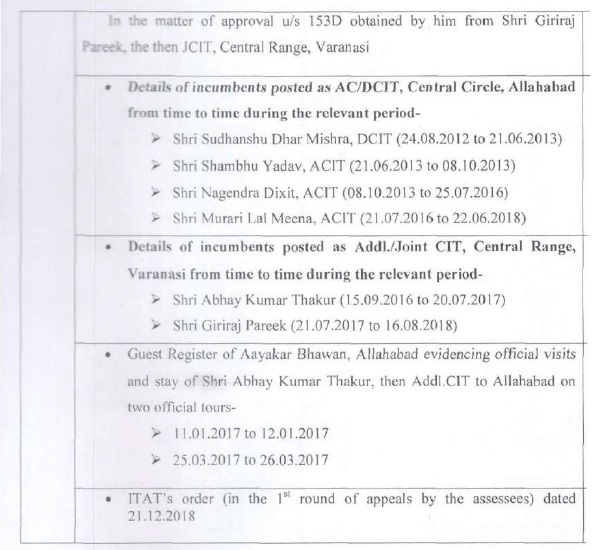
COMMON PAPER BOOK – PART-3
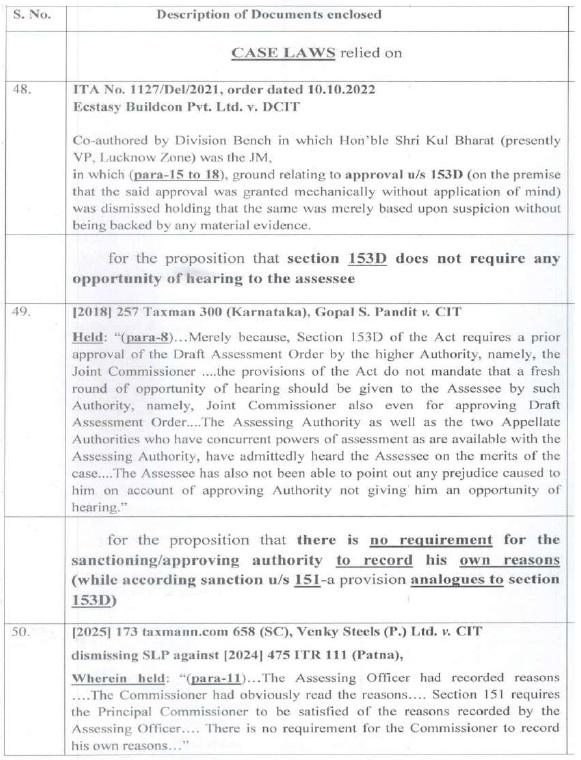
COMMON PAPER BOOK – PART4
Revenue’s Appeal I.T.A. Nos. 39 to 41/All/2025 & assessee’s C.O. Nos. 2 to 4/All/2025 (paper book filed by Revenue)
Revenue’s paper book in I.T.A. No.337/All/2018
Revenue’s paper book in respect of I.T.A. No.56/All/2025
Revenue’s paper book in I.T.A. Nos. 39 to 41/All/2025 & Assessee’s C.O. Nos. 2 to 4/All/2025
Revenue’s paper book in I.T.A. Nos. 13 & 14/All/2025
Revenue’s paper book in I.T.A. No.44/All/2025 & in assessee’s C.O. No.5/All/2025
Revenue’s paper book in I.T.A. Nos. 54 & 55/All/2025
Revenue’s paper book in I.T.A. Nos. 34 to 40/All/2019
Assessee’s paper book in I.T.A. No.337/All/2018
Assessee’s paper book in I.T.A. Nos. 34 to 40/All/2018
Assessee’s paper book in I.T.A. No.13/All/2025
Assessee’s appeal in I.T.A. No.14/Allahabad/2025
Assessee’s paper book in I.T.A. Nos. 39 to 41/All/2025
(F) At the time of hearing, representatives of both sides agreed that appeals of Minto Developers Pvt. Ltd. (I.T.A. No.337/Lkw/2018 for A.Y. 2009-10) may be taken as the lead case as regards the legal issue whether the assessments were passed by the Assessing Officer after obtaining valid approval of JCIT. They submitted that the facts and circumstances for all the other appeals on this issue were in pari materia and the decision in the case of Minto Developers Pvt. Ltd. would apply mutatis mutandis to remaining cases also. Accordingly, we first take up the appeal of Minto Developers Pvt. Ltd. (I.T.A. No.337/Alld/2018 for A.Y.2009-10).
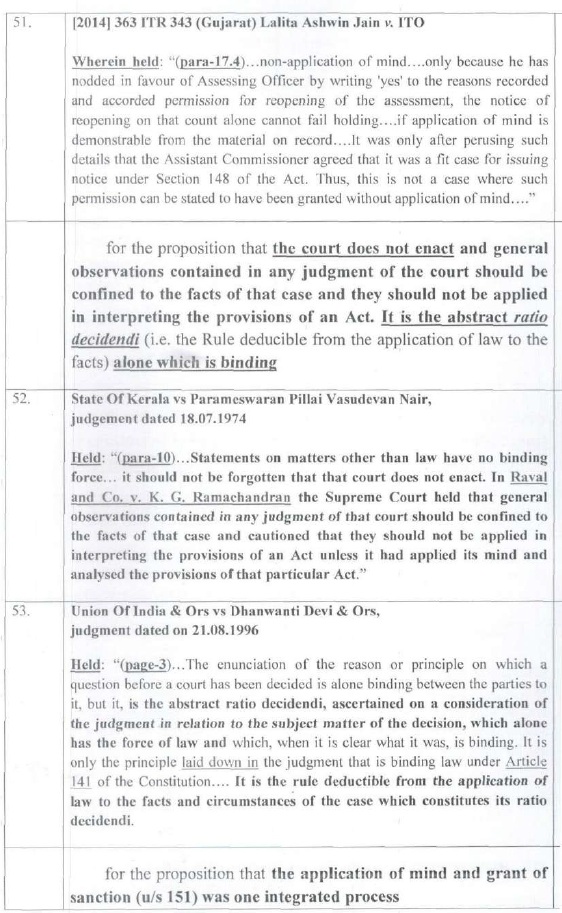
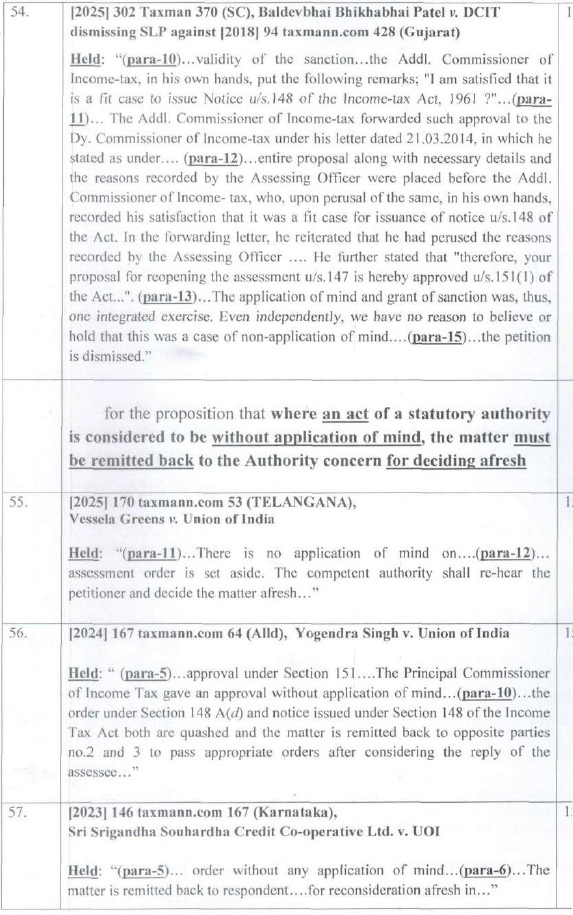
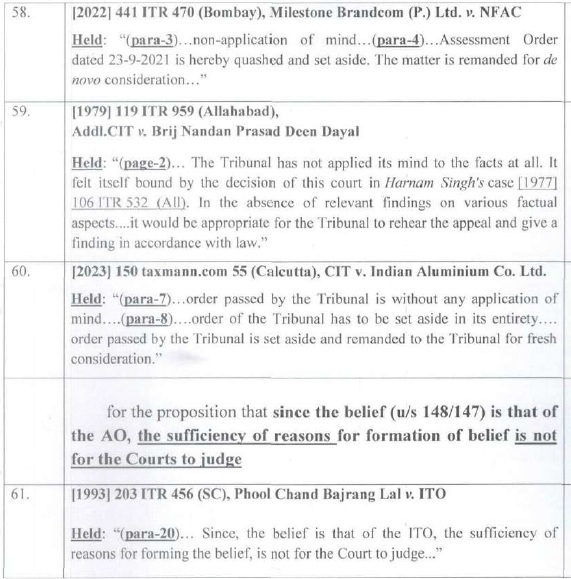
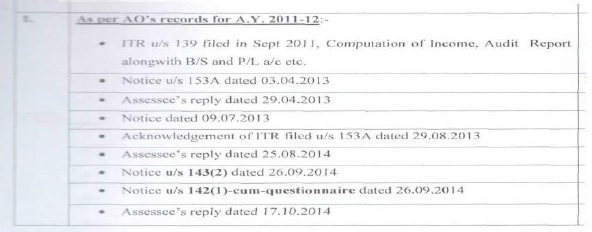
(F.1) As regards validity of approval given by JCIT u/s 153D of the Act, the learned Counsel for the assessee drew our attention to approval letter No.Jt.CIT/CR/VNS/Approval u/s 153D/JJGroup/2017-18/304 dated 31/07/2017 whereby approvals were given for 11 different assessees for a total of 63 assessments pertaining to numerous assessment years. The aforesaid letter is reproduced below for the ease of reference:
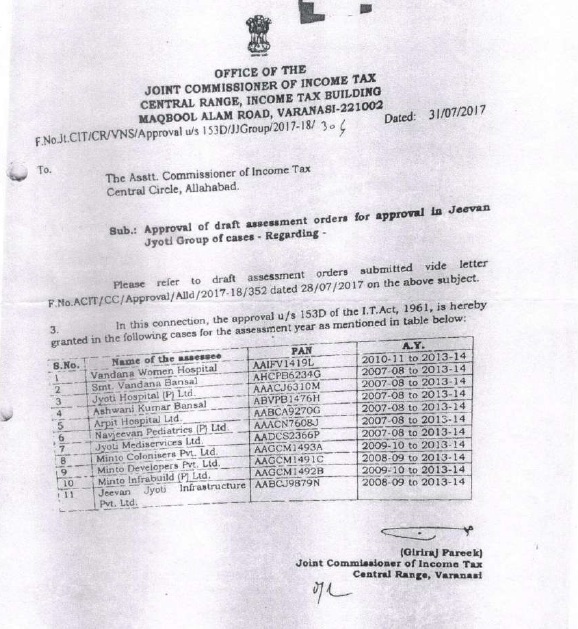
(F.1.1) The learned Counsel for the assessee challenged the validity of approval granted u/s 153D of the Act on many grounds. To begin with, he contended that the approvals were given without due application of mind. In this regard he drew our attention to the fact that the draft assessment orders were sent to the JCIT by the Assessing Officer vide letter F.No.ACIT/CC/Approval/Alld/2017-18/352 dated 28/07/2017. He further drew our attention to the fact that the next two days, i.e. 29th & 30th July, 2017 were closed holidays on account of Saturday and Sunday. Thereafter, the JCIT gave approval u/s 153D of the Act vide aforesaid letter dated 31/07/2017 in the case of aforesaid 11 assessees for a total of 63 assessments pertaining to different assessment years in the cases of the aforesaid 11 different assessees. It was the contention of the learned Counsel for the assessee that considering the enormity of seized materials, digital data, submissions of the assessees, appraisal report provided by the Investigation Wing of Income Tax Department, reports under Rules 9 and 9A of ITSC(P) Rules, and other materials including assessment records, it was humanly impossible for the JCIT to exercise due application of mind before granting approval to the Assessing Officer for 63 assessments pertaining to 11 different assessees for various assessment year; vide aforesaid common approval letter dated 31/07/2017, sufficiently in time on 31/07/2017 for the letter of approval to reach the Assessing Officer along with seized materials, digital data, submissions of the assessees, appraisal report provided by the Investigation Wing of Income Tax Department, reports under Rules 9 & 9A of ITSC(P) Rules and other materials including assessment records to reach the Assessing Officer on 31st July 2017 itself from Varanasi (where JCIT was stationed) to Allahabad (where the Assessing Officer was stationed) in order to also enable the Assessing Officer to pass the assessment order on 31/07/2017 itself, which was the last date for passing assessment order (after which the assessments would have been barred by limitation).
(F.1.2) The learned Counsel for the assessee then challenged the aforesaid approval given u/s 153D of the Act on the basis that the JCIT did not grant approvals u/s 153D of the Act through separate approval letters for separate assessment years for each assessment orders pertaining to each of the aforesaid assessees. He contended that the JCIT was required to issue separate letters of approval for each assessment year for each assessee. The approvals granted u/s 153D for the aforesaid assessments pertaining to different assessment years for the aforesaid 11 assessees through a common letter do not meet this requirement, the learned Counsel for the assessee submitted.
(F.1.3) Next, the learned Counsel for the assessee challenged the validity of the approval granted u/s 153D of the Act, contending that the approvals were granted by JCIT vide aforesaid common letter dated 31/07/2017 in a non speaking manner. The letter did not contain any writeup of JCIT himself indicating that the approvals were granted for the aforesaid 63 assessments after proper application of mind. He contended that contents of the approval letter should include discussion to show that the JCIT had considered all the issues in the proposed draft assessment order, and had applied his mind independently before granting approval instead of giving approval in a summary and non speaking way, in the manner of rubber stamping whatever draft assessment order was sent by the Assessing Officer. He further submitted that this showed that the approvals were granted in a summary, routine, perfunctory and mechanical manner, as an idle formality; and that approvals were not based on independent application of mind by the JCIT.
(F.1.4) The learned Counsel for the assessee also submitted that the JCIT was required, u/s. 153D of the Act, to approve not only the additions proposed by the Assessing Officer; but was also required to approve the assessment order in entirety, contending that the assessment order proposed by the Assessing Officer was required to be approved word by word. In the present case, the learned Counsel for the assessee submitted, the JCIT, vide order sheet dated 25/07/2017, had observed that certain corrections were needed in the draft orders and had directed the Assessing Officer to resubmit the draft orders after making necessary corrections, as discussed with him, latest by 28/07/2017. The JCIT had further directed the Assessing Officer to resubmit the draft orders after corrections, through official e-mail address. Therefore, learned Counsel for the assessee submitted even till 25/07/2017, there was no finality to the assessment order. The state of affairs was conditioned and tentative.
(F.1.4.1) Moreover, the learned Counsel for the assessee submitted, there was common order sheet for all the cases of Jeevan Jyoti Group which consisted of several assessees and the assessments pertained to seven assessment years in the case of each assessee. However, the learned Counsel for the assessee submitted, there was no record, either in the order sheet or elsewhere, as to what corrections were directed to be made by JCIT in the draft assessment orders sent by the Assessing Officer vide aforesaid letter dated 18/07/2017 which was received in the office of the JCIT on 19/07/2017. He contended that considering large number of assessees and multiple assessments for different assessment years; it was impossible for the JCIT to remember what corrections were directed by him in the absence of any record and therefore, it was impossible for him to satisfy himself whether the second draft assessment orders were prepared after carrying out the corrections as per the directions given on 25/07/2017. In the absence of such satisfaction, the approval given u/s 153D of the Act were in the nature of rubber stamping and suffered from infirmity on the ground of having been given without due application of mind.
(F.1.5) The learned Counsel for the assessee further submitted in this connection that the direction of the JCIT to send the second draft of the proposed assessment order by e-mail by 28/07/2017, was not complied with by the Assessing Officer and instead only physical copies were submitted by the Assessing Officer. In the absence of compliance of the directions of the JCIT, the learned Counsel for the assessee submitted, the approvals granted by the JCIT vide aforesaid common approval letter dated 31/07/2017 were vitiated. The learned Counsel for the assessee also contended that the omission to send the second draft of the proposed assessment order by e-mail, pointed to the likelihood that the proposed second drafts of the assessment orders were not even ready by 28/07/2017 and hard copies of the second drafts of the assessment order may have been sent to the JCIT later, possibly on 31/07/2017, which was the next working day; leaving the JCIT with no time to exercise due application of mind before giving approvals u/s 153D of the Act, on 31/07/2017 itself.
(F.6) The learned Counsel for the assessee further submitted that CBDT has directed the Assessing Officers, in Search Manual, to seek the approval from the approving authority at least one month before the time barring date. In this connection, he drew our attention to order of Lucknow Bench of ITAT in the case of Navin Jain v. DCIT [IT (SS) Appeal No. 639-641 (Lkw) of 2019, dated 3-8-2021] in which, at paragraph 7 of the order, this direction of CBDT is noted. For the ease of reference; para 7 of the aforesaid order dated 03/08/2021 of ITAT is reproduced below:
“7…………Learned counsel for the assessee submitted that granting of approval u/s 153D is a huge task which involves the verification by the approving authority to examine as to which year is unabated and which year is abated and the relevance vis-a-vis seized material. Learned counsel for the assessee further invited our attention to CBDT manual of Office Procedure Volume-II (Technical) placed at pages 995 and 996 of paper book wherein the CBDT has directed that Assessing Officer should submit the draft assessment order for approval from the approving authority well in time. Such manual says that the Assessing Officer should seek approval from the approving authority at least one month before the time barring date. While going through CBDT manual placed at paper book pages 995 & 996, it was observed that this manual was printed in February 2003 and therefore, Learned counsel for the assessee was asked as to how it is applicable to the provisions of section 153D of the Act which came into existence w.e.f. 01/06/2007. Learned counsel for the assessee in this respect submitted that this manual is applicable to the provisions of section 158BG of the Act and which are pari materia to the provisions of section 153D of the Act. It was further submitted that Mumbai Tribunal in the case of Shreelekha Damani, vide order dated 19/08/2015, while deciding similar issue u/s 153D, has relied on the case laws relied for deciding the issue of approval u/s 158BG of the Act and therefore this manual is applicable to provisions of Section 153D also………………..”
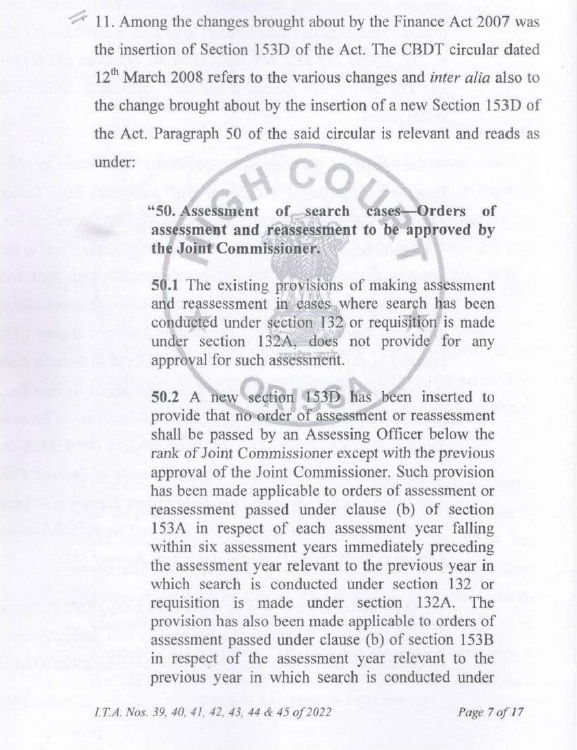
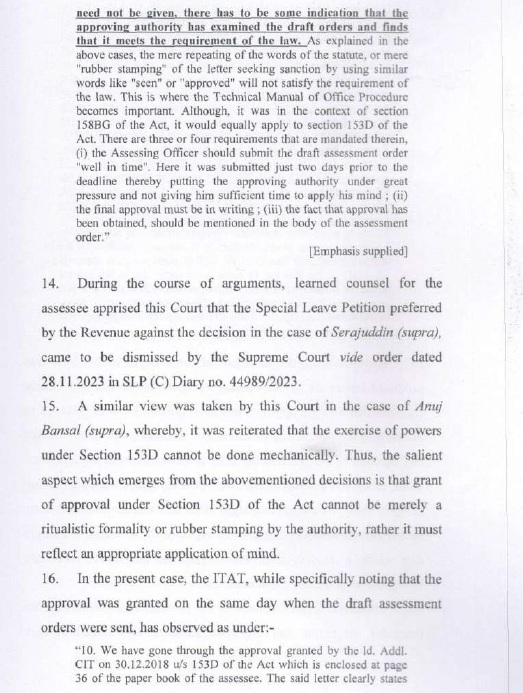
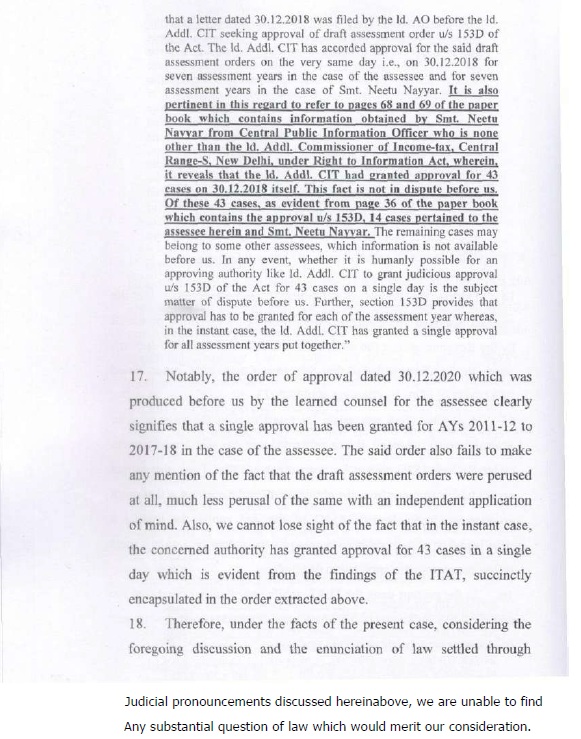
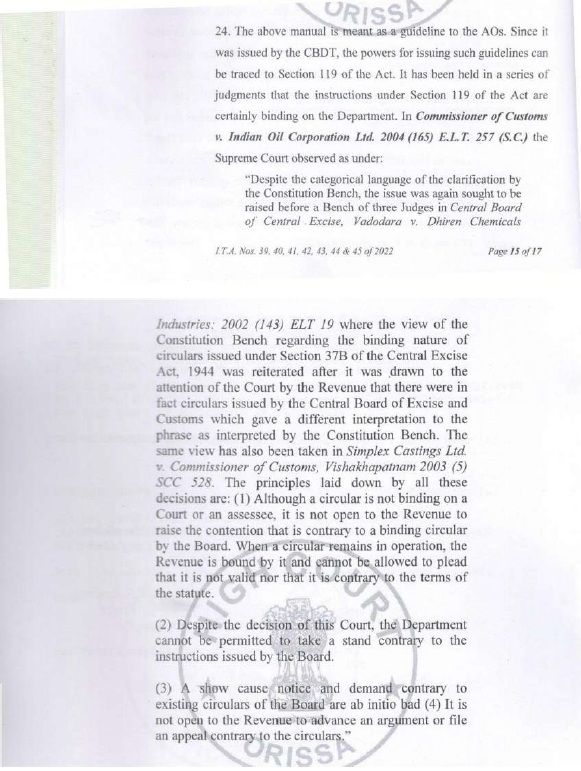
The learned Counsel for the assessee further submitted that the aforesaid order dated 03/08/2021 of ITAT has been referred to and approval by Hon’ble Allahabad High Court in the case of order dated 12/12/2022 in Income Tax Appeal No. 88 of 2022) Pr. CIT v. Sapna Gupta (Allahabad) and also in the case of (order dated 12/12/2022 in Income Tax Appeal No. 90 of 2022) Pr. CIT v. Siddarth Gupta (Allahabad)/[2023] 450 ITR 534 (Allahabad). The learned Counsel for the assessee submitted that the Hon’ble Orissa High Court also, in the case of (in order dated 15/03/2023 in I.T.A. Nos. 39 – 45 of 2022) ACIT v. Serajuddin and Co. (SC) has in paragraphs 13 and 24 of the order; took the aforesaid direction of CBDT into consideration and held that since CBDT, has powers for issuing such guidelines u/s 119 of I.T. Act; the same was certainly binding on the Department. The learned Counsel for the assessee further submitted that the aforesaid orders of Hon’ble Allahabad High Court in the case of Siddarth Gupta (supra) and Hon’ble Orissa High Court in the case of Serajuddin & Co. (supra) were challenged by Revenue in Hon’ble Supreme Court through separate SLPs; but both SLPs were dismissed by Hon’ble Supreme Court vide order dated 09/08/2024 (in the case of Pr.CIT v. Siddharth Gupta) in SLP(C) Diary No. 43280/2023 and order dated 28/11/2023 in SLP(C) Diary No.44989 of 2023 respectively. He drew our particular attention to paragraphs 13 and 24 of the aforesaid order of Hon’ble Orissa High Court in the case of Serajuddin & Co. (supra) which are reproduced below for the ease of reference:
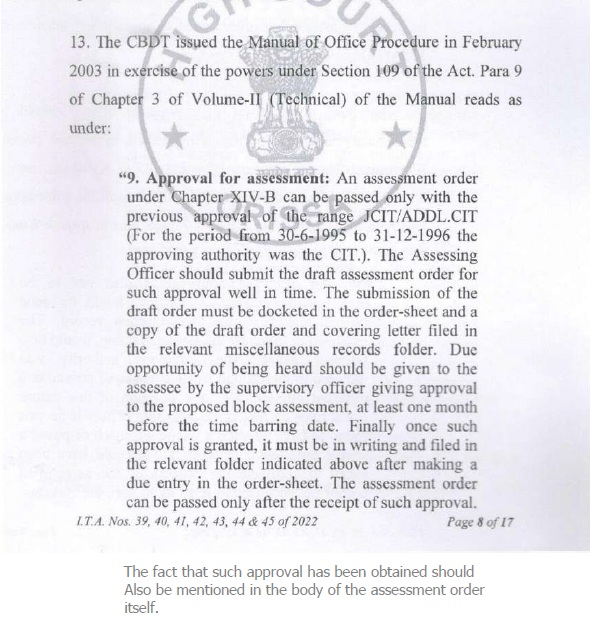
In the present case, the learned Counsel for the assessee submitted, the first draft of proposed assessment order was sent by the Assessing Officer to the JCIT vide letter dated 18/07/2017 which was received in the office of JCIT on 19/07/2017. The limitation date, after which assessment would become time barred was 31/07/2017; therefore, the Assessing Officer was required to seek the approval of JCIT by 30/06/2017. The second draft of the proposed assessment order was sent by the Assessing Officer to the JCIT vide letter dated 28/07/2017. Both the draft orders were sent by the Assessing Officer to JCIT after 30/06/2017; in violation of the aforesaid direction of CBDT, the learned Counsel for the assessee submitted.
(F.6.1) The learned Counsel for the assessee submitted that Hon’ble Delhi High Court, in the case of Pr. CIT v. Shiv Kumar Nayyar (Delhi)/[2024] 467 ITR 186 (Delhi)(order dated 15/05/2024 in I.T.A. No.285/2024 and CM Appeal 28994/2024) considered the aforesaid order of Hon’ble Allahabad High Court in the case of Sapna Gupta (supra) and order of Hon’ble Orissa High Court in the case of Serajuddin & Co. (supra); and expressing agreement with the Hon’ble Allahabad High Court and Hon’ble Orissa High Court; upheld the order of Delhi Bench of ITAT quashing the assessment order.
(F.7) In view of the foregoing, the learned Counsel for the assessee submitted that the assessment should be quashed in the present appeal also.
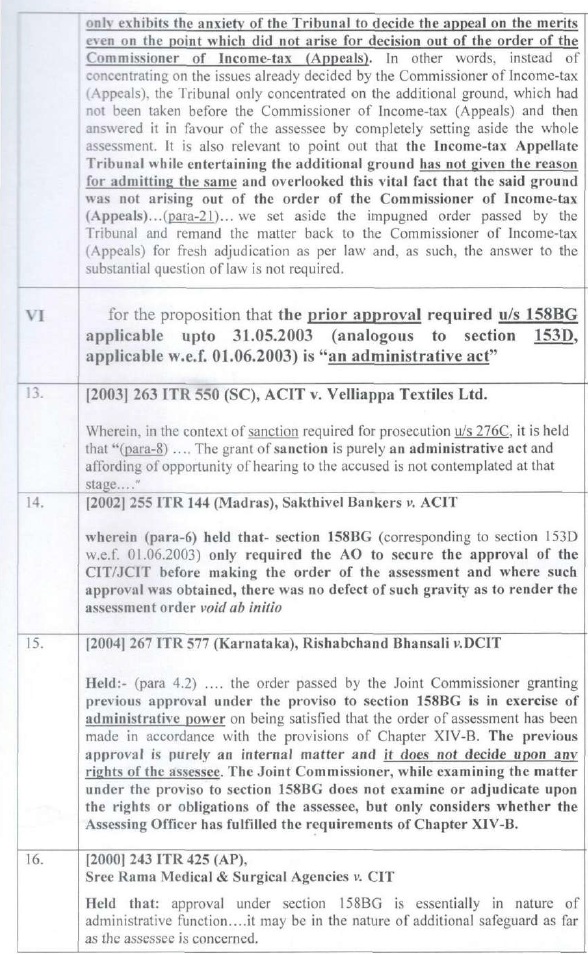
(G) Learned Departmental Representatives contended that it was not required on the part of the JCIT to issue separate letters for giving approval to different assessment years. They submitted that the assessees also, from time to time, provided their written submissions through common letter. They further submitted that it was permitted under law to issue common notice and to pass common assessment orders for several assessment years in the case of a particular assessee. They further submitted that logically therefore, it should also be permissible to give approval u/s 153D of the Act for several assessments pertaining to an assessee. In this regard they drew our attention to the provisions under section 158BG of the Act (which were applicable upto 31/05/2007) and relied on the following case laws:
| (i) |
|
Asstt. Commissioner v. Velliappa Textiles Ltd. (SC)/[2003] 263 ITR 550 (SC). |
| (ii) |
|
Sakthivel Bankers v. Asstt. Commissioner (Madras)/[2002] 255 ITR 144 (Madras) |
| (iii) |
|
Rishabchand Bhansali v. Dy. CIT (Karnataka)/[2004] 267 ITR 577 (Karnataka) |
| (iv) |
|
Sree Rama Medical & Surgical Agencies v. CIT (Andhra Pradesh)/[2000] 243 ITR 425 (Andhra Pradesh) |
| (v) |
|
Lakshmi Jewellery v. Dy. CIT (Madras)/[2001] 252 ITR 712 (Madras) |
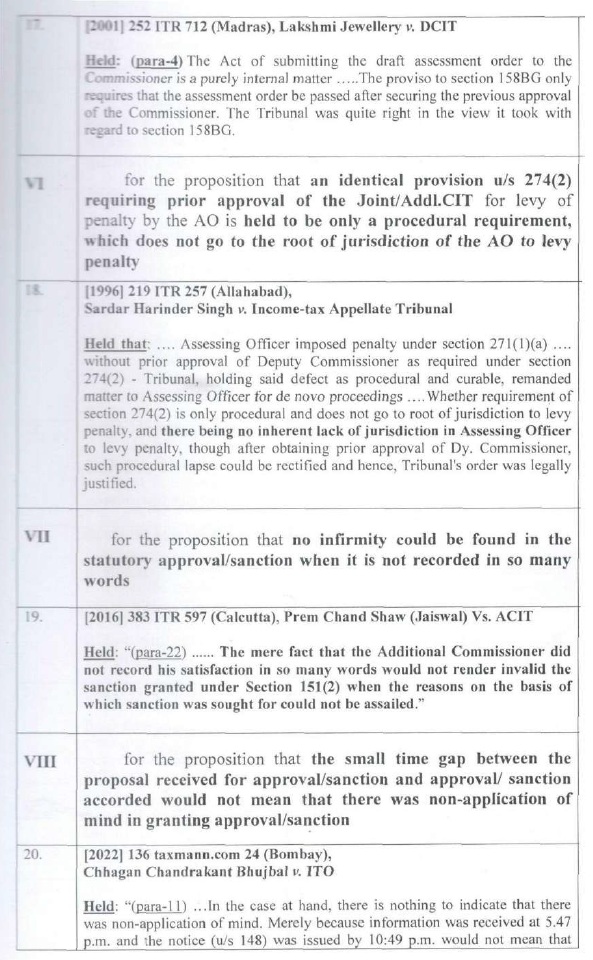
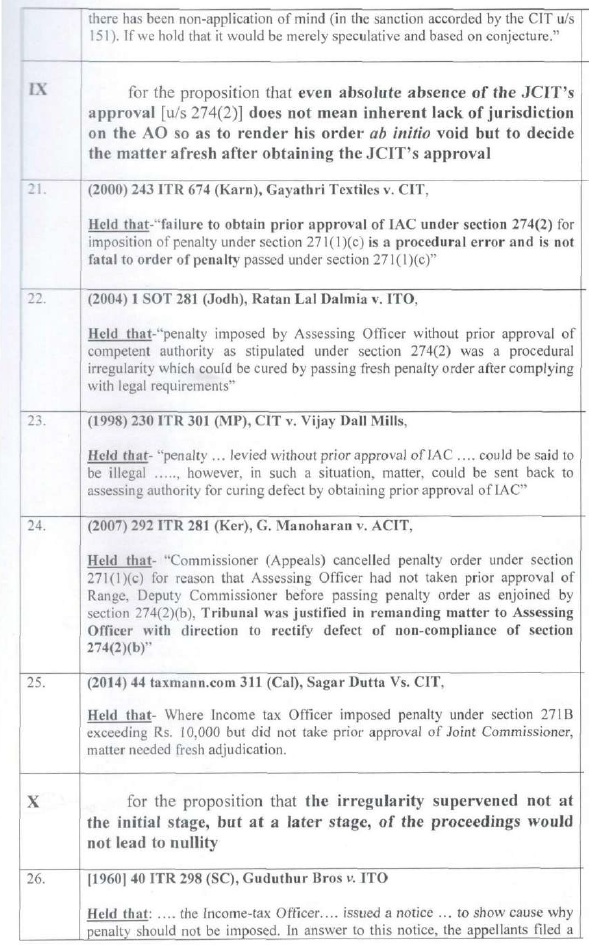
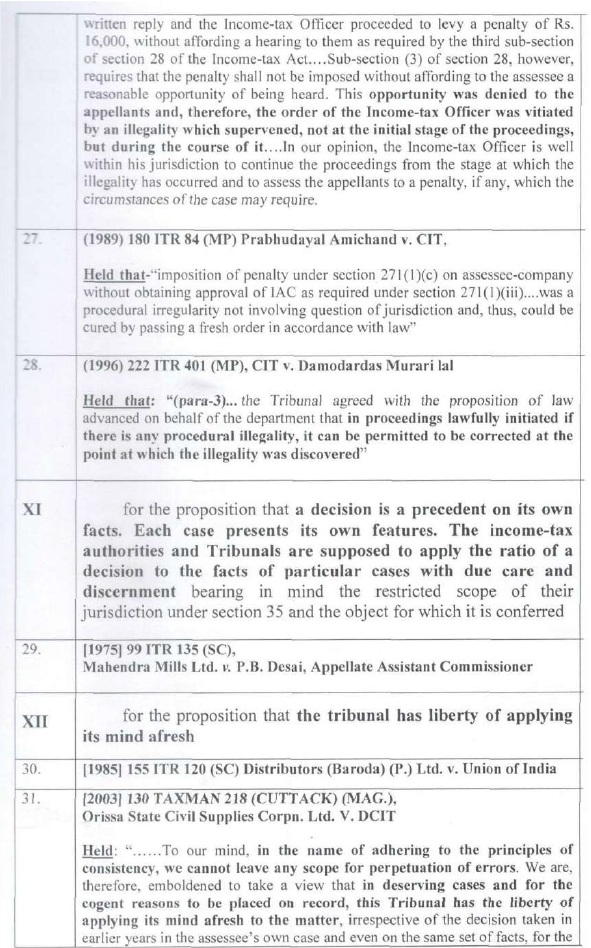
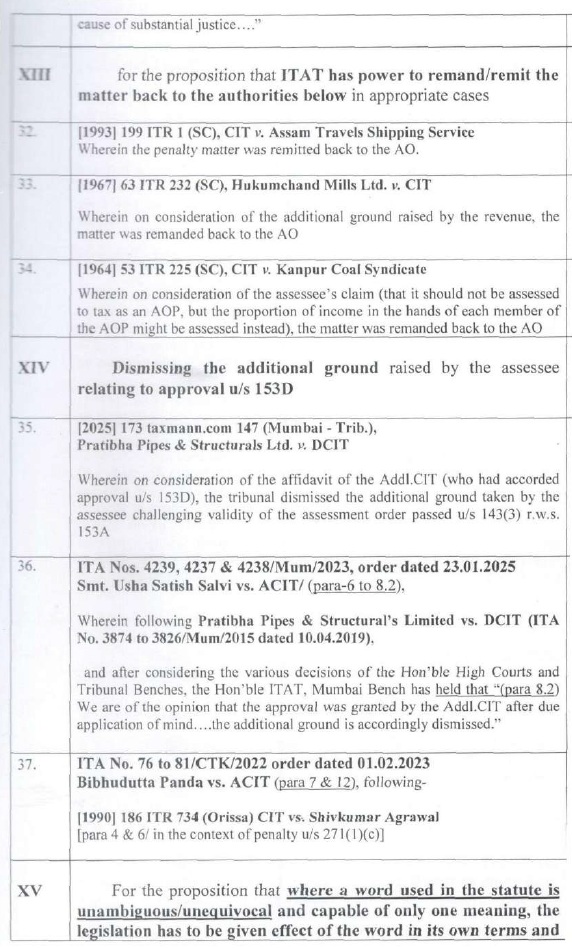
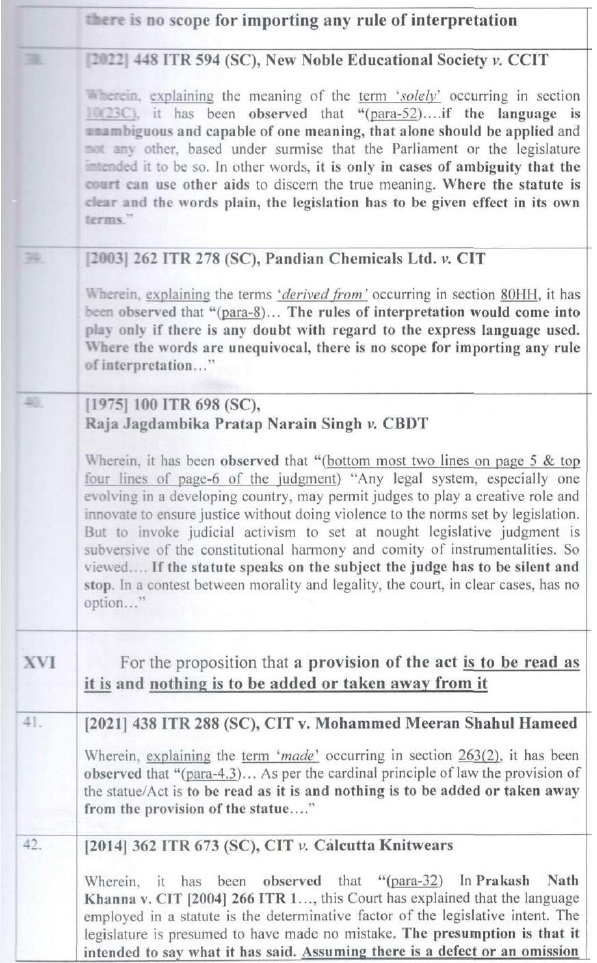
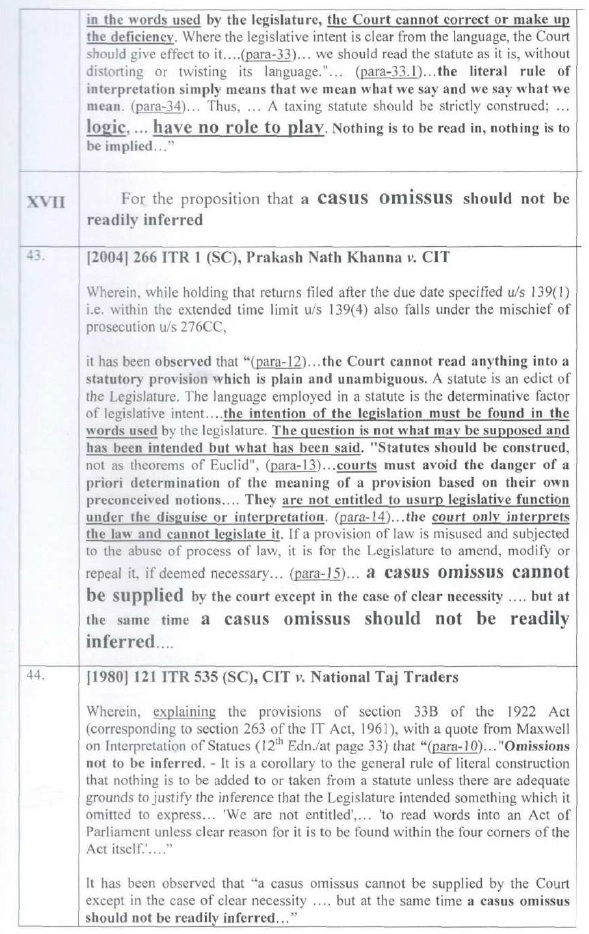
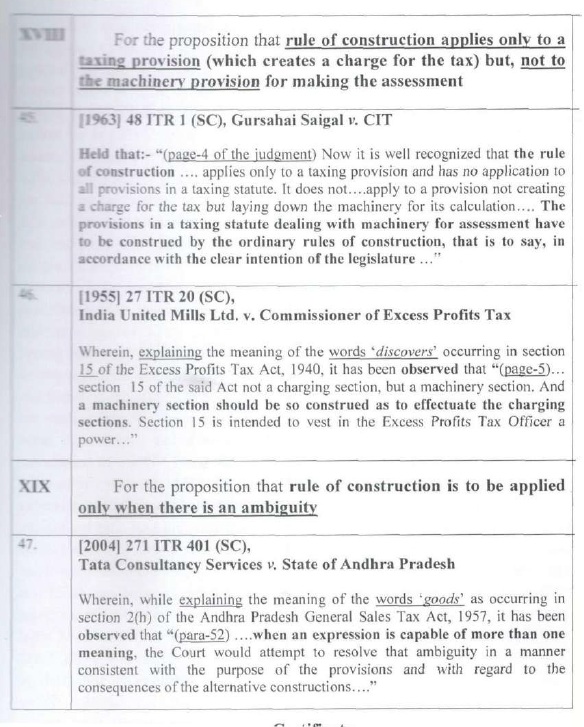
(H) Learned Departmental Representatives further contended that the approval u/s 153D of the Act was akin to approval u/s 274(2) of the Act and further that the approval u/s 274(2) of the Act was held to be a procedural requirement which did not go to the root of the jurisdiction of the Assessing Officer to levy penalty. In this regard they placed reliance on the case of Sardar Harinder Singh v. Income-tax Appellate Tribunal (Allahabad)/[1996] 219 ITR 257 (Allahabad). They also contended that no infirmity can be attributed in the statutory approvals even when it was not recorded in so many words. They placed reliance on the case of Prem Chand Shaw (Jaiswal) v. Asstt. Commissioner (Calcutta)/[2016] 383 ITR 597 (Calcutta) and contended that mere fact that the additional Commissioner did not record his satisfaction in so many words, would not render invalid the sanction granted under section 151(2) when the reasons on the basis of which sanction was sought for could not be assailed. They relied on the order in the case of Chhagan Chandrakant Bhujbal v. ITO (Bombay) (Bombay)/[2022] 440 ITR 359 (Bombay) for the proposition that the small time gap between the proposal received for approval/sanction and approval/sanction accorded would not mean that there was non-application of mind in granting approval/sanction. Learned Departmental Representatives also relied on the case laws Gayathri Textiles v. CIT (Karnataka)/[2000] 243 ITR 674 (Karnataka), Ratan Lal Dalmia v. ITO [2004] 1 SOT 281 (Jodhpur); CIT v. Vijay Dal Mills [1998] 230 ITR 301 (Madhya Pradesh), G. Manoharan v. Asstt. CIT (Kerala)/[2007] 292 ITR 281 (Kerala)andSagar Dutta v. CIT (Calcutta)for the proposition that even absolute absence of the JCIT’s approval u/s 274(2) did not mean inherent lack of jurisdiction on the Assessing Officer so as to render his order ab initio void but to decide the matter afresh after obtaining the JCIT’s approval. Learned Departmental Representatives also placed reliance on the case laws in Guduthur Bros v. ITO [1960] 40 ITR 298 (SC), Prabhudayal Amichand v. CIT ITR 84 (Madhya Pradesh) andCIT v. Damodardas Murarilal ITR 401 (Madhya Pradesh) for the proposition that the irregularity supervened not at the initial stage, but at a later stage of the proceedings would not lead to nullity. Learned Departmental Representatives further placed reliance on the case law in Mahendra Mills Ltd. v. P.B. Desai, Appellate Asstt. Commissioner [1975] 99 ITR 135 (SC) for the proposition that a decision is a precedent on its own facts; that each case presents its own features; and that Income Tax authorities and Tribunals are supposed to apply the ratio of a decision to the facts of particular cases with due care and discernment. They also placed reliance on the case laws in the cases of Distributors (Baroda) (P.) Ltd. v. Union of India (SC)/[1985] 155 ITR 120 (SC)and Orissa State Civil Supplies Corpn. Ltd. v. Dy. CIT (Cuttack)for the proposition that the Tribunal has liberty of applying its mind afresh. Learned Departmental Representatives also placed reliance on the cases of CIT v. Assam Travels Shipping Service (SC)/[1993] 199 ITR 1 (SC), Hukumchand Mills Ltd. v. CIT [1967] 63 ITR 232 (SC)andCIT v. Kanpur Coal Syndicate [1964] 53 ITR 225 (SC); for the proposition that ITAT has power to remand/remit the matter back to the authorities below in appropriate cases. They further placed reliance on the case laws in the cases of New Noble Educational Society v. Chief CIT (SC)/[2022] 448 ITR 594 (SC); Pandian Chemicals Ltd. v. CIT ITR 278 (SC) andRaja Jagdambika Pratap Narain Singh v. CBDT [1975] 100 ITR 698 (SC) for the proposition that where a word used in the statute is unambiguous/unequivocal and capable of only one meaning, the legislation has to be given effect of the word in its own terms and there is no scope for importing any rule of interpretation. Learned Departmental Representatives also placed reliance on the precedents in the cases of CIT v. Mohammed Meeran Shahul Hameed (SC)/[2021] 438 ITR 288 (SC)and CIT v. Calcutta Knitwears (SC)/[2014] 362 ITR 673 (SC) for the proposition that a provision of the Act is to be read as it is and nothing is to be added or taken away from it. Learned Departmental Representatives placed further reliance on Prakash Nath Khanna v. CIT (SC)/[2004] 266 ITR 1 (SC)andCIT v. National Taj Traders (SC)/[1980] 121 ITR 535 (SC) for the proposition that casus omissus should not be readily inferred. Learned Departmental Representatives also relied on the case laws in Gursahai Saigal v. CIT [1963] 48 ITR 1 (SC) andIndia United Mills Ltd. v. Commissioner of Excess Profits Tax [1955] 27 ITR 20 (SC) for the proposition that rule of construction applies only to a taxing provision (which creates a charge for the tax) but, not to the machinery provision for making the assessment. They also relied on the Tata Consultancy Services v. State of Andhra Pradesh (SC)/[2004] 271 ITR 401 (SC) for the proposition that rule of construction is to be applied only when there is an ambiguity. Learned Departmental Representatives also relied on orders of Mumbai Bench of ITAT in the cases of Pratibha Pipes & Structurals Ltd. v. Dy. CIT (Mumbai – Trib.)andUsha Satish Salvi v. ACIT [IT Appeal No. 4237-4239 (mum) of 2023, dated 23-10-2025] and also on order of Cuttack Bench of ITAT in the case of Bibhudutta Panda v. ACIT [IT Appeal Nos. 76 to 81 (CTK.) of 2022, dated 1-2-2023] in which grounds raised by the assessee against validity of approval granted u/s 153D of the I.T. Act were dismissed.
(H.1) Learned Departmental Representatives also submitted that procedural irregularity was not fatal if jurisdictional issue was established. Further, learned Departmental Representatives submitted that fiscal acts should be interpreted in a way which enables functioning of the Act and does not frustrate the Act. Learned Departmental Representatives submitted furthermore, that there was no statutory form prescribed for granting approval u/s 153D of the Act and therefore, the approval given u/s 153D of the Act in the present case did not suffer from any infirmity. Learned Departmental Representatives moreover submitted that the draft assessment order sent by the Assessing Officer to the JCIT vide aforesaid letter dated 28/07/2017 was the second draft order; that the first draft order was sent by the Assessing Officer along with the letter dated 18/07/2017, which was received by the then JCIT (Shri Abhay Kumar Thakur) on 19/07/2017; that the earlier JCIT, who held charge from 15/09/2016 to 20/07/2017 (who received the original draft assessment orders) did not give approval u/s 153D of the Act; but the approval u/s 153D of the I.T. Act was given by the new incumbent (Shri Giriraj Parikh) who took charge on 21/07/2017. They submitted that the new incumbent called the Assessing Officer for discussion, that the discussion between the JCIT and the Assessing Officer took place on 25/07/2017; that after the discussion, the JCIT gave certain directions to the Assessing Officer and the Assessing Officer forwarded the second draft assessment order along with the aforesaid letter dated 28/07/2017, which was approved by the JCIT u/s 153D of the I.T. Act, on 31/07/2017. They also submitted that the Assessing Officer had sent, along with the aforesaid letter dated 18/07/2017, the assessment records and a pen drive (of 8GB capacity) containing seized materials, digital data, submissions of the assessees, appraisal report provided by the Investigation Wing of Income Tax Department and other materials of assessment records; which remained in the office of the JCIT till 31/07/2017 when the JCIT gave approvals u/s 153D of the Act vide aforesaid common letter dated 31/07/2017. They submitted that although the new incumbent, in the office of JCIT (Shri Giriraj Parikh) took charge on 20/07/2017, he immediately came into action regarding the matter of giving approvals u/s 153D of the Act immediately and the approval was given vide aforesaid letter dated 31/07/2017 after due application of mind. Learned Departmental Representatives also submitted that the earlier incumbent in the office of the JCIT (Shri Abhay Kumar Thakur) had visited Allahabad for discussion with the Assessing Officer on multiple occasions and had also stayed in the guest house of the Income Tax department a couple of times. Learned Departmental Representatives also submitted that although the second draft of the proposed assessment orders were not sent to the JCIT by e-mail, the physical copies were indeed sent to the JCIT on 28/07/2017 itself along with the aforesaid letter dated 28/07/2017 with an Inspector of the income tax department, named Mr. Agrahari. Learned Departmental Representatives produced the concerned Inspector, Mr. Agrahari, in person before us, who stated in his oral testimony that the second drafts of the proposed assessment orders were physically carried by him from Allahabad to Varanasi and were handed over to the JCIT on 28/07/2017 itself.
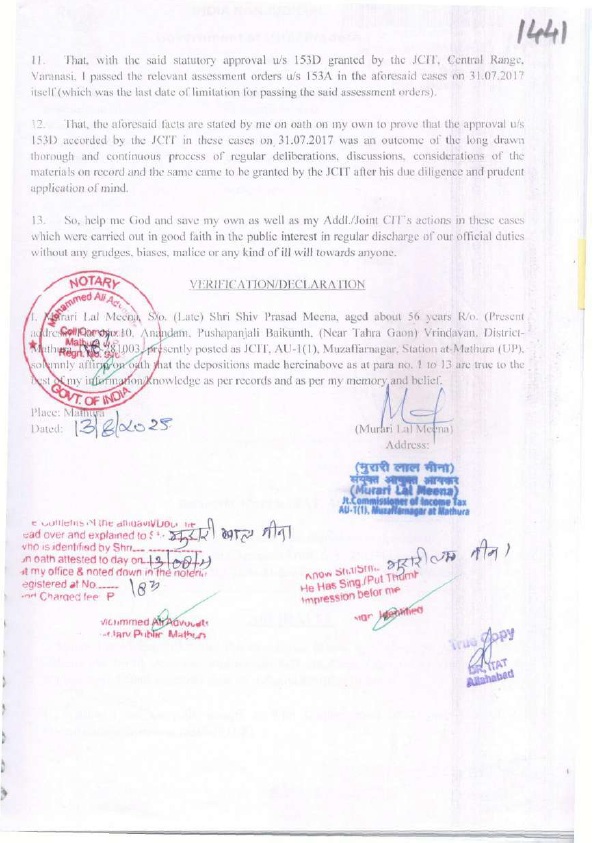
(H.1.1) Learned Departmental Representatives contended emphatically that whether the JCIT had given approval u/s 153D of the Act after due application of mind, was a question of fact and the answer would depend on facts and circumstances of each case. They contended that a conclusion arrived at in a particular case that the approvals were given u/s 153D of the Act without application of mind, did not act as a precedent (being a question of fact) in another case; and conclusion as to whether there was due application of mind in a particular case was to be decided for each case, based on the specific facts of the particular case; and the conclusion was to be arrived at independent of conclusion arrived at in any other case. Learned Departmental Representatives also submitted that the earlier incumbent in the office of JCIT (Mr. Abhay Kumar Thakur) had issued directions u/s 144A of the Act in June 2017, which also enabled him to develop familiarity with the case. Moreover, they contended that the limited time available with the Assessing Officer and the JCIT for the process of approval u/s 153D of the Act was partly attributable to the assessees, as the assessees had sought adjournment of hearing till 12/07/2017. Moreover, they contended that the direction of CBDT to Assessing Officer to seek approval of the approving authority at least one month before the time barring date was directory and not mandatory. They also submitted that although the JCIT, who gave approval, took charge of office on 20/07/2017 which may have been just a few days before limitation date for passing assessment order, the association of the predecessor JCIT (Shri Abhay Kumar Thakur) with the Assessing Officer was part of institutional memory which was reflected in the final approval given vide aforesaid common approval letter dated 31/07/2017 by the next incumbent in the office of JCIT who succeeded him. In view of the submissions made, Learned Departmental Representatives pleaded that the validity of approval given u/s 153D of the Act by the JCIT should be upheld. In their alternate submissions, Learned Departmental Representatives pleaded that the matter regarding approval u/s 153D of the I.T. Act should be restored back to the file of the approving authority (i.e. Addl. CIT/JCIT) for fresh view to be taken; in case it was found that the approval granted u/s 153D of the I.T. Act suffered from infirmities or were invalid. In order to support their submissions, Learned Departmental Representatives drew our attention to the affidavit of Shri M. L. Meena, ACIT, the Assessing Officer. The affidavit of Shri M. L. Meena dated 13/08/2025 is reproduced below for the ease of reference:
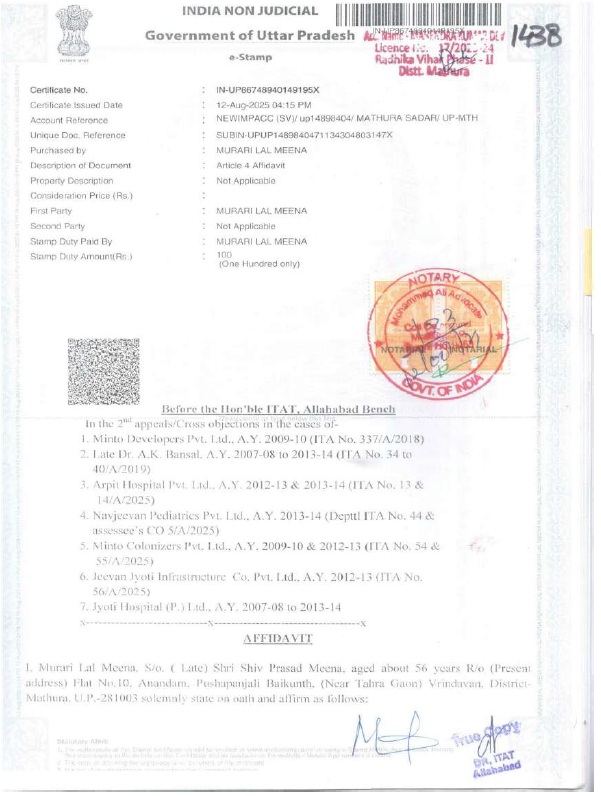
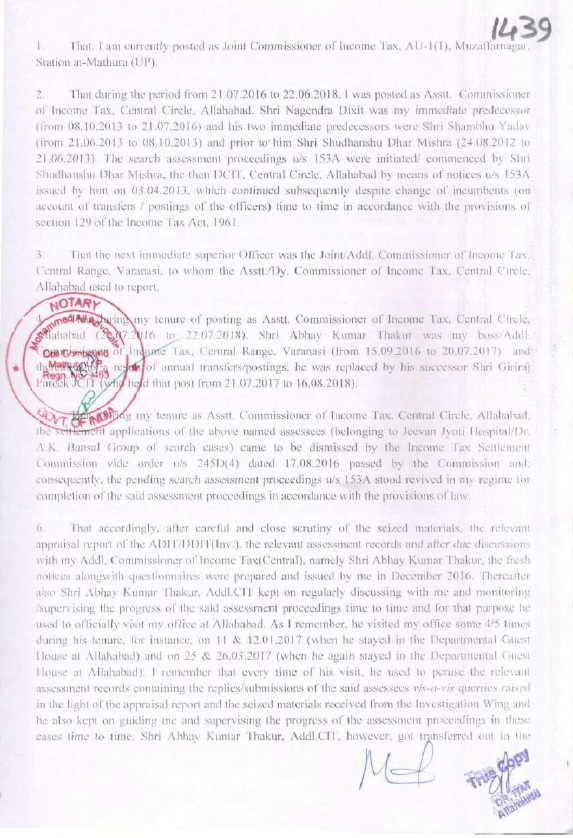
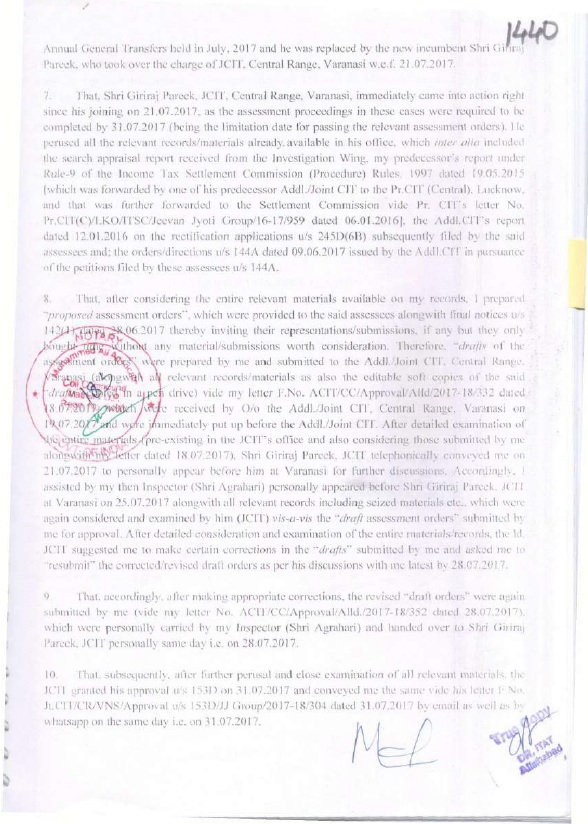
(I) The learned Counsel for the assessee, in his rejoinder, countered the submissions made by learned Departmental Representatives emphatically. He submitted that affidavit of the Assessing Officer and the Departmental Inspector are de void of any credibility. He submitted that it was an important and material fact to be noted that the JCIT who gave approval u/s 153D of the IT Act, and who had since superannuated, did not file any affidavit/statement in support of Revenue’s contentions. Since it was the JCIT who gave approval, and he did not support Revenue’s stand; the version of Assessing Officer and Inspector, who still working in the Department and were under the control and discipline of Department; must be rejected. In this regard he contended that the affidavit and personal testimony of Departmental Inspector were self-serving documents and it was aimed at covering omissions and mistakes of Departmental authorities. He also contended that the affidavit and personal testimony of the Departmental Inspector are not supported by any documentary evidence. Further he submitted that the Assessing Officer was not competent to state on oath about the conduct of some other officer specially his senior officer. In particular he referred to paragraph-7 of the affidavit of the Assessing Officer wherein he has stated that Shri Giriraj Parikh, JCIT, came into action right since his joining on 21/07/2017. The deponent Assessing Officer has further stated that the JCIT perused all the relevant records/materials already available in his office, which included appraisal report, the report under Rule 9 of Income Tax Settlement Commission (Procedure) Rules, 1997 [“ITSC(P) Rules” for short], the report of the Addl. CIT dated 12/01/2016, the orders and directions u/s 144A of the I.T. Act etc. The learned Counsel for the assessee also drew our attention to paragraph 8 of the affidavit wherein the deponent Assessing Officer has stated that the JCIT, examined the entire materials (pre existing in the JCIT’s office and also considering those submitted along with letter dated 18/07/2017). The learned Counsel for the assessee further drew our attention to para 10 of the affidavit of the deponent Assessing Officer wherein he has stated that the JCIT granted approval u/s 153D of the Act after further perusal and close examination of all the relevant materials. The learned Counsel for the assessee contended that the deponent Assessing Officer has made statements in the affidavit regarding these materials about which only the JCIT had personal knowledge and the deponent Assessing Officer could not have personal knowledge, information and belief. Further he submitted that in paragraph-9 of the affidavit of the deponent Assessing Officer and in the personal testimony of the Departmental Inspector, it has been stated that the Inspector handed over draft orders to Shri Giriraj Parikh, JCIT on 28/07/2017 along with letter No.ACIT/CC/Approval/All./2017/18/352 dated 28/07/2017. However, no documentary evidence, such as acknowledgement from the office of the JCIT is available on record and no such documentary evidence has been produced by Revenue. The learned Counsel for the assessee also contended that the affidavit of the deponent Assessing Officer has been made on 13/08/2025 after more than 8 years since 31/07/2017 on which approval was given by the JCIT u/s 153D of the Act. He contended that it was impossible for the deponent Assessing Officer to remember the facts of the case including specific dates and specific letter numbers; which are found in the affidavit; after such substantial lapse of time; and similarly, it was impossible for the Inspector to remember things in such specific details after such a long time. In view of these facts and circumstances, the learned Counsel for the assessee submitted that the affidavit of the deponent Assessing Officer and the personal testimony of the Departmental Inspector should be rejected being completely de void of any credibility.
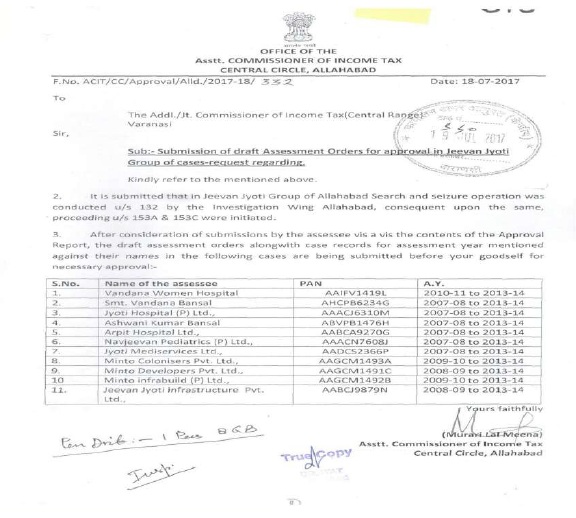
(I.1) Learned Counsel for the assessee also submitted that the contention of Revenue that the Assessing Officer was in regular supervision of the earlier incumbent in the office of the JCIT (Shri Abhay Kumar Thakur) and that Shri Abhay Kumar Thakur regularly discussed with the Assessing Officer, monitored/supervised the progress of the assessment proceedings and extended guidance to the Assessing Officer was entirely irrelevant because it was not Shri Abhay Kumar Thakur who gave approval u/s 153D of the Act. He submitted that it was Shri Giriraj Parikh, JCIT, who took charge on 21/07/2017 who, on 31/07/2017 gave approval u/s 153D of the Act and the validity of the approval u/s 153D of the Act is to be examined regardless of whatever was done and whatever happened when Shri Abhay Kumar Thakur, the earlier incumbent before Shri Giriraj Parikh, held office. He also submitted that 21/07/2017 was Friday and before 31st July 2017 (on which approval was given u/s 153D of the Act) there were only five working days (excluding Saturdays and Sundays which were closed holidays). The learned Counsel for the assessee also submitted that although it is contended by Revenue that the letter dated 18/07/2017 containing initial draft of the assessment order was accompanied with a pen drive (8GB capacity), the note and order sheet of the office of the JCIT dated 19/07/2017, does not make a mention of any pen drive accompanying the aforesaid letter. The notes and order sheet merely mentioned the receipt of letter of the Assessing Officer, and makes no mention of pen drive. Further he submitted that the letter dated 18/07/2017 of the Assessing Officer also does not contain any description of the contents of the pen drive and merely mentions at the bottom of the letter, in hand writing “Pen Drib 1 pees. 8GB”. He also drew our attention to the report of an expert (included in the paper book, filed by the assessee) in which it has been mentioned that there were approximately 40,434 seized documents, 7 CPUs, 26 HDDs and one laptop seized during the search u/s 132 of the Act. The expert has opined that the storage of this data would require a memory of 200GB and that it was impossible to store it on a pen drive of 8GB capacity. The learned Counsel for the assessee also submitted that in any case there was no evidence from record that the JCIT did even examine the contents of the pen drive and also that the letter dated 18/07/2017 did not in any case provide any description of the contents of the pen drive. In the absence of any description of the contents of the pen drive in letter dated 18/07/2017 of the Assessing Officer and in the absence of any reference to pen drive in the notes and order sheet of the office of the JCIT, the claim of Revenue that a pen drive was sent along with letter dated 18/07/2017 carried no value or relevance for the issue at hand, the learned Counsel for the assessee contended. For the ease of reference, the aforesaid letter dated 18/07/2017 of the Assessing Officer is reproduced below:
(I.2) The learned Counsel for the assessee submitted further that the reliance of the learned Departmental Representatives on precedents of Hon’ble Courts, pertaining to section 158BG of the Act to draw equivalence with section 153D of the Act deserved to be rejected outrightly because section 158BG pertained to block assessment order in which, under the mandate of law the Assessing Officer was required to pass one assessment order for the block period consisting of multiple years; whereas under section 153D of the Act, separate approvals are to be given by the approving authority for separate assessment orders pertaining to different assessment years for each assessee. The learned Counsel for the assessee stated that the contention of the learned Departmental Representatives that there was no statutory form prescribed for granting approval u/s 153D of the Act also deserved to be rejected because in any case the approval is to be granted u/s 153D of the Act after due application of mind of the approval authority and the approval given by the approving authority should be done in a speaking manner and not in a summary manner. The learned Counsel for the assessee submitted that the contention of the learned Departmental Representatives that the assessee had sought adjournment of hearing till 20/07/2017 is misleading. He pointed out that the reports under Rules 9 and 9A of ITSC(P) Rules were already on the record of the Assessing Officer, which contained all the information sought for by the Assessing Officer. Moreover, in any case, whether the assessee delayed the assessment proceedings or not is wholly irrelevant for the purpose of examining the validity of approval of the proposed draft assessment order, under section 153D of the Act. He contended that the Assessing Officer was at liberty to proceed with ex parte order if he considered that there was default on the part of the assessee in providing information or in making compliance with the notices. The learned Counsel for the assessee also submitted that direction of CBDT to Assessing Officer to seek approval of the approving authority at least one month before the time barring date was mandatory on the Assessing Officer. He also contended that the association of the JCIT/Addl CIT with the Assessing Officer till the time of preparation of the draft assessment order has no significance for considering the validity of the approval given u/s 153D of the Act because the statutory requirement of approval u/s 153D of the Act cast a separate duty upon the approving authority which was de hors any other role and responsibility of the approving authority. He also submitted that the contention of the learned Departmental Representatives that the association of the predecessor JCIT (Shri Abhay Kumar Thakur) with the Assessing Officer was part of institutional memory, deserved to be rejected for the aforesaid reason. In view of the submissions and contentions presented before us by learned Counsel for the assessee, he submitted that the approval granted by the JCIT was invalid and suffered from the infirmity, because it was humanly impossible for the JCIT to apply his independent mind to total of 63 assessments pertaining to 11 different assessees for different assessment years having regard to enormity of the seized materials, digital data, submissions of the assessees, appraisal report provided by the Investigation Wing of Income Tax Department, reports under Rules 9 & 9A of ITSC(P) Rules, and other materials including assessment records. The learned Counsel for the assessee submitted that although it has been contended in the affidavit of the Assessing Officer and in the submissions of the learned Departmental Representatives that the JCIT sent approvals u/s 153D of the Act to the Assessing Officer on 31/07/2017 through e-mail and Whatsapp, there was no evidence on record that any such e-mail or Whatsapp was sent by the JCIT; and also no print out of such e-mail/Whatsapp communication has been adduced from the side of the Revenue at any stage. In this regard, he also relied on the various paper books, referred to in foregoing paragraph (E) of this order, and on the compilation of the case laws/decisions referred to in foregoing paragraph (E) of this order.
(J) We have heard both sides, patiently; we have also diligently perused the materials on record. We have been presented many precedents/case laws; and many propositions; which are either of general nature, or which pertain to specific issues other than the specific matter of validity of approval u/s 153D of the IT Act. It is settled position of law that specific principles and provisions of law prevail over general principles/provisions of law. It is also settled position of law that principles and provisions of a particular matter or issue, prevail over principles and provisions of another matter or issue; for taking a decision on the former matter or issue. Therefore, the specific propositions, precedents and case laws in the context of validity of approval u/s 153D of the Act have stronger force than those propositions and precedents pertaining to general propositions or pertaining to specific issues other than validity of approval u/s 153D of the IT Act. Moreover, although the learned Departmental Representatives have placed reliance on some orders of ITAT (Bombay Bench and Cuttack Bench), orders of Hon’ble Supreme Court, Hon’ble Allahabad High Court which is the jurisdictional High Court, and orders of other Hon’ble High Courts, such as Hon’ble Orissa High Court and Hon’ble Delhi High Court; prevail over orders of Bombay Bench and Cuttack Bench of the Tribunal.
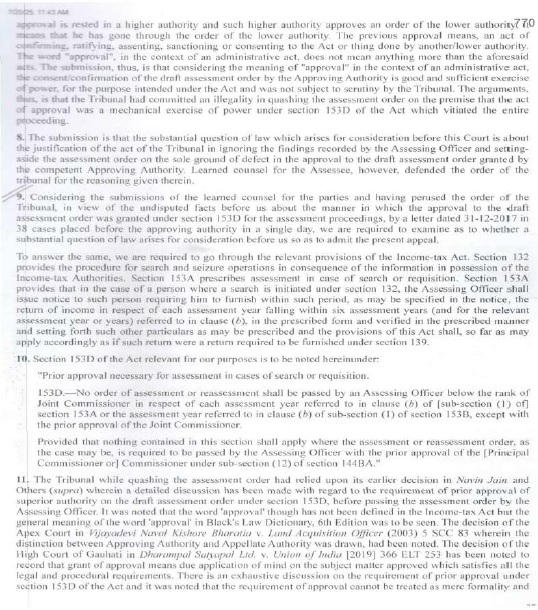
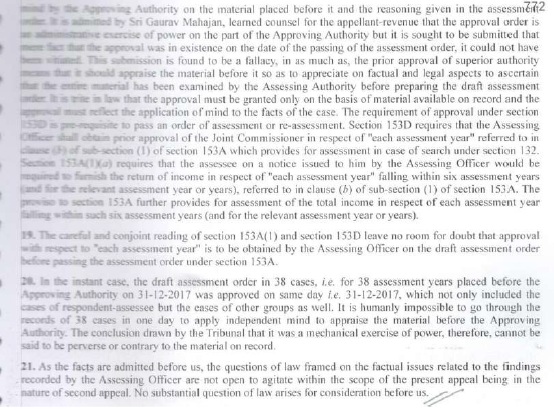
(J.1) In the case of ACIT, Circle-1(2), Bhubaneswar v. Serajuddin & Co. (supra), it was held as under:
(J.1.1) Further, in the case of Pr.CIT (Central) & Anr. v. Siddarth Gupta (supra), Hon’ble Allahabad High Court held as under:
(J.1.1.1) SLPs filed by Revenue against aforesaid order of Hon’ble Orissa High Court in the case of ACIT v. Serajuddin & Co. [2023] (Orissa)/[2023] 454 ITR 312 (Orissa) and aforesaid order of Hon’ble Allahabad High Court in the case of Siddharth Gupta (supra) ; have been dismissed by Hon’ble Supreme Court in decisions at Serajuddin and Co. (supra) and vide order dated 09/08/2024 in SLP(C) Diary No.43280/2023 in the case of Pr.CIT v. Siddharth Gupta, respectively.
(J.1.2) Similarly, in the case of Sapna Gupta (supra), Hon’ble Allahabad High Court held as under:
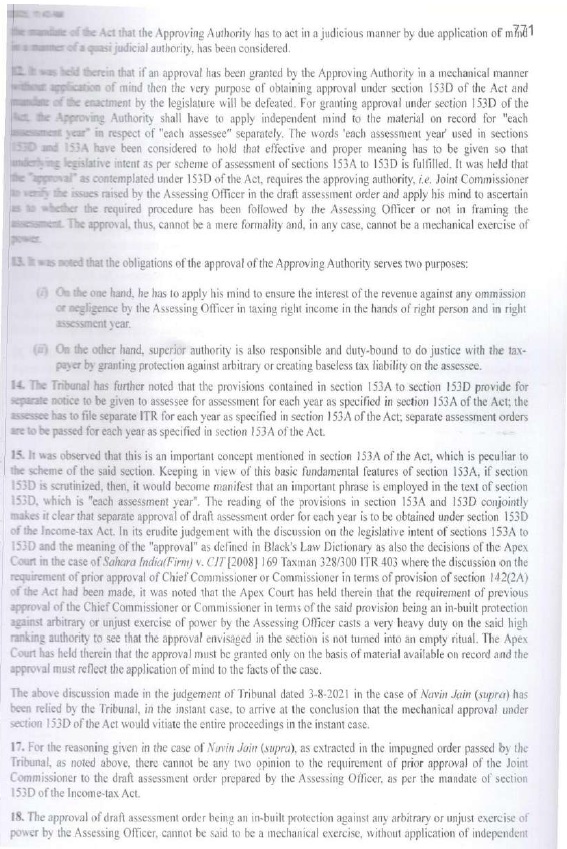
(J.1.3) Moreover, in the case of Shiv Kumar Nayyar (supra), Hon’ble Delhi High Court held as under:
10. Before embarking upon the analysis of the factual scenario of the instant appeal, we deem it apposite to examine the underlying.
(J.1.3.1) In the case Pr. CIT (Central) v. Anuj Bansal (Delhi)/[2024] 466 ITR 251 (Delhi) also, Hon’ble Delhi High Court upheld the order of ITAT quashing assessment order on the ground that there was absence of application of mind by the approving authority in granting approval u/s 153D of IT Act. The SLP filed by Revenue against this order of Hon’ble Delhi High Court has been dismissed by Hon’ble Supreme Court in Anuj Bansal (supra). Similar view has also been taken by Hon’ble Delhi High Court in the cases CIT v. Pioneer Town Planners (P.) Ltd. (Delhi)/[2024] 465 ITR 356 (Delhi) and in Pr. CIT v. MDLR Hotels (P.) Ltd. (Delhi).
(J.1.4) In the case of Pr. CIT v. Subodh Agarwal (Allahabad) ; Hon’ble Allahabad High Court held as under:
(J.1.5) We are also cognizant of the order of Lucknow Bench of ITAT in the case of Standard Frozen Foods Exports Pvt. Ltd. v. DCIT [IT(SS)A No.41 & 41/Lkw/2022], which has been authored by us and order of Lucknow Bench of the ITAT in Quality Structures Pvt. ltd. v. DCIT [IT(SS)A No.679 & 680/Lkw/2019], which is co-authored by one of us (the Judicial Member). In these orders, we have already taken view regarding validity of approval u/s 153A of the Act and relevant portions are reproduced as under:
Standard Frozen Foods Exports Pvt. Ltd. (supra)
“(D) We have heard representatives of both sides. We have also perused the materials on record carefully.
(D.1) The first limb of the contention raised by the learned Counsel for the assessee is on the legal ground that statutory approval given to the Assessing Officer for the assessment orders was not based on application of mind. It was the case of the learned Counsel for the assessee that approval was given by Addl. CIT in a mechanical manner within a short period of time during which it was humanly impossible for the Addl. CIT to go through exhaustive assessment records, search & seizure materials and to thereafter give approval after due application of mind. The learned Counsel for the assessee submitted that the Addl. CIT gave approval to 110 cases in two days which included; 48 cases on 27/12/2019 and 62 cases on 28/12/2019. These cases included approvals given for assessment orders which are subject matters of the present batch of appeals before us. The learned Counsel for the assessee further drew our attention to the fact that approval No. 1490 was requested by the Assessing Officer for 16 cases on 28/12/2019 and approval was given by the Addl. CIT on the same day i.e. on 28/12/2019. He further drew our attention to the fact that approval No. 1488 was requested by the Assessing Officer for 15 cases on 26/12/2019 and approval was given by the Addl. CIT on the very next day i.e. on 27/12/2019. He also drew our attention to the fact that draft assessment orders were sent by the Assessing Officer for approval to the Addl. CIT at the fag end of the assessment proceedings on 26/12/2019 and 28/12/2019 though the assessments were going to be barred by limitation barely a few days later, on 31/12/2019. Placing reliance on the order of Hon’ble Allahabad High Court in the case of Pr. CIT v. Subodh Agarwal, I.T.A. No. 86 of 2022, dated 12/12/2022 and order of Hon’ble Orissa High Court in the case of ACIT v. Serajuddin & Co. (supra) and further on the order of Hon’ble Delhi High Court in the case of Pr. Commissioner of Income Tax v. Shiv Kumar Nayyar (supra), learned Counsel for the assessee submitted that the assessment orders passed by the Assessing Officer, based on mechanical approval given by the Addl. CIT, without due application of mind, lacked legal validity and deserved to be quashed. He also placed reliance on the orders of Income Tax Appellate Tribunal in the case of Khoday Ehshwarsa and Sons v. DCIT, I.T.A. No.1079 & 1080/Bang/2024 dated 20/09/2024 and in the case of Sanjay Duggal and Others, I.T.A. No.1813/Del/2019 and in the case of Quality Structure Pvt. Ltd. v. DCIT, IT (SS)A Nos. 679 & 680/Lkw/2019. The learned CIT, D.R. for Revenue submitted that it was the normal practice that the Assessing Officer and the Addl. CIT/Jt. CIT engage in periodical discussion over a long period of time. Therefore, it was possible for the Addl. CIT to grant approval to draft assessment order after application of mind even though time available was short. In his rejoinder, learned Counsel for the assessee submitted that there is nothing on record to show that there was discussion between the Assessing Officer and Addl. CIT. In response to specific query from Bench whether the assessees were responsible for the delay on the part of the Assessing Officer in submission of draft assessment orders to the Addl. CIT at the fag end of the limitation period; and if so, whether the submissions made by the assessee would still be good on merits, learned Counsel for the assessee submitted that the delay on the part of the Assessing Officer in submission of the draft assessment orders to the Addl. CIT was due to the fact that assessment proceedings were taken up in haste by the Assessing Officer after lapse of substantial duration of time available during the limitation period. He further submitted that the assessees made compliance with the notices of the Assessing Officer even though sufficient time was not given by the Assessing Officer. Therefore, he contended that the delay on the part of the Assessing Officer in submission of the draft assessment order to the Addl. CIT was entirely attributable to Revenue and to the Assessing Officer in particular; and further, that the assessees were in no way responsible for the delay. After hearing both sides, we are of the view that the issue in dispute is squarely covered by the order of the Hon’ble Allahabad High Court in the case of Pr. CIT v. Subodh Agarwal, I.T.A. No. 86 of 2022, dated 12/12/2022, order of Hon’ble Orissa High Court in the case of ACIT v. Serajuddin & Co. (supra) and order of Hon’ble Delhi High Court in the case of Pr. Commissioner of Income Tax v. Shiv Kumar Nayyar (supra), in favour of the assessee. Further the issue in dispute is also squarely covered in favour of the assessee by the orders of the Income Tax Appellate Tribunal in the case of Khoday Ehshwarsa and Sons v. DCIT, I.T.A. No.1079 & 1080/Bang/2024 dated 20/09/2024 and in the case of Sanjay Duggal and Others, I.T.A. No.1813/Del/2019 and in the case of Quality Structure Pvt. Ltd. v. DCIT, IT (SS)A No. 679 & 680/Lkw/2019 (supra). In view of the foregoing, we set aside the impugned appellate orders of learned CIT(A) deserve to be set aside; and the assessment orders passed by the Assessing Officer deserve to be annulled.
(D.2) The second limb of the contentions made by the learned Counsel for the assessee on behalf of the appellant assessees was that in the following cases, no incriminating material was found in the course of search conducted u/s 132 ofthe IT Act:
| Appeal Number |
Assessment year |
Appellant |
| IT(SS)A No.41/Lkw/2022 |
2012-13 |
Standard Frozen Foods Exports Pvt. Ltd. |
| IT(SS)A No.42/Lkw/2022 |
2013-14 |
Standard Frozen Foods Exports Pvt. Ltd. |
| IT(SS)A No.43/Lkw/2022 |
2016-17 |
Standard Frozen Foods Exports Pvt. Ltd. |
| IT(SS)A No.44/Lkw/2022 |
2017-18 |
Standard Frozen Foods Exports Pvt. Ltd. |
| IT(SS)A No.46/Lkw/2022 |
2012-13 |
Standard Agro Vet Pvt. Ltd. |
| IT(SS)A No.47/Lkw/2022 |
2013-14 |
Standard Agro Vet Pvt. Ltd. |
| IT(SS)A No.48/Lkw/2022 |
2014-15 |
Standard Agro Vet Pvt. Ltd. |
| IT(SS)A No.49/Lkw/2022 |
2015-16 |
Standard Agro Vet Pvt. Ltd. |
| IT(SS)A No.55/Lkw/2022 |
2014-15 |
Sachin Verma |
| IT(SS)A No.57/Lkw/2022 |
2016-17 |
Sachin Verma |
| IT(SS)A No.54/Lkw/2022 |
2012-13 |
Sachin Verma |
| IT(SS)A No.56/Lkw/2022 |
2015-16 |
Sachin Verma |
| IT(SS)A No.58/Lkw/2022 |
2017-18 |
Sachin Verma |
| IT(SS)A No.50/Lkw/2022 |
2015-16 |
Kamal Kant Verma |
| IT(SS)A No.51/Lkw/2022 |
2016-17 |
Kamal Kant Verma |
| IT(SS)A No.52/Lkw/2022 |
2017-18 |
Kamal Kant Verma |
Further, he submitted that in the aforesaid cases, the assessments were unabated. Therefore, he contended, following the order of Hon’ble Supreme Court in the case of Pr. CIT v. Abhisar Buildwell (P) Ltd. (supra), no additions could be made in the assessment orders passed by the Assessing Officer in the aforesaid assessment orders. The learned CIT D.R. for Revenue placed reliance on the orders ofthe Assessing Officer and the impugned appellate orders of the learned CIT(A) on this issue. After hearing both sides, we are of the view that the issue is squarely covered in favour of the assessees as far as aforesaid assessments are concerned, by order of Hon’ble Supreme Court in the case of Pr. CIT v. Abhisar Buildwell (P) Ltd. (supra). Accordingly, the additions made in the aforesaid assessment orders deserve to be deleted.
(D.2.1) In view of the foregoing, we are of the view that the additions made in the assessment orders pertaining to the present bunch of 19 appeals cannot be upheld. In the light of the discussion in foregoing paragraph (D.1) and (D.2) of this order, we are also of the view that the assessment orders passed by the Assessing Officer in the present batch of 19 appeals lack validity in law; and that the additions made cannot be upheld. In view of the foregoing, we set aside the impugned appellate orders passed by the learned CIT(A) and we annul corresponding assessment orders for various assessment years pertaining to various assessees in present batch of 19 appeals being disposed ofthrough this consolidated order.”
Quality Structures Pvt. Ltd. v. DCIT (supra)
“10. We have heard the rival parties and have gone through the material on record. We find that in this case, in view of a search carried out on the Sigma Group, the assessments of various assessees were reopened and various assessees were required to file income tax returns as required under the provisions of section 153A of the Act. The search was started on 23.8.2016 and it continued upto 25.8.2016, and therefore, the assessment year 2017-18 became the search year and the years preceding the search year became the subject matter of reopening under section 153A of the Act. Since the controversy involved herein is with regard to the approval under section 153D of the Act, it would be appropriate to first visit the provisions of section 153D of the Act, which, for the sake of completeness are reproduced below:
Prior approval necessary for assessment in cases of search or requisition.
153D. No order of assessment or reassessment shall be passed by an Assessing Officer below the rank of Joint Commissioner in respect of each assessment year referred to in clause (b) of sub-section (1) of section 153A or the assessment year referred to in clause (b) of sub-section (1) of section 153B, except with the prior approval of the Joint Commissioner.
Provided that nothing contained in this section shall apply where the assessment or reassessment order, as the case may be, is required to be passed by the Assessing Officer with the prior approval of the Principal Commissioner or Commissioner under sub-section (12) of section 144BA.
11. The above provisions of section 153D of the Act were inserted by the Finance Act, 2007 with effect from 1.6.2007. In our meek understanding of the said provisions, we are of the considered opinion that the Legislature wanted that the assessment/re-assessment of the search cases should be made and the order should be passed with the prior approval of the superior authority.
12. In the group of cases of Shri Navin Jain and others in I.T.(SS)A. Nos.639 to 641/Lkw/2019, etc., vide order dated 3.8.2021, for Assessment Years 2015-16 to 2017-18, on which reliance has been placed by the ld. counsel for the assessee, a similar issue has been considered by the Lucknow Bench of the Tribunal, wherein also, the approval under section 153D of the Act was given through the same letter dated 30.12.2018 by the ACIT, Central, Kanpur and the Ground raised in this regard by the assessee was allowed, and the assessment orders were annulled by us. While allowing the Ground raised by the assessee, the Tribunal had also considered various cases laws, including that of the Hon’ble Supreme Court. For the sake of ready reference, the findings of the Tribunal in that case are reproduced as under:
“9. We have heard the rival parties and have gone through the material placed on record. We find that in these cases, in view of a search carried out on the Sigma Group, the assessments of various assessees were reopened and various assessees were required to file income tax returns as required under the provisions of section 153A of the Act. The search was conducted on 23/08/2016 which continued upto 25/08/2016 and therefore, assessment year 2017-18 became the search year and the years preceding the search year became the subject matter of reopening u/s 153A of the Act. The issue raised by Learned counsel for the assessee is that the approval granted by the Addl. CIT is bad in law as it is humanly impossible to go through documents exceeding 17,800 in a single day and then grant approval on the same day. Since the controversy involved here is with respect to approval u/s 153D of the Act, it would be appropriate to first visit the provisions of section 153D of the Act, which for the sake of completeness are reproduced below:
“SECTION 153D.
Prior approval necessary for assessment in cases of search or requisition [No order of assessment or reassessment shall be passed by an Assessing Officer below the rank of Joint Commissioner in respect of each assessment year referred to in clause (b) of [sub-section (1) of section 153A] or the assessment year referred to in clause (b) of subsection (1) of section 153B, except with the prior approval of the Joint Commissioner.] [Provided that nothing contained in this section shall apply where the assessment or reassessment order, as the case may be, is required to be passed by the Assessing Officer with the prior approval of the [Principal Commissioner or Commissioner] under sub-section (12) of section 144BA.]”
9.1 The above provisions of section 153D of the Act were inserted by Finance Act, 2007 with effect from 01/06/2007. In our humble understanding of the said provisions, we are of the opinion that the Legislature wanted the assessment/reassessment of the search cases should be made and order should be passed with the prior approval of superior authority. The word approval has not been defined in the Income Tax Act but the general meaning of word approval can be understood from Black Law of Dictionary which defines approval as:
“The Act of confirming, rectifying, sanctioning or consenting to some act or thing done by another. To approve means to be satisfied with, to confirm, rectify, sanction or ‘consent to some act or thing done by another, to consent officially, to rectify, to confirm, to pronounce good, thing or Judgment of, admitting propriety or excels or to pleas with.”
9.2 The Hon’ble Supreme Court of South Carolina in State v. Duckett 133 SC 85 [SC 1925], 130 SE 340 decided on 05.11.1925 held that approval implies knowledge and, the exercise or discretion after knowledge.
9.3 Further Hon’ble Supreme Court in the case of Vijayadevi Naval Kishore Bharatia v. Land Acquisition Officer [2003] 5 SCC 83 has held as under:
“Whenever there is an administrative approval given by higher authority, higher authority applies its mind to see whether the proposed Award is acceptable to the Government or not ? Such Authority may satisfy itself as to the material relied upon by the Adjudicator, but, the Approving Authority cannot reverse the finding, as he is an Appellate Authority for the purpose of remanding the matter to the Adjudicating Authority as can be done by the Appellate Authority. Further, the Approving Authority also cannot exercise its power of prior approval to give directions to the Adjudicating Authority in what beneficial to accept/ appreciate tine material on record in regard to the compensation payable. Otherwise, it would tantamount to blurring the distinction between Approving Authority and Appellate Authority”.
9.4 Further Hon’ble Gauhati High Court in the case of Dharampal Satyapal Ltd., vs., Union of India [2019] 366 ELT 253 (Gau.) Manu/GH/07070/2018 in para-28 has held as under :
“When an Authority is required to give his approval, it is also to be understood that such Authority makes an application of mind as to whether the matter that is required to be approved satisfies all the requirements of Law or procedure to which it may be subjected. In other words, grant of approval and application of mind as to whether such approval is to be granted must co- exist and, therefore, where an Authority grants an approval it is also to be construed that there was due application of mind that the subject matter approved and satisfies all the legal and procedural requirements.”
Therefore, from the definition of approval as per above authorities, its meaning with respect to approval u/s 153D means that the superior authority should apply his mind on the material on the basis of which the Assessing Officer is making or passing assessment order and after due application of mind to material in the hands of the Department and after going through the explanation by the assessee and documentary evidence and other relevant material, the superior authority has to grant approval u/ s 153D for passing assessment/reassessment order in search cases. The approval u/s 153D of the Act cannot be treated mere formality only and the purpose of inserting this provision is two fold i.e. one before approving the senior authority will ensure that the assessee should be protected against the undue and irrelevant addition and disallowances and the approving authority will also ensure that proper enquiry or investigations are carried out by the Assessing Officer on the relevant materials including material in the hands of the Department. Secondly, the Assessing Officer also keeps in mind the interest of Revenue. Therefore, the said provision provides application of mind by the approving authority of the Department.
Therefore, the provision of section 153D of the Act cannot be treated as mere formality and mandate therein is required to be followed by the approving authority in a judicious manner by due application of mind in a manner of a quasi judicial authority. We are cautious about the fact that reasons for granting approval may not be a subject matter of challenge or not required to be mentioned in the order of approval but the manner and material on the basis of which approval has been granted can be challenged by the assessee. The scope and issue agitated by the assessee by way of legal ground in the present cases is not that of granting of approval but the main grievance of the assessee is that the approving authority has granted approval without application of mind and without looking into the seized material. We are inclined to hold that if an approval has been granted by the approving authority in a mechanical manner without application of mind then the very purpose of obtaining approval u/s 153D of the Act and mandate of enactment by the Legislature will be defeated. It is a trite law that for granting approval u/s 153D of the Act, the approving authority shall have to apply independent mind to the material on record for each assessment year in respect of each assessee separately. The rationale of word “Each” as specifically referred to in Section 153D and Section 153A deserves to be given effective/proper meaning so that underlying legislative intent as per scheme of assessment of Section 153A to 153D is fulfilled. The meaning of ‘approval’, as contemplated u/s 153D of the Act, is that the Jt. CIT is required to verify the issues raised by the Assessing Officer in the draft assessment order and apply his mind and to ascertain as to whether the entire facts have been properly appreciated by the Assessing Officer. The Jt. CIT is also required to verify whether the required procedure has been followed by the Assessing Officer or not in framing the assessment. Thus, the approval cannot be a mere discretion or formality but quasi judicial function based on reasoning. In our view, when the Legislature has enacted the provision to be exercised by the higher authority to pass assessment order in the search cases then it is the duty of the Jt. CIT to exercise such power by applying his judicious mind. The obligation of the approval of the approving authority is of two fold i.e. on one hand, he has to apply his mind to ensure the interest of the Revenue against any omission or negligence by the Assessing Officer in taxing right income in the hands of right person and in right assessment year and on the other hand, superior authority is also responsible and duty bound to do justice with the tax payer by granting protection against arbitrary or creating baseless tax liability on the assessee. The provisions contained from section 153A to section 153D contain features by which the assessee is to be given separate notice for assessment for each year as specified u/ s 153A of the Act. Secondly, the assessee has to file separate ITR for each year as specified in section 153A of the Act. Thirdly, separate assessment orders are to be passed for each year as specified in section 153A of the Act. There is an important concept mentioned in section 153A of the Act, abated and non abated which is peculiar to the scheme of section 153A of the Act. Keeping in view the above basic fundamental features of Section 153A, if Section 153D is scrutinized, then, it would become manifest that very important phrase as deployed in text of Section 153D, is “Each” assessment year. The word “Each” has been used extensively and this word needs to be given due weightage and adequate meaning and as such for each year separate approval is to be given under section 153D of the I. T. Act which is lacking in the present cases. There are many other provisions where statutory approval is required from higher authorities. Few of them are noted like in Section 151 and Section 274 etc., respectively dealing with the approvals on reopening cases and penalty cases. When Section 153D is juxtaposed with Section 151 and Section 274, most important differences which is peculiar to Section 153D is the word “Each”. Word each is not used in Section 151 and Section 274 and the word “Each” is specially and consciously referred to in Section 153D so that assessee-wise and year-wise application of mind on the part of the approving authority is there which is in accordance with the overall scheme of Section 153A to Section 153D of the I. T. Act. Hon’ble Allahabad High Court in the case of Shri Mohd. Ayub v. ITO [2012] 346 ITR 30 (Alld) dealt with non issue of separate notice under section 148 of the I. T. Act and held it to be invalid because each assessment year was to be taken as an independent unit of assessment and therefore, if the above settled position is tested with the provisions of Section 153D, it would emerge that when in a case where requirement of separate notice under section 148 of the I. T. Act was given absolute primacy therefore, in the context of Section 153D of the I. T. Act (where each word is expressly used and which is a year centric special scheme of assessment with concept of abated/non-abated assessments) there is absolute necessity of separate approval for each year and for each assessee. In the present cases Jt. CIT has given approval u/s 153D of the Act for all the years altogether involved in search and the approving authority in a mechanical manner and as an idle formality has granted approval. In one line the approving authority has given blank go ahead to pass order under section 153A without even taking minimum possible pains to take appropriate note of year-wise income as computed. The legislative intent behind Section 153D can be discerned/gathered from the CBDT Circular No.3/2008 dated 12.03.2008 in which it is highlighted that approval of the approving authority is mandatory. For the sake of completeness, the contents of Circular No. 3/2008 are reproduced below:
“50. Assessment of search cases Orders of assessment and reassessment to be approved by the Joint Commissioner.
50.1 The existing provisions of making assessment and reassessment in cases where search has been conducted under section 132 or requisition is made under section 132A does not provide for any approval for such assessment.
50.2 A new section 153D has been inserted to provide that no order of assessment or reassessment shall be passed by an Assessing Officer below the rank of Joint Commissioner except with the previous approval of the Joint Commissioner. Such provision has been made applicable to orders of assessment or reassessment passed under clause (b) of section 153A in respect of each assessment year falling within six assessment years immediately preceding the assessment year relevant to the previous year in which search is conducted under section 132 or requisition is made under section 132A. The provision has also been made applicable to orders of assessment passed under clause (b) of section 153B in respect of the assessment year relevant to the previous year in which search is conducted under section 132 or requisition is made under section 132A.
50.3 Applicability-These amendments will take effect from the 1st day of June, 2007.”
9.5 It is evident from the CBDT Circular that the legislature in its highest wisdom made it compulsory that the assessments of search cases should be made with the prior approval of superior authority, so that the superior authority could apply his mind on the materials and other circumstances on the basis of which the officer is making the assessment and after due application of mind and on the basis of seized materials, the superior authority have to approve the assessment order. The object of entrusting the duty of approval of assessment in search cases is that the Jt. CIT, with his experience and understanding could scrutinize the seized documents and any other material forming the foundation of assessment. It is an elementary law that whenever any statutory obligation is casted upon any statutory authority, such authority is required to discharge its obligation not mechanically, not even formally but after due application of mind. The approval granted under section 153D of the Act should necessary reflect due application of mind and if the same is subjected to judicial scrutiny, it should stand for itself and should be self defending. In the above background of law and in the light of order dated 30.12.2018 passed under section 153D of the Act, which gives legality to the impugned assessment orders, question which arises for our consideration is whether the approval granted by the Additional CIT, Central, Kanpur vide his order dated 30.12.2018 can be held to be granted after due application of mind and can be held to be valid in the eyes of law. Learned counsel for the assessee, during the proceedings before us had filed a chart showing number of documents seized during search belonging to the group totaling 15,800 pages. Besides the above documents, replies filed by assessees belonging to the group consisted of about 200 pages and in fact there were documents belonging to other group also, the approval of which has also been granted along with assessees on the same day through the same approval letter. Therefore, keeping in view huge number of documents involved, it is humanely impossible for a person to apply his mind on all cases individually and that too in a single day. For the sake of completeness, the said approval dated 30/12/2018 has been made part of this order and is reproduced below:
The contents of the approval speaks for itself loud and clear. The following inferences are inevitable from the bare reading of the said order. The draft assessment orders were placed before the Additional CIT, Central, Range-Kanpur on 30/12/2018 for the first time and on the same day approval was granted. As clearly mentioned in the approval under challenge, prior to this date the case was never discussed with the authority granting the approval. The Additional CIT without any consideration on merits in respect of the issues on which addition was made, granted the approval and such approval is an eyewash and idle formality and such a mechanically granted approval is no approval in the eyes of law. The entire gamete of law, as contemplated u/s 153D of the Act, has been considered by Delhi Bench of the Tribunal in a bunch of 52 appeals in I.T.A. No.1813/Del/2019 in the case of Sanjay Duggal and Others wherein the Hon’ble Bench vide order dated 19/01/2021 has quashed the assessment orders by holding that the approval granted u/s 153D of the Act was in a mechanical manner and thus cannot be held to be an approval as required u/s 153D of the Act. The relevant findings of the Tribunal are contained in para 11 onwards, which for the sake of completeness are reproduced below:
“11. We have considered the rival submissions and perused the written submissions filed by the parties and considered the material on record. It is an admitted fact that search and seizure action were carried-out in the cases of the assessees on 29.12.2015. Section 153A have been inserted into the Income Tax Act w.e.f. 01.06.2003. Prior to that there were provisions contained under section 158BC being the special procedure for assessment of search cases. Thus, the provisions of Section 153A to 153D are applicable in the case of assessees. According to Section 153A of the I. T. Act, there should be a search initiated under section 132 of the I. T. Act and panchanama drawn, the A.O. shall have to issue notice to the assessee requiring him to furnish the return of income within the specified time in respect of each assessment year falling within six assessment years. The A.O. shall assess or re-assess the total income of six assessment years immediately preceding the assessment year relevant to the previous year in which such search is conducted or requisition is made. Provided that the A.O. shall assess or re-assess the total income in respect of each assessment year falling within such six assessment years. It is further provided that assessment or re-assessment, if any, relevant to any assessment year falling within the period of six assessment years referred to in this Section pending on the date of initiation of the search under section 132 or making of requisition under section 132A as the case may be, shall abated. Thus, when provisions of Section 153A are applicable in a case of assessee, A.O. shall have to give separate notice of each assessment year and assessee shall have to be directed to file return of income for each year and separate orders shall have to be passed for each assessment year. In Section 153A of the I. T. Act, the A.O. shall have to see whether there are abated or nonabated assessments which was not provided in earlier provisions for block assessments. The Hon’ble Delhi High Court in the case of CIT vs., Kabul Chawla [2016] 380 ITR 573 (Del.) considered the issue of abated and non-abated assessments and with regard to completed assessments held that the same can be interfered with by the A.O. while making the assessment under section 153A only on the basis of some incriminating material unearthed during the course of search which was not produced or not already disclosed or made known in the course of original assessment. It is also held in the same Judgment that in so far as pending assessments are concerned, the jurisdiction to make the original assessment and the assessment under section 153A merges into one. Only one assessment shall have to be made separately for each assessment year on the basis of the findings of the search and any other material existing or brought on record by the A.O. Therefore, these were the mandatory provisions contained in Section 153A which shall have to be satisfied by the A.O. before proceeding to frame assessment in the cases of persons searched under section 132 of the I. T. Act, 1961. Further safeguard have been provided for framing the assessments under section 153A that prior approval shall be necessary for assessments in the cases of the search or requisitioned, under section 153D of the IT. Act. Section 153D of the I.T. Act is reproduced as under: “153D – No Order of assessment or re-assessment shall be passed by an Assessing Officer below the rank of Joint Commissioner in respect of each assessment year referred to in Clause (b) of Sub-Section (1) of Section 153A or the assessment year referred to in Clause (b) of sub-section (ii) of Section 153B except with the prior approval of the Joint Commissioner.
“Provided that nothing contained in this section shall apply where the assessment or reassessment order, as the case may be, is required to be passed by the Assessing Officer with the prior approval of the Commissioner under subsection (12) of section 144BA.”.
11.1. It is an admitted fact that in all the above appeals assessments under section 153A have been framed by ACIT, Central Circle, New Delhi, therefore, prior approval of the JCIT in respect of each assessment year referred to under section 153A or 153B shall have to be obtained. Thus, no order of assessment or re-assessment shall be passed by the A.O. in the present cases in respect of each assessment years under section 153A/153B of the I. T. Act, 1961, except with the prior approval of the Joint Commissioner. Learned Counsel for the Assessee has argued that the approval under section 153D have been granted by the JCIT without going through the seized material, appraisal report and other material on record. Thus, the approval is granted in a most mechanical manner and without application of mind. Therefore, same is invalid, bad in Law and void ab initio and as such all assessments under section 153A got vitiated and as such A.O. was not having jurisdiction to pass the assessment orders under section 153A of the I.T. Act, 1961.
11.2. The meaning of the word “Approval” as defined in Black Law Dictionary is –
“The Act of confirming, rectifying, sanctioning or consenting to some act or thing done by another. To approve means to be satisfied with, to confirm, rectify, sanction or ‘consent to some act or thing done by another, to consent officially, to rectify, to confirm, to pronounce good, thing or Judgment of, admitting propriety or excels or to pleas with.”
11.3. The Hon’ble Supreme Court of South Carolina in State vs., Duckett 133 SC 85 [SC 1925], 130 SE 340 decided on 05.11.1925 held that “Approval implies knowledge and, the exercise or discretion after knowledge.”
11.4. The Hon’ble Supreme Court in the case of Vijayadevi Naval Kishore Bharatia vs., Land Acquisition Officer [2003] 5 SCC 83 wherein it has been held that :
“Whenever there is an administrative approval given by higher authority, higher authority applies its mind to see whether the proposed Award is acceptable to the Government or not ? Such Authority may satisfy itself as to the material relied upon by the Adjudicator, but, the Approving Authority cannot reverse the finding, as he is an Appellate Authority for the purpose of remanding the matter to the Adjudicating Authority as can be done by the Appellate Authority. Further, the Approving Authority also cannot exercise its power of prior approval to give directions to the Adjudicating Authority in what beneficial to accept/ appreciate tine material on record in regard to the compensation payable. Otherwise, it would tantamount to blurring the distinction between Approving Authority and Appellate Authority”.
11.5. The Hon’ble Gauhati High Court in the case of Dharampal Satyapal Ltd., vs., Union of India [2019] 366 ELT 253 (Gau.) Manu/GH/07070/2018 in para-28 has held as under :
“When an Authority is required to give his approval, it is also to be understood that such Authority makes an application of mind as to whether the matter that is required to be approved satisfies all the requirements of Law or procedure to which it may be subjected. In other words, grant of approval and application of mind as to whether such approval is to be granted must co- exist and, therefore, where an Authority grants an approval it is also to be construed that there was due application of mind that the subject matter approved and satisfies all the legal and procedural requirements.”
11.6. Therefore, in the cases of search, assessment orders whether framed under section 153A or 153C, the Joint Commissioner [Approving Authority] is required to see that whether the additions have been made in the hands of assessee are based properly on incriminating material found during the course of search, observations/comments in the appraisal report, the seized documents and further enquiries made by the A.O. during the course of assessment proceedings. Therefore, necessarily at the time of grant of approval of the assessment made by the A.O, the Joint Commissioner is required to verify the above issues, apply his mind that whether they have been properly appreciated by the A.O. while framing the assessment orders or not. The JCIT is also required to verify whether the required procedure have been followed by the A.O. or not at the time of framing of the assessments. Thus, the approval cannot be a mere discretion or formality, but, is mandatory being Quasi Judicial function and it should be based on reasoning. In our view, when the legislature has enacted some provision to be exercised by the higher Revenue Authority enabling the A.O. to pass assessment order or reassessment order in search cases, then, it is the duty of the JCIT to exercise such powers by applying his judicious mind. We are of the view that the obligation of the approval of the Approving Authority is of two folds ; on one hand, he has to apply his mind to secure in build for the Department against any omission or negligence by the A.O. in taxing right income in the hands of right person and in right assessment year and on the other hand, JCIT is also responsible and duty bound to do justice with the tax payer [Assessee] by granting protection against arbitrary or unjust or unsustainable exercise and decision by the A.O. creating baseless tax liability on the assessee and thus, the JCIT has to discharge his duty as per Law. Thus, granting approval under section 153D of the I. T. Act is not a mere formality, but, it is a supervisory act which requires proper application of administrative and judicial skill by the JCIT on the application of mind and this exercise should be discernable from the Orders of the approval under section 153D of the I.T. Act.”
9.7 Further we find that I.T.A.T. Cuttack Bench in the case of Geetarani Panda v. ACIT in I.T.A. No.01/CTK/2019 vide order dated 05/07/2018 has held as under:
“24. In our considered view, the provisions contained in Section 153D as enacted by the Parliament cannot be treated as an empty formality. The provision has certain purpose. It is apparent that the purpose behind the enactment of the above provision in the Statute by the Parliament are two folds. Firstly, the approval of the Senior Authority will ensure that the assessee is not prejudiced by the undue or irrelevant addition or assessment. Secondly, the approval by Senior Authority will also ensure that proper enquiry or investigation are carried out by the Assessing Authority. Thus, the above provision provides for mental application of a Senior Officer of the Department, which in turn, provides safeguard to both i.e. Revenue as well as the assessee. Therefore, this important provision laid down by the legislature cannot be treated as a mere empty formality. The same view was expressed by the Pune Benches of the Tribunal in the case of Akil Gulamali Somji v. ITO, in IT Appeal Nos.455 to 458 (Pune) of 2010 order dated 30.3.2012, wherein, it was held that when the approval was granted without proper application of mind, the order of assessment will be bad in law. The Hon’ble Bombay High Court in the case of CIT-II v. Shri Akil Gulamali Somji, in Income Tax Appeal (L) No.1416 of 2012 order dated 15.1.2013 concurred with the view of the Tribunal that not following of the provisions of section 153D of the Act will render the related order of assessment void.”
9.8 Further we find that I.T.A.T. Mumbai Bench in the case of Shreelekha Dammani vs.DCIT in I. T.A. No.4061/Mum/2012 vide order dated 19/08/2015 has decided the issue in favour of the assessee by holding as under:
“12. Coming to the facts of the case in hand in the light of the analytical discussion hereinabove and as mentioned elsewhere, the Addl. Commissioner has showed his inability to analyze the issues of draft order on merit clearly stating that no much time is left, inasmuch as the draft order was placed before him on 31.12.2010 and the approval was granted on the very same day. Considering the factual matrix of the approval letter, we have no hesitation to hold that the approval granted by the Addl. Commissioner is devoid of any application of mind, is mechanical and without considering the materials on record. In our considered opinion, the power vested in the Joint Commissioner/Addl Commissioner to grant or not to grant approval is coupled with a duty. The Addl Commissioner/Joint Commissioner is required to apply his mind to the proposals put up to him for approval in the light of the material relied upon by the AO. The said power cannot be exercised casually and in a routine manner. We are constrained to observe that in the present case, there has been no application of mind by the Addl. Commissioner before granting the approval. Therefore, we have no hesitation to hold that the assessment order made u/ s. 143(3) of the Act r. w. Sec. 153 A of the Act is bad in law and deserves to be annulled. The additional ground of appeal is allowed.
13. The ld. Departmental Representative has strongly relied upon the decision of the Tribunal Mumbai Bench in the case of Rafique Abdul Hamid Kokani v. DCIT , Hon’ble High Court of Karnataka in the case of Rishabchand Bhansali v. DCIT and Hon’ble High Court of Madras in the case of Sakthivel Bankers v. Asstt.Commissioner
13.1. We have carefully perused the decisions placed on record by the Ld. DR. We find that all the decisions relied upon by the Ld. DR are misplaced inasmuch as all these decisions relate to the issue whether the Joint CIT/CIT has to give an opportunity of being heard to the assessee before granting the approval. This is not the issue before us as the Ld. Counsel has never argued that the assessee was not given any opportunity of being heard. These decisions therefore would not do any good to the Revenue.
14. Since we have annulled the assessment order, we do not find it necessary to decide the issues raised on merits of the case.”
9.9 In this case, the Addl. Commissioner has showed his inability to analyze the issues of draft order clearly stating that no much time was left as the draft order was placed before him on 31/12/2010 and approval was granted on the same day. In the case before us the Addl. CIT has though not expressly expressed his inability to analyze the issues of draft order but it is abundantly clear that he had not analyzed the issues in the draft order as in the present cases the approval has been given in 67 cases on the same date which is humanly impossible. If an ACIT cannot express his opinion on a single case in one day how another ACIT can express his opinion in 67 cases in a single day.
9.10 The Hon’ble Bombay High Court has dismissed the appeal of the Department filed against the above order of the Mumbai Tribunal in the case of Shreelekha Damani vide judgment dated 27/11/2018. The findings of Hon’ble Bombay High Court are reproduced below:
“7. In plain terms, the Additional CIT recorded that the draft order for approval under Section 153D of the Act was submitted only on 31st 3 of 4 Uday S. Jagtap 668-16-ITXA- 15=.doc December, 2010. Hence, there was not enough time left to analyze the issues of draft order on merit. Therefore, the order was approved as it was submitted. Clearly, therefore, the Additional CIT for want of time could not examine the issues arising out of the draft order. His action of granting the approval was thus, a mere mechanical exercise accepting the draft order as it is without any independent application of mind on his part. The Tribunal is, therefore, perfectly justified in coming to the conclusion that the approval was invalid in eye of law. We are conscious that the statute does not provide for any format in which the approval must be granted or the approval granted must be recorded. Nevertheless, when the Additional CIT while granting the approval recorded that he did not have enough time to analyze the issues arising out of the draft order, clearly this was a case in which the higher Authority had granted the approval without consideration of relevant issues. Question of validity of the approval goes to the root of the matter and could have been raised at any time. In the result, no question of law arises.”
9.11 Similar are the findings of I.T.A.T. Jodhpur Bench in the case of Indra Bansal & Ors. v. ACIT in I.T.A. Nos. 321 to 324 in which the Tribunal held as under:
“6. We have heard the rival contentions and have perused the material on record. The main contention of learned Authorised Representative is that reasonable time was not available with the Joint Commissioner for the grant of necessary approval as envisaged under section 153D of the Act. We have perused the forwarding letter dt. 30-32013 seeking approval of the draft assessment order. The date of receipt of this letter in the office of Joint Commissioner is indisputably on 31-3-2013 which is apparent from the date stamped on it by the office of the Joint Commissioner. Thus, this leaves no doubt that the letter requesting grant of approval and the granting of approval, both, are within one day of each other. This lends credence to the contention of the learned Authorized Representative that the draft assessment order was approved without much deliberation by the Joint Commissioner. Further, the time of the fax granting approval is 6.56 a.m. on 31-3-2013 which is prior to the office hours and, thus, it brings out a reasonable doubt that the approval was granted even before the letter requesting the approval was received in the office of the Joint Commissioner. Further, the response received by the assessee in response to his application under Right to Information Act, 2005 also establishes the correctness of the claim of the assessee that the assessment records were not before the Joint Commissioner when the approval was granted as the records were with the Range Office in Jodhpur whereas the approval was sent by fax on the morning of 31-3-2013 from Udaipur. Thus, it is our considered opinion that the Joint Commissioner had granted approval in a mechanical manner without examining the case records because the approval has been granted at 6.56 a.m. on 31-3-2013 from Udaipur wherein it has already been mentioned that the assessment records were being returned whereas the draft assessment order along with the assessment records were handed over to the office of the Joint Commissioner on 31-3-2013 and as such it was physically impossible that all the case records along with the draft assessment order were received by the Joint Commissioner at Udaipur.
Tribunal, Mumbai Bench in the case of Smt. Shreelekha Damani v. Dy. CIT (2015) 125 DTR (Mumbai)(Trib) 263 : (2015) 173 TTJ (Mumbai) 332 has held that the legislative intent behind the insertion of section 153D of the Act was that the assessments in search and seizure cases should be made with the prior approval of superior authority which means that the superior authorities should apply their mind to the material on the basis of which the assessing officer is making the assessment. In this case, the Addl. CIT had expressed his inability to analyze the issues of the draft order on merits clearly stating that not much time was left and granted the approval under section 153D of the Act on the same day and Tribunal, Mumbai Bench held that the approval granted by Addl. CIT was mechanical and had been passed without considering the material on record and was, therefore, devoid of any application of mind. The impugned assessment order was annulled.
Similarly, Tribunal, Allahabad Bench in Verma Roadways v. Asstt. CIT (2001) 70 TTJ (All) 728; (2000) 75ITD 183 (All) held that while granting approval, Commissioner is required to examine the material before approving the assessment order. In this case, Tribunal, Allahabad Bench was examining the issue of approval under section 158BG of the Act and it opined that the object for entrusting the job of approval to a superior and a very reasonable (sic-responsible) officer of the rank of Commissioner is that he with his ability, experience and maturity of understanding can scrutinize the documents, can appreciate its factual and legal aspects and can properly supervise the entire progress of assessment. Tribunal, Allahabad Bench held that the concerned authority while granting the approval is expected to examine the entire material before approving the assessment order and further that whenever any statutory obligation is cast on any authority, such authority is legally required to discharge the obligation not mechanically, nor formally but by application of mind.
Similarly, the Hon’ble Apex Court in the case of Sahara India (Firm) v. CIT & Anr. (2008) 216 CTR (SC) 303 : (2008) 7 DTR (SC) 27: (2008) 300 ITR 403 (SC), while discussing the requirement of prior approval of Chief Commissioner or Commissioner in terms of provision of section 142(2A) of the Act, opined that the requirement of previous approval of the Chief Commissioner or Commissioner in terms of said provision being an inbuilt protection against arbitrary or unjust exercise of power by the assessing officer, casts a very heavy duty on the said high-ranking authority to see it that the approval envisaged in the section is not turned into an empty ritual. The Hon’ble Apex Court held that the approval must be granted only on the basis of material available on record and the approval must reflect the application of mind to the facts of the case.
Coming to the facts of the case, it is apparent from the documents on record that the approval was given by the Joint Commissioner in hasty manner without even going through the records as the records were in Jodhpur while the Joint Commissioner was camping at Udaipur. The entire exercise of seeking and granting of approval in all the 2 cases was completed in one single day itself i.e., 313-2013. Thus, it is apparent that the Joint Commissioner did not have adequate time to apply his mind to the material on the basis of which the assessing officer had made the draft assessment orders. Tribunal, Mumbai Bench and Tribunal, Allahabad Bench in their orders, as discussed in the preceding paragraphs, have laid down that the power to grant approval is not to be exercised casually and in routine manner and further the concerned authority, while granting approval, is expected to examine the entire material before approving the assessment order. It has also been laid down that whenever any statutory obligation is cast upon any authority, such authority is legally required to discharge the obligation by application of mind. In all the cases before us, the Department could not demonstrate, by cogent evidence, that the Joint Commissioner had adequate time with him so as to grant approval after duly examining the material prior to approving the assessment order. The circumstances indicate that this exercise was carried out by the Joint Commissioner in a mechanical manner without proper application of mind. Accordingly, respectfully following the ratio of the Co-ordinate Benches of Mumbai and Allahabad as afore-mentioned and also applying the ratio of the judgment of the Hon’ble Apex Court in the case of Sahara India (Firm) v. CIT (supra), we hold that the Joint Commissioner has failed to grant approval in terms of section 153D of the Act i.e., after application of mind but has rather carried out exercise in utmost haste and in a mechanical manner and, therefore, the approval so granted by him is not an approval which can be sustained. Accordingly, assessments in three COs and nineteen appeals of the assessee(s), on identical facts, are liable to be annulled as suffering from the incurable defect of the approval not being proper. Accordingly, we annul the assessment orders in CO Nos. 8 to 10/Jodh/2016 and ITA Nos. 325 to 331/Jodh/2016. Thus, all the three COs and the nineteen appeals of the assessee, as aforesaid, are allowed.”
10. Similarly we find that Hon’ble Supreme Court in the case of Sahara India v. CIT & Others’ [2008] 216 CTR 303 (S.C.) : [2008] 7 DTR (SC) 27:
[2008] 300 ITR 403 (SC) while discussing the requirement of prior approval of Chief Commissioner or Commissioner in terms of provision of section 142(2A) of the Act, opined that the requirement of previous approval of the Chief Commissioner or Commissioner in terms of said provision being an inbuilt protection against arbitrary or unjust exercise of power by the assessing officer, casts a very heavy duty on the said high- ranking authority to see it that the approval envisaged in the section is not turned into an empty ritual. The Hon’ble Apex Court held that the approval must be granted only on the basis of material available on record and the approval must reflect the application of mind to the facts of the case.
11. In view of these facts and circumstances and in view of judicial precedents relied on by Learned A. R. Ground No.5 in appeals is allowed and the assessments orders are annulled. Rest of the grounds were not argued by Learned A. R. therefore, rest of the grounds are dismissed as not pressed.”
13. In view of these facts and circumstances and respectfully following the order of the Tribunal in the case of Shri Navin Jain and others (supra), the grievance of the assessee by way of Ground no.6 is allowed and the assessment order is annulled.”
(J.1.6) Moreover, in a Third Member case, order has been passed by Tribunal in the case of Dheeraj Chaudhary v. Asstt. CIT (Delhi – Trib.), on the issue of validity of approval u/s 153D of the Act. Also, we are conscious of order in the case of P.C. Puri v. CIT [1985] 151 ITR 584 (Delhi), in which Hon’ble Delhi High Court held: There is no difference, really speaking, between a full bench of three judges sitting together and this method of referring to the third judge in the case of a difference of opinion between the A two judges. Whether the first method is adopted or the second, “”opinion of the majority”” will be decisive. In this case there is a formal reference to a third judge to ascertain his opinion. His is the deciding voice. He turns the scales. The third judge is the full bench. Not alone. But along with two others who first heard the case. Whether the three judges sit at the same time or at different times-two at one time, and the third hearing the matter later on a difference of opinion-does not make much difference. As has happened in this case, the two judges have differed. So the case bag come to me, the third judge. The two judges have expressed their opinion. I, am now called upon to give my opinion. The opinion of the majority will prevail. All that happens is that the third is segregated from the two and does not sit with them. He comes in later on when there is a difference of opinion between them. In all cases it is the theory of numbers which is the foundation of the doctrine of stare decisis. Majority is a term signifying the greater number. Counting of heads underlies the theory” of judicial precedents as in any majority decision. The constitutional requirement of a constitution court of five judges is based on this theory. Similarly the CPC of 1908 enacts that in case of difference of opinion the matter has to be referred to a third judge. Therefore, the reference was correctly made to the third judge. Relevant portion of the order in the case of Dheeraj Chaudhary is reproduced as under:
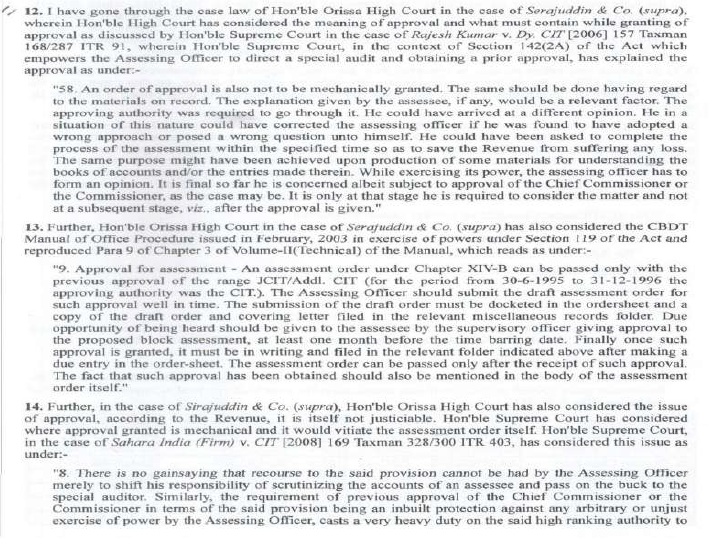
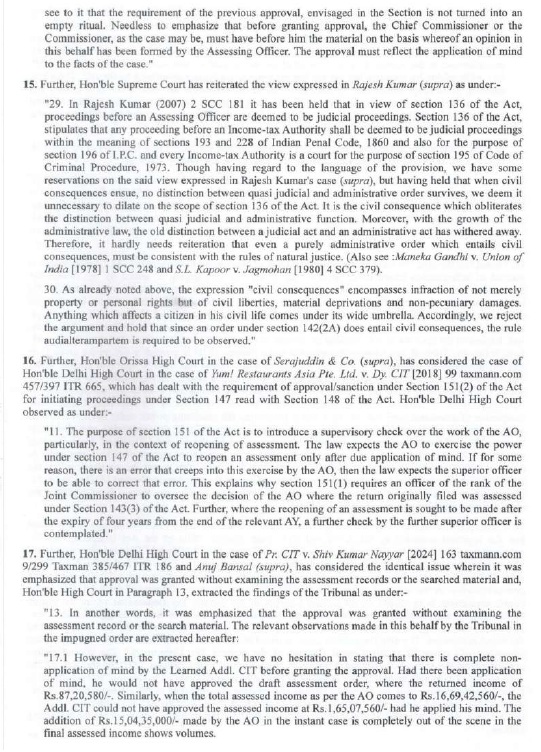
(K) The principles that emerge, in our understanding; from careful perusal of the aforesaid precedents, referred to in foregoing paragraphs (J.1) to (J.6.1) are as under:
| (i) |
|
Approval u/s 153D of IT Act cannot be a mechanical exercise. The approval must be granted by the approving authority after due application of independent mind. When this requirement is not met, the approval suffers from infirmity and is invalid. |
| (ii) |
|
The contention of Revenue that approval u/s 153D of the IT Act being an administrative act, is not justiciable; is wrong. |
| (iii) |
|
It is a bare minimum requirement that the approving authority must indicate what thought process was involved in granting the approval. Even if elaborate reasons are not given; there has to be some indication that the approving authority has examined the draft orders with regard to applicable law and all the relevant materials. When this requirement is not met, such approval suffers from infirmity and is invalid. |
| (iv) |
|
The directions given by CBDT in Search Manual regarding granting of approval, although initially issued in the context of section 158BG of I.T. Act, are also applicable for approval u/s 153D of the IT Act; and are mandatory. When these directions are not met; the approval suffers from infirmity and is invalid. |
| (v) |
|
The approval of draft assessment order by approving authority being an in-built protection against any arbitrary or unjust exercise of power by the Assessing Officer, cannot be said to be a mechanical exercise without due application of independent mind by the approving authority on the relevant materials and reasoning given in the assessment order; so as to appreciate factual and legal aspects to ensure that the entire material has been factored in, in the draft assessment order proposed by the Assessing Officer. |
| (vi) |
|
Section 153D of the IT Act requires that the Assessing Officer shall obtain prior approval of JCIT in respect of each assessment year. Section 153D of the IT Act requires that the Assessing Officer would be required to furnish the return of income in respect of each assessment year. The proviso to section 153D of the IT Act further provides for assessment of the total income in respect of each assessment year. Careful and conjoint reading of section 153A and section 153D of the IT Act leave no room to doubt that approval with respect to each assessment year is mandatory. As separate returns are to be filed for each assessment year, and as separate assessment orders are to be passed for each assessment year; it follows that approvals u/s 153D of the IT Act are to be given by the approving authority separately for each assessment year. If approvals for multiple assessment years are given u/s 153D of the IT Act through a common letter of approval; this violates statutory requirements; and such approvals suffer from infirmity and are invalid. |
| (vii) |
|
In Manual of Office Procedure, Volume-II (Technical) issued by CBDT is exercise of powers u/s 119 of the IT Act has directed in Chapter-3 that the Assessing Officer should submit draft assessment order in search cases to the approving authority well in time; and the approving authority should give due opportunity of being heard, at least one month before time barring date. These directions are binding on the Assessing Officer. |
| (viii) |
|
The Assessing Officer, while framing assessment, acts in quasi-judicial capacity and he ought to conform to the more elementary rules of judicial procedure; and in particular, to conduct the case himself, and not allow somebody else, even his superior officer to interfere in the conduct of the case. Higher authorities an Assessing Officer, Addl. CIT/Joint CIT i.e. JCIT or CIT or CCIT are not entitled to interfere in process of framing of assessment order by the Assessing Officer; except by mandate of law. The Addl.CIT/JCIT is entitled to issue directions u/s 144A of IT Act. Other than that, his role starts when he receives draft assessment orders for approval u/s 153D of the IT Act (wherever such approval is required under law). When first draft is returned back; his role ceases; and the role of Addl. CIT/JCIT starts again when he receives the final draft of the proposed assessment order, which he eventually approves. The question if the approval u/s 153D of the IT Act suffered from infirmity and was invalid is to be decided having regard to receipt of final draft of the proposed assessment order which the Addl. CIT/JCIT eventually approved. The association of Addl. CIT/JCIT with the Assessing Officer, and involvement of the Addl. CIT/JCIT in the assessment proceedings before that has no relevance for deciding whether approval u/s 153D of the IT Act suffered from infirmity and was invalid. In fact, in view of the foregoing discussion, any such association and involvement may, depending on facts and circumstances of the case, be fatal to the assessment on strict application of rules of judicial procedure as aforesaid; depending on facts and circumstances of the case. |
| (ix) |
|
When approval u/s 153D of the IT Act suffers from infirmity and is invalid for one or more aforesaid reasons, the entire assessment order becomes vitiated; and is to be annulled. |
(L) We accept the contention of the learned Departmental Representatives, as referred to in foregoing paragraph (H.1.1) of this order that whether in a particular case, JCIT had given approval u/s 153D of the IT Act after due application of mind, is a question of fact and the answer would depend on facts and circumstances of the particular case, independent of conclusion arrived at in any other case.
(L.1) Coming to the facts and circumstances of the present case; we accept the contention of the learned Counsel for the assessee that the affidavit of Shri M. L. Meena, the Assessing Officer and personal testimony of Shri Agrahari, Departmental Inspector are de void of any credibility; having regard to submissions made by learned Counsel for the assessee as referred to in foregoing paragraph (I) of this order. Further, in view of submissions of learned Counsel for the assessee as referred to in foregoing paragraph (I.1) of this order, we are of the opinion that neither the story presented by Revenue regarding Pen Drive inspires confidence nor, in any case it advances the case of Revenue, in the absence of any description of the contents of the Pen Drive in letter dated 18/07/2017 of the Assessing Officer and in the absence of any reference to Pen Drive in the notes and order sheet of the JCIT, the approving authority. Moreover, it is claimed by Revenue that all relevant records/materials were sent to the Addl. CIT/JCIT along with editable soft copies of the draft assessment order together with letter dated 18/07/2017, but there is no mention of “all relevant records/materials” in the letter dated 18/07/2017. Also, as mentioned earlier, there is no description of the contents of the Pen Drive in letter dated 18/07/2017. Besides, we are perplexed at hand written mention of the Pen Drive in the letter. Who writes Pen Drive as “Pen Drib”?. Who writes 1 Piece as “1 pees”? We are not convinced that a Pen Drive was sent with the letter dated 18/07/2017 by the Assessing Officer to the Addl. CIT/JCIT. Notwithstanding, the claim of Revenue that all relevant records/materials; which should consist of assessment records, seized materials, digital data in CPU, HDD and laptop, reports under Rules 9 and 9A of ITSC(P) Rules, assessees’ submissions etc; were available to the JCIT who gave approval u/s 153D of the IT Act in either physical form of digital form, is not borne out from records. Even if it was available, there is nothing on record to show that indeed the JCIT considered all relevant materials before giving approval u/s 153D of the IT Act. Further, having regard to submissions made by learned Counsel for the assessee, as referred to in foregoing paragraphs (F.1.1), (F.1.4, (F.1.4.1), (F.1.5) (I) (I.1) and (I.2) of this order; it is concluded that approval was granted by JCIT in a mechanical way without due application of mind, as an idle formality, and in the manner of rubber stamping; as it was humanly impossible for the JCIT to give approval in a total of 63 assessments; vide aforesaid common approval letter dated 31/07/2017; after due consideration of all relevant materials such as seized materials, appraisal report, digital data, submissions of the assessees, assessment records, reports under Rules 9 and 9A of ITSC(P) Rules, etc; within extremely limited time available to the JCIT. Further, the assessment order is dated 31/07/2017 but there is no mention of return of the assessment record from Varanasi (where JCIT was stationed) to Allahabad (where Assessing Officer was stationed) in any official communication between the two of them; which shows that the assessment records always remained with the Assessing Officer; and the JCIT did not even refer to the assessment records before granting approval u/s 153D of the IT Act. The doctrine of human probabilities in orders of Hon’ble Supreme Court in CIT v. Durga Prasad More [1971] 82 ITR 540 (SC) and Sumati Dayal v. CIT (SC)/[1995] 214 ITR 801 (SC) operates against Revenue, in the facts and circumstances of the present case.
(L.2) It is not in dispute that aforesaid common approval letter dated 31/07/2017 was issued by JCIT to give approval u/s 153D of the IT Act for 63 different assessments pertaining to 11 different assessees of Jeevan Jyoti Group, for different assessment years.
(L.3) On perusal of aforesaid common approval letter dated 31/07/2017 issued by JCIT; it is found that there is complete absence of any indication of thought process involved in granting the approvals for the assessment u/s 153D of the IT Act. There is no indication that the JCIT examined the draft order with regard to assessment record, applicable law and all relevant materials. The approval u/s 153D of the IT Act has been given in a non-speaking, summary and formal way, in the manner of rubber stamping.
(L.4) Neither the approving authority gave opportunity of being heard to the assessee before giving approval u/s 153D of the IT Act; nor did the Assessing Officer submit draft assessment order to the approving authority well in time to enable the approving authority to provide opportunity to the assessee (at least) one month before the time barring date of 31/07/2017. Thus, the approving authority and the Assessing Officer, both, failed to comply with mandatory direction of CBDT, issued in exercise of power u/s 119 of the IT Act, in Chapter-3 of Manual of Office Procedure, Volume-II (Technical).
(L.5) The claim of Revenue that Addl. CIT/JCIT were associated with the Assessing Officer and were involved in assessment proceedings (otherwise than in proceedings u/s 144A of IT Act) even before role of Addl. CIT/JCIT as approving authority u/s 153D of the IT Act began upon receipt of the final draft of the proposed assessment order which was eventually approved u/s 153D of the IT Act, is in violation of Rules of judicial procedure prohibiting any interference by higher authorities with assessment proceedings before the Assessing Officer.
(M) When the facts of the case as discovered in foregoing paragraphs (L.1), (L.2), (L.3), (L.4) and (L.5) are considered; they are found to be in contravention of every principle in foregoing paragraph (K) of this order enumerated as (i) to (ix). Respectfully following the precedents referred to in foregoing paragraphs (J.1) to (J.6.1); which are at the core of these principles; it is concluded that approval u/s 153D of the IT Act was given by the JCIT in a mechanical manner without due application of mind. It is further concluded that the approval u/s 153D of the IT Act given by the JCIT suffered from infirmities mentioned at Sl.Nos. (i), (iii), (vi), (viii) and (iv) read with (vii) in foregoing paragraph (K) of this order. Accordingly, it is concluded that the approval given u/s 153D of the IT Act suffers from multiple infirmities; and is invalid; because of which the entire assessment order is vitiated. In accordance with Sl.No. (ix) in foregoing paragraph (K) of this order, therefore, the assessment order is to be annulled. The alternate submission made by learned Departmental Representatives, to restore the matter regarding approval u/s 153D of the IT Act to the file of the approving authority (i.e. Addl. CIT/JCIT) is rejected because it would amount to providing a second innings to Revenue against mandate of law; and also because it would amount to extending period of limitation available for completing assessment proceedings, which is not permissible in law. The limitation period available to Revenue is inclusive of time taken for granting approval u/s 153D of the IT Act; and there is no provision of law permitting extention of period of limitation for failure of the approving authority to give valid approval u/s 153D of the IT Act. In view of the foregoing; the Assessing Officer is annulled.
(M.1) Since the assessment order is annulled, the impugned appellate order of learned CIT(A) has no legs to stand. Therefore, the impugned appellate order of learned CIT(A) is set aside.
(M.2) As mentioned in foregoing paragraph (F) of this order, representatives of both sides have agreed that appeals of Minto Developers Pvt. Ltd. (I.T.A. No.337/Lkw/2018 for A.Y. 2009-10) may be taken as the lead case as regards the legal issue whether the assessments were passed by the Assessing Officer after obtaining valid approval of JCIT. They submitted that the facts and circumstances for all the other appeals on this issue were in para materia and the decision in the case of Minto Developers Pvt. Ltd. would apply mutatis mutandis to remaining cases also. Therefore, the assessment orders pertaining to all the appeals/Cross-Objections are also hereby annulled; and the impugned appellate orders pertaining to all appeals/Cross-Objections before us are set aside.
(M.2.1) As the assessment orders pertaining to all appeals and Cross-Objections before us have been annulled; and all the impugned appellate orders have been set aside; the grounds pertaining to other issues and matters before us have become merely academic in nature; hence not decided.
(N) In the result, the appeals and Cross-Objections filed by the assessees are allowed and the appeals of the Revenue are dismissed.