ORDER
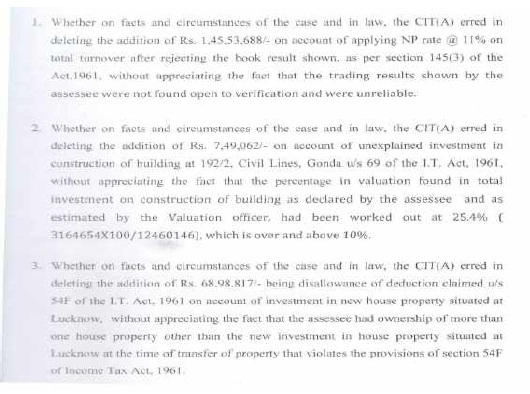
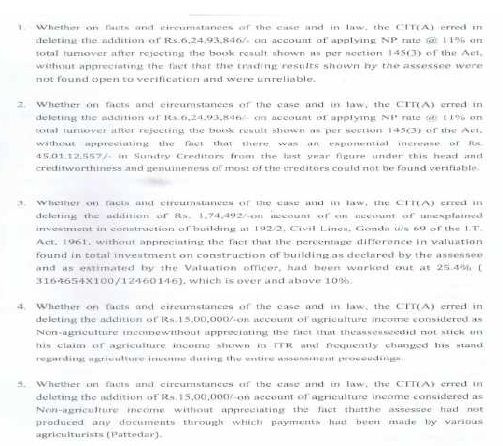
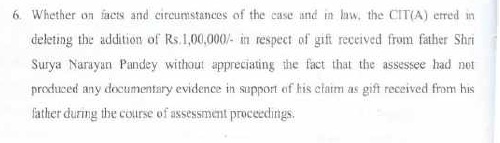
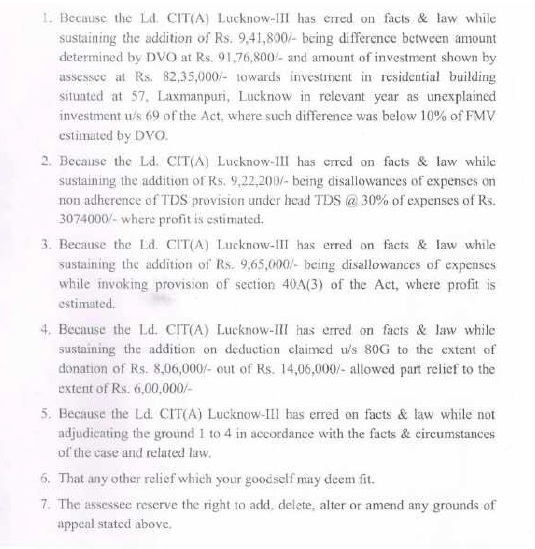
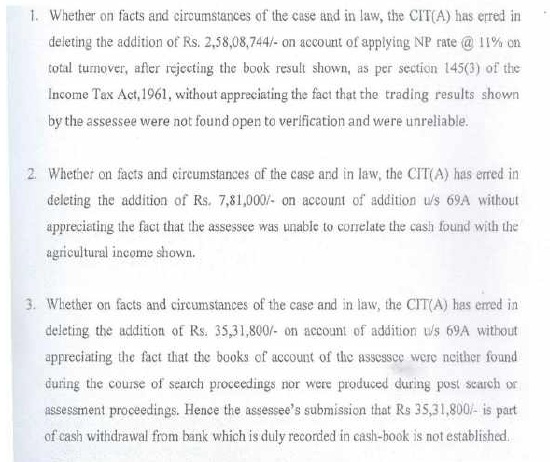
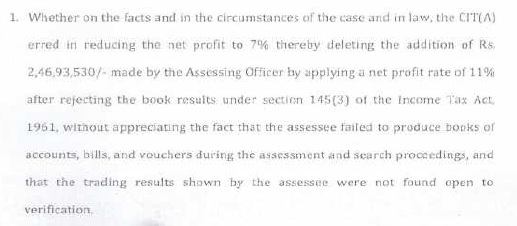
Anadee Nath Misshra, Accountant Member.- (A) For the sake of convenience and brevity these appeals and Cross Objections (“COs” for short) pertaining to the same assessee are hereby disposed of through this consolidated order. Grounds taken in these appeals and COs are as under:
I.T.A. No.557/Lkw/2024, A.Y. 2021-22 (Revenue’s Appeal)
I.T.A. No.608/Lkw/2024, A.Y. 2020-21 (Revenue’s Appeal)
C.O.No.27/Lkw/2024, A.Y. 2021-22 (Assessee’s C.O.)
C.O.No.28/Lkw/2024, A.Y. 2020-21 (Assessee’s C.O.)
I.T.A. No.347/Lkw/2025, A.Y. 2014-15 (Assessee’s Appeal)
I.T.A. No.348/Lkw/2025, A.Y. 2015-16 (Assessee’s Appeal)
I.T.A. No.349/Lkw/2025, A.Y. 2016-17 (Assessee’s Appeal)
I.T.A. No.350/Lkw/2025, A.Y. 2017-18 (Assessee’s Appeal)
I.T.A. No.351/Lkw/2025, A.Y. 2018-19 (Assessee’s Appeal)
I.T.A. No.352/Lkw/2025, A.Y. 2019-20 (Assessee’s Appeal)
I.T.A. No.353/Lkw/2025, A.Y. 2022-23 (Assessee’s Appeal)
I.T.A. No.398/Lkw/2025, A.Y. 2015-16 (Revenue’s Appeal)
I.T.A. No.399/Lkw/2025, A.Y. 2016-17 (Revenue’s Appeal)
I.T.A. No.402/Lkw/2025, A.Y. 2019-20 (Revenue’s Appeal)
I.T.A. No.405/Lkw/2025, A.Y. 2022-23 (Revenue’s Appeal)
I.T.(SS)A. No.460 /Lkw/2025, A.Y. 17-18 (Revenue’s Appeal)
(A.1) The Cross Objection vide C.O.No.28/Lkw/2024 has been filed by the assessee, beyond time limit prescribed under section 253(3) of IT Act. The assessee has submitted application for condonation of delay in filing of the Cross Objection; pleading that the delay was unintentional and beyond the control of the assessee and has requested to admit the Cross Objection for hearing. The learned Departmental Representative for Revenue did not express any objection to assessee’s application for condonation of delay in filing of the Cross Objection. In view of the foregoing, and in specific facts and circumstances of the present Cross Objection before us, the delay in filing of this Cross Objection is condoned; and the Cross Objection is admitted for hearing, on merits.
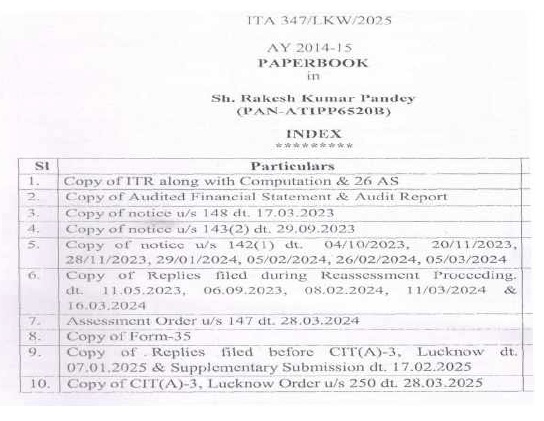
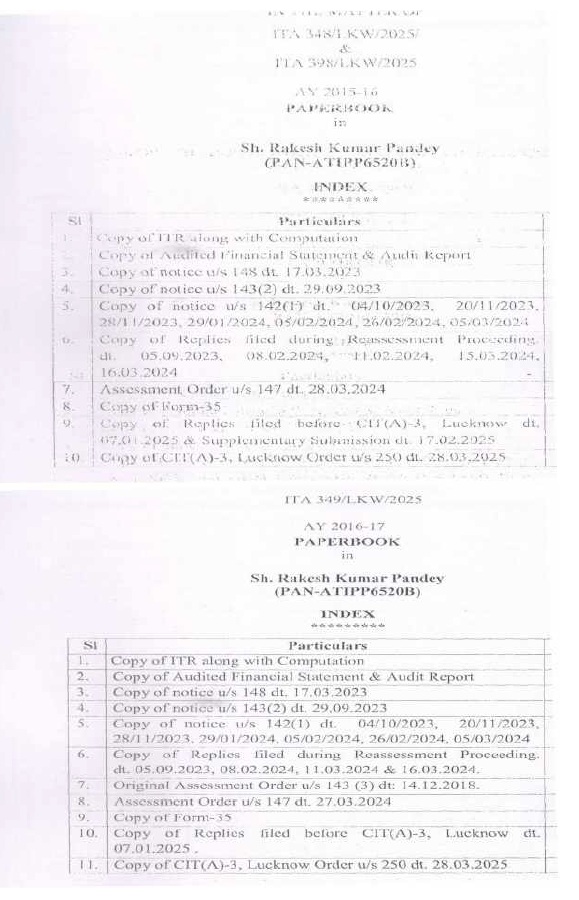
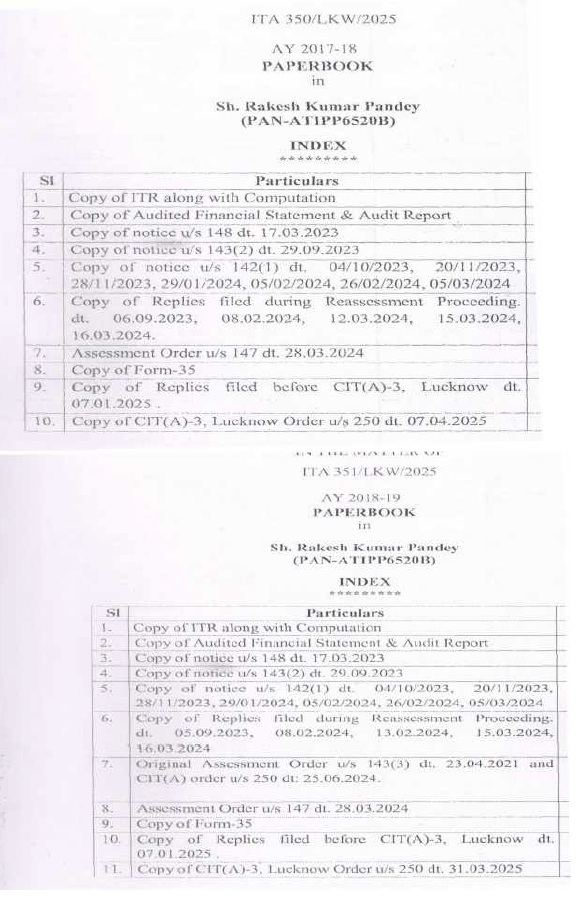
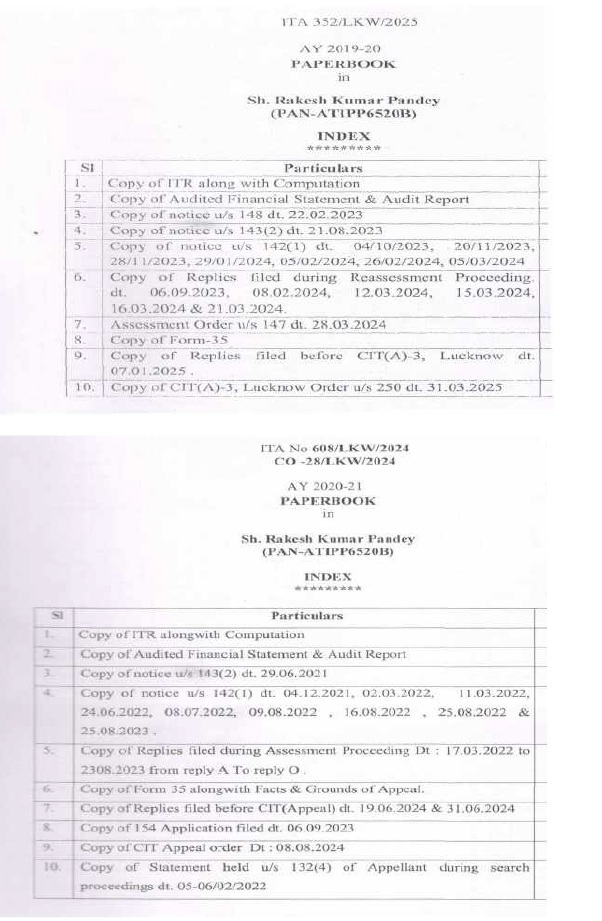
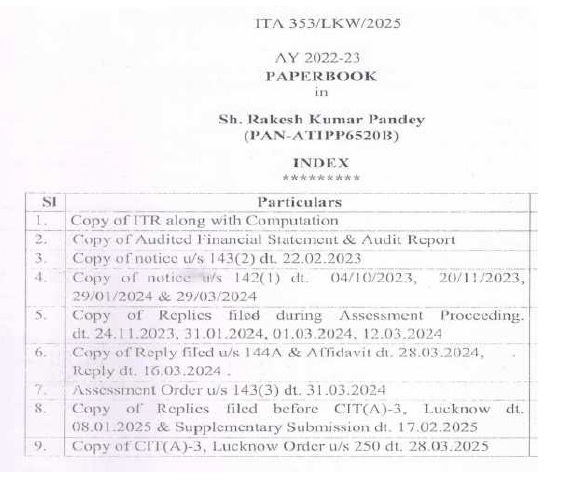
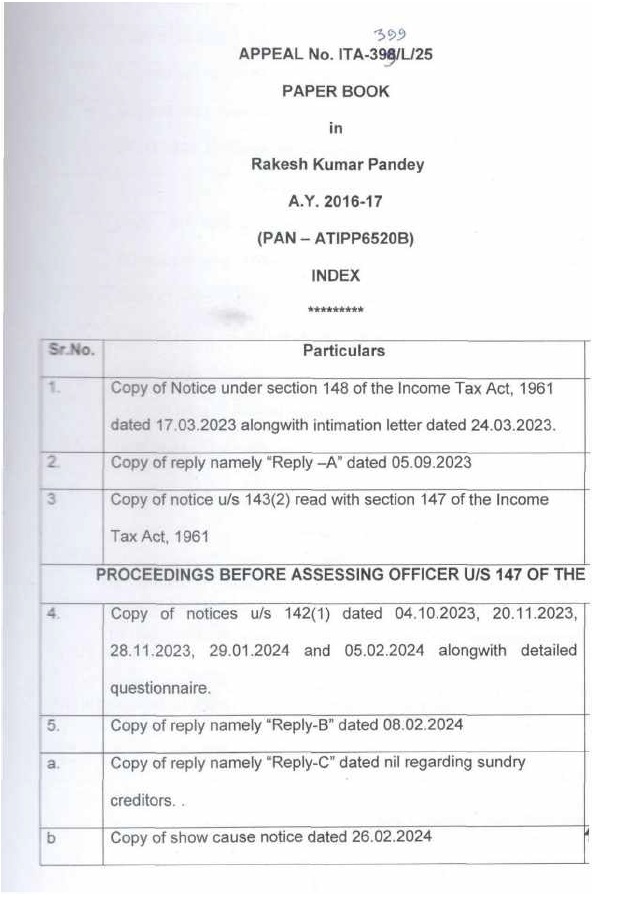
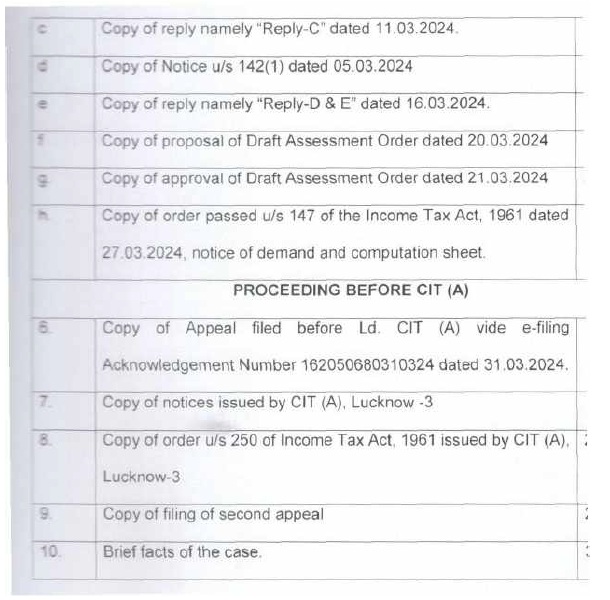
(B) In the course of appellate proceedings in Income Tax Appellate Tribunal, (“ITAT” for short), following paper book were filed from the assessee’s side:
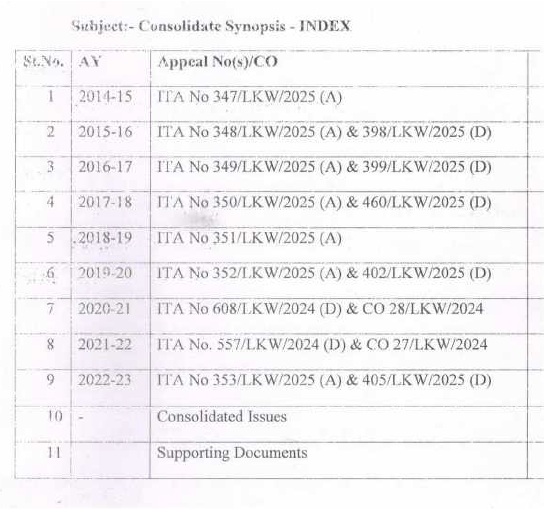
(B.1) Further, a consolidated synopsis, common for all the appeals and COs before us, was filed from assessee’s side; which is reproduced below for the ease of reference:
“Before,
The Hon’ble ITAT, Lucknow Bench ‘A’, Lucknow
Hon’ble Members,
Ref: SHRI RAKESH KUMAR PANDEY (PAN:ATIPP6520B)
Subject:-Consolidate Synopsis:
| 1. |
|
ITA No 347/LKW/2025 (A) AY 2014-15 |
| 2. |
|
ITA No 348/LKW/2025(A) & 398/LKW/2025 (D) AY 2015-16 |
| 3. |
|
ITA No 349/LKW/2025 (A) & 399/LKW/2025 (D) AY 2016-17 |
| 4. |
|
ITA No 350/LKW/2025 (A) & 460/LKW/2025 (D) AY 2017-18 |
| 5. |
|
ITA No 351/LKW/2025 (A) AY 2018-19 |
| 6. |
|
ITA No 352/LKW/2025 (A) & 402/LKW/2025 (D) AY 2019-20 |
| 7. |
|
ITA No 608/LKW/2024 (D) & CO 28/LKW/2024 AY 2020-21 |
| 8. |
|
ITA No. 557/LKW/2024 (D) & CO 27/LKW/2024 AY 2021-22 |
| 9. |
|
ITA No 353/LKW/2025 (A) & 405/LKW/2025 (D) AY 2022-23 |
In above said pending appeals filed by Appellant and Revenue substantially issues are common, therefore, consolidated synopsis are prepared based on issues involved w.r.t. respective year.
Issue No. 1 – AY 2014-15 TO AY2022-23
| 1. |
|
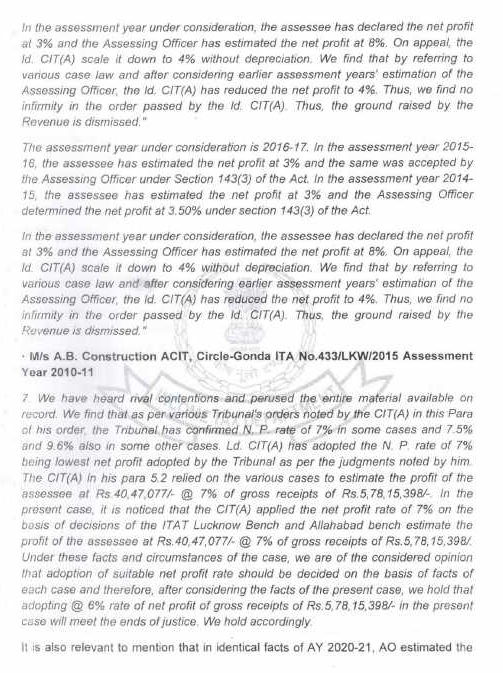
That a search and seizure operation u/s 132 of the Income Tax Act was carried out on 05.02.2022 on the business and residential premises of M/s Alok Construction being proprietary concern of Appellant. The assessee is Government Contractor and during the relevant period, the assessee engaged in proprietorship business of construction of road etc. in semi urban area from contract work provided by the UPPWD, under the name and style of M/s Alok Construction. |
| 2. |
|
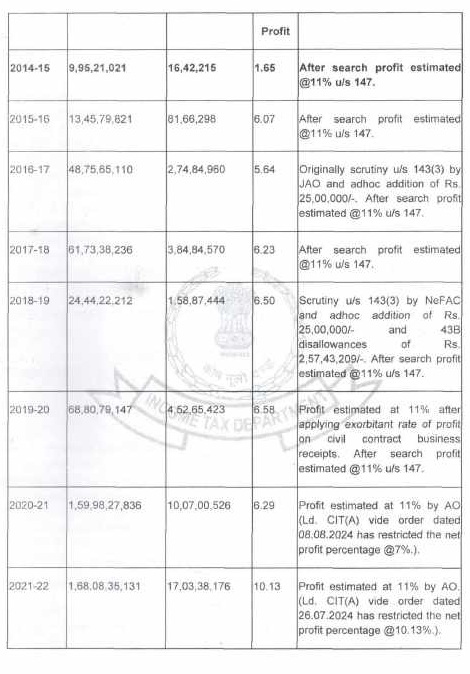
The books of accounts for relevant year were regularly maintained and audited and ITRs alongwith TAR. were filed within due date in respective years with following financial details:- |
| AY |
Turnover |
Profit |
Assessee % of Profit |
AO % of Profit |
CIT(A) % of Profit |
Remark |
| 2014-15 |
9,95,21,021 |
16,42,215 |
1.65 |
11% |
7% |
Year of inception of proprietary business. |
| 2015-16 |
13,45,79,821 |
81,66,298 |
6.07 |
11% |
7% |
|
| 2016-17 |
48,75,65,110 |
2,74,84,960 |
5.64 |
11% |
7% |
Erstwhile Scrutiny u/s 143(3) dated 14.12.2011 by JAO and adhoc addition of Rs. 25,00,000/- |
| 2017-18 |
61,73,38,236 |
3,84,84,570 |
6.23 |
11% |
7% |
|
| 2018-19 |
24,44,22,212 |
1,58,87,444 |
6.50 |
11% |
7% |
Erstwhile Scrutiny u/s 143(3) dt. 23.04.2021 by NeFAC and adhoc addition of Rs. 25,00,000/- and 43B disallowances of Rs. 2,57,43,209/-, Ld. CIT(A) allowed the appeal against original order. |
| 2019-20 |
68,80,79,147 |
4,52,65,423 |
6.58 |
11% |
7% |
|
| 2020-21 |
1,59,98,27,836 |
10,07,00,526 |
6.29 |
11% |
7% |
|
| 2021-22 |
1,68,08,35,131 |
17,03,38,176 |
10.13 |
11% |
10.13% |
Addition on extra profit deleted. |
| 2022-23 |
2,82,59,71,973 |
28,50,48,173 |
|
11% |
9.68% |
Addition on extra profit deleted. |
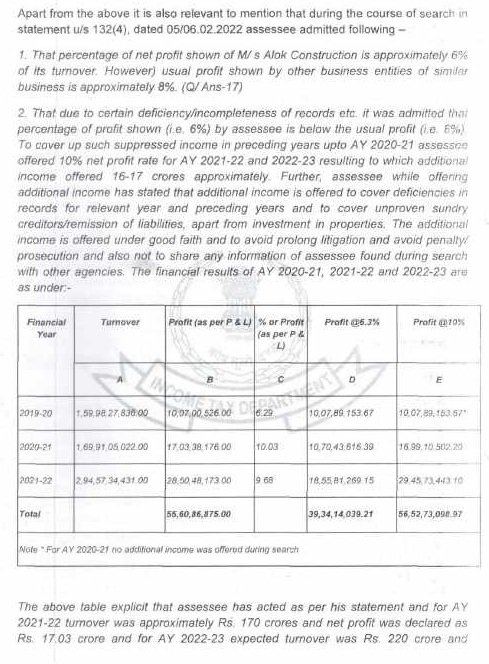
That during the course of search proceeding in statement recorded u/s 132(4), dated 05/06.02.2022 assessee admitted following –
That percentage of net profit shown of M/s Alok Construction is approximately 6% of its turnover. However, usual profit shown by other business entities of similar business is approximately 8%. (Q/Ans-17)
That due to certain deficiency/incompleteness of records etc. it was admitted that percentage ofprofit shown (i.e. 6%) by assessee is below the usual profit (i.e. 8%). To cover up such suppressed income in preceding yearsupto AY 2020-21 assessee offered 10% net profit rate for AY 2021-22 and 2022-23 resulting to which additional income offered 16-17 crores approximately. Further, assessee while offering additional income has stated that additional income is offered to cover deficiencies in records for relevant year and preceding years and to cover unproven sundry creditors/remission of liabilities, apart from investment in properties. Further, no adverse inference may be drawn w.r.t. extra profits and seized documents for years prior to AY 2021-22.
Further, at the time of the search proceeding for AY 2020-21 was under progress and issues arising from the search operation was also covered by Ld. AO in assessment proceedings.
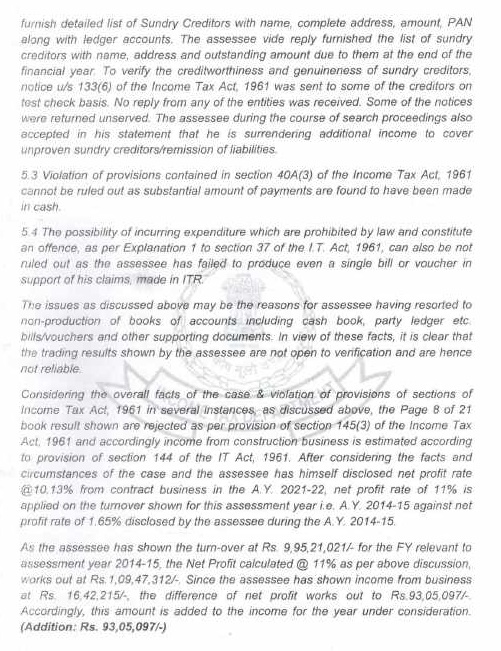
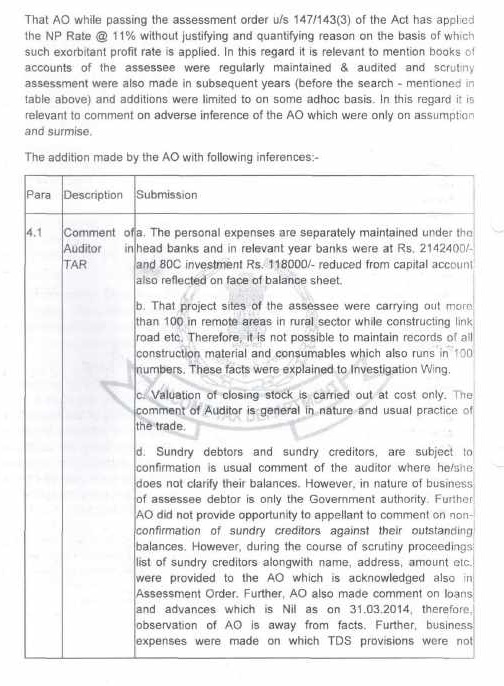
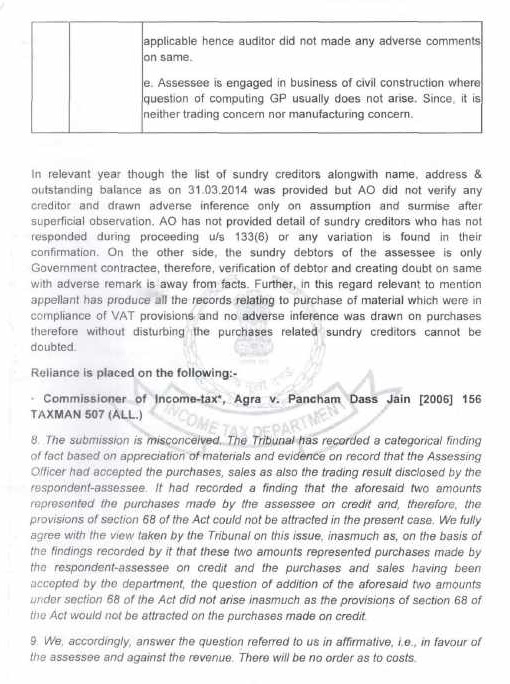
During the course of the assessment proceeding, assessee has provided all relevant information as required time to time with regard to purchase of material, business expenses and reconciliation of sales with VAT/GST return. However, AO only on usual observation of Tax Auditor in form 3CB has invoked provision of section 145(3) of the Act and estimated income according to provision of sec. 144 of the Act. It is relevant to mention that these are the general observation made by Auditor in TAR without adverse finding on particular transactions and figures, which are year wise reproduced for ready reference.
Observation of Auditor in TAR
| AY |
Para/ Page of Assessment Order |
Observation of AO |
Remarks |
| 2014-15 |
5.1 / 2 & 3 |
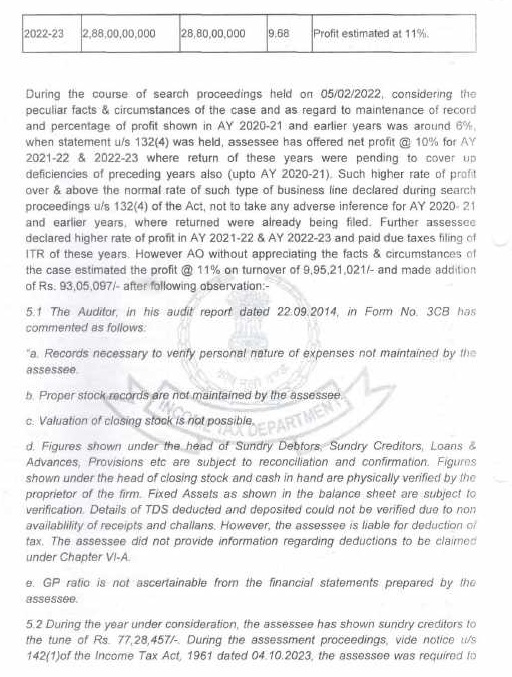
5.1 The Auditor, in his audit report dated 22.09.2014, in Form No. 3CB has commented as follows:
“a. Records necessary to verify personal nature of expenses not maintained by the assessee.
b. Proper stock records are not maintained by the assessee.
c. Valuation of closing stock is not possible.
d. Figures shown under the head of Sundry Debtors, Sundry Creditors, Loans & Advances, Provisionsetc are subject to reconciliation and confirmation. Figures shown under the head of closing stock and cash in hand are physically verified by the proprietor of the firm. Fixed Assets as shown in the balance sheet are subject to verification. Details of TDS deducted and deposited could not be verified due to nonavailability of receipts and challans. However, the assessee is liable for deduction of tax. The assessee did not provide information regarding deductions to be claimed under Chapter VI-A.
e. GP ratio is not ascertainable from the financial statements prepared by the assessee. |
|
| 2015-16 |
5.1 / 2 & 3 |
5.1 The Auditor, in his audit report dated 22.09.2015, in Form No. 3CB has commented as follows:
“a. GP ratio is not ascertainable in such type of business.
b. We have not found any documentary records available with the assessee to verify payments through account payee cheque.
c. We have not found any record to verify personal nature expenses incurred by the management.
d. We have not been provided with the stock records by the assessee.
e. Valuation of closing stock is not possible as no proper records of stock has been maintained by the assessee and the value of the closing stock has been certified by the assessee himself.
f. Balances of Sundry debtors and Sundry creditors are subject to verification. |
|
| 2016-17 |
5.1 / 2 & 3 |
5.1 The Auditor, in his audit report dated 25.05.2016, in Form No. 3CB has commented as follows:
“a. GP ratio is not ascertainable in such type of business.
b. We have not found any documentary records available with the assessee to verify payments through account payee cheque.
c. We have not found any record to verify personal nature expenses incurred by the management.
d. We have not been provided with the stock records by the assessee.
e. Valuation of closing stock is not possible as no proper records of stock has been maintained by the assessee and the value of the closing stock has been certified by the assessee himself.
f. Balances of Sundry debtors and Sundry creditors are subject to verification. |
|
| 2017-18 |
5.1 / 2 & 3 |
5.1 The Auditor, in his audit report dated 28.09.2017, in Form No. 3CB has commented as follows:
“a. GP ratio is not ascertainable in such type of business.
b. We have not found any documentary records available with the assessee to verify payments through account payee cheque.
c. We have not found any record to verify personal nature expenses incurred by the management.
d. We have not been provided with the stock records by the assessee.
e. Valuation of closing stock is not possible as no proper records of stock hasbeen maintained by the assessee and the value of the closing stock has been certified by the assessee himself.
f. Balances of Sundry debtors and Sundry creditors are subject to verification. |
|
| 2018-19 |
5.1 / 2 & 3 |
5.1 The Auditor, in his audit report dated 22.09.2018, in Form No. 3CB has commented as follows:
“a. GP ratio is not ascertainable in such type of business.
b. We have not found any documentary records available with the assessee to verify payments through account payee cheque.
c. We have not found any record to verify personal nature expenses incurred by the management.
d. We have not been provided with the stock records by the assessee.
e. Valuation of closing stock is not possible as no proper records of stock has been maintained by the assessee and the value of the closing stock has been certified by the assessee himself.
f. Balances of Sundry debtors and Sundry creditors are subject to verification. |
|
| 2019-20 |
5.1 / 2 & 3 |
5.1 The Auditor, in his audit report dated 28.10.2019, in Form No. 3CB has commented as follows:
“a. GP ratio is not ascertainable in such type of business.
b. We have not found any documentary records available with the assessee to verify payments through account payee cheque.
c. Expenditure by way of personal nature was Nil as explained by the Assessee. However, the extent of personal use in case of cacr running and maintenance, Telephone Expenses etc. if any could not be ascertained for want of record.
d. We have not been provided with the stock records by the assessee. Item wise Quantitative details of stock could not be furnished due to nature of business and large number of items. So, we are unable to give item wise quantitative details of stock in Para 35(b) of Form 3D.
e. Valuation of closing stock is not possible as no proper records of stock hasbeen maintained by the assessee and the value of the closing stock has been certified by the assessee himself.
f. Balances of Sundry debtors and Sundry creditors are subject to verification. |
|
| 2020-21 |
4.1 / 2 |
4.1 follows: The Auditor, in his audit report dated 21.12.2020, in Form No. 3CB has commented as
“a. GP ratio is not ascertainable in such type of business.
b. Balances of Sundry Debtors and Sundry Creditors are subject to verification.
c. The assessee has not obtained TAN, thus, we, are unable to comment on TDS provisions.
d. We have not been provided with the stock records by the assessee. Item wise Quantitative details of stock could not be furnished due to nature of business and large number of items. So, we are unable to give the item wise quantitative details of stock in Para no. 35(b) of Form 3D.
e. Valuation of closing assessee stock is not possible as no proper records has been maintained by the assessee and the value of the closing stock has been certified by the itself.” |
|
| 2021-22 |
4.1 / 2 |
4.1 follows: The Auditor, in his audit report dated 08.03.2022, in Form No. 3CB has commented as
a. It is not possible to ascertain GP ratio in such type of business.
b. As explained to us, entity has not maintained quantity wise reconciliation of stock.
c. Sundry debtor, creditors and loans & advances are as per books of account only and are subject to reconciliation and confirmation. |
|
| 2022-23 |
6.1 / 2 & 3 |
6.1 The Auditor, in his audit report dated 30.09.2022, in Form No. 3CB has commented as follows:
“a. It is not possible to ascertain GP ratio in such type of business.
b. Expenditure related to personal nature could not be ascertained for want of record.
c. It is not possible for us to verify whether all loans and deposit taken or accepted u/s 269SS and the payments in excess the specified limit in section 269T have been made otherwise than by account payee cheque or account payee bankdraft, as the necessary evidence are not in possession of the assessee. The management certifies that all payments in excess of limit prescribed were made through account payee cheque/drafts or RTGS/NEFT.
d. As explained to us, entity has not maintained quantity wise reconciliation of stock, however physical verification of stock has been conducted at the year end. |
|
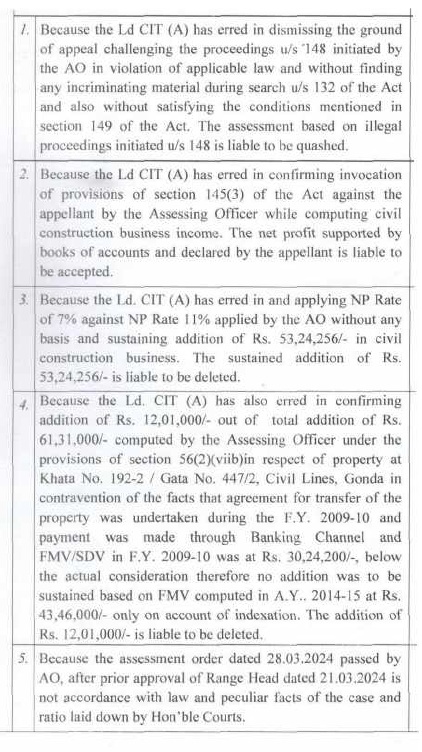
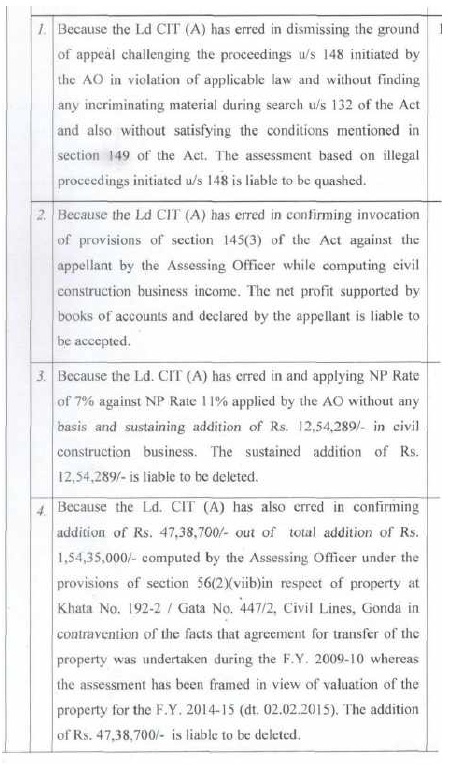
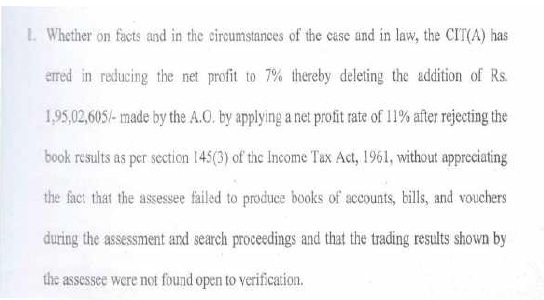
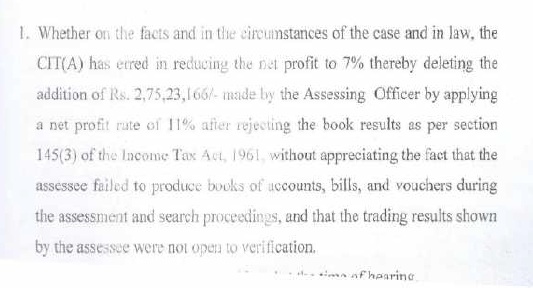
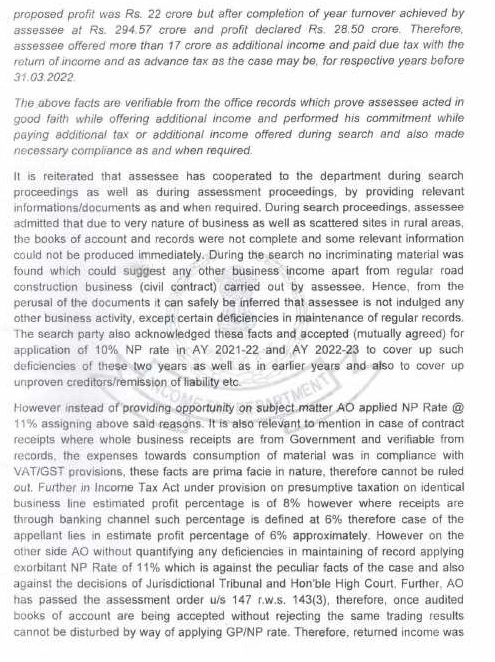
In this regard, it is relevant to mention that prior to date of search for AY 2016-17 & 2018-19 case of the appellant was completed under scrutiny by JAO & FAO respectively where assessment was completed u/s 143(3) after due verification of record. It is also relevant to mention that during the course of the search no incriminating material was found w.r.t. justification of enhancement of profit percentage. On the other side documents found and seized for differentyears of above said period were duly reconciled with either recorded in books of account relates to business of assessee or personal investments relates to investment in construction of house properties. In the assessment order of above said period the Ld. AO has not brought any single instance of incriminating material on the basis of which addition could have been made w.r.t. business income of assessee in support to justify increase profit percentile. In the assessment order the observation of the AO while estimating net profit @ 11% of Gross Receipt was simply based on Net Profit occurred by assessee @ 10.13% for AY 2021-22 in compliance of statement u/s 132(4) held during the search, higher percentage of profit for AY 2021-22 to AY 2022-23 only.
The Ld. AO was highly unjustified while increasing the profit percentage and making the addition for AY 2014-15 to AY 2020-21 where no incriminating material was found w.r.t. addition made in these years.
Reliance is placed on AbhisarBuildwell (P.) Ltd. Pr. CIT v. Abhisar Buildwell (P.) Ltd. (SC) (SC)/[2023] 454 ITR 212 (SC)(For AY 2014-15 to AY 2019-20)
Further, while estimating the profit percentile at 11% AO made reliance on profit estimated @11% in AY 2021-22 which is highly unjustified. In AY 2021-22 assessee himself offered profit percentile around 10% as per statement held u/s 132(4) for AY 2021-22 & AY 2022-23, with prior condition no adverse inference is drawn in years prior to AY 2021-22. Therefore, the whole additions on account of increase in profit percentile was made based on the statement of assessee which is not sustainable in the peculiar circumstances and in the eyes of law.
Reliance is placed on the followings:-
| • |
|
Principal Commissioner of Income-tax, (Central)-1 v. Forum Sales (P.) Ltd.*Principal Commissioner of Income-tax, (Central)-1 v. Forum Sales (P.) Ltd. (Delhi) HIGH COURT OF DELHI |
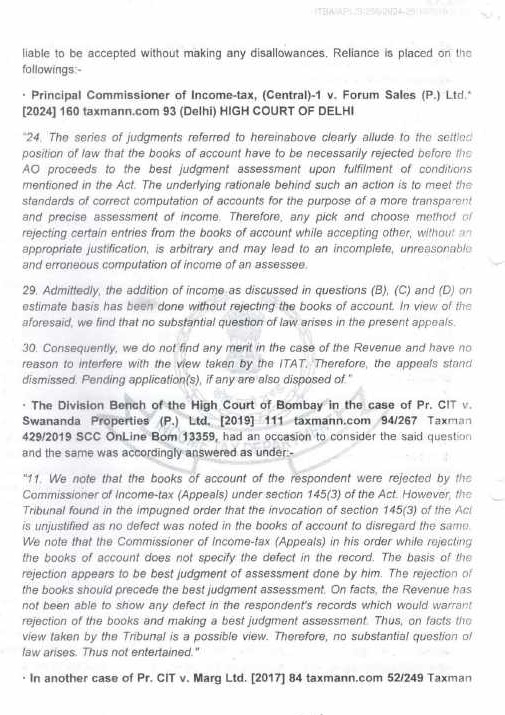
“24. The series of judgments referred to hereinabove clearly allude to the settled position of law that the books of account have to be necessarily rejected before the AO proceeds to the best judgment assessment upon fulfillment of conditions mentioned in the Act. The underlying rationale behind such an action is to meet the standards of correct computation of accounts for the purpose of a more transparent and precise assessment of income. Therefore, any pick and choose method of rejecting certain entries from the books of account while accepting other, without an appropriate justification, is arbitrary and may lead to an incomplete, unreasonable and erroneous computation of income of an assessee.
29. Admittedly, the addition of income as discussed in questions (B), (C) and (D) on estimate basis has been done without rejecting the books of account. In view of the aforesaid, we find that no substantial question of law arises in the present appeals.
30. Consequently, we do not find any merit in the case of the Revenue and have no reason to interfere with the view taken by the ITAT. Therefore, the appeals stand dismissed. Pending application(s), if any are also disposed of.”
| • |
|
The Division Bench of the High Court of Bombay in the case of Pr. CIT v. Swananda Properties (P.) Ltd. 429/2019 SCC OnLineBom 13359, had an occasion to consider the said question and the same was accordingly answered as under:- |
| “11. |
|
We note that the books of account of the respondent were rejected by the Commissioner of Income-tax (Appeals) under section 145(3) of the Act. However, the Tribunal found in the impugned order that the invocation of section 145(3) of the Act is unjustified as no defect was noted in the books of account to disregard the same. We note that the Commissioner of Income-tax (Appeals) in his order while rejecting the books of account does not specify the defect in the record. The basis of the rejection appears to be best judgment of assessment done by him. The rejection of the books should precede the best judgment assessment. On facts, the Revenue has not been able to show any defect in the respondent’s records which would warrant rejection of the books and making a best judgment assessment. Thus, on facts the view taken by the Tribunal is a possible view. Therefore, no substantial question of law arises. Thus not entertained.” |
| • |
|
Commissioner of Income-tax – I v. Sahu Construction (P.) Ltd. (Allahabad) |
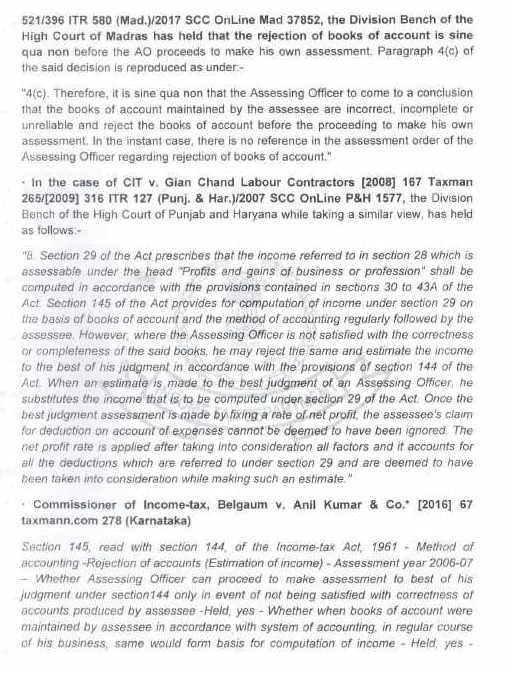
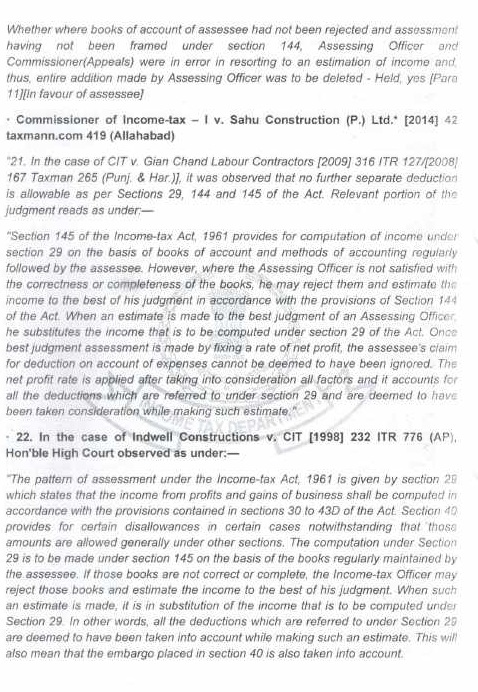
“21. In the case of CIT v. Gian Chand Labour Contractors(Punj. &Har.)], it was observed that no further separate deduction is allowable as per Sections 29, 144 and 145 of the Act. Relevant portion of the judgment reads as under:—
“Section 145 of the Income-tax Act, 1961 provides for computation of income under section 29 on the basis of books of account and methods of accounting regularly followed by the assessee. However, where the Assessing Officer is not satisfied with the correctness or completeness of the books, he may reject them and estimate the income to the best of his judgment in accordance with the provisions of Section 144 of the Act. When an estimate is made to the best judgment of an Assessing Officer, he substitutes the income that is to be computed under section 29 of the Act. Once best judgment assessment is made by fixing a rate of net profit, the assessee’s claim for deduction on account of expenses cannot be deemed to have been ignored. The net profit rate is applied after taking into consideration all factors and it accounts for all the deductions which are referred to under section 29 and are deemed to have been taken consideration while making such estimate.”
| • |
|
Commissioner of Income-tax, Allahabad v. Target Construction Co. Ltd. (Allahabad) |
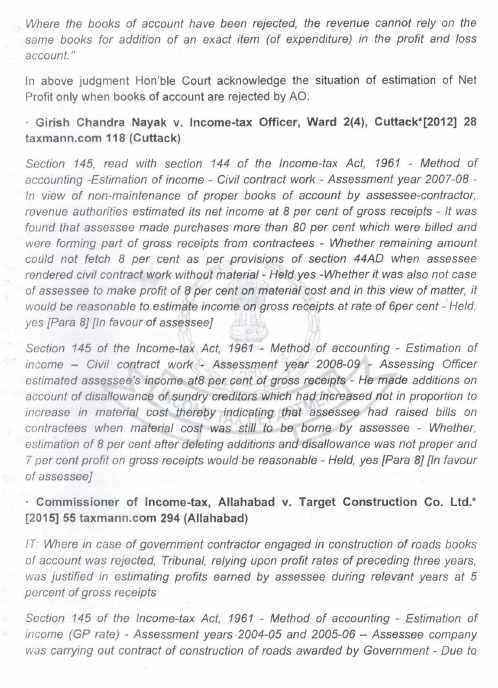
IT: Where in case of government contractor engaged in construction of roads books of account was rejected, Tribunal, relying upon profit rates of preceding three years, was justified in estimating profits earned by assessee during relevantyears at 5 percent ofgross receipts
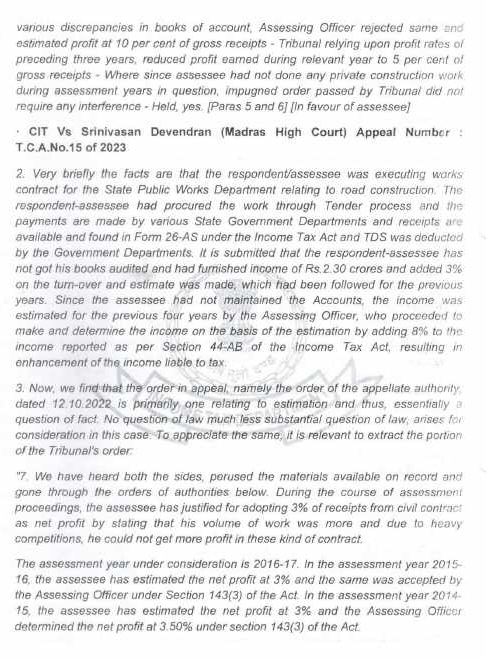
Section 145 of the Income-tax Act, 1961 – Method of accounting -Estimation of income (GP rate) – Assessment years 2004-05 and 2005-06 -Assessee-company was carrying out contract of construction of roads awarded by Government – Due to various discrepancies in books of account, Assessing Officer rejected same and estimated profit at 10 per cent ofgross receipts – Tribunal relying upon profit rates of preceding three years, reduced profit earned during relevant year to 5 per cent of gross receipts -Where since assessee had not done any private construction work during assessment years in question, impugned order passed by Tribunal did not require any interference – Held, yes. [Paras 5 and 6] [In favour of assessee]
| • |
|
M/s Omshree Agrotech Private Ltd. IT(SS)A No. 45 to 50/ PUN/2022 |
Held that book of accounts cannot be rejected only on surmise and lower profit declared by assessee.
| • |
|
Shri Ramesh Singh Ranavs DCIT Range-4, Lucknow ITA No.717/LKW/2019 |
Held that the action of the Ld. CIT(A) is justified for restricting the addition @ 6.5% of the net profit. As he has also considered the past history and also the reason as to why the net profit was estimated at 5%. It is pointed out that gross business receipts were high in that year comparing to the year under appeal. The assessee did not point out any infirmity in adopting such rate by filing credible evidence. The grounds raised in this appeal of the assessee lack merit, hence dismissed.
| • |
|
Manoj Gupta v. ACIT, Range- 3, Lucknow ITA No. 355/LKW/2020 |
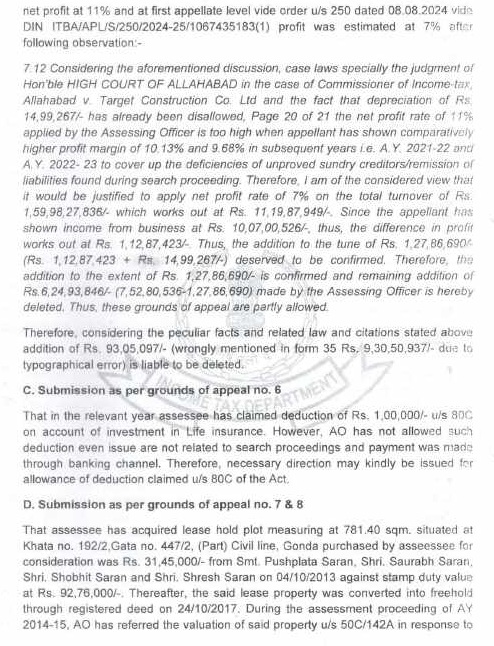
Held where sales and purchase are verified books of account cannot be rejected and profit cannot be estimated. Further estimation of profit may be made only on the basis ofalways on past history only. It is also relevant to mention that in identical facts of AY 2020-21, AO estimated the net profit at 11% and at first appellate level vide order u/s 250 dated 08.08.2024 vide DIN ITBA/APL/S/250/2024-25/1067435183(1) profit was estimated at 70% after following observation:-
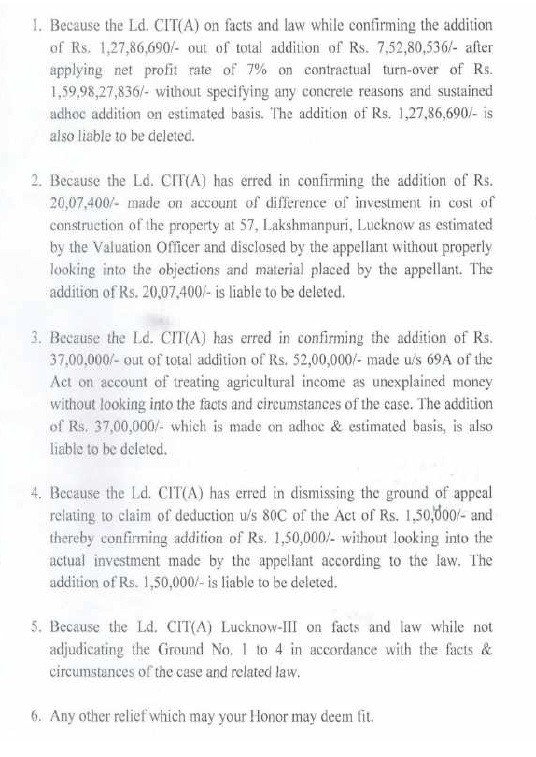
7.12 Considering the aforementioned discussion, case laws specially the judgment of Hon’ble HIGH COURT OF ALLAHABAD in the case of Commissioner of Income-tax, Allahabad v. Target Construction Co. Ltd and the fact that depreciation of Rs. 14,99,267/- has already been disallowed, the net profit rate of 11% applied by the Assessing Officer is too high when appellant has shown comparatively higher profit margin of 10.13% and 9.68% in subsequent years i.e. A.Y. 2021-22 and A.Y. 202223 to cover up the deficiencies of unproved sundry creditors/remission of liabilities found during search proceeding. Therefore, I am of the considered view that it would be justified to apply net profit rate of 7% on the total turnover of Rs. 1,59,98,27,836/- which works out at Rs. 11,19,87,949/-. Since the appellant has shown income from business at Rs. 10,07,00,526/-, thus, the difference in profit works out at Rs. 1,12,87,423/-. Thus, the addition to the tune of Rs. 1,27,86,690/- (Rs. 1,12,87,423 + Rs. 14,99,267/-) deserved to be confirmed. Therefore, the addition to the extent of Rs. 1,27,86,690/- is confirmed and remaining addition of Rs.6,24,93,846/- (7,52,80,536-1,27,86,690) made by the Assessing Officer is hereby deleted. Thus, these grounds of appeal are partly allowed.
Issue No. 2 – A Y 2014-15
Ld. CIT(A)-3 sustained the addition Rs. 1201000/- (Rs. 43460003135000)
That assessee has acquired lease hold plot measuring at 781.40 sqm. situated at Khata no. 192/2,Gata no. 447/2, (Part) Civil line, Gonda purchased by assessee for consideration was Rs. 31,45,000/- from Smt. Pushplata Saran, Shri. Saurabh Saran, Shri. Shobhit Saran and
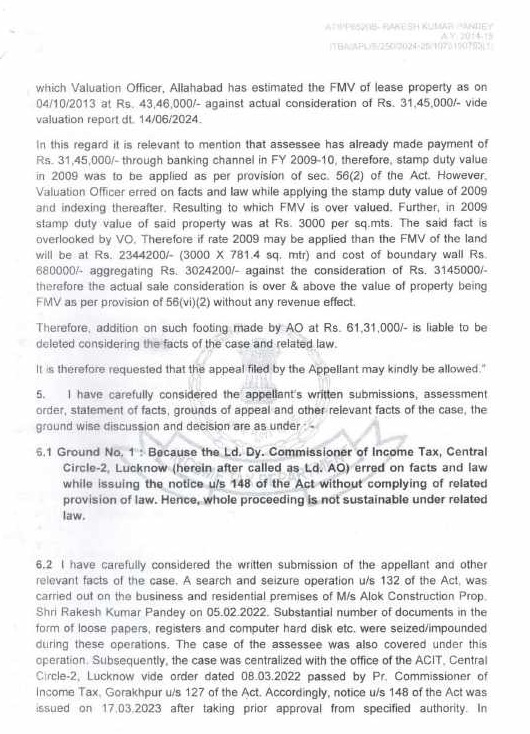
Shri. Shresh Saran on 04/10/2013 against stamp duty value at Rs. 92,76,000/-. Thereafter, the said lease property was converted into freehold through registered deed on 24/10/2017. During the assessment proceeding of AY 201415, AO has referred the valuation of said property u/s 50C/142A in response to which Valuation Officer, Allahabad has estimated the FMV of lease property as on 04/10/2013 at Rs. 43,46,000/- against actual consideration of Rs. 31,45,000/- vide valuation report dt. 14/06/2024.
In this regard it is relevant to mention that assessee has already made payment of Rs. 31,45,000/- through banking channel in FY 2009-10, therefore, stamp duty value in 2009 was to be applied as per provision of sec. 56(2) of the Act. However, Valuation Officer erred on facts and law while applying the stamp duty value of 2009 and indexing thereafter. Resulting to which FMV is over valued. Further, in 2009 stamp duty value of said property was at Rs. 3000 per sq.mts. The said fact is overlooked by VO. Therefore if rate 2009 may be applied than the FMV of the land will be at Rs. 2344200/- (3000 X 781.4 sq. mtr) and cost of boundary wall Rs. 680000/- aggregating Rs. 3024200/- against the consideration of Rs. 3145000/-therefore the actual sale consideration is over & above the value of property being FMV as per provision of 56(vi)(2) without any revenue effect.
Therefore, addition sustained to the extent of Rs. 12,01,000/- u/s 56(2)(vii)(b) may kindly be deleted.
Issue No. 3- A Y 2015-16
Ld. CIT(A)-3 sustained the addition Rs. 4738700/- (Rs. 77387003000000)
That assessee has acquired lease hold plot measuring at 1279.06 sqm. situated at Khata no. 192/2,Gata no. 447/2, (Part) Civil line, Gonda for consideration of Rs. 30,00,000/- against value for stamp duty of Rs. 1,84,26,000/- from Smt. Pushplata Saran, Shri. Saurabh Saran, Shri. Shobhit Saran and Shri.Shresh Saran on 02/02/2015. The said property was in continuation of property transaction held with same seller in AY 2014-15, where advance are given for adjacent of property of same Gata. However whole advance given in FY 2009-10 was absorbed in property acquired in AY 2014-15. During the assessment proceeding of AY 2015-16, AO has referred the valuation of said property u/s 142A in response to which Valuation duty value of said property was at Rs. 3000 per sq.mts. The said fact is overlooked by VO and estimated the FMV at Rs. 77,38,700/-. Therefore if rate 2009 may be applied than the FMV of the land will be at Rs. 32,61,603/- [2,550 (3,000+300750) X 1279.06 sq. mtr] and cost of boundary wall Rs. 3,67,500/- aggregating Rs. 36,29,103/- against the consideration of Rs. 30,00,000/-. Therefore difference between FMV of property and actual sale consideration is of Rs. 6,29,103/- only. However, Ld. CIT(A) sustained the addition to the extent of Rs. 47,38,700/- being difference between FMV estimated by VO at Rs. 77,38,700/-(-) Rs. 30,00,000/-.
Therefore, addition sustained by ld. CIT(A) at Rs. 47,38,700/- on such footing may be restricted to Rs. 6,29,103/-.
Issue No. 4 – AY 2015-16
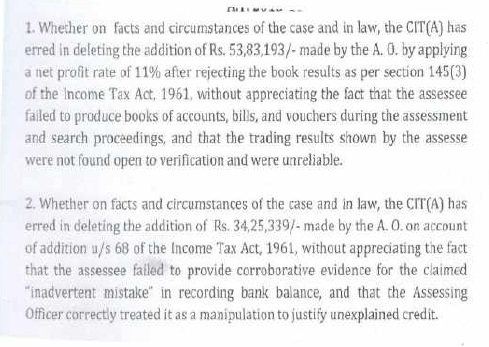
Addition u/s 68 source of introduction of Capital in Firm M/s Alok Construction Rs. 34,25,339/-
That AO made addition of Rs. 34,25,339/- amount added in capital a/c inadvertently and bank balance was also increased by Rs. 34,25,339/- being contra entry on debit side. The said mistake was rectified in immediately following year on 1st April, 2015 when mistake came into the knowledge of appellant while finalizing the books/ audit. The Ld. AO ignoring the documents placed on record made addition only on surmise and against the CBDT circular no. 14 of 1955 dated 11.04.1955.
The Ld. CIT(A) considering the peculiar facts of the case of relevant year when mistake occurred of AY 2016-17 when mistake was rectified both the cases were completed under scrutiny and no adverse inference was drawn by AO on rectification of such transaction in AY 2016-17 and deleted the addition.
Issue No. 5 – AY 2020-21, 2021-22 & 2022-23
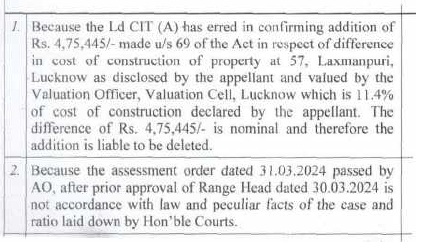
3. That assessee has acquired residential property situated at 57, Laxmanpuri, Lucknow on 17.08.2015 in which residential house was constructed by assessee and such construction was carried out in the period of AY 2020-21 to till the date of search 05.02.2022 (AY 2022-23) and made investment of Rs. 2,99,44,455/-. During the assessment proceeding investment in construction of house property was referred to Valuation Cell, Income Tax office, Lucknow, the Ld. VO estimated the cost at Rs. 3,33,69,100/- against investment made by assessee at Rs. 2,99,44,455/-, the year wise breakup is as under:-
| AY |
Amount of Investment (Assessee) |
Estimated cost (Valuation Officer) |
Difference |
Difference in percentile based on estimation by Valuation Office |
Difference in percentile based on Investment by Assessee |
| A |
B |
C |
D |
E |
F |
| 2020-21 |
17552000 |
19559400 |
2007400 |
10.26% |
11.43% |
| 2021-22 |
8235000 |
9176800 |
941800 |
10.26% |
11.43% |
| 2022-23 |
4157455 |
4632900 |
475445 |
10.26% |
11.43% |
| Total |
29944455 |
33369100 |
3424645 |
10.26% |
11.43% |
4. The Valuation Officer has allowed deduction on account of self supervision, purchase of bulk material and being state government registered contractor only 7.5% instead of 10% which usually allowed by Valuation Department. Further on site existing old house was situated carrying area of 260.223 i.e. 2800sqft which is dismantled and use in new building value considered for old building material at Rs. 5,53,042/- by Valuation Officer was on very lower site.
5. The Ld. CIT(A) while sustaining the addition in respective years being difference between amount of investment made towards construction of house and estimation made by Valuation Officer has considered difference in percentile on the basis of investment made by Appellant. On the other side the difference in percentile liable to be computed on the basis of estimation made by Valuation Officer. Further, assessee himself is a Civil Contractor &Engineer, therefore, difference is of 10.26% which is near to 10% liable to be ignored. Reliance is placed on:
| i. |
|
Hon’ble Allahabad High Court in case of Tulsiani Constructions & Developers Ltd (Allahabad)has discussed the decision of Hon’ble Madhya Pradesh High Court in case of CIT v. Abeeson Hotels (P) Ltd 2004 191 CTR (MP) 263 and allowed difference upto 10%of estimated FMV by Valuation Department is within tolerance limit, no addition is warranted. In said case difference in percentile @ 10.47% was computed on the basis of estimation made by VO and Hon’ble MP High Court has dismissed the appeal of Revenue. |
| ii. |
|
That Jurisdictional Hon’ble ITAT in case of M/s Dr. Bhim Rao Ambedkar Educational Society ITA No. 658/LKW/2012. In said case difference in percentile @ 6.58% was computed on the basis of estimation made by VO and Hon’ble ITAT Lucknow Bench has rejected the appeal of Revenue. |
Issue No. 6 – AY 2020-21 & 2021-22
6. That assessee has acquired residential property situated at 192/2, Civil Lines, Gonda on 24.10.2017 in which residential house was constructed by assessee and such construction was carried out in the period of AY 2020-21 to AY 2022-23. Further at the time of search construction activities were under progress and as on date of search on 05.02.2022 investment in said property was at Rs. 12460146/- however investment in construction during 07.02.2022 to 31.03.2022 was at Rs. 2035960/- therefore aggregate investment till 31.03.2022 was Rs. 14496106/- against said investment VO estimated value at Rs. 15624800/-. These facts and details were submitted to VO. Initially VO in his report considered investment of assessee at Rs. 12460146/-. Considering the glaring mistake assessee filed rectification in Valuation Report to VO and sent copy to the AO also on 09.08.2023.Thereafter VO in Valuation Report (Rectified) on 25.08.2023 has correctly considered investment of assessee at Rs. 14496104/-. The yearwise detail of investment in property is as under:
| FY |
AY |
Amount of Investment (Assessee) |
Estimated cost (Valuation Cell) |
Difference |
Difference in percentile based on estimation by Valuation Office |
Difference in percentile based on Investment by Assessee |
| A |
B |
C |
D |
E |
F |
G |
| 2019-20 |
2020-21 |
2241054 |
2415546 |
174492 |
7.22% |
7.78% |
| 2020-21 |
2021-22 |
9620392 |
10369454 |
749062 |
7.22% |
7.78% |
| 2021-22 Till date of Search 05.02.2022 Rs. 598700 From 07.02.2022 to 31.03.2022 Rs. 2035960 |
2022-23 |
2634660 |
2839800 |
205140 |
7.22% |
7.78% |
|
Total |
14496106 |
15624800 |
1128694 |
7.22% |
7.78% |
In AY 2022-23 Ld. AO vide Scrutiny Order vide DIN ITBA/AST/S/143(3)/2023-24/1063757561(1), dt31.03.2024 did not draw adverse inference on investment in above said property however on identical facts in AY 2020-21 & AY 2021-22, he made addition of Rs.174492/- and Rs.749062/- which itself is below 10% of value estimated by VO in respective years, which is against the facts of the case and related law. Further Ld. CIT(A) has deleted the addition on this issue in AY 2020-21 & AY 2021-22.
Reliance is placed on
| iii. |
|
Hon’ble Allahabad High Court in case of Tulsiani Constructions & Developers Ltd (Allahabad)has discussed the decision of Hon’ble Madhya Pradesh High Court in case of CIT v. Abeeson Hotels (P) Ltd 2004 191 CTR (MP) 263 and allowed difference upto 10%of estimated FMV by Valuation Department is within tolerance limit, no addition is warranted. In said case difference in percentile @ 10.47% was computed on the basis of estimation made by VO and Hon’ble MP High Court has dismissed the appeal of Revenue. |
| iv. |
|
That Jurisdictional Hon’ble ITAT in case of M/s Dr. BhimRaoAmbedkar Educational Society ITA No. 658/LKW/2012. In said case difference in percentile @ 6.58% was computed on the basis of estimation made by VO and Hon’ble ITAT Lucknow Bench has rejected the appeal of Revenue. |
Issue No. 7—AY 2020-21
Disallowances of Agriculture Income in tune of Rs. 37,00,000/-
That in the relevant assessee and his family earned agricultural income in tune of Rs. 52,00,000/-. Further, during the course of assessment proceedings detail of agricultural income was submitted as under:-
| 1. |
|
That as regard to gross agriculture income of Rs.52 Lacs earned by assessee along with his family members, it is relevant to mention, relevantyear while filing of ITR, assessee has incorporated inadvertently agricultural income of rest of his family members who were non-filer of ITR for relevantyear in absence of any other taxable income. Income of the all family members are under: |
| S.N. |
Name & PAN |
Agriculture Income |
Land Holding |
| (a) |
Shri Surya Narayan Pandey (PAN-BWPPP5138L) (Father) |
Rs. 8,90,000/- |
5.3815 Hect. |
| (b) |
Smt. Rajkumari w/o Surya Narayan Pandey (PAN/Aadhar-243864686286) (Mother) |
Rs. 2,30,000/- |
1.3597 Hect. |
| (c) |
Smt. LalitaPandey (PAN-BWPPP5188L) (Spouse) |
Rs. 1,10,000/- |
0.6340 Hect. |
| (d) |
Rakesh Kumar Pandey (PAN: ATIPP6520B) |
Rs. 34,30,000/- |
20.176 Hect. |
|
Total |
Rs. 46,60,000/- |
|
Further, while declaring agricultural income for relevant year of whole family, assessee offered the same on its Gross Value could not deduct agricultural expenses which was around Rs. 5,40,000/- incorporated in drawings, therefore, net agricultural income was at Rs. 46,60,000/- of assessee as well as other family members. Hence it is relevant to mention while assessing the agriculture income pertaining to assessee only may kindly be incorporated in total income for rate purposes.
That as regard to agriculture income it is reiterated that such income was earned on sharing basis through many agriculturist (labour basis) who performed agriculture activities on agriculture land of assessee and also sold seasonal agriculture crop in open market and thereafter shared the revenue in cash mode as per terms with assessee periodically, confirmation of all these parties are already placed on record along with their address & identity proof which are open for verification. Further these are small agriculturist are not assessed to tax because of their agriculture income exempt from tax however such queries may be raised directly from them and they are ready to appear before your good self, if required. Hence agriculture income net of agriculture expenses pertaining to assessee at Rs. 34,30,000/- may kindly be accepted.
However, the Assessing Officer made addition of Rs. 52,00,000/-being gross agricultural income of appellant as well as his family members ignoring the confirmation alongwith supporting documents provided related to person who carried out agricultural activities and shared agricultural income with assessee and confirmation of other family members for their agricultural income incorporate in the hands of appellant. Further, this bonafide mistake occurred during Covid period when assessee could not properly coordinate his consultant and reconcile agricultural income which was not part of audited financial statement and books of account and reported separately. The agricultural income of relevant year and preceding and sub sequent year assessed by revenue is as under:-
| AY |
Agricultural income as per ITR |
Disallowances |
Remarks |
| 2022-23 |
22,12,500 |
– |
Assessment completed u/s 144 of the Act |
| 2021-22 |
12,60,000 |
– |
Assessment completed u/s 144 of the Act |
| 2020-21 |
52,00,000 |
52,00,000 |
Assessment completed u/s 144 of the Act |
| 2019-20 |
15,42,683 |
– |
Assessment completed u/s 147 of the Act |
| 2018-19 |
16,52,848 |
– |
Assessment completed u/s 147 of the Act |
The ld. CIT(A) considered allowed the agricultural income at Rs. 15,00,000/- and sustained the addition of Rs. 37,00,000/- only on adhoc basis considering the agricultural income of other years, without considering the peculiar facts of the case and documents placed on record.
Since, additions sustained by Ld. CIT(A) is purely on estimated basis of Rs. 37,00,000/- may kindly be deleted.
Issue No. 8- A Y2020-21
Disallowances of deduction claimed u/s 80C of Rs. 1,50,000/- on repayment of housing loan
That in the relevant year assessee has repaid housing loan (ICICI Bank loan a/c no. LBLUC00004351237) etc. for the house self occupied at 57, laxmanpuri, Lucknow which was eligible for deduction u/s 80C. However, CIT(A) did not allow such deduction and sustained the disallowances of Rs. 1,50,000/- which liable to be deleted considering the peculiar facts of the case and related law.
Issue No. 9 – AY 2020-21
Addition u/s 68 Gift from father Sh. S.N. PandeyRs. 1,00,000/-
The Ld. AO made addition of Rs. 1,00,000/- being gift received by Appellant from his father Shri Surya Narayan Pandey only on assumption and surmise ignoring the documents placed on record.
The Ld. CIT(A) has deleted the addition of Rs. 1,00,000/- being bonafide gift received from his father Shri Surya Narayan Pandey (PAN-BWPPP5138L)who is agriculturist and given such gift on the occasion of construction of residential house under construction and native place Gonda considering the supporting documents placed on record and genuineness of transaction.
Issue No. 10 – AY 2021-22
Disallowance of claimed deduction u/s 54F of the Act – Rs. 68,98,817/-
That in the relevant year assessee has sold residential land measuring 300 sq. mtr. on 20.05.2020, part of 447/2, Chawni Bazar (Civil Lines), Pargana-Tehsil, Gonda for consideration of Rs. 9,00,000/- Stamp Duty value Rs. 82,35,000/- to his son AlokPandey (PAN-CZZPP5325B).
Considering the provision of Sec. 50C, the liability of Long Term Capital Gain was computed amounting to Rs.68,98,817/- and claimed deduction u/s 54F of the Income Tax Act against the investment made in house property situated at 57, Laxmanpuri, Indira Nagar, Lucknow. However, Ld. AO rejected the claim of assessee on following ground being details filed in ITR in AL schedule:-
| i. |
|
opp. VikasBhawan, Pant Nagar, Civil Lines, Gonda |
| iii. |
|
Poly opp. VikasBhawan, Pant Nagar, Civil Lines, Gonda |
| iv. |
|
57, Laxmanpuri, Indira Nagar, Lucknow |
Ignoring the submission of assessee and details furnished in AL schedule were having duplicate entry at Sl. No. iii w.r.t. Sl. No. i. Further, property mentioned at Sl. No. i was under construction in AY 2021-22 and reference to Valuation Cell was also made and also part of assessment order where such property was completed in AY 2022-23. Further, property mentioned at Sl. No. ii relates to joint property in which only temporary erection only (teen shed) is on portion of assessee not habitable. Therefore, assessee was eligible to claim deduction u/s 54F of the Act. The Ld. CIT(A) considering the facts and circumstances of the case and in accordance with law has allowed the appeal.
Issue No. 11 – AY2021-22
Addition due to Non deduction of TDS on payment of Rs. 3074000 @ 30% i.e. 922200/- in violation of the provision of section 40a(ia)
In relevant year Ld. AO made addition of Rs. 9,22,200/- on account of payment of such expenses on which tax was not deducted aggregating Rs. 30,74,000/- as reported by Auditor in TAR and on other side estimated the profit @11%.
The ld. CIT(A) on one side deleted the estimated profit addition but sustained the addition on account of expenses on which tax was not deducted in tune of Rs. 9,22,200/-.
That since the Ld. AO rejected the books of accounts after invoking the provision of sec. 145(3) and made assessment u/s 144 of the Act, there may not be in scope for such technical disallowances. Hence, addition of Rs. 9,22,200/- may not be sustained.
Issue No. 12 – AY 2021-22
Addition due to violate the provision of section 40A(3) Rs. 9,65,000/-
In relevant year Ld. AO made addition of Rs. 9,65,000/- after invoking the provision of section 40A(3) being cash payment exceeding Rs. 10,000/-against certain head of expenses and on other side estimated the profit @11%.
The ld. CIT(A) on one side deleted the estimated profit addition but sustained the addition on account of expenses on which tax was not deducted in tune of Rs. 9,65,000/-.
That since the Ld. AO rejected the books of accounts after invoking the provision of sec. 145(3) and made assessment u/s 144 of the Act, there may not be in scope for such technical disallowances. Hence, addition of Rs. 9,65,000/- may not be sustained. Reliance is placed on Commissioner of Income-tax v. BanwariLalBanshidhar [1998] 229 ITR 229 (ALL.)
Issue No. 13-AY2021-22
Disallowances of deduction claimed u/s 80G Rs. 7,03,000/- on donation of Rs. 14,06,000/-, being donation given to UP Wrestling Association Rs. 6,00,000/- and Ram JanamBhumiRs. 8,06,000/-
That the Ld. CIT(A) has allowed the deduction of Rs. 3,00,000/- against the donation in tune of Rs. 6,00,000/-. However, sustained the disallowances of Rs. 4,03,000/- against donation of Rs. 8,06,000/- paid to Ram JanamBhumi. The said donation is eligible u/s 80G and may kindly be allowed as deduction claimed.
Issue No. 14 – AY2022-23
Addition u/s 69A – Cash found Rs. 43,12,800/-
That during the course of search cash amounting Rs. 35,31,800/- from business/residential place at 57, Laxmanpuri, Lucknow and cash amounting Rs. 7,81,000/- at Village Devarda, Belsar, Gondawere found and out of which Rs. 34,00,000/- and Rs. 7,00,000/- were seized. During the course of search as well as assessment proceedings assessee informed nature and source of eligibility of cash. During the assessment proceeding assessee has submitted cash found at Lucknow were out of bank withdrawal immediately before the date of search from SBI (a/c no. 34788366126) and relates to business of assessee and cash found in Village were out of agricultural income. Further, cash found and seized in tune of Rs. 41,00,000/- were duly recorded in books of account and part of Audited Financial Statement. The assessment is being completed u/s 143(3) of the Act and no adverse finding is given by AO on such transaction w.r.t. source of availability of fund of cash seized on contra heads. Therefore, addition made was deleted by Ld. CIT(A).
Issue No. 15 – AY 2014-15 to AY 2019-20Identical Legal Grounds
AY 2014-15 (GOA-1 & 5)
AY 2015-16 (GOA-1 & 5)
AY 2016-17 (GOA-1 & 4)
AY 2017-18 (GOA-1 & 4)
AY 2018-19 (GOA-1 & 4)
AY 2019-20 (GOA-1 & 4)
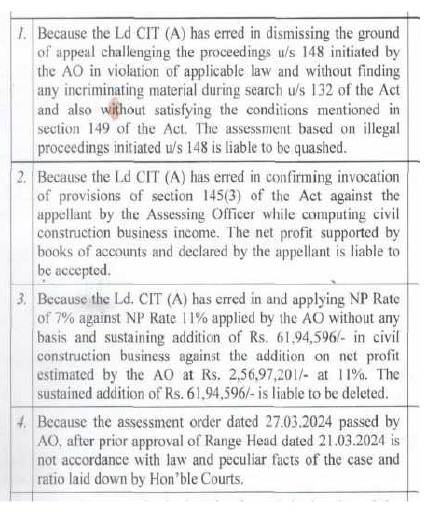
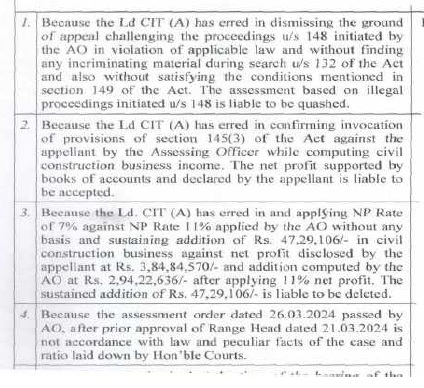
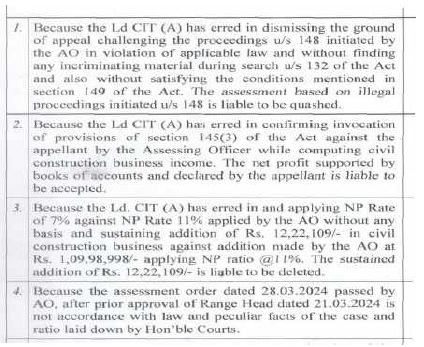
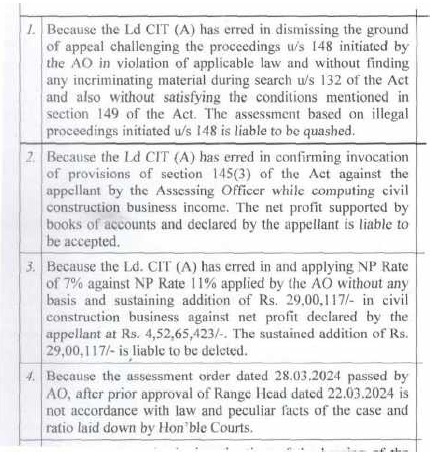
| 1. |
|
Because the Ld CIT (A) has erred in dismissing the ground of appeal challenging the proceedings u/s 148 initiated by the AO in violation of applicable law and without finding any incriminating material during search u/s 132 of the Act and also without satisfying the conditions mentioned in section 149 of the Act. The assessment based on illegal proceedings initiated u/s 148 is liable to be quashed. |
| 2. |
|
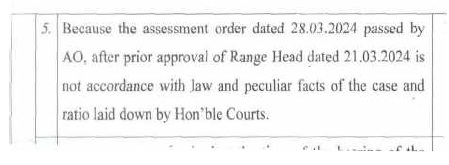
Because the assessment order passed by AO, after prior approval of Range Head dated 21.03.2024 (AY2019-20 – 22.03.2024) is not accordance with law and peculiar facts of the case and ratio laid down by Hon’ble Courts. |
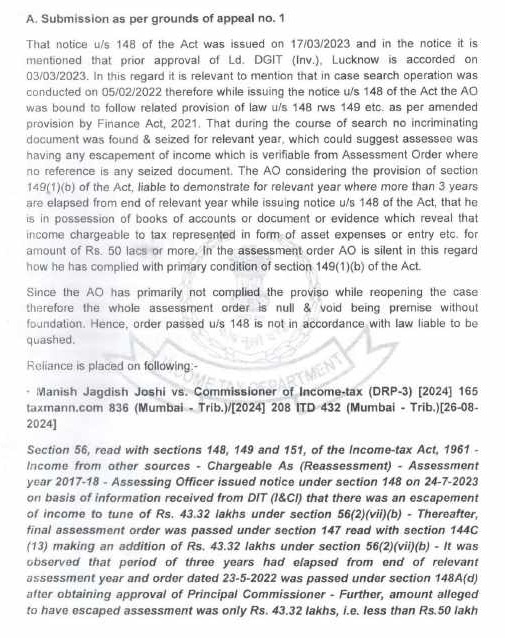
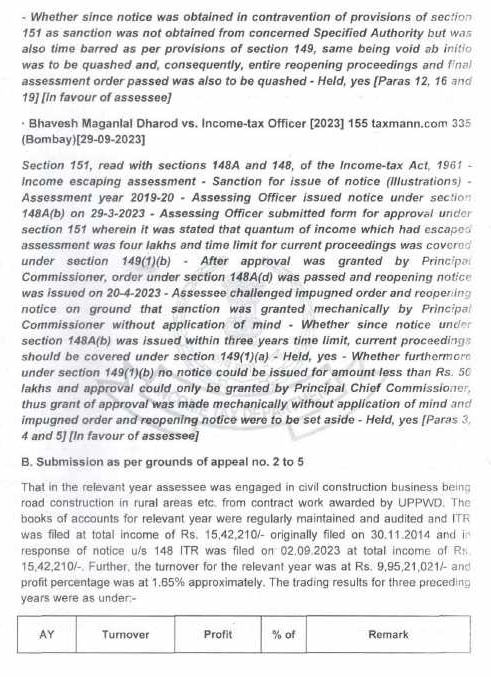
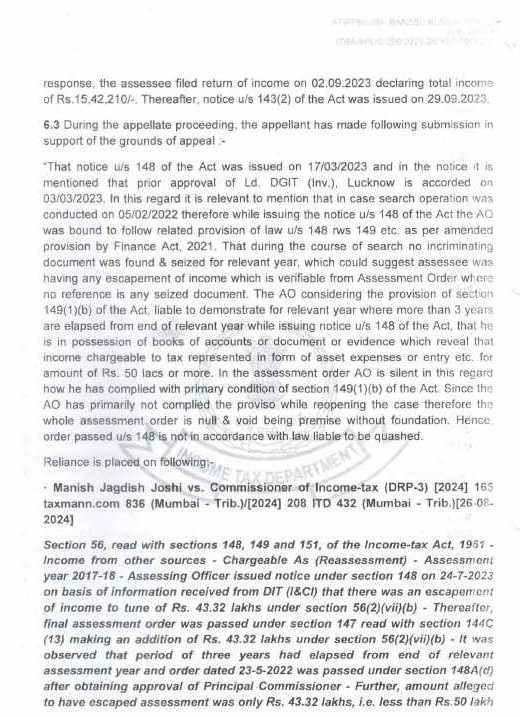
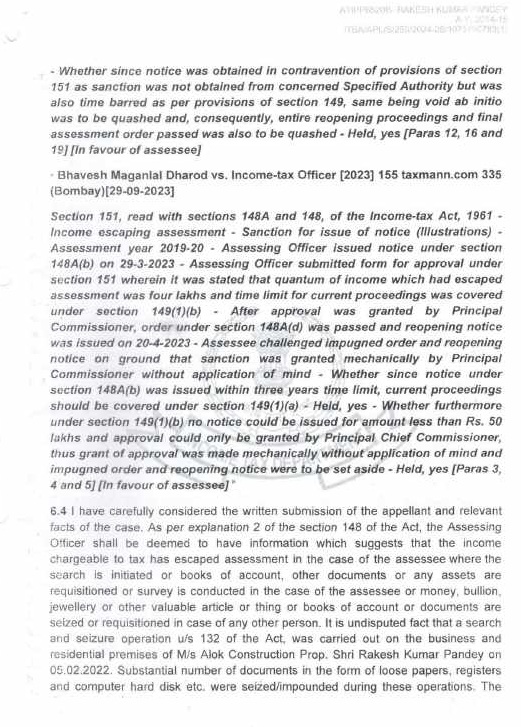
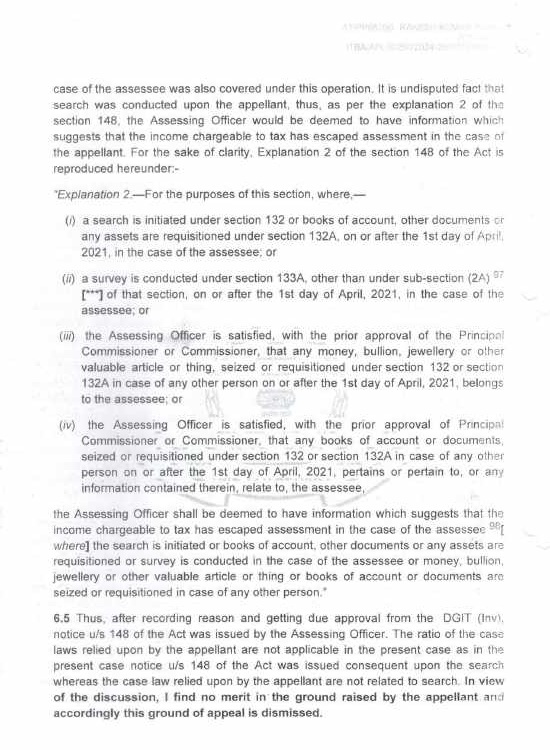
That appellant has filed applications for above years on 03.10.2025 alongwith requisite fees (copy enclosed before Ld. AO (DCIT/AC, Central Circle-2, Lucknow) for inspection of case record and certified copy of order sheet including approval copy while initiating reassessment proceeding. In response to which department has provided copy of order sheet on 24.10.2025. In which reasons are not recorded while issuing notice u/s 148 and approval taken from specified authority were also not provided. Though the case was selected for income escaping assessment of assessee covered by sec. 132 and Assessing Officer while issuing notice u/s 148, shall be deemed to have information. However, no material is available on record how income is being quantified alleging escaped assessment amount to or is likely to amount Rs. 50 lakhs or more where three years have been elapsed from end of relevant assessment year in compliance of provision section 149(1)(b) of the Act, while issuing notice u/s 148 the Act. Further during the course of search no incriminating material was found with reference to above said years which could suggest income escaping assessment in assessment order AO has also not discussed/demonstrated about any seized document found during search while drawing any adverse inference. Therefore proceeding initiated u/s 148 of the Act is not accordance with Law.
Reliance is also placed on Principal Commissioner of Income-tax, Central-3 v. AbhisarBuildwell (P.) Ltd. Pr. CIT v. Abhisar Buildwell (P.) Ltd. (SC)/[2023] 454 ITR 212 (SC).
Further in above cases notices u/s 148 were issued on 17.03.2023 by ACIT/DCIT (CC-II), Lucknow however which is not accordance with law after the amendment made u/s 151A of the Act. Central Board of Direct Taxes vide NOTIFICATION New Delhi, the 29th March, 2022 18/2022/F. No. 370142/16/2022-TPL(Part1)has notified, notice u/s 148 from such date was liable to be issued through automated allocation in accordance with RMS formulated by Board Faceless manner. Therefore notice issued by JAO was not accordance with law after such notification hence whole assessment is liable to be quashed.
Recently, Hon’ble Mumbai High Court in case of PrakashPandurangPatil (Bombay) after following the Division bench judgment of Hon’ble Mumbai high Court in case of Hexaware Technologies Limited held as under:-
“9. In the light of the above discussion, and when there is no dispute that the Jurisdictional Assessing Officer (JAO) had no jurisdiction to issue the impugned order and the impugned notices, the writ petition is required to be allowed. It is accordingly allowed in terms of prayer clause (b) and (d), which reads thus:-
“(b) To issue a writ of Mandamus or direction or order in the nature of Mandamus or writ of Certiorari or any other writ under Article 226 of the Constitution of India, setting aside the impugned order under section 148A(d) dated 05.04.2022.
(d) To issue a writ of Mandamus or direction or order in the nature of Mandamus or writ of Certiorari or any other writ under Article 226 of the Constitution of India, declaring that the consequential notice dated 05.04.2022 issued under section 148 as invalid.”
10. We make it clear that having disposed of this petition on the ground of non-compliance with Section 151A of the Act, we have not expressed any opinion on the other issues as raised in the Writ Petition, which are expressly kept open.”
Further, SLP of Revenue Diary No. 39689 / 2025 (dated 18.08.2025) in case of PrakashPandurangPatil are dismissed by Hon’ble Supreme Court on ground of delay as well as merits.
Recently Apex Court in case of Deepanjan Roy SLP Civil Diary No. 33956/2025 (dated 16.07.2025) has dismissed the SLP of Revenue.
Issue No. 16 – A Y2020-21
That for the relevant year case was picked for scrutiny vide notice u/s 143(2) dated 29.06.2021 before the date of search and search was conducted on 05.02.2022 when scrutiny assessment was under progress. The Ld. AO suomoto converted normal scrutiny assessment against into search assessment which is against the spirit of Guidelines issued on 10.06.2021vide F. No. 225/61/2021/ITA-II and also against the specific law relating to search assessment u/s 147 where search is conducted on or after 01.04.2021 to 31.08.2024. Hence, the assessment order passed u/s 144 dated 25.08.2023 for relevant not accordance with law and facts of the case liable to be quashed.
Further, AO while passing the assessment order has not taken approval from Range Head u/s 148B of the Act which is mandatory for search assessment resulting to which assessment order passed not accordance with law liable to be quashed.
Issue No. 17 – A Y2021-22
| 1. |
|
That it is relevant to mention since the search was conducted on or after 01/04/2021, while framing the assessment order, the provisions of section 147 to 151 was required to be followed as per law amendment took place by Finance Act, 2021. Erstwhile assessment in case of search cases were covered by 153A/ 153C of the Act, where search conducted till 31/03/2021. Therefore the Ld. AO was under obligation to follow provisions of section 147 to 151 while making assessment of appellant considering search case. By Finance Act, 2024 procedure of search assessment has again been changed where search conducted on or after 01/09/2024 and NOW covered by block assessment u/s 158BC/BD of the Act, accordingly following sub-section-3 has been inserted in section 152 by Finance Act, 2024:- |
[(3) Where a search has been initiated under section 132 or requisition is made under section 132A, or a survey is conducted under section 133A [other than under sub-section (2A) of the said section], on or after the 1st day of April, 2021 but before the 1st day of September, 2024, the provisions of sections 147 to 151 shall apply as they stood immediately before the commencement of the Finance (No. 2) Act, 2024.
| 2. |
|
That AO has not issued the notice u/s 148 of the Act for relevant year alike he issued for AY 2019-20 &AY 2020-21. Since the case of assessee was transferred to Central Circle because of search in the case of other person u/s 132 of the Act, therefore while assessing the income of appellant notice u/s 148 of the Act was directly issued without conducting enquiry, providing opportunity as provided u/s 148A, of the Act, which provides:- |
Provided that the provisions of this section shall not apply in a case where,—
| (a) |
|
a search is initiated under section 132 or books of account, other documents or any assets are requisitioned under section 132A in the case of the assessee on or after the 1st day of April, 2021; or (not the case of appellant) |
| (b) |
|
the Assessing Officer is satisfied, with the prior approval of the Principal Commissioner or Commissioner that any money, bullion, jewellery or other valuable article or thing, seized in a search under section 132 or requisitioned under section 132, in the case of any other person on or after the 1st day of April, 2021, belongs to the assessee; or (not the case of appellant nothing is mentioned in assessment order about money etc.) |
| (c) |
|
the Assessing Officer is satisfied, with the prior approval of the Principal Commissioner or Commissioner that any books of account or documents, seized in a search under section 132 or requisitioned under section 132, in case of any other person on or after the 1st day of April, 2021, pertains or pertain to, or any information contained therein,262[relate to, the assessee; or (Covered by said clause in A Y 2019-20 & A Y 2020-21) |
| (d) |
|
the Assessing Officer has received any information under the scheme notified under section 135A pertaining to income chargeable to tax escaping assessment for any assessment year in the case of the assessee.] (NA) |
Explanation.—For the purposes of this section, specified authority means the specified authority referred to in section 15.]
The above applicable provision was obligatory on the part of AO to record satisfaction with prior approval of PCIT/CIT while issuing the notice u/s 148 of the Act which is safeguard to appellant because such assessee is deprived of enquiry/opportunity as provided u/s 148A of the Act. It transpires AO without issuing notice u/s 148 directly selected the case for scrutiny only misinterpreting Board Circular No. F.NO. 225/81/2022/ITA-II, dt. 03.06.2022:-
| S.No. |
Parameter |
Procedure for compulsory selection |
| 2 |
Cases pertaining to search & seizure/requisition |
| 2.2 |
Search & seizure/requisition on or after 01.04.2021: Assessments in cases arising from search & seizure actions/requisitions u/s 132/132A conducted on or after 01.04.2021, for returns pertaining to A. Y 2021-22. |
The cases shall be selected for scrutiny with prior administrative approval of Pr. CIT/pr. DIT/Crr/DIT concerned, who shall ensure that such cases are transferred to Central Charges u/s 127 of the Act within 15 days of service of notice u/s 143(2)/142(1) of the Act by the Assessing Officer concerned. |
The above guidelines was issued after detailed (Master) guidelines for compulsory scrutiny of cases during FY 2022-23 on 11-05-2022 vide FNo. 225/81/2022/ITA-II. However para-2 of Sl. No-2 being cases pertaining to search & seizure, substituted guidelines were issued on 03.06.2022 discussed above, since erstwhile guidelines at para-2, covers only search cases, where conducted upto 31-03-2021. Therefore guidelines issued on 03.06.2022 covers in para-2 as under:-
2.1 Search & seizure/requisition prior to 01.04.2021 (Not Our Case)
2.2 Search & seizure/requisition on or after 01.04.2021 (discussed above)
It is relevant to mention the detailed (Master) guidelines dt. 11.05.2022 at Para-4 of Sl. No.-2 also covers search cases where search conducted on or after 01.04.2021 under the heading cases in which notice have been issued u/s 148 ofthe Act with following details:-
| S.No. |
Parameter |
Procedure for compulsory selection |
| 4 |
Cases in which notices u/s 148 of the Act have been issued |
|
Cases where return is either furnished or not furnished in response to notice u/s 148 of the Act. |
(i) Cases, where notices u/s 148 of the Act have been issued pursuant to search & seizure/survey actions conducted on or after the 1st day of April, 2021: These cases shall be selected for compulsory scrutiny with prior administrative approval of Pr. CIT/pr.DIT/CIT/DIT concerned who shall ensure that such cases, if lying outside Central Charges, are transferred to Central Charges u/s 127 of the Act within 15 days of service of notice u/s 143(2)/142(1) of the Act calling for information by the Assessing Officer concerned. |
Therefore the above guidelines itself proves that search cases where search conducted on or after 01.04.2021 liable to be covered by 147 to 151 provisions. Since for relevant year AY 2021-22 notice was not issued u/s 148 of the Act, therefore Ld. AO was liable to first issue notice u/s 148 after recording the satisfaction on documents/information available with him found during the search of other person with prior approval of PCIT/CIT. The issuance of notice u/s 148 is not tantamount to selection of case of scrutiny for making regular assessment but being a pre-condition for search assessment where search held in case of other person on or after 01.04.2021.
It is reiterated the case for the relevant year of appellant is neither normal scrutiny assessment where only notice u/s 143(2) was liable to be issued for making assessment u/s 143(3) nor it is normal reassessment proceeding covered by provision of section 147 to 151 where time for issuance of notice u/s 143(2) was left. Since the case of the assessee has already been considered as search case by Revenue in AY 2019-20 & AY 2020-21 while issuing notice u/s 148 directly without compliance of u/s 148A proceedings therefore for AY 2021-22 which is not a year of search notice could not have been issued directly u/s 143(2) with administrative approval depriving assessee legal safeguards provided u/s 148 of the Act. Further during the course of assessment proceeding vide reply dt. 20.12.2024 (Pg. no. 184 of paperbook filed on 09.05.2025) Appellant raised issue for not issuing notice u/s 148 for the relevant year which AO did not address in Assessment Order.
It is also relevant to mention if case of the appellant is considered as nonsearch case while selecting the case for scrutiny under procedure of compulsory selection, AO was liable to demonstrate in the Assessment Order, under which category case is selected as per scrutiny guidelines, which he failed to do so.
The intent of such guidelines to issue administrative order for selecting the case under scrutiny not to bypass legal obligation of AO to take approval from PCIT/CIT as defined in proviso of section 148 of the Act.
It is also pertinent to mention where search conducted on or after 01.04.2021 covered by section 147 to 151 are special provisions for search assessments which supersede the General provision of assessment and vice versa is not possible. Therefore the Ld. AO while issuing the notice u/s 143(2) without issuance of notice u/s 148 went against the well established principal of law “Gnerraiiaseeciaiibus non derogant’is a Latin legal maxim that means “gnnr&i provisions do not derogate from special provisions,” or “gnnr&i laws do not override specific laws” In essence, it dictates that when a general rule conflicts with a specific rule, the specific rule takes precedence. This principle is used in statutory interpretation to resolve conflicts between laws, ensuring that the more precise and relevant provision is applied.
The Board itself substituted the guidelines dt. 03.06.2022 para no-2.2 in which erstwhile only AY 2021-22 was mentioned after realising the mistake, deleted such assessment year in substituted guidelines dt. 26.09.2022 with following details:-
2. With reference to the above, I am directed to state that Sl No. 2.2 of para-2 of CBDT’s Guidelines dt. 03.06.2022 shall be substituted as under:-
| S.No. |
Parameter |
Procedure for compulsory selection |
| 2 |
Cases pertaining to search & seizure/requisition |
| 2.2 |
Search & seizure/requisition on or after 01.04.2021: Assessments in cases arising from search & seizure actions/requisitions u/s 132/132A conducted on or after 01.04.2021. |
The cases shall be selected for scrutiny with prior administrative approval of Pr. CIT/pr. DIT/CIT/DIT concerned, who shall ensure that such cases are transferred to Central Charges u/s 127 of the Act within 15 days of service of notice u/s 143(2)/142(1) of the Act by the Assessing Officer concerned. |
After the above changes it transpires search cases for compulsory scrutiny where search conducted on or after 01.04.2021 in case of other eerson, are to be selected for scrutiny issuing notice u/s 143(2), only after issuing of notice u/s 148 of the Act, during the FY 2022-23 once assessee files the ITR in response to notice u/s 148 of the Act and thereafter to be transferred to Central Charge. The intent of substituted guidelines dt. 26.09.2022 to carry out process of selection of cases for scrutiny during whole year of FY 2022-23, which could be possible only after issuance of notice u/s 148 of the Act, where ITR filed in FY 2021-22 or earlier years for AY 2021-22 and preceding years, OTHERWISE in normal course notice u/s 143(2) could have been issued till 30.06.2022, where ITR filed during FY 2021-22. Thus directing the issuance of notice u/s 148 in scrutiny guidelines is not possible as it is a statutory provisions and cannot be override by any guidelines whatsoever.
| 3. |
|
That as a matter of fact the assessment of appellant/assessee company for two previous assessment years i.e. A.Y. 2019-20 & 2020-21 has been completed under the provisions of section 148/147 of the Act and after following due procedure which includes proper approval from Statutory Prescribed Authority before issuing notice u/s 148 of the Act and also Approval u/s 148B of the Act. Prescribed Procedure of recording satisfaction as per procedure u/s 148A of the Act has also not been followed by the Assessing Authority before framing a search assessment against the appellant/assessee company. |
| 4. |
|
That the search assessments framed by the Assessing Officer also lacks of proper approval u/s 148B of the Act behind the veil of framing assessment u/s 143(3) of the Act only. Had the Assessing Officer taken proper route to frame a search assessment he would have obtained to necessary approvals from the prescribed authorities, one at the time of issuing notice u/s 148 of the Act and second at the time of finalization for assessment u/s 148B of the Act which could entail proper justice to the appellant/assessee company. |
| 5. |
|
That it is therefore respectfully submitted that the appellant/assessee company has been deprived of its legal rights under the Income Tax Act while dragging it to search assessment and the present assessment framed u/s 143(3) of the Act is illegal and liable to be quashed. |
Issue No. 18 – A Y2022-23
That the relevant i.e. AY 2022-23 is being search year since search was conducted on 05.02.2022. However, assessment for relevant year was completed u/s 143(3) which is against the spirit of relevant provision of law where specific provisions of sec. 147 to 151 liable to be applied which is also proves from section 152(3) inserted by FA-2024 (w.e.f. 01.09.2024) [(3) Where a search has been initiated under section 132 or requisition is made under section 132A, or a survey is conducted under section 133A [other than under sub-section (2A) of the said section], on or after the 1st day of April, 2021 but before the 1st day of September, 2024, the provisions of sections 147 to 151 shall apply as they stood immediately before the commencement ofthe Finance (No. 2) Act, 2024.]
Further, AO while passing the order has not taken approval from Range Head as per the provision of sec. 148B being applicable provision on the other side took administrative approval from Range Head as per the Board order dated 15.07.2022 vide F. No. 299/36/2021-Dir(Inv-III)/577 which is also not accordance with law and facts of the case. Hence, the assessment order is liable to be quashed.”
CASE LAWS
| 1. |
|
CBDT Circular F.No.286/2/2003-IT(Inv) dated 10/03/2003 |
| 2. |
|
CBDT Circular F.No.286/98/2013-IT(Inv-II) dated 18/12/2014 |
| 3. |
|
CIT v. Dilbagh Rai Arora (Allahabad) |
| 4. |
|
CIT v. Mantri Share Brokers (P.) Ltd. (Rajasthan) |
| 5. |
|
CIT v. Smt. Malti Mishra (Allahabad) |
| 6. |
|
Pr. CIT v. Abhisar Buildwell (P.) Ltd. (SC)/[2023] 454 ITR 212 (SC) |
| 7. |
|
Pr. CIT v. Swananda Properties (P.) Ltd. (Bombay) |
| 8. |
|
CIT v. Naresh Kumar Agarwal (Andhra Pradesh)/[2014] 369 ITR 171 (Andhra Pradesh) |
| 9. |
|
Pr. CIT v. Rohit Karan Jain (Gauhati)ITA/ 5/2023 (Gauhati High Court) |
| 10. |
|
ACIT v. Kuber Khadyan Pvt. Ltd. (ITAT Delhi Bench) |
| 11. |
|
KC Raju Multi Specialty Hospital v. DCIT (ITAT ‘A’ Bench Bangalore) |
(B.2) Further, year-wise synopsis was also filed from the assessee’s side; containing narration of important papers in year-wise paper books referred to in foregoing paragraph (B) of this order; The same is reproduced below:
Ref: SHRI RAKESH KUMAR PANDEY (PAN:ATIPP6520B)
Date of Search: 05.02.2022
| 10. |
|
ITA No 347/LKW/2025 (A) AY 2014-15 |
| 11. |
|
ITA No 348/LKW/2025 (A) & 398/LKW/2025 (D) AY 2015-16 |
| 12. |
|
ITA No 349/LKW/2025 (A) & 399/LKW/2025 (D) AY 2016-17 |
| 13. |
|
ITA No 350/LKW/2025 (A) & 460/LKW/2025 (D) AY 2017-18 |
| 14. |
|
ITA No 351/LKW/2025 (A) AY 2018-19 |
| 15. |
|
ITA No 352/LKW/2025 (A) & 402/LKW/2025 (D) AY 2019-20 |
| 16. |
|
ITA No 608/LKW/2024 (D) & CO 28/LKW/2024 AY 2020-21 |
| 17. |
|
ITA No. 557/LKW/2024 (D) & CO 27/LKW/2024 AY 2021-22 |
| 18. |
|
ITA No 353/LKW/2025 (A) & 405/LKW/2025 (D) AY 2022-23 |
| AY |
Notice u/s 148 |
Order Passed |
Remarks |
| 2013-14 |
17.03.2023 |
28.03.2024 |
1. Unabated Year, no incriminating material and all seized documents w.r.t. business were reconcile with regular books (nothing is mentioned in Assessment Order & no addition on the basis of seized document)
2. Three years elapsed from end of relevant year while issuing notice u/s 148, no information in possession of AO in document/evidence represented in form of asset, expenditure or entry which has escaped assessment amount of fifty lacs or more (Noting is mentioned in Assessment Order about reason of reopening of case and during inspection nothing found in case record about alleged escaped income of fifty lacs or more, addition made solely based on percentile of income declared in AY 2021-22 & AY 2022-23 only under statement u/s 132(4)) |
| 2014-15 |
17.03.2023 |
28.03.2024 |
—do— |
| 2015-16 |
17.03.2023 |
28.03.2024 |
—do— |
| 2016-17 |
17.03.2023 |
27.03.2024 |
—do— |
| 2017-18 |
17.03.2023 |
26.03.2024 |
—do— |
| 2018-19 |
17.03.2023 |
28.03.2024 |
—do— |
| 2019-20 |
22.02.2023 |
28.03.2024 |
1. Unabated Year, no incriminating material and all seized documents w.r.t. business were reconcile with regular books (nothing is mentioned in Assessment Order & no addition on the basis seized document)
2. On the basis of deemed information for relevant year notice u/s 148 was issued within three years from end of relevant year. addition made solely based on percentile of income declared in AY 2021-22 & AY 2022-23 only under statement u/s 132(4) |
| 2020-21 |
143(2) issued on 29.06.2021 under progress as on date of search |
25.08.2023 |
Regular scrutiny was converted into search case
SCN Not issued |
| 2021-22 |
143(2) issued on 28.06.2022 |
25.08.2023 |
SCN Not issued |
| 2022-23 |
143(2) issued on 22.02.2023 |
31.03.2024 |
SCN Not issued
144A Application not dealt in Assessment Order |
Ref: SHRI RAKESH KUMAR PANDEY (PAN:ATIPP6520B)
AY 2014-15
| Reply dt. |
Page of PB |
Description |
Remarks |
| 11-05-2023 |
48 |
General |
|
| 05-09-2023 |
49 |
General |
|
| 08-02-2024 |
50-52 |
General |
Bank Statement, Turnover reconciliation |
| 26-02-2024 |
|
SCN issued |
NP Rate applied @11% not mentioned in SCN |
| 11-03-2024 |
53-57 |
General & Seized document with regular books |
VAT, Seized document reconciliation with regular books |
| 16-03-2024 |
58 |
Request for reference to VO |
|
| 16-03-2024 |
59 |
Bank statement summary |
|
| 20-03-2024 |
|
Portal block for reply |
Draft Order Sent to Range Head for approval (as per paper book of Revenue of AY 2016-17) |
| 21-03-2024 |
|
Approval Granted for Order u/s 147/143(3) |
(as per paper book of Revenue of AY 2016-17) |
| 28-03-2024 |
|
Assessment Order u/s 147/144 |
|
Ref: SHRI RAKESH KUMAR PANDEY (PAN:ATIPP6520B)
AY 2015-16
| Reply dt. |
Page |
Description |
Remarks |
| 06-09-2023 |
54 |
General |
Turnover reconcile with 26 AS |
| 08-02-2024 |
55-57 |
General |
Bank accounts submitted |
| 26-02-2024 |
49 |
SCN |
NP Rate applied @11% not mentioned in SCN |
| 11-03-2024 |
58-67 |
General & Seized document with regular books |
Property transaction & reconciliation with sale with VAT Return |
| 15-03-2024 |
68 |
General |
Reconciliation of bank and drawings |
| 16-03-2024 |
69 |
Request for reference to VO |
|
| 20-03-2024 |
|
Portal block for reply |
Draft Order Sent to Range Head for approval (as per paper book of Revenue of AY 2016-17) |
| 21-03-2024 |
|
Approval Granted for Order u/s 147/143(3) |
(as per paper book of Revenue of AY 2016-17) |
| 28-03-2024 |
70 |
Assessment Order u/s 147 |
|
Ref: SHRI RAKESH KUMAR PANDEY (PAN:ATIPP6520B)
AY 2016-17
| Reply dt. |
Page |
Description |
Remarks |
| 06.09.2023 |
49 |
General |
|
| 01.02.2024 |
50-52 |
General |
Bank Statement, Turnover reconciliation& copy of order u/s 143(3) |
| 26.02.2024 |
44-45 |
SCN issued |
NP Rate applied @11% not mentioned in SCN |
| 11.03.2024 |
53-54 |
General& Property detail |
VAT, Request for reference to VO |
| 16.03.2024 |
55 |
General |
|
| 16.03.2024 |
56 |
General |
|
| 20-03-2024 |
|
Portal blocked for reply |
Draft Order Sent to Range Head for approval (as per paper book of Revenue of AY 2016-17) |
| 21-03-2024 |
|
Approval Granted for Order u/s 147/143(3) |
(as per paper book of Revenue of AY 2016-17) |
| 27-03-2024 |
|
Assessment Order u/s 147/144 |
|
SHRI RAKESH KUMAR PANDEY (PAN:ATIPP6520B)
AY 2017-18
| Reply dt. |
Page |
Description |
Remarks |
| 06.09.2023 |
53 |
General |
|
| 01.02.2024 |
54-56 |
General |
Bank Statement, Turnover reconciliation& copy of order u/s143(1) |
| 12.03.2024 |
57-63 |
General & Property detail, Seized document detail |
Request for reference to VO,insurance policy,VAT, Seized document reconciliation with regular books |
| 15.03.2024 |
64 |
Capital Gain detail |
|
| 16.03.2024 |
65 |
General |
|
| 20-03-2024 |
|
Portal blocked for reply |
Draft Order Sent to Range Head for approval (as per paper book of Revenue of AY 2016-17) |
| 21-03-2024 |
|
Approval Granted for Order u/s 147/143(3) |
(as per paper book of Revenue of AY 2016-17) |
| 26-03-2024 |
|
Assessment Order u/s 147/144 |
|
Note: SCN Not issued
SHRI RAKESH KUMAR PANDEY (PAN:ATIPP6520B)
AY 2018-19
| Reply dt. |
Page |
Description |
Remarks |
| 06.09.2023 |
62 |
General |
|
| 08.02.2024 |
63-65 |
General |
Bank Statement, Turnover reconciliation |
| 26.02.2024 |
57-58 |
SCN issued |
NP Rate applied @11% not mentioned in SCN |
| 12.03.2024 |
66-70 |
General & Property Detail,Seized document with regular books |
GST, Request for reference to VO Seized document reconciliation with regular books |
| 15.03.2024 |
71-72 |
General |
Breakup of payable of FS |
| 16.03.2024 |
73 |
General |
|
| 20-03-2024 |
|
Portal blocked for reply |
Draft Order Sent to Range Head for approval (as per paper book of Revenue of AY 2016-17) |
| 21-03-2024 |
|
Approval Granted for Order u/s 147/143(3) |
(as per paper book of Revenue of AY 2016-17) |
| 28-03-2024 |
|
Assessment Order u/s 147/144 |
|
Ref: SHRI RAKESH KUMAR PANDEY (PAN:ATIPP6520B)
AY 2019-20
| Reply dt. |
Page |
Description |
Remarks |
| 06.09.2023 |
81 |
General |
|
| 08.02.2024 |
82-84 |
General |
Bank Statement, Turnover reconciliation |
| 26.02.2024 |
76-77 |
SCN issued |
NP Rate applied @11% not mentioned in SCN |
| 12.03.2024 |
85-92 |
General, Property Detail, Seized document reconciliation |
GST Turnover reconciliation, Request for reference to VO Seized document reconciliation with regular books |
| 15.03.2024 |
93 |
General |
Breakup of payable of FS |
| 16.03.2024 |
94 |
General |
Detail & confirmation of Unsecured loan |
| 21.03.2024 |
95 |
General |
GST& ITC reconciliation |
| 21-03-2024 |
|
Portal blocked for reply |
|
| 28-03-2024 |
|
Assessment Order u/s 147/144 |
|
Ref: SHRI RAKESH KUMAR PANDEY (PAN:ATIPP6520B)
AY 2020-21
| Reply dt. |
Page |
Description |
Remarks |
| 17.03.2022 |
61-62 |
General |
|
| 22.03.2022 |
63 |
General |
|
| 26.08.2022 |
64-65 |
General |
GST & ITC reconciliation |
| 02.09.2022 |
66-68 |
General |
|
| 02.09.2022 |
69 |
General |
Detail & confirmation of Unsecured loan |
| 05.09.2022 |
70-71 |
General &detail of Seized document |
Seized document reconciled with regular books |
| 08.09.2022 |
72 |
General |
|
| 08.09.2022 |
73 |
General |
|
| 31.07.2023 |
74-77 |
General |
Sanctity of Additional income to AO and Range Head |
| 11.08.2023 |
78-82 |
General |
Bank Statement – Request for deviation note to Investigation Wing |
| 14.08.2023 |
83-84 |
General |
Agriculture income |
| 16.08.2023 |
85-86 |
General |
GST & ITC reconciliation |
| 17.08.2023 |
87 |
General |
List of sundry creditors of FS |
| 21.08.2023 |
88-89 |
General |
Agriculture income |
| 22.08.2023 |
90-92 |
General & Property Detail |
Details of unsecured loan of FS Request for reference to VO |
| 23.08.2023 |
93 |
General |
Details of unsecured loan of FS with confirmation |
| 25.08.2023 |
|
Assessment Order u/s 144 |
|
Note: SCN Not issued
Ref: SHRI RAKESH KUMAR PANDEY (PAN:ATIPP6520B)
AY 2021-22
| Reply dt. |
Page |
Description |
Remarks |
| 29.11.2022 |
60 |
General |
|
| 29.11.2022 |
61-65 |
General |
Bank statement, GST reconciliation Turnover reconcile with 26AS |
| 13.12.2022 |
66-70 |
General & Seized document reconciliation with regular books |
Seized document reconciliation with regular books |
| 13.12.2022 |
71-74 |
General & Property detail |
Gift, Request for reference to VO |
| 11.08.2023 |
75-77 |
General |
Bank accounts and submission on difference of property valuation |
| 14.08.2023 |
78-79 |
General |
Turnover reconcile, agricultural income, chapter VIA deduction |
| 16.08.2023 |
80-81 |
General & Property detail |
Request for reference to VO |
| 21.08.2023 |
82 |
General |
GST reconciliation, cash withdrawal details and detail of sundry creditors |
| 25.08.2023 |
|
Assessment Order u/s 144 |
|
Note: SCN Not issued
Ref: SHRI RAKESH KUMAR PANDEY (PAN:ATIPP6520B)
AY 2022-23
| Reply dt. |
Page |
Description |
Remarks |
| 24.11.2023 |
78 |
General |
Turnover reconcile with 26 AS |
| 31.01.2024 |
79-83 |
General |
GST reconciliation &Bank accounts submitted |
| 01.03.2024 |
84-86 |
General |
Detail of cash found and request for deviation note |
| 12.03.2024 |
87-114 |
General & Seized document |
Seized document reconciliation with regular books |
| 28.03.2024 |
115-116 |
General |
Request for direction u/s 144A to Range Head |
| 28.03.2024 |
117-127 |
General |
List of sundry creditors of FS and affidavit |
| 16.03.2024 |
128-135 |
General & detail of property |
Request for reference to VO |
| 31-03-2024 |
136-145 |
Assessment Order u/s 143(3) |
|
Note: SCN Not issued
(B.2.1) Moreover, revised consolidated synopsis was also filed from the assessee’s side, which is reproduced below for the ease of reference:
Before
The Hon’ble ITAT, Lucknow Bench ‘A’, Lucknow
Hon’ble Members,
Ref: SHRI RAKESH KUMAR PANDEY (PAN:ATIPP6520B)
Subject:-Consolidate Synopsis:
| 1. |
|
ITA No 347/LKW/2025 (A) AY 2014-15 |
| 2. |
|
ITA No 348/LKW/2025(A) & 398/LKW/2025 (D) AY 2015-16 |
| 3. |
|
ITA No 349/LKW/2025 (A) & 399/LKW/2025 (D) AY 2016-17 |
| 4. |
|
ITA No 350/LKW/2025 (A) & 460/LKW/2025 (D) AY 2017-18 |
| 5. |
|
ITA No 351/LKW/2025 (A) AY 2018-19 |
| 6. |
|
ITA No 352/LKW/2025 (A) & 402/LKW/2025 (D) AY 2019-20 |
| 7. |
|
ITA No 608/LKW/2024 (D) & CO 28/LKW/2024 AY 2020-21 |
| 8. |
|
ITA No. 557/LKW/2024 (D) & CO 27/LKW/2024 AY 2021-22 |
| 9. |
|
ITA No 353/LKW/2025 (A) & 405/LKW/2025 (D) AY 2022-23 |
In above said pending appeals filed by Appellant and Revenue substantially issues are common, therefore, consolidated synopsis are prepared based on issues involved w.r.t. respective year.
Issue No. 1 – AY 2014-15 TO AY 2022-23
| 7. |
|
That a search and seizure operation u/s 132 of the Income Tax Act was carried out on 05.02.2022 on the business and residential premises of M/s Alok Construction being proprietary concern of Appellant. The assessee is Government Contractor and during the relevant period, the assessee engaged in proprietorship business of construction of road etc. in semi urban area from contract work provided by the UPPWD, under the name and style of M/s Alok Construction. |
| 8. |
|
The books of accounts for relevant year were regularly maintained and audited and ITRs alongwith TAR. were filed within due date in respective years with following financial details:- |
| AY |
Turnover |
Profit |
Assessee % of Profit |
AO % of Profit |
CIT(A) % of Profit |
Remark |
| 2014-15 |
9,95,21,021 |
16,42,215 |
1.65 |
11% |
7% |
Year of inception of proprietary business. |
| 2015-16 |
13,45,79,821 |
81,66,298 |
6.07 |
11% |
7% |
|
| 2016-17 |
48,75,65,110 |
2,74,84,960 |
5.64 |
11% |
7% |
Erstwhile Scrutiny u/s 143(3) dated 14.12.2011 by JAO and adhoc addition of Rs. 25,00,000/- |
| 2017-18 |
61,73,38,236 |
3,84,84,570 |
6.23 |
11% |
7% |
|
| 2018-19 |
24,44,22,212 |
1,58,87,444 |
6.50 |
11% |
7% |
Erstwhile Scrutiny u/s 143(3) dt. 23.04.2021 by NeFAC and adhoc addition of Rs. 25,00,000/- and 43B disallowances of Rs. 2,57,43,209/-, Ld. CIT(A) allowed the appeal against original order. |
| 2019-20 |
68,80,79,147 |
4,52,65,423 |
6.58 |
11% |
7% |
|
| 2020-21 |
1,59,98,27,836 |
10,07,00,526 |
6.29 |
11% |
7% |
|
| 2021-22 |
1,68,08,35,131 |
17,03,38,176 |
10.13 |
11% |
10.13% |
Addition on extra profit deleted. |
| 2022-23 |
2,82,59,71,973 |
28,50,48,173 |
|
11% |
9.68% |
Addition on extra profit deleted. |
That during the course of search proceeding in statement recorded u/s 132(4), dated 05/06.02.2022 assessee admitted following –
That percentage of net profit shown of M/s Alok Construction is approximately 6% of its turnover. However, usual profit shown by other business entities of similar business is approximately 8%. (Q/Ans-17)
That due to certain deficiency/incompleteness of records etc. it was admitted that percentage of profit shown (i.e. 6%) by assessee is below the usual profit (i.e. 8%). To cover up such suppressed income in preceding yearsupto AY 2020-21 assessee offered 10% net profit rate for AY 2021-22 and 2022-23 resulting to which additional income offered 16-17 crores approximately. Further, assessee while offering additional income has stated that additional income is offered to cover deficiencies in records for relevant year and preceding years and to cover unproven sundry creditors/remission of liabilities, apart from investment in properties. Further, no adverse inference may be drawn w.r.t. extra profits and seized documents for years prior to AY 2021-22.
Further, at the time of the search proceeding for AY 2020-21 was under progress and issues arising from the search operation was also covered by Ld. AO in assessment proceedings.
During the course of the assessment proceeding, assessee has provided all relevant information as required time to time with regard to purchase of material, business expenses and reconciliation of sales with VAT/GST return. However, AO only on usual observation of Tax Auditor in form 3CB has invoked provision of section 145(3) of the Act and estimated income according to provision of sec. 144 of the Act. It is relevant to mention that these are the general observation made by Auditor in TAR without adverse finding on particular transactions and figures, which are year wise reproduced for ready reference.
Observation of Auditor in TAR
| AY |
Para/ Page of Assessment Order |
Observation of AO |
Remarks |
| 2014-15 |
5.1 / 2 & 3 |
5.1 The Auditor, in his audit report dated 22.09.2014, in Form No. 3CB has commented as follows:
“a. Records necessary to verify personal nature of expenses not maintained by the assessee.
b. Proper stock records are not maintained by the assessee.
c. Valuation of closing stock is not possible.
d. Figures shown under the head of Sundry Debtors, Sundry Creditors, Loans & Advances, Provisionsetc are subject to reconciliation and confirmation. Figures shown under the head of closing stock and cash in hand are physically verified by the proprietor of the firm. Fixed Assets as shown in the balance sheet are subject to verification. Details of TDS deducted and deposited could not be verified due to nonavailability of receipts and challans. However, the assessee is liable for deduction of tax. The assessee did not provide information regarding deductions to be claimed under Chapter VI-A.
e. GP ratio is not ascertainable from the financial statements prepared by the assessee. |
In this regard, it is relevant to mention that prior to date of search for AY 2016-17 & 2018-19 case of the appellant was completed under scrutiny by JAO & FAO respectively where assessment was completed u/s 143(3) after due verification of record. It is also relevant to mention that during the course of the search no incriminating material was found w.r.t. justification of enhancement of profit percentage. On the other side documents found and seized for different years of above said period were duly reconciled with either recorded in books of account relates to business of assessee or personal investments relates to investment in construction of house properties. The detail of compliance made during assessment proceeding is as under:
AY 2014-15
| Reply dt. |
Page of PB |
Description |
Remarks |
| 11-05-2023 |
48 |
General |
|
| 05-09-2023 |
49 |
General |
|
| 08-02-2024 |
50-52 |
General |
Bank Statement, Turnover reconciliation |
| 26-02-2024 |
|
SCN issued |
NP Rate applied @11% not mentioned in SCN |
| 11-03-2024 |
53-57 |
General & Seized document with regular books |
VAT, Seized document reconciliation with regular books |
| 16-03-2024 |
58 |
Request for reference to VO |
|
| 16-03-2024 |
59 |
Bank statement summary |
|
| 20-03-2024 |
|
Portal block for reply |
Draft Order Sent to Range Head for approval (as per paper book of Revenue of AY 2016-17) |
| 21-03-2024 |
|
Approval Granted for Order u/s 147/143(3) |
(as per paper book of Revenue of AY 2016-17) |
| 28-03-2024 |
|
Assessment Order u/s 147/144 |
|
In the assessment order of above said period the Ld. AO has not brought any single instance of incriminating material on the basis of which addition could have been made w.r.t. business income of assessee in support to justify increase profit percentile. In the assessment order the observation of the AO while estimating net profit @ 11% of Gross Receipt was simply based on Net Profit occurred by assessee @ 10.13% for AY 2021-22 in compliance of statement u/s 132(4) held during the search, higher percentage of profit for AY 2021-22 to AY 2022-23 only.
The Ld. AO was highly unjustified while increasing the profit percentage and making the addition for AY 2014-15 to AY 2020-21 where no incriminating material was found w.r.t. addition made in these years.
The relevant para of Assessment Order is as under:
5. From the perusal of record, it is seen that against total receipts of Rs. 9,95,21,021/-, net profit of Rs. 16,42,215/- has been shown by the assessee which gives net profit rate of 1.65%. During the course of assessment proceedings, the assessee was required to produce books of accounts, bills/vouchers relating to the expenses claimed vide notice u/s 142(1) of the Income Tax Act, 1961 dated 04.10.2023, 20.11.2023, 28.11.2023, 29.01.2024, 05.02.2024, 26.02.2024, 05.03.2024 and order sheet entries dated 01.03.2024, 07.03.2024 and 12.03.2024. No books of accounts, bills/ vouchers were produced by the assessee despite ample opportunities given to him. Not only that, during the course of search proceedings, post search proceedings also, books of accounts, bills/vouchers were neither found norproduced. In view of above and following discrepancies, books of account of assessee are not reliable: 5.1 The Auditor, in his audit report dated 22.09.2014, in Form No. 3CB has commented as follows: “a. Records necessary to verify personal nature of expenses not maintained by the assessee. b. Proper stock records are not maintained by the assessee. c. Valuation of closing stock is not possible. Page 2 of 6 ATIPP6520B- RAKESH KUMAR PANDEY A.Y. 2014-15 ITBA/AST/S/147/2023-24/1063514529(1) d. Figures shown under the head of Sundry Debtors, Sundry Creditors, Loans & Advances, Provisions etc are subject to reconciliation and confirmation. Figures shown under the head of closing stock and cash in hand are physically verified by the proprietor of the firm. Fixed Assets as shown in the balance sheet are subject to verification. Details of TDS deducted and deposited could not be verified due to non availablility of receipts and challans. However, the assessee is liable for deduction of tax. The assessee did not provide information regarding deductions to be claimed under Chapter VI-A. e. GP ratio is not ascertainable from the financial statements prepared by the assessee. 5.2 During the year under consideration, the assessee has shown sundry creditors to the tune of Rs. 77,28,457/-. During the assessment proceedings, vide notice u/s 142(1)of the Income Tax Act, 1961 dated 04.10.2023, the assessee was required to furnish detailed list of Sundry Creditors with name, complete address, amount, PAN along with ledger accounts. The assessee vide reply furnished the list of sundry creditors with name, address and outstanding amount due to them at the end of the financial year. To verify the creditworthiness and genuineness of sundry creditors, notice u/s 133(6) of the Income Tax Act, 1961 was sent to some of the creditors on test check basis. No reply from any of the entities was received. Some of the notices were returned unserved. The assessee during the course of search proceedings also accepted in his statement that he is surrendering additional income to cover unproven sundry creditors/remission of liabilities. 5.3 Violation of provisions contained in section 40A(3) of the Income Tax Act, 1961 cannot be ruled out as substantial amount of payments are found to have been made in cash. 5.4 The possibility of incurring expenditure which are prohibited by law and constitute an offence, as per Explanation 1 to section 37 of the I.T. Act, 1961, can also be not ruled out as the assessee has failed to produce even a single bill or voucher in support of his claims, made in ITR. The issues as discussed above may be the reasons for assessee having resorted to non-production of books of accounts including cash book, party ledger etc bills/ vouchers and other supporting documents. In view of these facts, it is clear that the trading results shown by the assessee are not open to verification and are hence not reliable. Considering the overall facts of the case & violation of provisions of sections of Income Tax Act, 1961 in several instances, as discussed above, the book result Page 3 of 6 ATIPP6520B- RAKESH KUMAR PANDEY A.Y. 2014-15 ITBA/AST/S/147/2023-24/1063514529(1) shown are rejected as per provision of section 145(3) of the Income Tax Act, 1961 and accordingly income from construction business is estimated according to provision of section 144 of the IT Act, 1961. After considering the facts and circumstances of the case and the fact that the assessee has himself disclosed net profit rate @10.13% from contract business in the A.Y. 2021-22, net profit rate of 11% is applied on the turnover shown for this assessment year i.e. A.Y. 2014-15 against net profit rate of 1.65% disclosed by the assessee during the A.Y. 2014-15. As the assessee has shown the turn-over at Rs. 9,95,21,021/- for the FY relevant to assessment year 2014-15, the Net Profit calculated @ 11% as per above discussion, works out at Rs.1,09,47,312/-. Since the assessee has shown income from business at Rs. 16,42,215/-, the difference of net profit works out to Rs.93,05,097/-. Accordingly, this amount is added to the income for theyear under consideration. (Addition: Rs. 93,05,097/-)
However Ld. CIT(A) has restricted the estimated profit @ 7% ignoring the peculiar facts of the case, related law only on assumption & surmise with following observation:
7.10 The appellant has placed his reliance in the case of M/s A.B. Construction ACIT, Circle-Gonda, ITA No.433/LKW/2015 wherein the Hon’ble ITAT, Lucknow bench vide its order has held as under:-“7. We have heard rival contentions and perused the entire material available on record. We find that as per various Tribunal’s orders noted by the CIT(A) in this Para of his order, the Tribunal has confirmed N. P. rate of 7% in some cases and 7.5% and 9.6% also in some other cases. Ld. CIT(A) has adopted the N. P. rate of 7% being lowest net profit adopted by the Tribunal as per the judgments noted by him. The CIT(A) in his para 5.2 relied on the various cases to estimate the profit of the assessee at Rs.40,47,077/- @ 7% of gross receipts of Rs.5,78,15,398/-. In the present case, it is noticed that the CIT(A) applied the net profit rate of 7% on the basis of decisions of the ITAT Lucknow Bench and Allahabad bench estimate the profit of the assessee at Rs.40,47,077/- @7% of gross receipts of Rs.5,78,15,398/. Under these facts and circumstances of the case, we are of the considered opinion that adoption of suitable net profit rate should be decided on the basis of facts of each case and therefore, after considering the facts of the present case, we hold that adopting @ 6% rate of net profit of gross receipts of Rs.5,78,15,398/- in the present case will meet the ends of justice. We hold accordingly.” 7.11 Considering the aforementioned discussion, case laws specially the judgment of Hon’ble HIGH COURT OF ALLAHABAD in the case of Commissioner of Income-tax, Allahabad v. Target Construction Co. Ltd, the net profit rate of 11% applied by the Assessing Officer is too high when appellant has shown comparatively higher profit margin of 10.13% and 10.09% in subsequent years i.e. A.Y. 2021-22 and A.Y. 2022- 23 to cover up the deficiencies of unproved sundry creditors/remission of liabilities found during search proceeding. I am of the considered opinion that for the year under consideration it would be justified to apply net profit rate of 7% on the total turnover of Rs. 9,95,21,021/- which works out at Rs. 69,66,471/-. Since the appellant has shown income from business at Rs. 16,42,215/-, thus, the difference in profit works out at Rs. 53,24,256/-. Thus, the addition to the tune of Rs. 53,24,256/- deserved to be confirmed. Therefore, the addition to the extent of Rs. 53,24,256/- is confirmed and remaining addition of Rs. 39,80,841/- made by the Assessing Officer Page 49 of 55 ATIPP6520B- RAKESH KUMAR PANDEY A.Y. 2014-15 ITBA/APL/S/250/2024-25/1075190753(1) is hereby deleted. Thus, these grounds of appeal are partly allowed.
Reliance is placed on Abhisar Buildwell (P.) Ltd. (supra)(For AY 2014-15 to AY 2019-20)
Further, while estimating the profit percentile at 11% AO made reliance on profit estimated @11% in AY 2021-22 which is highly unjustified. In AY 2021-22 assessee himself offered profit percentile around 10% as per statement held u/s 132(4) for AY 2021-22 & AY 2022-23, with prior condition no adverse inference is drawn in years prior to AY 2021-22. Therefore, the whole additions on account of increase in profit percentile was made based on the statement of assessee which is not sustainable in the peculiar circumstances and in the eyes of law.
Reliance is placed on the followings:-
| • |
|
Principal Commissioner of Income-tax, (Central)-l v. Forum Sales (P.) Ltd. (Delhi) HIGH COURT OF DELHI |
“24. The series of judgments referred to hereinabove clearly allude to the settled position of law that the books of account have to be necessarily rejected before the AO proceeds to the best judgment assessment upon fulfillment of conditions mentioned in the Act. The underlying rationale behind such an action is to meet the standards of correct computation of accounts for the purpose of a more transparent and precise assessment of income. Therefore, any pick and choose method of rejecting certain entries from the books of account while accepting other, without an appropriate justification, is arbitrary and may lead to an incomplete, unreasonable and erroneous computation of income of an assessee.
29. Admittedly, the addition of income as discussed in questions (B), (C) and (D) on estimate basis has been done without rejecting the books of account. In view of the aforesaid, we find that no substantial question of law arises in the present appeals.
30. Consequently, we do not find any merit in the case of the Revenue and have no reason to interfere with the view taken by the ITAT. Therefore, the appeals stand dismissed. Pending application(s), if any are also disposed of.”
| • |
|
The Division Bench of the High Court of Bombay in the case of Swananda Properties (P.) Ltd. (supra)had an occasion to consider the said question and the same was accordingly answered as under:- |
“11. We note that the books of account of the respondent were rejected by the Commissioner of Income-tax (Appeals) under section 145(3) of the Act. However, the Tribunal found in the impugned order that the invocation of section 145(3) of the Act is unjustified as no defect was noted in the books of account to disregard the same. We note that the Commissioner of Income-tax (Appeals) in his order while rejecting the books of account does not specify the defect in the record. The basis of the rejection appears to be best judgment of assessment done by him. The rejection of the books should precede the best judgment assessment. On facts, the Revenue has not been able to show any defect in the respondent’s records which would warrant rejection of the books and making a best judgment assessment. Thus, on facts the view taken by the Tribunal is a possible view. Therefore, no substantial question of law arises. Thus not entertained.”
| •Commissioner |
|
of Income-tax – I v. Sahu Construction (P.) Ltd. (Allahabad) |
“21. In the case of CIT v. Gian Chand Labour Contractors (Punj. &Har.)], it was observed that no further separate deduction is allowable as per Sections 29, 144 and 145 of the Act. Relevant portion of the judgment reads as under:—
“Section 145 of the Income-tax Act, 1961 provides for computation of income under section 29 on the basis of books of account and methods of accounting regularly followed by the assessee. However, where the Assessing Officer is not satisfied with the correctness or completeness of the books, he may reject them and estimate the income to the best of his judgment in accordance with the provisions of Section 144 of the Act. When an estimate is made to the best judgment of an Assessing Officer, he substitutes the income that is to be computed under section 29 of the Act. Once best judgment assessment is made by fixing a rate of net profit, the assessee’s claim for deduction on account of expenses cannot be deemed to have been ignored. The net profit rate is applied after taking into consideration all factors and it accounts for all the deductions which are referred to under section 29 and are deemed to have been taken consideration while making such estimate.”
| •Commissioner |
|
of Income-tax, Allahabad v. Target Construction Co. Ltd. (Allahabad) |
IT: Where in case of government contractor engaged in construction of roads books of account was rejected, Tribunal, relying upon profit rates of preceding three years, was justified in estimating profits earned by assessee during relevant years at 5 percent of gross receipts
Section 145 of the Income-tax Act, 1961 – Method of accounting – Estimation of income (GP rate) – Assessment years 2004-05 and 2005-06 – Assessee-company was carrying out contract of construction of roads awarded by Government -Due to various discrepancies in books of account, Assessing Officer rejected same and estimated profit at 10 per cent of gross receipts – Tribunal relying upon profit rates of preceding three years, reduced profit earned during relevant year to 5 per cent of gross receipts – Where since assessee had not done any private construction work during assessment years in question, impugned order passed by Tribunal did not require any interference – Held, yes. [Paras 5 and 6] [In favour of assessee]
| • |
|
Asstt. CIT v. Omshree Agrotech Private Ltd. [IT(SS)A No. 45 to 50( PUN) of 2022, dated 28-6-2023] |
Held that book of accounts cannot be rejected only on surmise and lower profit declared by assessee.
| • |
|
Ramesh Singh Rana v. DCIT [ ITA No.717/LKW/2019, dated 9-4-2025] |
Held that the action of the Ld. CIT(A) is justified for restricting the addition @ 6.5% of the net profit. As he has also considered the past history and also the reason as to why the net profit was estimated at 5%. It is pointed out that gross business receipts were high in that year comparing to the year under appeal. The assessee did not point out any infirmity in adopting such rate by filing credible evidence. The grounds raised in this appeal of the assessee lack merit, hence dismissed.
Manoj Gupta v. ACIT [IT Appeal No. 355 (Lkw) of 2020, dated 18-2-2025]
Held where sales and purchase are verified books of account cannot be rejected and profit cannot be estimated. Further estimation of profit may be made only on the basis of always on past history only.
It is also relevant to mention that in identical facts of AY 2020-21, AO estimated the net profit at 11% and at first appellate level vide order u/s 250 dated 08.08.2024 vide DIN ITBA/APL/S/250/2024-25/1067435183(1) profit was estimated at 7% after following observation:-
7.12 Considering the aforementioned discussion, case laws specially the judgment of Hon’ble HIGH COURT OF ALLAHABAD in the case of Commissioner of Income-tax, Allahabad v. Target Construction Co. Ltd and the fact that depreciation of Rs. 14,99,267/- has already been disallowed, the net profit rate of 11% applied by the Assessing Officer is too high when appellant has shown comparatively higher profit margin of 10.13% and 9.68% in subsequent years i.e. A.Y. 2021-22 and A.Y. 2022- 23 to cover up the deficiencies of unproved sundry creditors/remission of liabilities found during search proceeding. Therefore, I am of the considered view that it would be justified to apply net profit rate of 7% on the total turnover of Rs. 1,59,98,27,836/- which works out at Rs. 11,19,87,949/-. Since the appellant has shown income from business at Rs. 10,07,00,526/-, thus, the difference in profit works out at Rs. 1,12,87,423/-. Thus, the addition to the tune of Rs. 1,27,86,690/- (Rs. 1,12,87,423 + Rs. 14,99,267/-) deserved to be confirmed. Therefore, the addition to the extent of Rs. 1,27,86,690/- is confirmed and remaining addition of Rs.6,24,93,846/- (7,52,80,536-1,27,86,690) made by the Assessing Officer is hereby deleted. Thus, these grounds of appeal are partly allowed.
Issue No. 2 – AY 2014-15
Ld. CIT(A)-3 sustained the addition Rs. 1201000/- (Rs. 4346000-3135000)
That assessee has acquired lease hold plot measuring at 781.40 sqm. situated at Khata no. 192/2,Gata no. 447/2, (Part) Civil line, Gonda purchased by assessee for consideration was Rs. 31,45,000/- from Smt. Pushplata Saran, Shri. Saurabh Saran, Shri. Shobhit Saran and Shri.Shresh Saran on 04/10/2013 against stamp duty value at Rs. 92,76,000/-. Thereafter, the said lease property was converted into freehold through registered deed on 24/10/2017. During the assessment proceeding of AY 2014-15, AO has referred the valuation of said property u/s 50C/142A in response to which Valuation Officer, Allahabad has estimated the FMV of lease property as on 04/10/2013 at Rs. 43,46,000/- against actual consideration of Rs. 31,45,000/- vide valuation report dt. 14/06/2024.
The relevant para of Assessment Order is as under:
7. During the year under consideration, the assessee was found to have purchased an immovable property bearing Khata No. 192/2, Gata No. 447/2, Civil Line, Gonda on 04.10.2013. On perusal of sale deed, it was noticed that the sale consideration of the property was Rs. 31,45,000/-(Stamp duty amount Rs. 6,55,000/-) and market value of the property is Rs.92,76,000/-. The difference between sale consideration and market value of the property is found to be of Rs. 61,31,000/-. During the assessment proceedings, the assessee was required to show cause vide notice dated 26.02.2024 as to why the difference in market value and sale consideration of the property amounting to Rs. 61,31,000/- may not be added u/s 56(2)(vii)(b) of the Income Tax Act, 1961. No satisfactory reply has been submitted by the assessee. Page 4 of 6 ATIPP6520B- RAKESH KUMAR PANDEY A.Y. 2014-15 ITBA/AST/S/147/2023-24/1063514529(1) Accordingly, difference amount of Rs. 61,31,000/- between market rate and sale consideration of the property is added to the total income for the year under consideration u/s 56(2)(vii)(b) of the Income Tax Act, 1961. (Addition : Rs.61,31,000/-)
In this regard it is relevant to mention that assessee has already made payment of Rs. 31,45,000/- through banking channel in FY 2009-10, therefore, stamp duty value in 2009 was to be applied as per provision of sec. 56(2) of the Act. However, Valuation Officer erred on facts and law while applying the stamp duty value of 2009 and indexing thereafter. Resulting to which FMV is over valued. Further, in 2009 stamp duty value of said property was at Rs. 3000 per sq.mts. The said fact is overlooked by VO. Therefore if rate 2009 may be applied than the FMV of the land will be at Rs. 2344200/- (3000 X 781.4 sq. mtr) and cost of boundary wall Rs. 680000/- aggregatingRs. 3024200/- against the consideration of Rs. 3145000/-therefore the actual sale consideration is over & above the value of property being FMV as per provision of 56(vi)(2) without any revenue effect.
However Ld. CIT(A) sustain the addition to the extent of Rs. 12,01,000/- ignoring the peculiar facts of the case and related law with following observation, which may kindly be deleted:
8.5 Considering the above case laws wherein the Hon’ble Courts directed to the Assessing Officer that valuation estimated by the Departmental Valuation Officer has to be adopted being binding in nature, therefore, I am of the view that the difference of sale consideration of Rs. 31,45,000/- and Rs. 43,46,000/- which is the value estimated by the Valuation Officer deserves to be added to the total income of the appellant. Thus, the addition of Rs. 12,01,000/- (43,46,000 – 31,45,000) is hereby confirmed and remaining addition of Rs. 49,30,000/- is hereby deleted. Thus, this ground of appeal is partly allowed.
Issue No. 15 – AY 2014-15 to AY 2019-20Identical Legal Grounds
AY 2014-15 (GOA-1 & 5)
AY 2015-16 (GOA-1 & 5)
AY 2016-17 (GOA-1 & 4)
AY 2017-18 (GOA-1 & 4)
AY 2018-19 (GOA-1 & 4)
AY 2019-20 (GOA-1 & 4)
| 3. |
|
Because the Ld CIT (A) has erred in dismissing the ground of appeal challenging the proceedings u/s 148 initiated by the AO in violation of applicable law and without finding any incriminating material during search u/s 132 of the Act and also without satisfying the conditions mentioned in section 149 of the Act. The assessment based on illegal proceedings initiated u/s 148 is liable to be quashed. |
| 4. |
|
Because the assessment order passed by AO, after prior approval of Range Head dated 21.03.2024 (AY 2019-20 – 22.03.2024) is not accordance with law and peculiar facts of the case and ratio laid down by Hon’ble Courts. |
LdCIT(A) has not allowed the legal issues with following observations:
6. 4 I have carefully considered the written submission of the appellant and relevant facts of the case. As per explanation 2 of the section 148 of the Act, the Assessing Officer shall be deemed to have information which suggests that the income chargeable to tax has escaped assessment in the case of the assessee where the search is initiated or books of account, other documents or any assets are requisitioned or survey is conducted in the case of the assessee or money, bullion, jewellery or other valuable article or thing or books of account or documents are seized or requisitioned in case of any other person. It is undisputed fact that a search and seizure operation u/s 132 of the Act, was carried out on the business and residential premises of M/s Alok Construction Prop. ShriRakesh Kumar Pandey on 05.02.2022. Substantial number of documents in the form of loose papers, registers and computer hard disk etc. were seized/impounded during these operations. The Page 25 of 55 ATIPP6520B- RAKESH KUMAR PANDEY A.Y. 2014-15 ITBA/APL/S/250/2024-25/1075190753(1) case of the assessee was also covered under this operation. It is undisputed fact that search was conducted upon the appellant, thus, as per the explanation 2 of the section 148, the Assessing Officer would be deemed to have information which suggests that the income chargeable to tax has escaped assessment in the case of the appellant. For the sake of clarity, Explanation 2 of the section 148 of the Act is reproduced hereunder:-“Explanation 2.—For the purposes of this section, where,— (i) a search is initiated under section 132 or books of account, other documents or any assets are requisitioned under section 132A, on or after the 1st day of April, 2021, in the case of the assessee; or (ii) a survey is conducted under section 133A, other than under sub-section (2A) 97 [***] of that section, on or after the 1st day of April, 2021, in the case of the assessee; or (iii) the Assessing Officer is satisfied, with the prior approval of the Principal Commissioner or Commissioner, that any money, bullion, jewellery or other valuable article or thing, seized or requisitioned under section 132 or section 132A in case of any other person on or after the 1st day of April, 2021, belongs to the assessee; or (iv) the Assessing Officer is satisfied, with the prior approval of Principal Commissioner or Commissioner, that any books of account or documents, seized or requisitioned under section 132 or section 132A in case of any other person on or after the 1st day of April, 2021, pertains or pertain to, or any information contained therein, relate to, the assessee, the Assessing Officer shall be deemed to have information which suggests that the income chargeable to tax has escaped assessment in the case of the assessee 98[where] the search is initiated or books of account, other documents or any assets are requisitioned or survey is conducted in the case of the assessee or money, bullion, jewellery or other valuable article or thing or books of account or documents are seized or requisitioned in case of any other person.” 6.5 Thus, after recording reason and getting due approval from the DGIT (Inv), notice u/s 148 of the Act was issued by the Assessing Officer. The ratio of the case laws relied upon by the appellant are not applicable in the present case as in the present case notice u/s 148 of the Act was issued consequent upon the search whereas the case law relied upon by the appellant are not related to search. In view of the discussion, I find no merit in the ground raised by the appellant and accordingly this ground of appeal is dismissed.
That appellant has filed applications for above years on 03.10.2025 alongwith requisite fees (copy enclosed before Ld. AO (DCIT/AC, Central Circle-2, Lucknow) for inspection of case record and certified copy of order sheet including approval copy while initiating reassessment proceeding. In response to which department has provided copy of order sheet on 24.10.2025. In which reasons are not recorded while issuing notice u/s 148 and approval taken from specified authority were also not provided. Though the case was selected for income escaping assessment of assessee covered by sec. 132 and Assessing Officer while issuing notice u/s 148, shall be deemed to have information. However, no material is available on record how income is being quantified alleging escaped assessment amount to or is likely to amount Rs. 50 lakhs or more where three years have been elapsed from end of relevant assessment year in compliance of provision section 149(1)(b) of the Act, while issuing notice u/s 148 the Act. Further during the course of search no incriminating material was found with reference to above said years which could suggest income escaping assessment in assessment order AO has also not discussed/demonstrated about any seized document found during search while drawing any adverse inference. Therefore proceeding initiated u/s 148 of the Act is not accordance with Law.
Reliance is also placed on Principal Commissioner of Income-tax, Central-3 v. AbhisarBuildwell (P.) Ltd. Pr. CIT v. Abhisar Buildwell (P.) Ltd. (SC)/[2023] 454 ITR 212 (SC).
Further in above cases notices u/s 148 were issued on 17.03.2023 by ACIT/DCIT (CC-II), Lucknow however which is not accordance with law after the amendment made u/s 151A of the Act. Central Board of Direct Taxes vide NOTIFICATION New Delhi, the 29th March, 2022 18/2022/F. No. 370142/16/2022-TPL(Part1)has notified, notice u/s 148 from such date was liable to be issued through automated allocation in accordance with RMS formulated by Board Faceless manner. Therefore notice issued by JAO was not accordance with law after such notification hence whole assessment is liable to be quashed.
Recently, Hon’ble Mumbai High Court in case of PrakashPandurangPatil (Bombay) after following the Division bench judgment of Hon’ble Mumbai high Court in case of Hexaware Technologies Limited held as under:-
“9. In the light of the above discussion, and when there is no dispute that the Jurisdictional Assessing Officer (JAO) had no jurisdiction to issue the impugned order and the impugned notices, the writ petition is required to be allowed. It is accordingly allowed in terms of prayer clause (b) and (d), which reads thus:-
“(b) To issue a writ of Mandamus or direction or order in the nature of Mandamus or writ of Certiorari or any other writ under Article 226 of the Constitution of India, setting aside the impugned order under section 148A(d) dated 05.04.2022.
(d) To issue a writ of Mandamus or direction or order in the nature of Mandamus or writ of Certiorari or any other writ under Article 226 of the Constitution of India, declaring that the consequential notice dated 05.04.2022 issued under section 148 as invalid.”
10. We make it clear that having disposed of this petition on the ground of non-compliance with Section 151A of the Act, we have not expressed any opinion on the other issues as raised in the Writ Petition, which are expressly kept open.”
Further, SLP of Revenue Diary No. 39689 / 2025 (dated 18.08.2025) in case of PrakashPandurangPatil are dismissed by Hon’ble Supreme Court on ground of delay as well as merits.
Recently Apex Court in case of Deepanjan Roy SLP Civil Diary No. 33956/2025 (dated 16.07.2025) has dismissed the SLP of Revenue.
(B.2.2) In addition; written submissions in the nature of revised year-wise synopsis were also filed from the assessee’s side, vide letter dated 27/11/2025, relevant portion of which is reproduced below for the ease of reference:
27.11.2025
Before,
The Hon’ble ITAT, Lucknow Bench ‘A’,
Lucknow
Hon’ble Members,
Ref: RAKESH KUMAR PANDEY(PAN:ATIPP6520B) (Heard on 27.11.2025)
Subject:- Revised Consolidate Synopsis for following years& correction in Issue no. 17 – AY 2021-22 of consolidated synopsis submitted on 20.11.2025
| 1. |
|
ITA No 347/LKW/2025 (A) AY 2014-15 |
| 2. |
|
ITA No 348/LKW/2025 (A) & 398/LKW/2025 (D) AY 2015-16 |
| 3. |
|
ITA No 349/LKW/2025 (A) & 399/LKW/2025 (D) AY 2016-17 |
| 4. |
|
ITA No 350/LKW/2025 (A) & 460/LKW/2025 (D) AY 2017-18 |
| 5. |
|
ITA No 351/LKW/2025 (A) AY 2018-19 |
| 6. |
|
ITA No 352/LKW/2025 (A) & 402/LKW/2025 (D) AY 2019-20 |
| 7. |
|
ITA No 608/LKW/2024 (D) & CO 28/LKW/2024 AY 2020-21 |
| 8. |
|
ITA No. 557/LKW/2024 (D) & CO 27/LKW/2024 AY 2021-22 |
| 9. |
|
ITA No 353/LKW/2025 (A) & 405/LKW/2025 (D) AY 2022-23 |
As per direction issued by Hon’ble Bench during hearing on 27.11.2025, I am submitting herewith Revised Consolidate Synopsis for above years. Further, in consolidated synopsis submitted on 20.11.2025 carrying some glaring mistakes against Issue No. 17, which is also corrected and rectified copy is also enclosed.
RAKESH KUMAR PANDEY PAN:ATIPP6520B (AY 2014-15) – ITA 347/LKW/2025
FACTS: Date Of Search 05.02.2022
| (a) |
|
Original Return Filed on 30.11.2014 at Total Income of Rs. 1542210/- |
| (b) |
|
Notice issued u/s 148 issued on 17.03.2023, ITR u/s 148 filed on 02.09.2023 at Rs. 1542210/- |
| (c) |
|
Order passed u/s 147 dt. 28.03.2024 at total income Rs. 17078307/- |
| (d) |
|
Ld. CIT(A)-3 passed order u/s 250 on 28.03.2025 |
| Sl. No. |
Description |
AO (Pg. No. 60-65 of Paper Book(PB)dt. 01.10.25 |
Ld. CIT(A) (Pg. No. 173-22 7 of Paper Book(PB)dt. 01.10.25 |
Hon’ble ITAT-ITA 347/LKW/2025 (filed by Assessee) |
Remarks Issue/pg. No. of Consolid ated Synopsis (CS) 20.11.25 |
| 1 |
Profits estimated @11% on turnover 99521021 i.e. 10947312 reduced by declared profit Rs. 1642215. Addition made Rs. 9305097/- |
9305097 (Para-5 of Order, Pg. 61-63 of PB) (Statement u/s 132(4) Q-27, Pg No. 108 of PB) |
5324256 (Addition sustained) (Para-7.10 of Order, Pg. 221 ofPB) |
Rs. 5324256 (In Dispute) |
Consolid ated Issue No. 01 (Pg. No. 14-23 of CS) |
| Further Ld. CIT(A) has restricted to estimation of profit @ 7% i.e. Rs. 6966471/- and after reducing declared profit Rs. 1642215/-. Addition Sustained Rs. 5324256/- and relief provided Rs. 3980841/-. (No Penalty levied) |
| 2 |
Disallowances of deduction claimed u/s 80C |
100000 |
Partly allowed |
Not Disputed |
NA |
| Ld. CIT(A)-3 directed to AO allow deduction after verification (Penalty levied) |
| 3 |
Addition u/s 56(2)(vii)(b) Purchase of property Khata No. 192/2, Gata No. 447/2 Civil Lines, Gonda for Rs. 3145000/- Stamp Duty Value Rs. 9276000/- difference added Rs. 6131000/- Matter was referred to Valuation Cell valued FMV vide Report dt. 14.06.2024 at Rs. 4346000/- |
6131000 (Para-7 of Order, Pg. 63 ofPB) |
1201000 (Addition Sustained) (Para-8.5 of Order, Pg. 226 ofPB) (Valuation Report Pg. No. 112-113 of PB) (Submission CIT(A) Pg. No. 95/96, 111114 of PB) |
In Dispute |
Consolid ated Issue No. 02 (Pg. No. 23-24 of CS) |
| Ld. CIT(A)-3 sustained the addition Rs. 1201000/-(Rs. 4346000-3135000) |
| 4 |
Other Legal Issues: 1. Issuance of Notice u/s 148 not accordance with law, No incriminating material found, relates to relevant year and Notice issued u/s 148 without satisfying the condition mentioned u/s 149(1)(b) of the Act 2. Approval dt. 21.03.2024 from Range Head is also not accordance with law |
Not Dealt |
Not Allowed (Para-6.4 & 6.5 of Order, Pg. 197-198 ofPB) (Submission CIT(A) Pg. No. 78 ofPB) |
In Dispute |
Consolid ated Issue No. 15 (Pg. No. 31-33 of CS) |
RAKESH KUMAR PANDEY PAN:ATIPP6520B (AY 2015-16)- ITA 348/LKW/2025 (A) & ITA 398/LKW/2025 (R)
FACTS: Date of Search -05.02.2022
| (e) |
|
Original Return Filed on 30.09.2015 at Total Income of Rs. 8166297/- |
| (f) |
|
Notice issued u/s 148 issued on 17.03.2023, ITR u/s 148 filed on 02.09.2023 at Rs. 8166300/- |
| (g) |
|
Order passed u/s 147 dt. 28.03.2024 at total income Rs. 33664121/- |
| (h) |
|
Ld. CIT(A)-3 passed order u/s 250 on 28.03.2025 |
| Sl. No. |
Description |
AO (Pg. No. 7075 of Paper Book(PB)dt 01.10.25 |
Ld. CIT(A) (Pg. No. 190247 of Paper Book(PB)dt. 01.10.25 |
Hon’ble ITAT ITA 348/LKW/2 025 (filed by Assessee) |
Hon’ble ITAT ITA 398/LKW/2025 (filed by Revenue) |
Remarks Issue/pg. No. of Consolidated Synopsis (CS) 20.11.25 |
| 1 |
Profits estimated @11% on turnover 134579821 i.e. 14803780/- reduced by declared profit Rs. 8166298. Addition made Rs. 6637482/- |
Rs.6637482 (Para-5.4 of Order, Pg. 72-73 ofPB) (Statement u/s 132(4) Q-27, Pg No. 120 of PB) |
Rs.1254289 (Addition sustained) (Para-7.16 of Order, Pg. 240 ofPB) |
Rs. 1254289 (In Dispute) |
Rs. 5383193/-(in dispute) |
Consolidated Issue No. 01 (Pg. No. 1423 of CS) |
| Further Ld. CIT(A) has restricted to estimation of profit @ 7% i.e. Rs. 9420587/- and after reducing declared profit Rs. 8166298/- Addition Sustained Rs. 1254289/-, relief provided Rs. 5383193/-(No Penalty levied) |
| 2 |
Addition u/s 56(2)(vii)(b) Purchase of property Khata No. 192/2, Gata No. 447/2 Civil Lines, Gonda for Rs. 3000000/- Stamp Duty Value Rs. 18435000/-difference added Rs. 15435000/- Matter was referred to Valuation Cell, VO report dt 30/09/24 estimated FMV at 7738700/- (No Penalty levied) |
Rs.15435000 (Para-6 of Order, Pg. 73 ofPB) |
Rs.4738700 (Addition Sustained) (Para-8.5 of Order, Pg. 244 ofPB) (Valuation Report Pg. No. 124-127 ofPB) iSllbmission CIT(A) Pg. No. 106-107 ofPB) |
Rs. 4738700 (In Dispute) |
Rs. 10696300 (in dispute) |
Consolidated Issue No. 03 (Pg. No. 24 of CS) |
| Ld. CIT(A)-3 sustained the addition Rs. 4738700/- (Rs. 7738700-3000000) (No Penalty levied) |
| 3 |
Addition u/s 68 source of introduction of Capital in Firm M/s Alok Construction. (No Penalty levied) |
3425339 (Para-7 of Order, Pg. 73-74 ofPB) |
Rs. 3425339 (Addition Deleted) (Para-9.4 of Order, Pg. 246 ofPB) (Ledger copy of drawing and bank of FY 2015-16 Pg. No. 185-186 of PB) |
– |
Rs. 3425339 (in dispute) |
Consolidated Issue No. 4 (Pg. No. 25 of CS) AO recommended for withdrawal of appeal for low tax effect |
| Ld. CIT(A)-3 deleted the addition Rs. 3425339/-(No Penalty levied) |
| 4 |
Other Legal Issues: 3. Issuance of Notice u/s 148 not accordance with law, No incriminating material found, relates to relevant year and Notice issued u/s 148 without satisfying the condition mentioned u/s 149(1)(b) of the Act 4. Approval dt. 21.03.2024 from Range Head is also not accordance with law |
Not Dealt |
Not Allowed (Para-6.4 of Order, Pg. 216 of PB) (submission CIT(A) Pg. No. 88-90 of PB) |
In Dispute |
|
Consolidated Issue No. 15 (Pg. No. 31-33 of CS) |
RAKESH KUMAR PANDEY PAN:ATIPP6520B (AY 2016-17)ITA 349/LKW/2025 (A) & ITA 399/LKW/2025 (R)
FACTS: Date of Search -05.02.2022
| (i) |
|
Original Return Filed on 31.03.2017 at Total Income of Rs.27784960/- |
| (j) |
|
Notice issued u/s 148 issued on 17.03.2023, ITR u/s 148 filed on 02.09.2023 at Rs. 27784960/- |
| (k) |
|
Order passed u/s 147 dt. 27.03.2024 at total income Rs. 5,36,32,161/- |
| (l) |
|
Ld. CIT(A)-3 passed order u/s 250 on 28.03.2025 |
| Sl. No. |
Description |
AO (Pg. No. 60-64 of Paper Book(PB)dt. 01.10.25 |
Ld. CIT(A) (Pg. No. 109157 ofPaper Book(PB)dt. 01.10.25 |
Hon’ble ITAT ITA 349/LKW/2025 (filed by Assessee) |
Hon’ble ITAT ITA 399/LKW/2025 (filed by Revenue) |
Remarks Issue/pg. No. of Consolidated Synopsis (CS) 20.11.25 |
| 1 |
Profits estimated @11% on turnover 487565110 i.e. 53632162/- reduced by declared profit Rs. 27934961. Addition made Rs. 25697201/- |
Rs.25697201 (Para-5.4 of Order, Pg. 6263 ofPB) (Statement u/s 132(4) Q-27, Pg No. 106108 ofPB) |
Rs.6194596 (Addition sustained) (Para-7.15 of Order, Pg. No. 156 of PB) |
Rs. 6194596 (In Dispute) |
Rs. 19502605/- (In Dispute) |
Consolidated Issue No. 01 (Pg. No. 14-23 ofCS) |
| Further Ld. CIT(A) has restricted to estimation of profit @ 7% i.e. Rs. 34129557/- and after reducing declared profit Rs. 27934961/-. Addition Sustained Rs. 6194596/-, relief provided Rs. 19502605/-(No Penalty levied) |
| 2 |
Disallowances of deduction claimed u/s 80C |
Rs.150000 |
Partly allowed |
Not Disputed |
Not Disputed |
NA |
| Ld. CIT(A)-3 directed AO to allow deduction after verification (Penalty levied) |
| 3 |
Other Legal Issues: 5. Issuance of Notice u/s 148 not accordance with law, No incriminating material found, relates to relevant year and Notice issued u/s 148 without satisfying the condition mentioned u/s 149(1)(b) of the Act 6. Approval dt. 21.03.2024 from Range Head is also not accordance with law |
Not Dealt |
Not Allowed (Para-6.4 of Order, Pg. No. 132-133 ofPB) |
In Dispute |
NA |
Consolidated Issue No. 15 (Pg. No. 31-33 ofCS) |
RAKESH KUMAR PANDEY PAN:ATIPP6520B (AY 2017-18) ITA 350/LKW/2025 (A) & ITA 460/LKW/2025 (R)
FACTS: Date of Search -05.02.2022
| (m) |
|
Original Return Filed on 06.11.2017 at Total Income of Rs.38334570/- |
| (n) |
|
Notice issued u/s 148 issued on 17.03.2023, ITR u/s 148 filed on 02.09.2023 at Rs. 38334570/- |
| (o) |
|
Order passed u/s 147 dt. 26.03.2024 at total income Rs. 67907206/- |
| (p) |
|
Ld. CIT(A)-3 passed order u/s 250 on 07.04.2025 |
| Sl. No. |
Description |
AO (Pg. No. 6670 of Paper Book(PB)dt. 01.10.25 |
Ld. CIT(A) (Pg. No. 115-163 of Paper Book(PB)dt. 01.10.25 |
Hon’ble ITAT ITA 350/LKW/2025 (filed by Assessee) |
Hon’ble ITAT ITA 460/LKW/202 5 (filed by Revenue) |
Remarks Issue/pg. No. of Consolid ated Synopsis (CS) 20.11.25 |
| 1 |
Profits estimated @11% on turnover 617338236 i.e. 67907206/- reduced by declared profit Rs. 38484570. Addition made at Rs. 29422636/- |
Rs.29422636 (Para-5.4 of Order, Pg. 68 ofPB) (Statement u/s 132(4) Q-27, Pg No. 112-114 of PB) |
Rs. 4729106 (Addition sustained) (Para-7.14 of Order, Pg. 161-162 ofPB) |
Rs. 4729106 (In Dispute) |
Rs.24693530/-(In dispute) |
Consolid ated Issue No. 01 (Pg. No. 14-23 of CS) |
| Further Ld. CIT(A) has restricted to estimation of profit @ 7% i.e. Rs. 43213676/- and after reducing declared profit Rs. 38484570/-. Addition Sustained at Rs. 4729106/-, relief provided Rs. 24693530/-(No Penalty levied) |
| 2 |
Disallowances of deduction claimed u/s 80C |
Rs.150000 |
Addition Confirmed |
Not Disputed |
NA |
NA |
| Ld. CIT(A)-3 confirmed the disallowance of deduction claimed u/s 80C. (Penalty levied) |
| 3 |
Other Legal Issues: 7. Issuance of Notice u/s 148 not accordance with law, No incriminating material found, relates to relevant year and Notice issued u/s 148 without satisfying the condition mentioned u/s 149(1)(b) of the Act 8. Approval dt. 21.03.2024 from Range Head is also not accordance with law |
Not Dealt |
Not Allowed (Para-6.4 of Order, Pg. 138-139 of PB) |
In Dispute |
NA |
Consolid ated Issue No. 15 (Pg. No. 31-33 of CS) |
RAKESH KUMAR PANDEY PAN:ATIPP6520B (AY 2018-19)ITA 351/LKW/2025 (A)
FACTS: Date of Search -05.02.2022
| (q) |
|
Original Return Filed on 30.10.2018 at Total Income of Rs.15611370/- |
| (r) |
|
Notice issued u/s 148 on 17.03.2023, ITR u/s 148 filed on 02.09.2023 at Rs. 15611370/- |
| (s) |
|
Order passed u/s 147 dt. 28.03.2024 at total income Rs. 26760368/- |
| (t) |
|
Ld. CIT(A)-3 passed order u/s 250 on 31.03.2025 |
| Sl. No. |
Description |
AO (Pg. No. 9498 of Paper Book(PB)dt. 01.10.25 |
Ld. CIT(A) (Pg. No. 143189 of Paper Book(PB)dt. 01.10.25 |
Hon’ble ITAT ITA 351/LKW/2025 (filed by Assessee) |
Remarks Issue/pg. No. of Consolidated Synopsis (CS) 20.11.25 |
| 1 |
Profits estimated @11% on turnover Rs.244422212/- i.e. 26886443/- reduced by declared profit Rs. 15887445/-. Addition made Rs. 10998998/- |
Rs.10998998 (Para 5.4 of order Pg. 9697 of PB) (Statement u/s 132(4) Q-27, Pg No. 140-142 of PB) |
Rs.1222109 (Addition sustained) (Para-7.14 of Order, Pg. 189 ofPB) |
Rs. 1222109 (In Dispute) |
Consolidated Issue No. 01 (Pg. No. 14-23 ofCS) |
| Further Ld. CIT(A) has restricted to estimation of profit @ 7% i.e. Rs. 17109554/- and after reducing declared profit Rs. 15887445/-. Addition Sustained Rs. 1222109/-, relief provided Rs. 9776889/-. (No Penalty levied) |
| 2 |
Disallowances of deduction claimed u/s 80C |
Rs.150000 |
Partly allowed |
Not Disputed |
NA |
| Ld. CIT(A)-3 directed AO to verify then allow deduction. (Penalty levied) |
| 3 |
Other Legal Issues: 9. Issuance of Notice u/s 148 not accordance with law, No incriminating material found, relates to relevant year and Notice issued u/s 148 without satisfying the condition mentioned u/s 149(1)(b) of the Act 10. Approval dt. 21.03.2024 from Range Head is also not accordance with law |
Not Dealt |
Not Allowed (Para-6.4 of Order, Pg. 166-167 of PB) |
In Dispute |
Consolidated Issue No. 15 (Pg. No. 31-33 ofCS) |
RAKESH KUMAR PANDEY PAN:ATIPP6520B (AY 2019-20)ITA 352/LKW/2025 (A) & ITA 402/LKW/2025 (R)
FACTS: Date of Search -05.02.2022
| (u) |
|
Original Return Filed on 31.10.2019 at Total Income of Rs.45187530/- |
| (v) |
|
Notice issued u/s 148 on 22.02.2023, ITR u/s 148 filed on 18.05.2023 at Rs. 45187530/- |
| (w) |
|
Order passed u/s 147 dt. 28.03.2024 at total income Rs. 75760810/- |
| (x) |
|
Ld. CIT(A)-3 passed order u/s 250 on 31.03.2025 |
| Sl. No. |
Description |
AO (Pg. No. 96-100 of Paper Book(PB)d t. 01.10.25 |
Ld. CIT(A) (Pg. No. 144188 of Paper Book(PB)dt. 01.10.25) |
Hon’ble ITAT ITA 352/LKW/20 25 (filed by Assessee) |
Hon’ble ITAT ITA 402/LKW/2 025 (filed by Revenue) |
Remarks Issue/pg. No. of Consolidated Synopsis (CS) 20.11.25 |
| 1 |
Profits estimated @11% on turnover 688079147 i.e. 75688706/- reduced by declared profit Rs. 45265423. Addition made Rs. 30423283/- |
Rs.304232 83 (Para-5.2 of Order, Pg. 98-99 ofPB) (Statement u/s 132(4) Q-27, Pg No. 141143 ofPB) |
Rs.2900117 (Addition sustained) (Para-6.14 of Order, Pg. No. 186-187 ofPB) |
Rs. 2900117 (In Dispute) |
Rs.2752316 6 (In Dispute) |
Consolidated Issue No. 01 (Pg. No. 1423 of CS) |
| Further Ld. CIT(A) has restricted to estimation of profit @ 7% i.e. Rs. 48165540/- and after reducing declared profit Rs. 45265423/-. Addition Sustained Rs. 2900117/-, relief provided Rs. 27523166/-(No Penalty levied) |
| 2 |
Disallowances of deduction claimed u/s 80C |
Rs.150000 |
Partly allowed |
Not Disputed |
Not Disputed |
NA |
| Ld. CIT(A)-3 directed AO to verify and then allow deduction. (Penalty levied) |
| 3 |
Other Legal Issues: 11. Issuance of Notice u/s 148 not accordance with law, No incriminating material found, relates to relevant year and Notice issued u/s 148 without satisfying the condition mentioned u/s 149(1)(b) of the Act 12. Approval dt. 22.03.2024 from Range Head is also not accordance with law |
NA |
NA |
In Dispute |
NA |
Consolidated Issue No. 15 (Pg. No. 3133 of CS) |
RAKESH KUMAR PANDEY PAN:ATIPP6520B (AY 2020-21)ITA 608/LKW/2025 (R) & CO 28/LKW/2024 (A)
FACTS: Date of Search -05.02.2022
| (y) |
|
Original Return Filed on 31.12.2020 at Total Income of Rs.100540530/- |
| (z) |
|
Order passed u/s 144dt.25.08.2023 at total income Rs. 183452950/- |
| aa) |
|
Ld. CIT(A)-3 passed order u/s 250 on 08.08.2024 |
| Sl. No. |
Description |
AO (Pg. No. 111-121ofPaper Book (PB) dt. 22.04.25) |
Ld. CIT(A) (Pg. No. 270-350of PaperBook (PB) dt. 22.04.25) |
Hon’ble ITAT ITA 608/LKW/2024 (filed by Revenue) |
Hon’ble ITAT CO 28/LKW/2024 (filed by Assessee) |
Remarks Issue/pg. No. of Consolidated Synopsis (CS) 20.11.25 |
| 1 |
Profits estimated @11% on turnover 1,59,98,27,836 i.e. 17,59,81,062/- reduced by declared profit Rs. 10,07,00,526/-. Addition made Rs. 75280536/- |
Rs.75280536 (Para-4.1 of Order, Pg. 112-115 of PB) (Statement u/s 132(4) Q-27, Pg No. 363365) |
Rs. 12786690/-(Addition sustained) (Para-7.10 of Order, Pg. No. 337-338 of PB) |
Rs. 62493846/- (In Dispute) |
Rs. 12786690/-(In Dispute) |
Consolidated Issue No. 01 (Pg. No. 14-23 ofCS) |
| Further Ld. CIT(A) has restricted to estimation of profit @ 7% i.e. Rs. 111987949/- and after reducing declared profit Rs. 100700526/-. Addition Sustained Rs. 11287423/- and depreciation Rs. 1499267/-aggregating Rs. 12786690/-, relief provided Rs. 62493846/- (No Penalty levied) |
| 2 |
Addition u/s 69 difference in construction of house property at 57, Laxmanpuri, Lucknow by Appellant Rs. 17552000/- and while estimated by DVO at Rs. 19559400/-. Addition made at Rs. 2007400/- (19559400-17552000) |
Rs.2007400 (Para-5 of Order, Pg. 115-116 of PB) |
Rs. 2007400/-(Addition Sustained) (Para-8.3 of Order, Pg. No. 339 of PB) (Valuation Report Pg. No. 208-214 of PB) |
|
Rs. 2007400/-(In Dispute) |
Consolidated Issue No. 05 (Pg. No. 25-26 ofCS) |
| Ld. CIT(A)-3 has sustained the addition Rs. 2007400/-(No Penalty levied) |
| 3 |
Addition u/s 69 difference in construction of house property at Khata No. 192/2, Gata No. 147/2 Civil Lines, Gonda by Appellant Rs. 22,41,054/- and while estimated by DVO at Rs. 24,15,546/-. Addition made at Rs. 1,74,492/- (1,56,24,800-1,24,60,146) |
Rs.174492 (Para-6 of Order, Pg. 116-117 of PB) |
Rs. 174492/-Addition Deleted (Para-9.3 of Order, Pg. No. 341 of PB) (Revised Valuation Report Pg. No. 238-243 of PB) |
Rs. 174492/-(In Dispute) |
|
Consolidated Issue No. 06 (Pg. No. 26-27 ofCS) |
| Ld. CIT(A)-3 has deleted the addition Rs. 174492/-(No Penalty levied) |
| 4 |
Disallowances of Agriculture Income in tune of Rs. 52,00,000 Ld. CIT(A)-3 sustained the addition of Rs. 3700000 and provide relief at Rs. 1500000/-(Penalty levied) |
Rs.5200000 (Para-7 of Order, Pg.118-120 of PB |
Rs. 3700000 (Addition Sustained)(Para-10.4 of Order, Pg. 347 of PB) |
Rs. 1500000 (In Dispute) |
Rs. 3700000 (In Dispute) |
Consolidated Issue No. 07 (Pg. No. 27-29 of CS) |
| 5 |
Disallowances of deduction claimed u/s 80C Ld. CIT(A)-3 sustained the addition. (Penalty levied) |
Rs.150000 (Para-9 of Order, Pg. 120 ofPB) |
Rs. 150000 (Addition Sustained) (Para-12.3 of Order, Pg. 349 ofPB) |
|
Rs. 150000 (In Dispute) |
Consolidated Issue No. 08 (Pg. No. 29 of CS) |
| 6 |
Addition u/s 68 Gift from father Sh. S.N. Pandey Rs, 100000/- Ld. CIT(A)-3 deleted the Addition and allowed the claim. (NA) |
Rs.100000 (Para-8 of Order, Pg. 120 ofPB) |
Allowed (Para-11.3 of Order, Pg. 348 ofPB |
Rs. 100000 (In Dispute) |
|
Consolidated Issue No. 09 (Pg. No. 29 of CS) |
| 7 |
Other Legal Issues: 13. Where scrutiny case (notice u/s 143(2) issued before search i.e. dt. 29.06.2021) suomoto considered as search case. 14. While passing the order Extension of time provided in explanation 1 (xii) of sec. 153 was not allowed. 15. Prior Approval from Range Head was not taken u/s 148B of the Act when case was considered as search case. 16. Board Instruction/Circular not followed by Ld. AO/Approving Authority. |
Not Dealt |
Not Allowed (Para-6.2 of Order, Pg. 317 ofPB) |
NA |
In Dispute |
Consolidated Issue No. 16 (Pg. No. 33 of CS) |
RAKESH KUMAR PANDEY PAN:ATIPP6520B (AY 2021-22)ITA 557/LKW/2025 (R) & CO 27/LKW/2024 (A)
FACTS: Date of Search -05.02.2022
| bb) |
|
Original Return Filed on 11.03.2022 at Total Income of Rs.16,95,42,000/- |
| cc) |
|
Order passed u/s 144dt.25.08.2023 at total income Rs. 19,54,25,567/- |
| dd) |
|
Ld. CIT(A)-3 passed order u/s 250 on 26.07.2024 |
| Sl. No. |
Description |
AO |
Ld. CIT(A) (Paper Book (PB) dt. 31.12.24) |
Hon’ble ITAT ITA 557/LKW/2024 (filed by Revenue) |
Hon’ble ITAT CO 27/LKW/202 4 (filed by Assessee) |
Remarks Issue/pg. No. of Consolidated Synopsis (CS) 20.11.25 |
| 1 |
Profits estimated @11% on turnover 1,68,08,35,131 i.e. 17,59,81,062/- reduced by declared profit Rs. 18,48,91,864/-. Addition made Rs. 1,45,53,688/- Further Ld. CIT(A) has deleted the addition of Rs. 1,4553688/-(NA) |
Rs.14553688 (Para-4 of Order, Pg. 2 of Assessment Order (AO)) (Statement u/s 132(4) Q-27, Pg No. 158-160 of PB) |
Rs. 14553688/-(Relief provided) (Para-7.12 of Order, Pg. 69 of CIT(A) Order) (Submission CIT(A) Para-B Pg. No. 86-95 ofPB) |
Rs. 14553688/-(In Dispute) |
|
Consolidated Issue No. 01 (Pg. No. 14-23 of CS) |
| 2 |
Addition u/s 69 difference in construction of house property at 57, Laxmanpuri, Lucknow by Appellant Rs. 8235000/- and while estimated by DVO at Rs. 9176800/-. Addition made at Rs. 941800/-(9176800-8235000) Ld. CIT(A)-3 has sustained the addition Rs. 941800/-(No Penalty levied) |
Rs.941800 (Para-5 of Order, Pg. 34 of AO) |
Rs. 941800/-(Addition Sustained) (Para-8.3 of Order, Pg. 7071 of CIT(A) Order) (Submission CIT(A) Para-C Pg. No. 95-99 ofPB) |
|
Rs. 941800/-(In dispute) |
Consolidated Issue No. 05 (Pg. No. 25-26 of CS) |
| 3 |
Addition u/s 69 difference in construction of house property at Khata No. 192/2, Gata No. 147/2 Civil Lines, Gonda by Appellant Rs. 9620392/- and while estimated by DVO at Rs. 10369454/-. Addition made at Rs. 749062/- (10369454 9620392) Ld. CIT(A)-3 has deleted the addition Rs. 749062/-(NA) |
Rs.749062 (Para-6 of Order, Pg. 56 of AO) |
Rs. 749062/-(Addition Deleted) (Para-9.8 of Order, Pg. 75 of CIT(A) Order) (Submission CIT(A) Para-D Pg. No. 99-103 ofPB) (Valuation Report (rectified) dt. 25.08.2023 Pg. No. 111-115 of PB) |
Rs. 749062/-(In dispute) |
|
Consolidated Issue No. 06 (Pg. No. 26-27 of CS) |
| 4 |
Disallowance of claimed deduction u/s 54F of the Act |
Rs.6898817 (Para-7 of Order, Pg. 68 of AO) |
Rs. 6898817/- (Addition Deleted) (Para-10.4 of Order, Pg. 78 of CIT(A) Order) (Submission CIT(A) Para-E Pg. No. 103107 ofPB) |
Rs. 6898817/-(In Dispute) |
|
Consolidated Issue No. 10 (Pg. No. 29-30 of CS) |
| Ld. CIT(A)-3 has deleted the addition of Rs. 6898817/-(NA) |
|
|
| 5 |
Addition due to Non deduction of TDS on payment of Rs. 3074000 @ 30% i.e. 922200/- in violation of the provision of section 40a(ia) |
Rs.922200 (Para-8 of Order, Pg. 8 of AO) |
Rs. 922200/-(Addition Sustained) (Para-11.3 of Order, Pg. 79 of CIT(A) Order) (Submission CIT(A) Para-F Pg. No. 107109 ofPB) |
|
Rs. 922200/-(In dispute) |
Consolidated Issue No. 11 (Pg. No. 30 ofCS) Not Pressed (If order of Ld. CIT(A) is sustained disputed by Revenue on business profit % estimated by AO deleted by Ld. CIT(A)) |
| Ld. CIT(A)-3 has sustained the addition of Rs. 922200/-(No Penalty levied) |
| 6 |
Addition due to violate the provision of section 40A(3) |
Rs.965000 (Para-9 of Order, Pg. 9 ofPB) |
Rs. 965000/-(Addition Sustained) (Para-12.3 of Order, Pg. 80 of CIT(A) Order) (Submission CIT(A) Para-F Pg. No. 107109 ofPB) |
|
Rs. 965000/-(in dispute) |
Consolidated Issue No. 12 (Pg. No. 30 ofCS) Not Pressed (If order of Ld. CIT(A) is sustained disputed by Revenue on business profit % estimated by AO deleted by Ld. CIT(A)) |
| Ld. CIT(A)-3 has sustained the addition of Rs. 965000/-(No Penalty levied) |
| 7 |
Disallowances of deduction claimed u/s 80C |
Rs.150000 (Para-10 of Order, Pg. 9 ofAO) |
Rs. 150000 (Addition Deleted) (Para-13.3 of Order, Pg. 81 of CIT(A) Order) |
– |
– |
NA |
| Ld. CIT(A)-3 has deleted the addition. (NA) |
| 8 |
Disallowances of deduction claimed u/s 80G Rs. 703000/- being donation given to UP Wrestling Association Rs. 600000/- and Ram Janam Bhumi Rs. 806000/- |
Rs.703000 (Para-11 of Order, Pg. 9 ofAO) |
Rs. 403000 (Addition Sustained) (Para-14.4 of Order, Pg. 83 of CIT(A) Order) (Submission CIT(A) Para-H Pg. No. 109110 ofPB) |
|
Rs. 403000 (in dispute) |
Consolidated Issue No. 13 (Pg. No. 30-31 of CS) Not Pressed |
| Ld. CIT(A)-3 has deleted the addition Rs. 300000 and Rs. 403000/-sustained. (Penalty levied) |
| 9 |
Other Legal Issues: 17. BECAUSE such case was search case, Ld. AO has issued notice u/s 143(2) without compliance of provision of sec. 148, proceedings initiated not accordance with law. 18. While passing the order Extension of time provided in explanation 1 (xii) of sec. 153 was not allowed. 19. Prior Approval from Range Head was not taken u/s 148B of the Act when case was considered as search case. 20. Board Instruction/Circular not followed by Ld. AO/Approving Authority. |
Not Dealt |
Not Allowed (Para-6.2 of Order, Pg. 49 of CIT(A) Order) (Submission CIT(A) Para-A Pg. No. 85-86 ofPB) |
NA |
In Dispute |
Consolidated Issue No. 17 (Pg. No. 33-37 of CS) |
RAKESH KUMAR PANDEY PAN:ATIPP6520B (AY 2022-23)ITA 353/LKW/2025 (A) & ITA 405/LKW/2025 (R)
FACTS: Date of Search -05.02.2022
| ee) |
|
Original Return Filed on 05.11.2022 at Total Income of Rs.284718380/- |
| ff) |
|
Order passed u/s 143(3) dt.31.03.2024 at Total Income of Rs. 315465369/- |
| gg) |
|
Ld. CIT(A)-3 passed Order u/s 250 on 28.03.2025 |
| Sl. No. |
Description |
AO (Pg. No. 136 144 of Paper Book(PB)dt. 01.10.25 |
Ld. CIT(A) (Pg. No. 193243 of Paper Book(PB)dt. 01.10.25 |
Hon’ble ITAT ITA 353/LKW/ 2025 (filed by Assessee) |
Hon’ble ITAT ITA 405/LKW/20 25 (filed by Revenue) |
Remarks Issue/pg. No. of Consolidat ed Synopsis (CS) 20.11.25 |
| 1 |
Profits estimated @11% on turnover 2825971973 i.e. 310856917/- reduced by declared profit Rs. 285048173. Addition made Rs. 25808744/- |
Rs.25808744 (Para-6 of Order, Pg. 137-139 of PB) (Statement u/s 132(4) Q-27, Pg No. 177-179 of PB) |
Rs. 25808744/-(Addition deleted) (Para-6.7 of Order, Pg. 236237 of PB) |
Not Disputed |
Rs. 25808744/-(in Dispute) |
Consolidat ed Issue No. 01 (Pg. No. 14-23 of CS) |
| Further Ld. CIT(A) has deleted the said addition Rs. 25808744/- (NA) |
| 2 |
Addition u/s 69 difference in construction of house property at 57, Laxmanpuri, Lucknow by Appellant Rs.41,57,455/- and while estimated by DVO at Rs.46,32,900/-. Addition made at Rs. 4,75,445/-(4632900-4157444) |
Rs.4,75,445 (Para-7 of Order, Pg. No. 139-140 ofPB) |
Rs. 4,75,445/-Addition Sustained (Para-7.2 of Order, Pg. 237238 of PB) |
Rs. 4,75,445/-(In Dispute) |
NA |
Consolidat ed Issue No. 05 (Pg. No. 25-26 of CS) |
| Ld. CIT(A)-3 has sustained the addition Rs. 4,75,445/-(No Penalty levied) |
| 3 |
Disallowances of deduction claimed u/s 80C |
Rs.150000 |
– |
– |
– |
– |
| CIT(A)-3 deleted the disallowances and allowed the claim. (NA) |
|
Allowed |
Not Disputed |
NA |
NA |
| 4 |
Addition u/s 69A – Cash found |
Rs.43,12,800 (Para-9 of Order, Pg. No. 141-143 ofPB) |
Rs.43,12,800 (Addition Deleted) (Para-9.4 of Order, Pg. 240 ofPB) |
Not Disputed |
Rs. 4312800/-(in Dispute) |
Consolidat ed Issue No. 14 (Pg. No. 31 of CS) |
| Ld. CIT(A)-3 deleted the addition (NA) |
| 5 |
Other Legal Issues : 21. Approval dt. 30.03.2024 from Range Head not accordance with law |
Not Dealt |
Not Allowed |
In Dispute |
NA |
Consolidat ed Issue No. 18 (Pg. No. 37 of CS) |
Ref Before,
The Hon’ble ITAT, Lucknow Bench ‘A’,
Lucknow
Hon’ble Members,
Ref: SHRI RAKESH KUMAR PANDEY (PAN:ATIPP6520B)
Subject:- Revised Consolidate Synopsis for AY 2021-22 (Issue No. 17) -ITA No. 557/LKW/2024 (D) & CO 27/LKW/2024 AY 2021-22
Issue No. 17 – AY 2021-22
| 1. |
|
That it is relevant to mention since the search was conducted on or after 01/04/2021, while framing the assessment order, the provisions of section 147 to 151 was required to be followed as per law amendment took place by Finance Act, 2021. Erstwhile assessment in case of search cases were covered by 153A / 153C of the Act, where search conducted till 31/03/2021. Therefore the Ld. AO was under obligation to follow provisions of section 147 to 151 while making assessment of appellant considering search case. By Finance Act, 2024 procedure of search assessment has again been changed where search conducted on or after 01/09/2024 and NOW covered by block assessment u/s 158BC/BD of the Act, accordingly following sub-section-3 has been inserted in section 152 by Finance Act, 2024:- |
[(3) Where a search has been initiated under section 132 or requisition is made under section 132A, or a survey is conducted under section 133A [other than under sub-section (2A) of the said section], on or after the 1st day of April, 2021 but before the 1st day of September, 2024, the provisions of sections 147 to 151 shall apply as they stood immediately before the commencement of the Finance (No. 2) Act, 2024.
| 2. |
|
That AO has not issued the notice u/s 148 of the Act for relevant year alike he issued for AY 2019-20 or earlier years. Since the case of assessee was transferred to Central Circle because of search conducted u/s 132 of the Act, therefore while assessing the income of appellant notice u/s 143(2) of the Act was directly issued without following the procedure laid down in sec. 148 where AO shall be deemed to have information case covered by Explanation 2(i) of Sec. 148 and liable to obtain approval Specified Authority. Further, section 148A is not applicable in relevant year which provides:- |
Provided that the provisions of this section shall not apply in a case where,—
| (a) |
|
a search is initiated under section 132 or books of account, other documents or any assets are requisitioned under section 132A in the case of the assessee on or after the 1st day of April, 2021; or (case of appellant) |
| (b) |
|
the Assessing Officer is satisfied, with the prior approval of the Principal Commissioner or Commissioner that any money, bullion, jewellery or other valuable article or thing, seized in a search under section 132 or requisitioned under section 132A, in the case of any other person on or after the 1st day of April, 2021, belongs to the assessee; or (not the case of appellant nothing is mentioned in assessment order about money etc.) |
| (c) |
|
the Assessing Officer is satisfied, with the prior approval of the Principal Commissioner or Commissioner that any books of account or documents, seized in a search under section 132 or requisitioned under section 132A, in case of any other person on or after the 1st day of April, 2021, pertains or pertain to, or any information contained therein, —[relate to, the assessee; or (not the case of appellant nothing is mentioned in assessment order about money etc.) |
| (d) |
|
the Assessing Officer has received any information under the scheme notified under section 135A pertaining to income chargeable to tax escaping assessment for any assessment year in the case of the assessee.] (N.A.) |
Explanation.—For the purposes of this section, specified authority means the specified authority referred to in section 151.]
The above applicable provision was obligatory on the part of AO to record satisfaction with prior approval of Specified Authority, while issuing the notice u/s 148 of the Act which is safeguard to appellant because such assessee is deprived of enquiry/opportunity as provided u/s 148A of the Act. It transpires AO without issuing notice u/s 148 directly selected the case for scrutiny only misinterpreting Board Circular No. F.NO. 225/81/2022/ITA-II, dt. 03.06.2022:-
| S.No. |
Parameter |
Procedure for compulsory selection |
| 2 |
Cases pertaining to search & seizure/requisition |
| 2.2 |
Search & seizure/requisition on or after 01.04.2021: Assessments in cases arising from search & seizure actions/requisitions u/s 132/132A conducted on or after 01.04.2021, for returns pertaining to A.Y. 2021-22. |
The cases shall be selected for scrutiny with prior administrative approval of Pr. CIT/pr. DIT/CIT/DIT concerned, who shall ensure that such cases are transferred to Central Charges u/s 127 of the Act within 15 days of service of notice u/s 143(2)/142(1) of the Act by the Assessing Officer concerned. |
The above guidelines was issued after detailed (Master) guidelines for compulsory scrutiny of cases during FY 2022-23 on 11-05-2022 vide FNo. 225/81/2022/ITA-II. However para-2 of Sl. No-2 being cases pertaining to search & seizure, substituted guidelines were issued on 03.06.2022 discussed above, since erstwhile guidelines at para-2, covers only search cases, where conducted upto 31-03-2021. Therefore guidelines issued on 03.06.2022 covers in para-2 as under:-
2.1 Search & seizure/requisition prior to 01.04.2021 (Not Our Case)
2.2 Search & seizure/requisition on or after 01.04.2021 (discussed above)
It is relevant to mention the detailed (Master) guidelines dt. 11.05.2022 at Para-4 of Sl. No.-2 also covers search cases where search conducted on or after 01.04.2021 under the heading cases in which notice have been issued u/s 148 of the Act with following details:-
| S.No. |
Parameter |
Procedure for compulsory selection |
| 4 |
Cases in which notices u/s 148 of the Act have been issued |
|
Cases where return is either furnished or not furnished in response to notice u/s 148 of the Act. |
(i) Cases, where notices u/s 148 of the Act have been issued pursuant to search & seizure/survey actions conducted on or after the 1st day of April, 2021:
These cases shall be selected for compulsory scrutiny with prior administrative approval of Pr. CIT/pr.DIT/CIT/DIT concerned who shall ensure that such cases, if lying outside Central Charges, are transferred to Central Charges u/s 127 of the Act within 15 days of service of notice u/s 143(2)/142(1) of the Act calling for information by the Assessing Officer concerned. |
Therefore the above guidelines itself proves that search cases where search conducted on or after 01.04.2021 liable to be covered by 147 to 151 provisions. Since for relevant year AY 2021-22 notice was not issued u/s 148 of the Act, therefore Ld. AO was liable to first issue notice u/s 148 after recording the satisfaction on documents/information available with him found during the search with prior approval of Specified Authority. The issuance of notice u/s 148 is not tantamount to selection of case of scrutiny for making regular assessment but being a pre-condition for search assessment where search held u/s 132 /132A on or after 01.04.2021.
It is reiterated the case for the relevant year of appellant is not normal scrutiny assessment where only notice u/s 143(2) was liable to be issued for making assessment u/s 143(3), within specified time limit of following year, subsequent to the year in which return is filed. Since the case of the assessee has already been considered as search case by Revenue in AY 2019-20 and earlier years while issuing notice u/s 148 directly without compliance of u/s 148A proceedings therefore for AY 2021-22 which is not a year of search notice could not have been issued directly u/s 143(2) without administrative approval, depriving assessee legal safeguards provided u/s 148 of the Act.
It is also relevant to mention if case of the appellant is considered as non-search case while selecting the case for scrutiny under procedure of compulsory selection, AO was liable to demonstrate in the Assessment Order, under which category case is selected as per scrutiny guidelines, which he failed to do so.
The intent of such guidelines to issue administrative order for selecting the case under scrutiny not to bypass legal obligation of AO to take approval from DGIT/pDIT/pCIT etc. as defined in proviso of section 148 of the Act.
It is also pertinent to mention where search conducted on or after 01.04.2021 covered by section 147 to 151 are special provisions for search assessments which supersede the General provision of assessment and vice versa is not possible. Therefore the Ld. AO while issuing the notice u/s 143(2) without issuance of notice u/s 148 went against the well established principal of law “Generaliaspecialibus non derogant”is a Latin legal maxim that means “general provisions do not derogate from special provisions,” or “general laws do not override specific laws”. In essence, it dictates that when a general rule conflicts with a specific rule, the specific rule takes precedence. This principle is used in statutory interpretation to resolve conflicts between laws, ensuring that the more precise and relevant provision is applied.
The Board itself substituted the guidelines dt. 03.06.2022 para no-2.2 in which erstwhile only AY 2021-22 was mentioned after realizing the mistake, deleted such assessment year in substituted guidelines dt. 26.09.2022 with following details:-
2. With reference to the above, I am directed to state that Sl No. 2.2 of para-2 of CBDT’s Guidelines dt. 03.06.2022 shall be substituted as under:-
| S.No. |
Parameter |
Procedure for compulsory selection |
| 2 |
Cases pertaining to search & seizure/requisition |
| 2.2 |
Search & seizure/requisition on or after 01.04.2021: Assessments in cases arising from search & seizure actions/requisitions u/s 132/132A conducted on or after 01.04.2021. |
The cases shall be selected for scrutiny with prior administrative approval of Pr. CIT/pr. DIT/CIT/DIT concerned, who shall ensure that such cases are transferred to Central Charges u/s 127 of the Act within 15 days of service of notice u/s 143(2)/142(1) of the Act by the Assessing Officer concerned. |
After the above changes it transpires search cases for compulsory scrutiny where search conducted u/s 132/132A on or after 01.04.2021, are to be selected for scrutiny issuing notice u/s 143(2), only after issuing of notice u/s 148 of the Act, during the FY 2022-23 once assessee files the ITR in response to notice u/s 148 of the Act and thereafter to be transferred to Central Charge. The intent of substituted guidelines dt. 26.09.2022 to carry out process of selection of cases for scrutiny during whole year of FY 2022-23, which could be possible only after issuance of notice u/s 148 of the Act, where ITR filed in FY 2021-22 or earlier years for AY 2021-22 and preceding years, OTHERWISE in normal course notice u/s 143(2) could have been issued till 30.06.2022, where ITR filed during FY 2021-22. Thus directing the issuance of notice u/s 148 in scrutiny guidelines is not possible as it is a statutory provisions and cannot be override by any guidelines whatsoever.
| 3. |
|
That as a matter of fact the assessment of appellant for preceding assessment years i.e. A.Y. 2019-20 & earlier years has been completed under the provisions of section 148/147 of the Act and after following due procedure which includes proper approval from Statutory Prescribed Authority before issuing notice u/s 148 of the Act and also Approval u/s 148B of the Act. |
| 4. |
|
That the search assessments framed by the Assessing Officer also lacks of proper approval u/s 148B of the Act behind the veil of framing assessment u/s 143(3) of the Act only. Had the Assessing Officer taken proper route to frame a search assessment he would have obtained to necessary approvals from the prescribed authorities, one at the time of issuing notice u/s 148 of the Act and second at the time of finalization for assessment u/s 148B of the Act which could entail proper justice to the appellant. |
| 5. |
|
That it is therefore respectfully submitted that the appellant has been deprived of its legal rights under the Income Tax Act while dragging it to search assessment and the present assessment framed u/s 143(3)/144 of the Act is illegal and liable to be quashed. |
(B.2.3) We take appeal vide I.T.A. No.347/Lkw/2025 (assessment year 201516) first. In this case, assessment order dated 28/03/2024 was passed under section 147 of the I. T. Act whereby the assessee’s total income was determined at Rs.1,70,78,307/- as against the returned income of Rs.15,42,210/-. In the aforesaid assessment order, an addition of Rs.93,05,097/- was made by enhancing the net profit rate disclosed by the assessee. The Assessing Officer applied net profit rate of 11%. The Assessing Officer enhanced the net profit rate disclosed by the assessee on mainly two grounds. Firstly, she took note that the assessee had disclosed net profit rate of 10.13% in Assessment Year 2021-22. Secondly, she observed that possibility of expenses claimed that would be partly disallowable under section 40A(3) of the I. T. Act and as per Explanation 1 to Section 37 of I. T. Act could not be ruled out. The learned CIT(A) reduced the net profit rate from 11% (as applied by the Assessing Officer) to 7%, thereby confirming the addition to the tune of Rs.54,24,256/-. The remaining amount of Rs.39,80,841/- out of the total addition made by the Assessing Officer on this account was deleted by the learned CIT(A). The assessee has appealed against the order of learned CIT(A) sustaining the aforesaid amount of Rs.39,80,841/-. On perusal of records, it is found that in the assessee’s statement recorded under section 132(4) of the Act, at the time of search conducted under section 132 of the Act, the assessee offered to disclose net profit @10% for Assessment Year 2021-22 and Assessment Year 2022-23 on estimated turnover of Rs.170 crores and Rs.220 crores respectively. However, there was no such offer made by the assessee for any earlier assessment years. The assessee has honoured the offer made in the aforesaid statement recorded under section 132(4) of the I. T. Act and has disclosed net profit rate of more than 10% in assessment year 2021-22. However, merely on this basis, Revenue authorities cannot enhance net profit rate for earlier years. As far as disallowance under section 40A(3) of I. T. Act and disallowance as per Explanation 1 to section 37 of I. T. Act are concerned; the Assessing Officer has not pointed to even a single claim of the assessee that attracts either of these disallowances. Moreover, the Assessing Officer has not pointed out any incriminating material found at the time of search in the assessee’s premises, conducted under section 132 of the I. T. Act.
(B.2.4) At the time of hearing, the learned A.R. for the assessee placed reliance on written submissions, referred to in foregoing paragraphs (B), (B.2), (B.2.1) and (B.3) of this order. He further drew our attention to the fact that the assessee had invoked the jurisdiction of the Addl. CIT for issue of direction under section 144A of the Act objecting to the Assessing Officer’s idea of using the net profit rate disclosed by the assessee for assessment year 2021-22 and assessment year 2022-23, in estimating net profit for earlier years also. The petition of the assessee under section 144 of the Act and annexures thereto are reproduced below for the ease of reference:
To,
Additional CIT,
Central Range,
Income Tax Office,
Lucknow.
Ref: Rakesh Kumar Pandey (Prop. Alok Construction)
Vill. & Post- Devarda,
Near Belsar, Gonda (UP) India
PAN: ATIPP6520B
Sir,
Subject: Reg. direction u/s 144A of the Income Tax Act for AY 2022-23.
In reference to the above said matter, it is hereby submitted as under:
| 1. |
|
That during the course of the search, assessee offered additional income in AY 2021-22 & AY 2022-23 over & above the usual profit of civil contract business to cover up possible deficiencies in maintenance of record till the date of search and other adverse observations of the search party. The such additional income was approx.Rs. 16-17 Crore arising out of additional income offered in these two years and which includes remission/cessation of old business liabilities (sundry creditors) and accordingly considered as income in financial statement of AY 2022-23 in tune of Rs. 9,89,66,810/- and credited in P&L account under the head ‘Old balance written off’. |
| 2. |
|
That during the course of assessment proceedings query dated 23.03.2024 has been asked why the entry of Rs. 9,89,66,810/-credited to the P & L A/c should not be treated as unexplained credits in the hands of assessee and taxed accordingly. In response to which assessee has submitted detailed reply of even date along with affidavit on subject matter. |
| 3. |
|
In this regard it is reiterated that the additional income offered in AY 2021-22 & AY 2022-23 with higher profit has been misinterpreted by the Department and unusual rate of profit without any basis, has been applied in AY 2020-21 & earlier years without considering the peculiar facts and maintaining the sanctity of additional income offered during the search. |
| 4. |
|
In this regard it is also relevant to mention that old accumulated liability under the head sundry creditors in tune of Rs. 9,89,66,810/-written off and credited in P&L a/c alleged as unexplained credits, which is part of opening balance as on 01/04/2021 of Rs. 45,51,69,292/- and very much relates to the FY 2020-21 & prior years, and duly covered in additional income offered during the search. Further detail of such sundry creditors has already been placed on record during assessment proceeding of AY 2020-21 and having the roots from business of assessee. Therefore same cannot be considered as unexplained credits. |
| 5. |
|
It is also relevant to mention, additional income offered during the search on which assessee has paid tax in AY 2021-22 & AY 2022-23, was on the basis to cover deficiencies in maintenance of record from AY 2014-15 onwards. However income of AY 2014-15 to AY 202021 has been taxed with higher rate of profit, which was offered only for AY 2021-22 & AY 2022-23 to cover deficiencies from AY 2014-15 to AY 2020-21 has resulted addition in many folds due to misinterpretation of additional income offered during the search. Further AO is alleging to add remission/cessation of business liability already credited in P&L account, as an unexplained credit will result to the same income to be assessed being more than two times hence violating the principle of double jeopardy and spirit of relevant provision of law and contrary to peculiar facts of the case. |
| 6. |
|
Hence it is requested considering the provision of section 144A of the Act, necessary directions may be issued on subject matter and income which has already been offered towards tax as part of the additional income may not be taxed again keeping the sanctity of the additional income offered during search. |
To,
DCIT/ACIT(Central)-2
Income Tax Office
Lucknow.
Ref: Rakesh Kumar Pandey,
Vill. & Post-Devarda,
Near Belsar,
Gonda, Uttar Pradesh, India
PAN: ATIPP6520B
Sir/Madam,
Subject: Reg. Submission of information for AY 2022-23.
In continuation to earlier submission and query raised on 23.03.2024 it is submitted as under:-
| 1. |
|
That the assessee, vide query dated 23.03.2024 has been asked why the entry of Rs. 9,89,66,810/- credited to the P & L A/c should not be treated as unexplained credits in the hands of assessee and taxed accordingly. In this regard it is submitted that the entry of Rs. 9,89,66,810/- pertains to various Sundry Creditors (114 in No) which have been offered to tax under the provisions of section 41(1) of the Income Tax Act 1961. All the Sundry Creditors are opening Balances as on 1-4-2021 and cannot be treated as “Unexplained for the F.Y. 2021-22 relevant to the A.Y. 2022-23. The list of such creditors has already been submitted before your honour during the course of assessment for AY 2020-21 when issue relating to additional income offered during the search was discussed vide letter dt. 16/08/2023, 11/08/2023 & 28/07/2023 (with copy to Range Head). |
| 2. |
|
That it is reiterated that above said remission/cessation of business liabilities (sundry creditors) already credited in P&L A/c under the head ‘Old balance written off in tune of Rs. 9,89,66,810/- and offered to tax part of additional income for AY 2022-23 as promised during the search. Therefore these are the trade creditors of the business of the assessee from whom purchase have been made and who cannot be equalize with the nature of income such as ‘Cash Credit’ of ‘unexplained Money. In support of which ledger copies of such creditors are also enclosed herewith. |
| 3. |
|
That during the course of the search assessee offered additional income in AY 2021-22 & AY 2022-23 over & above the usual profit of civil contract business to cover up possible deficiencies in maintenance of record till the date of search and other adverse observations of search party. The such additional income was approx. Rs. 16-17 Crore arising out of additional income offered in these two years and which includes remission/cessation of old business liabilities and accordingly considered as income in financial statement of AY 2022-23 in tune of Rs. 9.89,66,810/- discussed above. |
Therefore at this juncture no other cognizance may be taken of income already offered to tax and alleged as unexplained credit.
| 4. |
|
That it is also relevant to mention that additional income offered in good faith hence same may kindly be accepted under the same spirit and sanctity of offer made during the search. If any contrary view is taken on additional income offered on relevant year in good faith, would also cost him heavily and cause severe injustice to him. |
| 5. |
|
That it appears roots of basis on which additional income was offered for AY 2021-22 & AY 2022-23 has become the reason for making addition in earlier years & relevant year in many folds, therefore assessee is filing an affidavit on subject matter which may kindly be taken on records. |
| 6. |
|
That it is therefore requested that the Credit Entry of Rs. 9,89,66,810/-shown in the P & L a/c pertaining to cessation of old business liabilities may kindly be accepted as such, which is part of the additional income already declared by the assessee under bonafide belief. |
| 7. |
|
Further if your good self is still drawing any adverse inference, kindly provide reasonable opportunity to submit the same. |
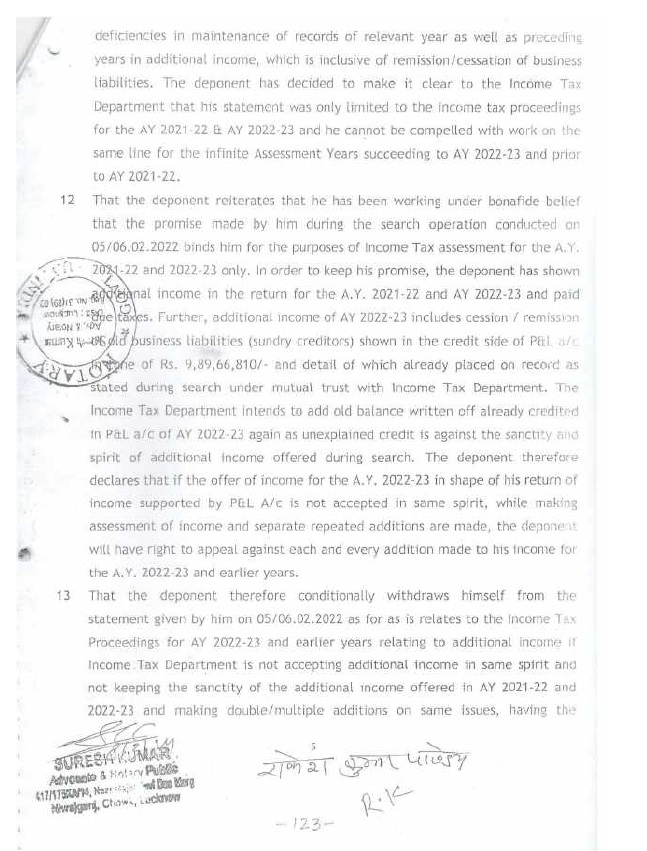
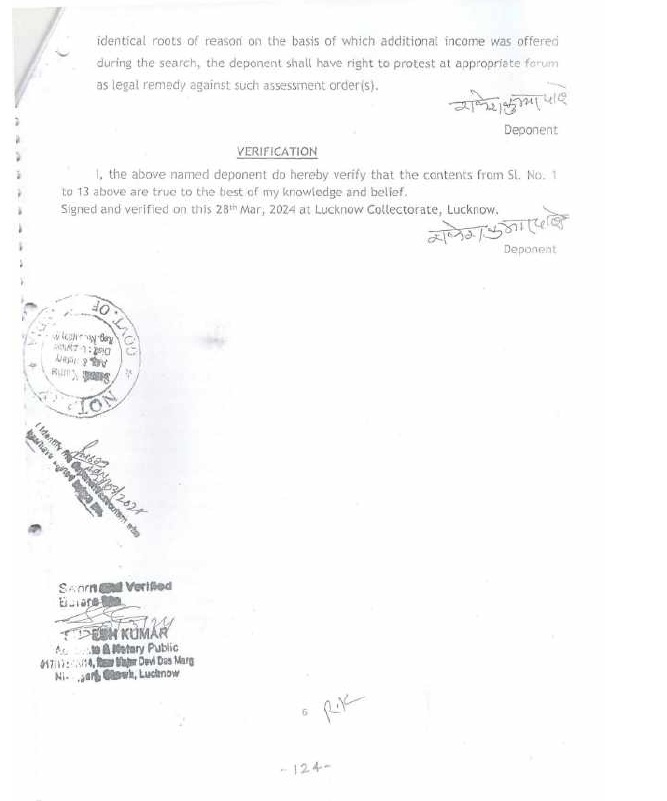
(B.2.5) However, the Addl. CIT did not issue any direction to the Assessing Officer, and also did not dispose of the assessee’s petition under section 144 of the I. T. Act. Further the learned A.R. for the assessee also highlighted that no incriminating material was found from the assessee’s premises at the time of search under section 132 of the Act, and therefore, no addition could have been made to income disclosed by the assessee as per well settled position of law as decided by Hon’ble Supreme Court in the case of Abhisar Buildwell (P.) Ltd. (supra) and in the case of Dy. CIT v. U. K. Paints (Overseas) Ltd. (SC)/[2023] 454 ITR 441 (SC). He also drew our attention to the fact that Co-ordinate Bench of ITAT, Lucknow has followed the aforesaid orders of Hon’ble Supreme Court in the case of Abhisar Buildwell (P.) Ltd. (supra) and in the case of. U. K. Paints (Overseas) Ltd. (supra)in many decisions and, therefore, the issue is squarely covered in favour of the assessee.
(B.2.6) The learned A.R. for the assessee also placed reliance on CBDT Circular F.No.286/2/2003-IT(Inv) dated 10/03/2003 and Circular F.No.286/98/2013-IT(Inv-II) dated 18/12/2014. Moreover, he also placed reliance on the decided precedents. Dilbagh Rai Arora (Supra), Mantri Share Brokers (P.) Ltd. (supra). Smt. Malti Mishra (supra) Abhisar Buildwell (P.) Ltd.(supra), Swananda Properties (P.) Ltd. (supra), Naresh Kumar Agarwal (supra) Rohit Karan Jain(supra), ACIT v. Kuber Khadyan Pvt. Ltd. (ITAT Delhi Bench), KC Raju Multi Specialty Hospital v. DCIT (ITAT ‘A’ Bench Bangalore). The relevant portions of these CBDT Instructions and decided precedents are reproduced below for the ease of reference:
“SHRI RAKESH KUMAR PANDEY(PAN:ATIPP6520B)
AY 2014-15 TO AY 2022-23
A. Board Instruction- Confession of Additional Income during search etc.
1. F. No. 286/2/2003-IT (Inv) date 10.03.2003
Instances have come to the notice of the Board where assessees have claimed that they have been forced to confess the undisclosed income during the course of the search & seizure and survey operations. Such confessions, if not based upon credible evidence, are later retracted by the concerned assessees while filing returns of income. In these circumstances, such confessions during the course of search & seizure and survey operations do not serve any useful purpose. It is, therefore, advised that there should be focus and concentration on collection of evidence of income which leads to information on what has not been disclosed or is not likely to be disclosed before the Income-tax Department. Similarly, while recording statement during the course of search & seizure and survey operations no attempt should be made to obtain confession as to the undisclosed income. Any action on the contrary shall be viewed adversely.
2. F. No. 286/98/2013-IT (Inv-II) date 18.12.2014
Instances/complaints of undue infuence/coercion have come to notice of the CBDT that some assessees were coerced to admit undisclosed income during Searches/Surveys conducted by the Department. It is also seen that many such admissions are retracted in the subsequent proceedings since the same are not backed by credible evidence. Such actions defeat the very purpose of Search/Survey operations as they fail to bring the undisclosed income to tax in a sustainable manner leave alone levy of penalty or launching of prosecution. Further, such actions show the Department as a whole and officers concerned in poor light.
I am further directed to invite your attention to the Instructions/Guideiines issued by CBDT from time to time, as referred above, through which the Board has emphasized upon the need to focus on gathering evidences during Search/Survey and to strictly avoid obtaining admission of undisclosed income under coercion/undue influence.
In view of the above, while reiterating the aforesaid guidelines of the Board, I am directed to convey that any instance of undue influence/coercion in the recording of the statement during Search/Survey/Other proceeding under the I.T.Act,1961 and/or recording a disclosure of undisclosed income under undue pressure/ coercion shall be viewed by the Board adversely.
B. No addition only on the basis of statement u/s 132(4) of the Act
| 1. |
|
Commissioner of Income-tax v. Dilbagh Rai Arora CIT v. Dilbagh Rai Arora (Allahabad). |
21. Therefore, the case law relied upon by the Appellant is of no help. The case in hand the assessee-respondent has given documents, material and explained threadbare with regard to amount of Rs. 24 crores but the assessing authority has mechanically made the addition of Rs. 7 crores and added back the same amount only on the basis of statement having been made by the assessee which is not permitted.
| 2. |
|
CIT v. Mantri Share Brokers (P.) Ltd. (Rajasthan)[05-09-2017] Commissioner of Income-tax-1 v. Mantri Share Brokers (P.) Ltd. |
11. It is settled proposition of law that merely on the statement that too also was taken in view of threat given in question No.36 as narrated by Mr Gupta and the same sought to have been relied upon, there is no other material either in the form of cash, bullion, jewellery or document in any other form which can come to the conclusion that the statement made was supported by some documentary evidence. We have gone through the record and find that the CIT (A) has rightly observed as stated hereinabove, which was confirmed by the Tribunal.
SLP of revenue is dismissed.
| 3. |
|
2013]Commissioner of Income-tax II v. Smt. Malti Mishra |
12. In the instant case, there is no concealment on the part of the assessee regarding the transactions. All the transactions were duly disclosed. If the income as per law is exempted, then the offer of the assessee is meaningless as the law will prevail and will supersede the “offer” made by the assessee. In the instant case, surrender was to buy the peace as the assessee is not an expert in income tax matter The Department cannot take the advantage of the ignorance of the assessee as per CBDT CirculrNo. 14(XL-35)/1955 dated 01.04.1955mentioned in Parekh Bros. v. CIT [1984] 150ITR 105/(Ker.)
C. No incriminating material – No Addition – In unabated years (A Y 2014-15 to A Y2019-20)
Pr. CIT v. Abhisar Buildwell (P.) Ltd. (SC)/[2023] 454 ITR 212 (SC) (SC)Principal Commissioner of Income-tax, Central-3 v. Abhisar Buildwell (P.) Ltd. *
14. In view of the above and for the reasons stated above, it is concluded as under:
| (i) |
|
that in case of search under section 132 or requisition under section 132A, the AO assumes the jurisdiction for block assessment undersection 153A; |
| (ii) |
|
all pending assessments/reassessments shall stand abated; |
| (ii) |
|
in case any incriminating material is found/unearthed, even, in case of unabated/completed assessments, the AO would assume the jurisdiction to assess or reassess the ‘total income’ taking into consideration the incriminating material unearthed during the search and the other material available with the AO including the income declared in the returns; and |
| (iv) |
|
in case no incriminating material is unearthed during the search, the AO cannot assess or reassess taking into consideration the other material in respect of completed assessments/unabated assessments. Meaning thereby, in respect of completed/unabated assessments, no addition can be made by the AO in absence of any incriminating material found during the course of search under section 132 or requisition undersection 132A of the Act, 1961. However, the completed/unabated assessments can be re-opened by the AO in exercise of powers undersections 147/148 of the Act, subject to fulfilment of the conditions as envisaged/mentioned under sections 147/148 of the Act and those powers are saved. |
The question involved in the present set of appeals and review petition is answered accordingly in terms of the above and the appeals and review petition preferred by the Revenue are hereby dismissed. No costs.
D. Section 145(3) wrongly invoked
Principal Commissioner of Income-tax-3 v. Swananda Properties (P.) Ltd. * Pr. CIT v. Swananda Properties (P.) Ltd.(Bombay)
11. We note that the books of accounts of the Respondent were rejected by the CIT (A) under section 145(3) of the Act. However, the Tribunal found in the impugned order that the invocation of section 145(3) of the Act is unjustified as no defect was noted in the books of accounts to disregard the same. We note that CIT (A) in his order while rejecting the Books of Account does not specify the defect in the record. The basis of the rejection appears to be best judgment of assessment done by him. The rejection of books should precede the best judgment assessment. On facts, the Revenue has not been able to show any defect in the Respondent’s records which would warrant rejection of books and making a Best Judgment Assessment. Thus, on facts the view taken by the Tribunal is possible view. Therefore, no substantial question of law arises. Thus not entertained.
17. The Supreme Court has observed in the case of CIT v. A. Raman & Co. [1968] 67 ITR 11 that the law does not oblige a trader to make maximum profit, he can make, out of his trading activity. Income on which he can be taxed is only the income he has earned. So also recently, the Supreme Court in the case of S.A. Builders v. CITITR 1 has observed that no businessman can be compelled to maximize his profits. Therefore, in view of the above, this question as proposed also does not give rise to any substantial question of law. Thus not entertained.
IN THE INCOME TAX APPELLATE TRIBUNAL LUCKNOW BENCH “A”, LUCKNOW ITA No. 355/LKW/2020
12. Ground no. 2 of the Department appeal, relates to disallowance on account of differences in balances of Sundry Creditors as shown by the assessee and as confirmed by the Sundry Creditors on enquiry by the Assessing Officer. As this is a matter of re-conciliation, we restore this matter back to the file of the Assessing Officer so as to give the assessee of the opportunity to re-concile the differences and order that in the event of such re-conciliation being made to satisfaction of the Assessing Officer, addition should not be made on this account. This ground of appeal is allowed for statistical purposes.
13. The third ground of the Revenue’s appeal relates to the raising of additional grounds, as the need arises. Since no additional grounds have been raised, the ground is dismissed, as not pressed.
14. Coming to the appeal filed by the assessee, on the issue of the Ld. CIT(A) applying the net profit rate of 8% and upholding the addition to the extent of Rs.18,89,682/-, we observe that the Ld. CIT(A) has not pointed out any defects in the books of account of the assessee, which could form the basis for rejection of the books of the assessee under section 145(3) of the Act. All he has pointed out, is that the assessee has not produced the books of account as per the request of the Assessing Officer and at the time of appellate proceedings. However, perusal of the appellate order does not show that the Ld. CIT(A) called for production of the books of account in the course of appellate proceedings. The failure to produce of the books of account can be a good ground for presuming the books of account are not maintained and even presuming the books of account have not ITA Nos. 355 & 444/LKW/2020 Page 9 of 10 been audited, which in return invite consequential penalty proceedings. But to our mind, it would not constitute sufficient reason to hold that the books were incomplete or incorrect. We note that the Ld. CIT(A) has himself recorded the fact that VAT Authorities have examined and confirmed the sales and purchases of the assessee. In the circumstances, in the absence of finding any fault in the accounts of the assessee, in our opinion the rejection of the books and estimation of the profit @ 8% would not be justified. In any case, the 8% profit is presumptive tax for civil contractors having turnover less than of Rs. 2 crores. The turnover of the assessee is over Rs.7 crores. In the circumstances, a rate not bearing any relation to the history of the assessee’s case or any comparable case cannot be justified. In the circumstances, we find it fit to delete the addition made on account of estimation of net profit and to restore the rate of net profit to that disclosed by assessee in the return. Ground no. 1 of the assessee’s appeal is accordingly allowed.
15. Ground no. 2 of the assessee’s appeal relates to not appreciating the previous order ofthe ITAT in the assessee’s own case. After considering the arguments presented, we observe that res-judicata does not apply to income tax proceedings and each year has to be decided upon the facts of the case in that year. Therefore, Ld. CIT(A) was not bound to follow the rate of profit deemed reasonable by the ITAT in a particular year. However, as we have already held earlier, a rate cannot be estimated without reference to the history of the assessee’s case or comparable cases. Hence to the extent that the Ld. CIT(A) estimated the same without reference to the history ofthe assessee’s case, ground of appeal is partly allowed.
16. The third ground agitates the failure of the Ld. CIT(A) to consider the VAT assessment and the fact that the assessee ITA Nos. 355 &444/LKW/2020 Page 10 of 10 supplied only to PSUs, which was the reason for higher estimation of income by him. In deciding ground no. 1, we have already observed that the Ld. CIT(A) has considered the VAT assessment and we observe that he has also recorded the fact of the purchases of the assessee being verifiable as they were from PSUs. However, since the estimation of income by him is at variance with these findings recorded by him in his order, the same is not maintainable. Accordingly, this ground of appeal is allowed.
17. In the result, both appeals of the department and the assessee are partly allowed.
E. Statement u/s 132(4) is not incriminating material itself without corroborative evidence.
1. CIT v. Naresh Kumar Agarwal (Andhra Pradesh)/[2014] 369 ITR 171 (Andhra Pradesh)Commissioner of Income-tax-II, Hyderabad v. Naresh Kumar Agarwal
12. Ground no. 2 of the Department appeal, relates to disallowance on account of differences in balances of Sundry Creditors as shown by the assessee and as confirmed by the Sundry Creditors on enquiry by the Assessing Officer. As this is a matter of re-conciliation, we restore this matter back to the file of the Assessing Officer so as to give the assessee of the opportunity to re-concile the differences and order that in the event of such re-conciliation being made to satisfaction of the Assessing Officer, addition should not be made on this account. This ground of appeal is allowed for statistical purposes. 13. The third ground of the Revenue’s appeal relates to the raising of additional grounds, as the need arises. Since no additional grounds have been raised, the ground is dismissed, as not pressed. 14. Coming to the appeal filed by the assessee, on the issue of the Ld. CIT(A) applying the net profit rate of 8% and upholding the addition to the extent of Rs.18,89,682/-, we observe that the Ld. CIT(A) has not pointed out any defects in the books of account of the assessee, which could form the basis for rejection of the books of the assessee under section 145(3) of the Act. All he has pointed out, is that the assessee has not produced the books of account as per the request of the Assessing Officer and at the time of appellate proceedings. However, perusal of the appellate order does not show that the Ld. CIT(A) called for production of the books of account in the course of appellate proceedings. The failure to produce of the books of account can be a good ground for presuming the books of account are not maintained and even presuming the books of account have not ITA Nos. 355 & 444/LKW/2020 Page 9 of 10 been audited, which in return invite consequential penalty proceedings. But to our mind, it would not constitute sufficient reason to hold that the books were incomplete or incorrect. We note that the Ld. CIT(A) has himself recorded the fact that VAT Authorities have examined and confirmed the sales and purchases of the assessee. In the circumstances, in the absence of finding any fault in the accounts of the assessee, in our opinion the rejection of the books and estimation of the profit @ 8% would not be justified. In any case, the 8% profit is presumptive tax for civil contractors having turnover less than of Rs. 2 crores. The turnover of the assessee is over Rs.7 crores. In the circumstances, a rate not bearing any relation to the history of the assessee’s case or any comparable case cannot be justified. In the circumstances, we find it fit to delete the addition made on account of estimation of net profit and to restore the rate of net profit to that disclosed by assessee in the return. Ground no. 1 of the assessee’s appeal is accordingly allowed. 15. Ground no. 2 of the assessee’s appeal relates to not appreciating the previous order of the ITAT in the assessee’s own case. After considering the arguments presented, we observe that res-judicata does not apply to income tax proceedings and each year has to be decided upon the facts of the case in that year. Therefore, Ld. CIT(A) was not bound to follow the rate of profit deemed reasonable by the ITAT in a particular year. However, as we have already held earlier, a rate cannot be estimated without reference to the history of the assessee’s case or comparable cases. Hence to the extent that the Ld. CIT(A) estimated the same without reference to the history of the assessee’s case, ground of appeal is partly allowed. 16. The third ground agitates the failure of the Ld. CIT(A) to consider the VAT assessment and the fact that the assessee ITA Nos. 355 & 444/LKW/2020 Page 10 of 10 supplied only to PSUs, which was the reason for higher estimation of income by him. In deciding ground no. 1, we have already observed that the Ld. CIT(A) has considered the VAT assessment and we observe that he has also recorded the fact of the purchases of the assessee being verifiable as they were from PSUs. However, since the estimation of income by him is at variance with these findings recorded by him in his order, the same is not maintainable. Accordingly, this ground of appeal is allowed. 17. In the result, both appeals ofthe department and the assessee are partly allowed.
2. THE GAUHATI HIGH COURT
Case No. : Principal Commissioner of Income-tax v. Rohit Karan Jain (Gauhati)/ITA/5/2023
THE PRINCIPAL COMMISSIONER OF INCOME TAX v. ROHIT KARAN JAIN
Mr.Keyal has submitted that in the present case, the Assessing Officer has invoked Section 153A of the Income Tax Act on the basis of the incriminating material only and not otherwise. It is contended that the finding recorded by the Commissioner, Income Tax (Appeals) as well as by the ITAT to the effect that no incriminating material was available to the Assessing Officer to invoke the power provided under Section 153A is perverse and therefore, the same is liable to be interfered with.
15. We have considered the submission made on behalf of the learned counsel for the appellants and perused the material available on record.
16. On a perusal of the material available on record, we are of the view that the Commissioner of Income Tax (Appeals) as well as ITAT, after carefully scrutinizing the material collected by the Assessing Officer, has recorded a finding of the fact that other than the retracted statement no other evidence/material was relied upon by the Assessing Officer to invoke the addition. The Commissioner of Income Tax (Appeals) and the ITAT were of the view that the said piece of evidence, i.e. retracted statement cannot be termed as incriminating material.
17. Taking into consideration the above fact, we are of the view that the said finding of fact recorded by the Commissioner of Income Tax (Appeals) as well as ITAT is not liable to be interfered with in this appeal since this Court can only exercise jurisdiction when any substantial question of law arises.
18. In view of the above discussion, it is held that the present appeal does not involve any substantial question of law and therefore, the same is dismissed, being devoid of merit.
3. IN THE INCOME TAX APPELLATE TRIBUNAL,DELHI BENCH
ACIT,Central Circle-30,New Delhi V. M/s. KuberKhadyanPvt. Ltd.,
9.3 We find that Hon’ble Delhi High Court in the case of PCIT v. Best Infrastructure Private Limited, 397 ITR 82 has held that statement under section 132(4) in the itself does not constitute incriminating material. The relevant finding of the Hon’ble High Court is reproduced as under: “38. Fifthly, statements recorded under Section 132 (4) of the Act of the Act do not by themselves constitute incriminating material as has been explained by this Court in Commissioner of Income Tax v. HarjeevAggarwal(supra). Lastly, as already pointed out hereinbefore, the facts in the present case are different from the facts in Smt. Dayawanti Gupta v. CIT (supra) where the admission by the Assessees themselves on critical aspects, of failure to maintain accounts and admission that the seized documents reflected transactions of unaccounted sales and purchases, is non-existent in the present case. In the said case, there was a factual finding to the effect that the Assessees were habitual offenders, indulging in clandestine operations whereas there is nothing in the present case, whatsoever, to suggest that any statement made by Mr.AnuAggarwal or Mr.Harjeet Singh contained any such admission.”
9.4 The relevant paragraph of the decision of the Hon’ble Hon’ble Delhi High Court in the case of HarjeevAgrawal(supra) also reproduced as under: “20. In our view, a plain reading of Section 158BB(1) of the Act does not contemplate computing of undisclosed income solely on the basis of a statement recorded during the search. The words “evidence found as a result of search” would not take within its sweep statements recorded during search and seizure operations. However, the statements recorded would certainly constitute information and if such information is relatable to the evidence or material found during search, the same could certainly be used in evidence in any proceedings under the Act as expressly mandated by virtue of the explanation to Section 132(4) of the Act. However, such statements on a standalone basis without reference to any other material discovered during search and seizure operations would not empower the AO to make a block assessment merely because any admission was made by the Assessee during search operation. 21. A plain reading of Section 132 (4) of the Act indicates that the authorized officer is empowered to examine on oath any person who is found in possession or control of any books of accounts, documents, money, bullion, jewellery or any other valuable article or thing. The explanation to Section 132 (4), which was inserted by the Direct Tax Laws (Amendment) Act, 1987 w.e.f. 1st April, 1989, further clarifies that a person may be examined not only in respect of the books of accounts or other documents found as a result of search but also in respect of all matters relevant for the purposes of any investigation connected with any proceeding under the Act. However, as stated earlier, a statement on oath can only be recorded of a person who is found in possession of books of accounts, documents, assets, etc. Plainly, the intention of the Parliament is to permit such examination only where the books of accounts, documents and assets possessed by a person are relevant for the purposes of the investigation being undertaken. Now, if the provisions of Section 132(4) of the Act are read in the context of Section 158BB(1) read with Section 158B(b) of the Act, it is at once clear that a statement recorded under Section 132(4) of the Act can be used in evidence for making a block assessment only if the said statement is made in the context of other evidence or material discovered during the search. A statement of a person, which is not relatable to any incriminating document or material found during search and seizure operation cannot, by itself, trigger a block assessment. The undisclosed income of an Assessee has to be computed on the basis of evidence and material found during search. The statement recorded under Section 132(4) of the Act may also be used for making the assessment, but only to the extent it is relatable to the incriminating evidence/material unearthed or found during search. In other words, there must be a nexus between the statement recorded and the evidence/material found during search in order to for an assessment to be based on the statement recorded. 22. In CIT v. Sri Ramdas Motor Transport Ltd.: (1999) 238 ITR 177 (AP), a Division Bench of Andhra Pradesh High Court, reading the provision of Section 132(4) of the Act in the context of discovering undisclosed income, explained that in cases where no unaccounted documents or incriminating material is found, the powers under Section 132(4) of the Act cannot be invoked. The relevant passage from the aforesaid judgment is quoted below: “A plain reading of sub-section (4) shows that the authorised officer during the course of raid is empowered to examine any person if he is found to be in possession or control of any undisclosed books of account, documents, money or other valuable articles or things, elicit information from such person with regard to such account books or money which are in his possession and can record a statement to that effect. Under this provision, such statements can be used in evidence in any subsequent proceeding initiated against such per son under the Act. Thus, the question of examining any person by the authorised officer arises only when he found such person to be in possession of any undisclosed money or books of account. But, in this case, it is admitted by the Revenue that on the dates of search, the Department was not able to find any unaccounted money, unaccounted bullion nor any other valuable articles or things, nor any unaccounted documents nor any such incriminating material either from the premises of the company or from the residential houses of the managing director and other directors. In such a case, when the managing director or any other persons were found to be not in possession of any incriminating material, the question of examining them by the authorised officer during the course of search and recording any statement from them by invoking the powers under section 132(4) of the Act, does not arise. Therefore, the statement of the managing director of the assessee, recorded patently under section 132(4) of the Act, does not have any evidentiary value. This provision embedded in subsection (4) is obviously based on the well established rule of evidence that mere confessional statement without there being any documentary proof shall not be used in evidence against the person who made such statement. The finding of the Tribunal was based on the above well settled principle.” 23. It is also necessary to mention that the aforesaid interpretation of Section 132(4) of the Act must be read with the explanation to Section 132(4) of the Act which expressly provides that the scope of examination under Section 132(4) of the Act is not limited only to the books of accounts or other assets or material found during the search. However, in the context of Section 158BB(1) of the Act which expressly restricts the computation of undisclosed income to the evidence found during search, the statement recorded under Section 132(4) of the Act can form a basis for a block assessment only if such statement relates to any incriminating evidence of undisclosed income unearthed during search and cannot be the sole basis for making a block assessment. 24. If the Revenue’s contention that the block assessment can be framed only on the basis of a statement recorded under Section 132(4) is accepted, it would result in ignoring an important check on the power of the AO and would expose assessees to arbitrary assessments based only on the statements, which we are conscious are sometimes extracted by exerting undue influence or by coercion. Sometimes statements are recorded by officers in circumstances which can most charitably be described as oppressive and in most such cases, are subsequently retracted. Therefore, it is necessary to ensure that such statements, which are retracted subsequently, do not form the sole basis for computing undisclosed income of an assessee. 25. In Commissioner of Income Tax v. Naresh Kumar Aggarwal: (2014) 3699 ITR 171 (T & AP), a Division Bench of Telangana and Andhra Pradesh High Court held that a statement recorded under Section 132(4) of the Act which is retracted cannot constitute a basis for an order under Section 158BC of the Act. The relevant extract from the said judgement is quoted below: “17. The circumstances under which a statement is recorded from an assessee, in the course of search and seizure, are not difficult to imagine. He is virtually put under pressure and is denied of access to external advice or opportunity to think independently. A battalion of officers, who hardly feel any limits on their power, pounce upon the assessee, as though he is a hardcore criminal. The nature of steps, taken during the course of search are sometimes frightening. Locks are broken, seats of sofas are mercilessly cut and opened. Every possible item is forcibly dissected. Even the pillows are not spared and their acts are backed by the powers of an investigating officer under section 94 of the Code of Criminal Procedure by operation of sub-section (13) of section 132 of the Act. The objective may be genuine, and the exercise may be legal. However, the freedom of a citizen that transcends, even the Constitution cannot be treated as non- existent.” “18. It is not without reason that Parliament insisted that the recording of statement must be in relation to the seized and recovered material, which is in the form of documents, cash, gold, etc. It is, obviously to know the source thereof, on the spot. Beyond that, it is not a limited licence, to an authority, to script the financial obituary of an assessee.” “19. At the cost of repetition, we observe that if the statement made during the course of search remains the same, it can constitute the basis for proceeding further under the Act even if there is no other material. If, on the other hand, the statement is retracted, the Assessing Officer has to establish his own case. The statement that too, which is retracted from the assessee cannot constitute the basis for an order under section 158BC of the Act.”
9.5 In view of the above finding of the Hon’ble Delhi High Court statement of Sh. MulchandMalu under section 132(4) of the Act alone cannot be considered as incriminating material unless any corroborating incriminating material is found during the course of the search from the premises of the assessee.
9.6 As far as the decision in the case of Sh. B Kishore Kumar (supra) is concerned Hon’ble Supreme Court has dismissed the SLP filed by the assessee against the decision of Hon’ble Madras High Court (decision reported in , wherein the Hon’ble Court has held that where the assessee himself has stated in sworn statement during search and seizure about his undisclosed income, tax was to be levied on the basis of the admission without be scrutinizing documents. The relevant finding of the Hon’ble High Court is reproduced as under: “6. With regard to the undisclosed income of Rs.52,73,920/- supported by printouts, in the sworn statement dated 29.8.2006, the assessee says that he had separate business income which was not included in his income tax returns. Therefore, admission of undisclosed income of Rs.52,73,920/- is categoric and undisputed. The assessee in the sworn statement made on 10.10.2006, stated that outstanding loans to the tune of Rs.25 Lakhs to 30 Lakhs are to be recovered with interest at the rate of 18%. This is a clear admission. This amount has also been calculated and added as undisclosed income. When there is a clear and categoric admission of the undisclosed income by the assessee himself, in our considered opinion, there is no necessity to scrutinize the documents. The document can be of some relevance, if the undisclosed income is determined higher than what is now determined by the department. Moreover, it is not the case of the assessee that the admission made by him was incorrect or there is mistake. In fact, when there is a clear admission, voluntarily made, by the assessee, that would constitute a good piece of evidence for the Revenue. 7. The learned counsel for the assessee relied upon a decision of the Delhi High Court in C1T v. GirishChaudhary,to plead that loose sheets ofpapers should not be taken as a basis for determining undisclosed income. However, in the case on hand, loose sheets found during the search on admitted facts. The entire exercise by the department to bring to tax undisclosed income, we find has been generous and simple. There appears to be no confusion in the quantification of the tax liability and we uphold the order of the Tribunal.”
9.7 Thus, we find that in the above decision addition has been sustained on the basis of the statement recorded of the assessee himself and not based on the statement of any third-party. The facts of above case are distinguishable from the facts ofthe assessee.
9.8 In view of the above facts and circumstances, we do not find any error in the order of the Ld. CIT(A) on the issue in dispute. Following the finding of the Hon’ble Delhi High Court in the case of Kabul Chawal (supra), we, accordingly, uphold the same. The ground No. 1 of the appeal of the Revenue is accordingly dismissed.
4. IN THE INCOME TAX APPELLATE TRIBUNAL’A’ BENCH, BANGALORE
KC Raju Multi Specialty Hospital v. The Dy. Commissioner of Income Tax,
11.2 Thus, both the Hon’ble Supreme Court and the CBDT have made it clear that in unabated assessments, additions can only be made on the basis of incriminating material unearthed during search and not merely on confessions or extrapolations. It is the admitted position that the year under consideration is unabated assessment year which was also not disputed by the learned DR of the revenue at the time of hearing. 11.3 Applying the above settled legal position to the facts of the present case, we find that the only seized document was a draft profit and loss account for A.Y. 2017-18, which does not pertain to this year. There was no incriminating material found for the present year. The entire addition rests on the statement of the partner recorded during search, which was later retracted. In light of the CBDT circulars, such confessions cannot be the sole basis for assessment. Moreover, as held in AbhisarBuildwell (supra), additions in unabated years are permissible only if supported by incriminating material. None exists here. The extrapolation by the AO from one year to another, without material for the relevant year, is against the settled law. Therefore, the addition of Z48 lakhs made by the AO and sustained by the CIT(A) cannot be upheld. Hence, the addition of Z48 lakhs is hereby deleted. Thus, the ground of appeal of the assessee is allowed. ITA Nos.1051 – 1054/Bang/2025 Page 7 of 8. 11.4 Regarding the issues raised by the assessee on merit of the case, we note that the appeal of the assessee has been decided in its favour on technical ground. Therefore, we are of the view that no separate finding is required to be given with respect to the grounds of appeal raised on merit of the case. As such, the learned AR and the DR also agreed not to adjudicate the issue raised by the assessee on merit of the case if the technical issue is decided in favour of the assessee. Accordingly, we dismiss the same as infructuous. 12. In the result, the appeal of the assessee is hereby partly allowed. Coming to ITA Nos.1052- 1053 and 1054/Bang/2025, appeals by the assessee for the AYs 2014-15 to 2016-17 13. The facts of the cases on hand are identical to the facts of the case discussed above, therefore, respectfully following the same, the appeals of the assessee are hereby partly allowed. 14. In the result, all the appeals of the assessee are hereby allowed.
F. Condition laid down u/s 149(1)(b) of the Act w.r.t. alleged escapement of 50 lacs or more represented in form of asset, expenditure or entry in books does not satisfied (AY 2014-15 to AY 2018-19)
Note : During assessment proceedings of A.Y 2022-23 appellant filed application for direction u/s 144A to Range Head and also filed submission to A.O. of even date with affidavit to maintain sanctity of statement help u/s 132(4) during search and additional income may be lifted to A.Y. 2021-22 and 2022-23 Where he has already honoured additional income incorporated in respective years and paid due tax.”
(B.2.7) The learned Departmental Representative placed reliance on the assessment order, and impugned appellate order of learned CIT(A).
(B.2.8) We have heard both sides. We have perused materials on record. On perusal of the assessment order, it is found that the Assessing Officer has based her estimation of net profit rate @11%, following the disclosed net profit rate of the assessee for assessment year 2021-22. She has no other material to support the aforesaid act of enhancing the net profit rate disclosed by the assessee. We have already commented on this, in the foregoing paragraph. Further, in our view, the statement recorded under section 132(4) of the Act, at the time of search under section 132 of the Act is in itself, not an incriminating document. In fact it is not a document found/seized at the time of search. It is a document prepared by the search party of the Income-tax Department at the time of search under section 132 of the Act. The statement under section 132(4) is to record prima facie response of the assessee to the questions that arise in the mind of the search party/the authorized officer. It may include the prima facie response of the assessee to documents/assets found at the time of search under section 132 of the Act; but such prima facie response of the assessee recorded in statement under section 132(4) of the Act cannot be said to be, in itself, an incriminating document. For this conclusion, we take strength from the aforesaid precedents reported at Dilbagh Rai Arora (supra) Mantri Share Brokers (P.) Ltd. (supra), Smt Malti Mishra (supra), Abhisar Buildwell (P.) Ltd. Abhisar Buildwell (P.) Ltd.(supra), Swananda Properties (P.) Ltd. (supra) Naresh Kumar Agarwal (supra) Rohit Karan Jain(supra), ACIT v. Kuber Khadyan Pvt. Ltd. (ITAT Delhi Bench), KC Raju Multi Specialty Hospital v. DCIT (ITAT ‘A’ Bench Bangalore). As no incriminating material was found at the assessee’s premises at the time of search under section 132 of the Act, there is nothing in support of the action of the Assessing Officer in enhancing the net profit rate from what was disclosed by the assessee in the return of income. Merely because the assessee has earned and disclosed higher rate of net profit in a later year, it does not automatically lead to conclusion that the assessee has earned similarly higher rate of net profit in earlier years also. The matter is also squarely covered by the orders of Hon’ble Supreme Court reported at Abhisar Buildwell (P.) Ltd. (supra) and in the case of U. K. Paints (Overseas) Ltd. (supra) wherein it was held by Hon’ble Supreme Court that no addition can be made if no incriminating material was found from assessee’s premises, at the time of search under section 132 of the I. T. Act. Co-ordinate Bench of ITAT, Lucknow has followed these precedents in numerous orders, including Smt. Shashi Agarwal v. Deputy Commissioner of Income-tax ITD 360/[2025] 122 ITR(T) 218 (Lucknow – Trib.); Ocean Dream Infrastructure Pvt. Ltd. v. DCIT [I.T.A. Nos. 146 & 147(Lkw) of 2023, dated 21-1-2025]; Blue Nile Infratech Pvt. Ltd. v. DCIT [IT(SS)A. Nos.698 to 700/Lkw/2024, dated 13-2-2025]. In view of the foregoing, it is held that the action of the Assessing Officer in enhancing the rate of net profit from what was disclosed by the assessee to 11% is without any merit. The act of the Assessing Officer in enhancing the net profit is merely by way of guess work, conjecture, surmises and imagination. The submissions made from the assessee’s side, as contained in foregoing paragraphs (B.1), (B.2), (B.2.1) and (B.3) (sic)of this order; and the discussion in foregoing paragraphs (C) and (C.1) (sic)of this order support the case of the assessee. Accordingly, we direct the Assessing Officer to accept the net profit disclosed by the assessee.
(B.2.9) The second addition made by the Assessing Officer in assessment year 2014-15 is an amount of Rs.61,31,000/- under section 56(2)(vii)(b) of the Act. The Assessing Officer noted that the sale consideration of the immovable property at Gonda was Rs.31,45,000/- whereas the market value of property was Rs.92,76,000/-. The Assessing Officer added Rs.61,30,000/- to the assessee’s income noting that the assessee did not file satisfactory reply to show cause notice dated 26/02/2024. However, the Assessing Officer has not discussed in the assessment order, why the response of the assessee was not found to be satisfactory. She has made the addition in a summary manner without discussing through a speaking order, the reasons for not accepting the assessee’s reply. In the impugned appellate order, the learned CIT(A) noted that Departmental Valuation Officer had valued the property at Rs.43,46,000/-. The learned CIT(A), sustained the addition of Rs.12,01,000/- (difference of Rs.43,46,000 minus Rs.31,45,000) and remaining addition of Rs.49,30,000/- was deleted. The assessee has filed appeal against the decision of learned CIT(A) sustaining the aforesaid amount of Rs.12,01,000/-. At the time of hearing; the learned A.R. for the assessee drew our attention to written submissions on this issue, as contained in foregoing paragraphs (B.1), (B.2) and (B.2.1) of this order; to highlight the fact that, Free Market Value of the property, including cost of land along with cost of construction of boundary wall aggregated to Rs.30,24,200/- which was less than the sale consideration of Rs.31,45,000/-; and Free Market Value determined by Departmental Valuation Officer (D.V.O.) was erroneous. Thus, he contended, actual sale consideration being more than Free Market Value; the entire addition made by the Assessing Officer on the basis of erroneous valuation report of D.V.O. should be deleted. The learned Departmental Representative relied on the impugned order of learned CIT(A), and on the assessment order. After hearing both sides and perusing materials on record, we are satisfied with the submissions made from the assessee’s side. Hence, we direct the Assessing Officer to delete the entire aforesaidaddition of Rs.61,30,000/-.
(B.2.10) In the appeal for assessment year 2014-15, the assessee has also disputed the validity of approval granted by the Assessing Officer under section 147/143(3) of the Act. At the time of hearing before us, learned A.R. for the assessee relied on written submissions on thi issue, which are referred to in the foregoing paragraphs (B.1), (B.2) and (B.2.1) of this order. The learned Departmental Representative supported the impugned appellate order of the learned CIT(A) and the assessment order passed by the Assessing Officer. The aforesaid approval was granted by the Assessing Officer under section 148B of the Act. For this purpose, the Assessing Officer had sent proposed draft assessment orders vide letter No. ACIT/CC-II/Lko./Approval(Assessment)/2023-24/431 dated 20/03/2024; whereby the Assessing Officer had sought approval for proposed assessment orders in the case of six different assessees belonging to two different groups (Alok Construction Group and Raj Group). The total number of draft assessment orders for which approval was sought by the Assessing Officer was 12, pertaining to seven different assessment years from 2013-14 to 2022-23. The approval was granted by the Addl. CIT on the very next day i.e. on 21/03/2024. The time gap between sending of draft assessment orders by the Assessing Officer (on 20/03/2024) and approval granted by the Addl. CIT (on 21/03/2024) was too short for the Addl. CIT to exercise due application of mind for the purpose of giving approval. It is an obvious inference that approval was given by the Addl. CIT in a mechanical manner, without due application of mind; because, having regard to the enormity of materials to be considered for the purpose of giving approval, including assessment record, appraisal report, seized material, statement recorded during and after search under section 132 of the Act, etc; was so much that it was humanly impossible for the Addl. CIT to exercise due application of mind within such a short time for the purpose of giving approval to so many draft assessment orders, under section 148B of the Act.
(B.2.11) The provision regarding approval under section 148B of the Act for post search assessments are akin to provisions under section 153D of the Act for granting of approval to post search assessments. In the cases of Minto Developers Pvt. Ltd. v. ACIT [I.T.A. No.337(Alld) of 2018, dated 30-9-2025]) and in the case of Jyoti Mediservices Pvt. Ltd. v. DCIT [I.T.A. No.113, 114, 115(Alld) of 2025, dated 21-11-2025]; we have passed detailed orders regarding validity of approval to post search assessments, given by the Addl. CIT under section 153D of the Act. The relevant portion of the aforesaid order dated 21/11/2025 in the case of Jyoti Mediservices Pvt. Ltd. (supra) passed by us, which also contains relevant parts of our order in the case of Minto Developers Pvt. Ltd. (supra), is reproduced as under:
“(B.2.1) We have heard both sides. We have perused materials on record. The aforesaid order dated 30/09/2025 in the case of Minto Developers Pvt. Ltd. (supra) was delivered by us after detailed discussion of submissions made by the two sides, careful perusal of materials on record and due consideration of numerous precedents which included binding precedents also. The relevant portion of our order in the case of Minto Developers Pvt. Ltd. (supra) is reproduced below for the ease of reference:
“(F) At the time of hearing, representatives of both sides agreed that appeals of Minto Developers Pvt. Ltd. (I.T.A. No.337/Lkw/2018 for A.Y. 2009-10) may be taken as the lead case as regards the legal issue whether the assessments were passed by the Assessing Officer after obtaining valid approval of JCIT. They submitted that the facts and circumstances for all the other appeals on this issue were in para materia and the decision in the case of Minto Developers Pvt. Ltd. would apply mutatis mutandis to remaining cases also. Accordingly, we first take up the appeal of Minto Developers Pvt. Ltd. (I.T.A. No.337/Alld/2018 for A.Y.2009-10).
(F.1) As regards validity of approval given by JCIT u/s 153D of the Act, the learned Counsel for the assessee drew our attention to approval letter No.Jt.CIT/CR/VNS/Approval u/s 153D/JJGroup/2017-18/304 dated 31/07/2017 whereby approvals were given for 11 different assessees for a total of 63 assessments pertaining to numerous assessment years. The aforesaid letter is reproduced below for the ease of reference:
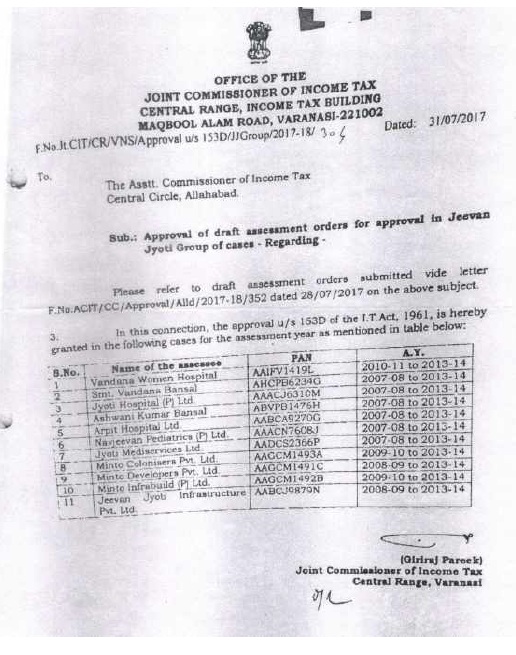
(F.1.1) The learned Counsel for the assessee challenged the validity of approval granted u/s 153D of the Act on many grounds. To begin with, he contended that the approvals were given without due application of mind. In this regard he drew our attention to the fact that the draft assessment orders were sent to the JCIT by the Assessing Officer vide letter F.No.ACIT/CC/Approval/Alld/2017-18/352 dated 28/07/2017. He further drew our attention to the fact that the next two days, i.e. 29th & 30th July, 2017 were closed holidays on account of Saturday and Sunday. Thereafter, the JCIT gave approval u/s 153D of the Act vide aforesaid letter dated 31/07/2017 in the case of aforesaid 11 assessees for a total of 63 assessments pertaining to different assessment years in the cases of the aforesaid 11 different assessees. It was the contention of the learned Counsel for the assessee that considering the enormity of seized materials, digital data, submissions of the assessees, appraisal report provided by the Investigation Wing of Income Tax Department, reports under Rules 9 and 9A of ITSC(P) Rules, and other materials including assessment records, it was humanly impossible for the JCIT to exercise due application of mind before granting approval to the Assessing Officer for 63 assessments pertaining to 11 different assessees for various assessment year; vide aforesaid common approval letter dated 31/07/2017, sufficiently in time on 31/07/2017 for the letter of approval to reach the Assessing Officer along with seized materials, digital data, submissions of the assessees, appraisal report provided by the Investigation Wing of Income Tax Department, reports under Rules 9 & 9A of ITSC(P) Rules and other materials including assessment records to reach the Assessing Officer on 31st July 2017 itself from Varanasi (where JCIT was stationed) to Allahabad (where the Assessing Officer was stationed) in order to also enable the Assessing Officer to pass the assessment order on 31/07/2017 itself, which was the last date for passing assessment order (after which the assessments would have been barred by limitation).
(F.1.2) The learned Counsel for the assessee then challenged the aforesaid approval given u/s 153D of the Act on the basis that the JCIT did not grant approvals u/s 153D of the Act through separate approval letters for separate assessment years for each assessment orders pertaining to each of the aforesaid assessees. He contended that the JCIT was required to issue separate letters of approval for each assessment year for each assessee. The approvals granted u/s 153D for the aforesaid assessments pertaining to different assessment years for the aforesaid 11 assessees through a common letter do not meet this requirement, the learned Counsel for the assessee submitted.
(F.1.3) Next, the learned Counsel for the assessee challenged the validity of the approval granted u/s 153D of the Act, contending that the approvals were granted by JCIT vide aforesaid common letter dated 31/07/2017 in a non speaking manner. The letter did not contain any writeup of JCIT himself indicating that the approvals were granted for the aforesaid 63 assessments after proper application of mind. He contended that contents of the approval letter should include discussion to show that the JCIT had considered all the issues in the proposed draft assessment order, and had applied his mind independently before granting approval instead of giving approval in a summary and non speaking way, in the manner of rubber stamping whatever draft assessment order was sent by the Assessing Officer. He further submitted that this showed that the approvals were granted in a summary, routine, perfunctory and mechanical manner, as an idle formality; and that approvals were not based on independent application of mind by the JCIT.
(F.1.4) The learned Counsel for the assessee also submitted that the JCIT was required, u/s u/s 153D of the Act, to approve not only the additions proposed by the Assessing Officer; but was also required to approve the assessment order in entirety, contending that the assessment order proposed by the Assessing Officer was required to be approved word by word. In the present case, the learned Counsel for the assessee submitted, the JCIT, vide order sheet dated 25/07/2017, had observed that certain corrections were needed in the draft orders and had directed the Assessing Officer to resubmit the draft orders after making necessary corrections, as discussed with him, latest by 28/07/2017. The JCIT had further directed the Assessing Officer to resubmit the draft orders after corrections, through official e-mail address. Therefore, learned Counsel for the assessee submitted even till 25/07/2017, there was no finality to the assessment order. The state of affairs was conditioned and tentative.
(F.1.4.1) Moreover, the learned Counsel for the assessee submitted, there was common order sheet for all the cases of Jeevan Jyoti Group which consisted of several assessees and the assessments pertained to seven assessment years in the case of each assessee. However, the learned Counsel for the assessee submitted, there was no record, either in the order sheet or elsewhere, as to what corrections were directed to be made by JCIT in the draft assessment orders sent by the Assessing Officer vide aforesaid letter dated 18/07/2017 which was received in the office of the JCIT on 19/07/2017. He contended that considering large number of assessees and multiple assessments for different assessment years; it was impossible for the JCIT to remember what corrections were directed by him in the absence of any record and therefore, it was impossible for him to satisfy himself whether the second draft assessment orders were prepared after carrying out the corrections as per the directions given on 25/07/2017. In the absence of such satisfaction, the approval given u/s 153D of the Act were in the nature of rubber stamping and suffered from infirmity on the ground of having been given without due application of mind.
(F.1.5) The learned Counsel for the assessee further submitted in this connection that the direction of the JCIT to send the second draft of the proposed assessment order by e-mail by 28/07/2017, was not complied with by the Assessing Officer and instead only physical copies were submitted by the Assessing Officer. In the absence of compliance of the directions of the JCIT, the learned Counsel for the assessee submitted, the approvals granted by the JCIT vide aforesaid common approval letter dated 31/07/2017 were vitiated. The learned Counsel for the assessee also contended that the omission to send the second draft of the proposed assessment order by e-mail, pointed to the likelihood that the proposed second drafts of the assessment orders were not even ready by 28/07/2017 and hard copies of the second drafts of the assessment order may have been sent to the JCIT later, possibly on 31/07/2017, which was the next working day; leaving the JCIT with no time to exercise due application of mind before giving approvals u/s 153D of the Act, on 31/07/2017 itself.
(F.6) The learned Counsel for the assessee further submitted that CBDT has directed the Assessing Officers, in Search Manual, to seek the approval from the approving authority at least one month before the time barring date. In this connection, he drew our attention to order of Lucknow Bench of ITAT in the case of Navin Jain and Others v. DCIT (order dated 03/08/2021 in IT(SS)A Nos. 639 – 641/Lkw/2019) in which, at paragraph 7 of the order, this direction of CBDT is noted. For the ease of reference; para 7 of the aforesaid order dated 03/08/2021 of ITAT is reproduced below:
“7……..Learned counsel for the assessee submitted that granting of approval u/s 153D is a huge task which involves the verification by the approving authority to examine as to which year is unabated and which year is abated and the relevance vis-a-vis seized material. Learned counsel for the assessee further invited our attention to CBDT manual of Office Procedure Volume-II (Technical) placed at pages 995 and 996 of paper book wherein the CBDT has directed that Assessing Officer should submit the draft assessment order for approval from the approving authority well in time. Such manual says that the Assessing Officer should seek approval from the approving authority at least one month before the time barring date. While going through CBDT manual placed at paper book pages 995 & 996, it was observed that this manual was printed in February 2003 and therefore, Learned counsel for the assessee was asked as to how it is applicable to the provisions of section 153D of the Act which came into existence w.e.f. 01/06/2007. Learned counsel for the assessee in this respect submitted that this manual is applicable to the provisions of section 158BG of the Act and which are para materia to the provisions of section 153D of the Act. It was further submitted that Mumbai Tribunal in the case of Shreelekha Damani, vide order dated 19/08/2015, while deciding similar issue u/s 153D, has relied on the case laws relied for deciding the issue of approval u/s 158BG of the Act and therefore this manual is applicable to provisions of Section 153D also……….”
The learned Counsel for the assessee further submitted that the aforesaid order dated 03/08/2021 of ITAT has been referred to and approval by Hon’ble Allahabad High Court in the case of Pr.CIT v. Sapna Gupta (order dated 12/12/2022 inPrincipal Commissioner of Income-tax v. Sapna Gupta (Allahabad)/ Income Tax Appeal No. 88 of 2022) reported at Pr.CIT v. Sapna Gupta (Allahabad) and also in the case of Pr.CIT v. Siddharth Gupta (order dated 12/12/2022 in Principal Commissioner of Income-tax v. Siddarth Gupta ITR 534 (Allahabad)/Income Tax Appeal No. 90 of 2022) reported at Pr.CIT v. Siddarth Gupta (Allahabad). The learned Counsel for the assessee submitted that the Hon’ble Orissa High Court also, in the case of ACIT v. M/s Serajuddin & Co. (in order dated 15/03/2023 in I. T.A. Nos. 39 – 45 of2022) reported at ACIT v. Serajuddin & Co. (Orissa) has in paragraphs 13 and 24 of the order; took the aforesaid direction of CBDT into consideration and held that since CBDT, has powers for issuing such guidelines u/s 119 of I.T. Act; the same was certainly binding on the Department. The learned Counsel for the assessee further submitted that the aforesaid orders of Hon’ble Allahabad High Court in the case of Pr.CIT v. Siddarth Gupta (supra) and Hon’ble Orissa High Court in the case of ACIT v. Serajuddin & Co. (supra) were challenged by Revenue in Hon’ble Supreme Court through separate SLPs; but both SLPs were dismissed by Hon’ble Supreme Court vide order dated 09/08/2024 (in the case of Pr.CIT v. Siddharth Gupta) in SLP(C) Diary No. 43280/2023 and order dated 28/11/2023 in SLP(C) Diary No.44989 of 2023 respectively. He drew our particular attention to paragraphs 13 and 24 of the aforesaid order of Hon’ble Orissa High Court in the case of ACIT v. Serajuddin & Co. (supra) which are reproduced below for the ease of reference:
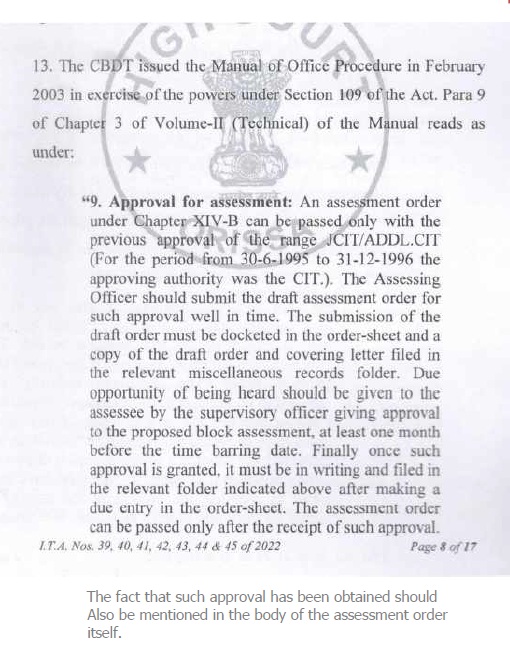
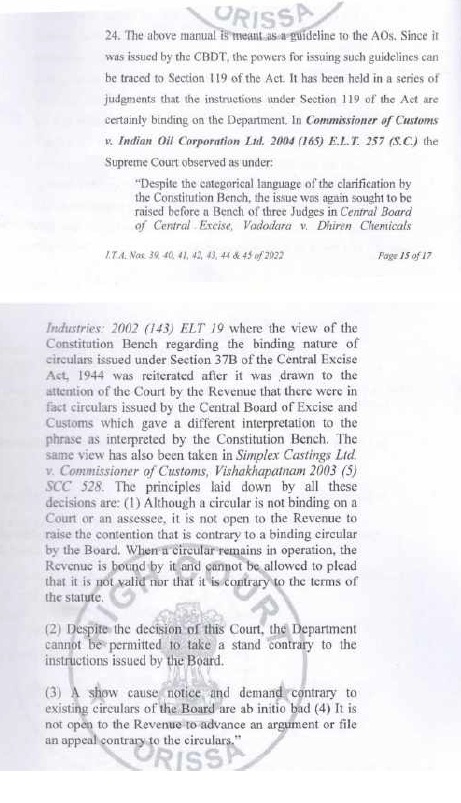
In the present case, the learned Counsel for the assessee submitted, the first draft of proposed assessment order was sent by the Assessing Officer to the JCIT vide letter dated 18/07/2017 which was received in the office of JCIT on 19/07/2017. The limitation date,
after which assessment would become time barred was 31/07/2017; therefore, the Assessing Officer was required to seek the approval of JCIT by 30/06/2017. The second draft of the proposed assessment order was sent by the Assessing Officer to the JCIT vide letter dated 28/07/2017. Both the draft orders were sent by the Assessing Officer to JCIT after 30/06/2017; in violation of the aforesaid direction of CBDT, the learned Counsel for the assessee submitted.
(F.6.1) The learned Counsel for the assessee submitted that Hon’ble Delhi High Court, in the case of Pr.CIT v. Shiv Kumar Nayyar (order dated 15/05/2024 in I.T.A. No.285/2024 andPrincipal Commissioner of Income-tax v. Shiv Kumar Nayyar 9/467 ITR (Delhi)/ CM Appeal 28994/2024) reported at (Delhi) considered the aforesaid order of Hon’ble Allahabad High Court in the case of Pr.CIT v. Sapna Gupta (supra) and order of Hon’ble Orissa High Court in the case of ACIT v. Serajuddin & Co. (supra); and expressing agreement with the Hon’ble Allahabad High Court and Hon’ble Orissa High Court; upheld the order of Delhi Bench of ITAT quashing the assessment order.
(F.7) In view of the foregoing, the learned Counsel for the assessee submitted that the assessment should be quashed in the present appeal also.
(G) Learned Departmental Representatives contended that it was not required on the part of the JCIT to issue separate letters for giving approval to different assessment years. They submitted that the assessees also, from time to time, provided their written submissions through common letter. They further submitted that it was permitted under law to issue common notice and to pass common assessment orders for several assessment years in the case of a particular assessee. They further submitted that logically therefore, it should also be permissible to give approval u/s 153D of the Act for several assessments pertaining to an assessee. In this regard they drew our attention to the provisions under section 158BG of the Act (which were applicable upto 31/05/2007) and relied on the following case laws:
| (i) |
|
[2003] 263 ITR 550 (SC), ACIT v. Velliappa Textiles Ltd. |
| (ii) |
|
[2002] 255 ITR 144 (Madras), Sakthivel Bankers v. ACIT |
| (iii) |
|
[2004] 267 ITR 577 (Karnataka) Rishabchand Bhansali v. DCIT |
| (iv) |
|
[2000] 243 ITR 425 (AP) |
| (v) |
|
[2001] 252 ITR 712 (Madras), Lakshmi Jewellery v. DCIT |
(H) Learned Departmental Representatives further contended that the approval u/s 153D of the Act was akin to approval u/s 274(2) of the Act and further that the approval u/s 274(2) of the Act was held to be a procedural requirement which did not go to the root of the jurisdiction of the Assessing Officer to levy penalty. In this regard they placed reliance on the case of Sardar Harinder Singh v. ITAT [1996] 219 ITR 257 (All). They also contended that no infirmity can be attributed in the statutory approvals even when it was not recorded in so many words. They placed reliance on the case of Prem Chand Shaw (Jaiswal) v. ACIT [2016] 383 ITR 597 (Calcutta) and contended that mere fact that the additional Commissioner did not record his satisfaction in so many words, would not render invalid the sanction granted under section 151(2) when the reasons on the basis of which sanction was sought for could not be assailed. They relied on the order in the case of Chhagan Chandrakant Bhujbal v. Income Tax Officer (Bombay) for the proposition that the small time gap between the proposal received for approval/sanction and approval/sanction accorded would not mean that there was non-application of mind in granting approval/sanction. Learned Departmental Representatives also relied on the case laws reported at 243 ITR 674 (Karnn)Gayathri Textiles v. CIT, 1 SOT 281 (Jodh)Ratan Lal Dalmia v. Income Tax Officer; 230 ITR 301 (MP)CIT v. Vijay Dall Mills; 292 ITR 281 (Ker)G. Manoharan v. ACIT and (Cal)Sagar Dutta v. CIT for the proposition that even absolute absence ofthe JCIT’s approval u/s 274(2) did not mean inherent lack of jurisdiction on the Assessing Officer so as to render his order ab initio void but to decide the matter afresh after obtaining the JCIT’s approval. Learned Departmental Representatives also placed reliance on the case laws in 40 ITR 298 (SC)Guduthur Bros v. Income Tax Officer, 180 ITR 84 (MP)Prabhudayal Amichand v. CIT and 222 ITR 401 (MP) CIT v. Damodaras Murari Lal for the proposition that the irregularity supervened not at the initial stage, but at a later stage of the proceedings would not lead to nullity. Learned Departmental Representatives further placed reliance on the case law in Mahendra Mills Ltd. v. Appellate Assistant Commissioner 99 ITR 135 (SC) for the proposition that a decision is a precedent on its own facts; that each case presents its own features; and that Income Tax authorities and Tribunals are supposed to apply the ratio of a decision to the facts of particular cases with due care and discernment. They also placed reliance on the case laws in the cases of 155 ITR 120 (SC)Distributors (Baroda) (P.) Ltd. v. UOI and (Cuttack)(Mag.) Orissa State Civil Supplies Corpn. Ltd. v. DCIT for the proposition that the Tribunal has liberty of applying its mind afresh. Learned Departmental Representatives also placed reliance on the cases of 199 ITR 1 (SC)CIT v. Assam Travels Shipping Service, 63 ITR 232 (SC)Hukumchand Mills Ltd. v. CIT and 53 ITR 225 (SC)CIT v. Kanpur Coal Syndicate ; for the proposition that ITAT has power to remand/remit the matter back to the authorities below in appropriate cases. They further placed reliance on the case laws in the cases of 448 ITR 594 (SC) New Noble Educational Society v. CCIT; 262 ITR 278 (SC)Pandian Chemicals Ltd. v. CIT and 100 ITR 698 (SC) Raja Jagdambika Pratap Narain Singh v. CBDT for the proposition that where a word used in the statute is unambiguous/unequivocal and capable of only one meaning, the legislation has to be given effect of the word in its own terms and there is no scope for importing any rule of interpretation. Learned Departmental Representatives also placed reliance on the precedents in the cases of 438 ITR 288 (SC)CIT v. Mohammed Meeran Shahul Hameed and 362 ITR 673 (SC) CIT v. Calcutta Knitwears for the proposition that a provision of the Act is to be read as it is and nothing is to be added or taken away from it. Learned Departmental Representatives placed further reliance on 266 ITR 1 (SC)Prakash Nath Khanna v. CIT and 121 ITR 535 (SC) CIT v. National Taj Traders for the proposition that casus omissus should not be readily inferred. Learned Departmental Representatives also relied on the case laws in [1963] 48 ITR 1 (SC)Gursahai Saigal v. CIT and [1955] 27 ITR 20 (SC) India United Mills Ltd. v. Commissioner of Excess Profits Tax for the proposition that rule of construction applies only to a taxing provision (which creates a charge for the tax) but, not to the machinery provision for making the assessment. They also relied on the [2004] 271 ITR 401 (SC) for the proposition that rule of construction is to be applied only when there is an ambiguity. Learned Departmental Representatives also relied on orders of Mumbai Bench of ITAT in the cases of Pratibha Pipes & Structurals Ltd. v. DCIT (Mumbai-Trib) and Usha Satish Salvi v. ACIT (order dated 23/10/2025 in I.T.A. Nos.4237 -4239/Mum/2023) and also on order of Cuttack Bench of ITAT in the case of Bibhudutta Panda v. ACIT (order dated 01/02/2023 in I.T.A. Nos. 76 – 81/CTK/2022) in which grounds raised by the assessee against validity of approval granted u/s 153D of the I.T. Act were dismissed.
(H.1) Learned Departmental Representatives also submitted that procedural irregularity was not fatal if jurisdictional issue was established. Further, learned Departmental Representatives submitted that fiscal acts should be interpreted in a way which enables functioning of the Act and does not frustrate the Act. Learned Departmental Representatives submitted furthermore, that there was no statutory form prescribed for granting approval u/s 153D of the Act and therefore, the approval given u/s 153D of the Act in the present case did not suffer from any infirmity. Learned Departmental Representatives moreover submitted that the draft assessment order sent by the Assessing Officer to the JCIT vide aforesaid letter dated 28/07/2017 was the second draft order; that the first draft order was sent by the Assessing Officer along with the letter dated 18/07/2017, which was received by the then JCIT (Shri Abhay Kumar Thakur) on 19/07/2017; that the earlier JCIT, who held charge from 15/09/2016 to 20/07/2017 (who received the original draft assessment orders) did not give approval u/s 153D of the Act; but the approval u/s 153D of the I.T. Act was given by the new incumbent (Shri Giriraj Parikh) who took charge on 21/07/2017. They submitted that the new incumbent called the Assessing Officer for discussion, that the discussion between the JCIT and the Assessing Officer took place on 25/07/2017; that after the discussion, the JCIT gave certain directions to the Assessing Officer and the Assessing Officer forwarded the second draft assessment order along with the aforesaid letter dated 28/07/2017, which was approved by the JCIT u/s 153D of the I.T. Act, on 31/07/2017. They also submitted that the Assessing Officer had sent, along with the aforesaid letter dated 18/07/2017, the assessment records and a pen drive (of 8GB capacity) containing seized materials, digital data, submissions of the assessees, appraisal report provided by the Investigation Wing of Income Tax Department and other materials of assessment records; which remained in the office of the JCIT till 31/07/2017 when the JCIT gave approvals u/s 153D of the Act vide aforesaid common letter dated 31/07/2017. They submitted that although the new incumbent, in the office of JCIT (Shri Giriraj Parikh) took charge on 20/07/2017, he immediately came into action regarding the matter of giving approvals u/s 153D of the Act immediately and the approval was given vide aforesaid letter dated 31/07/2017 after due application of mind. Learned Departmental Representatives also submitted that the earlier incumbent in the office of the JCIT (Shri Abhay Kumar Thakur) had visited Allahabad for discussion with the Assessing Officer on multiple occasions and had also stayed in the guest house of the Income Tax department a couple of times. Learned Departmental Representatives also submitted that although the second draft of the proposed assessment orders were not sent to the JCIT by e-mail, the physical copies were indeed sent to the JCIT on 28/07/2017 itself along with the aforesaid letter dated 28/07/2017 with an Inspector of the income tax department, named Mr. Agrahari. Learned Departmental Representatives produced the concerned Inspector, Mr. Agrahari, in person before us, who stated in his oral testimony that the second drafts of the proposed assessment orders were physically carried by him from Allahabad to Varanasi and were handed over to the JCIT on 28/07/2017 itself.
(H.1.1) Learned Departmental Representatives contended emphatically that whether the JCIT had given approval u/s 153D of the Act after due application of mind, was a question of fact and the answer would depend on facts and circumstances of each case. They contended that a conclusion arrived at in a particular case that the approvals were given u/s 153D of the Act without application of mind, did not act as a precedent (being a question of fact) in another case; and conclusion as to whether there was due application of mind in a particular case was to be decided for each case, based on the specific facts of the particular case; and the conclusion was to be arrived at independent of conclusion arrived at in any other case. Learned Departmental Representatives also submitted that the earlier incumbent in the office of JCIT (Mr. Abhay Kumar Thakur) had issued directions u/s 144A of the Act in June 2017, which also enabled him to develop familiarity with the case. Moreover, they contended that the limited time available with the Assessing Officer and the JCIT for the process of approval u/s 153D of the Act was partly attributable to the assessees, as the assessees had sought adjournment of hearing till 12/07/2017. Moreover, they contended that the direction of CBDT to Assessing Officer to seek approval of the approving authority at least one month before the time barring date was directory and not mandatory. They also submitted that although the JCIT, who gave approval, took charge of office on 20/07/2017 which may have been just a few days before limitation date for passing assessment order, the association of the predecessor JCIT (Shri Abhay Kumar Thakur) with the Assessing Officer was part of institutional memory which was reflected in the final approval given vide aforesaid common approval letter dated 31/07/2017 by the next incumbent in the office of JCIT who succeeded him. In view of the submissions made, Learned Departmental Representatives pleaded that the validity of approval given u/s 153D of the Act by the JCIT should be upheld. In their alternate submissions, Learned Departmental Representatives pleaded that the matter regarding approval u/s 153D of the I.T. Act should be restored back to the file of the approving authority (i.e. Addl. CIT/JCIT) for fresh view to be taken; in case it was found that the approval granted u/s 153D of the I.T. Act suffered from infirmities or were invalid. In order to support their submissions, Learned Departmental Representatives drew our attention to the affidavit of Shri M. L. Meena, ACIT, the Assessing Officer. The affidavit of Shri M. L. Meena dated 13/08/2025 is reproduced below for the ease of reference:
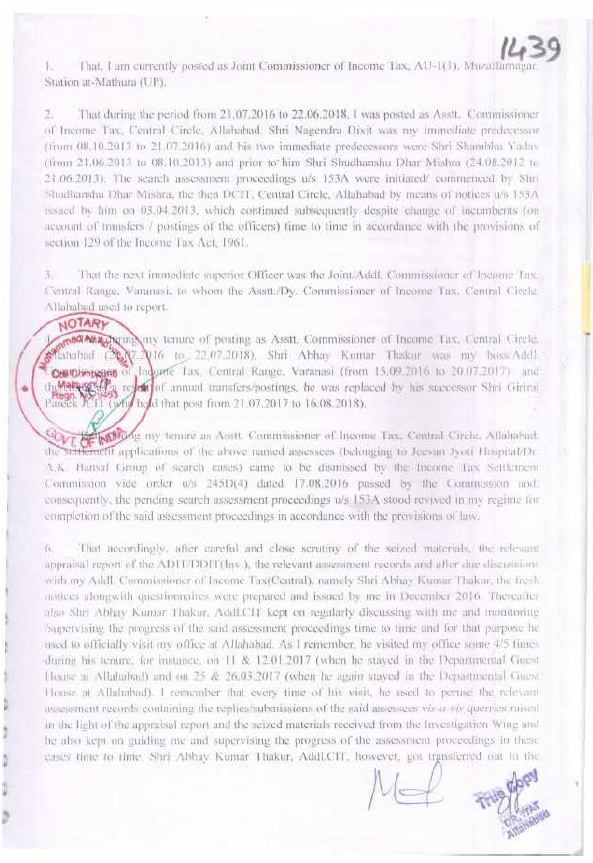
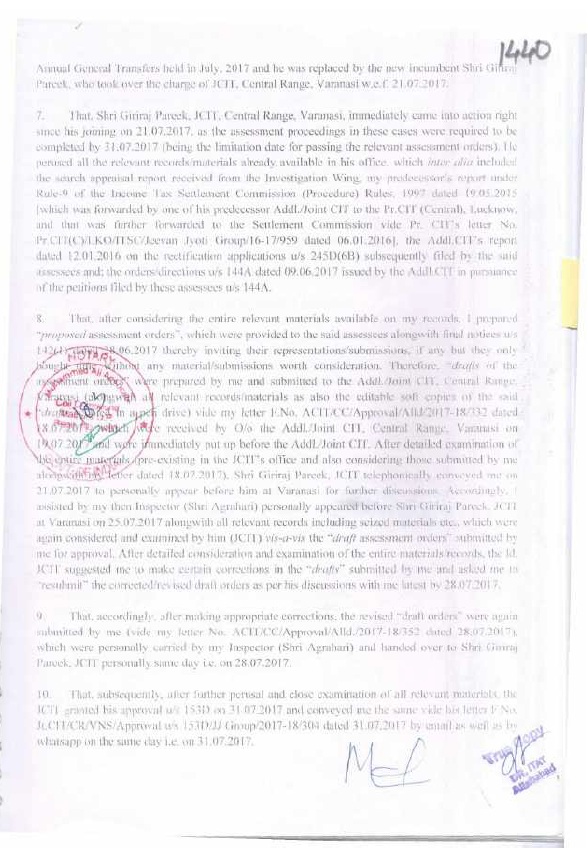
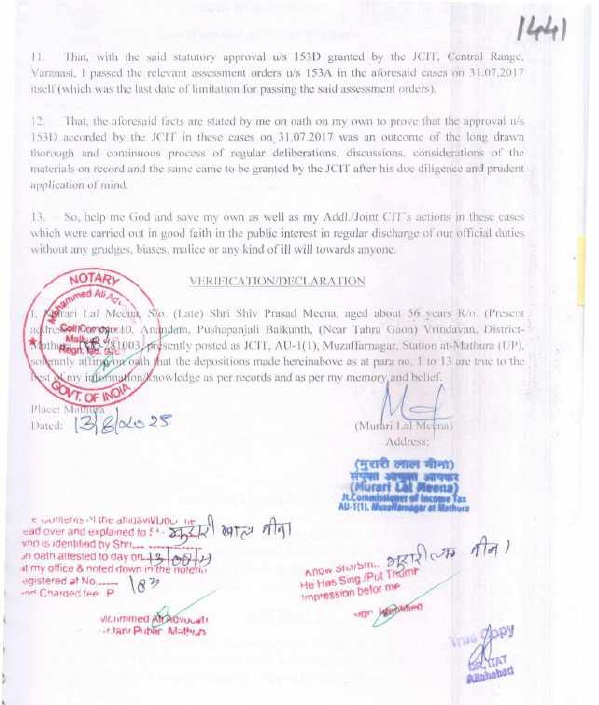
(I) The learned Counsel for the assessee, in his rejoinder, countered the submissions made by learned Departmental Representatives emphatically. He submitted that affidavit of the Assessing Officer and the Departmental Inspector are de void of any credibility. He submitted that it was an important and material fact to be noted that the JCIT who gave approval u/s 153D ofthe IT Act, and who had since superannuated, did not file any affidavit/statement in support of Revenue’s contentions. Since it was the JCIT who gave approval, and he did not support Revenue’s stand; the version of Assessing Officer and Inspector, who still working in the Department and were under the control and discipline of Department; must be rejected. In this regard he contended that the affidavit and personal testimony of Departmental Inspector were self-serving documents and it was aimed at covering omissions and mistakes of Departmental authorities. He also contended that the affidavit and personal testimony of the Departmental Inspector are not supported by any documentary evidence. Further he submitted that the Assessing Officer was not competent to state on oath about the conduct of some other officer specially his senior officer. In particular he referred to paragraph-7 of the affidavit of the Assessing Officer wherein he has stated that Shri Giriraj Parikh, JCIT, came into action right since his joining on 21/07/2017. The deponent Assessing Officer has further stated that the JCIT perused all the relevant records/materials already available in his office, which included appraisal report, the report under Rule 9 of Income Tax Settlement Commission (Procedure) Rules, 1997 [“ITSC(P) Rules” for short], the report of the Addl. CIT dated 12/01/2016, the orders and directions u/s 144A of the I.T. Act etc. The learned Counsel for the assessee also drew our attention to paragraph 8 of the affidavit wherein the deponent Assessing Officer has stated that the JCIT, examined the entire materials (pre existing in the JCIT’s office and also considering those submitted along with letter dated 18/07/2017). The learned Counsel for the assessee further drew our attention to para 10 of the affidavit of the deponent Assessing Officer wherein he has stated that the JCIT granted approval u/s 153D of the Act after further perusal and close examination of all the relevant materials. The learned Counsel for the assessee contended that the deponent Assessing Officer has made statements in the affidavit regarding these materials about which only the JCIT had personal knowledge and the deponent Assessing Officer could not have personal knowledge, information and belief. Further he submitted that in paragraph-9 of the affidavit of the deponent Assessing Officer and in the personal testimony of the Departmental Inspector, it has been stated that the Inspector handed over draft orders to Shri Giriraj Parikh, JCIT on 28/07/2017 along with letter No.ACIT/CC/Approval/All./2017/18/352 dated 28/07/2017. However, no documentary evidence, such as acknowledgement from the office of the JCIT is available on record and no such documentary evidence has been produced by Revenue. The learned Counsel for the assessee also contended that the affidavit of the deponent Assessing Officer has been made on 13/08/2025 after more than 8 years since 31/07/2017 on which approval was given by the JCIT u/s 153D of the Act. He contended that it was impossible for the deponent Assessing Officer to remember the facts of the case including specific dates and specific letter numbers; which are found in the affidavit; after such substantial lapse of time; and similarly, it was impossible for the Inspector to remember things in such specific details after such a long time. In view of these facts and circumstances, the learned Counsel for the assessee submitted that the affidavit of the deponent Assessing Officer and the personal testimony of the Departmental Inspector should be rejected being completely de void of any credibility.
(I.1) Learned Counsel for the assessee also submitted that the contention of Revenue that the Assessing Officer was in regular supervision of the earlier incumbent in the office of the JCIT (Shri Abhay Kumar Thakur) and that Shri Abhay Kumar Thakur regularly discussed with the Assessing Officer, monitored/supervised the progress of the assessment proceedings and extended guidance to the Assessing Officer was entirely irrelevant because it was not Shri Abhay Kumar Thakur who gave approval u/s 153D of the Act. He submitted that it was Shri Giriraj Parikh, JCIT, who took charge on 21/07/2017 who, on 31/07/2017 gave approval u/s 153D of the Act and the validity of the approval u/s 153D of the Act is to be examined regardless of whatever was done and whatever happened when Shri Abhay Kumar Thakur, the earlier incumbent before Shri Giriraj Parikh, held office. He also submitted that 21/07/207 was Friday and before 31st July 2017 (on which approval was given u/s 153D of the Act) there were only five working days (excluding Saturdays and Sundays which were closed holidays). The learned Counsel for the assessee also submitted that although it is contended by Revenue that the letter dated 18/07/2017 containing initial draft of the assessment order was accompanied with a pen drive (8GB capacity), the note and order sheet of the office of the JCIT dated 19/07/2017, does not make a mention of any pen drive accompanying the aforesaid letter. The notes and order sheet merely mentioned the receipt of letter of the Assessing Officer, and makes no mention ofpen drive. Further he submitted that the letter dated 18/07/2017 of the Assessing Officer also does not contain any description of the contents of the pen drive and merely mentions at the bottom of the letter, in hand writing “Pen Drib 1 pees. 8GB”. He also drew our attention to the report of an expert (included in the paper book, filed by the assessee) in which it has been mentioned that there were approximately 40,434 seized documents, 7 CPUs, 26 HDDs and one laptop seized during the search u/s 132 of the Act. The expert has opined that the storage of this data would require a memory of 200GB and that it was impossible to store it on a pen drive of 8GB capacity. The learned Counsel for the assessee also submitted that in any case there was no evidence from record that the JCIT did even examine the contents of the pen drive and also that the letter dated 18/07/2017 did not in any case provide any description of the contents of the pen drive. In the absence of any description of the contents of the pen drive in letter dated 18/07/2017 of the Assessing Officer and in the absence of any reference to pen drive in the notes and order sheet of the office of the JCIT, the claim of Revenue that a pen drive was sent along with letter dated 18/07/2017 carried no value or relevance for the issue at hand, the learned Counsel for the assessee contended. For the ease of reference, the aforesaid letter dated 18/07/2017 of the Assessing Officer is reproduced below:
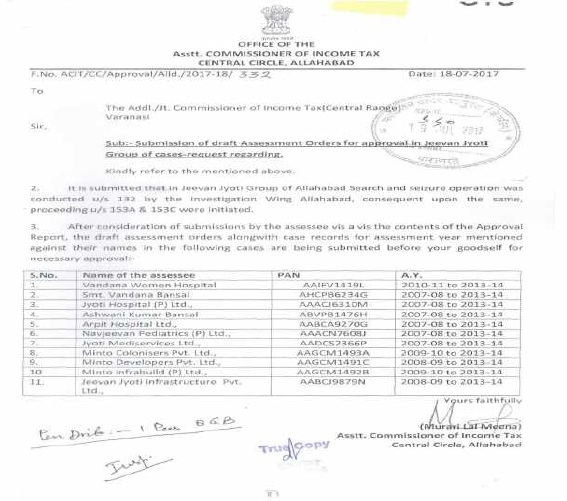
(I.2) The learned Counsel for the assessee submitted further that the reliance of the learned Departmental Representatives on precedents of Hon’ble Courts, pertaining to section 158BG of the Act to draw equivalence with section 153D of the Act deserved to be rejected outrightly because section 158BG pertained to block assessment order in which, under the mandate of law the Assessing Officer was required to pass one assessment order for the block period consisting of multiple years; whereas under section 153D of the Act, separate approvals are to be given by the approving authority for separate assessment orders pertaining to different assessment years for each assessee. The learned Counsel for the assessee stated that the contention of the learned Departmental Representatives that there was no statutory form prescribed for granting approval u/s 153D of the Act also deserved to be rejected because in any case the approval is to be granted u/s 153D of the Act after due application of mind of the approval authority and the approval given by the approving authority should be done in a speaking manner and not in a summary manner. The learned Counsel for the assessee submitted that the contention of the learned Departmental Representatives that the assessee had sought adjournment of hearing till 20/07/2017 is misleading. He pointed out that the reports under Rule 9 and 9A of ITSC(P) Rules were already on the record of the Assessing Officer, which contained all the information sought for by the Assessing Officer. Moreover, in any case, whether the assessee delayed the assessment proceedings or not is wholly irrelevant for the purpose of examining the validity of approval of the proposed draft assessment order, under section 153D of the Act. He contended that the Assessing Officer was at liberty to proceed with ex-parte order if he considered that there was default on the part of the assessee in providing information or in making compliance with the notices. The learned Counsel for the assessee also submitted that direction of CBDT to Assessing Officer to seek approval of the approving authority at least one month before the time barring date was mandatory on the Assessing Officer. He also contended that the association of the JCIT/Addl CIT with the Assessing Officer till the time ofpreparation of the draft assessment order has no significance for considering the validity of the approval given u/s 153D of the Act because the statutory requirement of approval u/s 153D of the Act cast a separate duty upon the approving authority which was de hors any other role and responsibility of the approving authority. He also submitted that the contention of the learned Departmental Representatives that the association of the predecessor JCIT (Shri Abhay Kumar Thakur) with the Assessing Officer was part of institutional memory, deserved to be rejected for the aforesaid reason. In view of the submissions and contentions presented before us by learned Counsel for the assessee, he submitted that the approval granted by the JCIT was invalid and suffered from the infirmity, because it was humanly impossible for the JCIT to apply his independent mind to total of 63 assessments pertaining to 11 different assessees for different assessment years having regard to enormity of the seized materials, digital data, submissions of the assessees, appraisal report provided by the Investigation Wing of Income Tax Department, reports under Rules 9 & 9A of ITSC(P) Rules, and other materials including assessment records. The learned Counsel for the assessee submitted that although it has been contended in the affidavit of the Assessing Officer and in the submissions of the learned Departmental Representatives that the JCIT sent approvals u/s 153D of the Act to the Assessing Officer on 31/07/2017 through e-mail and Whatsapp, there was no evidence on record that any such e-mail or Whatsapp was sent by the JCIT; and also no print out of such e-mail/Whatsapp communication has been adduced from the side of the Revenue at any stage. In this regard, he also relied on the various paper books, referred to in foregoing paragraph (E) of this order, and on the compilation of the case laws/decisions referred to in foregoing paragraph (E) ofthis order.
(J) We have heard both sides, patiently; we have also diligently perused the materials on record. We have been presented many precedents/case laws; and many propositions; which are either of general nature, or which pertain to specific issues other than the specific matter of validity of approval u/s 153D of the IT Act. It is settled position of law that specific principles and provisions of law prevail over general principles/provisions of law. It is also settled position of law that principles and provisions of a particular matter or issue, prevail over principles and provisions of another matter or issue; for taking a decision on the former matter or issue. Therefore, the specific propositions, precedents and case laws in the context of validity of approval u/s 153D of the Act have stronger force than those propositions and precedents pertaining to general propositions or pertaining to specific issues other than validity of approval u/s 153D of the IT Act. Moreover, although the learned Departmental Representatives have placed reliance on some orders of ITAT (Bombay Bench and Cuttack Bench), orders of Hon’ble Supreme Court, Hon’ble Allahabad High Court which is the jurisdictional High Court, and orders of other Hon’ble High Courts, such as Hon’ble Orissa High Court and Hon’ble Delhi High Court; prevail over orders of Bombay Bench and Cuttack Bench ofthe Tribunal.
(J.1) In the case of ACIT, Circle-1(2), Bhubaneswar v. Serajuddin & Co. (supra), it was held as under:
(J.1.1) Further, in the case of Pr.CIT (Central) & Anr. v. Siddarth Gupta (supra), Hon’ble Allahabad High Court held as under:
(J.1.1.1) SLPs filed by Revenue against aforesaid order of Hon’ble Orissa High Court in the case of ACIT v. Serajjuddin & Co. (Orissa)/454 ITR 312 (Orissa) and aforesaid order of Hon’ble Allahabad High Court in the case of PCIT v. Siddharth Gupta (Allahabad)/ 450 ITR 534 (Allahabad); have been dismissed by Hon’ble Supreme Court in decisions at ACIT v. Serajuddin and Co. (SC) and vide order dated 09/08/2024 in SLP(C) Diary No.43280/2023 in the case of Pr.CIT v. Siddharth Gupta, respectively.
(J.1.2) Similarly, in the case of Pr.CIT & Anr. v. Sapna Gupta (supra), Hon’ble Allahabad High Court held as under:
(J.1.3) Moreover, in the case of Pr.CIT v. Shiv Kumar Nayyar (supra), Hon’ble Delhi High Court held as under:
10. Before embarking upon the analysis of the factual scenario of the instant appeal, we deem it apposite to examine the underlying
(J.1.3.1) In the case reported at Pr.CIT v. Anuj Bansal (Delhi)/466 ITR 251 (Delhi) also, Hon’ble Delhi High Court upheld the order of ITAT quashing assessment order on the ground that there was absence of application of mind by the approving authority in granting approval u/s 153D of IT Act. The SLP filed by Revenue against this order of Hon’ble Delhi High Court has been dismissed by Hon’ble Supreme Court in Pr.CIT v. Anuj Bansal (SC). Similar view has also been taken by Hon’ble Delhi High Court in the cases reported at Pr.CIT v. Pioneer Tour Planner (P.) Ltd. ITR 356 (Delhi) and in Pr.CIT v. MDLR Hotels (P.) Ltd. (Delhi).
(J.1.4) In the case of Pr.CIT v. Subodh Agarwal (Allahabad High Court); Hon’ble Allahabad High Court held as under:
(J.1.5) We are also cognizant of the order of Lucknow Bench of ITAT in the case of Standard Frozen Foods Exports Pvt. Ltd. v. DCIT in IT(SS)A No.41 & 41/Lkw/2022, which has been authored by us and order of Lucknow Bench of the ITAT in Quality Structures Pvt. ltd. v. DCIT in IT(SS)A No.679 & 680/Lkw/2019, which is co-authored by one of us (the Judicial Member). In these orders, we have already taken view regarding validity of approval u/s 153A of the Act and relevant portions are reproduced as under:
Standard Frozen Foods Exports Pvt. Ltd. v. DCIT (supra)
“(D) We have heard representatives of both sides. We have also perused the materials on record carefully.
(D.1) The first limb of the contention raised by the learned Counsel for the assessee is on the legal ground that statutory approval given to the Assessing Officer for the assessment orders was not based on application of mind. It was the case of the learned Counsel for the assessee that approval was given by Addl. CIT in a mechanical manner within a short period of time during which it was humanly impossible for the Addl. CIT to go through exhaustive assessment records, search & seizure materials and to thereafter give approval after due application of mind. The learned Counsel for the assessee submitted that the Addl. CIT gave approval to 110 cases in two days which included; 48 cases on 27/12/2019 and 62 cases on 28/12/2019. These cases included approvals given for assessment orders which are subject matters of the present batch of appeals before us. The learned Counsel for the assessee further drew our attention to the fact that approval No. 1490 was requested by the Assessing Officer for 16 cases on 28/12/2019 and approval was given by the Addl. CIT on the same day i.e. on 28/12/2019. He further drew our attention to the fact that approval No. 1488 was requested by the Assessing Officer for 15 cases on 26/12/2019 and approval was given by the Addl. CIT on the very next day i.e. on 27/12/2019. He also drew our attention to the fact that draft assessment orders were sent by the Assessing Officer for approval to the Addl. CIT at the fag end of the assessment proceedings on 26/12/2019 and 28/12/2019 though the assessments were going to be barred by limitation barely a few days later, on 31/12/2019. Placing reliance on the order of Hon’ble Allahabad High Court in the case of Pr. CIT v. Subodh Agarwal, I.T.A. No. 86 of 2022, dated 12/12/2022 and order of Hon’ble Orissa High Court in the case of ACIT v. Serajuddin & Co. (supra) and further on the order of Hon’ble Delhi High Court in the case of Pr. Commissioner of Income Tax v. Shiv Kumar Nayyar (supra), learned Counsel for the assessee submitted that the assessment orders passed by the Assessing Officer, based on mechanical approval given by the Addl. CIT, without due application of mind, lacked legal validity and deserved to be quashed. He also placed reliance on the orders of Income Tax Appellate Tribunal in the case of Khoday Ehshwarsa and Sons v. DCIT, I.T.A. No.1079 & 1080/Bang/2024 dated 20/09/2024 and in the case of Sanjay Duggal and Others, I.T.A. No.1813/Del/2019 and in the case of Quality Structure Pvt. Ltd. v. DCIT, IT (SS)A No. 679 & 680/Lkw/2019. The learned CIT, D.R. for Revenue submitted that it was the normal practice that the Assessing Officer and the Addl. CIT/Jt. CIT engage in periodical discussion over a long period of time. Therefore, it was possible for the Addl. CIT to grant approval to draft assessment order after application of mind even though time available was short. In his rejoinder, learned Counsel for the assessee submitted that there is nothing on record to show that there was discussion between the Assessing Officer and Addl. CIT. In response to specific query from Bench whether the assessees were responsible for the delay on the part of the Assessing Officer in submission of draft assessment orders to the Addl. CIT at the fag end of the limitation period; and if so, whether the submissions made by the assessee would still be good on merits, learned Counsel for the assessee submitted that the delay on the part of the Assessing Officer in submission of the draft assessment orders to the Addl. CIT was due to the fact that assessment proceedings were taken up in haste by the Assessing Officer after lapse of substantial duration of time available during the limitation period. He further submitted that the assessees made compliance with the notices of the Assessing Officer even though sufficient time was not given by the Assessing Officer. Therefore, he contended that the delay on the part of the Assessing Officer in submission of the draft assessment order to the Addl. CIT was entirely attributable to Revenue and to the Assessing Officer in particular; and further, that the assessees were in no way responsible for the delay. After hearing both sides, we are of the view that the issue in dispute is squarely covered by the order of the Hon’ble Allahabad High Court in the case of Pr. CIT v. Subodh Agarwal, I.T.A. No. 86 of 2022, dated 12/12/2022, order of Hon’ble Orissa High Court in the case of ACIT v. Serajuddin & Co. (supra) and order of Hon’ble Delhi High Court in the case of Pr. Commissioner of Income Tax v. Shiv Kumar Nayyar (supra), in favour of the assessee. Further the issue in dispute is also squarely covered in favour of the assessee by the orders of the Income Tax Appellate Tribunal in the case of Khoday Ehshwarsa and Sons v. DCIT, I.T.A. No.1079 & 1080/Bang/2024 dated 20/09/2024 and in the case of Sanjay Duggal and Others, I.T.A. No.1813/Del/2019 and in the case of Quality Structure Pvt. Ltd. v. DCIT, IT (SS)A No. 679 & 680/Lkw/2019 (supra). In view of the foregoing, we set aside the impugned appellate orders of learned CIT(A) deserve to be set aside; and the assessment orders passed by the Assessing Officer deserve to be annulled.
(D.2) The second limb of the contentions made by the learned Counsel for the assessee on behalf of the appellant assessees was that in the following cases, no incriminating material was found in the course of search conducted u/s 132 ofthe IT Act:
| Appeal Number |
Assessment year |
Appellant |
| IT(SS)A No.41/Lkw/2022 |
2012-13 |
Standard Frozen Foods Exports Pvt. Ltd. |
| IT(SS)A No.42/Lkw/2022 |
2013-14 |
Standard Frozen Foods Exports Pvt. Ltd. |
| IT(SS)A No.43/Lkw/2022 |
2016-17 |
Standard Frozen Foods Exports Pvt. Ltd. |
| IT(SS)A No.44/Lkw/2022 |
2017-18 |
Standard Frozen Foods Exports Pvt. Ltd. |
| IT(SS)A No.46/Lkw/2022 |
2012-13 |
Standard Agro Vet Pvt. Ltd. |
| IT(SS)A No.47/Lkw/2022 |
2013-14 |
Standard Agro Vet Pvt. Ltd. |
| IT(SS)A No.48/Lkw/2022 |
2014-15 |
Standard Agro Vet Pvt. Ltd. |
| IT(SS)A No.49/Lkw/2022 |
2015-16 |
Standard Agro Vet Pvt. Ltd. |
| IT(SS)A No.55/Lkw/2022 |
2014-15 |
Sachin Verma |
| IT(SS)A No.57/Lkw/2022 |
2016-17 |
Sachin Verma |
| IT(SS)A No.54/Lkw/2022 |
2012-13 |
Sachin Verma |
| IT(SS)A No.56/Lkw/2022 |
2015-16 |
Sachin Verma |
| IT(SS)A No.58/Lkw/2022 |
2017-18 |
Sachin Verma |
| IT(SS)A No.50/Lkw/2022 |
2015-16 |
Kamal Kant Verma |
| IT(SS)A No.51/Lkw/2022 |
2016-17 |
Kamal Kant Verma |
| IT(SS)A No.52/Lkw/2022 |
2017-18 |
Kamal Kant Verma |
Further, he submitted that in the aforesaid cases, the assessments were unabated. Therefore, he contended, following the order of Hon’ble Supreme Court in the case of Pr. CIT v. Abhisar Buildwell (P) Ltd. (supra), no additions could be made in the assessment orders passed by the Assessing Officer in the aforesaid assessment orders. The learned CIT D.R. for Revenue placed reliance on the orders ofthe Assessing Officer and the impugned appellate orders of the learned CIT(A) on this issue. After hearing both sides, we are of the view that the issue is squarely covered in favour of the assessees as far as aforesaid assessments are concerned, by order of Hon’ble Supreme Court in the case of Pr. CIT v. Abhisar Buildwell (P) Ltd. (supra). Accordingly, the additions made in the aforesaid assessment orders deserve to be deleted.
(D.2.1) In view of the foregoing, we are of the view that the additions made in the assessment orders pertaining to the present bunch of 19 appeals cannot be upheld. In the light of the discussion in foregoing paragraph (D.1) and (D.2) of this order, we are also of the view that the assessment orders passed by the Assessing Officer in the present batch of 19 appeals lack validity in law; and that the additions made cannot be upheld. In view of the foregoing, we set aside the impugned appellate orders passed by the learned CIT(A) and we annul corresponding assessment orders for various assessment years pertaining to various assessees in present batch of 19 appeals being disposed ofthrough this consolidated order.”
Quality Structures Pvt. Ltd. v. DCIT (supra)
“10. We have heard the rival parties and have gone through the material on record. We find that in this case, in view of a search carried out on the Sigma Group, the assessments of various assessees were reopened and various assessees were required to file income tax returns as required under the provisions of section 153A of the Act. The search was started on 23.8.2016 and it continued upto 25.8.2016, and therefore, the assessment year 2017-18 became the search year and the years preceding the search year became the subject matter of reopening under section 153A of the Act. Since the controversy involved herein is with regard to the approval under section 153D of the Act, it would be appropriate to first visit the provisions of section 153D of the Act, which, for the sake of completeness are reproduced below:
Prior approval necessary for assessment in cases of search or requisition.
153D. No order of assessment or reassessment shall be passed by an Assessing Officer below the rank of Joint Commissioner in respect of each assessment year referred to in clause (b) of sub-section (1) of section 153A or the assessment year referred to in clause (b) of sub-section (1) of section 153B, except with the prior approval of the Joint Commissioner.
Provided that nothing contained in this section shall apply where the assessment or reassessment order, as the case may be, is required to be passed by the Assessing Officer with the prior approval of the Principal Commissioner or Commissioner under sub-section (12) of section 144BA.
11. The above provisions of section 153D of the Act were inserted by the Finance Act, 2007 with effect from 1.6.2007. In our meek understanding of the said provisions, we are of the considered opinion that the Legislature wanted that the assessment/re-assessment of the search cases should be made and the order should be passed with the prior approval of the superior authority.
12. In the group of cases of Shri Navin Jain and others in I.T.(SS)A. Nos.639 to 641/Lkw/2019, etc., vide order dated 3.8.2021, for Assessment Years 2015-16 to 2017-18, on which reliance has been placed by the ld. counsel for the assessee, a similar issue has been considered by the Lucknow Bench of the Tribunal, wherein also, the approval under section 153D of the Act was given through the same letter dated 30.12.2018 by the ACIT, Central, Kanpur and the Ground raised in this regard by the assessee was allowed, and the assessment orders were annulled by us. While allowing the Ground raised by the assessee, the Tribunal had also considered various cases laws, including that of the Hon’ble Supreme Court. For the sake of ready reference, the findings of the Tribunal in that case are reproduced as under:
“9. We have heard the rival parties and have gone through the material placed on record. We find that in these cases, in view of a search carried out on the Sigma Group, the assessments of various assessees were reopened and various assessees were required to file income tax returns as required under the provisions of section 153A of the Act. The search was conducted on 23/08/2016 which continued upto 25/08/2016 and therefore, assessment year 2017-18 became the search year and the years preceding the search year became the subject matter of reopening u/s 153A of the Act. The issue raised by Learned counsel for the assessee is that the approval granted by the Addl. CIT is bad in law as it is humanly impossible to go through documents exceeding 17,800 in a single day and then grant approval on the same day. Since the controversy involved here is with respect to approval u/s 153D of the Act, it would be appropriate to first visit the provisions of section 153D of the Act, which for the sake of completeness are reproduced below:
“SECTION 153D.
Prior approval necessary for assessment in cases of search or requisition [No order of assessment or reassessment shall be passed by an Assessing Officer below the rank of Joint Commissioner in respect of each assessment year referred to in clause (b) of [sub-section (1) of section 153A] or the assessment year referred to in clause (b) of subsection (1) of section 153B, except with the prior approval of the Joint Commissioner.] [Provided that nothing contained in this section shall apply where the assessment or reassessment order, as the case may be, is required to be passed by the Assessing Officer with the prior approval of the [Principal Commissioner or Commissioner] under sub-section (12) of section 144BA.]”
9.1 The above provisions of section 153D of the Act were inserted by Finance Act, 2007 with effect from 01/06/2007. In our humble understanding of the said provisions, we are of the opinion that the Legislature wanted the assessment/reassessment of the search cases should be made and order should be passed with the prior approval of superior authority. The word approval has not been defined in the Income Tax Act but the general meaning of word approval can be understood from Black Law of Dictionary which defines approval as:
“The Act of confirming, rectifying, sanctioning or consenting to some act or thing done by another. To approve means to be satisfied with, to confirm, rectify, sanction or ‘consent to some act or thing done by another, to consent officially, to rectify, to confirm, to pronounce good, thing or Judgment of, admitting propriety or excels or to pleas with.”
9.2 The Hon’ble Supreme Court of South Carolina in State v. Duckett 133 SC 85 [SC 1925], 130 SE 340 decided on 05.11.1925 held that approval implies knowledge and, the exercise or discretion after knowledge.
9.3 Further Hon’ble Supreme Court in the case of Vijayadevi Naval Kishore Bharatia v. Land Acquisition Officer [2003] 5 SCC 83 has held as under:
“Whenever there is an administrative approval given by higher authority, higher authority applies its mind to see whether the proposed Award is acceptable to the Government or not ? Such Authority may satisfy itself as to the material relied upon by the Adjudicator, but, the Approving Authority cannot reverse the finding, as he is an Appellate Authority for the purpose of remanding the matter to the Adjudicating Authority as can be done by the Appellate Authority. Further, the Approving Authority also cannot exercise its power of prior approval to give directions to the Adjudicating Authority in what beneficial to accept/ appreciate tine material on record in regard to the compensation payable. Otherwise, it would tantamount to blurring the distinction between Approving Authority and Appellate Authority”.
9.4 Further Hon’ble Gauhati High Court in the case of Dharampal Satyapal Ltd., vs., Union of India [2019] 366 ELT 253 (Gau.) Manu/GH/07070/2018 in para-28 has held as under :
“When an Authority is required to give his approval, it is also to be understood that such Authority makes an application of mind as to whether the matter that is required to be approved satisfies all the requirements of Law or procedure to which it may be subjected. In other words, grant of approval and application of mind as to whether such approval is to be granted must co- exist and, therefore, where an Authority grants an approval it is also to be construed that there was due application of mind that the subject matter approved and satisfies all the legal and procedural requirements.”
Therefore, from the definition of approval as per above authorities, its meaning with respect to approval u/ s 153D means that the superior authority should apply his mind on the material on the basis of which the Assessing Officer is making or passing assessment order and after due application of mind to material in the hands of the Department and after going through the explanation by the assessee and documentary evidence and other relevant material, the superior authority has to grant approval u/ s 153D for passing assessment/reassessment order in search cases. The approval u/s 153D of the Act cannot be treated mere formality only and the purpose of inserting this provision is two fold i.e. one before approving the senior authority will ensure that the assessee should be protected against the undue and irrelevant addition and disallowances and the approving authority will also ensure that proper enquiry or investigations are carried out by the Assessing Officer on the relevant materials including material in the hands of the Department. Secondly, the Assessing Officer also keeps in mind the interest of Revenue. Therefore, the said provision provides application of mind by the approving authority of the Department.
Therefore, the provision of section 153D of the Act cannot be treated as mere formality and mandate therein is required to be followed by the approving authority in a judicious manner by due application of mind in a manner of a quasi judicial authority. We are cautious about the fact that reasons for granting approval may not be a subject matter of challenge or not required to be mentioned in the order of approval but the manner and material on the basis of which approval has been granted can be challenged by the assessee. The scope and issue agitated by the assessee by way of legal ground in the present cases is not that of granting of approval but the main grievance of the assessee is that the approving authority has granted approval without application of mind and without looking into the seized material. We are inclined to hold that if an approval has been granted by the approving authority in a mechanical manner without application of mind then the very purpose of obtaining approval u/s 153D of the Act and mandate of enactment by the Legislature will be defeated. It is a trite law that for granting approval u/s 153D of the Act, the approving authority shall have to apply independent mind to the material on record for each assessment year in respect of each assessee separately. The rationale of word “Each” as specifically referred to in Section 153D and Section 153A deserves to be given effective/proper meaning so that underlying legislative intent as per scheme of assessment of Section 153A to 153D is fulfilled. The meaning of ‘approval’, as contemplated u/s 153D of the Act, is that the Jt. CIT is required to verify the issues raised by the Assessing Officer in the draft assessment order and apply his mind and to ascertain as to whether the entire facts have been properly appreciated by the Assessing Officer. The Jt. CIT is also required to verify whether the required procedure has been followed by the Assessing Officer or not in framing the assessment. Thus, the approval cannot be a mere discretion or formality but quasi judicial function based on reasoning. In our view, when the Legislature has enacted the provision to be exercised by the higher authority to pass assessment order in the search cases then it is the duty of the Jt. CIT to exercise such power by applying his judicious mind. The obligation of the approval of the approving authority is of two fold i.e. on one hand, he has to apply his mind to ensure the interest of the Revenue against any omission or negligence by the Assessing Officer in taxing right income in the hands of right person and in right assessment year and on the other hand, superior authority is also responsible and duty bound to do justice with the tax payer by granting protection against arbitrary or creating baseless tax liability on the assessee. The provisions contained from section 153A to section 153D contain features by which the assessee is to be given separate notice for assessment for each year as specified u/ s 153A of the Act. Secondly, the assessee has to file separate ITR for each year as specified in section 153A of the Act. Thirdly, separate assessment orders are to be passed for each year as specified in section 153A of the Act. There is an important concept mentioned in section 153A of the Act, abated and non abated which is peculiar to the scheme of section 153A of the Act. Keeping in view the above basic fundamental features of Section 153A, if Section 153D is scrutinized, then, it would become manifest that very important phrase as deployed in text of Section 153D, is “Each” assessment year. The word “Each” has been used extensively and this word needs to be given due weightage and adequate meaning and as such for each year separate approval is to be given under section 153D of the I. T. Act which is lacking in the present cases. There are many other provisions where statutory approval is required from higher authorities. Few of them are noted like in Section 151 and Section 274 etc., respectively dealing with the approvals on reopening cases and penalty cases. When Section 153D is juxtaposed with Section 151 and Section 274, most important differences which is peculiar to Section 153D is the word “Each”. Word each is not used in Section 151 and Section 274 and the word “Each” is specially and consciously referred to in Section 153D so that assessee-wise and year-wise application of mind on the part of the approving authority is there which is in accordance with the overall scheme of Section 153A to Section 153D of the I. T. Act. Hon’ble Allahabad High Court in the case of Shri Mohd. Ayub v. ITO [2012] 346 ITR 30 (Alld) dealt with non issue of separate notice under section 148 of the I. T. Act and held it to be invalid because each assessment year was to be taken as an independent unit of assessment and therefore, if the above settled position is tested with the provisions of Section 153D, it would emerge that when in a case where requirement of separate notice under section 148 of the I. T. Act was given absolute primacy therefore, in the context of Section 153D of the I. T. Act (where each word is expressly used and which is a year centric special scheme of assessment with concept of abated/non-abated assessments) there is absolute necessity of separate approval for each year and for each assessee. In the present cases Jt. CIT has given approval u/s 153D of the Act for all the years altogether involved in search and the approving authority in a mechanical manner and as an idle formality has granted approval. In one line the approving authority has given blank go ahead to pass order under section 153A without even taking minimum possible pains to take appropriate note of year-wise income as computed. The legislative intent behind Section 153D can be discerned/gathered from the CBDT Circular No.3/2008 dated 12.03.2008 in which it is highlighted that approval of the approving authority is mandatory. For the sake of completeness, the contents of Circular No. 3/2008 are reproduced below:
“50. Assessment of search cases Orders of assessment and reassessment to be approved by the Joint Commissioner.
50.1 The existing provisions of making assessment and reassessment in cases where search has been conducted under section 132 or requisition is made under section 132A does not provide for any approval for such assessment.
50.2 A new section 153D has been inserted to provide that no order of assessment or reassessment shall be passed by an Assessing Officer below the rank of Joint Commissioner except with the previous approval of the Joint Commissioner. Such provision has been made applicable to orders of assessment or reassessment passed under clause (b) of section 153A in respect of each assessment year falling within six assessment years immediately preceding the assessment year relevant to the previous year in which search is conducted under section 132 or requisition is made under section 132A. The provision has also been made applicable to orders of assessment passed under clause (b) of section 153B in respect of the assessment year relevant to the previous year in which search is conducted under section 132 or requisition is made under section 132A.
50.3 Applicability-These amendments will take effect from the 1st day of June, 2007.”
9.5 It is evident from the CBDT Circular that the legislature in its highest wisdom made it compulsory that the assessments of search cases should be made with the prior approval of superior authority, so that the superior authority could apply his mind on the materials and other circumstances on the basis of which the officer is making the assessment and after due application of mind and on the basis of seized materials, the superior authority have to approve the assessment order. The object of entrusting the duty of approval of assessment in search cases is that the Jt. CIT, with his experience and understanding could scrutinize the seized documents and any other material forming the foundation of assessment. It is an elementary law that whenever any statutory obligation is casted upon any statutory authority, such authority is required to discharge its obligation not mechanically, not even formally but after due application of mind. The approval granted under section 153D of the Act should necessary reflect due application of mind and if the same is subjected to judicial scrutiny, it should stand for itself and should be self defending. In the above background of law and in the light of order dated 30.12.2018 passed under section 153D of the Act, which gives legality to the impugned assessment orders, question which arises for our consideration is whether the approval granted by the Additional CIT, Central, Kanpur vide his order dated 30.12.2018 can be held to be granted after due application of mind and can be held to be valid in the eyes of law. Learned counsel for the assessee, during the proceedings before us had filed a chart showing number of documents seized during search belonging to the group totaling 15,800 pages. Besides the above documents, replies filed by assessees belonging to the group consisted of about 200 pages and in fact there were documents belonging to other group also, the approval of which has also been granted along with assessees on the same day through the same approval letter. Therefore, keeping in view huge number of documents involved, it is humanely impossible for a person to apply his mind on all cases individually and that too in a single day. For the sake of completeness, the said approval dated 30/12/2018 has been made part of this order and is reproduced below:
The contents of the approval speaks for itself loud and clear. The following inferences are inevitable from the bare reading of the said order. The draft assessment orders were placed before the Additional CIT, Central, Range-Kanpur on 30/12/2018 for the first time and on the same day approval was granted. As clearly mentioned in the approval under challenge, prior to this date the case was never discussed with the authority granting the approval. The Additional CIT without any consideration on merits in respect of the issues on which addition was made, granted the approval and such approval is an eyewash and idle formality and such a mechanically granted approval is no approval in the eyes of law. The entire gamete of law, as contemplated u/s 153D of the Act, has been considered by Delhi Bench of the Tribunal in a bunch of 52 appeals in I.T.A. No.1813/Del/2019 in the case of Sanjay Duggal and Others wherein the Hon’ble Bench vide order dated 19/01/2021 has quashed the assessment orders by holding that the approval granted u/s 153D of the Act was in a mechanical manner and thus cannot be held to be an approval as required u/s 153D of the Act. The relevant findings of the Tribunal are contained in para 11 onwards, which for the sake of completeness are reproduced below: “11. We have considered the rival submissions and perused the written submissions filed by the parties and considered the material on record. It is an admitted fact that search and seizure action were carried-out in the cases of the assessees on 29.12.2015. Section 153A have been inserted into the Income Tax Act w.e.f. 01.06.2003. Prior to that there were provisions contained under section 158BC being the special procedure for assessment of search cases. Thus, the provisions of Section 153A to 153D are applicable in the case of assessees. According to Section 153A of the I. T. Act, there should be a search initiated under section 132 of the I. T. Act and panchanama drawn, the A.O. shall have to issue notice to the assessee requiring him to furnish the return of income within the specified time in respect of each assessment year falling within six assessment years. The A.O. shall assess or re-assess the total income of six assessment years immediately preceding the assessment year relevant to the previous year in which such search is conducted or requisition is made. Provided that the A.O. shall assess or re-assess the total income in respect of each assessment year falling within such six assessment years. It is further provided that assessment or re-assessment, if any, relevant to any assessment year falling within the period of six assessment years referred to in this Section pending on the date of initiation of the search under section 132 or making of requisition under section 132A as the case may be, shall abated. Thus, when provisions of Section 153A are applicable in a case of assessee, A.O. shall have to give separate notice of each assessment year and assessee shall have to be directed to file return of income for each year and separate orders shall have to be passed for each assessment year. In Section 153A of the I. T. Act, the A.O. shall have to see whether there are abated or nonabated assessments which was not provided in earlier provisions for block assessments. The Hon’ble Delhi High Court in the case of CIT vs., Kabul Chawla [2016] 380 ITR 573 (Del.) considered the issue of abated and non-abated assessments and with regard to completed assessments held that the same can be interfered with by the A.O. while making the assessment under section 153A only on the basis of some incriminating material unearthed during the course of search which was not produced or not already disclosed or made known in the course of original assessment. It is also held in the same Judgment that in so far as pending assessments are concerned, the jurisdiction to make the original assessment and the assessment under section 153A merges into one. Only one assessment shall have to be made separately for each assessment year on the basis of the findings of the search and any other material existing or brought on record by the A.O. Therefore, these were the mandatory provisions contained in Section 153A which shall have to be satisfied by the A.O. before proceeding to frame assessment in the cases of persons searched under section 132 of the I. T. Act, 1961. Further safeguard have been provided for framing the assessments under section 153A that prior approval shall be necessary for assessments in the cases of the search or requisitioned, under section 153D of the IT. Act. Section 153D of the I.T. Act is reproduced as under: “153D – No Order of assessment or re-assessment shall be passed by an Assessing Officer below the rank of Joint Commissioner in respect of each assessment year referred to in Clause (b) of Sub-Section (1) of Section 153A or the assessment year referred to in Clause (b) of sub-section (ii) of Section 153B except with the prior approval of the Joint Commissioner.
“Provided that nothing contained in this section shall apply where the assessment or reassessment order, as the case may be, is required to be passed by the Assessing Officer with the prior approval of the Commissioner under subsection (12) of section 144BA.”.
11.1. It is an admitted fact that in all the above appeals assessments under section 153A have been framed by ACIT, Central Circle, New Delhi, therefore, prior approval of the JCIT in respect of each assessment year referred to under section 153A or 153B shall have to be obtained. Thus, no order of assessment or re-assessment shall be passed by the A.O. in the present cases in respect of each assessment years under section 153A/153B of the I.T. Act, 1961, except with the prior approval of the Joint Commissioner. Learned Counsel for the Assessee has argued that the approval under section 153D have been granted by the JCIT without going through the seized material, appraisal report and other material on record. Thus, the approval is granted in a most mechanical manner and without application of mind. Therefore, same is invalid, bad in Law and void ab initio and as such all assessments under section 153A got vitiated and as such A.O. was not having jurisdiction to pass the assessment orders under section 153A of the I.T. Act, 1961.
11.2. The meaning of the word “Approval” as defined in Black Law Dictionary is –
“The Act of confirming, rectifying, sanctioning or consenting to some act or thing done by another. To approve means to be satisfied with, to confirm, rectify, sanction or ‘consent to some act or thing done by another, to consent officially, to rectify, to confirm, to pronounce good, thing or Judgment of, admitting propriety or excels or to pleas with.”
11.3. The Hon’ble Supreme Court of South Carolina in State vs., Duckett 133 SC 85 [SC 1925], 130 SE 340 decided on 05.11.1925 held that “Approval implies knowledge and, the exercise or discretion after knowledge.”
11.4. The Hon’ble Supreme Court in the case of Vijayadevi Naval Kishore Bharatia vs., Land Acquisition Officer [2003] 5 SCC 83 wherein it has been held that :
“Whenever there is an administrative approval given by higher authority, higher authority applies its mind to see whether the proposed Award is acceptable to the Government or not ? Such Authority may satisfy itself as to the material relied upon by the Adjudicator, but, the Approving Authority cannot reverse the finding, as he is an Appellate Authority for the purpose of remanding the matter to the Adjudicating Authority as can be done by the Appellate Authority. Further, the Approving Authority also cannot exercise its power of prior approval to give directions to the Adjudicating Authority in what beneficial to accept/ appreciate tine material on record in regard to the compensation payable. Otherwise, it would tantamount to blurring the distinction between Approving Authority and Appellate Authority”.
11.5. The Hon’ble Gauhati High Court in the case of Dharampal Satyapal Ltd., vs., Union of India [2019] 366 ELT 253 (Gau.) Manu/GH/07070/2018 in para-28 has held as under :
“When an Authority is required to give his approval, it is also to be understood that such Authority makes an application of mind as to whether the matter that is required to be approved satisfies all the requirements of Law or procedure to which it may be subjected. In other words, grant of approval and application of mind as to whether such approval is to be granted must co- exist and, therefore, where an Authority grants an approval it is also to be construed that there was due application of mind that the subject matter approved and satisfies all the legal and procedural requirements.”
11.6. Therefore, in the cases of search, assessment orders whether framed under section 153A or 153C, the Joint Commissioner [Approving Authority] is required to see that whether the additions have been made in the hands of assessee are based properly on incriminating material found during the course of search, observations/comments in the appraisal report, the seized documents and further enquiries made by the A.O. during the course of assessment proceedings. Therefore, necessarily at the time of grant of approval of the assessment made by the A.O, the Joint Commissioner is required to verify the above issues, apply his mind that whether they have been properly appreciated by the A.O. while framing the assessment orders or not. The JCIT is also required to verify whether the required procedure have been followed by the A.O. or not at the time of framing of the assessments. Thus, the approval cannot be a mere discretion or formality, but, is mandatory being Quasi Judicial function and it should be based on reasoning. In our view, when the legislature has enacted some provision to be exercised by the higher Revenue Authority enabling the A.O. to pass assessment order or reassessment order in search cases, then, it is the duty of the JCIT to exercise such powers by applying his judicious mind. We are of the view that the obligation of the approval of the Approving Authority is of two folds ; on one hand, he has to apply his mind to secure in build for the Department against any omission or negligence by the A.O. in taxing right income in the hands of right person and in right assessment year and on the other hand, JCIT is also responsible and duty bound to do justice with the tax payer [Assessee] by granting protection against arbitrary or unjust or unsustainable exercise and decision by the A.O. creating baseless tax liability on the assessee and thus, the JCIT has to discharge his duty as per Law. Thus, granting approval under section 153D of the I. T. Act is not a mere formality, but, it is a supervisory act which requires proper application of administrative and judicial skill by the JCIT on the application of mind and this exercise should be discernable from the Orders of the approval under section 153D of the I.T. Act.”
9.7 Further we find that I.T.A.T. Cuttack Bench in the case of Geetarani Panda v. ACIT in I. T.A. No. 01/CTK/2019 vide order dated 05/07/2018 has held as under:
“24. In our considered view, the provisions contained in Section 153D as enacted by the Parliament cannot be treated as an empty formality. The provision has certain purpose. It is apparent that the purpose behind the enactment of the above provision in the Statute by the Parliament are two folds. Firstly, the approval of the Senior Authority will ensure that the assessee is not prejudiced by the undue or irrelevant addition or assessment. Secondly, the approval by Senior Authority will also ensure that proper enquiry or investigation are carried out by the Assessing Authority. Thus, the above provision provides for mental application of a Senior Officer of the Department, which in turn, provides safeguard to both i.e. Revenue as well as the assessee. Therefore, this important provision laid down by the legislature cannot be treated as a mere empty formality. The same view was expressed by the Pune Benches of the Tribunal in the case of Akil Gulamali Somji v. ITO, in IT Appeal Nos.455 to 458 (Pune) of 2010 order dated 30.3.2012, wherein, it was held that when the approval was granted without proper application of mind, the order of assessment will be bad in law. The Hon’ble Bombay High Court in the case of CIT-II v. Shri Akil Gulamali Somji, in Income Tax Appeal (L) No.1416 of 2012 order dated 15.1.2013 concurred with the view of the Tribunal that not following of the provisions of section 153D of the Act will render the related order of assessment void.”
9.8 Further we find that I.T.A.T. Mumbai Bench in the case of Shreelekha Dammani vs.DCIT in I. T.A. No.4061/Mum/2012 vide order dated 19/08/2015 has decided the issue in favour of the assessee by holding as under:
“12. Coming to the facts of the case in hand in the light of the analytical discussion hereinabove and as mentioned elsewhere, the Addl. Commissioner has showed his inability to analyze the issues of draft order on merit clearly stating that no much time is left, inasmuch as the draft order was placed before him on 31.12.2010 and the approval was granted on the very same day. Considering the factual matrix of the approval letter, we have no hesitation to hold that the approval granted by the Addl. Commissioner is devoid of any application of mind, is mechanical and without considering the materials on record. In our considered opinion, the power vested in the Joint Commissioner/Addl Commissioner to grant or not to grant approval is coupled with a duty. The Addl Commissioner/Joint Commissioner is required to apply his mind to the proposals put up to him for approval in the light of the material relied upon by the AO. The said power cannot be exercised casually and in a routine manner. We are constrained to observe that in the present case, there has been no application of mind by the Addl. Commissioner before granting the approval. Therefore, we have no hesitation to hold that the assessment order made u/ s. 143(3) of the Act r. w. Sec. 153 A of the Act is bad in law and deserves to be annulled. The additional ground of appeal is allowed.
13. The ld. Departmental Representative has strongly relied upon the decision of the Tribunal Mumbai Bench in the case of Rafique Abdul Hamid Kokani v. DCIT , Hon’ble High Court of Karnataka in the case of Rishabchand Bhansali v. DCIT and Hon’ble High Court of Madras in the case of Sakthivel Bankers v. Asstt.Commissioner .
13.1. We have carefully perused the decisions placed on record by the Ld. DR. We find that all the decisions relied upon by the Ld. DR are misplaced inasmuch as all these decisions relate to the issue whether the Joint CIT/CIT has to give an opportunity of being heard to the assessee before granting the approval. This is not the issue before us as the Ld. Counsel has never argued that the assessee was not given any opportunity of being heard. These decisions therefore would not do any good to the Revenue.
14. Since we have annulled the assessment order, we do not find it necessary to decide the issues raised on merits of the case.”
9.9 In this case, the Addl. Commissioner has showed his inability to analyze the issues of draft order clearly stating that no much time was left as the draft order was placed before him on 31/12/2010 and approval was granted on the same day. In the case before us the Addl. CIT has though not expressly expressed his inability to analyze the issues of draft order but it is abundantly clear that he had not analyzed the issues in the draft order as in the present cases the approval has been given in 67 cases on the same date which is humanly impossible. If an ACIT cannot express his opinion on a single case in one day how another ACIT can express his opinion in 67 cases in a single day.
9.10 The Hon’ble Bombay High Court has dismissed the appeal of the Department filed against the above order of the Mumbai Tribunal in the case of Shreelekha Damani vide judgment dated 27/11/2018. The findings of Hon’ble Bombay High Court are reproduced below:
“7. In plain terms, the Additional CIT recorded that the draft order for approval under Section 153D of the Act was submitted only on 31st 3 of 4 Uday S. Jagtap 668-16-ITXA- 15=.doc December, 2010. Hence, there was not enough time left to analyze the issues of draft order on merit. Therefore, the order was approved as it was submitted. Clearly, therefore, the Additional CIT for want of time could not examine the issues arising out of the draft order. His action of granting the approval was thus, a mere mechanical exercise accepting the draft order as it is without any independent application of mind on his part. The Tribunal is, therefore, perfectly justified in coming to the conclusion that the approval was invalid in eye of law. We are conscious that the statute does not provide for any format in which the approval must be granted or the approval granted must be recorded. Nevertheless, when the Additional CIT while granting the approval recorded that he did not have enough time to analyze the issues arising out of the draft order, clearly this was a case in which the higher Authority had granted the approval without consideration of relevant issues. Question of validity of the approval goes to the root of the matter and could have been raised at any time. In the result, no question of law arises.”
9.11 Similar are the findings of I.T.A.T. Jodhpur Bench in the case of Indra Bansal & Ors. v. ACIT in I.T.A. Nos. 321 to 324 in which the Tribunal held as under:
“6. We have heard the rival contentions and have perused the material on record. The main contention of learned Authorised Representative is that reasonable time was not available with the Joint Commissioner for the grant of necessary approval as envisaged under section 153D of the Act. We have perused the forwarding letter dt. 30-32013 seeking approval of the draft assessment order. The date of receipt of this letter in the office of Joint Commissioner is indisputably on 31-3-2013 which is apparent from the date stamped on it by the office of the Joint Commissioner. Thus, this leaves no doubt that the letter requesting grant of approval and the granting of approval, both, are within one day of each other. This lends credence to the contention of the learned Authorized Representative that the draft assessment order was approved without much deliberation by the Joint Commissioner. Further, the time of the fax granting approval is 6.56 a.m. on 31-3-2013 which is prior to the office hours and, thus, it brings out a reasonable doubt that the approval was granted even before the letter requesting the approval was received in the office of the Joint Commissioner. Further, the response received by the assessee in response to his application under Right to Information Act, 2005 also establishes the correctness of the claim of the assessee that the assessment records were not before the Joint Commissioner when the approval was granted as the records were with the Range Office in Jodhpur whereas the approval was sent by fax on the morning of 31-3-2013 from Udaipur. Thus, it is our considered opinion that the Joint Commissioner had granted approval in a mechanical manner without examining the case records because the approval has been granted at 6.56 a.m. on 31-3-2013 from Udaipur wherein it has already been mentioned that the assessment records were being returned whereas the draft assessment order along with the assessment records were handed over to the office of the Joint Commissioner on 31-3-2013 and as such it was physically impossible that all the case records along with the draft assessment order were received by the Joint Commissioner at Udaipur.
Tribunal, Mumbai Bench in the case of Smt. Shreelekha Damani v. Dy. CIT (2015) 125 DTR (Mumbai)(Trib) 263 : (2015) 173 TTJ (Mumbai) 332 has held that the legislative intent behind the insertion of section 153D of the Act was that the assessments in search and seizure cases should be made with the prior approval of superior authority which means that the superior authorities should apply their mind to the material on the basis of which the assessing officer is making the assessment. In this case, the Addl. CIT had expressed his inability to analyze the issues of the draft order on merits clearly stating that not much time was left and granted the approval under section 153D of the Act on the same day and Tribunal, Mumbai Bench held that the approval granted by Addl. CIT was mechanical and had been passed without considering the material on record and was, therefore, devoid of any application of mind. The impugned assessment order was annulled.
Similarly, Tribunal, Allahabad Bench in Verma Roadways v. Asstt. CIT (2001) 70 TTJ (All) 728; (2000) 75ITD 183 (All) held that while granting approval, Commissioner is required to examine the material before approving the assessment order. In this case, Tribunal, Allahabad Bench was examining the issue of approval under section 158BG of the Act and it opined that the object for entrusting the job of approval to a superior and a very reasonable (sic-responsible) officer of the rank of Commissioner is that he with his ability, experience and maturity of understanding can scrutinize the documents, can appreciate its factual and legal aspects and can properly supervise the entire progress of assessment. Tribunal, Allahabad Bench held that the concerned authority while granting the approval is expected to examine the entire material before approving the assessment order and further that whenever any statutory obligation is cast on any authority, such authority is legally required to discharge the obligation not mechanically, nor formally but by application of mind.
Similarly, the Hon’ble Apex Court in the case of Sahara India (Firm) v. CIT & Anr. (2008) 216 CTR (SC) 303 : (2008) 7 DTR (SC) 27: (2008) 300 ITR 403 (SC), while discussing the requirement of prior approval of Chief Commissioner or Commissioner in terms of provision of section 142(2A) of the Act, opined that the requirement of previous approval of the Chief Commissioner or Commissioner in terms of said provision being an inbuilt protection against arbitrary or unjust exercise of power by the assessing officer, casts a very heavy duty on the said high-ranking authority to see it that the approval envisaged in the section is not turned into an empty ritual. The Hon’ble Apex Court held that the approval must be granted only on the basis of material available on record and the approval must reflect the application of mind to the facts of the case.
Coming to the facts of the case, it is apparent from the documents on record that the approval was given by the Joint Commissioner in hasty manner without even going through the records as the records were in Jodhpur while the Joint Commissioner was camping at Udaipur. The entire exercise of seeking and granting of approval in all the 2 cases was completed in one single day itself i.e., 313-2013. Thus, it is apparent that the Joint Commissioner did not have adequate time to apply his mind to the material on the basis of which the assessing officer had made the draft assessment orders. Tribunal, Mumbai Bench and Tribunal, Allahabad Bench in their orders, as discussed in the preceding paragraphs, have laid down that the power to grant approval is not to be exercised casually and in routine manner and further the concerned authority, while granting approval, is expected to examine the entire material before approving the assessment order. It has also been laid down that whenever any statutory obligation is cast upon any authority, such authority is legally required to discharge the obligation by application of mind. In all the cases before us, the Department could not demonstrate, by cogent evidence, that the Joint Commissioner had adequate time with him so as to grant approval after duly examining the material prior to approving the assessment order. The circumstances indicate that this exercise was carried out by the Joint Commissioner in a mechanical manner without proper application of mind. Accordingly, respectfully following the ratio of the Co-ordinate Benches of Mumbai and Allahabad as afore-mentioned and also applying the ratio of the judgment of the Hon’ble Apex Court in the case of Sahara India (Firm) v. CIT (supra), we hold that the Joint Commissioner has failed to grant approval in terms of section 153D of the Act i.e., after application of mind but has rather carried out exercise in utmost haste and in a mechanical manner and, therefore, the approval so granted by him is not an approval which can be sustained. Accordingly, assessments in three COs and nineteen appeals of the assessee(s), on identical facts, are liable to be annulled as suffering from the incurable defect of the approval not being proper. Accordingly, we annul the assessment orders in CO Nos. 8 to 10/Jodh/2016 and ITA Nos. 325 to 331/Jodh/2016. Thus, all the three COs and the nineteen appeals of the assessee, as aforesaid, are allowed.”
10. Similarly we find that Hon’ble Supreme Court in the case of Sahara India v. CIT & Others’ [2008] 216 CTR 303 (S.C.) : [2008] 7 DTR (SC) 27: [2008] 300 ITR 403 (SC) while discussing the requirement of prior approval of Chief Commissioner or Commissioner in terms of provision of section 142(2A) of the Act, opined that the requirement of previous approval of the Chief Commissioner or Commissioner in terms of said provision being an inbuilt protection against arbitrary or unjust exercise of power by the assessing officer, casts a very heavy duty on the said high- ranking authority to see it that the approval envisaged in the section is not turned into an empty ritual. The Hon’ble Apex Court held that the approval must be granted only on the basis of material available on record and the approval must reflect the application of mind to the facts of the case.
11. In view of these facts and circumstances and in view of judicial precedents relied on by Learned A. R. Ground No.5 in appeals is allowed and the assessments orders are annulled. Rest of the grounds were not argued by Learned A. R. therefore, rest of the grounds are dismissed as not pressed.”
13. In view of these facts and circumstances and respectfully following the order of the Tribunal in the case of Shri Navin Jain and others (supra), the grievance of the assessee by way of Ground no.6 is allowed and the assessment order is annulled.”
(J.1.6) Moreover, in a Third Member case, order has been passed by Tribunal in the case of Dheeraj Chaudhary v. ACIT (Delhi-Trib._ (TM), on the issue of validity of approval u/s 153D of the Act. Also, we are conscious of order in the case of P. C. Puri v. CIT [1985] 151 ITR 584 (Delhi), in which Hon’ble Delhi High Court held: There is no difference, really speaking, between a full bench of three judges sitting together and this method of referring to the third judge in the case of a difference of opinion between the A two judges. Whether the first method is adopted or the second, “”opinion of the majority”” will be decisive. In this case there is a formal reference to a third judge to ascertain his opinion. His is the deciding voice. He turns the scales. The third judge is the full bench. Not alone. But along with two others who first heard the case. Whether the three judges sit at the same time or at different times-two at one time, and the third hearing the matter later on a difference of opinion-does not make much difference. As has happened in this case, the two judges have differed. So the case bag come to me, the third judge. The two judges have expressed their opinion. I, am now called upon to give my opinion. The opinion of the majority will prevail. All that happens is that the third is segregated from the two and does not sit with them. He comes in later on when there is a difference of opinion between them. In all cases it is the theory of numbers which is the foundation of the doctrine of stare decisis. Majority is a term signifying the greater number. Counting of heads underlies the theory” ofjudicial precedents as in any majority decision. The constitutional requirement of a constitution court of five judges is based on this theory. Similarly the CPC of 1908 enacts that in case of difference of opinion the matter has to be referred to a third judge. Therefore, the reference was correctly made to the third judge. Relevant portion of the order in the case of Dheeraj Chaudhary is reproduced as under:
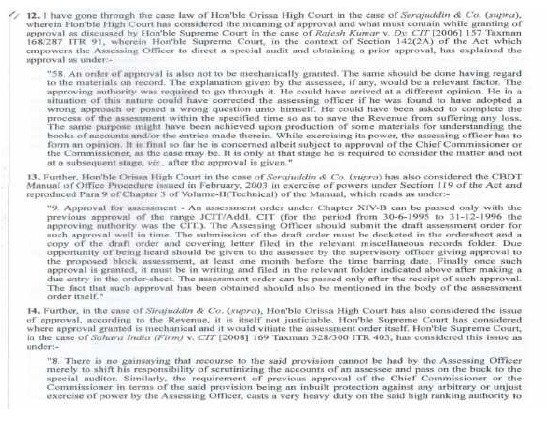
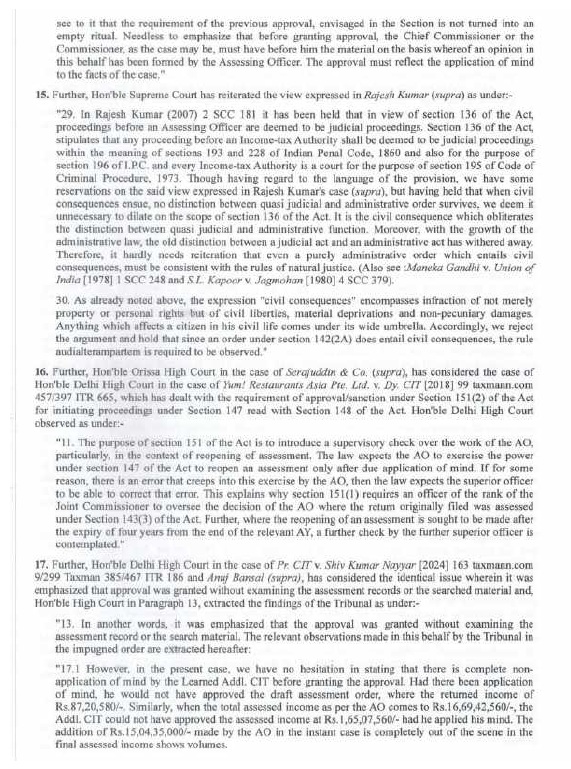
(K) The principles that emerge, in our understanding; from careful perusal of the aforesaid precedents, referred to in foregoing paragraphs (J.1) to (J.6.1) are as under:
| (i) |
|
Approval u/s 153D of IT Act cannot be a mechanical exercise. The approval must be granted by the approving authority after due application of independent mind. When this requirement is not met, the approval suffers from infirmity and is invalid. |
| (ii) |
|
The contention of Revenue that approval u/s 153D ofthe IT Act being an administrative act, is notjusticiable; is wrong. |
| (iii) |
|
It is a bare minimum requirement that the approving authority must indicate what thought process was involved in granting the approval. Even if elaborate reasons are not given; there has to be some indication that the approving authority has examined the draft orders with regard to applicable law and all the relevant materials. When this requirement is not met, such approval suffers from infirmity and is invalid. |
| (iv) |
|
The directions given by CBDT in Search Manual regarding granting of approval, although initially issued in the context of section 158BG of I.T. Act, are also applicable for approval u/s 153D of the IT Act; and are mandatory. When these directions are not met; the approval suffers from infirmity and is invalid. |
| (v) |
|
The approval of draft assessment order by approving authority being an in-built protection against any arbitrary or unjust exercise ofpower by the Assessing Officer, cannot be said to be a mechanical exercise without due application of independent mind by the approving authority on the relevant materials and reasoning given in the assessment order; so as to appreciate factual and legal aspects to ensure that the entire material has been factored in, in the draft assessment order proposed by the Assessing Officer. |
| (vi) |
|
Section 153D of the IT Act requires that the Assessing Officer shall obtain prior approval of JCIT in respect of each assessment year. Section 153D of the IT Act requires that the Assessing Officer would be required to furnish the return of income in respect of each assessment year. The proviso to section 153D of the IT Act further provides for assessment of the total income in respect of each assessment year. Careful and conjoint reading of section 153A and section 153D of the IT Act leave no room to doubt that approval with respect to each assessment year is mandatory. As separate returns are to be filed for each assessment year, and as separate assessment orders are to be passed for each assessment year; it follows that approvals u/s 153D of the IT Act are to be given by the approving authority separately for each assessment year. If approvals for multiple assessmentyears are given u/s 153D of the IT Act through a common letter of approval; this violates statutory requirements; and such approvals suffer from infirmity and are invalid. |
| (vii) |
|
In Manual of Office Procedure, Volume-II (Technical) issued by CBDT is exercise of powers u/s 119 of the IT Act has directed in Chapter -3 that the Assessing Officer should submit draft assessment order in search cases to the approving authority well in time; and the approving authority should give due opportunity of being heard, at least one month before time barring date. These directions are binding on the Assessing Officer. |
| (viii) |
|
The Assessing Officer, while framing assessment, acts in quasi-judicial capacity and he ought to conform to the more elementary rules of judicial procedure; and in particular, to conduct the case himself, and not allow somebody else, even his superior officer to interfere in the conduct of the case. Higher authorities an Assessing Officer, Addl. CIT/Joint CIT i.e. JCIT or CIT or CCIT are not entitled to interfere in process of framing of assessment order by the Assessing Officer; except by mandate of law. The Addl.CIT/JCIT is entitled to issue directions u/s 144A of IT Act. Other than that, his role starts when he receives draft assessment orders for approval u/s 153D of the IT Act (wherever such approval is required under law). When first draft is returned back; his role ceases; and the role of Add. CIT / JCIT starts again when he receives the final draft of the proposed assessment order, which he eventually approves. The question if the approval u/s 153D of the IT Act suffered from infirmity and was invalid is to be decided having regard to receipt of final draft of the proposed assessment order which the Addl. CIT /JCIT eventually approved. The association of Addl. CIT/JCIT with the Assessing Officer, and involvement of the Addl. CIT/JCIT in the assessment proceedings before that has no relevance for deciding whether approval u/s 153D of the IT Act suffered from infirmity and was invalid. In fact, in view of the foregoing discussion, any such association and involvement may, depending on facts and circumstances of the case, be fatal to the assessment on strict application of rules of judicial procedure as aforesaid; depending on facts and circumstances ofthe case. |
| (ix) |
|
When approval u/s 153D of the IT Act suffers from infirmity and is invalid for one or more aforesaid reasons, the entire assessment order becomes vitiated; and is to be annulled. |
(L) We accept the contention of the learned Departmental Representatives, as referred to in foregoing paragraph (H.1.1) of this order that whether in a particular case, JCIT had given approval u/s 153D of the IT Act after due application of mind, is a question of fact and the answer would depend on facts and circumstances of the particular case, independent of conclusion arrived at in any other case.
(L.1) Coming to the facts and circumstances of the present case; we accept the contention ofthe learned Counsel for the assessee that the affidavit of Shri M. L. Meena, the Assessing Officer and personal testimony of Shri Agrahari, Departmental Inspector are de void of any credibility; having regard to submissions made by learned Counsel for the assessee as referred to in foregoing paragraph (I) of this order. Further, in view of submissions of learned Counsel for the assessee as referred to in foregoing paragraph (I.1) of this order, we are of the opinion that neither the story presented by Revenue regarding Pen Drive inspires confidence nor, in any case it advances the case of Revenue, in the absence of any description of the contents of the Pen Drive in letter dated 18/07/2017 of the Assessing Officer and in the absence of any reference to Pen Drive in the notes and order sheet of the JCIT, the approving authority. Moreover, it is claimed by Revenue that all relevant records/materials were sent to the Addl. CIT/JCIT along with editable soft copies of the draft assessment order together with letter dated 18/07/2017, but there is no mention of “all relevant records/materials” in the letter dated 18/07/2017. Also, as mentioned earlier, there is no description of the contents of the Pen Drive in letter dated 18/07/2017. Besides, we are perplexed at hand written mention of the Pen Drive in the letter. Who writes Pen Drive as “Pen Drib”?. Who writes 1 Piece as “1 pees”? We are not convinced that a Pen Drive was sent with the letter dated 18/07/2017 by the Assessing Officer to the Addl. CIT/JCIT. Notwithstanding, the claim of Revenue that all relevant records/materials; which should consist of assessment records, seized materials, digital data in CPU, HDD and laptop, reports under Rules 9 and 9A of ITSC(P) Rules, assessees’ submissions etc; were available to the JCIT who gave approval u/s 153D of the IT Act in either physical form of digital form, is not borne out from records. Even if it was available, there is nothing on record to show that indeed the JCIT considered all relevant materials before giving approval u/s 153D of the IT Act. Further, having regard to submissions made by learned Counsel for the assessee, as referred to in foregoing paragraphs (F.1.1), (F.1.4, (F.1.4.1), (F.1.5) (I) (I.1) and (I.2) of this order; it is concluded that approval was granted by JCIT in a mechanical way without due application of mind, as an idle formality, and in the manner of rubber stamping; as it was humanly impossible for the JCIT to give approval in a total of 63 assessments; vide aforesaid common approval letter dated 31/07/2017; after due consideration of all relevant materials such as seized materials, appraisal report, digital data, submissions of the assessees, assessment records, reports under Rules 9 and 9A of ITSC(P) Rules, etc; within extremely limited time available to the JCIT. Further, the assessment order is dated 31/07/2017 but there is no mention of return of the assessment record from Varanasi (where JCIT was stationed) to Allahabad (where Assessing Officer was stationed) in any official communication between the two of them; which shows that the assessment records always remained with the Assessing Officer; and the JCIT did not even refer to the assessment records before granting approval u/s 153D of the IT Act. The doctrine of human probabilities in orders of Hon’ble Supreme Court in Durga Prasad More 82 ITR 540 (SC) and Sumati Dayal 214 ITR 801 (SC) operates against Revenue, in the facts and circumstances of the present case.
(L.2) It is not in dispute that aforesaid common approval letter dated 31/07/2017 was issued by JCIT to give approval u/s 153D of the IT Act for 63 different assessments pertaining to 11 different assessees ofJeevan Jyoti Group, for different assessmentyears.
(L.3) On perusal of aforesaid common approval letter dated 31/07/2017 issued by JCIT; it is found that there is complete absence of any indication of thought process involved in granting the approvals for the assessment u/s 153D of the IT Act. There is no indication that the JCIT examined the draft order with regard to assessment record, applicable law and all relevant materials. The approval u/s 153D of the IT Act has been given in a non-speaking, summary and formal way, in the manner of rubber stamping.
(L.4) Neither the approving authority gave opportunity of being heard to the assessee before giving approval u/s 153D of the IT Act; nor did the Assessing Officer submit draft assessment order to the approving authority well in time to enable the approving authority to provide opportunity to the assessee (at least) one month before the time barring date of 31/07/2017. Thus, the approving authority and the Assessing Officer, both, failed to comply with mandatory direction of CBDT, issued in exercise of power u/s 119 of the IT Act, in Chapter-3 of Manual of Office Procedure, Volume-II (Technical).
(L.5) The claim of Revenue that Addl. CIT/JCIT were associated with the Assessing Officer and were involved in assessment proceedings (otherwise than in proceedings u/s 144A of IT Act) even before role of Addl. CIT/JCIT as approving authority u/s 153D of the IT Act began upon receipt of the final draft of the proposed assessment order which was eventually approved u/s 153D of the IT Act, is in violation of Rules of judicial procedure prohibiting any interference by higher authorities with assessment proceedings before the Assessing Officer.
(M) When the facts of the case as discovered in foregoing paragraphs (L.1), (L.2), (L.3), (L.4) and (L.5) are considered; they are found to be in contravention of every principle in foregoing paragraph (K) of this order enumerated as (i) to (ix). Respectfully following the precedents referred to in foregoing paragraphs (J.1) to (J.6.1); which are at the core of these principles; it is concluded that approval u/s 153D of the IT Act was given by the JCIT in a mechanical manner without due application of mind. It is further concluded that the approval u/s 153D of the IT Act given by the JCIT suffered from infirmities mentioned at Sl.Nos. (i), (iii), (vi), (viii) and (iv) read with (vii) in foregoing paragraph (K) of this order. Accordingly, it is concluded that the approval given u/s 153D of the IT Act suffers from multiple infirmities; and is invalid; because of which the entire assessment order is vitiated. In accordance with Sl.No. (ix) in foregoing paragraph (K) of this order, therefore, the assessment order is to be annulled. The alternate submission made by learned Departmental Representatives, to restore the matter regarding approval u/s 153D of the IT Act to the file of the approving authority (i.e. Addl. CIT/JCIT) is rejected because it would amount to providing a second innings to Revenue against mandate of law; and also because it would amount to extending period of limitation available for completing assessment proceedings, which is not permissible in law. The limitation period available to Revenue is inclusive of time taken for granting approval u/s 153D of the IT Act; and there is no provision of law permitting extention of period of limitation for failure of the approving authority to give valid approval u/s 153D of the IT Act. In view ofthe foregoing; the Assessing Officer is annulled.
(M.1) Since the assessment order is annulled, the impugned appellate order of learned CIT(A) has no legs to stand. Therefore, the impugned appellate order of learned CIT(A) is set aside.
(M.2) As mentioned in foregoing paragraph (F) of this order, representatives of both sides have agreed that appeals of Minto Developers Pvt. Ltd. (I.T.A. No.337/Lkw/2018 for A.Y. 2009-10) may be taken as the lead case as regards the legal issue whether the assessments were passed by the Assessing Officer after obtaining valid approval of JCIT. They submitted that the facts and circumstances for all the other appeals on this issue were in para materia and the decision in the case of Minto Developers Pvt. Ltd. would apply mutatis mutandis to remaining cases also. Therefore, the assessment orders pertaining to all the appeals/Cross Objections are also hereby annulled; and the impugned appellate orders pertaining to all appeals/Cross Objections before us are set aside.”
B.3) Further, the aforesaid order in the case of Ramji Vaish (supra) on which learned Departmental Representatives placed reliance has also been respectfully considered by us. The relevant portion of this order is reproduced below for the ease of reference:
“12. Commencing their arguments, Shri Suyash Agarwal, Advocate and Sh. Praveen Godbole, C.A. (hereinafter referred to as the ld. ARs) submitted that in the present case, a search and seizure operation under section 132 of the Act was conducted on 03.02.2011, at the residential and business premises of the assessee. After the date of search, notices under section 153A were issued on 17.07.2012 and in compliance to those notices, returns were filed on 22.08.2012.After issuance of notices, to which compliance was made, the ld. AO framed assessment orders on 30.03.2013under section 153A/143(3) of the Act. In the assessment order for each year, on the last page of the order, the Assessing Officer narrated that the order had been passed after approval from the Joint Commissioner of Income, Central Range, Lucknow.It was submitted that while preparing the appeal against the decision of the ld. CIT(A), the assessee came to know that a legal issue was involved and therefore, a prayer had been made by the assesseefor admission of additional grounds as under: –
“3.That in any view of the matter approval u/s 153D of the as taken by the assessing officer from Joint Commissioner of Income Tax, Lucknow in various assessee (Group cases) in one day which shows that prescribed authorities granted the approval without application of mind and without considering the search material facts, in all the cases (Group cases) hence the entire assessment order is illegal invalid hence order of the two lower authorities liable to be declared void as well as non-est.
4. That in any view of the matter meaning of approval as contemplated u/s 153D of the Act by the Joint Commissioner Lucknow was required to verify the issue raised by the assessing officer in draft assessment order and to apply his mind and to ascertain the entire facts from the assessing officer and to examine search material but in the present case inmechanical manner approval taken/granted on the day in more than 45 cases (Group) hence the order passed by the assessing officer and his action as confirmed by CIT(A) is highly unjustified. The legal issue in question is well covered by the decision of Hon’ble Jurisdictional High Court as well as other Hon’ble ITAT benches hence the decisions are binding.”
13. It was submitted that the aforesaid grounds were pure legal grounds and by virtue of them, the validity of assessment had been challenged in the light of the provisions of section 153D of the Act as well as in the light of settled law. The assessee placed reliance on the decision of the Hon’ble Supreme Court in the case of NTPC Limited v. CIT 229 ITR 383 (SC). It was submitted that in such cases, the ld. AO, before passing the assessment order,was bound to take, “approval” from the JCIT under section 153D of the Act. For such purposes, the Approving Authority was required to see all such materials, seized documents, appraisal report, enquiries made by the Investigation Wing as well as various enquiries made by the ld. AO in the assessment proceedings as well in compliance to inquiries made by the ld. AO and was required to give the approval after due application of mind to the said material. It was only after approval was given in such a manner, that the ld. AO could frame the assessment order. It was submitted that, contrary to the above, in the present case,the ld. AO submitted all the assessment orders pertaining to the assessee for consideration on 25.03.2013. It was submitted that in the said letter, which was placed on page no. 39 of the assessee’s paper book, a total of 290 orders pertaining to 45 assessees had been submitted for approval. Thus, it was submitted that in view of the fact that the reference to the JCIT was made on 25.03.2013and the approval was also given on 26.03.2013, it was humanly impossible for any person to grant approval in so short a period of time, after examining the voluminous details (documents and books etc.) in a single day. Thus, it was argued that it was self-evident that the approval granted on 26.03.2013 was given in a mechanical manner without due application of mind and that the entire proceeding was vitiated on this account. Since the approval under section 153D was the foundation for passing the impugned assessment order dated 30.03.2013, but the same was in fact not an approval in the eyes of law, because it was given mechanically, the said assessment order was rendered illegal and void. The ld. ARs submitted that there was no indication in the letter dated 26.03.2013, issued by the JCIT, that the JCIT had examined the draft order and found that it met the requirements of law. It was submitted that therefore, the approval was not an approval but mere, “rubber stamping” of the assessment order. It was reiterated that these draft assessment orders had been put up to the JCIT (according to the AO on 25.03.2013) at the fag end of the assessment period, thereby not giving the JCIT anytime to go through the voluminous material relating to the search and apply his mind. The approval given by the JCIT did not mention the fact that the JCIT had applied his mind by considering the contents of the draft order and was totally silent on whether he had considered the seized material. It was submitted that it was a settled principle of law that the power of granting approval was not to be exercised in a casual or routine manner, but should be given after examining the entire material. It was further submitted that the Department had failed to produce any evidence justifying the granting of approval in this mechanical manner. The ld. ARs argued that the provisions contained in section 153D as enacted by the Parliament could not be treated as aformality. It required proper application of mind by a senior officer. Since in the present case, the so-called approval did not constitute an approval as envisaged under section 153D, therefore, the impugned assessment order was void and bad in law. It was further submitted that the facts of the assessee’s case were proved by the fact that the Joint Commissioner was stationed at Lucknow, whereas the ld. AO was stationed at Allahabad and the distance between the two places was nearly 200 Kilometers. It was therefore clear that the entire seized material was never placed before the Joint Commissioner at the time of granting of approval and therefore, it was a clear-cut case of mechanical approval granted by the superior authority, which could not be said to meet the conditions of an approval as contemplated under section 153D of the Act. The ld. AR invited our attention to the order of the Hon’ble High Court in the case of PCIT v. Siddhartha Gupta (2023) 450 ITR 534 (All), in which the Hon’ble Allahabad High Court had held that the approval of draft assessment order,being an inbuilt protection against any arbitrary or unjust exercise of power by the ld. AO, cannot be a mechanical exercise, without application of independent mind by the Approving Authority on the material placed before it and the reasoning given in the assessment order. The Court had held that prior approval of a superior authority meant that the said authority should appraise the material before it, so as to appreciate the factual and legal aspect to ascertain that the entire material had been examined by the Assessing Authority before preparing the draft assessment order. It held that it was clear that the approval must be granted only on the material available on record and the approval must reflect the application of mind to the facts of the case. Accordingly, it was held that requirement of approval in this manner was not met in the case of thatassessee, where draft assessment orders in 123 cases were placed before the Approving Authorityon 30th December, 2017 and approved by him on 31st December, 2017, as it was impossible to go through records of so many cases in one day so as to apply independent mind to the material before the Approving Authority. After a conjoint reading of sections 153A(1) and section 153D, the Court had held that approval had to be obtained with respect to, “each assessment year” before passing the assessment orders under section 153A and since in that case, they were not so obtained, the Hon’ble High Court had upheld the conclusion drawn by the Tribunal that the approval was a mechanical exercise of power and justified its decision to treat the consequent assessments as void. The ld. ARs also took us through the judgment of the Hon’ble Allahabad High Court in the case of PCIT v. Sapna Gupta (2023) (All), wherein the Hon’ble Allahabad High Court had held that it was humanly impossible to go through the records of 85 cases in one day, to apply independent mind to appraise the material before the Approving Authority, therefore it had held that theconclusion drawn by the Tribunal, that it was a mechanical exercise of power, was justified. The ld. ARsplaced further reliance on the decision of the Hon’ble Allahabad Court in the case of PCIT & Ors v. Subodh Agarwal 450 ITR 526 (2023) (All),wherein the Hon’ble Allahabad High Court had held that it was humanly impossible for the Approving Authority to peruse and apply his mind to appraise the material in one day in respect of 38 assessees, therefore, the conclusion of the Tribunal that the authority under section 153D had been exercised mechanically and that it vitiated the entire proceedings under section 153A, was neither perverse nor contrary to the material on record. Further the Court had held that the submission of the Department that the grant of approval was an administrative exercise of power and the existence of the approval meant the order could not be vitiated, was a fallacy as prior approval of superior authority required him to appraise the material before him, so as to appreciate the factual and legal aspects of the case and assure himself that it had been examined by the AO before preparing the draft assessment order. Thus, it too had held, that orders passed without such application of mind were vitiated in the eyes of law. The ld. ARs pointed out that the Hon’ble High Court in the said order had referred with approval to the decision of the ITAT Lucknow in the case of Naveen Jain and Others v. DCIT (2021) 91 ITR-Trib 682 (Lucknow), wherein the Hon’ble Tribunal had held that though the word, “approval” had not been defined in the Income Tax Act, but due to various decisions of the Hon’ble Courts, it had been held to mean that the grant of approval means due application of mind on the subject matter approved, which satisfies all the legal and procedural requirements and if an approval had been granted by the Approving Authority in a mechanical manner without application of mind, then the very purpose of obtaining approval under section 153D of the Act would be defeated. The Tribunal had held in that case, that the Approving Authority would have to apply its independent mind to the material on record for, “each assessment year” in respect of, “each assessee” separately. The Tribunal had noted that the provisions contained in section 153A to 153D provide for separate notices to be given to the assesseefor each assessment year and for passing of separate assessment orders. Therefore, separate approval of draft assessment orders for each assessment year was required to be obtained under section 153D of the Income Tax Act. The Tribunal in that case had held, that the approval of the Approving Authority serves two purposes i.e. it has to ensure the interest of Revenue by guarding against any omission or negligence by the Assessing Officer and it also had to do justice to the taxpayer by granting protection against arbitrary or baseless tax liability. Therefore, an order passed mechanically, which did not do these, could not be held to be valid. The ld. ARs, thereafter, drew our attention to the decision of the Hon’ble Orissa High Court in the case of CIT v. Serajuddin and Co. (2023) 453 ITR 312 (Orissa), wherein the Hon’ble Orissa High Court had stated that a letter that simply granted approval without mentioning what the thought process involved was, does not satisfy the requirements of law and since in that case, the approval did not mention the reasons for granting the approval, the approval had been given mechanically, thereby vitiating the assessment order itself. The ld. ARs submitted that subsequently the SLP of the Department against this decision of the Hon’ble Orissa High Court had been dismissed by the Hon’ble Supreme Court and therefore, this position now stood affirmed by the Hon’ble Supreme Court. Taking cues from these case laws, the ld. ARs pointed out, that in the present case, no discussion between the AO and the JCIT was recorded in the order-sheets and no reasons had been discussed for granting of the approval. The ld. ARs drew reference to the CBDT manual of office procedure that was referred to in the order of the Hon’ble Orissa High Court in the case of CIT v. Serajuddin& Co. (supra) and submitted that as per the said manual, orders which required approval of the superior authority under section 158BG, were required to be submitted to the Approving Authority, “well in time”. As in the present case, this had not been done, the said order was also violative of the said office procedure manual. In the circumstances, the ld. ARs argued that the order in question was deserving of being quashed.
14. Responding to the paper books filed by the ld. DR before the hearing, including submissions opposing the admission of the additional ground raised by the assessee, the ld. ARs submitted that the additional ground was a purely legal ground, it went to the root of the matter and on identical facts and grounds, the matter stood concluded by decisions of various Courts including the Hon’ble Supreme Court, the Hon’ble jurisdictional High Court and the jurisdictional Bench of the ITAT, Lucknow. Our attention was invited to the latest decision of the ITAT Bench of Lucknow in ITA No. 667 to 669/LKW/2018 vide order dated 6.08.2024, wherein the ITAT had admitted the identical additional ground in the light of the decision of the Hon’ble Supreme Court in the case of NTPC Limited v. CIT 229 ITR 383 (SC), on the grounds that they were of the opinion that the additional ground raised by the assessee was a purely legal ground which was germane to the issue involved in the appeal. Similarly, in the case of Subodh Agarwal in ITA No.674/LKW/2018, the ld. CIT DR had not voiced any objection to the admission of the additional ground since the ground was a purely legal ground. Reference was also invited to the decision of the ITAT in various cases where the additional grounds questioning the validity of the approval under section 153D had been admitted. On the issue of validity of proceedings under section 153D, it was once again reiterated that there was series of decisions in support of the contention that if many orders were approved on the same day, it reflected non application of mind. Therefore, it was prayed that the legal ground may be admitted as the issues involved were identical to various other cases, where the Courts had admitted challenges to the approval under section 153D, on account of the fact that it was purely a legal ground.
15. Further, in response to an affidavit of the JCIT, who had given the approval under section 153D on 26.03.2013, which formed a part of the DR’s paper book, the ld. ARs raised an objection, that such affidavit of a retired officer had no sanctity in the eyes of law, firstly because it had been filed after eleven years (it was dated 23.08.2024) and secondly because it was an afterthought and the Department had only filed this affidavit to give life to a dead approval, which could not be permitted in the eyes of law. It was submitted that by filing this affidavit, the ld. DR had contended that the Tribunal had committed error in annulling good assessment orders due to non-application of mind by JCIT under section 153D by ignoring the contention that the JCIT is not required to follow the principles of natural justice. It was submitted that this contention was totally misconceived.In the light of the orders passed by various Courts it was a settled proposition that the JCIT had to grant approval under section 153D after due application of mind as he was acting in his capacity as a quasi-judicial authority. It was also a settled proposition of law, that orders and judgments passed by a Tribunal or Court had binding effect unless set aside by the Hon’ble Supreme Court and for this proposition the ld. ARs placed reliance on the judgment of the Hon’ble Supreme Court in the case of Union of India and Others v. Kamlakshi Finance Corporation Ltd. (1991) 55 ELT 433 (SC), wherein the Hon’ble Apex Court had held that even if the order of a superior court was not acceptable, the lower authority was still bound to follow the orders of the superior judicial authority.It was submitted that the approval dated 26.03.2013 granted by the JCIT under section 153D was without application of mind and now the DRs, with a view to cure the defect, had filed the affidavit dated 23.08.2024, justifying the approval and stating that the same was approved after due application of mind, which is clearly an afterthought. The ld. ARs drew our attention to the decision of the Hon’ble Supreme Court in the case of Mohinder Singh Gill v. Chief Election Commissioner (1978) 1 SCC 405, in which the Hon’ble Supreme Court had held that when a statutory functionary makes an order based on certain grounds, its validity must be judged by the reasons so mentioned and cannot be supplemented by fresh reasons in the shape of an affidavit or otherwise as an order bad in the beginning could not get validated by additional grounds that were later brought out. Therefore, it was submitted that the affidavit of the retired officer was liable to be ignored and justice ought to be provided to the assessee, in the light of settled law and the contention of the Department that a legal issue could not be raised before the Hon’ble Bench, had no force and therefore should be ignored. The ld. ARs also emphasized that the legal issue that had been raised as an additional ground was required to be adjudicated first, keeping other issues on merits pending, until the legal issue had been determined. As per Order XIV Rule 2 of the CPC, it had been laid down in Rule II(2) that where issues of law and of fact arise in the same suit and the court finds that the suit or any part thereof may be disposed of on an issue of law only, it may try that suit first. They also drew reference to the decision of the Hon’ble Supreme Court in the case of Major S.S. Khanna v. Brigadier F.J. Dhillon (AIR 1964) SC 497, where the Hon’ble Supreme Court had held, that the jurisdiction to try an issue of law under Order XIV Rule 2 CPC, may be exercised only where the whole suit or a part thereof could be disposed of on the issue of law alone and relying upon such judgments, the ld. ARs prayed that a decision be first pronounced on the legal issue of the validity of the assessment, in view of their contention that the approval under section 153D, was given without due application of mind.
16. The Department has opposed the admission of these additional grounds raised for the first time before the ITAT in respect of approval under section 153D, under the provisions of Rule 11, Rule 18 and Rule 29 of the ITAT Rules, 1963. Sh. Amalendu Nath Mishra, CIT DR and Sh. A.K. Singh, Sr. DR (hereinafter referred to as the ld. DRs) argued the matter before the Bench and submitted that the said additional ground had been sought to be raised for the first time before the ITAT. The assessee had not explained why it did not raise this ground before the ld. CIT(A). The ld. DRs submitted that the aforesaid additional grounds were based on the AOs letter dated 25.03.2013, soliciting approval under section 153D and the JCIT’s letter dated 26.03.2013 conveying the approval under section 153D, both of which have been filed by the assessee alongwith its application for admission of additional ground. It was, therefore, self-evident that since the assessee was not a party to the process under section 153D, that these two documents were in the nature of the additional evidences adduced by the assessee and it was on the basis of these additional evidences, that the additional ground was sought to be raised. The ld. DRs pointed out that under Rules 11, 18 and 29, no additional evidences could be adduced and no additional ground could be raised, except with the leave of the Tribunal and for the reasons to be recorded by the Tribunal for allowing the additional evidences and for raising the additional ground. Moreover, asthe issue of approval under section 153D was not the subject matter of appeal before the ld. CIT(A), the ld. CIT(A) had no occasion to record his finding on the said issue. Therefore, the said issue does not emanate out of the order under section 250 of the ld. CIT(A) and was not a subject matter of appeal before the ITAT. In fact, the ld. DRs submitted that the approval under section 153D was not an appealable order and therefore, it did not fall within the jurisdiction of the Tribunal as defined under section 253(1) of the Income Tax Act. It was submitted that the jurisdiction of the ITAT and the powers of the ITAT were two different things. The issue of approval under section 153D, which did not emanate out of the orders of the ld. CIT(A), was beyond the jurisdiction of the ITAT in the present appeal. The ld. DRs argued that had the issue been within the jurisdiction of the ITAT, (in terms of the subject matter of appeal), then it would have had the widest powers to adjudicate upon the same, but it is not so in the present case. Therefore, since the Tribunal did not enjoy the jurisdiction to rule upon an approval under section 153D dehors of the matter being considered by the ld. CIT(A), where was the question of the Tribunal exercising the power to do so. Thus, it was submitted that the additional ground should not be entertained by the ITAT on account of this.
17. The ld. DRs also submitted, that the question as to whether in a given case, approval under section 153D has been accorded with due application of mind or not, is essentially a question of fact, which would depend upon the facts of each case and therefore, this was not a legal issue which could be raised as an additional / legal ground for the first time before the ITAT. The ld. DRs questioned the submissions made by the ARs that the issue of approval under section 153D went to the root of the matter, because the AOs jurisdiction or power to assess the income of a searched person is dependent upon the fulfillment of the requirements of section 153A and not on the approval under section 153D. It was, therefore submitted, that the impugned assessment proceedings having been validly initiated and completed under section 153A, after approval under section 153D, cannot be called into question on account of alleged non-application of mind in approval under section 153D, so as to render the impugned assessment order ab initio void as the assessee was trying to make out by means of the said additional / legal ground. It was submitted that the provisions requiring statutory approval under section 153D were analogous to the provisions of section 158BG (for block assessments applicable upto 31.05.2003) and section 274(2) for imposition of penalties, and in the context of the said two analogous provisions requiring approval of the Additional / Joint CIT, the Courts have repeatedly held, that such an approval is only an administrative act, which does not affect the AOs inherent jurisdiction to assess the income of the assessee or to levy penalty upon the assessee. Hence, the reasons being presented by the assessee, firstly for showing that this was a legal ground and secondly for showing that it went to the root of the matter and effected the validity of the assessment, were both misplaced and for the aforesaid reasons, the ld. DRs submitted that the aforesaid legal grounds should not be considered and admitted for adjudication by the Tribunal.
18. Continuing their arguments, the ld. DR submitted that approval, prior to assessment under section 153D was an administrative act and not a quasi-judicial act. Such administrative acts were believed to have been performed in the manner which they were supposed to be performed unless some positive tangible material is brought on record to show that the converse is true. They argued that no such material had been brought on record by the ld. ARs in this case. It was submitted that the Legislature had mandated approval to an assessment under section 153A/153C of the Income Tax Act. The manner and method of the same had not been prescribed. Hence, if the JCIT was satisfied with the assessment as proposed by the ld. AO and had conveyed his approval for the same, the requirement of law was fulfilled. It was argued that if the Hon’ble Tribunal was to venture into whether the approval could have been accorded by the JCIT under certain circumstances or not, it was only creating fetters (which the Legislature did not consider it necessary to do) and thereby exceeding its jurisdiction. The artificial requirement imposed by the Tribunal that the JCIT should go through the entire body of material available on record at the time of according approval was not only harsh but vicious, because by such logic as the final fact-finding authority, the Tribunal was also required to go through the entire body of material available on record and if it did not do so, its decisions ought not to pass muster. There was, therefore, no occasion to annul any assessment on this count,without finding any fault in the assessment, due to which it could be said to be incapableof receiving approval of a person reasonably instructed in law.It was further submitted that the difference between procedural irregularity and judicial defect was well known. While the latter was incurable, the former may not be. In the case in question, the fact that the JCIT had accorded approval was not in dispute and furthermore the approval had been accorded after due deliberations and discussions with the ld. AO, on overall consideration of the entire material on record. However, if the Hon’ble Tribunal felt that something more was needed to be done, it could remand the matter back for fresh consideration of the JCIT and give such directions as it thinks fit under the given circumstances, for appropriate disposal of the case. This was not a case where any prejudice had been caused to the assessee by the alleged so-called deficiency in the approval by the JCIT. The acid test in such cases was whether the assessment order was such, that a person reasonably instructed in law would not approve it ? If the answer was in the affirmative, the approval may be vitiated but even then, it would be a mere procedural irregularity or error of judgment, which could be corrected in appeal. If an assessment was based on improper appreciation of facts, it could be remanded back to the ld. AO for fresh adjudication after removing deficiencies, if any. The question of annulment only arose when a mandatory requirement of law at the time of initiation of the impugned proceedings had not been complied with. That being the benchmark of appeal against deficiencies in assessment, there was no reason why there should be any differential treatment to the approval which was part and parcel of assessment proceedings and it was merely a procedural mechanism to avoid glaring arbitrariness or omissions in assessment. The question of nullity of the assessment could possibly arise if the statutory approval was wanting altogether but, in this case, since the statutory approval had been accorded, the ld. DRs argued that there was no case for annulling the assessment on the account that the approval had been accorded for particular number of cases simultaneously.
19. The ld. DRs then took us through the working of the Central Ranges. It was pointed out that a Central Range was specialized range set up for the assessment of search and seizure cases, where an Assessing Officer is assigned a limited number of cases requiring in depth and coordinated investigation. The main role of the JCIT in a Central Range was to keep on monitoring and supervising the assessment work in his range. The assessment work was conducted under the direct and constant supervision of the JCIT Central, and the draft assessment order was formally submitted to him as and when the order was ready to be made. It was submitted that the view of the Tribunal that the JCIT should go through the entire assessment records (including the seized material etc.) while according approval, was based on the assumption that the JCIT was a stranger to the assessment work until he was provided with the draft assessment order. But that was factually incorrect. It was, therefore unfair and improper to say that the JCIT should go through the voluminous records at the time of recording approval and hold that the same was, “humanly impossible” in the short time that it took for giving an approval, to hold that the said approval had been given without application of mind. The ld. DRs sought to explain the issue by pointing out that the Assessing Officer was expected to make an assessment after thoroughly familiarizing himself with the facts of a case and evaluating the entire body of evidences. He naturally could not make such orders in one day, but kept working throughout the year during which the assessment work went on as work in progress and because of that continuous work, he was able to complete a large number of assessments on a particular day. Ignoring the work in progress of the assessment work, would lead to a conclusion that all assessment orders bearing one common date must have been made without application of mind. It was argued that a similar conclusion had been drawn by other Benches of the Tribunal with regard to approvals granted by JCITs in search cases, butthis ignored the continuous work done by the JCITs in relation to day-to-day monitoring of the progress in cases of the Range. Therefore, merely because the JCIT had accorded approval for a large number of cases in one day and by one letter, this could not be a ground to conclude that he had not applied his mind to the facts of the case or acted mechanically. It was further submitted that if the logic of taking the date of order as the only date on which work was done was applied, then superior courts passed orders running into hundreds of pages on a particular day, but it was obvious that the said order was not prepared on that day, but a result of continuous efforts overtime. Similarly, the approval was not accorded by consideration of the matters in one day,but over a period of time and therefore, the fact of simultaneous approval in a large number of cases could not be held to be without application of mind or mechanical.
20. The ld. DRs thereafter submitted that, without prejudice to their submissions that the consideration of approval under section 153D was beyond the jurisdiction of the Tribunal, that the matter of whether there was due application of mind was a matter of fact and not a matter of law and that even if there was a mechanical approval, it was a procedural irregularity that could be cured by remand rather than meriting annulment of the assessment, they would also demonstrate that, in this particular case, there was no mechanical approval and that the approval had been given with due application of mind. The ld. DRs invited our attention to the CBDT general guidelines for search and seizure assessments in F No.286/161/2006-IT(Inv. II) dated 22.12.2006 contained in Appendix V of the search and seizure manual and stated that the same demonstrated that the ld. AO and the Range Head were jointly involved in the assessment, right from the stage of receipt of appraisal report and the seized material. A copy of the same was filed before us. It was submitted that in a search case, after the conclusion of search, the Investigation Wing prepared an appraisal report with regard to the findings in the search and the documents recovered and sentcopies of the same to the ld. AO, Range Head and Pr. CIT, Central within a period of 60 days. It was submitted that as per para 1.2 of the said guidelines, the seized material should be handed over to the Assessing Officer within a week of sending of the said appraisal report. The Board has laid down that in case of any delay, the CIT, Central is to be informed. The ld. DRs thereafter pointed out, that as per para 1.3 of the said guidelines, after receiving the said appraisal report, the CBDT has directed that the Assessing Officer and Range Head would jointly scrutinize the appraisal report and seized material in order to prepare an examination note to decide where cases were required to be taken up under section 153A, 153C or section 148 and such cases where the seized material pertained to cases other than those which had been centralized with the ld. AO. Thus, it was submitted that the JCIT was acquainted with the seized material and the appraisal report at the very commencement of the assessment. The ld. ARs thereafter invited our attention to para 1.5 of the said guidelines,which directed that an action note based upon a comprehensive and methodical examination of the seized material, in addition to the comments in the available appraisal report, should be prepared within 90 days of the receipt of the seized material and that as per para 1.7, this action note had to be sent to the CIT, Central through the Addl. CIT/ Jt. CIT, as part of a compliance report,to enable proper supervision by him. The ld. DRs thereafter submitted,in their capacity as officers of the Court, that in fact the said action notes were usually prepared by the ld. AO and the Range Head in consultation with each other. Thereafter, our attention was invited to para 1.8 of the said guidelines, wherein the Board had laid down that proper satisfaction should be recorded before the issue of notices under section 153C or under section 148, as the case may be, and the Range Heads had been directed to ensure proper action in this regard. It was further pointed out that as per these guidelines, a detailed questionnaire was to be prepared after considering the seized materials and where it was considered necessary, directions under section 144A could be given by the Range head, as laid down in para 2.2 of the said guidelines. The ld. DRs pointed out that,in practice, since the detailed questionnaire was prepared in consultation with the Range Head, it was usually not necessary to issue formal directions under section 144A. The ld. DRs thereafter drew our attention to para 2.10 of the said guidelines and pointed out that the same laid down that after receiving replies of the assessee’son the questionnaire and after gathering further evidence in the case, the instructions could be issued by the Range Head under section 144A, either on his own motion or on a reference by the Assessing Officer. We were also made aware of para 3.2 of the said guidelines which laid down that the final show cause notice in the case should be prepared by the Assessing Officer, in consultation with the Range Head. Finally, the ld. DRs invited our attention to para 3.10 wherein the AO was advised to consult his higher authorities, while making large additions. It was, therefore, submitted that the said guidelines demonstrated that the Range Head (in this case the JCIT who gave the approval under section 153D) had already seen the seized material and participated in the assessment various stages and therefore, the approval under section 153D was only for the purposes of meeting the statutory requirement, so that the assessee should not allege that the order had not been passed in accordance with law. However, as the JCIT had been involved in the assessment process throughout the period of assessment, it was not necessary for him at the stage of granting of approval, to examine the material and records again. He only had to see that the orders had been passed in accordance with the discussions held by him with the Assessing Officer. Thus, any imputation that he did not apply his mind and acted mechanically, only because he did not require a long time to grant such approvals, was unfounded in the light of these facts. It was submitted that there is no instrument that could measure application of mind. However, the JCIT was a responsible officer having sufficient experience and therefore would know what is to be seen in which case and no conclusion could be reached regarding non application of mind, only on account of the fact that the approvals had been given within a short period of time. Since the JCIT was familiar with the facts of the case, he was in a position to grant these approvals. It was further submitted that the assessee had not been able to point out even a single instance or issue on which the impugned order could be held to have been made without any basis or without application of mind. Hence, there could not be any allegation of approval under section 153D, given without due application of mind, in such circumstances. The ld. DRs thereafter invited our attention to an affidavit that had been sworn by the then JCIT, Sh. Buddhadeb Mukhopadhyay on 23.08.2024 which reads as under: –
Affidavit
“I, Buddhadeb Mukhopadhyay, S/o Late Amiyalal Mukherjee aged about 69 years P./o Fiat No. 801, Moore Heights, 93, M. B. Sarani, Kolkata 700040 Solemnly affirm as under:
1. That, during the period 19.07.2012 to 15.10.2014, 1 was posted as Joint/Addi Commissioner of Income Tax, Central Range, Lucknow.
2. That, apart from other supervisory roles, I was also approving authority for the Assessment orders prepared by Assessing Officer of Central Circle within jurisdiction of these ranges.
3. That, vide letter F.No. DCIT(CC)/Alld/Vaish Groups/2012-13/1037 dated 125.03.2013, the A.O. sought approval for passing assessment orders in the case of Shri Ramji Vaish for A.Y. 2005-05 to 2011-12 which are under appeal for Hon’ble ITAT.
4. That, after proper application of mind, accorded approval for-passing assessment orders in the case of ShriRanji Vaishfor A.Y. 2005-06 to 2011-2, which are under appeal before Hon’ble ITAT, vide my office letter F.No. dated 26.03.2013. Jt. CIT/CR/LKO/Approval/2012-13/158
5. That, before approving the draft assessment orders submitted by Assessing Officers, a regular monitoring and supervision of assessment proceedings were made since examination of seized materials till scrutinizing of final reply.
6. That, since I, as Range Head constantly supervised the proceedings therefore at the time of submitting droit assessment order, I was well acquainted with facts and findings of the case.
7. That, for the purpose of proper monitoring and firsthand information of the progress of the cases, time and again I made my Camp Office at Allahabad during the material time. Moreover, the Assessing Officer used to give the draft orders in my e-mail and after due diligence, I used to return those draft order, after necessary correction and modification, through e-mail.
8. That, this is the reason that approval process took minimum time.
9. That, the regular monitoring was also necessary because in the most of cases assessee took long time for giving responses and submitted final reply at the fag-end of the year.
10. That, the approval has been accorded after due diligence and proper application of mind.
DECLARATION
I, Buddhadeb Mukhopadhyay, S/o Late Amiyalal Mukherjee aged about 69 years R/o Flat No.- 301, Moore Heights, 93, M. B. Sarani, Kolkata- 700040, solemnly affirm that contents of point no. 1 to 10 are true and correct to the best of my knowledge and belief.”
21. The ld. DRs pointed out that only because these extensive discussions between the Assessing Officer and the Range Head were not recorded in the order-sheet of the assessment folder, it could not be presumed that the said joint examination of seized material or joint consideration of the case over a period of time had not taken place. It was submitted that since the role of the Range Head was in the nature of administrative supervision and the assessee was not involved in the same, JCIT’s devise their own method in order to ensure proper supervision over the case, in accordance with the guidelines. The writing of an order-sheet was just a procedure and not a requirement and it could not be said that if something was not recorded in an order-sheet, the said discussions, did not take place. Drawing reference to the affidavit, the ld. DRs submitted that the then JCIT, who was now a retired Government Servant on pension had sworn an affidavit that he had engaged himself in regular monitoring and supervision of the assessment proceedings, right since the examination of seized materials till the receipt of final reply from the assessee and because he had constantly supervised the proceedings, therefore, at the time of submitting the draft assessment order, he was well acquainted with the facts and finding of the case. The ld. former Range Head had also submitted that he had set up a Camp office at Allahabad time and again during the material time period for this purpose and furthermore, that draft assessment orders were submitted on email, which after diligently going through and making corrections or modifications as necessary, he would approve and return by e-mail. The ld. DRs submitted that the said former JCIT, was a retired Government Servant on pension bound by the CCS Pension Rules, 1972. Therefore, he was a responsible person whose statement on oath was worthy of consideration. Countering the objections of the ld. ARs to the submission of this affidavit, it was submitted that by virtue of the affidavit, he had explained his actions and as he was the person whose order was under challenge, his statement was a vital piece of evidence which was required to be considered. It was further submitted that if there was any doubt on the submissions made by him, the AR’s could get him summoned and cross examined. However, without disproving the contents of his affidavit, the affidavit could not be disregarded. With regard to the delay in the submission of the affidavit, it was submitted that the assessee had raised the issue of approval under section 153D for the first time on 1.08.2024 i.e. eleven years after the appeal had been filed. It was therefore natural that the Department would offer evidence to counter this ground only after the issue had been raised by the assessee in appeal. The ld. DRs also drew our attention through the decision of the Hon’ble Supreme Court in the case of Chuharmal v. CIT 172 ITR 250. It was submitted that in the said case, the Hon’ble Supreme Court had held that there was a presumption in law, specifically section 114(e) of the Evidence Act that Judicial and Official Acts supposed to be performed in a particular manner had actually been performedin the way they were supposed to be conducted. There could not be presumption of illegality. Thus, when the guidelines existed that search assessments had to be carried out in a particular manner and the officer giving the approval had come on record to swear that he had involved himself in the assessment proceedings and given approval after due application of mind, the burden of proof was clearly on the assessee to prove non-application of mind. In the instant case, the assessee had not brought on record a single instance of arbitrariness or unjust behavior, so how could it be proved that the actions of the Assessing Officer and the JCIT were illegal. Since, the fact of approval was not denied, the Department was protected by the said provisions of the Evidence Act and the insinuations of illegality that had been raised by the assessee without any evidence had no basis whatsoever.
22. With regard to the objections filed by the ld. AR on account of this affidavit citing the case of Mohinder Singh Gill, it was submitted that the said objections had no basis, because the said case law had no application to the facts of the particular case. In the case of Mohinder Singh Gill, the Hon’ble Court had held that an order must speak for itself and cannot be modified by way of any additional document. But in this particular case, the order was not being modified in any way. The affidavit was only an assertion by the approving authority that he had applied his mind in the matter that he was required to under the provisions of the Act and thereafter given his approval. Since, it was the actions of this officer which were under challenge by the assessee, the Department had every right to place the response of the concerned officer before the Tribunal to refute and rebut the insinuations levied by the assessee.It was further submitted that in the case of State of Uttaranchal v. Rajpal Singh Pahwa, the case of Mohinder Singh Gill had been distinguished by the Hon Supreme Court itself on the grounds that an order cannot be modified, but could be explained. It was, therefore, submitted that the objections filed by the assessee had no basis whatsoever and the affidavit deserved to be considered. Our attention was also invited to the decision of the ITAT, Mumbai Bench in the case of Pratibha Pipes and Structural Limited v. DCIT in ITA Nos. 3874 to 3826/MUM/2015 dated 8.04.2019 wherein on consideration of the affidavit of the Additional CIT (who had accorded approval under section 153D), the Tribunal dismissed the additional ground taken by the assesseechallenging the validity of the assessment order passed under section 143(3)r.w.s. 153A. It was submitted that this order of the Tribunal had been followed by the ITAT in the case of Usha Satish Salve v. ACIT in ITA Nos. 4239, 4237 and 4238/MUM/2023 vide their order dated 23.01.2025, therefore, the ld. DRs submitted that the officer who had given the approvals, having sworn an affidavit which was not disproved by the assessee, there was no reason to hold that the approvals given in the instant case were given in any manner that was violative of the Act.
23. Without prejudice to this argument, the ld. DRs submitted that even otherwise there was no reason to hold the assessments to be invalid on account of any irregularity in the approval process. It was submitted that cases had come up for decision where there was absolute lack of approval and theretoo the Courts had not held such assessments to be invalid. The lack of approval had been held to be a procedural irregularity that was not fatal to the order passed. Our attention was invited to the judgment of the Hon’ble Karnataka High Court in the case of Gayathri Textiles v. CIT (Kar) wherein the ld. CIT(A) had cancelled the penalty levied under section 271(1)(c), holding that the ld. AO had not obtained the previous approval of the IAC as required under section 274(2). On appeal by the Revenue, the Tribunal had reversed the order, holding that the failure to obtain the previous permission from the IAC for imposing penalty under section 271(1)(c) was only a procedural error and it was not fatal to the order of penalty under section 271(1)(c). The Hon’ble High Court held that in the said case, the proceedings were validly initiated and the proceedings under section 271(1)(c)(iii) only require prior approval of the IAC for direction for payment of penalty and not for the initiation of proceedings. Therefore, it was a procedural defect and as such the Tribunal was justified in holding that the failure to obtain the previous permission from the IAC for imposing the penalty under section 271(1)(c) was only a procedural error and it was not fatal to the order of penalty passed under section 271(1)(c) and also that the Tribunal was right to remand the matter back to the Department to pass a fresh penalty order. The ld. DRs also invited our attention to the judgment of the ITAT Jodhpur Bench in the case of Ratan Lal Dalmiya v. ITO (2004) 1 SOT 281 (Johdhpur) in which a similar view had been taken with reference to penalty under section 271(1)(c), the judgment of the Hon’ble Madhya Pradesh High Court in the case of CIT v. Vijay Dal Mills (1998) 230 ITR 301 (M.P.) where the Hon’ble Madhya Pradesh High Court followed its earlier order in the case of PrabhudayalAmichand v. CIT (1989) 180 ITR 84 (M.P.) which in turn held that a procedural irregularity not involving the question of jurisdiction can be cured. It was held in that case that there could be no doubt that levy of penalty by the ITO without the previous approval of the IAC was illegal, but the case could go back to the ld. AO for curing the defect,by obtaining the prior approval of IAC. The ld. DRs also referred to the decision of the Hon’ble Kerela High Court in the case of G. Manoharan v. ACIT (Ker),the decision of the Hon’ble Kolkata High Court in the case of Sagar Dutta v. CIT (Calcutta) and the decision of the Hon’ble Supreme Court in the case of Guduthur Bros. v. Income-Tax Officer (1960) 40 ITR 298 (SC), in which the Hon’ble Courts had taken a similar view, that in case an illegality vitiated the proceeding after it was lawfully initiated, the proceedings were to be restored back to the stage at which the illegality occurred and not quashed altogether. The ld. DRs pointed out that in this instant case, the proceedings had been validly and lawfully initiated following a search against the assessee under section 153A. The notice that had been issued had been served upon the assessee. The jurisdiction to assess the assessee arose out of the search under section 132 and the subsequent service of notice under section 153A.It was not dependent upon the approval under section 153D, therefore,it was argued that when the proceedings had been validly and lawfully initiated, the resultant assessment orders could not be voidab initioand therefore could not be nullified. The obtaining of approval in a particular manner could be held to be a procedural irregularity and following the decision of the Hon’ble Supreme Court, as rendered in the case of Guduthur Bros. v. Income-Tax Officer (supra), the proceedings were to continue from the stage of such illegality. Therefore, if the Tribunal was of the opinion, that any irregularity had crept in to the approval process, then the right course of action would be to send it back to the JCIT for the removal of lacuna / irregularity. In support of this stance, the ld. DRs further relied upon the judgments of the Hon’ble Madhya Pradesh High Court in the case of PrabhudayalAmichand v. CIT (M.P.) and CIT v. Damodar Das Muralilal (M.P.), where this principle was that a procedural irregularity can be corrected at the point in which the regularity occurred when it was discovered,was re-affirmed. Acknowledging the fact that Tribunal’s and Courts had taken a different view on the matter on previous occasions, the ld. DRs submitted that the said Tribunal’s and Courts had no occasion to consider the facts and position in law as explained by them, before they had arrived at their conclusion. It was submitted that when a new set of arguments that were not presented before Courts earlier were submitted, then the Tribunal could and was duty bound to apply its mind to the issue afresh. For this proposition, the ld. DRs placed reliance on the decision of the ITAT Cuttack Bench in the case of Orissa State Civil Supplies Corporation Limited v. DCIT (Cuttack) (Mad),wherein the Tribunal had considered this aspect and held that in the name of adhering to the principles of consistency, it could not leave any scope for perpetuation of errors and therefore, in deserving cases and for cogent reasons to be placed on record, the Tribunal had the liberty of applying its mind afresh to the matter, irrespective of the decision taken in earlier years in the assessee’s own case and even on the same set of facts. The ld. DRs submitted that it had been held by the Hon’ble Supreme Court in the case of CIT v. Assam Travels Shipping Service (SC)and Hukum Chand Mills Limited v. CIT (1967) 63 ITR 232 (SC), that in appropriate cases, the Tribunal had the power to remand the matter back. It was, therefore, prayed that if the ITAT was not convinced that the approval granted in the present case was in accordance with the Act, then it should in the interest of justice remand the matter back to the ld. AO for obtaining approval in the correct manner. Finally, the ld. DRs placed their reliance upon the decision of the Hon’ble Supreme Court in the case of CIT v. Kanpur Coal Syndicate (1964) 53 ITR 225 (SC) to further reiterate this point.
24. Continuing their arguments further, the Ld. DRs sought to distinguish the present case from the cases cited by the Ld. ARs. It was submitted that in the case of Subodh Agarwal, approval was accorded to 38 cases on the same day and the approval letter did not even mention the fact of approval. Similarly in the case of Siddhartha Gupta, it was pointed out that in that case, 123 cases had been placed before the Approving Authority on the 31st and approvals had been granted on the same day. In the case of Naveen Jain, 67 cases had been approved on the same day, while in the case of Serajuddin, the approval given by the Additional Commissioner was not even mentioned in the assessment order. It was submitted that in none of these cases had the Courts been made aware of the CBDT guidelines dated 22.11.2006 nor had the approving authority come forward to refute the assessee’s allegations.Thus, it was submitted that none of these cases were binding precedents in the case of the assessee as they were all based on the different set of facts. Our attention was invited to the reference to the decision of Ashok Kumar Sahu v. Union of India AIR 2006 SC 2879, wherein the Hon’ble Apex Court had observed that when the power of approval was rested in a higher authority and such authority approves an order of the lower authority, it means that he has gone through the order of the lower authority. The word, ‘Approval’ in the context of an administrative act, does not mean anything more than the aforesaid acts. Therefore, it was submitted that considering the meaning of, ‘approval’ in the context of an administrative act, the consent/confirmation of the draft assessment orders by the approving authority was good and sufficient exercise of power for the purposes intended under the Act. It was further submitted that the process of approval had not been placed before the Hon’ble High Court in those cases and therefore, the Hon’ble High Court had had no occasion to consider it. Therefore, it was argued that when the Hon’ble High Court had no occasion to apply its mind to the particular facts of a case and decide on those issues, its orders could not be regarded as binding, as laid down by the Hon’ble Supreme Court in the case of Union of India& Ors v. Dhanvanti Devi (1996) 6 SCC 44.
25. Responding to the arguments of the ld. DRs, the ld. ARs once again invited our decision to the Constitution Bench judgment in the case of Mohinder Singh Gill and pointed out, that as per the same, the affidavit filed by the DCIT was not maintainable to explain the approval. The ld. ARs also sought to counter the arguments of the ld. DRs by drawing reference to the decision of the Delhi Tribunal in the case of Shiv Kumar Nayyar to show that the Tribunal had held that even where a plea was taken of the involvement of the JCIT in the assessment proceedings, the approval that was given had to show application of mind failing which it rendered the approval under section 153D as mechanical and accordingly the assessment was held to be invalid. The ld. ARs once again placed reliance upon the decisions given by the Hon’ble Courts in the cases of Sapna Gupta and Serajuddin. The ld. ARs thereafter, submitted that the Act was very clear that approval had to be granted for each case separately and by the rule of strict interpretation this had to be followed and there had to be independent application of mind for each assessment before granting the approval. As this was not the case in the present matter, the approvals were mechanical and rendered the assessment orders invalid. The ld. ARs also drew reference the judgment in the case of Naveen Jain (supra) wherein it had been pointed out that the proceedings under section 153D were a substantive and mandatory provision and a default with regard to the same could not be cured. It was submitted that the doctrine of stare decisis laid down that if a decision is given in respect of a particular case and is not upset, then that has to be followed by the subordinate and coordinate Tribunals. Furthermore, it was submitted that even if there was an ambiguity in the section, but if the section had been judicially explained then also it was not required to look into the matter afresh every time. The ld. ARs thereafter proceeded to point out that it had been judicially held that the word ‘Approval’ did not mean writing of one word of approval but natural justice was of wide import and application of mind was required to fulfil it, as the assessee’s rights were affected by non-application of mind.The ld. ARs drew our attention to the principal of Stare Decisis and pointed out that as per the same, judgments which had held the field for a long time should be followed and not unsettled by deviation. Our attention was thereafter invited to the decision of the Hon’ble Supreme Court in the case of Shankar Raju v. Union of India (2011) 2 SCC 132, in which the Hon’ble Supreme Court had explained the doctrine of stare decisis and pointed out that binding precedents must be followed and must not be disregarded. In this case, the binding precedents laid down that there must not be rubber stamping of assessment orders but independent application of mind to the law.Secondly, it had been laid down that, if approval is there, it must be demonstrative of this application of mind and therefore, these principles of law which had been consistently laid down by the various judgments quoted by the ld. ARs must consistently be applied. Our attention was also invited to the decision of the Hon’ble Allahabad High Court in the case of M/s Johnson Mathhey Chemicals India Pvt. Ltd. with regard to Rule 24 of CPC on the issue of remand, wherein the Hon’ble High Court had held that where all materials were there before the authority then the issue must be decided by that authority. Only where further enquiry was required, could it be sent back to the lower courts. It was argued that a matter could not be sent back to the lower courts to rectify a defect, unless the power to correct the defect was enshrined in the law. The ld. ARs further submitted that the powers of the Tribunal were limited to the scope of the Act and did not extend to sending back such matters for rectification of defects.
26. On the merits of the issue, the ld. ARs conceded that the JCIT and the AO worked together on the preparation of the action note and that the JCIT was conversant with the facts of the case at the time of the preparation of the action note, but they pointed out that there was no role thereafter for the JCIT until the final show cause notice that was prepared in consultation with him or the consultation that was required for making large additions. They argued that the powers of the JCIT had to be exercised under section 144A and the day-to-day interaction did not have much relevance. The ld. ARs also argued that internal guidelines issued by the CBDT were an obiter but they were not a ratio. Therefore, since they were only guidelines and not an instruction, they could not be held to be sacrosanct. The Leaned ARs argued that guidelines overlooked the fact that there should be independent application of mind by the ld. AO and not joint application of mind in any case. Furthermore, it was argued that there was no mention of these guidelines in the affidavit sworn by the Retired JCIT, that he had followed the same. In support of these arguments, the ld. ARs placed reliance on the judgment of the Mumbai Tribunal in the case of Vrushali Sanjay Shinde in ITA no 198/Mum/2023, wherein the Hon Tribunal had held that the approval process has to indicate the proper procedure and application of mind and that the affidavit filed by the JCIT was an afterthought. They also invited our attention to the judgment by the Jodhpur Bench of the Tribunal in the case of Indira Bansal in ITA numbers 321-324,279 -281,325-331& 404-404/Jodh/2016 where the Tribunal had reaffirmed that the approval given in similar circumstances to the assessee’s case was mechanical thus vitiating the assessment.They submitted that prior knowledge of the matter, as argued by the learned DRs, had no value. What was essential was proper application of mind to the approval process and since the circumstances indicated that this had not been done in this particular case, the orders were vitiated and deserving of being quashed.Finally, they argued that the judgment of the Supreme Court in the case of Mohinder Singh Gill was rendered by a constitution bench and still held the fort and therefore no credence should be given to the affidavit filed by the JCIT, who was since retired.
27. We have duly considered the rival arguments raised by the assessee and the Revenue on this matter and in our view, the preliminary question to be decided is whether the additional grounds that have been raised by the assessee are questions of fact or whether they are questions of law that could be raised before the Tribunal for the first time, in view of the judgment of the Hon’ble Supreme Court in the case of NTPC Limited v. CIT 229 ITR 383 (SC). It has been constantly held by various Courts and Tribunals that the fact of whether approval was exercised in a mechanical way is purely a question of fact to be determined from the facts and circumstances of each individual case. However, the question,as emerges from the grounds of appeal that have been raised are whether, if the approval under section 153D has been given in a mechanical manner and without application of mind, the assessment as framed under section 153A r.w.s. 143(3) of the Act are illegal and nonest. It has also been contended that the approval as taken from the JCIT, Central Range, Varanasi is not an approval in the eyes of law and therefore, the assessments are null and void, liable to be declared illegal as they are without jurisdiction. These questions are undoubtedly questions of law that go to the root of the matter as they deal with the validity of the assessment. Time after time, similar questions have been raised before the ITAT on the grounds that they are questions of law and they have repeatedly been admitted as such. In view of our understanding of the issues raised, we are not in doubt that the essential question of whether the assessments are null and void on account of a mechanical approval, which would not be an approval in the eyes of law,are questions of law that deserve to be admitted in view of the judgment of the Hon’ble Supreme Court in the case of NTPC Limited v. CIT (supra). It has been argued by the ld. DRs that these issues, which could have been raised before the ld. CIT(A), have not been raised and therefore, the ld. CIT(A) has not had occasion to apply his mind to these legal issues. Therefore, these do not emerge out of the orders of the ld. CIT(A) and are therefore, beyond jurisdiction of the Tribunal. One of the cases that has been cited before us by the ld. ARs is the decision of the Hon’ble Allahabad High Court in the case of M/s Johnson Mathhey Chemicals India Pvt. Ltd. (Sales / Trade Tax Revision No.361 of 2022), in which the Hon’ble Allahabad High Court has referred to order XLI of the Code of Civil Procedure, 1908 and perusal of Rule 24 of the said order reveals that the Appellate Court is competent to pronounce judgmentupon an issue to determine the case finally, notwithstanding that the judgment of the Court from whose decree the appeal is preferred has preceded wholly upon some other ground other than on which the Appellate Court proceeds. Furthermore, the Hon’ble Bombay High Court in the case of PCIT v. Sreelekha Damani (2019)307 CTR 218 (Bom)has held that the question of validity of approval goes to the root of the matter and could have been raised at any time. In these circumstances, and in view of these precedents, we cannot accept the arguments offered by the ld. DRs that the Tribunal does not have the jurisdiction to hear such issues simply because they did not emanate out of the orders of the ld. CIT(A). The ld. DRs have also argued that the assessee could have raised these issues before the ld. CIT(A) so that the CIT(A) could apply his/her mind to the issue, but we observe that the ld. ARs have admitted that it was only when drawing up the grounds of appeal for the appeal before us, that it came to their knowledge that this legal issue had not been raised earlier. We would look at this submission, in the context of the legal developments happening with regard to the approvals under section 153D. It is entirely possible that the assessee realized that he was in a position to take the shelter of law, after certain Tribunals and Courts had rendered their judgments regarding the validity of assessments if the approval under section 153D was rendered mechanically. Thereafter, once he came to know of the same, he could not be precluded from raising this ground simply because he had not raised this ground earlier before the ld. CIT(A).We accept the argument that whether or not the approval rendered by the JCIT was mechanical, was a question of fact which was required to be looked into before the legal issue could be addressed. However, we note that the Tribunal is the final factfinding authority, and if all the materials are already available with the Tribunal, then the Tribunal is fully competent to discover the true facts without needing to remand the matter to the ld. CIT(A) or the ld. AO. In the circumstances, we do not find merit in the contentions of the ld. DRs that the Tribunal was necessarily obliged to refer the matter back to the lower authorities before it could proceed on the issue.
28. The ld. DRs have also raised objections in the context of Rule 11, Rule 18 and Rule 29 of the ITAT Rules, 1963. We observe that the additional grounds that have been raised have been sought to be argued by the assessee with the permission of the Tribunal and the Tribunal has heard the Department before concluding whether such grounds should be admitted or not. Thus, objections to the admission of the grounds on account of Rule 11 are not maintainable. Similarly, under Rule 18, it has been laid down that for submitting supplementary paper books, the leave of the Bench must be sought. We note that in the present case, both parties have filed supplementary paper books on account of the additional grounds that have been raised by the assessee. The admission of these supplementary paper books depends upon the necessity of considering them if the Bench were to admit the additional grounds of appeal. Since we have deemed it fit to admit the additional grounds of appeal on account of reasoning given in the foregoing paragraph, we also admit the supplementary paper books submitted on this account. In any case, the objection to filing of documents subsequent to the filing of the original paper book, being a matter within the discretion of the Tribunal, the objections on such grounds are again held to be not maintainable. Rule 29 deals with the production of the additional evidence. The ld. DRs have argued that since the assessee was not a party to the proceeding between the ld. AO and the ld. JCIT, the letters written by the Assessing Officer to the ld. JCIT seeking his approval and the subsequent approval rendered by the JCIT constitute additional evidences as far as the assessee is concerned and before admitting any such document, the Tribunal must record its reason in writing pointing out that the conditions outlined in Rule 29 have been met. Our observation upon this objection is that documents which form a part of the assessment record cannot be classified as additional evidences merely because they have not been relied upon a previous occasion by either party. Therefore, the objections raised by the ld. DRs against the admission of the additional grounds are held to be not maintainable and we accordingly admit the additional grounds of appeal for consideration and adjudication. Moreover, as the additional grounds of appeal challenge the very validity of the assessments that are before us, it is appropriate that they must be decided first before proceeding to hear the case on merits.
29. The next question which we must decide before proceeding is whether the said additional grounds that have been raised by the assessee are already covered by judicial precedents that are binding upon us and preclude us from looking into issues raised by the DRs on account of the principle of stare decisis. The assessee has cited various Court judgment of the Hon’ble jurisdictional High Court, the Hon’ble Orissa High Court and the Hon’ble Delhi High Court and the Lucknow Bench of the Tribunal to show that the matter has already been decided by the various courts, leaving us with little option but to follow those judgments. The DRs have argued otherwise and pointed out that each case was decided on a different set of facts and decision on the facts of a particular case cannot constitute precedents that would preclude us from looking into the matters afresh, if a different set of facts were presented for the first time. We may examine these rival arguments with reference to the cases that have been cited.
30. At the very outset, it has been urged by the ARs that the Hon’ble Supreme Court, having dismissed the SLP filed by the Revenue against the decision of the Hon’ble Orissa High Court in the case of ACIT v. Serajuddin& Co. (2024) , the orders of the Hon’ble Orissa High Court in the matter ofACIT v. Serajuddin& Co. (2023) (Orissa) stood affirmed by the Hon’ble Supreme Court and therefore, was now the view of the Hon’ble Supreme Court. However, we observe from a perusal of the said order that the SLP was dismissed by the Hon’ble Supreme Court with the following observations: –
“Having regard to the facts and circumstances of the case, we are not inclined to interfere in the matter. The Special Leave Petition is dismissed.”
It is settled law that an in limine dismissal of an SLP has no binding force in terms of Article 141 of the Constitution of India. Consequently, it has nobinding precedent value, in contra distinction with a reasoned order of the Hon’ble Supreme Court or an order that has been passed in appeal. In the case of State of Orissa and Anrs v. Dhirendra Sundar Das & Ors (2019) 6 SCC 270, the Hon’ble Supreme Court has clarified this issue with the following observations:-
“9.27 It is a well settled principle of law emerging from a catena of decisions of this Court including Supreme Court Employees’ Association v. Union of India and Anrand State of Punjab v. Davinder Pal Singh Bhullar, that the dismissal of the SLP in limine simply implies that the case before this Court was not considered worthy of examination for a reason, which may be other than the merits of the case. Such in limine dismissal at the threshold, without giving any detailed reasons, does not constitute any declaration of law or a binding precedent under article 141 of the Constitution.”
Thus, in view of the judgment of the Hon’ble Supreme Court itself on this subject, the contention of the ld. ARs that the Hon’ble Supreme Court has affirmed the order of Hon’ble Orissa High Court is not maintainable.
31. We may, thereafter, turn our attention to the judgments of the Hon’ble Allahabad High Court which have been cited by the ld. ARs as precedents that, in their opinion would bind us to concluding that the approvals given in the instant case were mechanical and therefore, the assessments were vitiated on that account. It is observed that in the case of PCIT v. Subodh Agarwal (2023) 450 ITR 526 (Alld), the Hon’ble High Court was hearing a case to determine whether, in view of the undisputed fact of 38 draft assessment orders being approved by the JCIT on the same day that they were put up, whether a substantial question of law arose for their consideration from the finding of the Tribunal that it being humanly impossible to apply the mind to all the materials and facts necessary for granting a considered approval in one day, the orders in question were passed after mechanical approval and therefore vitiated. The Hon’ble High Court after referring to the decisions of the Tribunal in the case of Navin Jain v. DCIT (2021) 91 ITR (Trib) 682 (Lucknow) held that the approval of the draft assessment order being an inbuilt protection against any arbitrary or unjust power of the ld. AO cannot be a mechanical exercise without application of independent mind by the approving authority on the material placed before him and the reasoning given in the assessment order. It rejected the submission of the Department that the mere fact that approval was in existence on the date of the passing of the assessment order, it could not have been vitiated, by holding that prior approval of a superior authority meant that he must apprise the material before him to appreciate on factual and legal aspects to ascertain that the entire material has been examined by the ld. AO before preparing the draft assessment order. The Hon’ble Court also held that section 153D required that the ld. AO should obtain approval of the JCIT in respect of, ‘each assessment year’ falling within six assessment years and the search year and therefore, on account of failure of the ld. AO to obtain approval with respect to, ‘each assessment year’ but instead by obtaining common approval in 38 cases on the last day, made it humanly impossible for the approving authority to apply independent mind to appraise material before approving those orders. Therefore, theHon’ble High Court held that the conclusion drawn by the Tribunal that it was a mechanical exercise of power could not be said to be perverse or contrary to the material and record and it specifically pointed out that as the facts stood admitted, the questions of law framed on factual issues did not give rise to any substantial question of law. In the case of PCIT v. Siddhartha Gupta (2023) 450 ITR 534 (Alld), the Hon’ble High Court held that the draft assessment orders under section 153A in the case of 123 assessee’s placed before the approving authority on December 30, 2017and December 31, 2017 that were approved under section 153D on December 31, 2017, not only included the case of the assessee but the cases of other groups. Having regard to this fact, the Hon’ble High Court held that it was humanly impossible to go through the records of 123 cases in one day to apply independent mind to appraise the material before the approving authority. Therefore, the conclusion drawn by the Tribunal that it was a mechanical exercise of power by the approving authority was not perverse or contrary to the material on record and no question of law arose for the consideration of the Court. Approvals had to be obtained for, ‘each assessment year’ on the draft assessment orders before the passing of the assessment orders. In the case of PCIT v. Sapna Gupta, , the Hon’ble High Court reiterated its position that the ld. AO was required to obtain prior approval of the Joint Commissioner in respect of, ‘each assessment year’for which assessment was being done under section 153A and that before such approval was granted, the superior authority must appraise the material before it so as to appreciate on the factual and legal aspects as also to ascertain that the entire material has been examined by the ld. AO before preparing the draft assessment order. In the instant case, it held that since the draft assessment orders had been placed before the approving authority on 30.12.2017 and was approved by the approving authority on the very same day which not only included the cases of the assessee but the cases of other groups as well, it was humanly impossible to go through the records of 85 cases in one day to apply independent mind to appraise the material before the approving authority and therefore, the conclusion drawn by the Tribunal that it was a mechanical exercise of power, therefore, could not be said to be perverse or contrary to the material on record. Consequently, the Hon’ble High Court held that no substantial question of law arose for consideration before it.
32. What emerges from a reading of these three orders by the Hon’ble jurisdictional High Court, that have been cited before us by the ld. AR,is that the Hon’ble Court laid down the following 2 principles of law;
| i. |
|
That as per the provisions of the Act, before an assessment order was passed under section 153A of the Income Tax Act, the approval under section 153D had to be given by the superior authority after appraising the material before it, so that it may appreciate the factual and legal aspects to ascertain that the entire material had been examined by the assessing authority before preparing the draft assessment order. |
| ii. |
|
Careful and conjoint reading of section 153A(1) and section 153D left no room for doubt that approval with respect to, ‘each assessment year’ of ‘each assessee’ was to be obtained by the ld. AO on the draft assessment order before passing the same under section 153A. |
It had also observed/ concluded, that approving of a larger number of orders on a single day, that had been put up to the JCIT on the same day or a day before, made it humanly impossible for the approving authority to appraise the material and apply his mind to it and since they had been addressed through a common approval therefore, the conclusion drawn by the Tribunal that such approvals had been given mechanically was neither perverse nor contrary to the material on record.
33. The ld. ARs have argued that the case of the assessee fits squarely under the parameters laid down by the Hon’ble High Court in these matters as in the instant case also, the draft assessment orders in respect of the assessee had been put up on 25.03.2013 alongwith other cases of the group and the same had been approved on the next working day i.e. on 26.03.2013.Thus, it was clear that there was no time for the approving authority to go through the voluminous material and assessment records before granting the approval, thereby rendering the said approval to be a mechanical exercise of power and in terms of the aforesaid judgments of the Hon’ble High Court rendering such assessments to be void on this account. The ld. DRs, on the other hand, have argued that the judgments of the Hon’ble Allahabad High Court in the aforesaid three cases have been rendered with reference to the specific facts of those cases. They have attempted to demonstrate that in the instant case, the JCIT was involved with the assessment process throughout the assessment period and therefore, was not a stranger to the materials or records at the time of according the approvals. Therefore, the ratio laid down by the Hon’ble jurisdictional High Court in the aforesaid three cases, would not hold good in the facts of the assessee’s case as they were predicated on the arguments that the approving authority had no access to the materials or the records before the submission of the draft assessment orders and therefore, had too little time to apply his independent mind to the facts of the case.
34. The next important decision which has been cited before us the decision of ACIT v. Serajuddin& Co. (2023) 454 ITR 312 (Orissa). In this case, the Hon’ble High Court had observed that the requirement of prior approval under section 153D of the Act was comparable with a similar requirement under section 158BG of the Act and quoting from para 9 of Chapter 3 of Volume -II (Technical) of the manual of office procedure issued by the CBDT in February, 2003 in respect of assessment orders under Chapter XIV-B, it had noted that as per the said manual, the draft assessment order had to be submitted to the Assessing Officer, ‘well in time’, the approval had to be given in writing and the fact that the approvalhad been obtained was to be mentioned in the body of the order. The Hon’ble High Court has observed that in that instant case, the assessment orders were silent about the Assessing Officer having written to the Additional CIT seeking his approval or of the Additional CIT having granted such approval and orders were therefore, not in compliance with the requirements spelt out in para 9 of the manual of office procedure. It further held that since the manual, which was issued as a guideline to Assessing Officers had been issued by the CBDT, it could be traced back to section 119 of the Income Tax Act and was therefore, binding on officers of the Department. The Hon’ble High Court also observed that the approval of the superior officer could not be a mechanical exercise and this had been emphasized in several decisions. It was, therefore, not correct on the part of the Revenue to contend that the approval was not justiciable. Where the approval was granted mechanically, it would vitiate the assessment order itself. Going through the approval letter in that case, the Hon’ble High Court observed that even the bare minimum requirement of the approving authority indicating what thought process was involved was missing in the aforementioned approval order and held that while elaborate reasons were not required, there had to be some indications that the approving authority had examined the draft orders and find that it meets the requirements of law. The Hon’ble High Court held that merely rubber stamping of the letter seeking sanction with an approval would not satisfy the requirements of law.
35. The ld. ARs have held that in their case also, the approval issued by the approving authority merely rubber stamped the proposals of the Assessing Officer and this made the approvals mechanical, thereby vitiating the assessment. Further, it was argued that the contravention of the guidelines so quoted by the Hon’ble Orissa High Court in the instant case also, the orders were put up at the last minute and therefore, were in contravention of the Board’s guidelines. On the other hand, the ld. DRs have argued that the facts of the assessee’s case are entirely different. A fresh set of guidelines for search and seizure assessment had been issued vide F. No. 286/161/2006-IT(Inv. II) on 22.12.2006, which had not been considered by the Hon’ble High Court while passing the said order. Furthermore, there was no corresponding prescription in the new guidelines of orders being placed before the approving authority, ‘well in time’ because the new guidelines envisaged close interaction between the ld. Assessing Officer and the approving authority throughout the course of assessment and as the present set of assessments were framed in accordance with the new guidelines, the order of the Hon’ble Orissa High Court in the case of ACIT v. Serajuddin& Co. (supra) would not be applicable to the facts of the assessee’s case. Moreover, in that case, the AO had not even mentioned the fact of approval in the assessment orders, which was not true in the assessee’s case and therefore that order did not have relevance to the assessee’s case.
36. Another decision cited by the ld. AR as a legally binding precedent is the decision of the Hon’ble Delhi High Court in the case of PCIT v. Shiv Kumar Nayyar. In the said case, the Hon’ble Delhi High Court placed reliance on the orders of the Hon’ble Allahabad High Court in the case of PCIT v. Sapna Gupta (supra) and on the decision of the Hon’ble Orissa High Court in the case of ACIT v. Serajuddin& Co. (supra),as also the earlier decision of the Hon’ble Delhi High Court in the case of PCIT v. Anuj Bansal in ITA No. 368/2023, wherein it had been held that the exercise of powers under section 153D could not be done mechanically. Noting that in the present case before it, the Additional CIT had granted approvals in 43 cases on the very day they had been submitted for approval and noting that the Additional CIT had granted a single approval for all assessment years put together when section 153D provided for approval to be granted for each assessment year, the ld. High Court observed that the said order failed to make any mention of the fact that the draft assessment orders were perused or perused with an independent application of mind. Therefore, considering that the authority had granted approval for 43 cases in a single day and covered all assessment orders under a single approval, the Hon’ble High Court did not find the existence of any question of law arising out of the orders of the Tribunal to declare the entire search assessment as illegal. The ld. ARs have pointed out that vide this order, the Hon’ble Delhi High Court have affirmed the orders of the Tribunal,which rejected the arguments of the Department that the fact of the ld. Additional CIT getting involved in search assessment proceedings right from the receipt of copy of appraisal report as not material and held that the ld. Additional CIT is supposed to independently apply his mind in a judicious way before drawing any conclusions on the contents of the seized documents while framing the search assessments. The Tribunal had held that the law provides that only the AO can frame the assessment but checks and balances are provided in the act by conferring powers on the approving authority to grant judicious approval under section 153D of the Act, de hors the conclusions drawn by the Investigation Wing in the appraisal report or by the ld. AO in the draft assessment order. Thus, it has been argued that by implication, the Hon’ble Delhi High Court has debunked the arguments of the Department on joint application of mind being a substitute for independent approval by the JCIT. On the other hand, the ld. DRs have submitted that the Hon’ble Tribunal did not consider the guidelines issued F. No. 286/161/2006-IT(Inv. II) on 22.12.2006 before coming to the conclusions that they had and, in any case, the issue in question was not decided by the Hon’ble Delhi High Court, which upheld the orders of the Tribunal only on the facts of that particular case.
37. The orders passed by the Hon’ble Allahabad High Court referred to above arose out of the orders of the Lucknow Bench of the ITAT in the cases of Sh. Siddhartha Gupta, Smt. Sapna Gupta and Sh. Subodh Agarwal. In each one their cases, the ITAT Lucknow Bench had held the assessments to be vitiated on account of the fact that no evidence was presented before it to show that the JCIT had examined the material relating to the search and / or the assessment records prior to giving the approval. In all these cases, the ITAT had held that it was humanly impossible for the approving authority to apply his mind to a very large number of cases that were put up to him at the fag end of the assessment period and this implied that the approvals had been given mechanically and without application of mind to the materials, on the basis of which the assessment was conducted, and the orders of the ld. AO. All these orders essentially followed the earlier order of the Lucknow Bench passed in the matter of Sh. Navin Jain v. DCIT (2021) 91 ITR (Trib) 682 (Lucknow). The order passed in the case of Sh. Navin Jain and Ors has also been quoted by the Hon’ble High Court while holding that no substantial question of law arose in the actions of the Tribunal in holding the approvals granted by the approving authority to be a mechanical exercise of power. Therefore, it would be pertinent to examine the orders of the ITAT Lucknow Bench in the case of Sh. Navin Jain& Ors to understand the gist of the findings of the ITAT in all these cases. In the case of Sh. Navin Jain, the ITAT held that for granting approval under section 153D of the Income Tax Act, the approving authority should apply his independent mind to the material on record for each assessment year in respect of each assessee separately. It held that the rational of the word, ‘each’ specifically referred to in section 153D and 153A deserved to be given effective and proper meaning so that the underlying and legislative intent as per the scheme of assessment of sections 153A to 153D was fulfilled. The Tribunal also held that the meaning of, ‘approval’, as contemplated under section 153D of the Act is that the Joint Commissioner was required to verify the issues raised by the ld. AO in the draft assessment order and apply his mind to ascertain as to whether the entire facts had been properly appreciated by the ld. AO. The Joint Commissioner was also required to verify whether or not the required procedure had been followed by the ld. AO in framing the assessment. In that case, the ITAT observed that the Assessing Officer had passed the draft assessment orders on the same day that approval under section 153D was accorded by the Additional Commissioner in 67 cases. It held that the panchnamaprepared by the Revenue authorities consisted of 15,800 pages and the replies filed by the assessees belonging to the group consisted of about 2000 pages.There were also documents belonging to other groups, approvals for which had also been granted by the same approving authority alongwith the assessees on the same day through the same approval letter. Accordingly, the ITAT held that it was humanly impossible for a person to apply his mind on all cases individually and that too on a single day. Therefore, the approval granted by the Additional Commissioner under section 153D was mechanical in nature, without proper application of mind and therefore, it was illegal and non-est. Consequentially, the assessment made on the basis of such approvals were also illegal and deserved to be annulled.
38. Ongoing through the above decisions rendered by the various Courts and Tribunals, which the assessee has cited as binding precedents which we are obliged to follow, we cannot help but observe that the fact of the approving authority being associated with the assessment procedure right through the process of assessment, has never been brought to the knowledge of the Tribunals or the Hon’ble High Court by the officers and counsels representing the Revenue. Therefore, all these orders are predicated on the belief that prior to the submission of the draft assessment order, the approving authority is a stranger to the proceedings and the materials on the basis of which the assessment orders have been framed. Thus, while the principles of law that have been laid down by the Hon’ble jurisdictional High Court on the issue of the nature of the approval, the requirement of the approving authority to consider the materials judiciously before granting the approval, the need for application of mind to the case of each assessee for each assessment year and the fact that any approval not given in the aforesaid manner would be a mechanical exercise of power which vitiates the assessment process, is binding upon us and must be the test for evaluating any approval given by the approving authority in a proceeding under section 153A, the affirmation of the Tribunal’s findings in particular cases that there was no application of mind because a large number of cases were approved on the same day would not create a binding precedence of what constituted mechanical approval if the Revenue were to bring on record material which suggested that the JCIT who had granted the approval under section 153D, was well acquainted with the materials on record that related to the search and actively associated with the assessment proceedings for the entire duration of the proceedings. We are also not in agreement with the ld. ARs that in the aforementioned cases, the Court has laid down any principle of law that all cases of approvals given in a short period of time in a large number of cases are ipso facto cases of mechanical approvals. In fact, the Hon Allahabad High Court while dismissing the appeals of the Department, has done so on the facts of those cases, pointing out that no substantial question of law arises for its’ consideration. In this context, it is worthwhile to consider the case of Anuj Bansal, which is one of the cases cited by the assessee. On similar facts as presented to the Hon’ble Allahabad High Court, the Hon’ble Delhi High Court in its order in ITA 368 of 2023dated 23rd July 2023, upheld the decision of the Tribunal to quash the assessment order. However, subsequently in another assessment year pertaining to the same assessee, Department filed another appeal in which it brought the fact of the Departmental guidelines dated 22.11.2006 (contained in Search and Seizure Manual 2007) and an internal correspondence folder that showed monitoring by the Addl CIT, to the knowledge of the Court. The Hon’ble Court in ITA No. 8 of 2024, after considering these arguments was pleased to admit the following question of law for consideration;
“1. Whether the supervisory and advisory involvement of the Approving authority would be liable to be borne in consideration while examining the validity of approval accorded under section 153D of the Act ?”
The Hon’ble Delhi High Court ultimately dismissed that appeal on account of the fact that a common and composite approval was given in the case of the assessee and the invalidity of that approval had attained finality with the in limine dismissal of the Departmental SLP, but even while it did so, it held,
“We leave the question pertaining to the effect and impact of section 144A of the Act as well as the provision contained in the Search and Seizure Manual 2007, open to be addressed in appropriate proceeding”.
Thus, the Hon’ble Delhi High Court, in effect, acknowledged that these were issues that had not been considered by it in its earlier order, which could potentially have a bearing on the issue. For these reasons, we are of the view that the finding of the Hon’ble Allahabad High Court in the cases of Sh. Siddhartha Gupta, Smt. Sapna Gupta and Sh. Subodh Agarwal,with regard to a given set of facts do not preclude us from inquiring into the nature of approval on another set of facts. Thus, in our understanding, every case where it was agitated that the approval was given mechanically would have to be examined with reference to the facts of that particular case and the arguments presented by the parties in that particular case to determine whether the approval in such case was the culmination of the exercise of assessment or whether it was a perfunctory exercise to meet a statutory requirement and examination of this question to our mind, would not interfere with the principle of stare decisis as long as the analysis of whether the approval was mechanical,took due cognizance of the parameters laid down by the Hon’ble Court in determining the legality of the exercise.
39. With regard to the decision rendered by the Hon’ble Orissa High Court in the case of ACIT v. Serajuddin& Co. (supra), while the same is not rendered by the jurisdictional High Court, it has been raised by the assessee and therefore, must be considered by us while rendering our decision. In consideration thereof, we cannot help but notice that the Hon’ble Orissa High Court has based its findings on the search manual guidelines laid down by the CBDT for block assessments under Chapter XIV-B and the CBDT has issued a separate set of guidelines for search assessments to be done under Chapter XIV. Therefore, even while the provisions of section 158BG may be para materiato the provisions of section 153D, the guidelines laid down by the CBDT in respect of conduct of assessments under sections 153A to 153D are completely different. In those circumstances, the guidelines laid down for search assessments under Chapter XIV that have been brought to our knowledge by the ld. DRs through the third supplementary paper book filed on 22.10.2024 would be the parameter under which these particular assessments must be judged. Thus, to our mind, the decision rendered by the Hon’ble Orissa High Court in the case of ACIT v. Serajuddin& Co. (supra) would not be applicable to the facts of the assessee’s case, as it was based on an inapplicable guideline. It is pertinent to mention that the Cuttack Bench of the ITAT in the case of Gobardhan Matia in IT(SS)A Nos. 62-68/CTK/2018, has differed with the judgment of the Hon’ble High Court on this account.
40. Coming to the assessee’s case, it has been brought to our notice by the ld. DRs that the CBDT has issued guideline for search and seizure assessments in F. No. 286/161/2006-IT (Inv. II) on 22.12.2006contained in Appendix V of the Search &Seizure Manual 2007which involves the Range Head in the assessment process right from the stage of receipt of the appraisal report and the seized material to the granting of the final approval. As brought out by the ld. DRs, it is observed that the Range Head (approving authority) is involved in scrutinizing the appraisal report and the seized material at the time of preparation of the examination note to decide which cases were to be taken up under section 153A, 153C or section 148. Subsequently, he was also supposed to vet the action note prepared by the AO within 90 days of receipt ofseized materialafter methodological examination of the seized material and it has been brought to our knowledge by the DRs that usually these action notes are prepared by the ld. AO and the Range Head in consultation with each other. We also observe that the Range Head has been directed to ensure proper satisfaction note are recorded before issuance of notices under section 153C or under section 148. Furthermore, it appears that the Board envisaged that the Range Headwas to be associated with the preparation of the detailed questionnaire and could even give directions under section 144A where it was considered necessary. As has been explained to us by the ld. DRs, since the said questionnaires are prepared in consultation with the Range Head, formal directions under section 144 were usually not required in the matter. It is also observed that the Range Headis also to be involved in examining the final replies of the assessee on the questionnaire and that the final show cause notice in the matters were to be prepared by the ld. AO in consultation with Range Head. As per the said guidelines, the ld. AO has been advised to consult his higher authorities while making large additions. Thus, it appears that the Range Head is not envisaged as merely an approving authority of the actions of the ld. AO but has been assigned the supervisory role in the conduct of the search assessments by way of such guidelines that have been issued by the CBDT. As held by the Hon’ble Orissa High Court in the case of ACIT v. Serajuddin& Co. (supra), such guidelines are necessarily to be complied with by the officers as they can be said to emerge from the powers granted to the CBDT under section 119 of the Income Tax Act, 1961. Therefore, in view of these specific guidelines, which were not brought to the knowledge of the Co-ordinate Bench of the ITAT in the case of Shiv Kumar Nayyar v. ACIT (ITA No.1986 & 1987/DEL/2022), the findings of the Tribunal that the Additional CIT while granting approval under section 153D has to independently apply his mind to the conclusions drawn by the Investigation Wing in the appraisal report or the draft assessment order do not appear to account for the association of the Range Head in the conceptualization and drafting of the assessment order itself. After all, if the Range Head is to be involved in the preparation of the questionnaire and thereafter in the preparation of the show cause notice upon receipt of replies from the assesseeand if he is to be consulted on major additions, then it is clear that he would have duly appraised all the materials upon which the case of the ld. AO was sought to be made out and the responses of the assessees to the queries made in this regard. Having already familiarized himself with the same material and the line of enquiry being pursued by the ld. AO, with his concurrence, the only action left for the Additional CIT at the time of granting of approval was to ensure that the issues had been marshalled properly while giving the final shape to the assessment order. We are, therefore, unable to agree with the Co-ordinate Bench that the law only provides that the ld. AO will frame the assessment and because, in the aforesaid scheme laid down by the CBDT under the powers drawn by it under section 119 of the Income Tax Act, 1961, the scheme of assessment as envisaged in such guidelines is a cooperative enterprise, in which both the ld. AO and the approving authority are equal participants in the preparation of the final assessment order. Furthermore, it is pertinent to note that it was shortly after the promulgation of these guidelines that the Act was amended to include section 153D and provide for approvals by the Range Head. The guidelines have therefore to be read in the light of the subsequent amendment, as laying down the roadmap regarding exercise of jurisdiction under section 153D. To our mind such guidelines and the subsequent introduction of Section 153D to the Act made it mandatory for the AO to act in concert with the Range head, otherwise his orders would not pass muster. In such circumstances, decisions rendered by Courts with regard to normal assessments or assessments under section 147 relating to the independence of the ld. AO, which have been relied upon by Coordinate Benches, cannot apply to search assessments under section 153A, which have to be conducted by the officers of the Department in accordance with the amended provision of the Act and the guidelines issued by the Board. Thus, the premise that the ld. AO is obliged to act independently prior to the submission of the draft assessment order and the Range Head is required to independently appraise the material only thereafter is a flawed premise in view of the guidelines furnished before us.After consideration of such guidelines, it must be held that the approval given by the Range Head under section 153D, is the culmination of the process of assessment, whereby the ld. approving authority records his final concurrence with the assessment order that has been framed by the ld. AO in consultation with him at various stages. Such approval therefore, in our mind need not separately indicate why the approval was being granted, because the entire line of investigation and the conclusions arrived at after considering of various replies would be under the close supervision of the ld. Range Head and therefore, the approval under section 153D must be viewed as being the final stamp of concurrence, in accordance with the statutory provisions. Furthermore, since such approval of an assessment framed in accordance with the guidelines issued by the CBDT necessarily presumes familiarity with the materials on record and in fact the entire assessment proceedings that were conducted by the ld. AO, an approval given at the fag end of the process, in a short span of time after the submission of the draft assessment order cannot be held to be mechanical, when such guidelines are considered. It is observed that in none of the cases that were argued before the Lucknow Bench of the ITAT have the facts of the existence of these guidelines and the functioning of the assessment authorities in accordance with them, have ever been brought to the attention of the Tribunal. Accordingly, the same has led to a premise that the approval have been issued in a large number of cases without examination of the materials on record or without considering the issues involved, thereby rendering the said approvals to be mechanical and thereby invalid and vitiating the assessment process itself. Neither were these guidelines brought to the knowledge of the Hon’ble High Court by the Revenue, when the orders of the ITAT were challenged before it. In the circumstances, the conclusions that approvals granted in a large number of cases were mechanical because they did not lead scope for examination of the materials on record for consideration of the issues at hand were arrived at without any submission to the effect that the officers of the Department were functioning in accordance with the guidelines issued by the CBDT, that deeply involve the approving authority in the assessment process itself, right from inception till conclusion. We further note that the search manual of February, 2003, which has been referred to by the Hon’ble Orissa High Court in the case of ACIT v. Serajuddin& Co. (supra) does not involve a similarly close association of the approving authority in the assessment process, prior to the date of approval. It is in this context that ld. Assessing Officers have been advised to submit the draft assessment order in block assessments to the approving authority” well in time” and it is also in this context that the due opportunity of being heard is required to be given by the Supervisory Officer to the assessee before giving approval to the proposed block assessment. Thus, since the guidelines laid down by the CBDT in respect of search assessments to be conducted under section 153A to 153D are completely different from the guidelines that were in existence for block assessments to be done under Chapter XIV-B, the said guidelines could not be pointer to hold that a search assessment under section 153A or 153C was not in accordance with law if the same conformed to the specific guidelines issued by the Board in F. No. 286/161/2006-IT (Inv. II) on 22.12.2006. As the judgment of the Hon’ble Orissa High Court in the case of Serajuddin& Co. (supra) is not based on consideration of the relevant guidelines, it cannot be held as a valid judicial precedent in the case of the assessee. Similarly, decisions of coordinate Benches that place reliance on the guidelines of February 2003, cannot be a binding precedent.
41. The question that must exercise our mind in the instant case is whether the CBDT guidelines as laid down in F. No. 286/161/2006-IT (Inv. II) on 22.12.2006 have been followed by the Assessing Officer and the Range Head during the course of assessment. The assessee has furnished a copy of the letter sent by the Assessing Officer to the JCIT dated 25.03.2013 and a copy of the approval issued by the JCIT on 26.03.2013 to demonstrate that in fact these guidelines have not been followed. The assessee has also argued that irrespective of the guidelines, the JCIT is a stranger to the assessment process after the preparation of the Action Report and till the receipt of the draft assessment order and therefore, he is required to independently examine the material after he receives the draft assessment order. The Department on the other hand had furnished an affidavit from the approving authority which reads as under:-
Affidavit
“I, Buddhadeb Mukhopadhyay, S/o Late Amiyalal Mukherjee aged about 69 years P./o Fiat No. 801, Moore Heights, 93, M. B. Sarani, Kolkata 700040 Solemnly affirm as under:
1. That, during the period 19.07.2012 to 15.10.2014, 1 was posted as Joint/Addi Commissioner of Income Tax, Central Range, Lucknow.
2. That, apart from other supervisory roles, I was also approving authority for the Assessment orders prepared by Assessing Officer of Central Circle within jurisdiction of these ranges.
3. That, vide letter F.No. DCIT(CC)/Alld/Vaish Groups/2012-13/1037 dated 125.03.2013, the A.O. sought approval for passing assessment orders in the case of ShriRamjiVaishfor A.Y. 2005-05 to 2011-12 which are under appeal for Hon’ble ITAT.
4. That, after proper application of mind, accorded approval for-passing assessment orders in the case of ShriRanji Vaishfor A.Y. 2005-06 to 2011-2, which are under appeal before Hon’ble ITAT, vide my office letter F.No. dated 26.03.2013. Jt. CIT/CR/LKO/Approval/2012-13/158
5. That, before approving the draft assessment orders submitted by Assessing Officers, a regular monitoring and supervision of assessment proceedings were made since examination of seized materials till scrutinizing of final reply.
6. That, since I, as Range Head constantly supervised the proceedings therefore at the time of submitting droit assessment order, I was well acquainted with facts and findings of the case.
7. That, for the purpose of proper monitoring and firsthand information of the progress of the cases, time and again I made my Camp Office at Allahabad during the material time. Moreover, the Assessing Officer used to give the draft orders in my e-mail and after due diligence, I used to return those draft order, after necessary correction and modification, through e-mail.
8. That, this is the reason that approval process took minimum time.
9. That, the regular monitoring was also necessary because in the most of cases assessee took long time for giving responses and submitted final reply at the fag-end of the year.
10. That, the approval has been accorded after due diligence and proper application of mind.
DECLARATION
I, Buddhadeb Mukhopadhyay, S/o LateAmiyalal Mukherjee aged about 69 years R/o Flat No.- 301, Moore Heights, 93, M. B. Sarani, Kolkata- 700040, solemnly affirm that contents of point no. 1 to 10 are true and correct to the best of my knowledge and belief.”
42. Thus, the approving authority has affirmed the fact under oath, that before approving the draft assessment orders submitted by the ld. AO, regular monitoring and supervision of assessment proceedings was done by him since the examination of seized materials till scrutinizing of the final reply and since he had constantly supervised the proceedings, therefore, at the time of submitting the draft assessment order, he was well acquainted with the facts and findings of the case and for this reason the approval process took minimum time. The approving authority has also affirmed that from time to time he set up Camp at Allahabad for this purpose. He submits that in these cases regular monitoring was necessary because the assessees took a long time to respond to queries. He has also submitted that the Assessing Officer and he were regularly exchanging emails wherein draft orders were submitted, corrected and returned. The ld. AR have protested to the submission of consideration of this affidavit by the approving authority (since retired) on two counts. Firstly, that in terms of the judgment of the Hon’ble Supreme Court in the case of Mohinder Singh Gill and Anr v. Chief Election Commissioner, New Delhi & Ors, (1978) 1 SCC 405, an order had to be judged by the reasons stated while making the order and supplementary reasons in the shape of affidavits were to be excluded. It has argued that the affidavit submitted by the approving authority is nothing but an attempt to improve upon the defect of mechanical approval in the existing assessment order and therefore, cannot be accepted as evidence before the Tribunal. It has also been argued that the affidavit having been filed after eleven years of the assessment, had no evidentiary value due to the lag of time. It has also been submitted that by filing such an affidavit, the Department was attempting to challenge the wisdom of earlier decision of the Tribunal and finally according to the ld. ARs, the affidavit does not make any mention of having followed the CBDT guidelines as laid down in F. No. 286/161/2006-IT (Inv. II) on 22.12.2006.On the other hand, the ld. DRs have pointed out that the affidavit is not an attempt to improve upon any defect in the order because there was no such defect, it is a statement on oath by the person against whom allegations of mechanical exercise of power have been alleged and represents his rebuttal to the allegation. The ld. DRs have argued that the reason for the affidavit being submitted so long after the assessment was completed was that the assessee had raised the additional ground challenging the approval granted by the ld. JCIT for the first time on 1.08.2024 i.e. nearly eleven years after the assessment had been finalized. It was, therefore, natural that the rebuttal to this allegation would be filed after the allegation was made.
43. We have duly considered the matter and we find ourselves in agreement with the arguments placed by the ld. DRs. In our view, the case of the assessee is completely different from the case of Mohinder Singh Gill and Anr v. Chief Election Commissioner, New Delhi & Ors (supra). We noticed that in the case of Mohinder Singh Gill and Anr v. Chief Election Commissioner, New Delhi & Ors (supra), the Hon’ble Supreme Court had relied upon its earlier order in the case of Commissioner of Police, Bombay v. Gordhandas Bhanji AIR 1952 SC 16, wherein the Hon’ble Supreme Court had held that public orders, publicly made, in exercise of a statutory authority cannot be construed in the light of explanations subsequently given by the officer making the order of what he meant or what was in his mind or what he intended to do.That such orders must be construed objectively with reference to the language used in the order itself. Following this order, the Hon’ble Supreme Court had held that when a statutory functionary makes an order based on certain grounds, its validity must be judged by the reasons so mentioned and cannot be supplemented by fresh reasons in the shape of an affidavit or otherwise. Otherwise, an order bad in the beginning, made by the time it comes to Court on account of a challenge, get validated by additional grounds that were later brought out. The facts of the assessee’s case are totally different. The affidavit filed by the ld. approving authority does not seek to add anything to the order that was passed by the ld. Assessing Officer. The ld. JCIT, by virtue of filing an affidavit has refuted the allegations levelled upon him for the first time on 27.04.2023 that he acted mechanically while giving the approval in the case and he has sought to defend his actions by pointing out that he had done all that he was required to do as a Supervisory Officer and as evidence of this, he has referred to his numerous visits to Allahabad for this purpose and the exchange of e-mails with the Assessing Officer.Therefore, in our view, an affidavit filed by the officer refuting the allegations levelled against him cannot be equated with an affidavit supplementing the reasons for a particular course of action in a particular order and accordingly we hold that the challenge to the admission of the affidavit by the assessee has no basis. We also observe that while the ld. Range Head may not have specifically referred to the CBDT guidelines in question, he has pointed out the activities that he undertook during the assessment proceedings which are in consonance with such guidelines. Hence, the affidavit has to be viewed as an assertion by the approving authority that he had performed his role as envisaged in the said CBDT guidelines. We further note that Rule 10 of the ITAT Rules permits facts which cannot be borne out from the record, to be stated in the form of an affidavit.
44. We have also noticed that the Hon’ble ITAT, Mumbai ‘C’ Bench in the case of Pratibha Pipes &Structural’s Limited v. DCIT, Central Circle- 17 and 28, Mumbai (ITA No.3874/Mum/2015, ITA No.3875/Mum/2015, ITA No.3876/Mum/2015 & ITA No.7120/Mum/2016 dated 10.04.2019) was seized of a similar situation. In that case, as the letter seeking approval and the letter granting approval were not to be found in the assessment folder, the assessee had argued that the assessments were void on account of the absence of approval under section 153D. In that case, affidavits were filed by two senior officers who were in charge of the assessment proceedings. The then AO, who had since retired, had filed an affidavit and stated that the mandatory requirement of approval under section 153B had been obtained. Furthermore, the then Additional CIT had also filed an affidavit and stated that he had granted approval required to be given under section 153D vide letter No. Addl CIT/CR-4/Approval/153D/2012-13 dated 25.03.2013.The ITAT held that the affidavits filed by the officers could not be ignored as not having any evidentiary value. The contents of the affidavits filed by the officers coupled with the circumstantial evidences available in the assessment folders clearly established the fact of obtaining the necessary approval under section 153D. The matter was subsequently considered again by the ITAT Mumbai ‘F’ Bench in the case of Usha Satish Salvi v. ACIT, (ITA Nos. 42391, 4237 & 4238/MUM/2023 dated 23.01.2025). In that case also the assessee has alleged that the approving authority had not gone through the seized material and the assessment records leading to an allegation of non-application of mind by the approving authority. Affidavits were filed on behalf of the approving authority as well as for the assessment orders in support of the contention that the assessment orders were approved after due application of mind. The ld. AO deposed that in that instant case, discussion on various issues between him and the approving authority happened regularly based on the appraisal reports and seized / impounded materials. Similarly, the approving authority also deposed that all the issues involved in the assessment were regularly discussed since the stage of issuing notice for query letter to the stage of making draft assessment order. The ITAT observed that in the affidavits filed before it, it had been unequivocally stated by the ld. AO and the Additional CIT that all the issues involved in the assessments were discussed on regular basis from time to time between the two authorities and each issue dealt with in the draft assessment order had been examined properly and only thereafter had approval been granted. The Tribunal noted that certain modifications were suggested to the ld. AO in the draft assessment order, which had been carried out by the ld. AO in the assessment order that was passed which also showed that the approving authority approved the draft order, not in a mechanical manner, but after due application of mind. The fact of modification suggested in the order showed that the approving authority had gone through the assessment order and analyzed the issue involved therein. The ITAT, thereafter referred to the decision of the Coordinate Bench in the matter of Pratibha Pipes &Structural’s Limited v. DCIT (supra) and held that the approval was granted by the Addl Commissioner of Income Tax, after due application of mind. Accordingly, the objections raised by the assessee in an additional ground were accordingly rejected. Thus, in view of these judicial precedents and the fact that the said affidavit did not seek to modify the order in any way but was only an assertions by the then Range Head that he had closely involved himself with the assessment proceedings and given the approval after due application of mind, we reject the objections to the assessee against the admission of the said affidavit holding that the decision of the Hon’ble Supreme Court in the case of Mohinder Singh Gill and Anr v. Chief Election Commissioner, New Delhi & Ors (supra) has no application to the facts of the present case. We also note that while presenting the said affidavit to the Bench, the ld. DRs had suggested that the concerned officer was available for cross examination in respect of the same but no request was made on behalf of the assessee for this. Neither was any counter affidavit filed by the assessee in opposition to the said affidavit. The officer swearing the affidavit is a responsible former Government Servant who is still bound under the CCS Pension Rules to conduct himself in a manner befitting of a Government Servant and therefore, the sworn testimony of such a person against whom the allegations have been levelled cannot be disregarded as having been made for any reasons other than to clarify the actual position. We further observe that the decision of the co-ordinate Bench in Vrushali Sanjay Shinde (ITA No. 198/MUM/2022) has no application to the facts of this case because in that case the affidavit was sworn by an officer who had no association with the approval process. We also note that none of the averments that have been made in the said affidavit have been disputed by the assessee with any counter affidavit or evidence. The assessee has not been able to demonstrate that the JCIT did not visit Allahabad regularly for monitoring these cases or that no e-mails were exchanged between the then AO and Range head during the assessment process. He has also not been able to point to any instances of failure to apply mind to any submission, fact or legal issue. Thus nothing has been placed before us that would lead us to reject the affidavit and hold that the JCIT had granted the approval ‘mechanically’ without application of mind to the materials or record. In the case of Chuharmal v. CIT 172 ITR 250 (SC) the Hon Supreme Court has held that there was a presumption in law, specifically section 114(e) of the Evidence Act that Judicial and Official Acts supposed to be performed in a particular manner had actually been performed in the way they were supposed to be conducted. There could not be presumption of illegality. Therefore, as the assesseehas not been able to prove that the JCIT gave the approvals mechanically, while the Department has placed both the guidelines and the uncontroverted affidavit of the Approving Authority, we are not able to hold the view that the approvals have been rendered mechanically, without reference to the materials or the records.
45. Be that as it may, perusal of the letter seeking approval in respect of the assessee’s case and the letter granting the approval under section 153D in respect of the assessee’s case reveals that in neither of the two letters have the approvals been solicited for or granted in respect of,’each assessee’ for ‘each assessment year’. In fact, it is seen that in his letter dated 26.03.2013 granting the approval for the assessment under section 153D, the ld. JCIT, Central Range, Lucknow has granted approvals in respect of 45 different assessees and in respect of several years assessments together. Due to the fact that we have observed that there exist guidelines which enjoined him to be an active participant in the assessment proceedings right from the stage of receipt of seized material to the preparation of the final show cause notice and directed consultations between him and the ld. AO on all large additions, and in view of affidavit filed by him that before approving the draft assessment orders submitted by the ld. AO regular monitoring and supervision of the assessment proceedings were done by him and therefore he was well acquainted with the facts and findings of the case and furthermore that for the purpose of proper monitoring, he had time and again visited Allahabad to go through the materials as also the submission that draft orders were submitted to him by the ld. AO on email and after going through them, he would return the draft orders with necessary corrections and modifications, we cannot hold that the approval was granted without perusal of the materials on record or understanding the issues involved. But at the same time, it is quite clear that the approval has not been granted in respect of ‘each assessee’ separately in respect of ‘each assessment year’ and, as observed by the Hon’ble Allahabad High Court by quoting from the ITAT in the case of Navin Jain v. DCIT (2021) 91 ITR (Trib) 682 (Lucknow), the provisions of the Act require that each assessment under section 153D in respect of each assessee be approved separately. Thus, the approval granted by the ld. JCIT, Range, Lucknow is clearly not in accordance with the provisions of the Act and therefore, renders the assessment orders as defective or vitiated.
46. The question that thereafter arises is whether,after observing that the ld. JCIT was involved in the assessment process right since the receipt of seized material till the preparation of the draft assessment order, the failure to give approval in the manner as required under the Act and as laid down by the Hon’ble Allahabad High Courtin its orders in the cases of Sh. Siddhartha Gupta, Smt. Sapna Gupta and Sh. Subodh Agarwal, could render the assessment vitiated to the extent that it was required to be annulled. The ld. ARs have drawn our attention to the orders of the ITAT Lucknow Bench in the cases of Sh. Navin Jain and Ors, Sh. Siddhartha Gupta, Smt. Sapna Gupta and Sh. Subodh Agarwal in which after consideration of orders of various Coordinate Benches, the Lucknow Bench of the Tribunal has annulled all these orderson finding them to be without proper approval that vitiated the entire assessment. They have pointed out that the Hon’ble Allahabad High Court has affirmed the orders passed by the Tribunal and therefore, set a binding precedent that we are obliged to follow. On the contrary, the ld. DRs have submitted that the Hon’ble Supreme Court in the case ofGuduthur Bros. v. Income-Tax Officer (1960) 40 ITR 298 (SC) had observed that in case an illegality vitiated the proceedings after it was lawfully initiated, the proceedings were to be restored back to the stage at which the illegality occurred and not quashed altogether. They have also pointed that the decision to annul the proceedings in the cases of Sh. Navin Jain, Sh. Siddhartha Gupta, Smt. Sapna Gupta and Sh. Subodh Agarwal had been taken on the assumption and premise that the Range Head was a stranger to the assessment proceedings prior to the submission of the draft assessment order and had the fact of the said CBDT guidelines being brought to the knowledge of the Tribunal at that point of time, the results may have been quite different. They have also argued that the Hon’ble Allahabad High Court has merely upheld the decision of the Tribunal to hold that the approval was mechanically granted on the given facts and circumstances of those cases. It has not passed any order with regard to what should happen if and when the proceedings were vitiated as a result of an illegality having crept in after a proceeding was validly initiated. Nor had any such matter been argued before the Hon’ble Allahabad High Court, therefore, it could not be said that the Hon’ble Allahabad High Court had pronounced any orders on the said subject that required us to annul the proceedings, if we were of the opinion that the approval granted vitiated the assessment proceedings. The ld. DRs have placed reliance on the judgment of the Hon’ble Supreme Court in the case of Union of India & Ors v. Dhanvanti Devi (1996) 6 SCC 44, wherein the Hon’ble Supreme Court had observed,
“A decision is only an authority for what it actually decides. What is of the essence in a decision is its ratio and not every observation found therein, nor what logically follows from the various observations made in the judgment. Every judgment must be read as applicable to the particular facts proved, since the generality of the expressions which may be found there is not intended to be exposition of the whole law, but governed and qualified by the particular facts of the case in which such expressions are to be found.
And further…..
“It is only the principle laid down in the judgment that is binding law under article 141 of the Constitution. A deliberate judicial decision arrived at after hearing argument on a question which arises in the case or is put in any issue may constitute a precedent, no matter for what reason, and the precedent by long recognition may mature into rule of stare decisis. It is the rule deductible from the application of law to the facts and the circumstances of the case which constitutes its ratio decidendi.
Therefore, in order to understand and appreciate the binding force of a decision is always necessary to see what were the facts in the case in which the decision was given and what was the point which had to be decided. No judgment can be read as if it is a statute. A word or a clause or a sentence in the judgment cannot be regarded as a full exposition of law. Law cannot afford to be static and therefore, Judges are to employ an intelligent interpretation in the use of precedents……”
47. On consideration of these arguments, we observethat the fact of what should be the fate of an assessment if the approval had not been granted in the manner as envisaged under section 153D, was not a matter argued before the Court and was not a matter on which the Court exercised its mind, even while it held that it could find no perversity in the decision of the ITAT in holding the assessment to be bad in law, in view of the facts on record. Thus, any assumption that the Hon’ble Allahabad High Court affirmed the principle that if the approval under section 153D was not given in the prescribed manner, it would necessarily lead to annulment of assessment does not automatically emerge from its findings that it could find no perversity in the order of the Tribunal to hold the assessments to be bad in law on account of mechanical approvals, given the facts of those cases. Therefore, in view of our reading of the order of the Hon’ble Allahabad High Court and our understanding of the said order in the light of the decision rendered by the Hon’ble Supreme Court in Union of India & Ors v. Dhanvanti Devi (supra) we cannot accept the contention raised by the ld. ARs that the Hon’ble High Court has laid down the principle that the orders which are vitiated by improper approval under section 153D must invariably be annulled or that such a principle is binding upon us, particularly when the orders that have been affirmed, have been rendered by the Tribunal without reference to the existence of guidelines for assessments under section 153A to 153D. We are therefore of the view that examination of the question of the fate of the assessment subsequent to it being vitiated on account of an irregular approval, is within the domain of our enquiries.
48. We observe, that the co-ordinate Bench in the case of Navin Jain (supra) has held that the defect of improper approval to be incurable and on this basis has annulled the order of the assessees in that case, which has subsequently been repeated by it in the cases of Siddharth Gupta, Sapna Gupta and Subodh Agarwal. However, we observe that such conclusion was not arrived at after any discussion or reasoning on why the defect was incurable. Accordingly, it is a decision sub silentio, which according to the judgment of the Hon’ble Supreme Court in State of U.P. & Another v. Synthetics and Chemicals Ltd., (1972) 87 STC 289, cannot be a binding precedent. We have also scoured through the judgments filed by the assessee in his paper book.We noticed that in each and every case where a decision had been taken to annul the assessment, there was a corresponding finding by the coordinate bench that the approvals had been rendered mechanically and without examination of the materials on record, while there is no such finding in our case. In the circumstances, we feel that the decisions cited by the ld. DRs are of relevance in helping us to resolve this matter.In the case of Gayatri Textiles v. CIT (Karnataka), the Hon’ble Karnataka High Court held in a matter relating to penalty u/s 271(1)(c), that where the proceedings were validly initiated and only required prior approval of the IAC for direction for payment of penalty and not for the initiation of proceedings, the failure to obtain approval was a procedural defect and the Tribunal was justified in holding that the failure to obtain previous permission from the IAC was not fatal to the order of penalty passed under section 271(1)(c) and the Tribunal was right to remand the matter back to the Department to pass fresh penalty order. In the case of CIT v. Vijay Dal Mills (1998) 230 ITR 301 (M.P.), the Hon’ble Madhya Pradesh High Court followed its earlier order in the case of PrabhudayalAmichand v. CIT (1989) 180 ITR 84 (M.P.) and held that a procedural irregularity not involving the question of jurisdiction can be cured. It held that there could be no doubt that the levy of penalty by the ITO without the previous approval of the IAC was illegal, but the case could go back to the AO for curing the defect by obtaining that prior approval. In the case of CIT v. Damodardas Murarilal (1996) 222 ITR 401 (MP) the Hon High Court held that the procedural irregularity in passing a penalty order without taking the approval of the IAC could be cured by remanding the case to the AO and that such remand would not be affected by the limitations ordinarily prescribed for the levy of penalty.Most importantly, in the case of Guduthur Bros. v. Income-Tax Officer (1960) 40 ITR 298 (SC), the Hon’ble Supreme Court has laid down the principle that a proceeding that is validly initiated cannot be quashed altogether, only because an illegality had vitiated the proceedings after it was lawfully initiated and affirmed the principle that such proceedings were to be restored back to the stage at which the illegality occurred. It could be argued that these decisions have been rendered in the context of penalty orders and not in the context of an assessment under section 153D.However, the moot point is that by virtue of such orders, the Hon’ble Supreme Courthas laid down the law and other courts have affirmed it,that if a proceeding is validly initiated and an illegality creeps into the proceeding after it has been lawfully initiated, the proceedings cannot be held to be void ab initio and quashed as such but rather should be restored back to the stage at which the illegality occurred for removal of the said illegality. We also observe from going through the paper books furnished by the assessee and the Revenue that there are narrations within orders therein, which suggest that in several matters relating to approvals u/s 158 BG and 153D, the co-ordinate Benches have either felt that any deficiency in the approval process will not invalidate the assessment orrequire that the matter should be restored back to the point at which the illegality occurred. The ITAT Delhi Bench ‘A’ (Special Bench) in Kailash Moudgil v. DCIT (2000) 72 ITD 97 (Delhi) (SV) held that,
“The approval of the Commissioner without recording any reasons in writing for approving the order would not render the order of the Assessing Officer void ab initio and would not invalidate the assessment order. Assuming without admitting that some infirmity is there, it is curable under law, since the order under section 158BG is made appealable under section 253(1)(b) of the Income Tax Act, in which the assessee is entitled to canvass all the points available to invalidate any part of the assessment and thus the defect if any existing previously would be completely cured.
The Kolkata Bench of the Tribunal in the case of Shaw Wallace & Co. v. Commissioner of Income Tax (1999) 68 ITD 148 (Kol), observed,
“In our opinion the purpose / necessity to take approval u/s 158BG by AO to pass block assessment order appears to be that the CIT should monitor and supervise the assessment of the block period for the reason of this not being a routine assessment but a special assessment being a case of search and seizure and involving a block period of 10 years. It is from this angle that the Board’s instruction contained in its circular letter dated 2nd January 1996, directs the CIT to keep themselves involved in search assessments proceedings right from the beginning and for proper monitoring of search cases, internal correspondence folder should be maintained. While considering the giving of approval u/s 158BG the CIT may on perusal of record consider some part of the draft assessment order to need a modification or some addition not to be made, and to advise / instruct the AO accordingly. This process may rid the appellate authority of some its exercise. Therefore, even if their appears to be some irregularity in giving approval, the same hardly has any fatal consequence inasmuch as the resultant block assessment order remain very much assailable in appeal before the Tribunal and thus approval hardly entails any material prejudice to the assessee. Such approval, even if laconic in some aspects, will not invalidate / vitiate the order itself. The only understandable impact seems to be that it may necessitate somewhat more exercise at the appellate stage.”
It is generally accepted that the provisions of section 158BG are Para Materia to that of section 153D. Thus, the view that a defect in the approval u/s 158 BG would not render the assessment invalid must be considered which deciding the matter of the effect of irregular approval u/s 153D.The Cuttack Bench of the Tribunal, in the case of Gobardhan Matia 62-65/CTK/2013, following the judgment of the Hon’ble Orissa High Court in the case of Shiv Kumar Agarwal 186 ITR 734 (Ori), held,
“Let us now for a moment assume that there has been a violation of section 153D of the Act. The consequence of the same would not be annulment of the assessment order. The provisions of section 153D is an administrative procedure in the course of assessment. The breach of such administrative procedure could at best lead to the assessment proceeding being redone from the point which the breach took place.”
49. We further observe that the ITAT Cuttack Bench in the case of Bibhudutta Panda v. ACIT Corporate Circle- 1(2) Bhubneshwarin ITA Nos. 76 to 81/CTK/2022, after holding the approval granted by the Additional CIT as bad in law, have held that the approval under section 153D of the Act is an administrative act and if an administrative act has been prescribed in respect of the statutory documents, such administrative act has to be done in respect of statutory document. Failure of such act or waiver of such act would lead to a statutory document being passed erroneously.Admittedly such a document does not become void ab initio.Therefore, following the decision of the Hon’ble Orissa High Court in the case of PCIT v. Shiv Kumar Agarwal(supra) and also the decision of the ITAT in the case of Goberdhan Das Matia (supra), as the irregularity in the assessment proceedings has taken place when the final assessment order has been passed without obtaining the approval of the Additional CIT, it deemed it appropriate to restore the matter to the point before the passing of the impugned assessment order to obtain the approval of the Additional CIT and then to proceed therefrom in accordance with law.
50. Accordingly, in view of our findings that the Range Head was bound by the guidelines issued by the CBDT on 22.11.2006, to associate himself with the assessment process right from the inception of the seized material to the preparation of the draft assessment order and considering that he had filed an affidavit where he rebutted the allegations made against him by the assessee that he had not applied his mind to the facts of the case, it could not be said that the Range Head had granted the approvals under section 153D in a mechanical manner without reference to the materials on record or the facts of the case. However, considering that the approvals had not been granted in respect of each assessment year and in respect of each assessee as envisaged under the act and as pointed out by the Hon’ble Allahabad High Court and the Lucknow Bench of the Tribunal in its various orders referred to earlier, we hold that the resultant orders under section 153A are defective on this account. However, after considering the judgment of the Hon’ble Supreme Court in the case of Guduthur Bros. v. Income-Tax Officer (supra), the decisions of the Karnataka and Madhya Pradesh High Courts,as cited above, on the impact of erroneous and deficient approvals, the decision of the Special Bench of the Tribunal in the cases of Kailash Moudgil v. DCIT (supra),the Kolkata bench in the case of Shaw Wallace & Co. v. ACIT (supra)and the Cuttack Bench in the cases of Gobardhan Matia &Bibhudutt Panda (supra), we deem it appropriate to restore all these matters back to the file of the Assessing Officer for seeking fresh approvals from the Range Head, in accordance with law. Accordingly, the Additional grounds of appeal preferred by the assessee are partly allowed. Further, in the case of Ramji Vaish, those grounds in the original grounds that relate to the approvals under section 153D are also held to be partly allowed.
51. Sincethe additional grounds of appeal have been partly allowed and the matters stand restored to the file of the ld. AO for seeking therefore, approvals from the Range head in accordance with law, the challenge to the orders of the ld. CIT(A) on the merits of the additions and on other issues are rendered infructuous and do not survive anymore. Accordingly, all the original grounds raised by the assessee barring those that relate to the issue of approvals under section 153D, in ITA Nos. 36, 37,38,101,125,126 & 127/ALLD/2023 are dismissed as infructuous and all the aforesaid appeals are held to be partly allowed.”
(B.3.1) We have also given our respectful consideration to order of the Lucknow Bench of the Tribunal in the case of Satvik Polychem Private Limited v. DCIT [I.T.A. No.149(Lkw) of 2022, dated 30-5-2025] and others, which has also been passed by Division Bench of the same Members (Shri Sudhanshu Srivastava, Judicial Member and Shri Nikhil Choudhary, Accountant Member) who have delivered aforesaid order in the case of Ramji Vaish (supra), relevant portion of the order is reproduced below:
“5. The Ld. Authorized Representative for the assessee (Ld. A.R.) submitted that the assessee was challenging the validity of approval granted under section 153D of the Act in all the three appeals and prayed that this ground may be taken up first for hearing. Since the Department did not have any objection to the prayer, the Ld. A.R. proceeded to advance his arguments on the validity of approval under section 153D of the Act.
5.1 The Ld. A.R. invited our attention to the Letter of Approval under section 153D of the Act, dated 27.12.2019 of the Addl. Commissioner of Income Tax, Central Range, Kanpur (copy placed in the paper book) and submitted that the order dated 31.12.2019 passed by the DCIT, Central Circle-1, Kanpur under section 153A of the Act was based on the approval under section 153D of the Act granted by the ACIT, Central Range, Kanpur by a common order dated 27.12.2019 in cases pertaining to different assessees and different assessment years. He further submitted that the order passed by the DCIT within four days of approval granted by the ACIT, i.e. 27.12.2019, was without application of mind and without appreciating the facts and the same did not follow the mandate of section 153A of the Act. The Ld. A.R. in support of his arguments placed reliance on various case laws, which were placed in paper book.
5.2 Inviting our specific attention to order dated 22.11.2024 by the Co-ordinate Bench of ITAT Lucknow in the cases of M/s Standards Frozen Exports Pvt. Ltd., M/s Standard Agro Vet Pvt. Ltd., Shri Kamal Kant Verma and Shri Sachin Verma in IT(SS)A Nos. 41 to 45/LKW/2022, 46 to 49/LKW/2022, 50 to 53/LKW/2022 and 54 to 59/LKW/2022 respectively, the Ld. A.R. submitted that these appeals were decided in favour of the assessee by holding that the approval(s) granted under section 153D of the Act were done in a mechanical manner without application of mind. He submitted that likewise in the present set of appeals, the approval granted by learned Addl. CIT under section 153D of the Act, for passing the assessment orders was done in a mechanical manner without due application of mind. He drew our attention to approval granted by the Addl. CIT vide the communication dated 27.12.2019 and 28.12.2019 in the case of Satvik Polychem Pvt. Ltd. for assessment years 2017-18, 2015-16 and 2016-17 respectively. He further drew our attention to the contents of the aforesaid approval letters dated 27.12.2019 and 28.12.2019 and submitted that on their perusal, it emerges that the approval was sought by the Assessing Officer on 27.12.2019 and 28.12.2019 itself and the approval was given by the Addl. CIT. He contended that it was humanly impossible for the Addl. CIT to exercise due application of mind before granting approval in such a large number of cases having regard to the enormity of materials for due application of mind on the part of the Addl. CIT within a short span of the same working day. He also contended that the assessments made by the Assessing Officer were vitiated due to approval granted by the Addl. CIT in a mechanical manner without due application of mind. Moreover, he also contended that the absence of due application of mind by the Addl. CIT and the grant of approval in mechanical manner was fatal to the assessments made in pursuance of the approvals so granted by Addl. CIT.
5.3 The Ld. A.R. also submitted a compilation of copies of approval letters dated 27.12.2019 and 2812.2019 issued by the Addl. CIT, Kanpur and submitted that on these two dates approval was granted in as many as 110 cases (including assessee’s) which would indicate that there was complete nonapplication of mind while according approval under section 153D of the Act.
5.4 Reliance was also placed on the order dated 07.10.2021 of the Lucknow Bench of the Tribunal in the case of Shri Subodh Agarwal v. DCIT, Kanpur for assessment year 2015-16 in ITA No.674/LKW/2018. The Ld. A.R. submitted that an identical issue had arisen before the Tribunal wherein, the Tribunal had quashed the assessment order based on the common approval dated 31.12.2017 granted by ACIT, Central Range, Kanpur under section 153D of the Act. He further submitted that against the said order dated 07.10.2021 (supra) of the Tribunal, the Department had filed an appeal before the Hon’ble Allahabad High Court, vide ITA No.86 of 2022, which was dismissed by the Hon’ble Court vide order dated 12.12.2022.
6. Per contra, the ld. CIT (D.R.) submitted that the assessee’s argument that the approval under Section 153D of the Act was granted mechanically without application of mind was not supported by the factual matrix of the case. The Ld. CIT(DR) prayed that the submission of assessee on the ground of mechanical approval under section 153D of the Act by Addl. CIT/ Jt. CIT before the Tribunal may kindly be rejected and the order of the Assessing Officer may kindly be upheld.
7. In his rejoinder, learned Counsel for the assessee again emphasized that there was nothing on record to suggest that there was any application of mind while granting the approvals and that granting of approval in 110 cases in just two days pointed out to complete non-application of mind while granting the approvals.
8. We have heard both sides and we have also perused the materials on record. There is no dispute that approvals were given by the Addl. CIT in a huge number of cases within an extremely short period of time. The requirement of statutory approval of draft assessment order is an inbuilt protection against any unjust, improper, illegal or arbitrary exercise of power of the Assessing Officer. This cannot be done in a mechanical manner, without due application of independent mind by the Addl. CIT. At this juncture, it would be worthwhile to reproduce the two approval letters in the present appeals for the sake of clarity:
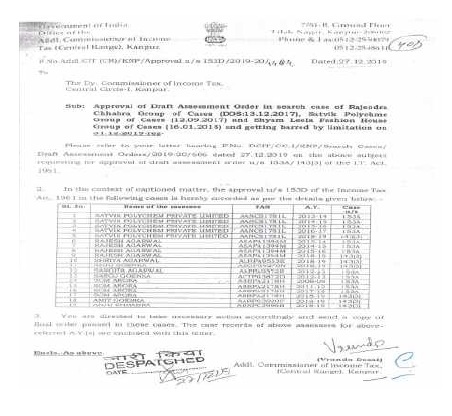
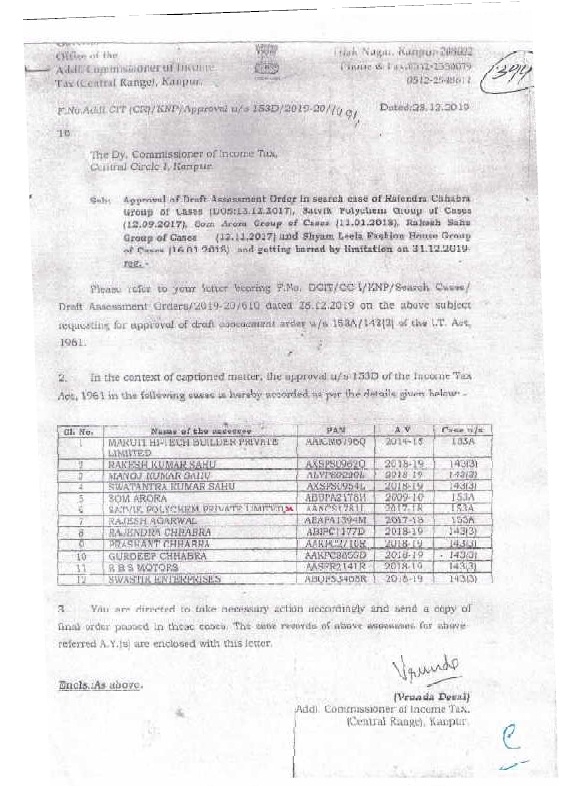
8.1 As is apparent from the above two communications, 19 approvals were given in one communication dated 27.12.2019 (including two in the appeals before us) and 12 approvals were given in another communication dated 28.12.2019 (including one in the appeal before us). The requirement of prior approval of a superior authority i.e. the AddI. CIT, requires that the Addl. CIT should give due consideration to all relevant materials and appraise them properly in order to appreciate the factual and the legal aspects. It is well settled in law that statutory approval by superior authority must be granted only on the basis of proper consideration of all relevant materials, and further that the approval must reflect the due application of mind to the facts of the case and to the applicable law.
8.2 In the case of Pr. CIT v. Subodh Agarwal Principal Commissioner of Income-tax v. Subodh Agarwal (Allahabad), it was held by the Hon’ble Jurisdictional High Court that it was humanly impossible to go through the records of 38 cases in one day to apply independent mind to appraise the materials before the approving authority and the Hon’ble Allahabad High Court upheld the conclusion drawn by the Income Tax Appellate Tribunal that it was the mechanical exercise of power. The Hon’ble High Court upheld the order of the Income Tax Appellate Tribunal that the approval given in such a manner vitiated the entire assessment proceedings. Similar view was taken by Hon’ble jurisdictional High Court in the case of Pr. CIT v. Siddarth Gupta (Allahabad). In addition to the aforesaid orders of Hon’ble jurisdictional High Court, the issue is also covered in favour of the assessee by the orders of Co-ordinate Bench of the Income Tax Appellate Tribunal, Lucknow in the cases of Sapna Gupta v. DCIT (order dated 07.10.2021 in I.T.(SS)A.No.424/LKW/2019), Navin Jain v. DCIT (order dated 03.08.2021 in I.T.(SS)A.No.424/Lkw/2019), Rohit Gupta v. DCIT (order dated 04.07.2022 in I.T.A. No.115/Lkw/2021), M/s Quality Structure Pvt. Ltd. v. DIT (order dated 30.09.2024 in I.T. (SS)A.No.679 & 680). The SLP filed by Revenue on this issue was dismissed by Hon’ble Supreme Court in(SC).
8.3 Similar view was taken by ITAT in Kamal Kant Verma v. DCIT in I.T.(SS)A. No.50 to 53/Lkw/2022, Sachin Verma v. DCIT in I.T.(SS)A. No.54/Lkw/2022 and Sachin Verma v. DCIT in I.T.A. No.55 to 59/Lkw/2022. In fact, the ITAT allowed relief to the assessee in these group of cases on facts identical to the facts in these present group of appeals. The captioned appeals were part of the 110 approvals granted on 27.12.2019 and 28.12.2019 and so were the Standard Frozen Foods Exports Pvt. Ltd., M/s Standard Agro Vet Pvt. Ltd., Shri Kamal Kanth Verma and Shri Sachin Verma group of cases (supra) which have already been allowed relief by the ITAT by holding that the approvals granted under section 153D of the Act were granted without due application of mind by the Addl. CIT. The ITAT in these group of cases annulled the assessments by placing reliance on number of judicial precedents viz.:
| (i) |
|
Hon’ble Allahabad High Court in the case of Pr. CIT v. Subodh Agarwal in ITA No.86 of 2022, dated 12.12.2022; |
| (ii) |
|
Hon’ble Orissa High Court in the case of ACIT v. Serajuddin & Co. (Orissa); |
| (iii) |
|
Hon’ble Delhi High Court in the case of Pr. CIT v. Shiv Kumar Nayyar in ITA No.285/2024. |
| (iv) |
|
ITAT Bangalore Bench in the case of Khoday Eshwarsa & Sons v. DCIT in ITA Nos.1079 & 1080/Bang/2024; |
| (v) |
|
ITAT Delhi Bench in the case of Sanjay Duggal & Sons in ITA No.1813/Del/2019; and |
| (vi) |
|
ITAT Lucknow Bench in the case of Quality Structure Pvt. Ltd. v. DCIT in IT(SS)A No.679&680/LKW/2019. |
8.4 The Ld. CIT (DR) has not been able to point out any facts in the present appeals which would distinguish the facts in the above mentioned group of appeals.
8.5 Therefore, respectfully following the aforesaid precedents and in view of foregoing discussion, it is held that the assessment orders passed in pursuance of approvals given by AddI. CIT in a mechanical manner without due application of mind, vitiated the entire assessment proceedings, which was fatal to the assessment orders. Accordingly, we set aside the impugned appellate orders of the learned CIT(A) in the present three appeals before us; and the corresponding assessment orders each dated 31.12.2019 (for assessment years 2015-16, 2016-17 and 2017-18) are annulled.
9. As we have already annulled the assessment orders in the foregoing paragraph No.8 of this order, the grounds taken by the assessee in the appeals on remaining disputes become merely academic in nature and need not be decided. Therefore, we decline to express any opinion on the same.
10. Since the assessment orders are annulled, the Departmental appeals become infructuous and are dismissed as such.”
(C) There are two aspects of approval given by JCIT u/s 153D of the Act. The first pertains to the consequences that follow if approval given u/s 153D of the Act is found to be invalid. This is a question of law on which we must take guidance from binding precedents and decisions of higher forums. In the aforesaid order dated 30/09/2025 passed by us in the case of Minto Developers Pvt. Ltd. (supra), we have taken guidance from binding precedents of Hon’ble Allahabad High Court in the cases Principal Commissioner of Income-tax v. Sapna Gupta (Allahabad)/ Income Tax Appeal No. 88 of 2022) and also in the case of Principal Commissioner of Income-tax v. Siddarth Gupta ITR 534 (Allahabad)/Income Tax Appeal No. 90 of 2022). We have also taken guidance from binding precedents in a Third Member case of Income Tax Appellate Tribunal passed in the case of Dheeraj Chaudhary v. ACIT (Delhi-Trib.) (TM). We have further taken guidance from the order of Hon’ble Orissa High Court in the case of ACIT v. Serajuddin & Co.(Orissa)/ (in order dated 15/03/2023 in I.T.A. Nos. 39 – 45 of 2022) (Orissa). The Special Writ Petitions filed by Revenue against the aforesaid order of Hon’ble Allahabad High Court in the case of Siddarth Gupta (supra), and order of Hon’ble Orissa High Court in the case of Serajuddin & Co. (supra) have been dismissed by Hon’ble Supreme Court. We have further taken guidance from the order of Hon’ble Delhi High Court in the case of Pr.CIT v. Shiv Kumar Nayyar (order dated 15/05/2024 in I.T.A. No.285 9/467 ITR (Delhi)/ CM Appeal 28994/2024) (Delhi). In this case, Hon’ble Delhi High Court duly considered the aforesaid orders of Hon’ble Allahabad High Court in the case of Sapna Gupta (supra) and Hon’ble Orissa High Court in the case of Serajuddin & Co. (supra), and expressing agreement with the Hon’ble Allahabad High Court and Hon’ble Orissa High Court; Hon’ble Delhi High Court upheld the order of the Income Tax Appellate Tribunal, quashing the assessment order. Further, in the case of Sapna Gupra (supra), Hon’ble Allahabad High Court has approved the order of Income Tax Appellate Tribunal in the case of Navin Jain & Others quashing the assessment order for lack of valid approval under section 153D of the Act. We have also taken guidance from the case of Pr.CIT v. Anuj Bansal (Delhi)/466 ITR 251 (Delhi) in which Hon’ble Delhi High Court upheld the order of the Income Tax Appellate Tribunal quashing assessment order on the ground that there was absence of application of mind by the approving authority in granting approval under section 153D of the Act. SLP filed by Revenue against this order of Hon’ble Delhi High Court has also dismissed by Hon’ble Supreme Court. Further we have taken guidance from order of Hon’ble Delhi High Court in the case reported at Pr.CIT v. Pioneer Tour Planner (P.) Ltd. ITR 356 (Delhi) and in Pr.CIT v. MDLR Hotels (P.) Ltd.(Delhi); in which similar view was taken. We have, moreover, taken guidance from the order of Hon’ble Allahabad High Court in the case of Pr.CIT v. Subodh Agarwal (Allahabad High Court). In all the aforesaid precedents, the quashing of assessment order by ITAT due to lack of valid approval under section 153D of the Act has been upheld by Hon’ble High Courts. We may further point out that the view taken by Income Tax Appellate Tribunal in the case of aforesaid order dated 31/10/2025 in the case of Ramji Vaish (supra) is in complete contrast with order passed in the case of Satvik Polychem Private Limited (supra), relevant portion of which has been reproduced in foregoing paragraph (B.3.1) of this order. In the case of Satvik Polychem Private Limited (supra), the Bench of Income Tax Appellate Tribunal has approved the quashing of assessment order for lack of valid approval under section 153D of the Act. However, the same Members of the Tribunal, in the case of Ramji Vaish (supra) have taken a contrasting decision, restoring the matters back to the file of the Assessing Officer for seeking fresh approvals from the range head. In our respectful opinion, the Bench of Tribunal, consisting of the same Members, and falling under the Jurisdiction of the same jurisdictional High Court (i.e. Hon’ble Allahabad High Court) was bound by their own earlier decision in the case of Satvik Polychem Private Limited (supra) wherein they have quashed the assessment orders for lack of valid approval under section 153D of the Act unless they were forced to take a different view on the basis of a stronger precedent. Since the aforesaid order dated 31/10/2025 in the case of Ramji Vaish (supra) is in violation of the binding precedents and precedents of higher forums, as discussed above, we respectfully hold that the aforesaid order dated 31/10/2025 in the case of Ramji Vaish (supra) is not a useful precedent for deciding the present appeals before us.
(C.1) We also find that the order of the Tribunal in the case of Ramji Vaish (supra), restoring the matter back to the file of the Assessing Officer for seeking fresh approval from the range head is also unimplementable and for this reason also it does not help us as a good precedent for deciding these appeals. The order in the case of Ramji Vaish is unimplementable because it will amount to non application of mind by the Assessing Officer if he seeks approval for draft assessment order prepared by his predecessor several years ago. The present Assessing Officer must exercise due application of mind on his own; and cannot simply resubmit the draft assessment order prepared by his predecessor. However, if the Assessing Officer exercises due application of mind on his own, and prepares a fresh draft of assessment order, the approval given by JCIT to the earlier draft assessment order becomes infructuous instantly; because the fresh approval under section 153D of the I.T. Act will no longer be for draft assessment order approved originally by JCIT vide aforesaid common approval letter dated 31/07/2017. In that event, it is self-evident that the approval given vide aforesaid common approval letter dated 31/07/2017 becomes automatically invalid.
(C.1) Moreover, in our aforesaid order dated 30/09/2025 in the case of Minto Developers Pvt. Ltd. (supra), we have already rejected the alternate submission made by Revenue to restore the matters regarding approvals under section 153D of the Act to the file of the approving authority, for two reasons. Firstly, because it would amount to providing a second inning to Revenue against mandate of law. Secondly, because it would amount to extending period of limitation available for completing assessment proceedings, which is not permissible in law. We have held already in that order that the limitation period available to Revenue is inclusive of time taken for granting approval under section 153D of the Act and there is no provision of law permitting extension of period of limitation for failure of the approving authority to give valid approval under section 153D of the Act. This view is consistent with the decision of Hon’ble Supreme Court in the case of Hope Textiles Ltd. v. Union of India (SC) in which it was held that even writ cannot be issued for passing order beyond limitation period. The Hon’ble Supreme Court held in this case that “A writ of mandamus can be issued to a statutory authority to compel it to perform its statutory obligation. It cannot be issued to compel him to pass an order in violation of a statutory provisions. Therefore, the writ cannot be issued to compel the ITO to pass order of assessment beyond period of limitation.” Further, in the case of Pr.CIT v. Sunrise Finlease (P.) Ltd. (Gujarat), Hon’ble Gujarat High Court held that lack of approval under section 153D of the Act would invalidate the assessment order, and was not a curable defect. The Hon’ble High Court noted that it was well settled that taxing statute had to be strictly construed; and requirement of obtaining approval of JCIT was to be regarded as mandatory in nature. It would be readily inferred that the lack of valid approval under section 153D of the Act was not a curable deficiency and the assessment orders passed in the absence of valid approval under section 153D of the Act would render the assessment order, void ab initio. Same view was taken by Nagpur Bench of the Income Tax Appellate Tribunal in the case of Umesh Sadashiv Thakre v. ACIT (Nagpur-Trib.) and in Maheshwari Coal Benefication & Infrastructure (P.) Ltd. v. DCIT (Nagpur-Trib) in which the settled position that absence of valid approval under section 153D of the Act was a substantive defect and thus not curable, was emphasized; and it was held that order passed without a valid approval was void ab initio. Further, we once again mention the principles that emerge from various precedents, as noted in paragraph (K) of our aforesaid order dated 30th September, 2025 in the case of Minto Developers Pvt. Ltd. (supra), relevant portion of which is already reproduced in foregoing paragraph (B.2.1) of this order:
“(K) The principles that emerge, in our understanding; from careful perusal of the aforesaid precedents, referred to in foregoing paragraphs (J.1) to (J.6.1) are as under:
| (i) |
|
Approval u/s 153D of IT Act cannot be a mechanical exercise. The approval must be granted by the approving authority after due application of independent mind. When this requirement is not met, the approval suffers from infirmity and is invalid. |
| (ii) |
|
The contention of Revenue that approval u/s 153D ofthe IT Act being an administrative act, is notjusticiable; is wrong. |
| (iii) |
|
It is a bare minimum requirement that the approving authority must indicate what thought process was involved in granting the approval. Even if elaborate reasons are not given; there has to be some indication that the approving authority has examined the draft orders with regard to applicable law and all the relevant materials. When this requirement is not met, such approval suffers from infirmity and is invalid. |
| (iv) |
|
The directions given by CBDT in Search Manual regarding granting of approval, although initially issued in the context of section 158BG of I.T. Act, are also applicable for approval u/s 153D of the IT Act; and are mandatory. When these directions are not met; the approval suffers from infirmity and is invalid. |
| (v) |
|
The approval of draft assessment order by approving authority being an in-built protection against any arbitrary or unjust exercise ofpower by the Assessing Officer, cannot be said to be a mechanical exercise without due application of independent mind by the approving authority on the relevant materials and reasoning given in the assessment order; so as to appreciate factual and legal aspects to ensure that the entire material has been factored in, in the draft assessment order proposed by the Assessing Officer. |
| (vi) |
|
Section 153D of the IT Act requires that the Assessing Officer shall obtain prior approval of JCIT in respect of each assessment year. Section 153D of the IT Act requires that the Assessing Officer would be required to furnish the return of income in respect of each assessment year. The proviso to section 153D of the IT Act further provides for assessment of the total income in respect of each assessment year. Careful and conjoint reading of section 153A and section 153D ofthe IT Act leave no room to doubt that approval with respect to each assessment year is mandatory. As separate returns are to be filed for each assessment year, and as separate assessment orders are to be passed for each assessment year; it follows that approvals u/s 153D of the IT Act are to be given by the approving authority separately for each assessment year. If approvals for multiple assessment years are given u/s 153D of the IT Act through a common letter of approval; this violates statutory requirements; and such approvals suffer from infirmity and are invalid. |
| (vii) |
|
In Manual of Office Procedure, Volume-II (Technical) issued by CBDT is exercise ofpowers u/s 119 ofthe IT Act has directed in Chapter -3 that the Assessing Officer should submit draft assessment order in search cases to the approving authority well in time; and the approving authority should give due opportunity of being heard, at least one month before time barring date. These directions are binding on the Assessing Officer. |
| (viii) |
|
The Assessing Officer, while framing assessment, acts in quasijudicial capacity and he ought to conform to the more elementary rules of judicial procedure; and in particular, to conduct the case himself, and not allow somebody else, even his superior officer to interfere in the conduct of the case. Higher authorities an Assessing Officer, Addl. CIT/Joint CIT i.e. JCIT or CIT or CCIT are not entitled to interfere in process of framing of assessment order by the Assessing Officer; except by mandate of law. The Addl.CIT/JCIT is entitled to issue directions u/s 144A of IT Act. Other than that, his role starts when he receives draft assessment orders for approval u/s 153D of the IT Act (wherever such approval is required under law). When first draft is returned back; his role ceases; and the role of Add. CIT / JCIT starts again when he receives the final draft of the proposed assessment order, which he eventually approves. The question if the approval u/s 153D of the IT Act suffered from infirmity and was invalid is to be decided having regard to receipt of final draft of the proposed assessment order which the Addl. CIT /JCIT eventually approved. The association of Addl. CIT/JCIT with the Assessing Officer, and involvement of the Addl. CIT/JCIT in the assessment proceedings before that has no relevance for deciding whether approval u/s 153D ofthe IT Act suffered from infirmity and was invalid. In fact, in view of the foregoing discussion, any such association and involvement may, depending on facts and circumstances of the case, be fatal to the assessment on strict application of rules of judicial procedure as aforesaid; depending on facts and circumstances ofthe case. |
| (ix) |
|
When approval u/s 153D ofthe IT Act suffers from infirmity and is invalid for one or more aforesaid reasons, the entire assessment order becomes vitiated; and is to be annulled.” |
(C.1.2) Accordingly, we again affirm our view that assessment order passed under section 153A of the Act in the absence of valid approval under section 153D of the Act is not curable, and it makes the assessment order void ab initio; and such an assessment order deserves to be annulled.
(C.2) The second aspect of approval under section 153D of the Act is the question whether in a particular case the approval granted under section 153D of the Act suffered from infirmities rendering the approval invalid. We note that the approval given in the cases pertaining to these appeals before us, vide aforesaid common approval letter dated 31/07/2017 is the same approval letter through which the approval was granted by JCIT in the case of aforesaid order dated 30/09/2025 passed by us in the case of Minto Developers Pvt. Ltd. (supra). In the aforesaid case of Minto Developers Pvt. Ltd. (supra), we have already taken view that the approval by JCIT under section 153D of the Act was granted in a mechanical way, without due application of mind, as an idle formality and in a manner of rubber stamping. We have also highlighted in the aforesaid order dated 30/09/2025 in the case of Minto Developers Pvt. Ltd. that the approval under section 153D of the Act suffered from multiple infirmities because of which the approval granted under section 153D of the Act was invalid. The relevant discussion in paragraph (L) to (M) of our order dated 30/09/2025 in the case of Minto Developers Pvt. Ltd., already reproduced in foregoing paragraph (B.2.1) of this order, is reproduced below for the ease of reference:
“(L) We accept the contention of the learned Departmental Representatives, as referred to in foregoing paragraph (H.1.1) of this order that whether in a particular case, JCIT had given approval u/s 153D of the IT Act after due application of mind, is a question of fact and the answer would depend on facts and circumstances of the particular case, independent of conclusion arrived at in any other case.
(L.1) Coming to the facts and circumstances of the present case; we accept the contention ofthe learned Counsel for the assessee that the affidavit of Shri M. L. Meena, the Assessing Officer and personal testimony of Shri Agrahari, Departmental Inspector are de void of any credibility; having regard to submissions made by learned Counsel for the assessee as referred to in foregoing paragraph (I) of this order. Further, in view of submissions of learned Counsel for the assessee as referred to in foregoing paragraph (I.1) of this order, we are of the opinion that neither the story presented by Revenue regarding Pen Drive inspires confidence nor, in any case it advances the case of Revenue, in the absence of any description of the contents of the Pen Drive in letter dated 18/07/2017 of the Assessing Officer and in the absence of any reference to Pen Drive in the notes and order sheet of the JCIT, the approving authority. Moreover, it is claimed by Revenue that all relevant records/materials were sent to the Addl. CIT/JCIT along with editable soft copies of the draft assessment order together with letter dated 18/07/2017, but there is no mention of “all relevant records/materials” in the letter dated 18/07/2017. Also, as mentioned earlier, there is no description of the contents of the Pen Drive in letter dated 18/07/2017. Besides, we are perplexed at hand written mention of the Pen Drive in the letter. Who writes Pen Drive as “Pen Drib”?. Who writes 1 Piece as “1 pees”? We are not convinced that a Pen Drive was sent with the letter dated 18/07/2017 by the Assessing Officer to the Addl. CIT/JCIT. Notwithstanding, the claim of Revenue that all relevant records/materials; which should consist of assessment records, seized materials, digital data in CPU, HDD and laptop, reports under Rules 9 and 9A of ITSC(P) Rules, assessees’ submissions etc; were available to the JCIT who gave approval u/s 153D of the IT Act in either physical form of digital form, is not borne out from records. Even if it was available, there is nothing on record to show that indeed the JCIT considered all relevant materials before giving approval u/s 153D of the IT Act. Further, having regard to submissions made by learned Counsel for the assessee, as referred to in foregoing paragraphs (F.1.1), (F.1.4, (F.1.4.1), (F.1.5) (I) (I.1) and (I.2) of this order; it is concluded that approval was granted by JCIT in a mechanical way without due application of mind, as an idle formality, and in the manner of rubber stamping; as it was humanly impossible for the JCIT to give approval in a total of 63 assessments; vide aforesaid common approval letter dated 31/07/2017; after due consideration of all relevant materials such as seized materials, appraisal report, digital data, submissions of the assessees, assessment records, reports under Rules 9 and 9A of ITSC(P) Rules, etc; within extremely limited time available to the JCIT. Further, the assessment order is dated 31/07/2017 but there is no mention of return of the assessment record from Varanasi (where JCIT was stationed) to Allahabad (where Assessing Officer was stationed) in any official communication between the two of them; which shows that the assessment records always remained with the Assessing Officer; and the JCIT did not even refer to the assessment records before granting approval u/s 153D of the IT Act. The doctrine of human probabilities in orders of Hon’ble Supreme Court in Durga Prasad More 82 ITR 540 (SC) and Sumati Dayal 214 ITR 801 (SC) operates against Revenue, in the facts and circumstances of the present case.
(L.2) It is not in dispute that aforesaid common approval letter dated 31/07/2017 was issued by JCIT to give approval u/s 153D of the IT Act for 63 different assessments pertaining to 11 different assessees ofJeevan Jyoti Group, for different assessmentyears.
(L.3) On perusal of aforesaid common approval letter dated 31/07/2017 issued by JCIT; it is found that there is complete absence of any indication of thought process involved in granting the approvals for the assessment u/s 153D of the IT Act. There is no indication that the JCIT examined the draft order with regard to assessment record, applicable law and all relevant materials. The approval u/s 153D of the IT Act has been given in a non-speaking, summary and formal way, in the manner of rubber stamping.
(L.4) Neither the approving authority gave opportunity of being heard to the assessee before giving approval u/s 153D of the IT Act; nor did the Assessing Officer submit draft assessment order to the approving authority well in time to enable the approving authority to provide opportunity to the assessee (at least) one month before the time barring date of 31/07/2017. Thus, the approving authority and the Assessing Officer, both, failed to comply with mandatory direction of CBDT, issued in exercise of power u/s 119 of the IT Act, in Chapter-3 of Manual of Office Procedure, Volume-II (Technical).
(L.5) The claim of Revenue that Addl. CIT/JCIT were associated with the Assessing Officer and were involved in assessment proceedings (otherwise than in proceedings u/s 144A of IT Act) even before role of Addl. CIT/JCIT as approving authority u/s 153D of the IT Act began upon receipt of the final draft of the proposed assessment order which was eventually approved u/s 153D of the IT Act, is in violation of Rules of judicial procedure prohibiting any interference by higher authorities with assessment proceedings before the Assessing Officer.
(M) When the facts of the case as discovered in foregoing paragraphs (L.1), (L.2), (L.3), (L.4) and (L.5) are considered; they are found to be in contravention of every principle in foregoing paragraph (K) of this order enumerated as (i) to (ix). Respectfully following the precedents referred to in foregoing paragraphs (J.1) to (J.6.1); which are at the core of these principles; it is concluded that approval u/s 153D of the IT Act was given by the JCIT in a mechanical manner without due application of mind. It is further concluded that the approval u/s 153D of the IT Act given by the JCIT suffered from infirmities mentioned at Sl.Nos. (i), (iii), (vi), (viii) and (iv) read with (vii) in foregoing paragraph (K) of this order. Accordingly, it is concluded that the approval given u/s 153D of the IT Act suffers from multiple infirmities; and is invalid; because of which the entire assessment order is vitiated. In accordance with Sl.No. (ix) in foregoing paragraph (K) ofthis order, therefore, the assessment order is to be annulled. The alternate submission made by learned Departmental Representatives, to restore the matter regarding approval u/s 153D of the IT Act to the file of the approving authority (i.e. Addl. CIT/JCIT) is rejected because it would amount to providing a second innings to Revenue against mandate of law; and also because it would amount to extending period of limitation available for completing assessment proceedings, which is not permissible in law. The limitation period available to Revenue is inclusive of time taken for granting approval u/s 153D of the IT Act; and there is no provision of law permitting extention of period of limitation for failure of the approving authority to give valid approval u/s 153D of the IT Act. In view ofthe foregoing; the Assessing Officer is annulled.
(M.1) Since the assessment order is annulled, the impugned appellate order of learned CIT(A) has no legs to stand. Therefore, the impugned appellate order of learned CIT(A) is set aside.
(M.2) As mentioned in foregoing paragraph (F) of this order, representatives of both sides have agreed that appeals of Minto Developers Pvt. Ltd. (I.T.A. No.337/Lkw/2018 for A.Y. 2009-10) may be taken as the lead case as regards the legal issue whether the assessments were passed by the Assessing Officer after obtaining valid approval of JCIT. They submitted that the facts and circumstances for all the other appeals on this issue were in para materia and the decision in the case of Minto Developers Pvt. Ltd. would apply mutatis mutandis to remaining cases also. Therefore, the assessment orders pertaining to all the appeals/Cross Objections are also hereby annulled; and the impugned appellate orders pertaining to all appeals/Cross Objections before us are set aside.
(M.2.1) As the assessment orders pertaining to all appeals and Cross Objections before us have been annulled; and all the impugned appellate orders have been set aside; the grounds pertaining to other issues and matters before us have become merely academic in nature; hence not decided.
(C.2.1) As the facts of the present appeals before us are identical to the facts of aforesaid order dated 30/09/2025 in the case of Minto Developers Pvt. Ltd. (supra) to such an extent that approval under section 153D of the Act have been given by the same common approval letter dated 31/07/2017; and as our order in the case of Minto Developers Pvt. Ltd. has been passed after detailed discussion of submissions made by the two sides, careful perusal of materials on record and due consideration of precedents, we are inclined to conclude in the present appeals also that approval given under section 153D of the Act suffered from multiple infirmities because of which approval given under section 153D of the I.T. Act was rendered; and we are further inclined to annul the assessment orders pertaining to the present appeals, also in the like manner. However, we would also like to add further, having regard to materials and submissions brought for our consideration by learned Departmental Representatives at the time of hearing of these appeals. Firstly, we observe that the learned Departmental Representatives wrongly contended at the time of hearing that in the case of order passed by us in Minto Developers Pvt. Ltd. (supra) there was no mention anywhere that approvals were given by JCIT in a mechanical way without due application of mind. We note that in paragraph (L.1) our order in the case of Minto Developers Pvt. Ltd., already reproduced earlier in paragraph (B.2.1) of this order; we have categorically concluded that approval was granted by JCIT in a mechanical way without due application of mind as an idle formality and in a manner of rubber stamping. Further, it has been wrongly submitted by learned Departmental Representatives at the time of hearing, that order in the case of Minto Developers Pvt. Ltd. (supra) did not take into consideration the fact that JCIT had given certain directions regarding the first draft of the assessment order submitted alongwith the letter dated 18/07/2017; and that the final drafts, which were approved by JCIT vide aforesaid common approval letter dated 31/07/2017 were slightly different from earlier drafts in some cases. We find that in paragraph (H) of our order in the case of Minto Developers Pvt. Ltd., we have duly taken into consideration the submissions of the learned Departmental Representatives that there was a discussion between the JCIT and the Assessing Officer on 25/07/2017 that after that discussion the JCIT gave certain directions to the Assessing Officer and that the Assessing Officer forwarded the second draft assessment order along with the letter dated 28/07/2017. Moreover, we are disturbed by the contention of the learned Departmental Representatives that the Assessing Officer and the JCIT giving approval under section 153D of the Act were not required to peruse all the materials found/seized at the time of search under section 132 of the Act. The learned Departmental Representatives have contended that it was sufficient for the Assessing Officer and the JCIT to start their work with appraisal report (prepared by Investigation Wing of the Income Tax Department) as the basis. It amounts to admission that neither the Assessing Officer nor the JCIT applied their minds to materials found/seized in the course of search under section 132 of the Act and they were relying on appraisal of these materials by the Investigation Wing. This is tantamount to accepting that there was non application of mind by not only the JCIT giving approval under section 153D of the Act but also by the Assessing Officer; to material facts of the case; that they relied on borrowed appraisal of material facts as prepared by Investigation Wing. On this basis alone, the assessment orders deserve to be annulled.
(C.3) On facts also, these cases before us are clearly distinguishable from the facts of order of Lucknow Bench of the Tribunal in the case of Ramji Vaish (supra) because of which the order in the case of Ramji Vaish is not a useful precedent for deciding the appeals before us. In the case of Ramji Vaish (supra), the Bench of the Tribunal gave material consideration to the fact that there was ongoing discussion and consultation between the Assessing Officer and the approving authority under section 153D of the Act over prolonged period. However, in the present appeals before us, as is also obvious from relevant discussion in our aforesaid order dated 30/09/2025 in the case of Minto Developers Pvt. Ltd. (supra) that the JCIT who eventually gave approval under section 153D of the Act joined office barely a few days before giving approval through aforesaid common approval letter dated 31/07/2017. The JCIT, in fact joined office and took charge on 21/07/2017. This is clearly a relevant and distinguishing fact. Thus, the JCIT did not have enough time to familiarize himself with all the cases; and to have any kind of meaningful discussion. Moreover, another distinguishing fact is, the Assessing Officer and JCIT were posted at two different stations at (Allahabad and Varanasi) respectively, which must have come in the way of regular discussion and consultation.
(C.4) The learned Departmental Representatives have also strongly contended that there was prior discussion between the Assessing Officer and the JCIT because of which it cannot be said that JCIT gave approval under section 153D of the Act without due application of mind. In our order in the case of Minto Developers Pvt. Ltd., we have discussed how consultation, between the JCIT and Assessing Officer prior to approval under section 153D of the Act was not only irrelevant for deciding whether the approval was valid; but also was fatal to the assessment order itself due to interference of JCIT during pendency of assessment proceedings before the Assessing Officer. The relevant discussion is in paragraph (K) of our order in the case of Minto Developers Pvt. Ltd. In this regard, we would like to add further that the meaning of approval was explained by Hon’ble Supreme Court in the case of Lord Krishna Textiles Ltd. v. Its Workmen [1961] 1 LLJ 211 (SC).[1961] 1 LLJ 211 (SC). The Hon’ble Supreme Court noted that approval, according to dictionary meaning, suggests that what has to be approved has already taken place; it is in the nature of ratification of what has already taken place. The word ‘approval’ in contradiction to the ‘prior permission’ shows that the action is taken first and ‘approval’ is to be obtained afterwards. It would logically imply that any role of JCIT in his association with the Assessing Officer, is de hors, his role and association as an approving authority under section 153D of the IT Act. His role prior to that of approval u/s 153D of the Act is that of general supervision of Assessing Officer; and it precludes interference in process of assessment. His legitimate role in the assessment is only as approving authority which begins only after the final draft of assessment order (eventually approved) is received at his end. Moreover, Hon’ble Punjab & Haryana High Court in a recent case reported at Findoc Finvest (P.) Ltd. v. DCIT FinDoc Finvest (P.) Ltd. v. Deputy Commissioner of Income-tax, Central (Punjab & Haryana) (Punjab & Haryana), held that where Assessing Officer was influenced by consultation and discussion with superior officer, assessment order could not be result of an independent application of mind but an order passed under influence and directions of superior officer. The assessment order was to be set aside. We also take guidance from case of DCIT v. Surendra Kumar Jain (dead) through legal heir (neutral citation 2024: CGHC:25811-DB) [2025] 472 ITR 346 (Chhattisgarh)/I.T.A. No. 6 of 2005, vide order delivered on 18/07/2024 in which Hon’ble Chhatisgarh High Court, after detailed discussion of numerous orders of Hon’ble Supreme Court and Hon’ble High Courts, upheld the quashing of assessment order by ITAT, and held that (i) In democracy like ours, every authority may, however high, should function within four corners of law because the rule of law requires that all the machinery of state must function according to mandate of statute (ii) Statutory authority cannot permit its decision to be influenced by dictation of superior as same would amount to surrendering of discretion (iii) General power of superintendence must be distinguished from the interference in the adjudication process (iv) The true test of bias is not whether the judge is actually biased or not, but whether there is a real danger of bias from view point of fair minded and informed observer.
(C.5) Even on perusal of bare act; we find in provisions u/s 119 of IT Act; that even CBDT cannot issue orders, instructions or direction so as to require any Income Tax Authority to make a particular assessment or to dispose of a particular case in a particular manner. The approving authority u/s 153D of the I.T. Act cannot be delegated with powers (by an instruction/circular/notification of CBDT) which CBDT does not have. It is well settled, that a delegating authority cannot delegate such powers to a subordinate authority, which the delegating authority does not have. So, the argument that the CBDT can issue direction to the Assessing Officer, to have discussion and consultation with JCIT; fails comprehensively.
(C.6) We also would like to comment on the contention of the learned Departmental Representatives that the JCIT who gave approval under section 153D of the Act was now available for filing of affidavit and for giving personal evidence. We express strong disapproval of this tendency on the part of the Revenue to try to incrementally improve their case; by bringing materials which were not available at the time of framing of the original assessment order. We hold that such a practice has to be discouraged. We further hold that any material which was not part of the assessment record, cannot be used at this stage to advance the case of Revenue for deciding validity of approval u/s 153D of the I.T. Act; whether it be affidavit, personal evidence or the claim that there was discussion and consultation between the Assessing Officer and the JCIT. In this regard, we take respectful guidance from order of Hon’ble Madras High Court in the case of Central Board of Direct Taxes v. Regen Infrastructure & Services (P.) Ltd. (Madras) (Madras), in which at para 8 of the order, relying on order of Hon’ble Supreme Court in the case of Mohinder Singh Gill v. CEC AIR 1978 SC 851, Hon’ble High Court held that an order must necessarily be tested for its validity with reference to the reasons assigned and found on record. “The reasons cannot be supplemented subsequent to the passing of such order, by furnishing any other memorandum containing additional reasons or by way of explanations in the form of affidavit……..Otherwise, an order bad in the beginning may, by the time it comes to court on account of challenge, get validated by additional grounds later brought out.”, the Hon’ble High Court held.
(D) In view of the foregoing discussion, we hold, concurring with our earlier decision in the aforesaid order dated 30/09/2025; in the case of Minto Developers Pvt. Ltd. (supra); that in cases pertaining to present appeals before us; the approval given u/s 153D of the IT Act suffered from multiple infirmities; rendering the approval u/s 153D of the IT Act invalid in the eyes of law. For the same reasons, we hereby annul the assessment orders in the cases pertaining to present appeals before us. As the assessment orders have been annulled, other grounds taken in these appeals on merits of the additions made, become infructuous and merely academic; hence not decided. In appeals filed by the assessee; the grounds taken against initiation of penalty proceedings are not maintainable; which are dismissed being not maintainable.
(E.1) In view of the foregoing, we are of the view, consistent with the view taken by us in the cases of Jyoti Mediservices Pvt. Ltd. (supra), and Minto Developers Pvt. Ltd. (supra); that the approval has been given by Addl. CIT, under section 148B of the Act, in a mechanical manner and is not valid in the eye of law.
(E.1.1) Another reason, why the approval given by the Addl. CIT under section 148B of the Act is not valid, is because of his failure to dispose of the assessee’s application under section 144A of the Act. Through a petition under section 144 of the Act, the jurisdiction of the Addl. CIT was invoked, which remained to be discharged by the Addl. CIT. Neither the Addl. CIT gave any direction under section 144B of the Act, nor did he dispose of the assessee’s application under section 144A of the Act in any manner. Relevant discussion on this matter has also been made in foregoing paragraph (C.1) of this order, wherein contents of the assessee’s application under section 144 of the I. T. Act have been discussed. When the jurisdiction of Addl. CIT under section 144A of the Act is invoked by an assessee, the role of Addl. CIT temporarily becomes that of an assessing authority having concurrent jurisdiction with designated Assessing Officer having jurisdiction permanently. The failure of the Addl. CIT to give direction under section 144A of the Act and to dispose of the application under section 144A of the Act in any manner whatsoever, implied that because of this failure, the preparation of draft assessment order remained incomplete. Since the preparation of draft assessment order itself remained incomplete, the approval given under section 148B of the Act to such an incompletely prepared draft assessment order has to be held as invalid and suffering from infirmity.
(E.2) Because of the aforesaid reasons, we hold that the approval given by the Addl. CIT under section 148B of the Act was invalid in the eye of law. Further, since the provisions of giving approval under section 148B of the Act are akin to earlier provisions under section 153D of the Act, and both the provisions are in pari materia, therefore, following our decision in Jyoti Mediservices Pvt. Ltd. v. DCIT (supra), we hold that the assessment order, passed without a valid approval of the Addl. CIT, is in itself invalid and deserves to be annulled.
(F) In the assessee’s appeal for assessment year 2014-15, the assessee has also disputed the initiation of proceedings under section 147 of the Act. This issue was also raised by the assessee during appellate proceedings before the learned CIT(A). The learned CIT(A) however dismissed the assessee’s plea, taking recourse to Explanation -2 to Section 148 of the Act. The relevant portion of the order of the learned CIT(A) is reproduced as under:
(F.1) At the time of hearing, the learned A.R. for the assessee placed reliance on written submissions on this matter, as referred to in foregoing paragraphs (B.1), (B.2), (B.2.1) and (B.3) of this order. The learned Departmental Representative placed reliance on the impugned order of the learned CIT(A).
(F.2) We have heard both sides. We have perused materials on record. Relevant facts are not in dispute. It is not in dispute, that no incriminating material was found from the assessee’s premises during search under section 132 of the I. T. Act. Therefore, the Assessing Officer, in the absence of any such incriminating material; had no reason to believe that income had escaped assessment. The search under section 132 of the Act was conducted on 05/02/2022. Therefore, for the purpose of notice under section 148 of the Act read with section 147 of the Act, the provisions of law as amended by Finance Act, 2021 would prevail. The provisions of section 147 & 148 of the I. T. Act, as amended by Finance Act, 2021, and prevailing at the relevant time; are reproduced below:
“Income escaping assessment
147. If any income chargeable to tax, in the case of an assessee, has escaped assessment for any assessment year, the Assessing Officer may, subject to the provisions of sections 148 to 153. assess or reassess such income or recompute the loss or the depreciation allowance or any other allowance or deduction for such assessment year (hereafter in this section and in sections 148 to 153 referred to as the relevant assessment year Explanation.—For the purposes of assessment or reassessment or recomputation under this section, the Assessing Officer may assess or reassess the income in respect of any issue, which has escaped assessment, and such issue comes to his notice subsequently in the course of the proceedings under this section, irrespective of the fact that the provisions of section 148A have not been complied with. “
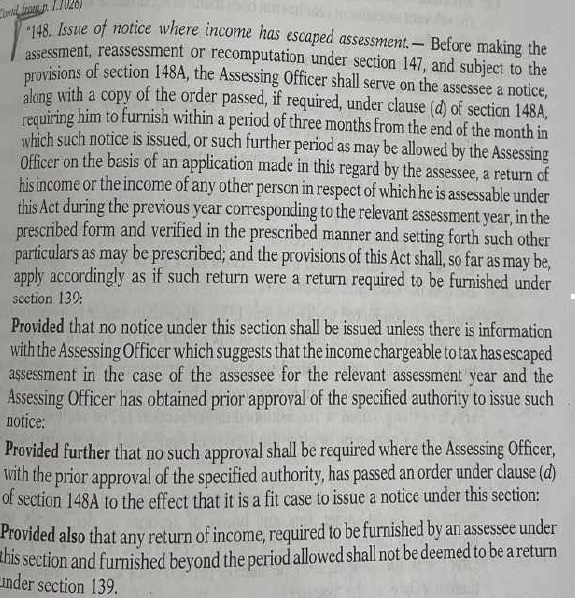
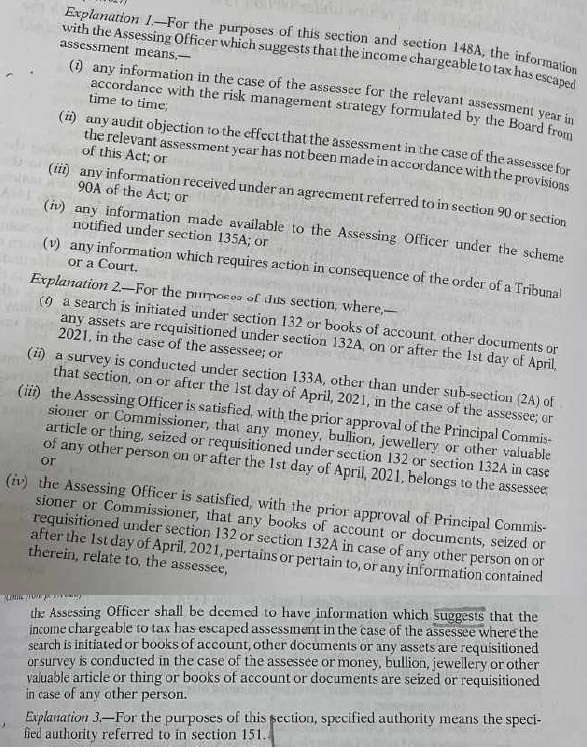
(F.2.1) A conjoint reading of the prevailing law as contained in section 147 & 148 of the I. T. Act, shows that the Assessing Officer is deemed to have information which suggests that income chargeable to tax has escaped assessment where a search is initiated under section 132 of the Act. However, to satisfy the requirement of section 147 of the Act, a mere suggestion is not adequate to assume jurisdiction under section 147 of the Act. The perusal of section 147 of the I. T. Act shows that the Assessing Officer can assume jurisdiction under section 147 of the Act if any income chargeable to tax has escaped assessment. Therefore, to assume jurisdiction under section 147 of the Act, the Assessing Officer must have, sound reasons to belief (and not just a suggestion) that income chargeable to tax has escaped assessment in the case of the assessee. The deeming provision under Explanation-2 to Section 148 of the Act is to be read strictly and not liberally; as it is well settled that deeming provisions of law are to be interpreted strictly. Explanation-2 to Section 148 of the Act provides that the Assessing Officer is deemed to have information which suggests that income chargeable to tax has escaped assessment. However, there is no deeming provision of law to the effect that the Assessing Officer is deemed to have sound belief that income has escaped assessment. The requirement u/s 147 of I. T. Act of forming a sound belief that income has escaped assessment, has placed a much higher burden on the Assessing Officer than merely having suggestion, that income has escaped assessment. Moreover, the search action under section 132 of the Act is merely a provision of law, authorizing investigation of the assessee’s affairs. Section 132 of the Act is not a charging provision. A provision of law, authorizing investigation in the case of the assessee, cannot bestow substantive or jurisdictional rights on Revenue to the detriment of the assessee, which were not available before the investigation started. It is well settled that provisions of law are to be interpreted in a manner which does not lead to absurd results. The interpretation give by the learned CIT(A) would imply that merely because search has been conducted under section 132 of the Act, which is a no more than a process of investigation; the Assessing Officer becomes vested with additional substantive and jurisdictional powers to assume jurisdiction u/s 147 of the I. T. Act even when no incriminating materials have been found at the time of search u/s 132 of the I. T. Act from the assessee’s premises based on which the Assessing Officer can reasonably arrive at sound belief that income has escaped assessment. This interpretation, being absurd is unacceptable. A reasonable interpretation of law, as provided in Section 147 and 148 of the I. T. Act, is that the Assessing Officer can assume jurisdiction u/s 147 of the I. T. Act if he can reasonably come to a sound belief that income has escaped assessment, with the help of incriminating materials found in the course of search under section 132 of the Act. However, if there are no incriminating materials found during search under section 132 of the Act, the deeming ‘suggestion’ under Explanation-2 to Section 148 of the Act, in itself does not lead to fulfillment of mandatory requirement u/s 147 of the I. T. Act that Assessing Officer must have sound reasons to believe that income has escaped assessment. From perusal of records, it is obvious that no incriminating material was found in the course of search under section 132 of the Act. In the absence of any incriminating material, the deeming provision under section 132 of the Act is not adequate for the Assessing Officer to assume jurisdiction under section 147 of the Act. For the aforesaid reason, we are of the view that the proceedings under section 147 read with section 148 were started, and jurisdiction under section 147 was assumed by the Assessing Officer without meeting the requirement of law. Accordingly, we conclude that the assessment order passed under section 147 of the Act is nonest and is unsustainable in the eye of law. Therefore, for this reason also, the assessment order deserved to be annulled.
(G) For the aforesaid reasons, as discussed in foregoing paragraphs (E), (E.1), (E.2), (E.2.1), (E.3), (F), (F.1), (F.2) and (F.2.1); the assessment order for assessment year 2014-15 is hereby annulled.
(G.1) Since the assessment order has been annulled, our observations regarding merits of various additions, as contained in earlier part of this order, become merely academic in nature.
(H) In assessment year 2015-16, in the assessee’s appeal vide I.T.A. No.348/Lkw/2025, once again the validity of initiation of proceedings under section 147 of the Act, and validity of approval granted under section 148B of the Act have been challenged. Moreover, the assessee has objected to net profit rate being assessed at 7% as per impugned appellate order of learned CIT(A), instead of the net profit rate disclosed by the assessee in the return of income. Further, the assessee has also appealed against the addition of Rs.1,54,35,000/- under section 56(2)(vii)(b) of the Act, out of which addition of Rs.47,38,700/- was sustained by learned CIT(A). We take up these issues one by one.
(H.1) As regards the aforesaid addition of Rs.1,54,35,000/- under section 56(2)(vii)(b) of the Act also, learned CIT(A) has sustained an addition of Rs.47,38,700/- in her impugned appellate order. At the time of hearing, learned A.R. for the assessee relied on written submissions made on this issue, as contained in foregoing paragraphs (B.1), (B.2), (B.2.1) and (B.3) of this order and explained that addition is to be restricted to Rs.6,29,103/-instead of Rs.47,48,700/- as per impugned order of learned CIT(A). Learned Departmental Representative supported the impugned order of learned CIT(A) and assessment order passed by the Assessing Officer. In view of the aforesaid submissions made from the assessee’s side; we direct the Assessing Officer to restrict the addition u/s 56(2)(vii)(b) of I. T. Act; to Rs.6,29,103/- as explained by learned A.R. for the assessee.
(H.2) As regards the dispute on net profit ratio; this issue for assessment year 2015-16 is in pari materia with assessment year 2014-15. No material has been brought for our consideration by either side at the time of hearing to persuade us to take a view different from the view taken in assessment year 2014-15. Therefore, consistent with our view taken for assessment year 2014-15, we direct the Assessing Officer to accept net profit ratio disclosed by the assessee in return of income.
(H.2.1) As regards the validity of approval given by Addl. CIT u/s 148B of the I. T. Act, our view taken in assessment year 2014-15 in I.T.A. No.348/Lkw/2025 and our findings given for assessment year 2014015 will apply in this year also, because facts and circumstances in assessment year 2015-16 are in pari material with assessment year 2014-15; and no material has been brought for our consideration by either side, at the time of hearing to persuade us to take a view in assessment year 2015-16, different from our view taken for assessment year 2014-15. Accordingly, it is held that the approval granted u/s 148B of the Act is invalid in the eyes of law.
(H.3) Similarly, as far as validity of proceedings u/s 147 of I. T. Act is concerned, facts and circumstances for assessment year 2015-16 are in pari material with assessment year 2014-15 and no materia has been brought for our consideration by either side, at the time of hearing, to persuade us to take a view in assessment year 2015-16, different from view taken in assessment year 2014-15. Therefore, we hold that initiation of proceedings u/s 147 of the Act is invalid.
(I) Consistent with our order for assessment year 2014-15; and in view of foregoing paragraphs (H.2.1) and (H.3) of this order; the assessment order for assessment year 2015-16 is annulled.
(I.1) Since the assessment order for A.Y.2015-16 has been annulled, our observations regarding merits of various additions, as contained in earlier part of this order for assessment year 2015-16, become merely academic in nature.
(J) In assessment year 2015-16, the Revenue’s appeal vide I.T.A. No.398/Lkw/2025 has tax effect below Rs.60 lacs. Representatives of both sides, the learned Departmental Representative for Revenue and the learned A.R. for the assessee were in agreement that the tax effect being below the minimum prescribed limit of Rs.60,00,000/-, this appeal is not maintainable and should be dismissed. In view of foregoing and as representatives of both sides are in agreement on this, this appeal is dismissed in limine without admitting the appeal and without going into the merits of the case. By way of abundant caution, we clarify that Revenue will be at liberty to approach Income Tax Appellate Tribunal for restoration of appeal; if deemed fit, if it is found that the appeal is otherwise maintainable despite the tax effect being below Rs.60 lakhs.
(K) In assessment year 2016-17 also, the assessee, in appeal vide I.T.A. No.349/Lkw/2025; has raised dispute regarding validity of initiation of proceedings u/s 147 of the Act and validity of approval under section 148B of the Act. Further the assessee has also disputed the estimation of net profit rate @7% in the impugned order of learned CIT(A), which is higher than the net profit rate disclosed by the assessee in the return of income. In Revenue’s appeal for assessment year 2016-17 vide I.T.A. No.399/Lkw/2025, only one issue has been raised which is regarding the net profit rate. Revenue has appealed against scaling down of the net profit rate from 11% as per assessment order to 7% as per impugned appellate order of learned CIT(A). In assessment year 2017-18 also, the assessee, in appeal vide I.T.A. No.350/Lkw/2025, has raised dispute regarding validity of initiation of proceedings u/s 147 of the Act and validity of approval under section 148B of the Act. Further, the assessee has also disputed the estimation of net profit rate @7% in the impugned order of learned CIT(A), which is higher than the net profit rate disclosed by the assessee in the return of income. In Revenue’s appeal for assessment year 2017-18 vide I.T.A. No.460/Lkw/2025, only one issue has been raised which is regarding the net profit rate. Revenue has appealed against scaling down of the net profit rate from 11% as per assessment order to 7% as per impugned appellate order of learned CIT(A). In assessment year 2018-19, in the assessee’s appeal, vide I.T.A. No.351/Lkw/20205, once again the validity of initiation of proceedings under section 147 of the Act, and validity of approval granted under section 148B of the Act have been challenged. The assessee has also appealed against estimation of net profit rate @7% in the impugned appellate order. In assessment year 2019-20, the assessee, in appeal vide I.T.A. No.352/Lkw/2025, has once again raised dispute regarding validity of initiation u/s 148 of the Act and validity of approval under section 148B of the Act. Further the assessee has also disputed the estimation of net profit rate @7% in the impugned order of learned CIT(A), which is higher than the net profit rate disclosed by the assessee in the return of income. In Revenue’s appeal for assessment year 2019-20 vide I.T.A. No.402/Lkw/2025, only one issue has been raised which is regarding the net profit rate. Revenue has appealed against scaling down of the net profit rate from 11% as per assessment order to 7% as per impugned appellate order of learned CIT(A).
(K.1) In respect of all the disputed issues in aforesaid appeals filed by the assessee and by Revenue, for Assessment Year 2016-17, Assessment Year 2017-18, Assessment Year 2018-19 and Assessment Year 2019-20; the facts and circumstances are in pari materia with facts and circumstances for Assessment Year 2014-15. No materials have been brought for our consideration to persuade us to take a view in assessment year 2016-16 to assessment year 2019-20, different from view taken by us in assessment year 2014-15. Accordingly, consistent with our view taken in assessment year 2014-15; we direct the Assessing Officer to accept the net profit rates disclosed by the assessee in respective returns for assessment year 201617, assessment year 2017-18, assessment year 2018-19 and assessment year 2019-20.
(K.1.1) Again, consistent with view taken by us for assessment year 201415; and in view of foregoing paragraph (K.1) of this order; we hold that initiation of proceedings u/s 147 of I. T. Act, in assessment year 2016-17, assessment year 2017-18, assessment year 2018-19 and assessment year 2019-20 is invalid. Further, consistent with view taken by us for assessment year 2014-15 and in view of foregoing paragraph (K.1) of this order, we hold that approvals given by Allahabad. CIT u/s 148 of I. T. Act, for A.Y.2019-20; are invalid in the eyes of law.
(K.2) In view of foregoing paragraph (K.1.1) of this order; the assessment orders for assessment year 2016-17, assessment year 2017-18, assessment year 2018-19 and assessment year 2019-20 are also hereby annulled.
(K.2.1) In view of foregoing paragraph (K.2) of this order, whereby we have annulled the assessment orders for assessment year 2016-17 to assessment year 2019-20; our views expressed in foregoing paragraph (K.1) on merits of additions made, are of merely academic value.
(L) In assessment year 2020-21 in Revenue’s appeal vide I.T.A. No.608/Lkw/2024, four disputes have been raised. The first issue is regarding net profit rate. The Revenue contends in its appeal that the net profit rate should not have been scaled down by learned CIT(A) from 11% as per assessment order. On this issue, facts and circumstances are in pari material with assessment year 2014-15, and no material has been brought for our consideration to take a different view in assessment year 2020-21. Therefore, consistent with our view for assessment year 2014-15, we direct the Assessing Officer to accept the net profit rates disclosed by the assessee.
(L.1.) The second issue in Revenue’s appeal for A.Y.2020-21 is regarding addition of Rs.1,74,492/- on account of difference in valuation of property as determined by the Departmental Valuation Officer (D.V.O.) and as disclosed by the assessee in return of income. At the time of hearing before us the learned D.R. placed reliance on the order of the Assessing Officer whereas the learned A.R. for the assessee placed reliance on the impugned order of learned CIT(A). The Learned A.R. for the assessee also placed reliance on written submissions made on this issue, as referred to in foregoing paragraphs (B.1), (B.2), (B.2.1) and (B.3) of this order. We find that the order of learned CIT(A) on this issue is just and reasonable having regard to the applicable law and facts and circumstances of the case. Therefore, on this issue, the ground taken by Revenue is dismissed and order of the learned CIT(A) is upheld.
(L.2) The next issue raised in Revenue’s appeal is regarding addition of Rs.1,00,000/- on account of gift taken by the assessee from his father. The learned CIT(A) has deleted the addition in her impugned appellate order. At the time of hearing learned D.R. relied on the assessment order whereas learned A.R. for the assessee relied on the order of learned CIT(A). The Learned A.R. for the assessee also placed reliance on written submissions made on this issue, as referred to in foregoing paragraphs (B.1), (B.2), (B.2.1) and (B.3) of this order. We find that the order of learned CIT(A) on this issue is just and reasonable having regard to the applicable law and facts of the case. Therefore, on this issue, the ground taken by Revenue is dismissed and order of the learned CIT(A) is upheld.
(L.3) The last issue raised in the appeal of the Revenue is regarding addition of Rs.52,00,000/- on account of agricultural income. The learned CIT(A), in her impugned appellate order has deleted the addition of Rs.15,00,000/- out of the aforesaid amount of Rs.52,00,000/- and has sustained the addition of remaining amount of Rs.37,00,000/-. Revenue has appealed against the order of learned CIT(A) deleting the aforesaid amount of Rs.15,00,000; whereas in assessee’s Cross Objection vide C.O.No.28/Lkw/2024, the assessee has objected to addition of Rs.37,00,000/- being sustained by learned CIT(A). At the time of hearing, the learned Departmental Representative relied on the assessment order; while the learned A.R. for the assessee relied on written submissions on this issue, as referred to in foregoing paragraphs (B.1), (B.2), (B.2.1) and (B.3) of this order. On perusal of impugned appellate order of learned CIT(A), we find that the learned CIT(A) has accepted that the assessee has been showing agricultural income in earlier years also, and has taken into consideration the fact that the assessee has shown agricultural income in the following years also. The learned CIT(A) has not doubted that the assessee has agricultural income in this year also. However, she has sustained addition of Rs.37,00,000/- on ad hoc basis without explaining reasons on the basis of which this amount of Rs.37,00,000/- was determined by the learned CIT(A). Having regard to assessee’s submissions on this issue as contained in foregoing paragraphs (B.1), (B.2), (B.2.1) and (B.3) of this order; and in the absence of any justification given by learned CIT(A) for quantification of the addition of Rs.37,00,000/- sustained by learned CIT(A), we direct the Assessing Officer, in the specific facts and circumstances of the present case, to delete this amount of Rs.37,00,000/- also, in addition to Rs.15,00,000/- already deleted by learned CIT(A). In effect the Assessing Officer is directed to delete the entire addition of Rs.52,00,000/-.
(L.4) In aforesaid Cross Objection of the assessee for assessment year 2020-21, ground has also been taken against net profit being determined at 7%. This issue is in pari materia with assessment year 2014-15 in which we have directed the Assessing Officer to accept net profit rate disclosed by the assessee in the return of income. No material has been brought for our consideration to persuade us to take a different view in assessment year 2020-21. Therefore, consistent with view taken by us for assessment year 2014-15 to assessment year 2019-20; we direct the Assessing Officer to accept net profit rate disclosed by assessee in return of income for assessment year 2020-21.
(L.5) In the Cross Objection for A.Y. 2020-21, the assessee has also taken ground against disallowance of assessee’s claim under section 80C of the Act. At the time of hearing, the learned A.R. for assessee placed reliance on written submissions on this issue as referred to in foregoing paragraphs (B.1), (B.2), (B.2.1) and (B.3) of this order. The learned Departmental Representative relied on the impugned order of learned CIT(A). On perusal of the impugned order of learned CIT(A), we are of the view that the order of learned CIT(A) on this issue is just and reasonable having regard to the applicable law and facts of the case. Therefore, this addition is upheld and ground taken by the assessee in Cross Objection regarding assessee’s claim u/s 80C is dismissed.
(L.6) The last dispute in the Cross Objection of the assessee for A.Y. 202021 is regarding addition of Rs.20,07,400/- in respect of another property of the assessee. The addition has been made on the basis of difference between value determined by the D.V.O. and the value disclosed by the assessee. At the time of hearing before us, learned A.R. for the assessee placed reliance on written submissions on this issue as referred to in foregoing paragraphs (B.1), (B.2), (B.2.1) and (B.3) of this order. The learned Departmental Representative placed reliance on the assessment order and on impugned order of learned CIT(A). In view of submissions made from the assessee’s side, the Assessing Officer is directed to delete the aforesaid addition of Rs.20,07,000/-.
(M) In assessment year 2021-22,Revenue has filed appeal vide I.T.A. No.557/Lkw/2024. In this appeal, Revenue has taken ground against scaling down of the net profit rate from 11% determined by the Assessing Officer in the assessment order. On this issue, facts and circumstances in this year are in pari materia with facts and circumstances of assessment year 2014-15. No material has been brought for our consideration, by either side, to persuade us to take a view in this year, different from view taken by us for assessment year 2014-15. Therefore, consistent with view taken by us for assessment year 2014-15; we direct the Assessing Officer to accept the net profit rate disclosed by the assessee in return of income for A.Y. 2021-22.
(M.1) The second issue raised by Revenue in appeal for assessment year 2021-22 is regarding addition made by the Assessing Officer on account of difference in value of property as per value determined by D.V.O. and the value disclosed by the assessee in return of income. The total addition made by the Assessing Officer on this account was Rs.7,49,062/-. In her impugned appellate order, the learned CIT(A) has deleted the aforesaid addition of Rs.7,49,062/-. Revenue is in appeal against the order of learned CIT(A) on this issue. At the time of hearing, learned D.R. relied on assessment order whereas learned A.R. for the assessee relied on the impugned order of learned CIT(A). The learned A.R. for the assessee also relied on submissions made on this issue, as referred to in foregoing paragraphs (B.1), (B.2), (B.2.1) and (B.3) of this order. We find that the order of learned CIT(A) on this issue is just and reasonable having regard to the applicable law and facts of the case. The order of learned CIT(A) on this issue is sustained and ground taken by Revenue is dismissed.
(M.2) The third issue raised by Revenue in the appeal for assessment year 2021-22, is regarding claim of the assessee u/s 54F of the Act. The Assessing Officer disallowed this claim. The learned CIT(A), in her impugned appellate order has directed the Assessing Officer to allow the assessee’s claim under section 54F of the Act. At the time of hearing, learned D.R. for Revenue placed reliance on the assessment order. Learned A.R. for the assessee placed reliance on the impugned appellate order of learned CIT(A), and on submissions made on this issue, as referred to in foregoing paragraphs (B.1), (B.2), (B.2.1) and (B.3) of this order. We find that the order of learned CIT(A) on this issue is just and reasonable having regard to the applicable law and facts of the case. The order of learned CIT(A) on this issue is sustained, and ground taken by Revenue on this issue is dismissed.
(M.3) In Cross Objection of the assessee for assessment year 2021-22, vide C.O.No.27/Lkw/2024, ground has been taken by the assessee against the addition of Rs.9,41,800/-. This addition was made by the Assessing Officer on the basis of difference of valuation determined by the D.V.O. and the value disclosed by the assessee in respect of immovable property. The learned CIT(A) has sustained this addition. At the time of hearing, learned A.R. for the assessee relied on written submissions made on this issue, as contained in foregoing paragraphs (B.1), (B.2), (B.2.1) and (B.3) of this order. The learned D.R. for Revenue relied on the assessment order and the impugned appellate order of learned CIT(A). In view of the submissions made from the assessee’s side, we direct the Assessing Officer to delete the aforesaid addition of Rs.9,41,800/-.
(M.4) In the Cross Objection for assessment year 2021-22, the assessee has also taken the ground that the learned CIT(A) did not decide ground Nos. 1 to 4 of the appeal in assessee’s appeal before the learned CIT(A). After hearing learned D.R. and the learned A.R. for the assessee, we direct the learned CIT(A) to decide ground nos. 1 to 4 of the assessee’s appeal filed before him. Accordingly, the issues in grounds 1 to 4 of assessee’s appeal filed in the office of learned CIT(A), are restored back to the file of learned CIT(A) with the direction to pass order on these issues in accordance with law, after providing reasonable opportunity to the assessee.
(M.5) In the Cross Objection for assessment year 2021-22, the assessee has also taken ground against addition of Rs.9,22,200/- (being disallowance of expenses because of non adherence of TDS provisions), Rs.9,65,000/-[being disallowance made under 40A(3) of the Act] and Rs.8,06,600/- being disallowance made out of assessee’s claim of Rs.14,06,000/- under section 80G of the Act. At the time of hearing, learned A.R. for the assessee relied on written submissions as referred to in foregoing paragraphs (B.1), (B.2), (B.2.1) and (B.3) of this order. The learned D.R. for Revenue relied on the assessment order and on the impugned order of learned CIT(A). These issues require further verification of facts as the factual matrix contained in the assessment order and in the order of learned CIT(A) are not adequate to decide these issues at present. Therefore, these issues are also restored back to the file of the learned CIT(A) with the direction to pass de novo order in accordance with law after ascertaining the relevant facts and after giving reasonable opportunity to the assessee.
(N) In assessment year 2022-23, Revenue has filed appeal vide I.T.A. No.405/Lkw/2025 whereas the assessee has filed appeal vide I.T.A. No.353/Lkw/2025; against the impugned appellate order of learned CIT(A). In Revenue’s appeal, ground has been taken against scaling down of net profit rate from 11% determined by the Assessing Officer. On this issue, facts and circumstances in assessment year 2022-23 are in pari materia with facts and circumstances in assessment year 2014-15. No material has been brought for our consideration by either side to persuade us to take a view in assessment year 2022-23, different from view taken by us in assessment year 2014-15. Therefore, consistent with view taken by us for assessment year 2014-15; we direct the Assessing Officer to accept the net profit rate disclosed by the assessee in return of income for A.Y. 2022-23.
(N.1) The second issue raised in Revenue’s appeal for assessment year 2022-23 is regarding addition of Rs.7,81,000/- under section 69A of the Act on account of agricultural income shown by the assessee. The third issue raised by Revenue in its appeal for assessment year 2022-23 is regarding addition of Rs.35,31,800/- under section 69A of the Act. On the aforesaid issues regarding aforesaid additions of Rs.7,81,000/- and Rs.35,31,800/-, learned D.R. for Revenue relied on the assessment order. The learned A.R. for the assessee relied on impugned appellate order of the learned CIT(A) and on written submissions on these issues as referred to in foregoing paragraphs (B.1), (B.2), (B.2.1) and (B.3) of this order. We are of the view that the order of learned CIT(A) on these issues is just and fair having regard to applicable law and facts and circumstances of the case. Therefore, we decline to interfere with the impugned order of learned CIT(A) on these issues.
(N.2) In the assessee’s appeal for assessment year 2022-23, ground has been taken against the addition of Rs.4,75,445/-. This addition was made by the Assessing Officer on the basis of difference in valuation of property as determined by D.V.O. and value as disclosed by the assessee in the return of income. In the assessee’s appeal, the assessee has also taken ground against validity of approval given by the Addl. CIT, to the draft assessment order sent by the Assessing Officer. On these issues, learned
A.R. for the assessee relied on written submissions as referred to in foregoing paragraphs (B.1), (B.2), (B.2.1) and (B.3) of this order. Learned D.R. for Revenue relied on impugned appellate order of learned CIT(A) and on the assessment order. As regards the dispute regarding aforesaid amount of Rs.4,75,445/-, we are of the view that factual matrix available in the records is not sufficient to decide the issue; and further verification of facts is required for deciding the issue. Therefore, this issue is restored back to the file of the Assessing Officer with the direction to pass denovo order on this issue, in accordance with law, after considering the submissions of assessee, and after providing reasonable opportunity to the assessee. As far as dispute regarding validity of approval given by the Addl CIT to draft assessment order is concerned; this issue is not relevant at present; because no disputed addition survives for assessment year 202223, in view of our aforesaid directions in appeal of the assessee and appeal of Revenue for assessment year 2022-23. As the dispute is not relevant at present, it is not being decided.
(O) In the result, the outcome of the appeals and Cross Objections are as under:
| Appeal for A.Y. —————— |
Filed by (Party) — ————- |
Result ————- |
| 2014-15 |
Assessee |
Allowed for statistical purposes. |
| 2015-16 |
Assessee |
Allowed for statistical purposes. |
| 2015-16 |
Revenue |
Dismissed for statistical purposes. |
| 2016-16 |
Assessee |
Allowed for statistical purposes. |
| 2015016 |
Revenue |
Dismissed for statistical purposes. |
| 2017-18 |
Assessee |
Allowed for statistical purposes |
| 2017-18 |
Revenue |
Dismissed for statistical purposes. |
| 2018-19 |
Assessee |
Allowed for statistical purposes |
| 2019-20 |
Assessee |
Allowed for statistical purposes |
| 2019-20 |
Revenue |
Dismissed for statistical purposes. |
| 2020-21 |
C.O. (assessee) |
Partly allowed |
| 2020-21 |
Revenue Dismissed for statistical purposes. |
| 2021-22 |
Revenue |
Partly allowed |
| 2021-22 |
C.O.(assessee) |
Partly allowed |
| 2022-23 |
Revenue |
Dismissed for statistical purposes. |
| 2022-23 |
Assessee |
Dismissed for statistical purposes. |