Software License Renewal and AMC Fees Held Deductible as Revenue Expenditure u/s 37(1); No Creation of Capital Asset or Enduring Benefit

By | February 24, 2026

Software License Renewal and AMC Fees Held Deductible as Revenue Expenditure u/s 37(1); No Creation of Capital Asset or Enduring Benefit


1. Core Dispute: Capital vs. Revenue Classification

The assessee, a service provider, incurred various software-related costs including Annual Maintenance Charges (AMC), database support fees, and license renewal costs. The assessee claimed these as a business expense under Section 37(1).

  • Assessing Officer’s (AO) Stand: The AO disallowed the claim, arguing that the software provided an “enduring benefit” to the business and should therefore be treated as a capital expenditure (eligible for depreciation but not a 100% deduction).

  • Assessee’s Stand: The expenses were “period costs” (recurring annually) required to keep the existing business systems running. No new asset or ownership was created.


2. Legal Analysis: The “Enduring Benefit” and “Ownership” Tests

The Tribunal/Commissioner (Appeals) scrutinized the nature of the software spend by applying established judicial tests to determine if the cost was for “profit-earning apparatus” (Capital) or “facilitating trading operations” (Revenue).

I. No Creation of an Asset or IPR

The court observed that by paying renewal and maintenance fees, the assessee did not acquire any Intellectual Property Rights (IPR) or ownership of the software. The vendor remained the owner, and the assessee was merely a licensee.

  • The Ruling: Since no tangible or intangible asset came into existence, the expenditure cannot be capitalized.

II. The “Functional Test” & Period Cost

Software licenses for a fixed period (typically 12 months) are considered period costs.

  • Recurring Nature: These expenses are incurred periodically to maintain the efficiency of existing operations.

  • Facilitation: The software merely facilitates the conduct of business more profitably/efficiently without affecting the “profit-making functions” (the core capital base) of the business.


3. Final Verdict: Deduction Upheld

The ITAT concluded that the software expenses did not bring any enduring benefit or new capital asset into existence.

  • Verdict: Software expenses were held to be revenue expenses, deductible under Section 37(1).

  • Outcome: The AO’s disallowance was set aside, and the assessee was granted the full deduction.


Key Takeaways for Businesses

  • Subscription Models (SaaS): Modern SaaS renewals and annual license fees are classic examples of revenue expenditure. They provide “annual benefit” only and must be renewed to maintain access.

  • Application vs. System Software: While “system software” (like an OS) might sometimes be capitalized, “application software” and its maintenance/upgrades are generally treated as revenue expenditures by various High Courts.

  • Enduring Benefit is Not Absolute: Even if software lasts more than a year, it is not a capital asset if it only improves the efficiency of the existing business rather than creating a new line of business.

IN THE ITAT MUMBAI BENCH ‘B’
Assistant Commissioner of Income-tax
v.
BNP Paribas India Solutions (P.) Ltd.*
Amit Shukla, Judicial Member
and Girish Agrawal, Accountant Member
IT Appeal No. 5688 (MUM) OF 2025
[Assessment year 2017-18]
FEBRUARY  9, 2026
Vaibhav Jain, CIT DR for the Appellant. Niraj Sheth, Adv. for the Respondent.
ORDER
Girish Agrawal, Accountant Member. – This appeal filed by the Revenue is against the order of National Faceless Appeal Centre (NFAC), Delhi vide DIN & Order No. ITBA/NFAC/S/250/2025-26/1079062407(1) dated 30.07.2025 passed against the assessment order u/s. 143(3) of the Income-tax Act, 1961 (hereinafter referred to as the “Act”), dated 28.12.2019 for AY 2017-18.
2. Grounds taken by the Revenue are reproduced as under:
“1. “Whether on the facts and in the circumstances of the case and in law, the learned CIT(A) erred in holding that the software expenses amounting to Rs. 28,24,19,000/- incurred by the assessee were revenue in nature, ignoring the fact that such expenditure resulted in enduring benefit to the assessee and hence was rightly treated as capital expenditure by the Assessing Officer”.
2 “Whether on the facts and in the circumstances of the case and in law, the learned CIT(A) erred in holding that software expenses amounting to Rs. 28,24,19,000/- were revenue in nature, without appreciating that such expenditure resulted in acquisition of software tools and licenses of enduring utility and benefit to the assessee, and hence rightly treated as capital expenditure by the Assessing Officer”.
3. “Whether on the facts and in the circumstances of the case and in law, the learned CIT(A) failed to appreciate that the expenditure incurred towards software acquisition, database support, and license renewal formed an integral part of a capital asset that enhanced the assessee’s business infrastructure, and therefore, the AO was justified in allowing depreciation thereon and disallowing the balance amount”.
4. “Whether on the facts and in the circumstances of the case and in law, The learned CIT(A) erred in not considering the judicial precedents relied upon by the AO, which support the proposition that expenditure on software, particularly of high value and enduring utility, qualifies as capital expenditure”.
5. “Whether on the facts and in the circumstances of the case and in law The learned CIT(A) failed to appreciate that the magnitude of the software expense and its recurring nature alone does not alter its capital character, especially when the software contributes to the long-term efficiency and profitability of the business operations”.
6. “Whether on the facts and in the circumstances of the case and in law The order of the learned CIT(A) is contrary to the facts, applicable judicial precedents, and statutory provisions, and thus, the order of the AO treating the impugned software expenditure as capital and allowing depreciation thereon may kindly be restored”.”
2.1. The only issue involved in this appeal is in respect of treatment of software expenses amounting to Rs. 28,24,19,000/-, whether revenue or capital in nature.
3. Brief facts of the case are that assessee is registered under the Software Technology Parks of India (STPI) Scheme and operates as a captive service provider for BNP Paribas Group. It filed its return of income on 30.11.2017, reporting total income at Rs.167,95,07,080/-which was revised on 19.03.2019 with revised total income at Rs. 167,17,30,710/. In respect of the grounds raised, assessee had debited expenditure amounting to Rs. 28,24,19,000/- being software expenses in its profit and loss account for the year under consideration. Explanations were called for in this respect for which details were furnished along with corroborative documentary evidences. However, ld. AO after considering the same disallowed the claim of these expenses by treating it as capital in nature. Ld. AO though allowed deduction towards depreciation on the same @ 60%. Ld. In the first appeal, after considering elaborate submissions of the assessee backed by several judicial precedents, ld. CIT(A) allowed the claim of the assessee, treating these software expenses as revenue in nature. Revenue is in appeal before the Tribunal on the relief so granted at the first appellate stage.
4. Contention of the assessee are summarized as under:
a.It is in the business of providing support services to its group entities. Software expenses incurred are in the nature of annual maintenance charges, fees for database support, license renewal cost, etc, which are necessary to carry on its regular business and are in furtherance of its business activities.
b.The said software expenses are annual, recurring in nature, which are paid towards usage of software and do not create any asset or intellectual property. No ownership of the same is transferred to the assessee. Accordingly, software expenses are debited to its profit and loss account, being revenue expenditure in nature. The said treatment is also supported by commercial principles of accounting and in absence of any contrary provision under the Act, such commercial accounting treatment followed by the assessee in its books of account and as certified by the statutory auditor are uncontroverted.
c.The said software expenses have a direct nexus with the business of the assessee and have been incurred wholly and exclusively for its business, allowable u/s. 37(1).
d.Ld. AO erred in holding that the software expenses are capital in nature by relying on general proposition of law without having regard to the actual facts of the case and without appreciating the real nature of expenses incurred by the assessee.
4.1. Reference is also made to details furnished by the assessee in the course of assessment proceedings vide submission dated 12.12.2019 copy of which is placed on record. Extract from this submission is are reproduced as under:
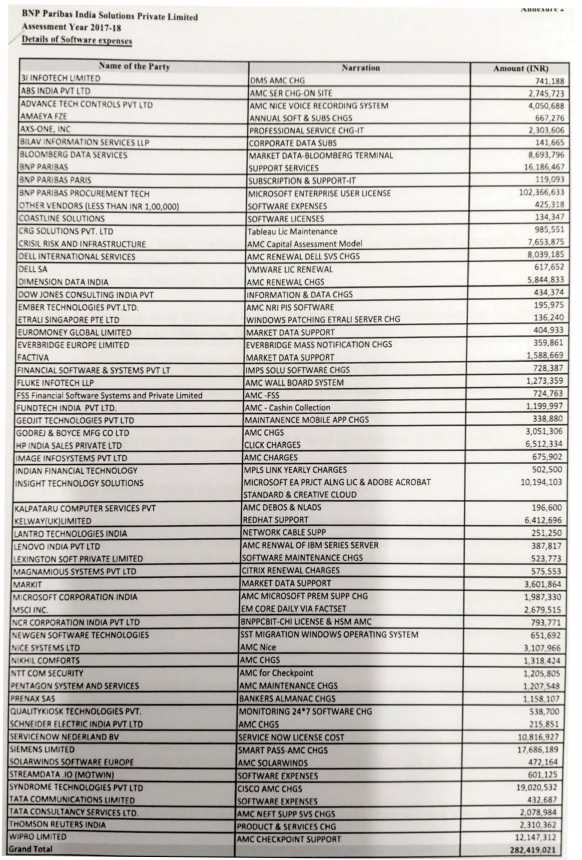
“The breakup of Software expenses is enclosed as Annexure 2. We wish to submit that these expenses are essentially in the nature of annual maintenance charges, fees for database support, license renewal cost, etc. These software expenditures are incurred as annual fees paid towards usage of software and do not create any software assets or intellectual property to which title or ownership right are created in favor of the Assessee. These software costs are “Period” costs in the sense they are “recurring” costs incurred for usage of the software and hence are revenue expenditure in nature. The benefit of these recurring costs is an annual benefit only and no enduring benefit can be said to arise in subsequent years.”
Annexure 2:
5. Ld. Sr. DR contended that the nature of expense claim by the assessee has not been discussed by the ld. CIT(A) while giving relief. Further, assessee has used the nomenclature of “maintenance” which is not correct for the expenses incurred by it. He also submitted that the case laws relied upon while granting relief by the ld. CIT(A) are not relevant to the facts of the case. He thus, placed reliance on the order of ld. AO.
6. We have heard both the parties and perused the material on record. The details of expenditure incurred by the assessee is tabulated above and it is evidently discernible that all these expenses incurred by the assessee are on account of annual maintenance charge, fees for database support, licence renewal cost etc. These are all “period cost” and “recurring” in nature. Assessee incurred these expenses not for acquiring any right in the software, but are towards subscription for a fixed period giving annual benefits only.
6.1. No enduring benefits accrued to the assessee by incurring these period costs. Ld. AO has not doubted on the legitimacy of these expenses incurred for the purpose of business. Also, ld. AO has not brought on record any cogent material to evidently demonstrate that any capital asset is brought into existence, resulting into enduring benefits to the assessee by incurring these expenses. No asset has come into existence nor any intellectual property right. Also, there is no transfer of ownership to the assessee in these software, by incurring such expenses.
6.2. The issue before in the present appeal is no longer res integra as dealt by plethora of decisions of the Co-ordinate Benches of ITAT and also by Hon’ble High Courts including that of Karnataka and Delhi. Few of these judicial precedents relied upon are listed below for ready reference.
i.Asstt. CIT v. Matrix Publicities and Media India (P.) Ltd. (Mumbai – Trib.)/[2025] 213 ITD 463 (Mumbai – Trib.)
ii.ACIT v. First Advantage (P.) Ltd. (Mumbai – Trib.)
iii.Asstt. CIT v. Boots Piramal Health Care Ltd. (Mumbai)
iv.Ratilal Becharlal & Sons v. Jt. CIT (Mumbai)/[2014] 148 ITD 628 (Mumbai)
v.CGI Information Systems and Management Consultants (P.) Ltd. v. ITO (Karnataka)/[2023] 455 ITR 270 (Karnataka)
vi.CIT v. G.E Capital Services Limited [IT Appeal No. 560 (Mum) of 2007, dated 10-07-2007] by Hon’ble High Court of Delhi
6.3. Considering the overall factual matrix as discussed above and the judicial precedents, software expenses claim by the assessee are held to be revenue expenses, deductible under the provisions of Section 37(1). These expenses towards software are period cost and recurring in nature, giving annual benefits only. No enduring benefit is derived by the assessee by incurring these expenses as there is no change in the asset base of the assessee. Accordingly, keeping the above discussion in juxtaposition, we do not find any reason to interfere with the findings arrived at by ld. CIT(A), whereby the addition made by the ld. AO is deleted. Accordingly, grounds raised by the Revenue are dismissed.
7. In the result, appeal of the Revenue is dismissed.