ORDER
Madhusudan Sawdia, Accountant Member.- This appeal is filed by Shri Manohar Reddy Cheruku (“the assessee”), feeling aggrieved by the order passed by the Learned Commissioner of Income Tax (Appeals)-12, Hyderabad (“Ld. CIT(A)”) dated 24.09.2025 for the A.Y.2016-17.
2. The assessee has raised the following grounds of appeal:
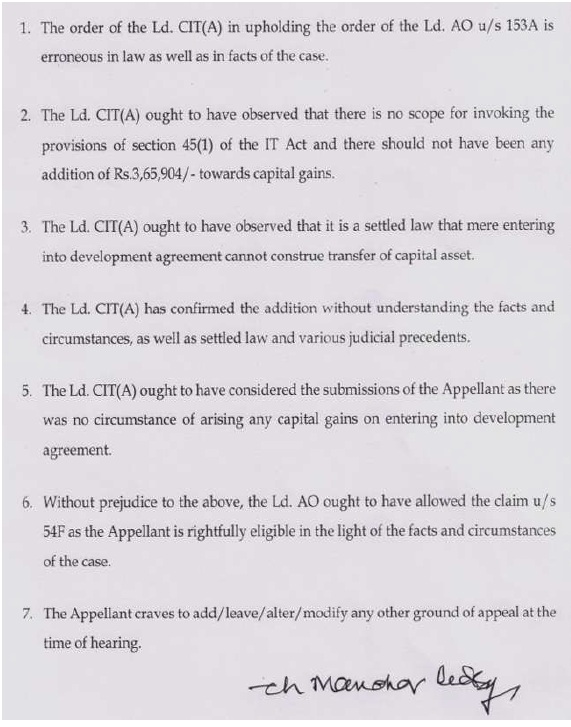
3. The brief facts of the case are that the assessee is an individual deriving income from business & profession and house property. The assessee filed his return of income for the assessment year 2016-17 on 31.03.2017 admitting a total income of Rs.5,98,860/-. A search and seizure operation under section 132 of the Income Tax Act, 1961 (“the Act”) was conducted on 09.08.2018 in the case of the assessee, M/s Moksha Infracon Private Limited (“the developer”) and M/s Kaveri Infra Projects Private Limited. Consequent to the search, notice under section 153A of the Act was issued to the assessee on 18.03.2019. In response, the assessee filed return of income on 15.04.2019 admitting a total income of Rs.5,98,860/-. Thereafter, the Learned Assessing Officer (“Ld. AO”) issued notice under section 143(2) of the Act on 19.07.2019. During the assessment proceedings, the Ld. AO noticed that the assessee, along with Shri Ch Anand Reddy and Shri M. Sahodar Reddy (hereinafter collectively called “the landowners”), had entered into a Joint Development Agreement (“JDA”) dated 19.01.2016 with the developer. As per the terms of the JDA, in lieu of land measuring 676 sq. yards, the landowners were entitled to receive 1853 sq. ft. of built-up area. The Ld. AO held that the execution of JDA on 19.01.2016 constituted a “transfer” within the meaning of section 2(47) of the Act and that capital gains under section 45(1) of the Act arose in the year of execution of JDA itself. The Ld. AO computed long-term capital gain of Rs.3,65,904/- and added the same to the returned income of the assessee. Accordingly, the assessment under section 153A of the Act was completed on 26.04.2021 determining the total income of the assessee at Rs.9,64,764/-.
4. Aggrieved with the order of the Ld. AO, the assessee preferred appeal before the Ld. CIT(A). Relying upon the decision of the Hon’ble Andhra Pradesh High Court in the case of Potla Nageswara Rao v. Dy. CIT (Mag.)/365 ITR 249 (Andhra Pradesh), the Ld. CIT(A) upheld the addition made by the Ld. AO.
5. Aggrieved by the order of the Ld. CIT(A), the assessee has preferred this appeal before the Tribunal. At the outset, the Learned Authorised Representative (“Ld. AR”) submitted that the only issue out of the grounds of the assessee is the addition made by the Ld. AO for Rs.3,65,904/- on account of long-term capital gain. In this regard, the Ld. AR further submitted that no taxable event of “transfer” within the meaning of section 2(47) of the Act had taken place during the year under consideration. It was contended that the assessee had not received any consideration whatsoever during the year of JDA and the possession, if any, was handed over only for the limited purpose of facilitating the developer to undertake construction, and not in the nature of possession contemplated under section 2(47)(v) of the Act read with section 53A of the Transfer of Property Act. The Ld. AR further submitted that the reliance placed by the Ld. CIT(A) on the judgment of the Hon’ble Andhra Pradesh High Court in the case of Potla Nageswara Rao (supra) is misplaced, as the Hon’ble Telangana High Court in the case of Smt. Shantha Vidyasagar Annam v. ITO (TELANGANA) has considered Potla Nageswara Rao (supra) and has categorically held that where no consideration is received and where possession is handed over only for limited purposes of development, no capital gains can be said to be accrued in the year of execution of JDA. Accordingly, the Ld. AR submitted that the addition made by the Ld. AO is liable to be deleted.
6. Per contra, the Learned Departmental Representative (“Ld. DR”) relied upon the orders of the Ld. AO and the Ld. CIT(A) and supported the view that the signing of JDA itself constitutes transfer as per section 2(47)(v) of the Act. Accordingly, there is no infirmity in the order of the lower authorities.
7. We have considered the rival submission and perused the material available on record. The Ld. AR has contended that the assessee had not received any consideration whatsoever during the year of JDA and the possession, if any, was handed over only for the limited purpose of facilitating the developer to undertake construction, and not in the nature of possession contemplated under section 2(47) of the Act read with section 53A of the Transfer of Property Act. Therefore, the Ld. AR has argued that no taxable event of “transfer” within the meaning of section 2(47) of the Act had taken place during the year under consideration. In this regard we have gone through para nos. 17 & 18 of the decision of the Hon’ble Telangana High Court in the case of Smt. Shantha Vidyasagar Annam (supra), which is to the following effect:
“17. Thus, from the aforementioned facts, it is evident that even though there is a contract to transfer the immovable property, which is signed by the parties, yet the contract has not been executed for consideration. A sum of Rs.2,00,000/-mentioned in paragraph 6 of the development agreement is only the performance guarantee which is refundable. The aforesaid amount of Rs.2,00,000/- has not been paid by way of consideration of the transaction. The developer has been handed over the possession for the limited purpose of carrying out the development work. Therefore, in pursuance of the development agreement, the possession of the immovable property has not been handed over to the developer as contemplated under Section 53A of the Transfer of the Property Act, 1882. Therefore, the same does not fall within the definition of ‘transfer’ under Section 2(47) of the Act.
18. Insofar as reliance placed by the learned Senior Standing Counsel for the Revenue in Potla Nageswara Rao (supra) is concerned, the same is an authority for the proposition that element of factual possession and agreement are contemplated as transfer within the meaning of Section 2(47) of the Act. It has further been held that when the transfer is complete, the consideration mentioned in the agreement for sale has to be taken into consideration for the purpose of assessment of income. In the instant case, under the development agreement there is no transfer and the consideration has also not been paid. Therefore, the aforesaid decision of the Division Bench has no application to the fact situation of the case. Similarly, in the case of Arvind S Phake (supra), the possession was handed over to the developer and the entire consideration was paid. In the instant case, consideration has not been paid. Therefore, the Division Bench decision of the Bombay High Court also does not apply to the fact situation of the case. In. Harbour View (supra), the Division Bench of Kerala High Court on the facts of the case found that the possession of the property was handed over under Section 53A of the Transfer of Property Act, 1882. Therefore, the aforesaid decision also has no application to the fact situation of the case.”
8. On a perusal of the above, we find that the Hon’ble High Court after considering the judgment in Potla Nageswara Rao (supra), has held that unless consideration is received or accrues to the assessee, or unless possession is handed over in the manner contemplated under section 53A of the Transfer of Property Act, no transfer can be said to have occurred for the purpose of section 45 of the Act. In the present case, the revenue has not brought on record any material to show that the assessee received any consideration, monetary or otherwise, during the year of execution of JDA; or the assessee handed over possession to the developer otherwise than for the limited purpose of development. In absence of such essential conditions, the very foundation of invoking section 45(1) of the Act in the year of JDA fails. Respectfully following the binding judgment of the Hon’ble Telangana High Court in the case of Smt. Shantha Vidyasagar Annam (supra), we hold that no taxable capital gains arise in the hands of the assessee during the year under consideration. We therefore find no justification to sustain the addition of Rs.3,65,904/- made on account of alleged long-term capital gains. Accordingly, we set aside the order passed by the Ld. CIT(A) and direct the Ld. AO to delete the addition made on account of longterm capital gains.
9. In the result, the appeal filed by the assessee stands allowed.



