


Extension of the Assam Tenancy Act, 2021 to UT of Chandigarh.
The Gazette of India
CG-DL-E-07052026-272303
EXTRAORDINARY
PART II—Section 3—Sub-section (ii)
PUBLISHED BY AUTHORITY
No. 2174]
NEW DELHI, WEDNESDAY, MAY 6, 2026/VAISAKHA 16, 1948
MINISTRY OF HOME AFFAIRS
NOTIFICATION
New Delhi, the 6th May, 2026
S.O. 2265(E).—In exercise of the powers conferred by section 87 of the Punjab Reorganization
Act, 1966 (31 of 1966), the Central Government hereby extends the Assam Tenancy Act, 2021 (Assam
Act No. XXXI of 2021), as in force in the State of Assam on the date of this notification, to the Union
territory of Chandigarh, subject to the following modifications, namely:౼
MODIFICATIONS
In the Assam Tenancy Act, 2021 (hereinafter referred to as the Principal Act), so extended to the Union
territory of Chandigarh,౼
1. In the principal Act, in section 1,౼
(a) for sub-section (1), the following sub-section shall be substituted, namely: ౼
“(1) This Act may be called the Assam Tenancy Act, 2021 as extended to the Union
territory of Chandigarh.”;
(b) in sub-section (2), for the words “State of Assam”, the words “Union territory of
Chandigarh” shall be substituted;
(c) for sub-section (3), the following sub-section shall be substituted, namely:౼
“(3) This Act shall come into force from the date of its publication in the Gazette of
India.”
2. In the principal Act, in section 2,౼
(a) for clause (a), the following clauses shall be substituted, namely:౼
‘(a) “Administrator” means the Administrator of the Union territory of Chandigarh
appointed by the President under article 239 of the Constitution;
(aa) “landlord” means a person who receives or is entitled to receive the rent of any
premises, whether on his own account or on behalf of or for the benefit of any other
person, if the premises were let out to a tenant, and shall include,౼
(i) his successor-in-interest; and
(ii) a trustee or guardian or receiver receiving rent for any premises or is
entitled to so receive, on account of or on behalf of or for the benefit of any
other person such as minor or person of unsound mind who cannot enter into a
contract;’;
(b) for clause (b), the following clauses shall be substituted, namely:౼
‘(b) “Local authority” means the Municipal Corporation or a Municipal Council or the
Estate Office or the Chandigarh Housing Board or a Planning or Development
Authority, by whatever name called or the Cantonment Board, or as the case may be, a
civil area committee appointed under section 47 of the Cantonment Act, 2006 (41 of 2006) or such other body entitled to function as a local authority in any city or town,
constituted under any law for the time being in force;
bb) “Municipal bye-laws” means the bye-laws made under the Capital of Punjab
(Development and Regulation) Act, 1952 (Punjab Act No. 27 of 1952) and the rules
made thereunder and the Haryana Housing Board Act, 1971 (Haryana Act No. 20 of
1971) as extended to the Union territory of Chandigarh;’;
(c) in clause (c), for the words “the State”, the words “India” shall be substituted;
(d) in clause (e), for the words “State Government”, the word “Administrator” shall be
substituted;
3. In section 3, in sub-section (1),౼
(a) in clause (a), for the words “State Government”, the words “Union territory of
Chandigarh” shall be substituted;
(b) in clause (c), for the words “State Government”, the words “Union territory of
Chandigarh” shall be substituted;
(c) in clause (d), for the word “State”, the words “Union territory of Chandigarh” shall be
substituted;
(d) in clause (e), for the words “State Government”, the word “Administrator” shall be
substituted.
4. In the Principal Act, in section 4, for the word “State” wherever it occurs, the words “Union
territory of Chandigarh” shall be substituted;
5. In the Principal Act, in section 21, in sub-section (2), in clause (f), in the Explanation, for the
words “Municipal Corporation or the Municipality or the Development Authority or any other
authority”, the words “Municipal Corporation or the Municipal Council or the Estate Office or
the Chandigarh Housing Board or any other Development Authority, by whatever name called
or the Cantonment Board, or as the case may be, a civil area committee appointed under section
47 of the Cantonment Act, 2006 (41 of 2006) or such other body entitled to function as a local
authority in any city or town, constituted under any law for the time being in force”, shall be
substituted.
6. In the Principal Act, for section 30, the following section shall be substituted, namely:౼
“30. Rent Authority- The Deputy Commissioner, Union territory, Chandigarh shall, with the
previous approval of the Administrator appoint an Officer, not below the rank of Tehsildar to
be the Rent Authority in a specified jurisdiction.”.
7. In the Principal Act, in section 33, for the words “State Government”, the word “Administrator”
shall be substituted.
8. In the Principal Act, in section 34, for the words “State Government”, the words
“Administrator” shall be substituted.
9. In the Principal Act, in section 38, in sub-section (2), for the words “Local Government”, the
words “Local Administration” shall be substituted.
10. In the Principal Act, in section 39, for the words “State Government” wherever it occurs, the
word “Administrator” shall be substituted;
11. In the Principal Act, after section 43, the following section shall be inserted, namely:౼
“43A. Act not in derogation of any other law – Save as otherwise provided, the provisions of
this Act shall be in addition to and not in derogation of any other law for the time being in force
in the Union territory of Chandigarh.” ;
12. In the Principal Act, in section 44,౼
(a) in sub-section (1), for the words “State Government”, the word “Administrator” shall
be substituted;
(b) in sub-section (2), in clause (a), for the word “State”, the words “Union territory of
Chandigarh” shall be substituted;
13. In the Principal Act, for section 45, the following section shall be substituted, namely:-
“45. Laying of rules- Every rule made under this Act shall be laid as soon as may be, after it is
made, before each House of the Parliament, while it is in session, for a total period of thirty
days which may be comprised in one session or in two or more successive sessions, and if,
before the expiry of the session immediately following the session or the successive session
aforesaid, both Houses agree in making any modification in the rule or both the Houses agree
that the rule, should not be made, the rule, shall thereafter have effect only in such modified
form or be of no effect, as the case may be; so, however, that any such modification or
annulment shall be without prejudice to the validity of anything previously done under that
rule.”
14. In the Principal Act, in section 46,-
(a) in sub-section (1), for the words “State Government”, the word “Administrator” shall be
substituted;
(b) for sub-section (2), the following sub-section shall be substituted, namely:-
“(2) Every order made under this section shall be laid as soon as may be, after it is made, before
each House of the Parliament.”
15. In the Principal Act, for section 47, the following section shall be substituted, namely;
“47. Repeal and saving-
(1) The East Punjab Urban Rent Restriction Act, 1949 (East Punjab
Act III of 1949), which is in force in the Union territory of Chandigarh immediately before the
commencement of this Act, is hereby repealed.
(2) Notwithstanding such repeal, all cases and other proceedings under the East Punjab Urban
Rent Restriction Act, 1949 (East Punjab Act III of 1949), pending, on the date of
commencement of this Act, shall be continued and disposed of in accordance with the
provisions of the East Punjab Urban Rent Restriction Act, 1949 (East Punjab Act III of 1949),
as if that Act had continued to be in force and this Act had not been enacted.”.
[F. No. U-11020/3/2019-UTL]
PARVEEN KUMAR RAI, Jt. Secy.
GOVERNMENT OF ASSAM
ORDERS BY THE GOVERNOR
LEGISLATIVE DEPARTMENT ::: LEGISLATIVE BRANCH
NOTIFICATION
The 27th September, 2021
No. LGL.94/2021/37.- The following Act of the Assam Legislative Assembly which received
the assent of the Governor on 23rd September, 2021 is hereby published for general information.
Assam Act No. XXXI OF 2021
(Received the assent of the Governor on 23rd September, 2021)
THE ASSAM TENANCY ACT, 2021
AN
ACT
to establish Rent Authority to regulate renting of premises and to protect the
interests of landlords and tenants and to provide speedy adjudication
mechanism for resolution of disputes and matters connected therewith or
incidental thereto.
It is hereby enacted by the state of Assam in the Seventy-second Year
of the Republic of India as follows :-
CHAPTER I
PRELIMINARY
Short title, extent
and
commencement
1. (1) This Act may be called the Assam Tenancy Act,
2021.
(2) It extends to the whole of the State of Assam.
(3) It shall come into force on such date as the State
Government may, by notification in the Official
Gazette, appoint and different dates may be
appointed for different provisions of this Act.
Definitions
2. In this Act, unless the context otherwise requires,౼
(a) “landlord”, means the landowner or lessor or any
other person who receives or is entitled to
receive, on his behalf the rent of any premises,
on his own account, if the premises were let to a
tenant, and shall include-
(i) his successor-in-interest; and
(ii) a trustee or guardian or receiver receiving
rent for any premises or is entitled to so
receive, on account of or on behalf of or for the benefit of, any other person such as
minor or person of unsound mind who
cannot enter into a contract;
(b) “local authority” means a Village Panchayat or
Panchayat Samiti or Zila Parishad or a Municipal
Corporation of a Municipal Council or a
Planning or a Development Authority, by
whatever name called, or the Cantonment Board,
or as the case may be, a civil area committee
appointed under section 47 of the Cantonment
Act, 2006 or such other body entitled to function
as a local authority in any city or town,
constituted under any law for the time being in
force;
(c) “Notification” means a notification published in
the Official Gazette of the State and the
expression “notify” with its grammatical
variations and cognate expressions shall be
construed accordingly;
(d) “premises” means any building or part of a
building which is, or is intended to be, let on rent
for the purpose of residential or commercial use
except for hotel, lodging house, dharamshala, inn
and for industrial use but includes-
(i) garden, garage or closed parking area,
vacant land, grounds and out-houses, if
any, appertaining to such building or part
of the building; and
(ii) any fitting to such building or part of the
building for the more beneficial
enjoyment thereof;
(e) “prescribed” means prescribed by rules made by
the State Government under this Act;
(f) “property manager” means a person or any legal
entity including rental agent who is authorised by
the landlord to manage the premises and who
represents the landlord in his dealings with the
tenant;
(g) “rental agent” means any person, who
negotiates or act on behalf of landlord or tenant
or both in a transaction of renting of any
premises and receives remuneration or fees or
any other charges for his services whether as a
commission or otherwise and includes a person
who introduces, through any medium,
prospective landlord an tenant to each other for
negotiation for renting of premises and includes
property dealers, brokers or middlemen, by
whatever name called;
(h) “Rent Authority” means an officer appointed
under section 30;
(i) “Rent Court” means a Rent Court constituted
under section 33;
(j) “Rent payable” in relation to any premises means
the rent as specified in section 8;
(k) “Rent Tribunal” means a Rent Tribunal
constituted under section 34;
(l) “Scheduled” means a Schedule annexed to this
Act;
(m) “sub-tenant” means a person to whom the tenant
sublets whole or part of the premises held by him
or transfers or assigns his right accrued under the
tenancy agreement or any part thereof upon
entering into a supplementary agreement to the
existing tenancy agreement;
(n) “tenant”, whether called lessee or by any other
name, means a person by whom or on whose
account or on behalf of whom, the rent of any
premises is payable to the landlord under a
tenancy agreement and includes any person
occupying the premises as a sub-tenant and also,
any person continuing in possession after the
termination of his tenancy whether before or
after the commencement of this Act; but shall not
include any person against whom any order or
decree for eviction has been made.
Act not to apply to
certain premises
3. (1) Nothing in this Act shall apply to any-
(a) premises owned or promoted by the Central
Government or State Government or local
authority or a Government undertaking or
enterprise or a statutory body or Cantonment
Board;
(b) premises owned by a company, University or
organisation given on rent to its employees as
part of service contract;
(c) premises owned by religious or charitable
institutions as may be specified, by notification
by the State Government;
(d) premises owned by Waqf registered under the
Waqf Act, 1995 or by any trust registered under
the public trust law of the State for the time
being in force
e) other building or category of buildings
specifically exempted in public interest by
notification by the State Government.
(2) Notwithstanding anything contained in subsection (1), if the owner and tenant of the
premises referred to in clause (a) to clause (e) of
the said sub-section agrees that the tenancy
agreement entered into between such landlord
and tenant be regulated under the provisions of
this Act, such landlord may inform the Rent
Authority of the agreement to do so at the time
of information of the tenancy agreement under
section 4.
CHAPTER II
TENANCY
Tenancy
agreement
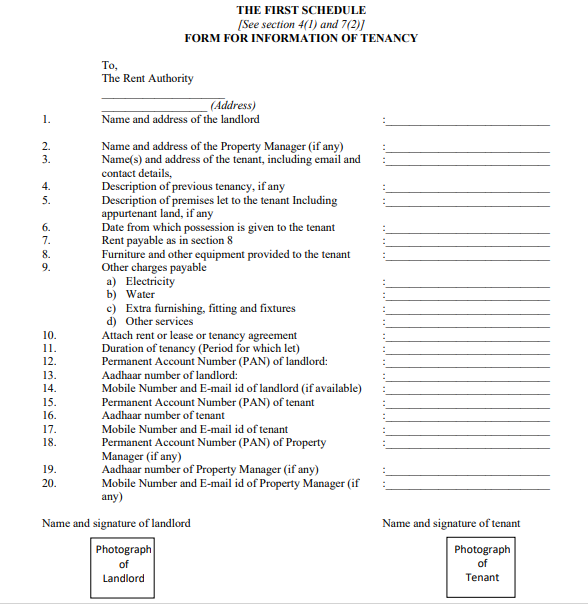
4. (1) Notwithstanding anything contained in this Act
or any other law for the time being in force, no
person shall, after the commencement of this
Act, let or take on rent any premises except by
an agreement in writing, which shall be
informed to the Rent Authority by the landlord
and tenant jointly, in the form specified in the
First Schedule withing a period of two months
from the date of tenancy agreement.
(2) Where the landlord and the tenant fail to jointly
inform the execution of the tenancy agreement
referred to in sub-section (1), the landlord and
tenant shall separately inform the execution of
tenancy agreement to the Rent Authority within
a period of one month from the date of expiry
of the period specified in sub-section (1).
(3) The Rent Authority shall, within three months
from the date of its appointment, put in place a
digital platform in the local vernacular
language or the language of the State for
enabling submissions of document in such
form and manner as may be prescribed.
(4) The Rent Authority shall, after receiving
information about the execution of tenancy
agreement along with the documents specified
in the First Schedule,-
(a) provide a unique identification number to
the parties; and
(b) upload the details of the tenancy
agreement on its website in local
vernacular language or the language of the
State, within seven working days from the
date of receipt of such information, in such manner along with such documents as it
may deem fit.
(5) The term of authorisation of the property
manager, if any, by the landlord to deal with the
tenant shall be such as agreed to by the landlord
and tenant in that behalf in the tenancy
agreement.
(6) The information provided under sub-section
(1) and sub-section (2) above shall be
conclusive proof of the facts relating to tenancy
and matters connected therewith, and in the
absence of any statement of information, the
landlord and the tenant shall not be entitled to
any relief under the provisions of this Act.
Period of tenancy 5.
(1) Every tenancy entered into after the
commencement of this Act shall be valid for a
period as agreed upon between the landlord and
the tenant and as specified in the tenancy
agreement.
(2) The tenant may request the landlord for
renewal or extension of the tenancy, within the
period agreed to in the tenancy agreement, and
if agreeable to the landlord, may enter into a
new tenancy agreement with the landlord on
mutually agreed terms and conditions.
(3) Where a tenancy for a fixed term ends and has
not been renewed or the tenant fails to vacate
the premises at the end of such tenancy, then
such tenant shall be liable to pay an enhanced
rent to the landlord as provided in section 23.
Provided that notwithstanding anything
contained in this section, if the term of tenancy
expires at a time when the locality where the
premises let out on rent is situated is affected
by any disastrous event of force majeure, then,
subject to requisition by the tenant, the landlord
shall allow the tenant to continue in possession
of the said premises till a period of one month
from the date of cessation of such disastrous
event on the same terms and conditions of the
tenancy agreement already entered into.
Explanation.౼ For the purposes of this section,
“force majeure” means a situation of war,
flood, drought, fire, cyclone, earthquake or any
other calamity caused by nature affecting the
habitation of the tenant in the premises let out
on rent.
Rights and
obligation of
successor in the
case of death
6. The terms of agreement executed between
landlord and tenant, shall be binding upon their
successors in the event of the death of landlord or
tenant, as the case may be, and in such case,
successors of the deceased landlord or tenant shall
have the same rights and obligations as agreed to
in the tenancy agreement for the remaining period
of such tenancy.
Restriction on subletting
7. (1) After the commencement of this Act, no tenant
shall, except by entering into a supplementary
agreement to the existing tenancy agreement,-
(a) sub-let whole or part of the premises held
by him as a tenant;
(b) transfer or assign his rights in the tenancy
agreement or any part thereof.
(2) Where the premises is sub-let upon entering into
a supplementary agreement to the existing
tenancy agreement as referred to in sub-section
(1), the landlord and tenant shall jointly inform
the Rent Authority about the sub-tenancy
within a period of two months from the date of
execution of such agreement in the Form
specified in the First Schedule.
CHAPTER III
RENT
Rent payable 8. The rent payable in respect of a premises shall be
the rent agreed to between the landlord and the
tenant in accordance with the terms of the
tenancy agreement.
Revision of rent 9.
(1) The revision of rent between the landlord and the
tenant shall be in accordance with the terms of
the tenancy agreement.
(2) Where, after the commencement of tenancy,
the landlord has entered into an agreement in
writing with the tenant prior to the
commencement of the work and has incurred
expenditure for carrying out improvement,
addition or structural alteration in the premises
occupied by the tenant, which does not include
repairs necessary to be carried out under
section 15, the landlord may increase the rent
of the premises by an amount as agreed to
between the landlord and the tenant, and such
increase in rent shall become effective from
one month after the completion of such work.
10. In case of any dispute between the landlord and the
tenant regarding revision of rent, the Rent Authority
may, on an application made by the landlord or tenant,
determine the revised rent and other charges payable
by the tenant and also fix the date from which such
revised rent becomes payable.
Security deposit
11. (1) The security deposit to be paid by the tenant in
advance shall be such as may be agree upon
between the landlord and the tenant in the
tenancy agreement, which shall-
(a) not exceed two months rent, in case of
residential premises; and
(b) not exceed six months rent, in case of
non-residential premises.
(2) The security deposit shall be refunded to the tenant
on the date of taking over vacant possession of
the premises from the tenant, after making due
deduction of any liability of the tenant.
CHAPTER IV
RIGHTS AND OBLIGATIONS OF LANDLORD
AND TENANT
Original tenancy
agreement to be
retained by the
landlord and the
tenant
12 The tenancy agreement shall be signed in duplicate by
both the landlord and the tenant, and one each of such
original signed tenancy agreement shall be retained
by the landlord and the tenant.
Rent and other
charges payable
and receipt for
payment thereof
13. (1) Every tenant shall pay rent and other charges
payable withing such period as agreed to in the
tenancy agreement.
(2) Every landlord or his property manager shall, on
receipt of payment towards rent and other
charges payable withing the stipulated period as
in the tenancy agreement from the tenant,
provide forthwith against acknowledgement, a
duly signed receipt for the amount received by
him:
Provided that where the payment of rent or other
charges is made by the tenant to the landlord
through the electronic mode, the bank
acknowledgement thereof shall be conclusive
proof of such payment.
Deposit of rent
with Rent Authority
14. (1) Where the landlord refuses to accept any rent and
other charges payable or refuses to give a receipt,
the rent and other charges shall be paid to the
landlord by postal money order or any other
method, in such manner as may be prescribed,
consecutively for two months, and if the landlord
refuses to accept the rent and other charges within such period, then the tenant may deposit
the same with the Rent Authority in such manner
as may be prescribed.
(2) Where the tenant is unable to decide to whom the
rent is payable during the period of tenancy
agreement, the tenant may, in such case, deposit
the rent with the Rent Authority in such manner
as may be prescribed.
(3) Where the rent is deposited under sub-section (1)
or sub-section (2), the Rent Authority shall
enquire the case as to whom the rent is payable
and pass orders as may deem fit on the basis of
the facts of the case.
(4) The withdrawal of rent and other charges
payable, deposited under sub-section (1) or subsection (2), shall not by itself operate as an
admission against the landlord or any other claim
made by the tenant, if the landlord withdraws it
to the extent of rent agreed upon under the
tenancy agreement.
Repair and
maintenance of
property
15 (1) Notwithstanding any agreement in writing to the
contrary, the landlord and the tenant shall keep
the premises in as good a condition as at the
commencement of the tenancy, except for
normal wear and tear, and shall respectively be
responsible to repair and maintain the said
premises as specified in the Second Schedule or
as agreed to in the tenancy agreement.
(2) In case of common facilities shared among the
tenants or with the landlord, the respective
responsibilities of the tenant and landlord to
repair and maintain those facilities shall be such
as may be specified in the tenancy agreement.
(3) If the tenant fails or refuses to carry out the
repairs referred to in sub-section (1) or subsection (2), above the landlord may carry out the
repairs or remove the additional structure erected
by tenant without consent of the landlord and
deduct the amount incurred for such repairs or
removal as the case may be, from the security
deposit and the amount so deducted shall be paid
by the tenant within a period of one month of
issue of notice by the landlord in that regard:
Provided that if the cost for such repairs exceed
the security deposit, the tenant shall be liable to
pay the excess cost including the security deposit
so deducted to the landlord within a period of one
month of the issue of notice by the landlord in
that regard.
(4) In case the landlord refuses to carry out the
repairs referred to in sub-section (1) or subsection (2), the tenant may carry out such repairs
and deduct the expenditure incurred towards the
same from the rent to be paid for the succeeding
months:
Provided that in no case the deduction from rent
in any one month shall exceed fifty per cent of
the agreed rent for a month.
(5) Where the premises is uninhabitable without the
repairs and the landlord refuses to carry out the
required repairs, after being called upon by the
tenant in writing to do so, the tenant may
abandon the premises after giving the landlord
fifteen days notice in writing.
(6) Where the premises let out on rent becomes
uninhabitable for the tenant due to an event of
force majeure or the tenant is unable to reside
due to occurrence of such event, the landlord
shall not charge rent from the tenant until the said
premises is restored by the landlord subject to the
provisions of this section, to be inhabitable:
Provided that where the rented premises
becomes uninhabitable as specified in subsection (5) or this sub-section and the landlord
fails to carry out the required repairs to make it
inhabitable or the said premises could not be
made inhabitable, then, the security deposit and
advance rent shall be refunded by the landlord to
the tenant within a period of fifteen days of the
expiry of the notice period, after making due
deduction of liability of the tenant, if any.
Explanation.—For the purposes of this section,
“force majeure” means a situation of war, flood,
drought, fire, cyclone, earthquake or any other
calamity caused by nature affecting the
habitation of the tenant in the premises let out on
rent.
Tenant to look
after premises
16. During the subsistence of tenancy, the tenant shall,-
(a) not intentionally or negligently damage the
premises or permit such damage;
(b) inform in writing the landlord of any damage;
(c) take reasonable care of the premises and its
contents including fitting and fixtures and keep
it reasonably habitable having regard to its
condition at the commencement of tenancy and
the normal incidence of living.
Entry into
premises
17 (1) Every landlord or the property manager may
enter the premises let out on rent after serving a
notice, in writing or through electronic mode, to
the tenant at least twenty four hours before the
time of entry under the following circumstances,
namely:-
(a) to carry out repairs or replacement or to do
or to get work done in the premises; or
(b) to carry out an inspection of the premises for
the purpose of determining whether the
premises are in a habitable state; or
(c) for any other reasonable cause for entry
specified in the tenancy agreement.
(2) The notice referred to in sub-section (1) shall
specify the day, time and reason for entry:
Provided that no person shall enter the premises
before sun rise and after sun set:
Provided further that nothing contained in this
section shall prevent the landlord from entering
into the premises let out on rent without prior
notice to the tenant in case of emergent situations
like war, flood, fire, cyclone, earthquake or any
other natural calamity, which may affect that
premises.
Information as to
property manager
18 In case the landlord has engaged a property manager,
the landlord shall provide the following information
to the tenant, namely:-
(a) name of the property manager;
(b) proof that such property manager is authorised
by the landlord;
(c) specific purposes for which the property
manager has been authorised by the landlord and
the period of such authorisation; and
(d) if the property manager is a legal entity, the name
of the entity and the person authorised in this
behalf by that legal entity who may be contacted
in relation to the tenancy agreement.
19 (1) The duties of the property manager shall
include the following, namely:-
(a) to collect rent against receipt;
(b) to do essential repairs on behalf of the
landlord;
(c) to inspect the premises from time to time;
(d) to give notices to tenant for-
(i) proper maintenance of the premises;
(ii) delay in payment of rent;
(iii) revision of rent;
(iv) vacating of premises;
(v) renewal of tenancy;
(e) help in resolution of disputes among tenants
and between landlord and tenant;
(f) any other matters relating to tenancy to be acted
upon only on the instructions of the landlord.
(2) Where the property manager acts, in
contravention of the provisions of sub-section
(1) or against the instructions of the landlord, the
Rent Authority may, on an application made to it
by the landlord or tenant in that behalf, remove
the property manager or impose such costs on the
property manager so as to compensate any loss
incurred by the landlord or tenant due to such
contravention.
Withholding
essential supply and service
20 (1) No landlord or property manager shall either by
himself or through any other person, withhold
any essential supply or services in the premises
occupied by the tenant.
(2) In case of contravention of provisions of subsection (1) and on application made by the
tenant in this behalf, the Rent Authority after
examining the matter, may pass an interim
order directing the restoration of supply of
essential services immediately on service of
such order upon the landlord or property
manager, as the case may be, pending the
inquiry referred to in sub-section (3).
(3) The Rent Authority shall conduct an enquiry in
respect of the application made by the tenant
under sub-section (2), and complete the inquiry
within one month of filing such application.
(4) The Rent Authority may, after giving a
reasonable opportunity of being heard, award a
compensation not exceeding two months rent
to be paid by the person responsible for
withholding the essential supply, so as to
compensate the loss incurred.
(5) The Rent Authority may levy a penalty of a
sum not exceeding twice the monthly rent to
the tenant, if it finds that the application was
frivolous or vexatious.
Explanation.— For the purposes of this
section, essential services includes supply of
water, electricity, piped cooking gas supply,
lights in passages, lifts and on staircase,
conservancy, parking, communication links,
sanitary services and security fixtures and
features.
CHAPTER V
EVICTION AND RECOVERY OF
POSSESSION OF PREMISES BY LANDLORD
Eviction and
recovery of
possession of
premises by landlord
21 (1) A tenant shall not be evicted during the
continuance of tenancy agreement unless
otherwise agreed to in writing by the landlord
and tenant, except in accordance with the
provisions of sub-section (2) or in accordance
with the provisions of section
22.
(2) The Rent Court may, on an application made to
it by the landlord in such manner as may be
prescribed, make an order for eviction and
recovery of possession of the premises on one or
more of the following grounds namely: –
(a) that the tenant does not agree to pay the rent
payable under section 8;
(b) that the tenant has not paid the arrears of rent
and other charges payable in full as specified
in sub-section (1) of section 13 for two
consecutive months, including interest for
delayed payment as may be specified in the
tenant agreement within a period of one
month from the date of service of notice of
demand for payment of such arrears of rent
and other charges payable to the landlord in
the manner provided in sub-section (4) of section 106 of the Transfer of Property Act,
1882;
(c) that the tenant has, after the commencement
of this Act, parted with the possession of
whole or any part of the premises without
obtaining the written consent of the landlord;
(d) that the tenant has continued to misuse the
premises even after receipt of notice from the
landlord to desist from such misuse;
Explanation. – For the purposes of this
clause, “misuses of premises” means
encroachment of additional space by the
tenant or use of premises which causes public
nuisance or causes damages to the property
or is detrimental to the interest of the landlord
or for immoral or illegal purposes.
(e) Where it is necessary for the landlord to carry
out any repair or construction or rebuilding
or addition or alteration or demolition in
respect of the premises or any part thereof,
which is not possible to be carried out
without the premises being vacated:
Provided that after such repair,
construction, rebuilding, addition or
alteration, the tenant may be allowed to
reoccupy the premises only when it has been
mutually agreed to between the landlord and
the tenant and a new tenancy agreement has
been submitted with the Rent Authority:
Provided further that the tenant shall not
be allowed to reoccupy the premises-
(i) in the absence of submission of such
mutual tenancy agreement with the
Rent Authority; and
(ii) in cases where the tenant has been
evicted under the orders of a Rent
Court;
(f) that the premises or any part thereof is required
by the landlord for carrying out any repairs,
construction, rebuilding, additions, alteration
or demolition, for change of its use as a
consequence of change of land use by the
competent authority;
Explanation.- For the purposes of this clause,
the expression “competent authority” means
the Municipal Corporation or the Municipality or the Development Authority or any other
authority, as the case may be, which provides
permission on matters relating to repair or
redevelopment or demolition of building or
permission for change in land use.
(g) that the landlord has given written notice to
vacate the premises let out on rent and in
consequence of that notice the landlord has
contracted to sell the said premises or has taken
any other step, as a result of which his interests
would seriously suffer if he is not put in
possession of that premises;
(h) that the tenant has carried out any structural
change or erected any permanent structure in
the premises let out on rent without the written
consent of the landlord.
(3) No order for eviction of the tenant on account of
failure to pay the rent specified in clause (b) of
sub-section (2) shall be made, if the tenant makes
payment to the landlord or deposits with the Rent
Court the arrears of rent and other charges
payable, if any, including interest within one
month from the date of service of the said demand
notice upon him.
(4) Where the tenant fails to pay rent consecutively for
two months subsequent to the grant of the relief
specified in sub-section (3) in any one year, then
the tenant shall not be entitled to such relief again.
(5) In any proceedings for eviction under clause (e) of
sub-section (2), the Rent Court may allow eviction
from only a part of the premises, if the landlord
agrees for the same.
Eviction and
recovery of
possession of
premises in case
of death of land
lord
22 (1) Notwithstanding anything contained in this Act or
any other law for the time being in force, in case
of death of the landlord, where there is a bonafide
requirement of the premises let out on rent by the
legal heirs of the landlord during the period of
tenancy, such legal heirs may file an application in
this behalf for eviction and recovery of possession
of the said premises before the Rent Court in such
form and manner, as may be prescribed.
(2) The Rent Court may, on an application made to it
under sub-section (1), if it is satisfied that the legal
heirs of the deceased landlord are in bonafide
requirement of the premises let out on rent, pass
necessary orders against the tenant for handing
over vacant possession of the said premises to the
legal heirs of the deceased landlord.
23 Where the tenant fails to vacate the premises let out
on rent in accordance with the tenancy agreement on
the expiration of the period of tenancy or termination
of tenancy by an order or notice under the provisions
of this Act, such tenant shall be liable to pay the
landlord-
(a) Twice the monthly rent for the first two
months; and
(b) Four times the monthly rent thereafter till the
tenant continues to occupy the said premises.
Refund of advance
rent by landlord
24 (1) Where a landlord exercises the right of recovery
of possession under sub-section (2) of section 21
or under section 22, and he had received any rent
or any other payment in advance from the tenant,
he shall before recovery of possession, refund to
the tenant such amount after deducting the rent
and other charges due to him.
(2) If the landlord fails to make any refund, he shall
be liable to pay simple interest to the tenant at
such rate as may be prescribed from time to time
on the amount which he has omitted or failed to
refund.
Payment of rent
during eviction
proceedings
25 In any proceedings for recovery of possession on any
ground other than that referred to in clause (a) or
clause (b) of sub-section (2) of section 21, where the
tenant contests the claim for eviction, the landlord
may at any stage of the proceedings apply to the Rent
Court to direct the tenant to pay him the rent payable,
as under section 8, and the Rent Court may order the
tenant to make such payment and all other charges
due from the tenant along with penal charges, if any,
due to delay in payment, in accordance with the
provisions of sub-section (1) of section 14.
Permission to
build additional
structure
26 (1) Tenant shall not carry out any structural change
or erect any permanent structure in the premises
let out on rent without the written consent of the
landlord.
(2) Where the landlord proposes to make any
improvement in or construct any additional
structure on any premises which has been let out
to a tenant and the tenant refuses to allow the
landlord to make such improvement or construct
such additional structure, the landlord may make
an application in this behalf to the Rent Court.
(3) On an application made by the landlord under
sub-section (2), if the Rent Court is satisfied that
the landlord is ready and willing to commerce the
work which is necessary, the Rent Court may
permit the landlord to do such work and may
make such other order as it may deem fit:
Provided that such improvement or additional
structure shall not decrease or diminish or
deteriorate the accommodation or housing
services in the premises which may cause undue
hardship to the tenant:
Provided further that it shall be the
responsibility of the tenant to remove any such
additional structure built by tenant without
consent of landlord.
Special provision
regarding vacant
land
27 (1) Notwithstanding anything contained in section
21 or section 22, where any premises let out for
rent comprises vacant land, upon which it is
permissible under the municipal bye-laws for the
time being in force to erect any building whether
for residence or for any other purpose, and the
landlord who intends to erect such building is
unable to obtain possession of the same from the
tenant on the basis of the tenancy agreement, the
landlord or, in case of death of the landlord, his
legal heirs, may file an application in this behalf,
in such form and manner as may be prescribed,
before the Rent Court.
(2) The Rent Court may, on receipt of the application
referred to in sub-section (1), if it is satisfied that
the landlord is or, as the case may be, his legal
heirs are ready and willing to commence the work
and that the severance of the vacant land from the
rest of the premises shall not cause undue
hardship to the tenant,-
(a) direct such severance after such enquiry as it
may deem fit;
(b) place the landlord in possession of the vacant
land;
(c) determine the rent payable by the tenant in
respect of the rest of the premises; and
(d) make such other orders as it may deem fit in
the circumstances of the case.
Vacant possession
to landlord
28 Notwithstanding anything contained in any other law
for the time being in force, where the interest of a
landlord or in case of death of the landlord or his legal
heirs in any premises is determined for any reason
whatsoever and any order is made by the Rent Court
under this Act for the recovery of possession of such
premises, such order shall, subject to the provisions
of sub-section (3) of section 21, be binding on all
occupants who may be in occupation of the premises
and vacant possession thereof shall be given by all
such occupants to the landlord or to the legal heirs of
the landlord.
Provisions
regarding notice
29 Notwithstanding anything contained in this Act or any
other law for the time being in force, a tenant may
give up possession of the premises on giving such
written notice as is required under the tenancy
agreement and in the absence of any stipulation
relating to such notice, the tenant shall give notice to
the landlord of at least one month before giving up
possession of the premises.
CHAPTER VI
RENT AUTHORITIES, THEIR POWER AND
APPEALS
Rent Author ity 30 The Deputy Commissioner of a District shall, with the
previous approval of the State Government, appoint
an officer, not below the rank of Circle Officer to be
the Rent Authority within his jurisdiction.
Power and
procedure of Rent
Authority
31 The Rent Authority shall have all the powers as are
vested in a Rent Court under this Act in respect of any
proceedings initiated under sections 4, 9, 10, 14, 15,
19 or section 20 and the procedure as laid down in
sections 35 and 36 shall apply in such proceedings.
Appeals 32 (1) Any person aggrieved by the order of the Rent
Authority may prefer an appeal to the Rent Court
having territorial jurisdiction.
(2) The appeal under sub-section (1) shall be
preferred within a period of thrity days from the
date of the order of the Rent Authority.
Rent Court
33 The Deputy Commissioner of a District shall, with the
previous approval of the State Government, appoint
Additional Deputy Commissioner or an officer of
equivalent rank, to be the Rent Court for the purposes
of this Act, within his jurisdiction.
Rent Tribunal 34 The State Government may, in consultation with the
High Court, may by notification, appoint District
Judge or Additional District Judge as Rent Tribunal
in each district.
Procedure to be
followed in Rent
Court and Rent
Tribunal
35 (1) Save as provided in this section, nothing
contained in the Code of Civil Procedure, 1908
shall apply to the Rent Courts and Rent Tribunals,
which shall be guided by the principles of natural
justice and shall have power to regulate their own
procedure in the following manner, namely: –
(a) the landlord or the tenant may file an
application or appeal before the Rent Court
or, the Rent Tribunal as the case may be
accomp anied by affidavit and documents, if
any;
(b) the Rent Court or the Rent Tribunal, as the
case may be, shall then issue notice to the
opposite party, accompanied by copies of
application or appeal, affidavit and
documents;
(c) the opposite party shall file a reply
accompanied by affidavit and documents, if
any, after serving a copy of the same to the
applicant;
(d) the applicant may file a rejoinder, if any after
serving the copy to the opposite party;
(e) the Rent Court or the Rent Tribunal, as the
case may be, shall fix a date of hearing and
may hold such summary inquiry as it deems
necessary.
(2) The Rent Court or the Rent Tribunal as the case
may be, shall endeavour to dispose the case as
expeditiously as possible, not exceeding a period
of sixty days from the date of receipt of the
application or appeal:
Provided that where any such application or
appeal as the case may be, could not be disposed
of within the said period of sixty days, the Rent
Court or the Rent Tribunal shall record its reasons
in writing for not disposing of the application or
appeal within that period.
(3) In every application or appeal, before the Rent
Court or the Rent Tribunal, the evidence of a
witness shall be given by affidavit:
Provided that the Rent Court or the Rent Tribunal
as the case may be, may, where it appears to it that
it is necessary in the interest of justice to call a
witness for examination or cross-examination,
order attendance of such witness to be present for
examination or cross-examination.
(4) The provisions of the Code of Civil Procedure,
1908, regarding service of summons shall be
applicable mutatis mutandis for service of notice
by the Rent Court or Rent Tribunal.
(5) Every application or appeal shall be in such form
as may be prescribed.
(6) The Rent Authority or Rent Court or the Rent
Tribunal as the case may be, shall not allow more
than three adjournments at the request of a party
throughout the proceedings and in case of
reasonable and sufficient cause to do so, it shall
record the reasons for the same in writing and
order the party requesting adjournment to pay a
reasonable cost.
(7) Every application under clauses (a), (b), (e), (f)
and (g) of sub-section (2) of section 21 or under
section 22 shall be decided within ninety days
from the date of filing of such application in the
Rent Court.
(8) The Rent Court shall decide every application
filed under clause (c) and (d) of sub-section (2) of
section 21 within thirty days from the date of
filing of such application.
Powers of Rent
Court and Rent
Tribunal
36 (1) The Rent Court and the Rent Tribunal shall, for
discharging of their functions under this Act, have
the same powers as are vested in a civil court
under the Code of Civil Procedure, 1908 for the
purposes of,-
(a) Summoning and enforcing the attendance
of any person and examining him on oath;
(b) Requiring the discovery and production of
documents;
(c) Issuing commissions for examination of the
witnesses or documents;
(d) Issuing commission for local investigation;
(e) Receiving evidence on affidavits;
(f) Dismissing an application or appeal for
default or deciding it ex-parte;
(g) Setting aside any order of dismissal of any
application or appeal for default or any
other order passed by it ex-parte;
(h) Execution of its orders and decisions under
this Act without reference to any civil
court;
(i) Reviewing its orders and decisions;
(j) Revision of orders and decisions of Rent
Authority and Rent Court and;
(k) Any other matter, which may be prescribed.
(2) Any proceedings before the Rent Court or Rent
Tribunal shall be deemed to be a judicial
proceeding within the meaning of section 193
and 228, and for the purpose of section 196, of
the Indian Penal Code; and the Rent Court and
the Rent Tribunal shall be deemed to be a civil
court for the purposes of section 195 and
Chapter XXVI of the Code of Criminal
Procedure, 1973.
(3) For the purposes of holding any inquiry or
discharging any duty under this Act, the Rent
Court may,-
(a) after giving not less than twenty-four hours
notice in writing, enter and inspect or
authorise any officer, subordinate to it, to
enter and inspect, any premises at any time
between sunrise and sunset;
(b) by written order, require any person to
produce for its inspection such books or
documents relevant to the inquiry, at such
time and at such place as may be specified
in the order.
(4) The Rent Court may, if it thinks fit, appoint one
or more persons having special knowledge of the
matter under consideration as an assessor or
valuer to advise it in the proceeding before it.
(5) Any clerical or arithmetical mistake in any order
passed by the Rent Court or any other error
arising out of any accidental omission may, at
any time, be corrected by the Rent Court on an
application received by it in this behalf from any
of the parties or otherwise.
(6) The Rent Court may exercise the powers of
Judicial Magistrate of the first class for the
recovery of the fine under the provision of the
Code of Criminal Procedure, 1973 and the Rent
Court shall be deemed to be a Magistrate under
the said Code for the purposes of such recovery.
(7) An order made by a Rent Court or an order
passed in appeal or revision, or review under this
Chapter shall be executable by the Rent Court as
a decree of a civil court and for this purpose, the
Rent Court shall have the powers of a civil court.
(8) The Rent Court may set aside any order passed
ex-parte if the aggrieved party files an
application and satisfies it that notice was not
duly served or that he was prevented by any
sufficient cause from appearing when the case
was taken up for hearing.
(9) Save as otherwise expressly provided in this Act,
every order made by the Rent Court shall,
subject to decision in appeal, be final and shall
not be called in question in any original suit,
application or execution proceedings.
Appeal to Rent
Tribunal
37 (1) Any person aggrieved by an order passed by the
Rent Court, may prefer an appeal along with a
certified copy of such order to the Rent Tribunal
within the jurisdiction/local limits of which the
premise is situated, within a period of thirty days
from the date of order.
(2) The Rent Tribunal, upon filing an appeal under
sub-section (1) shall serve notice, along with a
copy of appeal to the respondent and fix a
hearing not later than thirty days from the date
of service of notice of appeal on the respondent
and the appeal shall be disposed of within a
period of sixty days from such date of service.
(3) Where the Rent Tribunal considers it necessary
in the interest of arriving at a just and proper
decision, it may allow documents at any stage of
the proceedings in appeal:
Provided that no such document shall be allowed
more than once during the hearing.
(4) The Rent Tribunal may, in its discretion, pass
such interlocutory order during the pendency of
the appeal, as it may deem fit.
(5) While deciding the appeal, the Rent Tribunal
may, after recording reasons thereof, confirm,
set aside or modify the order passed by a Rent
Court.
Execution of order 38 (1) The Rent Court shall, on an application filed by
any party, execute an order of a Rent Court or a
Rent Tribunal or any other order made under this
Act, in such manner as may be prescribed, by-
(a) Delivering possession of the premises to the
person in whose favour the decision has been
made; or
(b) Attaching one or more bank accounts of the
opposite party for the purpose of recovering
the amount specified in such order; or
(c) Appointing any advocate or any other
competent person including officers of the
Rent Court or local administration or local
body for the execution of such order.
(2) The Rent Court may take the help from the Local
Government or local body or the local police for
the execution of the final orders:
Provided that no applicant shall obtain police
help unless he pays such costs as may be decided
by the Rent Court.
(3) The Rent Court shall conduct the execution
proceedings, in relation to its order or an order
of a Rent Tribunal or any other order passed
under this Act, in a summary manner and
dispose of the application for execution made
under this section within a period of thirty days
from the date of service of notice on opposite
party.
CHAPTER VIII
MISCELLANEOUS
Power of State
Government to
appoint Officers
and other
employees of Rent
Authority, Rent
Court and Rent
Tribunal
39 The State Government may, in consultation with
the Rent Authority, Rent Court and Rent Tribunal,
determine the nature and categories of officers and
other employees of Rent Authority, Rent Court and
Rent Tribunal as is consider necessary and appoint
such officers and employees for the efficient
discharge of their functions under this Act.
Jurisdiction of
Civil Courts
barred in respect
of certain matters
40 (1) Save as otherwise provided in this Act no civil
court shall entertain any suit or proceeding in so
far as it relates to the provision of this Act.
(2) The jurisdiction of the Rent Court shall be limited
to tenancy agreement submitted to it as specified
in the First Schedule and shall not extend to the
question of title or ownership of premises referred
in the tenancy agreement.
Court fee
41 (1) The provisions of the Court Fees Act, 1870 shall
apply in respect of applications or appeals to be
presented before the Rent Authority or Rent Court
or Rent Tribunal, as the case may be.
(2) For the purposes of computation of court fees, the
application for recovery of possession made to the
Rent Court and the memorandum of appeals
presented before the Rent Tribunal, shall be
deemed to be a suit between the landlord and the
tenant.
(3) The court fees for the application filed before the
Rent Authority shall be same as that of an
interlocutory application presented in a civil court.
Central
Act No. 7
of 1870
Members etc. to
be public servant
42 Every member of Rent Authority, Rent Court and
Rent Tribunal appointed under this Act shall be
deemed to be a public servant within the meaning of
section 21 of the Indian Penal Code, 1860.
Central
Act No. 45
of 1860
43 No suit, prosecution or other legal proceeding shall
lie against any person, Rent Authority, Rent Court or
Rent Tribunal in respect of anything which is in
good faith done or intended to be done in pursuance
of this Act.
Power to make
rules
44 (1) The State Government may, subject to the
condition of previous publication, make rules for
carrying out the provision of this Act.
(2) In particular and without prejudice to the
generality of the foregoing power, such rules may
provide for all or any of the following matters,
namely:-
(a) the form and manner of digital platform to be
put in place by the Rent Authority in the local
vernacular language or the language of the
State for enabling submissions of documents
under sub-section (3) of section 4;
(b) the manner of payment of rent and other
charges to the landlord by the tenant by postal
money order or any other method and the
manner of deposit of rent and other charges
with the Rent Authority on refusal by landlord
to accept the same under sub-section (1) and
the manner of deposit of rent with the Rent
Authority under sub-section (2), of section 14;
(c) manner of making an application for the
recovery of possession of the premises under
sub-section (2) of section 21;
(d) form and manner of making an application for
the recovery of possession of the premises
under sub-section (1) of section 22;
(e) rate of interest payable to the tenant where the
landlord fails to make refund under sub-section
(2) of section 24;
(f) the form and manner of filing application by
the landlord before the Rent Court for
obtaining possession of the premises let out on
rent for erecting building under sub-section (1)
of section 27;
(g) the form of fling application before Rent Court
and appeal before the Rent Tribunal under subsection (5) of section 35;
(h) any other matter to be provided under clause
(k) of sub-section (1) of section 36;
(i) the manner of execution of an order of Rent
Court or a Rent Tribunal or any other order
made under this Act under sub-section(1) of
section 38;
(j) any other matter which is required to be, or
may be, prescribed under the provisions of this
Act.
Laying of rules 45 Every rule made by the State Government under this
Act shall be laid as soon as may be, after it is made,
before the State Legislature where it consist of two
Houses, or where such Legislature consist of one
House, before that House.
Power to remove
difficulty
46 (1) If any difficulty arises in giving effect to the
provision of this Act, the State Government
may, by order published in the Official Gazette,
not inconsistent with the provisions of this Act,
remove the difficulty:
Provided that no such order shall be made after
the expiry of a period of two years from the
commencement of this Act.
(2) Every order made under this section shall, as
soon as may be after it is made, be laid before
the State Legislature.
Repeal and saving 47 (1) The Assam Urban Areas Rent Control Act, 1972
which is in force immediately before the
commencement of this Act, is hereby repealed.
(2) Notwithstanding such repeal, all cases and other
proceedings under the said Assam Urban Areas
Rent Control Act, 1972 pending, at the
commencement of this Act, shall be continued
and disposed of in accordance with the
provisions of the Assam Urban Areas Rent
Control Act, 1972 as if that Act had continued to
be in force and this Act had not been enacted
THE SECOND SCHEDULE
[See section 15 (1)]
DIVISION OF MAINTENANCE RESPONSIBILITY BETWEEN THE
LANDLORD AND THE TENANTS
Unless otherwise agreed in the tenancy agreement, the landlord shall be responsible for
repairs relating to the matter falling under Part A and the tenant shall be responsible
for matters falling under Part B.
Part A:
Responsibilities of the Landlord
1. Structural repairs except those necessitated by the damage caused by the tenant.
2. Whitewashing of walls and painting of doors and windows.
3. Changing and plumbing pipes when necessary.
4. Internal and external wiring and related maintenance when necessary.
Part B:
Periodic repairs to be got done by the tenant
1. Changing of tap washers and taps.
2. Drain cleaning.
3. Water closet repairs.
4. Wash Basin repairs
5. Bath tub repairs
6. Geyser repairs.
7. Circuit breaker repairs
8. Switches and socket repairs.
9. Repairs and replacement of electrical equipment except major internal and external
wiring changes.
10. Kitchen fixtures repairs.
11. Replacement of knobs and locks of doors, cupboard, windows etc.
12. Replacement of fly-nets.
13. Replacement of glass panels in windows, doors etc.
14. Maintenance of gardens and open spaces let out to or used by the tenant.
GEETANJALI DAS SAIKIA,
Secretary to the Government of Assam,
Legislative Department, Dispur, Guwahati-6.
Download PDF click here
Read more
for more refer income tax website click here
for more refer YouTube Subscribe website click here