Reassessment notice containing the issuing officer’s name and designation is valid without a physical signature.

By | May 19, 2026

Reassessment notice containing the issuing officer’s name and designation is valid without a physical signature.


Issue

Whether a reassessment notice issued under Section 148 of the Income-tax Act, 1961 is legally invalid and unauthenticated under Section 282A if it lacks a handwritten or digital signature but explicitly displays the name and designation of the issuing Assessing Officer.


Facts

  • The assessee filed a writ petition before the High Court challenging a reassessment order passed under Section 147 for the Assessment Year 2022-2023.

  • The core contention of the assessee was that the initial notice under Section 148 was invalid because it lacked the physical or digital signature of the Assessing Officer as required under Section 282A.

  • The Assessing Officer had issued the disputed Section 148 notice through the system without appending a physical handwritten or digital signature.

  • However, the notice prominently featured the specific name and official designation of the issuing authority.

  • Following the issuance of this notice, the tax department proceeded to complete the reassessment process under Section 147.


Decision

  • Notice Declared Valid: The High Court ruled that the impugned notice issued under Section 148 was fully valid and legally authenticated.

  • Covered by Statutory Exception: The court held that since the notice explicitly bore the name and designation of the issuing authority, it fell squarely within the enabling ambit of sub-section (2) of Section 282A.

  • Signature Not Mandatory: It was determined that when the name and designation of the issuing officer are clearly mentioned on the face of the statutory communication, a physical or digital signature is not a mandatory prerequisite for validity.

  • Reassessment Upheld: Consequently, the subsequent reassessment order passed under Section 147 was held to be entirely sustainable, and the issue was decided in favour of the revenue.


Key Takeaways

  • Authentication via Name and Designation: Under Section 282A(2), a statutory income tax notice does not require a physical or digital signature to be valid, provided it explicitly mentions the name and designation of the issuing officer.

  • Substance Rules Technicality: System-generated or printed notices cannot be struck down on mere hyper-technical grounds like a missing signature block if the identity and authorization of the issuing official are clear on the record.

  • Revenue Protections: This ruling shields the income tax department from having technical faceless or automated communications invalidated purely due to the absence of traditional signature formats.

HIGH COURT OF DELHI
Asro Arcade
v.
Income-tax Officer*
Dinesh Mehta and Vinod Kumar, JJ.
W.P.(C) Nos. 5065 of 2026
CM APPL. No. 24820 & 24852 of 2026
APRIL  16, 2026
Mukesh Chand and Keshav Rai, Advs. for the Petitioner. Sunil Aggarwal, Sr. SC, Gibran NaushadMs Monica Benjamin, JSCs, Rohit Chakraborty and Ms Nancy Jain, Advs. for the Respondent.
ORDER
1. By way of the present writ petition, the petitioner has challenged the assessment order dated 18.03.2026 for Assessment Year 2022-2023 that was passed under Section 147 of the Income Tax Act, 1961 (hereinafter referred to as ‘the Act of 1961’).
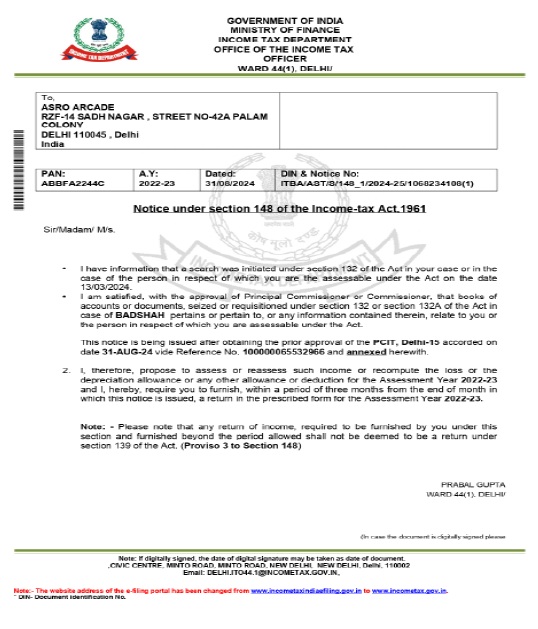
2. The only premise on which the petition is founded, is that prior to passing of the impugned assessment order, the notice (dated 31.08.2024) which was issued under Section 148 of the Act 1961 to the petitioner did not have the signature of the Assessing Officer (AO).
3. Relying upon the provision of Section 282A of the Act of 1961, learned counsel argued that unless a notice is signed by the issuing authority, it cannot be said to be a valid notice.
4. Learned counsel argued that since the genesis of the proceedings is an unsigned and illegal notice, the impugned assessment order is void and without jurisdiction and is liable to be quashed.
5. Ms Monica Benjaman, learned Junior Standing Counsel for the Department invited Court’s attention towards the sub-Section (2) of Section 282A of the Act of 1961 and submitted that since the impugned notice bears the name and designation of the issuing officer [Prabal Gupta, WARD 44(1), Delhi], the same is in accordance with the statutory provision.
6. She also argued that the petitioner had not taken any objection about purported irregulatory in the impugned notice before the AO and therefore, such objection (though not sustainable in the eye of law) cannot be allowed to be raised for the first time before this Court that too at such a belated stage, when the petitioner had already suffered an assessment order.
7. Learned counsel for the petitioner, in rejoinder, relied upon the judgment of Madhya Pradesh High Court dated 17.04.1982 passed in the case of Umashankar Mishra v. CIT 136 ITR 330 (Madhya Pradesh) and the judgment of Hon’ble the Supreme Court dated 15.10.1958 rendered in the case of Y. Narayana Chetty v. ITO [1959] 35 ITR 388 (SC).
8. Heard learned counsel for the parties.
9. The scan copy of the impugned notice dated 31.08.2024 is pasted hereinfra :
10. A simple look at the above notice reveals that it bears the name and designation of the issuing authority. According to us, the same falls within the ambit of sub-Section (2) of Section 282A of the Act 1961, which provision reads thus :
“(2) Every notice or other document to be issued, served or given for the purposes of this Act by any income tax authority, shall be deemed to be authenticated if the name and office of a designated income-tax authority is printed, stamped or otherwise written thereon.”
11. Since the name and the designation of the issuing officer has been mentioned, according to us, no signature is necessary. In the present era, when computer generated notice(s) and order(s) are being issued, the inscription of name(s) and the designation(s) is enough, as no digital document can bear the signature.
12. May be a digital signature is a proper course, but since sub section (2) of Section 282A of the Act of 1961 does not enjoin upon the issuing authority to affix digital signature, we are of view that there is no irregulatory worth the name in the notice under consideration. Because, in any case name and designation as required under Section 282A(2) of the Act of 1961 has been mentioned.
13. So far as the judgments relied upon by learned counsel for the petitioner are concerned, the same are of years 1982 and 1991, when the computers and electronically generated documents were not in vogue. The law, commerce and procedures are ever evolving; the judgment of years 1982 and 1991 on the issue in hand cannot be a guiding force in the present digital era.
14. The writ petition merits rejection, which we hereby do.
15. Considering that the petitioner has been pursuing the present writ petition (which was filed on 08.04.2026) the Appellate Authority shall consider the time consumed in pursuing the present writ petition (from 08.04.2026, till 16.04.2026) in accordance with law.
16. With these observations, the petition along with pending applications is dismissed.