
The Jurisdictional Validity Of Faceless Reassessment Prior To Statutory Notification (AY 2017-18)

By | March 17, 2026

The Jurisdictional Validity Of Faceless Reassessment Prior To Statutory Notification (AY 2017-18)

This ruling addresses a fundamental jurisdictional conflict that arose during the transition of the Indian Tax Department to a fully digital, faceless ecosystem. It clarifies when the National Faceless Assessment Centre (NFAC) officially gained the legal power to conduct reassessments under Section 147.


The Legal Issue

Can a reassessment order passed by the National Faceless Assessment Centre (NFAC) under Section 144B be considered legally valid if it was issued before the Central Government officially notified the specific scheme for faceless reassessments under Section 151A?


Facts of the Case

  • Original Assessment: The assessee, a partnership firm, originally filed a return declaring a business loss, which was initially accepted.

  • The Reopening Trigger: Based on information that ₹15 lakhs from cash deposits made by a third party during the 2016 Demonetization period were transferred to the assessee, the case was reopened under Section 147.

  • The Faceless Order (30-03-2022): The NFAC (Faceless Regime) passed the final reassessment order, making an addition to the income as “unexplained.”

  • The Legal Mismatch: Section 151A, which provides the specific legal framework for “Faceless assessment of income escaping assessment,” was formally notified by the Government on March 29, 2022, through the e-Assessment of Income Escaping Assessment Scheme, 2022.


The Decision

The Court ruled in favour of the assessee, setting aside the reassessment order:

  • Absence of Operating Jurisdiction: The Court held that for any authority to exercise power, that power must be granted by the statute. While Section 144B governed faceless regular assessments, it did not automatically cover reassessments under Section 147 until the notification of Section 151A.

  • Effective Date of the Scheme: The specific power to conduct faceless reassessments (including issuance of notices under Section 148) only came into existence and became operational on March 29, 2022.

  • Invalid Proceedings: Since the reassessment proceedings were initiated and the final order was passed through the faceless regime prior to (or at the very cusp of) the legal authorization of that regime for reassessment purposes, the entire process was deemed “without jurisdiction.”

  • Outcome: Even if the underlying facts of the ₹15 lakhs transfer were valid, the procedural illegality of using an unauthorized forum (NFAC for reassessment before the scheme was active) made the order void.


Key Takeaways for Taxpayers

  • Jurisdictional Error is Fatal: In tax law, an order passed by an authority without the legal right to do so on that date is a “nullity.” This applies even if the tax addition itself is factually correct.

  • Timeline Analysis: If you received a reassessment order passed by the NFAC/Assessment Unit between 2021 and early 2022, check the specific dates. If the process was conducted facelessly before the March 29, 2022 notification, the order may be challenged on jurisdictional grounds.

  • Faceless vs. Jurisdictional AO: This ruling reinforces that the transition to “faceless” required specific statutory enabling at each level (Assessment, Penalty, Appeal, and Reassessment).


IN THE ITAT DELHI BENCH ‘F’
Shiv Shakti Traders
v.
Income-tax Officer*
Vimal Kumar, Judicial Member
and S. Rifaur Rahman, Accountant Member
ITA No.5450 (Del) of 2025
[Assessment year 2017-18]
MARCH  6, 2026
Lalit Mohan, CA and Ankit Kumar, Adv. for the Appellant. Ms. Harpreet Kaur Hansra, Sr. DR for the Respondent.
ORDER
Vimal Kumar, Judicial Member.- The application for condonation of delay of 245 days in filing appeal and appeal filed by the Assessee are against order dated 11.10.2024 of Learned Commissioner of Income Tax (Appeal), National Faceless Appeal Centre, Delhi [hereinafter referred to as ‘the Ld. CIT(A)’] passed u/s 250 of the Income Tax Act, 1961, [hereinafter referred to as ‘the Act’] arising out of assessment order dated 30.03.2022 of the Ld. Assessing Officer/ Assessment Unit u/s 147 r.w.s 144B of the Act for Assessment Year 2017-18.
2. Brief facts of the case are that the assessee is a partnership firm engaged in the business of trading of Iron and Steel on wholesale and retail basis. Assessee filed its ITR on 31.03.2018 at business loss of Rs.68,98,172/-. Assessment u/s 143(3) was completed on 16.12.2019 at an income of Rs. 56,60,67,770/- after making an addition on account of unexplained bogus creditors, cash deposit, advance from customers, disallowance u/s 40(a)(ia)/40A(3)/43B. Information was received from ITO, Ward-3(2), Saharanpur vide letter dated 27.07.2020 that assessee in his account had deposited of cash during the demonetization period by Mr. Manoj Kumar. Out of cash deposited amount, Mr. Manoj Kumar has transferred an amount of Rs.15,00,000/- to the assessee. The case was reopened u/s 147/148. Notice u/s 148 dated 28.03.2021 was issued. Assessee filed return of income on 27.05.2021. Notice u/s 143(2) dated 22.11.2021 was issued. On 08.12.2021 assessee filed objections against notice u/s 148 which were disposed off vide order dated 11.03.2022. Notice u/s 142(1) was issued. The Assessee filed replies dated on 14.01.2022, 05.02.2022 and 15.03.2022. On completion proceedings, Ld. AO vide order dated 30.03.2022 made addition of Rs.25,95,000/-. Against order dated 30.03.2022 of Ld. AO, assessee filed appeal before Ld. CIT(A) which was dismissed vide order dated 11.10.2024.
3. Being aggrieved, the appellant assessee filed application for condonation of delay of 245 days in filing appeal and appeal on following grounds:
“1. That the learned Commissioner of Income Tax (Appeals), National Faceless Appeal Centre (NFAC), Delhi has erred both in law and, on facts in upholding the determination of income made by the learned Additional/Joint/Deputy/Assistant Commissioner of Income tax/Income Tax Officer, National Faceless Assessment Centre, Delhi of the appellant at Rs. 56,86,62,770/- as against assessed income of Rs. 56,60,67,7701/- as assessment order passed u/s 143(3) of the Act in an order of assessment dated 30.3.2022 u/s 147/144B of the Act.
2. That the learned Commissioner of Income Tax (Appeals) has erred both in law and on facts in disposing off the appeal ex-parte without granting any fair opportunity of being heard to the appellant.
2.1 That the finding that notices remained un-complied during the appellate proceedings is not based on correct appreciation of facts and circumstances of the case of the appellant and hence could not have been made a ground to deny an effective opportunity of being heard to the appellant firm.
2.2 That the learned Commissioner of Income Tax (Appeals) has failed to appreciate that there was reasonable cause for the appellant for not causing appearance on the dates fixed for hearing and as such disposal of the appeal without granting fair, meaningful and proper opportunity is untenable.
3. That the learned Commissioner of Income Tax (Appeals) has grossly erred both in law and on facts in upholding the initiation of proceedings under section 147 of the Act and, completion of assessment under section 147/144B of the Act without appreciating that the same were without jurisdiction and hence deserved to be quashed as such.
3.1 That the learned Commissioner of Income Tax (Appeals) has failed to appreciate that there was no specific relevant, reliable and tangible material on record to form a “reason to believe” that income of the appellant had escaped assessment and in view thereof the proceedings initiated are illegal, untenable and therefore unsustainable.
3.2 That the learned Commissioner of Income Tax (Appeals) has failed to appreciate that reasons recorded mechanically without application of mind do not constitute valid reasons to believe for assumption of jurisdiction u/s 147 of the Act.
3.3 That in absence of any valid approval obtained under section 151 of the Act, initiation of proceedings u/s 147 of the Act and assessment framed u/s 147/144 of the Act are invalid and deserve to be quashed as such.
4. That the learned Commissioner of Income Tax (Appeals) has erred both in law and on facts in upholding an addition of Rs. 25,95,000/-representing alleged unexplained cash credits in the bank account of the appellant brought to tax u/s 69A of the Act read with section 115BBE of the Act
4.1 That while upholding the above addition, the learned Commissioner of Income Tax (Appeals) has failed to appreciate the factual substratum of the case, statutory provisions of law and as such, addition so upheld is highly misconceived, totally arbitrary, wholly unjustified and therefore, unsustainable.
5 That without prejudice to the above and in the alternative, even otherwise, the learned Commissioner of Income Tax (Appeals) has erred both in law and on facts in holding that amount credited in the bank by the appellant is taxable as income under section 69A of the Act and thereafter computed the demand in accordance with the rates specified in section 115BBE of the Act as amended by Taxation Laws (Second Amendment) Act, 2016.
5.1 That the learned Commissioner of Income Tax (Appeals) has failed to appreciate that the amendment made by the Taxation Laws (Second Amendment) Act, 2016 was w.e.f. 1.4.2017 and thus applicable from financial year 2017-18 onwards and not from the financial year 2016-17 relevant to assessment year 201718 and therefore, demand computed was not only arbitrary but highly excessive.
5.2 That the learned Commissioner of Income Tax (Appeals) Tax ought to have therefore applied the income tax at best @ 30% of the income determined under section 69A of the Act and not at the rate of 60% as specified in section 115BBE of the Act as amended by Taxation Laws (Second Amendment) Act, 2016, more particularly when no such section has been invoked in the body of the order of assessment u/s 143(3) of the Act.
5.3 That the learned Commissioner of Income Tax (Appeals) has failed to appreciate that substitution of provisions by Taxation Laws (Second Amendment) Act, 2016 w.e.f. 1.4.2017 was not retrospective in nature but was prospective and only application from financial year 2017-18 relevant to assessment year 2018-19.
6. That even otherwise the learned Commissioner of Income Tax (Appeals) passed the order without granting sufficient proper opportunity to the appellant firm and therefore the same is contrary to principle of natural justice and hence vitiated.
7. That the learned Commissioner of Income Tax (Appeals) has also erred both in law and on facts in upholding the levy of interest of Rs. 2,07,68,127/- u/s 234A of the Act and, interest of Rs. 13,80,07,791/-u/s 234B of the Act Act which are not leviable on the facts of the instant case.”
4. Ld. Authorized Representative for appellant assessee submitted that there is delay of 245 days in filing appeal due the latches on part of counsel. Affidavit dated 18.01.2026 mentions inadvertent omission to notice uploading the order dated 11.10.2024 of Ld. CIT(A). The Explanation for delay of 245 days in filing of appeal due to inadvertence does not smack of malafides as the appellant has not gained anything by not filing appeal within period of limitation. Therefore, delay of 245 days in filing the appeal is condoned.
5. Ld. Authorized Representative for appellant assessee submitted that Ld. CIT(A) while passing the order failed to appreciate that various notices for filing of submissions remained un-complied with by the assessee. Ld. CIT(A) failed to appreciate that the assessee for reasonable cause could not be cause appearance in the appeal. The Ld. CIT(A) passed ex-parte order in violation of principle of natural justice. Ld. CIT(A) failed to appreciate that notice u/s 148 was issued to assessee on 28.03.2021. The assessee had not filed any return in response to notice. Notices u/s 142(1) of the Act were issued. The assessee filed replies dated 14.01.2022, 05.02,2022 and 15.03.2022. The assessment order dated 30.03.2022 was passed treating amount of Rs.25,95,000/- as unexplained. The Hon’ble ITAT Delhi in Suresh Chand v. ITO [IT Appeal No. 4110 (Delhi) of 2024, dated 30-7-2025] decided in favour of the assessee.
6. Ld. Departmental Representative submitted that objections of assessee were disposed of vide order dated 11.03.2022. Notice u/s 142(1) including show cause notice was issued by NFAC. On the contrary faceless regime of income escaping assessment stood notified only on 29.03.2022. The Faceless Assessment Scheme was significantly launched in the year of 2019 and notices u/s 142(1) have been issued to the assessee mentioning that “Kindly refer to ongoing assessment proceedings in your case for A.Y. 2017-18 under Faceless Assessment Scheme, 2019”.
7. From examination of record in light of aforesaid rival contention, it is crystal clear that Ld. CIT(A) in ex-parte order dated 11.10.2024 held that the appellant/ assessee despite several notices failed to submit submissions in respect of grounds of appeal. Ld. CIT(A) failed to appreciate that substitution of provisions by Taxation Laws (Second Amendment) Act, 2016 w.e.f 01.04.2017 was not retrospective in nature but was prospective and only applicable from Financial Year 2017-18 relevant to Assessment Year 2018-19.
7.1 A Co-ordinate Bench in Suresh Chand (supra) in para No.5 to 7 held as under:
“5. We now come to the basic relevant facts. There is hardly any dispute between the parties that the learned assessing authority had issued section 148 notice to the assessee on 31.03.2021. He did not file any return in response thereto. All this followed the Assessing Officer’s section 142(1) twin notices dated 24.12.2021 and 11.02.2022 followed by his assessment in question framed on 21.03.2022 treating the assessee’s alleged cash deposits of Rs.4,22,25,229/- as unexplained, which stand upheld to the extent of Rs.2,00,00,000/- only in the lower appellate discussion.
It is in this factual backdrop that the assessee’s case before us is that given the fact that the faceless regime in question got notified on 29.03.2022, the faceless assessment framed in his case on 21.03.2022 is non-est in the eyes of law.
6. The Revenue has drawn strong support from the learned lower authorities respective findings framing the faceless assessment herein in the assessee’s case. We find no reason to express our concurrence to the Revenue’s foregoing arguments. A perusal of the case file indicates that this tribunal recent learned co-ordinate bench order in ITA No. 1328/Kol/2024 dated 15.10.2024 in Nabiul Industrial Metal Pvt. Ltd. v. ITO has decided the very issue against the department as under:

“1.1. The brief facts of the case of the appellant are that the assessee Nabiul Industrial Metal Pvt. Ltd. did not file the return of income for the AY 2017-18 as a result of which case of the assessee was re-opened u/s 147 of the Act. The Assessing Officer (hereinafter referred to as ld. ‘AO’) received information from the investigation wing, Kolkata wherein it was mentioned that in course of the investigation in the case of M/s. Darsh Coke Trading Pvt. Ltd., it was revealed that the said company is a paper company through which entry operators provide bogus entries and layer money in exchange of commission. It was also found that the one of the beneficiaries is the assessee company which has received Rs. 15,00,000/- from a paper concern namely Tanishi Commotrades Pvt. Ltd. During the course of reassessment, the assessee was asked to explain the transactions with Tanishi Commotrades Pvt. Ltd. In response, the assessee submitted that in the current year i.e. FY 2016-17 the assessee took a loan/ advance from this party against sale of goods and in the immediately succeeding year i.e. FY 2017-18 sales were made to Tanishi Commotrades Pvt. Ltd and said sale was duly credited in the Profit and Loss account of the company and tax was duly paid. However, the AO was not convinced with the submission filed by the assessee and accordingly, added the sum of Rs. 15,00,000/- to the income of the assessee u/s 68 of the Act. The said assessment order has been challenged before the ld. CIT(A) wherein in absence of any response from the appellant the case of the assessee has been dismissed.

Being aggrieved and dissatisfied with the impugned order, the present appeal has been preferred.

1.2. The ld. Counsel for the assessee challenges the impugned order by taking several grounds but he, in course of hearing, took an additional ground being the legal ground and he pressed only legal ground which are as follows:

“That the National Faceless Assessment Centre erred in having assumed jurisdiction u/s 151A r.w.s 144B of the Act from 29.11.2021 when they were not empowered under any notification about the applicability of the faceless scheme for making assessment in faceless manner prior to 29.03.2022.”

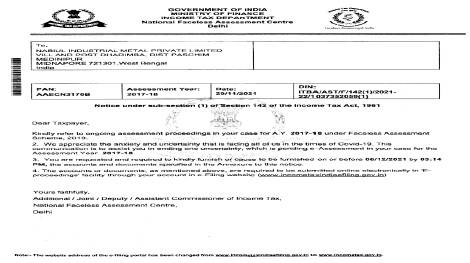
1.3. Ld. Counsel for the assessee submitted that the provisions of Section 151A of the Act came in the statute on 01.11.2021 but it was notified with effect from 29.03.2022. But in the present case, assessment proceedings to the NFAC started on 29.11.2021 which is evident from the notice u/s 142(1) of the Act. Ld. Counsel for the assessee further submits that the show cause notice has also been issued and the date has been mentioned as 28.03.2022 that is prior to 29.03.2022. Ld. Counsel for the assessee further submits that the assumption of jurisdiction by the NFAC was without jurisdiction. Consequently, the whole assessment is without jurisdiction and unsustainable in law. Ld. Counsel for the assessee further drew the attention of this Bench on the issuance of show cause notice and submitted that it was served on 29.03.2022 and asked the assessee to furnish explanation on or before 29.03.2022,it means without giving the assessee any opportunity before framing of the assessment order. Ld. Counsel for the assessee has filed the following papers:

(a) Notification of Ministry of Finance dated 29.03.2022.

(b) Notice issued u/s 142(1) of the Act.

(c) Show cause notice dated 28.03.2022.

1.4. Ld. D/R though supports the impugned order but did not raise any objection on the legal ground.

2. We have perused the records and the papers filed by the assessee. It appears that Notification with respect to Section 151A of the Act has been made with effect from 29.03.2022 which is as under:

“S.O. 1466(E).—In exercise of the powers conferred by subsections (1) and (2) of section 151A of the Income-tax Act, 1961 (43 of 1961), the Central Government hereby makes the following Scheme, namely:-

1. Short title and commencement.—(1) This Scheme may be called the e-Assessment of Income Escaping Assessment Scheme, 2022.

(2) It shall come into force with effect from the date of its publication in the Official Gazette.

2 .Definitions.—(1) In this Scheme, unless the context otherwise requires, —

(a)”Act” means the Income-tax Act, 1961 (43 of 1961);

(b) “automated allocation” means an algorithm for randomised allocation of cases, by using suitable technological tools, including artificial intelligence and machine learning, with a view to optimise the use of resources.

(2)Words and expressions used herein and not defined, but defined in the Act, shall have the meaning respectively assigned to them in the Act.

3. Scope of the Scheme.—For the purpose of this Scheme,—

(a) assessment, reassessment or re-computation under section 147 of the Act,

(b)issuance of notice under section 148 of the Act, shall be through automated allocation, in accordance with risk management strategy formulated by the Board as referred to in section 148 of the Act for issuance of notice, and in a faceless manner, to the extent provided insection 144B of the Act with reference to making assessment or reassessment of total income or loss of assessee.”

2.1. We have also gone through the notice u/s 142(1) of the Act dated 29.11.2021 which is as follows:
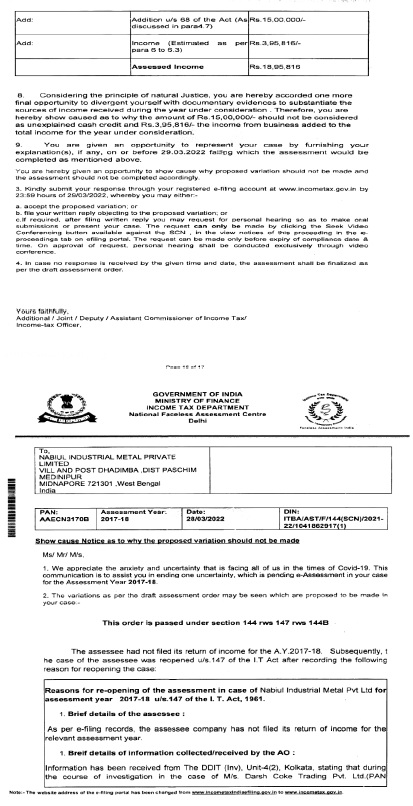
2.2. We further find the show cause notice issued that also reflects the date 28.03.2022 which is as follows:
………………………………………………….

2.3. It appears from the show cause notice issued on 28.03.2022 that at the bottom of the page it was digitally signed thereby giving date 29.03.2022 at 00:20:37 IST.

2.4. We further find that in the show cause notice the assessee has been directed to furnish explanation on or before 29.03.2022. It is surprising that when it was issued on 29.03.2022 at 00:20:37 IST and directed the assessee to explain the explanation before 29.03.2022.

3. Keeping in view the entire facts and discussions made above, we find substance in the argument of the ld. CIT(A) that assumption of jurisdiction prior to 29.03.2022 by the ld. AO is to be held to be without jurisdiction. Accordingly, the assessment order, passed, is to be deemed without jurisdiction. Subsequently, all the orders passed are hereby held to be without jurisdiction.”

7. We adopt the above detailed discussion mutatis mutandis to accept the assessee’s instant additional/legal ground in very terms to quash the assessing authority’s assessment framed in his case on 21.03.2022. Ordered accordingly.”
7.2 In view of above material facts and well settled principle of law the orders of Ld. CIT(A) dated 11.10.2024 and Ld. AO dated 30.03.2022 are set aside.
8. In the result, application for condonation of delay of 245 days in filing appeal and the appeal filed by the Assessee are allowed.
Order is pronounced in the Open Court 06.03.2026.