


Publication of The Social Security (Central) Rules, 2026

The Gazette of India
CG-DL-E-08052026-272366
EXTRAORDINARY
PART II—Section 3—Sub-section (i)
PUBLISHED BY AUTHORITY
No. 310]
NEW DELHI, FRIDAY, MAY 8, 2026/VAISAKHA 18, 1948
MINISTRY OF LABOUR AND EMPLOYMENT
NOTIFICATION
New Delhi, the 8th May, 2026
G.S.R. 344(E).—Whereas, the draft of the Social Security (Central) Rules, 2025 were
published as required under sections 154, 155, 158 and 159 of the Code on Social Security, 2020 (36
of 2020) in the Gazette of India, Extraordinary, Part II, Section 3, Sub-Section (i) vide notification
number G.S.R. 935(E), dated the 30th December, 2025, inviting objections and suggestions from all
persons likely to be affected thereby within a period of forty-five days from the date on which the
Gazette containing the said notification were made available to the public;
And whereas, the notification was made available to the public on the 30th December, 2025;
And whereas, the objections and suggestions received from persons and stakeholders have been duly
considered by the Central Government;
Now, therefore, in exercise of the powers conferred by sub-section (1) of section 154 read with subsection (2) thereof, and sub-section (1) of section 155 read with sub-section (2) thereof and Section
158 and sub-section (1) read with sub-section (2) of section 159 of the Code on Social Security, 2020
(36 of 2020) and read with section 24 of the General Clauses Act, 1897(10 of 1897) in supersession of
the-
(i) Employee‘s Compensation Rules, 1924;
(ii) Employee‘s Compensation (Transfer of Money) Rules, 1935;
(iii) Employees‘ State Insurance (Central) Rules, 1950;
(iv) Employment Exchanges (Compulsory Notification of Vacancies) Rules, 1960;
(v) Maternity Benefit (Mines and Circus) Rules, 1963;
(vi) Payment of Gratuity (Central) Rules, 1972;
(vii) Cine-Workers Welfare Fund Rules, 1984;
(viii) Employee‘s Compensation (Venue of Proceedings) Rules, 1996;
(ix) Tribunal (Procedure) Rules, 1997;
(x) Employees‘ Provident Funds Appellate Tribunal (Conditions of Service) Rules, 1997;
(xi) Building and other Constructions Workers‘ Welfare Cess Rules, 1998; and
(xii)Unorganised Workers‘ Social Security Rules, 2009;
except as respects things done or omitted to be done before such supersession, the Central Government
hereby makes the following rules, namely:-
CHAPTER I
PRELIMINARY
1. Short title and commencement.– (1) These rules may be called the Social Security (Central)
Rules, 2026.
(2) They shall come into force on the date of their publication in the Official Gazette.
2. Definitions.– (1) In these rules, unless the context otherwise requires, —
(a) ―agency‖ means any corporation, body or institution, established under an Act of Parliament or
central public sector undertaking or special purpose vehicle as notified by the Central Government;
(b) ―appeal‖ means an appeal preferred under the Code;
(c) “Appellate authority” means in Central sphere, the Central Government or the authority specified
by the Central Government under sub-section (8) of section 56 or in State sphere, an officer, senior in
rank to the Assessing Officer for the purposes of section 105, appointed by the State Government, as
the case may be;
(d) ―Assessing Officer‖ means a gazetted officer of a State Government or an officer of a local
authority holding an equivalent post to a gazetted officer of the State Government appointed by such
State Government for assessment of cess under Chapter VIII of the Code;
(e) ―Authorised Officer for Employees‘ Compensation‖ means any officer whom the State
Government may designate either generally or in respect of any area or class of areas, for the purpose
of performing the functions assigned by these rules to the Authorised Officers;
(f) ―authority‖ means the Central Government or the authority specified by the Central Government
for the purpose of sub-section (3) of section 72;
(g) ―average daily wages during a contribution period‖ under Chapter IV of the Code in respect of an
employee, means the aggregate amount of wages payable to him during that period divided by the
number of days for which such wages were payable;
(h) ―average daily wages during a wage period‖ under Chapter IV of the Code means —
(i) in respect of an employee who is employed on time-rate basis, the amount of wage which
would have been payable to him for the complete wage period had he worked on all the working days
in that wage period, divided by 26 if he is monthly rated, 13 if he is fortnightly rated, 6 if he is weekly
rated and 1 if he is daily rated;
(ii) in respect of an employee employed on any other basis, the amount of wages earned during the
complete wage period in the contribution period divided by the number of days in full or part for
which he has worked for wages in that wage period:
Provided that where an employee receives wages without working on any day during such
wage period, he shall be deemed to have worked for 26, 13, 6 or 1 day or days if the wage period be a
month, a fortnight, a week or a day respectively.
Explanation. — Where any night shift continues beyond midnight, the period of the night shift after
midnight shall be counted for reckoning the day worked as part of the day preceding;
(i) ―benefit period‖ means the period not exceeding six consecutive months corresponding to the
contribution period, as specified in the regulations made under section 157;
(j) ―career centre (central)‖ means that career centre as notified by the Central Government;
(k) ―career centre (regional)‖, throughout India, except the Union territory of Chandigarh, means the
career centre as notified by the respective State Government or the Administration of the Union
territory as having jurisdiction –
(i) over the area in which the establishments concerned are situated; or
(ii) over specified classes or categories of establishments concerned or vacancies;
(l) ―career centre (regional) in the Union territory of Chandigarh‖ means the career centre established
either by the Union territory Administration of Chandigarh or by the State Government of Punjab or
Haryana, as the case may be, notified by the respective States as having jurisdiction over specified
classes or categories of establishments or vacancies:
Provided that the career centres established by the State Government of Punjab or Haryana shall
not have jurisdiction over—
(i) the public sector offices or establishments other than those belonging to the respective
States; and
(ii) private sector establishments;
(m) ―cess collector‖ means an officer appointed by the State Government for collection of cess under
Chapter VIII of the Code;
(n) ―chairperson‖ means the chairperson of the Corporation, the Central Board, the National Social
Security Board, the State Unorganised Workers‘ Social Security Board, the Standing Committee, the
Medical Benefit Committee or the Executive Committee, as the case may be;
(o) ―chartered engineer‖ means a person having an engineering degree and the corporate membership
of the Institution of Engineers (India);
(p) ―Code‖ means the Code on Social Security, 2020 (36 of 2020);
(q) ―contribution period‖ means the period not exceeding six consecutive months, as specified in the
regulations made under section 157;
(r) ―electronically‖ means any information submitted by email or uploading on the designated Portal
or digital payment in any mode for the purpose of the Code;
(s) ―excluded vacancies‖ means those vacancies which have been excluded from the purview of the
section 139 under the provisions of sub-sections (1) and (2) of section 140;
(t) ―Form‖ means a form appended to these rules;
(u) ―fund‖ means the Employees‘ State Insurance Fund referred to in section 25, the Provident Fund,
the Pension Fund and the Employees‘ Deposit-Linked Insurance Fund referred to in section 16 or the
Social Security Fund referred to in section 141, as the case may be;
(v) ―Government Securities‖ means Government Securities as defined in the Government Securities
Act, 2006 (38 of 2006);
(w) ―immovable property‖ includes land, benefits to arise out of land, things attached to the earth, or
permanently fastened to anything attached to the earth;
(x) ―movable property‖ means property of every description except immovable property;
y) ―nodal officer‖ means a person designated by the Building Workers‘ Welfare Board or the State
Government to facilitate the registration, renewal and updation electronically or otherwise or to
perform any other function relating to building workers from the private sector, State Government,
Central Government and public sector undertakings or local authority including supervising and
monitoring the functions of the beneficiary registering officers designated by the appropriate
Government;
(z) ―nomination” means nomination made under section 55;
(za) ―register of women employees‖ means a register of women employees maintained under rule 53;
(zb) ―Schedule‖ means the Schedule to the Code;
(zc) ―section‖ means a section of the Code;
(zd) ―ShramSuvidha Portal‖ means the portal of the Ministry of Labour and Employment with such
name;
(ze)―specified‖ means specified by an order of the Central Government or any State Government or
any officer so authorised by such Government;
(zf) ―standard benefit rate‖ means average daily wages obtained by dividing the total wages paid
during the contribution period by the number of days for which these wages were paid;
(zg) ―transferring authority‖ means any authority in any country which transfers or causes to be
transferred any lump sum awarded under the law relating to employees compensation in such country
and applicable for the benefit of any person residing or about to reside in India; and
(zh) ―year‖ means the financial year, beginning from the 1st day of April and ending with the 31st day
of March of the following year.
(2) The words and expressions used in these rules which are not defined therein, but are defined in the
Code, shall have their respective meaning as assigned to them in the Code.
3. Manner and conditions of making the provisions of Chapter III or Chapter IV inapplicable to
an establishment.– (1) The employer of an establishment to which the provisions of Chapter III or
Chapter IV have been made applicable under sub-section (5) or sub-section (7) of section 1 of the
Code, may apply electronically on the specified portal to the Central Provident Fund Commissioner or
the Director General, as the case may be, for making such provisions inapplicable to the
establishments, subject to the condition that the employer and the majority of the employees of that
establishment agree in writing to such request.
(2) The Central Provident Fund Commissioner or the Director General, as the case may be, shall
decide the application under sub-section (5) or sub-section (7) of section 1 of the Code within a period
of sixty days from the date of receipt of the application:
Provided that if no decision is taken by the Central Provident Fund Commissioner or the
Director General, as the case may be, within the period of sixty days from the date on which the
application is made, the permission under sub-section (5) or sub-section (7) of section 1of the Code,
as the case may be, shall be deemed to have been granted with effect from the date of completion of
such sixty days:
Provided further that no such application shall be entertained if the provisions of Chapter III
or Chapter IV have become applicable, in terms of sub-section (4) of section 1of the Code, to the
establishment at any time subsequent to the notification under sub-section (5) or sub-section (7) of
section 1 of the Code, as the case may be:
Provided also that no such application shall be made by the employer of the establishment
before five years of such coverage under the provisions of Chapter III or Chapter IV, as the case may
be:
Provided also that no such application shall be entertained unless the employer has furnished
all returns, paid all dues under the Code and submitted a self-certification to that effect along with the
application.
4. Income of dependent parents of employee.–For the purposes of sub-clause (e) of clause (33) of
section 2 of the Code, the income from all sources, for the purposes of Chapter IV of the Code shall
not exceed fourteen thousand rupees in a month or such amount as may be specified by notification.
5. Registration of establishments and cancellation thereof.–(1)(a) Every employer seeking
registration for an establishment not already registered shall apply electronically in Form-I of the
Occupational Safety, Health and Working Conditions (Central) Rules, 2026, on the Shram Suvidha
Portal by furnishing details of the establishment and uploading documents related to registration of
the establishment including proof of identity and address of the employers, as specified in the Form.
Explanation.- For the purposes of this sub-rule, Form-I under the Occupational Safety, Health and
Working Conditions (Central) Rules, 2026 shall be the common form for registration under these
rules.
(b) The Form shall be signed digitally or in such other manner as may be required on the portal.
(c) The applicant shall be responsible for the veracity of all information submitted in the application.
(d) The Permanent Account Number (PAN) of the establishment allotted under Income Tax 2025 (30
of 2025) or any other unique number allotted to the establishment under any other law for the time
being in force or any other particular furnished in the form, may be verified online.
(e) The certificate of registration shall be issued in Form-III of the Occupational Safety, Health and
Working Conditions (Central) Rules, 2026 electronically, if the application is complete in all respects
but not later than seven days from the date of submission of complete application, failing which such
establishment shall be deemed to have been registered and the certificate of registration shall be autogenerated:
Provided that in exceptional circumstances, the Central Government may, by notification and
for such period as may be specified therein, dispense with the requirement of electronic registration in
respect of establishment or class of establishments, for the whole or any part of India, and submission
of application in the Form-I of the Occupational Safety, Health and Working Conditions (Central)
Rules, 2026 so provided, may be allowed.
(2) The authorised officer under the Code shall direct the employer who fails to comply with the
requirements of sub-rule (1) to do so within the time stated therein and such employer shall thereupon
comply with the instructions issued by that officer in this behalf.
(3) The employer in respect of an establishment already registered under any other central labour
law for the time being in force shall, update the particulars of the employer or establishment on the
Shram Suvidha Portal within such period as prescribed under the Occupational Safety, Health and
Working Conditions Code, 2020.
(4) Any registration obtained by furnishing wrong information shall be liable to cancellation after the
establishment has been given an opportunity to show cause within a period of thirty days from the
date on which the notice is served on the concerned employer, electronically or otherwise, as to why
the certificate of registration should not be cancelled.
(5) The employer shall quote the registration number on all documents prepared or submitted by
him in connection with the Code or the schemes or the rules or the regulations, as the case may be,
and in all correspondence with the offices concerned.
(6) Any change in the particulars furnished in the Form-Iof the Occupational Safety, Health and
Working Conditions (Central) Rules, 2026 submitted on the specified portal shall be updated by the
employer within thirty days of such change.
(7) The employer of an establishment to which the provisions of the Code apply and whose
business activities are in the process of closure, may apply for cancellation of registration in the
specified form online on the Shram Suvidha Portal after furnishing complete details and the status of
the contribution and other dues payable under the Code.
(8) The application for cancellation of registration shall be allowed after the particulars in the
application are verified in such manner as may be specified by the Central Government:
Provided that no such application for cancellation of registration shall be entertained unless the
employer has furnished all returns, paid all dues under the Code and submitted a self-certification to
that effect along with the application: Provided further that such application for cancellation shall be decided within a period of ninety days from the date of receipt of the application complete in all respects.
(9) A copy of the certificate of registration shall be displayed at the conspicuous places in the
premises where the work is being carried out.
CHAPTER II
SOCIAL SECURITY ORGANISATIONS
A. CENTRAL BOARD, EMPLOYEES’ PROVIDENT FUND
6. Administration of funds vested in Central Board.–(1) The Central Board shall administer the
funds vested in it in accordance with the guidelines issued by the Central Government.
(2) The Central Board for the efficient administration of the schemes may open as many accounts as
it may consider necessary or as specified in the schemes.
(3) All moneys belonging to the funds shall be deposited in the Reserve Bank of India or the State
Bank of India or in such other Scheduled Banks as may be approved by the Central Government from
time to time or shall be invested as the Central Government may, by notification in the Official
Gazette, Specify.
(4) All expenses incurred in respect of, and loss, if any, arising from any investment shall be charged
to the funds.
(5) The funds, not including therein the administration account, shall not be expended for any
purpose other than the payment of the sums standing to the credit of individual members of the funds
or to their nominees or heirs or legal representatives in accordance with the provisions of respective
schemes.
(6) The funds shall be operated upon by such officers as may be authorised in this behalf by the
Central Board.
7. Executive Committee. – (1)The Central Board shall perform such functions as may be assigned to
it by the Central Government under section 13 and administer the Schemes framed under section 15.
(2) The Executive Committee shall consist of the following members, namely: –
i. a Chairperson to be appointed by the Central Government from amongst the members
of the Central Board;
ii. two persons appointed by the Central Government from amongst the persons referred
to in clause (b) of sub-section (1) of section 4;
iii. three persons appointed by the Central Government from amongst the persons
referred to in clause (c) of sub-section (1) of section 4;
iv. three persons representing the employers elected by the Central Board from amongst
the persons referred to in clause (d) of sub-section (1) of section 4;
v. three persons representing the employees elected by the Central Board from amongst
the persons referred to in clause (e) of sub-section (1) of section 4; and
vi. the Central Provident Fund Commissioner, ex officio.
(3) (a) The Chairperson of the Central Board shall call a meeting of the Board for the purpose of
election to the Executive Committee of the members representing the employers or, as the case may
be, the employees referred to in sub-clauses (iv) and (v) of sub-rule (2).
(b) The Chairperson of the Central Board may invite the members to propose the names of those
members who represent the employers or, as the case may be, the employees and every such
proposal shall be duly seconded by another member of the Board.
(c) In case where the number of persons proposed and seconded for election under clause (a)
does not exceed the number of vacancies to be filled up from amongst the persons representing the
employers, or, as the case may be, the employees, the persons whose names have been so proposed
and seconded in relation to the category of employers or employees, shall be declared elected to the
Executive Committee.
(d) In case where the number of persons proposed and seconded for election under clause (a)
exceeds the number of vacancies to be filled up from amongst the persons representing the employers
or, as the case may be, the employees, each member of the Board present at the meeting, other than
the Chairperson, shall be given a ballot paper containing the names of all the candidates so proposed
and seconded and he may record his votes thereon for as many candidates belonging to the categories
of employers or employees, as there are vacancies to be filled up in relation to each such category, but
not more than one vote shall be given in favour of any one candidate.
(e) In case where any member votes for more candidates than the number of vacancies in relation
to the categories of employers or employees or gives more than one vote in favour of any one
candidate, all his votes shall be deemed to be invalid.
(f) The persons getting the highest number of votes shall be declared by the Chairperson as duly
elected to the Executive Committee at the same meeting or as soon thereafter as possible:
Provided that where there is an equality of votes between candidates, the Chairperson shall
have a casting vote.
(g) In case where any question arises as to the validity of any election, it shall be referred to the
Central Government, which shall decide the same.
(4) The Central Board may, by order, constitute one or more committees consisting of as many
trustees and officers of the Employees‘ Provident Fund Organisation, as may be specified in the order:
Provided that the Central Board may also include such persons, who in its opinion, have
special knowledge of the subject matter relating to the committee.
(5) The Executive Committee shall function under the general superintendence of the Central Board
and assist the Central Board in performance of its functions and shall perform such functions as may
be assigned to it by the Central Board.
(6) (a) The term of office of the Chairperson, Vice-Chairperson and every trustee of the Central Board
referred to in clauses (b), (c), (d) and (e) of sub-section (1) of section 4 shall be four years
commencing on and from the date on which their respective appointment is notified in the Official
Gazette.
(b) The term of office of the Chairperson and every member of the Executive Committee shall be two
years, commencing on and from the date on which their respective appointment is notified.
(c) Notwithstanding anything contained in clauses (a) and (b), every trustee or member of the Central
Board or Executive Committee, as the case may be, shall continue to hold office until the appointment
of his successor is notified in the Official Gazette:
Provided that a member of the Executive Committee shall cease to hold office when he ceases
to be a member of the Central Board.
(d) A trustee or a member referred to in clauses (a) and (b) appointed to fill a casual vacancy shall
hold office for the remaining period of the term of office of the trustee or member in whose place he is
appointed and shall continue to hold office on the expiry of the term of office until the appointment of
his successor is notified in the Official Gazette.
(e) A person shall be eligible for appointment as a trustee or a member for a maximum of two terms:
Provided that such limitation of terms shall not apply to the Chairperson, ViceChairperson, and a trustee or member appointed ex officio and such appointment shall be co-terminus
with the tenure of the office of the trustee or member, as the case may be:
Provided further that the maximum of two terms shall also include the number of terms
for which a person has been appointed as a trustee of the Central Board under clause (d) or clause (e)
of sub-section (1) of section 5A of the erstwhile Employees’ Provident Funds and Miscellaneous
Provisions Act, 1952 (19 of 1952).
(7) (a) The Central Provident Fund Commissioner shall be the Secretary to the Central Board and
also to the Executive Committee.
(b) The Secretary to the Central Board and the Executive Committee shall, in consultation with the
Chairperson of the Central Board or the Executive Committee, as the case may be, convene meetings
of the Central Board or the Executive Committee, keep a record of their minutes and shall take
necessary steps for carrying out the decisions of the Central Board or the Executive Committee, as the
case may be.
B. EMPLOYEES’ STATE INSURANCE CORPORATION
8. The Employees’ State Insurance Corporation, Standing Committee and Medical Benefit
Committee.–(1) Every person representing each of the States shall be appointed as a member of the
Corporation, on nomination by the State Government concerned.
(2) (a) The common seal of the Corporation shall remain in the custody of the Director General of the
Corporation and shall not be affixed to any instrument except in the presence of the Director General
or two members of the Standing Committee constituted under sub-rule (3) and the Director General or
the said two members shall sign the contract in token of the fact that the same was sealed in his or
their presence.
(b) The Corporation shall have for use at each of its other offices, as it may specify, an official seal
which shall be a facsimile of the common seal of the Corporation with the addition of the name of the
office where it is to be used.
(c) The official seal shall not be affixed to any instrument except in the presence of such person or
persons as the Standing Committee may authorise in this behalf and such person or persons shall sign
the instrument in token of the fact that the same was sealed in his or their presence.
(d) An instrument to which an official seal is duly affixed shall bind the Corporation as if it had been
sealed with the common seal of the Corporation.
(3) A Standing Committee of the Corporation shall be constituted from amongst its members,
consisting of —
(a) a Chairperson appointed by the Central Government;
(b) three members of the Corporation, appointed by the Central Government;
(c) three members of the Corporation representing such three State Governments thereon as
the Central Government shall specify from time to time;
(d) eight members elected by the Corporation as follows, namely: —
(i) three members from among the members of the Corporation representing employers;
(ii) three members from among the members of the Corporation representing employees;
(iii) one member from among the members of the Corporation representing the medical
profession; and
(iv) one member from among the members of the Corporation elected by Parliament;
and
(e) the Director-General of the Corporation, ex officio.
(4) (a) The Chairperson of the Corporation shall, at a meeting of the Corporation at which it is
proposed to elect members of the Standing Committee under clause (d) of sub-rule (3), invite
members to propose names from among members of the Corporation belonging to the group from
which election is to be held and the names proposed shall be duly seconded by another member of the
Corporation.
(b) If the number proposed from any group for election does not exceed the number of vacancies to be
filled therefrom, the persons whose names have been so proposed shall be declared elected to the
Standing Committee.
(c) If the number proposed from a group for election exceeds the number of vacancies to be filled
there from, each member of the Corporation present at the meeting shall be given a secret ballot paper
containing the names of all the candidates proposed and he shall be required to vote thereon for as
many candidates from the group as there are vacancies to be filled up, with one vote in favour of any
one candidate and if any member votes for more candidates than there are vacancies in the group or
gives more than one vote in favour of any one candidate, all his votes shall be deemed to be invalid.
(d) The persons getting the highest number of votes shall be declared by the Chairperson at the
meeting or as soon thereafter as possible as duly elected to the Standing Committee:
Provided that where an equality of votes is found to exist between any candidates and the
addition of one vote will entitle any of the candidates to be declared to be elected, the determination
of the person or persons to whom such one additional vote shall be deemed to have been given shall
be made by lot to be drawn in the presence of the Chairperson and in such manner as he may
determine.
(e) If any question arises as to the validity of any election, it shall be referred to the Central
Government whose decision in the matter shall be final.
(5) The powers and duties of the Medical Benefit Committee shall be–
(a) to advise the Corporation in regard to the constitution, setting up, duties and powers of local
committees constituted for the purpose of assisting in the administration of medical benefit;
(b) to make recommendations to the Corporation in regard to —
(i) the scale and nature of medical benefit provided at hospitals, dispensaries, clinics and other
institutions and the nature and the extent of the medicines, staff and equipment which shall be
maintained at such institutions and the extent to which these fall short of the desired standard;
(ii) the medical formulary for use in connection with the medical benefit provided under the
Code;
(iii)medical certification for the purposes of the grant of benefits, including the procedure and the
forms for such certification, statistical returns, registers and other medical records; and
(iv) measures undertaken for the improvement of the health and welfare of Insured Persons, and
the rehabilitation and re-employment of Insured Persons, disabled or injured;
(c) to advise the Corporation on any matter relating to the professional conduct of any medical
practitioner employed for the purpose of providing medical benefit under the Code.
(6) (a) Save as otherwise expressly provided in the Code, the terms of office of members of the
Corporation, other than the members referred to in clauses (a), (b), (c), (d) and (e) of sub-section (1)
of section 5 and the ex officio member, shall be for four years commencing from the date respectively
on which their appointment or election is notified:
Provided that a member of the Corporation shall notwithstanding the expiry of the said period
of four years, continue to hold office until the appointment or election of his successor is notified:
Provided further that the tenure of non-official members of the Corporation shall not be for
more than a total of two terms.
(b) The members of the Corporation referred to in clauses (a), (b), (c), (d) and (e) of sub-section (1) of
section 5 shall hold office during the pleasure of the Central Government.
(7) (a) Save as otherwise expressly provided in the Code, the terms of office of a member of the
Standing Committee, other than a member referred to in clause (a) or clause (b) or clause (c) of subrule (3), shall be two years from the date on which his election is notified:
Provided that a member of the Standing Committee shall, notwithstanding the expiry of the
said period of two years, continue to hold office until the election of his successor is notified:
Provided further that a member of the Standing Committee shall cease to hold office when he
ceases to be a member of the Corporation.
(b) A member of the Standing Committee referred to in clause (a) or clause (b) or clause (c) of subrule (3) shall hold office during the pleasure of the Central Government.
(8) The Standing Committee shall be responsible for administering the affairs of the Corporation and
may exercise any of the powers and perform any of the functions of the Corporation as provided
under the rules and regulations made under the Code.
C. NATIONAL SOCIAL SECURITY BOARD
9. National Social Security Board.–(1)(a) A member of the National Social Security Board
other than an ex officio member thereof,
shall hold office for a period not exceeding three years from the date of his nomination and
shall be eligible for re-nomination:
Provided that a member, other than an ex officio member, shall not hold the office for more
than total of two terms.
(b) The Central Government shall seek nominations from amongst the representatives of associations
of unorganised sector workers and employers‘ associations of unorganised sector, in the National
Social Security Board in the category of sub-clauses (i) and (ii) of clause (c) of sub-section (2) of
section 6 in such manner as it may determine.
(c) The Central Government shall nominate seven persons under sub-clause (iii) of clause (c) of subsection (2) of section 6 from amongst persons of eminence in the fields of labour welfare,
management, finance, law and administration.
(d) The Central Government shall seek nominations of two Lok Sabha members from the Speaker of
the Lok Sabha and one member from the Chairman of the Rajya Sabha under sub-clause (iv) of clause
(c) of sub-section (2) of section 6, as the case may be.
(e) The Central Government shall nominate ten members under sub-clause (v) of clause (c) of subsection (2) of section 6 representing Ministries or Departments of the Central Government, concerned
with the matters related to the welfare of the unorganised sector workers.
(f) The Central Government shall nominate five members representing the State Governments under
sub-clause (vi) of clause (c) of sub-section (2) of section 6, and one member representing Union
territories under sub-clause (vii) of clause (c) of sub-section (2) of section 6 on rotation basis in such
manner, as it may determine.
(g) A member nominated under sub-clauses (i), (ii) and (iii) of clause (c) of sub-section (2) of section
6, shall cease to be a member of the National Social Security Board, if he
ceases to represent the category of interest from which he was so nominated:
Provided that out of seven persons nominated under said sub-clause (i),
one member each from the Scheduled Caste, the Scheduled Tribe, the minorities and women
shall be represented.
(h) A member nominated under sub-clause (iv) of clause (c) of sub-section (2) of section 6
shall cease to be a member of the National Social Security Board, if he ceases to be a member
of the House of Parliament by which he was so elected.
(i) No person shall be chosen as, or continue to be, a member of the National Social Security Board if
such person attracts any provision of section 8.
(2) (a) The National Social Security Board for Unorganised Workers constituted under section 6
shall be the Board referred to in sub-section (6) of section 114, for the gig and platform workers.
(b) A member of the National Social Security Board, other than an ex officio member thereof, shall
hold office for a period not exceeding three years from the date of his nomination and shall be
eligible for re-nomination:
Provided that a member, other than an ex officio member, shall not hold the office for more
than total of two terms.
(c) The Central Government shall nominate five members under clause (a) of sub-section (6) of
section 114, as representative of aggregators on rotation basis from amongst the types of the
aggregators mentioned in the Seventh Schedule.
(d) The Central Government shall nominate five members under clause (b) of sub-section (6) of
section 114 from amongst the gig workers and platform workers, on rotation basis, representing the
different types of gig workers and platform workers.
(e)The Central Government shall nominate five members as experts from amongst persons of
eminence in the field of labour welfare, management, finance, law, administration, e-commerce or
information technology under clause (e) of sub-section (6) of section 114.
(f) In the discharge of functions of the National Social Security Board for the purpose of the welfare
of gig workers and platform workers, the quorum for transaction of business at any of the meeting
shall be six members.
(g) The National Social Security Board may constitute an expert committee to advise it on matters
related to the welfare of gig workers and platform workers, assessment of number of gig workers and
platform workers, identifying the new types of aggregators or any other matter related to gig workers
and platform workers.
(3) (a) The National Social Security Board, for discharging its functions as assigned to it, under subsection (7) of section 6, may constitute a committee to deliberate and recommend on the specific
issues as may be assigned to such committee;
(b) Such committee may co-opt members from such Board or outside, as the case may be, from the
fields of the experts, on which the committee is required to deliberate.
(4) (a) The Central Government shall initiate the process for reconstitution of the National Social
Security Board, prior to six months of expiry of the term of the Board.
(b) If the new Board is not re-constituted after completion of the term of the National Social Security
Board, such arrangements may be made for discharging the functions of the Board as may be decided
by the Central Government for the period till the new Board is constituted, through a notification.
(c) Consequent upon institution of arrangement referred to in clause (b), all actions taken shall have
the same effect as if it has been carried out by the Board itself.
(5) (a) A member of the National Social Security Board, not being an ex
officio member, may resign by a letter in writing addressed to the Central Government.
(b) The seat of such a member shall fall vacant from the date on
which his resignation is accepted or on the expiry
of thirty days from the date of receipt of intimation of resignation, whichever is earlier.
(c) The power to accept the resignation of such a member shall vest with the Central
Government.
(6)If such a member changes his address, he shall notify his new address to the MemberSecretary of the Board who shall thereupon enter his new address in the official records:
Provided that if a member fails to notify his new address, the
address in the official records shall for all purposes be deemed to be the member‘s correct
address.
(7) When a vacancy occurs or is likely to occur in the membership of the National Social
Security Board, Member-Secretary of the Board shall submit a report to the Central
Government and on receipt of such report, the Central Government may,
by notification, nominate a person to fill the vacancy in the manner specified under sub-rules (1)
and (2) of rule 9, and the person so nominated shall hold
office for the remainder of the term of office of the member in whose place he is nominated.
(8) (a) During the pendency of the proceeding, if any, under clauses (b) and (c) of sub-section (2) of
section 8, for removal of a member of the National Social Security Board for Unorganised Workers,
such member shall abstain from the meetings of the Board;
(b) the decision of the Central Government, on the debarment, dis-qualification and removal of any
member under section 8, shall be final.
10. Other welfare measures and facilities.– If, in the opinion of the Central Government, it is
necessary, for the improvement of well-being of the building workers, to formulate a new welfare
scheme or schemes in a State, Building Workers Welfare Board shall make provisions for such other
welfare measures and facilities as may be prescribed by the Central Government.
D. GENERAL
11. Meetings, notice of meetings, list of business and quorum.–(1) (a) The Central Board or the
Corporation or the National Social Security Board or the State Building Workers‘ Welfare Board or
any Committee thereof shall, subject to sub-rule (2), meet at such place and time as may be decided
by its Chairperson.
(b) The Central Board or the Corporation shall meet at least twice in a year.
(c) The Executive Committee of the Central Board and the Standing Committee of the Corporation
shall meet at least four times in a year and the Medical Benefit Committee of the Corporation shall
meet at least twice in a year.
(d) The National Social Security Board or the State Building Workers‘ Welfare Board shall meet at
least thrice in a year.
(e) The Chairperson of the Central Board or the Corporation or the National Social Security Board or
the State Building Workers‘ Welfare Board or any committee thereof may whenever he thinks fit, and
shall within fifteen days of the receipt of a requisition in writing from not less than one half of the
members of the body concerned call for a special meeting thereof and a requisition so made shall
specify the object of the meeting proposed to be called.
(2) (a) A notice of not less than fifteen days from the date of issue, containing the date, time and place
of every ordinary meeting of Central Board or Corporation or National Social Security Board or the
State Building Workers‘ Welfare Board or any committee thereof, together with a list of business
proposed to be transacted and approved by the Chairperson concerned shall be sent to every trustee or
member of Central Board or Corporation or National Social Security Board or the State Building
Workers‘ Welfare Board or any Committee thereof, as the case may be, through e-mail or speed post
(with registration) or by special messenger, and a brief note on each item of the agenda shall be sent
along with the agenda as soon thereafter as possible.
(b) When the Chairperson concerned calls an emergency meeting of the Central Board or Corporation
or National Social Security Board or the State Building Workers‘ Welfare Board or any committee
thereof, as the case may be, for considering any matter which in his opinion is urgent, a notice giving
such reasonable time as he may consider necessary shall be deemed sufficient and shall be sent to
every trustee or member of Central Board or Corporation or National Social Security Board or the
State Building Workers‘ Welfare Board or any Committee thereof, as the case may be, through e-mail
or speed post (with registration) or by special messenger.
(c) No business other than for which the meeting of Central Board or Corporation or National Social
Security Board or the State Building Workers‘ Welfare Board or any Committee thereof has been
convened shall be considered at the meeting except with the permission of the Chairperson of the
meeting.
(3) The Chairperson or in his absence the Vice-Chairperson of Central Board or Corporation or
National Social Security Board or the State Building Workers‘ Welfare Board, as the case may be,
shall preside over the meeting and in the event of absence of both the Chairperson and the ViceChairperson, the meeting shall be presided over by such trustee or member as may be nominated by
the Chairperson.
(4) No business shall be transacted at any meeting of Central Board or Corporation or National Social
Security Board or the State Building Workers‘ Welfare Board or any committee thereof unless a
quorum of –
(a) eleven trustees in case of Central Board and four members in case of Executive
Committee thereof; or
(b) fifteen members in case of Corporation, five members in case of Standing Committee and
seven members in case of Medical Benefit Committee thereof; or
(c) ten members in case of National Social Security Board for Unorganised Workers and six
members in case of National Social Security Board for Gig Workers and Platform Workers;
or
(d) four members in case of the State Building Workers‘ Welfare Board;
is present:
Provided that if at any meeting, no sufficient number of trustees or members, as the case
may be, are present to form quorum, the Chairperson of the meeting shall adjourn the meeting for an
hour and it shall thereupon be lawful to dispose of the business at such adjourned meeting
irrespective of the number of trustees or members attending.
(5) (a) If a trustee or member is unable to attend any meeting of the Central Board or Corporation or
National Social Security Board or the State Building Workers‘ Welfare Board or any committee
thereof, as the case may be, he may, by a written instrument, signed by him, addressed to the
Chairperson of the concerned body and explaining the reasons for his inability to attend the meeting,
appoint any representative of the organisation, which he represents on the Central Board or
Corporation or National Social Security Board or the State Building Workers‘ Welfare Board or any
committee thereof, as his substitute for attending that meeting of the Central Board or Corporation or
National Social Security Board or the State Building Workers‘ Welfare Board or any committee
thereof in his place:
Provided that no such appointment shall be valid unless—
(i) such appointment has been approved by the Chairperson of the body concerned; and
(ii) the instrument making such appointment has been received by the Chairperson of the
body concerned before the date fixed for the meeting.
(b) A substitute validly appointed under clause (a) shall have all the rights and powers of the member
to whom he represents in relation to the meeting of the body concerned, in respect of which he is
appointed and shall receive allowances, and be under obligations as if he were a trustee or the member
appointed under the Code.
(c) A trustee or the member appointing a substitute for attending any meeting of the Central Board or
Corporation or National Social Security Board or the State Building Workers‘ Welfare Board or any
committee thereof under clause (a), shall, notwithstanding anything contained in this sub-rule,
continue to be liable for the misappropriation or misapplication of the fund by the substitute and shall
also be liable for any act of misfeasance or non-feasance committed in relation to the fund by the
substitute appointed by him.
(6) Every question considered at a meeting of the Central Board or Corporation or National Social
Security Board or the State Building Workers‘ Welfare Board or any Committee thereof shall be
decided by a majority of the votes of the trustees or members of the body concerned present and
voting and in the event of an equality of votes the Chairperson shall exercise an additional casting
vote:
Provided that the Chairperson may, if he thinks fit, direct that any question shall be decided
by the circulation of necessary papers to the trustees or members of the Central Board or Corporation
or National Social Security Board or the State Building Workers‘ Welfare Board or any committee
thereof and by securing their opinions in writing; and any such question shall be decided in
accordance with the opinion of the majority of the trustees or members received within the time-limit
allowed and if the opinions are equally divided, the opinion of the Chairperson shall prevail:
Provided further that any trustee or member of the Central Board or Corporation or National
Social Security Board or the State Building Workers‘ Welfare Board or any committee thereof may
request that the question referred to the trustees or members of the concerned body, as the case may
be, for written opinion be considered at a meeting of the Central Board or Corporation or National
Social Security Board or the State Building Workers‘ Welfare Board or any committee thereof and
thereupon the Chairperson may, and if the request is made by not less than three trustees or members
of the concerned body, shall direct that it be so considered.
(7) (a) The minutes of each meeting showing inter-alia the names of the members present there, shall
be forwarded to each trustee or member of the Central Board or the Corporation or the National Social
Security Board or any committee thereof, as the case may be, and to the Central Government and in
the case of the State Building Workers‘ Welfare Board, the minutes shall be forwarded to each
member or any committee thereof, as the case may be, and to the State Government concerned, as
soon as possible and in any case not later than four weeks after the meeting.
(b) The records of the minutes of each meeting of the Central Board and the Executive Committee
thereof shall be signed by the Central Provident Fund Commissioner with the approval of the
Chairperson.
(c) The minutes of the meeting shall be confirmed with such modification considered necessary at the
next meeting.
(d) The minutes of a meeting of the Central Board or the Corporation or the National Social Security
Board or any committee thereof shall be kept in separate Books (hereinafter referred to as minutebooks) and shall be signed by the Chairperson of the meeting at which the proceedings are confirmed.
(e) A copy of the minutes so confirmed shall be forwarded to the Central Government within fifteen
days from the date of such confirmation:
Provided that in the case of State Building Workers‘ Welfare Board, a copy of the minutes
so confirmed shall be forwarded to the State Government concerned within fifteen days from the date
of such confirmation.
(f) The minute-books shall be kept open at the principal office of the Central Board or Corporation or
National Social Security Board during office hours on working days for inspection free of charge by
any of the respective member.
(8) (a) Every non-official trustee or member of the Central Board or the Corporation or the National
Social Security Board or any committee thereof, as the case may be, shall be allowed travelling and
daily allowance for attending its meetings at the rates admissible to officers of the Central
Government holding a post in Level11 in the pay matrix.
(b) Where such trustee or member, is a Member of Parliament or a Member of State Legislature, he
shall be paid travelling allowance and daily allowance in accordance with the provisions of the Salary,
Allowances and Pension of Members of Parliament Act, 1954 (30 of 1954) or the respective
provisions of the law pertaining to the members of the concerned State Legislature, as the case may
be:
Provided that when a Minister is appointed as Chairperson or trustee or member of the
Central Board or the Corporation or the National Social Security Board or any committee thereof and
attends a meeting, his travelling and daily allowance shall be governed by the rules applicable to him
for journeys performed on official duties and shall be paid by the authority paying his salary.
(c) No daily or travelling allowance, as the case may be, in respect of any day of journey shall be
claimed by a trustee or member of the Central Board or the Corporation or the National Social
Security Board or any committee thereof, if he has drawn or will draw allowance for the same from
his employer or as a member of the committee or any legislature or of any committee or conference
constituted or convened by Government and no travelling allowance shall be claimed, if he uses a
means of transport provided at the expense of Government or his employer.
(d) The daily and travelling allowance shall also be payable to a member in respect of the meetings of
any sub-committee set up by the Central Board or the Corporation or the National Social Security
Board or by any Committee thereof, attended by him.
(e) For attending a meeting of the Central Board or the Corporation or the National Social Security
Board or any committee thereof or meetings of a sub-committee set up by the Central Board or
Corporation or National Social Security Board or any Committee thereof, an official trustee or
member of the Central Government shall draw his travelling allowance from his department on a scale
admissible to him under the Central Government rules and the amounts so drawn shall, on a demand
being made therefor by the Central Government, be reimbursed by the Central Board or Corporation
or National Social Security Board or Committee thereof to that Government.
(f) Payments shall not be made to a non-official member earlier than the last date up to which the
allowance is claimed and the travelling allowance for both the onward and return journeys will be
included in the travelling allowance bill and the payment made therefor treated as final, irrespective of
the date of completion of the journey.
12. Reconstitution of Corporation, Central Board, National Social Security Board, State
Unorganised Workers’ Board, Building Workers’ Welfare Board or any of the Committees.–
When the Central Board or the Corporation or the National Social Security Board for Unorganised
Workers or the State Unorganised Workers‘ Social Security Board or the State Building and Other
Construction Workers‘ Welfare Board has been superseded under the provisions of section 11, the
Central Government or the State Government, as the case may be, shall —
(a) appoint or cause to be appointed or elected new trustees or members to the Central Board
or the Corporation or the National Social Security Board for Unorganised Workers or the
State Unorganised Workers‘ Social Security Board or the State Building and Other
Construction Workers‘ Welfare Board in accordance with section 4 or section 5 or section 6
read with proviso to sub-section (6) of section 114 or section 7, as the case may be; and
(b) in its discretion, make such arrangement for such period as it may think fit, to exercise the
powers and perform the functions of the Central Board or the Corporation or the National
Social Security Board for Unorganised Workers or the State Unorganised Workers‘ Social
Security Board or the State Building and Other Construction Workers‘ Welfare Board.
CHAPTER III
EMPLOYEES’ PROVIDENT FUND
13. Form, manner, time limits and fees for filing of appeal.–(1) The language of the Tribunal shall
be English:
Provided that the parties to the proceedings before the Tribunal may file documents drawn up in
Hindi, if they so desire:
Provided further that –(i) the Tribunal may, in its discretion permit the use of Hindi in the proceedings, but the
final order shall be in English;
(ii) the Tribunal hearing the matter, may in its discretion, direct English translation of
pleadings and documents to be filed.
(2) (a) An appeal to the Tribunal shall be presented in Form-I by the appellant in person or by an
agent or by a duly authorised legal practitioner to the registry or any other officer authorised in
writing by the Registrar of the Tribunal to receive the same or be sent by speed post (with registration)
with acknowledgement due duly addressed to the Registrar.
(b) The appeal under clause (a) shall be presented electronically or in triplicate in a paper-book
form along with one unused file size envelope bearing full address of the respondent:
Provided that where the number of respondents is more than one, as many extra copies of
the appeal in paper-book form as there are respondents together with unused file size envelopes
bearing the full address of each respondent or electronically shall be furnished by the Appellant:
Provided also that where the number of respondents is more than five, the Registrar may
permit the appellant to file the extra copies of the appeal at the time of issue of notice to the
respondents.
(c) The Registrar shall cause to be issued an acknowledgement of receipt of the appeal
electronically or otherwise in Form-II.
(3) (a) The Registrar, or the officer authorised by him under sub-rule (2), shall endorse on every
appeal the date on which it is presented or deemed to have been presented under that rule and shall
sign the endorsement digitally or otherwise.
(b) If, on scrutiny, the appeal is found to be in order, it shall be duly registered and given a
serial number.
(c) If the appeal, on scrutiny, is found to be defective and the defect noticed is formal in
nature, the Registrar may allow the party to rectify the same in his presence, and if the defect is not
formal in nature, the Registrar shall give instruction to the appellant by speed post (with registration)
or electronic mail, to remove the defects within a period of fifteen days from the date of the receipt of
such intimation.
(d) If the appellant fails to rectify the defect within the specified time under clause (c), the
Registrar may by order and for reasons to be recorded in writing, decline to register the appeal and
inform the appellant accordingly.
(4) The appeal shall ordinarily be filed by the appellant with the Registrar of such Tribunal within
whose jurisdiction —
(i) the cause of action has arisen, or
(ii) office of the respondent against whose order relief is sought, is located.
(5) (a) Every appeal filed with the Registrar shall be accompanied by a fee of rupees two thousand to
be remitted by electronic transfer or in the form of crossed demand draft on a scheduled commercial
bank in favour of the Registrar and payable at the main branch of that Bank at the station where the
seat of the said Tribunal is situated.
(b) Any person aggrieved by an order passed under section 125 or section 128 may within a
period of sixty days from the date of issue of the order, prefer an appeal to the Tribunal:
Provided that the Tribunal may, if it is satisfied that the appellant was prevented by sufficient
cause from preferring the appeal within sixty days, extend the said period by a further period of sixty
days:
Provided further that no appeal by the employer shall be entertained by the Tribunal unless he
has deposited with the respective Fund constituted under section 16, by way of electronic transfer or
demand draft, a sum equal to twenty-five per cent of the amount due from him as determined under
section 125.
(6) Every appeal filed under sub-rule (2) shall set forth concisely under distinct heads the grounds for
such appeal and such grounds shall be numbered consecutively; and the appeal, including any
miscellaneous petition shall be filed electronically or typed in double space on both sides on thick
paper of good quality.
(7) (a) Every appeal being filed electronically or otherwise shall be accompanied by a paper-book
containing —
(i) a copy of the order against which the appeal is filed;
(ii) copies of the documents relied upon by the appellant and referred to in the appeal;
and
(iii) an index of the documents.
(b) The documents referred to in clause (a) may be digitally signed or attested by a legal
practitioner or by a gazetted officer and each document shall be marked serially as Annexures A-1, A2, A-3 and so on.
(c) Where an appeal is filed by an agent, document authorising him to act as such agent shall also
be appended to the appeal:
Provided that where an appeal is filed by a legal practitioner, it shall be accompanied by a duly
executed ‗Vakalatnama‘ in digital format or otherwise.
(8) An appeal shall be based upon a single cause of action and may seek one or more reliefs provided
that they are consequential to one another.
(9) (a) Notices and processes to be issued by the Tribunal may be served electronically or by any of
the following modes as directed by the Tribunal, namely:–
(i) service by the party itself; or
(ii) by hand delivery (Dasti) through process server; or
(iii) by speed post (with registration) with acknowledgement due.
(b) Where notice issued by the Tribunal is served by the party himself electronically or by
‗Hand delivery‘ (Dasti), he shall file with the registry of the Tribunal, the acknowledgement, together
with an affidavit of service.
(c) Notwithstanding anything contained in clause (a), the Tribunal may, taking into account the
number of respondents and their places of residence or work and other circumstances, direct that
notice of the appeal shall be served upon the respondents electronically or in any other manner
including any manner of substituted service, as it appears to the Tribunal just and convenient.
(d) Notwithstanding anything done under clause (a), the Tribunal may, in its discretion, having
regard to the nature and urgency of the case, direct the service of the notice on the Standing Counsels
appointed as such by the Central Government or any State Government or any other authority under
the Code, as the case may be.
(e) Every notice issued by the Tribunal shall, unless otherwise ordered, be accompanied by a
copy of the appeal along with a copy of the paper-book.
(f) Every appellant shall pay a fee for the service or execution of process in such manner as
the Tribunal may direct under clause (c), such a sum, not exceeding the actual charges incurred in
effecting the service, as may be determined by the Tribunal.
(g) The fee for the service or execution of processes under clause (c) shall be remitted in the
manner specified in sub-rule (5) within one week of the date of the order of the Registrar determining
the fee or within such extended time as he may permit.
(h) Notwithstanding anything contained in clauses (a) to (d), if the Tribunal is satisfied that it
is not reasonably practicable to serve notice of appeal upon all the respondents, it may, for reasons to
be recorded in writing, direct that the appeal shall be heard notwithstanding that some of the
respondents have not been served with notice of the application:
Provided that no appeal shall be heard unless –
(i) notice of appeal has been served on the Central Government or the State
Government or the Central Board if such Government or Board is a respondent;
(ii) notice of appeal has been served on the authority which passed the order against
which the appeal has been filed; and
(iii) the Tribunal is satisfied that the interests of the respondents on whom notice of the
appeal has not been served are adequately and sufficiently represented by the respondents on whom
notice of the appeal has been served.
(10)(a) Any person intending to contest the appeal, shall file electronically or in triplicate the reply to
the appeal and the documents relied upon in paper-book form with the registry of the Tribunal within
a period of thirty days of the service of notice of the appeal on him.
(b) In the reply filed under clause (a), the respondent shall specifically, admit, deny or explain
the facts stated by the appellant in his appeal and may also state such additional facts as may be found
necessary for the just decision of the case and it shall be signed digitally or otherwise and verified as a
written statement by the respondent or any other person duly authorised by him in writing in the same
manner as provided for in order VI, rule 15 of the Code of Civil Procedure, 1908 (5 of 1908).
(c) The reply referred to in clause (b) shall be filed along with the documents and the same
shall be marked as R-1, R-2, R-3 and so on.
(d) The respondent shall also serve a copy of the reply along with documents as mentioned in
clause (c) on the appellant or his legal practitioner, if any, electronically or otherwise and file proof of
such service in the registry of the Tribunal.
(e) Where the respondent fails to file the reply within the said period of thirty days, he shall be
allowed to file the reply on such other day, as may be specified by the Tribunal, for reasons to be
recorded in writing and on the payment of such costs as the Tribunal deems fit, but which shall not be
later than sixty days from the date of the service of notice on the respondent for such purpose.
(11) The Tribunal shall notify to the parties the date and the place of hearing of the appeal
electronically or otherwise in such manner as the presiding officer of the Tribunal may, by general or
special order direct.
(12) (a) The Tribunal shall draw up a calendar for the hearing of cases and, as far as possible, hear and
decide the cases according to the calendar;
(b) Notwithstanding anything contained in the Code of Civil Procedure, 1908 (5 of 1908), the appeal
under section 23, as far as practicable, shall be heard on a day-to-day basis and endeavour shall be
made to ensure that the same is decided within a period of one year.
(c) The Tribunal shall have the power to decline an adjournment and also to limit the time for oral
arguments.
(13) (a) Where on the date fixed for hearing of the appeal or on any other date to which such hearing
may be adjourned, the appellant does not appear when the appeal is called for hearing, the Tribunal
may, in its discretion, either dismiss the appeal for default or hear and decide it on merits.
(b) Where an appeal has been dismissed for default and the appellant files an application for
restoration of appeal within a period of thirty days from the date of dismissal and satisfies the
Tribunal that there was sufficient cause for his non-appearance when the appeal was called for
hearing, the Tribunal shall make an order setting aside the order dismissing the appeal and restore the
same:
Provided that where the case was disposed of on merits, the decision shall not be reopened except
by way of review.
(14) (a) Where on the date fixed for hearing the appeal or on any other date to which such hearing
may be adjourned, the appellant appears and the respondent does not appear when the appeal is called
for hearing, the Tribunal may, in its discretion adjourn the hearing or hear and decide the appeal ex
parte.
(b) Where an appeal has been heard ex parte against a respondent or respondents, such
respondent or respondents may apply to the Tribunal for an order to set it aside and if such respondent
or respondents satisfy the Tribunal that the notice was not duly served or that he or they were
prevented by any sufficient cause from appearing when the appeal was called for hearing, the Tribunal
may make an order setting aside the ex-parte hearing as against him or them upon such terms as it
thinks fit, and shall appoint a day for proceeding with the appeal:
Provided that where the ex-parte order is of such nature that it cannot be set aside as against one
respondent only, it may be set aside as against all or any of the other respondents also:
Provided further that in cases covered by clause (h) of sub-rule (9), the Tribunal shall not set
aside ex-parte order of an appeal merely on the ground that it was not served upon the respondent or
respondents.
(15) (a) In case of death of a party during the pendency of the proceedings before the Tribunal, the
legal representatives of the deceased respondent or appellant may apply electronically or otherwise
within thirty days of the date of such death for being brought on record as necessary parties.
(b) Where no application is received from the legal representatives of deceased party within
the period specified in clause (a), the proceedings against the deceased party shall abate:
Provided that on good and sufficient reasons the Tribunal, on an application, may set aside the
order of abatement and substitute the legal representatives.
(16) The Tribunal may, if sufficient cause is shown at any stage of proceedings, grant time to the
parties or any of them, and adjourn the hearing of the appeal.
(17) Every order of the Tribunal shall be in writing and shall be signed digitally or otherwise by
the presiding officer who pronounced the order and the order shall be pronounced in open court.
(18)(a) Every final order passed on any appeal shall be communicated to the appellant and to the
respondent concerned either electronically or otherwise by hand delivery or by speed post (with
registration), free of cost.
(b) If the appellant or the respondent to any proceeding requires a copy of any document or
proceeding, the same shall be supplied to him on such terms and conditions on payment of such fees
as may be fixed by the presiding officer in consultation with the Central Government by general or
special order, issued from time to time.
(19) The Tribunal may make such orders or give such directions as may be necessary or
expedient to give effect to its orders or to prevent abuse of its process or to secure the ends of justice.
(20) Except on Saturdays, Sundays and other public holidays, the office of the Tribunal shall,
subject to any order made by the presiding officer remain open from 9.30 A.M. to 6.00 P.M.
(21) The sitting hours of the Tribunal shall, ordinarily, be from 10.30 A.M. to 1.30 P.M. and
2.30 P.M. to 5.00 P.M. subject to any general or special order made by the presiding officer.
(22) (a) The Registrar shall have the custody of the records of the Tribunal and shall exercise
such other functions as are assigned to him under these rules or by the presiding officer by separate
order.
(b) The official seal shall be kept in the custody of the Registrar.
(c) Subject to any general or special direction by the presiding officer, the seal of the Tribunal
shall not be affixed to any order, summons or other process save under the authority in writing of the
Registrar.
(d) The seal of the Tribunal shall not be affixed to any certified copy issued by the Tribunal
save under the authority in writing of the Registrar.
(23) In addition to the powers conferred elsewhere in these rules, the Registrar shall have the
following powers and duties subject to any general or special order of the presiding officer, namely:
—
(i) to receive all appeals and other documents;
(ii) to decide all questions arising out of the scrutiny of the appeals before they are
registered;
(iii) to require any appeal presented to the Tribunal to be amended in accordance with the
Code and the rules;
(iv) subject to the directions of the Tribunal, to fix the date of first hearing of the appeals
or other proceedings and issue notices thereof;
(v) to direct any formal amendment of records;
(vi) to order grant of copies of document to parties to the proceedings;
(vii) to grant permission to inspect the records of the Tribunal;
(viii) to dispose of all matters relating to the service of notices or other process for the
issue of fresh notices and for extending the time for filing such appeals and to grant
time not exceeding fifteen days for filing a reply or rejoinder, if any, and to place the
matter before the Tribunal for appropriate order after the expiry of the aforesaid
period;
(ix) to requisition records from the custody of any court or other authority;
(x) to receive applications, within sixty days from the date of death, for substitution of
legal representatives of the deceased parties during the pendency of the appeals;
(xi) to receive and dispose of applications for substitution, except where the substitution
would involve setting aside an order of abatement; and
(xii) to receive and dispose of application by parties for return of documents.
(24) (a) A person preferring appeal to a Tribunal under section 23 may either appear in person or
take the assistance of a legal practitioner of his choice to present his case before the Tribunal.
(b) The Central Government or a State Government or any other authority under the Code may
authorise one or more legal practitioner or any of its officers and every person so authorised may
present the case on its behalf with respect to any appeal before a Tribunal.
(25) The official seal and emblem of the Tribunal shall be in a round shape bearing name of the
Tribunal in capital letters with the National Emblem in the Centre.
(26) The dress for the presiding officer of the Tribunal and member of the staff of the Tribunal
shall be such as the presiding officer may specify by order from time to time.
(27) A legal practitioner or, as the case may be, a presenting officer shall appear before the
Tribunal in his professional dress, if any, and if there is no such dress, then:
(i) if a male, in a closed collared coat and trousers or in a lounge suit;
(ii) if a female, in a saree, or any other customary dress of sober colour.
CHAPTER IV
EMPLOYEES’ STATE INSURANCE CORPORATION
14. Salary and allowances of Director General and Financial Commissioner.–(1)The Director
General and the Financial Commissioner appointed by the Central Government under sub-section (1)
of section 24 shall receive such pay and allowances and other benefits as are admissible to officers of
the Central Government drawing corresponding level of pay:
Provided that where the Director General or the Financial Commissioner is a person already
in the service of the Corporation, he shall be entitled to pension, gratuity and other superannuation
benefits to which he would have been otherwise entitled but for his appointment as the Director
General or the Financial Commissioner.
(2) (a) The powers and duties of the Director General of the Corporation shall be —
(i) to act as the Chief Executive Officer of the Corporation;
(ii) to convene, under the orders of the Chairperson of the Corporation, meetings of the
Corporation, the standing committee and the medical benefit committee thereof in accordance
with the Code and the rules made thereunder by the Central Government and to implement
the decisions reached at the meetings;
(iii)to enter into contracts on behalf of the Corporation in accordance with the Code or the rules
made by the Central Government thereunder or regulations made thereunder, or the general or
special instructions of the Corporation or the Standing Committee thereof;
(iv) to furnish all returns and documents required by the Code or the rules made thereunder by the
Central Government, to the Central Government and to correspond with the Central
Government and the State Governments upon all matters concerning the Corporation;
(v) to undertake such other duties and to exercise such other powers as may from time to time, be
entrusted to him under the Code and the Central Rules and Regulations made thereunder.
(b) The Director General may, with the approval of the Standing Committee, by general or special
order, delegate any of his powers or duties under the Central rules or the regulations or under any
resolution of the Corporation or the Standing Committee thereof, as the case may be, to any person
subordinate to him and the exercise or discharge of any of the powers or duties so delegated shall be
subject to such restrictions, limitations and conditions, if any, as the Director General may, with the
approval of the Standing Committee of the Corporation, impose.
(3) The powers and duties of the Financial Commissioner of the Corporation shall, subject to the
control of the Director General, be —
(i) to maintain the accounts of the Corporation and to arrange for the compilation of accounts by
the collection of returns from the centres and the regions of the Corporation;
(ii) to prepare the budget of the Corporation;
(iii)to arrange for internal audit of the accounts of the centres and the regionsof the Corporation
and of the receipts and payments thereat;
(iv) to make recommendations for the investment of the funds of the Corporation; and
(v) to undertake such other duties and to exercise such other powers as may, from time to time,
be entrusted or delegated to him for executive convenience.
(4) The powers of the Corporation under sub-section (7) of section 24 for employing such officers and
employees shall be exercised by the Corporation in relation to posts carrying maximum of level 14 in
the pay matrix as per the Seventh Central Pay Commission.
15. Investment of Employees’ State Insurance Fund or any other money held by Corporation. –
(1) The Corporation shall invest the Employees‘ State Insurance Fund vested in it in accordance with
the guidelines issued by the Central Government.
(2) The Corporation for the efficient administration of the scheme may open as many accounts as it
may consider necessary or as specified in the scheme.
(3) All expenses incurred in respect of and loss, if any, arising from any investment shall be charged
to the Employees‘ State Insurance Fund and the profit, if any from the sale of any investment shall
also accrue to the Employees’ State Insurance Fund.
(4) Any investment made under this rule may, subject to the provisions of sub-rule (1), be varied,
transposed or realised from time to time:
Provided that if such variation, transposition or realisation is likely to result in a loss, the prior
approval of the Central Government shall be obtained.
Explanation. — The approval of the Central Government shall not be required merely on the
ground that the value of the security on its maturity is less than the price at which it was purchased.
(5) The Central Government may, at any time, direct the vacation in part or in whole, or prohibit
investment in any security or class of securities or any land or building.
(6) All dividends, interest or other sums received in respect of any investment shall, as soon as
possible after receipt, be paid into or credited to the account of the Employees’ State Insurance Fund.
16. Limits for defraying of expenditure.–
For the promotion of measures for the improvement of
the health and the welfare of insured persons, annual medical examination for insured persons of the
age of forty years and above through the Corporation from its own hospitals or dispensaries only and
for the rehabilitation and re-employment of insured persons who have been disabled or injured, the
Corporation may incur an expenditure up to a limit of rupees one thousand crore per year, or as may
be specified by the Central Government from time to time, from the Employees‘ State Insurance
Fund.
17. Holding of property, etc.–(1) Subject to the provisions of sub-rule (3) and such conditions as
may, from time to time, be laid down by the Corporation, the Director General may, for the purposes
of the Code, acquire on behalf of the Corporation movable or immovable property:
Provided that sanction of the Standing Committee of the Corporation shall be required for the
exchange of any immovable property, for the taking of any property on lease for a term exceeding
thirty six months, or for the acceptance of any gift or bequest of property burdened with an obligation.
(2) Subject to the provisions of sub-rule (3) and such conditions as may be laid down by the
Corporation from time to time, the Director General may —
(a) dispose of, by sale or exchange, any movable property belonging to the Corporation, the value of
which does not exceed rupees one crore in each case, or grant for any term not exceeding twelve
months a lease of any immovable property belonging to the Corporation;
(b) with the sanction of the Standing Committee of the Corporation, lease, sell or otherwise dispose of
any movable or immovable property belonging to the Corporation.
(3) (a) The Corporation may enter into and perform all such contracts as it may consider necessary or
expedient for carrying into effect the provisions of the Code.
(b) Every contract made under or for any purpose of the Code shall be made on behalf of the
Corporation-
(i) by the Director General; or
(ii) subject to such conditions as it may specify, by such member or officer of the
Corporation as it may authorise:
Provided that the sanction of the Standing Committee of the Corporation shall be obtained in
respect of any contract involving an expenditure exceeding rupees twenty-five crore.
(c) Every contract entered into by any person as provided in clause (b) shall be entered into in such
manner and form as would bind him if it were made on his own behalf and may in like manner and
form be varied or discharged:
Provided that the common or official seal, as the case may be, of the Corporation shall be
affixed to every contract for amounts exceeding rupees five lakh.
(4) (a) The Corporation may, in pursuance of a resolution passed at a meeting of the Standing
Committee thereof, and with the prior approval of the Central Government, raise loans for the
purposes of the Code.
(b) In particular and without prejudice to the generality of the foregoing power, the Corporation may
raise loans —
(i) for the acquisition of land or the raising of buildings thereon or both, as the case may be; or
(ii) to repay a loan raised under this sub-rule; or
(iii) for any other purpose approved by the Central Government.
(c) All loans under this sub-rule shall be obtained —
(i) from the Central Government on such rates of interest and such terms as to the time and
method of repayment as the Central Government may specify; or
(ii) with the approval of the Central Government from such bank or banks specified in rule
30.
(d) Where a loan is obtained from such bank or banks specified in rule 31, the Corporation may, with
the approval of the Central Government, grant mortgages of all or any of the property vested in it for
securing the repayment of the sums so advanced, with interest.
(e) All payments due from the Corporation for interest on, and repayment of, loans shall be made in
such manner and at such times as may have been agreed upon:
Provided that the Corporation may apply any sums, which can be so applied, in repayment of
any amount due in respect of the principal amount of any loan although the repayment of the same
may not be due.
(f) No expenditure incurred out of a loan shall be charged by the Corporation to capital, except with
the previous sanction of the Central Government.
(g) The Corporation shall submit to the Central Government an annual statement by the thirtieth of
April each year showing the loans raised and repayments made during the preceding year.
18. Insurance of employees.–(1)The employer in respect of an establishment shall before or on the
day of taking any person into employment, unless such person is already registered under Chapter IV
of the Code, register him by entering his name and Aadhaar number and other details on the specified
portal for such purpose and an insurance number shall be automatically allotted to the employee
immediately on his registration which shall remain valid for a period of thirty days.Persons already
registered under chapter IV shall be added on the specified portal by inserting Insurance number and
date of appointment.
(2) On registration under sub-rule (1), the employer shall enter the updated particulars of that
employee and family on declaration form available on the specified portal and an Aadhaar linked
identity card shall be provided by the Corporation to the insured person and his dependent family
members, electronically or otherwise.
(3) The insurance number allotted under sub-rule (1) shall automatically become invalid if the
employee‘s details are not updated on the Declaration form within a period of thirty days or the
Aadhaar number provided by the newly employed person is returned unauthenticated by the
concerned authorities.
(4) The employer of the establishment shall be responsible for correctness of the particulars of the
employee, filled on specified portal by him and the Insured Person shall be responsible for correctness
of the particulars of his family submitted to the employer.
(5) The insurance number of an employee will be used by the employer for filing the contributions
and for all other purposes in respect of the employee.
(6) The insurance number allotted to the employee under sub-rule (1) shall be used by him for
availing any benefits available to him or his family members or both, as the case may be, under the
Code.
Explanation.– For the purposes of this rule, ―insurance number‖ means a number allotted by the
specified portal to an employee for the purpose of Chapter-IV of the Code, Central rules and
regulations made thereunder.
19. Rate of contributions.–(1) The amount of contribution for a wage period shall be in respect of
—
(a) employer‘s contribution, a sum (rounded to the next higher rupee) equal to three and onefourth per cent. of the wages payable to an employee; and
(b) employee‘s contribution, a sum (rounded to the next higher rupee) equal to three-fourth
per cent. of the wages payable to an employee.
(2) In respect of an employee who is a person with disability under the Rights of Persons with
Disabilities Act, 2016 (49 of 2016) and under the National Trust for Welfare of Persons with Autism,
Cerebral Palsy, Mental Retardation and Multiple Disabilities Act, 1999 (44 of 1999), the employer
shall not be required to pay employer‘s share of contribution up to a maximum period of three years
or for such period as may be specified by the Central Government, from the date of commencement of
the contribution period.
(3) The employer‘s share of contribution in respect of such employees and for such period under subrule (2) shall be reimbursed to the Corporation by the Central Government.
20. Administrative expenses.–(1) The expenditure incurred by the Corporation on the following
items shall be termed as administrative expenses under section 30, namely:–
(a) payment of fees and allowances to members of the Corporation, the Standing
Committee and the Medical Benefit Committee and other committees of the Corporation;
(b) payment of salaries, leave and joining time allowances, travelling and compensatory
and other allowances, bonus, gratuities and compassionate allowances, pension, contributions to the
Provident or other benefit funds and training related expenses of officers and employees of the
Corporation;
(c) defraying expenses on depreciation and maintenance of staff cars, office buildings, staff
quarters, hiring of accommodation, purchase of furniture, office equipment, stationery, printing and
other expenditure in respect of offices of the Corporation;
(d) defraying expenses towards membership subscription to International Organisation,
and other services for the purposes of giving effect to the provisions of Chapter IV of the Code;
(e) defraying the cost (including all expenses) of the auditing accounts of the Corporation
and of the valuation of its assets and liabilities;
(f) defraying the cost (including all expenses) of the Employees‘ Insurance Courts set up
under the Code;
(g) payment of any sums under any contract entered into for the purposes of the Code by
the Corporation or the Standing Committee thereof or by any officer duly authorised by the
Corporation or such Standing Committee in that behalf;
(h) payment of sums under any decree, order or award of any Court or Tribunal against the
Corporation or any of its officers or servants for any act done in the execution of his duty or under a
compromise or settlement of any suit or other legal proceedings or claim instituted or made against
the Corporation;
(i) defraying the cost and other charges of instituting or defending any civil or criminal
proceedings arising out of any action taken under the Code;
(j) defraying the expenditure in connection with publicity of the Employees‘ State
Insurance Scheme including printing of publicity materials and courses relevant for the purposes of
the Code; and
(k) defraying the expenditure on conducting evaluation studies on various aspects of
functioning of the Employees‘ State Insurance Scheme.
(2) The percentage of the total revenue income of the Corporation which may be spent every year on
its administrative expenses shall not exceed fifteen per cent.
Explanation.– For the purposes of this rule, the expression ―Employees‘ State Insurance Scheme‖
means the schemes referred to in Chapter IV of the Code, administered by the Corporation and such
Central and state rules, regulations and notifications required to be administered by the Corporation
including administrative instructions issued by the Corporation.
21. Limit for funeral expenses.–The amount of funeral expenses for the purposes of proviso to
clause (f) of sub-section (1) of section 32 shall be notified by the Corporation and shall be twenty
thousand rupees.
22. Qualification for claiming benefits.–(1) Subject to the provisions of the Code and the
regulations, a person shall be qualified to claim sickness benefit for sickness occurring during any
benefit period if the contributions in respect of him were payable for not less than seventy-eight days
in the corresponding contribution period and shall be entitled to receive such benefit at the rate of
seventy per cent. of the ―Standard Benefit Rate‖ of that person during the corresponding contribution
period rounded to the next higher rupee:
Provided that in case of a person who becomes an employee within the meaning of Chapter IV of
the Code for the first time and for whom a shorter contribution period of less than one hundred and
fifty six days is available, he shall be qualified to claim sickness benefit if the contribution in respect
of him were payable for not less than half the number of days available for working in such
contribution period:
Provided further that in case of an Insured woman in receipt of maternity benefit or an Insured
Person in receipt of temporary disablement benefit and owing to such fact, as the case may be, a
shorter contribution period is available to her or him, she or he shall be qualified to claim sickness
benefit in the corresponding benefit period if the contribution in her or his respect were payable for
not less than half the number of days available for working in such shorter contribution period:
Provided also that he shall not be entitled to the benefits for the first two days of sickness except
in the case of a spell of sickness following, at an interval of not more than fifteen days, the spell of
sickness for which sickness benefits were last paid:
Provided also that sickness benefits shall not be paid to any person for more than ninety-one
days in any two consecutive benefit periods.
(2) (a) The sickness benefit may be extended if the person is diagnosed to be suffering from any one
or more of the diseases specified in regulations made by the Corporation, provided that the Insured
Person has completed four contribution periods immediately preceding the beginning of the spell in
which the disease is first diagnosed and has paid contribution for a period of one hundred and fifty six
days in the four aforesaid contribution periods and he is eligible to claim sickness benefit at least in
one of the aforesaid four contributory periods.
(b) The extended sickness benefit shall be granted only if the Insured Person is otherwise entitled to
extended sickness benefit under foregoing provisions but has exhausted the sickness benefit due to
him under the fourth proviso to sub- rule (1) or is ineligible to sickness benefit in terms of sub-rule
(1).
(c) The sickness benefit may be extended for a maximum period of seven hundred and thirty days
including the sickness benefit under fourth proviso to sub-rule (1), subject to the conditions as
specified in the regulations made under section 157.
(d) The daily rate of the extended sickness benefit of an insured person shall be eighty per cent. of the
―Standard Benefit Rate‖.
(3) (a) An insured woman shall be qualified to claim maternity benefits for a confinement occurring or
expected to occur in a benefit period, if the contributions in respect of her were payable for not less
than seventy days in the immediately preceding two consecutive contribution periods.
(b) Subject to the provisions of the Code and the regulations, if any, an insured woman who is
qualified to claim maternity benefits in accordance with clause (a) shall be entitled to receive it at the
daily rate specified in clause (e) for all days on which she does not work for remuneration during a
period of twenty-six weeks of which not more than eight weeks shall precede the expected date of
confinement:
Provided that where the insured woman dies during her delivery or during the period
immediately following the date of her delivery for which she is entitled to maternity benefits, leaving
behind child in either case, the maternity benefits shall be paid for the whole of that period but if the
child also dies during the said period, then, for the days up to and including the day of the death of the
child, to the person nominated by the insured woman in the manner as specified in the regulations
made under section 157, and if there is no such nominee, to her legal representative:
Provided further that the insured woman shall be entitled to twelve weeks of maternity benefit
from the date the child is handed over to the commissioning mother after birth or adopting mother, as
the case may be:
Provided also that the insured woman having two or more than two surviving children shall be
entitled to receive maternity benefits during a period of twelve weeks of which not more than six
weeks shall precede the expected date of confinement.
(c) An insured woman who is qualified to claim maternity benefits in accordance with clause (a) shall,
in case of miscarriage or medical termination of pregnancy, be entitled, on production of such proof,
as may be required under the regulations made under section 157, to maternity benefits at the rates
specified in clause (e ), for all days on which she does not work for remuneration during a period of
six weeks immediately following the date of her miscarriage or medical termination of pregnancy.
(d) An insured woman who is qualified to claim maternity benefits in accordance with clause (a) in
case of sickness arising out of pregnancy, confinement, premature birth of child or miscarriage or
medical termination of pregnancy shall, on production of such proof, as may be required under the
regulations made under section 157, be entitled, in addition to the maternity benefits payable to her
under any other provisions of the Chapter IV, for all days on which she does not work for
remuneration to maternity benefits at the rates specified in the clause (e) for all days on which she
does not work for remuneration during an additional period not exceeding one month.
(e) The daily rate of maternity benefit payable in respect of confinement occurring or expected to
occur during any benefit period shall be equal to the standard benefit rate in respect of the insured
woman during the corresponding contribution period, rounded to the next higher rupee.
(4) An insured woman and an Insured Person in respect of his wife shall be paid a sum of rupees
fifteen thousand per case as medical bonus on account of confinement expenses:
Provided that the confinement occurs at a place where necessary medical facilities under the
Employees‘ State Insurance Scheme are not available:
Provided further that confinement expenses shall be paid for two confinements only.
(5) (a) A person shall be qualified to claim disablement benefits for temporary disablement for not
less than three days (excluding the day of accident) for the period of such disablement sustained as an
employee under the Code.
(b) A person shall be qualified to claim periodical payment for permanent disablement sustained as an
employee under the Code whether total or partial, for such disablement:
Provided that where permanent disablement, whether total or partial, has been assessed
provisionally for a limited period or finally, the benefit provided under this sub-rule shall be payable
for that limited period, or as the case may be, for life.
(c) The daily rate of disablement benefit shall be ninety per cent. of the standard benefit rate in the
contribution period corresponding to the benefit period in which the employment injury occurs,
rounded to the next higher rupee:
Provided that where an employment injury occurs before the commencement of the first benefit
period in respect of a person, the daily rate of disablement benefit shall be —
(i) where a person sustains employment injury after the expiry of the first wage period in
the contribution period in which the injury occurs, ninety per cent. of his average daily wages
in that wage period, rounded to the next higher rupee;
(ii) where a person sustains employment injury before the expiry of the first wage period in
the contribution period in which the injury occurs, ninety per cent. of his wages actually
earned or which would have been earned, had he worked for a full day on the date of
accident, rounded to the next higher rupee.
Explanation. — The disablement benefit calculated under the foregoing provisions of this sub-rule
shall be called the ―full rate‖.
(d)The disablement benefits shall be payable to the Insured Person as follows, namely: –
(i) for temporary disablement, at the full rate;
(ii) for permanent total disablement, at the full rate;
(iii) for permanent partial disablement resulting from an injury specified, in Part II of the
Fourth Schedule, at such percentage of the full rate which would have been payable in the
case of permanent total disablement, as specified in the said Schedule as being the
percentage of the loss of earning capacity caused by the injury;
(iv) for permanent partial disablement resulting from an injury not specified in Part II of the
Fourth Schedule, at such percentage of the full rate payable in the case of permanent total
disablement as is proportionate to the loss of earning capacity permanently caused by the
injury.
Explanation. — For the purposes of this sub-rule, where more injuries than one are caused by the
same accident, the rate of benefit payable under sub-clauses (iii) and (iv) shall be aggregated but not
so in any case as to exceed the full rate and in cases of disablement not covered by sub-clauses (i), (ii),
(iii) and (iv) at such rate, not exceeding the full rate, as provided in the regulations made under section
157.
(6) Dependants’ benefit shall be paid to the dependants of the Insured Person who dies as a result of
an employment injury, in the following manner, namely:-
(a) In the case of death of the Insured Person, the dependants‘ benefit shall be payable to his widow,
children and widowed mother as follows, namely: –
(i) to the widow during life until remarriage, an amount equivalent to three-fifths of the full
rate and, if there are two or more widows, the amount payable to the widow as aforesaid shall
be divided equally between the widows;
(ii) to each legitimate or adopted son, an amount equivalent to two-fifths of the full rate until
he attains the age of twenty-five years:
Provided that in the case of a legitimate or adopted son who is infirm and who is wholly
dependent on the earnings of the Insured Person at the time of his death, dependants‘ benefits
shall continue to be paid while the infirmity lasts;
(iii) to each legitimate or adopted unmarried daughter, an amount equivalent to two-fifths of
the full rate:
Provided that in the case of legitimate or adopted daughter who is infirm and is wholly
dependent on the earnings of the Insured Person at the time of his death, dependants‘ benefit
shall continue to be paid while the infirmity lasts.
(iv) to the widowed mother during life an amount equivalent to two-fifths of the full rate:
Provided that if the total of the dependants‘ benefits distributed among the widow(s) and
legitimate or adopted children and widowed mother of the deceased person as aforesaid
exceeds at any time the full rate, the share of each of the dependants shall be proportionately
reduced, so that the total amount payable to them does not exceed the amount of disablement
benefits at the full rate.
(b) In case the deceased person does not leave widow or legitimate or adopted child or widowed
mother, dependants‘ benefits shall be payable to other dependants as follows, namely:-
(i) to the widower during life until remarriage, at an amount equivalent to three-fifths of the full
rate;
(ii) to a parent other than the widowed mother or grandparent, for life, at an amount equivalent to
two fifths of the full rate and if there are two or more parents (other than widowed mother) or
grandparents the amount payable to the parents (other than widowed mother) or grandparents
as aforesaid shall be equally divided between them;
(iii)to any other —
(a) male dependant, until he attains the age of eighteen years,(b) female dependant, until she attains
the age of eighteen years or until marriage, whichever is earlier or if widowed, until she attains
eighteen years of age or re-marriage, whichever is earlier,
at an amount equivalent to two-tenths of the full rate:
Provided that if there be more than one dependant, under sub-clause (ii), the amount payable
under this sub-rule shall be equally divided between them:
Provided further that if the total of the dependants‘ benefits distributed among the other
dependants of the deceased person under clause (b) exceeds at any time the full rate, the share
of each of the dependants shall be proportionately reduced, so that the total amount payable to
them does not exceed the amount of disablement benefits at the full rate.
(7) The daily rate of dependants‘ benefit shall be ninety per cent. of the standard benefit rate in the
contribution period corresponding to the benefit period in which the employment injury occurs:
Provided that where an employment injury occurs before the commencement of the first
benefit period in respect of a person, the daily rate of dependants‘ benefit shall be —
(i) where a person sustains employment injury after the expiry of the first wage period in the
contribution period in which the injury occurs, ninety per cent. of his average daily wages
during that wage period, rounded to the next higher rupee;
(ii) where a person sustains employment injury before the expiry of the first wage period in
the contribution period in which the injury occurs, ninety per cent. of wages actually earned
or which would have been earned had he worked for a full day on the date of accident,
rounded to the next higher rupee:
Provided that the minimum total amount of the periodical monthly payment of dependants‘
benefit payable to all eligible dependants of a deceased employee, shall be as notified by the
Corporation.
(8) At any time when its funds so permit, the Corporation may review and alter the scale of any
benefit admissible under the Code and the period for which such benefit may be given.
23. Appeal to Medical Appeal Tribunal.–(1) If the Insured Person or the Corporation is not
satisfied with the decision of the medical board, the Insured Person or the Corporation, as the case
may be, may appeal against such decision to The Medical Appeal Tribunal referred to in sub-section
(7) of section 37 by presenting an application within ninety days from the date of communication of
the said decision to the Insured Person or the Corporation, as the case may be:
Provided that the medical appeal tribunal may entertain an application after the period of
ninety days, if it is satisfied that the appellant had sufficient reasons for not presenting the application
within the said period.
(2) The application, referred to in sub-rule (1), shall be in such form as may be specified in the
regulations made under section 157.
(3) The application may be sent to the Chairperson of the Medical Appeal Tribunal by speed post
(with registration) or may be presented personally.
24. Second appeal to Employees’ Insurance Court. – (1)The Insured Person or the Corporation, as
the case may be, may appeal to the Employees‘ Insurance Court by presenting an application within a
period of ninety days from the date of the communication of the decision of the medical board or
medical appeal tribunal:
Provided that the Employees‘ Insurance Court may entertain an application after the period of
ninety days, if it is satisfied that the appellant had sufficient reasons for not presenting the application
within the said period.
(2) The rules made by the State Government under the Code in respect of the form and manner to be
followed in presenting applications to the Employees‘ Insurance Court, shall be applicable to the
applications presented under this rule.
25. Qualification and other conditions of Insured Person and his family for claiming medical
benefit.–(1) A person shall be entitled to medical benefit during any period for which contributions
are paid or payable in respect of him or in which he is qualified to claim sickness benefit or maternity
benefit.
(2) A person who is in receipt of disablement benefit shall be entitled to medical benefit while he is in
receipt of such benefit:
Provided that after the disablement has been declared as permanent disablement, the person
shall not be entitled to medical benefit, if he is not otherwise entitled to such benefit, except in respect
of any medical treatment which may be rendered necessary on account of the employment injury from
which the disablement resulted.
(3) A person on becoming an Insured Person for the first time shall be entitled to medical benefit for a
period of three months provided that where such a person continues for three months or more to be an
employee of an establishment to which the Chapter IV of the Code applies, he shall be entitled to
medical benefit till the beginning of the corresponding benefit period.
(4) The person in respect of whom contributions have been paid in a contribution period for not less
than seventy-eight days in the said contribution period shall be entitled to medical benefit till the end
of the corresponding benefit period:
Provided that in case of a person who becomes an employee within the meaning of the Code,
for the first time, and for whom a shorter contributory period of less than one hundred and fifty six
days is available, he shall be entitled to medical benefit till the end of the corresponding benefit period
if the contributions in respect of him were payable for not less than half the number of days available
for working in such contribution period.
(5) When a person qualifies for extension of sickness benefit as per provision of clause (b) of sub-rule
(2) of rule 22 and regulations made on the subject under section 157, he shall be entitled to medical
benefit till the end of the relevant extended benefit period.
(6) An Insured Person, whose entitlement to medical benefit has ceased under this rule, shall again be
entitled to medical benefit from the date of his re-employment as an employee under Chapter IV of
the Code by an establishment to which the Code applies immediately on registration on specified
portal for such purpose and such an Insured Person shall, unless he is covered by sub-rule (4) or (5),
be entitled to medical benefit till the commencement of the benefit period corresponding to the
contribution period in which he is re-employed.
(7)The family of an Insured Person shall become entitled to medical benefit from such date as may be
specified by the Corporation, by notification and shall continue to be so entitled so long as the Insured
Person is entitled to receive medical benefit for himself, or in the case of death of the Insured Person
till such date up to which the Insured Person would have remained entitled to medical care, had he
survived.
(8) An Insured Person and his family shall be entitled to receive medical benefit only of such kind and
on such scale as may be provided by the State Government or by the Corporation, as the case may be,
and an Insured Person or his family shall not have a right to claim any medical treatment except such
as is provided by the dispensary, hospital, clinic or other institution to which he or his family is
allotted, or as may be provided by the regulations made under section 157.
(9) Nothing in these rules shall entitle an Insured Person and his family to claim reimbursement from
the Corporation of any expenses incurred in respect of any medical treatment, except as may be
provided by the regulations made under section 157.
(10) An Insured Person who ceases to be in an insurable employment on account of permanent
disablement caused due to an employment injury shall be eligible to receive medical benefits for
himself and his spouse at the scale to be provided under sub-rule (8), subject to —
(i) the production of proof by such an Insured Person that he ceased to be in an insurable
employment on account of permanent disablement due to employment injury to the
satisfaction of such officer in such manner as may be authorised by the Corporation;
(ii) the payment of contribution at the rate of fifty rupees per month in lump sum for one year
at a time in advance to the concerned office of the Corporation in the manner specified by it;
and
(iii) after demise of disabled Insured Person, his spouse shall be eligible to receive medical
benefit at the scale as provided in sub-rule (8), subject to payment of contributions specified
in clause (ii).
(11) The widow or widower, as the case may be, of an insured person in receipt of dependant benefits
shall be eligible to receive medical benefit at the scale to be provided in sub-rule (8) subject to the
payment of contribution at the rate of rupees fifty per month in lump sum for one year at a time in
advance to the concerned officer of the Corporation in the manner specified by it.
(12) The employer may avail the facility of free annual medical examination in respect of Insured
Person of the age of forty years and above through the Corporation from its own dispensaries or
hospitals on the scale as provided in the Occupational Safety, Health and Working Conditions
(Central) Rules, 2026.
26. Employees’ State Insurance Society.– (1) The State Government may establish such
organisation as an Employees‘ State Insurance Society (hereinafter refer to as the Society), which
shall serve as a managerial and health care body, in terms of sub-section (5) of section 40.
(2) The Society shall consist of the Governing Body, the Executive Committee, the Chief Executive
Officer and the Secretariat.
(3) The Society shall be registered under the State specific Societies Registration Act or the State
specific Public Trust Act.
(4) The Governing Body of the Society shall consist of the following members, namely: –
(i) Chief Secretary of the State as Chairperson;
(ii) Additional Chief Secretary or Principal Secretary or Secretary (Labour or Health)
whosoever is overseeing the Employees‘ State Insurance Services in the State as ViceChairperson;
(iii) Additional Chief Secretary or Principal Secretary or Secretary (Health or Labour)
other than appointed under clause (ii) as member;
(iv) Additional Chief Secretary or Principal Secretary or Secretary (Finance)as member;
(v) Director, Employees‘ State Insurance Services of the State as Chief Executive
Officer-cum-Member Secretary;
(vi) Corporation‘s Nominee as member;
(vii) three Employers‘ Representative nominated by the Corporation as member;
(viii) three Employees‘ representatives nominated by the Corporation as member;
(ix) Regional Director, Employees‘ State Insurance Corporation as member;
(x) State Medical Officer, Employees‘ State Insurance Corporation or any other Medical
Officer nominated by the Corporation as member.
(5) The management of the affairs of the Society shall be entrusted to the Governing Body and the
property of the society shall be vested in the Governing Body and the Society shall be responsible for
repair and maintenance of the properties in the possession of the Society and vested in the Governing
Body.
(6) The Society shall have an Executive Committee which shall act for and discharge functions on
behalf of Governing Body, consisting of the following members, namely:–
(i) Additional Chief Secretary or Principal Secretary or Secretary (Labour or Health) overseeing
the Employees‘ State Insurance Directorate in the State as Chairperson;
(ii) Additional Chief Secretary or Principal Secretary or Secretary (Health or Labour) other than
the Chairperson as Vice Chairperson;
(iii) Additional Chief Secretary or Principal Secretary or Secretary (Finance) as member,
(iv) Director-in-Chief of Directorate of Health and Family Welfare of State as member,
(v) Regional Director of Employees‘ State Insurance Corporation as member;
(vi) State Medical Officer of Employees‘ State Insurance Corporation or any other Medical
Officer nominated by the Corporation as member;
(vii) One Employer Representative as member;
(viii) One Employee Representative as member;
(ix) The Director, State Employees‘ State Insurance Directorate shall be the Chief Executive
Officer-cum-Member Secretary.
(7) One third or at least three, whichever is higher, of the filled in posts of the members of the
Governing Body or the Executive Committee, shall form the quorum for their meeting and every
matter coming up for decision before a meeting of the Governing Body or the Executive Committee,
as the case may be, shall be decided by the majority of persons present and voting at the time of
meeting and in case of equality of votes, the Chairperson of the meeting shall have an additional
casting vote.
(8) The Governing Body shall hold meeting at least twice a year and the Executive Committee shall
hold meeting at least once in every three months
(9) The Chairperson, or in his absence, the Vice Chairperson of the Governing Body or the Executive
Committee, as the case may be, shall preside at the meeting.
(10) The Society shall establish a secretariat which shall be responsible for day to day management of
the Society‘s activities.
(11) The Chief Executive Officer may be authorised by the Governing Body to execute such
contracts on behalf of the Society as it may deem fit in the conduct of the business of the Society,
subject to the State Government norms.
(12) The Society shall submit its budget by 10th December of each year and the accounts of the
Society shall be audited annually by the Comptroller and Auditor General of India.
(13) The financial year of the Society shall be from 1st April to 31st March.
(14) The financial statement for the year ending 31st March shall be prepared by 31st May of the year
and an annual report along with annual accounts shall be submitted to the Corporation within six
months of the closure of financial year.
(15) It shall have a bank account in the name of the Society to be opened in a Nationalised Bank or
any scheduled bank authorised for government agency business and the Society shall be entitled to
receive grants, donations, contributions, subscription, bequests, fees, loan or contingency in cash or
kind, either in Indian or foreign currency, subject to the approval of Governing Body of the Society.
(16) The tenure of non-official members of the Society shall be two years and no non-official
member shall be entitled to more than two terms as a member of the Society.
(17) The Society may sue or be sued in the name of Chief Executive Officer of the Society or of such
other members as shall, in reference to the matter concerned, be appointed by the Governing Body for
the occasion.
(18) The Society shall engage employees on deemed deputation from the State Government or the
Public Sector Undertaking or the Central Government or the Corporation and their pensionary
liabilities, if any, shall rest with respective appointing authorities.
(19) The Society shall carry out any other activity as may be specified by the Central Government or
as may be directed by the Corporation.
(20) The non-official members of the Governing Body, and the Executive Committee, of the Society
shall be allowed travelling allowance and daily allowance for attending its meetings at the rates
admissible to the officers of the Central Government holding a post in level 12 in the pay matrix.
27. Capitalised value of benefit payable to the employee.–The capitalised value of the permanent
disablement benefit and dependants‘ benefit shall be calculated by multiplying the daily rate of benefit
with the multiplication factor based on age of the Insured Person or the dependants provided in the
regulations made under section 157.
28. Terms and conditions for operation of scheme for other beneficiaries.–The terms and
conditions for providing benefits under the scheme for other beneficiaries under section 44, such as
may be notified, by the Central Government from time to time and user charges shall be as specified
by the Corporation from time to time, with the prior approval of the Central Government.
29. Proceedings before Employees’ Insurance Court, etc.– (1) The proceedings before an
Employees‘ Insurance Court shall be commenced on application by the Corporation or the aggrieved
person or the employer of an establishment, as the case may be.
(2) Subject to the provisions of Chapter IV of the Code and any rules made by the State Government
thereunder, all proceedings before the Employees‘ Insurance Court shall be instituted in the Court
appointed for the local area in which the Insured Person was working at the time the question or
dispute arose.
(3) If the Court is satisfied that any matter arising out of any proceedings pending before it can be
more conveniently dealt with by any other Employees‘ Insurance Court in the same State, it may,
subject to any rules made by the State Government in this behalf, order such matter to be transferred
to such other Court for disposal and shall forthwith transmit to such other Court the records connected
with that matter.
(4) The State Government may transfer any matter pending before any Employees‘ Insurance Court in
the State to any such Court in another State with the consent of the State Government of that State.
(5) The Court to which any matter is transferred under sub-rule (3) or sub-rule (4) shall continue the
proceedings, further from the stage it is transferred to it, as if they had been originally instituted in it.
30. Administration of Fund.–(1) All moneys accruing or payable to the Employees‘ State Insurance
Fund shall be received by such officers of the Corporation as may be authorised by it in this behalf
and the amount so received shall as soon as practicable be acknowledged by a receipt electronically or
otherwise in such form as specified in the regulations made under section 157 and deposited in the
Reserve Bank of India or Banks approved by the Central Government to the account of such fund:
Provided that such bank or banks for depositing the fund shall be a nationalised bank or any
scheduled bank authorised for Government agency business.
Explanation. — For the purposes of this rule, – (a) ―nationalised bank‖ means a corresponding
new bank specified in the First Schedule to the Banking Companies (Acquisition and Transfer of
Undertakings) Act, 1970 (5 of 1970) or a corresponding new bank specified in the First Schedule to
the Banking Companies (Acquisition and Transfer of Undertakings) Act, 1980 (40 of 1980);
(b) ―scheduled bank‖ means a scheduled bank referred to in section 42 and specified in the Second
Schedule to the Reserve Bank of India Act, 1934 (2 of 1934); and
(c) ―authorised bank for Government agency business‖ means banks notified by the Government of
India Department of Expenditure in the Ministry of Finance vide Office Memorandum number S11021/1(20)/Rly/2008/RBD/2018, dated 7th December, 2016, as amended from time to time.
(2) (a) All moneys accruing or payable to the Corporation shall be credited to the bank or banks
approved by the Central Government for such purpose and not utilised directly for any purpose;
(b) Such bank or banks shall be required at the end of every calendar month to furnish to the
Corporation or such officer as may be authorised by it in this behalf, a statement of the amounts
deposited in and withdrawn from the Fund during the month and these statements shall be examined
by the Director General before the expiry of a period of two months following the period to which the
statement relates.
(3) (a) The accounts of the fund shall be operated on by such officers as may be authorised by the
Standing Committee, with the approval of the Corporation.
(b) No payment shall be made by the bank or banks out of the fund except on a cheque signed by such
officers as may be authorised under clause (a).
(c) Any payment in excess of one thousand rupees shall be made electronically or by means of a
cheque signed as aforesaid and not in any other way unless specifically authorised by the Standing
Committee or the Corporation.
(d) No payment shall be made out of the fund unless the expenditure is covered by a current budget
grant:
Provided that in the absence of a current budget grant, the Corporation may authorise
payments either generally or for any particular case:
Provided further that the payment of benefits to Insured Persons under the provisions of the
Code and of the pay and allowances of duly sanctioned posts shall not be withheld for want of a
sanctioned budget grant.
(4) Before any person authorised under sub-rule (3) signs a cheque or authorises an electronic
payment, he shall satisfy himself that the sum for which the cheque is drawn is —
(i) required for a purpose or work specifically sanctioned by the competent authority and
covered by a current budget grant; and
(ii) required for any payment referred to and specified under section 26.
(5) (a) The budget estimates of the Corporation for each financial year beginning on the 1st day of
April and ending on the 31st day of March next shall be prepared by the Financial Commissioner of
the Corporation in such form as the Central Government may, from time to time, direct and shall be
submitted with his recommendations by the Director General to the Standing Committee for approval
at a meeting of the Standing Committee to be held before the 1st day of February of the preceding
year.
(b) A copy of the budget estimates shall be sent to each member of the Standing Committee and of the
Corporation at least seven clear days before the meeting of the Standing Committee or the
Corporation at which these estimates are to be considered.
(c) The Standing Committee shall consider and approve the budget estimates with such changes as it
may consider necessary.
(d) The budget estimates as approved by the Standing Committee shall be placed before a meeting of
the Corporation to be held before the 20th day of February of the preceding year.
(e) The budget estimates as passed by the Corporation shall be authenticated by affixing the common
seal of the Corporation and shall be submitted to the Central Government under section 117, not later
than the 1st day of March next following.
(f) It shall be open to the Central Government to make such alterations in the budget estimates as may
be considered necessary before according approval.
(g) The budget estimates as finally adopted by the Corporation and as approved by the Central
Government shall be placed before the Parliament by the administrative Ministry concerned in the
month of March preceding the financial year to which the estimates relate.
(6) The Standing Committee of the Corporation may cause a supplementary estimate to be prepared
and submitted to the Corporation if in respect of any financial year further expenditure is likely to be
incurred and every such supplementary estimate shall be considered and sanctioned by the
Corporation and submitted to the Central Government in the same manner as if it were an original
annual estimate, not later than the 15th day of February of the financial year to which it relates and the
provisions of sub-rule (5) shall, so far as may be, apply to such supplementary estimate.
(7) (a) If the Director General finds in the course of the year that there is likely to be an excess of
expenditure over the sanctioned budget estimate under any head, he shall examine the allotment under
each head of the budget estimate with the object of discovering probable savings under any other head
and effecting a re-appropriation and where such re-appropriation is feasible, he may sanction the reappropriation subject to such conditions as may be laid down by the Central Government from time to
time.
(b) Fund shall not be re-appropriated to meet expenditure on a new service not contemplated in the
budget estimates except with the prior approval of the Central Government.
(c) No re-appropriation shall be permitted between the grant sanctioned for administrative expenses,
two-thirds of which shall be met by the Central Government, and a grant sanctioned for any other
expenditure.
CHAPTER V
GRATUITY
31. Gratuity invested for benefit of minor.-In the case of a nominee, or an heir, who is minor, the
competent authority referred to in the third proviso to sub-section (1) of section 53 shall invest the
gratuity amount deposited with him by the employer for the benefit of such minor in term deposit with
the State Bank of India or any nationalised bank.
Explanation.– For the purposes of this rule, “nationalised bank” means a corresponding new bank
specified in the First Schedule to the Banking Companies (Acquisition and Transfer of Undertakings)
Act, 1970 (5 of 1970) or a corresponding new bank specified in the First Schedule of the Banking
Companies (Acquisition and Transfer of Undertakings) Act, 1980 (40 of 1980).
32. Nomination, fresh nomination and modification.– (1) A nomination shall be in Form-III and
submitted in duplicate by the employee either by personal service, after taking proper receipt or by
speed post (with registration) or electronically to the employer, –
(i) in the case of an employee who is already in employment for a year or more on the date of
commencement of these rules but has not submitted the nomination, ordinarily, within ninety
days from such date; and
(ii) in the case of an employee who completes one year of service after the date of
commencement of these rules, ordinarily within ninety days of the completion of one year of
service:
Provided that nomination in Form-III shall be accepted by the employer after the expiry of the
specified period, if filed and no nomination so accepted shall be invalid merely because it was filed
after the specified period.
(2) Within thirty days of the receipt of nomination in Form-III under sub-rule (1), the employer shall
get the service particulars of the employee, as mentioned in the form of nomination, verified with
reference to the records of the establishment and return to the employee, after obtaining a receipt
thereof, the duplicate copy of the nomination in Form-III duly attested either by the employer or an
officer authorised in this behalf by him, as a token of recording of the nomination by the employer
and the other copy of the nomination shall be retained by him.
Provided that the details of Aadhaar of the nominee shall be provided by the employee at the time of
filling the nomination form.
(3) An employee who has no family at the time of making a nomination shall, within ninety days of
acquiring a family submit in the manner specified in sub-rule (1), a fresh nomination, as required
under sub-section (4) of section 55, duplicate in Form-III to the employer and thereafter the provisions
of sub-rule (2) shall apply mutatis mutandis as if it was made under sub-rule (1).
(4) A notice of modification of a nomination, including cases where a nominee predeceases an
employee, shall be submitted in duplicate in Form-III to the employer in the manner specified in subrule (1), and thereafter the provisions of sub-rule (2) shall apply mutatis mutandis as if it was made
under sub-rule (1).
(5) A nomination or a fresh nomination or a notice of modification of nomination shall be, signed by
the employee or, if illiterate, shall bear his thumb impression in the presence of two competent
witnesses, who shall also sign a declaration to that effect in the nomination, fresh nomination or notice
of modification of nomination, as the case may be, and shall be submitted by the employee
electronically or by personal service or by speed post (with registration) to the employer.
(6) A nomination, fresh nomination or notice of modification of nomination shall take effect from the
date of receipt thereof by the employer.
33. Application for gratuity and appeal etc.,– (1) (a) An employee who is eligible for payment of
gratuity under the Code, or any person authorised, in writing, to act on his behalf, shall apply,
ordinarily within a period of thirty days from the date the gratuity became payable, in Form-IV to the
employer:
Provided that where the date of superannuation or retirement of an employee is known, the
employee may apply to the employer before thirty days of the date of superannuation or retirement:
Provided further that an employee on fixed term employment shall be eligible for gratuity, if
he renders service under the contract for a period of at least one year and for subsequent period in
excess of six months and more, but less than one year, shall be rounded off to one additional year.
(b) A nominee of an employee who is eligible for payment of gratuity under the third proviso to subsection (1) of section 53 shall apply, ordinarily within thirty days from the date gratuity became
payable to him, in Form-IV to the employer:
Provided that an application in plain paper with relevant particulars shall also be accepted and
the employer may obtain such other particulars as may be deemed necessary by him.
(c) A legal heir of an employee, who is eligible for payment of gratuity under the third proviso to subsection (1) of section 53, shall apply, ordinarily within one year from the date gratuity became payable
to him, in Form-IV to the employer;
(d) Where gratuity becomes payable under the Code before the commencement of these rules, the
periods of limitation specified in clauses (a), (b) and (c) shall be deemed to be operative from the date
of such commencement;
(e) An application for payment of gratuity filed after the expiry of the periods specified in this rule
shall also be entertained by the employer, if the applicant adduces sufficient cause for the delay in
preferring his claim, and no claim for gratuity under the Code shall be invalid merely because the
claimant failed to present his application within the specified period and any dispute in this regard
shall be referred to the competent authority for his decision.
(f) An application under this rule shall be presented to the employer either electronically or by
personal service or by speed post (with registration).
(2) (a) within fifteen days of the receipt of an application under sub-rule (1) for payment of gratuity,
the employer shall–
(i) if the claim is found admissible on verification, issue a notice in Form-V to the applicant
employee, nominee or legal heir, as the case may be, specifying the amount of gratuity payable and
fixing a date, not being later than the thirtieth day after the date of receipt of the application, for
payment thereof; or
(ii) if the claim for gratuity is not found admissible, issue a notice in Form-V to the applicant
employee, nominee or legal heir, as the case may be, specifying the reasons why the claim for
gratuity is not considered admissible and a copy of the notice shall be endorsed to the competent
authority.
(b) In case payment of gratuity is due to be made in the employer’s office, the date fixed for the
purpose in the notice in Form-V under sub-clause (i) of clause (a) sub-rule (2) shall be re-fixed by the
employer, if a written application in this behalf is made by the payee explaining why it is not possible
for him to be present in person on the date specified.
(c) If the claimant for gratuity is a nominee or a legal heir, the employer may ask for such witness(es)
or evidence(s) as may be deemed relevant for establishing his identity or maintainability of his claim,
as the case may be and in that case, the time limit specified for issuance of notices under clause (a) of
sub-rule (2) shall be operative with effect from the date such witness(es) or evidence(s), as the case
may be, called for by the employer is furnished to the employer.
(d) A notice in Form-V shall be served on the applicant either by personal service after taking receipt
or by speed post (with registration) or electronically.
(e) A notice under sub-section (2) of section 56 shall be in Form-V.
(3) The gratuity payable under the Code shall be paid through Demand Draft or by crediting in the
bank account of the eligible employee, nominee or legal heir, as the case may be.
(4) (a) If an employer–
(i) refuses to accept a nomination under rule 32 or to entertain an application sought to be filed
under sub-rule (1); or
(ii) issues a notice under clause (a) of sub-rule (2) either specifying an amount of gratuity which
is considered by the applicant less than what is payable or rejecting eligibility to payment of
gratuity; or
(iii) having received an application under sub-rule (1) fails to issue notice as required under subrule (2) within the time specified therein,
the claimant employee, nominee or legal heir, as the case may be, may, within one hundred eighty
days of the occurrence of the cause for the application, apply in Form-VI to the competent authority
for issuing a direction under sub-section (5) of section 56 with copy to the opposite party:
Provided that the competent authority may accept any application under this sub-rule, on
sufficient cause being shown by the applicant, after the expiry of the specified period.
(b) Application under clause (a) and other documents relevant to such an application shall be
presented in person to the competent authority or shall be sent by speed post (with registration) or
electronically.
(5) (a) On receipt of an application under sub-rule (4) the competent authority shall, by issuing a
notice in Form-VII, electronically or speed post (with registration) acknowledgment due or in person
call upon the applicant as well as the employer to appear before him on a specified date, time and
place, either by himself or through his authorised representative through virtual mode or otherwise
together with all relevant documents and witnesses, if any.
(b) Any person desiring to act on behalf of an employer or employee, nominee or legal heir, as the
case may be, shall present to the competent authority a letter of authority from the employer or the
person concerned, as the case may be, on whose behalf he seeks to act together with a written
statement explaining his interest in the matter and praying for permission so to act and the competent
authority shall record thereon an order either according his approval or specifying, in the case of
refusal to grant the permission prayed for, the reasons for the refusal.
(c) A party who is being represented by an authorised representative shall be bound by the acts of the
representative.
(d) After completion of hearing on the date(s) fixed under clause (a), or after taking such further
evidence(s), examination of documents or witnesses, hearing and inquiry, as may be deemed
necessary, the competent authority shall record his finding as to whether any amount is payable to the
applicant under the Code and a copy of the finding shall be given to each of the parties.
Provided that the Competent Authority shall dispose of the application for gratuity within six months
from the date of receipt of the application:
Provided further that the Competent Authority may, for reasons to be recorded in writing, extend the
said period for a further period not exceeding three months.
(e) If the employer concerned fails to appear on the specified date of hearing after due service of
notice without sufficient cause being shown, the competent authority may proceed to hear and
determine the application ex parte; and if the applicant fails to appear on the specified date of hearing
without sufficient cause, the competent authority may dismiss the application:
Provided that an order under clause (e) may, on good cause being shown within a period of
thirty days of receipt of the said order, be reviewed and the application re-heard after giving not less
than fourteen days‘ notice to the opposite party of the date fixed for rehearing of the application.
(6) The sittings of the competent authority shall be held at such times and at such places as he may fix
and he shall inform the parties of the same electronically or otherwise.
(7) The competent authority may authorise a clerk of his office to administer oaths for the purpose of
giving evidence or producing documents.
(8) The competent authority may, at any stage of the proceedings before him, either upon or without
an application by any of the parties involved in the proceedings before him, and on such terms as may
appear to the competent authority just, issue summons to any person in Form-VII either to give
evidence or to produce documents or for both purposes on a specified date, time and place.
(9) (a) Subject to the provisions of clause (b), any notice, summons, process or order issued by the
competent authority may be served either personally or by speed post (with registration) or
electronically or in any other manner as provided under the Code of Civil Procedure, 1908 (5 of
1908).
(b) Where there are numerous persons as parties to any proceeding before the competent authority and
such persons are members of any trade union or association or are represented by an authorised
person, the service of notice on the secretary, or where there is no secretary, on the principal officer of
the trade union or association, or on the authorised person shall be deemed to be service on such
persons.
(10) (a) The competent authority shall record the particulars of each case under section 56 and at the
time of passing orders shall sign and date the particulars so recorded.
(b) The competent authority shall, while passing orders in each case, also record the findings on the
merits of the case and file it together with the memoranda of evidence with the order sheet.
(c) Any record, other than a record of any order or direction, which is required by these rules to be
signed by the competent authority, may be signed on behalf of and under the direction of the
competent authority by any subordinate officer appointed in writing for this purpose by the competent
authority.
(11) If a finding is recorded under clause (d) of sub-rule (5) that the applicant is entitled to payment of
gratuity under the Code, the competent authority shall issue a notice to the employer concerned in
Form-VIII electronically or by speed post (with registration) or in person specifying the amount
payable and directing payment thereof to the applicant under intimation to the competent authority
within a period of thirty days from the date of the receipt of the notice by the employer and a copy of
the notice shall be endorsed to the applicant employee, nominee or legal heir, as the case may be.
(12) (a) The memorandum of appeal under sub-section (8) of section 56 shall be submitted to the
appellate authority specified, by order, by the Central Government with a copy thereof to the opposite
party and the competent authority either through delivery in person or by speed post (with
registration) or electronically.
(b) The memorandum of appeal shall contain the facts of the case, the decision of the competent
authority, the grounds of appeal and the relief sought.
(c) There shall be appended to the memorandum of appeal a certified copy of the finding of the
competent authority and direction for payment of gratuity.
(d) On receipt of the copy of memorandum of appeal, the competent authority shall forward records of
the case to the appellate authority.
(e) Within fourteen days of the receipt of the copy of the memorandum of appeal from the appellate
authority, the opposite party shall submit his reply of each paragraph of the memorandum with
additional pleas, if any, to the appellate authority with a copy to the appellant.
(f) The appellate authority shall record its decision after giving the parties to the appeal a reasonable
opportunity of being heard and a copy of the decision made by the appellate authority shall be given
to the parties to the appeal electronically or byspeed post (with registration) or in person and a copy
thereof shall be sent to the competent authority returning records of the case sent by him:
Provided that the Appellate Authority shall dispose of the application for gratuity within six months
from the date of receipt of the application:
Provided further that the Appellate Authority may, for reasons to be recorded in writing, extend the
said period for a further period not exceeding three months.
(g) The competent authority shall, on receipt of the decision of the appellate authority, make
necessary entry in the records of the case maintained by him.
(h) On receipt of the decision of the appellate authority, the competent authority shall, if required
under that decision, modify his direction for payment of gratuity and issue a notice to the employer
concerned in Form-VIII specifying the modified amount payable and directing payment thereof to the
applicant, under intimation to the competent authority within a period of fifteen days of the receipt of
the notice by the employer and a copy of the notice be endorsed to the appellant employee, nominee
or legal heir, as the case may be, and to the appellate authority.
(13) Where an employer fails to pay the gratuity due under the Code in accordance with the notice by
the competent authority under sub-rule (11) or sub-rule (12), as the case may be, the employee
concerned, his nominee or legal heir, as the case may be, to whom the gratuity is payable may apply
to the competent authority in duplicate in Form IX for recovery thereof under section 129.
34. Qualifications and experience of competent authority.–The competent authority shall be
appointed by the Central Government, by notification, from its gazetted officers having experience in
labour matters.
CHAPTER VI
MATERNITY BENEFIT
35. Certificate and notice of claim for maternity benefit.–(1) (a) The fact that a woman is
pregnant or has been delivered of a child or has undergone miscarriage or medical termination of
pregnancy or tubectomy operation or is suffering from illness arising out of pregnancy, delivery,
premature birth of a child or miscarriage or medical termination of pregnancy or tubectomy operation
shall be proved by the production of a certificate in Form-X, from-
(i) a registered medical practitioner; or
(ii) an Accredited Social Health Activist; or
(iii) a qualified Auxiliary Nurse and Midwife.
(b) The fact that a woman has been confined may also be proved by the production of a certificate of
birth from the municipality or the gram panchayat, extract from a birth register maintained under the
provisions of any law for the time being in force or a certificate signed by an Accredited Social Health
Activist or qualified Auxiliary Nurse and Midwife or Gram Pradhan or Village Administrative Officer
or Authorised Officer of the Municipality, as the case may be.
(c) The fact that a woman has undergone miscarriage may also be proved by the production of a
certificate signed by a qualified Auxiliary Nurse and Midwife.
(d) The fact of death of a woman or a child may be proved by the production of a certificate to that
effect in Form-X from any of the authorities referred to in clause (a) that is to say from the Gram
Pradhan or the Village Administrative Officer or Authorised Officer of the Municipality, as the case
may be, or by the production of a certified extract from a death register maintained under the
provisions of any law for the time being in force.
(2) (a) A woman employed in an establishment and entitled to maternity benefit shall give notice to
her employer in Form-XI and the employer shall make payment of the maternity benefit and any other
amount due under the Code to the woman concerned, or, in case of her death before receiving such
maternity benefit or amount, or where the employer is liable for maternity benefit under the second
proviso to sub-section (3) of section 60, to the person nominated by the woman in her notice in FormXI and in case there is no such nominee to her legal representative:
Provided that an application in plain paper or electronically with relevant particulars may be
accepted by an employer at his discretion instead of Form-XI:
Provided further that no claim shall be invalid merely because the claimant failed to present
her application in specified form.
Provided that the details of Aadhaar of the nominee shall be provided by the women
employee at the time of filling the nomination form.
(b) In case of doubt, the maternity benefit or other amount due to a woman employed in an
establishment shall be deposited by the employer, within two months from the date of death of the
woman concerned with the competent authority, who shall, after making necessary enquiries as he
may think fit, pay it to the person who, in his opinion, is entitled to receive it.
Provided that the enquiry by the Competent Authority shall be completed within three months from
the date of deposit of the maternity benefit by the employer and may, for reasons to be recorded in
writing, be extended for a further period not exceeding three months.
(c) Whenever the payment referred to in clause (a) is made, a receipt shall be obtained by the
employer in Form-XI from the person to whom the payment is made and in cases falling under clause
(b), a receipt shall be given to the employer by the competent authority.
(d) The medical bonus shall be paid along with maternity benefit.
(e) The maternity benefit or any other amount payable under section 63 shall be paid within two
months of the date of death of the woman entitled to receive such benefit or amount.
(f) The wages payable under section 65 shall be paid to the woman entitled to receive such wages
within forty-eight hours of production of the certificate in Form-X by her.
36. Duration of nursing breaks.–(1) Each of the two breaks mentioned in section 66 shall be of 15
minutes duration however, an extra sufficient period, depending upon the distance to be covered, shall
be allowed for the purpose of journey to and from the crèche or the place where the children are left
by women while on duty, provided that such extra period shall be up to 15 minutes.
(2) If any dispute arises regarding such extra period, the matter shall be referred to the competent
authority for decision.
37. Employees and crèche facility.–(1) In every establishment where fifty or more employees are
ordinarily employed, there shall be provided and maintained a crèche for the use of children under the
age of six years of such employees.
(2) The crèche shall provide adequate accommodation with lighting, ventilation and shall be
maintained in a clean and sanitary condition and the criteria for setting up of a crèche shall be as
under, namely:–
(i) a crèche shall be located within one kilometre of the establishment to which Chapter VI of the
Code applies and shall be conveniently accessible to the employees whose children are
accommodated therein:
Provided that the location of one kilometre radius shall be relaxed by the competent
authority in case of the establishments located within the industrial parks or industrial area, notified by
the Central Government or the State Government or any Local Authority of the Central Government
or the State Government, as the case may be, where a common crèche facility is provided within such
industrial parks or industrial area and easily accessible to the employees;
(ii) crèche shall be maintained in safe and rain proof building;
(iii) (a) accommodation in the crèche shall be on a scale of at least ten square feet of floor
area per child;
(b) there shall be a play area suitably fenced for children;
(iv) the working hours of crèche shall correspond to the working hours of the employees and
it may work in shifts;
(v) every crèche shall be in the charge of a woman with midwifery qualification or training as
crèche attendant and where the number of children exceeds ten, the crèche attendant shall be
assisted by female ayahs at the rate of one ayah for every ten children up to six years;
(vi) the crèche shall have sufficient number of cots, beds, cotton sheets, rubber sheets,
blankets, pillows, toys, and like other things for children;
(vii) (a) every crèche shall have suitable arrangement for female employees to feed their
children below fifteen months of age during the intervals;
(b) adequate number of bathrooms, toilets, washbasins, clean towels and soap shall be
provided in the crèche;
(c) the crèche shall have first aid facility kept in proper condition under the supervision of
trained female staff;
(d) there shall be a kitchen attached to the crèche with utensils and other facilities for boiling
milk and preparing refreshments and like other things; and
(e) drinking water, milk and wholesome refreshments shall be available for the children at the
crèche;
(viii) (a) In any establishment where there is a sole negotiating union under sub-section (2) or (3) of
section 14 of the Industrial Relations Code, 2020 (35 of 2020) or a negotiating council under subsection (4) of section 14 of the Industrial Relations Code, 2020 (35 of 2020), then, such negotiating
union or negotiating council, as the case may be, may enter into an agreement with the employer of
the establishment that the crèche facility under section 67 shall be provided, if women or widower or
single parent employees, who are having children below the age of six years and eligible to get crèche
facility and if not provided, then, such employee shall be paid crèche allowance every month by that
establishment.
(b) Where there is no sole negotiating union or negotiating council referred to in sub-clause (a) the
majority of the employees of the establishment may enter into an agreement with the employer of the
establishment that the crèche facility under section 67 shall be provided, if women or widower or
single parent employees, who are having children below the age of six years and eligible to get crèche
facility and if not provided, then, such employee shall be paid crèche allowance every month by that
establishment.
Provided that, in both cases under clause (a) and this clause, the amount of crèche allowance
shall not be less than rupees five hundred per month per child or such amount as may be notified by
the Central Government from time to time:
Provided further that the crèche allowance shall be admissible for two children only except
when the number of children exceeds two due to second child birth resulting in multiple births.
38. Gross misconduct.–(1) The following acts shall constitute gross misconduct for the purposes of
second proviso to sub-section (1) of section 68, namely:—
(a) wilful destruction of employer‘s goods or property;
(b) assaulting any superior or co-employee at the place of work;
(c) criminal offence involving moral turpitude resulting in conviction in a court of law;
(d) theft, fraud, or dishonesty in connection with the employer‘s business or property; and
(e) wilful non-observance of safety measures or rules on the subject or wilful interference
with safety devices or with firefighting equipment.
(2) (a) An appeal under sub-section (2) of section 68 shall be preferred to the competent authority in
Form-XII;
(b) The appeal may be made in writing and either handed over personally or sent under a registered
cover or electronically to the competent authority.
(c) When an appeal is received, the competent authority shall furnish a copy of the memorandum of
appeal to the employer, call for his reply thereto and also ask him to produce documents connected
with the issue of the appeal by fixing a date.
(d) The competent authority may ascertain further details, if necessary, from the employer as well as
from the appellant, and he shall consider the facts presented to him, if any, and shall give his decision.
Provided that the Competent Authority shall dispose of the appeal within three months from the date
of receipt of the appeal:
Provided further that the Competent Authority may, for reasons to be recorded in
writing, extend the said period for a further period not exceeding three months.
(e) In case the employer fails to submit his reply or produce the required documents within the
specified period, the competent authority may give his decision ex-parte.
39. Complaint before Inspector-cum-Facilitator and appeal.–(1) (a) A complaint under subsection (1) of section 72 shall be made in writing in Form-XIII-Ato the Inspector-cum-Facilitator
having jurisdiction.
(b) When a complaint referred to in sub-rule (1) is received by an Inspector-cum-Facilitator, he shall
examine the relevant records maintained by the employer in this behalf, examine any person
employed in the establishment and take down necessary statement for the purpose of the enquiry and
if he is satisfied that the maternity benefit or any amount has been improperly withheld or the woman
employee is discharged or dismissed, he shall direct the employer to make the payment to the
complainant or to the person claiming the payment under section 63, and pass such order as he deems
fit, immediately but not exceeding period of 45 days.
(2) (a) An appeal against the decision of the Inspector-cum-Facilitator, shall lie to the competent
authority.
(b) The aggrieved person shall prefer an appeal in writing to the competent authority in Form-XIII-B
and file other supporting documents.
(c) When an appeal is received, the competent authority shall call record of the case from the
Inspector-cum-Facilitator before fixing the date of hearing. The competent authority shall, if
necessary, also record the statements of the aggrieved person, and of the Inspector-cum-Facilitator
and seek clarification, if any is required.
(d) Taking into account the document(s), the evidence produced before him and the facts presented to
him or ascertained by him, the competent authority shall give his decision.
Provided that the Competent Authority shall dispose off the appeal within three months from
the date of receipt of the appeal.
Provided further that the Competent Authority may for reasons to be recorded in writing,
extend the said period for a further period not exceeding three months.
40. Duties of Inspector-cum-Facilitator.–(1) (a) The competent authority shall be responsible for
the administration of these rules within their respective areas notified by the Central Government.
(b) Every Inspector-cum-Facilitator shall discharge his duties within the area assigned to him by the
Central Government and shall act under the supervision and control of the competent authority.
(c) Every Inspector-cum-Facilitator shall at each inspection of an establishment see—
(i) whether due action has been taken on every notice given under section 62;
(ii) whether the register of women employees referred to in rule 53 is correctly maintained;
(iii) whether there have been any cases of discharge or dismissal or notices of discharge or
dismissal in contravention of the provisions of section 68 since the last inspection;
(iv) whether the provisions of sub-section (1) of section 59, sub-sections (5) and (6) of section
62, sections 64, 65, 66, 67, 69 and 71 have been complied with and whether amounts due
have been paid within the time as per the relevant provisions of the Code and rules made by
the Central Government;
(v) whether there have been any cases of deprival of maternity benefit or medical bonus as
referred to in sub-section (2) of section 68; and
(vi) how far the irregularities pointed out at previous inspections have been remedied and how
far orders previously issued have been complied with.
(d) Where an Inspector-cum-Facilitator observes any irregularity against the Code or the rules, he
shall issue an order in writing electronically or otherwise to the employer asking the employer to
rectify the irregularities within a period of fifteen days from the date of receipt of the order and report
compliance to the Inspector-cum-Facilitator.
(2) The employer shall supply to every woman employed by him at her request free of cost copies of
Forms-X, XI, XII, XIII-A and XIII-B.
(3) Nothing in sub-rule (2) of rule 35 and sub-rules (1) and (2) of rule 39 shall affect the right of a
woman entitled to receive maternity benefit or any other amount due under the Code if she fails to
submit a notice, appeal or complaint under the said rules, as the case may be, in a form specified for
such purpose:
Provided that where a notice, appeal or complaint under the said rules has been submitted by
a woman entitled to receive maternity benefit or any other amount due under the Code in a form other
than the form specified for such purpose, the authority concerned may, within fifteen days of the
receipt of such notice, appeal or complaint require the woman to submit the notice, appeal or
complaint, as the case may be, in the form specified for such purpose.
(4) The abstract of the provisions of Chapter VI of the Code and the Central rules made there under
required to be exhibited under section 71 shall be in Form-XIV, and shall be exhibited in such manner
as the competent authority may require.
CHAPTER VII
SOCIAL SECURITY AND CESS IN RESPECT OF BUILDING AND OTHER
CONSTRUCTION WORKERS
41. Collection and refund of cess.– (1) (a) Every employer, within sixty days from the date of
commencement of his work or payment of cess, as the case may be, furnish to the assessing officer,
information in Form-XV.
(b) Any change or modification in the information furnished under clause (a) shall be communicated
to the assessing officer in Form-XV incorporating details of such modifications immediately but not
later than thirty days from the date of affecting the modification or change.
(2) (a) The cess levied under sub-section (1) of section 100 shall be paid by an employer in advance,
on the basis of his self-assessment duly certified by a chartered engineer at the time of approval or
before the commencement of the work.
(b) For the purpose of self-assessment of cost of construction, the employer shall calculate the cost of
construction work on the uniform rate or rates of construction as specified by respective State‘s Public
Works Department (PWD) or the Central Public Works Department (CPWD) or any other schedule of
rates applicable to such building or construction work or rates as per return or document submitted to
the Real Estate Regulatory Authority for a building work (where Real Estate Regulatory Authority is
applicable), applicable for that particular year in which the commencement of building or other
construction work took place in Form-XVI.
(c) Notwithstanding the provisions contained in clauses (a) and (b), where the approval of a
construction work by a local authority or such other authority notified by the State Government, as the
case may be, is required, every application for such approval shall be accompanied by proof of online
payment made in favour of the State Building Workers‘ Welfare Board for an amount of cess payable
on the basis of self-assessment duly certified by the chartered engineer:
Provided that if the duration of the project is likely to exceed one year, the amount of cess
payment may be for the amount of cess payable on cost of construction self-assessed to be incurred
during one year from the date of commencement of the concerned building or other construction work
and further payments of due cess shall be made as per the provisions of clause (b).
(d) Notwithstanding the provisions of clauses (a) and (b), where the levy of cess pertains to building
or other construction work of a Government or of a public sector undertaking, such Government or
the public sector undertaking shall deduct, or cause to be deducted, the cess payable at the notified
rates from the bills paid for such works. This deducted cess shall be deposited with the respective
State Building Workers‘ Welfare Board within a period of thirty days from the date of such deduction
made along with the details of the construction work to the assessing officer of the area concerned.
(e) In case, there is any stoppage or reduction of building or other construction work, employer shall
furnish the information in Form-XVII, to the assessing officer within sixty days of such stoppage or
reduction of building or other construction work.
(f) Every employer on completion of building or other construction work, shall be required to submit
a return in Form-XVIII, to the assessing officer within sixty days of each completed project.
(g) Advance cess paid under the aforementioned provision shall be adjusted in the final assessment
order made by assessing officer.
(3) (a) The proceeds of the cess collected under sub-rule (2), shall be transferred by such Central or
State Government office, public sector undertaking, local authority or such other authority notified by
the State Government, or assessing officer, as the case may be, in the bank account of the State
Building Workers‘ Welfare Board, electronically through online payment system.
(b) The amount so collected shall be transferred to such Board‘s fund within thirty days of its
collection through online payment system.
(c) The State Building Workers‘ Welfare Board shall periodically reconcile the amount of cess
collected, with the concerned authorities of the State Government or Central Government or Public
Sector Undertaking of the State Government or the Central Government or any such other authority,
as specified by the appropriate Government.
(d) The State Building Workers‘ Welfare Board shall submit half-yearly report, to the State
Government with a copy to the Central Government, on the amount of cess collected, cumulative and
during the period, expenditure incurred during the period, number of live building or other
construction workers, for such period and with such details, as specified by the Central Government.
(4) (a) The assessing officer, on receipt of information of return and cess paid from an employer in
Form-XVIII, may conduct a scrutiny of such information furnished and, if he is satisfied about the
correctness of the particulars so furnished, he shall make an order of assessment within a period not
exceeding one hundred and eighty days from the date of receipt of such information, indicating the
amount of cess payable by the employer and endorse a copy thereof to the employer and to the cesscollector and to the Building Workers‘ Welfare Board and despatch such order within five days of the
date on which such order is made:
Provided that such scrutiny shall be done by the assessing officer only where the amount of
cess based on self-assessment exceeds rupees ten lakhs:
Provided further that if the assessing officer fails to make the order of assessment within a
period of one hundred and eighty days, the self-assessment shall be deemed to be final.
(b) The order shall, inter-alia, specify the amount of cess due, cess already paid by the employer or
deducted at source and the balance amount payable and the date, consistent with the provision of subrule (2), by which the cess shall be paid to the cess collector.
(c) If on the scrutiny of information furnished by the employer in Form-XVIII, the Assessing Officer
is of the opinion that employer has undervalued or miscalculated the cost of construction or has
calculated less amount of cess payable, he shall issue notice to the employer for assessment of the
cess.
(d) On receipt of such notice the employer shall furnish to the Assessing Officer a reply together with
copies of documentary or other evidences in support of his claim, within thirty days of the receipt of
the notice:
Provided that the Assessing Officer may, in the course of assessment afford an opportunity to
the assessee to be heard in person, if he so requests to substantiate his claim.
(e) If the employer fails to furnish the reply within the stipulated period specified under clause (d) or
where any employer fails to furnish information in Form-XVIII, the Assessing Officer shall proceed
to make the assessment on the basis of the available records and other information incidental thereto.
(f) The assessing officer may, at any time while the work is in progress or in the process of assessment
of cost of construction authorise an officer to make such enquiry at the work site or from documentary
evidence or in any other manner as he may think fit for the purpose of estimating the cost of
construction as accurately as possible.
(5) (a) Where the employer has deposited the cess in advance and the employer decides to withdraw
from or foreclose the works or modifies the plan of construction thereby reducing the cost of
construction undertaken or has been forced by other circumstances to call off the completion of the
work undertaken, he may seek refund of the excess amount of advance cess paid by submitting
information in Form-XVIIto the Assessing Officer giving details of such reduction or stoppage of
work.
(b) The Assessing Officer, on receipt of information in Form-XVII from an employer shall make a
scrutiny of such information furnished and, if he is satisfied about the correctness of the particulars so
furnished, he shall make an order of assessment within a period not exceeding thirty days of receipt of
such information.
(c) Following the assessment order made on receipt of Form-XVII as per clause (b), the assessing
officer shall, wherever necessary, endorse a copy of the such assessment to the respective Building
Workers‘ Welfare Board, cess collector and to such other persons as he thinks appropriate, for making
the refund of excess cess as ordered in the assessment made under clause (b).
(d) The State Building Workers‘ Welfare Board shall, within thirty days of receipt of the endorsement
from the assessing officer under clause (c), refund the amount specified in the order to the employer
through electronic payment system in the bank account as per details furnished by the employer for
that purpose.
(e) Where the appellate authority has modified the order of assessment reducing the amount of cess,
refund shall be made within such time as may be specified in that order or in the manner and time as
specified under clause (d).
42. Time limit for payment of cess and rate of interest.– (1) Date of payment of cess shall be the
date on which the amount is deposited with the cess collector under clauses (a) and (b) of sub-rule (2)
of rule41, or the date of deduction at source under clause (d) of sub-rule (2) of rule41, or the date on
which the amount has been deposited with the local authority under clause (c) of sub-rule (2) of
rule41, as the case may be.
(2) If any employer fails to pay any amount of cess payable under section 100, within such time as
may be specified in the assessment order, such employer shall be liable to pay interest on the amount
of cess, to be paid, at the rate of one percent per month or part thereof comprised in the period from
the due date until the date of actual payment.
43. Penalty.–(1) An assessing officer, if it appears to him that an employer has not paid the cess
within the date as specified in the assessment order or has paid less cess, including the cess deducted
at source or paid in advance, shall issue a notice to such employer that it shall be deemed to be in
arrears and such assessing officer may, after such inquiry as it deems fit, impose on such employer, a
penalty not exceeding such amount of cess:
Provided that before imposing any such penalty, such employer shall be given a reasonable
opportunity of being heard and if after such hearing the assessing officer is satisfied that the default
was for any good and sufficient reason, no penalty shall be imposed on such employer.
(2) If any penalty is imposed on the employer or the notice for imposing the penalty is withdrawn, as
mentioned in sub-rule (1), the assessing officer will pass a speaking order in this regard stating the
reasons thereof. A copy of such order shall be endorsed to the employer, cess-collector and to the
secretary, Building Workers‘ Welfare Board.
44. Appeal.– (1) An employer aggrieved by an order of the assessment made under sub-rule (4) of
rule 41or by an order imposing penalty made under rule43, may file an appeal in Form-XIX against
such order, within ninety days of the receipt of such order, to the appellate authority as notified by
the State Government in this regard.
(2) Such appeal, inter alia, shall be accompanied by—
(a) the order appealed against;
(b) a certificate from the cess collector to the effect that the amount of cess or penalty or both, as
the case may be, relating to such appeal has been deposited;
Provided that the appellate authority may, for reasons to be recorded in writing,
waive or reduce the amount to be deposited under rule 43 on application by the appellant.
(c) a non-refundable fee equivalent to one-half percent., but not exceeding rupees twenty
five thousand of the amount in dispute or penalty or both, as the case may be, under such
appeal;
(d) a statement of points in dispute; and
(e) documentary evidence relied upon.
(3) On receipt of the appeal, the appellate authority may, call details from the assessing officer or
his statement on the basis of his assessment order appealed against, as such appellate authority
may consider necessary for the disposal of such appeal.
(4) The appellate authority shall give the appellant an opportunity of being heard in the matter and
dispose of the appeal as expeditiously as possible but not exceeding sixty days from the date
of receipt of such appeal.
(5) On being satisfied on the quantum of cess the appellate authority shall confirm the order of
the assessing officer or if in his opinion the assessment was wrong; or on the higher side shall
modify the order of assessment or if in his opinion the assessment is on the lower side or if
the basis of assessment is wrong, it shall remand the assessment order to the assessing officer
along with his observations to rectify the error.
(6) An order remanded back under sub-rule (5) shall be disposed of by the assessing officer
within thirty days in view of the observation made by the Appellate Authority:
Provided that, if the amount of cess is proposed to be enhanced the assessee shall be given an
opportunity of being heard.
(7) If the appellate authority is of the opinion that the quantum of penalty imposed is on the
higher side or not correctly made it shall suitably modify or set aside the order of the
assessing officer, as he deems appropriate.
(8) The appeal under this rule shall be disposed of by making a speaking order and a copy of such
order shall be sent to each of the appellant, the assessing officer and to the secretary, Building
Workers‘ Welfare Board within five days of the date on which such order is made.
(9) An order in appeal, reducing the amount of cess, shall also ask the Secretary of the concerned
Building Workers‘ Welfare Board to refund the excess cess stating clearly a specified time to
the appellant.
(10) An order in appeal enhancing or reducing the amount of cess or penalty or both, as the case
may be, shall also specify the date by which the amount of cess or penalty or both shall be
paid or refunded.
(11) No appeal shall lie against the order of the appellate authority under this rule.
45. Registration of building worker.– (1) Every employer or the contractor shall be responsible to
register such building workers eligible under this rule who are on their muster roll on the portal of the
State Government or the State Building Workers‘ Welfare Board or the designated portal of the
Central Government, within 30 days of the worker(s) becoming eligible, and such registration shall be
seeded with Aadhaar and the Universal Account Number or any other such unique number generated
through the designated portal of the Central Government.
(2) It shall be the responsibility of the State Building Workers‘ Welfare Board to provide a portal with
the facility to the employers and contractor to register the eligible building workers on such portal.
Further, the State Building Workers‘ Welfare Board shall also register any other eligible building
worker within the geographical area of the State:
Provided that every such building worker has completed eighteen years of age and is less than
sixty years of age and has been engaged in building or other construction work for not less than ninety
days in the preceding twelve months.
(3) The designated Portal of the Central Government shall have the facility for enabling each of the
State Building Workers‘ Welfare Board or the employer or the contractor of building or other
construction work to have access for generating Universal Account Number or any other such unique
number in respect of all eligible building workers and such State Board shall share details of the
registered building workers with the designated Portal of the Central Government quarterly or at such
periodicity as may be decided by the Central Government.
(4) The State Building Workers‘ Welfare Board or the employer or the contractor may utilise the
services of the business correspondents of the Department of Posts or Common Service Centres or esewa kendras of the Central Government or the State Government or any such other agency as may be
decided by the State Government or State Building Workers‘ Welfare Board for facilitating the
registration, renewal or updation of particulars of eligible building workers.
(5) To facilitate the registration of eligible building workers, the Board referred to in sub-rule (1) may
set up camps as may be required in the labour-intensive areas.
(6) Every registered building worker shall be issued a digital identity card bearing his photograph and
other details as may be specified by the State Government or the Board referred to in sub-rule (1)
which shall be downloadable from the portal of the State Government or such Board.
(7) Every building worker registered with the State Building Workers‘ Welfare Board, shall be
entitled to receive the benefits provided by the Board from its fund during the validity period of such
registration.
(8) The delivery of welfare schemes for the building workers may be done electronically using the
registration number of the building worker and any cash assistance shall be given through direct
benefit transfer only.
(9) In case a building worker moves from one State to another State, then, it shall be the
responsibility of the employer or the contractor to obtain the unique registration number from the
building worker and effect the requisite changes in respect of such worker on the portal of the State
Building Workers‘ Welfare Board of the destination State within a period of thirty days of such
worker joining the muster roll under such employer or contractor, and in case the building worker
does not possess such unique registration number then the employer or the contractor shall register
such eligible building worker as referred to in sub-rule (1).
(10) Where a building worker moves from one State to another State, and is registered under sub-rule
(9), he shall be entitled to get such benefits as are applicable to the other building workers of the
destination State from the Building Workers‘ Welfare Board of that State:
Provided that an eligible building worker on the muster roll of an employer or a contractor in
the destination State shall not be denied benefits only because such employer or contractor has failed
to update his registration on the portal of the destination State.
(11) Every State Building Workers‘ Welfare Board shall submit a report annually to the State
Government with a copy to the Central Government in the form as may be specified by the Central
Government for such purpose.
(12) The State Building Workers‘ Welfare Board shall provide a mechanism for redress of grievances
of building workers including telephone helpline, registration, renewal, updation, portability and
delivery of welfare schemes.
46. Benefits of beneficiary.–If any building worker has been a beneficiary for at least three years
continuously immediately before attaining the age of sixty years, for the benefit applicable to such
worker, the Central Government may formulate such schemes as may be notified by the Central
Government under which such worker shall be eligible to get such benefit.
47. Recovery of due and exemption.– (1)For the purpose of recovery of sums due on account of
unpaid cess, interest or overdue payment or, penalty under these rules, the assessing officer shall
prepare a certificate signed by him, specifying the amount due and send it to the recovery officer of
the district concerned who shall proceed to recover from the said employer the amount specified
thereunder as if it were an arrear of land revenue or under any other such law prevailing in that State
for such purpose.
(2) An assessing officer, for the purposes of section 103, may-
(a) enter any establishment where building or other construction work is going on only with the
prior approval of the Secretary, State Building Workers‘ Welfare Board;
(b) make an inventory of materials, machinery or other articles lying at the workplace;
(c)enquire about the number of workers engaged in various activities;
(d) require the production of any concerned register or any other documents relevant to the
assessment of cost of construction or number of workers employed;
(e)seize or take copies of any such records;
(f) make a general assessment of the stage of the construction work of the completed construction
work;
(g) take measurement, notes or photographs; and
(h) exercise such other powers considered absolutely necessary for reasonable assessment of cost
of construction.
(3) The assessing officer or any Inspector-cum-Facilitator under the Code, having come to know of
violation of an obligation to furnish return, furnishing of false information, intentionally or wilfully
evading or attempting to evade the payment of cess may make a complaint with evidence pertaining to
such complaint to the State Government with a copy to the concerned State Building Workers‘
Welfare Board in writing.
(4) (a) Any employer or class of employers in a State seeking exemption under section 102 may make
an application to the Director General of Labour Welfare, Ministry of Labour and Employment,
Government of India, stating the details of works undertaken, name of the corresponding law in force
in that State under which he is liable to pay cess for the social security and welfare measure of the
construction workers and amount of cess actually paid along with the date of such payment and proof
thereof. A copy of such application shall be endorsed to each of the assessing officer and the State
Building Workers‘ Welfare Board concerned.
(b) On receipt of such application, the Central Government may, if it considers necessary, seek a
report from the State Government concerned.
(c) On examining the grounds, facts and merits of such application the Central Government may, by
notification, issue an order exempting the employer or class of employers, as the case may be, from
payment of cess payable under the Code where such cess is already levied and payable under such
corresponding law.
(d) Assessment proceedings shall be stopped by the assessing officer for a period of thirty days
commencing from the date of the receipt of a copy of the application under clause (a) to him, or till
the order of the Central Government under clause (c) is conveyed to an employer or class of
employers who made the application under clause (a), whichever is earlier.
CHAPTER VIII
SOCIAL SECURITY FOR UNORGANISED WORKERS, GIG WORKERS OR PLATFORM
WORKERS
48. Registration of unorganised workers, gig workers and platform workers.–(1) (a) Every
unorganised worker, who has completed sixteen years of age shall be required to be registered under
section 113, on the designated Portal of the Central Government.
(b) The eligible unorganised worker shall make an application for registration on a self-declaration
basis, electronically, with Aadhaar and such other documents and in such form as specified by the
Central Government, through general or special order, for that purpose.
(c) The Central Government, shall provide a facility such as mobile app or any other application
facilitating the eligible unorganised workers to register themselves on the designated Portal of the
Central Government. In order to avail the facility of self-registration, an unorganised worker, shall be
required to establish his identity through Aadhaar and other documents as prescribed by the Central
Government through general or special order.
(d) It shall be the responsibility of the appropriate Government to register their specific set of eligible
unorganised workers within their geographical area of the State/UT or jurisdiction, as the case may
be, on the designated Portal of the Central Government.
(e) On completion of registration, such eligible worker, if not already in possession of a Universal
Account Number, shall be issued such a number or any other such unique number through the
designated Portal of the Central Government.
(f) Every eligible registered unorganised worker shall be issued a digital identity card bearing his
photograph and other details as specified by the Central Government for such purpose, through
general or special order, and such digital card shall be downloadable from the designated Portal of the
Central Government.
(g) In order to be eligible for any benefit under any scheme framed under the Code for unorganised
workers, the appropriate Government may notify specific conditions for eligibility, as it deemed fit, in
addition to registration on the designated Portal of the Central Government.
(h) The appropriate Government shall access the information from the designated Portal of the
Central Government for delivery of benefits of the social security schemes to the eligible unorganised
workers.
(i) The eligible unorganised worker, shall be required to update their particulars such as address,
occupation, mobile number, skill or any other particulars from time to time, as may be specified by
the appropriate Government and in the absence of such updation, any unorganised worker, may not be
eligible to avail benefits of the social security schemes notified under the Code and applicable on him.
(j) The services of business correspondents of the Department of Posts, Common Service Centres or
e-sewa kendras of the Central Government or the State Government or any other such agency as may
be decided by the appropriate Government may be utilised for facilitating the registration, updation of
particulars of, and delivery of welfare schemes for, unorganised workers.
(2) (a)Every gig and platform worker, who has completed sixteen years of age shall be required to be
registered with Aadhaar and other documents as prescribed by the Central Government through
general or special order, on self-declaration basis under section 113, on a portal designated for the
purpose by the Central Government.
(b) Every aggregator shall, within forty five days from the commencement of these rules, share
through Application Programming Interface (API) or other electronic modes, the details of gig and
platform workers who are engaged with such aggregator on the designated Portal of the Central
Government for the generation of a Universal Account Number or any other such unique number, if
such worker is not already in possession of such number.
(c) Every aggregator engaging any new gig and platform worker shall register such worker on the
designated Portal of the Central Government in real time or daily basis through Application
Programming Interface (API) or other electronic modes. Every Aggregator shall also share the exit
details of gig and platform worker registered with them on the designated Portal of the Central
Government on a real time or daily basis through Application Programming Interface (API) or other
electronic modes.
(d) Every eligible registered gig and platform worker shall be issued an identity card, digital or
otherwise, bearing his photograph and other details as specified by the Central Government for such
purpose; and such digital card shall be downloadable from the designated Portal of the Central
Government.
(e) In order to be eligible for any benefit under any scheme framed under the Code for gig and
platform workers, the Central Government may notify specific conditions for eligibility through
general or special order, in addition to registration on the designated Portal of the Central
Government:
Provided that such eligible worker has been engaged as gig and platform worker for not less
than ninety days with an aggregator, or in the case of multiple aggregators, not less than one hundred
and twenty days, in the last financial year.
Explanation. – For the purposes of this sub-rule, –
(i) a gig and platform worker will be considered to be engaged with an aggregator for one day,
if he has earned income, irrespective of the amount, for such work rendered with the aggregator
on that calendar day;
(ii) in case of working with multiple aggregators, the days of engagement of a gig and platform
worker shall be calculated across the aggregators in cumulative manner;
(iii) if a gig and platform worker is engaged with three aggregators on a particular calendar day,
it shall count as three days.
(f) An eligible gig and platform worker shall include all such workers engaged by the aggregator
directly or through associate company or holding company or subsidiary company or limited liability
partnership or through a third party;
Explanation: For the purposes of this clause,
(i)‗associate company‘ in relation to another company means a company as defined in clause
(6) of section 2 of the Companies Act, 2013(18 of 2013).
(ii)‗holding company‘ in relation to one or more other companies means a company as defined
in clause (46) of section 2 of the Companies Act, 2013(18 of 2013).
(iii)‘subsidiary company‘ in relation to other company as defined in clause (87) of section 2 of
the Companies Act, 2013(18 of 2013).
(iv) ‗limited liability partnership‘ in relation to partnership means a limited liability partnership
as defined in clause (n) of section 2 of the Limited Liability Partnership Act, 2008(6 of 2009).
(g) For facilitating updation of particulars of registered gig and platform workers, every aggregator
shall share electronically the details of the gig and platform workers engaged with such aggregator,
monthly or at such other periodicity and in such form as shall be specified on the designated Portal of
the Central Government.
(h) In the absence of such updation, a gig and platform worker, may not be eligible to avail benefits of
the social security schemes notified under the Code and applicable to him.
49. Implementation of schemes and refund of contribution.–(1) (a) The Central Government shall
designate an officer or an agency, as the authority responsible to collect and expend the contributions
from the aggregators.
(b) Such authority may seek any information as may be required from the aggregators for registration
of gig and platform workers, formulation of suitable social security schemes under section 114 and
implementation thereof.
(c) The contribution collected under section 114 shall be maintained as part of the Social Security
Fund in a separate account meant for gig and platform workers as specified in sub-section (2) of
section 141.
(2) If any aggregator fails to pay any amount of contribution payable under sub-section (4) of section
114, within such time as may be specified by the Central Government for such purpose, such
aggregator shall be liable to pay interest on the amount of contribution, to be paid, at the rate of one
per cent. for every month or part of a month comprised in the period from the date on which such
payment was due till such amount is actually paid.
(3) (a) Every aggregator shall assess contribution payable under sub-section (4) of section 114 in
Form-XX and pay provisional contribution as assessed in the designated account of the Social
Security Fund, for the preceding year not later than the 30th June of the current year in which the
contribution is payable:
Provided that if the aggregator is making the contribution payable on the basis of five per cent.
of the amount paid or payable to gig and platform workers, then, this shall include all such workers
engaged with the aggregator directly or through associate company or holding company or subsidiary
company or limited liability partnership or through a third party.
(b) After finalisation of the audited statement of the account for the previous financial year as per the
relevant provisions of the Income-Tax Act, 2025 (30 of 2025) or the Companies Act, 2013 (18 of
2013) or the Limited Liability Partnership Act, 2008(6 of 2009), each aggregator shall submit a final
return in Form-XXI, detailing the provisional payment of contribution made along with the details of
outstanding contribution, if any, paid by 31st October, of the current year in which the contribution is
payable.
(c) In case of excess contribution, if any, paid by any aggregator, such aggregator shall claim the
refund in Form-XXI of such excess amount. The authority designated by the Central Government in
this regard shall scrutinize Form-XXI, as submitted by the aggregator and excess amount paid, if any,
shall be refunded electronically in the bank account specified in Form-XXI, within a period not
exceeding ninety days from the date of receipt of such claim.
(4) Any gig and platform worker registered under section 113 shall cease to be eligible for the benefits
of social security schemes, when he attains the age of sixty years or when he is not engaged as gig and
platform worker, with any of the aggregators for a period not less than ninety days, or in case of
multiple aggregators, for a period not less than one hundred and twenty days in the last financial year.
(5) Every aggregator shall register on the designated Portal or any other portal, as may be specified by
the Central Government for such purpose.
CHAPTER IX
FINANCE AND ACCOUNTS
50. Rules under section 120.–The conditions to acquire, hold, sell or otherwise transfer any movable
or immovable property under sub-section (1), conditions to invest moneys, re-invest or realise
investments under sub-section (2), terms to raise loans and take measures for discharging such loans
under sub-section (3) and terms to constitute for the benefit of officers and staff or any class of them,
provident or other benefit fund under sub-section (4), of section 120 shall be–
(a) in case of the Provident Fund, Pension Fund or Insurance Fund, as specified respectively in the
Provident Fund Scheme, Pension Fund Scheme and Insurance Fund Scheme; and
(b) in case of the Corporation, as specified in Chapter IV and under this Chapter.
51. Conditions for writing off irrecoverable dues.– (1) Where the Corporation or the National
Social Security Board is of the opinion that the amount of contribution, cess, interest and damages due
to the Corporation or the National Social Security Board, as the case may be, have become
irrecoverable, the Corporation or National Social Security Board or any other officer authorised by it
in this behalf may sanction the writing off of the said amount, subject to the following conditions,
namely: —
(i) that the concerned establishment has been closed for more than five years and the
whereabouts of the employer of such establishment cannot be ascertained, despite all possible
efforts;
(ii) that the decree obtained by the Corporation or the National Social Security Board could
not be executed successfully for want of sufficient assets of the defaulting employer; or
(iii) that the claim for contribution is not fully met by —
(a) the official liquidator in the event of the factory or establishment having gone into
liquidation; or
(b) the Commissioner of payments in the event of unit being nationalised or taken over
by the Government.
(2) In case of the Provident Fund, Pension Fund or Insurance Fund, such writing off shall be
specified in the Provident Fund Scheme or Pension Scheme or Insurance Scheme, as the case may be.
52. Account and annual report.–(1) The Corporation shall maintain complete and accurate accounts
in such form as the Standing Committee thereof may, with the approval of the Central Government,
specify from time to time and the books shall be balanced on the thirty-first day of March each year.
(2)The Corporation shall prepare revenue accounts for the financial year ended on the thirty-first
March and a balance sheet as on the thirty-first March by the thirty-first of May:
Provided that on the application of the Corporation, the Central Government may extend the said
date by a period not exceeding thirty days:
Provided further that the Corporation may, and if so required by the Central Government shall,
cause to be prepared the revenue accounts and the balance sheet for any other period or as on any
other date.
(3)The annual accounts shall be set out and produced before the Comptroller and Auditor General of
India for scrutiny on or before the fifteenth of June of each year following the close of the financial
year to which they relate:
Provided that on the application of the Corporation, the Central Government may extend the
said date by a period not exceeding thirty days.
(4)The Corporation shall submit all accounts to the Comptroller and Auditor General of India as
required by him and the Comptroller and Auditor General of India may —
(i) by written notice, require the production before him or before any officer subordinate to
him, of any document which he may consider necessary for the proper conduct of his audit;
(ii) by written notice, require any person accountable for or having the custody or control of,
any such documents, to appear in person before him or before any officer subordinate to him;
and
(iii) require any person so appearing before him or before any officer subordinate to him to
make and sign a declaration with respect to such document or to answer any question or
prepare and submit any statement desired by him or such officer.
(5) The report of the Comptroller and Auditor General of India on the annual accounts shall be
submitted to the Corporation on such date and in such form as the Central Government may specify in
this behalf and in the report it shall be stated whether in their opinion the balance sheet is a full and
fair balance sheet containing all necessary particulars and properly drawn up so as to exhibit a true
and correct view of the state of the Corporation‘s affairs and in case they have called for any
explanation or information from the Corporation or any of its officers whether it has been given and
whether it is satisfactory or not.
(6)(a) The annual report on the work and activities of the Corporation (excluding the unaudited
accounts for the year incorporated therein) shall be considered by the Standing Committee thereof and
shall be placed for adoption at a meeting of the Corporation to be held before the tenth of December
following the close of the said financial year.
(b)The annual accounts relating to a financial year duly authenticated by the Financial Commissioner
of the Corporation and the Director General and approved by the Standing Committee of the
Corporation shall be submitted for audit to the Comptroller and Auditor General of India and the
audited accounts together with the report of the Comptroller and Auditor General of India thereon
shall be placed for adoption at a meeting of the Corporation to be held before the tenth of December
following the close of the said financial year:
Provided that the report of the Comptroller and Auditor General of India shall be received by
the twentieth of November, following the year to which it pertains.
(7) The annual accounts together with the report of the Comptroller and Auditor General of India
thereon and the annual report on the work and activities of the Corporation as adopted by the
Corporation shall be authenticated by affixing the common seal of the Corporation and four copies
thereof, together with the comments of the Corporation on the report of the Comptroller and Auditor
General shall be submitted to the Central Government not later than the twentieth of December
following the close of the financial year concerned for being placed before the Parliament:
Provided that if the report of the Comptroller and Auditor General of India is not received by
the twentieth of November following the financial year to which it pertains, the annual accounts
together with the report of the Comptroller and Auditor General of India thereon shall be submitted to
the Central Government separately from the annual report on the work and activities of the
Corporation.
(8) The cost of audit shall be paid by the Corporation by such date as may be specified by the Central
Government.
(9)(a)The auditors shall submit to the Corporation and the Central Government a separate statement, if
necessary, in regard to —
(i) any material impropriety or irregularity which he may observe in the expenditure, or in
the recovery of money due to, or in the accounts of the Corporation; or
(ii) any loss or waste of money or other property owned by or vested in the Corporation which
has been caused by neglect or misconduct, with the names of the persons who in their opinion
are directly or indirectly responsible for such loss or waste.
(b)The Standing Committee shall forthwith remedy any defect or irregularity that may be pointed out
by the auditors and shall report to the Central Government the action taken by it thereon within a
period of ninety days of the receipt of the report of the auditors:
Provided that if there is a difference of opinion between the Standing Committee and the
auditors, or if the Standing Committee does not remedy any defect or irregularity within a reasonable
period, the Central Government may, and on a reference specifically made therefor, shall pass such
orders thereon as it thinks fit and the Standing Committee shall thereafter take action in accordance
therewith within such time as may be specified by the Central Government.
(10) (a)The Standing Committee or any authority authorised by it in this behalf may after giving the
person concerned an opportunity to submit an explanation, and after considering any such
explanation, disallow any item of account contrary to the provisions of the Code or of the Rules or
Regulations made thereunder, and surcharge the same on the person making or authorising the making
of payment of such account and shall charge against any person accounting, the amount of any
deficiency or loss incurred by the negligence or misconduct of that person, or of any sum which ought
to have been but is not brought into account by that person, and shall in every such case certify the
amount due from such person:
Provided that no certificate made by the authority authorised by the Standing Committee shall
have effect unless it is approved by the Standing Committee.
(b) The Standing Committee shall state in writing its reasons for every disallowance, surcharge or
charge made or approved by it and shall serve a certificate of the amount due and a copy of the
reasons for its decision on the person against whom the certificate is made and shall also furnish
copies thereof to the Central Government.
(c) Any person aggrieved by a certificate made under sub-rule (10) may, within one month from the
date of the service of certificate on him under clause (b) sub-rule (10), file an application to the
Central Government for setting aside or modifying the disallowance, surcharge or charge in respect of
which the certificate was made.
(d) On receipt of an application under clause (c) or on its own motion, the Central Government may,
after making such inquiry as may be necessary, pass such order as it thinks fit either confirming,
modifying or setting aside the disallowance, surcharge or charge in respect of which the certificate
was made, and the Standing Committee shall thereupon take action in accordance with such order
within such time as may be specified by the Central Government.
(e) The Central Government may by order direct that all further action under the certificate made
under sub-rule (10) shall be stayed until the disposal of the matter pending before it under clause (d).
(11) (a) Every sum certified to be due from any person by the Standing Committee or if the certificate
has been modified by the Central Government, the sum shown to be due from such person in the
modified certificate, shall be paid by such person to the Corporation within three months after he has
been served with the certificate of the Standing Committee ; or within such longer period as may be
allowed by the Central Government; and any such sum, if not so paid, shall be recovered as arrears of
land revenue.
(b) Any sum or part of a sum so paid or recovered, the certificate in respect of which is set aside or
modified, shall, as the case may require, be wholly or partly refunded to the person who paid it.
(12) The Corporation shall establish, maintain and contribute to a Provident Fund called the
Employees‘ State Insurance Corporation Provident Fund (hereinafter referred to as the Provident
Fund) in respect of its employees other than those whose services are placed at the disposal of the
Corporation by the Central Government or State Government.
(13) The Provident Fund shall be administered by the Standing Committee of the Corporation or by
any other Committee approved by it for the purpose and subject to such conditions as it may deem fit
to impose.
(14) The Corporation may make regulations under clause (1) of section 157 of the Code to provide for
all other matters incidental to or necessary for the Provident Fund.
(15) Where an Insured Person is convicted under clause (o) of section 133, he shall not be entitled to
any cash benefit admissible under Chapter IV of the Code for a period of three months for first
conviction and six months for each subsequent conviction from the date of receipt of judgment of the
court in the concerned office of the Corporation.
CHAPTER X
AUTHORITIES, ASSESSMENT, COMPLIANCE AND RECOVERY
53. Form and manner for maintenance of records and registers etc.–(1) (a) the employer of every
establishment shall maintain, register –
(i) of employees in Form – I of the Wages (Central) Rules, 2026;
(ii) of attendance-cum-muster roll in Form – IX of the Wages (Central) Rules, 2026;
(iii) of wages, overtime, advances, fines and deductions for damages and losses in
Form – IV of the Wages (Central) Rules, 2026;
(iv) of women employees in Form – XXII.
Provided that in respect of establishment which is governed by the Code on Wages, 2019(29
of 2019) or the Code on Occupational Safety, Health and Working Conditions, 2020 (37 of 2020) and
rules made thereunder maintain the registers specified in clause (i), (ii) and (iii) which shall be
deemed to be maintained by the employer under these rules also;
(b) registers under this Chapter shall be maintained electronically or otherwise;
(c) entries in the registers shall be made in English and Hindi or the language understood by a
majority of persons employed;
(d) every employer shall produce records and registers, on demand before the Inspector-cumFacilitator or any person authorised in that behalf by the Central Government;
(e) all the registers and other records shall be preserved in original for a period of five calendar
years from the date of last entry made therein.
(2) Every employer shall issue wage slips, electronically or otherwise to the employees under
clause (c) of section 123 on or before payment of wages in Form – V of the Wages (Central) Rules,
2026.
(3) All registers and other records required to be maintained under the Code and the rules made
thereunder shall be maintained complete and up-to-date and unless otherwise provided by the Central
Government, shall be kept at an office or the nearest convenient building within the precincts of the
workplace or at a place within a radius of three kilometres therefrom.
(4) The employer shall display conspicuously a notice at or near the main entrance of the
establishment in bold letters in English, Hindi and in a language understood by the majority of the
employees specifying the name of the officer with designation authorised by the employer to receive,
on his behalf, notices under the Code or the rules made therein.
(5) (a) The employer to which the provisions of Chapter V and Chapter VI of the Code apply, on or
before the 28th or 29th day of February in each year, upload a unified annual return in Form-XXIII
online on the web portal of the Central Government in the Ministry of Labour and Employment,
giving information as to the particulars specified, in respect of the preceding year:
Provided that during inspection, the Inspector-cum-Facilitator may require the production of
accounts, books, registers and other documents maintained in electronic form or otherwise.
Explanation.- For the purposes of this sub-rule, the expression ―electronic form‖ shall have the same
meaning as assigned to it in clause (r) of section 2 of the Information Technology Act, 2000 (21 of
2000).
(b) If the employer to whom the provisions of Chapter V and Chapter VI of the Code apply, sells,
abandons or discontinues the working of the establishment, then, he shall, within one month of the
date of such sale or abandonment or four months of the date of such discontinuance, as the case may
be, upload online, on the web portal of the Central Government in the Ministry of Labour and
Employment, a further unified return in Form XXIII referred to in clause (a) of sub-rule 5 in respect
of the period between the end of the preceding year and the date of such sale, abandonment or
discontinuance, as the case may be.
CHAPTER XI
OFFENCES AND PENALTIES
54. Compounding of offences.–(1) The officer authorised by the Central Government, (hereinafter in
this rule referred to as the ―compounding officer‖) by notification, for the purposes of compounding
of offences under sub-section (1) of section 138 shall issue electronically a compounding notice in
Form-XXIV for the offences which are compoundable under section 138.
(2) The person so noticed under sub-section(1) may apply in Part III of the Form-XXIV to the officer
electronically and deposit the entire compounding amount by electronic transfer or otherwise, within
fifteen days of the receipt of the notice.
(3) The Compounding Officer shall issue a composition certificate in Part IV of Form-XXIV within
ten days of receipt of the composition amount, to such person from whom such amount has been
received in satisfaction of the composition notice.
(4) If a person so noticed fails to deposit the composition amount within the time specified by the
Officer, the prosecution shall be instituted after one month from the last date of specified time before
the Competent Court against such person for the offences in respect of which the compounding notice
was issued.
(5) For the compounding of an offence after the institution of prosecution in a Competent Court in
respect thereof, the provisions of sub-section (6) of section 138 shall apply.
CHAPTER XII
EMPLOYMENT INFORMATION AND MONITORING
55. Establishment and maintenance of career centre.– (1) The appropriate Government may
establish, run and maintain a career centre or modify and declare its already established office or
employment exchange, or both or a portal or authorise any other such centre as career centre, by
notification. Until such notification is made, existing local Employment Exchanges and Central
Employment Exchanges shall function as career centres (Regional) and career centres (Central)
respectively.
(2) The appropriate Government may also enter into an agreement with any institution, local
authority, local body or private body for running a career centre.
(3) The career centres established under sub-rules (1) and (2) above shall, inter-alia, perform the
following functions, namely:–
(a) collection and furnishing of information, either by the keeping of registers or otherwise,
manually, digitally, or virtually as may be notified by Central Government from time to time,
relating to –
(i) persons who seek to employ employees;
(ii) persons who seek employment;
(iii) occurrence of vacancies; and
(iv) persons who seek vocational guidance and career counselling or guidance to start selfemployment;
(b) providing career counselling and vocational guidance;
(c) organising job-fairs and job drives;
(d) employment related surveys and studies;
(e) employability enhancement activities; and
(f) other services as may be decided by the appropriate Government from time to time.
Explanation.– For the purposes of this chapter, appropriate Government shall be Central Government
for Career Centre (Central) and respective State Government for career centre (Regional).
56. Reporting of vacancies and result of selection etc.–(1) (a) on the commencement of the Code,
the employer in every establishment in public sector in any State or area shall, before filling up any
vacancy in any employment in that establishment, report that vacancy or cause to be reported to such
career centre as may be specified by notification, made by the appropriate Government;
(b) the employer in every establishment in private sector or every establishment pertaining to any
class or category of establishments in private sector shall, before filling up any vacancy in any
employment in that establishment, report that vacancy or cause to be reported to such career centre
(Regional) from such date as may be specified in the notification made by the appropriate
Government;
(c) appropriate Government shall provide a digital mechanism for receipt of vacancies reported by the
employers and career centre to which the vacancies are to be reported, which shall generate a unique
vacancy reporting number for the vacancy reported and convey it to the employer digitally or through
any other such media immediately but not later than seven working days from the date of receipt of
reporting of vacancies in north-eastern States and three working days in other States:
Provided that time limit of three working days may be further extended up to seven working
days by the appropriate Government, through notification, keeping in view the geographical
conditions or other local needs;
(d) Career Centre (Regional) shall share all information collected by it in writing, through email or
digitally or through any other such media, as may be notified by central government from time to
time, to the Career Centre (Central) in the Form-XXV, Form-XXVI and Form-XXVI (A).
(e) The State Government shall furnish to the Career Centre (Central) the details of any newly
established Career Centre (regional) or of the closure of any existing Career Centre (regional) within
15 days from the date of such establishment or closure, along with the jurisdictional details of such
Career Centre (Regional), so established or closed, as the case may be.
Explanation.–For the purposes of this rule, –
(A) ―establishment in public sector‖ means an establishment owned, controlled or managed by-
(i) the Government or a Department of the Government;
(ii) a Government company as defined in clause (45) of section 2 of the Companies Act,
2013 (18 of 2013);
(iii) a corporation (including a co-operative society ) or an autonomous organisation or an
authority or a body established by or under a Central or State enactment, which is
owned, controlled or managed by the Government; and
(iv) a local authority.
(B) ―establishment in private sector‖ means an establishment which is not an establishment in
public sector and with 20 or more employees or such number of employees as may be notified by
the Central Government are employed therein.
(C) Any State Government, having no career centre or digital portal of its own, may specify, by
notification, reporting of vacancies by establishments in an area thereof to the digital portal or to
the Career Centre of the Central Government.
(2) (a) The following vacancies, namely:–
(i) all vacancies in posts of Technical and Scientific nature carrying a minimum pay or pay level
or both as notified by the Central Government, occurring in establishments in respect of
which the Central Government is the appropriate Government under the Code; and
(ii) vacancies which an employer may desire to be circulated to the career centres outside the
State or Union territory in which the establishment is situated;
shall be reported to such career centre (Central) as may be specified by the Central Government, by
notification:
(b) vacancies in establishments having branches in more than one State or Union Territory, where the
employer seeks to fill such vacancies across multiple locations, may, at the option of the employer, be
reported either centrally to the Career Centre (Central) or separately to the respective Career Centres
(Regional), as may be specified by the appropriate Government.
(c) vacancies other than those specified in clause (a), shall be reported to the career centre (Regional)
concerned.
(3)(a) The vacancies shall be reported in writing or through official email or digitally, as may be
notified by Central Government from time to time, to the career centre specified by the appropriate
Government.
(b)The vacancies shall be reported in the Form-XXV, furnishing as many details as practicable,
separately in respect of each type of vacancy.
(c) Any change in the particulars already furnished to the career centre under clause (a) of sub-rule
(3), shall be reported in writing or through official email or digitally, as the case may be, as may be
notified by Central Government from time to time, to the specified career centre.
(4)(a) Vacancies, required to be reported to the career centre (Regional), shall be reported at least
fifteen days before the last date of receipt of the applications.
(b) Vacancies required to be reported to the career centre (Central) shall be reported at least forty days
before the last date of receipt of the applications.
(c) The employer shall furnish the information relating to the result of selection to the concerned
career centre against the vacancies reported within thirty days from the date of selection.
(5) (a) On commencement of the Code, the employers of every establishment in the public sector in
any State or area shall maintain records manually or electronically or digitally about –
(i) total number of employees (regular, contractual or fixed term employment) on 31st March of
every year;
(ii) persons recruited during the year ending on 31st March;
(iii) occupational details of its employees on 31st March of every year;
(iv) vacancies for which suitable candidates were not available during the year ending on
31st March; and
(v) approximate number of vacancies likely to occur during the next financial year.
(b) Appropriate Government may, through notification, direct that from such date as may be specified
in the notification, the employer of every establishment in private sector or every establishment
pertaining to any class or category of establishment in private sector shall maintain records manually
or electronically or digitally about –
i. total number of employees (regular, contractual or fixed term employment) as on 31st March
of every year;
ii. persons recruited during the year ending on 31st March;
iii. occupational details of its employees as on 31st March of every year;
iv. vacancies for which suitable candidates were not available during the year ending on
31st March; and
v. approximate number of vacancies likely to occur during the next financial year.
(6) An employer shall furnish to the concerned Career Centre (Regional) yearly returns in FormXXVI (Employment Information Return) and yearly returns shall be furnished manually or,
electronically, or digitally, as the case may be, as specified by the respective State Government by
notification, within thirty days of the due date, namely, 31st March of the year.
(7) (a) the Director of Employment or officer of equivalent or higher rank, controlling the work of
career centres (Regional) of the respective State Government, will declare in writing an officer, who is
looking after the work of career centres (Regional) as Executive Officer for each district for the
purpose of enforcement or implementation of Chapter XIII (Employment Information and
Monitoring) of the Code and such officer shall exercise the rights and perform duties referred to in
section 139, or authorise any person in writing to exercise those rights and perform duties;
(b) the Director of Employment or an officer of equivalent or higher rank, controlling the work of
Directorate General of Employment, Ministry of Labour and Employment, New Delhi, will declare in
writing an officer, who is looking after the work of career centres (Central) as Executive Officer
for the purpose of enforcement or implementation of Chapter XIII (Employment Information and
Monitoring) of the Code. Such officer shall exercise the rights and perform duties referred to in
section 139.
(8)For implementation of provisions of Code relating to Chapter XIII and rules thereof, the Central
Government may issue detailed guidelines explanatory in nature which shall be supplemented further
by the respective State Government as per local needs
CHAPTER XIII
EMPLOYEE’S COMPENSATION
57. Rate of interest payable by employer under clause (a) of sub-section (3) of section 77.-If the
amount of compensation payable under sub-section (3) of section 77 is not paid by the employer
within the period of thirty days, the employer shall pay, from the date on which the compensation
becomes payable to the date on which it is paid, simple interest at the rate of twelve per cent. per
annum or any other rate notified by the Central Government from time to time.
58. Manner of notice under sub-section (1) and the manner of transmitting money under subsection (3), of section 92.- (1) No application under section 92(1) shall be processed before or by a
competent authority other than the competent authority having the jurisdiction over the area in which
the accident took place without his giving notice in Form-XXIX electronically or otherwise to the
competent authority having jurisdiction over the area in which accident occurred and the State
Government concerned.
(2) Money transmitted by one competent authority to another in accordance with sub-section (3) of
section 92 shall be transmitted either by remittance receipt or by e-transfer or by net banking or by
Demand Draft, as the competent authority transmitting the money may direct.
59. Form, manner and fee for application for claim or settlement under sub-section (3) of
section 93.- (1) The applicant may send any application of the nature referred to in section 93 to the
competent authority by speed post (with registration) or electronically or may be presented to him or
to any of his subordinates authorised by him in this behalf, and, if so sent or presented, shall, unless
the competent authority otherwise directs, be made in duplicate in Form-XXVII, if any, and shall be
signed by the applicant.
(2) There shall be appended to every such application a certificate in Form-XXVIII, which shall be
signed by the applicant to the effect that the statement of facts contained in the application is to the
best of his knowledge and belief, accurate.
(3) When the application for relief is based upon a document, the document shall be appended to the
application.
60. Rules to give effect to arrangements with other countries for transfer of money paid as
compensation under section 159.-(1) When any sum is transmitted by any competent authority in
India to any other competent authority in accordance with these rules by remittance transfer receipt or
by e-transfer or by net banking or by demand draft, the competent authority which transmits the sum
may, deduct the costs of such transmission from the sum so transmitted.
(2) When the whole or any part of a lump sum deposited with a competent authority for payment as
compensation under the Code is payable to any person or persons residing or about to reside in any
other country, the competent authority may order the transfer to that country of the sum so payable.
(3) When the competent authority has ordered the transfer of any sum under sub-rule (2), he shall
cause to be prepared and shall certify under his hand a memorandum containing a brief statement of
the facts of the case, of the orders passed upon it and of the name and address of each person to whom
payment is to be made.
(4) If the competent authority is not himself the Authorised Officer he shall forward the memorandum
in duplicate to the Authorised Officer and may either remit the sum to be transferred to the Authorised
Officer or retain it and dispose of it in accordance with the directions of the Authorised Officer.
(5) If the competent authority is himself the Authorised Officer, he shall proceed as provided in subrule (6).
(6) The Authorised Officer, after satisfying himself that the memorandum is complete, shall forward it
and remit or cause to be remitted the sum to which it relates by such means of safe transmission as he
may consider convenient to the authority appointed in this behalf for the country to which the sum is
to be transferred, or if no such authority has been appointed, to such authority as the State
Government may, by general or special order, direct, and shall at the same time request the authority
addressed—
(a) to arrange for payment to be made in accordance with the directions contained in the
memorandum; and
(b) to furnish him with a report of the action taken upon the memorandum and return any sum the
payment of which is for any reason impossible.
(7) (a) The Authorised Officer shall, if he is not the competent authority with whom the matter
originated, forward to such competent authority a copy of any report received in response to a request
made under sub-rule (6).
(b) Any sum returned in accordance with sub-rule (6) shall be disposed of in accordance with the
Code.
(8) (a) The Authorised Officer shall be the proper authority to receive moneys from transferring
authorities.
(b) If any competent authority or other Government servant, not being the Authorised Officer,
receives any sum from a transferring authority he shall either forward such sum, together with any
papers relating thereto, to the Authorised Officer for disposal or obtain the instructions of the
Authorised Officer as to the disposal of the sum and papers and act in accordance with his
instructions.
(9) The Authorised Officer may himself dispose of any sum or part of any sum which he receives or
of which he assumes control under sub-rule (8) or may send it or any part of it for disposal to such
competent authority or competent authorities as he considers proper.
(10) All sums received from a transferring authority shall be disposed of as far as possible in
accordance with the provisions of the Code and the rules made there under:
Provided that the directions, if any, received from the transferring authority as to the manner
in which the sum should be administered shall be complied with.
(11)(a) The Authorised Officer shall forward to the transferring authority a report showing how the
sum received from him has been disposed of.
(b) Any competent authority, not being the Authorised Officer who has disposed of any part of the
sum, shall make a report in duplicate as to the disposal of that part to the Authorised Officer, and, if
the sum was received by him from another such competent authority in accordance with section 92 of
the Code, shall forward his report through that competent authority.
(12) Any part of the sum received from the transferring authority which shall have remained
undisbursed after the completion of the proceedings shall be returned to the transferring authority by,
or under the direction of the Authorised Officer.
61. Proceedings after transfer of matters. – The competent authority under clause (b) or clause
(c) of sub-section (1) of section 92 may initiate the proceedings afresh or he may continue the
previous proceedings initiated under clause (a) of sub-section (1) of section 91 as if the same or any of
its part had been taken before him if he is satisfied that the interest of the parties shall not thereby be
prejudiced.
62. Transfer of records or money.-(1) If any matter under the Code is required to be processed
before or by a competent authority other than the competent authority having jurisdiction over the
area in which the accident took place the former may for the proper disposal of the matter call for in
Form-XXX a detailed report including transfer of any records or money remaining with the latter and
on receipt of such a request he shall comply with the same:
Provided that if any further enquiry is necessary in the area in which the accident took place
for framing of issues or for determining the amount of compensation, the competent authority, before
whom the application has been filed, may require the competent authority of the area in which the
accident took place to conduct such enquiries and to serve such notices or orders as may be necessary
for the purpose of such enquiries.
(2) Money deposited with one competent authority under section 81 shall be transmitted to another
competent authority either by remittance transfer receipt or by e-transfer or by net banking or by
demand draft.
63. Every employer shall at the time of employment of an employee, inform the employee of his
right to compensation under the Code, in writing and by electronic means, in English or Hindi or in
the official language of the area of employment, which is known to the employee.
CHAPTER XIV
MISCELLANEOUS
64. Establishment and administration of Social Security Fund.– (1) All the following funds
received shall be credited to separate account(s) and called as Social Security Fund and all expenses
towards the scheme notified under sections 109 and 114 for the Unorganised Workers, Gig Workers
or Platform Workers shall be met out of the following Fund, namely –
(a) under sub-section (1) of section 141 of the Code on Social Security, 2020 (36 of 2020);
and
(b) under sub-section (1) of section 115 of the Occupational Safety, Health and Working
Conditions Code, 2020 (37 of 2020).
(2) The Central Government shall identify the sources for initial funding or replenishing the Social
Security Fund from time to time.
(3) The Fund shall be administered by the Central Government through an agency designated by the
Central Government in the manner, as specified by the Central Government.
(4) Directions of the Central Government, if any, shall be complied with by the agency designated for
the administration of the Social Security Fund.
(5) The Statement of accounts of the Social Security Fund shall be maintained by the agency, in the
form and manner as specified by the Central Government and shall be submitted to the Central
Government from time to time.
(6) The accounts of the Social Security Fund shall be audited by the Comptroller and Auditor General
of India.
65. Eligibility conditions for grant of exemption.– (1) An establishment, to be eligible to seek
exemption under section 143 shall be required to fulfil the following conditions, prior to grant of
exemption, namely: –
(a) the employees of such establishment are in receipt of benefits substantially similar or superior to
the benefits granted in the schemes framed under Chapter III or the benefits available under Chapter
IV, as the case may be, of the Code;
(b) the establishment seeking exemption shall make an application electronically or otherwise;
(c) the establishment has been complying with the provisions of Chapter III of the Code or the
Employees‘ Provident Funds and Miscellaneous Provisions Act, 1952 (19 of 1952); or, the provisions
of Chapter IV of the Code or the Employees‘ State Insurance Act, 1948 (34 of 1948), as the case may
be, for a continuous period of three years immediately before making the application and has not
defaulted in payment of contribution payable under the respective Chapters during such period;
(d) the establishment seeking exemption under section 143 shall have minimum five hundred
contributory members for the purposes of Chapter III of the Code or minimum five hundred
employees for the purposes of Chapter IV of the Code, as the case may be, on the date of such
application;
(e) the establishment seeking exemption from the provisions of the Provident Fund Scheme or the
Pension Scheme framed under section 15 shall have a cumulative balance in members account of
rupees fifty crore or more in respect of the Scheme from which exemption is sought;
(f) for the purposes of the Chapter III, the establishment shall furnish consent of majority of the
employees for seeking exemption under section 143;
(g) the establishment seeking exemption should have a positive net worth during each of the last three
years before the date of application;
(h) the establishment must have seeded the Aadhaar number of each member in the respective
member‘s account for the purposes of Chapter III or that of each of insured person and his or her
family members for the purposes of Chapter IV, as the case may be, of the Code in the respective
database; and
(i) for the purposes of Chapter III of the Code, the establishment shall provide facilities for online
claim settlement and has an online portal for grievance resolution to provide linkages with that of
Employees‘ Provident Fund Organisation within ninety days of grant of exemption.
(2) The notification granting exemption under section 143 shall be issued so as to take effect from the
date of the notification and shall contain the other terms and conditions to be complied with by the
establishment and /or the employer, as the case may be.
(3) (a) The application for extension of exemption under section 143 shall be made on specified
portal, at least six months before expiry of exemption.
(b) The exemption granted to an establishment from the provisions of Chapter IV shall be extendable
by the appropriate Government for a period of five years at a time, subject to the condition that the
establishment continues to fulfil the relevant conditions in specified sub-rule (1) of rule 65 except that
in clause (d) of sub-rule (1).
(c) No exemption under the provisions of Chapter IV shall be extended without prior consultation of
the Corporation.
(d) The Corporation shall submit its views to the appropriate Government within three months of
receipt of application failing which the appropriate Government shall decide on the extension of
exemption, as it may deem fit.
(e) The exemption granted in respect of the Provident Fund Scheme or the Pension Scheme or the
Insurance Scheme, as the case may be, may be extended for such period and on such terms and
conditions as may be specified in the respective Schemes.
66. Time limit for Central Board or Corporation to provide views on application for exemption.
–The Central Board or the Corporation, as the case may be, shall forward its views on the application
seeking exemption under section 143 to the appropriate Government within six months of receipt of
proposal for exemption. If the Central Board or the Corporation, as the case may be, is unable to
provide its views within the said period, the appropriate Government may extend the time limit or
take action on the application for exemption, as it may deem fit.
67. Terms and conditions for compliance of exempted establishment.–(1) The establishment to
which exemption has been granted from the provisions of Chapter IV of the Code –
(a) shall maintain such records regarding the exempted employees and submit such returns and other
information to the Corporation as may be specified in the regulations made under section 157; and
(b) in case of change of legal status of an establishment which has been granted exemption under
section 143, due to merger, demerger, acquisition, sale, amalgamation, formation into a subsidiary,
whether wholly owned or not, etc., the exemption shall be deemed to be cancelled and the
establishment shall be required to apply afresh for exemption to the appropriate Government.
(2) For the purposes of Chapter III, the establishment and/or employer, after the grant of
exemption, shall comply with all such terms and conditions as may be specified in the Provident Fund
Scheme or the Pension Scheme or the Insurance Scheme, as the case may be, framed under section 15.
68. Terms and conditions for management of trust.–(1) A Board of Trustees shall be established
for the management of the Provident Fund or the Pension Fund according to such directions as may be
given by the Central Government or the Central Provident Fund Commissioner, as the case may be,
from time to time.
(2) The Board of Trustees shall consist of such equal number of representatives each of the employers
and employees as may be specified in the Provident Fund Scheme or the Pension Scheme, as the case
may be.
(3) The employer of such exempted establishment shall be the Chairperson of the Board of Trustees
and the Chairperson may exercise a casting vote in the event of equality of votes and arm‘s length
principles shall be maintained by the Chairperson in all meetings of the Board of Trustees.
(4) The Board of Trustees shall meet at least once in every three months and shall function in the
accordance with the guidelines that may be issued from time to time by the Central Government or the
Central Provident Fund Commissioner or any officer authorised by him.
(5) The terms and conditions, including the tenure of office of the Trustees, the procedure and manner
for election or nomination of the representatives of the employees and of employers to the Board of
Trustees, disqualification and cessation of trusteeship, re-election or re-nomination of trustees, the
quorum at the meeting of the Board, records to be kept of the transaction of business and all such
other matters and conditions for the management of the Trust shall be as provided for in the Provident
Fund Scheme or the Pension Scheme, as the case may be.
(6) In case of any dispute or doubt on-
(a) the interpretation of any provision of this rule, such matter shall be referred to the Central
Government; and
(b) any clarifications on the grant of such exemption which do not relate to this rule, shall be
referred to the Central Provident Fund Commissioner or any other officer of the Employees‘
Provident Fund Organization authorised by him;
and the interpretation of the Central Government or the clarification of the Central Provident Fund
Commissioner or such officers, as the case may be, on such dispute or doubt shall be binding for the
disposal of such matter so referred.
69. Manner of determining misuse of any benefit by an establishment or by any other person
under section 148.-On the recommendations of the authority or the competent authority or Social
Security Organisation, if the Central Government is satisfied that any establishment or any person has
misused any benefit provided under the Code or these rules, the Central Government may by
notification, deprive such establishments or such person, as the case may be, from such benefit for
such time as may be specified in the notification:
Provided that no such order shall be passed unless an opportunity of being heard is given to
such establishment or such person, as the case may be.
*****
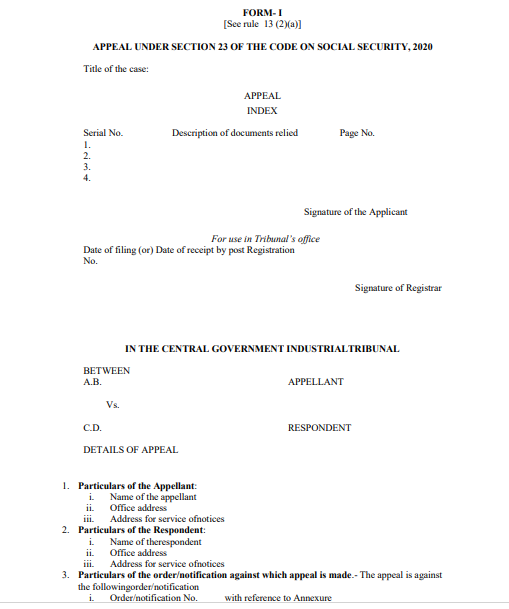
ii. Date
iii. Passed by
iv. Subject inbrief
4. Jurisdiction of the Tribunal.- The appellant declares that the subject of the matter against
which he wants redressal is within the jurisdiction of theTribunal.
5. Limitation. —The appellant further declares that the appeal is within the limitation specified
in section 126 of the Code on Social Security, 2020 (36 of 2020).
6. Facts of the case.- The facts of the case are given below:
(Give here a concise statement of facts in a chronological order, each paragraph
containing as nearly as possible a separate issue, fact or otherwise)
7. Details of remedies exhausted. —The appellant declares that he has availed of all the
remedies available to him under the Code.
(Give here chronologically the details of representations made and the outcome of
such representation with reference to the Annexure numbers).
8. Matters not previously filed or pending with any other Court. —The appellant further
declares that he had not previously filed any appeal, writ petition or suit regarding the matters
in respects of which this appeal has been made, before any court of law or any other authority
or any other bench of the Tribunal nor any such appeal, writ petition or suit is pending before
any ofthem.
In case the appellant has previously filed any appeal, writ petition or suit, the
stage at which it is pending and if decided, the gist of the decision should be given
with reference to the Annexure.
9. Relief(s) sought. —In view of the facts mentioned in para 6 above, the appellant prays for the
following relief(s):–
[Specify below the relief(s) sought explaining the ground for relief(s) and the legal
provisions (if any) relied upon].
10. Interim order, if any, prayed for. —Pending final decision on the appeal the applicant seeks
issue of the following interim order—
(Give here the nature of the interim order prayed for with reasons)
11. In the event of appeal being sent by speed post (with registration), it may be stated whether
the appellant desires to have oral hearing at the admission stage and if so, he shall attach a
self-addressed Post Card, Inland Letter, at which intimation regarding the date of hearing
could be sent tohim.
12. Particulars of Bank Draft or Postal order in respect of the Appeal Fee:
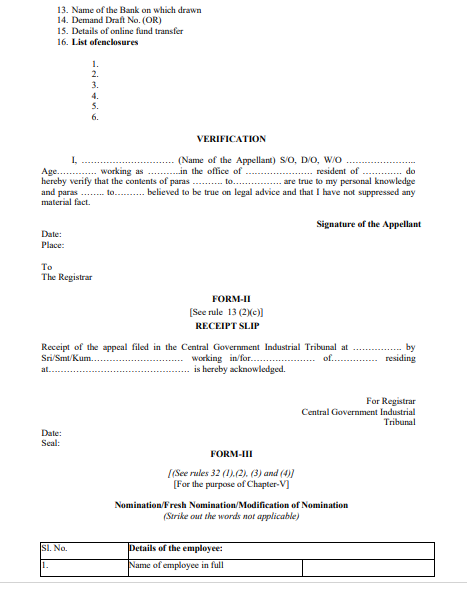
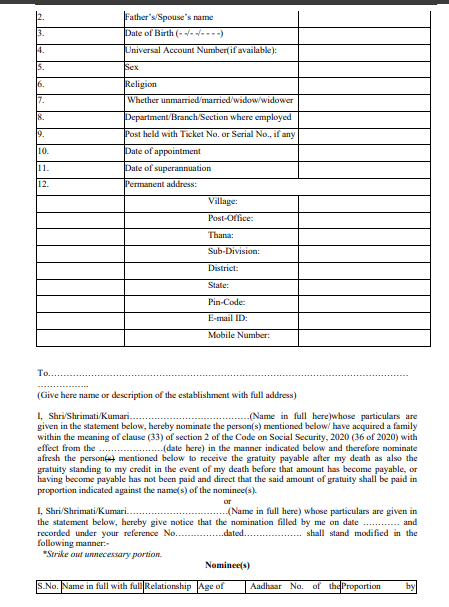
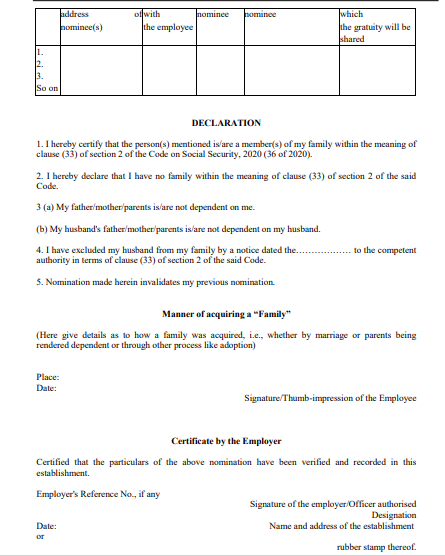
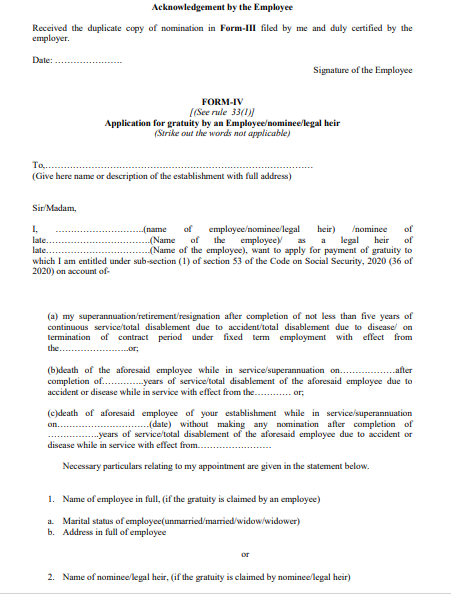

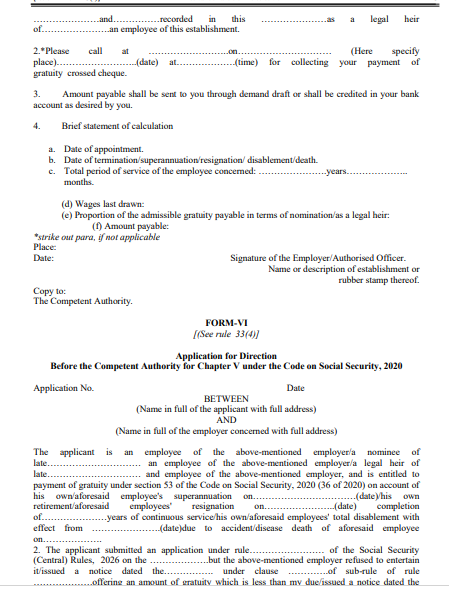
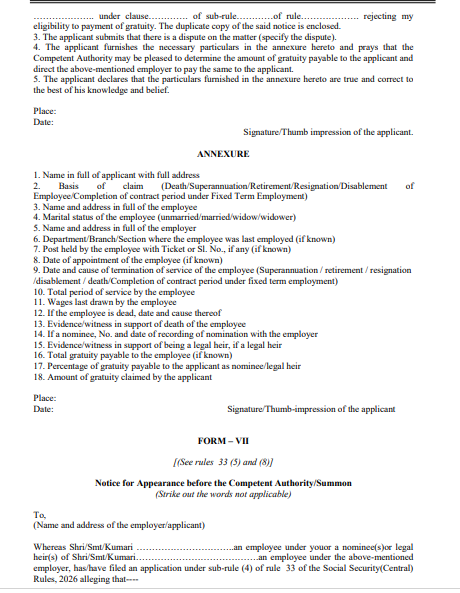
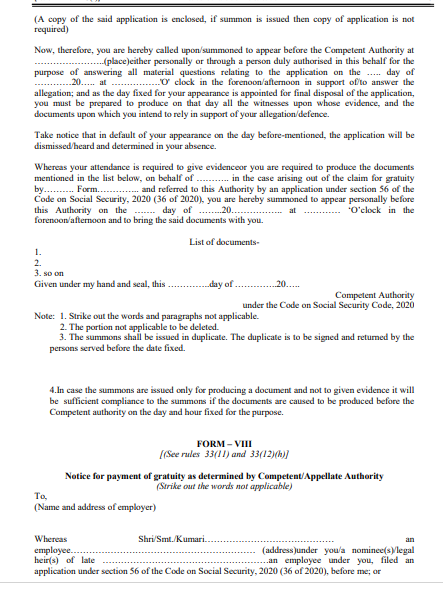

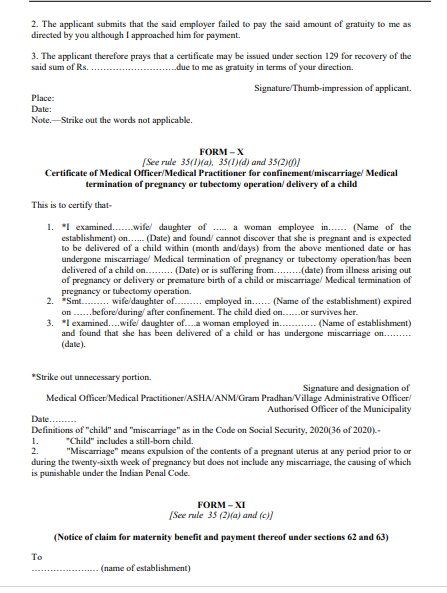

Sir,
I, ..…. The undersigned, woman employee of ….(name and full address of the establishment)
have been wrongly deprived by the employer of maternity benefit or medical bonus or both or
wrongly discharged or dismissed during or on account of absence from work in accordance with the
provisions of Chapter VI of the Code on Social Security, 2020(36 of 2020) for the reasons attached
hereto, prefer this appeal under sub-section (2) of section 68 and request that the said employer be
ordered to pay the above mentioned amount to me and/or set aside the order of discharge/dismissal. A
copy of the order of the employer in this behalf is enclosed.
Signature or thumb impression of the Woman employee/
nominee/ legal representative
Place………..
Date…………
Signature of an Attester in case the woman employee/
nominee/ legal representative is
unable to sign and affixes thumb impression.
Full address of the woman employee /nominee/legal representative.
FORM – XIII-A
[See rule 39(1)(a)]
Complaint to the Inspector-cum-Facilitator
To,
The Inspector-cum-Facilitator
(under the Code on Social Security, 2020)
Sir,
I…… (Name of woman employee) employed in…… (name and full address of the
establishment) or I……, (name), a person nominated under section 62 by or a legal representative
of……(name of woman employee) employed in…….(name and full address of the establishment)
having fulfilled the conditions laid down in the Code on Social Security, 2020(36 of 2020) and the
rules framed thereunder, am entitled to Rs…… being maternity benefit and/ or Rs…… being the
medical bonus and/ or Rs………. being wages for leave due under section 65 but the same has been
improperly withheld by the employer/discharged or dismissed during or on account of my/her absence
from work in accordance with the provisions of Chapter VI of Code on Social Security, 2020(36 of
2020).
You are, therefore, requested to direct the employer to pay the amount to me and/or to set
aside the discharge or dismissal done by the employer.
Signature or thumb impression of the Woman employee/
nominee/ legal representative
Place………….
Date…………
Signature of an Attester in case the woman employee/
nominee/ legal representative is
unable to sign and affixes thumb impression.
Full address of the woman employee/nominee/legal representative.
FORM-XIII-B
[See rule 39 (2) (b)]
Appeal
To,
The Appellate Authority,
(Appointed under the Code on Social Security, 2020)
……………………………………………(Address)
Sir,
I………, the undersigned, woman employee/her legal heir/her representative or employer/his
representative of……… (name and full address of the establishment) aggrieved by the order of
Inspector-cum-Facilitator Shri…….. hereby prefer this Appeal under sub-section (3) of section 72 in
view of the facts mentioned in the memorandum and other documents filed herewith.
*Denial by his order under sub-section (2) of section 72, the maternity benefit or other amount
……… (Nature of amount) to which……… (Name of woman employee) is entitled and/or refused to
set aside discharge or dismissal of …….. (Name of woman employee) during or on account of
absence from work in accordance with the provisions of Chapter VI of the Code on Social Security,
2020(36 of 2020)(Strike out unnecessary portion).
*It is submitted that the ……….. (Name of woman employee) is not entitled to the maternity benefit
or the said amount and/or rightly discharged or dismissed hence the order of the Inspector-cumFacilitator may be set aside.
*Strike out unnecessary portion.
Signature or thumb impression of the Woman employee/Aggrieved person/Employer
Place………….
Date………
…………………………………………………………………..
Signature of an Attester in case the woman employee is
not able to sign and affixes thumb impression.
Full address of the nominee/legal representative
FORM – XIV
[See rule 40(4)]
(Abstract for the Maternity Benefit, and the rules made under the Code on Social Security,
2020).
1. No employer shall knowingly employ a woman during the six weeks immediately following
the day of her delivery/miscarriage/Medical termination of pregnancy and no woman shall work in
any establishment during the said period.
2. No pregnant woman shall, on a request being made by her in this behalf, be required by her
employer to do during the period of one month immediately preceding the period of six weeks before
the date of her expected delivery and also for any period during this period of six weeks for which she
does not avail of leave of absence, any work which is of an arduous nature or which involves long
hours of standing, or which in way is likely to interfere with her pregnancy or the normal development
of the foetus, or is likely to cause her miscarriage or otherwise to adversely affect her health.
3. (a) Subject to the provisions of the Code, every woman who has actually worked in an
establishment of the employer from whom she claims maternity benefit for a period of not less than
eighty days, including the days during which she was laid off, shall be entitled to, and her employer
shall be liable for, the payment of maternity benefit at the rate of her average daily wages, or the
minimum rate of wage fixed or revised under the Code on Wages, 2019 (29 of 2019) or two hundred
rupees a day, whichever is higher, for the period of her actual absence not exceeding six weeks
immediately preceding the day of delivery and the remaining period immediately following that day:
Provided that where a woman dies during the period for which maternity benefit is payable,
to her, the benefit shall be payable only for the days up to and including the day of her death.
However, where the woman having been delivered of a child, dies during her delivery or during the
remaining period of maternity benefit leaving behind in either case the child, the employer shall be
liable for the payment of maternity benefit for the entire period of maternity benefit following the day
of her delivery but if the child also dies during the said period, then, for the days up to and including
the day of the death of the child.
(b)The amount of maternity benefit for the period preceding the date of her expected delivery shall be
paid in advance by the employer to the woman on production of a certificate in Form-X stating that
she is pregnant and is expected to be delivered of a child within six weeks of the date of production of
the certificate, and the amount due for the subsequent period shall be paid by the employer to the
woman within forty-eight hours of production of the certificate in Form-X stating that she has been
delivered of a child or production of a certified extract from a Birth Register maintained under the
provisions of any law for the time being in force.
4. (a) Any woman employed in an establishment and entitled to maternity benefit under the
provisions of the Code may give notice in writing in Form-XI to her employer, stating that her
maternity benefit and any other amount to which she may be entitled under the Code may be paid to
her or to such person as she may nominate in the notice and that she will not work in any
establishment during the period for which she receives maternity benefit.
(b) In the case of a woman who is pregnant, such notice shall state the date from which she will
be absent from work, not being a date earlier than six weeks from the date of her expected delivery.
(c) Any woman who has not given the notice when she was pregnant may give such notice as
soon as possible after the delivery.
(d) On receipt of the notice, the employer shall permit such woman to absent herself from
establishment until the expiry of the remaining period of maternity benefit after the day of her
delivery.
5. (a)Every woman entitled to maternity benefit under the Code shall also be entitled to receive
from her employer a medical bonus of rupees three thousand and five hundred, if no pre-natal,
confinement and post-natal care is provided for by the employer free of charge. The medical bonus
shall be paid along with the second installment of the maternity benefit.
(b)In case of miscarriage/medical termination of pregnancy, a woman shall, on production of a
certificate in Form-X be entitled to leave with wages at the rate of maternity benefit, for a period of
six weeks immediately following the day of her miscarriage. The wages shall be paid within 48 hours
of production of the certificate in Form-X.
(c)A woman suffering from illness arising out of pregnancy, delivery, premature birth of child or
miscarriage/ medical termination of pregnancy or tubectomy operation shall, on production of a
certificate in Form-X, be entitled, in addition to the period of absence allowed to her on account of
maternity or miscarriage/ medical termination of pregnancy or tubectomy operation, as the case may
be, to leave with wages at the rate of maternity benefit for a maximum period of one month. The
wages for the leave period shall be paid within 48 hours of the expiry of that period.
6. Every woman delivered of a child who returns to duty after such delivery shall, in addition to the
interval for rest allowed to her, be allowed in the course of her daily work two breaks of 15 minutes’
duration for nursing the child until the child attains the age of fifteen months. An extra sufficient
period, depending upon the distance to be covered, shall be allowed for the purpose of the journey to
and from the creche or the place where the children are left by women while on duty, provided that
such extra period shall be upto 15 minutes.
7. (1) When a woman absents herself from work in accordance with the provisions of the Code,
it shall be unlawful for her employer to discharge or dismiss her during or on account of such absence
or to give notice of discharge or dismissal on such a day that the notice will expire during such
absence, or to vary to her disadvantage any of the conditions of her service.
(2) (a) The discharge or dismissal of a woman at any time during her pregnancy, if the woman but for
which discharge or dismissal would have been entitled to maternity benefit or medical bonus shall not
have the effect of depriving her of the maternity benefit or medical bonus:
Provided that where the dismissal is for one or more of the following acts, the employer may,
by order in writing communicate to the woman, deprive her of the maternity benefit or medical bonus
or both-
(i) wilful destruction of employer’s goods or property;
(ii) assaulting any superior or co-employee at the place of work;
(iii) criminal offence involving moral turpitude resulting in conviction in a Court of law;
(iv) theft, fraud, or dishonesty in connection with the employer’s business or property; and
(v) wilful non-observance of safety measures or rules on the subject or wilful interference with
safety devices or with fire-fighting equipment.
(b) Any woman deprived of maternity benefit or medical bonus or both, may within sixty days
from the date on which the order of such deprivation is communicated to her, appeal in Form-XII to
the Competent Authority and his decision on such appeal whether the woman should or should not be
deprived of maternity benefit or medical bonus or both, shall be final.
8. If a woman works in any establishment after she has been permitted by her employer to absent
herself under the provisions of the Code, she shall forfeit her claim to the maternity benefit for such
period.
9. (1) Any woman claiming the maternity benefit or any other amount to which she is entitled
under the Code and any person claiming that payment due has been improperly withheld may make
complaint to the Inspector-cum-Facilitators in writing in Form-XIII-A.
(2)The Inspector-cum-Facilitators may, on his own motion or on receipt of a complaint in FormXIII-A, make an inquiry or cause an enquiry to be made and if satisfied that payment has been
wrongfully withheld, may direct the payment to be made in accordance with his orders.
(3) Any person aggrieved by the decision of the Inspector-cum-Facilitator may, within, thirty days
from the date on which such decision is communicated to such person, appeal in Form-XIII-B to the
Authority prescribed by the appropriate Government.
(4)The decision of Authority where an appeal has been preferred to him or of the Inspector-cumFacilitator where no such appeal has been preferred, shall be final.
10. (a)The employer shall supply to every woman employed by him at her request free of cost
copies of Forms X, XI, XII, XIII-A and XIII-B.
(b)The failure to submit a notice, appeal or complaint in the prescribed form shall not affect the right
of a woman entitled to receive maternity benefit or any other amount due under the Code. Where a
notice, appeal or complaint has been received in a form other than the prescribed form, the authority
concerned shall within fifteen days of the receipt of such notice, appeal or complaint, require the
woman to submit the notice, appeal or complaint, as the case may be in the prescribed form.
11. (a) (1) The employer of the establishment in which women are employed shall prepare and
maintain a register of women employees in Form-XXII and shall enter therein particulars of all
women employees in the establishment.
(2) All entries in the register of women employees shall be made in ink and maintained up-to-date and
it shall always be available for inspection by the Inspector-cum-Facilitator during working hours.
(b)The employer to which the Code applies, on or before the 28th/29th day of February in each year,
upload a unified annual return in Form-XXIII online on the web portal of the Central Government in
the Ministry of Labour and Employment, giving information as to the particulars specified, in respect
of the preceding year:
Provided that during inspection, the Inspector-cum-Facilitator may require the production of
accounts, books, register and other documents maintained in electronic form or otherwise.
Explanation.– The expression ―electronic form‖ shall have the same meaning as assigned to it
in clause (r) of section 2 of the Information Technology Act, 2000 (21 of 2000)

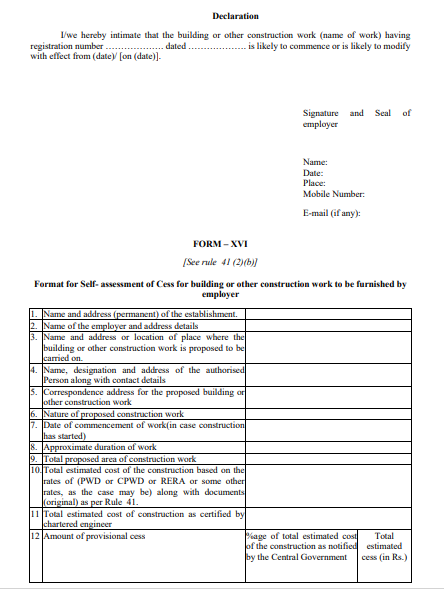
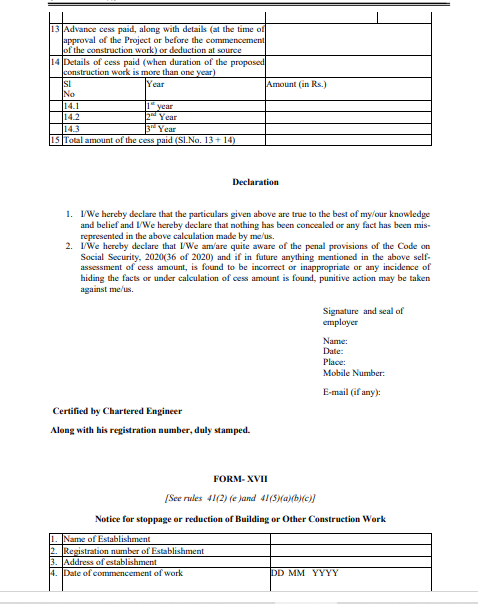
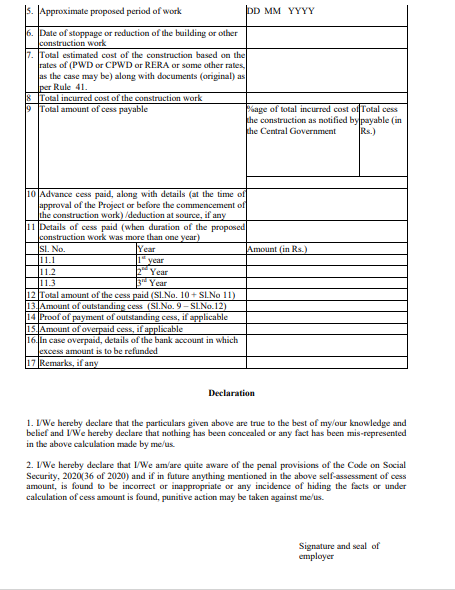
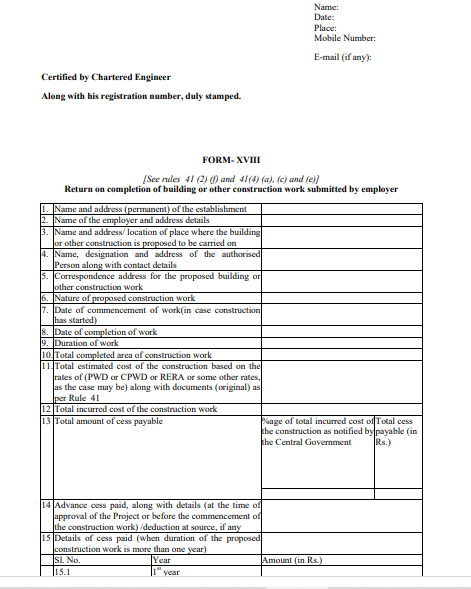
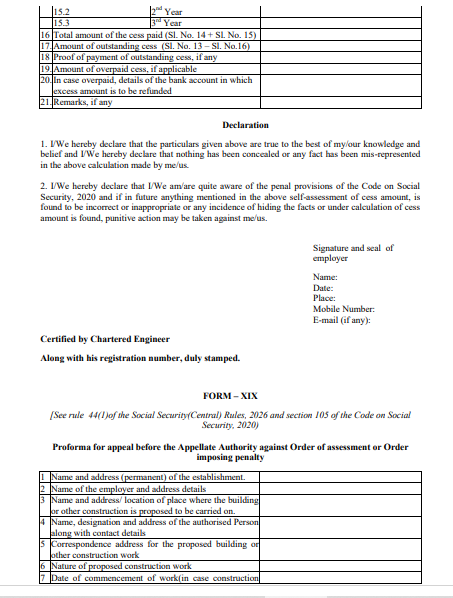
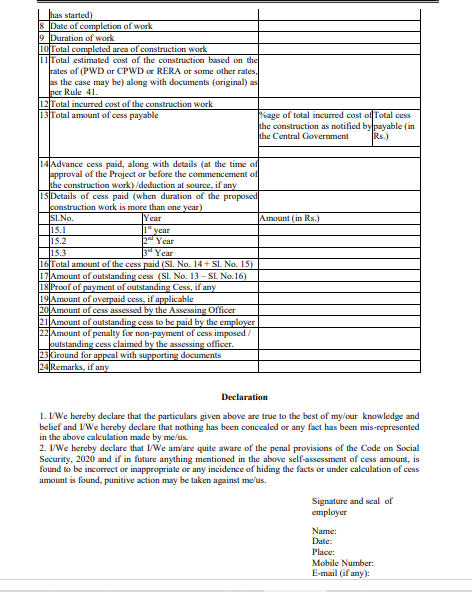
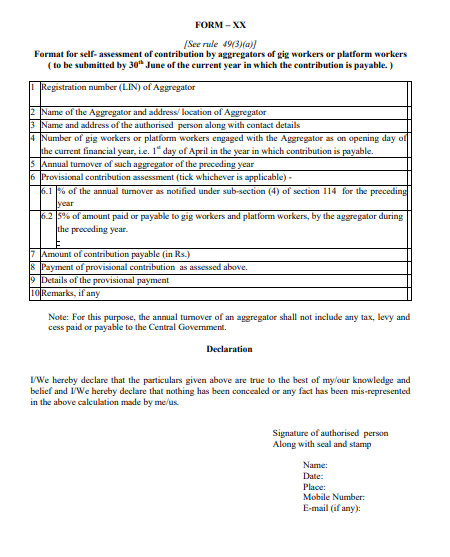
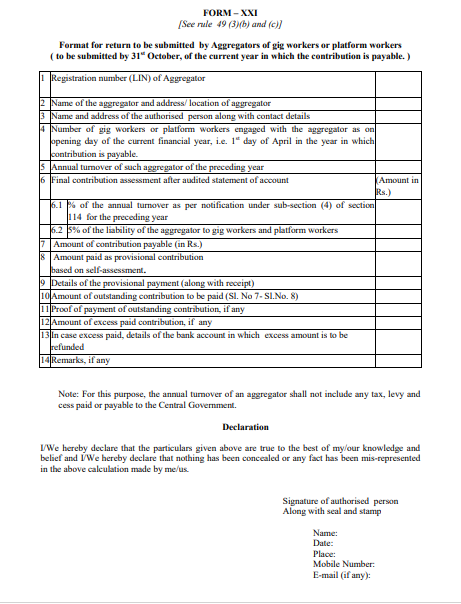
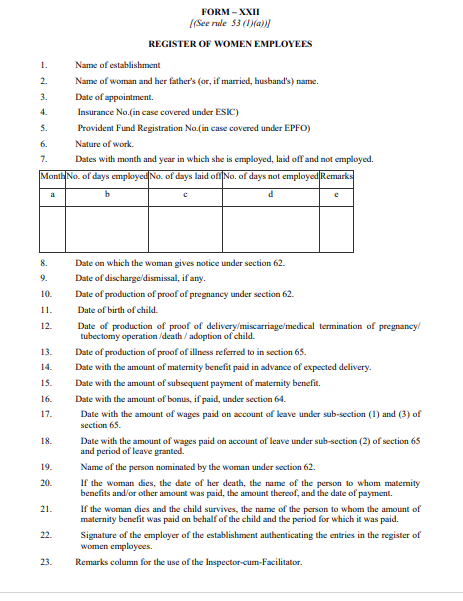
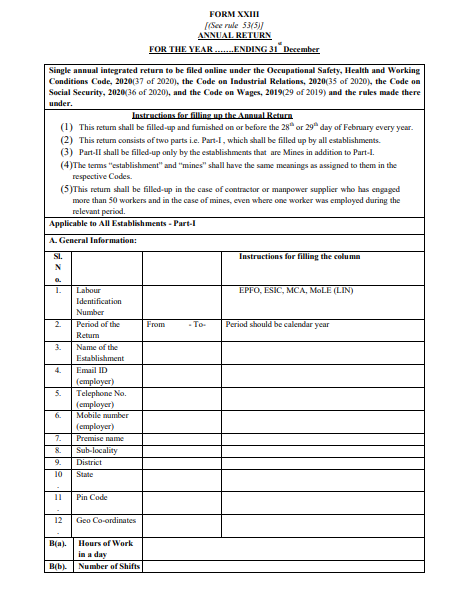

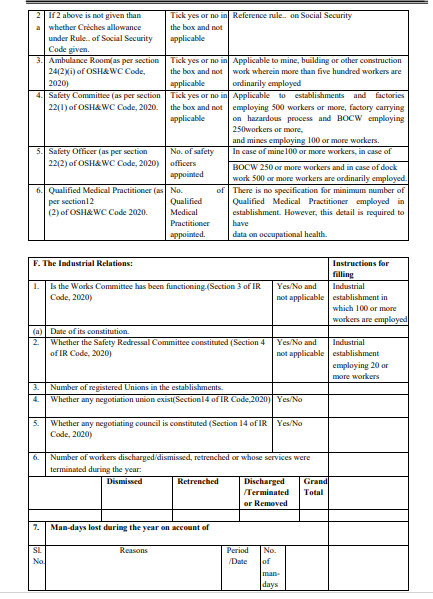

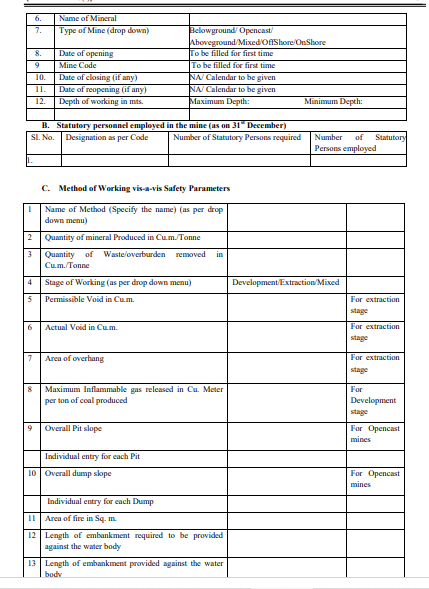

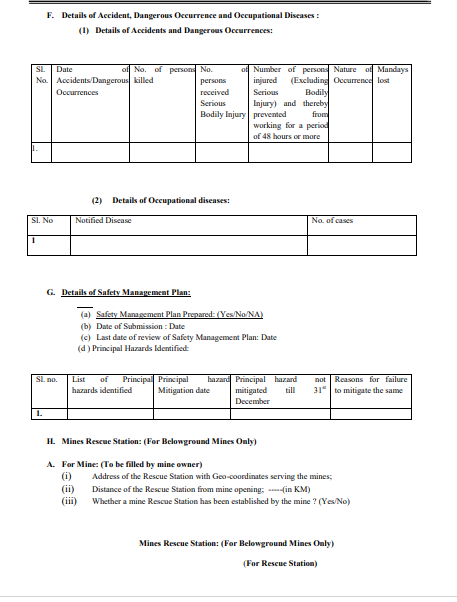
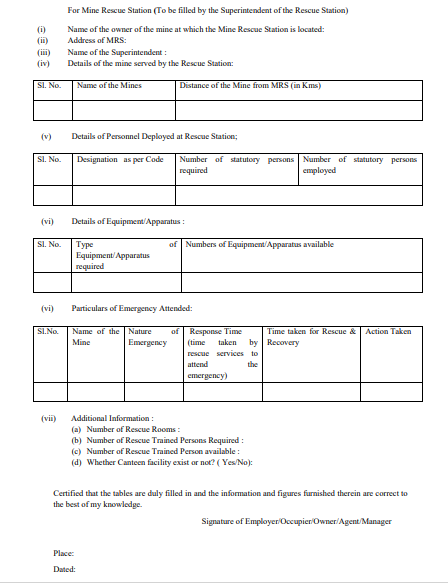
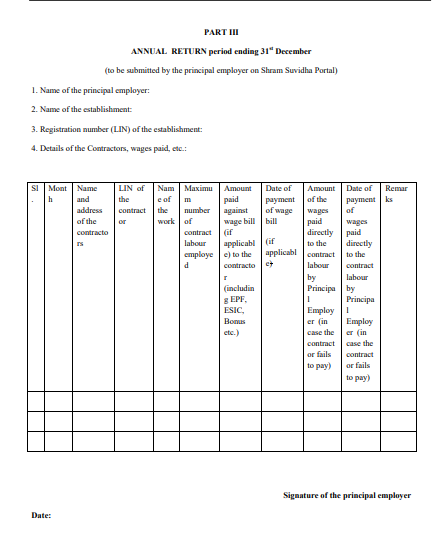
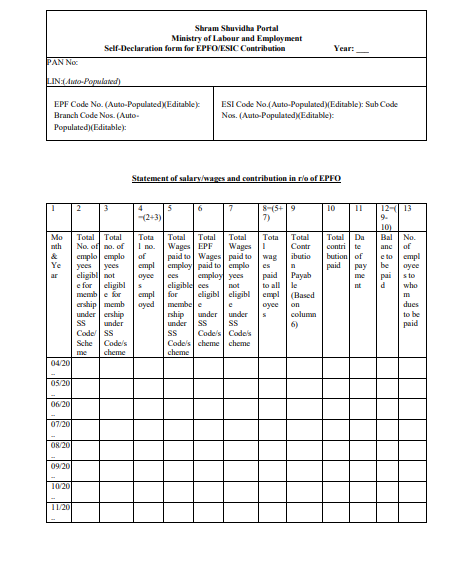
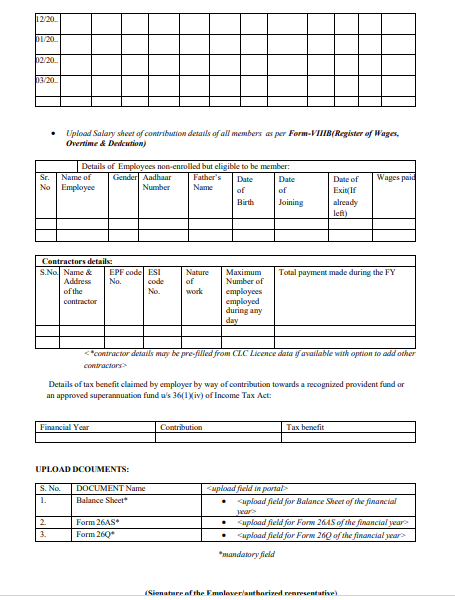
*Section 36(1)(iv) of Income Tax Act:
any sum paid by the assessee as an employer by way of contribution towards a recognised provident fund or an
approved superannuation fund, subject to such limits as may be prescribed for the purpose of recognising the
provident fund or approving the superannuation fund, as the case may be; and subject to such conditions as the
Board may think fit to specify in cases where the contributions are not in the nature of annual contributions of
fixed amounts or annual contributions fixed on some definite basis by reference to the income chargeable
under the head “Salaries” or to the contributions or to the number of members of the fund;
Download PDF click here
Read more
for more refer https Gazette website click here
for more refer YouTube Subscribe website click here