


Documents required for ITR Filing AY 2026-27
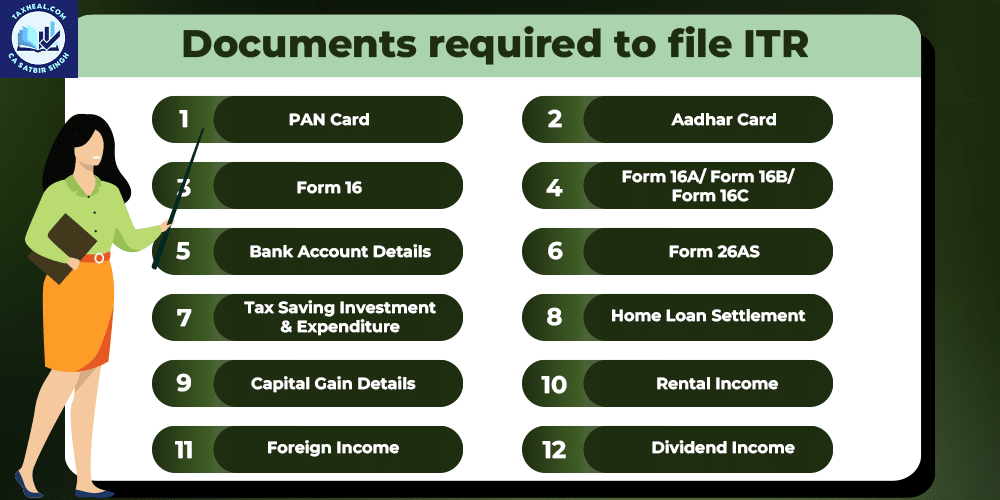
Documents required for ITR Filing AY 2026-27
Video Explanation of Documetns required for ITR filing
Core Identity & Tax Documents
- PAN and Aadhaar: Ensure your PAN is linked with Aadhaar.
- Form 16 Issued by your employer by 15th June 2026. Note that under the new Income Tax Act 2025, Form 130 is replacing Form 16, but employers will still issue Form 16 for this cycle for FY 2025-26 /AY 2026-27 as per Income Tax Act 1961
- Form 26AS: A consolidated tax statement showing all TDS deducted against your PAN, available on the official Income Tax portal.
- AIS & TIS: The Annual Information Statement (AIS) and Taxpayer Information Summary (TIS) provide a detailed view of all your financial transactions, like high-value purchases or interest earned.
Note: For salaried individuals, your employer is legally required to issue Form 16 by June 15, 2026. It is advisable to wait for your AIS to fully populate (usually by late May) before filing to avoid mismatches.
Income Proofs
- Salary Slips: Useful if you don’t have Form 16 or need to verify specific allowances like HRA or LTA.
- Bank Statements/Passbooks: To calculate interest earned on savings accounts and fixed deposits (FDs).
- Interest Certificates: Obtain these from your bank for FDs, RDs, or NRE/NRO accounts.
- Capital Gains Statements: If you sold shares or mutual funds, get these from your broker or platforms like CAMS or KFintech.
Income-Specific Documents
Depending on your sources of income, keep these documents handy:
| Income Source | Required Documents |
| Salary | Form 16 (Parts A & B) and Salary Slips for verifying HRA/allowances. |
| House Property | Rent agreements, tenant PAN (if rent > ₹1 lakh), and Housing Loan Interest Certificates (Section 24). |
| Business/Profession | P&L Account, Balance Sheet, GST Returns, and Tax Audit Report (if turnover exceeds prescribed limits). |
| Capital Gains | Demat statements, sale/purchase deeds for property, and cost of improvement records. |
| Other Sources | Interest certificates for Savings/FDs, dividend statements, and lottery/winnings records. |
Deduction & Exemption Proofs (Old Regime)
- Section 80C: Receipts for Life Insurance (LIC), Public Provident Fund (PPF), ELSS mutual funds, and children’s tuition fees.
- Section 80D: Medical insurance premium receipts for yourself and your parents.
- HRA Claims: Rent receipts and your landlord’s PAN (if annual rent exceeds ₹1 lakh).
- Home Loan: An Interest Certificate from your lender showing the principal and interest breakup for the year.
Other Essentials
- Bank Account Details: IFSC and account numbers for all active accounts; you must nominate one for your tax refund.
- Foreign Income/Asset Details: Required if you have assets or earned income outside India.
Documents required for ITR Filing AY 2026-27 in case of sale of house property
For Assessment Year (AY) 2026-27, the sale of house property is governed by the updated capital gains regime introduced in 2024. There is indexation choice and CII for FY 2025-26, which is set at 376.
Below are the documents required to accurately report the transaction and claim any eligible exemptions:
1. Primary Transaction Documents
These are necessary to establish the “Full Value of Consideration” and the “Cost of Acquisition.”
-
Purchase Deed: The registered sale deed from when the property was originally acquired.
-
Sale Deed: The registered agreement for the current sale to verify the sale price and date of transfer.
-
Fair Market Value (FMV) Report: Required only if the property was acquired before April 1, 2001. You will need a valuation report from a registered valuer to determine the FMV as of 01-04-2001.
-
Stamp Duty Value Proof: Documentation showing the circle rate/stamp duty value. Under Section 50C, if the sale price is less than 90% of the stamp duty value, the latter is treated as the sale consideration.
2. Cost and Improvement Records
To reduce the taxable gain, you need evidence of all capital outflows related to the property.
-
Cost of Improvement (CoI): Bills and invoices for major renovations or additions (e.g., adding a floor or a room). Routine repairs/painting are not deductible.
-
Transfer Expenses: Receipts for brokerage/commission paid to agents, legal fees for drafting the deed, and stamp duty/registration charges paid during the purchase.
3. Exemption & Reinvestment Proofs
If you are looking to save tax under the Income Tax Act 2025 (or the legacy sections), keep these ready:
-
Section 54 (New House): Purchase deed or construction allotment letter for the new residential house.
-
Section 54EC (Capital Gain Bonds): Investment certificates for bonds (REC, NHAI, PFC, or IRFC). Note the ₹50 lakh limit per financial year.
-
Capital Gains Account Scheme (CGAS) Passbook: If the gains have not been reinvested by the ITR filing deadline, proof of deposit in a CGAS account with a bank is mandatory.
4. Compliance & Reporting
-
Buyer’s Details: PAN and Aadhaar of the buyer are now mandatory for reporting in Schedule CG.
-
Form 26AS/AIS: Ensure the TDS deducted by the buyer (1% under Section 194-IA if the sale exceeds ₹50 lakh) is reflected correctly.
CA Desk: Key Points for AY 2026-27
-
Tax Rate Choice: For properties acquired before July 23, 2024, you can choose between 12.5% without indexation or 20% with indexation. For properties bought after that date, the rate is a flat 12.5% without indexation.
-
ITR Form: You must use ITR-2 (for individuals/HUFs) or ITR-3 (if you have professional income/ Business Income)
-
Holding Period: The period for a “Long-Term” classification remains 24 months for immovable property.
ITR filing Documents required in Case of Winning from Game
Filing ITR for net winnings from games (online games, betting, or gambling) for AY 2026-27 involves specific compliance under Section 115BBJ (for online games) and Section 115BB (for other games like lotteries or card games).
Since you are a Chartered Accountant, you’ll appreciate that the calculation now shifts from “gross winnings” to “net winnings” for online platforms, requiring precise reconciliation.
1. Mandatory Tax Documents
-
Form 16A (TDS Certificate): Online gaming platforms are required to deduct TDS under Section 194BA (for online games) or Section 194B (for others). You must download the quarterly Form 16A directly from the gaming platform or the TRACES portal.
-
Form 26AS & AIS (Annual Information Statement): Verify that the TDS reflected in your Form 16A matches the entries in your 26AS and AIS to avoid a “mismatch” notice.
-
Bank Statements: Highlighted entries of all deposits made into the gaming app and all withdrawals to the bank. This is crucial to substantiate the “Net Winnings” formula.
2. Transactional & Platform Records
-
Wallet/Ledger Statements: A detailed transaction report from the gaming app/website showing:
-
Total Deposits during the financial year.
-
Total Withdrawals during the financial year.
-
Opening Balance in the gaming wallet (as of April 1, 2025).
-
Closing Balance in the gaming wallet (as of March 31, 2026).
-
-
Winning Certificates: Many platforms issue a specific “Winning Certificate” for high-value wins, which specifies the gross win, the TDS deducted, and the net amount paid.
3. Proofs for “Kind” Winnings
If you won prizes like a car, gold, or electronic gadgets:
-
Valuation Certificate: Documentation showing the Fair Market Value (FMV) of the prize on the date of winning.
-
Challan of Tax Paid: If the platform didn’t deduct tax, you must have the challan showing you paid the 31.2% tax (30% + 4% cess) before taking delivery of the prize.
Important Filing Rules for AY 2026-27
-
Net Winnings Formula: For online games, tax is calculated as:
(Total Withdrawals + Closing Balance) – (Total Deposits + Opening Balance) -
No Deductions: You cannot claim any expenses (like internet bills or entry fees) or deductions under Chapter VI-A (Section 80C, 80D, etc.) against this income.
-
Correct ITR Form: You cannot use ITR-1. You must use:
-
ITR-2: For individuals not having business income.
-
ITR-3: ou will likely use ITR-3 to report this under Schedule OS (Income from Other Sources).
-
-
Flat Tax Rate: This income is taxed at a flat 30% (plus applicable surcharge and 4% cess), regardless of your total income slab.
Documents required for itr filing for pensioners
For Assessment Year (AY) 2026-27, the documentation for pensioners remains aligned with the updates under the Income Tax Act 2025. Since you are a Chartered Accountant, you will recognize that many “exemptions” for senior citizens now transition into a simplified filing process, especially under the New Tax Regime (the default choice).
Below is the updated checklist for your clients who are pensioners:
1. Primary Income Documents
-
Pension Certificate / Bank Passbook: Pension from a former employer is taxed as “Income from Salaries.” Ensure the client has a breakdown of the monthly pension and any arrears received.
-
Form 16 / Pension Statement: Issued by the pension-disbursing bank or the employer. This should reflect the Standard Deduction (now ₹75,000 under the New Regime and ₹50,000 under the Old Regime).
-
Commutation Details: Documentation of any portion of the pension commuted during the year to check for exemptions under Section 10(10A).
2. Investment & Interest Records
-
Interest Certificates (Section 80TTB): For senior citizens (60+), interest income from savings, FDs, or post office deposits is deductible up to ₹50,000 under the Old Regime. (Note: Under the Income Tax Act 2025, this limit has been enhanced for specific senior categories in some interpretations, but the general limit remains ₹50,000).
-
Form 26AS & AIS/TIS: Crucial for tracking TDS on interest income and verifying that the bank hasn’t deducted tax if Form 121 (which replaces the old Form 15H) was submitted.
-
Annuity Statements: If the pensioner receives payouts from an NPS or other retirement plans, these are taxable as “Income from Other Sources.”
3. Deductions (For Old Tax Regime Only)
If your client chooses to opt out of the default New Regime, keep these ready:
-
Section 80D (Medical Insurance): Receipts for health insurance premiums (up to ₹50,000 for seniors).
-
Medical Expenditure Proofs: For very senior citizens (80+) not covered by insurance, keep records of actual medical expenses (up to ₹50,000).
-
Section 80C: Proofs of SCSS (Senior Citizens Savings Scheme), ELSS, or life insurance.
-
Section 80DDB: Certificates for treatment of specified critical illnesses (deduction limit is ₹1 lakh).
Important: Special Provisions for AY 2026-27
| Provision | Details |
| Section 194P Exemption | Resident seniors (75+ years) are exempt from filing ITR if they only have pension and interest income from the same bank. They must submit Form 12BBA to the bank. |
| New Form 121 | The Income Tax Act 2025 has introduced Form 121 to replace Form 15H. Pensioners should file this in April to avoid TDS on interest. |
| Family Pension | If filing for a legal heir, the deduction on family pension is now ₹25,000 or 1/3rd of the pension (whichever is lower) under the New Regime. |
CA Checklist Tip: verify if their total income is below ₹12.75 lakh (under the New Regime). With the enhanced Section 87A rebate and standard deduction, many will have zero tax liability and may only need to file to claim TDS refunds.
How many months bank statement required for ITR filing
For Assessment Year (AY) 2026-27 (referring to the financial year 2025-26), the requirement for bank statements depends on whether you are filing as an individual or a business.
you need bank statements for the full 12 months of the financial year (April 1, 2025, to March 31, 2026).
Here is the specific breakdown of how these statements are used in the filing process:
1. Mandatory Reporting (All Taxpayers)
While you don’t “upload” the statement to the portal, you must have the full 12-month record to fulfill the following:
-
Interest Income: Reporting accurate interest from Savings Accounts and Fixed Deposits (as reflected in the AIS).
-
Dividend Income: Ensuring all dividends credited during the FY are included in “Income from Other Sources.”
-
High-Value Transactions: Reconciling any Significant Financial Transactions (SFT) reported in your AIS with your actual bank entries.
-
Account Disclosure: You must disclose all active bank accounts held at any time during the financial year (including those closed during the year).
2. For Business/Professional Returns (ITR-3 & ITR-4)
For Taxpayers with business income:
-
Full Financial Year (12 Months): A complete statement is required to prepare the P&L Account and Balance Sheet.
-
GST Reconciliation: Cross-referencing bank credits with GSTR-3B and GSTR-1 filings for the entire year.
-
Cash Balance: Verifying the cash-in-hand and bank balances as of March 31, 2026, for the Balance Sheet.
3. For Capital Gains (ITR-2 & ITR-3)
-
Payment Verification: If a property or shares were sold, the bank statement acts as the primary evidence for the date of receipt and the actual amount received, which is vital if there is a dispute over the Stamp Duty Value (Section 50C.)
Summary Table
| Purpose | Statement Period Required |
| Salaried Individuals (ITR-1/2) | 12 Months (for Interest/Dividend reporting) |
| Business/Professionals (ITR-3/4) | 12 Months (for Accounting & Audit) |
| Capital Gains Reporting | Dates specific to the transaction + Year-end balance |
| Foreign Asset Disclosure | 12 Months (to report peak balance & closing balance) |
Pro-Tip for AY 2026-27: With the Income Tax Act 2025 in effect, the department’s automated “mismatch” notices have become faster. I recommend you to reconciles the bank statements against the AIS/TIS at least once a quarter to ensure that by the July/August 2026 deadlines, the data is perfectly aligned.
which home loan documents required for itr filing
For Assessment Year (AY) 2026-27, the documents required to claim home loan benefits depend on your choice of tax regime and the status of the property (self-occupied vs. let-out).
The underlying documentation remains the primary evidence for any audit or scrutiny.
1. The “Golden Document”: Home Loan Interest Certificate
This is the most critical document. You must obtain the Final Interest Certificate (not the provisional one) from the bank for the period April 1, 2025, to March 31, 2026.
-
Interest Component: Clearly shows the total interest paid (to claim under Section 24b).
-
Principal Component: Shows the total principal repaid (to claim under Section 80C).
-
Loan Account Details: Must include the name of all co-borrowers and the specific loan account number.
2. Property Ownership & Completion Proofs
-
Possession Letter / Completion Certificate: You cannot claim the ₹2 Lakh interest deduction (Section 24b) until the construction is complete and possession is taken. If the property is under construction, interest must be tracked for the “Pre-construction period.”
-
Purchase Deed / Allotment Letter: To establish ownership and the date of acquisition.
-
Stamp Duty & Registration Receipts: If you bought the house in FY 2025-26, these receipts are required to claim a deduction under Section 80C (up to ₹1.5 Lakh) in the year of purchase.
3. Usage-Specific Documents
| Category | Required Documentation |
| Joint Loans | Co-borrower Agreement or proof of ownership share. Both individuals need their own certificates to claim their respective portions (e.g., 50:50). |
| Let-Out Property | Rent Agreement and Municipal Tax Receipts. Under the New Regime (FY 2025-26), you can only claim interest deduction if the property is let out. |
| Pre-Construction | A summary of interest paid in the years prior to completion. This is claimed in 5 equal installments starting from the year of completion. |
4. Special Case: Loans from Friends/Relatives
If the loan is not from a bank/NBFC:
-
Interest Certificate from the Individual: A signed declaration from the lender stating the interest amount and their PAN.
-
Note: You can claim Interest (Section 24b) on private loans, but you cannot claim Principal (Section 80C) unless the loan is from a specified financial institution.
Strategic Note for AY 2026-27 Filing
-
New Tax Regime (Default): For self-occupied properties, no home loan deductions (Interest or Principal) are allowed. Documentation is only needed if the property is rented.
-
Old Tax Regime: All benefits (Section 24b, 80C, 80EEA) are available.
-
Rebate 87A: With the potential for zero tax up to ₹12.75 Lakh (New Regime) or ₹5 Lakh (Old Regime), keep your AIS (Annual Information Statement) handy to ensure the bank has reported the interest correctly to the department.
Related Post
New Income Tax Act 2026 from April 1: What deductions and exemptions you lose under new tax regime
Which itr filing type for salaried person AY 2026-27 (FY 2025-26)
List of Deductions Allowed in New Tax Regime in AY 2025-26 and AY 2026-27
ITR filing Last Date FY 2025-26 AY 2026-27 I ITR filing Due date AY 2026-27
ITR filing start Date AY 2026-27
Income tax return form 2026-27 ! Download Notified Forms
ITR Forms for AY 2026-27: Major changes you need to know
Penalty for Late Filing of ITR AY 2026-27
ITR filing start Date AY 2026-27
Income tax return form 2026-27 ! Download Notified Forms
ITR Forms for AY 2026-27: Major changes you need to know
for more refer income tax website click here
for more refer YouTube Subscribe website click here
Your Queries Solved
documents required for itr filing,
how many documents required for itr filing,
documents required for income tax return pdf,
documents required to file itr for salaried employee,
how many months bank statement required for itr filing,
documents required for itr filing in india,
documents required for itr filing first time,
documents required for itr registration,
documents required for filing itr for business,
documents required for itr filing by salaried individuals,
documents required for itr filing for individual,
documents required for itr filing first time,
documents required for itr filing for pensioners,
documents required for itr filing 2025,
documents required for itr filing for business,
documents required for itr filing pdf,
documents required for itr filing in india,
documents required for itr filing for proprietorship firm,
what all documents required for itr filing,
list of documents required for itr filing,
how many documents required for itr filing,
which home loan documents required for itr filing,
how many documents required for itr filing for individual
How many documents required for itr filing
Documents required for income tax return pdf
Documents required to file ITR for salaried employee
How many months bank statement required for ITR filing
Documents required for itr filing in india
Documents required for ITR filing first time
Documents required for ITR registration
Documents required for filing ITR for business
Pingback: TaxHeal - GST and Income Tax Complete Guide Portal