Late PF/ESI Deposit During COVID-19 Involves Debatable Legal Interpretation Beyond Section 143(1) Adjustment Powers
Issue
Whether the Central Processing Centre (CPC) was justified in making a prima facie adjustment under Section 143(1), and subsequently rejecting a Section 154 rectification application, to disallow employees’ PF and ESI contributions deposited after the due date under respective labor welfare Acts but before the return filing due date under Section 139(1), especially given the prevailing COVID-19 lockdown relaxations and pending judicial reviews.
Facts
-
Assessment Year: The case pertains to the Assessment Year (AY) 2021-22, a period significantly impacted by the COVID-19 pandemic.
-
Delayed Deposit: The assessee deposited the employees’ share of Provident Fund (PF) and Employee State Insurance (ESI) contributions past the statutory due dates prescribed under the respective labor laws, but prior to the due date for filing the return of income under Section 139(1) of the Income-tax Act.
-
CPC Adjustment: The CPC processed the return of income and made a prima facie adjustment under Section 143(1), disallowing the deduction claimed for these employee contributions on account of the delay.
-
Rectification Rejected: The assessee filed a rectification application under Section 154 to reverse the disallowance. However, the CPC rejected the application and upheld its original adjustment.
-
Regulatory Context: During the relevant period, the Employees’ Provident Fund Organisation (EPFO) had issued a circular granting relaxation from the levy of damages and penalties for delayed deposits due to lockdown disruptions. Furthermore, the core legal issue regarding the timing of these deductions was sub-judice and awaiting review before the Supreme Court.
-
First Appeal: The Commissioner (Appeals) sustained the CPC’s rejection order, prompting the matter to be evaluated on whether such an adjustment fell within the scope of permissible prima facie corrections.
Decision
-
Issue Held to be Debatable: The Tribunal held that the question of whether PF/ESI contributions are deductible if paid before the Section 139(1) deadline is highly debatable, as it involved complex legal interpretations explicitly being reviewed by the Apex Court.
-
Outside the Scope of Section 143(1): It was decided that because the issue required a deep interpretation of law at the Supreme Court level, it fell entirely outside the narrow ambit of “permissible prima facie adjustments” that the CPC is authorized to make while processing returns under Section 143(1).
-
Failure to Acknowledge COVID-19 Hardships: The Tribunal found that the Commissioner (Appeals) failed to appreciate the genuine hardships of the COVID-19 lockdown period, which had already been formally acknowledged and relaxed by the EPFO authorities.
-
Impugned Order Set Aside: The order of the Commissioner (Appeals) rejecting the Section 154 application was held to be perverse to the facts on record. The issue was decided in favour of the assessee.
Key Takeaways
1. Scope of CPC Powers Restricted
Section 143(1) adjustments are strictly meant for clear-cut, arithmetic errors or unambiguous disallowances. If an issue requires judicial interpretation or is actively sub-judice before the Supreme Court, the CPC cannot summarily disallow it as a prima facie error.
2. COVID-19 Relaxations Hold Weight
Circulars and relief measures issued by sister regulatory bodies (like the EPFO) during extraordinary crises must be factored into tax proceedings to assess the genuineness and context of a delay.
3. Rectification via Section 154 is Valid for Wrongful Adjustments
When the CPC suo motu decides on a highly debatable legal issue under Section 143(1), it constitutes a mistake apparent from the record, making a rectification application under Section 154 a valid legal remedy for the taxpayer.
IN THE ITAT JODHPUR BENCH
Yadvendra Dhabhai
v.
SUDHIR PAREEK, Judicial Member
and Dr. Mitha Lal Meena, Accountant Member
IT Appeal No. 806 (Jodh) of 2025
[Assessment year 2021-22]
MAY 21, 2026
Deepak Patel, CA for the Appellant. Smt. Swapnil Parihar, JCIT for the Respondent.
ORDER
Dr. Mitha Lal Meena, Accountant Member. – This appeal by assessee is filed against the order of Ld. Commissioner of Income Tax Appeal ADDL/JCIT (A)-9 Delhi [hereinafter referred to JCIT(A)] dated 21.07.2025 with respect to Assessment Year 2021-22 challenging therein rejection of its application by CPC filed u/s 154 treating employees contribution to PF and ESI amounting to Rs. 1,85,03,917/- as delayed deposit.
2. At the outset, the Ld. Counsel for the assessee has submitted that the CPC while processing return of income u/s 143(1) made an addition on account of delayed deposit of employees contribution as per due dates prescribed under respective Acts, though such payments were admittedly deposited before the due date of filing the return of income u/s 139(1). He further submitted that the CPC has rejected its application filed u/s 154 of the Income Tax Act, 1961 dated 29.12.2022. The Ld. CIT(A) has upheld the addition relying on the decision of Hon’ble Supreme Court in the case of Checkmate Services (P.) Ltd. v. CIT (SC)).
3. The AR submitted that the CPC considered his application filed u/s 154 and concluded with the observation that the assessee’s request has been examined and the said intimation u/s 143(1) stands rectify by upholding the 143(1) order without changing the assessed income u/s 143(1) of the Income Tax Act. The AR contended that the addition made by CPC u/s 143(1)(a) was not justified in disallowance of the employees contribution to PF and ESI deposited delayed to the due date under the respective Act but before due date of filing of return of income due to the COVID-19 pandemic.
4. The AR further submitted that the unprecedented disruption caused by Covid-19 pandemic severely interrupted business operations and liquidity that caused such hardships that the Employees Provident Fund Organization (in short “the EPFO”) granted extension from levy of damages and penalties for delayed deposit of PF and ESI during the lockdown period. A copy of relevant notification is filed for reference on the record which reads as under:
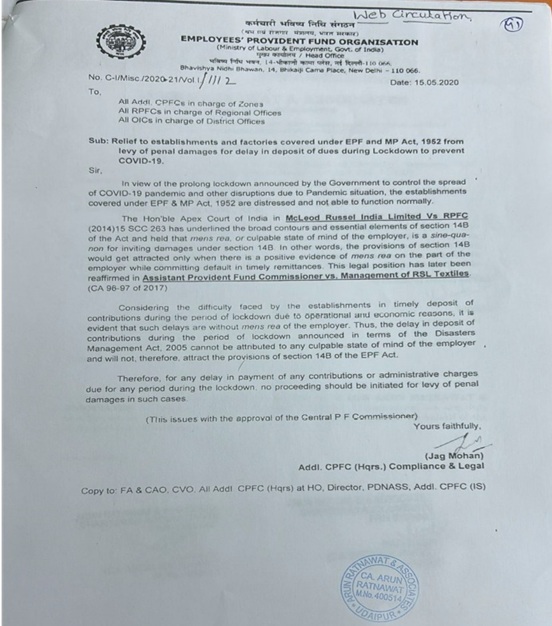
5. Thus, the Ld. AR has contended that the EPFO has issued the above circular No. C-I/Misc./2020-21/Vol.I/1112 dated 15.05.2020 in view of the prolonged lockdown announced by Government to control the spread of COVID-19 pandemic and that any delay in payment of any employer contribution or administrative charge due for any period during the lockdown, no proceedings be initiated for levy of penal damages in such cases. The appellant’s said delay has been covered under exempted period for which relaxation has been granted by EPFO from levy of damages and penalties for any delayed deposits of PF and ESI during the lockdown period under the PF and ESI Act. He accordingly, pleaded that it is a prima facie mistake, in not considering the COVID period and that it is being a debatable issue yet pending under review before the Hon’ble Apex Court for consideration. The AR pleaded that the addition made may be deleted, in support, he placed reliance on the following judgments:
| • |
|
ACIT v. Ashiana Housing Ltd. |
| • |
|
Maria Fernandes Cheryl v. ITO |
| • |
|
Kishore Hira Bhandari v. ITO |
| • |
|
Kalpesh Synthetics Pvt. Ltd. v. DCIT (ITAT Mumbai) |
| • |
|
Mohangarh Engineers & Construction Company v. CPC (ITAT Jodhpur) |
| • |
|
Crescent Roadways Pvt. Ltd. v. CPC (ITAT Kolkata) |
6. The Ld. DR on the other hand placed reliance on the impugned order. He submitted that although no penalty proceedings were initiated by the PF and ESI Department but the due dates were not extended. She pleaded that the impugned order may be sustained.
7. Having heard both the sides and perusal of record, we find that the CPC has rejected the application filed by the assessee u/s 154 to grant relief on account of delayed payment of employer contribution to PF and ESI even brushing aside the unprecedented disruption caused by COVID-19 pandemic and that the circular issued by EPFO granting relaxation from levy of damages and penalties for delay deposits during the lockdown period. The claim of deduction on deposit of employer contribution to PF and ESI before the due date under respective Act or due date of filing of return of income u/s 139(1) of the Act is a debatable issue. Recently, the Hon’ble Supreme Court has issued a notice in the case of Woodland (Aero Club) Pvt. Ltd. v. ACIT [SLP No. 1532 of 2026,dated 15-1-2026] to examine the issue of due date for deposit of employer contribution to PF and ESI interpretation amid lingering conflicts where the proceedings are pending and judgment is awaited.
8. Considering the EPFO aforesaid circular on granting relaxation from levy of damages and penalty for delay deposit during the lockdown period and that the issue being subjudice for review before the Supreme Court, shows that it is an issue which involves interpretation of law at the level of Hon’ble Apex Court which is out of the scope of the provisions of Section 143(1) to make prima facie adjustments by CPC to the return of income of the assessee. It is further emphasized that the EPFO vide circular dated 15.05.2020, the due dates were extended as also observed by the Ld. CIT(A) that no penalty proceedings were initiated as the due dates were extended. In our view, the relaxation from penalties makes is apparently clear that the EPFO authorities has acknowledged genuine hardship hence intended to grant relief to the appellant assessee from levy of penalty amount on acceptance of delayed payments under the exceptional circumstances like COVID-19 pandemic. Meaning thereby that the relaxation of penalty by the competent authority from Employees Fund Organization, Ministry of Labour and Employees, Government of India, acknowledges the genuine hardship and intended to grant relief. In such circumstances of COVID-19 pandemic, the non-levy of penalty tantamount to acceptance of delay under exceptional circumstances the absence of formal extension of due date does not negate the intent of relief. Therefore, such delays during the COVID-19 pandemic are deserves to be viewed pragmatically and not in a strict technical manner. Accordingly, we hold that the impugned order of the Ld. CIT(A) in rejecting the application of the assessee filed u/s 154 of the Income Tax Act is perverse to the facts on record by not appreciating the genuine hardships of COVID-19 period as duly acknowledged by EPFO authorities.
8.1 In the above view, we accept the grievance of the assessee as genuine and as such, delete the addition of Rs. 1,85,03,917/-.
9. Thus, the appeal of the assessee is allowed.



