ORDER
R.K. Panda, Vice President.- This appeal filed by the Revenue is directed against the order dated 11.02.2025 of the Ld. CIT(A) / NFAC, Delhi relating to assessment year 2015-16.
2. Facts of the case, in brief, are that the assessee is a partnership firm and engaged in the business of rice milling and trading of paddy, rice, broken rice etc. It filed its return of income for the impugned assessment year i.e. assessment year 2015-16 on 29.09.2015 declaring total income of Rs.8,01,710/-. The case of the assessee was selected for scrutiny under CASS. The Assessing Officer completed the assessment u/s 143(3) of the Act on 16.12.2017 determining the total income of the assessee at Rs.37,39,870/- by making addition of Rs.29,38,157/-.
3. Subsequently information was made available with the department that the assessee is a beneficiary of Rs.44,87,500/- on account of bogus purchases from M/s. Maa Sharda Process and Rs.74,12,500/- from M/s. Shri Vaishno Devi Exim. Accordingly a notice u/s 148 of the Income Tax Act, 1961 (hereinafter referred to as ‘the Act’) was issued on 30.06.2021 after obtaining approval of the PCIT-1, Raipur. Subsequently, pursuant to the order of Hon’ble Supreme Court and the Instruction No.01/2022 of the CBDT issued on 11.05.2022 another notice u/s 148 of the Act was issued on 23.07.2022 after obtaining approval of CCIT by passing order u/s 148A(d) of the Act. The Assessing Officer completed the assessment u/s 147 r.w.s. 144B of the Act on 23.05.2023 determining the total income of the assessee at Rs.1,27,01,710/- by making addition of Rs.1,19,00,000/- as unexplained expenditure u/s 69C of the Act on account of bogus purchases.
4. Before the Ld. CIT(A) / NFAC, the assessee apart from challenging the addition on merit, challenged the validity of re-assessment proceedings. The Ld. CIT(A) / NFAC held that the Additional Solicitor General of India, on behalf of the Revenue agreed that the notice issued for the A.Y. 2015-16, between 01-042021 and 30-06-2021 are not eligible for benefit of TOLA and therefore, all notices issued u/s 148 on or after 1st April 2021 and before 30-06-2021, following the procedure of pre-amended provisions of reassessment will have to be dropped as they did not fall for completion during the period covered under TOLA and subsequent notice issued thereunder. He further held that it is admitted position of the department that notices issued u/s 148 after 01-04-2021, following the old regime of reassessment was bad in law for A.Y. 2015-16, therefore, the impugned order of reassessment, which was initiated by issue of notice u/s 148 on 30-062021 following the old regime of reassessment will not survive for want of valid jurisdiction. In the spirit of justice and following the binding precedence of Hon’ble SC and having regard to stand of the revenue as spelt out by Hon’ble ASG in his submission before Hon’ble SC he held that the assumption of jurisdiction to reassess is bad in law. He accordingly held that the impugned order of assessment is also bad in law. He thus, allowed the appeal of the assessee.
5. Aggrieved with such order of the Ld. CIT(A) / NFAC the Revenue is in appeal before the Tribunal by raising the following grounds:
| 1) |
|
Whether on the facts and in the circumstances of the case the Ld. CIT(A) was justified in holding that the re-assessment proceedings under section 148 of the Income Tax Act, 1961 were bad in law when issuance of notice under section 148 of the Act on 23.07.2022 was valid, as it was issued after obtaining the approval of the Chief Commissioner of Income Tax in compliance with the Supreme Court’s order dated 04.05.2022 in the case of Union of India v. Ashish Agrawal (2022), and therefore, the re-assessment proceedings were initiated lawfully. |
| 2) |
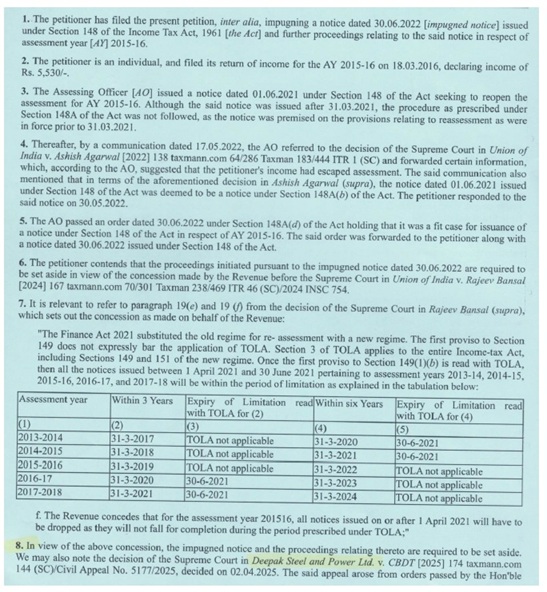
|
Whether on the facts and in the circumstances of the case the Ld. CIT(A) was justified in not considering the fact that the re-assessment notice was issued on 23.07.2022 which was within the time frame prescribed by the Supreme Court in the case of Union of India v. Ashish Agrawal (2022). |
| 3) |
|
Whether on the facts and in the circumstances of the case the Ld. CTT(A) was justified in not considering the merit of the case and holding that the re-assessment proceedings were invalid on the basis of reliance on the case of Rajiv Bansal v. Union of India. |
| 4) |
|
Whether on the facts and in the circumstances of the case the Ld. CIT(A) was justified in not considering the merits of the case and the grounds for re-assessment, and has incorrectly struck down the jurisdictional validity without examining the substantive issues involved. |
| 5) |
|
Any other ground which may be adduced at the time of hearing. |
6. The Ld. DR submitted that when the re-assessment proceedings were initiated by issue of notice on 23.07.2022 it was within the time frame prescribed by the Hon’ble Supreme Court in the case of
Union of India v.
Ashish Agarwal [2022] (SC), therefore, the Ld. CIT(A) / NFAC should not have placed his reliance in the case of
Union of India v.
Rajeev Bansal/ 469 ITR 46 (SC). She submitted that the Ld. CIT(A) / NFAC should have decided the appeal on merit instead of quashing such re-assessment proceedings being barred by limitation.
7. The Ld. Counsel for the assessee on the other hand referring to the decision of Hon’ble Delhi High Court in the case of
Veena Jain v.
ITO (Delhi) submitted that the Hon’ble High Court in the said decision has held that for assessment year 2015-16, notices issued under section 148 on or after 1-4-2021 would have to be dropped as they would not fall for completion during period prescribed under TOLA.
8. Referring to the decision of Hon’ble Bombay High Court in the case of
Cherian Nallathu Abraham Annamma v.
ITO [2025] (Bombay), he submitted that the Hon’ble High Court in the said decision has held that where the Assessing Officer issued reopening notice to assessee for assessment year 2015-16 on 5-4-2022, since revenue had categorically made a concession before Supreme Court in case of
Rajeev Bansal (supra) that for assessment year 2015-16 it would drop all notices issued under section 148 after 1-4-2021, impugned notice dated 5-4-2022 and all consequential orders/notices would not survive. He submitted that since admittedly the notice u/s 148 of the Act was issued under the old regime on 30.06.2021 and thereafter under the new regime notice u/s 148 of the Act was issued on 23.07.2022, therefore, in view of the decisions of Hon’ble Delhi High Court and the Hon’ble Bombay High Court, such notices are to be dropped and accordingly re-assessment proceedings are liable to be quashed.
9. We have heard the rival arguments made by both the sides, perused the orders of the Assessing Officer and Ld. CIT(A) / NFAC and the paper book filed on behalf of the assessee. We have also considered the various decisions cited before us. It is an admitted fact that the assessee filed its return of income u/s 139(1) of the Act on 29.09.2015. The assessment was completed u/s 143(3) of the Act on 16.12.2017 and thereafter the Assessing Officer issued notice u/s 148 of the Act under the old regime on 30.06.2021. Subsequently on the basis of directions issued by the Hon’ble Supreme Court in the case of Ashish Agarwal (supra) the Assessing Officer issued notice u/s 148A(b) of the Act on 24.05.2022 and an order u/s 148A(d) was passed on 21.07.2022. Thereafter, notice u/s 148 of the Act under the new regime was issued on 23.07.2022. Under these circumstances, we have to see as to whether the notice issued u/s 148 of the Act for the assessment year 2015-16 on 23.07.2022 is a valid notice or not.
10. We find an identical issue had come up before the Hon’ble Delhi High Court in the case of Veena Jain (supra) wherein the Hon’ble High Court has held that for assessment year 2015-16, notices issued under section 148 on or after 1-42021 would have to be dropped as they would not fall for completion during period prescribed under TOLA. The relevant observations of Hon’ble High Court read as under:
11. Similarly, we find the Hon’ble Bombay High Court in the case of Cherian Nallathu Abraham Annamma (supra) has held that where the Assessing Officer issued reopening notice to assessee for assessment year 2015-16 on 5-42022, since revenue had categorically made a concession before Supreme Court in case of Union of India(supra) that for assessment year 2015-16 it would drop all notices issued under section 148 after 1-4-2021, impugned notice dated 5-4-2022 and all consequential orders/notices would not survive. The relevant observations of Hon’ble High Court read as under:
“2. The present Petition has been filed primarily, with a prayer to quash and set aside (i) the order passed under Section 148A(d) and the Notice issued under Section 148, both dated 5th April 2022 (Exhibit B and C); (ii) the reassessment order dated 27th May 2024 passed under Section 147 read with Section 143(3) of the Act; (iii) notice of demand of even date raised for an amount of Rs.4,43,17,910/- for the Assessment Year (‘A.Y.’) 2015-16 (Exhibit E1 andE2); as well as (iv) the recovery notices issued for recovery of demand dated 2nd July 2025 and 9th September 2025 (Exhibit G and I) and the consequential penalty notices and orders.
3. At the outset, it has been fairly stated by Mr.Gandhi, that the Petitioner herein has filed an Appeal against the reassessment order passed. However, he submitted that no hearing has taken place despite the Appeal being filed more than one year back. Further, he stated that notices for recovery of demand have been issued on two occasions and the Petitioner has been threatened with coercive steps. He submitted that if the present Writ Petition is allowed then, he shall withdraw the Appeal.
4. It is contended by the Petitioner that the Notice issued under Section 148 for A.Y.2015-16 is dated 5th April 2022. Since it is issued after 1st April 2021, it is without jurisdiction and has to be withdrawn in light of the concession made by the Department before the Hon’ble Supreme Court in case of Union of India V/S Rajeev Bansal reported in
[2024] 469 ITR 46 (SC). Further, reliance is placed on the order dated 2nd April 2025 passed by the Hon’ble Supreme Court in case of Deepak Steel and Power Limited V/S Central Board of Direct Taxes & Ors in SLP (C) No.5632/2023 and an order dated 4th April 2025 passed in the case of Assistant Commissioner of Income-tax V/S Nehal Ashit Shah in SLP (C) No.57209/2023. Further, our attention is also drawn to the decision of this Court in Spicy Sangria Hotels Pvt Ltd V/S Income-tax Officer [W.P.1325 of 2023 decided on 6th October 2025]. Once the Notice under Section 148 is bad in law, all the consequential orders/notices would also not survive, is the submission.
5. The learned counsel for the Respondent does not dispute the above position. However, he contends that an Appeal has been filed by the Petitioner and that this Petition need not be entertained.
6. We have heard the learned counsel for the parties. It is not in dispute that the present petition relates to A.Y.2015-16. Further, it is also undisputed that the notice under Section 148 has been issued on 5th April 2022 which is at page 52 of the paper book. Once these are the facts, paragraphs 19 (e) and (f of the judgment of the Hon’ble Supreme Court in the case of Rajeev Bansal (supra) become relevant. They read as under:-
19. Mr. N Venkataraman, learned Additional Solicitor General of India, made the following submissions on behalf of the Revenue:-
a….
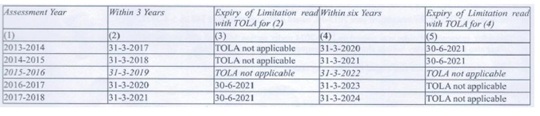
e. The Finance Act 2021 substituted the old regime for reassessment with a new regime. The first proviso to Section 149 does not expressly bar the application of TOLA. Section 3 of TOLA applies to the entire Income-tax Act, including Sections 149 and 151 of the new regime. Once the first proviso to Section 149(1)(b) is read with TOLA, then all the notices issued between 1 April 2021 and 30 June 2021 pertaining to assessment years 2013-2014, 2014-2015, 2015-2016, 2016-2017, and 2017-2018 will be within the period of limitation as explained in the tabulation below:
f. The Revenue concedes that for the assessment year 2015-16, all notices issued on or after 1 April 2021 will have to be dropped as they will not fall for completion during the period prescribed under TOLA;”
(emphasis supplied)
7. From the above it is clear, that the Department has conceded before the Hon’ble Supreme Court that all the notices issued under Section 148 after 1st April 2021 for A.Y.2015-16 have to be dropped. In the present case, the Notice under Section 148 is dated 5 th April 2022 and therefore, has to be dropped.
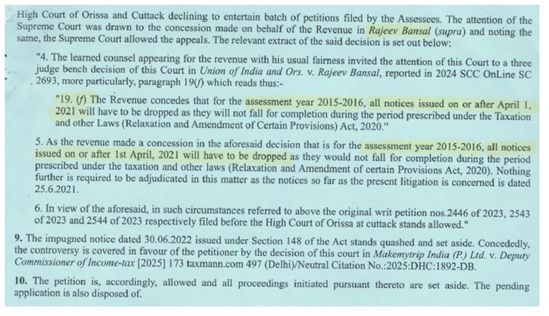
8. The decision in Rajeev Bansal (supra) has been subsequently followed by the Hon’ble Supreme Court in Deepak Steel and Power Limited (supra). Paragraphs 4 and 5 of the said order is reproduced hereunder:-
4. The learned counsel appearing for the revenue with his usual fairness invited the attention of this Court to a three judge bench decision of this Court in Union of India and Ors. v. Rajeev Bansal, reported in 2024 SCC OnLine SC 2693, more particularly, paragraph 19(f) which reads thus:-
“19. (f The Revenue concedes that for the assessment year 20152016, all notices issued on or after April 1, 2021 will have to be dropped as they will not fall for completion during the period prescribed under the Taxation and other Laws (Relaxation and Amendment of Certain Provisions) Act, 2020.”
5. As the revenue made a concession in the aforesaid decision that is for the assessment year 2015-2016, all notices issued on or after 1st April, 2021 will have to be dropped as they would not fall for completion during the period prescribed under the taxation and other laws (Relaxation and Amendment of certain Provisions Act, 2020). Nothing further is required to be adjudicated in this matter as the notices so far as the present litigation is concerned is dated 25.6.2021.
(emphasis supplied)
9. Similarly, even in the matter of Nehal Ashit Shah (supra), the Hon’ble Supreme Court, relying upon paragraphs 19 (e) and (f) of the decision in case of Rajeev Bansal (supra), dismissed the SLP filed by the Revenue. Paragraph 5 of the said order is reproduced hereunder:-
“5. In this regard, reference could also be made to paragraph 19(e) and (f) in the case of Union of India v. Rajeev Bansal, Civil Appeal No.8629 of 2024 on 03.10.2024 (2024 SCC ONLINE 754) under which the learned Additional Solicitor General for India has made a concession insofar as the assessment year 2015-16 is concerned.”
10. Lastly, this very Bench has on 6th October 2025, in the matter of Spicy Sangria (supra), allowed the petition filed by the Petitioner therein by noting that since, the notice under Section 148 was issued after 1st April 2021, the same was required to be set aside in light of the concession made by the Revenue before the Hon’ble Supreme Court in the case of Rajeev Bansal (supra).
11. In light of the above discussion, we find merit in the submissions as canvassed by the Petitioner. The Revenue has categorically made a concession that for A.Y.2015-16 they would drop all notices issued under Section 148 after 1st April 2021. Once this is the position, it is appropriate that the notice under Section 148 dated 5th April 2022, and the consequential assessment order, notice of demand, penalty notices/orders as well as the recovery notices be quashed and set aside. It is accordingly so ordered.
12. In light of this order, Mr. Gandhi, the learned counsel appearing on behalf of the Petitioner undertakes to withdraw the Appeal filed by him before the CIT (Appeals) within a period of 2 weeks from today. The said undertaking is accepted. If for any reason, the present order is challenged by the Revenue and is set aside, then the Appeal filed by the Petitioner before the CIT (Appeals) will automatically stand revived and the same shall be prosecuted on its own merits and in accordance with law.
13. Rule is made absolute in the above terms and the Writ Petition is also disposed of in terms thereof. No orders as to cost.
14. This order will be digitally signed by the Private Secretary/ Personal Assistant of this Court. All concerned will act on production by fax or email of a digitally signed copy of this order.”
12. Since the facts of the in the instant case are identical to the facts of the cases decided by the Hon’ble Delhi High Court and the Hon’ble Bombay High Court cited (supra), therefore, in absence of any contrary decision brought to our notice by Ld. DR, we respectfully following the decisions cited (supra) quash the notice issued u/s 148 of the Act dated 23.07.2022. Accordingly, we uphold the order of the Ld. CIT(A) / NFAC and dismiss the grounds raised by the Revenue.
13. In the result, the appeal filed by the Revenue is dismissed.