Rejection of an earlier Section 12AB application does not bar a trust from filing subsequent registration applications.Rejection of an earlier Section 12AB application does not bar a trust from filing subsequent registration applications.

By | July 24, 2026

Rejection of an earlier Section 12AB application does not bar a trust from filing subsequent registration applications.

Issue

Whether the rejection or dismissiveness of an earlier registration application under Section 12AB debars a charitable trust from subsequently applying afresh under Form 10AB before the same authority, and what is the effective date of registration if such a subsequent application is allowed.

Facts

  • Background & Initial Application:

    • The assessee-trust was constituted by a trust deed in 2021 to carry out charitable activities under Section 2(15) and applied for Section 12AB registration in Form 10AB.

    • The first application (filed on 18.11.2023) was rejected by the Commissioner (Exemptions) due to non-response to notices and non-submission of requested documents.

  • Subsequent Rejections:

    • A second application was rejected because the trust selected an incorrect section code.

    • Subsequent applications (including one filed on 20.01.2025) were treated as non-maintainable, non-est, and void-ab-initio on the ground that the original rejection order had attained finality since no appeal had been filed against it.

  • Assessee’s Stand:

    • The assessee filed a fresh application in Form 10AB (including one dated 18.07.2025) seeking registration, contending that there is no statutory prohibition against re-applying after satisfying all prescribed conditions.

Decision

  • No Statutory Bar on Subsequent Applications: The Tribunal held that there is no provision under the Income-tax Act barring an assessee from filing a fresh application in Form 10AB after an earlier rejection, provided all conditions for Section 12AB registration are satisfied. (In favour of assessee)

  • Duty of CIT(E) on Each Application: The CIT(E) is bound on each occasion to evaluate and satisfy himself/herself regarding the genuineness of the trust’s activities and compliance with relevant laws. (In favour of assessee)

  • Non-Filing of Appeal is Not a Permanent Estoppel: Failure to file an appeal against an earlier rejection does not forfeit or extinguish the trust’s statutory right to re-apply for registration before the same authority in the future. (In favour of assessee)

  • Arbitrary Declaration as Non-Est Set Aside: Declaring a subsequent Form 10AB application as non-maintainable or non-est was held to be illegal and unjustified. (In favour of assessee)

  • Effective Date Restrained to Latest Application: The Tribunal clarified that while the trust is entitled to apply afresh, registration can only be granted prospectively from the date of the latest valid application (e.g., 18.07.2025) and cannot relate back to the original application date (18.11.2023). (Partly in favour of assessee / Revenue)

Key Takeaways

  • No Doctrine of Permanent Res Judicata for Registration: An earlier administrative rejection of a Section 12AB application does not act as a permanent bar or res judicata against filing fresh applications in future years.

  • Effective Date Limitation: When registration is granted pursuant to a subsequent application, the effective tax exemption benefit attaches from the date of the latest application, not the date of any previously rejected application.

  • Mandatory Evaluation of Merits: Tax authorities cannot summarily throw out fresh registration applications as non-est; they must examine the genuineness of activities and statutory compliances afresh.

IN THE ITAT BANGALORE BENCH ‘B’
D.R. Shanmukappa Charitable Trust
v.
Commissioner of Income-tax (Exemptions)*
Keshav Dubey, Judicial Member
and BALAKRISHNAN S., Accountant Member
IT Appeal No. 2950 (Bang) OF 2025
JUNE  29, 2026
Veeresh, AR for the Appellant. N.S. Shashidhara, DR for the Respondent.
ORDER
Keshav Dubey, Judicial Member. – This appeal at the instance of the assessee is directed against the order of the ld. CIT(Exemptions) dated 24.9.2025 vide DIN & Notice No. ITBA/EXM/F/EXM45/2025-26/1081103140(1) rejecting the application for registration u/s 12AB of the Income Tax Act, 1961 (in short “the Act”).
2. The assessee has raised the following grounds of appeal:-
1. The Learned CIT(Exemptions) erred in law and on facts in rejecting the Appellant’s application for registration under Section 12AB / approval under Section 80G solely on the ground that an incorrect clause/sub-clause was selected in the online Form (wrong dropdown selection), without examining the merits of the application.
2. That the rejection is bad in law as the so-called “wrong clause selection” is a purely technical, procedural and curable defect, which is not fatal to the application, as consistently held in:

Akhil Bhartiya Adhivakta Parishad v. CIT (E), ITA No. 4954/De1/2024 (Del ITAT, Feb 2025) — mistake in selecting wrong 80G clause is curable, rejection on this ground alone is unsustainable.

Youth Service Centre v. CIT(E) (ITAT, 2025)— rejection only due to wrong clause in Form IOAB held invalid; matter remanded for reconsideration on merits.

Baroda Youth Federation v. CIT(E) (ITAT Ahmedabad, 2024/25) — wrong sub-clause selection in 12A application is a technical error; application must be evaluated under correct clause.

Aashritha The Dr. U. Sankaranarayana Raju Charitable Trust v. CIT(E) (Hyderabad ITAT, 2025) — rejection on wrong section code held unjustified; technical mistakes cannot defeat substantive entitlement.

3. That the Learned CIT(E) failed to appreciate that the Appellant had fully complied with all statutory requirements, furnished complete documentation, and satisfied all conditions under Sections 12AB / 80G(5), and therefore the application ought to have been examined and decided on merits.
4. That the Learned CIT(E) erred in not invoking the principles of natural justice by failing to give the Appellant an opportunity to correct the inadvertent technical defect, even though CBDT’s efiling system routinely permits rectification of procedural issues.
5. That the Learned CIT(E)’s approach is contrary to the judicially settled principle that “procedural mistakes should not defeat substantive rights”, as laid down in the above Tribunal orders, all of which emphasize that the purpose of Section 12AB/80G is to examine genuineness and charitable nature — not to punish technical errors.
6. The Learned CIT(Exemptions) failed to appreciate that the appellant had filed applications for registration under sections 12A and 80G on three occasions. While the first application was rejected due to an inadvertent wrong clause selection, the subsequent two applications—filed with the correctly selected clause—were also rejected solely on the basis of the initial procedural error, without examining the merits of the corrected applications.
7. That the impugned order is therefore liable to be set aside as it rests solely on a technical lapse and not on any finding relating to genuineness of activities, charitable purpose, or violation of Section 2(15).
8. That the appellant prays that the Hon’ble Commissioner (Appeals)/Appellate authority may kindly direct the CIT(Exemption) to treat the application as filed under the correct clause and re-adjudicate the same on merits, in line with the above binding and persuasive judicial precedents.
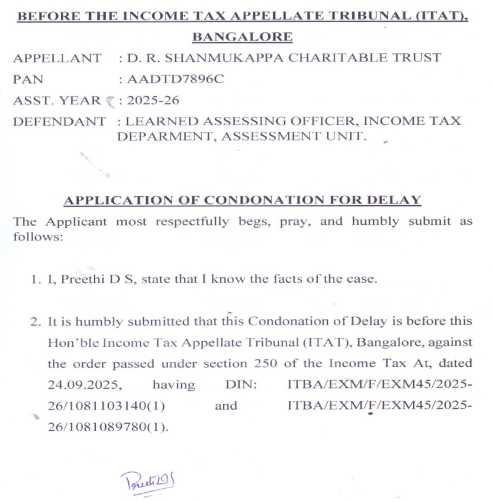
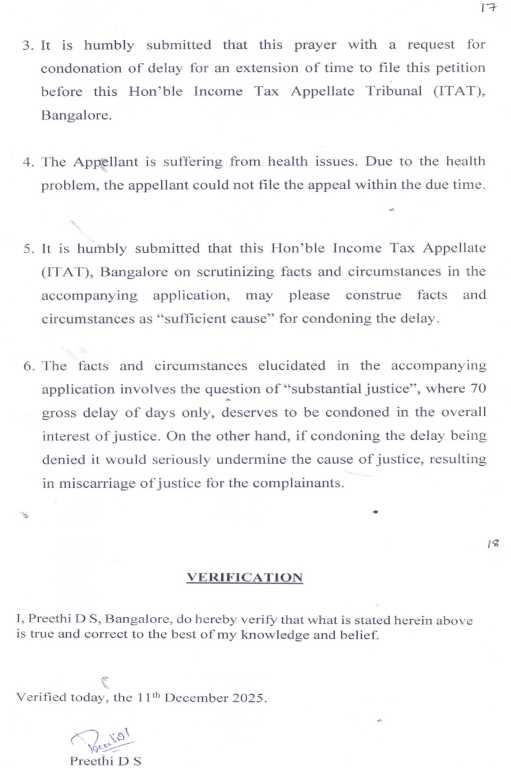
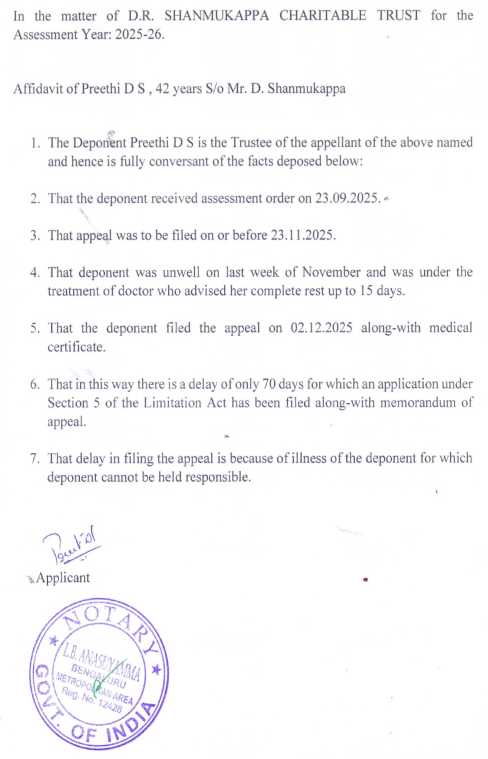
3. At the outset, the ld. A.R. of the assessee submitted that there is a delay of 16 days in filing the appeal before this Tribunal. The ld. A.R. of the assessee also drew our attention on an application for condonation of delay dated 11.12.2025 along with an affidavit in original sworn before the notary public stating the reason for the delay, which are reproduced below for ease of reference and record:
4. The main reason cited for delay in filing was solely attributable to the health issues of Mrs. D.S. Preethi, D/o Mr. D. Shanmukappa, who is the trustee of the assessee Trust, which prevented her for preparing the necessary documents and complying with the deadline associated with the filing of appeal. The assessee in support of its contentions had also produced medical certificate of Manas Multispeciality Hospital dated 20.11.2025.
4.1 Perused the record and having heard learned counsel for the assesse as well as ld. D.R, it is perceived that the explanation offered in the condonation application is plausible and “sufficient cause” has been shown by the assessee, which prevented the assessee trust from filing the appeal within the specified period before this Tribunal and accordingly, we are inclined to condone the short delay in filing the appeal before us.
5. Now the brief facts of the case are that the assessee, Shanmukappa Charitable Trust, is duly constituted by Deed of Trust dated 1.3.2021 at Bengaluru and is engaged in carrying out activities falling within the ambit of charitable purposes as defined under section 2(15) of the Act. The assessee trust applied for registration u/s 12AB of the Act on 8.11.2023 in Form No.10AB which was rejected by the ld. CIT (Exemptions), Bengaluru vide order dated 13.5.2024 on the ground that the assessee had not responded to the notices issued and failed to appear before the ld. CIT(Exemptions) and submit all the necessary documents/details as required for registration u/s 12AB of the Act. Subsequently, the assessee trust had filed another application in Form 10AB on 21.8.2024 for registration u/s 12AB of the Act, which was also rejected by the ld. CIT (Exemptions), Bengaluru vide order dated 6.1.2025 by stating that the assessee had selected the wrong section code while applying Form 10AB. Thereafter, the assessee again filed an application in Form No.10AB on 18.7.2025 for registration u/s 12AB of the Act which was again rejected by the ld. CIT (Exemptions), Bengaluru vide order dated 23.9.2025 by observing that the assessee had earlier applied for regularization of the provisional registration u/s 12AB of the Act and the application was rejected vide order dated 13.5.2024. Further, the ld. CIT(Exemptions) held that as the rejection order had attained finality as no appeal was filed before the ITAT within the same period amounts to collateral attack on a concluded decision and undermines the appellate framework recognized by law and accordingly held that the present application is not maintainable as non-est and is thus void-ab-initio. The assessee filed another application in Form 10AB on 20.1.2025 for registration u/s 12AB of the Act which was also rejected by the ld. CIT (Exemptions), Bengaluru vide order dated 24.9.2025 by stating that since the earlier rejection dated 6.12.2024 has attained finality, the assessee cannot reapply the same matter by filing another application. In view of the above facts, the application in Form 10AB filed for registration u/s 12AB of the Act on 20.1.2025 was rejected as not maintainable.
6. Aggrieved by the order of ld. CIT (Exemptions), Bengaluru dated 24.9.2025, the assessee has filed the present appeal before this Tribunal.
7. Before us, the ld. A.R. of the assessee vehemently submitted that the assessee could not submit the document/records required for registration u/s 12AB of the Act before the ld. CIT (Exemptions) and the ld. CIT(Exemptions) had rejected the application of the assessee on four occasions by holding that assessee has not responded to the notices issued and another by holding that assessee had selected the wrong section code while applying Form 10AB and accordingly prayed that one more opportunity of being heard may be granted before the ld. CIT (Exemptions) to furnish all the necessary documents/records required for granting registration u/s 12AB of the Act.
8. The ld. D.R. on the other hand, supported the order of the ld. CIT (Exemptions), Bengaluru.
9. We have heard the rival submissions and perused the materials available on record. It is an undisputed fact that the ld. CIT (Exemptions) vide order dated 13.5.2024 had rejected the application on the ground that the assessee did not respond to the notices issued and failed to appear and submit all the necessary documents/details as required for registration. Further, the ld. CIT (Exemptions) vide order dated 6.1.2025 had rejected the application on the ground that assessee had selected the wrong section code. We also observe that the ld. CIT (Exemptions) vide order dated 27.1.2025 as well as 23.9.2025 had rejected the application on the ground that since the rejection order had attained finality as no appeal was filed before the ITAT within the same period amounts to collateral attack on a concluded decision and undermines the appellate framework recognized by law and accordingly held that the present application is not maintainable as non-est and is thus void-ab-initio.
9.1 We are of the considered opinion that on receipt of an application for registration u/s. 12AB of the Act, the ld. CIT(E) shall call for such documents or information or make such inquiries as he/she thinks necessary in order to satisfy himself/ herself about-
(A) the genuineness of activities of such institution or fund; and
(B) the compliance of such requirements of any other law for the time being in force by the trust or institution as are material for the purpose of achieving its objects.
After satisfying himself/ herself about the genuineness of the activities and the compliance of such requirements of any other law for the time being in force by the trust or institution, the ld. CIT(E) shall pass an order in writing granting registration for a period of 5 years or if he/ she is not so satisfied, pass an order in writing rejecting such application and also cancelling the registration after affording reasonable opportunity of being heard. Thus, we are of the considered opinion that there is no such bar/restriction under the Act on the assessee trust in filing the application in form 10AB for granting registration u/s. 12AB of the Act before the same Authority subsequently if the assessee trust satisfy all the conditions for granting registration u/s 12AB of the Act. The ld. CIT(E) on receipt of the application on each occasion has to satisfy himself/herself only about the genuineness of the activities of the trust and the compliance of such requirements of any other law for the time being in force by the trust for granting registration. Merely because, the assessee trust had not preferred an appeal against the earlier orders dated 13.05.2024, 6.1.2025 & 23.9.2025 passed by ld.CIT(E), the assessee trust cant not be barred from exercising its statutory right subsequently before the same Authority if it fulfills the conditions as laid down for granting registration u/s 12AB of the Act. The only consequence of subsequent filing of application before the ld. CIT(E) will be the effective date of granting the registration which will ultimately be the date of the latest application. Thus, while entertaining the application in Form 10AB filed on 18.7.2025, the ld. CIT(E) cannot grant the registration effective from the date of original application i.e. 18.11.2023. Therefore, in our considered opinion treating the application filed in Form No.10AB on 20.1.2025 to be not maintainable as non-est and void-ab-initio is highly unjustified and bad in law as there are no such provisions under the Act that once the application for registration is rejected then the assessee can never apply for registration before the same Authority for ever.
9.2 Having held so, we are also of the considered opinion that as the assessee could not represent its case before the ld. CIT (Exemptions) by submitting the relevant documents/details required for registration u/s 12AB of the Act, and considering the request of the ld. A.R. of the assessee, we deem it fit and proper to remit the entire issue of registration to the file of ld. CIT (Exemptions) to decide afresh in accordance with law. Needless to say, a reasonable opportunity of being must be granted to the assessee. The assessee is also directed to produce all the relevant documents/ records/ accounts/ certificate/ reports to prove the genuineness of its activities and the compliance of such requirements of any other law for the time being in force. We make it clear that in case of further default, the assessee shall not be entitled for any leniency. It is ordered accordingly.
10. In the result, appeal filed by the assessee is partly allowed for statistical purposes.