ORDER
Anubhav Sharma, Judicial Member.- This appeal is preferred by the Assessee against the order dated 05.12.2025 of the Commissioner of Income-tax, Exemption, Delhi (hereinafter referred as ‘Competent Authority’) against the rejection of Form 10AB and consequent cancellation of registration granted under Section 12A(1)(ac)(i) of the Act.
2. Heard and perused the records. Both the sides have primarily rested their cases as contented before ld. Tax authorities. The facts giving rise to this appeal are that original return was filed by the Assessee on 28.2.2020 and case was selected for scrutiny on the issue of capital gains deductions claimed by the assessee. The admitted facts are assesses had inherited property at House number 11 street C2 Vasant Vihar on the death of his mother, Smt. Kamla Devi Jain on 25.12.1997 and the same was mutated in his name by the DDA on 20.09.1998.
2.1 The learned AO notes the facts in para 3.2. i. of his order that the assessee’s Mother was having 400 Sq Yard of land at C-2/11, Vasant Vihar, New Delhi wherein she built a single storey house in 1978. After her death on 25.12.1997, assesse, the sole legal heir, converted it into free hold in his name on 12.08.1999. Later on he entered into Collaboration Agreement with M/s Aditya Developers on 22.12.1999 for the demolition & reconstruction of the single storey property. The property was constructed with rights of Basement, Ground, Second floors and open Terrace above the second floor remaining with the assessee. M/s Aditya builders were given rights over entire First Floor of the building as per the agreement. He further notes that later on, the entire First floor of the property were sold as three parts / units by the Builders. i.e Front Portion of First floor to Smt. Bhagavathi Devi, Back Portion of First Floor to Smt. Nishi Singhal and Back Portion of First floor to Smt.Gauri Shankar.
2.2 In 2018, assessee and above mentioned three owners of First floor units, entered into Collaboration Agreement with M/s Uppal Builder to demolish the building and construct new building. As per this agreement dated 11.09.2018, after reconstruction, the ownership/ Rights of Basement, Entire Ground Floor, Entire Third Floor and Open Terrace of Third floor were to be with Assessee. Entire Second Floor with M/s Uppal Builders and Entire First floor with 2nd Party consisting of 3 persons who occupied the First Floor Units earlier. In para 3.2.4 and 3.2.5 of his order the learned AO notes that in addition to the above mentioned respective portions of the property, the Builders gave Rs.75 lakh to the assessee (in 2 years) and 25 Lakh each to the three others who were 2nd party to the Collaboration Agreement.
2.3 During the year under consideration, the Assessee has declared capital gain on sale of his share in 3rd floor rights of his immovable property at C-2/11, Vasant Vihar, New Delhi. The Assessee entered into a collaboration Agreement with M/s Uppal Housing Pvt. Ltd. vide collaboration Agreement dated 11.09.2018. As per agreement, he has sold his share in 3rd Floor Rights to the builder. In lieu of the said rights, the builder, has to construct Basement, Ground Floor & Third Floor after demolition the existing structure & in lieu therefore get 2nd floor as their share. The builder after completing the construction handed over to the Assessee, Basement, Ground Floor and Third Floor of the said building on 10.02.2020. Besides the construction of portion as mentioned above, the builder paid to the Assessee, a sum of Rs. 75,00,000/-(Rupees Seventy Five Lakhs only) as part consideration. (Before deduction of TDS). The Assessee has claimed the Exemption u/s 54/ 54F against the Long Term Capital Gains for the entire portion of his share in the building, ie; Ground Floor, Basement & Third floor.
2.4 The ld. AO examined following two aspects and proposed variation;
| i. |
|
Whether the assessee is eligible to claim fair market value, as per the valuation report. |
| ii. |
|
Whether the assessee is eligible to claim deduction u/s 54 for 3 residential units. |
2.5 Ld. AO observed that the fair market value adopted by the assessee, as per the valuation report of the Engineer is not acceptable, as the method adopted by the valuer is illogical and not correct. In two cases, the valuer has done calculation backwards from a future date. He has taken value of 2013 document and worked backwards to arrive at the value of 2001 indexation, as a method to calculate cost should only be used forward. With the city expanding rapidly, the properties which were considered as remote decades back have become the properties in the Centre of the city now. Hence taking the present value and working back ward to get the FMV in 2001 will not yield ‘ fair’ value, but only yield artificial value. The ld. AO observes that
“5.2.5 The concept of FMV is unambiguous as per the act. The price that the capital asset would fetch, in open market is determined using the circle rate fixed by the government authorities. Since the circle rate gives the minimum value for registration of a property, the registered value of any of the adjoining properties of that of the assessee as on 2001 can also be taken as FMV.
5.2.6 As per Govt rate, in the year 2000, the value of land in Vasant Vihar is Rs. 11550/- sq mt. Considering the CII for those years, the value as on 01.04.2001 comes to Rs. 12118/- only per square meter. This will suffice the requirement of clause i of section 2(22B) of IT Act. In the absence of any registered value adjacent to the property for the year 2001, I propose to take Rs. 12118/- per sq. meter as the FMV of land for the year 2001. Considering the prevailing cost of construction then, the FMV of the building is taken as claimed by the assessee.
2.6 Further with regard to elligibilty for deduction u/s 54F, the ld. AO observed for variation as follows;
“5.3.4 Hence it is unambiguously clear that, the assessee is not eligible to claim deduction for 3 residential units, as stated in his computation. The amendment to section 54F and ‘a” by Finance (No.2) Act, 2014, dated 1st April 2015, the benefit of capital gain deductions will be available to the one residential property only. “Courts have consistently held that post amendment benefit of 54F will be applicable only to one residential house in India whereas prior to the amendment residential house would include multiple residential houses/units
5.3.5 The assessee is in possession of basement, ground floor and third floor of the property. A perusal of the plans submitted by the assessee makes it elucidated that these are three distinct unit with no access through inside.
5.3.6 In view of the details mentioned in the preceding paragraphs, the assessee’s claim of deduction u/s 54 is restricted to Rs. 6,25,82,000/- , the construction cost of ground floor, being the one which is beneficial to the assessee.”
3. The appellant filed a revised computation making a revised claim in law that since the agreement is not registered, it will not attract taxability u/s 45(5A).
3.1 The same was duly noted and entertained by learned AO by noting that the Assessee entered into a collaboration agreement with M/s Uppal Developers parting with his 15% share in the land along with the super structure and the builder was to demolish and reconstruct the entire basement, ground floor and third floor for him. In the barter the builder’s share was second floor of the new building. In view of the provisions of section 2(22B) the FMV is defined as the ‘Fair Market Value’ in relation to capital asset. It is the price which any willing buyer will pay to the seller for that property on the relevant date.
3.2 Learned AO opined as under on the fresh claim:
“5. 6.4 With regards to the new computation furnished by the assessee, I have given my careful examination of the facts of the case and following conclusion is arrived at:
(i) Now let us analyse the latest capital gain statement filed by the assessee, in detail:
Capital Gain on Sale of Land
My Land Share @15 % (being 15% of 334.45 sqm) Or 50.17 sqm @ 7,74,000 per sqm – Rs. 3,88,31,580 (Circle rate of Land) = “7,74,000” X 15.17
(ii) The assessee together with the other co-owner has transferred 22.5 % of share of slit floor along with 22.5°% of undivided interest in land to the builder. Assesseee has not taken his percentage of share value of the building transferred to the builder while computing his capital gain. Assessee has only taken the land value while arriving at the consideration in the latest computation statement.
(iii) Assessee has furnished a valuation report from a registered valuer. However the valuation report can be relied upon only when the FMV of the building could not be ascertainable from any other parameter. There will be variation in the reports submitted by different valuers also. When primary rate itself is available, there is no need to depend upon a valuation report, which is less than the circle rate adopted by Government. The registration will be done as per circle rates. When an authentic government document is available which will communicate the fair market value of the property, there is no need to go behind the valuers report. All such are secondary documents which could be taken in to consideration when primary data is not available. The assessee, in his earlier computations, has worked out full value of consideration as per circle rate fixed by Govt, which is reproduced below;
(iv) Assessee has shown the cost of construction of first floor of the property which comprises of 22.5 % of share in the residential building as Rs. 43,38,637/-. This value is arrived at by the assessee as per circle rates, as detailed in the earlier computations submitted. Now the builder also possesses 22.5 % share in the property. In the absence of any documentary evidence proving the cost of construction, I have to go by the circle rates. So the cost of the building transferred to the builder comes to Rs. 43,38,637/- out of which assessee’s share comes to Rs.28,92,424/-, being 2/3rd share. This has to be added to the full value of consideration. As such, full value of consideration, in the hands of the assessee is worked out as:
Full value of consideration = Rs. 3,88,31,580 + Rs. 28,92,424 /- = Rs. 4,17,24,004/-
(v) Now, the assessee is eligible to claim deduction u/s 54 to the tune of Rs. 43,38,637/- being his investment in one house property.
(vi) Assessee has shown the following working for FMV as on 01.04.2001. Fair Market Value of Land & Building as on 01.04.2001
Cost of My Land Share @15% as 01.04.2001 42.66.000
Cost of building 45,00,000 87.66.000
(v) Due to the reasons stated in the preceding paragraphs, the cost of acquisition could only be allowed at Rs.13,860/- sq. meter. So, the cost of land share on 01.04.2001 comes to Rs. 6,95,321/- only. Accordingly the total cost of acquisition deciphers out to be Rs. 51,95,321/- (Rs. 45,00,000/- + Rs. 6,95,321/-). The indexed cost of acquisition of the land and building come to Rs. 1,50,14,477/- only (Rs, 51,95,321/- * 289/100) . The indexed cost of acquisition = Rs. 1,50,14,477/-
(vi) As per section 45(1), the computation of capital gain is reworked as under; Full Value of Consideration – Rs. 4,17,24,004/- Add: Amount Received from Builder – Rs.75,00,000 Less: GST Paid to the Builder -Rs. 35,00,000 Less: Indexed cost of acquisition – Rs. 1,50,14,477/- Less : Deduction u/s 54 – Rs. 43,38,637/- Total Capital Gain – Rs. 2,63,70,890/- Out of this, Short Term Capital Gain will be Rs.28,92,424/- & Long Term Capital Gain will be Rs.2,34,78,466/-.
4. Then for restricting claim of deduction u/s 54/54F of the Act ld. AO observes 5.6.5 Assessee did not put forward any arguments or furnished any reply in respect of the restriction of deduction u/s 54/54F to one house, in the reply to SCN. However, on Page 27 in para 5.6.2 (iii) learned AO states all the documents furnished by the assessee comprises of land along with residential house having different floors. None of the documents show distinct values for land and building. Since the cost of land and building are inseparable, from the documents furnished by the assessee, FMV of the land as on 01.04.2001 could not be determined from these documents. The assessee has separately shown Rs. 45 lakh as the FMV of the building as on 01.04.2001 in the computation statement and now the issue concerns about FMV of land on 01.04.2001. No document which establishes the FMV of land as on 01.04.2001 were uploaded by the assessee. Assessee, in annexures to the last reply stated about some other documents than which were listed above. However the documents pertaining to the same were not seen uploaded.
5. Now in first appeal before ld. CIT(A), after taking note of all the facts asserted by ld. AO, dismissed the appeal of assessee, and the ld. CIT(A) held as under:
8. Decision:
8.1 I have gone through impugned order, statement of facts, grounds of appeal, written submission filed by the appellant on multiple occasions, remand report and material available on record.
9. It is seen that the document is an assessment order u/s 143(3) read with Section 144B of the Income Tax Act, 1961, for Assessment Year 2020-21, concerning Mr. Ranjan Sen Jain (PAN: AADPJ9852C), a resident individual. The case was selected for scrutiny to verify capital gains deductions claimed under Sections 54 and 54F, relating to a collaboration agreement for redevelopment of his residential property located at C-2/11, Vasant Vihar, New Delhi.
9.1 The appellant inherited the property from his mother in 1997 and converted it into freehold in 1999. Initially, the appellant entered into a collaboration agreement in 1999 with M/s Aditya Developers, under which the first floor was allotted to the builder, while the basement, ground, second floor, and terrace remained with the appellant. In 2018, a second collaboration agreement was made with M/s Uppal Housing Pvt. Ltd., involving demolition and reconstruction. After redevelopment, the appellant retained Basement, Ground Floor, Third Floor, and terrace, while the Second Floor was given to the builder, and the First Floor to three other previous coowners. He also received Rs.75 lakhs as monetary consideration. The appellant adopted a fair market value of Rs.4.65 crores as on 01.04.2001, based on a private valuer’s report.
9.2 The AO, during the course of assessment proceedings, rejected this value, stating that it was based on extrapolated future data and did not follow standard methods. Instead, the AO applied the government-prescribed rate for 2001, arriving at a lower FMV using the Circle Rate (Rs.12,118/sq.m). Capital gains were recomputed using the government circle rates and reduced exemptions.
9.3 As regard claim made u/s 54 of the Act, the AO disallowed this, referring to Finance Act 2014 amendments effective from 01.04.2015, which limit exemption strictly to one residential unit. Based on building plans and usage patterns, the AO concluded the three floors were distinct dwelling units, and allowed exemption only for the Ground Floor, valued at Rs.6.25 crores. The AO held that only one residential unit qualifies for exemption post-2015, thus disallowed the appellant’s exemption claim and revised the long-term capital gains accordingly.’
10. In ground No.1 appellant has claimed that in view of the facts and circumstances of the case and in law, the show cause notice dated 10.08.2022 and the assessment order dated 29.09.2022 passed by National Faceless Assessment Centre (‘NFAC’)/AO under section 143(3) r.w.s. 144B of the Income Tax Act, 1961 (herein referred to as ‘Act’) and the additions made therein are illegal, bad in law, without jurisdiction and barred by time limitation.
10.1 I have gone through the assessment order, dates of notices issued and the section 143(3) of IT Act, 1961. It is seen that AO has issued notice u/s 143(2) in time as prescribed in IT Act, 1961 and the assessment order is also passed in time frame as on 29.09.2022.
Therefore, the ground No.1 is dismissed in the absence of any legal standing in support of the ground of appeal raised by the appellant.
11. Ground No.2 states that that, in view of the facts and circumstances of the case and in law, the NFAC/AO had no jurisdiction to add an amount of Rs. 28,92,424/- as Short Term Capital Gain (STCG) since no show cause notice was issued in respect of the said addition and this addition is also against the principles of natural justice and against the mandate of Sec 144B of the Act.
11.1 It is emanating from assessment records that elaborative notice was issued by the AO explaining the issue under consideration and the assessee has made his comprehensive submission on 07.12.21. Rather Assessee had availed the opportunity to revise the computation claim u/s 54/54F. Thus, it clearly indicates that the AO had given sufficient opportunity to the assessee to make elaborate submissions on the issue of Short Term Capital Gain.
11.2 Therefore, Ground No. 2 is dismissed.
12. Ground No. 3, 4, 5, 6, 7 and 8 are interrelated and mainly related to the claim of appellant that NFAC/AO has erred in adopting the cost of land as on 01/04/2001 at Rs. 13,860/- per sq mt. as against the value declared by the Appellant.
12.1 I have gone through various submissions made by the appellant and the assessment order. The main issue involved is the adoption of cost of land. It is seen that the cost of acquisition has been taken by the appellant based on the valuation report. Appellant has adopted the FMV as per valuation of Er. B P Singh, Govt Valuer. However, the AO has observed that:
“1. As per Govt rate, in the year 2000, the value of land in Vasant Vihar is Rs. 11550/- sq mt. Considering the CII for those years, the value as on 01.04.2001 comes to Rs. 12118/- only. However appellant has not followed the said value while computing the cost of acquisition.
2. A second rate was arrived at by the valuer by considering a sale deed of the year 1994-95. The purchase cost for the said property, as specified by the Valuer is Rs. 98,28,000/- for 200 sq yards. In order to arrive at the fair market value on 01.04.2001, the valuer has considered 10% increase of land price each year aggregating to 70% in 7 years from 94-95 to 2001-02. However, the CII jump for the same period is only 1.64 times. As such, the estimation of fair market value made by the valuer is quixotic and done in an unfeasible style.
3. When appellant has the fair market value of properties registered in the year 2001, it is unfair and irrational in taking the value of properties in the year 2014 or 2018 for determining the FMV in 2001. Appellant has taken the fair market value by working backwards. Such calculation of fair market value by going in the past brings out absurd results.
12.2 We cannot use today’s price and apply a discounting rate to arrive at a historical FMV. That would give a fictitious, mathematically engineered value, not one actually prevailing on that date. It is to be remembered that FMV is not an arbitrary value — it must reflect the real market worth of the asset as of a specific date, based on facts, evidence, and valuation norms. In the impugned case, there is no any registered value adjacent to the property under consideration for the year 2001. If there are no nearby sale instances, or market sales are unregistered/undisclosed: Circle rate becomes the only official benchmark.
12.3 Circle Rate is the primary rate duly decided by the Government Authorities. Circle rates decided by the Government Authorities remove subjectivity and provides a benchmark value to be widely accepted by various stakeholders.
12.4 In this scenario, as the circle rates fixed by the Government Authorities are more authentic and are used for stamp duty valuation, taking circle rate for calculating FMV is more practical, logical way to address the issue in the impugned case. Therefore, it can be fairly said that the AO has correctly adopted the Circle Rate fixed by the Government Authorities , in year 2000, the value of land in Vasant Vihar is Rs. 11550/- sq.mt and considering the CII for the relevant period , the value as on 01.04.2001 comes to Rs 12118/- as FMV of the land. In this scenario, I don’t see an occasion to interfere with the value adopted by the AO.
12.5 Therefore, Ground No. 3, 4, 5, 6, 7 and 8 are dismissed accordingly.
13. Ground No. 9 , 10, 11 and 12 are related to the exemption claimed by the appellant u/s 54/54F of the Act and the main claim of the appellant that there is no requirement in section 54 of the Act that residential house should be built in a particular manner.
13.1 The main issue to be addressed here is whether the appellant is eligible to claim deduction u/s 54 in respect of all 3 floors or can be restricted to only 1 floor.
13.2 Appellant has submitted that he has claimed the Exemption u/s 54/ 54F against the Long Term Capital Gains for the entire portion of his share in the building, i.e; Ground Floor, Basement & Third floor placing reliance on the Hon’ble Delhi High Court Judgement in the case of Commissioner of Income Tax v. Gita Duggal, ITA 1237/2011, dated 21.02.2013. He has also submitted that the above judgment was followed by the same High Court in the decision in CIT v. Smt. K G Rukminiamma in ITA No.783/2008 dated 27.08.2010.
13.3 The appellant requested that in view of the above facts & well settled Legal Pronouncement by the Hon’ble Supreme Court of India confirming the judgement in the case of
Karnataka High Court CIT v.
B Ananda Basappa; (2009) 309 ITR 329 , followed by the same High Court’s judgement in
CIT v.
Smt. K G Rukminiamma in ITA No. 783/2008 dated. 27.08.2010, the exemption as claimed may kindly be allowed.
13.4 The appellant is in possession of Basement, Ground Floor and Third floor of the property. Appellant has claimed that all these 3 floors are part of one residential unit and claimed deduction u/s 54/54F on all such residential units.
13.5 I have gone through the development plan of the building and I am of the considered opinion that Basement, Ground Floor and Third Floor are distinct units. Basement, Ground Floor, and Third Floor are:
1. Physically separated
2. Possibly with separate entrances, Kitchens and bathrooms
3. Capable of independent use or letting
13.6 These are distinct residential units, not “one” residential house.
Appellant has cited case law as CIT v.
Gita Duggal (2013) 357 ITR 153 (Del) . In the said case law
Delhi HC allowed exemption where two floors were part of one single residential house, used together, not independently. But in the impugned case, appellant is in possession of Basement, Ground Floor and Third Floor. Thus, we need to identify the truth that whether they are functionally independent and distinct or not.
13.7 AO has correctly observed from the development plan that all the three floors are distinct and each floor constitutes separate residential unit. Also, appellant has stated that he has given Ground Floor to a company Samsung Display Noida PVT Ltd for the residence of its manager. This statement of the appellant itself proves the fact that Ground Floor is a separate, distinct and functionally independent residential unit with separate entrance, bathrooms and kitchen. It means that Ground Floor is capable of independent use as a separate residential unit. I am reproducing a relevant part of section 54 as below:
“Profit on sale of property used for residence. 54.[Subject to the provisions of subsection (2), where, in the case of an assessee being an individual or a Hindu undivided family], the capital gain arises from the transfer of a long-term capital asset [***], being buildings or lands appurtenant thereto, and being a residential house , the income of which is chargeable under the head “Income from house property” (hereafter in this section referred to as the original asset), and the assessee has within a period of [one year before or two years after the date on which the transfer took place purchased], or has within a period of three years after that date [constructed, one residential house in India], then], instead of the capital gain being charged to income-tax as income of the previous year in which the transfer took place, it shall be dealt with in accordance with the following provisions of this section.”
13.8 It is seen that amendment in section 54 has been brought After the judgement of Hon’ble SC, and the Income tax Act was amended and w.e.f 01.04.2015. The relevant quotes from the memorandum to finance bill 2014 is reproduced below:
13.8.1 The existing provisions contained in sub-section (1) of section 54, inter alia, provide that where capital gain arises from the transfer of a long-term capital asset, being buildings or lands appurtenant thereto, and being a residential house, and the assessee within a period of one year before or two years after the date of transfer, purchases, or within a period of three years after the date of transfer constructs, a residential house then the amount of capital gains to the extent invested in the new residential house is not chargeable to tax under section 45 of the Act.
13.8.2 The existing provisions contained in sub-section (1) of section 54F, inter alia, provide that where capital gains arises from transfer of a long-term capital asset, not being a residential house, and the assessee within a period of one year before or two years after the date of transfer, purchases, or within a period of three years after the date of transfer constructs, a residential house then the portion of capital gains in the ratio of cost of new asset to the net consideration received on transfer is not chargeable to tax.
13.8.3 The benefit was intended for investment in one residential house within India. Accordingly, it is proposed to amend the aforesaid subsection (1) of section 54 so as to provide that the rollover relief under the said section is available if the investment is made in one residential house situated in India.
13.9 The Hon’ble Karnataka HC in the case of Arun K Thiagarajan v. Commissioner of Income Tax has made it clear that the deduction u/s 54F is available only to one residential house after 01.04.2015. The relevant extract is reproduced as under:
13.9.1 It is well settled in law that an Amending Act may be purely clarificatory in nature intended to clear a meaning of a provision of the principal Act, which was already implicit. [SEE: DECISION OF THE SUPREME COURT IN ‘CIT US. NEW DELHI US. RAMKRISHNA DAS’ IN CIVIL APPEAL NO.3211/2019 DECIDED ON 26.03.2019]. In view of aforesaid enunciation of law by different High Courts including this court and with a view to give definite meaning to the expression ‘a residential house’, the provisions of Section 54(1) were amended with an object to restrict the plurality to mean singularity by substituting the word ‘a residential house’ with the word ‘one residential house’. The aforesaid amendment came into force with effect from 01.04.2015. The relevant extracts of Explanatory note to provisions of Finance Act No.2/2014 reads as under:
13.9.2 Certain courts had interpreted that the exemption is also available if investment is made in more than one residential house. The benefit was intended for investment in one residential house within India. Accordingly, sub-Section (1) of Section 54 of the Income-Tax Act has been amended to provide that the rollover relief under the said Section is available if the investment is made in one residential house situated in India. 13.9.3 Applicability:- These amendments take effect from 1st April, 2015 and will accordingly apply in relation to Assessment year 2015-16 and subsequent Assessment years.
13.10 Thus it is clear that the aforesaid amendment was specifically applied only prospectively with effect from Assessment year 2015-16.
13.11 Thus, from the factual matrix as described above and the legal interpretation of the amendment in section 54 , I am of the considered opinion that AO is correct in allowing the benefit of deduction to one floor only as mentioned in the assessment order.
6. Accordingly the assessee is in appeal and has raised following grounds:
“1. That on the facts and circumstances of the case and in law, the impugned order dated 06.10.2025 passed by the Commissioner of Income Tax (Appeals), National Faceless Appeal Centre, Delhi [‘CIT(A)] affirming the impugned assessment order dated 29.09.2022, is completely perverse, invalid, illegal and bad in law.
1.1. That the CIT(A) erred on facts and in law in passing the impugned order without properly appreciating the facts of the case and the relevant legal provisions applicable thereto, by ignoring provisions of the Income Tax Act, 1961 (the Act’), and in gross violation of principles of natural justice.
2. That on the facts and circumstances of the case and in law, the CIT(A) erred in not
appreciating that the action of the assessing officer in travelling beyond the issues specified in the notice issued under section 143(2) for limited scrutiny, was beyond jurisdiction, illegal and the assessment order called for being quashed.
3. That on the facts and circumstances of the case and in law, the CIT(A) erred in
confirming the action of the assessing officer in denying the exemption claimed under section 54 of the Act by varying/ altering both, the cost of construction of the property and determination of the sale consideration.
4. That on the facts and circumstances of the case and in law, the CIT(A) erred in upholding the action of the AO in rejecting the indexed cost of acquisition of the immovable property (land computed by the appellant based on valuation reports obtained from Government registered valuer – without pointing out any error/ deficiency in such valuation reports and without even referring the valuation to DVO.
4.1. That on the facts and circumstances of the case and in law, the CIT(A) erred in not accepting the indexed cost of acquisition of the immovable property (land) computed by the appellant based on the fair market value of similar transactions undertaken by other independent third parties.
4.2. That the CIT(A)/AO erred on facts and in law in not appreciating that increase in Cost Inflation Index (CH is not proportionate to the increase in the fair market value of the land/ building and thus, the fair market value of the immovable property cannot be computed by applying increase in CII to historical value of immovable property.
5. That the CIT(A)/ AO erred on facts and in law in not appreciating that the sale value of the immovable property must be computed by adopting the cost of construction incurred by the developer towards the constructed area of immovable property handed over to the appellant post completion of construction.
5.1. That on the facts and circumstances of the case and in law, the CIT(A)/ AO erred in not allowing the stamp duty value/ cost of construction of basement and third floor, which constituted common residential unit, for the purpose of exemption under section 54 of the Act.
5.2. That on the facts and circumstances of the case and in law, the CIT(A) erred in not accepting/considering the additional evidences) filed by the appellant in terms of Rule 46A of the Income Tax Rules, 1962.
6. That on the facts and circumstances of the case and in law, the CIT(A)/ AO erred in restricting the exemption claimed under section 54 of the Act to the cost of construction of only the ground floor without appreciating that the appellant acquired/ constructed three floors, i.e. basement, ground floor and third floor in the same property.
6.1. That/the CIT(A) failed to appreciate that the conditions specified in section 54 for claim of exemption were duly satisfied and accordingly the appellant had rightly claimed exemption in respect of all three floors acquired and the value of land share associated therewith.
6.2. That the CIT(A) erred in not appreciating that the cost of inherited land was also required to be considered while computing the exemption allowable under section 54 of the Act inasmuch as the same formed an essential part of the property.
6.3. That the CIT(A)/ AO erred on facts and in law in not appreciating that the appellant did not derive any short-term capital gain from the alleged transfer of 1™ floor of the building because the appellant could not have transferred the 1″ floor of the building as he was never the owner of the 1″ floor of the building.
6.4. That without prejudice to the aforesaid, the CIT(A) erred on facts and in law in not appreciating that the land was owned/ held by the appellant since 1999, i.e. for a period of more than two years prior to its transfer to the developer and thus, the same qualified as long term capital asset.
The appellant craves leave to add, alter or amend any or all of aforesaid grounds of appeal before or at the time of hearing.”
7. On giving thoughtful consideration to the rival submissions and the careful perusal of the impugned orders of the ld. Tax authorities we are of the considered view that as with regard to the issue of non-allowance of exemption u/s 54 of the Act for allegedly assesse acquiring multiple residential units, the assesse cannot be denied benefit of Section 54 as there is nothing to show that though there are multiple floors but the same are not part of one residential property. The construction based on prospective uses by way of separate floors is merely a mode of structuring the property but what is vital is that as for the purpose of its ownership, the assesse should acquire it as on unit, in consequence to the investment of capital gains. The law in this regard is also in favour of assessee where it has been held that multiple floors or units, when purchased, are part of one single residential house the exemption u/s 54F of the Act cannot be denied. Reliance in this regard is placed on the decision of Hon’ble
Delhi High Court in case of
Pr. CIT v.
Lata Goel [2025)
(
Delhi) /ITA 127/2025 & CM No. 25518/2025 wherein it was held that that acquisition of multiple floors within the same residential property does not tantamount to ownership of more than one residential house. The Court further clarified that Section 54F does not prescribe any specific manner of construction of a residential house; accordingly, the assessee cannot be denied the benefit of deduction under Section 54F on the ground that more than one residential unit exists within the same property. Relevant extract of the findings of the judgement is reproduced as hereunder:
“22. It is also relevant to refer to the decision of the coordinate bench of this court in CIT v. Gita Duggal
[2013] 357 ITR 153 (
Delhi) /2013 SCC OnLine Del 752 where this court has held as under: –
“11. There could also be another angle. Section 54/54F uses the expression “a residential house”. The expression used is not “a residential unit”. This is a new concept introduced by the Assessing Officer into the section. Section 54/54F requires the assessee to acquire a “residential house” and so long as the assessee acquires a building, which may be constructed, for the sake of convenience, in such a manner as to consist of several units which can, if the need arises, be conveniently and independently used as an independent residence, the requirement of the section should be taken to have been satisfied. There is nothing in these sections which require the residential house to be constructed in a particular manner. The only requirement is that it should be for the residential use and not for commercial use. If there is nothing in the section which requires that the residential house should be built in a particular manner, it seems to us that the Incometax authorities cannot insist upon that requirement. A person may construct a house according to his plans and requirements. Most of the houses are constructed according to the needs and requirements and even compulsions. For instance, a person may construct a residential house in such a manner that he may use the ground floor for his own residence and let out the first floor having an independent entry so that his income is augmented. It is quite common to find such arrangements, particularly postretirement. One may build a house consisting of four bedrooms (all in the same or different floors) in such a manner that an independent residential unit consisting of two or three bedrooms may be carved out with an independent entrance so that it can be let out. He may even arrange for his children and family to stay there, so that they are nearby, an arrangement which can be mutually supportive. He may construct his residence in such a manner that in case of a future need he may be able to dispose of a part thereof as an independent house. There may be several such considerations for a person while constructing a residential house. We are therefore, unable to see how or why the physical structuring of the new residential house, whether it is lateral or vertical, should come in the way of considering the building as a residential house. We do not think that the fact that the residential house consists of several independent units can be permitted to act as an impediment to the allowance of the deduction under section 54/54F. It is neither expressly nor by necessary implication prohibited.”
23. This court in Mrs. Kamla Ajmera v. Pr. CIT (Delhi) /Neutral Citation No.: 2024: DHC:9342-DB, referred to the decision in Geeta Duggal (supra), and held that in certain circumstances, multiple residential units may be considered as a single residential house for the purposes of exemption under Section 54F of the Act. The court observed as follows: –
“39. This assumes significance in the backdrop of our opinion that the word ‘a’ used in Section 54F of the Act denotes one singular residence, along with the caveat that in case the floors or houses are so constructed as to be used as one singular unit or capable of being used as such, they may fall within the definition of a residential house.”
24. The Madras High Court also held a similar view in CIT v. Gumanmal Jain 394 ITR 666 (Madras) /CIT v. Gumanmal Jain [2017] 394 ITR 666 (Madras)/2017 SCC OnLine Mad 13653.
25. The aforesaid decisions were rendered in the context of construing whether the new asset purchased is ‘a residential house’ – an expression used in Section 54 and 54F of the Act. However, the said decisions would be equally applicable for construing the term ‘one residential house’ as used in clause (i) of the proviso to Section 54F of the Act. We say so because in Pawan Arva (supra) as well as in Gita Duggal (supra) and Mrs Kamla Ajmera (supra), the term ‘a residential house’ has been construed to mean ‘one residential house’. We find it difficult to accept that, in the given facts, different floors of a house are required to be considered as multiple residential houses.
(Emphasis supplied)
8. Similar observations have been made in the following decisions:
| *CIT |
|
v. Gumanmal Jain 394 ITR 666 (Madras)/2017 SCC OnLine Mad 13653 |
| * |
|
Smt. Payal Bansal v. ITO (Delhi – Trib.) |
| * |
|
Saroj Rani v. ITO: (Delhi – Trib.) |
| * |
|
Mrs. Chanda Runwal v. ACIT (Mumbai – Trib.) |
| * |
|
Nakul Aggarwal v. ACIT 209 ITD 342 (Mumbai – Trib.) |
| * |
|
Mohammadanif Sultanali Pradhan v. DCIT 181 ITD 238 (Ahmedabad – Trib.) |
| * |
|
Ms. Anita Mahindrakumar Oberai v. ITO (Pune – Trib.) |
9. Therefore, the denial of exemption u/s 54 cannot be sustain in law and corresponding ground deserves to be allowed.
10. Then, with regard to issue of calculation of long term capital gain, having considered the submissions of assesse in the assessment proceedings very apparently assesse has changed the stance and assessing officer has duly taking note of same and has finally concluded in favour of assesse, by making following conclusions in para 5.6.4(iv):
(iv) Assessee has shown the cost of construction of first floor of the property which comprises of 22.5% of share in the residential building as Rs.43,38,6371-. This value is arrived at by the assessee as per circle rates, as detailed in the earlier computations submitted. Now the builder also possesses 22.5 % share in the property. In the absence of any documentary evidence proving the cost of construction, I have to go by the circle rates. So the cost of the building transferred to the builder comes to Rs. 43,38,637l- out of which assessee’s share comes to Rs.28,92,424l-, being 2/3rd share. This has to be added to the full value of consideration.
11. Thus, very apparently assessing officer for want of cost of construction of share which builder has received by way of consideration in view of construction of remaining part going in the ownership of assesse, the circle rates were accepted by Assessing Officer.
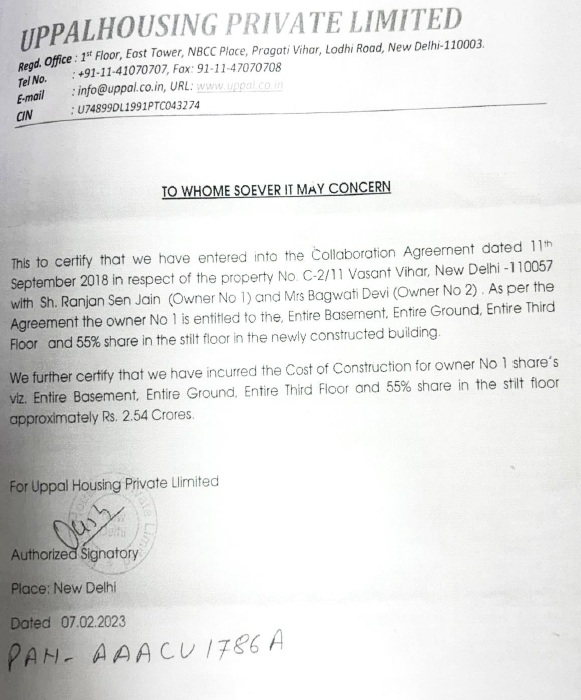
12. However, before ld. CIT(A) vide way of an application u/s 46A of the Income Tax Rules, 1962 assessee had filed copy of certificate dated 07.02.2023 issued by the builder M/s Uppal Housing Pvt. Ltd. regarding cost of construction and a copy of same is made available to us also on page No. 54-66 which is copy of application dated 17.06.2025 under Rule 46A and at page No. 67 the copy of certificate dated 07.02.2023 is provided and for conclusion we reproduce the certificate:
13. This evidence goes to the root of the issue to establish the cost of construction incurred by builder on the share of assesse in the residential building. However, ld. CIT(A) has not taken into consideration this vital evidence and in quite summary manner sustained the findings of AO.
14. Now, if this copy of certificate dated 07.02.2023 is taken into consideration the computation of long term capital gain, as per assesse, would be as follows:
|
|
|
Amount (Rs.) |
| A. Sale Consideration (cost of construction for covered area of 656.8235 sq. metre transferred to assesse as per Builder’s certificate dated 07.02.2023) |
|
2,54,00,000 |
|
| Add: Amount received from builder |
|
|
|
| Less: GST paid to builder |
75,00,000 |
|
|
| Net consideration from builder |
35,00,000 |
|
|
|
|
40,00,000 |
|
| Net Sales consideration |
|
|
2,94,00,000 |
| B. Cost of Acquisition as on 01.04.2001 Land share @ 71,100 per sq. yd. X 60 Sq. yd (As per valuation report dated 06.09.2022) |
|
42,66,000 |
|
| Cost of Super Structure (As per valuation report by B.P. Sind dated 02.08.2018- Accepted by AO) |
|
45,00,000 |
|
|
|
87,66,000 |
|
| Less: Indexed Cost of Land & Building as on 31.03.2020 Rs. 87,66,000 x 289/100 = 2,53,33,740 |
|
|
2,53,33,740 |
| C. LTCG |
40,66,260 |
| D. Exemption U/s 54 Cost of Construction (Builder certificate ( |
|
|
|
|
| All units as on 31.03.2020 Basement + Ground floor + Third Floor, Basis valuation report dated 02.09.2022 COC of all units amounts to Rs.3,25,54,862 |
|
|
2,54,00,000 |
| Net LTCG (C -D) |
|
|
NIL |
15. We find that assessing officer has made the computation accepting the cost of super structure of Rs.45,00,000/- as per valuation report given by Shri V.P. Singh dated 02.08.2018 but the cost of acquisition of the share of land of around 60 sq. yards, as taken in calculation by assesse or 50.70 sq. mtrs., as taken by AO, his calculation, is erroneously taken by Assessing Officer at Rs.13,860/- per sq. mtrs. on the basis of Government rates of the land in Vasant Vihar, because the Assessing Officer has accepted the plea of assesse that circle rate is fixed only in the year 2007. Still, the assessing officer has assumed fair market value of Rs.13,860/-, on the basis of government Rules.
16. We are of the considered view that though the more appropriate recourse was to call for a DVO report but here is the case where assesse had first placed on record in the evidence the valuation report prepared by one Mr. V.P. Singh dated 02.08.2018 copy of which is available at page No. 33-40 of the paper book and then another valuation report dated 6.9.22 prepared by Paramjeet Associates, copy of which is available at page 47-53 of PB, was filed by giving fresh computation and ld. Assessing officer has reproduced the computation in para 5.4.4. However, this later reports is altogether left out of consideration and instead has arbitrarily taken value of residential plots as on 31.03.2020 @ Rs. 11550, per sq. mtr., issued by Delhi Government in Vasant Vihar area and arrived at the figure of Rs. 13830 per sq mtr (11550 x 1.2).
17. Having rejected the valuation reports furnished by two Government-registered valuers without pointing out any specific infirmity or defect therein, and without making a reference to the DVO, the ld. Assessing Officer proceeded to substitute the same with an ad hoc estimation of his own. The co-ordinate bench at
Delhi in case of
Ved Kumari Subhash Chander v.
ITO [2019] (
Delhi –
Trib.)
ITA No. 2041/Del/2016 vide order dated 26.08.2019 held that a registered valuer’s report is valid evidence and the assessing officer cannot reject it without specifying reasons or reliable materials to the contrary. Further, it was also held that if the assessing officer fails to make a reference to the DVO, the FMV as determined by the assessee in accordance with the registered valuer’s report may be accepted.
“5.0 We have heard the rival submissions and have also perused the material available on record. It is the contention of the assessee that the lower authorities have erred in overriding the report of the registered valuer without supporting evidence and, therefore, the same is bad in law. It is also the contention of the assessee that the Assessing Officer should have referred the matter to the DO if he was not in agreement with the valuation as computed by the registered valuer and that in absence of any evidence on record, the report of the registered valuer should have been accepted with regard to fair market value as on 1.4.1981 for the purpose of computing the capital gains. It is seen that the Assessing Officer while rejecting the registered valuer’s estimate at Rs. 5800/- per sq mtr has noted that the average rate at which the sales deeds were being executed was Rs. 1160/- per sqmtr. However, it is our considered opinion that valuation done by the empanelled registered valuer of the Income Tax Department would certainly take precedence over a value which the Assessing Officer might adopt on his own without making a reference to the DVO. The fact of the matter remains that the Assessing Officer, during the course of assessment proceedings, did not make any reference to the DVO even though he chose not to accept the rate adopted by the registered valuer. Therefore, in our considered opinion, the Assessing Officer exceeded the powers entrusted to him in this regard by undertaking to compute the fair market value on his own without being supported by the expert knowledge of the DVO.
18. Thus, we are of the considered view that cost of acquisition of the land in regard to the land share deserves to be taken as per unrebutted last valuation report dated 06.09.2022, given by Sh Paramjeet Associates.
19. In the light of aforesaid we allow the corresponding grounds with regard to erroneous computation of long term capital gains by ld. AO. The appeal of the assesse is allowed with a direction to ld. AO to make the computation as reflected above in para 14 and further give assessee benefit of Section 54 of the Act, as determined above.