ORDER
Madhusudan Sawdia, Accountant Member.-This appeal is filed by Smt. Anuradha Chennu (“the assessee”), feeling aggrieved by the order passed by the Learned Commissioner of Income Tax (Appeals), National Faceless Appeal Centre (NFAC), Delhi (“Ld. CIT(A)”) dated 22.09.2025 for the A.Y.2013-14.
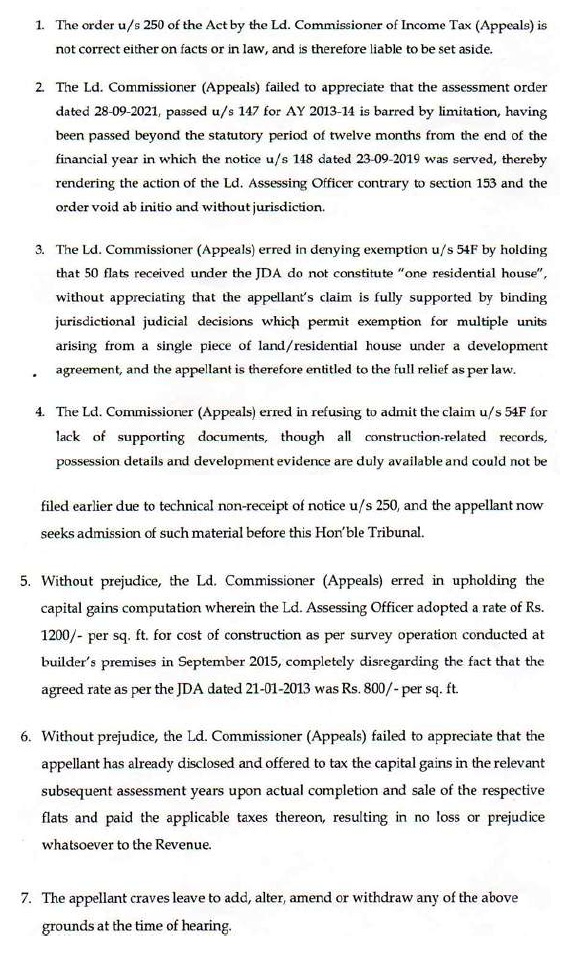
2. The assessee has raised the following grounds of appeal:
3. The assessee has raised the following additional grounds of appeal:
“1. On the facts and in the circumstances of the case, the learned NFAC, Delhi erred in assuming jurisdiction under section 151A r.w.s 144B of the Act by issuing show cause notice dated 21.09.2021, whereas the notification issued under section 151A is operative only w.e.f. 29.03.2022 rendering the assessment proceedings without authority of law and liable to be quashed”
2. In the absence of any notice/limitation as per provisions of clause iii to section 144B(1), the assumption of jurisdiction prior to 29.03.2022 by FAO is not proper and liable to be quashed”.
4. The Learned Authorized Representative (“Ld. AR”) submitted that additional grounds so filed are admissible in view of judgment rendered by the Hon’ble Supreme Court in the case of National Thermal Power Co. Ltd. v. CIT 229 ITR 383 (SC). The Learned Departmental Representative (“Ld. DR”) also did not make any objection for admission of the additional groundss. The prayer for admission of additional ground noted above which are not in memorandum of appeal are being admitted for adjudication in terms of Rule 11 of the Income Tax (Appellate Tribunal) Rules, 1963 owing to the fact that objection raised in additional grounds are legal in nature for which relevant facts are stated to be emanating from the existing records.
5. The brief facts of the case are that the assessee is an individual who had not filed any return of income under section 139 of the Income Tax Act, 1961 (“the Act”) for Assessment Year 2013-14. Pursuant to a survey operation conducted in the case of M/s Krishna Infra (“the developer”) on 10.09.2014, it came to the knowledge of the Revenue that the assessee had entered into a Joint Development Agreement (“JDA”) with the developer on 21.01.2013. As per the said JDA, total 165 flats with developed built-up area of 2,15,555 sq.ft. were to be constructed, out of which 50 flats having constructed area of 66,667 sq.ft. were to be allotted to the assessee against contribution of land. During the course of survey proceedings, the value of constructed area was estimated at Rs.1,200/- per sq.ft. On the basis of the said information, notice under section 148 of the Act was issued by the Learned Assessing Officer (“Ld. Ld. AO”) to the assessee on 23.09.2019. In response thereto, the assessee filed return of income on 12.10.2019 declaring total income at Rs.1,00,600/-along with agricultural income of Rs.1,40,900/-. Consequently, notice under section 143(2) of the Act was issued by the Ld. AO on 29.09.2020 to the assessee. After considering the submissions of the assessee, the Ld. AO held that transfer of land had taken place on the date of execution of the JDA itself within the meaning of section 2(47)(v) r.w.s. 53A of the Transfer of Property Act. Accordingly, the Ld. AO computed long-term capital gain in the hands of the assessee by adopting gross consideration at Rs.8,00,00,400/- by applying rate of Rs.1,200/- per sq.ft. on total developed built-up area of 66,667 sq.ft. receivable by the assessee and after allowing deduction towards cost of acquisition of land amounting to Rs.3,13,704/-. Accordingly, the long-term capital gain in the hands of the assessee was computed at Rs.7,96,86,696/-. Finally, the assessment under section 147 r.w.s. 144B of the Act was completed by the Ld. AO on 28.09.2021 assessing the total income of the assessee at Rs.7,97,87,296/- after making addition of Rs.7,96,86,696/- on account of long-term capital gain.
6. Aggrieved by the order of the Ld. AO, the assessee preferred appeal before the Ld. CIT(A). Before the Ld. CIT(A), for the first time, the assessee claimed deduction under section 54F of the Act in respect of 50 flats receivable under the JDA against the long-term capital gain computed by the Ld. AO. However, the Ld. CIT(A) rejected the claim of deduction under section 54F on two grounds. Firstly, the Ld. CIT(A) held that the assessee had not claimed deduction under section 54F before the Ld. AO through revised return and therefore such claim was not allowable. Secondly, the Ld. CIT(A) held that even if deduction under section 54F was allowable, the same could be restricted only to one residential flat and not all 50 flats. The Ld. CIT(A) further observed that the assessee had neither furnished relevant documentary evidence nor proved actual construction or acquisition of the flats. Accordingly, the Ld. CIT(A) sustained the addition made by the Ld. AO and dismissed the appeal of the assessee.
7. Aggrieved by the order of the Ld. CIT(A), the assessee is in appeal before this Tribunal. The assessee has raised an additional grounds challenging the validity of the said assessment on the ground that the notification issued by Central Board of Direct Taxes (“CBDT”) under section 151A of the Act, providing for faceless assessment/reassessment, came into effect only from 29.03.2022, and therefore, the FAO did not have jurisdiction to pass the assessment order prior to such date. The Ld. AR further submitted that in the present case, the assessment has been framed under section 147 read with section 144B of the Act by the FAO. It was contended that the jurisdiction to conduct reassessment proceedings in a faceless manner under section 147 of the Act was conferred only upon issuance of notification under section 151A of the Act, which came into effect from 29.03.2022. Since the impugned assessment order has been passed on 28.09.2021, it was argued that the FAO lacked jurisdiction to complete the reassessment. The Ld. AR submitted that in the absence of a validly notified scheme under section 151A of the Act as on the date of assessment, the proceedings are vitiated and liable to be quashed. Reliance was placed on the decision of the Kolkata Bench of the Tribunal in the case of Meenakshi Mittal Agrawal v. ITO [IT Appeal Nos. 111 and 112 (Kol) of 2026, dated 7-4-2026].
8. Per contra, the Ld. DR submitted that the jurisdiction of the FAO flows from section 144B of the Act, which was already in force at the relevant time and provides a complete mechanism for faceless assessment, including reassessment. The Ld. DR invited our attention section 144B(1)(iii)(a) of the Act and submitted that cases where return is furnished in response to notice issued under section 148 of the Act are specifically covered within the scope of faceless assessment. The Ld. DR further relied upon the judgment of the Hon’ble Telangana High Court in the case of Sri Venkataramana Reddy Patloola v. Dy. CIT 468 ITR 181 (Telangana)/(W.P No.13353, 16141 and 16877 of 2024) Dated 27.07.2024. The Ld. DR also relied on the decision of this Tribunal in the case of Gangaram Reddy Tekulapalli v. ITO [IT Appeal No. 786 & 787 (Hyd) of 2024, dated 10-9-2025] for the A.Y 2014-15, dated 10.09.2025 to contend that reassessment proceedings must follow the procedure under section 143 and, in faceless regime, such procedure is governed by section 144B of the Act. The relevant portion of the written submission of the Ld. DR is reproduced as under :
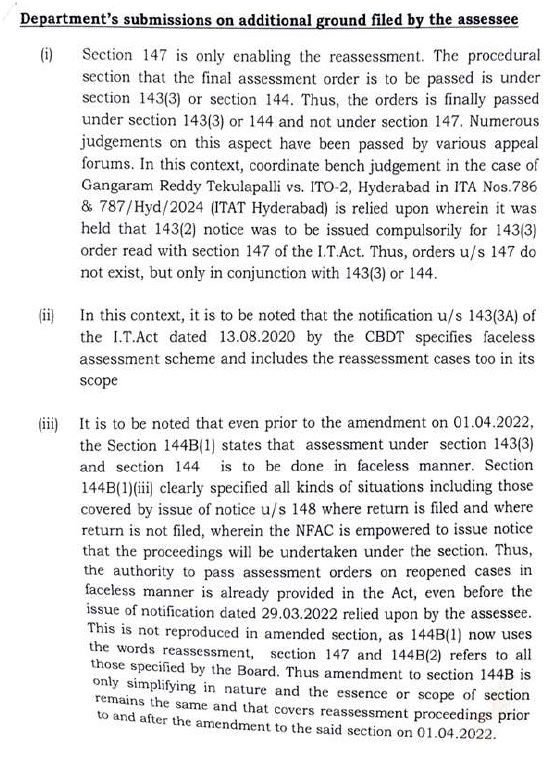
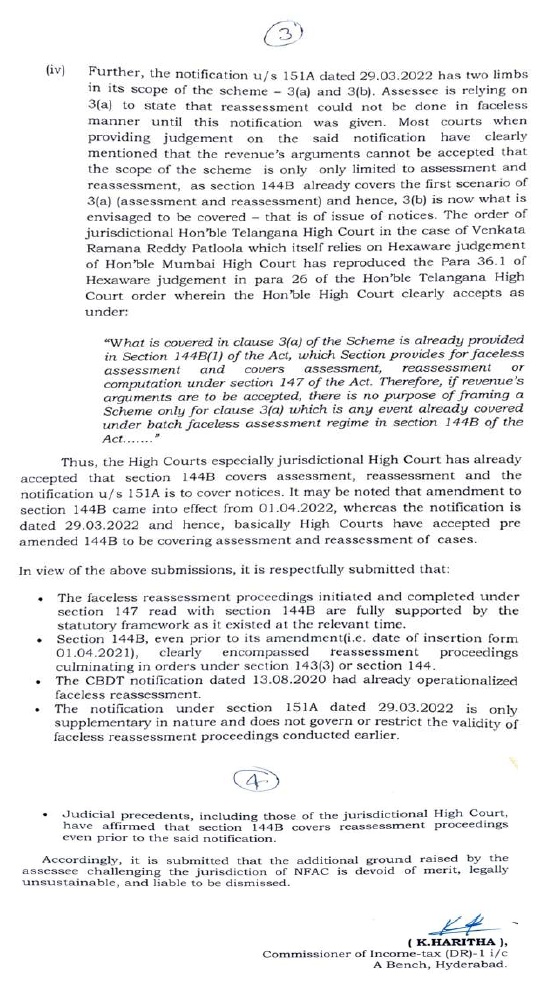
9. We have heard the rival submissions and perused the material available on record including the case laws relied upon. The core issue arising for our consideration out of the additional grounds raised by the assessee is whether the FAO had valid jurisdiction to complete reassessment under section 147 of the Act prior to issuance of Notification No.18/2022 dated 29.03.2022 issued by the CBDT under section 151A of the Act. It is the contention of the assessee that jurisdiction upon the FAO to conduct reassessment proceedings under section 147 arose only after issuance of notification dated 29.03.2022 under section 151A of the Act. According to the assessee, since the impugned reassessment order was passed on 28.09.2021, i.e., prior to issuance of the aforesaid notification, the FAO lacked inherent jurisdiction to pass the reassessment order and therefore the order is liable to be quashed as void ab initio. On the other hand, the Ld. DR has submitted that even prior to issuance of notification dated 29.03.2022 under section 151A, jurisdiction to complete reassessment proceedings in a faceless manner already stood conferred upon the FAO by virtue of section 144B of the Act itself. It was submitted that notification under section 151A was merely supplementary and enabling in nature and did not create jurisdiction for the first time. Before adjudicating the controversy, it would be apposite to examine the scheme of sections 151A and 144B of the Act. The provisions of section 151A of the Act is as under:
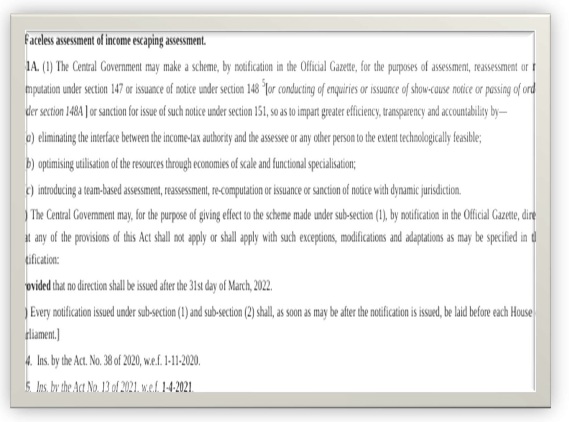
10. On perusal of section 151A, we find that the said provision is essentially an enabling provision empowering the Central Government to frame a scheme by way of notification for (i) assessment, reassessment or re-computation under section 147; (ii) issuance of notice under section 148; (iii) conducting enquiry or issuance of show cause notice under section 148A; (iv) passing order under section 148A; and (v) sanction for issuance of notice under section 151, in a faceless manner to the extent technologically feasible. In exercise of such enabling powers, CBDT issued Notification No.18/2022 dated 29.03.2022, which is to the following effect:
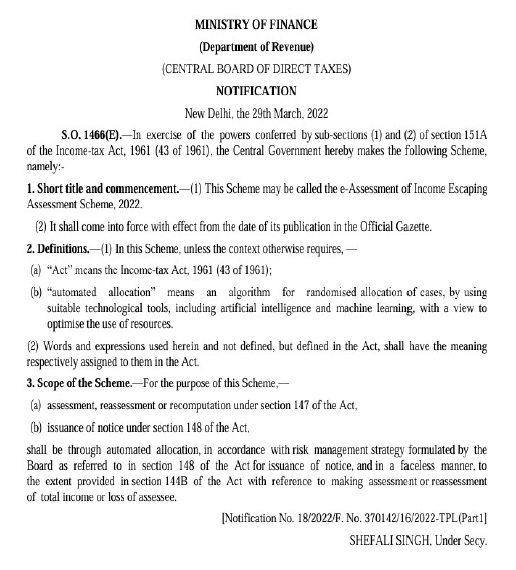
11. On perusal of clause 3(a) of the above notification, we find that assessment, reassessment or re-computation under section 147 of the Act was directed to be carried out in a faceless manner with effect from 29.03.2022. At first blush, the contention of the assessee appears attractive that jurisdiction for faceless reassessment became operational only from the date of said notification. However, on a deeper examination of the statutory scheme, we are unable to persuade ourselves to accept such proposition. In this regard, we have gone through provisions of section 144B (1) of the Act as it existed at the relevant point of time, which is to the following effect:
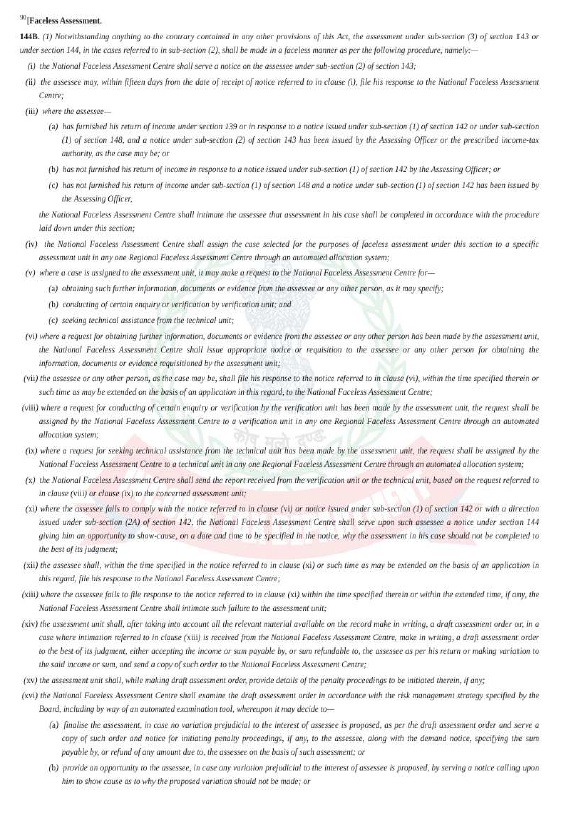
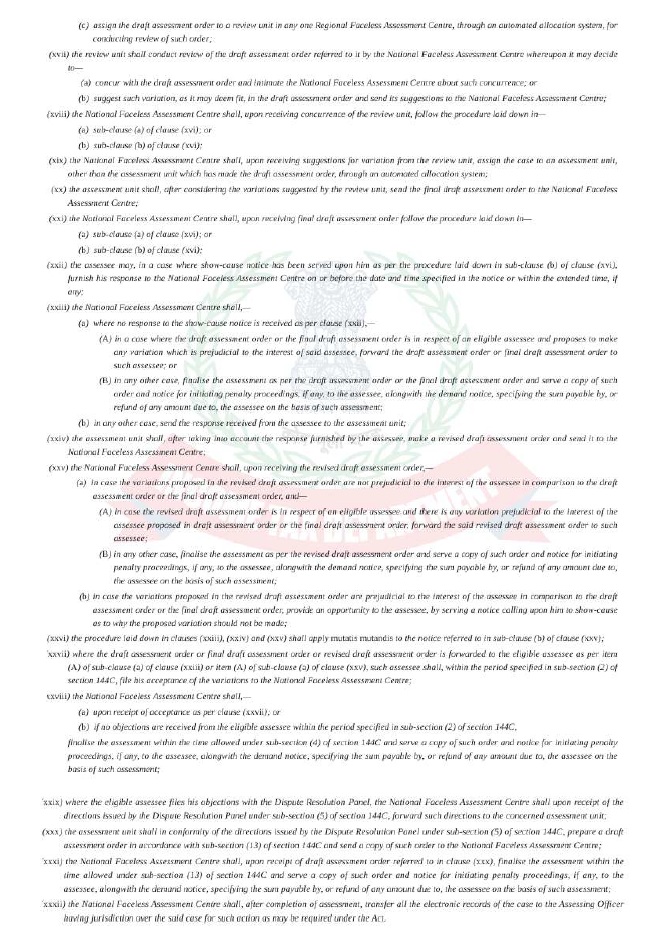
12. On careful reading of section 144B(1) as it existed at the relevant point of time, we find that the legislature had already provided a comprehensive statutory mechanism for faceless assessment. Section 144B(1)(
iii) specifically provided that in case where notice under section 148(1) has been issued, in those cases also, the assessment under section 143(3) or section 144 shall be completed in a faceless manner. We further observe that section 144B starts with a non obstante clause. The use of such non obstante clause clearly demonstrates legislative intention to give overriding effect to section 144B over other procedural provisions contained in the Act. Our this view is get fortified by para no. 41 of the decision of the Hon’ble Supreme Court in the case of
Union of India v.
Rajeev Bansal 469 ITR 46 (SC), which is to the following effect:
“41. A non-obstante clause must be given effect to the extent Parliament intended and not beyond
ICICI Bank Ltd. v.
SIDCO Leathers Ltd. [2006] 67 SCL 383 (SC)/[2006] 10 SCC 452.
In construing a provision containing a non obstante clause, courts must determine the purpose and object for which the provision was enacted SIDCO Leathers Ltd. (supra); Geeta v.
State of Utter Pradesh [2010] 13 SCC 678.
The courts are also required to find out the extent to which the legislature intended to give one provision overriding effect over another provision A G Varadarajulu v.
State of Tamil Nadu, [1998] 4 SCC 231. In case of a clear inconsistency between two enactments, a provision containing a non obstante clause can be given an overriding effect over a provision contained in another statute. “
(Emphasis supplied)
13. On perusal of the above, we find that the Hon’ble Supreme Court has categorically held that, where there exists inconsistency between statutory provisions, the provision containing a non obstante clause would ordinarily prevail and be given overriding effect. Therefore, once section 144B had already provided statutory mechanism for faceless assessment/reassessment, the same could not be nullified or postponed by subsequent notification issued under section 151A of the Act. We have also gone through para no. 26 of the judgment of the Hon’ble Telangana High Court in the case of Venkataramana Reddy Patlola v. DCIT in W.P. Nos.13353, 16141 & 16877 of 2024 dated 24.07.2024, which is to the following effect:
“26. The Bombay High Court in Hexaware Technologies Ltd. (supra) held as under:
“36.1 Section 151A of the Act itself contemplates formulation of Scheme for both assessment, reassessment or re-computation under Section 147 as well as for issuance of notice under Section 148 of the Act. Therefore, the Scheme framed by the Central Board of Direct Taxes, which covers both the aforesaid aspect of the provisions of Section 151A of the Act cannot be said to be applicable only for one aspect, i.e., proceedings post the issue of notice under Section 148 of the Act being assessment, reassessment or recomputation under Section 147 of the Act and inapplicable to the issuance of notice under Section 148 of the Act. The Scheme is clearly applicable for issuance of notice under Section 148 of the Act and accordingly, it is only the FAO which can issue the notice under Section 148 of the Act and not the JAO. The argument advanced by respondent would render clause 3(b) of the Scheme otiose and to be ignored or contravened, as according to respondent, even though the Scheme specifically provides for issuance of notice under Section 148 of the Act in a faceless manner, no notice is required to be issued under Section 148 of the Act in a faceless manner. In such a situation, not only clause 3(b) but also the first two lines below clause 3(b) would be otiose, as it deals with the aspect of issuance of notice under Section 148 of the Act. Respondents, being an authority subordinate to the CBDT, cannot argue that the Scheme framed by the CBDT, and which has been laid before both House of Parliament is partly otiose and inapplicable. The argument advanced by respondent expressly makes clause 3(b) otiose and impliedly makes the whole Scheme otiose. If clause 3(b) of the Scheme is not applicable, then only clause 3(a) of the Scheme remains. What is covered in clause 3(a) of the Scheme is already provided in Section 144B(1) of the Act, which Section provides for faceless assessment, and covers assessment, reassessment or recomputation under Section 147 of the Act. Therefore, if Revenue’s arguments are to be accepted, there is no purpose of framing a Scheme only for clause 3(a) which is in any event already covered under faceless assessment regime in Section 144B of the Act. The argument of respondent, therefore, renders the whole Scheme redundant. An argument which renders the whole Scheme otiose cannot be accepted as correct interpretation of the Scheme. The phrase “to the extent provided in Section 144B of the Act” in the Scheme is with reference to only making assessment or reassessment or total income or loss of assessee. Therefore, for the purposes of making assessment or reassessment, the provisions of Section 144B of the Act would be applicable as no such manner for reassessment is separately provided in the Scheme. For issuing notice, the term “to the extent provided in Section 144B of the Act” is not relevant. The Scheme provides that the notice under Section 148 of the Act, shall be issued through automated allocation, in accordance with risk management strategy formulated by the Board as referred to in Section 148 of the Act and in a faceless manner. Therefore, “to the extent provided in Section 144B of the Act” does not go with issuance of notice and is applicable only with reference to assessment or reassessment. The phrase “to the extent provided in Section 144B of the Act” would mean that the restriction provided in Section 144B of the Act, such as keeping the International Tax Jurisdiction or Central Circle Jurisdiction out of the ambit of Section 144B of the Act would also apply under the Scheme. Further the exceptions provided in sub-section (7) and (8) of Section 144B of the Act would also be applicable to the Scheme.”
(Emphasis supplied)
14. On a perusal of the above, we find that the Hon’ble Telangana High Court has reproduced and relied upon para no. 36 of the judgment of the Hon’ble Bombay High Court in the case of
Hexaware Technologies Ltd. v.
Asstt. CIT [2024] 464 ITR 430 (Bombay). On perusal of the same, we find that the Hon’ble Bombay High Court has clearly observed that what is covered under clause 3(
a) of Notification dated 29.03.2022 was already substantially embedded within section 144B(1) itself, which provided for faceless assessment and reassessment including proceedings under section 147 of the Act. Thus, the aforesaid observations of the Hon’ble High Courts fortify the view that jurisdiction for faceless reassessment was not created for the first time by Notification dated 29.03.2022, but such notification merely operationalized and streamlined the broader faceless reassessment framework already traceable to section 144B of the Act. We have also gone through para nos. 4 to 7 of the decision of the Kolkata Bench of the Tribunal in the case of
Meenakshi Mittal Agrawal(supra) for Assessment Years 201415 and 2015-16 dated 07.04.2026 relied upon by the assessee, which is to the following effect:
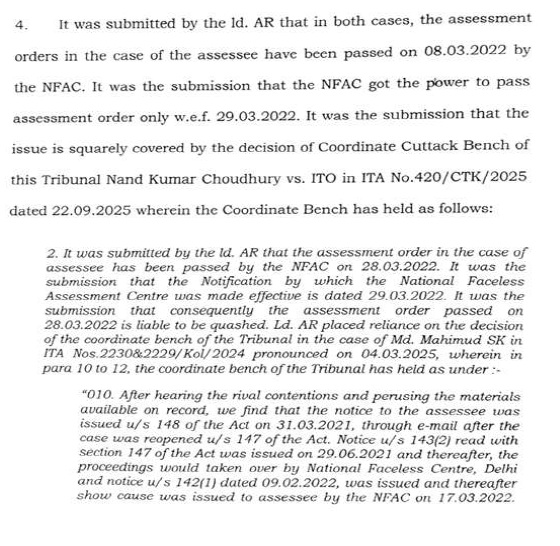
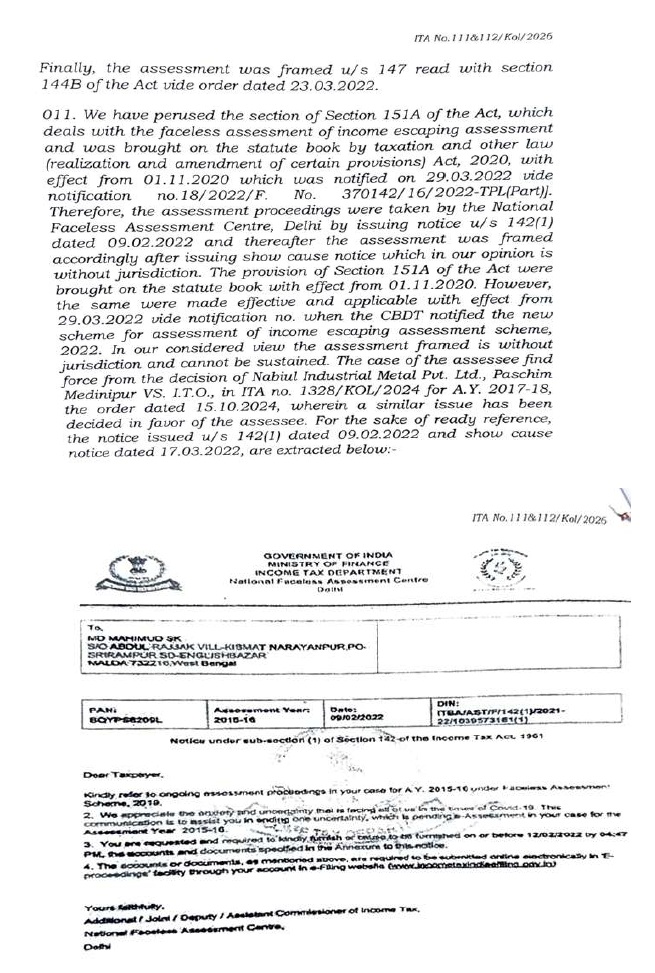
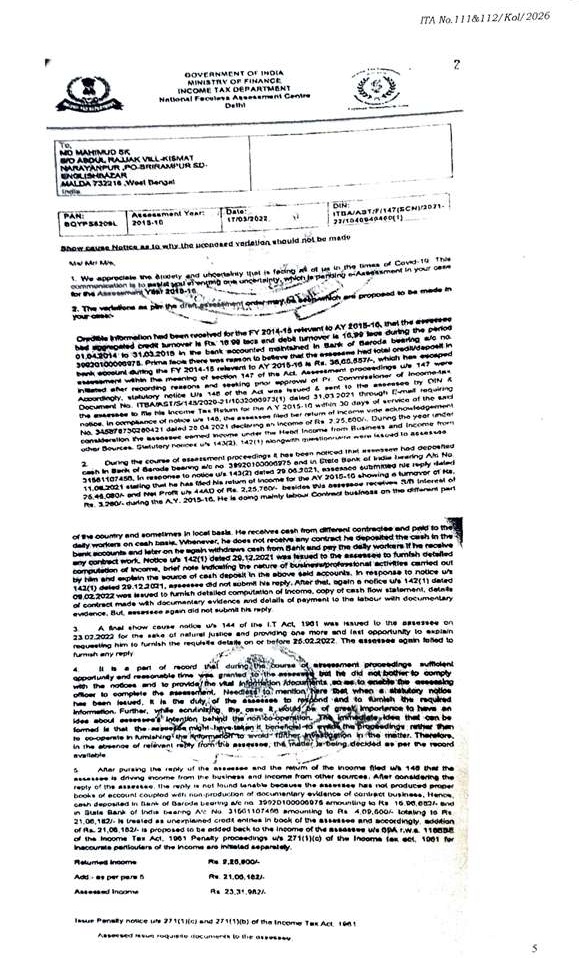
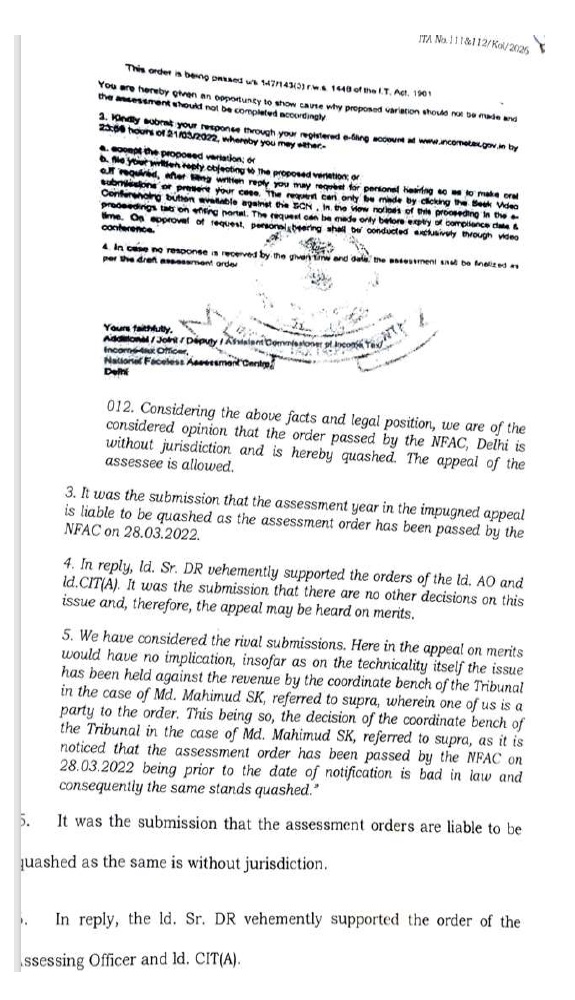
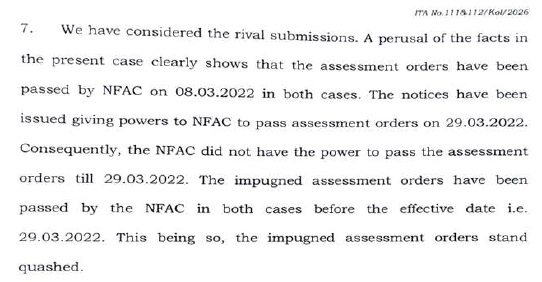
15. On perusal of the above, we find that the coordinate bench proceeded on a different interpretative premise while construing the interplay between section 151A and section 144B of the Act. We further find that the coordinate bench did not examine in detail the overriding effect of section 144B containing the non obstante clause nor the legal consequence flowing therefrom. Further, the decision of the coordinate bench does not appear to have considered the binding principles laid down by the Hon’ble Supreme Court in the case of Union of India v. Rajeev Bansal (supra) nor the observations made by the Hon’ble Bombay High Court in the case of Hexaware Technologies Ltd. (supra) as reproduced and relied upon by the Hon’ble Telangana High Court in the case of Venkataramana Reddy Patlola v. DCIT (supra). In our considered opinion, once section 144B of the Act had already statutorily provided the mechanism for faceless assessment/reassessment and such provision carried overriding effect, the subsequent notification issued under section 151A of the Act could not be interpreted in a manner so as to divest or postpone jurisdiction already vested under section 144B of the Act. Therefore, with utmost respect to the
view taken by the coordinate bench, we are unable to persuade ourselves to subscribe to the same, particularly in view of the statutory scheme discussed hereinabove and the binding judicial precedents of the Hon’ble High Courts and Hon’ble Supreme Court.
16. Accordingly, considering the statutory framework, the overriding effect of section 144B of the Act, the scheme of reassessment provisions and the judicial precedents discussed hereinabove, we are of the considered opinion that the FAO possessed valid jurisdiction to pass reassessment order under section 147 of the Act even prior to issuance of Notification dated 29.03.2022 under section 151A of the Act. Therefore, the reassessment order dated 28.09.2021 cannot be said to be without jurisdiction merely on the ground that notification under section 151A of the Act was issued subsequently. Accordingly, the legal ground raised by the assessee stands dismissed.
17. Without prejudiced to our aforesaid findings, we also find that reassessment proceedings under section 147 of the Act ultimately culminate into an assessment order passed either under section 143(3) r.w.s. 147 or under section 144 r.w.s. 147 of the Act. Thus, though jurisdiction for reopening is assumed under sections 147 to 151 of the Act, the actual machinery for framing reassessment continues to be governed by sections 143 and 144 of the Act. Our this view is fortified from the well settled principle through various judicial pronouncements that once a return of income is filed in response to notice issued under section 148 of the Act, issuance of notice under section 143(2) of the Act becomes mandatory before framing reassessment under section 147 of the Act. This settled legal principle itself demonstrates that reassessment proceedings under section 147 of the Act are procedurally governed by section 143 machinery provisions. Therefore, reassessment proceedings cannot be viewed in isolation from the procedural mandate contained under sections 143 and 144B of the Act. Our this view is supported by para nos. 17 to 22 of the decision of this Tribunal in the case of Gangaram Reddy Tekulapalli(supra), for A.Y 2014-15, dated 10.09.2025, which is to the following effect:
“17. We shall now deal with the second facet of the controversy involved in the present appeal, i.e. as to whether or not the assessment framed by the A.O. vide his order passed 143(3) r.w.s. 147 of the Act, dated 31.12.2019, in the absence of a notice u/s. 143(2) of the Act having been issued by him is sustainable in the eyes of law?
18. Apropos the validity of the assessment framed by the A.O. vide his order passed u/s 143(3) r.w.s. 147 of the Act, dated 31.12.2019, wherein he despite taking cognizance of the “return of income” filed by the assessee on 11.12.2019 in response to the notice issued under Section 148 of the Act, dated 27.03.2019 (which has been held by us hereinabove to be a valid return of income), had by treating the said “return of income” as invalid, dispensed with the statutory requirement of issuing a notice u/s 143(2) of the Act and framed the assessment vide his order passed u/s 143(3) r.w.s. 147 of the Act, dated 31.12.2019, we find that the said issue is covered by the judgments of the Hon’ble Supreme Court in the cases of ACIT and Anr. v. Hotel Blue Moon
(2010) 321 ITR 362 (SC)
and CIT v.
Laxman Das Khandelwal (2019) 417 ITR 325 (SC) and is no ITA.Nos.786 & 787/Hyd./2024 more res integra. The Hon’ble Apex Court in its aforesaid judicial pronouncements, has held, that the A.O. pursuant to the return of income filed by the assessee remains under the statutory obligation to issue notice u/s 143(2) of the Act for framing the assessment.
19. Our aforesaid view is further fortified by the judgment of the Hon’ble High Court of Delhi in the case of
Pr. CIT v.
Shri Jai Shiv Shankar Traders (P) Ltd. (2016) 3783 ITR 488 (Del). The Hon’ble High Court had held that the absence of notice u/s.143(2) of the Act impregnates the proceeding with a jurisdictional defect, and hence, renders it as invalid in the eyes of law. The aforesaid view had thereafter been reiterated by the Hon’ble High Court in the case of
Pr. CIT v.
Dart Infrabuild (P) Ltd. , (Del). Also, the Hon’ble High Court of Allahabad in the case of
CIT v.
Salarpur Cold Storage (P) Ltd. (Allahabad) had after relying upon the judgment of the Hon’ble Apex Court in the case of CIT v. Hotel Blue Moon (
supra), held that the requirement of issuance of notice u/s.143(2) of the Act was mandatory and cannot be brought within the meaning of a procedural irregularity. The Hon’ble High Court of Madras in the case of
Sapthagiri Finance & Investments v.
ITO, (Mad), has held that where the A.O found that there was a problem in the “return of income” filed by the assessee u/s.148 of the Act, which required an explanation, then he ought to have followed up by a notice u/s.143(2) of the Act. The Hon’ble High Court of Delhi in the case of
Pr. CIT v.
S.G Portfolio (P) Ltd. (2023) 454 ITR 761 (Del.) has, inter alia, held that where the assessee has filed a “return of income” in response to notice u/s. 148 of the Act, the A.O. was required to issue notice u/s.143(2) of the Act for framing the assessment. We ITA. Nos. 786 & 787/Hyd./2024 further find that Hon’ble High Court of Madras in the case of
Amec Foster Wheeler Iberia SLU-India Project Office v.
DCIT, (Mad), has held that where the A.O did not issue notice u/s.143(2) of the Act upon the assessee, then the initiation of reassessment proceedings; order rejecting the assessee’s objection against the assumption of jurisdiction for reopening and also the reference to the TPO were to be quashed.
20. Apropos the Ld. DR’s claim that as the assessee in the course of the proceedings before the A.O had not objected to the assumption of the jurisdiction by him, and on the contrary participated in the assessment proceedings, therefore, the non- issuance of the notice u/s 143(2) of the Act will be saved by the provisions of Section 292BB of the Act, we are unable to concur with the same. We say so, for the reason that the deeming provisions of the said statutory provision only cure the infirmities in the manner of service of notice and is not intended to cure the complete absence of notice itself. Our aforesaid view is supported by the judgment of the Hon’ble Supreme Court in the case of
CIT v.
Laxman Das Khandelwal (2019) 417 ITR 325 (SC). The Hon’ble Apex Court relying on its earlier order in the case of ACIT v. Hotel Blue Moon (
supra), has held that the failure to issue a notice under Section 143(2) renders the assessment order void even if the assessee had participated in the proceedings.
21. We thus, based on our aforesaid deliberations conclude as under:
(a) . the “return of income” filed by the assessee on 11.12.2019 in response to the notice issued by the A.O. under Section 148 of the Act, dated 27.03.2019, having been filed during the pendency of the assessment proceedings which had culminated ITA.Nos.786 & 787/Hyd./2024 vide the order of assessment passed u/s 143(3) r.w.s. 147 of the Act, dated 31.12.2019, is a valid “return of income” though involving a delay.
(b) . the A.O by treating the “return of income” filed by the assessee on 11.12.2019 in response to notice u/s 148, dated 27.03.2019 as invalid and non-est, had wrongly assumed jurisdiction by dispensing with the statutory obligation cast upon him to issue notice u/s 143(2) of the Act, and wrongly framed the impugned assessment vide his order passed u/s 143(3) r.w.s.147 of the Act, dated 31.12.2019.; AND
(c) . that as the deeming provisions of Section 292BB of the Act only cure the infirmities in the manner of service of notice and is not intended to cure the complete absence of notice itself, therefore, the non-issuance of notice u/s 143(2) of the Act, based on the “return of income” filed by the assessee on 11.12.2019 in response to the notice issued under Section 148 of the Act, dated 27.03.2019 will not be saved by the deeming provisions of the said statutory provision.
22. Accordingly, we are of the view that as the A.O in the present case before us, had erroneously held the “return of income” filed by the assessee on 11.12.2019 i.e in response to the notice u/s 148 of the Act, dated 27.03.2019 as invalid and non-est, and thereafter had on the said wrong premises dispensed with the statutory requirement of issuing the notice u/s 143(2) of the Act, and framed the impugned assessment vide his order passed under Section 143(3) r.w.s. 147 of the Act, dated 31.12.2019, therefore, the assessment order so passed by him cannot be sustained and is liable to be quashed for want of valid assumption of jurisdiction.”
18. On perusal of the above, we find that the Coordinate Bench of the Tribunal has set aside the order passed under section 143(3) r.w.s. 147 of the Act in the absence of issue of any notice under section 143(2) of the Act. Therefore, in our considered view, section 151A of the Act merely empowers framing of a comprehensive faceless reassessment scheme including issuance of notice under section 148, conducting enquiries under section 148A and grant of sanction under section 151 of the Act. The said provision does not curtail or dilute the jurisdiction already available under section 144B of the Act for completing reassessment proceedings in a faceless manner. In other words, section 144B of the Act operates in the field of “assessment procedure”, whereas section 151A of the Act operates in the field of “faceless reassessment scheme administration”. Both provisions operate in distinct though overlapping spheres. We observer that notification dated 29.03.2022 cannot be construed as the source of original jurisdiction for faceless reassessment. If the interpretation canvassed by the assessee is accepted, it would lead to the anomalous consequence that despite existence of section 144B of the Act on the statute book, all faceless reassessment proceedings conducted prior to 29.03.2022 would become jurisdictionally invalid, which does not appear to be the legislative intent. Accordingly, on this count also, the additional grounds raised by the assessee are liable to be dismissed.
19. Now coming to the merits of the case, the Ld. AR submitted that the Ld. CIT(A) erred in rejecting the claim under section 54F of the Act merely on the ground that the same was not claimed before the Ld. AO through revised return. Inviting our attention to the decision of the Hon’ble Supreme Court in the case of Goetze (India) Ltd. v. CIT 284 ITR 323 (SC), the Ld. AR submitted that though the Hon’ble Supreme Court restricted the power of the Assessing Officer in entertaining fresh claim otherwise than through revised return, the Hon’ble Supreme Court itself categorically clarified that the said restriction does not apply to appellate authorities. The Ld. AR further relied upon the decision of the Hon’ble Supreme Court in the case of Jute Corpn. of India Ltd. v. CIT [1991] 187 ITR 688 (SC) and submitted that appellate authorities have wide powers to entertain additional claims and grounds so as to correctly determine the tax liability of the assessee. Accordingly, it was submitted that rejection of claim under section 54F of the Act by the Ld. CIT(A) solely on the ground that no revised return was filed is contrary to settled law laid down by the Hon’ble Apex Court.
20. Further, with regard to the finding of the Ld. CIT(A) that deduction under section 54F of the Act can be allowed only in respect of one flat and not all 50 flats, the Ld. AR submitted that the present case pertains to Assessment Year 2013-14 and therefore provisions of section 54F of the Act as they existed prior to amendment made by Finance Act, 2014 are applicable. It was submitted that prior to amendment by Finance Act, 2014 with effect from 01.04.2015, the expression used in the statute was “a residential house”, whereas by way of amendment, the expression was substituted by the words “one residential house in India”. The Ld. AR further submitted that the amendment brought by Finance Act, 2014 is prospective in nature and not applicable to Assessment Year 2013-14. It was also submitted that prior to amendment, the expression “a residential house” had consistently been interpreted by various Courts and Tribunals to include multiple residential units received under a development agreement. The Ld. AR further submitted that the very same JDA on the basis of which the Revenue Authorities computed capital gains in the hands of the assessee clearly demonstrates that 50 flats admeasuring 66,667 sq.ft. were receivable by the assessee. Therefore, once the Revenue Authorities accepted the JDA for the purpose of taxing capital gains, they cannot simultaneously reject the same JDA for the purpose of allowing deduction under section 54F of the Act. In support of the said contention, the Ld. AR relied upon the judgment of the Hon’ble Madras High Court in the case of CIT v. Smt. V.R. Karpagam [2015] 373 ITR 127 (Madras) and specifically invited our attention to para nos.8 to 13 of the said judgment wherein the Hon’ble High Court held that where multiple residential units are received by an assessee under a JDA, deduction under section 54F of the Act cannot be denied in respect of all such units for the assessment years prior to amendment by Finance Act, 2014. Accordingly, the Ld. AR prayed that the Ld. AO may be directed to allow deduction under section 54F of the Act in respect of entire value of 50 flats receivable by the assessee under the JDA against the longterm capital gain assessed in the hands of the assessee.
21. Per contra, the Ld. DR relied upon the order of the Ld. CIT(A) and submitted that no deduction under section 54F of the Act can be allowed in the absence of documentary evidence regarding actual construction or acquisition of flats. It was further submitted that the assessee failed to furnish evidence establishing completion or possession of residential units. The Ld. DR alternatively submitted that even if deduction under section 54F of the Act is held to be allowable, the same should be restricted only to one residential flat and not all 50 flats.
22. We have heard the rival submissions and perused the material available on record including the case laws relied upon. We have also gone through the para no.5 of the order of the Ld. AO which is to the following effect:
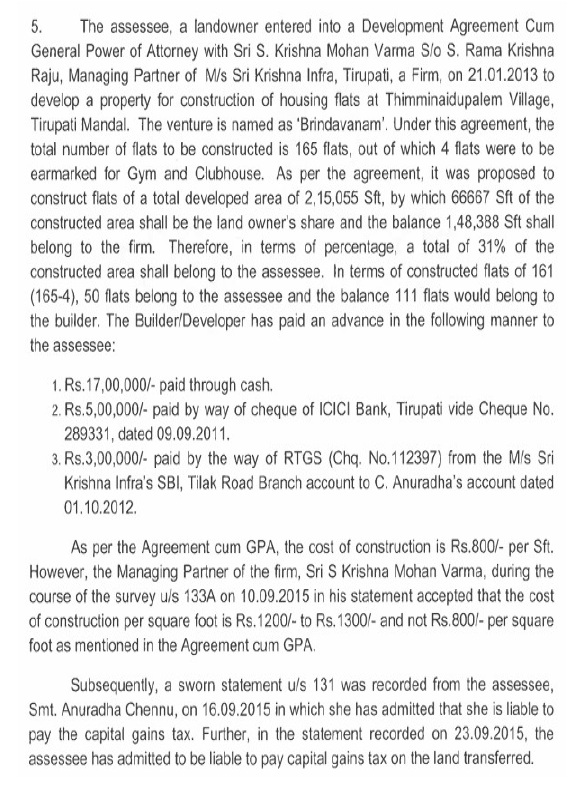
23. On perusal of the above, we find that the Ld. AO has categorically recorded the fact that the assessee has entered into JDA with the Developer on 21.01.2013 and the assessee was entitled to receive 50 residential flats admeasuring 66,667 sq.ft. against transfer of land contributed under the JDA. At the outset, as regards the finding of the Ld. CIT(A) that deduction under section 54F of the Act cannot be entertained for the first time before the appellate authority in the absence of revised return, we are unable to agree with the said finding. We found that the Hon’ble Apex Court in the case of Goetze (India) Ltd. (supra) itself has categorically clarified that the restriction imposed therein applies only to the powers of the Assessing Officer and not to appellate authorities. Further, the Hon’ble Supreme Court in the case of Jute Corporation of India Ltd. v. CIT (supra) has categorically held that appellate authorities have wide powers to entertain additional grounds and fresh claims in order to correctly determine the tax liability of the assessee. Therefore, in our considered opinion, the Ld. CIT(A) was not justified in rejecting the claim under section 54F of the Act merely on the ground that the same was not made before the Ld. AO through revised return.
24. The second objection of the Revenue is that no deduction under section 54F of the Act can be allowed to the assessee against the flats to be received on account of JDA and even if it is allowed, it can be allowed only in respect of one flat. In this regard, we find that the present case pertains to Assessment Year 2013-14 i.e., prior to amendment made by Finance Act, 2014 with effect from 01.04.2015. Prior to amendment, the expression used in section 54F of the Act was “a residential house”. The amendment substituting the said expression by “one residential house in India” is prospective in nature and therefore not applicable to the year under consideration. We have also gone through para nos.8 to 13 of the judgment of the Hon’ble Madras High Court in the case of V.R. Karpagam (supra), which is to the following effect:
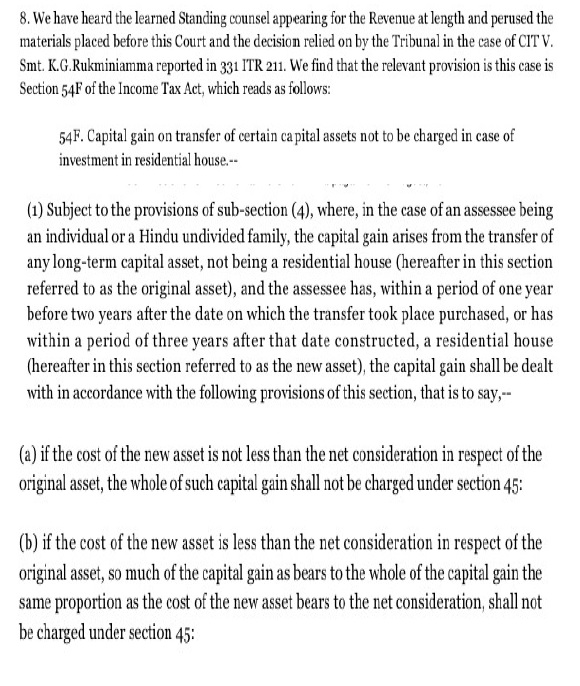
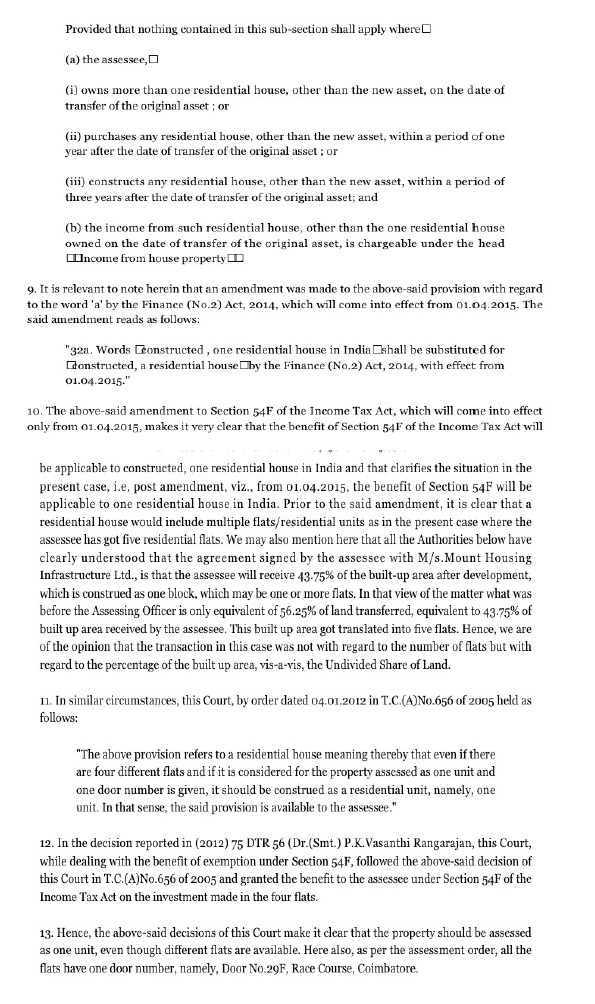
25. On perusal of the above, we found that the Hon’ble High Court has categorically held that where more than one residential unit has been received by the assessee pursuant to a development agreement, deduction under section 54F of the Act cannot be denied in respect of all such residential units for assessment years governed by pre-amended provisions. In the present case, the Revenue Authorities themselves have computed long-term capital gain in the hands of the assessee by adopting the value of 50 flats receivable under the JDA. Therefore, once the Revenue has accepted the JDA and quantified capital gains on the basis of the very same entitlement of flats receivable by the assessee, the Revenue cannot selectively disregard the same JDA while considering claim under section 54F of the Act. We further find merit in the contention of the Ld. AR that the JDA itself constitutes relevant documentary evidence establishing entitlement of the assessee to receive 50 residential flats from the developer. In our considered opinion, once the capital gains have been brought to tax on accrual basis by treating transfer under section 2(47)(v) of the Act as complete on execution of JDA, the corresponding exemption under section 54F of the Act arising from acquisition of residential units under the same JDA cannot be denied on hyper technical grounds. Accordingly, respectfully following the judgment of the Hon’ble Madras High Court in the case of CIT v. V.R. Karpagam (supra), we direct the Ld. AO to allow deduction under section 54F of the Act in respect of entire value of all 50 flats receivable by the assessee under the JDA against the long-term capital gain assessed in the hands of the assessee.
26. In addition to our aforesaid observations and findings, we further observe that the issue arising before us on merits has two distinct limbs for adjudication. The first limb relates to whether the assessee is eligible for deduction under section 54F of the Act in respect of investment made in more than one residential flat prior to the amendment brought in by the Finance Act, 2014 with effect from 01.04.2015. The second limb relates to whether the assessee is entitled to deduction under section 54F of the Act in respect of residential flats which are to be received by the assessee in future in terms of the JDA. As regards the first limb of the issue, we find that the same is squarely covered by para nos. 10 and 11 of the decision of this Tribunal in the case of Mekala Sharath Reddy (HUF) v. Dy. CIT (Hyderabad – Trib.)/ITA No.1799/ Hyd/2025, for the A.Y 2009-10 dated 15.03.2026, which is to the following effect:
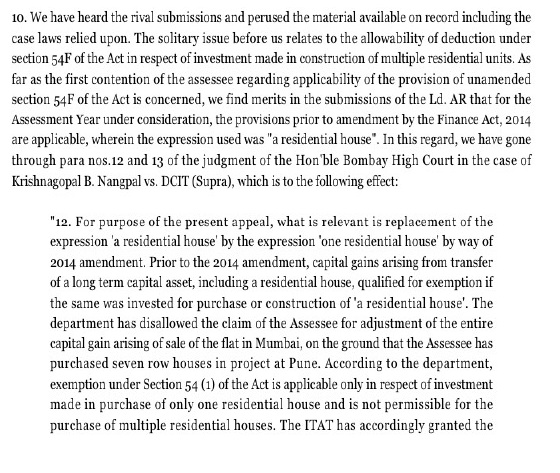
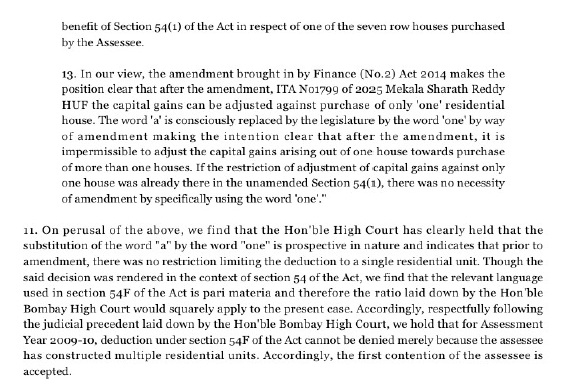
27. On perusal of the above, we find that the Coordinate Bench of the Tribunal, following the judgment of the Hon’ble Bombay High Court, held that prior to the amendment made by the Finance Act, 2014 with effect from 01.04.2015, deduction under section 54F of the Act could not be denied merely on the ground that the investment was made in multiple residential units/flats. Accordingly, in terms of the said decision, the assessee is eligible for deduction under section 54F of the Act in respect of investment made in more than one residential flat for the year under consideration. Now coming to the second limb of the issue relating to eligibility of deduction under section 54F of the Act in respect of flats which are to be received by the assessee in future pursuant to the JDA, we find that the issue is covered by para nos. 13 to 16 of the decision of this Tribunal in the case of Gyana Kumari Rojanala v. ITO [IT Appeal No. 1054 (Hyd) of 2025, dated 15-10-2025], which is to the following effect:
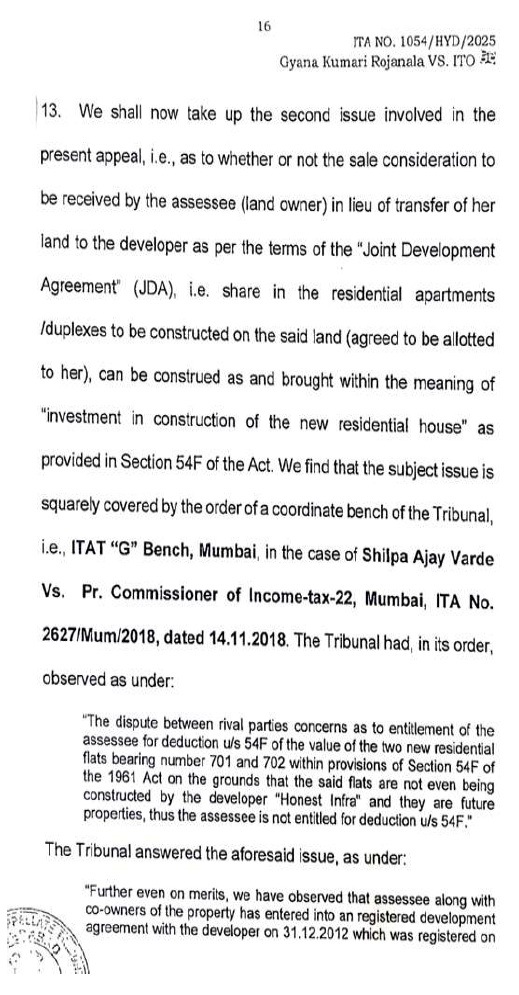
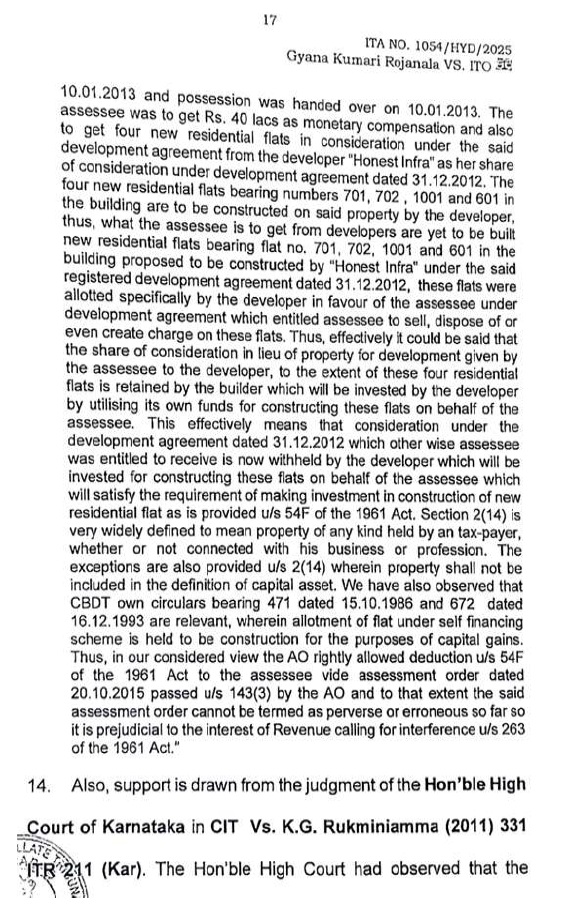
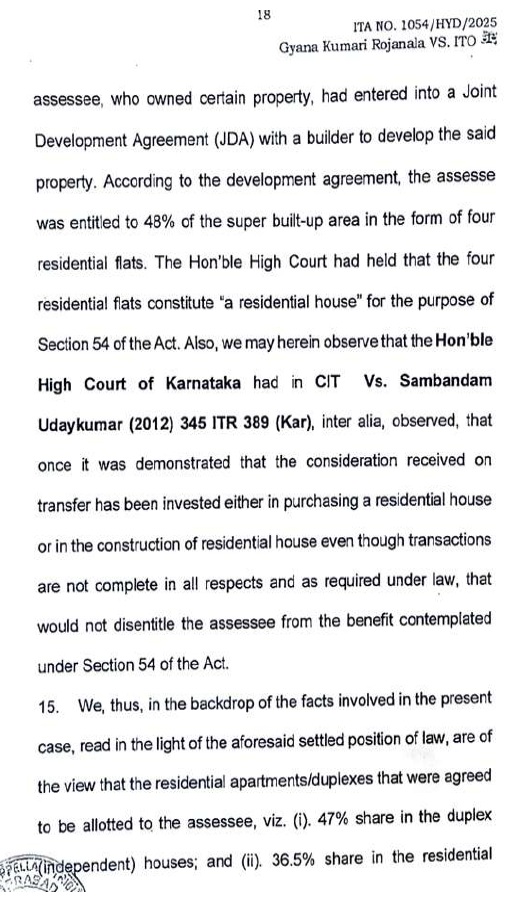
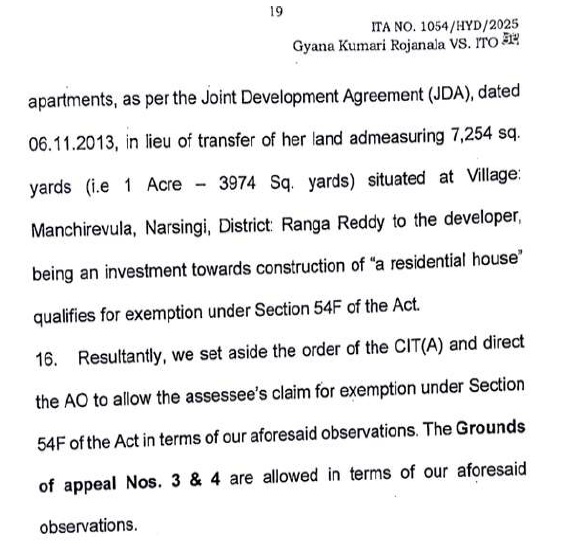
28. On perusal of the above, we find that the Coordinate Bench of the Tribunal has categorically held that the residential apartments agreed to be allotted to the assessee under the terms of the JDA would qualify for exemption under section 54F of the Act. Accordingly, in terms of the aforesaid decision, the assessee is entitled to deduction under section 54F of the Act in respect of the residential flats/apartments agreed to be received by the assessee under the JDA.
29. Accordingly, on the basis of our above findings, the grounds of the assessee on merits are allowed. Therefore, we direct the Ld. AO to allow deduction under section 54F of the Act in respect of entire value of all 50 flats receivable by the assessee under the JDA against the long-term capital gain assessed in the hands of the assessee.
30. In the result, the appeal of the assessee is allowed.