ORDER
Partha Sarathi Chaudhury, Judicial Member.- The present appeal preferred by the assessee emanates from the order of the Ld.CIT(Appeals)/NFAC, Delhi dated 29.07.2022 for the assessment year 2014-15 as per the grounds of appeal on record.
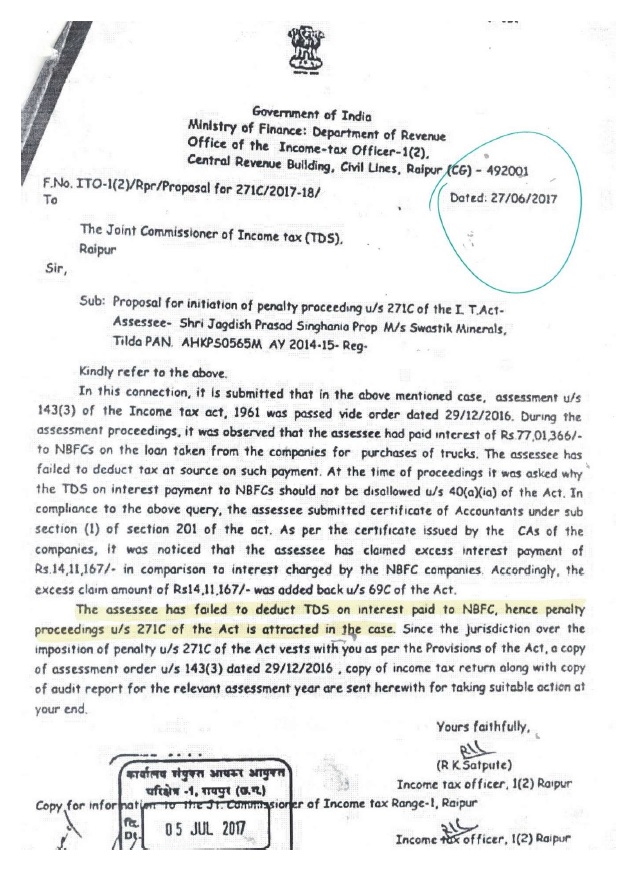
2. The contention in law assailed by the Ld. Counsel for the assessee is that penalty initiated u/s. 271C of the Income Tax Act, 1961 (for short ‘the Act’) is dated 27.06.2017 on the basis of the letter issued by the A.O to the Joint Commissioner of Income Tax (TDS), Raipur and the same is extracted as follows:
3. Further, it is contended by the Ld. Counsel for the assessee that the said imposition of penalty is barred by limitation as per Section 275(1)(c) of the Act. For the sake of completeness, Section 275(1)(c) of the Act is extracted as follows:
“275. (1) No order imposing a penalty under this chapter shall be passed___ xxxxx
(c) in any other case, after the expiry of the financial year in which the proceedings, in the course of which action for the imposition of penalty has been initiated are completed, or six months from the end of the month in which action for imposition of penalty is initiated, whichever period expires later.]”
4. It is evident from the penalty order that the said penalty u/s. 271C of the Act was imposed on 30th June, 2019 but as per the provisions of Section 275(1)(c) of the Act, time ends on 31.12.2017. Therefore, imposition of penalty through penalty order dated 30th June, 2019 is time barred and violative of Section 275(1)(c) of the Act.
5. The issue is no more “Res-Integra” for the fact that interpretation of the fiscal statutes has to be adhered to in its strictest form and there cannot be liberty provided to either of the parties for interpreting the provisions as per their own sweet will. The aforesaid provisions is clear that no order of imposition of penalty could be passed after expiry of six months from the end of the month, in which, action for imposition of penalty is initiated and in that manner, time ends on 31.12.2017 whereas, penalty has been imposed dated 30th June, 2019. This issue is squarely covered by the decision of the Hon’ble High Court of Delhi in the case of Pr. CIT v. JKD Capital & Finlease Ltd. [2015] 378 ITR 614 (Delhi), wherein it was held and observed as follows:
“10. Considering that the subject matter of the quantum proceedings was the non-compliance with Section 269 T of the Act, there was no need for the appeal against the said order in the quantum proceedings to be disposed of before the penalty proceedings could be initiated. In other words, the initiation of penalty proceedings did not hinge on the completion of the appellate quantum proceedings. This position has been made explicit in the decision in CIT v. Worldwide Township Projects Limited (
supra) in which the Court concurred with the view expressed in Commissioner of Income- Tax v. Hissaria Bros.
(2007) 291 ITR 244(Raj) in the following terms:
“The expression other relevant thing used in s. 275(1)(a) and cl. (b) of Sub-s. (1) of S. 275 is significantly missing from cl. (c) of s. 275(1) to make out this distinction very clear. We are, therefore, of the opinion that since penalty proceedings for default in not having transactions through the bank as required under ss. 269SS and 269T are not related to the assessment proceeding but are independent of it, therefore, the completion of appellate proceedings arising out of the assessment proceedings or the other proceedings during which the penalty proceedings under ss. 271D and 271E may have been initiated has no relevance for sustaining or not sustaining the penalty proceedings and, therefore, cl. (a) of sub-s. (1) of s. 275 cannot be attracted to such proceedings. If that were not so cl. (c) of s. 275(1) would be redundant because otherwise as a matter of fact every penalty proceeding is usually initiated when during some proceedings such default is noticed, though the final fact finding in this proceeding may not have any bearing on the issues relating to establishing default e.g. penalty for not deducting tax at source while making payment to employees, or contractor, or for that matter not making payment through cheque or demand draft where it is so required to be made. Either of the contingencies does not affect the computation of taxable income and levy of correct tax on chargeable income; if cl. (a) was to be invoked, no necessity of cl. (c) would arise.”
(emphasis supplied)
11. In fact, when the AO recommended the initiation of penalty proceedings the AO appeared to be conscious of the fact that he did not have the power to issue notice as far as the penalty proceedings under Section 271-E was concerned. He, therefore, referred the matter concerning penalty proceedings under Section 271-E to the Additional CIT. For some reason, the Additional CIT did not issue a show cause notice to the Assessee under Section 271-E (1) till 20th March 2012. There is no explanation whatsoever for the delay of nearly five years after the assessment order in the Additional CIT issuing notice under Section 271-E of the Act. The Additional CIT ought to have been conscious of the limitation under Section 275 (1) (c), i.e., that no order of penalty could have been passed under Section 271-E after the expiry of the financial year in which the quantum proceedings were completed or beyond six months after the month in which they were initiated, whichever was later. In a case where the proceedings stood initiated with the order passed by the AO, by delaying the issuance of the notice under Section 271- E beyond 30th June 2008, the Additional CIT defeated the very object of Section 275 (1) (c).
12. In that view of the matter, the order of the CIT (A) which has been affirmed by the impugned order of the ITAT does not suffer from any legal infirmity.
13. No substantial question of law arises for determination.
14. The appeal is dismissed.”
6. Further, the Hon’ble High Court of Delhi in the case of
CIT (TDS) v.
Turner General Entertainment Networks India (P.) Ltd. (Delhi) after considering its earlier decision in the case of
JKD Capital & Finlease Ltd. (
supra) on the issue of penalty to be imposable u/s.271C of the Act viz.-a-vis provisions of Section 275(1)(
c) of the Act has held and observed as follows:
“11. The question as to when a penalty proceeding can be stated to be initiated is squarely covered in favour of the assessee by the decision of this Court in Principal Commissioner of Income Tax-5 v. JKD Capital & Finlease Ltd.;
(2015) 378 ITR 614 (Del). The relevant extract of the said decision is set out below:
“10. Considering that the subject matter of the quantum proceedings was the non-compliance with Section 269 T of the Act, there was no need for the appeal against the said order in the quantum proceedings to be disposed of before the penalty proceedings could be initiated. In other words, the initiation of penalty proceedings did not hinge on the completion of the appellate quantum proceedings. This position has been made explicit in the decision in CIT v. Worldwide Township Projects Limited (
supra) in which the Court concurred with the view expressed in Commissioner of Income- Tax v. Hissaria Bros.
(2007) 291 ITR 244(Raj) in the following terms:
“The expression other relevant thing used in s. 275(1)(a) and cl. (b) of Sub-s. (1) of S. 275 is significantly missing from cl. (c) of s. 275(1) to make out this distinction very clear. We are, therefore, of the opinion that since penalty proceedings for default in not having transactions through the bank as required under ss. 269SS and 269T are not related to the assessment proceeding but are independent of it, therefore, the completion of appellate proceedings arising out of the assessment proceedings or the other proceedings during which the penalty proceedings under ss. 271D and 271E may have been initiated has no relevance for sustaining or not sustaining the penalty proceedings and, therefore, cl. (a) of sub-s. (1) of s. 275 cannot be attracted to such proceedings. If that were not so cl. (c) of s. 275(1) would be redundant because otherwise as a matter of fact every penalty proceeding is usually initiated when during some proceedings such default is noticed, though the final fact finding in this proceeding may not have any bearing on the issues relating to establishing default e.g. penalty for not deducting tax at source while making payment to employees, or contractor, or for that matter not making payment through cheque or demand draft where it is so required to be made. Either of the contingencies does not affect the computation of taxable income and levy of correct tax on chargeable income; if cl. (a) was to be invoked, no necessity of cl. (c) would arise.”
(emphasis supplied)
11. In fact, when the AO recommended the initiation of penalty proceedings the AO appeared to be conscious of the fact that he did not have the power to issue notice as far as the penalty proceedings under Section 271-E was concerned. He, therefore, referred the matter concerning penalty proceedings under Section 271-E to the Additional CIT. For some reason, the Additional CIT did not issue a show cause notice to the Assessee under Section 271-E (1) till 20th March 2012. There is no explanation whatsoever for the delay of nearly five years after the assessment order in the Additional CIT issuing notice under Section 271-E of the Act. The Additional CIT ought to have been conscious of the limitation under Section 275 (1) (c), i.e., that no order of penalty could have been passed under Section 271-E after the expiry of the financial year in which the quantum proceedings were completed or beyond six months after the month in which they were initiated, whichever was later. In a case where the proceedings stood initiated with the order passed by the AO, by delaying the issuance of the notice under Section 271- E beyond 30th June 2008, the Additional CIT defeated the very object of Section 275 (1) (c).
12. In that view of the matter, the order of the CIT (A) which has been affirmed by the impugned order of the ITAT does not suffer from any legal infirmity.”
12. Mr. Sharma, the learned counsel appearing for the Revenue sought to distinguish the case of Principal Commissioner of Income Tax-5 v. JKD Capital & Finlease Ltd. (supra) on the ground that the delay in the said case was over five years. However, we are unable to accept that the ratio decidendi of the said decision is inapplicable in the facts of this case. Although, the delay in the case of Principal Commissioner of Income Tax-5 v. JKD Capital & Finlease Ltd. (supra) was more than five years and there was no explanation to the said delay, the said decision also rests on the principle that the initiation of penalty proceedings cannot be delayed in an arbitrary manner. And, the initiation of proceedings must be considered as on date on which a reference was made to the concerned officer if not earlier.
13. In the present case, the learned JCIT, after receipt of the reference for penalty proceedings, had not taken immediate steps for concluding the said proceedings. He issued the show cause notice almost a year after receiving of the reference.
14. The expression initiated is not defined under the Act and must be construed in its normal sense.
15. The word ‘initiated’ is a past tense of the word ‘initiate’. The Shorter Oxford English Dictionary defines the word ‘initiate’ as under:
“to begin, commence, enter upon, to introduce, set going, originate.”
16. In Webster’s Third New International Dictionary, the word ‘initiate’ has, inter alia, been defined thus:
“to begin or set going: make a beginning of: perform or facilitate the first actions, steps, or stages of:”
17. The Words and Phrases (Permanent Edition) defines ‘initiate’ to mean:
“an introductory step or action, a first move; beginning; start, and to initiate as meaning – to commence.”
18. In Om Prakash Jaiswal v. D.K. Mittal & Anr.: (2000) 3 SCC 171, the Supreme Court had considered the meaning of the expression ‘initiate any proceedings for contempt’ by referring to the dictionary meaning of the said word. It is relevant to refer to paragraph 10 of the said decision, which is set out below:
“10. The expression—”initiate any proceedings for contempt” is not defined in the Act. Words and Phrases (Permanent Edition) defines “initiate” to mean – an introductory step or action, a first move; beginning; start, and “to initiate” as meaning to commence. Black’s Law Dictionary (6th Edn.) defines “initiate” to mean commence; start; originate; introduce; inchoate. In section 20, the word “initiate” qualifies “any proceedings for contempt”. It is not the initiation of just any proceedings; the proceedings initiated have to be proceedings for contempt.”
19. The expression ‘action for imposition of penalty is initiated’ must, thus, clearly refers to the date on which the first introductory step for such action is taken, it must necessarily mean the start of such action. It must mean the commencement of action for imposition of penalty. As noted above, the AO had found that it was the admitted case that the assessee had defaulted in deduction of TDS, which it was obliged to do. It had, accordingly, made a reference to the learned JCIT. This was obviously for the purposes of imposition of penalty. The reference, thus, clearly marked the first step for initiation of action for imposition of penalty. The Show Cause Notice issued subsequently was to provide the assessee an opportunity to show cause why penalty not be imposed.
20. In the given context, this was in the beginning of the action for imposition of penalty. The same had commenced earlier with the AO determining that there was a cause for such imposition.
21. In view of the above, we find no infirmity with the decision of the learned ITAT that the penalty proceedings had been initiated at the earliest on 25.09.2014 and the order of penalty passed by the learned JCIT (TDS) was barred by limitation.
22. In view of the above, no substantial question of law arises for consideration of this Court in this appeal.
23. Accordingly, the present appeal is dismissed.”
7. Respectfully following the aforesaid dictate of the Higher Forum and upon examination of the facts on record, since this legal issue raised is answered in favour of the assessee and against the Revenue, all other grounds stands academic only.
8. As per the above terms, the appeal of the assessee is allowed.
Avdhesh Kumar Mishra, Accountant Member.- I am in agreement with the final outcome of the appeal; i.e. ‘the appeal of the assessee is allowed’, but I am unable to persuade myself with the reasoning of the Ld. Brother in the draft order in case of Jagdish Prasad Singhania v. Additional Commissioner of Income Tax(TDS), Raipur in ITA No. 81/RPR/2023, while allowing the appeal of the assessee by treating the penalty levied under section 271C of the Income Tax Act, 1961 (‘Act’) by the Additional Commissioner of Income Tax (TDS), Raipur, barred by limitation.
2. This appeal was earlier dismissed as the delay in filing appeal was not condoned by the Tribunal. The assessee got it restored by the Hon’ble High Court who also condoned the delay.
3. Here, the relevant facts are that the assessee’s assessment of relevant year was completed vide order dated 29.12.2016 under section 143(3) of the Act by the ITO, Ward-1(2), Raipur [hereinafter the Assessing Officer (‘AO’)]. During the course of assessment proceedings, the Ld. AO, based on the details in 3CD report wherein it had been mentioned that the assessee had not deducted tax on interest payment of Rs.77,01,366/-, show-caused the assessee for disallowance of Rs.77,01,366/- under section 40(a)(ia) of the Act. However, the Ld. AO did not make any disallowance under section 40(a)(ia) of the Act.
4. During the course of assessment, the Ld. AO conducted enquiry from the NBFCs whom interest had been claimed to have been paid by the assessee. The outcome of enquiry was that the assessee had claimed excess payment of interest of Rs.14,11,167/-. Thereafter, the Ld. AO completed assessment by disallowing excess payment of interest of Rs.14,11,167/- and the disallowance of Rs.65,000/-out of various expenses. However, the Ld. AO did not make the disallowance of Rs.62,90,199/- (Rs.77,01,366/- minus Rs.14,11,167/-) under section 40(a)(ia) of the Act even when the assessee’s audit report showed the failure of assessee to deduct tax thereon. Further, the Ld. AO did not mention a word on the issue of of disallowance under section 40(a)(ia) of the Act and or the penalty liable to be levied under section 271C of the Act in the assessment order. Later, the Ld. AO, vide his letter dated 27.06.2017 (approximately 6th months after the assessment), made a reference to the Additional Commissioner of Income Tax (TDS), Raipur, for initiation of penalty under section 271C of the Act as the jurisdiction over TDS matter was with him. The Ld. Additional Commissioner of Income Tax (TDS), Raipur, issued show-cause penalty notice under section 271C of the Act after the lapse of almost 18 months. For the first time, the assessee was show-caused by a notice for penalty under section 271C of the Act on 11.12.2018. Before 11.12.2018, neither the AO who completed assessment nor the subordinate officer of Ld. Additional Commissioner of Income Tax (TDS), Raipur, had ever mentioned anything about initiation of penalty under section 271C of the Act. Thus, technically, the penalty proceedings were initiated for the first time on 11.12.2018 when the assessee was show-caused for the first time directly. The said penalty proceedings were concluded within six months from the end of month in which the penalty was initiated.
5. My Ld. Brother had decided the appeal in favour of the assessee by following the decisions of the Hon’ble Delhi High Court in the cases of JKD Capital & Finlease Ltd. (supra) and Turner General Entertainment Networks India (P.) Ltd. (supra). However, the facts of these cases are quite different than those of the present case.
6. The para 3 of the decision of the Hon’ble Delhi High Court in the case of JKD Capital & Finlease Ltd. (supra) clearly mentions that the Assessing Officer who completed the assessment has issued the direction to initiate the penalty proceedings under sections 271(1)(c) and 271E of the Act in the assessment order. However, later the Assessing Officer referred the penalty proceedings under section 271E of the Act to his Range Head. Here, in this case, the Hon’ble Delhi High Court, in para 11 of its order, had held that the Range Head issued showcause after the delay of 5 years from the reference of the Assessing Officer though the Assessing Officer vide assessment order initiated the penalty proceedings under section 271E of the Act. The inordinate delay of 5 years by the Range Head, in absence of any valid explanation for the same, has been held to have defeated the object of section 275(1)(c) of the Act by the Hon’ble Delhi High Court. Here, in the present case the Ld. AO has not given any reference of the penalty under section 271C of the Act in the assessment order; therefore, even the deemed am of the considered view that the decision of the Hon’ble Delhi High Court in the case of JKD Capital & Finlease Ltd. (supra) is distinguishable on the facts and thus, this decision is held non-applicable in the case in hand as there is no reference of the penalty under section 271C of the Act in the assessment order. Thus, the initiation of penalty cannot be taken as the date of assessment order where there is no reference of the penalty under section 271C of the Act.
7. The para 3 of the decision of the Hon’ble Delhi High Court in the case of Turner General Entertainment Network India (P) Ltd. (supra) clearly mentions that the Assessing Officer has admitted the existence of default of failure to deduct tax by the assessee and thereafter, he referred the Matter to the Range Head (TDS) who has valid jurisdiction over TDS matter. In this case, the Assessing Officer who completed the assessment had clearly mentions the TDS default in the assessment order. The Hon’ble Delhi High Court in the case of Turner General Entertainment Network India (P) Ltd. (supra), following its decision in the case of JKD Capital & Finlease Ltd. (supra), has held that the AO’s mentioning of existence of default of failure to deduct tax by the assessee is the trigger point for initiation of penalty under section 271C of the Act. Subsequent show-cause notice is only for opportunity of being heard provided to the assessee. However, in the present case, there is not even an iota of discussion on the issue of TDS default by the Ld. AO in the assessment order dated 29.12.2016 under section 143(3) of the Act; therefore, even the deemed initiation of penalty proceedings did get triggered by the assessment order. Thus, I am of the considered view that the decision of the Hon’ble Delhi High Court in the case of Turner General Entertainment Network India (P) Ltd. (supra) is distinguishable on the facts and thus, this decision is held non-applicable in the case in hand as there is no reference of the TDS default and or penalty under section 271C of the Act in the assessment order. Thus, the initiation of penalty in the present case cannot be taken as the date of assessment order where there is no reference of the TDS default and or penalty under section 271C of the Act.
8. Now reverting back to the facts of this case, the Ld. Additional Commissioner of Income Tax (TDS), Raipur, issued a show-cause notice of penalty under section 271C of the Act after the lapse of almost 18 months from the reference of the AO vide his letter dated 27.06.2017. Such inordinate delay of 18 months by the Ld. Additional Commissioner of Income Tax (TDS), Raipur, for issuing show-cause notice of penalty under section 271C of the Act, in absence of any explanation, seems unjustified in limitation matter. Such inordinate delay defeat the object of 275(1)(c) of the Act. I have also taken note of the fact that the Ld. AO, in the assessment order, made disallowance of Rs.14,11,167/- out of interest under section 69C of the Act. Thus, the sum of Rs.14,11,167/- is beyond the scope of TDS. Consequentially, the penalty of Rs.1,41,117/- on the disallowance of Rs.14,11,167/- is not valid in the eyes of law as the sum of Rs.14,11,167/- losses its nature as interest. I have also taken note of the fact that the Ld. AO’ instead of taxing the sum of Rs.62,90,199/- (Rs.77,01,366/- minus Rs.14,11,167/-) under section 40(a)(ia) of the Act, referred the failure to deduct tax to the Additional Commissioner of Income Tax (TDS), Raipur for penalty under section 271C of the Act. Such action of the Ld. AO does not seem justified. Now, the next point of consideration is that what will be the trigger point of initiation of penalty under section 271C of the Act. Further, I do not see any justification on the part of the Additional Commissioner of Income Tax (TDS), Raipur for taking 18 months’ time after receiving reference from the Ld. AO to initiate the penalty under section 271C of the Act. This inordinate delay defeats the object of section 275(1)(c) of the Act. Hence, I hereby hold that the penalty order is not sustainable in such facts and circumstances. In view of the above, the impugned order is set aside and the penalty is deleted.
9. In the result, the appeal of the assessee is allowed as above.