ORDER
Ms. Padmavathy S., Accountant Member. – These cross appeals by the assessee and the Revenue are against the order of the Commissioner of Income Tax (Appeals), Chennai-16 (in short “CIT(A)”) passed u/s. 250 of the Income Tax Act, 1961 (in short “the Act”) dated 26.08.2025 for Assessment Years (AYs) 2015-16.
2. The assessee is a company engaged in the business of manufacturing of processed sand, processed dolomite, manufacture and sale of float glass, automotive glass, mirror glass etc. The assessee filed the return of income for AY 2015-16 on 30.11.2020 declaring Nil income after setting off of brought forward loss of Rs.65,04,99,021/- and book profit of Rs. 2,22,28,82,391/- u/s. 115JB of the Act. The case was selected for scrutiny and the statutory notices were duly served on the assessee. Since the assessee had international transactions, the A.O made a reference to the Transfer Pricing Officer (TPO) to determine the Arm’s Length Price (ALP) of the said transactions. The A.O made an adjustment of Rs. 30,19,88,344/-. The A.O passed the draft order incorporating the TP adjustment. The A.O also made several additions/disallowances to arrive at the assessed income of Rs.226,14,19,998/-. Since the assessee preferred to file the appeal before the CIT(A), the A.O passed the final assessment order. Aggrieved, by the final order of assessment the assessee filed further appeal before the CIT(A). The CIT(A) gave partial relief to the assessee. Both the assessee and the Revenue are in appeals before the Tribunal against the order of CIT(A).
Assessee’s appeal in ITA No.3002/Chny/2025:
Disallowance of export commission u/s. 40(a)(i) of the Act – Ground No.1
3. The A.O noticed that the assessee has made payments to Saint Gobain Exprover, Belgium towards export commission. The A.O held that the impugned payments are taxable in India as per the provisions of Explanation to Section 9(1)(vii) of the Act and that as per DTAA the impugned payments would fall within definition of fees for technical services. Accordingly the A.O held that the assessee ought to have deducted tax at source on the said payment and since the assessee has not deducted the tax the amounts ought to be disallowed u/s. 40(a)(i) of the Act.
4. We have heard the parties, and perused the material available on record. The Ld. Authorized Representative (AR) of the assessee during the course of hearing fairly submitted that the assessee was taking the benefit under the Most Favourable Nation (MFN) clause under the DTAA between India and Belgium and considering the decision of Hon’ble Supreme Court in the case of Assessing Officer (International Taxation) v. Nestle SA 458 ITR 756 (SC) the issue now is to be decided against the assessee. Accordingly, the ground raised by the assessee in this regard is dismissed.
Disallowance of depreciation on goodwill – Ground No.2
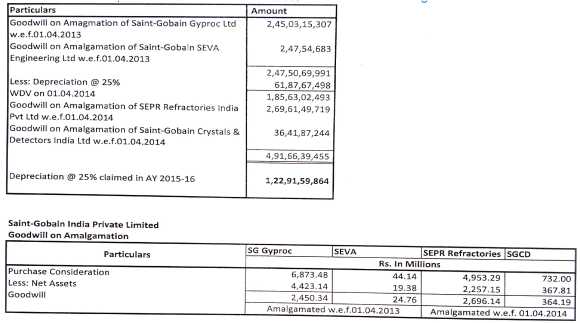
5. The assessee in the return of income has claimed depreciation on goodwill to the tune of Rs. 122,91,83,652/-. The A.O noticed that the assessee has capitalized a sum of Rs.27.8 Crores as goodwill arising from the amalgamation of the assessee with Saint Gobain Gyproc Ltd. w.e.f 01.04.2013, from amalgamation with Saint Gobain SEVA Engineering Ltd. w.e.f 01.04.2013 and amalgamation with Saint Gobain Crystals and Detectors India Ltd. w.e.f 01.04.2014. The assessee submitted that the amalgamations are approved by the Hon’ble Madras High Court and that the goodwill has arisen out of the difference between the excess of purchase consideration paid over the net assets and liabilities of the amalgamating companies. The A.O however held that goodwill is not transferable and hence cannot be an asset eligible for depreciation. Accordingly, the A.O disallowed the depreciation claimed by the assessee.
6. The Ld. AR submitted that the issue of allowability of the depreciation on goodwill for the year under consideration is covered by the decision of Hon’ble Supreme Court in the case of CIT v. Smifs Securities Ltd 348 ITR 302 (SC). The Ld. AR further submitted that the Coordinate Bench has also been consistently taking review following the decision of the Hon’ble Supreme Court. The Ld. AR also submitted that in assessee’s own case for AY 2016-17, the CIT(A) has allowed the depreciation claimed by the assessee and the appeal filed by the Revenue against the order of the CIT(A) is dismissed by the Coordinate Bench on the legal issue. Accordingly, the Ld. AR argued that the impugned issue in assessee’s case has reached finality.
7. The Ld. Departmental Representative (DR), on the other hand, relied on the orders of the lower authorities.
8. We have heard the parties, and perused the material available on record. The Ld. AR during the course of hearing submitted the following table containing the workings towards depreciation on goodwill:
9. Further, the Hon’ble Supreme Court in the case of Smifs (supra) has considered the issue of allowability of depreciation on goodwill and held that:
| “1. |
|
None appears for the respondent, though served. Heard learned counsel for the Department. Leave granted. This civil appeal concerns the Assessment Year 2003-2004. Three questions arise for determination by this Court. They are as follows: |
Question No.[a]: “Whether Stock Exchange Membership Cards are assets eligible for depreciation under Section 32 of the Income Tax Act, 1961? Whether, on the facts and in the circumstances of the case, deletion of Rs. 53,84,766/- has been made correctly?”
Answer: Learned Additional Solicitor General fairly concedes that the said question is covered by the decision of this Court in the case of Techno Shares and Stocks Limited v. Commissioner of Income Tax, reported in [2010] 327 I.T.R. 323, in favour of the assessee.
Question No.[b]: “Whether goodwill is an asset within the meaning of Section 32 of the Income Tax Act, 1961, and whether depreciation on ‘goodwill’ is allowable under the said Section?”
Answer: In the present case, the assessee had claimed deduction of Rs. 54,85,430/- as depreciation on goodwill. In the course of hearing, the explanation regarding origin of such goodwill was given as under:
“In accordance with Scheme of Amalgamation of YSN Shares & Securities (P) Ltd with Smifs Securities Ltd (duly sanctioned by Hon’ble High Courts of Bombay and Calcutta) with retrospective effect from 1st April, 1998, assets and liabilities of YSN Shares & Securities (P) Ltd were transferred to and vest in the company. In the process goodwill has arisen in the books of the company.”
2. It was further explained that excess consideration paid by the assessee over the value of net assets acquired of YSN Shares and Securities Private Limited [Amalgamating Company] should be considered as goodwill arising on amalgamation. It was claimed that the extra consideration was paid towards the reputation which the Amalgamating Company was enjoying in order to retain its existing clientele.
3. The Assessing Officer held that goodwill was not an asset falling under Explanation 3 to Section 32(1) of the Income Tax Act, 1961 [‘Act’, for short].
We quote hereinbelow Explanation 3 to Section 32(1) of the Act:
“Explanation 3.– For the purposes of this sub-section, the expressions ‘assets’ and ‘block of assets’ shall mean– [a] tangible assets, being buildings, machinery, plant or furniture;
[b] intangible assets, being know-how, patents, copyrights, trademarks, licences, franchises or any other business or commercial rights of similar nature.”
4. Explanation 3 states that the expression ‘asset’ shall mean an intangible asset, being know-how, patents, copyrights, trademarks, licences, franchises or any other business or commercial rights of similar nature. A reading the words ‘any other business or commercial rights of similar nature’ in clause (b) of Explanation 3 indicates that goodwill would fall under the expression ‘any other business or commercial right of a similar nature’. The principle of ejusdem generis would strictly apply while interpreting the said expression which finds place in Explanation 3(b).
5. In the circumstances, we are of the view that ‘Goodwill’ is an asset under Explanation 3(b) to Section 32(1) of the Act.
6. One more aspect needs to be highlighted. In the present case, the Assessing Officer, as a matter of fact, came to the conclusion that no amount was actually paid on account of goodwill. This is a factual finding. The Commissioner of Income Tax (Appeals) [‘CIT(A)’, for short] has come to the conclusion that the authorised representatives had filed copies of the Orders of the High Court ordering amalgamation of the above two Companies; that the assets and liabilities of M/s. YSN Shares and Securities Private Limited were transferred to the assessee for a consideration; that the difference between the cost of an asset and the amount paid constituted goodwill and that the assessee-Company in the process of amalgamation had acquired a capital right in the form of goodwill because of which the market worth of the assessee-Company stood increased. This finding has also been upheld by Income Tax Appellate Tribunal [TTAT, for short]. We see no reason to interfere with the factual finding.
7. One more aspect which needs to be mentioned is that, against the decision of ITAT, the Revenue had preferred an appeal to the High Court in which it had raised only the question as to whether goodwill is an asset under Section 32 of the Act. In the circumstances, before the High Court, the Revenue did not file an appeal on the finding of fact referred to hereinabove.
8. For the afore-stated reasons, we answer Question No.[b] also in favour of the assessee. “
10. The contention of the Revenue with regard to applicability of 5th proviso to section 32(1) of the Act is also not tenable for the reason that the said proviso is applicable only to those assets which commonly exist between predecessor and successor company in the scheme of amalgamation but does not apply to the asset which has been created or acquired after amalgamation. It is also relevant to mention here that the applicability of amendment by Finance Act, 2021 excluding goodwill from Section 32(1)(ii) of the Act has also been held to be prospective by the coordinate bench. Considering the various judicial precedence and the facts in assessee’ case, we are of the view that the A.O is not correct in disallowing the deprecation claimed on goodwill. We accordingly direct the AO to delete the disallowance made in this regard.
Disallowance of amortization of land development expenses – Ground No.3:
11. The assessee had taken land on lease from SIPCOT in Sriperumbudur for a period of 99 years. At the initial stage period, the assessee has paid land development charges of Rs. 10,67,52,973/- in 1999 and Rs. 7,97,34,809/- in 2005. The assessee has amortized the amount paid over the lease period and during the year under consideration the assessee has claimed a sum of Rs.98,39,348/- as deduction. The assessee submitted before the A.O that the amount claimed as revenue over the lease period and is to be allowed as a deduction. However, the A.O held that since the assessee has taken the property on lease for a period of 99 years assessee should be deemed to be the owner of the property and hence the amount paid is capital in nature. The AO further held that since the asset is land no depreciation can be allowed on the same. Accordingly, the A.O disallowed the entire amount.
12. The Ld. AR in this regard submitted that the assessee paid the amount towards infrastructure development in the land taken on lease and that the said infrastructure is used for the common purpose. The Ld. AR further submitted that the assessee by taking the land on lease has not become the owner of the land since the assessee has acquired only the right to use the land and has not acquired the land. Accordingly, the Ld. AR argued that the amount claimed by the assessee is to be allowed as a deduction. The Ld. AR in this regard relied on the decision of the Hon’ble Madras High Court in the case of
Hinduja Foundries Ltd. v.
Asstt. CIT [2025] [
2026] 486 ITR 117 (Madras)/[TCA No. 794 & 795 of 2016 dated 10.10.2025].
13. The Ld. Departmental Representative (DR), on the other hand, relied on the orders of the lower authorities.
14. We have heard the parties, and perused the material available on record. we notice that an identical issue came out before the Hon’ble Jurisdictional High Court in the case of Hinduja Foundries Ltd. (supra), where it has been held that:
“52. The assessee, who had contributed this amount towards the infrastructural development, though does not own the same and is also developed by SIPCOT, still the assessee has a right of usage and without using this right, the assessee will not be in a position to put up the factory or run the business. The expenditure made by the assessee is not towards betterment of the business or for any enduring benefit, but it is a basic requirement without which the business cannot be established or run. The contributions made by the assessee towards development charges not being owned by him and there being no capital asset, qualifies for deduction as a revenue expenditure.
53. In this regard, is useful to refer to the case of L.H.Sugar Factory & Oil Mills (P) Ltd. cited (supra), wherein the Hon’ble Supreme Court has allowed the amount contributed by the assessee for the purpose of formation of the road, which facilitates the conduct of business of the assessee as a revenue expenditure. The relevant portion is extracted hereunder:-
“Now it is clear on the facts of the present case that by spending the amount of Rs.50,000, the assessee did not acquire any asset of an enduring nature. The roads which were constructed around the factory with the help of the amount of Rs.50,000 contributed by the assessee belonged to the Government of U.P. and not to the assessee. Moreover, it was only a part of the cost of construction of these roads that was contributed by the assessee, since under the sugarcane development scheme, one-third of the cost of construction was to be borne by the Central Government, one-third by the State Government and only the remaining one-third was to be divided between the sugarcane factories and sugarcane growers. These roads were undoubtedly advantageous to the business of the assessee as they facilitated the transport of sugarcane to the factory and the outflow of manufactured sugar from the factory to the market centres. There can be no doubt that the construction of these roads facilitated the business operations of the assessee and enabled the management and conduct of the assessee’s business to be carried on more efficiently and profitably. It is no doubt true that the advantage secured for the business of the assessee was of a long duration inasmuch as it would last so long as the roads continued to be in motorable condition, but it was not an advantage in the capital field, because no tangible or intangible asset was acquired by the assessee nor was there any addition to or expansion of the profitmaking apparatus of the assessee. The amount of Rs.50,000 was contributed by the assessee for the purpose of facilitating the conduct of the business of the assessee and making it more efficient and profitable and it was clearly an expenditure on revenue account.”
54. Further the Division Bench of this Court in Commissioner of Income Tax v. Coats Viyella India Ltd. reported in 253 ITR 667 (Madras) by relying on the decision in the case of L.H.Sugar Factory & Oil Mills (P) Ltd. cited (supra), allowed the contributions made by the assessee towards construction of the bridge, though not owned by him and built by the government is allowable as a revenue expenditure. The relevant paragraphs are extracted hereunder for easy reference:-
“3. Here, the bridge is one which is built across the river. The bridge is not owned by assessee. It is built by the Government, and the assessee does not acquire any rights of ownership over the bridge in the shortterm or in the long run by reason of the contribution that it agreed to pay towards the construction of the bridge. So far as the assessee is concerned, the payment made is an outgo in return for which it receives no addition to the value of any of the assets owned by it. The bridge merely facilitates the movement of the workmen to gain access to assessee’s factory and to return home, and also for the movement of the goods over the bridge. The facts of this case are such as to bring it within the ratio of decision in the case of L.H.Sugar Factory & Oil Mills (P) Ltd. v. CIT (supra).
4. We, therefore, do not see any justification for calling for a reference. The Tribunal has rightly held that the amount is to be treated as revenue expenditure. The assessment year is 1991-92. The Petitions are dismissed.”
55. In the instant case also, the infrastructure developments including the roads, streets, etc., are not owned by the assessee and is developed by the SIPCOT. The assessee does not acquire any right of ownership and the payment receives no addition to the value of assets owned by the assessee. The development merely facilitates the running of the business of the assessee, which is an essential requirement without which the business could not be operated. As such the contributions made by the assessee are eligible to be treated as a revenue expenditure. “
15. From the perusal of the above findings, it is clear that by obtaining the land on lease, the assessee does not acquire the ownership and that the land development charges paid by the assessee therefore cannot be treated as capital in nature. Since the infrastructure development charges paid by the assessee are towards running the business of the assessee, the Hon’ble High Court has held that the same is revenue in nature. Respectfully following the above decision, we hold that the lower authorities are not correct in disallowing the expenses claimed by the assessee towards land development charges.
Disallowance of swap charges – Ground No.4:
16. The A.O noticed from the perusal of the breakup details of ECB loan and swap cost that an amount of Rs. 20,53,26,952/- claimed as deduction by the assessee pertains to “principal only swaps” incurred to swap the principal portion of ECB. The A.O accordingly called on the assessee to furnish the details pertaining to the same. The assessee submitted that the swap charges are not in the nature of foreign currency fluctuations to be capitalized u/s. 43A of the Act but is in the nature of bank charges towards providing swap facilities. Accordingly, the assessee submitted that the amount is of revenue in nature to be allowed as a deduction. The A.O however did not except the submissions of the assessee and held that the principal only swap cost is capital in nature and therefore to be disallowed.
17. The Ld. AR submitted that the assessee has obtained ECB loans from its group company in France with an obligation to repay the loan in foreign currency at the end of five years. The Ld. AR further submitted that the assessee has entered into cross currency rate swap agreements with banks to provide the foreign currency at the end of five years at the same exchange rate as at the beginning of the said period. The Ld. AR also submitted that bank charges annual transaction fee which is calculated as a percentage of the amount and that the said charge is in the nature of interest/bank charges charged by the banks and accordingly eligible for deduction us/. 36(1)(iii) of the Act and that even otherwise the impugned charges are incurred for the purpose of business that is eligible for deduction u/s.37(1) of the Act. The Ld. AR also drew our attention to the fact that the CIT(A) in assessee’s own case for AY 2016-17 has allowed the deduction. The Ld. AR in this regard relied on the decision of the Hon’ble Calcutta High Court in the case CIT v. Britannia Industries Ltd. 376 ITR 299 (Calcutta), where it is held that:
“11. We have heard rival contentions and are of the opinion that Explanation 3 relied on by Mr. Agarwal, quoted above, contemplates only the addition or deduction to the actual cost of the asset. The Explanation does not touch the point as regards the fee payable or the consideration payable to an authorised dealer under section 2 of the Foreign Exchange Regulation Act, 1947, which was the provision as it stood at the relevant time.
12. The entire section 43A has undergone a change with effect from April 1, 2003. It is not in dispute that the factual background is as follows, as would appear from the impugned judgment:
“The Commissioner of Income-tax has disallowed a sum of Rs. 1,78,08,000 being bank charges paid by the assessee-company in connection with repayment of a loan of US $ 10 million. The assessee-company took a foreign currency loan of US$ 10 million in the year 1995. The loan was utilised for incurring capital expenditure for acquisition of plant and machinery. The loan was to be repaid in two instalments with interest. In order to ensure availability of foreign currency at a pre-determined rate the assessee enter into a forward contract to the bank to obtain the foreign currency on a specific date at a specified rate. For obtaining this facility the sum in question was paid to the State Bank of India and has been debited as bank charges in the accounts of the assessee.”
13. In the light of the aforesaid facts, the judgment, cited by Mr. Agarwal far from helping him,, militates against the proposition sought to be advanced by him as would appear from the following views expressed by the apex court (page 28 of322 ITR):
“Roll over charges represent the difference arising on account of change in foreign exchange rates. Roll over charges paid/received in respect of liabilities relating to the acquisition of fixed assets should be debited/credited to the asset in respect of which liability was incurred. However, roll over charges not relating to fixed assets should be charged to the profit and loss account.”
14. We are, in this case, not concerned with the difference arising on account of change in foreign exchange rates. We are, on the contrary, concerned with consideration payable/paid to the authorised dealer for obtaining protection against change of the foreign exchange rates.
15. The apex court opined that roll over charges not relating to fixed asset should be charged to the profit and loss account. Herein lies the answer. The bank charges claimed by the assessee are not relatable to the fixed assets. Bank charges are payable in consideration of the risk undertaken by the bank. Therefore, it is in the nature of a fee for the guarantee provided by the banker which was considered by Andhra Pradesh High Court. What had happened before the Andhra Pradesh High Court is as follows.
16. The assessee, in that case imported machinery from two concerns in Japan on deferred payment basis. The deferred payments were guaranteed by banks and insurance companies. The assessee agreed to pay guarantee commission to the guarantors and claimed it as a business expenditure which was disallowed on the ground that the expenditure was of a capital nature.
17. The Andhra Pradesh High Court held as follows (page 301):
“. . . the guarantee commission paid by the assessee in the year of account of the relevant assessment year, Rs. 10,242 must be treated as revenue expenditure and not as capital expenditure. Hence, this expenditure of Rs. 10,242 is an admissible deduction as an expenditure under section 37(1) of the Income-tax Act, 1961.”
18. The hon’ble Supreme Court did not interfere in the special leave petition preferred by the Revenue.
19. We are of the opinion that the consideration paid by the assessee to the authorised dealer of foreign exchange, which is the bank in this case, in order to obtain protection from fluctuation of foreign exchange rates is a revenue expenditure and the view taken by the learned Tribunal is correct. Therefore, the third question is answered in the negative and against the Revenue. “
18. The ld DR on the other hand vehemently supported the orders of the lower authorities.
19. We have heard the rival submissions and perused the material available on record. The issue for consideration is whether the swap charges/premium paid by the assessee to the authorised dealer in connection with hedging the foreign currency exposure arising from the External Commercial Borrowing (ECB) are liable to be capitalised or are allowable as revenue expenditure. We find that the Hon’ble Calcutta High Court in the case of Britannia Industries Ltd (supra) has drawn a clear distinction between the foreign exchange fluctuation affecting the liability incurred for acquisition of a capital asset and the remuneration paid to the bank for assuming such foreign exchange risk. The Hon’ble High Court held that the amount paid to the authorised dealer is merely the consideration for the banking service rendered and for the risk undertaken by the bank in insulating the assessee from adverse foreign exchange fluctuations. In other words, the bank’s remuneration for assuming the foreign exchange risk is distinct from the exchange fluctuation itself. Consequently, it is held that such payment does not constitute an adjustment to the actual cost of the capital asset under section 43A but is an independent expenditure incurred for obtaining a hedging facility, allowable under section 37(1). The Hon’ble High Court further held that Explanation 3 to section 43A merely prescribes the mechanism for computation of exchange differences where a forward exchange contract has been entered into and does not require the bank’s charges or premium for undertaking the foreign exchange risk to be capitalised.
20. We notice that the AO has made the addition for the reason that the it is incurred towards Principle Only Swap (POS) and that in the case of cross currency interest rate swap (CCIRS) which includes both interest and principal portion the assessee has not provided the breakup. We further notice that the CIT(A) has upheld the disallowance stating that the ECB has been utilised for acquisition of the capital asset and the swap charges which have a direct nexus to the acquisition of the capital asset cannot be claimed as a deduction by placing reliance on Explanation 3 to section 43A. We also notice that the Hon’ble High Court in the above case has consider similar issue and therefore the ratio laid down therein would apply to the facts in the present case also. Accordingly when we apply the aforesaid ratio to the facts in the present case, we are of the considered view that the swap charges paid by the assessee under the hedging arrangement represent the consideration paid to the bank for assuming the foreign exchange risk and are distinct from the exchange fluctuation affecting the foreign currency liability then the swap charges cannot partake the character of the cost of acquisition of the capital asset so as to warrant capitalisation under section 43A. During the course hearing the revenue did not place on record any material for us to take a different view on the impugned issue. Therefore respectfully following the above judicial precedence we hold that the disallowance made by the Assessing Officer towards swap charges is unsustainable.
Revenue’s appeal in ITA No.3242/Chny/2025
Disallowance u/s. 14A – Ground No.1:
21. The assessee during the year under consideration has claimed exempted income of Rs.13,33,303/-. In the return of income, the assessee has disallowed expenditure to the tune of Rs.2,42,889/- towards exempt income. The A.O rejected the submissions of the assessee to make a disallowance u/s. 14A r/w Rule 8D of Rs.10,90,414/-. The CIT(A) on further appeal gave partial relief to the assessee by directing the A.O to re-compute the disallowance.
22. We have heard the parties, and perused the material available on record. The Ld. AR submitted that the assessee is having sufficient own funds and therefore no disallowance is warranted u/s. 14A r.w. Rule 8D(ii) of the Rules. The Ld. AR in this regard drew our attention to the financial statements of the assessee where it is noticed that the own funds of the assessee is at Rs.2493.80 Crores whereas the overall investments made by the assessee stands at Rs.24.55 Crores. Therefore there is merit in the submissions of the assessee that no disallowance u/s. 14A r/w. Rule 8D(ii) of the Rules.
23. With regard to disallowance under Rule 8D(
iii) of the Rules, the Ld. AR submitted that the A.O has considered the entire investments whereas the investments earning exempt income alone need to be considered. The said contention has merits in the light of the law settled by Special Bench of ITAT, Delhi in the case of
Asstt. CIT v.
Vireet Investment (P.) Ltd. [2017] 165 ITD 27 (Delhi –
Trib.). We accordingly we see no reason to interfere with the decision of the CIT(A) in directing the A.O to verify and exclude such investments that have not resulted in exempt income from the computation of disallowance under Rule 8D(
iii) of the Rules.
Restriction of depreciation on software:
24. The assessee in the computation of income has claimed depreciation on software at 60%, the A.O held that the software license are not part of computers and accordingly restricted the depreciation to 25%. On further appeal, the CIT(A) deleted the disallowance by placing reliance on the decision of the Coordinate Bench in the case of Toshniwal Instruments (Madras) (P.) Ltd. v. ACIT [IT Appeal No. 679 (Chny) of 2018, dated 1-08-2018].
25. We have heard the parties, and perused the material available on record. We notice that the assessee has capitalized the software along with the computers and has claimed 60% depreciation on the same. The Coordinate Bench in the above case has held that
4. We have considered the rival contentions and perused the orders of the authorities below. Rates on which depreciation is admissible on different assets is given in New Appendix I of the Income Tax Rules, 1962. Item No. (5) of this table gives the eligible rate of depreciation for ”computer including computer software” at 60%. Note 7 given under the said appendix defines computer software as a computer program recorded on any disc, tape, perforated media or other information storage device. Assessee here had claimed depreciation on the license to use the Microsoft software called Microsoft Dynamics- Ax 2009 considering it as a computer software, coming within the above definition. There can be no dispute that even if it was only a license it still was computer program recorded on an information storage device. In our opinion, assessee was eligible for depreciation @60%. We set aside the orders of the lower authorities and direct the ld. Assessing Officer to allow depreciation @60% on 13,71,600/-, being the cost incurred for purchasing Microsoft Dynamics- Ax 2009.
26. The software capitalised software licenses qualify the deprecation at 60% as per the Income Tax Rules and therefore considering the above decision and the position of law we see no infirmity in the decision of CIT(A) who allowed the claim of the assessee.
Disallowance of depreciation on goodwill on acquisition:
27. The assessee acquired Jhagadia Glass Plant in a slump sale and capitalized the cost of acquisition over net assets as goodwill. The assessee claimed depreciation on the said amount of goodwill was disallowed by the A.O stating that the goodwill is not an asset eligible for depreciation. On further appeal, CIT(A) allowed the deprecation by placing reliance on the decision of the Hon’ble Supreme Court in the case of Smifs Securities Ltd. (supra).
28. We have while deciding the issue of allowability of depreciation on goodwill acquired in the course of amalgamation has held that for the year under consideration depreciation on goodwill is an allowable expenditure by placing reliance on the decision of the Apex Court as relied on by the CIT(A). Therefore, we are of the view that there is no infirmity in the decision of the CIT(A) in allowing the depreciation.
Disallowance of deduction u/s. 80JJAA of the Act:
29. The assessee has claimed deduction u/s. 80JJAA of the Act, the A.O disallowed the said amount for the reason that the deduction includes employees hired in financial year 2013-14 who completed 300 days in FY 2014-15 i.e, the year under consideration. On further appeal, the CIT(A) deleted the disallowance by placing reliance on the decision of the Coordinate Bench in the case of Craftsman Automation (P.) Ltd. v. Jy. CIT [IT Appeal No. 652 (Chny) of 2016, dated 21.12.2022].
30. We have heard the parties, and perused the material available on record. We notice that a similar has been considered by the coordinate bench in the case of MRF Ltd. v. Dy. CIT [IT (TP) A No.68 (Chny) of 2018, dated 28.02.2025] where it has been held that:
“6.1 The facts as noted are that, the assessee had recruited employees in FY 2010-11 and FY 2011-12 in three of its units. However, these employees did not complete continuous employment of more than 300 days, during these respective years of joining but completed the same only in the succeeding FYs 2011-12 & 2012-13 respectively. The assessee is accordingly noted to have claimed deduction prescribed in Section 80JJAA of the Act in respect of the wages paid to such additional employees starting from FYs 2011-12 & 2012-13 respectively over a period of three (3) years. Accordingly, the relevant AY 2014-15 was the 3rd year of claim relating to FY 2011-12; and 2nd year of claim qua FY 201213. The AO however is noted to have disallowed the deduction on the principal premise that the deduction had already been denied in the initial year, since the workmen did not complete 300 days in the year of joining. The AO further held that, the deduction claimed in relation to the employees who joined in FY 2010-11 but completed 300 days in FY 201112 was not admissible as the impugned AY was the 4th year and that deduction u/s 80JJAA is allowable only in the first three (3) years. On appeal the DRP is noted to have upheld the AO’s action of rejecting the claim. Aggrieved by the aforesaid action of the AO/DRP, the assessee is before us.
6.2 We have heard both the parties and perused the records. The Ld. AR brought to our notice that, Section 80JJAA was introduced in the year 1999, to provide an impetus for additional employment. In terms of this provision, an assessee was entitled to additional deduction of 30% of the additional wages paid across three (3) years. It was further brought to our notice that, the condition precedent for availing this deduction was that, the ‘eligible workmen’ should be employed for a period of more than 300 days during the previous year of employment. The relevant provision reads as under: –
“80JJAA(2):
(ii) “regular workman”, does not include—
…….
(c) any other workman employed for a period of less than three hundred days during the previous year;”
6.3 The Ld. AR pointed out that the plain language of the above restriction meant that, any new employees recruited/employed after the month of May in any previous year could not be included for the purpose of claiming deduction under section 80JJAA, as he could not have possibly completed 300 days of employment in that year. According to Ld. AR, realizing this lacuna, the Legislature introduced a curative & beneficial amendment in the form of a proviso, by the Finance Act 2018, whereby it was provided that the period of employment of a new employee would also take into account his continuous employment in the immediately preceding previous year. The relevant second proviso to section 80JJAA(2)(ii) [as amended] in 2018, read as under:
“80JJAA(2)(ii)
….
Provided further that where an employee is employed during the previous year for a period of less than two hundred and forty days or one hundred and fifty days, as the case may be, but is employed for a period of two hundred and forty days or one hundred and fifty days, as the case may be, in the immediately succeeding year, he shall be deemed to have been employed in the succeeding year and the provisions of this section shall apply accordingly”
6.4 In view of the above curative amendment, therefore, if the workman is employed for less than 300 days in the year of joining but his period of stay exceeds 300 days in the succeeding year, then such workman would qualify as ‘eligible workman’ in the succeeding year and his wages shall be eligible for additional deduction u/s 80JJAA of the Act. According to Ld. AR, the above amendment being a curative and beneficial amendment ought to be held as retrospective in nature and hence applicable to the year in question as well. He thus argued that, the assessee had rightly claimed deduction u/s 80JJAA in respect of the new employees who did not complete continuous employment of more than 300 days during their respective years of joining i.e., FYs 2010-11 & 2011-12, but completed the same only in the succeeding FYs 2011-12 & 2012-13 respectively. According to the Ld. AR therefore, the AO ought to have allowed the pro-rata remaining deduction in the relevant year as well.
6.5 Per contra, the Ld. DR argued that this Tribunal in assessee’s own case for AY 2012-13 in ITA No.614 /CHNY/2018 had decided this issue against it and therefore urged that the order of the AO be upheld.
6.6 The Ld. AR in his rejoinder, brought to our notice that, the earlier decision of this Tribunal in their own case for AY 2012-13 was rendered by following the decision of the Bangalore Bench of this Tribunal in the case of M/s.Texas Instruments (reported in
wherein the deduction claimed u/s 80JJAA of the Act was disallowed on the ground that the new employees had not put in service of 300 days in the year of employment. The Ld. AR however brought to our notice that, subsequently the Bangalore Bench of this Tribunal in the same case of M/s Texas Instruments took note of the above referred amendment/proviso brought in Section 80JJAA by the Finance Act 2018 and held such amendment to be clarificatory in nature. The Tribunal accordingly held that the company was entitled to claim deduction under section 80JJAA, even if an employee completes service of 300 days across two (2) successive years, starting from the year in which the service of 300 days was completed, and that the benefit of such proviso was available in the years prior to 2018 as well. We note that this decision of the Bangalore Tribunal has since been affirmed by the Hon’ble Karnataka High Court which is reported in
435 ITR 1. The relevant findings taken note of by us is as follows: –
“16.8 Admittedly, the provisions concerned, i.e. Section 80JJ-AA, comes under Chapter-VI-A of the IT Act, which deals with deductions in certain income; this deduction is issued and or permitted as an incentive to the Assessee on fulfilling certain criteria as required under the various provisions under Chapter-VI-A. The incentive of the deduction provided under section 80JJ-AA is with an intention to encourage the Assessee to employ more and more people, provide employment and, in lieu thereof, permit the employer/assessee to deduct certain amounts from the income when the returns are filed. It is with this object, purport and intent of section 80JJ-AA of the Act that the present facts and circumstances would have to be considered. It is also required for the Assessing Officer, CITA, Income-tax Appellate Tribunal, as also any other officer to always interpret and or apply the provisions of the Act, taking into consideration the intent and purport of the said provision.
16.9 The meaning or interpretation now sought to be given by Sri. Aravind, learned Senior Panel counsel is that only if the employee were employed for a period of 300 days in a particular financial year, only then deductions could be claimed, if not the deductions could not be claimed even though such employee has been employed for 300 continuous days or more.
16.10 We would disagree with the said contention. What is required is for a person to be employed for a period of 300 days continuously. There is no such criteria made out for a person to be employed in any particular year or otherwise. If such a restrictive interpretation is given, then any person employed post 5th June of a particular year would not entitle the Assessee to claim any deduction. Thus in order to claim the benefit under section 80JJ-AA, an employer would have to hire the workmen before 5th June of that year. As a corollary, since the Assessee would not get any benefit if the workmen were engaged post 5th June, the employer/Assessee may not even employ anyone post 5th June, which would militate against the purpose and intent of section 80JJ-AA, which is the encourage creation of new employment opportunities.
16.11 The Income-tax Appellate Tribunal, while considering a similar situation as in Bosch Ltd. (supra) held that so long as the workman employed for 300 days, even if the said period is split into two blocks, i.e. the assessment year or financial year, the Assessee would be entitled to the benefit of Section 80JJ-AA in the next assessment year and so on so forthwith for a period of three years. The Income-tax Appellate Tribunal, having held to that effect, in our considered opinion, it would not be open for the Revenue to now contend otherwise, more so since the said order has attained finality on account of the Revenue not having filed an appeal.
16.12 It is sought to be contended by Sri. K.V. Aravind, learned Senior Panel counsel that the fact that such an interpretation could not be given is established by the curative amendment carried out in the year 2018 wherein it is clarified that an assesses whose employee completes 300 days in a second year would also be entitled to a deduction for three years therefrom. Thus he submits that the amendment having been brought into force in the year 2018 the present matter relating to the year 2007-2008, the said curative or clarificatory amendment would not come to the rescue of the Assessee and as such, the finding of the Tribunal in this regard is required to be set aside.
16.13 We are unable to agree with such a submission- the amendment of the year 2018 though claimed curative by Sri. Aravind, we are of the considered opinion that the same is more an explanatory amendment or a clarificatory amendment which clarifies the methodology of applying section 80JJ-AA of the Act. If the submission of Sri. K.V. Aravind is accepted, then no employer/assessee would be able to fulfil the requirement of employing its labour/assessee prior to 5th June of that assessment year so as to claim the benefit of Section 80JJ-AA. Such a narrow and pedantic approach is impermissible. It also being on account of the fact that section 80JJ-AA relating to deductions under Chapter is an incentive and, therefore, has to be read liberally. In this aspect, we are also supported by the decision of the Apex Court in Mavilayi Service Co-operative Bank Ltd.’scase (supra), wherein the Apex Court has held that a benevolent provision has to be read liberally and reasonably and if there is an ambiguity in favour of the Assessee.
16.14 The Apex Court in the case Vatika Township (P.) Ltd. (supra) has also held similarly, in that if there is a benefit conferred by legislation, the said benefit being legislative’s object, there would be a presumption that such a legislation would operate with retrospective effect by giving a purposive construction. Thus the clarificatory amendment of the year 2018 can also be said to apply retrospectively for the benefit of the Assessee even though the Revenue contends that there was no provision in the year 2007 permitting the Assessee to avail the benefit of deduction when the employee works for a period of 300 days in consecutive years.
16.15 In view thereof, the substantial question No. 1 is answered by holding that the software professional/engineer is a workman within the meaning of section 2(s) of ID Act, so long as such a software professional does not discharge supervisory functions, the benefit of section 80JJ-AA can be claimed by an employer/assessee even if the employee were not to complete 300 days in a particular assessment year but in the subsequent year so long as there is continuity of employment, the Assessee could continue to claim further benefit in the next two years as provided in under section 80JJ-AA of the Act.
16.16 Accordingly, we answer Question No. 1 by holding that a software engineer in a software industry is a workman within the meaning of section 2(s) of the Industrial Disputes Act so long as the Software engineer does not discharge any supervisory role.
16.17 The period of 300 days as mentioned under section 80JJAA of the Act could be taken into consideration both in the previous year and the succeeding year for the purpose of availing benefit under section 80JJAA. It is not required that the workman works for entire 300 days in the previous year.
16.18 Hence, in the facts and circumstances of the case, the software engineer being workman having satisfied the period of 300 days, the assessee is entitled to claim deduction under section 80JJAA.”
6.7 Having regard to the above, we deviate from the view expressed in assessee’s own case for AY 2012-13 and respectfully follow the ratio laid down by the Hon’ble Karnataka High Court in the case of Texas Instruments (supra), and hold that the assessee was entitled to claim deduction u/s 80JJAA of the Act in respect of the new employees who did not complete continuous employment of more than 300 days during their respective years of joining i.e., FYs 2010-11 & 2011-12, but completed the same only in the succeeding FYs 2011-12 & 2012-13, in light of the curative amendment made by insertion of proviso to Section 80JJAA, by the Finance Act, 2018.
6.8 We now come to the AO’s finding that, the relevant AY 2014-15 being the 4th year of claim, the deduction u/s 80JJAA was not allowable. As noted earlier, the assessee had recruited employees in FY 2010-11 and FY 2011-12 in three of its units and these employees did not complete 300 days of employment in that respective year of joining but completed 300 days when taking into account the succeeding FY (i.e., in FY 2011-12 and FY 2012-13 respectively). Having regard to the plain language used in the above referred proviso to Section 80JJAA, the assessee is noted to have rightly considered the 1st year of employment of those employees as FY 2011-12 (for employees who joined in FY 2010-11). Consequently, the assessee was eligible to claim deduction u/s 80JJAA in FY 2011-12, FY 2012-13 and FY 2013-14 (i.e., subject AY 2014-15) for employees joined in FY 2010-11. In the light of the aforesaid facts, we note that, the assessee company had claimed deduction only for a period of 3 years and not 4 years, as wrongly assumed by the AO. In support of this, the Ld.AR rightly drew our attention to the certificate issued by the Chartered Accountant in Form 10DA, which is found to be placed at Page No. 98 of the convenience compilation; wherein we note that, the relevant details in respect of this issue, such as, name of employee, date of joining and salary details etc., were also filed before the AO. The Ld. CIT, DR was unable to controvert this factual aspect. For the aforesaid reasons, this particular reasoning given by the AO to deny the deduction claimed u/s 80JJAA of the Act in respect of the employees who joined in FY 2010-11 but completed 300 days in service in FY 2011-12 is held to be unjustified and is accordingly rejected.
6.9 In view of the above, we accordingly reverse the order of the lower authorities on this issue and direct the AO to allow the deduction u/s 80JJAA of the Act as claimed by the assessee in the return of income. Accordingly, this ground stands allowed.”
31. Respectfully following the above judicial precedence, we hold that there is no infirmity in the order of the CIT(A) in allowing the claim of the assessee.
32. In the result, the appeal of the assessee is partly allowed and the appeal of the Revenue is dismissed.