ORDER
Manish Agarwal, Accountant Member. – The present appeal is filed by assessee against the order dated 21.11.2025 passed by Ld. Pr. Commissioner of Income Tax, Delhi-4 [“Ld. Pr. CIT”] u/s 263 of the Income Tax Act, 1961 [“the Act”] arising out of assessment order dated 29.02.2024 passed u/s 143(3) r.w.s. 144B of the Act pertaining to Assessment Year 2022-23.
2. Brief facts of the case are that the assessee has its filed the return of income, declaring total income of INR 21,40,911/- on 29.09.2022. The case of the assessee was selected for scrutiny under CASS for the reasons “that the assessee has made substantial purchases from such suppliers who have filed non-business ITR or reflected a substantially lower turnover in ITR as compared to turnover shown in GSTR 1 return”. Thereafter, the AO issued questionnaires specifically ask the assessee to file the details of expenses claimed on account of payments made to such suppliers. After considering the submissions made and the evidences produced, the AO has passed the assessment order accepting the declared income. Thereafter, in terms of the notice dated 28.08.2025, Ld. PCIT show caused the assessee wherein it is alleged that the assessee has made payments of INR 18,31,81,421/- to various parties including M/s Motley International wherein the Directors of the assessee company are partners and to whom total payment of INR 150,38,97,650/- was made. Ld. PCIT further observed that the payments of more than INR 18.31 crores were made against the exempted Service under the GST Act and the AO had not verified/examined these issues in depth. Accordingly, Ld. PCIT asked the assessee why not the assessment order be held as erroneous and pre-judicial to the interest of the Revenue in terms of Explanation 2 to section 263 of the Act. In response, the assessee filed detailed written submissions which is reproduced in the order of Ld. PCIT. In the said reply, assessee explained the nature of business of the assessee, the queries made by AO during the course of assessment proceedings, relevant replies/details filed, nature of payment made to M/s Motley International, payment of GST, exempt goods/services paid to various parties and further filed a chart of such payments alongwith copy of reconciliation with GST Exempt supply and services, copy of invoices, bank statements and TDS etc. The said reply is reproduced at pages 7 to 17 of the order of Ld. PCIT who after examining the reply filed by the assessee has held that the AO has failed to make in depth inquiries with respect to the purchase from suppliers who had filed non-business ITR or declared lower turnover in their ITRs as compared to GST returns. Ld. PCIT further observed that no re-conciliation was submitted to explain the difference between the turnover declared in ITR and turnover declared in GSTR and no verification from the invoices was made nor any confirmations were obtained nor any examination of nature and scope of the services rendered by M/s Motely International was done by the AO. Therefore, the ld. PCIT hold the order as erroneous as well as pre-judicial to the interest of the Revenue and direct the AO to pass the assessment order denovo after making all the inquiries/investigations of the suppliers of services.
3. For this, Ld. PCIT has placed reliance on the judgment of Hon’ble
Delhi High Court in the case of
Gee Vee Enterprises v.
Addl. CIT [1975] 99 ITR 375 (
Delhi);
Duggal & Co. v.
CIT [1996] 220 ITR 456 (
Delhi);
CIT v.
DLF Power Ltd. [2012] 345 ITR 446 (
Delhi) and order of Coordinate Bench of Tribunal in the case of
Ankush Garg v.
CIT [IT Appeal Nos. 2287 & 2288 (Del) of 2015, dated 21-5-2019].
4. Against the said order, the assessee is in appeal before the Tribunal by taking various Grounds of appeal wherein the assessee has challenged the action of Ld. PCIT in invoking the provisions of section 263 of the Act and holding the assessment order as erroneous and pre-judicial to the interest of the Revenue and against the direction to pass a fresh assessment denovo. Accordingly, all the Grounds of appeal are taken together for consideration.
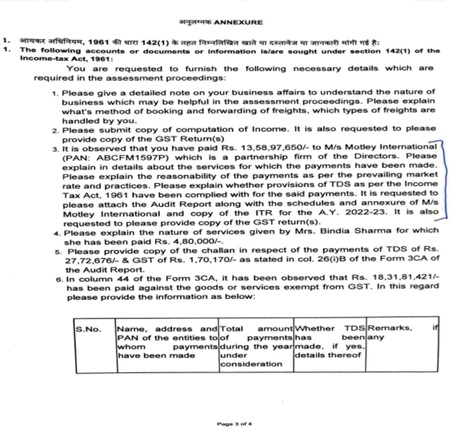
5. Before us, Ld.AR for the assessee submits that the assessee is engaged in the business of providing transportation and logistics services and acting as carrier by all means of transport including land, sea, inland waterways and air. For the supply of the services, the assessee has obtained services from established MultiNational Companies who are legally established as per law. Ld.AR submits that under the GST Act, Oceans freight services provided by suppliers are exempted. Ld.AR submits that it is not the first year of the business and identical services were obtained in preceding AYs where services provided by the service provider companies were accepted without any doubts. Ld.AR submits that during the course of assessment proceedings, notices u/s 142(1) were issued to furnish the comprehensive details of the expenses claimed on this account. He drew our attention to page 3 of the Paper Book where a copy of notice issued u/s 142(1) dated 04.12.2023 is placed where in Point No.3, the AO has specifically asked the assessee to file the details of the transactions carried out with M/s Motley International to whom payments of INR 13,58,97,650/- were made. Besides this, vide said query letter, AO further asked the assessee to file the details of expenses of INR 18,31,81,421/- reported in Tax Audit report for the services exempt from GST. The assessee submits that all the necessary replies were filed including complete details of transactions with Motley International, its ITR, financial statements, computation of income, Tax Audit Report and GST 1 & 3. Further vide reply dated 18.12.2023, besides the above stated details, assessee filed complete list alongwith PAN, addresses and all the freight and forward payments of INR 18,31,81,421/-. The relevant details are placed at pages 5 to 206 of the Paper Book filed before us. Ld.AR further submits that the return of income alongwith financial statements of Motely International Ltd. were filed wherein it had declared net income of INR 34.90 Lakhs after recording the receipts from the assessee company. The necessary copy is placed at pages 70 to 72 of the Paper Book.
6. Ld. AR further submits that AO after examining all the details, has accepted the income declared by the assessee. He further drew our attention to page 5 to 106 which is the copy of the reply filed before Ld. Pr. CIT wherein the assessee has again filed all the relevant details with respect to the payment of expenses of INR 13,58,97,650/- made to M/s. Motley International Ltd. and further details of payments of INR 18,31,81,421/- to various parties including Motley International Ltd. Ld. AR further drew our attention to pages 107 to 707 of the Paper Book which are copies of the ledger accounts of all the respective parties containing their complete ledger accounts and re-conciliation with the GST taxable and exempted supply, invoices raised, bank statements and TDS details which all were filed before Ld. Pr. CIT. He further drew our attention to page 764 to 778 of the Paper Book which contained the copies of notifications issued from time to time by GST authorities exempting the services provided by the respective parties under GST Act. Ld. AR submits that assessee during the course of assessment proceedings in terms of replies dated 07.06.2023; 18.12.2023 & 18.01.2024 has filed all the details as called for to prove the genuineness of expenses incurred of INR 18,31,81,421/- and the copies of the same were submitted before Ld. Pr. CIT for ready-reference, placed at pages 842 to 845. He thus, submits that all the details were filed before AO who after making proper verification of the same has concluded that the expenses claimed by the assessee were genuine. Ld.AR submits that Ld. Pr. CIT without pointing out any errors in the details so filed, has observed that the AO has not examined the said details in the manner he desired nor any further inquiries were made and thus held the assessment order as erroneous and prejudicial to the interest of the Revenue and direct the AO to pass the assessment order afresh after making adequate inquiry and verification. Ld.AR submits that it is the duty of Ld. Pr. CIT to point out the defects in the details so filed by the assessee and further to identify the area of investigation which has not been done in the instant case and held the order as erroneous and prejudicial to the interest of the Revenue. He thus, requested that the order passed by ld. Pr. CIT be held as bad in law and quashed. Ld.AR placed reliance on various judicial pronouncements of Hon’ble Supreme Court, Hon’ble High Courts and Co-ordinate Bench of the Tribunal and the copy of the same are placed in case-laws compilation. The list of the said orders are as under:-
| (1) |
|
Pr. CIT-1 v. V-Con Integrated Solutions (P.) Ltd. (SC)/[2025] 476 ITR 526 (SC) in SLP (Civil) Diary No. 13205/2025 by the Hon’ble Supreme Court of India |
| (2) |
|
Pr. CIT v. Clix Finance India Pvt. Ltd. [IT Appeal No.1428 of 2018, dated 1.03.2024] by the Hon’ble High Court of Delhi |
| (3) |
|
Pr. CIT v. Klaxon Trading Pvt Ltd [IT Appeal No. 125 of 2021, dated 20-5-2021] by the Hon’ble High Court of Delhi |
| (4) |
|
DIT v. Jyoti Foundation (Delhi) (Mag.)/357 ITR 388 (Delhi) ITA 267/2013 by the Hon’ble High Court of Delhi |
| (5) |
|
ITO v. D.G. Housing Projects Ltd. (Delhi) (Mag.)/[2012] 343 ITR 329 (Delhi) ITA 179/2011 by the Hon’ble High Court of Delhi |
| (6) |
|
CIT v. Anil Kumar Sharma (Delhi)/[2011] 335 ITR 83 (Delhi) ITA 820/2009 by the Hon’ble High Court of Delhi |
| (7) |
|
CIT v. Vikas Polymers [2012] 341 ITR 537 (Delhi)s ITA 3/1991 by the Hon’ble High Court of Delhi |
| (8) |
|
Pr. CIT v. Anjaniputra Nirmal (P.) Ltd. (Calcutta) ITAT/262/2024 BY THE Hon’ble High Court of Kolkata |
| (9) |
|
Liberty Shoes Ltd. v. Pr. CIT (Delhi – Trib.) ITA No. 2206/Del/2025 by the Hon’ble ITAT New Delhi |
| (10) |
|
CITY Union Bank v. PCIT, Madurai- 1 reported as ITA No.1126/CHny/2024 by the Hon’ble ITAT, Chennai |
| (11) |
|
Surya Roshni Limited v. PCIT- 7, DELHI reported as ITA No. 1445 & 1444/Del/2024 by the Hon’ble ITAT New Delhi |
| (12) |
|
Skn Propmart Pvt Ltd v. PCIT, GURUGRAM reported as ITA No. 4214/Del/2019 by the Hon’ble ITAT New Delhi |
| (13) |
|
Anil Kumar Batar v. Pr. CIT [IT Appeal No. 418 (JPR) of 2025, dated 9-9-2025] by the Hon’ble ITAT Jaipur |
| (14) |
|
Bharti Airtel Limited v. Pr. CIT, DELHI reported as ITA No. 1160/Del/2024 by the Hon’ble ITAT New Delhi |
| (15) |
|
Nirav Chandrakantbhai v. Pr. CIT [IT Appeal No. 1041 (Ahd) of 2024, dated 6-8-2024] by the Hon’ble ITAT Ahmedabad |
| (16) |
|
Shail Gas Pvt. Ltd. v. Pr. CIT 7, NEW DELHI reported as ITA No. 630/Del/2021 by the Hon’ble ITAT New Delhi |
| (17) |
|
SAIF Partners India Ltd. v. CIT, International Taxation, CENTRAL CIRCLE – 3(1)(2) NEW DELHI reported as ITA No. 1138/Del/2022 by the Hon’ble ITAT New Delhi |
| (18) |
|
Pramukh Realty v. Pr. CIT, RAJKOT reported as ITA No. 1445 & 1444/Del/2024 by the Hon’ble ITAT Rajkot |
| (19) |
|
Paramount Propbuild Pvt. Ltd. v. Pr. CIT 7, DELHI reported as ITA No. 388/Del/2021 by the Hon’ble ITAT New Delhi |
| (20) |
|
Shri Subbaraya Annamalai Siva Kumar v. ITO [IT Appea Nos. 439 & 440 (Hyd) of 2019, dated 9-4-2021] by the Hon’ble ITAT Hyderabad |
| (21) |
|
Klaxon Trading Pvt Ltd v. Pr.CIT Central – 3, NEW DELHI reported as ITA No. 7265/Del/2017 by the Hon’ble ITAT New Delhi |
| (22) |
|
Arun Kumar Garg HUF v. Pr.CIT13, NEW DELHI reported as ITA No. 3391/Del/2018 by the Hon’ble ITAT New Delhi |
| (23) |
|
Small Wonder Industries v. CIT [IT Appeal No. 2464 (Mum) of 2013, dated 24-2-2017] by the Hon’ble ITAT Mumbai |
| (24) |
|
Beena Jain v. CIT, MEERUT reported as ITA No. 2080/Del/2013 by the Hon’ble ITAT New Delhi |
| (25) |
|
Pr. CIT v. Delhi Airport Metro Express (P.) Ltd. (Delhi)/[2017] 398 ITR 8 (Delhi) ITA 705/2017 by the Hon’ble High Court of Delhi |
| (26) |
|
STUDDS Accessories Ltd. v. PCIT, Faridabad reported as ITA No.3570/Del/2025 by the Hon’ble ITAT, New Delhi.” |
7. On the other hand, Ld. CIT DR for the Revenue vehemently supports the orders of the ld. Pr. CIT and submits that case was selected under CASS for the sole reasons that the assessee has made purchases from various parties who have filed non-business ITR or reflected substantial low turnover in ITR as compared to turnover shows in GST return thus, there is a possibility that the assessee might have booked bogus expenses in order to reduce its profit / income. Ld. CIT DR submits that the details filed by the assessee were not examined by the AO as could be seen from the assessment order where the assessment order is very cryptic and non-speaking and the AO has not stated what enquiries were made and what replies/details were filed by the assessee. As per Ld. CIT DR, it is not clear whether the AO has made any inquiries or investigation before reaching to the conclusion that the income declared was correct. In this regard, he drew our attention to para 7(d) at page 18 onwards of the order of Ld. Pr. CIT and further at para 7(g) wherein Ld. Pr. CIT has referred certain documents which mut be examined by the AO before accepting the contention of the assessee but was not done.
8. Ld. CIT DR for the Revenue further submits that AO has not applied his mind on the nature of payment made to M/s Motley International Ltd. more particularly when the said party is covered u/s 40A(2)(b) of the Act and therefore, failure on the part of the AO in making verification of the expenses claimed by the assessee vis-a-vis the reason for scrutiny therefore, Ld. PCIT has rightly hold the assessment order as erroneous and pre-judicial to the interest of the Revenue. He prayed accordingly.
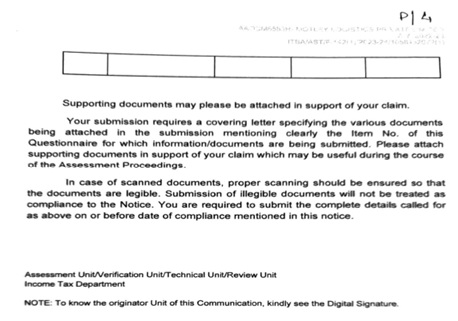
9. Heard the contentions of both the parties at length and perused the material available on record. In the instant case, solitary reason for which the case of the assessee was selected for scrutiny was that there was a difference in the turnover declared by the supplier under ITR and GSTR thus, the AO was of the opinion that there might be a possibility of claiming bogus expenses to reduce the taxable income. With this primary motive, the AO has made the inquiries during the course of assessment proceedings wherein in terms of notice issued on 04.12.2023 u/s 142 of the Act, the AO asked the assessee to file the following details:-
10. In response, the assessee has filed the replies on three occasions, filing all the relevant details such as copy of financial statements, ITR, GSTR, TDS charts etc. of the suppliers including of the M/s Motley International Ltd. All these details are placed at pages 5 to 206 of the Paper Book filed before us. Besides this, during the course of revisionary proceedings before Ld. PCIT, the assessee again filed copy of all the details and further filed party-wise break-up of the payments made to suppliers including their ledger accounts, re-conciliation statement, GST exempt and taxable supply invoices and bank statement and TDS details. The claim of the assessee was that all the payments were made against the services rendered by them in regular course of business and payments of similar nature were made in the preceding AYrs also as well as in subsequent AYrs where, the same were never doubted by the Revenue. The assessee further submits that all the payments were made through banking channel and duly backed by the respective copies of invoices raised. The service provider companies are foreign Multi National and filed GSTR details and all the payments were made after deducting tax at source in accordance with law. With respect to the payments made against the services rendered by the sister concern, M/s Motley International Ltd., the assessee filed its ITR, copy of account statement, audited financial statement and its GST returns. All these facts were available before Ld. Pr. CIT during the course of revisionary proceedings however, Ld. Pr. CIT has failed to point out any error in any of the details filed by the assessee.
11. The Hon’ble jurisdictional High Court in the case of Jyoti Foundation(supra) has held that when the AO has made inquiries thus, it is not a case of no inquiry and in such case, merely saying that AO has failed to make no inquiries was not sufficient, the inquiries should have been conducted by the Commissioner by himself to record the finding that assessment order was erroneous. He should not have set side or direct to conduct the said inquiries to the AO. The Hon’ble High Court has further followed the judgment of Hon’ble High Court in the case of D.G Housing Projects Ltd.(supra). Further, the Hon’ble Punjab & Haryana High Court in the case of PCIT v. Beaxon Solution Pvt. Ltd. has referred the inquiries conducted by the AO and observed as under:-
5. “We find that the ITAT has examined the entire record. The ITAT has noticed that the Assessing Officer had raised several queries and had also demanded documents, the details of which have been mentioned in the ITAT order, which is quoted as under:-
“12. So far as the issue relating to the issue of shares to the two companies namely M/s Takecare India Pvt. Ltd. And Videocon Realty infrastructure Ltd. Was concerned, the assessee explained that the AO had made adequate enquiries on this issue and various replies and details were furnished to the AO, considering which the AO has accepted the claim of the assessee. The ld. Counsel, in this respect has submitted that the AO had issued questionnaire dated 28.12.2020 wherein, the following details were asked for from the assessee, on this issue:
| (a) |
|
Name and address of the shareholders. |
| (b) |
|
PAN of the shareholders. |
| (c) |
|
Face Value of each share. |
| (d) |
|
Number of shares allotted to each shareholder. |
| (e) |
|
Total value of the shares allotted to each shareholder. |
| (f) |
|
Payment received from each shareholder during the financial year. |
| 2) |
|
Provide documentary evidence to substantiate the identity and ITR of the shareholders to substantiate creditworthiness the shareholders as well as the proof of genuineness of transaction in respect of fresh credit of the share capital account. |
| 3) |
|
The valuation report with respect to the working of EPS. |
| 4) |
|
The year wise details of dividend declared during the year and three earlier years. |
| 5) |
|
The year wise details of dividend declared during the year and three earlier years.” |
6. Therefore, it is noted that the Assessing Officer had issued a questionnaire on 28.12.2020 and had also asked for documents, which were answered and furnished to the Assessing Officer by the assessee and the same were also informed to the PCIT, who ensued proceedings under Section 263 of the IT Act. However, PCIT have not pointed out any further enquires, which were required to be made by the Assessing Officer in this case, which have not been so made. The scope of Section 263 of the IT Act, is apparently to see whether the concerned Assessing Officer has failed to conduct a proper inquiry, and therefore, committed an error resulting in causing loss to the revenue. Simply by holding that the Assessing Officer was required to make more enquiries, would not be a valid ground for treating the order of the Assessing Officer, as erroneous and prejudicial to the interests of the revenue. The power under Section 263 of the Act cannot be invoked in such circumstances by the PCIT. The order, therefore, passed by the PCIT is not sustainable in the eyes of law and the same has been quashed by the ITAT, which does not warrant any interference by this Court in appeal.”
12. It is relevant to state that the aforesaid order of the Hon’ble Punjab & Haryana High Court sought confirmed by the Hon’ble Supreme Court by rejecting the SLP filed by the Revenue in SLP Civil Diary No.13/2020 vide order dated 04.04.2025. The Hon’ble Jurisdictional High Court in the case of PCIT v. Clix Finance India Pvt. Ltd. in its order dated 01.03.2024 in ITA No.1428/2018 after considering the various judgements of Hon’ble Supreme Court, Jurisdictional High Court, Hon’ble Punjab & Haryana High Court has made detailed observations in respect to the orders passed u/s 263 by Ld. PCIT where Ld. PCIT has set aside the original assessment order. The relevant observations contained in para 17 onwards are as under:-
17. “The brief controversy involved in the present appeal pertains to the invocation of revisional jurisdiction under Section 263 of the Act by the CIT to set aside the original assessment order dated 30.03.2005.
18. Before adverting to the merits of the case, it is apposite to refer to the power of the revisional authority of the CIT envisaged as per Section 263 of the Act. For the sake of clarity, the relevant extract of Section 263 of the Act is reproduced as under:
“263. Revision of orders prejudicial to revenue—(1) The [Principal Chief Commissioner or Chief Commissioner or Principal Commissioner] or Commissioner] may call for and examine the record of any proceeding under this Act, and if he considers that any order passed therein by the Assessing Officer [or the Transfer Pricing Officer, as the case may be,] is erroneous in so far as it is prejudicial to the interest of the revenue, he may, after giving the assessee an opportunity of being heard and after making or causing to be made such inquiry as he deems necessary, pass such order thereon as the circumstances of the case justify, [including,—
| (i) |
|
an order enhancing or modifying the assessment or cancelling the assessment and directing a fresh assessment; or (ii) an order modifying the order under Section 92-CA; or |
| (iii) |
|
an order cancelling the order under Section 92-CA and directing a fresh order under the said section.] *** [Explanation 2.— For the purposes of this section, it is hereby declared that an order passed by the Assessing Officer [or the Transfer Pricing Officer, as the case may be,] shall be deemed to be erroneous in so far as it is prejudicial to the interests of the revenue, if, in the opinion of the Principal [Chief Commissioner or Chief Commissioner or Principal] Commissioner or Commissioner,— |
| (a) |
|
the order is passed without making inquiries or verification which should have been made; |
| (b) |
|
the order is passed allowing any relief without inquiring into the claim; |
| (c) |
|
the order has not been made in accordance with any order, direction or instruction issued by the Board under Section 119; or |
| (d) |
|
the order has not been passed in accordance with any decision which is prejudicial to the assessee, rendered by the jurisdictional High Court or Supreme Court in the case of the assessee or any other person.] ***” |
19. A bare reading of sub-Section (1) of Section 263 of the Act makes it abundantly clear that the said provision lays down a two pronged test to exercise the revisional authority i.e., firstly, the assessment order must be erroneous and secondly, it must be prejudicial to the interests of the Revenue. Further, Explanation 2 to Section 263 of the Act delineates certain conditions and circumstances when the order passed by the AO can be said to be erroneous and prejudicial to the Revenue.
20. Clause (a) of Explanation 2 to Section 263 of the Act further stipulates that if an order is passed without making an enquiry or verification which should have been made, the same would bestow a revisional power upon the Commissioner. However, the said Clause or any other condition laid down in Explanation 2 does not warrant recording of the said enquiry or verification in its entirety in the assessment order.
21. Admittedly, in the instant case, the questionnaire dated 02.11.2004, which has been annexed and brought on record in the present appeal, would manifest that the AO had asked for the allowability of the claims with respect to the issues in question. Consequently, the respondent-assessee duly furnished explanations thereof vide replies dated 09.12.2004, 20.12.2004 and 06.01.2005. Thus, it is not a case where no enquiry whatsoever has been conducted by the AO with respect to the claims under consideration. However, this leads us to an ancillary question-whether the mandate of law for invoking the powers under Section 263 of the Act includes the cases where either an adequate enquiry has not been made and the same has not been recorded in the order of assessment or the said authority is circumscribed to only consider the cases where no enquiry has been conducted at all.
22. Reliance can be placed on the decision of this Court in the case of CIT v. Sunbeam Auto Ltd. [2009 SCC OnLine Del 4237], wherein, it was held that if the AO has not provided detailed reasons with respect to each and every item of deduction etc. in the assessment order, that by itself would not reflect a non-application of mind by the AO. It was further held that merely inadequacy of enquiry would not confer the power of revision under Section 263 of the Act on the Commissioner. The relevant paragraph of the said decision reads as under:-
“17. We have considered the rival submissions of the counsel on the other side and have gone through the records. The first issue that arises for our consideration is about the exercise of power by the Commissioner of Income-tax under section 263 of the Income-tax Act. As noted above, the submission of learned counsel for the Revenue was that while passing the assessment order, the Assessing Officer did not consider this aspect specifically whether the expenditure in question was revenue or capital expenditure. This argument predicates on the assessment order, which apparently does not give any reasons while allowing the entire expenditure as revenue expenditure. However, that by itself would not be indicative of the fact that the Assessing Officer had not applied his mind on the issue. There are judgments galore laying down the principle that the Assessing Officer in the assessment order is not required to give detailed reason in respect of each and every item of deduction, etc. Therefore, one has to see from the record as to whether there was application of mind before allowing the expenditure in question as revenue expenditure. Learned counsel for the assessee is right in his submission that one has to keep in mind the distinction between “lack of inquiry” and “inadequate inquiry”. If there was any inquiry, even inadequate that would not by itself give occasion to the Commissioner to pass orders under section 263 of the Act, merely because he has a different opinion in the matter. It is only in cases of “lack of inquiry” that such a course of action would be open. In Gabriel India Ltd. (1993) 203 ITR 108 (Bom), law on this aspect was discussed in the following manner (page 113) ***”
23. A similar view was taken by this Court in the case of CIT v. Anil Kumar Sharma [2010 SCC OnLine Del 838], wherein, it was held that ITA 1428/2018 Page 10 of 14 once it is inferred from the record of assessment that AO has applied its mind, the proceedings under Section 263 of the Act would fall in the category of Commissioner having a different opinion. Paragraph 8 of the said decision reads as under:-
“8. In view of the above discussion, it is apparent that the Tribunal arrived at a conclusive finding that, though the assessment order does not patently indicate that the issue in question had been considered by the Assessing Officer, the record showed that the Assessing Officer had applied his mind. Once such application of mind is discernible from the record, the proceedings under section 263 would fall into the area of the Commissioner having a different opinion. We are of the view that the findings of facts arrived at by the Tribunal do not warrant interference of this court. That being the position, the present case would not be one of “lack of inquiry” and, even if the inquiry was termed inadequate, following the decision in Sunbeam Auto Ltd. (2011) 332 ITR 167 (Delhi) (page 180) : “that would not by itself give occasion to the Commissioner to pass orders under section 263 of the Act, merely because he has a different opinion in the matter.” No substantial question of law arises for our consideration.”
24. In Ashish Rajpal as well, this Court was of the view that the fact that a query was raised during the course of scrutiny which was satisfactorily answered by the assessee but did not get reflected in the assessment order, would not by itself lead to a conclusion that there was no enquiry with respect to transactions carried out by the assessee.
25. Further, the decision of the Hon’ble Supreme Court in the case of Malabar Industrial Co. Ltd., enunciates the meaning and intent of the phrase “prejudicial to the interests of the Revenue”, in the following words:-
“8. The phrase “prejudicial to the interests of the Revenue” is not an expression of art and is not defined in the Act. Understood in its ordinary meaning it is of wide import and is not confined to loss of tax. The High Court of Calcutta in Dawjee Dadabhoy & Co. v. S.P. Jain [(1957) 31 ITR 872 (Cal)], the High Court of Karnataka in CIT v. T. Narayana Pai [(1975) 98 ITR 422 (Kant)], the High Court of Bombay in CIT v. Gabriel India Ltd. [(1993) 203 ITR 08(Bom)] and the High Court of Gujarat in CIT v. Minalben S. Parikh [(1995) 215 ITR 81 (Guj)] treated loss of tax as prejudicial to the interests of the Revenue.
9. Mr. Abraham relied on the judgment of the Division Bench of the High Court of Madras in Venkatakrishna Rice Co. v. CIT [(1987) 163 ITR 129 (Mad)] interpreting “prejudicial to the interests of the Revenue”. The High Court held:
“In this context, (it must) be regarded as involving a conception of acts or orders which are subversive of the administration of revenue. There must be some grievous error in the order passed by the Income Tax Officer, which might set a bad trend or pattern for similar assessments, which on a broad reckoning, the Commissioner might think to be prejudicial to the interests of Revenue Administration.”
In our view this interpretation is too narrow to merit acceptance. The scheme of the Act is to levy and collect tax in accordance with the provisions of the Act and this task is entrusted to the Revenue. If due to an erroneous order of the Income Tax Officer, the Revenue is losing tax lawfully payable by a person, it will certainly be prejudicial to the interests of the Revenue.
10. The phrase “prejudicial to the interests of the Revenue” has to be read in conjunction with an erroneous order passed by the Assessing Officer. Every loss of revenue as a consequence of an order of the Assessing Officer cannot be treated as prejudicial to the interests of the Revenue, for example, when an Income Tax Officer adopted one of the courses permissible in law and it has resulted in loss of revenue; or where two views are possible and the Income Tax Officer has taken one view with which the Commissioner does not agree, it cannot be treated as an erroneous order prejudicial to the interests of the Revenue unless the view taken by the Income Tax Officer is unsustainable in law. It has been held by this Court that where a sum not earned by a person is assessed as income in his hands on his so offering, the order passed by the Assessing Officer accepting the same as such will be erroneous and prejudicial to the interests of the Revenue. (See Rampyari Devi Saraogi v. CIT [(1968) 67 ITR 84 (SC)] and in Tara Devi Aggarwal v. CIT [(1973) 3 SCC 482 : 1973 SCC (Tax) 318 : (1973) 88 ITR 323].)”
[Emphasis supplied]
26. Recently, the Hon’ble Supreme Court in the case of CIT v. Paville Projects (P) Ltd. [2023 SCC OnLine SC 371], while relying upon Malabar Industrial Co. Ltd. , has discussed the sanctity of twofold conditions for the purpose of invoking jurisdiction under Section 263 of the Act. The relevant paragraph of the said decision reads as under:-
“27. Learned counsel appearing on behalf of the assessee has heavily relied upon the decision of this Court in the case of Malabar Industrial Co. Ltd. (supra). It is true that in the said decision and on interpretation of Section 263 of the Income Tax Act, it is observed and held that in order to exercise the jurisdiction under Section 263(1) of the Income tax Act, the Commissioner has to be satisfied of twin conditions, namely, (i) the order of the Assessing Officer sought to be revised is erroneous; and (ii) it is prejudicial to the interests of the Revenue. It is further observed that if one of them is absent, recourse cannot be had to Section 263(1) of the Act. ***”
27. Considering the aforesaid judicial pronouncements, it can be safely concluded that inadequacy of enquiry by the AO with respect to certain claims would not in itself be a reason to invoke the powers enshrined in Section 263 of the Act. The Revenue in the instant case has not been able to make out a sufficient case that the CIT has exercised the power in accordance with law. Rather, in our considered opinion, the facts of the case do not indicate that the twin conditions contained in Section 263 of the Act are fulfilled in its letter and spirit.
28. Notably, the ITAT, while making a categorical finding that the CIT had failed to point out any definite or specific error in the assessment order, has satisfactorily explained both the claims in question in Paragraph 8.2 of its order, which reads as under:-
“8.2 In the Impugned Order, the Ld. Commissioner of Income Tax-IV, Delhi held that the AO had not examined the aforesaid two issues properly and, therefore, set aside the issues for further inquiries to be conducted by the AO. As regards the first issue is concerned, we note that out of total provision of Rs. 1114.68 lacs, a sum of Rs. 7,60,76,105/- was suo moto added back in the computation of income and a further sum of Rs. 73,46,160- was disallowed by the AO in the original assessment order dated 30.3.2005. Therefore, out of Rs. 1114.68 lacs, Rs. 834.22 lacs already stood disallowed in the original assessment order. The balance amount represented actual write off which was palpably clear from page 2 of the impugned order itself. No deduction on account of any such provision was, therefore, allowed to the assessee. Hence, there is no error or prejudice to the interest of revenue. As regards second issue it was noted that interest rate swap was an actual loss and only the net loss of Rs. 114.05 lacs after setting of gain of interest rate swap was claimed as deduction. However, we find that both these issues were duly examined by the AO vide Questionnaire dated 2.11.2004 (Page 1-2 of the Paper Book) to which replies dated 9.12.2004, 20.12.2004 and 6.1.2005 (Page No. 3-39 of Paper Book-1) were furnished and, therefore, the finding of the Ld. CIT that the issues were not examined properly was not correct. Even the Ld. CIT has not pointed out the definite and specific error in the original assessment order and observed that the inquiry made by the AO was inadequate or improper without first pointing out the error in the original assessment order passed by the AO, particularly because both the aforesaid issues were duly examined at the stage of the original assessment proceedings, hence, the impugned order is beyond jurisdiction, bad in law and void-ab-initio.”
29. It is discernible from the aforenoted findings of the ITAT that both the claims were duly examined during the original assessment proceedings itself and neither there was any error nor the same was prejudicial to the interests of the Revenue. Thus, the findings of fact arrived at by the ITAT do not warrant any interference of this Court.
30. So far as the reliance placed by the CIT on Umashankar Rice Mill is concerned, the same is misplaced, particularly in light of the insertion of Explanation 2 to Section 263 of the Act, brought in place by the Finance Act, 2015. The said amendment markedly specifies various conditions to exercise the authority vested in the Commissioner under Section 263 of the Act, leaving no ambiguity in the interpretation of the said provision.”
13. As could be seen from the details produced before us, the assessee has filed all the relevant details and documents which were examined by the AO and reached to the conclusion that the income declared by the assessee was correct. Under these circumstances it is incorrect to hold that no inquiry was made by the AO. It can be a case of inadequate enquiry however, is not the case of no enquiry. The Explanation (2) to section 263 provided that where the assessment order is passed without making inquiry or investigation, it the order can be held as erroneous and pre-judicial to the interest of the Revenue. In this regard, we may refer the judgment of Hon’ble Supreme Court in the case of Pr. CIT v. NYA International 482 ITR 281 (SC) wherein the Hon’ble Supreme Court vide order dated 17.02.2025 in SLP Diary No.1845/2025 has held as under:-
“In the given facts, the assertion by the Revenue that inquiry and verification in re the bank account was not made is ex-facie incorrect. This being the position, this is not a case of failure to investigate, but as no addition was made, the Revenue can argue that it is a case of wrong conclusion and decision in the reassessment proceedings. Therefore, to exercise jurisdiction under Section 263 of the 1961 Act, the Commissioner of Income Tax should have examined the merits and only on reaching a finding that the re-assessment order was erroneous and prejudicial to the interest of the Revenue made an addition.”
“This is not a case of ‘no inquiry and verification’, but as made out by the Revenue, a case of wrong conclusion. The difference between the two situations is clear and has different consequences.”
14. Further in the aforesaid case, the Hon’ble Gujarat High Court has held that when the Ld. PCIT was not satisfied with the inquiries carried out by the AO, he should himself has examined the details filed and pointed out errors and omissions which has not been done.
15. The Hon’ble Delhi High Court in the case of in the case of CIT v. Sunbeam Auto Ltd. /[2011] 332 ITR 167 (Delhi) and the Hon’ble Bombay High Court in the case of Commissioner to Income-tax v. Gabriel India Ltd. 203 ITR 108 (Bombay), has held that under section 263, the ld. PCIT cannot ask to make enquiries in the manner he likes, once it is established that the Assessing Officer has made the enquiries and verifications ,they may be in the opinion of Ld. PCIT are inadequate however this alone cannot be the reason for holding the assessment order as erroneous and prejudicial to the interest of the Revenue.
16. The Co-ordinate Bench of ITAT, Delhi in the case of Mukul Rohatgi v. Pr. CIT (Delhi – Trib.) ITA No.2427/Del/2025 vide order dt. 16.02.2026, has held that once the AO has made the inquiries and investigations and ld. PCIT must bring the material on record to point out what was the error based on which the revisionary powers are exercised by Ld. PCIT. The relevant observations as contained in para 43 of the order are reproduced as under:-
43. “On each of the issues discussed above i.e., investment made by the assessee in various funds whether these are equity oriented funds or not and liable to capital gain tax under the head ‘long term capital gain’ to be taxed under Section 112A of the Act or normal provisions under the head ‘short term capital gain’, secondly, the nil ALV or lower ALV as discussed in regard to above stated properties, in the above part of this order vide Paragraph No. 07 to 40, and noninitiation of penalty proceedings under Section 271C of the Act, whether these attract the revision provisions under Section 263 of the Act or not. We note that the learned PCIT was of the view that the investment made by the assessee in funds was not equity oriented funds and once these are not equity-oriented funds, these are not to be taxed under the special rate of taxation under Section 112A of the Act. We note that the assessee could explain before us that the funds are equity-oriented funds and we have given a clear finding in paragraph 6 of this order. We also find that the PCIT has not given a finding or has not observed that how these funds are not equity oriented funds and without that, the PCIT cannot invoke the revisionary power. We are of the view that consideration of the PCIT as to whether an order is erroneous insofar as it is prejudicial to the interest of the Revenue must be based on materials on record of the proceedings called for by him. If there is no such material on record on the basis of which it can be said that the PCIT acting in a reasonable manner could have come to such a conclusion, the very initiation of proceedings by him will be illegal and without justification. In similar circumstances, Hon’ble Bombay High Court in the case of
CIT v.
Gabriel India Ltd. (199)
203 ITR 108 (Bom) held the similar views. We are of the view, though, it is not expected of the PCIT to record his final conclusion in the order passed in revision proceedings under Section 263 of the Act, but, he must, at least indicate in his order how the order of the Assessing Officer is erroneous and prejudicial to the interest of the Revenue. The revisional power under Section 263 of the Act is not meant to be exercised to correct every error of fact, but the error must be of such a nature that it is erroneous and prejudicial to the interest of the Revenue. The PCIT, in revisional proceedings under Section 263 of the Act, has no jurisdiction to set aside the order of assessment merely to conduct another Investigation without finding the basis or without any material that the order is erroneous one and also prejudicial to the interest of the Revenue. We noted from the findings of the PCIT, in the present case before us, on various issues that the PCIT has not recorded reason for his conclusion, which is necessary for any quasi-judicial order required to be made by a quasi-judicial authority. The necessary consequence of revision order is that while passing the order revising an order passed by a subordinate authority, the PCIT must record reasons in support of his conclusion that the order is revised being erroneous and that it would be prejudicial to the interest of the Revenue due to such errors. In case the PCIT does not indicate the reasons for invoking the provisions of Section 263, his order cannot be held to be valid. In the present case, the entire material in regard to all the funds and the properties where ALV was questioned by the PCIT, the assessee has produced relevant material and offered explanations in pursuance to the notices issued under Section 142(1) and 143(2) of the Act and, after considering the materials and explanations, the Assessing Officer passed the assessment order and came to a conclusion and accepted the explanation. The mere fact that a different view can be taken, should not be the basis for an action or invocation of Section 263 of the Act. Such action, if taken, cannot be held to be justified because the material was there in the assessment record and the said material was considered by the Assessing Officer and a particular view was taken. This view of ours is supported by the decision of Hon’ble Supreme Court in the case of
The Malabar Industrial Co. Ltd. v.
CIT (2000) 243 ITR 83 (Supreme Court).”
17. The Hon’ble Supreme Court in the case of Pr. CIT v. Shreeji Prints (P.) Ltd. (SC) has held as under:-
“Section 69, read with section 263, of the Income-tax Act, 1961 – Unexplained investments (Unsecured loans) – Assessment year 2013-14 – Assessee-company had received unsecured loans from two different companies – Commissioner noting that said loans were shown as investment in assessee’s name in balance sheet of respective companies exercised revisionary powers and passed an order without giving an opportunity to assessee of being heard, invoking Explanation 2 to section 263 – High court by impugned order held that since Assessing Officer has made inquires in details and accepted genuineness of loans receive by assessee, such view of Assessing Officer was a plausible view and same cannot to be considered erroneous or prejudicial to interest of revenue – Whether SLP against said impugned order was to be dismissed – Held, Yes “
18. The Hon’ble Supreme Court in the case of Vivek Sheel Aggarwal v. Dy. CIT 212 ITD 257 (Delhi – Trib.) while dismissing the SLP of the assessee observed as under:-:-
“In our opinion, the order passed by the High Court, which upheld the decision of the Tribunal, is correct on facts and in law. This case does not involve a failure by the assessee officer to conduct any investigation. Instead, according to the Revenue, it is a case where the assessing officer having made inquiries erred by not making additions.
The assessee does not have control over the pen of the Assessing Officer. Once the Assessing Office carries out the investigation but does not make any addition, it can be taken that he accepts the plea and stand of the assessee.
In such cases, it would be wrong to say that the Revenue is remediless. The power under Section 263 of the Income Tax Act, 1961, can be exercised by the Commissioner of Income Tax, but by going into the merits and making an addition, and not by way of a remand, recording that there was failure to investigate. There is a distinction between the failure or absence of investigation and a wrong decision/conclusion. A wrong decision/conclusion can be corrected by the Commissioner of Income Tax with a decision on merits and by making an addition or disallowance
There may be cases where the Assessing Officer undertakes a superficial and random investigation that may justify a remit, albeit the Commissioner of Income Tax rust record the abject failure and lapse on the part of the Assessing Officer to establish both the error and the prejudice caused to the Revenue.”
19. In the instant case, ld. CIT(A) invoked the provisions of Explanation-2 of section 263 which conferred power to the PCIT/CIT to give directions to the AO for making fresh examination and verification, which is inserted by Finance Act, 2015 in Section 263 with effect from 01.06.2015. As per this Explanation, to declare an order to be erroneous in so far as it is prejudicial to the interest of the revenue, if in the opinion of appropriate authority- (i) the order was passed without making inquiries or verifications which should have been made; (ii) the order is passed allowing any relief without inquiring into the claim; (iii) the order is not in accordance with any direction or instructions etc. issued by the Board u/s 119; or (iv) the order was not in accordance with binding judicial precedent.
20. The Hon’ble Delhi High Court in Vikas Polymers(supra) observed that there is a fine distinction between “lack of inquiry” and “inadequate inquiry”. It is only in cases of “lack of inquiry” that the Commissioner is empowered to exercise his revisional powers by calling for and examining the records of any proceedings under the Act and passing orders thereon.
21. Hon’ble Bombay High Court in Gabriel India Ltd. (supra) held with reference to Black’s Law Dictionary that an “erroneous judgment” means “one rendered according to course and practice of Court, but contrary to law, upon mistaken view of law; or upon erroneous application of legal principles” and thus it is clear that an order cannot be termed as “erroneous” unless it is not in accordance with law. If an Income-tax Officer acting in accordance with law makes a certain assessment, the same cannot be branded as “erroneous” by the Commissioner simply because, according to him, the order should have been written differently or more elaborately. The Section does not visualize the substitution of the judgment of the Commissioner for that of the Income-tax Officer, who passed the order unless the decision is not in accordance with law. Further, each and every erroneous order cannot be the subject matter of revision because the second requirement also must be fulfilled. There must be material on record to show that tax which was lawfully leviable has not been imposed as held in Gabriel India Ltd. (supra). However, the expression “prejudicial to the interest of the revenue”, as held by the Supreme Court in the Malabar Industrial Co. Ltd. (supra), is not an expression of art and is not defined in the Act and, therefore, must be understood in its ordinary meaning. The Commissioner’s exercise of revisional jurisdiction under the provisions of Section 263 cannot be based on whims or caprice. It is trite law that it is a quasi-judicial power hedged in with limitation and not an unbridled and unchartered arbitrary power. The exercise of the power is limited to cases where the Commissioner on examining the records comes to the conclusion that the earlier finding of the Income-tax Officer was erroneous and prejudicial to the interest of the revenue and that fresh determination of the case is warranted. There must be material to justify the Commissioner’s finding that the order of the assessment was erroneous insofar as it was prejudicial to the interest of the revenue.
22. Various other judgments relied upon by the assessee also hold that the order passed by Ld. PCIT without pointing out any error and on mere suspicion and for making further inquiries, provision of section 263 cannot be invoked. In view of the above discussions, we are of the considered view that Ld. PCIT erred in holding the assessment order as erroneous and pre-judicial to the interest of the revenue and therefore, the order passed is hereby, quashed. Accordingly, all Grounds of appeal raised by the assessee are allowed.
23. In the result, appeal filed by the Assessee is allowed.



