ORDER
Satbeer Singh Godara, Judicial Member.- These assessee’s five appeals ITA No. 490/Del/2021, 2493/Del/2022, 1036/Del/2023, 4397/Del/2024 & 187/Del/2026 arise against the National e-Assessment Centre’s assessment having DIN No. ITBA/AST/S/143(3)/2021-22/1032225077(1) dated 05.04.2021 in the first and foremost year 2015-16, DCIT’s Central Circle- 13(1), Delhi’s twin DIN & Orders Nos. ITBA/AST/S/143(3)/2022-23/1045505728(1) & ITBA/AST/S/143(3)/2022-23/1050950356(1) dated 14.09.2022 & 18.03.2023 for assessment years 2017-18 & 2018-19 and the Assessment Unit’s remaining twin assessments dated 26.08.2023 & 23.02.2026 having DIN Nos. ITBA/AST/S/143(3)/2024-25/1067966019(1) & ITBA/AST/S/143(3)/2025-26/1086385635(1) in assessment years 2020-21 & 2022-23; respectively, involving proceedings u/s 143(3) r.w.s 144C(13) of the Act.
Heard both the parties. Case files perused.
2. Learned senior counsel Mr. Ajay Vohra representing the assessee has filed a combined tabulation chart regarding various identical issues involved herein having varying sums; assessment year-wise, respectively. The Revenue is equally fair in not disputing the same before us. It is in this factual backdrop that we deem it more appropriate to proceed issue/ground-wise for the sake of convenience and brevity in all these assessment years.
3. Learned senior counsel first of all submits that the assessee’s former identical four substantive issues herein i.e, arising against arms’ length price adjustments under Chapter X of the Act involving varying sums, are under the head(s) of advertisement/marketing and sales promotion “AMP” expenses ie. Ground nos. 7 to 8.14, 7 to 7.11, 6 to 6.13, 4 to 4.11 and 4 to 4.5 in all these assessment years and that the assessee’s second substantive issue is that if transfer pricing adjustment involving royalty payments made to its overseas enterprises in ground no. 9 to 9.9 in assessment year 2015-16 only.
4. Mr. Vohra continues with his tabulation chart to submit that the assessee has raised third substantive identical issue of ALPs adjustment pertaining to international transactions involving head quarter expenses, in all these cases i.e. ground no. 10 to 10.10, 8 to 8.9, 7 to 7.8, 5 to 5.9 & 5 to 5.7, assessment yearwise, respectively. His further case is that there is one more common issue having transfer pricing adjustment under the head “service warranty charges” in all these assessment years i.e. ground no. 11 to 11.7, 9 to 9.6, 8 to 8.7 & 6 to 6.8 in the latter twin assessment years, respectively.
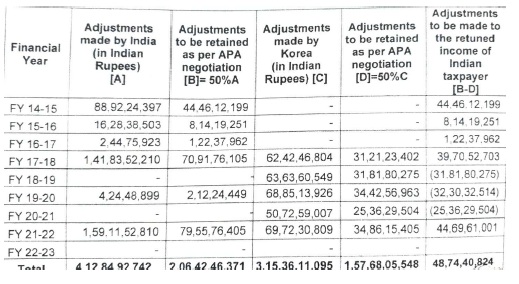
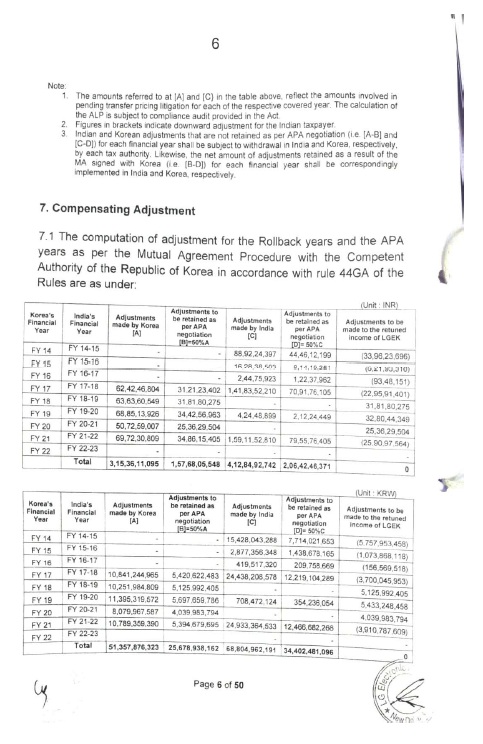
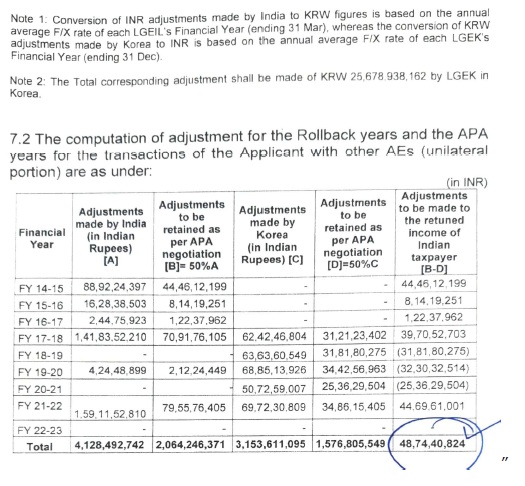
5. That being the identical factual position in all these assessment years, Mr. Vohra next submits that all these issues are no more res integra as the parties herein have arrived at an advance pricing adjustment “APA” u/s 92CC of the Act covering the impugned international transactions as well as the computation of adjustment(s) for the “Rollback” years recently on 05.01.2026; reading as under:
“This Advance Pricing Agreement (hereinafter referred to as “Agreement”) is made on this 5th day of January 2026, between the Central Board of Direct Taxes, Department of Revenue, Ministry of Finance, Government of India, having its office at Kartavya Bhawan, New Delhi-110 001, India (hereinafter referred to as “CBDT”) of the first part, AND
LG Electronics India Limited (“LGEIL”) (PAN-AAACL1745Q), a company registered in India under the Companies Act, 1956 and having its registered office at A-24/6, Mohan Cooperative, Industrial Estate, Mathura Road, New Delhi 110044, hereinafter referred to as “the Applicant” or “LGEIL”) (which expression shall include its successors, assignees, administrator, liquidator and receivers, wherever the context of meaning shall so require or permit) of the second part; (The CBDT and the Applicant shall hereinafter be referred to as such or collectively as “Parties” and individually as “Party”)
WHEREAS, the Applicant is engaged in the business of manufacturing and trading of electronic goods and consumer durables. Further, the Applicant has entered into various international transactions with LG Electronics Inc., South Korea (hereinafter referred to as “LGEK”) and other Associated Enterprises (“Other AEs”), collectively referred to as Associated Enterprises (“AEs”) and has filed an application in Form 3CED under rule 10-1 of the Income-tax Rules, 1962 (hereinafter referred to as “the Rules”) on 29 March 2018 proposing to enter into a Bilateral Advance Pricing Agreement with CBDT to determine the Arm’s Length Price (hereinafter referred to as “ALP”) of the international transactions with LGEK, and into a Unilateral Advance Pricing Agreement for transactions with Other AEs, covered by this Agreement pursuant to the provisions of clause (a) of sub-section (1) of section 92CC of the Income-tax Act, 1961, (hereinafter referred to as “the Act”) read with rules 10F to 10T and rule 44GA of the Rules;
AND WHEREAS the Competent Authority of India has formalized a Mutual Agreement Procedure with the Competent Authority of the Republic of Korea in accordance with rule 44GA of the Rules and the Applicant has conveyed its acceptance to such Mutual Agreement under the said rule 44GA; AND WHEREAS the CBDT, having obtained the approval of the Central Government, is authorised to enter into an Agreement with the Applicant pursuant to the provisions of clause (a) of subsection (1) of section 92CC of the Act, read with rules 10F to 10T and rule 44GA of the Rules.
AND WHEREAS the terms agreed under the Mutual Agreement with
Republic of Korea in respect of the Applicant’s transactions with its AE in Republic of Korea would also apply to its transactions with other covered AEs subject to other conditions prescribed in this Agreement, and the Applicant has conveyed its acceptance to the same,
AND NOW the Parties have agreed to enter into the said Agreement in accordance with and subject to the provisions of the Act, on the terms and conditions described hereunder:
1. Definitions
For the purposes of this Agreement, unless the context otherwise requires:
(a) “materially” and “material” will be interpreted consistently with the ordinary definition of these terms and in a manner that there is a material change, if the knowledge of the new facts could reasonably have resulted in an Agreement with significantly different terms and conditions:
(b) “previous year” means the financial year (commencing on the first day of April and ending with the thirty-first day of the following month of March) immediately preceding the assessment year.
For the purposes of the above definitions, computation of all expenses and revenue shall be in accordance with the Generally Accepted Accounting Principles /Indian Accounting Standards (IND AS), as applicable to LGEIL for the relevant years, for which the audited financial statements of LGEIL shall be relied upon. Any term not defined herein shall, unless the context otherwise requires, take its meaning as assigned to it in the Act read with the Rules.
2. The term of the Agreement
The Agreement shall apply to previous years 2018-19 to 2022-23 (relevant to assessment years 2019-20 to 202324) (hereinafter referred to as “APA years”) and previous years 2014-15 to 2017-18 (relevant to assessment years 2015-16 to 2018-19) (hereinafter referred to as “Rollback years”).
3. Covered Transactions and Associated Enterprises
3.1 The details of the AEs with whom the Applicant shall undertake the international transactions are described in Appendix I(a) of the Agreement. It is clarified that the bilateral portion of the Agreement applies to the Applicant’s transaction with LGEK while the unilateral portion applies to the Applicant’s transactions with Other AEs listed out in serial no. 2 to 56 of Appendix I(a).
3.2 For the bilateral and unilateral portion of this Agreement, the covered transactions between the Applicant and its AEs shall be
| (b) |
|
Import of raw materials, spares, consumables and components |
| (c) |
|
Export of raw material, spares and service components |
| (d) |
|
Import of finished goods |
| (e) |
|
Export of finished goods |
| (f) |
|
Export of Traded Goods |
| (g) |
|
Import of capital goods |
| (i) |
|
Service warranty charges (payable) |
| (j) |
|
Service warranty expenses (receivable) |
| (k) |
|
Corporate guarantee paid |
| 1) |
|
Reimbursement of expenses by LGE India to AEs |
| (m) |
|
Reimbursement of expenses by AEs to LGE India |
| 0) |
|
Software services received |
| (p) |
|
Repair of machinery (payable) |
| (q) |
|
Inspection charges (payable) |
3.3 The covered transactions shall include the issue arising from the incurring of advertisement, marketing and promotion (AMP) expenses by LGEIL
4. Functions, Assets and Risks
The functions performed, assets employed, and risks assumed (hereinafter referred to as “FAR”) by the Applicant and its AE, for the covered transactions shall be as given in Appendix I(b).
5. Most Appropriate Transfer Pricing Method (“MAM”)
The Most Appropriate Transfer Pricing methodology for the covered transactions as per clause 3.2 above shall be the ‘Other Method’ as prescribed under rule 10AB of the Rules. The ‘Other Method’ shall be as under:
Step 1: The operating margins returned by the Applicant (LGEIL) and its AE (LGEK) shall be accepted;
Step 2: The transfer pricing adjustments made in India and Korea shall be retained to the extent of 50% of the total adjustment made by the respective tax authorities,
The final ALP shall be a combination of steps 1 and 2 above and is illustrated in clause 6 of this Agreement.
6. Arm’s Length Price (“ALP”)
The ALP of the covered transaction during the covered years of this Agreement shall be as under:
6. The Revenue is equally fair in not disputing all these intervening developments in the assessee’s instant five appeals. We thus accept all these assessee’s former four substantive issues/grounds in all these appeals and direct the learned Transfer Pricing Officer as well as the Assessing Officer; as the case may be, to finalize the consequential computation in its case as per law in very terms. All these assessee’s four substantive grounds/issues in the impugned five assessment years; are treated as allowed for statistical purposes in preceding terms.
7. The assessee further submits that its fifth substantive grievance i.e., ground nos. 13 to 13.4, 11 to 11.3, & 8 to 8.2 relating to the appeals filed in the assessment years 2015-16, 2017-18 and 2020-21; respectively, seeks to reverse the learned lower authorities action disallowing its salary payments to expatriate u/s 37 disallowed u/s 37(1) of the Act thereby holding that the employees concerned had worked under the direct control of “LG, Korea”. We are informed that the instant issue also does not require the tribunal’s afresh adjudication since already decided against the department in assessee’s appeal L.G. Electronics India (P.) Ltd. v. ACIT (Delhi – Trib.)/ITA No. 755/Del/2015, in assessment year 2010-11 decided on 16.08.2022; as under:
“102. Ground No. 11 relates to the disallowance of salary of Rs. 36,33,50,841/- paid to expatriates u/s 37(1) of the Act holding that the expatriate employees work under direct control of LG Korea.
103. Briefly stated, that the facts of the impugned issue are that the assessee is engaged in the business of manufacturing consumers electronics and home appliances. During the year under consideration, in order to manufacture such technologically advanced goods, the assessee has employed 3,970 people including 42 expatriates, who were also on the payroll of LG Korea.
104. During the course of scrutiny assessment proceedings and on examination of the claim, the AO disallowed the salary amounting to Rs. 36,33,50,841/- paid to the said 42 expatriates by holding that the said expatriates were of the holding company/AE LG Korea and were serving the business interest of the holding company and, therefore, salaries paid to such expatriates by the assessee was not incurred wholly and exclusively for the business interests of the assessee.
105. Before us, the Id. counsel for the assessee stated that there is no dispute that the expatriates were employees of LG Korea earlier and therefore, continued to have lien on their employment with LG Korea. But during the year under consideration were in total employment with, and were working under the direct control and supervision of the assessee. It is the say of the Id. AR that the assessee was legal and economic owner of such expatriates during the year under consideration.
106. The Id. counsel drew our attention to the employment letters and Form No. 16 issued by the assessee. The ld. counsel further stated that while employing these expatriates, the assessee has followed a strict, well defined recruitment process, headed by the HRD of the assessee and expatriates hired by the assessee had to go through recruitment process of the assessee and were selected on the basis of their skills and merits.
107. The Id. counsel further stated that the assessee shares the job description of the persons to be hired with its AE LG Korea which recommends the names of the people having requisite skills for the relevant job description. It was stated that the expatriates were employed by the assessee for the purpose of its business and were not deputed by the holding company to serve its business. It was also strongly contended that during the period of employment of expatriates, the remuneration for services was directly paid by the assessee and LG Korea was not responsible to pay any remuneration or perquisite for performing their responsibilities. Salary was paid by the assessee after deducting tax at source in accordance with the provisions of the Act and the same has been accepted by the revenue.
108. Reliance was placed on the decision of the Hon’ble Supreme Court in the case of Carborandum
108 ITR 335.
109. Per contra, the ld. DR strongly supporting the findings of the Assessing Officer, pointed out that it is LG Korea who nominates its employees for the purpose of deputation to the assessee. The Id. DR pointed out that only employees from LG Korea have been seconded to the assessee. It was further stated by the Id. DR that expatriates continued to have lien over their employment while on deputation in India, which clearly establishes a continuous action between the assessee and LG Korea. It was further contended that the expatriates come to India and work under the control of LG Korea reported to them and do not resign from their employment in Korea.
110. The Id. DR further contended that the AO/DRP has only contributed 25% cost of the salary of expats to the alleged PE of LG Korea in India.
111. We have considered the orders of the authorities below and have given thoughtful consideration to the rival submissions. We have also perused the employment agreement between the assessee and the expat employees. On perusal of the agreement it clearly shows that the expatriates were wholly and exclusively working for the business interest/benefit of the assessee and were not entitled to render service of any nature whatsoever to any other person. It is also true that the assessee follows a well-defined recruitment process which is headed by HRD of the assessee.
112. Process of recruitment, as exhibited at page 405 of the paper book Volume II, shows that a requisition for recruitment is raised to the HRD and on such a receipt of such a requisition, the HRD evaluates job requirement and requisite skills and competencies to fill vacant posts. Thereafter, requisition is made to LG Korea. Based on job profile, LG Korea nominate its employees and thereafter HRD of the assessee shortlists the employees from pool of names suggested by LG Korea and conducts independent interviews and finally the assessee takes final decision of recruitment.
113. Considering the entire factual matrix, the only logical conclusion that can be drawn is that, such expatriates were employees of the assessee during the year under consideration and worked under the direct control and supervision of the assessee for the purpose of business of the assessee, and for such services they were paid remuneration directly by the assessee, on which tax was deducted at source as per the relevant provisions of the Act, which part has not been disputed by the revenue.
114. The decision of the Hon’ble Supreme Court in the case of Carborandum [supra] squarely apply on the facts of the case, in as much, as the assessee company had taken such expatriates on its payroll on the basis of various agreements of employment, and such expatriate employees worked under the direct control of the assessee company for day to day working. Considering the facts of the case in totality, it can be safely concluded that the expatriates were wholly and exclusively working for the business interest of the assessee and payment of salary to such expatriates is allowable u/s 37 of the Act. We, accordingly, direct the Assessing Officer to delete the impugned addition. Ground No. 11 is allowed.”
We thus adopt judicial consistency to delete the impugned expatriate salary disallowance made in the assessee’s hands in very terms.
8. The assessee’s sixth substantive grievance i.e., raised in ground nos. 12 to 12.3 (for A.Y. 2015-16), 10 to 10.2 (A.Y. 201516), 10 to 10.2 (A.Y. 2017-18) and 7 to 7.2 (in latter twin assessment years); respectively, is directed against the learned lower authorities’ action disallowing its royalty paid to the parent entities LG Electronics India Private Limited, Korea as capital expenditure. Suffice to say, we note that not only the assessee had succeeded on the very issue in assessment years 2012-13 to 2014-15 before the tribunal but also the same forms very well part of the above extracted APA (supra) as well. We thus delete the impugned disallowance of royalty in very terms.
9. The assessee’s seventh substantive ground herein is that the learned lower authorities have erred in law and on facts in disallowing its provisions if service warranty made on scientific and rational basis in assessment year 2015-16. It invites our attention to the tribunal’s order right from assessment years 2002-03 to 2008-09 as well as in assessment years 2013-14 to 2014-15(supra) that the department’s very stand stands already rejected which has gone unrebutted from the Revenue side. We thus adopt judicial consistency herein as well to delete the impugned provision for service warranty disallowance in assessment year 2015-16 therefore.
10. The assessee’s eighth substantive issue raised herein as per its thirteenth ground in assessment year 2017-18 is that the Assessing Officer has erred in law and on facts in restricting the TDS credits claim made in the revised return. The same is found to be more involving a factual reconciliation and verification than any substantive adjudication on our part as duly agreed by both the parties. We thus direct the learned Assessing Officer to decide the same afresh as per law therefore. This assessee’s ground succeeds for statistical purposes.
11. Next comes the assessee’s ninth substantive ground/issue raised in assessment years 2015-16, 2017-18 & 2018-19 that the learned lower authorities have erred in law and on facts in not allowing its additional claim in support of the Dividend Distribution Tax “DDT” going by Indo-Korea Double Taxation Avoidance Agreement “DTAA” thereby concluding that the same ought to be computed as per section 115-O of the Act. The Revenue vehemently submits in light of Dy. CIT v. Total Oil India (P.) Ltd. (Mumbai – Trib.) that the very issue already stands decided against the assessee. Learned senior counsel on the other hand submits that recent case law Colorcon Asia (P.) Ltd. v. Jt. CIT [2026] 486 ITR 476 (Bombay) has thereafter adjudicated the very issue in the assessee’s favour which has gone unrebutted from the revenue side.
12. By that as it may, the fact remains that hon’ble apex court’s recent interim order in Jt. CIT v. Colorcon Asia (P.) Ltd. (SC) admitting the Revenue’s Special Leave Petition “SLP” has directed all the high courts in the country to consider staying further proceedings on the very issue; reading as under:
“1. The following substantial questions of law arise for consideration in the present special leave petition:
i. Whether tax under Section 115-0 on any amount declared, distributed or paid by a company by way of dividend chargeable to additional income tax is in the nature of tax on distributed profits or tax on dividend?
ii. Whether Dividend Distribution Tax (DDT) paid by the respondent company on amounts declared, distributed and paid as dividend [as defined under the India-UK Double Taxation Avoidance Agreement (DTAA) and the Income Tax) to a resident of UK can be levied at a rate higher than permitted under the treaty; and
iii. Whether DDT being an income tax or an identical and/ or substantially similar tax is governed by UK DTAA.
2. It has been brought to our notice that the correctness of the decision impugned in this special leave petition has been doubted by a coordinate bench of the Bombay High Court vide order dated 27.04.2026 passed in Income Tax Appeal No.1123 of 2025
Foseco India Ltd. Company v.
Asstt. CIT [
2026] (Bombay). A copy of the order dated 27.04.2026 has been placed before us. In paragraph 40 of the said order, the following questions have been referred to a larger bench of the High Court. The said paragraph is reproduced herein under:
40. In our respectful opinion, in these circumstances, the following questions of law are required to be answered by the Larger Bench:
(1) Whether the decision of the Division Bench in M/s. Colorcon Asia Pvt. Ltd. v. The Joint Commissioner of Income Tax, Panji Goa and Ors. (Tax Appeal No.5/2004 decided on 28 November, 2025) lays down the correct position in law when it holds that, Dividend Distribution Tax (DDT) is a tax paid by the Company, on dividend income of the shareholder, entitling the shareholder of the benefit of the provisions of Double Taxation Avoidance Agreement (DTAA) between India and UK?
(ii) Considering the decision of the Supreme Court in Godrej and Boyce Pvt. Ltd. (supra), whether the decision of the Division Bench in M/s Colorcon Asia Pvt. Ltd. (supra) is per incuriam?
3. Having regard to the ramifications of the aforesaid questions being answered either way, several intervention applications (IA No. 143674/2026, IA No. 147312/2026, IA NO.146726/2026 and IA No. 151478/2026) have been filed. To enable the parties to make their submissions before us, the intervention applications are allowed.
4. Having regard to the fact that similar issue may have arisen before other High Courts also, we deem it appropriate to direct that the Registry of this Court shall circulate this order to all the High Courts. The Registry of the each High Court shall publish this order in the cause list of the High Court informing the parties about the matter being considered by us. Such exercise may be completed within a period of three weeks from today.
5. If any intervention application needs to be made before us, the same may be made by 15.07.2026.
6. List on 12.08.2026.
7. In the meantime, the High Courts may consider staying the further proceedings of any matter involving similar issues.”
(emphasis supplied)
13. We thus remit the instant issue back to the learned Assessing Officer to wait their lordships’ final adjudication in very terms. Allowed for statistical purposes.
14. Learned senior counsel’s states very fairly that the assessee does not wish to press for its substantive issue as per third ground raised in assessment years 2015-16 involving deduction of education cess on income tax payments. Rejected accordingly.
15. Mr. Vohara invites our attention to the assessee’s eleventh substantive grievance raised in ninth ground in assessment years 2020-21 that section 234A interest herein deserves to be computed afresh as the assessee had filed its return on 08.02.2021 whose “due” date was 15.02.2021. We therefore deem it appropriate to direct the learned Assessing Officer to redecide the issue afresh as per law in very terms. Allowed for statistical purposes.
16. Learned senior counsel does not press for the assessee’s sixteenth, ninth and tenth substantive ground in assessment years 2017-18, 2018-19 and 2020-21 raising the issue of initiation of section 270A penalty since premature at this stage. Rejected accordingly.
17. Mr. Vohra invites our attention to the assessee’s thirteenth substantive issue as per its eleventh ground in A.Y. 2020-21 seeking credit of self-assessment tax which is hereby restored back to the Assessing Officer for his afresh computation as per law as agreed between both the parties. Allowed for statistical purposes.
18. The assessee’s fourteenth and fifteenth substantive issues/ grounds are regarding sections 234B, 234C & 234D interest and section 271(1)(c) penalty(ies) which are treated as consequential in nature and rejected in very terms.
19. The assessee’s sixteenth substantive ground/issue in fourteenth and fifteenth grounds in A.Ys. 2015-16 & 2017-18 seeking tax credit of advance tax stands restored back to Assessing Officer for his afresh appropriate reconciliation and factual verification as per law.
20. The assessee’s seventeenth and eighteenth substantive issue/grounds raised herein seek to claim correct tax rate application and against double addition of transfer pricing adjustment which are treated as consequential in nature. Learned Assessing Officer is directed to ensure the correct tax rate is applied and there is no double addition in its hands. Necessary computation shall follow as per law in all these cases.
No other ground or arguments has been pressed before us.
21. These assessee’s five appeals ITA Nos. 490/Del/2021, 2493/Del/2022, 1036/Del/2023, 4397/Del/2024, 187/Del/2026 are partly allowed in above terms. A copy of this common order be placed in the respective case files.