


Advocates acting as Insolvency Professionals are subject to forward charge GST and must register.
Issue
Whether GST on services rendered by an Advocate acting in the capacity of an Insolvency Professional (IP) falls under the reverse charge mechanism applicable to legal services or under the forward charge mechanism under GST laws.
Facts
-
Background of Petitioner: The petitioner, an Advocate enrolled since 1995, registered as an Insolvency Professional with the Insolvency and Bankruptcy Board of India (IBBI) in July 2017.
-
Appointment as IRP: The National Company Law Tribunal (NCLT), Delhi, appointed the petitioner as an Interim Resolution Professional (IRP) in December 2018.
-
Invoicing Dispute: The petitioner raised invoices in August and October 2019 without GST, asserting that reverse charge mechanism (RCM) applied pursuant to Notifications 12/2017 and 13/2017. The Resolution Professional (RP) insisted on GST-compliant invoices.
-
NCLT Reference: The NCLT referred the dispute regarding GST applicability on Insolvency Professional fee to the IBBI.
-
IBBI Ruling: On 9 March 2021, IBBI held that insolvency and receivership services are not eligible for reverse charge mechanism and directed the petitioner to issue GST-compliant invoices under forward charge.
-
Writ Petition: The petitioner filed a writ petition before the High Court challenging the IBBI’s order.
Decision
-
In Favor of Revenue: The court upheld the IBBI’s view, ruling against the petitioner.
-
Forward Charge as Default Rule: Under GST law, the supplier is liable to pay tax under forward charge unless specifically notified under reverse charge.
-
Distinct Service Classification: Insolvency and receivership services fall under SAC Code 998241, which is distinct from legal services classified under SAC Code 99821.
-
Role Determines Taxability: The nature of the supply is governed by the role performed (Insolvency Professional) rather than the personal qualification or enrolment of the individual as an Advocate.
-
Non-Extension of RCM Exemption: The reverse charge benefit notified for Advocates providing legal services does not extend to services supplied in the capacity of an Insolvency Professional.
-
Mandatory Registration & Compliance: Advocates operating as Insolvency Professionals are required to obtain GST registration, issue GST-compliant invoices, and collect/pay tax under forward charge.
Key Takeaways
-
Qualification vs. Capacity: An Advocate acting as an Insolvency Professional acts under the IBC framework, not as a legal practitioner; the capacity in which the service is supplied dictates GST applicability.
-
Specific SAC Code Classification: “Insolvency and receivership services” (SAC 998241) and “Legal services” (SAC 99821) are distinct categories; RCM notifications applicable to legal services cannot be stretched to cover IP services.
-
Forward Charge Default for IPs: All Insolvency Professionals (whether Advocates, Chartered Accountants, or Cost Accountants) are uniformly subject to forward charge GST and must issue tax-compliant invoices.
HIGH COURT OF DELHI
Kanwal Chaudhary
v.
Insolvency and Bankruptcy Board of India
PRATHIBA M. SINGH and SHAIL JAIN, JJ.
W.P.(C) No. 9410 of 2021†
AUGUST 13, 2026
Rajat Navet, Kushagra Pandit and Rajat Rana, Advs. for the Petitioner. Ashish Verma, Nikhil Thakur, Ms. Kriti, Pulkit Deora, Ajay Kumar Agarwal, Ms. Upasna Vashistha, Preetpal Singh, Ms. Simran Kumari, Ms. Pooja, Sagar Pathak, Vinamra Kothari, K.V. Jain, Advs. and Ruchesh Sinha, SSC for the Respondent.
JUDGEMENT
Prathiba M. Singh, J.- This hearing has been done through hybrid mode.
2. The present petition has been filed by the Petitioner-Mr. Kanwal Chaudhary, under Article 226 of the Constitution of India, inter alia, assailing the order dated 9th March, 2021, passed by the Insolvency and Bankruptcy Board of India (hereinafter, ‘IBBI’).
3. Vide the impugned order, the IBBI has held that ‘Insolvency and receivership services’ are not covered under the reverse charge mechanism and thereby, the Petitioner was directed to submit Goods and Services Tax (hereinafter, ‘GST’) compliant invoices towards the professional fees charged by him in the capacity of an interim resolution professional.
I. Factual Background
4. The background of the present case is that, Mr. Kanwal Chaudhary, is an Advocate registered with the Bar Council of Delhi and has been practising law since 1995.
5. Upon the enactment of the Insolvency and Bankruptcy Code, 2016 (hereinafter, ‘the IBC’), the Petitioner decided to take the ‘Limited Insolvency Examination’ in order to be recognised and registered as an Insolvency Professional. The Petitioner qualified in the said examination, and is stated to have been registered as an Insolvency Professional since 27th July, 2017.
6. On 13th December, 2018, the NCLT, Delhi Bench, while admitting an application under Section 9 of the IBC, filed by Workspace Consulting Pvt. Ltd. in CP(IB) No. 408/2018, appointed the Petitioner as an Interim Resolution Professional for the Corporate Debtor i.e., Ireo Fiveriver Pvt. Ltd.
7. The Petitioner in his role as the Interim Resolution Professional is stated to have raised certain invoices dated 13th August, 2019 and 31st October, 2019 upon the corporate debtor.
8. On 17th September, 2019, Respondent No.2-Mr. K.V. Jain was appointed as the Resolution Professional for the Corporate Debtor and took over the assignment from the Petitioner.
9. Since the payments had not been made to the Petitioner, by the Corporate Debtor, the Petitioner preferred two applications being CA 430/ND/2019 and CA 1268/ND/2020 before the NCLT, seeking appropriate directions for release of payments.
10. Both the aforesaid applications came to be taken up for hearing before the NCLT on 1st September, 2020 and Mr. K.V Jain, the Resolution Professional, was directed to examine Petitioner’s invoices and calculate the contribution to be made by the Committee of Creditors.
11. Thereafter, vide email dated 6th September, 2020, Mr. K.V. Jain, called upon the Petitioner to issue GST compliant invoices, in place of the invoices dated 13th August, 2019 and 31st October, 2019. The Petitioner, by email reply dated 9th September, 2020, responded that he was neither registered with the GST Department nor required to be so registered, being exempted in terms of Section 9(3) and (4) of the Central Goods and Services Tax Act, 2017 (hereinafter, ‘CGST Act’) read with the Notification No. 12/2017 Central Tax (Rate) dated 28th June, 2017 and Notification No. 13/2017-Central Tax (Rate), dated 28th June, 2017 issued by Government of India, Ministry of Finance (Department of revenue).
12. Mr. K.V. Jain, by a further email dated 17th September, 2020, once again sought GST compliant invoices from the Petitioner. In response, the Petitioner, vide email dated 18th September, 2020, reiterated his stand.
13. Thereafter, on 23rd September, 2020, Mr. K.V Jain filed an additional affidavit before the NCLT, stating that an amount of Rs. 49,04,988/- was payable to the Petitioner, while once again raising the issue of GST compliant invoices. In response, the Petitioner filed his Response Affidavit dated 5th October, 2020, stating that GST, if payable, was to be paid by the Corporate Debtor on a ‘reverse charge’ basis.
14. The NCLT, vide order dated 7th October, 2020, while directing the balance payment of Rs. 49,04,988/- to be paid to the Petitioner, sought a clarification pertaining to the payment of GST to the IBBI. The relevant portion of the order dated 7th October, 2020 is set out below:
“IA No. 430/ND/2019 along with IA No. 1268/ND/2020 These two applications filed by erstwhile IRP seeking directions with respect to payment of the expenses incurred and the fees of erstwhile IRP. Mr. Chaudhary, Learned Counsel appearing for the erstwhile IRP states that there are two memos submitted to Resolution Professional against which the payment was not made. Mr. Deora, Learned Counsel for the Resolution Professional states that they have filed reply and out of total amount of Rs. 77 ,07 ,907 /-, after verification, total of Rs. 28,02,919/- has already been paid thus leaving a balance of Rs. 49,04,988/-. Resolution Professional is directed to disburse the balance amount to the erstwhile IRP of Rs. 49,04,988/-within three days.
At this stage, it is- mentioned that a clarification is required with respect to payment of GST by parties. The same can be referred to IBBI for clarification.
With this direction, applications are disposed of.”
15. As is evident from the above order passed by the NCLT, a clarification was sought from the IBBI, as to who is liable to deposit the GST. Pursuant thereto, the IBBI issued its clarification dated 9th March, 2021 (hereinafter, ‘the impugned order’.
16. The IBBI observed that ‘Insolvency and Receivership’ services are not covered under the ‘reverse charge mechanism’, and that the Petitioner, who was the interim resolution professional, was, therefore, required to submit GST compliant invoices in respect of the professional fee charged by him. The decision of the IBBI dated 9th March, 2021 is extracted below:
“This is with reference to your letter dated October 12, 2020 and Hon’ble NCLT, New Delhi order dated October 07, 2020 in the matter of Worxpace Consulting Pvt. Ltd. V/s Ireo Fiveriver Pvt. Ltd. on the issue of applicability of GST on professional fee charged by interim resolution professional (IRP) in the aforesaid matter.
2. In this connection, it is hereby informed that the matter has been examined vis-a-vis the provisions of extant GST law. It is also understood that the ‘Insolvency and Receivership ‘ services are not covered under ‘Reverse Charge Mechanism,’ as/claimed by Mr. Kanwal Chaudhary, having acted as IRP in the matter
3. Mr. Kanwal Chaudhary, IRP is therefore required to submit to the Resolution Professional, the GST compliant invoices towards the professional fee being charged by him in the capacity of IRP in the aforesaid matter. “
17. Aggrieved by the decision of the IBBI, the Petitioner has preferred the present petition seeking the following reliefs:
| “a) | Issue an appropriate Writ/order/direction quashing Respondent’s Communication/order dated 09.03.2021, whereby it has held that Insolvency and Receivership services provided by an Advocate under the Insolvency and Bankruptcy Code, 2016 is not covered under the Reverse Charge Mechanism in terms of Section 9 of the GST Act, 2017; |
| (b) | Issue an appropriate Writ/order/direction directing that services provided by an Advocate under the Insolvency and Bankruptcy Code, 2016 are covered under the Reverse Charge Mechanism in terms of Section 9 of the GST Act, 2017 and notifications issued under the said Act from time to time; |
| (c) | Pass such other order(s) and further order(s) as this Hon’ble Court may deem just and proper in the facts and circumstances of the case.” |
II. Proceedings before the Court
18. Notice in the present petition was issued on 9th September, 2021, whereby the impugned order dated 9th March, 2021 was stayed.
19. The said interim order was made absolute during the pendency of the present petition, vide order dated 17th August, 2022.
20. On 29th January, 2025, this Court noted that pleadings in the matter stood completed and directed that the matter be listed for hearing.
21. Pursuant thereto, the matter was listed from time to time. On 24th July, 2025, this Court directed the Bar Council of India to place its stand before the Court.
22. Thereafter, the submissions on behalf of the Petitioner were concluded on 10th September, 2025. The matter was taken up for final hearing on 9th July, 2026.
23. On the said date, arguments on behalf of the Respondents were concluded and the judgment was reserved.
III. Submissions on behalf of the parties
(a) Submissions on behalf of the Petitioner
24. Mr. Rajat Navet, ld. Counsel for the Petitioner has made the following submissions:
| (i) | At the outset, it is stated that the impugned order is passed without any jurisdiction, as the IBBI is not the competent authority to determine the applicability of ‘forward charge mechanism’ to Advocates acting as Insolvency Professionals. |
| (ii) | That one of the categories of persons who are qualified to give the ‘Limited Insolvency Examination’ in terms of Chapter-III, Regulation 5 of the Insolvency and Bankruptcy Board of India (Insolvency Professionals) Regulations, 2016 (hereinafter, ‘the IBBI regulations) are Advocates enrolled with the Bar Council. |
| (iii) | Advocates who are enrolled with the Bar Council, under the prevailing system, are governed by the ‘reverse charge mechanism’ for payment of GST. Though other Insolvency Professionals may be liable to pay GST under the ‘forward charge mechanism’, the position is different, where an Insolvency Professional is also an Advocate. In such a case, the GST registration need not be obtained by the said Advocate. Such an Advocate, would continue to be governed by the ‘reverse charge mechanism’, even for the services rendered as an Insolvency Professional. |
| (iv) | Insofar as the manner in which Advocates are governed under the GST regime is concerned, reliance is placed upon the following: |
| (a) | Notification No. 12/2017 Central Tax (Rate) dated 28th June, 2017 issued by the Government of India, Ministry of Finance (Department of revenue) (hereinafter, Notification No. 12/2017 Central Tax (Rate), where advocate and legal service are defined. |
| (b) | Notification No. 13/2017-Central Tax (Rate), dated 28th June, 2017, issued by the Government of India, Ministry of Finance (Department of Revenue),(hereinafter, ‘Notification No. 13/2017-Central Tax (Rate) whereby it has been clarified that, in respect of certain services, the GST shall be payable on reverse charge basis. It is stated that the said notification includes services by an Advocate. |
| (c) | The order dated 12th July, 2017 passed by the Coordinate Bench of this Court in W.P. (C) 5709/2017 titled ‘J.K. Mittal & Company v. Union of India & Ors.’, wherein the Court observed that there is lack of clarity as to whether all legal services provided by legal practitioners and law firms would be governed by the ‘Reverse Charge mechanism’. Thus, the Court directed that no-coercive action be taken against any lawyer or law firm for non-compliance under the GST regime. |
| (d) | The order dated 18th July, 2017 passed by the Coordinate Bench of this Court in W.P. (C) 5709/2017.Vide the said order, the Court observed that until further order, the Advocates, law firms, LLPs of Advocates would be governed by ‘reverse charge mechanism’, unless such individual/firm wants to take advantage of the Input Tax Credit and seeks to continue with the voluntary registration under Section 25 (3) of the CGST Act. |
| (v) | Since the notifications, as well as the orders dated 12th July, 2017 and 18th July, 2017 passed in W.P.(C) No. 5709/2017, make it abundantly clear that Advocates are covered only under the ‘reverse charge mechanism’, the impugned order would, therefore, be contrary thereto . |
| (vi) | That though other classes of professionals may also be providing Insolvency Professional Services, so far as Advocates registered with the Bar Council are concerned, they cannot be treated differently from other Advocates, if they provide insolvency professional services – failing which it would be discriminatory. |
| (vii) | Further, it is also stated that Chartered Accountants and other professionals are generally governed by the ‘Forward Charge Mechanism’ for GST, whereas Advocates are governed by the ‘Reverse Charge Mechanism’. In terms thereof, there cannot be said to be any discrimination between these two separate classes of professionals. |
| (viii) | That the term ‘legal service’ includes services of any kind, in any branch of law, and would also cover services rendered as an Insolvency Professional. To emphasise this position, reliance is placed upon the syllabus of the Limited Insolvency Examination, which is the qualifying examination for Insolvency Professionals, to contend that the majority of the subjects on which the examination is conducted, relate to statutes, laws, and other regulations, etc. |
| (ix) | Thus, it is contended that when Advocates registered with any Bar Council, render services as Insolvency Professionals, they continue to render legal services. Hence, they cannot be asked to obtain GST registration for payment of GST on a ‘Forward Charge Mechanism’ basis. |
| (x) | Furthermore, it is also stated that IBBI’s reliance on the separate classification of ‘Insolvency and Receivership Services’ under the heading 998241 of the ‘Explanatory Notes to the Scheme of Classification of Services’ issued by the GST Council (hereinafter, ‘Scheme of Classification of Services’) is misplaced, as the said entry covers advice, operational assistance, and acting as receiver/trustee in bankruptcy. However, it does not encompass the specific functions performed by an insolvency professional. |
| (xi) | In terms of the Bar Council of India Rules, Advocates can only render legal services, and cannot engage in any business or any other kind of activity, as is provided in the restrictions contained in Section VII, Part VI, Chapter II of the Bar Council of India Rules. |
| (xii) | Finally, it is contended that continued enrolment as an Advocate constitutes an eligibility requirement for appearing in the qualifying examination for registration as an insolvency professional. It is stated that, under the Advocates Act, 1961, and the Bar Council of India Rules, an Advocate can only render legal services, and that if insolvency services are not to be considered as legal services, the enrolment of the Advocate would have to be suspended. It is, therefore, submitted that any interpretation which leads to the suspension of an Advocate’s enrolment ought not to be accepted. |
(b) Submissions on behalf of the Department
25. Mr. Sinha, ld. Counsel for the GST Department has made the following submissions:
| (i) | At the outset, reliance is placed upon the affidavit dated 6th September, 2025, on behalf of the Bar Council of India (hereinafter, ‘BCI’) to contend that whenever an Advocate is appointed as an Insolvency Professional, the nature of services is different from conventional legal services. |
| (ii) | In the said affidavit, the BCI has categorically taken a position that the Advocate as an Insolvency Professional would be liable to pay GST under the ‘forward charge mechanism’ and cannot claim benefit under the ‘reverse charge mechanism’, which is applicable to traditional legal services. |
| (iii) | It is also stated that the IBBI regulations clearly prescribes the manner in which an Insolvency Professional is required to be registered. In this regard, reliance is placed upon Regulations 7, 7(2)(h), and 10 of the IBBI regulations. |
| (iv) | That when an Advocate acts in the capacity of an Insolvency Professional, they are governed by the provisions of Insolvency and Bankruptcy Code, 2016 (hereinafter, ‘IBC’) and the rules and regulations framed thereunder, and not by the Bar Council of India Rules. A distinction is, therefore, required to be drawn based on the nature of services. |
| (v) | It is emphasized that, under the GST regime, the taxability is determined by the nature of the services rendered and not by the identity or professional status of the person rendering such service. |
| (vi) | That when an Advocate is appointed as an Insolvency Professional, the individual performs functions such as managing the affairs of the Corporate Debtor, inviting claims of creditors, convening and conducting meetings of committee of creditors, submitting resolution plans, etc., Such functions, being administrative in nature, do not amount to ‘practising law’. |
| (vii) | It is contended that the Scheme of classification of services under the GST regime is specific and exhaustive, and that where a particular service is covered by a specific entry, recourse cannot be made to a general entry. |
| (viii) | In this regard, a distinction is drawn between entry- 99821 i.e., ‘legal services’ and entry-998241 i.e., ‘insolvency and receivership services’ of the Scheme of classification of services. It is stated that services rendered by an Insolvency Professional squarely fall within the specific entry which is ‘insolvency and receivership services’, and not within the general entry pertaining to ‘legal services’. |
| (ix) | Reliance is placed upon the judgments of Supreme Court in CCT v. A. R. Thermosets (P.) Ltd. (SC)/[2016] 58 GST 1 (SC)/(2016) 16 SCC 122, andMoorco (India) Ltd. v. Collector of Customs (SC)/(1994) Supp (3) SCC 562 , in support of the aforesaid submissions. |
| (x) | Thus, Mr. Sinha, ld. Counsel submits that advocates who are Insolvency Professionals have to be governed by the ‘forward charge mechanism’ and not by the ‘reverse charge mechanism’. |
(c) Submissions on behalf of the IBBI
26. On behalf of the Insolvency and Bankruptcy Board of India (hereinafter, ‘IBBI’), Mr. Ashish Verma, ld. Counsel has made the following submissions:
| (i) | A chart has been placed on behalf of the IBBI, which indicates that the total number of Advocates registered as Insolvency Professionals is approximately 273, whereas the total number of registered Insolvency Professionals is 4,558. The said chart is taken on record. The relevant statistical data, as reflected in the said chart, is set out below: |
“Table 21: Distribution of Ips as per their Eligibility as on June 30, 2025
| Eligibility | No. of Ips (Individual) | ||
| Male | Female | Total | |
| Member of ICAI | 2215 | 224 | 2439 |
| Member of ICSI | 602 | 139 | 741 |
| Member of ICMAI | 186 | 19 | 205 |
| Member of Bar Council | 238 | 35 | 283 |
| Managerial Experience | 724 | 37 | 761 |
| PGIP Qualified | 40 | 6 | 46 |
| Total | 4005 | 460 | 4558 |
| (ii) | It is emphasised that any person seeking recognition and registration as an Insolvency Professional is required to qualify the Limited Insolvency Examination conducted by the IBBI. It is only upon successfully clearing the said qualifying examination, that a person can be recognised and permitted to render services as an Insolvency Professional, and that persons who do not qualify the examination are ineligible to render such services. |
| (iii) | In this regard, it is contended that services provided by an interim resolution professional are not specific to Advocates. Even other professionals can provide such services. Advocates may provide services as an interim resolution professional. However, all Advocates may not provide services as an Insolvency Professional, unless they are eligible and qualified. |
| (iv) | Further, it is stated that Insolvency Professionals are regulated under the IBC. It is also stated that Sections 17 and 18 of the IBC clearly delineate the duties and responsibilities of an interim resolution professional, which are predominantly managerial in nature. In this regard, reliance is placed upon the decision in Swiss Ribbons (P.) Ltd. v. Union of India 152 SCL 365 (SC)/(2019) 4 SCC 17 to argue that services of a resolution professional are managerial/administrative and quasi-judicial in nature. |
| (v) | Additionally, Sections 20, 22, 23 of the IBC prescribe the manner in which the affairs of the corporate debtor are to be managed by the Insolvency Professional. |
| (vi) | Section 25 of IBC, in particular, enumerates the duties of the Insolvency Professionals. It is also stated that the Code of conduct of the Insolvency Professionals and the disciplinary proceedings against them are also separately governed by the provisions of the IBC and the IBBI regulations. |
| (vii) | Accordingly, IBC and the IBBI regulations lay down a comprehensive statutory framework governing the functioning of the Insolvency Professionals. |
| (viii) | Thus, Insolvency Professionals are governed by the statutory framework under the IBC and the regulations framed thereunder, and not by the Bar Council of India Rules or the provisions of the Advocates Act, 1961, insofar as the discharge of their functions as Insolvency Professionals is concerned. |
| (ix) | Finally, it is submitted that the role of an Advocate is extremely important. It is contended that where an Advocate renders legal services, such services are governed by the ‘reverse charge mechanism’, under the GST regime. However, where the same Advocate renders services of a different nature, for instance, by renting out immovable property, the applicable GST liability would be governed by the ‘forward charge mechanism’. |
(d) Submissions on behalf of Respondent No.2-Mr. K.V. Jain
27. Mr. Pulkit, ld. Counsel for Respondent No. 2- Mr. K.V. Jain has advanced the following submissions:
| (i) | That holding a sanad or being enrolled as an Advocate is not a prerequisite for qualifying as an Insolvency Professional. According to ld. Counsel, the IBC, which defines and regulates the Insolvency Professionals, is a complete code in itself, comprehensively governing the qualifications, registration, functions and conduct of the Insolvency Professionals. |
| (ii) | It is contended that Regulation 5(c)(iv) of the IBBI regulations makes it clear that continued enrolment as an Advocate is not mandatory, so long as the requirement of ten years’ cumulative practice, as an Advocate, has been fulfilled. It is further contended that, at the stage, when a person seeks to appear for the qualifying examination or obtain registration as an Insolvency Professional, he or she is not required to be a practising Advocate. |
| (iii) | Furthermore, it is stated that the certificate of registration/licence granted by the IBBI to the Insolvency Professional is distinct from, and independent of, the enrolment granted by the Bar Council to the Advocates, and that the two operate in separate fields. |
| (iv) | Finally, it is highlighted that the preface to the Scheme of classification of services itself makes it clear that when there is a specific description, the same would be preferred over a general description. Therefore, the Insolvency Professionals ought to be governed under the specific entry-998241, and not under the general entry 99821, in the scheme of classification. |
(e) Submissions of behalf of BCI
28. Mr. Preetpal Singh, ld. Counsel appearing for the BCI, places reliance upon the affidavit dated 6th September, 2025, filed on behalf of the BCI to contend that the services rendered by the Insolvency Professionals are not governed by the ‘reverse charge mechanism’, under the GST regime. It is submitted by ld. Counsel that such services are governed by the ‘forward charge mechanism’.
29. It is stated on behalf of the BCI that when an Advocate is appointed as an Insolvency Professional, under IBC, the nature of services rendered are different from conventional legal services.
30. Thus, it is stated that Advocates acting as Insolvency Professionals are liable to pay GST under the ‘forward charge mechanism’ and are not covered under the ‘reverse charge mechanism’, which is applicable to traditional legal services.
IV. Analysis and findings
31. The issue that arises for determination in the present petition is whether Advocates, who act as Insolvency Professionals, would be governed by the ‘forward charge mechanism’ or the ‘reverse charge mechanism’, for the purposes of payment of GST.
32. In order to answer the aforesaid question, the following three aspects require consideration:
| (i) | The GST payment mechanism applicable to Advocates. |
| (ii) | The GST payment mechanism applicable to Insolvency Professionals. |
| (iii) | The GST payment mechanism applicable to Advocates who act as Insolvency Professionals. |
A. The GST payment mechanism applicable to Advocates
33. The CGST Act came into effect from 1st July, 2017. The said Act brought into effect a whole new tax regime in India, in respect of supply of goods and services.
34. Under Section 12 and 13 of the CGST Act, the liability to pay the tax arises at the time of ‘supply’ of goods or services.
35. Section 9(1) of the CGST Act, is the charging provision. It levies tax on all supplies of goods or services or both, to be collected in the manner prescribed and paid by the taxable person. Section 2(107) of the CGST Act defines a ‘taxable person’, as a person registered or liable to be registered under Section 22 and Section 24 of the CGST Act.
36. Under Section 22 of the CGST Act, the registration of the ‘supplier’ is compulsory.
37. The tax is paid at the time when the supply is made by the person who has undertaken the outward supply – the supplier. The incidence of tax is thus at the stage when the supply is made. This is the mechanism under the ‘forward charge mechanism’, and is the default rule. Thus, the supplier has to include the GST component, at the time of raising the invoice, in the invoice itself. The liability to pay the GST is thus of the supplier.
38. However, Section 9(3) of the CGST Act, empowers the Government acting on the recommendations of the GST Council, to notify specific categories of supply of goods or services, in respect of which the tax shall be paid by the recipient, i.e., where the recipient is the person liable to pay tax under the CGST Act. Is respect of such categories, the tax is paid or liable to be paid on reverse charge basis, and the responsibility of paying the tax shifts from the supplier, to the recipient of such goods and services.
39. In order to determine the GST payment mechanism applicable to Advocates, it would be necessary to examine the relevant statutory notifications and judicial decisions interpreting the same.
40. Insofar as Advocates are concerned, two notifications are relevant to determine the manner in which GST is paid, namely:
| (i) | Notification No. 12/2017 Central Tax (Rate) dated 28th June, 2017 issued by the Government of India, Ministry of Finance (Department of revenue); |
| (ii) | Notification No. 13/2017-Central Tax (Rate), dated 28th June, 2017, issued by the Government of India, Ministry of Finance (Department of Revenue) |
41. In terms of Notification No. 12/2017 Central Tax (Rate), an Advocate is defined as under:
“(b) “advocate” has the same meaning as assigned to it in clause (a) of sub-section (1) of section 2 of the Advocates Act, 1961 (25 of 1961);”
42. The said notification also defines ‘legal services’ in the following terms:
“(zm) “legal service” means any service provided in relation to advice, consultancy or assistance in any branch of law, in any manner and includes representational services before any court, tribunal or authority;”
43. The Notification No. 13/2017-Central Tax (Rate) provides that for certain services, the central tax leviable under Section 9 of the CGST Act, shall be paid on ‘reverse charge’ basis, by the recipient of such services. Such services includes the following:
XXX
. “GSR. :. (E).- In exercise of the powers conferred by sub-section (3) of section 9 of the Central Goods and Services Tax Act 2017 (12 of 20 17), the CentralGovernment on the recommendations of the Council hereby notifies that on categories of supply of services mentioned in column (2) or the Table below supplied by a person as specified in column (3) of the said Table, the whole of central tax leviable under section 9 of the said Central Goods and Services Tax Act, shall be paid on reverse charge basis by the recipient of the such services as specified in column (4) of the said Table:-
| Sl. No. | Category of Supply of Services | Supplier of service | Recipient of Service |
| 2. | Services supplied by an individual advocate including a senior advocate by way of representational services before any court, tribunal or authority, directly or indirectly, to any business entity located in the taxable territory, including where contract for provision of such service has been entered through another advocate or a firm of advocates, or by a firm of advocates, by way of legal services, to a business entity. | An individual advocate including a senior advocate or firm of advocates. | Any business entity located in the taxable territory. |
44. A conjoint reading of the aforesaid Notifications reveals that, insofar as Advocates are concerned, the central tax leviable under Section 9 of the CGST Act is payable on ‘reverse charge basis’.
45. The aforesaid Notifications also came to be considered by a Coordinate Bench of this Court in W.P. (C) 5709/2017, wherein a challenge was raised to various notifications issued under the GST regime, including Notification No. 13/2017-Central Tax (Rate).
46. The principal contention of the Petitioners therein was that legal services, as a whole, were liable to GST only under the ‘reverse charge mechanism’, in terms of the recommendations of the GST Council. It was, accordingly, contended that Notification No. 13/2017-Central Tax (Rate), insofar as it restricted the categories of legal services covered under the ‘reverse charge mechanism’, was arbitrary and violative of the rights of Advocates. While considering the said challenge, the Division Bench vide order dated 12th July, 2017 observed as under:
“[.] 14. In view of the above submissions it is plain that as of date there is no clarity on whether all legal services (not restricted to representational services) provided by legal practitioners and firms would be governed by the reverse charge mechanism. If in fact all legal services are to be governed by the reverse charge mechanism than there would be no purpose in requiring legal practitioners and law firms to compulsorily get registered under the CGST, IGST and/or DGST Acts. Those seeking voluntary registration would anyway avail of the facility under Section 25 (3) of the CGST Act (and the corresponding provision of the other two statutes). There is therefore prima facie merit in the contention of Mr Mittal that the legal practitioners are under a genuine doubt whether they require to get themselves registered under the three statutes. In the circumstances, the Court directs that no coercive action be taken against any lawyer or law firms for non-compliance with any legal requirement under the CGST Act, the IGST Act or the DGST Act till a clarification is issued by the Central Government and the GNCTD and till further orders in that regard by this Court.
15. It is clarified that any lawyer or law firm that has been registered under the CGST Act, or the IGST Act or the DGST Act from 1st July, 2017 onwards will not be denied the benefit of such clarification as and when it is issued.”
47. In terms thereof, the Court observed that there is ambiguity regarding the applicability of ‘reverse charge mechanism’ to all legal services rendered by an Advocate. Thus, the Court directed that no coercive action be taken against Advocates and law firms, pertaining to non-compliance with GST requirements, until the issue was clarified by the competent authorities.
48. The aforesaid interim protection was thereafter continued by the Coordinate Bench in W.P. (C) 5709/2017, vide order dated 18th July, 2017, wherein the Court further observed as under:
“[.] 13. Considering that the Respondents are seeking more time to address the important legal and constitutional issues that arise in these petitions and it is asserted in the Court on behalf of the Respondents that as to date, in fact, no coercive action is taken against the lawyers, law firms or providers of legal services, Limited Liability Partnerships (LLPs), for noncompliance with the legal requirement of the CGST, IGST and DGST, the Court directs that till further orders:
| (i) | no coercive action would be taken against advocates, law firms of advocates including Limited Liability Partnerships (LLPs) of advocates providing legal services for non compliance with any legal requirement under the CGST, DGST, or IGST Act; and |
| (ii) | Any advocate, law firm of advocates, LLPs of advocates who are providers of legal services, who have registered under the CGST, DGST, or IGST Act from 1st July, 2017 will not be denied the benefit of this interim order. |
| (iii) | In view of the Press Release issued by the Ministry of Finance as shown to the Court today, and the instructions given to Mr. Narula to the effect that the legal position that existed under the Finance Act, 1994 as regard legal services being amenable to service tax under the reverse charge mechanism continuing even under the CGST, DGST or IGST Acts, till further orders, all legal services provided by advocates, law firms of advocates, or LLPs of advocates will be continued to be governed by the reverse charge mechanism unless of course any such legal service provider wants to take advantage of input tax credit and seeks to continue with the voluntary registration under Section 25 (3) of the CGST Act and the corresponding provisions of IGST or DGST Act.” |
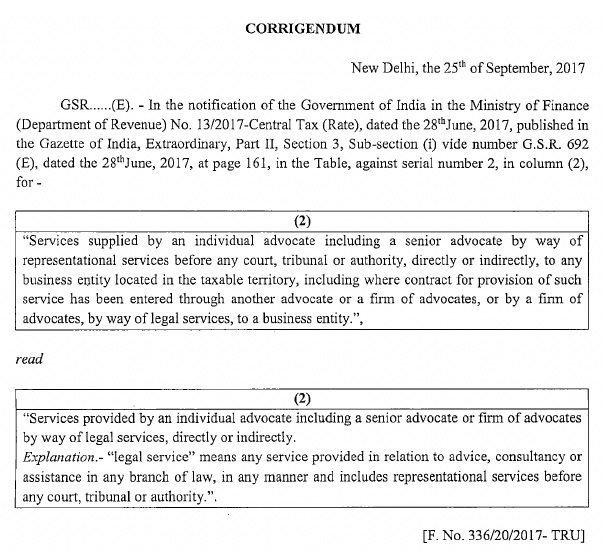
49. Thereafter, the issue in respect of Advocates being governed by the ‘reverse charge mechanism’ was clarified by way of a corrigendum dated 25th September, 2017 to Notification No. 13/2017-Central Tax (Rate), published by the Government of India, Ministry of Finance, (Department of Revenue). The said corrigendum is set out below:
50. Subsequent thereto, various writ petitions were filed before various High Courts, relating to the applicability of ‘reverse charge mechanism’. Transfer petitions came to be filed before the Supreme Court.
51. In Transfer Petition (C) No. 2460-2462/2017, vide order dated 28th March, 2018, the W.P.(C) 5709/2017 referred to above along with other petitions pending before this Court and in the High Court of Chhattisgarh were transferred to the Supreme Court. The relevant portion of the order dated 28th March, 2018 is set out below:
“[.]! .earned Additional Solicitor General and the respondent-in-person are fairly agreed that the transfer petitions be allowed and Writ Petition(C)No. 5709 of 2017 titled as M/s J.K.Mittal & Co. v. UOI & Ors., pending at High Court of Delhi at New Delhi, Writ Petition(C)No. 6017 of 2017 titled as Legalence IP Corp LLP v. UOI & Ors., pending at High Court of Delhi at New Delhi and Writ Petition (T) No. 274 of 2017 titled as M/s Lexloft Legal Advisory LLP & Anr. v. UOI & Ors, pending at High Court of Chhattisgarh be transferred to this Court. Ordered accordingly.
After transfer of the above-mentioned cases, the Registry is directed to register them as transferred cases.”
52. Thus, the position that enures as on date, from the aforesaid notifications, the orders dated 12th July, 2017 and 18th July, 2017, and corrigendum dated 25th September, 2017, is that services rendered by Advocates are governed by ‘reverse charge mechanism’, for the purposes of payment of GST.
B. The GST payment mechanism applicable to Insolvency Professionals
53. Insofar as Insolvency Professionals are concerned, it would be necessary to first examine the statutory framework under the IBC and the IBBI regulations, before considering the applicable GST mechanism.
54. The IBC was enacted in 2016, with effect from 28th May, 2016. Under the IBC, Insolvency Professionals are defined under Section 3(19), which reads as under:
“(19) “insolvency professional” means a person enrolled under section 206 with an insolvency professional agency as its member and registered with the Board as an insolvency professional under section 207;”
55. Further, Section 5(27) defines a Resolution Professional as under:
“(27) “resolution professional”, for the purposes of this Part, means an insolvency professional appointed to conduct the corporate insolvency resolution process and includes an interim resolution professional; and”
56. Section 207 of the IBC provides for the registration of Insolvency Professionals with the IBBI, as per the categories which would be specified by the IBBI. The same would include persons possessing qualifications in the field of finance, law, management, insolvency. The said provision is set out below:
“207. Registration of insolvency professionals.—
(1) Every insolvency professional shall, after obtaining the membership of any insolvency professional agency, register himself with the Board within such time, in such manner and on payment of such fee, as may be specified by regulations.
(2) The Board may specify the categories of professionals or persons possessing such qualifications and experience in the field of finance, law, management, insolvency or such other field, as it deems fit.”
57. Section 208 of the IBC lays down the functions and obligations of Insolvency Professionals. The said provision is as under:
“208. Functions and obligations of insolvency professionals.—
(1) Where any insolvency resolution, fresh start, liquidation or bankruptcy process has been initiated, it shall be the function of an insolvency professional to take such actions as may be necessary, in the following matters, namely:—
| (a) | a fresh start order process under Chapter II of Part III; |
| (b) | individual insolvency resolution process under Chapter III of Part III; |
| (c) | corporate insolvency resolution process under Chapter II of Part II; (d) individual bankruptcy process under Chapter IV of Part III; and |
| (e) | liquidation of a corporate debtor firm under Chapter III of Part II. |
(2) Every insolvency professional shall abide by the following code of conduct:—
| (a) | to take reasonable care and diligence while performing his duties; |
| (b) | to comply with all requirements and terms and conditions specified in the bye-laws of the insolvency professional agency of which he is a member; |
| (c) | to allow the insolvency professional agency to inspect his records; |
| (d) | to submit a copy of the records of every proceeding before the Adjudicating Authority to the Board as well as to the insolvency professional agency of which he is a member; and |
| (e) | to perform his functions in such manner and subject to such conditions as may be specified.” |
58. As per Section 240 of the IBC, the IBBI can frame regulations in order to carry out the provisions of IBC. In terms of the power granted under Section 240, the IBBI regulations have been framed.
59. The IBBI regulations stipulate the eligibility criteria, qualifications and experience, registration and recognition of the Insolvency Professionals. The IBBI regulations have been analysed in detail, in the next section.
60. The IBC and IBBI regulations provide a comprehensive statutory framework to regulate Insolvency Professionals. It is evident from the aforesaid statutory scheme that an Insolvency Professional is subject to distinct and self-contained regulatory regime.
61. Having regard to the aforesaid statutory framework, it would be apposite to examine the GST mechanism applicable to such services.
62. Section 9(1) of the CGST Act, 2017 provides that, subject to the provisions of 9(3), central tax shall be levied on all supplies of goods or services and shall be paid by the ‘taxable person’. A conjoint reading of Section 2(107) and Section 22 of the CGST Act, as discussed previously, denotes the taxable person to be the ‘supplier’ of the goods and services. Thus, the default rule under the CGST Act is that the supplier of services is liable to discharge GST under the ‘forward charge mechanism’.
63. In the exercise of powers under Section 9(3), Notification No. 13/2017-Central Tax (Rate) was issued, specifying the categories of services in respect of which the tax payable by the recipient of such services, is under the ‘reverse charge mechanism’.
64. Accordingly, insofar as Insolvency Professionals are concerned, services rendered by them are not separately stipulated under the specific categories of services mentioned in Notification No. 13/2017-Central Tax (Rate). Thereby, the default rule under Section 9(1) of the CGST Act applies. 65. Thus, services rendered by an Insolvency Professional is governed by the ‘forward charge mechanism’.
C. The GST payment mechanism applicable to Advocates who act as Insolvency Professionals
66. Having examined the GST mechanism applicable to Advocates, and Insolvency Professionals as two distinct classes, it is necessary to further consider what would be the position, when an Advocate renders services in the capacity of an Insolvency Professional.
67. The analysis in the foregoing sections yields that, insofar as Advocates are concerned, they are governed by the ‘reverse charge mechanism’ for the purposes of payment of GST, whereas Insolvency Professionals, as a class, are governed by the ‘forward charge mechanism’, for the said purpose.
(I) Eligibility criteria for registration as an Insolvency Professional
68. In order to examine whether an Advocate acting in the capacity of an Insolvency Professional continues to be governed by the ‘reverse charge mechanism’, or is to be governed by the ‘forward charge mechanism’ applicable to Insolvency Professionals, it is necessary to first examine the eligibility criteria prescribed for registration as an Insolvency Professional.
69. The eligibility criteria for Insolvency Professionals is prescribed in the IBBI Regulations.
70. Regulation 3 of the IBBI regulations is set out below:
” CHAPTER II
INSOLVENCY EXAMINATIONS
3. (1) The Board shall, either on its own or through a designated agency, conduct a ‘National Insolvency Examination’ in such a manner and at such frequency, as may be specified, to test the knowledge and practical skills of individuals in the areas of insolvency, bankruptcy and allied subjects.
(2) The Board shall, either on its own or through a designated agency, conduct a ‘Limited Insolvency Examination’ to test the knowledge and application of knowledge of individuals in the areas of insolvency, bankruptcy and allied subjects.
(3) The syllabus, format, qualifying marks and frequency of the Limited Insolvency Examination shall be published on the website of the Board at least three months before the examination.”
71. Regulation 4 of the IBBI Regulations provides as under:
” CHAPTER III
REGISTRATION OF INSOLVENCY PROFESSIONALS Eligibility.
4. (1) No individual shall be eligible to be registered as an insolvency professional if he-
| (a) | is a minor; |
| (b) | is not a person resident in India; |
| (c) | does not have the qualification and experience specified in Regulation 5 or Regulation 9, as the case may be; |
| (d) | has been convicted by any competent court for an offence punishable with imprisonment for a term exceeding six months or for an offence involving moral turpitude, and a period of five years has not elapsed from the date of expiry of the sentence: |
Provided that if a person has been convicted of any offence and sentenced in respect thereof to imprisonment for a period of seven years or more, he shall not be eligible to be registered;
| (e) | he is an undischarged insolvent, or has applied to be adjudicated as an insolvent; |
| (f) | he has been declared to be of unsound mind; or |
| (g) | he is not a fit and proper person; Explanation: For determining whether an individual is fit and proper under these Regulations, the Board may take account of any consideration as it deems fit, including but not limited to the following criteria- |
| (i) | integrity, reputation and character, |
| (ii) | absence of convictions and restraint orders, and |
| (iii) | competence, including financial solvency and net worth.” |
72. Upon a perusal of the aforesaid regulations, it emerges that Regulation 3 empowers the IBBI to conduct the National Insolvency Examination and the Limited Insolvency Examination, to test the individual’s knowledge and practical skills in the field of insolvency, bankruptcy and allied subjects.
73. Regulation 4 sets out the threshold disqualifications that would render an individual ineligible for registration as an Insolvency Professional.
74. These regulations establish that recognition of an Insolvency Professional is governed by an independent regulatory code i.e., IBBI regulations and independent authority i.e., the IBBI.
75. Regulation 5 provides for the qualifications and experience for an Insolvency Professional, and reads as under:
“5. Subject to the other provisions of these regulations, an individual shall be eligible for registration if he-
| (a) | has passed the Limited Insolvency Examination within twelve months before the date of his application for enrolment with the insolvency professional agency; |
| (b) | has completed a pre-registration educational course, as may be required by the Board, from an insolvency professional agency after his enrolment as a professional member; and |
| (c) | has- |
| (i) | successfully completed the National Insolvency Programme, as may be approved by the Board; |
| (ii) | successfully completed the Graduate Insolvency Programme, as may approved by the Board; |
| (iii) | experience of – |
| (a) | ten years in the field of law, after receiving a Bachelor’s degree in law; |
| (b) | ten years in management, after receiving a Master’s degree in Management or two-year full time Post Graduate Diploma in Management; or |
| (c) | fifteen years in management, after receiving a Bachelor’s degree, from a university established or recognised by law or an Institute approved by All India Council of Technical Education; or |
| (iv) | ten years’ of experience as – |
| (a) | chartered accountant registered as a member of the Institute of Chartered Accountants of India, |
| (b) | company secretary registered as a member of the Institute of Company Secretaries ofIndia, |
| (c) | cost accountant registered as a member of the Institute of Cost Accountants of India, or |
| (d) | advocate enrolled with the Bar Council. |
76. A perusal of the Regulations would show that any individual who wishes to qualify as an Insolvency Professional is required to pass the Limited Insolvency Examination, referred to in Regulation 3.
77. In addition, the individual would have to satisfy the eligibility criteria prescribed under Regulation 5(c), which requires as under:
| (i) | Complete the National insolvency programme as approved by the IBBI; |
| (ii) | Complete the post-graduate insolvency programme as approved by the IBBI; |
| (iii) | Such an individual is required to have ten years’ experience after obtaining the LLB degree, or 10 years’ experience in management after completion of the Master’s degree in management or a post graduate diploma in management, or 15 years in management after receiving bachelor’s degree from a recognised university; |
| (iv) | Individuals having 10 years’ experience as Chartered Accountants registered as members of the Institute of Chartered Accountants of India (hereinafter, ‘ICAI’), Company Secretaries registered as members of the Institute of Company Secretaries of India, Cost Accountants registered as members of the Institute of Cost Accountants of India, or Advocates enrolled with the Bar Council. |
78. It is apparent from a perusal of Regulation 5(c) of the IBBI Regulations that a wide range of degree holders are entitled to practice as Insolvency Professionals. They could include persons from varied qualifications, including , management, law, accountancy and economics.
79. Regulation 5(c) does not confine eligibility to any single basic
qualification exclusively, rather, it prescribes a defined set of alternative qualifying routes, through law, management, chartered accountancy, company secretaryship, or cost accountancy, the fulfilment of any one of which suffices, to act as an Insolvency Professional.
80. There are several professionals who hold double qualifications, such as, Chartered Accountants who are also lawyers, economists who are also lawyers, engineers who are also lawyers, and so on.
81. For instance, where a Chartered Accountant becomes a member of the ICAI, the person thereby chooses to practise as a Chartered Accountant and not as an Advocate, despite holding a law degree. Similarly, a Chartered Accountant who holds a law degree and is registered with the Bar Council chooses to practise as an Advocate and not as a Chartered Accountant.
82. In fact, Advocates form only a small sub-set of the large number of persons, who can qualify themselves as Insolvency Professionals.
83. This is further borne out by the statistical data placed on behalf of the ld. Counsel for the IBBI, which is extracted hereinabove. The said chart reveals that out of the 4,558 Insolvency Professionals registered as on 30th June, 2025, only 283 persons are Advocates registered with the Bar Council i.e., less than 6%. Thus, Advocates constitute a small fraction of the persons who can act as Insolvency Professionals.
(II) Insolvency Professionals as a distinct statutory class
84. Insolvency Professionals as a class discharge functions in terms of Section 17 (Management of affairs of corporate debtor by interim resolution professional), Section 18 (Duties of interim resolution professional), and Section 25 (Duties of resolution professional) of the IBC, and are regulated by the IBBI Regulations, which prescribes a specific code for them.
85. Further, as discussed in the preceding section, Sections 207 and 208 of the IBC prescribe the statutory framework governing the qualifications and professional obligations of Insolvency Professionals.
86. The IBBI issues the certificate of registration to the Insolvency Professionals in order to enable them to discharge their duties. Furthermore, the manner in which professional assignments are allocated to the Insolvency Professionals, is also strictly governed by the IBBI Regulations.
87. Insolvency Professionals, therefore, constitute a distinct class, governed exclusively by the IBC and the IBBI Regulations. The fact that such persons possess other qualifications or registrations, would not make them distinct or different from the class as a whole. The Insolvency Professionals as a class, are a singular, and distinct class by themselves.
88. This position finds further support in the Scheme of classification of services, adopted for the purposes of levy of GST.
89. Under the broad head for ‘legal and accounting services’, there are various subcategories of services, which are as under:
“982 Legal and Accounting Services
99821 Legal services
998211 Legal advisory and representation services concerning criminal law
This service code includes advice, representation and related services (defence, search for evidence, witnesses, experts, etc.) concerning criminal law
998212 Legal advisory and representation services concerning other fields of law
This service code includes advice, representation and other related legal services in judicial and quasi-judicial procedures concerning civil law, administrative law, constitutional law, international law, military law and other fields of law, except criminal law
998213 Legal documentation and certification services concerning patents, copyrights and other intellectual property rights
This service code includes drafting and certification of documents and other related legal services concerning patents, copyrights and other intellectual property rights
998214 Legal documentation and certification services concerning other documents
This service code includes drafting and certification of documents and other related legal services concerning other legal documents, such as wills, marriage contracts, commercial contracts, business charters, etc.
998215 Arbitration and conciliation services
xxx
998219 Other legal services n.e.c.
xxx
99822 Accounting, auditing and bookkeeping services xxx
998221 Financial auditing services
xxx
998222 Accounting and bookkeeping services
xxx
998223 Payroll services
xxx
998223 Other similar services n.e.c
xxx
99823 Tax consultancy and preparation services
998231 Corporate tax consulting and preparation services
xxx
998232 Individual tax preparation and planning services
xxx
99824 Insolvency and receivership services
998241 Insolvency and receivership services
This service code includes providing advice and operational assistance to the management and/or creditors of insolvent businesses and/or acting as receiver or trustee in bankruptcy”
90. A perusal of the above heads would show that insofar as the Insolvency Professionals are concerned, the services rendered by them i.e., ‘insolvency and receivership services’ are specifically covered under the head – 998241.
91. Furthermore, the broad head 982 -‘Legal and Accounting Services’ -is itself sub-divided into four distinct and mutually exclusive service codes. Legal services under 99821 are exhaustively enumerated through heads, 998211 to 998219, the last of which is 998219- ‘Other legal services n.e.c.’, and that is the residuary entry, meant to capture any legal service not falling within the preceding specific codes. Insolvency and receivership services, however, do not fall within this residuary entry, or anywhere within the 99821 sub-head at all. They are instead classified under an independent specific subhead, 99824, co-ordinate with, and not subordinate to 99821.
92. The Scheme of Classification, therefore, itself demonstrates that ‘insolvency and receivership services’ are treated as a distinct category of service, separate from ‘legal services’. This classification, further indicates that the nature of the service rendered by an Insolvency Professional is not, for the purposes of GST, to be equated with or subsumed within ‘legal service’ merely because the person rendering it happens to be enrolled as an Advocate.
93. The preface of the Scheme of classification of services further makes it more clear that, where a service is capable of differential treatment, based on its description, the most specific description is to be preferred over a more general one. The preface reads as under:
“Explanatory Notes to the Scheme of Classification of Services
Preface
The Scheme of Classification of Services adopted for the purposes of GST is a modified version of the United Nations Central Product Classification.
2. The Explanatory notes for the said Scheme of Classification of Services is based on the explanatory notes to the UNCPC, and as recommended by the committee constituted for the purpose, is annexed.
3. The explanatory notes indicate the scope and coverage of the heading, groups and service codes of the Scheme of Classification of Services. These may be used by the assessee and the tax administration as a guiding tool for classification of services. However it may be noted that where a service is capable of differential treatment for any purpose based on its description, the most specific description shall be preferred over a more general description. “
94. The principle that a specific entry prevails over a general entry is well settled, and has been considered in the following decisions:
| (i) | In Moorco (India) Ltd.(supra), the question before the Supreme Court was whether components and accessories of a volumetric flow meter were classifiable under the specific Customs Tariff Heading 90.24 (instruments for measuring flow) or the general residuary Heading 90.26 (production or calibrating meters). The Court observed that a specific heading of classification would prevail over a general heading. The observations of the Supreme Court are as under: |
“.The primary question, therefore, is whether the goods manufactured by the appellant fall in clause (a) as if it can be classified with reference to (a) then clauses (b) and (c) would not apply. Clause (a) incorporates the common and general principle that the goods which can be classified specifically with reference to any heading should be placed in that category alone. The specific heading of classification has to be preferred over general heading. The clause contemplates goods which may be satisfying more than one description. Or it may be satisfying specific and general description. In either situation the classification which is the most specific has to be preferred over the one which is not specific or is general in nature. In other words, between the two competing entries the one most nearer to the description should be preferred. Where the class of goods manufactured by an assessee falls say in more than one heading one of which may be specific, other more specific, third most specific and fourth general, the rule requires the authorities to classify the goods in the heading which satisfies most specific description. For instance, taking the case of the appellant the item manufactured by the appellant is described and used as flow meter. It is an instrument for measuring volume as well. Flow meter is specifically classified in Heading No. 90.24. Whereas the Heading 90.26 is general in nature, it applies to every production meter or calibrating meter for gas, liquid and electricity supply. Therefore, on the finding recorded by the Assistant Collector the goods produced by the appellant specifically fall in 90.24. They may also fall in 90.26 but that being more general entry preference should have been given to the Entry 90.24 as the goods satisfy most specific description of being flow meter. The Tribunal or the appellate authority without adverting to it applied clause (c) and levied duty under 90.26 as it was a latter heading. But clause (c) would apply only if clauses (a) and (b) do not apply. Since the goods manufactured by the appellant satisfied the specific description of Tariff Heading 90.24 being a flow meter, the Tribunal committed an error of law in classifying it under Tariff Heading 90.26 as it was a latter item under the classification list. “
| (ii) | Similarly, in SLP(C) 22191/2013 titled ‘A.R. Thermosets (Pvt.) Ltd.(supra)’, the Supreme Court was considering whether “bitumen emulsion” fell within the specific tariff entry 22 of Schedule II of Part A of the Uttar Pradesh Value Added Tax Act, 2008 (which refers only to “bitumen”), or under the general residuary entry as an unclassified commodity. In this regard, the Supreme Court held that bitumen emulsion, sharing the same composition, identity and use as bitumen, was covered by the specific entry, and that resort to the residuary entry was impermissible. The relevant portion of the said decision is as under: |
“[….]
21. It is perceivable that the legislature has used the word “bitumen” and treated it as a separate entity. As we notice, it has not indicated that this was done with the intention and purpose to exclude some type or variety of bitumen. All bitumen products, which share and have common composition and commercial entity, and meet the popular parlance test, is, therefore, meant to be covered by the said Entry. In the instant case, even the end use test is satisfied. There is nothing in the Entry to suggest and show that the Entry is required to be given a restrictive and a narrow meaning.
22. In this regard, another aspect needs to be noted. The Revenue does not rely upon another Entry under which bitumen emulsion can be taxed. The Revenue relies upon the residuary Entry which would only include goods, which cannot be covered under any other Entry in the schedule on application of the three-fold criteria. In the State of Maharashtra v. Bradma of India Limited, the Court had observed that the general principle is that specific Entry would override a general Entry. Referring to the decisions in the case of Collector of Central Excise, Shillong v. Wood Craft Products Ltd., it has been ruled that resort can be made to a residuary heading only when by liberal construction the specific Entry cannot cover the goods in question. Referring to Entry No. 90 in the said case, which covered tabulating, calculating, cash registering, indexing and data processing, etc, other than computer machines, it was held that the words did not contain words of limitation and would cover every species of cash registering machines, irrespective of their mode of operation. In the absence of any limitation or qualification as to the different kind of cash registering machines, there was no reason for such qualification and limit the Entry to a particular kind of cash registering machine.”
III Applicability of GST to Advocates acting as Insolvency Professionals
95. Applying the aforesaid principles, when an Advocate renders services as an Insolvency Professional, the role in which he acts is that of an Insolvency Professional, and not that of an Advocate. It is this role- that of a provider of ‘insolvency and receivership’ services -that is determinative of the nature of services rendered for the purpose of classification, and NOT the underlying professional qualification or the registration of the individual concerned. Accordingly, such services rendered by an Advocate, acting as an Insolvency Professional would fall under the specific head of ‘insolvency and receivership services’ of the Scheme of classification of services, rather than general head of ‘legal services’, irrespective of the concerned individual’s underlying qualification as an Advocate.
96. Thus, even when Advocates, or any other professionals, render services as Insolvency professionals, their services being ‘insolvency and receivership services’, would be governed by the IBC and IBBI Regulations, and not by the statute or regulatory body otherwise applicable to their respective basic professional qualifications. As a class, Insolvency Professionals cannot be treated differently, just because the basic qualifications of the concerned individual is that of an Advocate.
97. This position is also affirmed by the stance taken by the BCI in its affidavit dated 6th September, 2025.The relevant portion of the said affidavit is set out below:
“[.] 6. That when an advocate is appointed as an Insolvency Resolution Professional (hereinafter ‘TRP”) or Resolution Professional under the Insolvency and Bankruptcy Code, 2016 (hereinafter “IBC”), the nature of services rendered is significantly different from conventional legal practice/services. The IRP performs functions such as managing the affairs of the corporate debtor, inviting claims from creditors, convening and conducting meetings of the Committee of Creditors, submitting resolution plans, and other regulatory compliance tasks under the IBC.
7. Hence, such services do not fall within the scope of the reverse charge mechanism under Entry No. 2 of Notification No. 13/2017, but are instead taxable under the forward charge mechanism applicable to professional or management services.
8. The Insolvency and Bankruptcy Board of India (hereinafter “IBBI”), which is the regulatory authority under the IBC, has consistently held the position that IRPs are to be treated as professionals providing management or consultancy services, and are therefore liable to pay Goods and Services Tax (GST) under the forward charge mechanism.
9. The Central Board of Indirect Taxes and Customs (hereinafter “CBIC”) has issued clarifications through frequently asked questions (FAOs) and circulars indicating that the taxability of service under the reverse charge or forward charge mechanism depends on the actual nature of the service rendered. When a professional, even if an advocate, provides services not in the nature of legal representation or legal advice, such services are not covered under the reverse charge mechanism. Copy of the relevant extract is annexed herewith as Annexure Rl.
10. Therefore, the services provided by an advocate functioning as an IRP are generally not considered “legal services” as contemplated under the CGST Act and related notifications. Rather, they fall within the domain ofmanagerial or professional services, and thus the GST is payable by the IRP under the forward charge mechanism.
11. The statutory provisions of Central Goods and Services Tax Act, 2017, the Insolvency and Bankruptcy Code, 2016 ensures clarity in taxation. Applying the reverse charge mechanism to such professional roles performed by advocates would create inconsistencies and mischaracterize the nature of the services being performed.
12. Thus, advocates acting as Insolvency Resolution Professionals are liable to pay Goods and Services Tax under the forward charge mechanism and are not covered under the reverse charge mechanism applicable to traditional legal services.”
98. As can be seen from the aforesaid affidavit, the BCI affirms that the nature of services rendered by an Advocate, acting as an Insolvency Professional is significantly distinct from conventional legal services, and thereby, does not attract reverse charge mechanism. The BCI has further affirmed that such services, being in the nature of managerial and professional services, would accordingly, be governed by the ‘forward charge mechanism’.
99. In fact, if there is any violation of the code of conduct by an Insolvency Professional, disciplinary action can be taken by the IBBI, even where the Insolvency Professional happens to be an Advocate. While services rendered by an Advocate under the Advocates Act, 1961 are governed by the Bar Council, services rendered by an Advocate acting as an Insolvency Professional are governed by the IBBI Regulations, and not by the Advocates Act, 1961 or the Bar Council of India Rules.
100. The contention of the Petitioner was that an Advocate can, under the Advocates Act, 1961, only render legal services, and that treating insolvency services as distinct from legal services would necessitate suspension of the Advocate’s enrolment.
101. However, in this case, the regulation 5(c)(iv)(d) of the IBBI regulations expressly recognises an “Advocate enrolled with the Bar Council” as one among several distinct categories of professionals to be eligible for registration as an Insolvency Professional.
102. Thus, when the IBBI Regulations themselves recognise that an Advocate enrolled with the Bar Council is eligible to be registered as an Insolvency Professional. Far from restricting or disqualifying Advocates from undertaking such registration, the said regulation expressly contemplates and facilitates Advocates to take up this role. The Petitioner’s apprehension, that treating insolvency and receivership services as distinct from legal services would jeopardise an Advocate’s enrolment, cannot be sustained where the legislative and regulatory intent, as reflected in said regulation, is to permit and enable Advocates to render services as Insolvency professionals.
103. Where another statute, such as the IBC and IBBI regulations permits Advocates to additionally qualify as Insolvency Professionals, it does not derogate from the Advocates Act, 1961. It merely offers another stream or opportunity for Advocates to render more specialised and niche services. Such services may be connected with law, however, this would not mean that Advocates shall, for that reason, always be governed by the Advocates Act, 1961 and the Bar Council of India rules, since there is a separate regulatory mechanism for Insolvency Professionals as a class.
104. The two statutes, namely, the Advocates Act and the IBC, are accordingly required to be read in a harmonious manner, so as not to curb or curtail the growth of Advocates into other areas of rendering services, so long as the same is recognised by law.
105. An Advocate can, also render service as an Insolvency Professional, as the same is statutorily permitted. However, to the extent that they renders such services, such persons would be governed by the IBC and the IBBI regulations, and not by the regime otherwise applicable to Advocates.
106. There cannot be any distinction in the manner in which Insolvency Professionals as a class are treated. Thus, even where the Insolvency Professional happens to be an Advocate, the tax regime applicable to services rendered as an Insolvency Professional would be that which applies to Insolvency Professionals, and not that which applies to Advocates.
107. As per Notification No. 13/2017-Central Tax (Rate) read with corrigendum dated 25th September, 2017, which notifies the specific categories of services to which the ‘reverse charge mechanism’ would apply, the said mechanism is stipulated as applicable to “services provided by an individual advocate including a senior advocate or firm of advocates by way of legal services, directly or indirectly,” with ‘legal service’ defined thereunder to mean “any service provided in relation to advice, consultancy or assistance in any branch of law, in any manner and includes representational services before any court, tribunal or authority.”
108. While services rendered by the Insolvency Professionals would fall within the broad category of ‘legal and accounting services’, the specific service rendered is that of ‘insolvency and receivership service’.
109. Such ‘insolvency and receivership services’ are not covered by Notification No. 13/2017-Central Tax (Rate), as amended vide corrigendum dated 25th September, 2017.
110. Thus, the ‘reverse charge mechanism’ applicable to Advocates would not be applicable to services rendered by Advocates as Insolvency Professionals. An Advocate acting as an Insolvency Professional would, therefore, be governed by the ‘forward charge mechanism’, which is applicable to Insolvency Professionals, as a class, and not by the ‘reverse charge mechanism’, which is otherwise applicable to Advocates rendering legal services.
111. The facts of the present case are not in dispute. The Petitioner herein is an Advocate, registered with the Bar Council of Delhi since 1995. He was registered as an Insolvency Professional on 27th July, 2017, and appointed as an interim resolution professional for the Corporate Debtor, i.e., Ireo Fiveriver Pvt. Ltd., vide NCLT order dated 13th December, 2018. A dispute arose over the release of his professional fees as an interim resolution professional, in the course of which he was called upon to raise GST compliant invoices. The Petitioner contended that he stood exempted, and that GST, if payable, was payable by the Corporate Debtor on a ‘reverse charge basis’. The NCLT referred the issue to the IBBI, which, vide the impugned order dated 9th March, 2021, observed that ‘Insolvency and Receivership’ services are not covered under the ‘reverse charge mechanism’, and directed the Petitioner to furnish GST compliant invoices.
112. The impugned order of the IBBI dated 9th March, 2021, therefore, reflects the correct position in law. The position taken by the IBBI vide the impugned order is also reaffirmed by the affidavit dated 6th September, 2025 filed by the BCI. Accordingly, the challenge to the impugned order is not tenable.
V. Conclusion & Directions
113. In this factual, legal, and statutory background discussed above, it is concluded as under:
| (i) | That Advocates enrolled with the Bar Council, who act as Insolvency Professionals under the IBC, shall be governed by the ‘forward charge mechanism’. Accordingly, they shall be liable to obtain GST registration, and comply with all consequential requirements under the CGST Act, 2017 and the rules and notifications framed thereunder, in the same manner as is applicable to Insolvency Professionals, as a class. |
| (ii) | It is further clarified that the aforesaid direction shall apply only insofar as services rendered by an Advocate in the capacity of an Insolvency Professional are concerned, and shall not, in any manner, affect or alter the GST payment mechanism otherwise applicable to Advocates, in respect of legal services rendered by them in their capacity as Advocates, which shall continue to be governed by the ‘reverse charge mechanism’. |
| (iii) | In terms of the conclusions above, the Petitioner is directed to furnish GST compliant invoices, in respect of the professional fee charged by him for services rendered as an Interim Resolution Professional in CP(IB) No. 408/2018. |
114. The present petition is disposed of in these terms. Pending applications, if any, are also disposed of.