ORDER
1. The present appeal has been filed by the assessee, against the order passed by the Learned Commissioner of Income Tax (Appeal), National Faceless Appeal, Centre (NFAC), Delhi [hereinafter referred to as “CIT(A)”] dated 07.11.2024, which in turn arises out of an assessment order dated 29/12/2018, passed u/s 147/143(3) of the Income Tax Act, 1961 (here-in-after referred to as “the Act”) relevant to the Assessment Year 2011-12.
2. Grievances raised by the assessee, are as follows:
| (i) |
|
That on the facts and in the circumstances of the case and in law, the Ld CIT(A) erred in maintaining the legality of reopening of the case of the assessee in the absence of any tangible material and live link of concealment of income that could lead to a formation of belief that income chargeable to tax has escaped assessment. |
| (ii) |
|
That on the facts and in the circumstances of the case and in law, the Ld CIT(A) erred in maintaining the legality of reopening of the case of the assessee merely on the basis of borrowed opinion of the DDIT(Inv)-2, Indore and without independent application of mind. |
| (iii) |
|
That on the facts and in the circumstances of the case and in law, the Ld CIT(A) erred in maintaining the legality of reopening of the case of the assessee even when there was no taxable income in the hands of the assessee since the only source of income of the assessee was from agricultural activities and he had sold rural agricultural lands in light of Notification No. 9447 dated 06-01-1994. |
| (iv) |
|
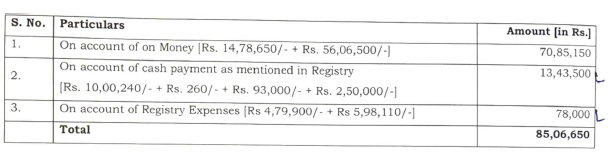
That on the facts and in the circumstances of the case and in law, the Ld CIT(A) erred in maintaining the addition of Rs. 66,56,650/- out of total addition of Rs.92,37,650/- made to the total income of the assessee on account of cash paid towards purchase of agricultural lands by treating it as unexplained investment under section 69 of the Act without properly appreciating the facts of the case and submissions made before him/her. |
| (v) |
|
That on the facts and in the circumstances of the case and in law, the Ld. CIT(A) erred in taxing the amount of long-term capital gain on sale of rural agricultural lands as taxable income of the assessee without properly appreciating the facts of the case and submissions made before him even when the land as sold by the assessee was rural agricultural land as per Notification No 9447 dated 06-01-1994. |
| (vi) |
|
That on the facts and in the circumstances of the case and in law, the Ld. CIT(A) erred in adopting the guideline value of registrar office under section 50C of the Act without referring the valuation of the same to the Departmental Valuation Officer and ignoring the fact that even the sale agreements in respect of these lands were executed in the prior years as a result of which guideline value of the year of registration shall not be considered. |
| (vii) |
|
That on the facts and in the circumstances of the case and in law, the Ld CIT(A) erred in adopting the Fair Market Value of Land as on 1-4-1981 arbitrarily without determining the Fair Market Value of Land as on 1-4-1981 using the Reverse Indexation Method which is a well settled method of determination of fair market value. |
| (viii) |
|
That on the facts and in the circumstances of the case and in law, the Ld CIT(A) erred in not allowing deduction under section 54F of the Act to the assessee in respect of residential house as purchased/ constructed which was eligible for deduction under section 54F of the Act without properly appreciating the facts of the case and submissions made before him/her. |
| (ix) |
|
The assessee reserves the right to add, alter and modify the grounds of appeal as taken by him. |
3. The relevant material facts, as culled out from the material on record, are as follows. In the assessee’s case the information was received from the office of the Dy. Director of Income Tax (Inv.)-2, Indore that the Dy. Director of Income Tax (Inv.)-2, Indore was made enquiry and taken statement of the assessee u/s 131(1)(A) of I.T. Act. As per information received and on perusal of statement of the assessee, it was found that assessee has sold agriculture land in financial year (F.Y.) 2010-11 related to assessment year (A.Y.) 2011-12, this land comes under purview of section 2(14) of Act and hence, it is a capital asset. By selling, this land, the assessee has earned capital gain, but he has not offered the same for taxation. Further, it was found that assessee have made investment in purchase of immovable property of Rs. 2,09,06,150/-, whereas from his bank accounts he has withdrawn only Rs. 1,48,03,000/-. The assessee, during the statement recording u/s 131(1A) of the Act was confronted with the fact, but he could not explain the source of balance fund, and merely submitted that he has made remaining cash payment in F.Y. 2012-13, but assessee has failed to make further submission. Thus, sources of investment were unexplained. Further, as per record it was found that assessee has not filed its return of income for the assessment year (A.Y.) 2011-12. In view of the above facts, case was selected for scrutiny assessment, after recording the reason and obtaining approval from the concerned competent authorities within the meaning of section 147 of the I.T. Act. Accordingly, notice u/s 148 dated 28.03.2018 was issued and served to the assessee. Further letters dated 07.08.2018, 14.09.2018, 08.10.2018 was issued to the assessee regarding filing of income tax return. In response to the same assessee has filed its return of income on 04.12.2018 at Rs. 69,209/-. The notice u/s 143(2) of the I.T. Act was issued on 04.12.2018 and duly served to the assessee. The notice u/s 142(1) of the Act dated 24.08.2018, 30.11.2018, 20.12.2018 was issued to the assessee. In response to these notices, the assessee attended the office of the assessing officer and filed written submission.
4. During the Assessment Year 2011-12, the assessee sold agricultural land to one Sarthak Builders for aggregate sum of Rs.5,41,00,000/-. Thereafter, the assessee also procured agricultural land for a disclosed value of Rs. 1,48,99,010/-. At the time of the reopened assessment the assessee submitted that some cash payment was made for some registry charges and other expenses. The Assessing Officer calculated total of cash investment for procurement of land for Rs.2,33,37,650/-. Therefore, assessing officer issued a notice to the assessee, to explain the cash payment. In response to the show cause notice, the assessee submitted,copy of sale deed, purchase deed and bank statement. The assessee further submitted before the assessing officer, vide reply dated 24.12.2018, that he incurred registry expenses through cheque paid to Bansi Lal Stamp Holder against cheque No. 30839 of Rs. 10,00,000/- dated 07.04.2011 and Rs. 10,00,000/-against cheque No. 99082 dated 12.07.2011. Total registry expenses incurred 12,56,170/-. On perusal of the same, it was found by the assessing officer that cheques were given to Bansi lal Stamp holder during the FY 2011-12 (on 07.04.2011 & 12.07.2011). Thus, registry expenses made during the F.Y. 2010-11 of Rs. 10,78,000/- were unexplained by the assessee. However, the assessing officer worked out the cash investment as follows:
Total Cash investment = Registry Expenses + Cash payment out of Registry Amount on money
= “10,78,000+13,43,500+2,09,16,150
= 2,33,37,650/-
During the deposition u/s. 131 of the Act, the assessee stated that such cash had been withdrawn from his bank account with Bank of India. However, the Assessing Officer found that the total cash withdrawal made by the assessee was for Rs. 1,41,00,000/- on various dates, therefore, after giving credit of such cash withdrawal of Rs. 1,41,00,000/- the Assessing Officer treated the balance sum of Rs.92,37,650/-(Rs.2,33,37,650- Rs. 1,41,00,000), as undisclosed cash in possession of the assessee and treated the said amount as unexplained investment u/s 69.
5. Moreover, the Assessing Officer made an enquiry with the Municipal Commissioner of Indore recording the distance of the land sold by the assessee from the Municipal boundary of City of Indore. The said Municipal Commissioner through letter dated 26.12.2018 confirmed that the said distance was Rs.5.7 kms. from the Municipal limit of City of Indore. Therefore, the Assessing Officer held that the sold land cannot be treated as an agricultural land as per exception clause given in section 2(14) and therefore, he computed taxable, capital gain on the said land adopting section 50C of the Act and by giving benefit of index cost of acquisition of the land. Such capital gain was calculated for Rs.7,06,36,000/- and therefore, assessing officer made addition for the same.
6. In such assessment order two specific additions were made by the assessing officer:
| (i) |
|
Unexplained cash investment for Rs. 92,37,650/- |
| (ii) |
|
Unexplained capital gains income for Rs.7,06,36,000/-. |
7. Aggrieved, by the order of the Assessing Officer, the assessee carried the matter in appeal before the Ld. CIT(A), who has partly allowed the appeal of the assessee.
8. Before, Ld. CIT(A), the assessee challenged the jurisdiction of the Assessing Officer by stating that the Assessing Officer reopened the case on the basis of information provided by the Investigation Wing, which was a borrowed satisfaction and did not appreciate that there was no liability of payment of any tax in case of the assessee as the assessee was having agricultural income only and the sold land being agricultural land cannot generate any taxable capital gain. However, Ld.CIT(A) noticed that at the stage of examining the validity of a notice on reopening of any assessment, any Court cannot go into sufficiency of reasons recorded by the Assessing Officer and if it is found that the Assessing Officer had tangible material at his command to form a bona-fide belief of income chargeable to tax, had escaped assessment, there should not be any interference with the Assessing Officer proceeding further with the reassessment. If the Assessing Officer has cause or justification to know or suppose that income had escaped assessment, he can be said to have reason to believe that income had escaped assessment. The expression cannot be read to mean that the Assessing Officer should have finally ascertained the fact by legal evidence or conclusion. What is required is reason to believe but not established facts of escapement of income. In this present case, the information received from Investigation Wing clearly showed that the assessee had sold as well as purchased land and there had been certain transactions made in cash. The said information was sufficient to have reason to believe that income has escaped assessment. Now, whether such lands were agricultural or not was matter of scrutiny which cannot be determined at this satisfaction stage. Therefore, ld.CIT(A) dismissed the technical ground raised by the assessee on reopening of assessment.
9. About cash investment of Rs. 92,32,650/-, the ld.CIT(A) noticed that Assessing Officer passed his conclusion on the sworn deposition given by the assessee, during the assessment stage on 20.12.2018 u/s 131 of the Act. At the appellate stage, the assessee contended that there has been a miscommunication during recording of the statement by the Assessing Officer when the assessee actually claimed the so called “on- money” payment, as not to be over and above the payments made through banking channel but the assessee had actually meant the total payment made to the sellers which included both cash and through banking channel. In a detailed written submission, the assessee furnished as follows:
| (i) |
|
Actual “on money” paid for purchase of the land was Rs.70,85,150/- and not Rs.2,09,16,150/-, as considered by the Assessing Officer. |
| (ii) |
|
The cash expenditure during registry was only Rs.78,000/- and not Rs. 10,78,000/- as calculated by the Assessing Officer. |
| (iii) |
|
The cash payment for registration purpose was actually Rs. 13,43,500/-, which was the same amount as mentioned in the assessment order. |
Therefore, the assessee agreed that there had been cash payment of Rs.85,06,650/-and claimed that the said sum was well below the sum of Rs.1,41,00,000/-, as mentioned in the assessment order as withdrawn from the bank account. However, ld.CIT(A) noticed that the impugned purchases were completed through registrations, and completed on 11.01.2011 and 30.03.2011 respectively. The ld.CIT(A) found that the cash withdrawals, as narrated in the assessment order started from 01.10.2011 to 08.11.2012. Therefore, the ld.CIT(A) noticed that the said two events of payment of cash and withdrawal of cash are not related at all. All the cash expense as agreed to by the assessee for Rs.85,06,650/-, had been incurred within Financial Year 2010-11 relevant to Assessment Year 2011-12, whereas the withdrawal mentioned in the assessment order were made during Financial Year 2011-12 and Financial Year 2012-13 respectively, relevant for Assessment Year 2012-13 and 2013-14 respectively. Therefore, ld.CIT(A) noticed that the said cash payments were not out of the withdrawals from bank account as was claimed by the assessee. The assessee, during the appeal stage had submitted copy of bank account from 05.05.2010 to 01.10.2011. From such bank statement, the ld.CIT(A) found that for the period up to 31.03.2011, there was no cash withdrawal at all from the bank account made by the assessee. Therefore, ld.CIT(A) observed that there was cash investments made and admitted by the assessee which is not corroborated with any withdrawal of cash from bank account. The ld. CIT(A) also noted that Assessing Officer in the assessment order had stated that as on 01.04.2010, the assessee was having cash in hand for Rs. 18,50,000/-, therefore, ld.CIT(A) had given credit of such cash in hand in making cash payment for purchase of the lands as admitted by the assessee and therefore, there was unexplained cash investment by the assessee for a sum of Rs.66,56,650/-, (Rs.85,06,650 – Rs.18,50,000), remained unexplained and assessable u/s 69 of the Act as unexplained investment. Therefore, ld. CIT(A) reduced the addition to Rs.66,56,650/- from Rs.92,37,650/- and allowed the issue partly.
10. Before the ld. CIT(A), the assessee raised objection to charge of capital gain and invocation of section 50C of the Act, by the Assessing Officer while computing the capital gain of the assessee for sale of land. The assessee claimed that the total sale proceeds received by him as per the sale deed was Rs.5,41,00,000/-. The Assessing Officer found that in respect of sale of land where the deed value was shown for Rs.2,11,00,000/-, the stamp duty assessor had valued the said amount for Rs.4,04,80,000/-. The other land which was sold for Rs.3,30,00,000/-, the stamp duty assessor accepted such value. Therefore, against the deed value of Rs. 5,41,00,000/- (Rs.2,11,00,000 + Rs.3,30,00,000), the Assessing Officer by invoking section 50C of the Act, took the said sale consideration for Rs.7,34,80,000/- (Rs.4,04,80,000 + Rs.3,30,00,000). However, the assessee, during appellate stage, claimed that the valuation should have been referred to the Departmental Valuation Officer(DVO), as the sale agreement in respect of such lands where agreements prior to the actual registration of the land. However, the ld.CIT(A) observed that the assessee had not submitted any documentary evidence of having any fixation of sale price or payment thereof prior to Financial Year 2010-11. The ld.CIT(A) noticed that the payments were received during Financial Year 2010-11, in respect of the land which was sold for Rs.3,30,00,000/-. For the other land, which was sold for Rs.2,11,00,000/-, the assessee claimed to have received the sale proceeds during Financial Year 2011-12. However, since the land was registered within Financial Year 2010-11, therefore, ld.CIT(A) noted that the action of the Assessing Officer to be proper in invocation of Section 50C of the Act.
11. The ld.CIT(A) further noticed that the sold land was an agricultural land and only after the sale, it was converted into non-agricultural land at the request of the purchaser. Therefore, the land should not be considered, as non-agricultural for the purpose of capital gains. The ld.CIT(A) agreed that the sold land was used by the assessee in cultivation of wheat and soyabean. However, in terms of section 2(14) any land which is situated within 8 kms, of the Municipal boundary are to be considered as non-agricultural, even if, it was actually used for agricultural purpose. In this case, the Municipal Commissioner of City of Indore, through his letter dated 26.12.2018, had certified that the road distance between the sold land from the Municipal boundary of the City of Indore was 5.7 kms. Such certificate cannot be ignored and therefore, even if, the land was used for agricultural purpose, for computation of capital gains, the land is to be treated as non-agricultural and the Assessing Officer was correct in computing taxable capital gain on such sale of land. Therefore, ld.CIT(A) dismissed this ground of the assessee.
12. The assessee raised another issue that the matter of purchase of new agricultural land within two years from sale of the land by the assessee was within the knowledge of the Assessing Officer, but still he ignored to give benefit of section 54B of the Act, by merely stating that there was no documentary evidence that agricultural activity is carried out in the said lands as purchased by the assessee. The assessee claimed that during Financial Year 2010-11 and Financial Year 2011-12, it had purchased agricultural land for a total sum of Rs.2,06,32,350/-. Therefore, ld.CIT(A) noted that it had a valid claim for deduction u/s 54B of the Act. The ld.CIT(A) has also verified from the website of Commissioner of Land Records of the State of Madhya Pradesh that all the pieces of land purchased by the assessee were characterized in such website as agricultural land. Therefore, ld.CIT(A) accepted the plea of the assessee, and save and except a sum of Rs.4,81,650/-, which the assessee himself had claimed to be spent for purchase of a shop at the basement of Harshal Manglik Bhawan at Dewas, Ward No.18. Therefore, ld.CIT(A) held that the assessee is eligible to get benefit of deduction u/s 54B of the Act, for Rs.2,01,50,700/-(Rs.2,06,32,350- Rs.4,81,650). Hence, ld.CIT(A) directed the Assessing Officer to recompute the taxable capital gain by taking the consideration of the sold land for Rs.7,34,80,000/-, and directed the assessing officer to allow index cost of acquisition for Rs.28,48,000/-, as narrated at page 20 of the assessment order and allow benefit u/s 54B for Rs.2,01,50,700/-.
13. Aggrieved by the order of Ld. CIT(A), the assessee is in further appeal before this Tribunal. We have heard both the parties and carefully gone through the submission put forth on behalf of the assessee along with the documents furnished and the case laws relied upon, and perused the fact of the case including the findings of the ld CIT(A) and other materials brought on record. The Ld. Counsel for the assessee submitted the written submission, and argued challenging the addition of Rs. 92,37,650/- made to the total income of the assessee on account of cash paid towards purchase of agriculture. During the course of re-assessment proceedings, statement of the assessee was recorded before the DDIT(Inv)-2, Indore wherein the assessee has stated that he has made payment towards purchase of new Agricultural land in his name and in the name of his family members. He has explained that payment was made through account payee cheques and also in cash. In his statement, the assessee himself stated that the payments were made by him out of cash withdrawals from his bank accounts. Henceforth, the source of only cash payment was duly explained by the assessee at the time of recording of his statement. The Authorised officer was not justified in twisting statement of the assessee and reached to wanted conclusion of the same. Since, the assessee had paid cash out of cash withdrawal from his bank account, in that case there was no justification for the assessing officer to further add an amount of Rs 92,37,650/-, to the total income of the assessee. The assessing officer in the assessment order, calculate the amount of cash payment on account of following heads, which are reproduced below:
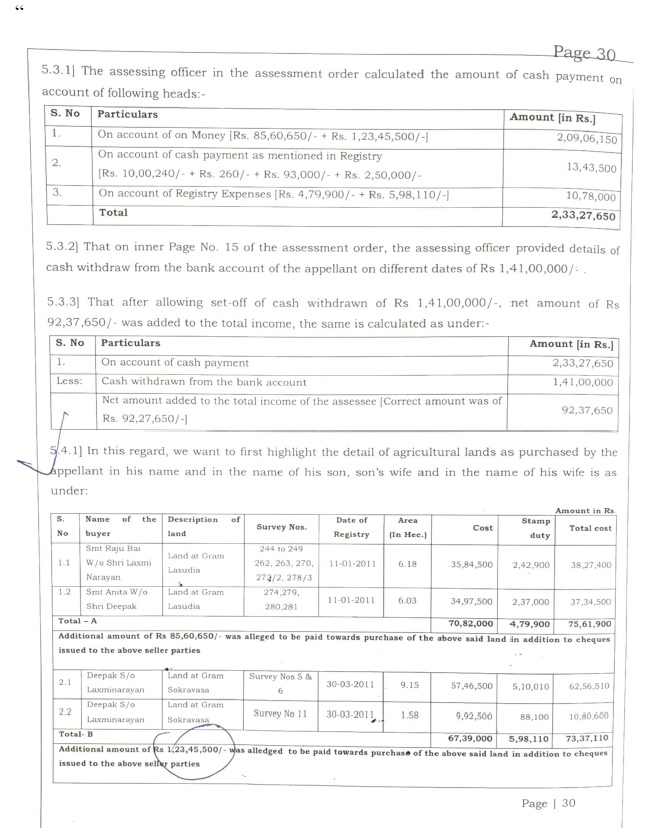
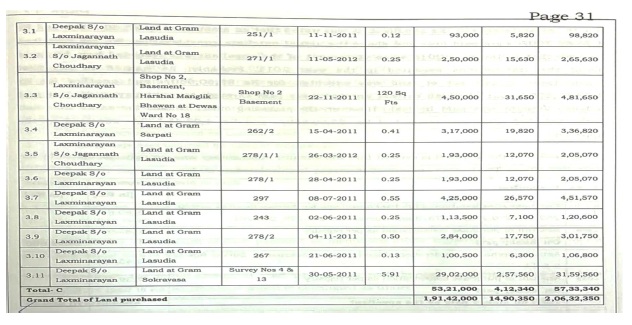
The entire lands was purchased by the assessee, as per guideline rates and there was no difference in the guideline rate and actual consideration paid by the assessee towards purchase of the said land. The assessing officer merely added the amount of Rs. 92,37,650/- by twisting the facts and merely on the basis of statement of the assessee recorded before the investigation wing. It is worth noting that entire purchase deeds were furnished in the Investigation wing and source of entire purchase consideration were also properly explained. The assessing officer himself accepted the source of land purchased by the assessee and no addition was made in this respect. In the statement of the assessee, it was noted that an amount of Rs. 85,60,650/- and Rs. 1,23,45,500/-, were paid over and above the actual purchase consideration. We note that in the year 2018, when statement of the assessee was recorded how he know about the transactions executed in the year 2011. Probably, he wanted to say that transactions of one set of land was executed for Rs 85,60,650/-and another for Rs. 1,23,45,500/-, out of which certain amount were paid through account payee cheques and balance amount was paid in cash. However, the assessing officer twisted the entire facts and concluded that additional amount of Rs. 85,60,650/- and Rs. 1,23,45,500/- was paid by the assessee.
14. In view of the above facts, ld.Counsel submitted that the amount of “on-money” was wrongly calculated by the assessing officer. The correct amount of “on-money” is calculated as under:
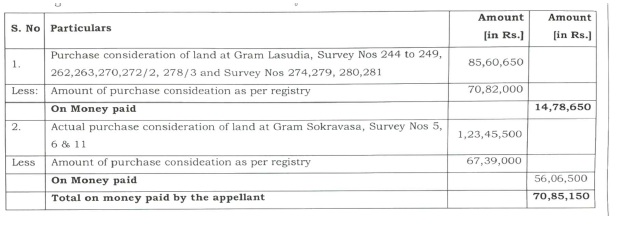
On perusal of the above, it is evident that the total amount of “on money” paid by the assessee, was only of Rs. 70,85,150/-. However, the assessing officer by twisting the entire facts stated that the assessee has paid additional amount of Rs. 85,60,650/-and Rs. 1,23,45,500/-, in addition to the purchase consideration, as mentioned in the purchase registry. The said calculation as done by the assessing officer was wrong and was merely done by twisting the facts of the case. The correct amount of on money paid of Rs. 70,85,150/- as calculated, the source of the same were also explained by the assessee stating that the assessing officer, considered the amount of registry expenses paid in cash was of Rs. 10,78,000/-, even when it was duly explained by the assessee that entire amount of registry expenses were transferred by the assessee to the advocate through an account payee cheques totaling to Rs. 20,00,000/- [Rs. 10,00,000/- paid on 07-04-2011 and Rs. 10,00,000/- paid on 1207-2011). That as against the registry expenses of Rs. 10,78,000/-, an amount of Rs. 10,00,000/- was paid through an account payee cheque and balance amount of Rs. 78,000/- was only paid in cash. The amount of cash paid towards registry expenses of Rs. 78,000/- is calculated as under:
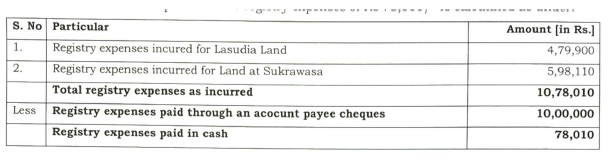
On perusal of the above, it is evident that the assessee has paid registry expenses of Rs. 78,010/- only in cash. Furthermore, the amount of cash payment as mentioned in the registry as considered by the assessing officer was of Rs 13,43,500/-. Henceforth, the actual amount of cash payment, as made by the assessee towards purchase of agriculture land is Rs. 85,06,650/- which is calculated as under:
The amount of cash as available with the assessee was of Rs. 1,41,00,000/- i.e. much higher than the amount of cash actually paid by the assessee. The same is calculated as under:
In view of the above, it is evident that the actual amount of cash payment, as made by the assessee for purchase of agriculture lands was only of Rs. 85,06,650/-. As against the said cash payment, the assessee was having cash of Rs. 1,41,00,000/-available with him on account of cash withdrawn from bank accounts the said fact is also accepted by the assessing officer, Henceforth, the source of cash payment of Rs. 85,06,650/- as made by the assessee stands duly explained.
15. On this issue, learned DR for the revenue, relied on the findings of the assessing officer.
16. We have considered submissions of both the parties and noted that assessing officer merely twisted the wording of statement of the assessee, as recorded by the Investigation wing and concluded that assessee has paid additional amount of Rs. 85,60,650/- and Rs. 1,23,45,500/- in addition to the purchase consideration, as mentioned in the purchase registry. However, the assessee during the course of recording of statement was asked to provide the total cost of purchase of agriculture lands. The assessee probably was trying to communicate that the total cost of one set of land was Rs. 85,60,650/- and total cost of another set of land was Rs. 1,23,45,500/-, out of which, certain amount were paid through account payee cheques and balance amount was paid in cash which interlia also includes amount mentioned in the registry. However, the assessing officer merely twisted the facts and concluded that the said amount represented additional amount paid over an above the registry amounts which was clearly not the contention of the assessee. Upon taking the correct calculation, the source of cash amount as paid by the assessee towards purchase of agriculture lands stands duly explained. We note that the assessee is a Agriculturist and not having any other source of income. The assessee sold his Agricultural land and in turn purchased new Agricultural land in his name and also in the name of his other family members. The sale consideration of the land was used towards purchase of new Agricultural land. Hence, there was no reason for doubting the source of land purchased by the assessee. The assessing officer was also not right in considering the amount of Rs 85,60,650/- and Rs. 1,23,45,500/-, as paid over and above the registered value of the land. The assessee categorcially denied the said version of the statement. We note that the aforesaid addition of Rs. 92,37,650/- was made to the total income of the assessee merely on the basis of statement of the assessee, that too, by twisting the facts narrated by the assessee, without support of any corroborative evidences to substantive the said addition.
17. On the identical and similar facts, Hon’ble ITAT Pune Bench “B” in the case of Kundan Builders v. ACIT [ITA No. 157(PUN) OF 2015 , dated 10-5-2022] has held that:
“6. The assessee contended that the addition made by the AO basing on statement recorded u/s. 131 of the Act without there being any documentary evidence to such statement. The CIT(A) sought remand report from the AO which is reproduced at Page No. 11 and 12 of the impugned order. On perusal of the same, we note that the CIT(A) directed the AO call for search material as he considered fit for conducting enquiries to verify the factual aspect and contention of no documentary evidence, no opportunity of cross-examination and denial of concerned person of assessee receipt of any amount other than the consideration recorded in cancellation agreement. The remand report of the AO was furnished to assessee. On perusal of remand report we note that the AO had given opportunity for crossexamination of Shri Bapu Vithal Parande to the assessee. The said person reaffirmed cash payment of Rs.21 lakh to the partners of the assessee and according to the AO that the assessee could prove nothing in favour of the assessee that no cash payment is made. The assessee made rebuttal to the cross-examination of the said Shri Bapu Vithal Parande and that the said Shri Bapu Vithal Parande expressed his inability of those persons present during the alleged search. We note that the alleged cash was withdrawn from the accounts of Shri Bapu Vithal Parande, Shri Sandeep Parande and two others. The said person expressed his inability bring Shri Sandeep Parande and two others from whose accounts amounts have been withdrawn as witnesses to the alleged cash payment who are none of them his own family members. We note that the AO in its order at Para No. 5 clearly observed that certain documents were seized which are related to Dighi property which resulted in making addition in the hands of assessee. The CIT(A) also affirmed the said observation at Para No. 6.13 of the impugned order but no such documentary evidence brought on record before this Tribunal showing that the assessee received the alleged cash payment. We find the case of ld. DR is that Shri Bapu Vithal Parande made statement that the cash payment to assessee withdrawing such amounts from the accounts of his family members but there was no statement recorded by the AO in this regard from such family members and also Shri Bapu Vithal Parande expressed inability such members for the examination. Thus, the evidence of cash payment by Shri Bapu Vithal Parande cannot be believed for the reason that there was no witnesses to the said cash payments and a mere statement by the said person that some of the amounts received from the accounts of others is not sufficient to make the addition in the hands of the assessee. Therefore, it is established that there was no documentary evidence corroborating the statement of Shri Bapu Vithal Parande recorded u/s. 131 of the Act. Thus, the order of CIT(A) is not justified and it is set aside and the grounds raised by the assessee are allowed.”.
18. We find that in view of the above facts, addition of Rs. 92,37,650/- made to the total income of the assessee on account of alleged cash paid towards purchase of agriculture land by treating it as unexplained investment under section 69 of the Act even when the source of actual cash paid towards purchase of agriculture land was duly explained by the assessee during the course of recording of statement and also during the course of assessment proceedings was neither legal nor proper and is required to be deleted in full, hence we delete the same and allow ground No.4 raised by the assessee.
19. In the result, ground No.4 raised by the assessee, is allowed.
20. Next grounds of the assessee are pertaining to challenging the addition of Rs. 7,06,36,000/-, made to the total income of the assessee, on account of long-term capital gain on sale of rural agriculture land. The assessee in this ground of appeal has challenged the addition of Rs. 7,06,36,000/- made to the total income of the assessee, on account of long-term capital gain on sale of rural agriculture land, however, on appeal by the assessee, before the learned CIT(A), the learned CIT(A) deleted the addition, partly. The ld.Counsel for the assessee submitted that assessee during the year under consideration has sold agriculture land situated at Gram Talawali Chanda, Indore [M.P] admeasuring total area of 4.048 hectare [10 acres) to M/s Sarthak Builders and Developers. Detail of the same is as under:
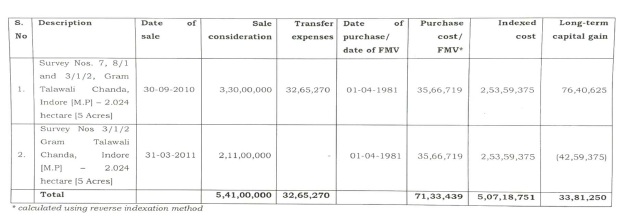
The assessee submitted copy of registry, executed between the assessee and the purchaser in respect of sale of the aforesaid agricultural land before the lower authorities. The ld.Counsel submitted that above agricultural land as sold by the assessee situated at Gram Talawali Chanda, Indore [M.P] is not a capital asset, as per provisions of section 2(14) of the Act. Hence, the capital gain arising on the sale of agricultural land is not chargeable to tax. However, the assessing officer while passing the assessment order, taxed the long-term capital gain, on sale of agriculture land by mentioning the below mentioned reasons:
| (i) |
|
.The assessee has sold the said lands after converting it to residential purposes. |
| (ii) |
|
.The said land sold by the assessee were not capital assets within the meaning of section 2(14)(iii) of the Income-tax Act, 1961. |
| (iii) |
|
.The assessing officer also adopted full value of consideration at Rs. 4,04,80,000/-, instead of actual sale consideration of Rs. 2,11,00,000/-, in respect of sale of land situated at Survey Nos 3/1/2 Gram Talawali Chanda, Indore [M.P] by invoking the provisions of section 50C of the Act. |
| (iv) |
|
.The assessing officer also had not allowed deduction under section 54B of the Act, however, ld.CIT(A) allowed deduction under section 54B of the Act. |
21. The Ld. Counsel for the assessee submitted that agriculture land sold by the assessee was not a capital asset as per the provisions of section 2(14) of the IncomeTax Act, 1961 and therefore, was not chargeable to tax. The assessee had sold agriculture land situated at Gram Talawali Chanda, Indore [M.P] admeasuring total area of 4.048 hectare (10 acres) to M/s Sarthak Builders and Developers during the Financial Year 2010-11 relevant to Assessment Year 2011-12. The Ld. Counsel in this regard, explained the definition of capital asset as per the erstwhile provisions of section 2(14)(iii) of the Income-tax Act, 1961, applicable for Assessment Year 2011-12 (i.e. stood prior to the amendment made w.e.f. AY 2014-15) which is reproduced hereunder for ready reference:
“(14) capital asset means property of any kind held by an assessee, whether or not connected with his business or profession, but does not include-
| (i) |
|
any stock-in-trade, consumable stores or raw materials held for the purposes of his business or profession; |
| (ii) |
|
personal effects, that is to say, movable property (including wearing apparel and furniture) held for personal use by the assessee or any member of his family dependent on him, but excludes- |
| (b) |
|
archaeological collections; |
Explanation. -For the purposes of this sub-clause, “jewellery” includes-
| (a) |
|
ornaments made of gold, silver, platinum or any other precious metal or any alloy containing one or more of such precious metals, whether or not containing any precious or semi-precious stone, and whether or not worked or sewn into any wearing apparel; |
| (b) |
|
precious or semi-precious stones, whether or not set in any furniture, utensil or other article or worked or sewn into any wearing apparel;] |
| (iii) |
|
Agricultural land in India, not being land situate- |
| (a) |
|
in any area which is comprised within the jurisdiction of a municipality (whether known as a municipality, municipal corporation, notified area committee, town area committee, town committee, or by any other name) or a cantonment board and which has a population of not less than ten thousand according to the last preceding census of which the relevant figures have been published before the first day of the previous year; or |
| (b) |
|
in any area within such distance, not being more than eight kilometres, from the local limits of any municipality or cantonment board referred to in item (a), as the Central Government may, having regard to the extent of, and scope for, urbanisation of that area and other relevant considerations, specify in this behalf by notification in the Official Gazette;” |
In view of the erstwhile provisions of section 2(14)(iii) of the Act stood prior to the amendment made in Assessment Year 2014-15, ld.Counsel submitted that it is clear that agriculture lands situated in India were excluded from the definition of capital asset except in the following two cases:
| (i) |
|
Clause (a) of section 2(14)(iii) of the Act: any land situated in an area within the jurisdiction of municipality having a population of not less than 10,000/- as per preceding census |
| (ii) |
|
Clause (b) of section 2(14)(iii) of the Act: any land situated in an area not more than 8 km from local limits of any municipality as the central government may specify. |
In the assessee’s case, the assessee had sold agriculture land situated at Gram Talawali Chanda, Indore [M.P]. It is clear that Gram Talawali Chanda, is not a municipality and therefore, clause (a) of section 2(14)(iii) of the Act is not applicable. The nearest area of municipality from the said agriculture land is Indore, whose municipal limits was also beyond 8 km from the area of the said agriculture land.
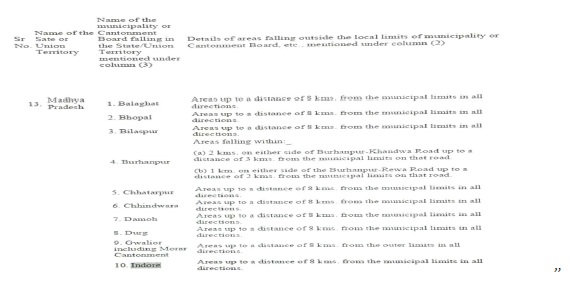
22. Coming to clause (b) of section 2(14)(iii) of the Act, any land situated in an area not being more than 8 km, from local limits of any municipality as the Central Government may specify will not be considered as “capital asset”. The Central Government vide its Notification No. [SO 9447] (File No. 164/3/87-ITA.I)] dated 06-01-1994 have specified the name of the municipality along with detail of areas falling outside the local limits of municipality. Relevant pages of the said notification wherein the detail of areas in respect of Indore is mentioned is submitted by the assessee before the Bench. Screenshot of relevant extract of the said notification is reproduced for ready reference:
“INCOME-TAX ACT, 1961: NOTIFICATION UNDER SECTION 2(1A)(C), PROVISO, CLAUSE (II)(B) AND SECTION 2(14) (III)(B): URBANISATION OF AREAS
Notification No. [SO 9447] (File No. 164/3/87-ITA.I)), dated. 6-1-1994
Whereas a draft notification was published by the Central Government in exercise of the powers conferred by item (B) of clause (ii) of the proviso to sub-clause (c) of clause (1A), and item (b) of sub-clause (iii) of clause (14), of section 2 of the Income-tax Act, 1961 (43 of 1961), in the Gazette of India, Extraordinary, Part II, section 3, sub-section (ii), dated February 13, 1991, under the notification of the Government of India in the Ministry of Finance (Department of Revenue) No. S.O. 91(E), dated February 8, 1991, for specifying certain areas for the purposes of the said clauses and objections and suggestions were invited from the public within a period of 45 days from the date the copies of the Gazette of India containing such notification became available to the public;
And whereas copies of the said Gazette were made available to the public on February 13, 1991;
And whereas the objections and suggestions received from the public on the said draft notification have been considered by the Central Government;
Now, therefore, in exercise of the powers conferred by item (B) of clause (ii) of the proviso to subclause (c) of clause (1A) and item (b) of sub-clause (iii) of clause (14) of section 2 of the Incometax Act, 1961 (43 of 1961), and in supersession of the notification of the Government of India in the erstwhile Ministry of Finance (Department of Revenue and Insurance) No. S.O. 77(E), dated February 6, 1973, the Central Government having regard to the extent of, and scope for urbanisation of the areas concerned and other relevant considerations hereby specifies the areas shown in column (4) of the schedule hereto annexed and falling outside the local limits of municipality or cantonment board, as the case may be, shown in the corresponding entry in column (3) thereof and against the State or Union Territory shown in column (2) thereof for the purposes of the above mentioned provision of the Income-tax Act, 1961 (43 of 1961).
SCHEDULE
2. This notification shall have effect on and from the date of its publication in the official Gazette. Explanation 1. -(1) In this notification. “Municipality” shall mean any areas which is comprised within the jurisdiction of a municipality, (whether known as a municipality, municipal corporation, notified areas committee, town areas committee, town committee or by any other name) which has a population of not less than ten thousand according to the last preceding census of which the relevant figures have been published before the first day of the previous year.
(2) The reference to municipal limits or the limit of Cantonment Board in the schedule to this notification is to the limits as existing on the date on which the limits as existing on the date on which the notification is published in the Official Gazette.”
On perusal of the above notification, it is evident that agriculture land situated upto a distance of 8 kms from the municipal limits in all directions of Indore will be excluded from the definition of agriculture land. Further, as per the said notification, the municipal limits in the schedule is to be the limits as existing as on the date of publishing of notification in the official gazette. Relevant extract of the said notification is reproduced again below, for better appreciation of facts:
“(2) The reference to municipal limits or the limit of Cantonment Board in the schedule to this notification is to the limits as existing on the date on which the limits as existing on the date on which the notification is published in the Official Gazette”.
As the said notification dated 06-01-1994 was published during the year 1994, the municipal limits in the said schedule was to taken as prevailing, on 06-01-1994. In the assessee’s case, the assessee had sold agriculture land situated at Gram Talawali Chanda, Indore [M.P]. The nearest area of municipality from the said agriculture land is Indore. Gram Talawali Chanda, Indore [M.P] is situated beyond 8 kms from the municipal limits of Indore prevailing during the Year 1994. Henceforth, clause (b) of section 2(14)(iii) of the Act was also not applicable in the assessee’s case in hand and therefore, the said land was not a capital asset as per the provisions of section 2(14) of the Act and any capital gain on sale of such land was exempt from tax.
23. However, we note that Assessing Officer while passing the assessment order concluded that the said land was a capital asset as defined under section 2(14) of the Act, on the basis of information received from the office of Municipal Corporation vide letter dated 26-12-2018, wherein it was written that the road distance of the said land from Indore was approx 5.7 km from the municipal limits of Indore, prevailing at the time of sale. Screenshot of relevant para of assessment order dated 29-12-2018 is reproduced hereunder for ready reference:
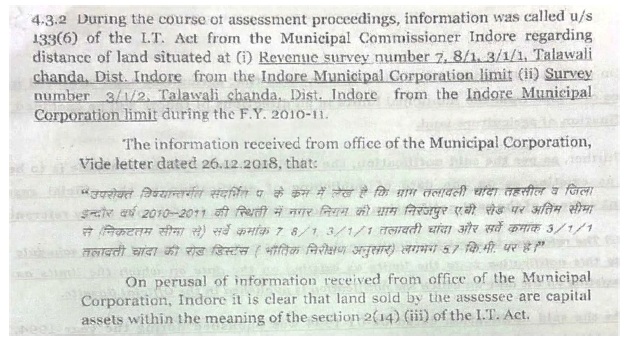
In this regard, ld.Counsel for the assessee brought to our notice that the Municipal Corporation had calculated the said distance of 5.7 km by taking the municipal limits during the year 2010-2011, that is, year of sale. However, as explained above, as per the Notification No. [SO 9447] (File No. 164/3/87-ITA.I)] dated 06-01-1994, the municipal limits for the purpose of calculation of the distance of 8 km is required to be taken based on the municipal limits prevailing as on the date of notification i.e 06-01-1994 and not as on the date of sale. Therefore, the said land was situated beyond 8 kms from the municipal limits prevailing at the time of year of sale also. We note that the said calculation as adopted by the assessing officer was not correct.
24. Therefore, we note that Assessing Officer merely by borrowing the information from the letter dated 26-12-2018, as issued by Municipal corporation held that the said land was situated at 5.7 km from Indore by taking the municipal limits of Indore during year 2010-11, more so, it is evident that as per the aforesaid notification, the municipal limits was required to be taken as prevailing as on 06-011994 and henceforth, the said measurement as made by Municipal Corporation of 5.7 km taking municipal limits of year 2010-11 was clearly not applicable to the present case of the assessee, for this, reliance is placed on the following direct judgements applicable to the assessee:
| (i) |
|
Hon’ble ITAT “Jaipur” Bench in the case of Satya dev Sharma v. ITO 149 ITD 725 (Jaipur – Trib.) [ITA No 25/JP/2010 & 123/JP/2012]for Assessment Year 2008-09 wherein the Hon’ble ITAT have categorically held that for the purpose of sub-clause (b) of clause (iii) of section 2(14) of the Act, the municipal limits are required to be considered prevailing at the time of date of notification, that is, 06-01-1994 and not the date of sale of land. Relevant para of the said decision is reproduced below: |
“6.0 We have heard the rival submission and have carefully perused the available material on record. We find that in the case of
Smt. Subha Tripathi v.
DCIT (
58 SOT 139 ), this Bench has already considered the similar matter in respect of land situated in the same village Machwa for the same assessment year. This Bench has found that the land is situated out of the limit of Jaipur Municipal Corporation and therefore, was not covered in sub-clause (
a) of section 2(14)(
iii). It has been held by this Bench that for the purpose of application of sub-clause (
b) of clause (
iii) of section 2(14) and to measure 8 KMs from the radius of Jaipur Municipal Corporation, the relevant date would be the date of notification i.e. 6.1.1994 and not the date of sale of land in question. We find that the 4 bigha land in question was part of total 16 bigha land of the assessee allotted to him by the Government in lieu of his retirement from defense services. As per the Government record in form of Girdawari which can be said to be conclusive evidence in this respect, the land was being cultivated by the assessee during the year under consideration and subsequently also. The assessee has shown Agricultural Income in the return of income of the previous year and also in the subsequent years which has been accepted. To further support this, assessee has also referred certain electricity bills showing consumption of electricity for agricultural use. These documents clearly suggest that agricultural activities were there on the said land during the relevant year. The use of land differently by the buyers on a subsequent date of inspection is not a relevant factor for us. In this view of the matter, following the order of this Bench in the case of Smt. Subha Tripathi us. DCIT we allow this ground of the assessee’s appeal. “
The Department has preferred an appeal before the Hon’ble High Court of Rajasthan against the above order of Hon’ble ITAT. The Hon’ble High Court of Rajasthan vide its order dt 11-09-2017 has dismissed the appeal as filed by the Department.
| (ii) |
|
The Hon’ble ITAT “Jaipur” Bench in the case of Smt. (Dr.) Subha Tripathi v. Dy. CIT 58 SOT 139 (Jaipur – Trib.) held as under: |
44 “IT: If agricultural land fell beyond 8 kms of municipal limits on date of publication of relevant CBDT notification but fell within 8 kms on date of sale of land, it would still fall outside term ‘capital asset.”
The Hon’ble ITAT “Jaipur” Bench in the case of Dinesh Kumar Jain v. ITO (Jaipur – Trib.)/ TA No 372/JP/2015] dated 01-12-2016 held as under:
“6.7 In light of above, the position in law is clear that section 2(14)(iii)(b) of the Act covers the situation where the subject land is not only located within the distance of 8 kms from the local limits, which is covered by Clause (a) to section 2(14)(iii) of the Act, but also requires the fulfillment of the condition that the Central Government has issued a notification under this Clause for the purpose of including the area up to 8 kms, from the municipal limits, to render the land as a “Capital Asset. In other words, whether the land in question falls under mischief of subclause (b) of Section 2(14)(iii) of the Act, the distance of 8 kms has to be taken into account in terms of notification dated 6-01-1994. As per explanation 2 of the said notification dated 6-01-1994, the Municipal Limits is to be the limits as existing on the date on which the notification is published in the official gazette. There is no amendment or withdrawal of the said notification except the amendment brought in the statute by the Finance Act 2013 whereby the requirement of said notification has been dispensed with. The amendment by the Finance Act 2013 is with effect from 01-04-2014 and therefore, applies prospectively in relation to the assessment year 2014-15 and subsequent assessment years.
6.8 Regarding the issue about measurement of distance, the contention of the Ld AR is that there was no direct road from Murlipura to Gram Salimgrampura and that the distance is to be measured by the approach road. The issue is no more rest integra and is fairly settled now. For the year under consideration, the distance has to be measured by the approach road. The amendment brought in by the Finance Act, 2013 to measure the distance aerially is effective from 01-04- 2014 and therefore, applies prospectively in relation to the assessment year 2014- 15 and subsequent assessment years. For the purposes of guidance, we refer to the decision of Hon’ble Punjab and Haryana High Court in case of
Commissioner of Income-tax-II, Ludhiana v.
Satinder Pal Singh (PUNJ. & HAR.) wherein the Hon’ble High Court has held as under.
“6. A perusal of the aforesaid provision shows that ‘capital asset’ would not include any agricultural land which is not situated in any area within such distance as may be specified in this behalf by a notification in the Official Gazette which may be issued by the Central Government. The maximum distance prescribed by section 2(14)(iii)(b) of the Act which may be incorporated in the notification could not be more than 8 kms. From the local limits of municipal committee or cantonment board etc. The notification has to take into account the extent of, and scope for urbanization of that area and other relevant considerations. The reckoning of urbanization as a factor for prescribing the distance is of significant which would yield to the principle of measuring distance in terms of approach road rather than by straight line on horizontal plane. If principle of measurement of distance is considered straight line distance on horizontal plane or as per crow’s flight then it would have no relationship with the statutory requirement of keeping in view the extent of urbanization. Such a course would be illusory. It is in pursuance of the aforesaid provision that Notification No. 9447, dated 6-1-1994 has been issued by the Central Government. In respect of the State of Punjab, at item No. 18, the SubDivision, Khanna has been listed at serial No. 19. It has, inter alia, been specified that area up to 2 kms. From the municipal limits in all directions has to be regarded other than agricultural land. Once the statutory guidance of taking into account the extent and scope of urbanization of the area has to be reckoned while issuing any such notification then it would be incongruous to the argument of the Revenue that the distance of land should be measured by the method of straight line on horizontal plane or as per crow’s flight because any measurement by crow’s flight is bound to ignore the urbanization which has taken place. Moreover, the judgment of the Mumbai Bench appears to have attained finality. Keeping in view the principle of consistency as laid down in Radhasoami Satsang v. CIT [1992] 193 ITR 321 1 (SC) we are of the view that the opinion expressed by the Tribunal does not suffer from any legal infirmity warranting interference of this Court. Accordingly question No. 1 is answered against the Revenue and in favour of the assessee by upholding the order of the Tribunal.”
| (iii) |
|
Decision of the Hon’ble Bombay High Court in case of CIT v. Nitish Ramesh Chandra Chordia (Bombay) where the Hon’ble High Court has held as under: |
“15. Insofar as relevance of Section 11 of the General Clauses Act is concerned, it needs to be noted that here the relevant amendment prescribing distance to be counted must be aerial has come into force w.e.f. 1st April, 2014. The need of amendment itself shows that, in order to avoid any confusion, the exercise became necessary. The Parliament noticed the Judgments being delivered and therefore, emphatically pointed out aerial distance as the relevant norm. This exercise to clear the confusion, therefore, shows that benefit thereof must be given to the assessee. It is settled law that, in such matters, when there is any doubt or confusion, the view in favour of the assessee needs to be adopted. The Circular No.3/240, dt.24.1.2014 shows vide clause no.4 -amendment in definition of ‘Capital Asset’ and clause 4.5 dealing with applicability expressly stipulates that it takes effect from 1.4.2014 and therefore, prospectively applies in relation to the assessment year 2014-15 and subsequent assessment years. Hence, the question whether prior to the said assessment year 2014-15 the Authorities erred in computing the distance by road does not arise at all. The IT cannot be questioned on that ground. For these reasons, Section 11 of the General Clauses Act also has no application in the present matter where the ITAT was concerned with the assessment year 2009-10 or prior to the time when amendment took effect.”
[Emphasis supplied)
| (iv) |
|
The Hon’ble ITAT “Kolkata” Bench in the case of DCIT v. Arijit Mitra 48 SOT 544 (Kolkata)/[ITA No. 1679/Kol/2010,dated 29-06-2010] for the Assessment Year 2007-08 has held that: |
“6. It is a fact that this land does not fall in any area which is comprised within the jurisdiction of Municipality or a Cantonment Board and which has a population of not less than ten thousand according to the last preceding census of which the relevant figures have been published before the 1st day of previous year. That means the land does not fall in sub-clause (a) of section 2(14)(iii) of the Act as this land is out of Municipal limit of Rajarhat Municipality and moreover it is 2.5 km from the outer limits of Rajarhat Municipality as certified by B.L & L.R.O, Rajarhat North 24 Parganas. Now, we have to see whether this land falls in clause (b) of section 2(14)(iii) of the Act as this section prescribes that any area within such distance, not being more than 8 km, from the local limits of any Municipality or Cantonment Board as referred to in sub-clause (a) of section 2(14)(iii) of the Act, as the central government may having regard to the extent of, and scope for, urbanization of that area and other relevant considerations, specify in this behalf by notification in the official gazette. As referred by Ld. Counsel the latest notification that is Notification under section 2(1A)(c), proviso (ii)(B) and 2(14)(ii)(b), i.e. Notification No.9947/F. No. 164/3/87-ITA-I] dated 6.1.1994 whereas a draft notification was published by central government in exercise of powers conferred by item B of clause (ii) of the proviso to sub-clause (c) of clause (1A), and item (b) of sub-clause (iii) of clause 14 of section 2 of the Act, in the Gazette of India, Extraordinary, Part II, Section3, sub- section (ii), dated 13.2.1991 under the Notification of Govt. of India in the Ministry of Finance, Department of Revenue, No. SO 91(E) dated 8.2.1991, for specifying certain areas for the purpose of said clauses and objections and suggestions were invited from the public within a period of 45 days from the date of the copies of the Gazette of India containing notification became available to the public. Further, this was amended by Notification No. 11186 dated 28/12/1999 in exercise of powers conferred by item (B) of clause (ii) of the proviso to subclause (c) of clause (1A), and item (b) of sub- clause (iii) of clause 14 of section 2 of the Act, and in supersession of the notification of Govt. of India in the erstwhile Ministry of Finance, Department of Revenue, No. SO 77(E) dated 6.2.1973, the Central Government having regard to the extent of, and scope for urbanization of the areas concerned and other relevant consideration, hereby specifies the areas shown in column (4) of the Schedule hereto annexed and falling outside the local limits of municipality or cantonment board, as the case may be, shown in the corresponding entry in column (3) thereof and against the State or Union Territory shown in column (2) thereof for the purpose of the above mentioned provision of the Income tax Act, 1961 (43 of 1961).
7. From the above, it is clear that agricultural land situated in areas lying within a distance not exceeding 8 km from the local limits of such Municipalities or Cantonment Boards are covered by the amended definitions of ‘capital asset’, if such areas are, having regard to the extent of and scope for their urbanization and other relevant considerations, is notified by the Central Government in this behalf. Central Government in exercise of such powers has issued the above notification, as amended latest by Notification No. 11186 dated 28.12.1999 clearly clarifies that agricultural land situation in rural areas, areas outside the Municipality or cantonment board etc., having a population of not less than 10,000 and also beyond the distance notified by Central Government from local limits i.e. the outer limits of any such municipality or cantonment board etc., still continues to be excluded from the definition of ‘capital asset. Accordingly, in view of sub-clause (b) of section 2(14)(iii) of the Act even under the amended definition of expression ‘capital asset’, the agricultural land situated in rural areas continues to be excluded from that definition. And as in the present case, admittedly, the agricultural land of the assessee is outside the Municipal Limits of Rajarhat Municipality and that also 2.5 KM away from the outer limits of the said Municipality, assessee’s land does not come within the purview of section 2(14)(iii) either under sub clause (a) or (b) of the Act, hence the same cannot be considered as capital asset within the meaning of this section. Hence, no capital gain tax can be charged on the sale transaction of this land entered by the assessee. Accordingly, we quash the assessment order qua charging of capital gains on very jurisdiction of the issue. The C.O. of the assessee is allowed.
| (v) |
|
The Hon’ble ITAT “Delhi” Bench in the case of DCIT v. Kushal Infraproject Industries India Limited [ITA No 2802/Del/2015,dated 30-12-2019] have also approved the similar view and held to exempt the amount of long term capital gain on sale of Rural Agricultural land. |
25. On the other hand, the Ld. DR for the Revenue has primarily reiterated the stand taken by the Assessing Officer, which we have already noted in our earlier para and is not being repeated for the sake of brevity. The Ld. DR submitted that agricultural land was sold after converting it into non-agricultural land and land is situated within 8 kilometers of municipal limit hence capital gain tax is attracted.
26. In view of the above facts, and findings reiterated in the judicial precedents cited (supra), it is evident that for the purpose of sub-clause (b) of clause (iii) of section 2(14) of the Act, the municipal limits of the areas are required to be taken prevailing at the time of date of notification [i.e. 06-01-1994] and not at the time of date of sale. However, the Assessing officer calculated the distance of the agriculture land from Indore by taking the municipal limits of Indore prevailing during the year of sale [i.e. year 2010-11] even when as per the notification dated 06-01-1994 and various judicial proceedings, municipal limits as on the date of notification are required to be taken for the measurement of distance. The said approach as adopted by the Assessing Officer is neither legal nor proper. Further as stated above, in any case, the said land was situated beyond 8 kms from the municipal limits prevailing at the time of year of sale also. The said calculation as adopted by the assessing officer was not correct. In the present case in hand, the assessee had sold agriculture land situated at Gram Talawali Chanda, Indore [M.P]. The nearest area of municipality from the said agriculture land is Indore. The said agriculture land is rural agriculture land as per the erstwhile provisions of section 2(14) of the Act.
Therefore, we note that the said agriculture land as sold by the assessee situated at Gram Talawali Chanda, Indore [M.P], India is rural agriculture land as per the provisions of section 2(14) of the Act applicable at the time of Assessment Year 2011-12. The said agriculture land is situated at Gram Talawali Chanda which is not a municipality. As stated above, as per the Notification No. [SO 9447] (File No. 164/3/87-ITA.I)] dated 06-01-1994, the municipal limits for the purpose of determination of distance is required to be taken as prevailing as on the date of notification and not as on the date of sale.
27. We note that the assessee had agreed to sale his Agricultural land situated at Gram Talawali chanda admeasuring 4.048 Hectare of land [10 Acres of land] at a consideration of Rs 5,41,00,000/-. Detail of the same is as under:
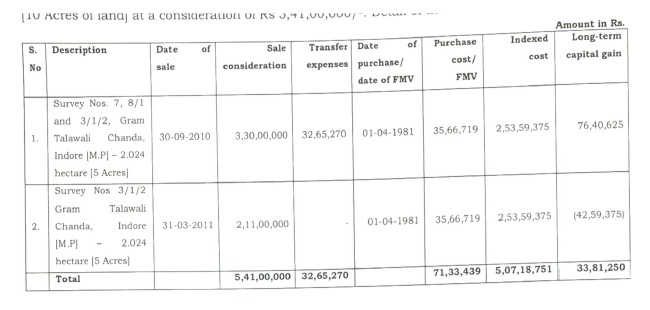
The assessee has duly proved that the said agriculture land is not a capital asset as per the provisions of section 2(14) of the Act. The said agriculture land situated at Gram Talawali chanda admeasuring 4.048 Hectare of land (10 Acres of land] was used for agriculture purposes for many years. It is evident that the said land was used by the assessee for agriculture activities during the year under consideration.The assessee, during the Financial Year 2010-11 relevant to Assessment Year 2011-12 agreed to sale his Agricultural land situated at Gram Talawali chanda to M/s Sarthak Builders and Developers. However, the registry in respect of the said agriculture land was executed in two parts on 30-09-2010 and 31-03-2011 due to the reason that the buyer was not able to make entire payment in one shot. During the execution of registry, the buyer was not able to pay entire consideration and therefore, the registry was done in 2 parts. This clearly shows that the land was sold by the assessee on 3009-2010 only, that is, at the time of first registry but merely due the payment issues, the registry in respect of the remaining part was delayed. At first, registry in respect of agriculture land situated at Survey Nos. 7, 8/1 and 3/1/2 Gram Talawali Chanda, Indore [M.P] admeasuring 2.024 hectare [5 Acres] was executed on 22-09-2010 at consideration of Rs. 3,30,00,000/-. The said land was sold by the assessee to M/s Sarthak Builders and Developers as agriculture land only. The same is clearly evident from the copy of sale registry as executed between the assessee and M/s Sarthak Builders and Developers. In respect of the remaining agriculture land admeasuring 2.024 hectare [5 Acres], M/s Sarthak Builders and Developers who has agreed to purchase entire land at the time of execution of first registry only, requested the assessee to get the remaining land diverted from agriculture to non-agriculture purposes. The assessee only at the request of buyer, for the purpose of making sale agreed to get the land diverted prior to the date of registry. Copy of affidavit of Shri Ashwin Mehta, Partner of M/s Sarthak Builders and Developers wherein he has duly confirmed that the diversion in respect of the remaining land was done on their request only. The remaining land situated at 3/1/2 Gram Talawali Chanda, Indore [M.P] admeasuring 2.024 hectare [5 Acres] was diverted on 23-11-2010 only at request of M/s Sarthak Builders and Developers, the buyer. Thereupon, registry in respect of the remaining land situated at 3/1/2 Gram Talawali Chanda, Indore [M.P] admeasuring 2.024 hectare [5 Acres) was executed on 31-03-2011 at a consideration of Rs.2,11,00,000/-.
28. It was stated that, though the land was converted to non-agriculture purpose prior to the date of registry, the assessee has continued agriculture activities till the date of registry. The said agriculture land was diverted by the assessee only at the request of buyer for making the sale effective. The said land was diverted for the said intention only and M/s Sarthak Builders and Developers has also confirmed the said facts.The assessee has duly offered agriculture income of Rs. 8,61,550/- in the income-tax return as filed for Assessment Year 2011-12, which is also accepted by the Assessing Officer as there was no disturbance on this count in the assessment order. Therefore, it is evident that the said land was used by the assessee for agriculture purposes and the income as earned in respect of the same is duly offered in the income-tax return. That even, though the assessee has diverted the land at the request of buyer, the assessee continued doing agriculture activities till the date of registry. This clearly shows that the diversion was done,only for the sake of sale, with the request of buyer and the said land was agriculture land only till the date of registry for the assessee, therefore, we allow ground Nos. 5 and 6 raised by the assessee, on merit and delete the addition sustained by the Ld. CIT(A).
29. As, we have allowed the appeal of the assessee on merit, therefore, all other issues on technical grounds of reopening of assessment, and other grounds on merits of the additions, in the impugned assessment proceedings, are rendered academic and infructuous.
30. In the result, appeal filed by the assessee is allowed.