ORDER
Partha Sarathi Chaudhury, Judicial Member.- The present appeal preferred by the assessee emanates from the order of the Ld. Pr.CIT, Raipur-1 dated 19.03.2026 for the assessment year 2022-23 as per the grounds of appeal on record.
2. The assessee is aggrieved with passing of order u/s. 263 of the Income Tax Act, 1961 (for short ‘the Act’) by the Ld. Pr. CIT through assumption of revisionary jurisdiction holding the assessment order to be erroneous so far it was prejudicial to the interest of the Revenue. The Ld. Pr. CIT had invoked revisionary jurisdiction on two issues viz. (i) suppression of business receipts; and (ii) unsecured loans. The relevant observations of the Ld. Pr. CIT in its order u/s. 263 of the Act, dated 19.03.2026 are extracted as follows:
“The assessee has filed its Return of Income for the Asstt. Year 2022-23 on 17.10.2022 declaring Total Income at Rs.6,10,41,300/-. Subsequently, the case was selected for scrutiny through CASS for scrutiny for the reasons (i) Substantial increase in capital in a year (ii) High interest expenditure and huge advance in excess of total proprietors/partners fund. Subsequently, assessment order u/s.143(3) r.w.s. 144B of the Income Tax Act, 1961 was passed on 21.03.2024 by accepting the returned income of Rs.6,10,41,300/-. On perusal of the assessment records, it was observed that the business receipt of the assessee during the F.Y. 2021-22 relevant to Asstt. Year 2022-23 is Rs.1,03,42,914/- upon which TDS of Rs.2,06,84,591/- has been claimed by the assessee. However, it was found that the assessee has shown business receipt of Rs.1,00,18,40,156/-. Thus, there is a difference of Rs.3,23,88,758/- in the business receipt as per 26AS details and as per books of account of the assessee. Further, it was evident that there are two major deductors from which the assessee has received contractual receipts of Rs.77,11,03,884/- and Rs.26,31,25,030/- amounting to Rs.1,03,42,28,914/-. However, the assessee has shown Rs.1,00,18,40,156/- only. As per section 199(1) of the Act if any tax has been deducted and paid to the central government it is treated as the payment of tax on behalf of the person upon whose income the deduction was made. Hence, the assessee was liable to account of the income of Rs.1,03,42,28,914/- upon which TDS of Rs.2,06,84,591/- has been deducted instead of Rs. 1,00,18,40,156/- as erroneously taken by the assessee. Thus, the assessee has suppressed its business receipt to the tune of Rs.3,23,88,758/-.
2. It was further found that, during the F.Y. 2021-22, the assessee has received unsecured loan of Rs.8,13,96,464/-and Rs.20,11,27,430/- from its two concern namely G.P. Global Industries Pvt. Ltd. (AACCG2548J) AND g p Khetan Infrastructure Pvt. Ltd. (AACCG6621N) and TDS of Rs. 1,39,646/- and Rs.6,62,743/- has been deducted upon the interest paid to the aforesaid concerns. In support of creditworthiness, it was found that the assessee has submitted ITR and Financial statements of the concern M/s G P Khetan Infrastructure Pvt. Ltd. and G P Global Industries Pvt. Ltd. From perusal of the quantum of loan given by the above two concerns, income generated from its business operation and other financial details as given, it is evident that creditworthiness of these concerns doesn’t substantiate with the quantum of loan given by them. Further, it was found that no bank statements reflecting the transactions have been furnished by the assessee so as to availability and source of liquidity on the date of payment of unsecured loan may be established beyond doubt. In view of the above it is evident that necessary limbs of creditworthiness and genuineness of transactions have not been established in respect of the above referred lenders to the tune of Rs. 28,25,23,894/-. Section 68 of the Act. As the unsecured loan to the tune of Rs.28,25,23,894/- has not been established, the interest paid upon the said income of Rs.66,27,430/- + Rs.13,96,460/- totaling Rs.80,23,890/- is liable to be disallowed u/s 37(1) of the Act. Thus, omission of this issue has caused under assessment of income of Rs.80,23,890/-. Thus, omission of the above discussed issues have caused under assessment of income totaling to Rs.32,30,57,661/-(3,23,88,758+28,25,23,894+80,23,890+1,21,119).
3. Since the issues discussed supra have not been properly and adequately verified by the AO while passing the assessment order, therefore, the assessment order passed u/s 143(3) r.w.s. 144B of the Act is erroneous in so far as it is prejudicial to interest of the ‘revenue in light of section 263 of the Income Tax Act, 1961.”
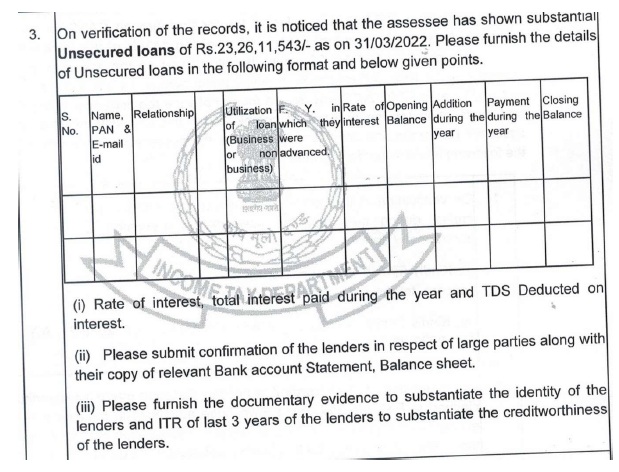
3. At the time of hearing, the Ld. Counsel for the assessee demonstrated that the issue of unsecured loan had been in detailed verified and examined by the A.O during assessment proceedings and having examined the same he has taken plausible view in the matter, after which, the Pr. CIT does not get jurisdiction to impose his view on the issue when plausible view has already been taken by the A.O after due verification. The Ld. Counsel further submitted that as per Page 26 to 107 of the paper book, details of unsecured loan were filed before the A.O. In this regard, he also demonstrates that specific question has been asked by the A.O for furnishing details of unsecured loan through notice u/s. 142(1) of the Act, dated 11.10.2023 a/w. questionnaire and at point No.3, the said specific query on unsecured loan had been enquired by the A.O. The relevant Point No.3 of the annexure of notice u/s. 142(1) of the Act is extracted as follows:
4. That once due verification has been conducted by the A.O and he had applied his mind while arriving at a particular satisfaction and accepting the said response, in such a case, thereafter, it is not open for the Ld. Pr. CIT to pass order u/s.263 of the Act again on the same issue just for conducting any roving enquiry. The very premises of satisfaction emanated in the order u/s.263 of the Act by the Pr. CIT is arbitrary, bad in law since exhaustively the said issue has been examined by the A.O in the assessment order. Therefore, on facts, it cannot be said to be a case where opinion was formed without any inquiry and without any material. Consequently, it could not be classified as a case of “lack of inquiry” but at the most even if the case of the Revenue is accepted on the basis of the order passed by the Commissioner, this was a case of “inadequate inquiry”. Once there is an inquiry, even inadequate, that would not by itself, give occasion to the Commissioner to pass order under Section 263 of the Act merely because he has a different opinion in the matter. It cannot, therefore, be said to be a case of erroneous order and prejudicial to the interest of the Revenue. Same view has been upheld by the Hon’ble High Court of Madras in the case of Arul Industries v. ACIT (Madras)/2025(8) TMI 1737 (Madras) wherein it has been held and observed as follows:
“16. Therefore, on facts, it cannot be said to be a case where opinion was formed without any inquiry and without any material. Consequently, it could not be classified as a case of “lack of inquiry” but at the most even if the case of the Revenue is accepted on the basis of the order passed by the Commissioner, this was a case of “inadequate inquiry”. Once there is an inquiry, even inadequate, that would not by itself, give occasion to the Commissioner to pass order under Section 263 of the Act merely because he has a different opinion in the matter. It cannot, therefore, be said to be a case of erroneous order and prejudicial to the interest of the Revenue.
17. A Division Bench of Delhi High Court in the case of Sunbeam Auto Ltd. (cited supra) examined the aforesaid legal position as regards the scope and ambit of power under Section 263 of the Act. It was held to be a settled principle that the Assessing Officer in the assessment order is not required to give detailed reason in respect of each and every item of deduction etc. One has to see from the records as to whether there was any application of mind. Distinction between “lack of inquiry” and “inadequate inquiry” was also highlighted in the said decision. It was held that if there was any inquiry, even inadequate, that would not by itself, give occasion to the Commissioner to pass orders under Section 263 of the Act, merely because he has different opinion in the matter and it is only in cases of “lack of inquiry” that such a course of action would be open.
18. Similar view was taken by the Bombay High Court in the case of Gabriel India Ltd. [supra]. Based on logical and rational reading of the provisions contained in Sub-section (1) of Section 263 of the Act, it was observed that suo motu revision can be exercised by the Commissioner only if, on examination of the records of any proceedings under the Act, it is found that any order passed therein by the Income Tax Officer is ‘erroneous insofar as it is prejudicial to the interests of the Revenue’. It is not an arbitrary or unchartered power, and can be exercised only on fulfilment of the requirements laid down in Sub-section (1) of Section 263 of the Act. The consideration of the Commissioner as to whether an order is erroneous insofar as it is prejudicial to the interests of the Revenue, must be based on the materials on the record of the proceedings called for by him. If there are no materials on record on the basis of which it can be said that the Commissioner, acting in a reasonable manner, could have come to such a conclusion, the very initiation of proceedings by him will be illegal and without jurisdiction. The Commissioner cannot initiate proceedings with a view to starting fishing and roving enquiries in the matters or orders which are already concluded. Such action will be against the well-accepted policy of law that there must be a point of finality in all legal proceedings, that stale issues should not be reactivated beyond a particular stage and that lapse of time must induce, repose in and set at rest judicial and quasi-judicial controversies as it must in other spheres of human activity.
19. Therefore, an order cannot be termed as erroneous unless it is not in accordance with law. If the Income Tax Officer, acting in accordance with law, makes certain assessment, the same cannot be branded as erroneous by the Commissioner, simply because, according to the Commissioner, the order should have been written more elaborately. The Section does not visualize a case of substitution of the judgment of the Commissioner or that of the Income Tax Officer, who passed the order, unless the decision is held to be erroneous. There must be some prima facie material on record to show that the tax which was lawfully eligible has not been imposed or that by wrong application of the relevant statute on an incorrect or incomplete interpretation, a lesser tax than what was just has been imposed.”
5. Further, the Hon’ble Apex Court in the case of Malabar Industrial Co. Ltd. v. CIT 243 ITR 83 (SC)had held and observed as follows:
“A bare reading of section 263 of the Income-tax Act, 1961, makes it clear that the prerequisite for the exercise of jurisdiction by the Commissioner suo motu under it, is that the order of the Income-tax Officer is erroneous in so far as it is prejudicial to the interests of the Revenue. The Commissioner has to be satisfied of twin conditions, namely, (i) the order of the Assessing Officer sought to be revised is erroneous ; and (ii) it is prejudicial to the interests of the Revenue. If one of them is absent—if the order of the Incometax Officer is erroneous but is not prejudicial to the Revenue or if it is not erroneous but is prejudicial to the Revenue— recourse cannot be had to section 263(1) of the Act. The provision cannot be invoked to correct each and every type of ‘mis-take or error committed by the Assessing Officer, it is only when an order is erroneous that the section will be attracted. An incorrect assumption of facts or an incorrect application of law will satisfy the requirement of the order being erroneous. In the same category fall orders passed without applying the principles of natural justice or without application of mind. The phrase “prejudicial to the interests of the Revenue” is not an expression of art and is not defined in the Act. Understood in its ordinary meaning it is of wide import and is not confined to loss of tax. The scheme of the Act is to levy and collect tax in accordance with the provisions of the Act and this task is entrusted to the Revenue. If due to an erroneous order of the Income-tax Officer, the Revenue is losing tax lawfully payable by a person, it will certainly be prejudicial to the interests of the Revenue. The phrase “prejudicial to the interests of the Revenue” has to be read in conjunction with an erroneous order passed by the Assessing Officer. Every loss of revenue as a consequence of an order of the Assessing Officer, cannot be treated as prejudicial to the interests of the Revenue, for example, when an Income-tax Officer adopted one of the courses permissible in law and it has resulted in loss of revenue, or where two views are possible and the Income-tax Officer has taken one view with which the Commissioner does not agree, it cannot be treated as an erroneous order prejudicial to the interests of the Revenue unless the view taken by the Income-tax Officer is unsustainable in law.”
6. That on the same parameters of law and facts, the Hon’ble High Court of Delhi in the case of
CIT v.
Sunbeam Auto Ltd. [2011] 332 ITR 167 (Delhi) has held and observed as follows:
“12. We have considered the rival submissions of the counsel on the other side and have gone through the records. The first issue that arises for our consideration is about the exercise of power by the Commissioner of Income-tax under section 263 of the Income-tax Act. As noted above, the submission of learned counsel for the revenue was that while passing the assessment order, the Assessing Officer did not consider this aspect specifically whether the expenditure in question was revenue or capital expenditure. This argument predicates on the assessment order which apparently does not give any reasons while allowing the entire expenditure as revenue expenditure. However, that by itself would not be indicative of the fact that the Assessing Officer had not applied his mind on the issue. There are judgments galore laying down the principle that the Assessing Officer in the assessment order is not required to give detailed reason in respect of each and every item of deduction, etc. Therefore, one has to see from the record as to whether there was application of mind before allowing the expenditure in question as revenue expenditure. Learned counsel for the assessee is right in his submission that one has to keep in mind the distinction between “lack of inquiry” and “inadequate inquiry”. If there was any inquiry, even inadequate, that would not by itself, give occasion to the Commissioner to pass orders under section 263 of the Act, merely because he has different opinion in the matter. It is only in cases of “lack of inquiry”, that such a course of action would be open. In Gabriel India Ltd.’s case (supra), law on this aspect was discussed in the following manner : “. . .
“….From a reading of sub-section (1) of section, it is clear that the power of suo motu revision can be exercised by the Commissioner only if, on examination of the records of any proceedings under this Act, he considers that any order passed therein by the Income-tax Officer is ‘erroneous insofar as it is prejudicial to the interests of the revenue’. It is not an arbitrary or unchartered power. It can be exercised only on fulfilment of the requirements laid down in sub-section (1). The consideration of the Commissioner as to whether an order is erroneous insofar as it is prejudicial to the interests of the revenue must be based on materials on the record of the proceedings called for by him. If there are no materials on record on the basis of which it can be said that the Commissioner acting in a reasonable manner could have come to such a conclusion, the very initiation of proceedings by him will be illegal and without jurisdiction. The Commissioner cannot initiate proceedings with a view to starting fishing and roving enquiries in matters or orders which are already concluded. Such action will be against the well-accepted policy of law that there must be a point of finality in all legal proceedings, that stale issues should not be reactivated beyond a particular stage and that lapse of time must induce repose in and set at rest judicial and quasijudicial controversies as it must in other spheres of human activity. [See : Parashuram Pottery Works Co. Ltd. v. ITO[1977] 106 ITR 1 (SC) at page 10].
From the aforesaid definitions it is clear that an order cannot be termed as erroneous unless it is not in accordance with law. If an Income-tax Officer acting in accordance with law makes a certain assessment, the same cannot be branded as erroneous by the Commissioner simply because, according to him, the order should have been written more elaborately. This section does not visualise a case of substitution of the judgment of the Commissioner for that of the Income-tax Officer, who passed the order unless the decision is held to be erroneous. Cases may be visualised where the Income-tax Officer while making an assessment examines the accounts, makes enquiries, applies his mind to the facts and circumstances of the case and determines the income either by accepting the accounts or by making some estimate himself. The Commissioner, on perusal of the records, may be of the opinion that the estimate made by the officer concerned was on the lower side and left to the Commissioner he would have estimated the income at a figure higher than the one determined by the Income-tax Officer. That would not vest the Commissioner with power to re-examine the accounts and determine the income himself at a higher figure. It is because the Income-tax Officer has exercised the quasi-judicial power vested in him in accordance with law and arrived at conclusion and such a conclusion cannot be termed to be erroneous simply because the Commissioner does not feel satisfied with the conclusion. There must be some prima facie material on record to show that tax which was lawfully exigible has not been imposed or that by the application of the relevant statute on an incorrect or incomplete interpretation a lesser tax than what was just has been imposed.
We may now examine the facts of the present case in the light of the powers of the Commissioner set out above. The Income-tax Officer in this case had made enquiries in regard to the nature of the expenditure incurred by the assessee. The assessee had given detailed explanation on that regard by a letter in writing. All these are part of the record of the case. Evidently, the claim was allowed by the Income-tax Officer on being satisfied with the explanation of the assessee. Such decision of the Income-tax Officer cannot be held to be “erroneous” simply because in his order he did not make an elaborate discussion in that regard . . .” (pp. 113-117)
13. When we examine the matter in the light of the aforesaid principle, we find that the Assessing Officer had called for explanation on this very items, from the assessee and the assessee had furnished his explanation vide letter dated 26-9-2002. This fact is even taken note of by the Commissioner himself in Para 3 of his order dated 3-11-2004. This order also reproduces the reply of the respondent in Para 3 of the order in the following manner : “The tools and dies have a very short life and can produce up to maximum 1 lakh permissible shorts and have to be replaced thereafter to retain the accuracy. Most of the parts manufactured are for the automobile industries which have to work on complete accuracy at high speed for a longer period. Since it is an ongoing procedure, a company had produced 10,75,000 sets whose selling rates is inclusive of the reimbursement of the dies cost. The purchase orders indicating the costing includes the reimbursement of dies cost are being produced before your honour. Since the sale rate includes the reimbursement of dies cost and to have the matching effect the cost of the dies has been claimed as a revenue expenditure.”
14. This clearly shows that the Assessing Officer had undertaken the exercise of examining as to whether the expenditure incurred by the assessee in the replacement of dyes and tools is to be treated as revenue expenditure or not. It appears that since the Assessing Officer was satisfied with the aforesaid explanation, he accepted the same. The CIT in his impugned order even accepts this in the following words : “Assessing Officer accepted the explanation without raising any further questions, and as stated earlier, completed the assessment at the returned income.”
15. Thus, even the Commissioner conceded the position that the Assessing Officer made the inquiries, elicited replies and thereafter passed the assessment order. The grievance of the Commissioner was that the Assessing Officer should have made further inquires rather than accepting the explanation. Therefore, it cannot be said that it is a case of ‘lack of inquiry’.
16. Having put the records straight on this aspect, let us proceed further. Is it a case where the Commissioner has concluded that the opinion of the Assessing Officer was clearly erroneous and not warranted on the facts before him and, viz., the expenditure incurred was not the revenue expenditure but should have been treated as capital expenditure ? Obvi-ously not. Even the Commissioner in his order, passed under section 263 of the Act, is not clear as to whether the expenditure can be treated as capital expenditure or it is revenue in nature. No doubt, in certain cases, it may not be possible to come to a definite finding and therefore, it is not necessary that in all cases the Commissioner is bound to express final view, as held by this Court in Gee Vee Enterprises’ case (supra). But, the least that was expected was to record a finding that order sought to be revised was erroneous and prejudicial to the interest of the revenue. [see : Seshasayee Paper & Board Ltd.’s case (supra)]. No basis for this is disclosed. In sum and substance, accounting practice of the assessee is questioned. However, that basis of the order vanishes in thin air when we find that this very accounting practice, followed for number of years, had the approval of the income-tax authorities. Interestingly, even for future assessment years, the same very accounting practice is accepted.
17. It is in this context the question that assumes importance is as to whether powers could be exercised under section 263 of the Act when two views are possible and following observations of the Tribunal, in this backdrop, become relevant : “38. Still further, the Hon’ble Supreme Court in Malabar Industrial Co. Ltd.’s case (supra) has held that when two views are possible and the Assessing Officer has taken one of the possible view, then the order cannot be held to be prejudicial to the interest of the Revenue. Since the CIT could not come to a definite finding that the expenditure in question was a capital expenditure in the proceedings under section 263, in our opinion, the order of the Assessing Officer could not be held to be erroneous.”
18. Let us look into the matter from another angel. What was the material/information available with the Assessing Officer on the basis of which he allowed the expenditure as revenue? It was disclosed to him that the assessee is a manufacturer of car parts. In the manufacturing process, dyes are fitted in machines by which the car parts are manufactured. These dyes are thus the components of the machines. These dyes need constant replacement, as their life is not more than a year. The assessee had also explained that since these parts are manufactured for the automobile industry, which have to work on complete accuracy at high speed for a longer period, replacement of these parts at short intervals becomes imperative to retain accuracy. Because of these reasons, these tools and dyes have a very short span of life and it could produce maximum one lakh permissible shorts. Thereafter, they have to be replaced. With the replacement of such tools and dyes, which are the components of a machine, no new assets comes into existence, nor is their benefit of enduring nature. It does not even enhance the life of existing machine of which these tools and dyes are only parts. No production capacity of the existing machines is increased either. The Tribunal, in these circumstances, relied upon the judgment of Mysore Spun Concrete Pipe (P.) Ltd.’s case (supra) wherein Karnataka High Court held that the replacement of moulds was not in the nature of replacement of a capital machinery, but in the nature of replacement a part of the machinery which in turn was in the nature of maintenance of machinery installed in the factory. Such an expenditure was treated as revenue expenditure. With this position in law, it is clear that view taken by the Assessing Officer was one of the possible views and, therefore, the assessment order passed by the Assessing Officer could not be held to be prejudicial to the revenue. Such an order thus has rightly been set aside by the Tribunal.
19. When we consider the matter in the aforesaid perspective, it also becomes clear that the judgments under which Mr. Sanjeev Sabharwal, learned counsel for the revenue, had taken umbrage would not be applicable in the instant case and, therefore, would not come to his rescue. In Saravana Spg. Mills (P.) Ltd.’s case (supra) where the Supreme Court expounded the principle of “current repairs”, clear finding recorded was that ring frames would constitute independent and separate machine capable of independent and specific functions, as is clear from the following observations : “In our view, the Assessing Officer was right in holding that each machine including the Ring Frame was an independent and separate machine capable of independent and specific function and, therefore, the expenditure incurred for replacement of the new machine would not come within the meaning of the words “current repairs”. In the present case it is not the case of the assessee that a part of the machine (out of 25 machines) needed repairs. The entire machine had been replaced. Therefore, the expenditure incurred by the assessee did not fall within the meaning of “current repairs” in section.” In the present case, finding is just the opposite, viz., dyes and tools are part of the machines. Replacing these dyes the purpose is to maintain the existing assets, viz., machine and not to bring a new asset. Moreover, case at hand is not a case of “repairs of machinery” which was the situation is in Saravana Spg. Mills (P.) Ltd.’s case (supra). The present case proceeded on the controversy right from the order of Assessing Officer till ITAT as to whether this expenditure was revenue or capital in nature. Even before us, arguments rested on this aspect.
20. Likewise, whether the Commissioner should have recorded definite finding or not, may not be very relevant factor in the present case where on the facts of this case we have found that the opinion of the Assessing Officer in treating the expenditure as revenue expenditure was plausible and thus there was no material before the CIT to vary that opinion and ask for fresh inquiry.
21. Thus, from whatever the matter is to be looked into, the conclusion would be that the order of the Tribunal does not call for any interference as the question of law has rightly been decided. We, thus, answer this question in favour of the assessee and against the Revenue, consequence whereof this appeal is dismissed with cost.”
7. Second aspect with regard to the suppression of business receipts, it was contended by the Ld. Counsel for the assessee that this issue was not enquired by the A.O. However, the same was placed before the Pr. CIT through written submission as annexed at Page 108 to 112 of the paper book. It was further submitted by the Ld. Counsel that entire reconciliation statement was filed before the Ld. Pr. CIT, however, the said authority had not pointed out any defect. It is not open for the Ld. Pr. CIT u/s. 263 of the Act to simply restore the matter to the file of the A.O. He must arrive at satisfaction and conclusively record his findings regarding the assessment order being erroneous in so far as it is prejudicial to the interest of the Revenue. In absence of such satisfaction by the Pr. CIT, remanding the matter to the A.O becomes mechanical and is therefore, not in terms with the settled legal principles on the issue. Revisionary order must explicitly demonstrates that Ld. Pr. CIT examined the case records himself and found distinct lapse in the assessment. Therefore, if the Ld. Pr. CIT holds that there is error in the order of the A.O, he should give categorical findings in this regard and for this purpose, he himself has to make enquiry and investigation whatever he deems fit in the circumstances. The Hon’ble High Court of Delhi in the case of Pr. CIT v. Delhi Airport Metro Express (P.) Ltd. /[2017] 398 ITR 8 (Delhi)/(ITA No.705/2017), dated 05.09.2017 has held that purpose of exercising jurisdiction u/s.263 of the Act, the conclusion that the order of the A.O is erroneous so as to be prejudicial to the interest of the Revenue has to be preceded by him on a minimal enquiry. If the Pr. CIT is of the view that the A.O did not undertake any enquiry, it becomes incumbent on the Pr. CIT to conduct such enquiry.
8. Further, the Hon’ble High Court of Delhi in the case of ITO v. D.G. Housing Projects Ltd. 343 ITR 329 (Delhi) has held that the Pr.CIT has to come to the conclusion and himself decide that the order is erroneous by conducting necessary enquiry before passing order u/s.263 of the Act. That why the order of the A.O is erroneous and prejudicial to the interest of the Revenue has to be recorded through specific findings by the Ld. Pr. CIT. The Ld. Pr. CIT therefore cannot summarily remand the matter to the file of A.O to decide whether the findings recorded are erroneous. Findings of the Ld. Pr. CIT must be clear and unambiguous and undebatable. The matter cannot be remanded for fresh decision of the A.O after conducting further enquiry without finding that the order is erroneous.
9. Reverting to the facts of the present case on this issue, entire reconciliation statement regarding issue of suppression of business receipts had been placed before the Ld. Pr. CIT but he has not brought out any failure or any wrong in such reconciliation. In absence of any such findings by the Ld. Pr. CIT, the order passed u/s. 263 of the Act is nothing but directing the A.O to conduct roving enquiry which is not permitted as per the dictate of the binding decisions (supra). Therefore, we do not find any merit in the order passed by the Ld. Pr. CIT u/s. 263 of the Act which is, therefore, set aside.
10. In the result, appeal of the assessee is allowed.



