


-
The petitioner filed a writ petition challenging Show Cause Notice No. 50/2023-24 GST PREV issued by Respondent No. 2.
-
The petitioner prayed for a declaration that Rule 96(10) of the CGST Rules was ultra vires the Constitution of India and the IGST scheme.
-
The petitioner sought directions for the consideration of its reply, reassessment of IGST on imports with interest, and processing of IGST refunds in accordance with relevant CBIC circulars.
-
During the pendency of the matter, Rule 96(10) was struck down in the precedent case of Hikal Ltd. v. Union of India and was formally omitted vide Notification No. 20/2024–Central Tax.
-
The High Court held that the controversy stood squarely covered by the precedent judgment in Hikal Ltd. v. Union of India (W.P. No. 15251 of 2020).
-
Since the foundational provision, Rule 96(10), was both judicially struck down and omitted by executive notification, the continuation of the SCN and any related proceedings became legally unsustainable.
-
The writ petition was allowed in terms of the Hikal judgment, and the impugned SCN along with all consequential proceedings were quashed in favor of the assessee.
-
Invalidation of Rule 96(10): Proceedings seeking to restrict IGST export refunds based on Rule 96(10) cannot survive due to the striking down and omission of the rule.
-
Quashing of Dependent SCNs: Any Show Cause Notice anchored solely on a rule that has been declared ultra vires and omitted is void and liable to be quashed.
-
Binding Precedential Effect: Precedents striking down a statutory rule apply equally to all pending matters involving identical legal issues and factual matrices.
| “(i) | Issue a Writ of Certiorari quashing the impugned Show cause notice dated 18.01.2024, bearing No.50/2023-24 GST PREV, issued by the Respondent No.2, the online copy of which is at Annexure-W. |
| (ii) | Declare that Rule 96 (10) of the Central Goods and Services Tax Rules, 2017 (as amended vide Notification No.54/2018 – CT dated 09.10.2018), is ultra vires Articles 14, 19 (1)(g) and 265 of the Constitution of India, and also ultra vires Section 16 of the IGST, 2017, and thereby strike down the said Rule as unconstitutional and unenforceable; The copy of provision is filed and marked as Annexure-G. |
| (iii) | Issue a writ of Mandamus directing the Respondents to consider the Petitioner’s reply dated 25.02.2025 in accordance with law and pass a reasoned and speaking order, the copy of which is at Annexure-Y; |
| (iv) | Direct the Respondents to consider the Petitioner’s reassessment request for IGST on imports and payment of applicable interest in accordance with the new legal framework, particularly in light of the CBIC Circulars the copy of which is at Annexure-AA and Annexure-AB, respectively and the relevant judicial precedents, and to process the refund claims accordingly. |
| (v) | Issue any other appropriate writ, order or direction as this Hon’ble Court may deem fit to grant in the circumstances of the case, in the interest of justice.” |
| “a) | To issue order(s), directions, writ(s) in the nature of Certiorari quashing the Notification No.53/2018-CT dated 09.10.2018 vide Annexure-F and Notification No.54/2018-CT dated 09.10.2018 vide Annexure-G issued by the Respondent No.3. |
| (b) | To issue order(s), directions, writ(s) in the nature of Certiorari quashing the SCN dated 07.10.2020 issued by the Respondent No.5 annexed at Annexure-R; |
| (c) | To issue order(s), directions, writ(s) in the nature of mandamus allowing the pending refund of IGST paid by the Petitioner. |
| (d) | To issue order(s), directions, writ(s) in the nature of mandamus holding that no interest is payable on the amount of IGST paid to comply with Explanation to Rule 96(10) inserted by Notification No.16/2020-CT dated 23.03.2020, if paid by the petitioner; |
| (e) | In the alternative and without prejudice to prayer (a), to issue a writ of mandamus directing Respondents to allow the petitioner to amend the Shipping Bills, invoices and the GST Return and consider the exports undertaken by the Petitioner as Zero-rated Supply undertaken under Bond or Letter of Undertaking and in effect allow them to claim the refund of the unutilized Input Tax Credit in terms of Section 16(3)(a) of the IGST Act read with Section 54 of the CGST Act and Rule 89 of the CGST Rules by filing an manual application in this regard; |
| (f) | To issue order(s), directions, writ(s) or any other relief as this Hon’ble Court deems it fit and proper in the facts and circumstances of the case in the interest of justice.” |
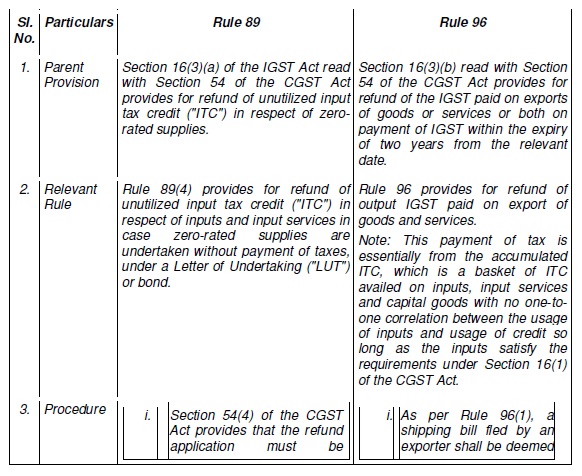
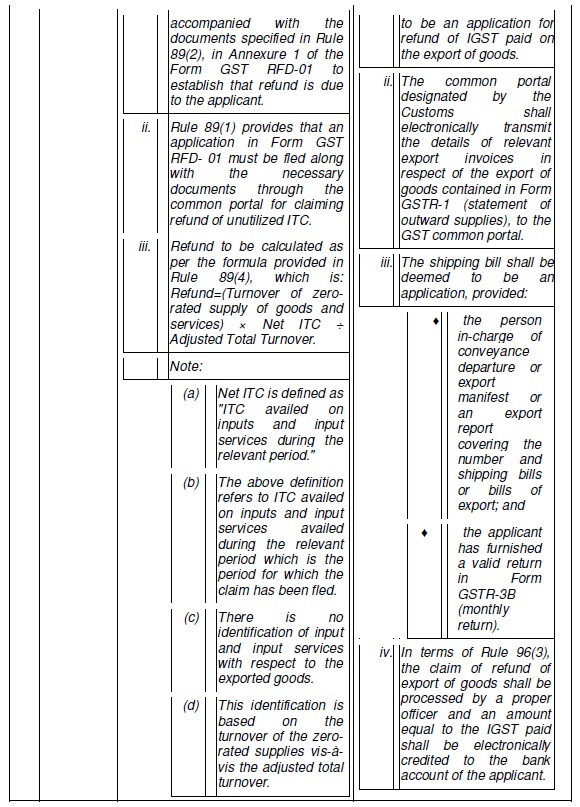
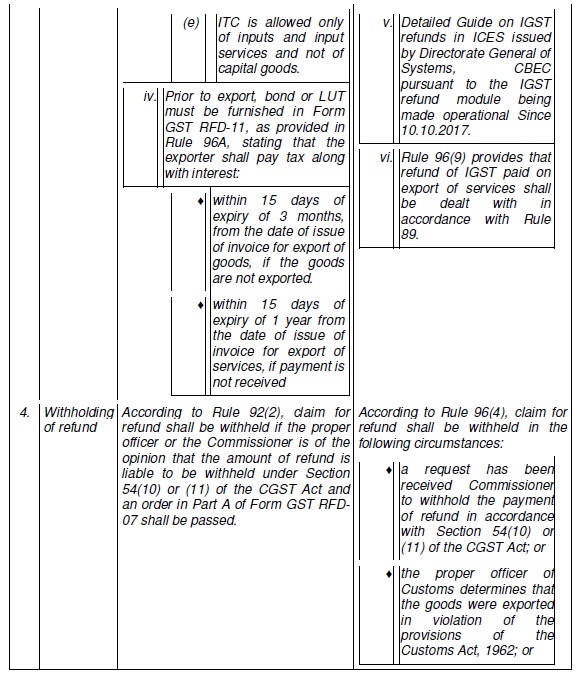
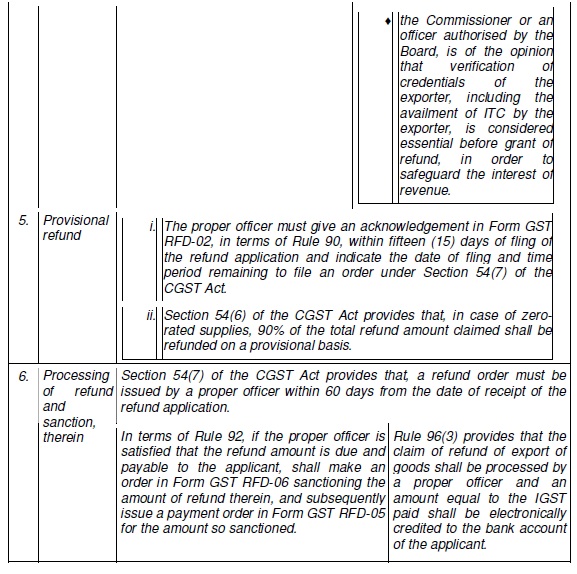
“14. In order to consider the contention that Rule 96(10) of the CGST Rules as it presently stands is manifestly arbitrary I proposed a comparison of the right to a refund flowing from Section 16(3)(a) of the IGST Act (in terms of Rule 89 of the CGST Rules) and the right to a refund following from Section 16(3)(b) of the IGST Act (in terms of Rule 96 of the CGST Rules). It may be noted that the reference to the statutory provisions is with reference to the provisions as they stood prior to the amendment of Section 16 w.e.f. 01-10-2023. The learned Senior Counsel appearing for the petitioner in W.P (C) No. 17447/2023 has provided the following comparison statement. A perusal of the statement shows as to how the working of Rule 96(10) of the CGST Rules has resulted in hostile discrimination amongst exporters who opt to apply for a refund under Section 16(3)(a) read with Rule 89 of the CGST Rules and those who opt to apply for a refund in the manner contemplated by Section 16(3)(b). The statement is extracted below in tabular form:-
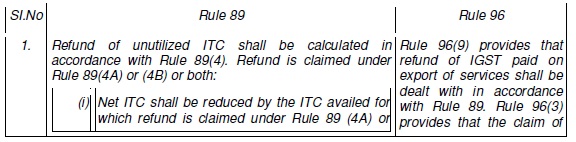
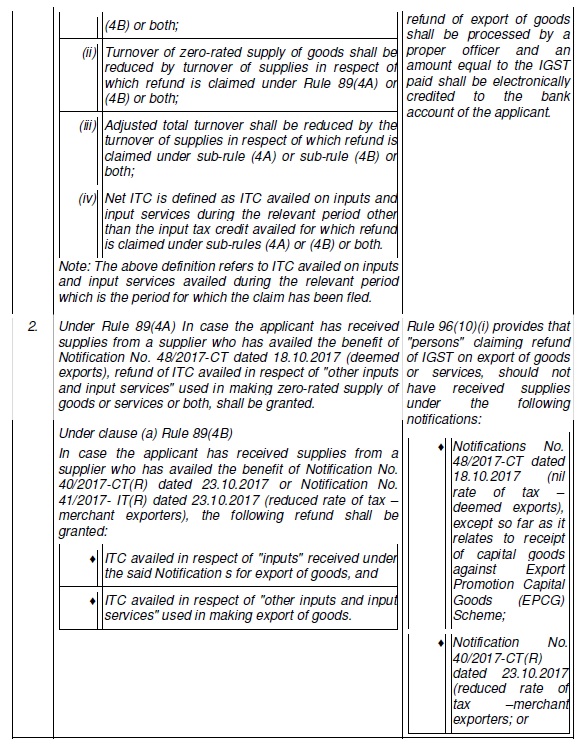
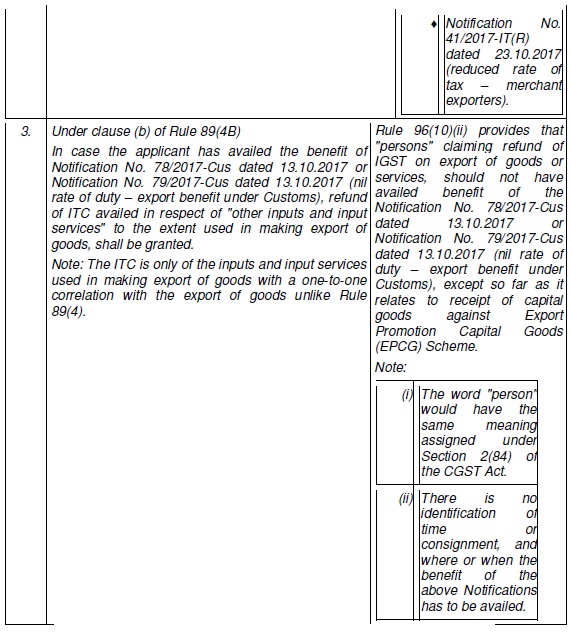
“101. It will be noticed that a Constitution Bench of this Court in Indian Express Newspapers (Bombay) (P) Ltd. v. Union of India stated that it was settled law that subordinate legislation can be challenged on any of the grounds available for challenge against plenary legislation. This being the case, there is no rational distinction between the two types of legislation when it comes to this ground of challenge under Article 14. The test of manifest arbitrariness, therefore, as laid down in the aforesaid judgments would apply to invalidate legislation as well as subordinate legislation under Article 14. Manifest arbitrariness, therefore, must be something done by the legislature capriciously, irrationally and/or without adequate determining principle. Also, when something is done which is excessive and disproportionate, such legislation would be manifestly arbitrary. We are, therefore, of the view that arbitrariness in the sense of manifest arbitrariness as pointed out by us above would apply to negate legislation as well under Article 14.”
“6. It is true that the consequences of a suggested construction cannot alter the meaning of a statutory provision but they can certainly help to fix its meaning. It is a well-recognised rule of construction that a statutory provision must be so construed, if possible, that absurdity and mischief may be avoided. There are many situations where the construction suggested on behalf of the Revenue would lead to a wholly unreasonable result which could never have been intended by the legislature.”
| i. | Rule 96(10) of the CGST Rules, as inserted by notification No.53/2018-CT dated 09-10-2018 w.e.f. 2310-2017 is declared ultra vires the provisions of Section 16 of the IGST Act and unenforceable on account of being manifestly arbitrary; |
| ii. | As a consequence of the above declaration, any action that has been initiated by the issuance of a show cause notice or otherwise or has culminated in an order against the petitioners in these writ petitions on the basis of the provisions contained in Rule 96(10) of the CGST Rules, as inserted by notification No.53/2018-CT dated 09-10-2018 w.e.f. 23-10-2017, will stand quashed; |
| iii. | It is directed that no proceedings shall be taken to recover any IGST that has been refunded to the petitioners in these writ petitions by applying the provisions of Rule 96(10) of the CGST Rules for the period between 23-10-2017 and 08-10-2024; |
| iv. | In cases where orders have been issued by the Adjudicating Authority including on issues other than those arising out of the application of Rule 96(10) of the CGST Rules, the person aggrieved may file appeals against such orders and on such issues other than those arising out of the application of Rule 96(10) of the CGST Rules within a period of two weeks from the date of receipt of a certified copy of this judgment. Since these Writ Petitions have been pending before this Court along with interim orders of protection such appeals shall be deemed to have been fled on time provided they are fled within the time permitted; |
| v. | In cases where a show cause notice has been issued, on issues other than those arising under Rule 96(10) of the CGST Rules, the petitioners shall file their replies in response to such notices within a period of two weeks from the date of receipt of a certified copy of this judgment and all issues other than those arising out of the application of Rule 96(10) of the CGST Rules shall be adjudicated by the proper officer. “ |
“7. Heard learned counsel for the parties, since the Rule 96 (10) of CGST Rule, 2017 have been declared ultra vires by the Hon’ble High Court of Kerala in Sance Laboratories Pvt. Ltd. v. Union of India, reported in 2024 (91) G.S.T.L. 245 (Ker.) – 2024-VIL-1160-KER and have subsequently been deleted vide Notification No.20/2024-Central Tax, dated 08.10.2024, therefore, it would be fruitless to again declare Rule 96 (10) of CGST Rule, 2017 as ultra vires the provisions of Section 16 of the IGST Act, therefore, the prayer no.1 does not service any more.
“50. The next question is whether the application of that principle could or ought to be limited to cases where a particular form of words is used to indicate that the earlier law has been repealed. The entire theory underlying implied repeals is that there is no need for the later enactment to state in express terms that an earlier enactment has been repealed by using any particular set of words or form of drawing but that if the legislative intent to supersede the earlier law is manifested by the enactment of provisions as to effect such supersession, then there is in law a repeal notwithstanding the absence of the word ‘repeal’ in the later statute. Now, if the legislative intent to supersede the earlier law is the basis upon which the doctrine of implied repeal is founded, could there be any incongruity in attributing to the later legislation the same intent which Sec. 6 presumes where the word ‘repeal’ is expressly used. So far as statutory construction is concerned, it is one of the cardinal principles of the law that there is no distinction or difference between an express provision and a provision which is necessarily implied, for it is only the form that differs in the two cases and there is no difference in intention or in substance. A repeal may be brought about by repugnant legislation, without even any reference to the Act intended to be repealed, for once legislative competence to effect a repeal is posited, it matters little whether this is done expressly or inferentially or by the enactment of repugnant legislation. If such is the basis upon which repeals and implied repeals are brought about it appears to us to be both logical as well as in accordance with the principles upon which the rule as to implied repeal rests to attribute to that legislature which effects a repeal by necessary implication the same intention as that which would attend the case of an express repeal. Where an intention to effect a repeal is attributed to legislature then the same would, in our opinion, attract the incident of the saving found in Sec. 6 for the rules of construction embodied in the General Clauses Act which are, so to speak, the basic assumptions on which statutes are drafted.”
“4. The Full Bench opined that the Circular was not applicable to the case on hand as the acquisition proceedings were over by the order of the Competent Authority passed on 31.3.1981. The Full Bench observed that the pendency of the proceeding before the Competent Authority was necessary for the applicability of the Circular and as no such proceedings were pending in this case, the Circular had no application. Consequently, the Full Bench declined to answer the question referred and directed the matter to be posted before the Division Bench for hearing.
xxx
8. It is well settled that the word “Proceedings” shall include the proceedings at the appellate stage. It is sufficient to refer to the Judgement of this Court in Garikapati Veeraya V/s. N. Subiah Choudhry, AIR 1957 SC 540, wherein the Court said at page 553 :-
“(i) That the legal pursuit of a remedy, suit appeal and second appeal are really but steps in a series of proceedings all connected by an intrinsic unity and are to be regarded as one legal proceedings.”
Hence we are unable to persuade ourselves to agree with the view expressed by the Full Bench of the High Court in the Judgement under appeal that the circular would apply only to proceedings pending before the Competent Authority.”
“A repeal will generally, therefore, divest all inchoate rights which have arisen under the repealed statute, and destroy all accrued causes of action based thereon. As a result, such a repeal, without a saving clause, will destroy any proceedings whether not yet begun, or whether pending at the time of the enactment of the repealing Act, and not already prosecuted to a final judgment so as to create a vested right.”
“See Cleveland, etc., R. Co. v. Mumford (Ind.) (2) where the repeal of a statute during the trial prevented a judgment from being rendered. Similarly, there can be no legal conviction for an offence, unless the act be contrary to law at the time it is committed; nor can there be a judgment, unless the law is in force at the time of the indictment and judgment. If the law ceases to operate, by its own limitation or by a repeal, at any time before judgment, no judgment can be given. Hence, it is usual in every repealing law to make it operate prospectively only, and to insert a a saving clause, preventing the retroactive operation of the repeal and continuing the repealed law in force as to all pending prosecutions, and often as to all violations of the existing law already committed.”
“It is well settled that if a statute giving a special remedy is repealed without a saving clause in favour of pending suits all suits must stop where the repeal finds them. If final relief has not been granted before the repeal went into effect, it cannot be after. If a case is appealed, and pending the appeal the law is changed, the appellate court must dispose of the case under the law in force when its decision was rendered. The effect of the repeal is to obliterate the statute repealed as completely as if it bad never been passed, and it must be considered as a law which never existed, except for the purposes of those actions or suits which were commenced, prosecuted and concluded while it was an existing law. Pending judicial proceedings based upon a statute cannot proceed after its repeal. This rule holds true until the proceedings have reached a final judgment in the court of last resort, for that court, when it comes to announce its decision, conforms it to the law then existing, and may therefore reverse a judgment which was correct when pronounced in the subordinate tribunal from whence the appeal was taken, if it appears that pending the appeal a statute which was necessary to support the judgment of the lower court has been withdrawn by an absolute repeal.”
“47. In this batch of Petitions, for reasons that we will discuss elaborately hereafter, we are satisfied that the Petitioners are entitled to succeed on the ground that this is a case of omission or repeal of the impugned Rules without any savings clause to protect the pending proceedings. Besides, we are also satisfied that the provisions of Section 6 of the General Clauses Act are not attracted and therefore, relying upon these provisions, the pending proceedings can claim no immunity or protection. Therefore, it is quite unnecessary to determine the issue of the constitutionality of the impugned rules.
48. However, we wish to briefly record one of the controversies regarding the constitutionality of Rule 96(10) of the CGST Rules, which is not significantly different from Rule 89(4B) of the CGST Rules. The first Rule applies to exports and the second to imports. Both the Rules provide for certain safeguards to ensure that there is no overlap between taxes and refunds regarding specific exports and imports.
49. One of the contentions raised on behalf of some of the Petitioners was that Rule 96(10) of the CGST Rules was already struck down as unconstitutional, null and void by the learned Single Judge of the Kerala High Court in the case of M/s. Sance Laboratories Pvt. Ltd. (supra). Based upon this, they contended that such a striking down will have an effect throughout the territory of India. They further contended that such striking down goes to the nativity, and therefore, any notices or orders alleging or recording the breach of any of the requirements of Rule 96(10), being based upon an ultra vires and unconstitutional Rule, would have to be quashed and set aside.
50. In Kusum Ingots & Alloys Ltd (supra), the Hon’ble Supreme Court has held that where a competent Court having territorial jurisdiction passes an order on a Writ Petition questioning the constitutionality of a parliamentary Act, then, keeping in view the provisions in Article 226(2) of the Constitution of India, such order, will have effect throughout the territory of India, subject of-course to the applicability of the Act.
51. Following Kusum Ingots & Alloys Ltd. (supra) the Coordinate Bench of this Court comprising Abhay S Oka, J (as His Lordship then was) and C V Bhadang, J held that the striking down of Section 10-A(1) of the Divorce Act, 1869 by the Division Bench of the Kerala High Court in the case of Saumya and Thomas (supra), would have effect throughout the territory of India. Therefore, the Family Court at Bandra, Maharashtra, could not have ignored the striking down of Section 10-A (1) of the Divorce Act by the Kerala High Court, on the ground that such a decision was not binding upon the Courts and Authorities in the State of Maharashtra.
52. In Commissioner of Income-Tax, Vidarbha (supra), another Coordinate Bench of this Court, comprising Kantawala, CJ and Chandurkar, J (as His Lordship then was), rejected the contention that the striking down of Section 140-A(3) of the Income Tax Act by the Madras High Court in the case of A.M. Sali Maricar And Anr. v. Income-Tax Officer And Anr [(1973) 90 ITR 116] was not binding upon the Income Tax Authorities or the Income Tax Tribunals in the State of Maharashtra. The Coordinate Bench held that the Income Tax Act was an all- India statute. If an Income Tax Tribunal in Madras was bound by the decision in A.M. Sali Maricar (supra), then, in the absence of any contrary decision given by any other competent High Court, binding on the authorities and tribunals in the State of Maharashtra, such authorities and tribunals in the State of Maharashtra must proceed based on the law declared by the High Court, even of another State and quash the assessment and penalties under the provision already struck down.
53. In these matters, none of the learned Counsel appearing on behalf of the Respondents was able to make any statement regarding the challenge to the Kerala High Court’s decision declaring Rule 96(10) of the CGST Rules as ultra vires and unconstitutional. The Uttarakhand High Court, in the case of M/s Shree Sai Vishwas Polymers (supra), has already taken cognisance of the Kerala High Court’s decision and proceeded based on its unconstitutionality. The learned Counsel for the Respondents were also unable to make any statement about the challenge to the Uttarakhand High Court’s decision.
54. In the case of Commissioner of Income-Tax v. Thana Electricity Supply Ltd [1993 SCC OnLine BOM 591], another Coordinate Bench of this Court of this Court comprising Dr B P Saraf, J (as His Lordship then was) & U T Shah, J, however, after noticing the earlier decision in Godavari Devi Saraf (supra) had suggested that the observations in Godavari Devi Saraf (supra) cannot be taken as the ratio decidendi and would, at best, constitute obiter dictum. The Coordinate Bench held that such observations might have persuasive efficacy but not a binding character as in the case of a precedent.
55. Though, for reasons discussed above, we do not propose to examine the issue of constitutional validity of Rules 89(4B) and 96(10) of the CGST Rules, we have noted the contention raised on behalf of some of the Petitioners that since Rule 96(10) is already struck down by the Kerala High Court, the effect of such striking down must enure even in the State of Maharashtra and the authorities in the State of Maharashtra cannot ignore the declaration made by the Kerala High Court in the case of M/s Sance Laboratories Pvt Ltd (supra) regarding unconstitutionality of Rule 96(10) of the CGST Rules, until the said Rule was omitted vide Notification dated 08 October 2024.”
xxxxx
“59. From the above, it is indisputable that the impugned rules stand deleted. The only dispute revolves around the scope of such omission or repeal. The Petitioners contend that any savings clause did not back such omission or repeal, and therefore, the common law principle regarding repeals obliterating the repealed provision from the statute book or rule book would apply. The Respondents admit the omission or repeal but contend that the common law rule would not apply because pending proceedings have been expressly saved.”
xxxxx
“65. Thus, subject to further discussion on whether this is a case of omission or repeal backed by any savings clauses, it is evident that an omission or a repeal without any savings clauses would lapse the impugned proceedings or orders unless they qualify as “transactions past and closed”.
66. In these matters, not even an attempt was made by the learned Counsel for the Respondents to contend that the impugned show cause notices or for that matter, the orders challenged in these Petitions, were covered by the expression “transactions past and closed”. In cases where the show cause notices did not culminate in any orders, obviously, the transaction is not covered by the expression. Not only do such show cause notices become vulnerable, but even the orders made after the date of omission or repeal, i.e. after 08 October 2024, become vulnerable. The show cause notices could not have proceeded any further post the repeal or omission of the impugned Rules i.e. beyond 08 October 2024. In some petitions, the challenge is to orders made by adjudicating authorities before October 08, 2024. However, a challenge to such orders was raised and was pending either before the Appellate Authorities or this Court. In such circumstances, even such orders could not be regarded as final for them to be included in the expression “transactions past and closed.
67. In M/s Add Wrap Packaging Pvt Ltd (supra) the Division Bench of the Gujarat High Court has considered this aspect of the omission or repeal of these very impugned Rules on pending proceedings in some detail. The Division Bench held that the omission or repeal of the impugned Rules would affect pending proceedings/cases where final adjudication has not taken place. The Division Bench held that the omission of Rule 9610 would apply to all the proceedings/cases/petitions which are pending adjudication either before the High Court or before the adjudicating authorities and no further proceedings are required to be carried forward and the Petitioners would be entitled to maintain refund claims of IGST paid on export of goods. The impugned show cause notices and the orders were therefore quashed and set aside, and it was declared that the Petitioners were entitled to maintain refund claims for IGST paid for the export of goods.”
xxxxx
“116. The 2024 Amendment Rules or the CGST Act do not include any savings clause to protect pending proceedings resulting from the omission of the impugned Rules. Mr Sridharan referenced a list of nearly 64 Notifications issued by the Central or State Government, which amended or omitted Rules and included explicit savings clauses. This indicates that the Central Government was aware of the legal obligation to include a savings clause where Section 6 of the General Clauses Act might not apply. Therefore, it appears that not including a savings clause in the Notification dated 08 October 2024, unlike the 64 Notifications mentioned above, was not an accident but a conscious choice, made to benefit export, import, and trade.
117. The argument about the impugned showcause notices being issued under Section 73 of the CGST Act and such notices surviving because this section had not been omitted or repealed also cannot be accepted. The only allegation in the impugned show cause notices concerns the alleged violation of the requirements of the impugned rules. There are no other allegations, as was asserted by the learned counsel for the Petitioners and not disputed by the learned counsel for the respondents, though a specific opportunity was granted to them. Therefore, if the impugned rules are omitted or repealed without any savings clauses or the protection of Section 6 of the General Clauses Act, nothing would survive in such notices. Such notices cannot be saved based on the argument now advanced.”
xxxxx
“122. Upon comprehensive review of all the above aspects, we hold that, following the omission or repeal of the impugned Rules, i.e., Rules 89(4B) and 96(10) of the CGST Rules via Notification dated 08 October 2024, and in the absence of any saving clauses or the benefit of Section 6 of the General Clauses Act, all pending proceedings-such as indisposed show cause notices, orders disposing of show cause notices issued after 08 October 2024, or even orders made before 08 October 2024 but not yet finalised due to appeals before the Appellate Authorities or challenges before this Court, thus not constituting “transactions past and closed”-are not preserved and will stand lapsed.
123. Accordingly, we quash and set aside the impugned show cause notices and the impugned orders in original. Furthermore, we also quash and set aside the orders refusing some of the Petitioners’ applications for refund, restore those applications to the files of the relevant Authorities, and direct the Authorities to consider and dispose of such refund applications in light of the declaration made by us above regarding the omission and repeal of the impugned Rules. This process must be completed within four months of the date of this order’s upload, after providing the Petitioners with a fair opportunity to be heard.”
“18. A conjoint reading of all the judicial precedents set out above leads to the following conclusions:
| (i) | In the 54th meeting of the GST Council, the recommendation made is relevant, as it clearly observed that Rule 96(10) of CGST Rules leads to unnecessary complication, without any intended benefit and therefore the omission was recommended. |
| (ii) | Rule 96(10) of the CGST rules has been omitted with effect from 8th October, 2024 upon the recommendations of the GST Council in its 54th meeting. The Kerala High Court in Sance Laboratories Pvt. Ltd (supra) has considered the constitutional validity of Rule 96(10) of the CGST rules and has held that, if permitted to stand, the constraints placed upon IGST refunds under Rule 96(10) would run contrary to the provisions of the IGST Act, especially Section 16 of the IGST Act. As evident from the above, the said omission of the said Rule has also been considered by all the other High Courts in above mentioned decisions. |
| (iii) | Additionally, various High Courts through the above mentioned decisions, have held that following the decision of the Supreme Court in Kolhapur Canesugar Works (supra), Rule 96(10) of the CGST rules having been omitted from the Statute, it would also apply to all pending proceedings. The Bombay High Court while considering the same has held that unless and until the transactions have passed and closed, the benefit of omission of Rule 96(10) of the CGST rules has been extended. |
| (iv) | All pending SCNs, orders and even appeals filed against orders would not be transactions passed and closed and therefore, the proceedings cannot continue under Rule 96(10) of the CGST rules. |
19. Applying the above legal principles to the facts and circumstances of the present writ petitions, the following observations are made:
| (i) | In W.P. (C) 3154/2023, the case is only at the stage of summons and therefore the proceedings deserve to be quashed including the summons. Thus, no proceedings can continue under Rule 96(10) of the CGST rules against the Petitioner. |
| (ii) | In W.P. (C) 10687/2023, the SCN and all subsequent orders emanating therefrom which were passed in the said matter shall also stand quashed. Moreover, as the Petitioner is already in the process of filing the appeal against the order and the additional 10% pre-deposit has already been made by the Petitioner. |
| (iii) | In W.P.(C) 3165/2023, the SCN and proceedings emanating from the SCN stand quashed.” |
| (i) | The petition is hereby allowed. |
| (ii) | The impugned Show Cause Notice at Annexure – R dated 07.10.2020 issued by respondent No.5 and all further proceedings pursuant thereto are hereby quashed. |
| (iii) | Respondent authorities are directed to refund IGST amounting to Rs.75,55,123/- along with applicable interest back to the petitioner as expeditiously as possible and at any rate within a period of three months from the date of receipt of a copy of this order. |
| (i) | Petition is hereby allowed and disposed of in terms of judgment of this Court in the case of Hikal Limited(supra). |
| (ii) | The impugned show cause notice bearing No. 50/2023-24 GST PREV dated 18.01.2024 issued by respondent No.2 and all further proceedings pursuant thereto are hereby quashed. |