


CIT(E) Must Confine Section 12AB Enquiry to Genuineness of Activities and Grant Final Registration for Commenced Objects
Issue
Whether the Commissioner of Income Tax (Exemptions) can reject an application for final registration under section 12AB by questioning the mode of donations or examining income assessment, when the trust has already commenced activities towards its charitable objects.
Facts
-
Entity and Objects: The assessee-society, registered under the Karnataka Societies Registration Act, was established with charitable objects focused on providing relief to the poor, medical aid, and housing repair assistance to the needy.
-
Provisional Registration: The society was initially granted provisional registration under section 12A(1)(ac)(vi) in Form 10AC for a period of three years.
-
Application for Final Registration: The assessee subsequently filed Form 10AB to obtain final registration under section 12AB.
-
Rejection by CIT(E): The CIT(E) rejected the Form 10AB application, observing that the bank account primarily reflected cash deposits, claimed donations were unverifiable, and donations recorded in financial statements did not match bank deposits, thereby concluding that no genuine donations were received or activities carried out.
-
Tabulated Expenditure: While passing the rejection order, the CIT(E) abstracted the society’s financial details in a tabular form, which actually reflected that the trust had incurred expenses toward its charitable objects.
Decision
-
Scope of Section 12AB Enquiry: At the registration stage, the authority must confine its examination strictly to verifying the genuineness of the trust’s activities and compliance with applicable laws, rather than conducting an assessment of income or questioning the mode/amount of expenditure.
-
Activities Commenced: Since the tabular data recorded by the CIT(E) itself demonstrated that the trust had incurred expenditure towards attaining its charitable objects, the finding that no activities were carried out was devoid of merit.
-
Registration Directed: The order of the CIT(E) rejecting the application was set aside, and the CIT(E) was directed to grant registration to the assessee-society under section 12AB in favor of the assessee.
Key Takeaways
-
Limited Scope of Registration Proceedings: Proceedings under section 12AB (or section 332 of the Income-tax Act, 2025) are limited to testing the genuineness of charitable activities and statutory compliance, not scrutinizing financial transactions like an assessment officer under section 143(3).
-
Expenditure Realization: Incurring expenses toward stated objects proves the commencement and genuineness of activities required for final registration.
-
Donation Scrutiny Belongs in Assessment: Issues regarding cash deposits, donor verifiability, or accounting discrepancies are matters to be examined during regular assessment proceedings, not as a ground to deny section 12AB registration.
IN THE ITAT BANGALORE BENCH ‘B’
Society of St. Vincent De Paul Bondel
v.
Commissioner of Income Tax (Exemptions)*
Keshav Dubey, Judicial Member
and BALAKRISHNAN S., Accountant Member
and BALAKRISHNAN S., Accountant Member
IT Appeal No. 1998 (Bang.) of 2025
SEPTEMBER 7, 2026
Balram R. Rao, Adv. for the Appellant. N.S. Shashidhara, CIT-DR for the Respondent.
ORDER
Keshav Dubey, Judicial Member.- This appeal at the instance of the assessee is directed against the order of the ld. CIT (Exemptions), Bangalore dated 30/12/2024 vide DIN & Notice No. ITBA/EXM/F/EXM45/2024-25/ 1071697665(1) rejecting the application in Form No.10AB dated 29/06/2024 filed for Registration u/s 12AB of the Income Tax Act, 1961 (in short “the Act”).
2. The assessee has raised the following grounds of appeal:-
1. On the facts and in the circumstances of the case, the learned CIT (Exemptions) erred in rejecting and cancelling the registration u/s 12AB of the Act vide. order dated 30.12.2024. On the ground that, the donation made were mostly cash deposit in the Bank Account and the same were not verifiable.
2. On the facts and in the circumstances of the case, the learned CIT (Exemptions) erred in rejecting the application in Form IOAB dated 29.06.2024 without providing sufficient opportunity to establish the genuineness of the activities of the Trust.
3. On the facts and in the circumstances of the case, the learned CIT (Exemptions) failed to appreciate that when oral donations were made by cash and the same had been taken to the respective accounts either towards corpus or donation, then the same could not be a ground to cancel the Appellant’s Registration.
4. For these and such other grounds that may be urged at the time of hearing, the Appellant prays that the appeal may please be allowed to meet ends of justice.
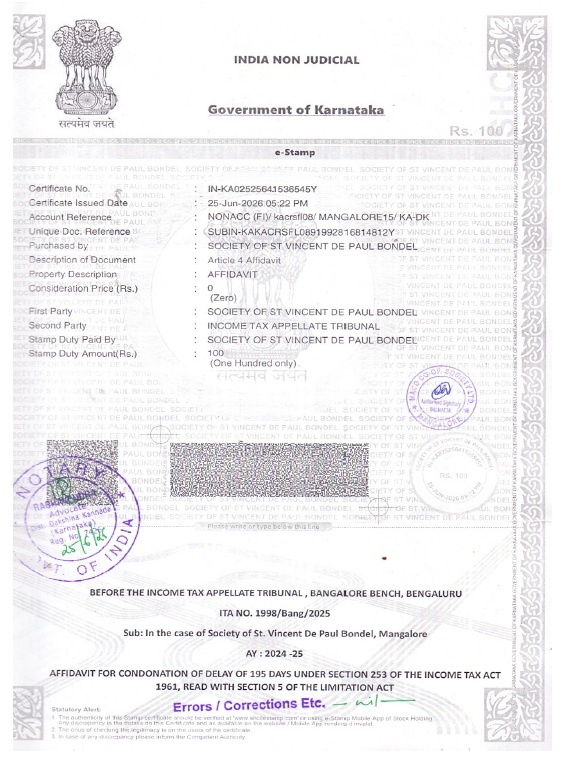
3. At the outset, the ld. A.R. of the assessee submitted that there is a delay of 195 days in filing the appeal before this Tribunal. The ld. A.R. of the assessee also drew our attention to an affidavit in original sworn before the notary public dated 25.06.2026 stating the reasons for the delay, which is reproduced below for ease of reference and convenience:
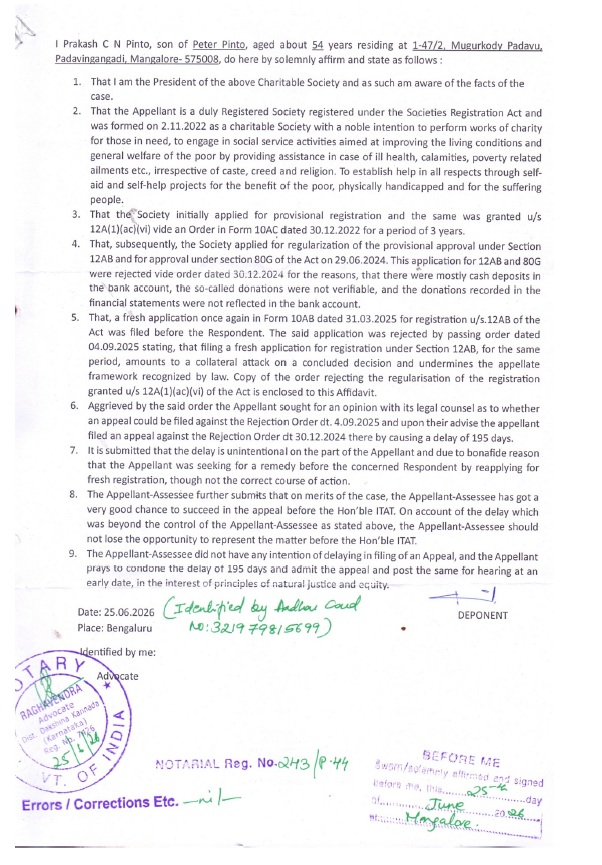
4. Before us, the ld. AR of the assessee reiterate the same as stated in the above affidavit & vehemently submitted that the assessee could not file the appeal within the prescribed period for the reason that the assessee society initially applied for provisional registration and the same was granted u/s 12A(1)(ac)(vi) of the Act vide order in Form 10AC dated 30.12.2022 for a period of 3 years. Subsequently, the assessee Society applied for regularization of the provisional approval u/s 12AB and for approval u/s 80G of the Act on 29.06.2024. These applications for 12AB and 80G were rejected vide order dated 30.12.2024 for the reasons, that there were mostly cash deposits in the bank account, the so-called donations were not verifiable, and the donations recorded in the financial statements were not reflected in the bank account. Thereafter, a fresh application once again in Form 10AB dated 31.03.2025 for registration u/s 12AB of the Act was filed before the ld. CIT (Exemptions), Bangalore. The said application was again rejected by passing order dated 04.09.2025 by stating that filing a fresh application for registration u/s 12AB, for the same period, amounts to a collateral attack on a concluded decision and undermines the appellate framework recognized by law. Aggrieved by the said order, the assessee sought for an opinion with its legal counsel as to whether an appeal could be filed against the rejection order dated 04.09.2025 and upon advice, the assessee filed an appeal against the earlier rejection order dated 30.12.2024 thereby causing a delay of 195 days. Hence, the ld. A.R. of the assessee submitted that the delay is unintentional and no benefit can be attributed to the assessee in filing the appeal belatedly. He thus prayed to condone the delay and requested to consider the issues raised by the assessee on merits.
5. On the contrary the ld. D.R. vehemently objected for granting the condonation of delay as the assessee failed to demonstrate the sufficient cause in filing the appeal belatedly.
6. We have perused the details filed by the assessee to justify the delay and we are satisfied that there is no malafide intention on the part of the assessee in filing the appeal belatedly before us. In our considered opinion, the assessee has demonstrated the sufficient cause in filing the appeal belatedly before us. It is to be noted that u/s 253(5) of the Act the Tribunal may admit the appeal filed beyond the period of limitation where it has established that there exists a sufficient cause on the part of the assessee for not presenting the appeals within the prescribed time. The explanation therefore, becomes relevant to determine whether the same reflect sufficient and reasonable cause on the part of the assessee in not filing these appeals within the prescribed time. We have gone through the reasons explained by the assessee in which we found that after rejection of application in form 10AB dated 29/06/2024, the assessee subsequently filed another application on 31/03/2025 before the same ld. CIT (Exemptions), Bangalore which was also rejected. The assessee thereafter upon legal advice by the counsel, filed an appeal against the earlier rejection order dated 30.12.2024 thereby causing a delay of 195 days.
6.1 While considering a similar issue the Apex Court in the case of Collector, Land Acquisition v. Mst. Katiji and Ors. 1072 (SC)/(167 ITR 471 ) laid down six principles. For the purpose of convenience, the principles laid down by the Apex Court are reproduced hereunder:
(1) Ordinarily, a litigant does not stand to benefit by lodging an appeal late.
(2) Refusing to condone delay can result in a meritorious matter being thrown at the very threshold and cause of justice being defeated. As against this, when delay is condoned, the highest that can happen is that a cause would be decided on merits after hearing the parties.
(3) ‘Every day’s delay must be explained’ does not mean that a pedantic approach should be made. Why not every hour’s delay, every second’s delay?
The doctrine must be applied in a rational, commonsense and pragmatic manner.
(4) When substantial justice and technical consideration are pitted against each other, the cause of substantial justice deserves to be preferred, for the other side cannot claim to have vested right in injustice being done because of a nondeliberate delay.
(5) There is no presumption that delay is occasioned deliberately, or on account of culpable negligence, or on account of mala fides. A litigant does not stand to benefit by resorting to delay. In fact, he runs a serious risk.
(6) It must be grasped that the judiciary is respected not on account of its power to legalise injustice on technical grounds but because it is capable of removing injustice and is expected to do so.
6.2 When substantial justice and technical consideration are pitted against each other, the cause of substantial justice deserves to be preferred, for the other side cannot claim to have vested right for injustice being done because of non-deliberate delay. Therefore, we have to prefer substantial justice rather than technicality in deciding the issue. As observed by Apex Court, if the application of the assessee for condoning the delay is rejected, it would amount to legalize injustice on technical ground when the Tribunal is capable of removing injustice and to do justice. Therefore, this Tribunal is bound to remove the injustice by condoning the delay on technicalities. If the delay is not condoned, it would amount to legalizing an illegal order which would result in unjust enrichment on the part of the State by retaining the tax relatable thereto. Under the scheme of Constitution, the Government cannot retain even a single pie of the individual citizen as tax, when it is not authorized by an authority of law. Therefore, if we refuse to condone the delay, that would amount to legalize an illegal and unconstitutional order passed by the lower authority.
6.3 Further, in the case of People Education and Economic Development Society (PEEDS) v. ITO [2006] 100 ITD 87 (Chennai) (TM), wherein held that “when substantial justice and technical consultation are pitted against each other, the cause of substantial justice deserves to be preferred for the other side cannot claim to have vested right in injustice being done because of non-deliberate delay”.
6.4 The next question may arise whether delay was excessive or inordinate. There is no question of any excessive or inordinate when the reason stated by the assessee was a reasonable cause for not filing the appeal. We have to see the cause for the delay. When there was a reasonable cause, the period of delay may not be relevant factor. In fact, the Madras High Court in the case of CIT v. K.S.P. Shanmugavel Nadar [1985] 153 ITR 596 (Madras) considered the condonation of delay and held that there was sufficient and reasonable cause on the part of the assessee for not filing the appeal within the period of limitation. Accordingly, the Madras High Court condoned nearly 21 years of delay in filing the appeal. When compared to 21 years, 195 days cannot be considered to be inordinate or excessive. Furthermore, the Chennai Tribunal by majority opinion in the case of People Education and Economic Development Society (PEEDS) (supra) condoned more than six hundred days delay. Therefore, in our opinion, by preferring the substantial justice, the delay of 195 days has to be condoned and accordingly we condone the delay and admit the appeal for adjudication.
7. The brief facts of the case are that the assessee society is registered under the Karnataka Society Registration Act, 1960 vide registration no. DRDK/SOR/295/2022-23 dated 21.11.2022. The objects of the assessee trust are relief to the poor and medical relief. It is submitted that the assessee trust provided the provisions for the poor families, medical aid and housing aid for repairs to the needy people. The assessee society was granted provisional registration u/s 12A(1)(ac)(vi) of the Act vide order in Form No. 10AC dated 30.12.2022 for a period of 3 years. The assessee trust thereafter filed an application in Form No.10AB dated 29.06.2024 for the final registration u/s 12AB of the Act. On receipt of the application, the case was assigned to the JAO for verification. The ld. CIT(Exemptions) finally rejected the application filed in Form No.10AB dated 29.06.2024 for registration u/s 12AB of the Act on the following grounds:
1. It is seen that there are mostly cash deposits in the bank account. The so called donations are not verifiable. The donations received as per financials is not seen in the bank account.
2. It is evident that there are no donations received and no charitable activities carried out.
8. Aggrieved by the aforesaid order of ld. CIT (Exemptions) dated 30.12.2024, the assessee has filed the present appeal before this Tribunal.
9. Before us, the ld. A.R. of the assessee vehemently submitted that the ld. CIT (Exemptions) grossly erred in rejecting the application on the ground that there were no donations received and no charitable activities have been carried out by the trust which is completely baseless and without any merits, especially when the ld. CIT (Exemptions) himself extracted the details of donations received, corpus donation and expenses towards objects of the trust for the years ended 31.03.2023 and 31.03.2024. Lastly, the ld. A.R. submitted that before rejecting the application for registration, the ld. CIT(Exemptions) did not give any opportunity to the assessee by way of issuing the show cause notice which is a gross violation of principles of natural justice.
10. The ld. D.R. on the other hand, relied on the order of ld. CIT (Exemptions).
11. We have heard the rival submissions and perused the materials available on record. On perusal of the order of the ld. CIT (Exemptions), we find that the ld. CIT (Exemptions) himself extracted the summary of income and expenditure of the assessee trust in a tabular form for the year ended 31.03.2023 and 31.03.2024. We also observed that the assessee society have not only received the donations but also applied the donation for the object of the society. We are surprised to note that the ld. CIT (Exemptions) completely ignored these facts in holding that no donations were received and no charitable activities were carried out by the assessee trust. We are of the considered opinion that when the donations received by the trust as well as the expenditure incurred toward the object of the trust were recorded in the Books of Accounts, it is the obligation of the ld. CIT (Exemptions) to call for such documents and information from the trust or make such enquiries he thinks necessary in order to satisfy about the (i) genuineness of the activity of the trust and (ii) the compliance of such requirements of any other law for the time being in force by the trust as are material for the purpose of achieving its object. In our considered opinion at the time of granting registration, the ld. CIT (Exemptions) should satisfy himself/herself about this twin objects only as discussed above and should not step into the shoes of the AO & start assessing the income. On perusal of the order of ld. CIT (Exemptions), we find that there is not even a whisper about any non-genuineness of the activities carried on by the assessee trust. The only allegation by the ld. CIT (Exemptions) is that there are no donations received whereas in fact the assessee had received the donations. Further another allegation is that there were no charitable activities carried out by the assessee whereas the ld. CIT (Exemptions) himself reproduced the details of expenditure incurred by the assessee towards the object of the trust in a tabular form for two years. Therefore, we agree with the contention of the ld. A.R. of the assessee that it is only the genuineness of the activity and not the mode and amount of expenditure/income which are relevant for granting registration u/s 12AB of the Act. In the present case, it is an undisputed fact that assessee had already commenced its activities towards the attainment of the object as the assessee trust had incurred expenses towards the object of the trust as observed by the ld. CIT (Exemptions) and abstracted the same in a tabular form while passing the order. In view of the above, we find no merit in rejecting the application of the assessee & accordingly we direct the ld. CIT (Exemptions) to grant registration u/s 12AB of the Act as per the application of the assessee in Form No.10AB dated 29.06.2024. It is ordered accordingly.
12. In the result, appeal filed by the assessee is allowed.