


Assessee’s contractual sharing of forex gains is non-taxable rebate and ad-hoc expenditure disallowances are reduced.
Issue
Whether foreign exchange fluctuation gains passed on to an overseas buyer under a contractual agreement qualify as an allowable business deduction/rebate under Section 37(1) of the Income-tax Act, 1961 (Section 34 of the Income-tax Act, 2025), and whether ad-hoc disallowances sustained out of various business expenses (job work, travelling, office, vehicle, and staff welfare) were excessive and liable to be restricted.
Facts
-
Forex Gain Sharing Agreement: During AY 2013-14, the assessee (an exporter) had a pre-existing contractual agreement with an overseas buyer to share foreign exchange fluctuation gains exceeding 2% of remittances in a 55:45 ratio.
-
Accounting Treatment: A total forex fluctuation gain of approximately ₹2.83 crores arose; the assessee credited ₹1.51 crores to its Profit & Loss account and passed on the balance ₹1.32 crores to the buyer as a rebate/discount.
-
AO Addition on Forex Gain: The Assessing Officer (AO) added ₹1.32 crores back to the assessee’s income on the grounds of inadequate supporting documentation.
-
Ad-hoc Expense Disallowances: The AO made ad-hoc disallowances under multiple heads: Job Work Expenses, Travelling and Conveyance Expenses, Office Expenses, and Vehicle & Staff Welfare Expenses.
-
CIT(A) Partial Relief: On appeal, the Commissioner (Appeals) sustained part of these expense disallowances, leading to the present grievance.
Decision
-
Allowability of Forex Gain Share: The passing on of ₹1.32 crores to the buyer was pursuant to a valid contractual obligation incurred for business purposes; regardless of the nomenclature or accounting head used (rebate/discount), the amount is allowable and cannot be brought to tax.
-
Restriction of Ad-hoc Disallowances: The sustained ad-hoc expense disallowances were found to be excessive and were restricted as follows:
-
Job Work Expenses: Restricted to ₹2,50,000.
-
Travelling & Conveyance Expenses: Restricted to ₹1,00,000.
-
Office Expenses: Restricted to ₹25,000.
-
Vehicle & Staff Welfare Expenses: Restricted to ₹50,000.
-
Key Takeaways
-
Contractual Obligations Supersede Nomenclature: Amounts passed on pursuant to a pre-existing commercial contract constitute legitimate business outgoings under Section 37(1) / Section 34, irrespective of whether they are booked as rebate, discount, or profit-sharing.
-
Ad-hoc Disallowances Must Be Reasonable: Revenue authorities cannot make or sustain arbitrarily high ad-hoc disallowances against routine operational expenses without establishing a concrete lack of business nexus or genuine inflation of expenses.
IN THE ITAT LUCKNOW BENCH ‘A’
Syed Asif Ali
v.
ACIT
Kul Bharat, Vice President
and Anadee Nath Misshra, Accountant Member
and Anadee Nath Misshra, Accountant Member
IT Appeal No. 400 (Lkw) of 2020
[Assessment year 2013-14]
[Assessment year 2013-14]
JULY 15, 2026
B.P. Yadav, Adv. for the Appellant. Amit Kumar, CIT (D.R.) for the Respondent.
ORDER
Anadee Nath Misshra, Accountant Member.- This appeal vide I.T.A. No.400/Lkw/2020 has been filed by the assessee for assessment year 2013-14 against impugned appellate order dated 26.08.2020 passed by learned Commissioner of Income Tax (Appeals) -1, Lucknow [“CIT(A)” for short]. In this appeal, the assessee has raised the following grounds: –
“1. Because, the Id. AO and Id. CIT(A) has without knowing the facts and circumstances of the case he has passed the assessment order and upheld the same by the Id. CIT(A), then therefore is bad in law.
2. Because, the Id. Assessing Officer has erred while making addition on fluctuation of foreign exchange gain rate as income from appellant of Rs.1,31,59,222/- without proper knowing terms and conditions of the exports that was mention in the purchased order.
3. Because, the appellant has disclosed the net foreign exchange gain in his financial statement and reported the same in his books of account and ITR, then therefore the addition made by the Id. Assessing Officer and upheld by the Id. CIT(A), was notjustified by the law.
4. Because, the addition made by the Id. Assessing Officer on fluctuation or gain of foreign exchange without applying section of Income Tax and same upheld by the Id. CIT(A) that is notjustified by law and liable to be deleted.
5. Because, the Id. Assessing Officer made addition against the head of Job Work on the basis of presumption and ad-hoc basis, then addition made by the Id. Assessing Officer is notjustified by law and liable to be deleted.
6. Because, the addition made by the Id. Assessing Officer in the head of Travelling and Conveyance Expenses of Rs.2,00,000/- without any proper base and on the basis of presumption and ad- hoc basis that is not justified by law and liable to be deleted
7. Because, the addition made by the Id. Assessing Officer in the head of Office Expenses of Rs.1,00,000/- without any proper base and on the basis of presumption and ad-hoc basis that is notjustified by law and liable to be deleted.
8. Because, the addition made by the Id. Assessing Officer in the head of Vehicle and Staff Welfare Expenses of Rs.66,531/- without any proper base and on the basis of presumption and ad-hoc basis that is notjustified by law and liable to be deleted.
9. Because, the entire addition made by the Id. Assessing Officer in his assessment order without mentioning any section/sections of the Income Tax Act, that is not justified by law then therefore the assessment order is invalid.
10. Because, the appellant reserve the right to add, delete, alter or amend any grounds of appeals in this case as per your permission your Honor. “
(B) In this case, assessment order dated 28.03.2016 was passed by the Assessing Officer u/s 143(3) of the Income Tax Act, 1961 (“Act”, for short) whereby the assessee’s total income was determined at Rs.2,73,15,634/-(Rounded off to Rs.2,73,15,630/-) as against returned income of Rs.1,01,80,980/-. Additions were made in the assessment order, on account of Foreign Exchange Fluctuation Gain (amounting to Rs.1,31,59,222/-); Capital introduced by the assessee (amounting to Rs.29,20,000/-); and disallowances (out of expenses, amounting to Rs.6,88,901/-) out of Job Work Expenses, disallowance of Rs.2,00,000/- out of Travelling and Conveyance Expenses, disallowance of Rs.1,00,000/- out of Office Expenses and disallowance of Rs.66,531/- out of Vehicle & Staff Welfare Expenses. Vide impugned appellate order dated 26.08.2020, the assessee’s appeal against the assessment order was partly allowed. In the impugned appellate order of the Ld. CIT(A), the aforesaid addition of Rs.1,31,59,222/- was confirmed whereas the aforesaid addition of Rs.29,20,000/- was deleted. Further, the Ld. CIT(A) deleted Rs.3,44,450/-from the aforesaid disallowance of Rs.6,80,901/- out of Job Work Expenses; whereas the aforesaid addition of Rs.2,00,000/- out of Travelling and Conveyance Expenses was confirmed. The aforesaid disallowance of Rs.66,531/- out of Vehicle & Staff Welfare Expenses were also confirmed whereas an amount of Rs.50,000/- out of Office Expenses was deleted. The present appeal has been filed by the assessee against the aforesaid impugned appellate order of the Ld. CIT(A).
(B.1) In the course of appellate proceedings in Income Tax Appellate Tribunal (ITAT), a paper book in three parts containing the following particulars: –
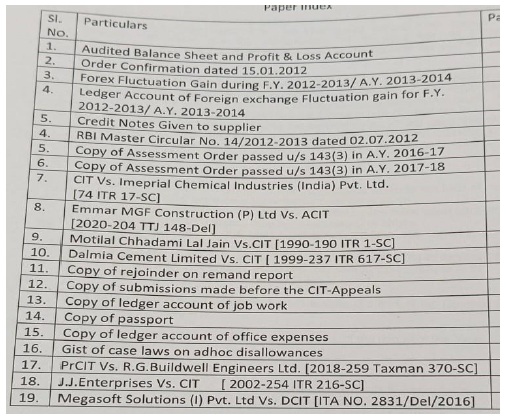
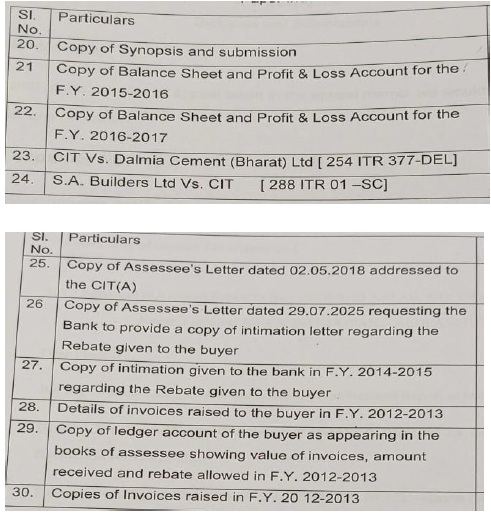
(B.2) As regards the aforesaid addition of Rs. 1,31,59,222/- made on account of gain arising from fluctuation in foreign exchange rates, the relevant portion of the assessment order is reproduced as under: –
“3.1 Addition on account of Foreign Currency Exchange Gain:
On perusal of PAL Account, it is seen that the assessee had total Foreign Exchange Fluctuation Gain of Rs.2,82,92,784/- out of which only on amount of Rs.1,51,33,562/- has been shown in the Profit and Loss Account. Therefore, assessee had failed to show the remaining amount of 1.31,59,222/- as his income.
It is relevant to note that the assessee had given the following remarks in his reply dated 25/06/2015:-
“Net foreign exchange fluctuation as detailed above had arisen from the dollar rate available and given on bill of lading as compared to the dollar rate applicable on the receipt of export remittance. The firm had gained Rs. 2,82,92,784/-. However, we had to oblige to the demand of the buyer to share gains arising from foreign exchange fluctuation. To that end we had allowed rebate of Rs.1,31,59,222/- to the buyer on account of foreign exchange fluctuation and informed RBI through our bankers of rebate deducted by the buyer from future remittances.”
In this reference, vide order sheet entries dated 14.09.2015. 02. 2016 and 16.03.2016, the assessee was afforded various opportunities to explain as to why remaining income of Rs. 1,31,59,222/- an account of change difference should not be taxed in the hands of the assessee
The assessee has furnished his reply on 29.01.2016 which is as under
Our net earnings from foreign exchange fluctuation was Rs. 1,51,33,562/-ding FY 2012-13. This gain is primarily the difference in dollar rate as applicable on the date of Bill of Lading and on receipt of export remittance for instance, the dollar rate was Rs.60 as on the date of Bill of Lading used by the Customs Department and if the dollar rate increases to Rs.62 on the date of remittance by the buyer, the foreign exchange gain is calculated in rupees equivalent to USD 2.”
Further the assessee vide his reply dated 18.03.2016 has furnished the following reply:
“Regarding foreign exchange rebate allowed to the buyer is as per Purchase Order copy ofwhich is enclosed.”
The reply of the assessee has been considered.
If there is any change in the exchange rate, the resultant difference is to be credited or debited as the case may be to the profit and loss account. Where the assessee books sale on account of prevailing rate of exchange on which the invoices have been raised, then, the resultant excess or shortfall is part of the sale proceeds and accordingly, the resultant profit.
Thus the assessee has attempted to divert his income. It is a matter of logic that the resultant gains/loss of the assessee on account of foreign currency fluctuation are profit/loss of the assessee. It is not amenable to reason that the assessee unilaterally diverts his income to any other person.
The assessee has also failed to adduce any document in support of his evidence. Therefore, it is a vain attempt by the assessee to suppress his profits. Thus, it can be concluded that the assessee has not shown proper income on account of exchange rate difference. Accordingly, an amount of Rs 1,31,59,222/- is being added back to the income of the assessee. Penalty proceedings u/s 271(1)(c) are separately being initiated on this issue.”
(B.2.1) Further, a copy of the order of the Hon’ble Karnataka High Court in the case of CIT v. Pompei Tile Works [1989] 175 ITR 1/[1988] (Karnataka) was also filed from the assessee’s side.
(B.2.2) The aforesaid addition of Rs. 1,31,59,222/- was confirmed by the learned CIT(A) in the impugned appellate order. The relevant findings and observations recorded by the learned CIT(A) are reproduced as under: –
“4.1 The AO made addition of Rs.1,31,59,222/- on account of the fact that the appellant failed to disclose the entire Foreign Exchange fluctuation Gain as Income. The appellant’s submission that out of Foreign Exchange Fluctuation Gain of Rs 2,82,92,784 the gain of Rs. 1.31.59.222/- was shared with the buyer as pre the agreement was rejected by the AO on the ground that resultant gains/loss of the assessee on account of foreign currency Fluctuation is profit/loss of the assessee and by allowing rebate to the buyer the appellant has diverted his income. The AD made the following comments in the Remand Report.
Ground No. 1- Addition on account of Rebate and Discount en fereign exchange fluctuation Rs. 1.31.59.222/-
The AO made the addition on ground that if there is any gain from foreign exchange fluctuation then it is to be credited into the profit and loss account and falls wider the category of taxation first. It is a matter of logic that the resultant gains/loss of the assessee on account of foreign currency fluctuation are profit/Loss of the assesse. It is not amendable to reason that the assessee unilaterally diverts his income to any other person prior taxation of the same. It is also worthwhile to mention here that the assesse has also failed to adduce any document in support of his evidence except bill quotation which does not confirm the genuineness and materialization of transaction. This evidence is not sufficient to prove that the transaction was really materialized. Further, the order confirmation dated 15 January 2012 submitted by the assessee includes only profit sharing and not any loss sharing aspect which confirms that it is a colourable devise to evade tax.
In view of the above facts, it is submitted that since the assesse has not submitted nay new evidences in this regard. Hence this addition may be sustained.
4.2 It is clearly mentioned in the Purchase Orders that in case of any foreign exchange pain in excess of 2% of remittances it shall be shared in the ratio of 55:45 as per the samples produced by the appellant. Now the question that has arisen for adjudication is whether the appellant is allowed to set-off the above sharing of gain with the buyer from the Foreign Exchange Gain in his accounts for the purpose of Income Tax. Matching principle is the accounting principle that requires that the expenses incurred during a period be recorded in the same period in which the related revenues are earned. This principle recognizes that businesses must incur expenses to earn revenues. It is a fundamental principle of accounting which has been accepted by the Hon’ble Courts in plethora of judgements. AS 23 issued by the ICAI is on the above concept. It is evident that the expenditure incurred by sharing of foreign exchange gain of the appellant with the buyer is has not been incurred to earn income from sales. It is also evident from the fact that the appellant was required to share any gain but not loss. Thus, the above sharing of gain is not an allowable expenditure for the purpose of computation of toil income. The submission of the appellant that the above sharing of gain falls under the category of “rebates and discounts” is also devoid of any merit as the above is clearly in nature of sharing of gain and not allowable revenue expenses u/s 37(1) of the Income Tax Act as discussed above. I agree with the finding of the AO given in the assessment order as well as in the Remand Report and the above addition is sustained.
4.3 The above ground of appeal is dismissed. “
(C) At the time of hearing, the Ld. Authorized Representative of the assessee submitted that the assessee had exported goods and received proceeds of exports in one currency. The sale consideration was demonetized in foreign currency, he submitted. He further submitted that between the date of sale and the date of receipt of the sale consideration value of foreign currency changed as a result of day today fluctuation in value of foreign currency in rupee term. The net result of the fluctuation in rate of foreign currency in rupee term for all sale transactions by way of export, was a gain for assessee amounting to Rs.2,82,92,784/-. However, the assessee had prior agreement with the buyer (importer) to share the gain as a result of fluctuation in value of foreign exchange, as per predetermined ratio. In this regard, he drew our attention to the agreement with the buyer (importer) which showed that the assessee whould grant rebate to the buyer (importer) in ratio of 55 to 45 in respect of gain exceeding 2% on account of fluctuation in rate of exchange of foreign currency. Therefore, because of the pre-existing agreement with the buyer (importer) an amount of Rs.1,31,59,222/- from out of the total gain of Rs.2,82,92,784/-on account fluctuation in rate of foreign currency had to be shared with concerned buyer (importer) as rebate. The Ld. Authorized Representative (“AR”, for short) for the assessee submitted that the aforesaid rebate given to importer (buyer) was in the nature of a legally enforceable right on account of pre-existing agreement. The Ld. AR for assessee further submitted that the rebate was in the nature of diversion at source by overriding title and not in the nature of application of profit of business. Alternatively, the Ld. AR for assessee submitted, even if, rebate paid was not treated as diversion by overriding title, it was still allowable as business expenditure u/s 37 of the Act. The Ld. Departmental Representative for Revenue submitted that the agreement for sharing the gains of fluctuation in rate of foreign currency, entered by the assessee, was a one-sided agreement. He drew our attention to the fact that agreement provided for sharing of gains of fluctuation in rate of foreign currency, entered by the assessee, but did not provide for sharing of loss from fluctuation in rate of foreign currency. The loss had to be borne by the assessee himself if there was a loss on account of fluctuation in rate of foreign currency in rupee term. Such one-sided agreement should be rejected, the Ld. Departmental Representative contended. He also drew our attention to the observation of the Ld. CIT(A) in his impugned appellate order that the claim of the assessee was in-consistent with matching principle of accountancy.
(C.1) We have heard both sides. We have perused the materials on record. It is not in dispute that the assessee had pre-existing agreement with the buyer (importer) for sharing of gains from fluctuation in rate of foreign currency. It is also not in the dispute that such gains in excess of 2% of the remittances on account of sale proceeds received by the assessee, was to be shared with the buyer (importer) in the ratio of 55: 45 as per the agreement. Further, the share of the importer (buyer) in such gains have been accounted for by the assessee as rebate and discount, the total of which is the aforesaid amount of Rs.1,31,59,222/-. Moreover, it is not in dispute that the assessee’s share in gains from fluctuation in rate of foreign currency, has been already credited in the assessee’s profit & loss account. The actual payment of such rebate by the assessee to the buyer (importer) is not in dispute and therefore the genuineness of the payment is not in dispute. Merely, because the agreement of the assessee with the buyer (importer) provided for sharing of gains of fluctuation in rate of foreign currency and did not provide for sharing of loss from fluctuation in rate of foreign currency; the agreement does not become invalid. Despite specific question in this regard from the Bench, the Ld. DR failed to bring to our notice any provisions of law under any legislation which prohibited or forbid an agreement in which the assessee shares the gains with the buyer (importer) but does not share the loss. Due to the pre-existing agreement of the assessee with buyer (importer), it is also not in dispute that the assessee was under contractual obligation to share the gains of fluctuation in rate of foreign currency. Such sharing and passing on of gains has been accounted for by the assessee under the head rebate and discount in the books of accounts. However, the nomenclature of the accounting head is immaterial. In whatever manner and under whatever nomenclature the sharing of gains of fluctuation in rate of foreign currency is indicated by the assessee in the books of account, the fact remains that the amount was incurred by the assessed for the purposes of business and the assessee was under contractual obligation to pay the share of the buyer (importer) in gains arising from fluctuation in rate of foreign currency.
(C.2) The reference to matching principle of accountancy in the impugned appellate order of the Ld. CIT(A) is misplaced. What the matching principle of accountancy requires is that the revenues of the entity for a particular period should be matched against expenses pertaining to the period; and the balancing amounts which result after such matching is profit/loss of the entity for that particular period. In the present case before us, it is not the case of the Revenue that the aforesaid amount of Rs. Rs.1,31,59,222/-claimed by the assessee as rebate and discount does not pertain to the previous year relevant to the assessment year 2013-14 (to which the dispute pertains). It is not in dispute that the rebate claimed by the assessee in the year does not correspond to the exports made by the assessee during the year. Therefore, the matching principle has no relevance in deciding this issue.
(C.2.1) We do not wish to get into description of accounting head or nomenclature of the rebate shown in the books of account of the assessee; as to whether it is in the nature of diversion at source by overriding title or it is in the nature of business expenditure eligible for deduction u/s 37 of the Act. In either case, the assessee is eligible for the claim of rebate and the amount cannot be brought to tax. In view of the foregoing, we direct the Assessing Officer to delete the aforesaid addition amounting to Rs.1,31,59,222/-.
(D) As regards the disallowances sustained by the Ld. CIT(A) out of the assessee’s claims towards Job Work Expenses, Travelling and Conveyance Expenses, Office Expenses, Vehicle and Staff Welfare Expenses, both the parties fairly left the matter to the discretion of the Bench. We have carefully perused the assessment order and the impugned appellate order passed by the Ld. CIT(A) on these issues. The disallowances sustained by the Ld. CIT(A) appear to be somewhat excessive having regard to the facts and circumstances of the case. Accordingly, the disallowance out of Job Work Expenses is restricted to Rs.2,50,000/-; the disallowance out of Travelling and Conveyance Expenses is restricted to Rs.1,00,000/-; the disallowance out of Office Expenses is restricted to Rs.25,000/- and the disallowance out of Vehicle and Staff Welfare Expenses is restricted to Rs.50,000/-. The assessee shall be entitled to consequential relief. All the grounds of appeal are treated as disposed off in accordance with the aforesaid order and directions.
(E) In the result, the appeal of the assessee is partly allowed.