


Issue
Facts
-
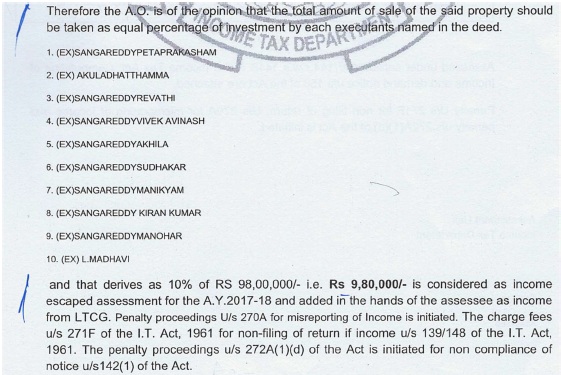
Information Received: The Assessing Officer received information from the Insight Portal regarding the sale of an immovable property valued at Rs. 98 lakhs executed by 10 co-vendors, including the assessee.
-
Issuance of Notice: On 28.03.2024, the Assessing Officer issued a notice under Section 148 for Assessment Year 2017-18—beyond three years from the end of the relevant assessment year—treating the entire property value of Rs. 98 lakhs as escaped income.
-
Actual Share of Assessee: As per the registered sale deeds, the assessee was only one of the 10 co-vendors, and their individual share of the transaction was only Rs. 9.80 lakhs.
-
Bar of Limitation: Since the alleged escaped income attributable to the assessee was below the statutory threshold of Rs. 50 lakhs required for issuing a notice beyond three years, the assessee challenged the notice as time-barred.
Decision
-
Monetary Threshold Not Met: For issuing a reassessment notice beyond three years from the end of the relevant assessment year, Section 149(1)(b) mandates that the income escaping assessment must be Rs. 50 lakhs or more.
-
Actual Escaped Income: The income attributable to the assessee was only Rs. 9.80 lakhs (their fractional share in the property sale), which is well below the statutory threshold of Rs. 50 lakhs.
-
Notice Time-Barred: Since the statutory monetary threshold was not satisfied, the notice issued under Section 148 beyond the three-year period was barred by limitation under Section 149.
-
Relief Granted: The Section 148 notice and consequential reassessment proceedings were quashed in favour of the assessee.
Key Takeaways
-
Strict Threshold for Extended Limitation: A Section 148 notice issued after three years from the end of the relevant assessment year is legally unsustainable unless the escaped income attributable specifically to the assessee is Rs. 50 lakhs or more.
-
Share-Wise Allocation Matters: In joint property transactions involving multiple co-owners, the threshold limit of Rs. 50 lakhs under Section 149 must be determined based on the assessee’s individual share, not the total aggregate value of the transaction.
-
Jurisdictional Defect: Issuing an extended-period reassessment notice without meeting the monetary prerequisite under Section 149(1)(b) constitutes a fundamental jurisdictional flaw that invalidates the notice ab initio.
[Assessment year 2017-2018]
| 1. | “I am the Appellant in the accompanying appeal and am fully acquainted with the facts and circumstances of the case. I am therefore competent to swear this affidavit. |
| 2. | The learned Commissioner of Income Tax (Appeals) passed the impugned order in 30th December 2025, against which the appeal was required to be filed before the Hon’ble Income Tax Appellate Tribunal on or before 28th February 2026. However, the appeal was filed on 15.04.2026, resulting in a delay of 46 days. |
| 3. | During the relevant period of November 2025 to February 2026, I was suffering from serious health problems. My health condition worsened, I was admitted to Sri Aadya Multi Speciality Hospital on 28.02.2026 with Lower Respiratory Tract Infection and viral pyrexia. I remained hospitalized and under medical care until 07.03.2026. |
| 4. | Owing to my illness, hospitalisation and the subsequent period of recovery, I was unable to attend to my personal and tax-related matters or approach my tax consultant for filing the appeal within the prescribed period. |
| 5. | After my health condition improved, I contacted my tax consultant, who, in turn, immediately contacted a tax consultant at Hyderabad dealing with appellate matters. Thereafter, the necessary documents were collected and the appeal was filed before the Hon’ble Tribunal on 15.04.2026. The delay was caused solely by the aforesaid unavoidable circumstances and was neither intentional nor attributable to any negligence on my part. |
| I | therefore humbly pray that this Hon’ble Tribunal may kindly be pleased to condone the delay of 46 days in filing the accompanying appeal and admit and adjudicate the appeal on merits in the interest of substantial justice. |
| 1. | “The Order of the learned Commissioner of Income Tax (A), NFAC is not correct either on facts or in law and in both. |
| 2. | The Learned CIT(A) erred in confirming the addition of Rs.9,80,000/-as long-term capital gains based on incorrect and incomplete appreciation of facts, by ignoring that the appellant was merely a consenting/signatory party to the sale deed, with no ownership interest and no receipt of consideration, and therefore no transfer within the meaning of section 2(47) read with section 45 arises in her hands, rendering the addition unsustainable in law. |
| 3. | The Learned CIT(A) failed to appreciate that in absence of receipt of consideration or beneficial ownership, there is no “transfer” giving rise to capital gains in the hands of the appellant, and the addition is contrary to the settled principle that only real income can be taxed. |
| 4. | Without prejudice to Ground Nos. 2 and 3, the Learned CIT(A) failed to appreciate that the assessee’s alleged share of consideration is only Rs.9,80,000/-, being 1/10th of the total consideration of Rs.98,00,000/-, which is below the threshold of Rs. 50,00,000/-, and therefore the notice under section 148 dated 30.03.2024 issued beyond 3 years from the end of Assessment Year 2017-18 is bad in law, rendering all consequential proceedings invalid. |
| 5. | The Learned CIT(A) failed to appreciate that the Assessing Officer has mechanically relied upon third-party information of total transaction value of Rs. 98,00,000/- without forming independent satisfaction as to escapement of income in the hands of the appellant individually, thereby vitiating the assumption of jurisdiction under section 147. |
| 6. | The Learned CIT(A) failed to appreciate that there is no tangible material evidencing receipt of consideration or accrual of income in the hands of the appellant, and hence the very foundation of reopening and addition is untenable. |
| 7. | Since the notice u/s 148 dt:30.03.2024 was issued by the JAO, ITO Ward 1, Sangareddy and not in a faceless manner, the said notice is invalid and all further proceedings are equally bad in law. |
| 8. | The appellant craves leave to add, amend, modify, rescind, supplement or alter any or more grounds of appeal stated herein above either before or at the time of hearing of this appeal.” |
“6. We have considered the rival submissions as well as relevant material on record. There is no dispute that the Assessing Officer issued show cause notice u/sec.148A(b) of the Act on 27.02.2023 which reads as under:
6.1. Thus, the Assessing Officer proceeded on the basis of the three transactions of cash deposit to reopen the assessment of the assessee. Thereafter, the Assessing Officer has passed an Order u/sec.148A(d) of the Act on 23.03.2023 and then issued notice u/sec.148 of the Act on 24.03.2023 reads as under:
6.2. Thus, it is clear that even at the time of passing the Order u/sec.148A(d), the Assessing Officer has considered the same amount of cash deposits without even verifying the bank account statement of the assessee. In the assessment order the Assessing Officer finally held that the only transaction of cash deposit during the year is Rs.38,10,000/- which is added to the total income of the assessee as under:
“Finding of the case
Section 69A of the Act deals with money etc, owned by the assessee and found in possession including in the bank accounts of the assessee which remain unexplained. The said section is reproduced below for ready reference:
Section 69A-Unexplained Money
“Where in any financial year the assessee is found to be the owner of any money, bullion, jewellery or other valuable article and such money, bullion, jewellery or valuable article is not recorded in the books of account, if any, maintained by him for any source of income, and the assessee offers no explanation about the nature and source of acquisition of the money, bullion, jewellery or other valuable article, or the explanation offered by him is not, in the opinion of the Assessing Officer, satisfactory, the money and the value of the bullion, jewellery or other valuable article may be deemed to be the income of the assessee for such financial year.”
In the present case, the assessee has deposited cash in the bank account amounting to Rs. 38,10,000/- which is treated as unexplained money u/s 69A of the Act, since she has not offered an acceptable or cogent explanation regarding the source thereof. As discussed above, the explanation offered by the assessee are entirely by self-serving documents without third party evidence.”
6.3. Therefore, it is a case of wrong and incorrect facts or rather non-existing fact and transaction in the bank account of the assessee considered by the Assessing Officer at the time of issuing the show cause notice u/sec.148A(b); at the time of passing the Order u/sec.148A(d) as well as issuing notice u/sec.148 of the Act. Undisputedly, the actual transaction of deposit of cash is found to be only Rs.38,10,000/- and therefore, the case of the assessee falls in the category of ‘income escaped assessment less than Rs.50 lakhs’ and consequently, as per the provisions of sec.149(1)(b) of the Act, the limitation for issuing the notice u/sec.148A is only 03 years from the end of the relevant assessment year. There is no dispute that the notice u/sec.148 of the Act issued on 24.03.2023 is beyond 03 years and therefore, the same is time barred and invalid. It is pertinent to note that if a notice based on the correct and actual facts is invalid then, the same cannot be treated as valid by considering incorrect and non-existing facts and hence, the period of limitation provided u/sec.149(1)(b) of the Act cannot be enlarged or extended on the basis of incorrect facts or non-existing facts. It is a case of non-existing transaction of cash deposit which are considered by the Assessing Officer and not a case that the transaction of deposit is rightly considered by the Assessing Officer however, the assessee was able to explain the source during the assessment proceedings and finally the Assessing Officer after accepting the source of cash deposit made an addition which is less than Rs.50 lakhs. Therefore, there is no quarrel on the point that the addition finally made by the Assessing Officer in the assessment would not necessarily render the case of the assessee in the category of ‘income escaped assessment is less than or more than Rs.50 lakhs’ but the primary facts are relevant to consider whether the income escaped assessment is less than or more than Rs.50 lakhs. The Assessing Officer relied upon the Judgment of Hon’ble Allahabad High Court in the case of ARB Hotels Resorts (P.) Ltd., v. Pr. CCIT (supra) however, the Hon’ble Allahabad High Court has made a specific observation in Para no.22 as under:
“22. Last, we may also note as a Court of equity, the writ Court may not be persuaded to drop the entire proceedings at the fag end on a purely technical submission. Yet, that submission is not being accepted in the present facts. On a general principle, once component of escapement exists, it has to be finally determined by the assessing authority. We therefore refrain ourselves from exercising the discretionary jurisdiction to quash the entire proceedings at this late stage. To that rule of equity and good conscience, we abide
(iii) Considering the facts of the case and decision of the Hon’ble High Court of Allahabad on similar issue, the contention of the assessee is not found to be acceptable and hence rejected.”
6.4. Therefore, the Hon’ble High Court has declined to accept the objection of the assessee which is purely technical in nature in the writ proceedings and therefore, challenging the validity of the notice u/sec.148 of the Act based on the factual finding given by the Assessing Officer in the assessment order would not render the notice u/sec.148 as time barred. The Hon’ble Madras High Court in the case of Krishna Reddy Venkatsan, Tiruvallur v. ITO, Tiruvallur (supra), has considered this issue in Para nos.2 to 6 as under:
“2 . Learned counsel for the petitioner invited my attention to the notice under Section 148A(b), the reply thereto and the impugned order. In spite of providing the bank statement for the relevant period, learned counsel submits that it is erroneously recorded therein that the details of the bank statement needs to be verified.
3. Mr. B. Ramana Kumar, learned senior standing counsel, submits in reply that the assessee is under an obligation to establish that the amount escaping assessment is less than Rs.50,00,000/-. He submits further that both the cash deposit and the time deposit qualify as assets and that the assessing officer was justified in adding the two to compute total income escaping assessment.
4. The operative paragraph of the impugned order reads as under:
“3. In response to the said notice u/s 148A(b), assessee replied on 28.03.2022. According to assessee “He deposited in cash Rs.25,90,000/-and the same has been deposited as fixed deposit. Hence, the amount of income escaped is less than 50 lakhs.” Assessee submitted bank statement also for the relevant financial year.
I have considered the reply of assessee and the same is not acceptable because of the following reasons:
Though the assessee stated as the cash deposit again deposited as fixed deposit, the details of bank statement and others need to be verified.
Thus income in the form of asset has escaped assessment is not less than Rs.50 lakhs.”
5. It is evident from the above that the assessing officer failed to examine the bank statement so as to verify whether the cash deposits were used for purposes of creating the fixed deposit. In spite of the assessee providing the bank statement, this exercise was not undertaken. Without undertaking this exercise, it cannot be rationally determined as to whether income in the form of an asset of the value not less than Rs 50,00,000/- had escaped assessment during the relevant assessment year.
6. On perusal of the bank statement, it appears that the petitioner has an arguable case to contend that the cash deposits were used for purposes of creating the fixed deposit. Therefore, the matter warrants reconsideration. Consequently, the impugned order under Section 148A(d) and notice under Section 148 of the I-T Act are set aside and the matter is remanded to the assessing officer. After providing a reasonable opportunity to the petitioner, a fresh order shall be issued under Section 148A(d) of the I-T Act within two months from the date of receipt of a copy of this order.”
6.5. Thus, the Hon’ble Madras High Court has noted the fact that the Assessing Officer failed to examine the bank statement so as to verify correct and actual transactions of cash deposit and then set aside the notice issued u/sec.148 of the Act and the matter was remanded to the Assessing Officer for passing a fresh Order u/sec.148A(d) of the Act, after giving reasonable opportunity to the assessee. The Hon’ble Bombay High Court in the case of Naresh Balachandra Rao Shinde v. ITO (supra), has also considered this issue in Para nos.6 to 9 as under:
“6. We have heard the learned counsel for the parties and we have perused the documents on record. To consider whether the writ petition could be entertained, it would be necessary to refer to certain undisputed facts. The notice under section 148 A(b) dated 23-3-2022 grants time to the petitioner to respond to the same by 29-3-2022. The period as granted is less than seven days as prescribed by section 148A(b) of the Act of 1961. Nevertheless, the petitioner has responded to the notice by his reply dated 29-3-2022.
Along with the reply, copy of the registered sale deed dated 3-2-2015 indicating that it was his daughter who had purchased the immovable property therein was supplied. The petitioner’s daughter is separately assessed for tax. The name of the petitioner is mentioned as special power of attorney holder for his daughter. The registered sale deed clearly indicates that the petitioner is not the purchaser of the immovable property mentioned therein but it is his daughter, a separate assessee. The amount of consideration mentioned is Rs.40,00,000/- and it is stated that the purchaser had availed housing loan for the same. On a bare perusal of the registered sale deed, it becomes evident that the petitioner is not the purchaser of the said property as stated in the notice issued under section 14BA (b) of the Act of 1961. Despite supplying copy of the registered sale deed to the Assessing Officer, it has not been taken into consideration by him before passing the order under section 148A(d) of the Act of 1961. The same thus clearly indicates lack of application of judicious mind to the material on record. The amount of Rs.40,00,000/- as mentioned in the notice issued on 23-3-2022 under section 148A(b) thus deserves to be excluded from consideration.
7. As regards deposit of cash of Rs.16,20,000/- is concerned, the petitioner had sought disclosure of the material of the source of information on the basis of which such notice was issued. The petitioner denied having deposited the aforesaid amount in his bank account. The material/source of information was not supplied to the petitioner. Be that as it may, even if the amount of Rs.40,00,000/- as mentioned in the notice dated 23-32022 is excluded from consideration for the reason that the petitioner is not the purchaser of the property in question, the amount remaining for consideration is Rs.20,71,500/- and Rs.16,20,000/- thus totaling Rs.36,91,500/-, In this regard, if the provisions of Section 149(1)(b) of the Act of 1961 are considered, it is seen that only if the amount in question that is likely to have escaped assessment is Rs.50,00,000/- or more, the time limit for issuing notice to re-open the assessment is three years but less than ten years. Thus if the income that is likely to escape assessment is only Rs.36,91,500/- after excluding the amount of Rs.40,00,000/-, it is clear that the proceedings are not liable to be re-opened as the amount involved is less than the one contemplated under section 149(1)(b) of the Act of 1961 and the same pertains to Assessment Year 2015-16. The notice under section 148(b) is dated 23-3-2022 which is beyond the permissible period of three years. On this count, a case for interference has been made out.
8. In the light of this undisputed position, it would be futile to require the petitioner to face proceedings under section 148 of the Act of 1961. The material on record that was placed before the Assessing Officer warranted consideration especially in the light of the fact that the document relied was a registered sale deed. If the amount of Rs.40,00,000/- mentioned therein is excluded from consideration, the notice as issued on 23-3-2022 falls foul of the provisions of section 149(1)(b) of the Act of 1961. Hence for this reason, we do not find that the petitioner should be required to further contest the proceedings under section 148 of the Act of 1961.
9. In that view of the matter, the order dated 31/3/2022 passed under section 145A(d) of the Income-tax Act, 1961 as well as notice dated 31-3-2022 issued under section 148 of the Act of 1961 are quashed and set aside. The respondents are free to take appropriate steps in accordance with law. ”
6.6. Therefore, in view of the Judgment of the Hon’ble Supreme Court in the case of CIT v. Vegetable Products Ltd. [1973] 88 ITR 192 (SC), we follow the Judgment of Hon’ble Madras High Court as well as Hon’ble Bombay High Court (supra) in deciding the issue in favour of the assessee. Accordingly, in the facts and circumstances of the case, when the actual transaction of cash deposit in the bank account of the assessee is only Rs.38,10,000/- then, the notice issued by the Assessing Officer after 03 years from the end of the assessment year under consideration is barred by limitation and liable to be set aside. We Order accordingly.”