


Acquisition cost of toll collection rights by SPV is depreciable as an intangible asset; revision under section 263 quashed.
Issue
-
Whether the Principal Commissioner of Income Tax (PCIT) was justified in invoking section 263 on the ground that the Assessing Officer allowed depreciation on intangible assets without making necessary inquiries.
-
Whether CBDT Circular No. 9/2014, which mandates amortization of cost over the concession period for developers constructing infrastructure facilities, applies to an SPV that merely acquired the right to operate, maintain, and collect toll on a pre-existing facility.
Facts
-
Entity and Background: The assessee is a wholly owned subsidiary of a state road development corporation, incorporated as a Special Purpose Vehicle (SPV) to operate, maintain, and transfer a sea link under a Concession Agreement.
-
Tolling Rights & Capitalization: The assigned tolling rights were for the period from February 2, 2020, to March 31, 2029. The assessee paid approximately Rs. 3,000 crores to acquire the license/right to collect toll and operate the sea link, capitalizing this amount as an intangible asset.
-
Depreciation Claim: In its return for AY 2020-21 (filed with ‘nil’ returned income), the assessee claimed depreciation of approximately Rs. 376.83 crores on the capitalized intangible asset.
-
Scrutiny Assessment: The case was selected for scrutiny regarding high creditor liability and investment in intangible assets. The Assessing Officer (AO) called for details, conducted inquiries, and completed the assessment under Section 143(3) read with Section 144B, accepting the returned income.
-
Revision Order under Section 263: PCIT invoked Section 263, alleging that the AO failed to make necessary inquiries and that the assessee was not the owner of the toll bridge. PCIT directed the AO to withdraw depreciation and instead allow amortization of about Rs. 26.21 crores over the concession period per CBDT Circular No. 9/2014.
Decision
-
Baseless Allegation of Lack of Inquiry: The record confirmed that the AO conducted detailed inquiries regarding the investment in the intangible asset and the assessee’s eligibility to claim depreciation thereon. The PCIT’s allegation was baseless. (In favour of assessee)
-
Inapplicability of CBDT Circular No. 9/2014: CBDT Circular No. 9/2014 applies specifically to assessees investing in the development and construction of infrastructure facilities (roads/highways). Since the assessee was not a builder/developer but had invested solely to acquire the right to collect toll and maintain the infrastructure, the PCIT misdirected himself in applying the circular. (In favour of assessee)
-
Quashing of Revision Order: The impugned order passed under Section 263 was unsustainable and accordingly quashed. (In favour of assessee)
Key Takeaways
-
Intangible Asset Depreciation vs. Amortization: An entity acquiring commercial/tolling rights to operate and collect tolls on an existing facility without constructing it holds an intangible asset eligible for depreciation under Section 32, rather than being restricted to straight-line cost amortization.
-
Scope of CBDT Circular No. 9/2014: The amortization framework under CBDT Circular No. 9/2014 is restricted to BOT (Build-Operate-Transfer) developers who incur construction and development costs, and does not extend to pure operators/transferees acquiring toll collection rights.
-
Prerequisites for Section 263 Revision: An assessment order cannot be branded as erroneous and prejudicial to the interest of the Revenue if the Assessing Officer has raised specific queries, examined the submissions, and taken a plausible view during original assessment proceedings.
IN THE ITAT MUMBAI BENCH ‘C’
MSRDC Sea Link Ltd.
v.
Principal Commissioner of Income-tax
SAKTIJIT DEY, Vice President
and Girish Agrawal, Accountant Member
and Girish Agrawal, Accountant Member
IT Appeal No. 3693 of 2025
[Assessment year 2020-21]
[Assessment year 2020-21]
SEPTEMBER 25, 2026
Nitesh Joshi, Adv. for the Appellant. Rajdeep Singh, CIT DR for the Respondent.
ORDER
Saktijit Dey, Vice President.- By filing the present appeal, the assessee has called into question the validity of order dated 27.03.2025 passed u/s. 263 of the Income Tax Act, 1961 (‘the Act’ for short) by learned Principal Commissioner of Income Tax, Mumbai (‘ld. PCIT’ for short), pertaining to Assessment Year (A.Y. for short) 2020-21.
2. Briefly the facts are, the Government of Maharashtra, intended to build/construct Rajiv Gandhi Sea Link Bridge in Mumbai to connect two different parts of Mumbai to alleviate traffic congestion. The work to develop, maintain and operate the Rajiv Gandhi Sea Link Bridge Project was awarded to Maharashtra State Road Development Corporation (‘MSRDC’ for short). Accordingly, a contract was executed between Government of Maharashtra and MSRDC on Design, Build, Finance, Operate and Transfer (DBFOT) basis. In terms with the contract, MSRDC undertook and completed the construction of Rajiv Gandhi Sea Link Bridge. As per the terms of the Agreement, Government of Maharashtra awarded the MSRDC tolling rights along with the operation and maintenance obligation for a period commencing from 24.03.2010 and expiring on 31.03.2052. MSRDC continued to operate and maintain the Rajiv Gandhi Sea Link Bridge till 2019. Subsequently, the present assessee was incorporated as a wholly owned subsidiary of MSRDC and was created as Special Purpose Vehicle (‘SPV’ for short) to Operate, Maintain and Transfer (‘OMT’ for short) the Rajiv Gandhi Sea Link Bridge project with assignment of toll rights, commencing from 02.02.2020 till 31.03.2029. Accordingly, a Concession Agreement was executed between Government of Maharashtra, MSRDC and MSRDC Sea Link Ltd. In terms with the Concession Agreement, the toll rights along with the work of operation and maintenance of Rajiv Gandhi Sea Link Bridge was transferred to the present assessee. As a consideration for acquiring the rights to collect toll and operate and maintain the sea link, the assessee paid an amount of Rs.30,00,00,00,000/- (Rs.3000 crores). The investment made by the assessee towards acquisition of the right to collect toll, operate and maintain the sea link was treated as ‘cost of acquisition’, of an intangible asset in the books of account. In the return of income filed for the assessment year under dispute, the assessee claimed depreciation of Rs.376,83,20,457/- on such intangible asset. The return of income so filed by the assessee was selected for scrutiny. After calling upon the assessee to furnish various details in connection with the return of income filed, the Assessing Officer (‘A.O.’ for short) ultimately completed the assessment u/s. 143(3) r.w.s. 144B of the Act on 31.08.2022, accepting the income returned by the assessee.
3. Post completion of assessment, as aforesaid, Id. PCIT called for and examined the assessment records and while doing so, he was of the view that the assessment order is not only erroneous, but prejudicial to the interest of revenue, as the A.O. without making necessary enquiry or verification on the issue of claim of depreciation on intangible asset has allowed the claim, though, the assessee is not entitled for depreciation. Accordingly, he issued a show cause notice to the assessee to explain why the assessment order should not be revised. Though, in response to the show cause notice, the assessee furnished a detailed submission, not only objecting to the exercise of jurisdiction u/s. 263 of the Act, but also justifying the claim of depreciation, however, ld. PCIT did not found merit in them. Ultimately, he proceeded to pass the impugned order, setting aside the assessment order with a direction to withdraw the benefit of deprecation claimed by the assesse, instead, allow amortization of cost of investment in terms with Circular No. 9/2014 dated 23.04.2014 issued by Central Board of Direct Taxes (‘CBDT’ for short).
4. Before us, ld. Counsel appearing for the assessee submitted that the allegation of ld. PCIT that the A.O. has allowed the claim of deprecation without making any enquiry is without any basis, as the A.O. has conducted thorough enquiry specifically on the issue of claim of deprecation on assets. In this context, he drew our attention to various notices issued by the A.O. in course of assessment proceedings and reply furnished by the assessee. Thus, he submitted, the A.O. did make full-fledged enquiry, so far as the claim of depreciation on intangible asset is concerned. Without prejudice, he submitted, even on merits, the assessee has a strong case, as the assessee had never claimed depreciation by claiming itself as the owner of the toll bridge. He submitted, through the Concession Agreement, the assessee has acquired the right to collect toll from the passengers travelling on the toll road. He submitted, the license to collect toll is nothing but an ‘intangible asset’ as per section 32(1)(ii) of the Act. To demonstrate that the investment made by the assessee is for acquiring intangible asset, ld. Counsel took us through various clauses of the Concession Agreement placed in the paper book as also the accounting treatment given in the book of accounts. Thus, he submitted, CBDT Circular referred to by the Revisionary Authority is not at all applicable to the assessee.
5. Proceeding further, ld. Counsel submitted since, the assessee had never claimed depreciation on the toll road, but has claimed depreciation on the right to collect toll as also to operate and maintain the sea link which is an intangible asset, ld. PCIT has erroneously exercised jurisdiction u/s. 263 of the Act, assuming that the assessee has claimed deprecation as owner of the toll road. Ld. Counsel submitted, the issue is otherwise covered by various decisions of the co-ordinate benches, insofar as it relates to claim of depreciation on the investment made towards acquiring right to collect toll. He submitted, in any case of the matter, the issue is highly debatable, where more than one view is possible. Therefore, the assessment order cannot be subjected to revisionary proceeding. In support of such contention, ld. Counsel relied upon the following judicial precedents:
| i. | CIT v. Paville Projects Pvt. Ltd. 453 ITR 447 (SC) |
| ii. | Malabar Industrial Co. Ltd. v. Commissioner of Income-tax [2000] 243 ITR 83 (SC) |
| iii. | PCIT v. Paramount Propbuild [2025] 482 ITR 61 (Delhi) |
| iv. | Gee Vee Enterprises v. Addl. CIT [1975] 99 ITR 375 (Delhi) |
| v. | North Karnataka Expressway v. CIT 372 ITR 145 (Bombay) |
| vi. | CIT v. West Gujarat Expressway v. ADIT (Mumbai – Trib.) |
| vii. | Hazaribaug Ranchi Expressway v. ACIT (Mum-Trib) |
| viii. | L & T Infrastructure Development Projects Limited (TS-1043-HC-2022 (Mad) |
| ix. | Patna Bakhtiyarpur Tollway v. ACIT (Hyderabad – Trib.) |
| x. | Diwantham Tollway Private Limited v. PCIT [ITA No. 3711/Mum/2025, dated 13-10-2025] |
| xi. | Hampi Expressways (P.) Ltd. v. Principal Commissioner of Income-tax (Mumbai – Trib.)/ITA No.3538/Mum/2025 vide order dated 21.05.2026) |
| xii. | Assistant Commissioner of Income-tax v. Progressive Constructions Ltd. 191 TTJ 549 (Hyderabad – Trib.)(SB)/ITA No. 1845/Hyd./2014 vide order dated 14.02.2017) |
6. Per contra, learned Departmental Representative (‘ld. DR’ for short) submitted that the right to collect toll and any other rights under the Concession Agreement cannot be treated as ‘intangible asset’ in terms with section 32(1)(ii) of the Act, as the definition of intangible asset therein refers to specific genus. He submitted, the right to collect toll does not fit into any other species mentioned therein. Without prejudice, ld. DR submitted that depreciation can be claimed only when the assets are either owned or partly owned by the assessee and are used for the purpose of its business. He submitted, in the facts of the present appeal, admittedly, the assessee is not the owner of the toll road. Hence, the assessee cannot claim depreciation either as an owner or user of the asset for its business. Ultimately, he submitted, learned PCIT has rightly directed the AO to allow amortization of cost over the concession period in terms with CBDT Circular No. 9/2014 dated 23.04.2014.
7. We have given a thoughtful consideration to rival contentions in the light of the judicial precedents cited before us and perused the materials available on record. It is manifest on record, learned PCIT has exercised jurisdiction u/s.263 of the Act and held the assessment order as erroneous and prejudicial to the interest of the revenue, primarily and only for the following two reasons:
| i. | Before allowing claim of depreciation, the AO has not made any inquiry. |
| ii. | The assessee not being the owner of the asset, amortization of cost over the concession period is allowable in terms with CBDT Circular Number 9 of 2014 dated 23.04.2014. |
8. At the outset, we will deal with the enquiry part, as it is a purely factual issue borne out on record. Undisputedly, the assessee had filed its return of income for the assessment year under dispute on 13.01.2021, declaring ‘nil’ income. The return of income filed by the assessee was selected for scrutiny, high creditor liability to investment in intangible asset. Thus, for examining these issues for which the return of income was picked up for scrutiny. The AO on 29.6.2021 issued a notice u/s. 143(2) of the Act, calling upon the assessee to furnish necessary details and evidences to justify its claim. In response to the said notice, the assessee on 09.08.2021 furnished reply with necessary details. Then on 06.12.2021, the AO issued a notice u/s.142(1) of the Act, requiring the assessee inter alia to furnish specific details relating to substantial investment/addition of intangible asset during the year in a tabular format. In response to the said notice, the assessee furnished its reply on 30.12.2021 with necessary details. On 16.12.2021, the AO again issued one more notice u/s.142(1) of the Act, calling upon the assessee to furnish details relating to investment made in the intangible asset. On 18.01.2022, one more notice u/s. 142(1) of the Act was issued by the AO, requiring the assessee to furnish further details in relation to the investment made in the intangible asset, as also the claim of depreciation. In response to the said notice, the assessee furnished reply on 04.02.2022, furnishing the factual details relating to the investment made and the depreciation claimed. The Concession Agreement and the investment made were also furnished before the AO. Thus, the aforesaid facts clearly demonstrate that in course of assessment proceeding, the AO did carry out detailed inquiry with regard to the investment made in intangible asset, as also the eligibility to claim depreciation thereon. Thus, the allegation of the Revisionary Authority that the AO has allowed depreciation without making any further inquiry appears to be baseless and not borne out from the facts and materials available on record. Therefore, we cannot subscribe to the view expressed by ld. PCIT that the assessment order has been passed without making any inquiry on the issue of claim of the depreciation.
9. Having held so, it is necessary to deal with the second aspect on which the Revisionary Authority has held the assessment order to be erroneous and prejudicial to the interest of revenue. Undisputedly, apart from the allegation of lack of inquiry, the other singular factor which influenced the decision-making process of the Revisionary Authority is CBDT Circular No.9/2014 dated 23.04.2014. Relying upon the aforesaid Circular, ld. Revisionary Authority has opined that Government of Maharashtra, being the owner of Toll Bridge and not the assesse, depreciation cannot be allowed in terms with section 32(1)(ii) of the Act. Rather, in terms with CBDT Circular No. 9/2014 dated 23/4/2014, the expenditure incurred by the assessee for development of roads/highways on Build-Operate-Transfer (‘BOT’) agreement has to be amortized over the concession period and allowed as ‘business expenditure’ u/s.37(1) of the Act. Accordingly, he has directed the AO to spread over the cost of investment made by the assessee for operation and maintenance over the entire concession period and allow amortization proportionately. Accordingly, he has worked out the amortization cost for the impugned assessment year at Rs.26,21,44,031/-, which according to him is to be allowed to the assessee as against the claim of depreciation.
10. It is a fact on record that the assessee has entered into a Concession Agreement with Government of Maharashtra and MSRDC, where-under, the assessee has been granted license not only to collect toll, but to operate and maintain the Toll Bridge during the concession period. For acquiring such right, the assessee has paid an amount of Rs.3000 crores, which has been capitalized in its books of accounts as cost of acquiring intangible asset in the form of collecting toll. Obviously, by making the investment the only source of income generated by the assessee is from the right to collect toll.
11. At this stage, it is necessary to look into some of the important clauses of the Concession Agreement. As per Clause 3.1 of the Concession Agreement, MSRDC was granted the concession rights, including the exclusive right, license and authority to toll, operate and maintain the sea link during the Concession Period. Under Article 3.1.3 (clause (d)), amongst others, MSRDC was granted the Right of Way, access and license to the Site for the purpose of and to the extent conferred by the Concession Agreement, to implement the project, to manage, operate and maintain the Project and regulate the use thereof by third parties, to demand, collect and appropriate fee from vehicles and users liable for payment of fee for using the Project or any part thereof and refuse entry to any vehicle if the fee due is not paid. Article 4 of the Concession Agreement lay down the Conditions Precedent to transfer of Concession rights to SPV. Thus, whatever rights MSRDC acquired under the agreement for collection of toll, as also operation and maintenance, were transferred to the present assessee. In other words, the assessee was granted license to operate and maintain the Sea Link with the right to collect toll. In this context, a reference can be made to Clauses 10.2 and 10.2.1 of the Concession Agreement. As per Article 11.3.1, other authorities intending to carry out any work on the Sea Link have to take permission of the assessee.
12. Thus, a reading of the Concession Agreement as a whole clearly demonstrates that the assessee was given the right to collect toll and operate and maintain the Sea Link over the Concession Period.
13. Having examined the nature and scope of mandate given to the assessee under the Concession Agreement and the right acquired by it thereunder, it is necessary to look to the applicability of CBDT Circular No. 9/2014. For better appreciation, the said Circular is reproduced hereunder:
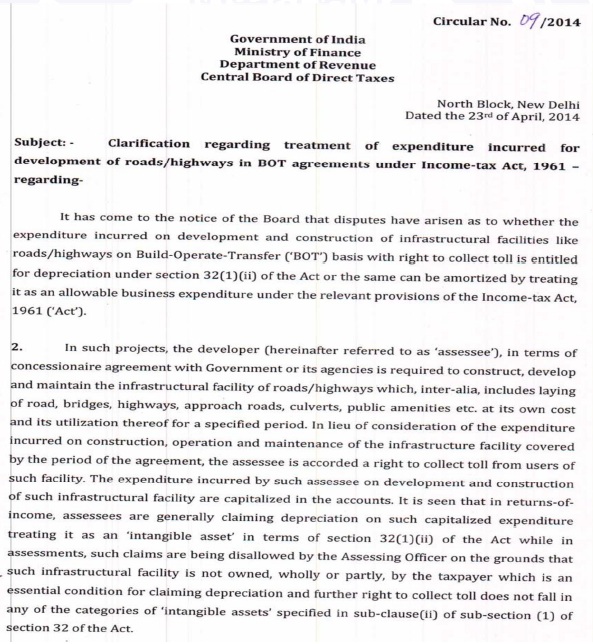
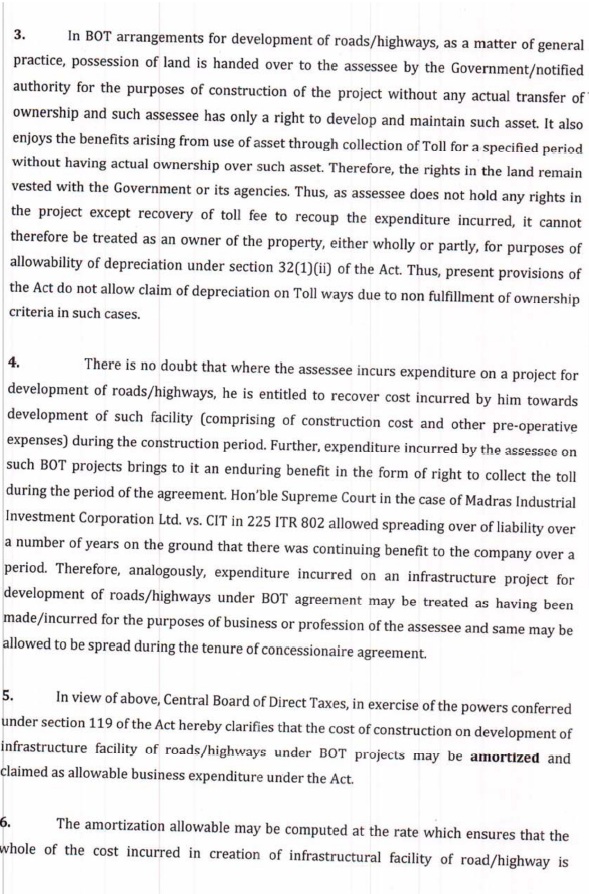
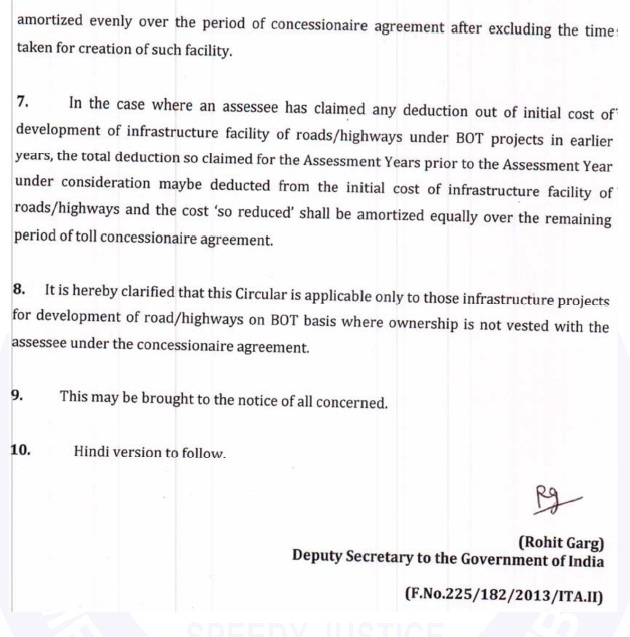
14. On a reading of the Circular reproduced above, it is explicit that it was issued by way of clarification to the Departmental Officers, as to how the expenditure incurred for development of roads/highways on BOT basis is to be allowed. In other words, the Circular is applicable to an assessee, making investment in development and construction of infrastructure facility like roads and highways. This fact is further clarified in paragraph 5 of the Circular, wherein it has been specifically stated that the cost of construction on development of infrastructure facilities such as roads/highways under BOT project has to be amortized and claimed as ‘business expenditure’. In the facts of the present appeal, admittedly, MSRDC is the builder/developer of the project and not the assessee. The assessee has not incurred even a single penny in building/developing the project. The entire investment made by the assessee is for acquiring the right to collect toll and operate and maintain the Sea Link during the Concession Period. Thus, the right acquired by the assessee is nothing but a license to collect toll as also to operate and maintain the sea link. Thus, CBDT Circular under reference heavily relied upon by ld. PCIT, in the first place, is not at all applicable to the present assessee, as the assessee is not the builder/developer of the Sea Link. Thus, once it is held so, the entire case of ld. PCIT that the assessee is eligible for amortization of cost, rather than claim depreciation on intangible asset, vanishes into thin air. Thus, in our considered opinion, ld. PCIT has not only misconstrued the tone and tenor of CBDT Circular No. 9 of 2014 dated 23.04.2014 but has completely misdirected himself while applying it to the assessee. Thus, in our view, once it is held that the CBDT Circular relied upon by ld. PCIT is not applicable to the assesse, the impugned order u/s. 263 of the Act becomes unsustainable.
15. We may further add, on a perusal of the impugned order of learned PCIT, more particularly paragraph 2.1 of the order, it is abundantly clear that the initiation of proceedings u/s. 263 of the Act was based on audit objection. Therefore, we are persuaded to believe that the exercise of jurisdiction u/s.263 of the Act was not an independent decision of the Revisionary Authority, but was at the behest of the audit party. That being the case, the exercise of jurisdiction is vitiated and unsustainable.
16. Without prejudice to the observations made in the foregoing paragraph, it is a fact on record that ld. PCIT has agreed that the cost of investment of the assessee has to be allowed as ‘business expenditure’, through amortization over the concession period. Therefore, even according to the department, the assessee remains entitled to recoup the cost of investment, either by way of depreciation or through amortization. Therefore, there can only be a timing difference in allowability of expenditure. In case depreciation is allowed, the claim would be exhausted in a short duration. Whereas, in case of amortization, the expenditure would be spread over a longer period. However, the assessee will be entitled to claim it. That being the case, no real prejudice is caused to the revenue. Hence, one of the conditions of section 263 is not satisfied. Since, in the facts of the present appeal, the assessee is not a builder/developer of the toll road/bridge, but has made investment only for acquiring the right to collect toll and maintain the infrastructure facilities, in our view, there is no need to refer to the decisions cited by the parties on allowability or otherwise of depreciation in case of assessees’s developing toll road/bridge on BOT/DBOFT basis. Suffice to say, the decisions cited by ld. Counsel for assessee lay down the ratio that investments in infrastructure facilities on BOT/DBOFT basis with right to collect toll gives rise to an intangible asset on which depreciation is allowable.
17. Thus, on overall consideration of facts and materials available on record, we hold that the assessment order subjected to proceedings u/s.263 of the Act, cannot be considered as erroneous and prejudicial to the interest of the revenue. Hence, we quash the impugned order passed u/s.263 of the Act, while restoring the assessment order to its original position.
18. In the result, the appeal is allowed as indicated above.
■