


Reassessment Notice Passed After Three Years Without PCCIT/CCIT Approval Under Section 151 Held Invalid
Issue
Whether an order under Section 148A(d) and a consequential reassessment notice under Section 148 issued after the expiry of three years from the end of the relevant assessment year are valid when sanctioned by a PCIT instead of the specified authority (PCCIT/CCIT) under Section 151.
Facts
-
Return & Information: The assessee, an individual, filed an income tax return for A.Y. 2019-20. Based on investigation findings alleging a bogus donation of ₹4.00 lakhs to a political party, a show cause notice under Section 148A(b) was issued on March 31, 2023.
-
Assessee’s Response: The assessee responded to the notice, asserting that the donation was genuine and fully supported by documentation.
-
Order & Reassessment Notice: Unpersuaded by the reply, the Assessing Officer passed an order under Section 148A(d) on April 17, 2023, after obtaining prior approval from the Principal Commissioner of Income Tax (PCIT), Bengaluru-3, and issued a Section 148 notice on the same date.
-
Timeline Threshold: More than three years had elapsed from the end of the relevant assessment year (A.Y. 2019-20) prior to the issuance of the Section 148A(d) order and Section 148 notice on April 17, 2023.
Decision
-
Invalid Sanctioning Authority (In Favour of Assessee): Since more than three years had elapsed from the end of A.Y. 2019-20, the specified authority competent to grant sanction under Section 151 was the Principal Chief Commissioner or Chief Commissioner of Income Tax (PCCIT/CCIT), not the PCIT.
-
Quashing of Order & Notice (In Favour of Assessee): Sanction granted by an authority lower than the specified statutory authority renders the order passed under Section 148A(d) and the consequential notice issued under Section 148 dated April 17, 2023, bad in law, requiring them to be quashed [In favour of assessee].
Key Takeaways
-
Strict Authority Compliance Under Section 151: Sanction for issuing reassessment notices beyond three years from the end of the relevant assessment year must strictly be obtained from the PCCIT/CCIT/DGIT/PDGIT as designated by law.
-
Jurisdictional Defect: Reassessment proceedings approved by an improper or lower specified authority suffer from an incurable jurisdictional flaw, rendering all consequential notices and orders void ab initio.
IN THE ITAT BANGALORE BENCH ‘B’
Naveen Chandrakar
v.
Income-tax Officer
Keshav Dubey, Judicial Member
and BALAKRISHNAN S., Accountant Member
and BALAKRISHNAN S., Accountant Member
IT Appeal No. 2751 (Bang) OF 2025
[Assessment year 2019-20]
[Assessment year 2019-20]
SEPTEMBER 29, 2026
Bhuvan M., A.R. for the Appellant. Pradeep S., Addl. CIT-DR for the Respondent.
ORDER
Keshav Dubey, Judicial Member. – This appeal at the instance of the assessee is directed against the order of the ld. CIT(A)/NFAC dated 14.08.2025 vide DIN & Order No. ITBA/NFAC/S/250/2025-26/1079640448(1) passed u/s 250 of the Income Tax Act, 1961 (in short “the Act”) for the assessment year 2019-20.
2. The assessee has raised the following grounds of appeal: –
| 1. | The learned Commissioner of Income-tax (Appeals) order is erroneous in facts and law. |
| 2. | The CIT (Appeals) erred in upholding the order of the assessing officer without properly considering the facts and circumstances of the case and further erred in confirming the action of the assessing officer without giving proper reasons, Therefore, the order passed by the CIT appeals is illegal, and arbitrary, and violative of the principles of natural justice. |
| 3. | The learned CIT (Appeals) erred in confirming the action of the assessing officer in issued notice u/s 148 of the IT Act dated: 17.04.2023 by the Jurisdictional Assessing Officer (JAO). |
| 4. | The learned CIT (Appeals)/Assessing officer issued notice, proceeded to pass order u/s.148 of the Act on 17.04.2023 which is contrary to the provisions of section 151A of the Act read with the CBDT notification. It is submitted that as per CBDT Circular No. 18/2022, dt.29.03.2022, Faceless Assessing Officer ought to have issued notice under section 148 of the Act to continue the proceedings thereafter, whereas in the present matter the Jurisdictional Assessing Officer has issued notice under section 148 of the Act which is contrary to the procedure prescribed under the E-Assessment of Income Escaping Assessment Scheme, 2022, dt.29.03.2022. notice u/s 148 of the IT Act dated: 17.04.2023 by the Jurisdictional Assessing Officer (JAO). |
| 5. | The jurisdictional AO issued/handled u/s 148A(d) on 17.04.2023 contrary to the faceless regime mandated by s. 151A read with CBDT’s scheme/Notification, rendering the proceedings void ab initio. Telangana High Court in Kankanala Ravindra Reddy has held that reassessment under the post-2021 regime must follow the faceless procedure; non-adherence vitiates the action. |
| 6. | The learned commissioner of income tax appeals erred in confirming action of assessing officer in confirming disallowance an amount of Rs.4,00,000/-without considering the facts of the case, therefore the order passed by the CIT appeals is illegal, and arbitrary, and violative of the principles of natural justice. |
| 7. | The learned commissioner of income tax appeals erred in confirming action of assessing officer in confirming disallowance an amount of Rs. 3,07,200/without considering the facts of the case, therefore the order passed by the CIT appeals is illegal, and arbitrary, and violative of the principles of natural justice. |
| 8. | The very approach of the learned Commissioner of Income-tax (Appeals) /NFAC in passing an order u/s 250 of the Income tax act without considering the appellant submissions is illegal arbitrary, and perverse, highhanded is contrary to the provisions law, therefore the order passed by the Learned Commissioner of Income Tax(appeals)NFAC is illegal ex-facie and violative of principals of natural justice. |
| 9. | The learned commissioner of income tax appeal erred in confirming the action of the assessing officer in determining the total of income an amount of Rs.51,73,250/- without appreciating the appellant submissions. |
| 10. | Any other ground/grounds may be urged at the time of hearing. |
3. The assessee has also raised additional grounds of appeal as follows:
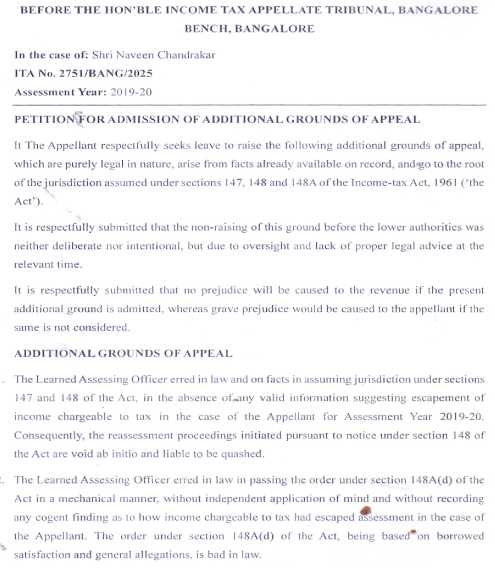
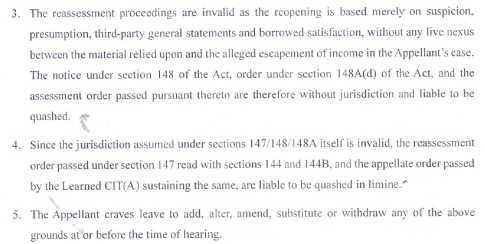
3.1 We have heard both the parties on admission of additional grounds. The Lucknow bench of the Hon’ble Allahabad High Court in the case of CIT v. Sahara India [2012] 347 ITR 331 (Allahabad) held that a legal issue can be raised at any stage but there shall be good reason for admitting the additional ground. In our Opinion all the facts are already on record and there is no necessity of investigation of any fresh facts for the purpose of the adjudication of above grounds. Further we are also of the opinion that the additional grounds raised in the present case are purely legal in nature & therefore these are critical for a fair adjudication of the matter. The Hon’ble Madras High Court in the case of CIT v. Indian Bank (Madras) held that Rule 11 of the I.T. Rules makes it clear that the assessee has the right to raise additional grounds and if the same is beneficial to the assessee, the same should be considered by the Tribunal.
3.2 Further, the Hon’ble Karnataka High Court in the case of Gundathur Thimmappa & Sons v. CIT [1968] 70 ITR 70 (Mysore) held that when the point raised by the assessee is a point which went to the root of the matter and affected not merely his liability to pay tax but also jurisdiction of the Tribunals and Authorities themselves to subject the amount concerned to tax, the Appellate Tribunal had the discretion to permit point of law to be raised for the first time in appeal because the question went to the root of the case. The Hon’ble Supreme Court in the case of National Thermal Power Co. Ltd. v. CIT 229 ITR 383 (SC) held that undoubtedly, the Tribunal will have the discretion to allow or not allow a new ground to be raised. But where the Tribunal is only required to consider a question of law arising from the facts which are on record in the assessment proceedings, we fail to see why such a question should not be allowed to be raised when it is necessary to consider that question in order to correctly assess the tax liability of an assessee. Accordingly, we are inclined to admit the additional legal grounds for the purpose of adjudication as there was no investigation of any fresh facts otherwise on record and these are critical for a fair adjudication of the matter.
4. The brief facts of the case are that the assessee being an individual filed his return of income for the AY 2019-20 u/s 139(1) of the Act on 31.08.2019 declaring total income of Rs.44,13,050/-. As per the information/details received by the AO, it was seen that the assessee had given bogus donation amounting to Rs.4,00,000/- to Rashtriya Samajwadi Party (Secular) during the year under consideration. Accordingly, a show cause notice u/s 148A(b) of the Act was issued to the assessee on 31.03.2023 directing the assessee to submit the reply along with the supporting document on or before 11.04.2023 electronically. In response to the said notice, the assessee submitted that he being a law-abiding citizen and consistently paid his taxes in a timely manner have also made several donations in the past including research for sickle cell anemia, helping the needy during Covid, supporting his community and contributing to the nation building process. Further, the assessee submitted that as regards the donation of Rs.4 lakhs made to Rashtriya Samajwadi Party (Secular), he had all the necessary documents and receipts to support his claim. The AO held that the donation paid to the Rashtriya Samajwadi Party (Secular) is not genuine in view of the facts mentioned in the reports of the income tax investigation wings of Ahmedabad and also on account of statement of oath u/s 132(4) of the Act of Smt. Sandhya Singh, National Party President of Rashtriya Samajwadi Party (Secular) on 07.09.2022 and also the statement on oath of Shri Bishwajeet Singh, husband of Smt. Sandhya Singh. The AO accordingly, passed an order u/s 148A(d) of the Act after taking prior approval of Pr. CIT, Bangalore-3, Bangalore on 17.04.2023 by holding to be a fit case for issuance of notice u/s 148 of the Act as amount of Rs.4 lakhs being bogus claim of deduction u/s Chapter VIA – 80G (Donation to Rashtriya Samajwadi Party (Secular)) chargeable to tax has escaped assessment for the AY 2019-20. The AO on the same day i.e. on 17.04.2023 had also issued notice u/s 148 of the Act and directed to furnish the return of income within 30 days from the date of service of the notice for the AY 2019-20. In response to the notice u/s 148 of the Act dated 17.04.2023, the assessee did not file any return of income. Thereafter, the AO completed the assessment proceedings u/s 144 r.w.s. 147 of the Act on a total assessed income of Rs.51,73,250/- by making an additions/disallowances of the following:-
| 1. | Disallowance of deduction of Rs.4,00,000/- claimed u/s 80G of the Act |
| 2. | Disallowance of exemption claimed u/s 10(13A) of the Act amounting to Rs.3,07,200/- in the absence of supporting document. |
| 3. | Disallowance of deduction claimed u/s 80D of the Act amounting to Rs.53,000/-. |
[Total amount of disallowance Rs.7,60,200/-]
5. Aggrieved by the assessment order passed by the AO u/s 147 r.w.s. 144 of the Act dated 26.11.2024, the assessee preferred an appeal before the ld. CIT(A)/NFAC.
6. The ld. CIT(A)/NFAC with regard to the disallowance of deduction of Rs.4 lakhs u/s 80GGC of the Act observed that the assessee’s compliance with the formal requirements of section 80GGC of the Act (i.e. donation via NEFT to a registered political party) is not disputed, however, the genuineness of the transaction is critical. The investigation wing’s findings, including statements on oath, incriminating documents and WhatsApp chats established that the Rashtriya Samajwadi Party (Secular) operated a systematic scam receiving donations and returning them as cash through intermediaries. Therefore, in view of the substantial evidence of the party’s fraudulent practices, the deduction u/s 80GGC of the Act does not meet the requirement of a genuine contribution and accordingly, the ld. CIT(A)/NFAC held that the disallowance of Rs.4 lakhs is well founded and upheld the same. Further, with regard to disallowance of exemption of Rs.3,07,200/- u/s 10(13A) of the Act, the ld. CIT(A)/NFAC also upheld the disallowance on the ground that the assessee has failed to furnish a signed rent agreement, bank statements or other corroborative evidence despite multiple opportunities given to prove his claim. Lastly, with regard to disallowance of deduction of Rs.53,000/- u/s 80D of the Act, the ld. CIT(A)/NFAC allowed only the insurance premium of Rs.2,517/- as the Form-16 substantiate only the health insurance premium paid and disallowed the balance of Rs.50,483/-. Thus, the ld. CIT(A)/NFAC partly allowed the appeal of the assessee.
7. Again, aggrieved by the order of the ld. CIT(A)/NFAC dated 14.08.2025, the assessee has filed the present appeal before this Tribunal.
8. Before us, the ld. A.R. of the assessee by raising the additional legal grounds vehemently submitted that the order passed u/s 148A(d) of the Act as well as issuance of notice u/s 148 of the Act both dated 17/04/2023 with the prior approval of Pr. CIT, Bengaluru-3, Bengaluru is illegal and bad in law as the approving authority should be Pr. CCIT and not Pr. CIT as the order as well as notice u/s 148 of the Act were issued after 3 years from the end of the AY 2019-20. Further, the ld. A.R. of the assessee vehemently submitted that as the income escaping assessment is also less than Rs.50 lakhs, the ld. A.O. should not have issued notice u/s 148 of the Act after 3 years from the end of the relevant AY as per the provisions contained in section 149(1)(ii) of the Act and accordingly prayed that the order u/s 148A(d) of the Act and consequent notice issued u/s 148 of the Act are illegal & bad in law and accordingly the entire reassessment proceeding is void-ab-initio & liable to be quashed.
9. The ld. D.R. on the other hand relied on the order of the authorities below and vehemently submitted that the reassessment proceedings for the AY 2019-20 was actually initiated on 31/03/2023 by issuing the show cause notice under clause (b) of section 148A of the Act dated 31/03/2023 & therefore the approval of the ld. PCIT, Bangalore-3 was rightly taken by the AO and prayed that the legal grounds as raised by the assessee may be dismissed.
10. We have heard the rival submissions and perused the materials available on record. On going through the paper book submitted by the assessee, we observed that the show cause notice u/s 148A(b) of the Act (as per the amended provisions) dated 31.3.2023 was issued to the assessee directing reply along with supporting documents on or before 11.04.2023. The AO subsequently passed an order u/s 148(d) of the Act on 17.04.2023 with prior approval of Pr. Commissioner of Income Tax, Bengaluru-3, Bengaluru and accordingly held that it is a fit case to issue notice u/s 148 of the Act. Thereafter, on the same day i.e. on 17.4.2023, the AO had also issued notice u/s 148 of the Act and directed the assessee to furnish a return in the prescribed format for the AY 201920 within 30 days from the date of service of the notice. Further, while passing the Order u/s 148A(d) of the Act on 17/04/2023, the AO had categorically mentioned that the name and designation of specified Authority is “Sant Saran Mantri, PCIT, Bengaluru-3, and the specified Authority approval date is 17.4.2023. Now the ld. A.R. of the assessee before us is contending that as per the provisions contained in section 151(ii) of the Act as amended by Finance Act, 2021, the specified authority for the purpose of section 148 of the Act and section 148A of the Act are Principal Chief Commissioner or Principal Director General or Chief Commissioner or Director General, if more than 3 years have elapsed from the end of the relevant assessment year. In the present case, the assessment year involved is AY 2019-20. The 3 years from the end of the relevant assessment year elapsed on 31.3.2023. Undisputedly, the order u/s 148A(d) of the Act as well as notice issued u/s 148 of the Act are dated 17.04.2023. Therefore, as on the date of passing the order u/s 148A(d) of the Act & issue of notice u/s 148 of the Act, 3 years has already elapsed in the present case.
10.1 Before proceeding further, it is apposite here to mention the relevant section 151 of the Act, which is reproduced below for ease of reference:
“Sanction for issue of notice.
Section 151: Specified authority for the purposes of section 148 and section 148A shall be,—
(i) Principal Commissioner or Principal Director or Commissioner or Director, if three years or less than three years have elapsed from the end of the relevant assessment year;
(ii) Principal Chief Commissioner or Principal Director General or where there is no Principal Chief Commissioner or Principal Director General, Chief Commissioner or Director General, if more than three years have elapsed from the end of the relevant assessment year.]”
10.2 On the plain reading of above, the specified authority for the purpose of section 148 & 148A of the Act are Principal Chief Commissioner or Chief Commissioner, if more than 3 years have elapsed from the end of the relevant assessment year. Thus, the specified authority changes depending on the time limit prescribed in section 151 of the Act. Therefore, we find force in the argument of the ld. A.R. of the assessee that the order u/s 148A(d) of the Act dated 17/04/2023 and also the notice issued u/s 148 of the Act dated 17/04/2023 were issued after obtaining the prior approval of the Pr. CIT, Bangalore-3, Bangalore accorded on 17/04/2023 whereas in the present case as more than 3 years have already elapsed from the end of the relevant assessment year, the Principal Chief Commissioner of Income Tax/Chief Commissioner should have accorded the Approval as per the provisions contained in section 151(ii) of the Act.
10.3 We are of the considered opinion that a satisfaction/approval, to be a valid satisfaction under section 151 of the Act has to be accorded by the Prescribed Authority under the Act on application of mind and not mechanically, as also held by the Hon’ble Supreme Court in the case of Chhugamal Rajpal (supra). Unless the Prescribed Authority under section 151 of the Act accords his satisfaction on application of mind, there cannot be a valid satisfaction empowering the AO to assume jurisdiction to issue notice under section 148 of the Act. Further, we are of the considered opinion that the approval is mandatory is plainly evident on perusal of the first proviso appended to section 148 of the Act. The said proviso reads as follows:
Provided that no notice under this section shall be issued unless there is information with the assessing officer which suggests that the income chargeable to tax has escaped assessment in the case of the assessee for the relevant assessment year and the assessing officer has obtained prior approval of the specified authority to issue such notice.
10.4 In view of the above, we are of the considered opinion that as in the present case more than 3 years have already elapsed from the end of the relevant assessment year, the specified authority for the purpose of section 148 & 148A(d) of the Act shall be Principal Chief Commissioner of Income Tax/Chief Commissioner of Income Tax. We accordingly held that the order dated 17/04/2023 passed under Section 148A(d) of the Act and the consequential notice issued under section 148 of the Act dated 17/04/2023 are bad in law for being violative of the provisions of Section 151(ii) of the Act. Hence, they are required to be quashed and set aside. We, accordingly, set aside the impugned order dated 17/04/2023 passed under section 148A(d), the Notice issued under Section 148 and all other proceedings/orders emanating therefrom and allow the appeal of the assessee.
11. In the result, appeal filed by the assessee is allowed.