


Export Commission Outside Scope of Tax Deduction, Technical Fees Taxable, and Section 14A Matter Remanded
Issue
Whether payments to non-residents for export commission and brochure distribution are exempt from TDS under Section 9(1)(vii)(b), whether import inspection services constitute Fees for Technical Services (FTS) requiring TDS under Section 40(a)(i), and whether a Section 14A disallowance must be remanded if the Appellate Authority failed to examine interest-free funds and Rule 8D(2)(iii) administrative disallowance.
Facts
-
Assessee Profile & AY: The assessee company, engaged in manufacturing and sales of chemicals, filed its return for Assessment Year 2016-17.
-
Section 14A Disallowance: The Assessing Officer (AO) invoked Rule 8D and disallowed ~Rs. 3.54 crores under Section 14A across both interest and administrative components.
-
CIT(A) Partial Review: CIT(A) deleted the entire Section 14A disallowance noting that interest-free funds exceeded exempt investments, treating the whole disallowance as interest disallowance under Rule 8D(2)(ii) without addressing administrative disallowances under Rule 8D(2)(iii) or verifying the AO’s specific findings.
-
Non-Resident Remittances: The assessee made remittances to non-residents without deducting tax at source (TDS) under three heads:
-
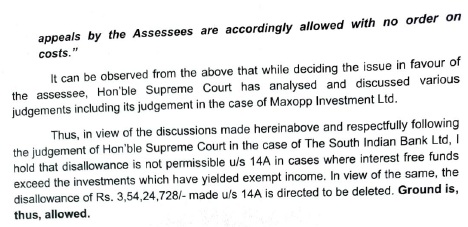
Export commission to non-resident agents.
-
Expenses for designing and distributing brochures to foreign customers.
-
Fees for imported inspection services and legal compliances.
-
Decision
-
Section 14A Remand: Since CIT(A) failed to examine the Section 14A issue in its entirety—omitting findings on Rule 8D(2)(iii) and factual verification of borrowed fund usage—the matter was restored to CIT(A) for complete examination.
-
Export Commission & Brochure Expenses: Payments for export commission and brochure distribution to non-resident agents without a PE in India were incurred for earning income from sources outside India; thus, the exception under Section 9(1)(vii)(b) applies and no TDS disallowance under Section 40(a)(i) is warranted.
-
Import Inspection Services (FTS): Payments for import inspection services involve technical, managerial, or consultancy services and do not fall under the overseas income exception. Consequently, such income is deemed to accrue or arise in India, making non-deduction of TDS liable for disallowance under Section 40(a)(i).
Key Takeaways
-
Scope of Section 9(1)(vii)(b) Exception: Remittances to foreign entities for acquiring overseas business or earning income outside India are exempt from Indian tax jurisdiction and TDS requirements.
-
Classification of Inspection Charges: Specialized import inspection and legal compliance services provided by foreign entities qualify as Fees for Technical Services (FTS), attracting statutory withholding tax requirements.
-
Comprehensive Section 14A Evaluation: Appellate authorities must separately evaluate both interest disallowance under Rule 8D(2)(ii) and indirect administrative expense disallowance under Rule 8D(2)(iii) rather than granting blanket relief based solely on the availability of interest-free funds.
IN THE ITAT PUNE BENCH ‘C’
DCIT
v.
Aquapharm Chemicals (P.) Ltd.
Vinay Bhamore, Judicial Member
and Manish Borad, Accountant Member
and Manish Borad, Accountant Member
IT Appeal No. 2150 (PUN) of 2024
C.O. No.16 (PUN) of 2025
[Assessment year 2016-17]
C.O. No.16 (PUN) of 2025
[Assessment year 2016-17]
SEPTEMBER 25, 2026
Siddhesh Chaugule and Ajit Jain for the Appellant. Smt. Sudha Gupta, CIT-DR for the Respondent.
ORDER
Dr. Manish Borad, Accountant Member.-The captioned appeal at the instance of Revenue and Cross Objection by the assessee pertaining to A.Y. 2016-17 are directed against the order of ld.CIT/NFAC dated 14.08.2024 passed u/s.250 of the Income-tax Act, 1961 (hereinafter also called ‘the Act’) arising out of Assessment order dated 21.12.2018 passed u/s.143(3) of the Act.
2. Revenue in its ITA No.2150/pUN/2024 has raised following grounds of appeal :
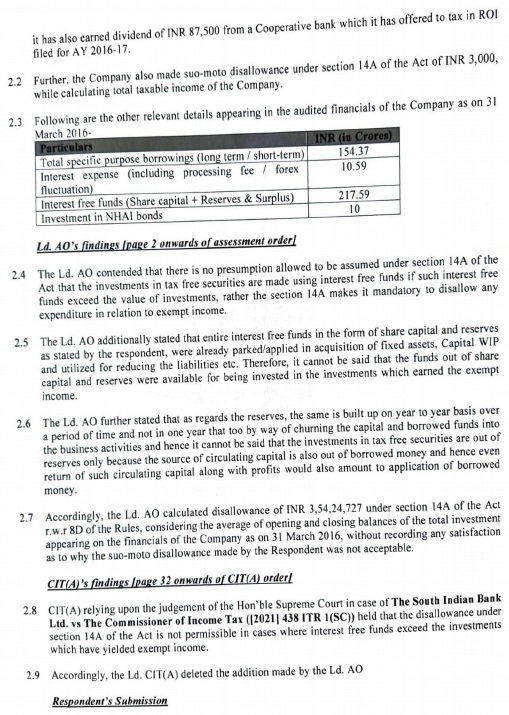
“1(a) On the facts and circumstances of the case and in law, the Ld. CIT(A) erred in deleting the addition of Rs. 3,54,24,728/- on account of disallowance u/s 14A r.w. Rule 8D by holding that the assessce’sown funds (interest free funds) exceeded the investments that have yielded exempt income without appreciating the fact that the entire interest free funds of 217.59 Cr in the form of share capital and reserves as stated by the assessee, were already parked/applied in acquisition of fixed assets, Capital WIP and utilized for reducing the liabilities etc. to the extent of Rs.249.72 Cr. Therefore, it cannot be said that the funds out of share capital and reserves of Rs.217 Cr were available to the assessee for being invested in the investments of Rs.106.704 Cr on which the assessee earned the exempt income.
1(b) On the facts and in the circumstances of the case and in law, Ld. CIT(A) has erred in accepting the contention of the assessee that disallowance u/s.14A should be restricted in relation to investments on which it has earned exempt during the year, ignoring Explanation to Sec.14A that the I.T. Act, 1961 which says that the provisions of Sec. 14 shall apply and shall be deemed to have always applied even in a case where the income, not forming part of the total income under the Act, has not accrued or arise or has not been received during the relevant previous year but expenditure in relation to such income has been incurred during the previous year.
2. (a) On the facts and circumstances of the case and in law, the Ld. CIT(A) erred in deleting the addition of Rs. 8,62,68,864/- u/s 40(a)(ia) of the Act by holding that non-resident agents are not liable to tax in India in respect of payments received by them from the assessee for various services rendered outside India without appreciating the fact that the AO has analysed the nature of these services and had found that these are in the nature of technical, consultancy or managerial based on some domain knowledge/professional skill, which squarely fall within the ambit of Fee for technical services (FTS) u/s 9(1)(vii) of the IT Act and hence taxable in the hands of non-residents.
2(b). On the facts and circumstances of the case the Ld. CIT(A) erred in deleting the addition of Rs. 8,62,68,864/- u/s 40(a)(ia) of the Act without appreciating the fact that the assessee has not given the TRCs, which is mandatory to claim any relief under the DTAA in view of provisions of section 90(4) of the IT Act.
4. The appellant craves leave to add, to amend, to alter any of the above grounds of appeal.”
3. Assessee in its C.O.No.16/pUN/2025 has raised following Cross Objections :
“Based on the facts and circumstances of the case, Aquapharm Chemical Limited (Formerly known as Advaya Chemical Industries Limited, surviving entity post amalgamation with Aquapharm Chemicals Private Limited) (‘The Respondent’) respectfully submits its cross objection against the appeal preferred by DCIT Circle-8, Pune, which is as follows:
Cross objection No. 1: Erroneous addition of INR 3,54,24,728 without recording satisfaction as mandated by section 14A(2) of the Act.
“On the facts and in the circumstances of the case and in law, the Learned Assessing Officer has factually and legally erred in making an addition of INR 3,54,24,728 under section 14A of the Act, without recording satisfaction on the suo moto disallowance offered by the Appellant as mandated by section 14A(2) of the Act.”
The Respondent craves leave to add to or alter, by deletion, substitution, modification or otherwise or amend or withdraw the cross objections herein and to submit such statements, documents and papers as may be considered necessary either before or during the hearing of the appeal.”
4. Registry has pointed out that the cross objection filed by the assessee is barred by limitation by 155 days. Assessee has filed a condonation application explaining the reasons for delay. On due consideration of the same, we are satisfied that ‘reasonable cause’ prevented the assessee from filing the appeal within the stipulated time. We therefore placing reliance on the judgment of Hon’ble Apex Court in the case of Collector, Land Acquisition v. Mst. Katiji (SC)/(1987) 2 SCC 107 and in the case of Inder Singh v. State of Madhya Pradesh 2025 INSC 382 condone the delay of 155 days in filing the appeal before this Tribunal and admit the cross objection for adjudication.
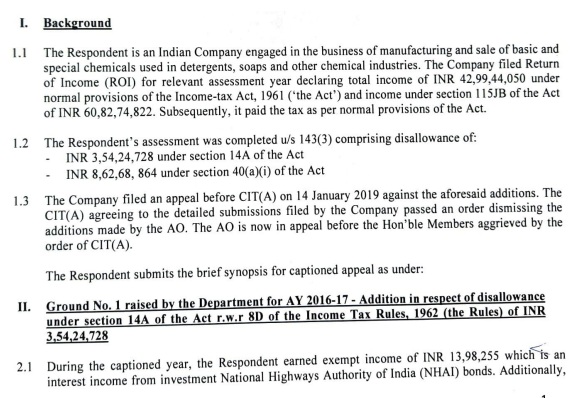
5. Brief facts of the case are that the assessee is a Private Limited Company engaged in the business of Manufacture and sale of basic and special chemical used in detergents, soaps and other chemical industries. Return of income for A.Y. 2016-17 e-filed on 24.11.2016 declaring total income of Rs.42,99,44,050/-. The case of the assessee was picked up for scrutiny under CASS followed by validly serving statutory notices u/s.143(2) and 142(1) of the Act. During the course of assessment proceedings, ld. Assessing Officer examined the submissions filed by the assessee. Ld. Assessing Officer on observing that assessee has made investments in Shares, Securities and Bonds at Rs.106.70 crore deriving exempt income in the form of Dividend and Interest show caused the assessee for the invocation of section 14A r.w. Rule 8D of the Act. In response, the assessee submitted that interest disallowance u/s.14A of the Act is uncalled for as the assessee has sufficient interest free funds in the form of share capital and reserves and surplus to cover up the investments fetching exempt income. However, ld. Assessing Officer was not satisfied and he on examining the balance sheet made reference to the application of funds as on 31.03.2015 and 31.03.2016 alongwith the interest free funds available with the assessee observed that against the application of funds during the year amounting to Rs.31.94 crore, the increase in interest free funds is only Rs.18.00 crore (approx.) indicating that borrowed funds have also been applied during the year. Even though the assssee made submissions, however, ld. Assessing Officer was not satisfied and he applied Rule 8D read with section 14A of the Act and made interest disallowance under Rule 8D(2)(ii) at Rs.3,08,16,152.63 and under Rule 8D(2)(iii) at 0.5% of the average value of investments calculating the same at Rs.46,08,575/-. In total, the disallowance u/s.14A of the Act made at Rs.3,54,24,727.63. Further, ld. Assessing Officer also noticed that assessee has made payments to non-residents without deduction of tax at source. Ld. Assessing Officer noted that there are 25 non-resident parties to whom payments without deduction of tax at source has been made which includes the payments made towards the commission paid for getting export orders, expenses incurred for legal compliances and import inspection. Assessee contended that the payments are not in the nature of Technical services and not taxable in India in the hands of non-resident recipients as they do not have any Permanent Establishment (PE) and in view of the Double Taxation Avoidance Agreement (DTAA) the amount received is not taxable in India. Ld. Assessing Officer however was not satisfied with these submissions and observed that by virtue of Explanation to section 9(1) of the Act where it has been clarified that the income of the non-resident shall be deemed to accrue or arise in India whether or not the non-resident has a place of business in India or the non-resident has rendered services in India and the income from services (FTS) defined u/s.9(1)(vii)(b) of the Act rendered by non-resident outside India will also accrue or arise in India. Ld. Assessing Officer made disallowance u/s.40(a)(ia) of the Act at Rs.8,62,68,864/-. Income assessed at Rs.55,16,37,642/-.
6. Aggrieved assessee preferred appeal before ld.CIT(A) and made detailed submissions as well as relied on plethora of decisions. Ld.CIT(A) on duly considering the same deleted the impugned addition/disallowance.
7. Aggrieved Revenue is now in appeal before this Tribunal and the assessee has raised cross objections raising ground that the disallowance u/s.14A has been made by the Assessing Officer without recording satisfaction as mandated u/s.14A(2) of the Act.
8. Ld. DR vehemently argued supporting the order of the Assessing Officer and submitted that in light of the amendment brought in by the Finance Act, 2022 clarifying that in absence of exempt income also the disallowance u/s.14A of the Act can be made. She also submitted that Assessing Officer has made detailed satisfaction and has observed that the application of funds under various heads of the assets is much more than the increase in the interest free funds which exhibits that borrowed funds have been applied for making investments in Shares, Securities and Bonds which have/will/may fetch exempt income on the issue of disallowance u/s.40(a)(ia) of the Act. She vehemently argued referring to the observation of ld. Assessing Officer.
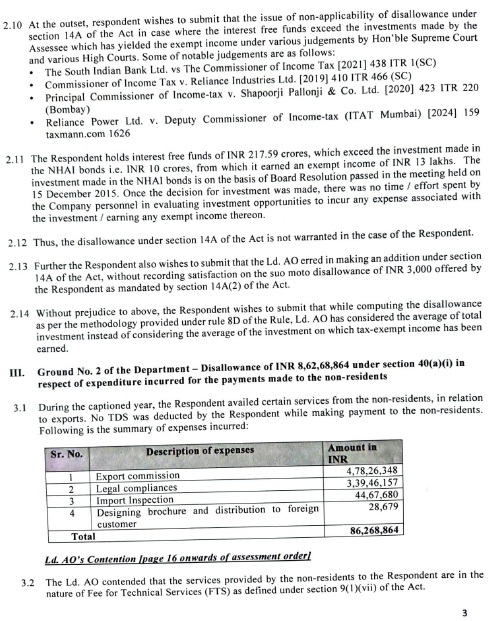
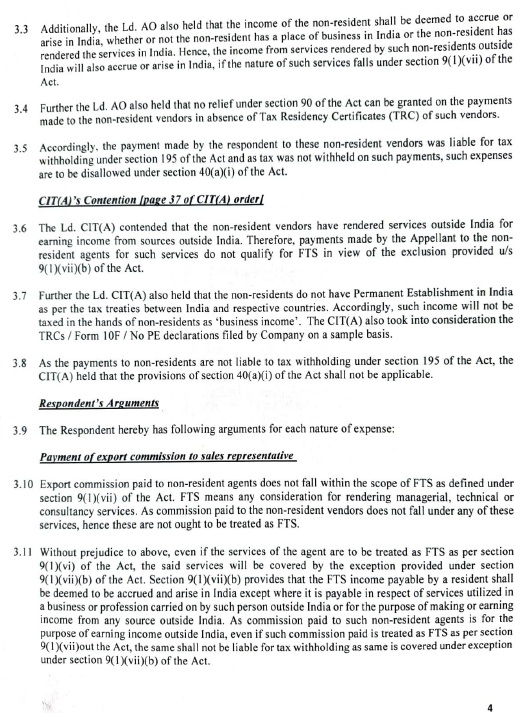
9 . On the other hand, ld. Counsel for the assessee vehemently argued referring to the following written submissions :
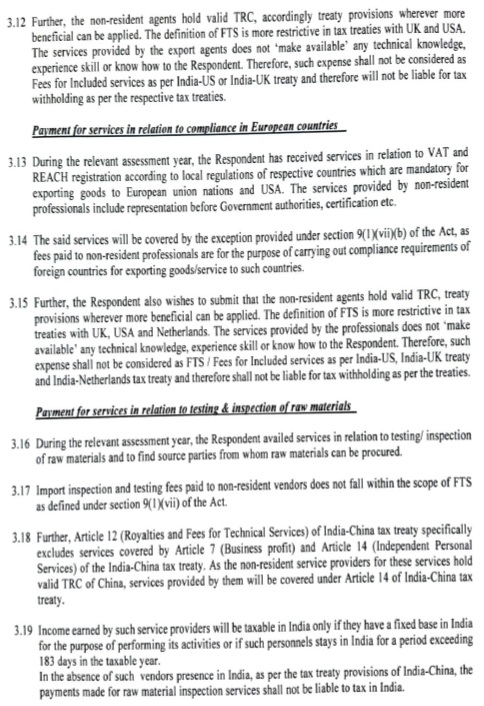
10. We have heard the rival submissions and perused the record placed before us. The first issue for consideration is disallowance u/s.14A of the Act wherein the Assessing Officer has made disallowance u/s.14A r.w. Rule 8D(2)(ii) and Rule 8D(2)(iii) of the Income Tax Rules, 1962 totalling to Rs.3,54,24,727.63 which has been deleted by ld.CIT(A). Since legal issue has been raised in the cross objection of the assessee, we will first deal with the same.
11. It is claimed that ld. Assessing Officer has not recorded proper satisfaction as mandated u/s.14A(2) of the Act. We note that the Assessing Officer has devoted almost 13 pages in the assessment order and taken into consideration each aspect of the investments made and the funds applied during the year and also take note of all the figures of the interest free funds and investments as on 31.03.2015 and 31.03.2016. It remains an undisputed fact that the Assessing Officer has adhered to the provisions of section 14A(2) of the Act and have recorded proper satisfaction, taken note of the accounts of the assessee and after being not satisfied with the correctness of the claim of the assessee has determined the amount of expenditure incurred in relation to income which does not form part of the total income. Under the given facts and circumstances, we find that the decisions referred and relied on by ld. Counsel for the assessee during the course of its submissions are not applicable. We find that ld. Assessing Officer has recorded proper satisfaction before proceeding to calculate the disallowance u/s.14A of the Act. Thus, Grounds of appeal raised by the assessee in the cross objection are hereby dismissed.
12. Now coming to the grounds raised by the Revenue challenging the finding of ld.CIT(A) relating to the impugned disallowance u/s.40(a)(ia) of the Act, we note that ld.CIT(A) has dealt with this issue of disallowance u/s.14A of the Act observing as follows :
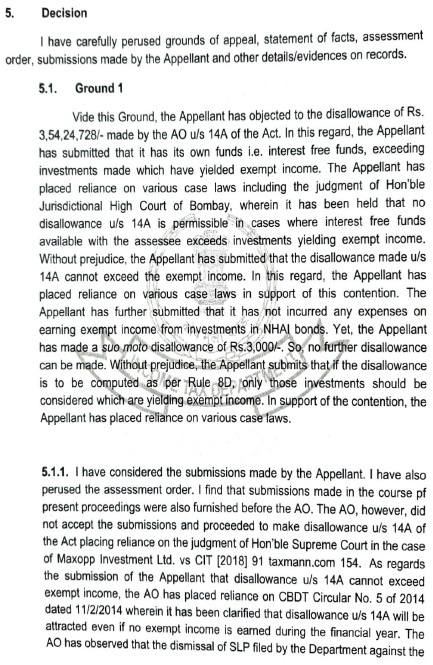
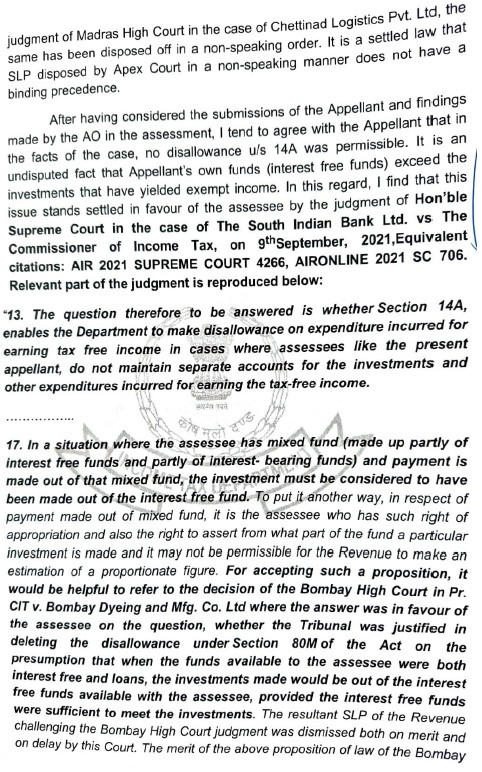
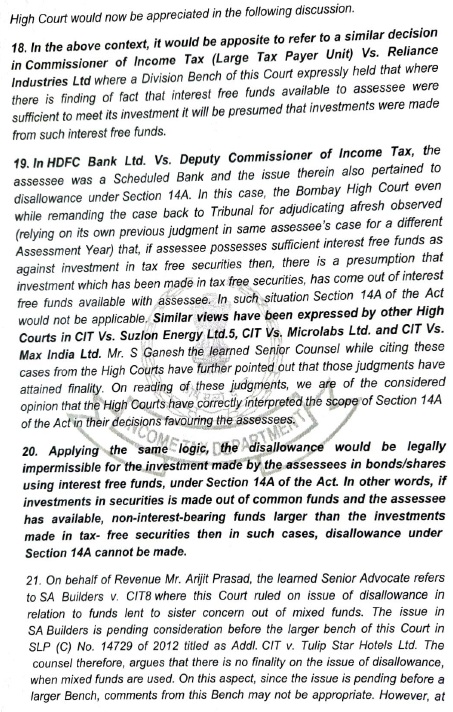
13. From perusal of the above finding of ld.CIT(A), we take note of the important aspects, firstly that ld.CIT(A) has considered the amount of disallowance as totally been made for interest disallowance under Rule 8D(2)(ii) of the I.T. Rules, however, the disallowance u/s.14A of the Act has been made under Rule 8D(2)(ii) and 8D(2)(iii) and secondly that ld.CIT(A) has deleted the impugned disallowance only on the ground that interest free funds exceeds the investments which have yielded exempt income and has referred to some judicial pronouncements. However, there is no finding/adjudication by ld.CIT(A) about the observation made by Assessing Officer regarding the availability of interest free funds, increase in interest free funds, application of funds and use of borrowed funds during the year showing that as against the increase in the interest free funds of Rs.18.00 crore approx. the application of income during the year in comparison to the preceeding year is Rs.31.94 crore which shows that atleast Rs.13.94 crore has been applied from the borrowed funds.
14. We note that ld.CIT(A) has totally disregarded these observations of the Assessing Officer and has not made any comment on these factual aspects. Further, ld.CIT(A) has treated the total disallowance u/s.14A of the Act as having been made by Assessing Officer as interest disallowance u/s.14A r.w. Rule 8D(2)(ii) whereas the Assessing Officer has made the disallowance under Rule 8D(2)(iii) at Rs.46,08,575/- but ld.CIT(A) has not made any comment on this aspect also. It therefore indicates that ld.CIT(A) has not examined the issue in entirety and in a haste has dealt with the issue without taking care of the facts as well as the observation of the Assessing Officer. We therefore deem it proper to restore this issue back to the file of ld.CIT(A) for necessary examination. Needless to mention that ld.CIT(A) shall provide reasonable opportunity to the assessee for filing relevant details. Ground No. 1(a) and 1(b) raised by the Revenue on this issue is allowed for statistical purposes.
15. Next issue is regarding the disallowance u/s.40(a)(ia) of the Act. We note that impugned disallowance has been made for the payment made to the following non-residents without deduction of tax at source:
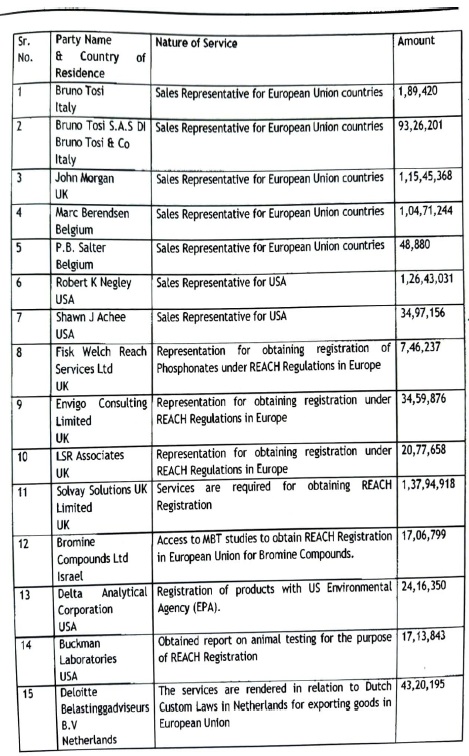
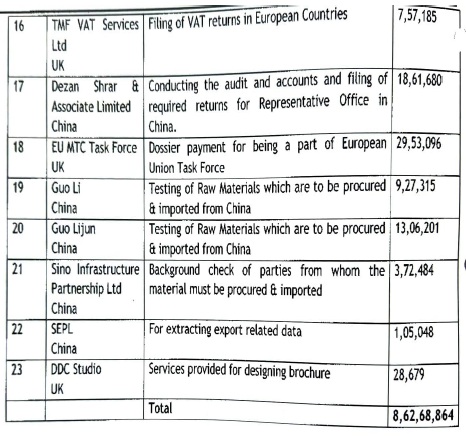
16. Further during the course of hearing, ld. Counsel for the assesee has filed a chart which has given the bifurcation of the nature of expenses indicating that Rs.4,78,55,027/- has been paid towards Export Commission and Designing Brochure and distribution to foreign customers, Rs.44,67,680/- has been incurred towards Import Inspection and Rs.3,39,46,157/- towards legal compliances. Ld. Assessing Officer has made the impugned disallowance treating the alleged sum having been paid towards Fees for Technical Services for rendering Technical, Managerial or Consultancy services and such payments do not fall in the exception provided u/s.9(1)(vii)(b) of the Act and assessee was required to deduct tax at source and in absence thereof the disallowance u/s.40(a)(ia) of the Act has been made. We note that section 9(1)(vii) has a direct bearing on this issue and the same reads as under :
“Income deemed to accrue or arise in India.
9. (1) The following incomes shall be deemed to accrue or arise in India :—
x x x x x x x x x x x x x x x x x x x x x x x
(vii). income by way of fees for technical services payable by—
(a) the Government ; or
(b) a person who is a resident, except where the fees are payable in in respect of services utilised in a business or profession carried on by such person outside India or for the purposes of making or earning any income from any source outside India; or
(c) a person who is a non-resident, where the fees are payable in respect of services utilised in a business or profession carried on by such person in India or for the purposes of making or earning any income from any source in India
Provided that nothing contained in this clause shall apply in relation to any income by way of fees for technical services payable in pursuance of an agreement made before the 1st day of April, 1976, and approved by the Central Government.
Explanation 1.—For the purposes of the foregoing proviso, an agreement made on or after the 1st day of April, 1976, shall be deemed to have been made before that date if the agreement is made in accordance with proposals approved by the Central Government before that date.
Explanation 2.—For the purposes of this clause, “fees for technical services” means any consideration (including any lump sum consideration) for the rendering of any managerial, technical or consultancy services (including the provision of services of technical or other personnel) but does not include consideration for any construction, assembly, mining or like project undertaken by the recipient or consideration which would be income of the recipient chargeable under the head “Salaries”;
17. As per the above provision, Fees for Technical Services means any consideration paid for the rendering of a Managerial, Technical or Consultancy services including the provision of services of Technical or other Personnel but does not include consideration for any Construction, Assembling, Mining or like projects undertaken by the recipients or consideration which would be income of the recipient chargeable under the head Salaries, therefore, the payments made for Managerial, Technical or Consultancy services forms part of the Technical Services.
18. Section 9(1)(vii)(b) provides that income by way of Fees for Technical services shall be deemed to accrue or arise in India payable by a person who is a resident except when such fees is payable in respect of services utilised in a business or profession carried on by such person outside India or for the purpose of making or earning any income from any source outside India.
19. The exclusions are that if such Fees for Technical Services is paid in respect of services utilised in a business or profession carried out by such person outside India or for the purpose of making or earning any income from any source outside India. First part regarding the business or profession carried out by such outside India is not applicable to the present case and facts of the case are to be examined for the second part, i.e. incurred for the purpose of making or earning any income from any source outside India and assessee is entitled to relief if the alleged payments fall in second exception referred above.
20. In the instant case, the alleged expenses are incurred under three heads; (1) Export Commission, (2) Expenses incurred for distributing brochures to the foreign customers and (3) Expenses incurred for Imported Inspection and legal compliances.
21. So far as this issue is concerned, ld.CIT(A) has dealt with by observing as follows :
“5.2.1. I have considered the submissions made by the Appellant. I have also perused the assessment order. I find that these submissions were also made before the AO but the AO has rejected the same on the ground that the payments made for services rendered by the non-resident agents are covered u/s 9(1)(vii). The AO has analysed the nature of these services and has held that these are in the nature of domain Technical, consultancy or managerial based on some knowledge/professional skill, which squarely fall within the ambit of Fee for technical services (FTS) u/s 9(1)(vil) of the IT Act and hence taxable in the hands of non-residents. In this regard, the AO has placed reliance on various case laws. The AO has further observed that these are not covered by the exclusion provided u/s 9(1)(vii)(b) in view of the Explanation to the said section. The AO has further observed that the beneficial treatment under respective DTAAs, if any, cannot be made available to the Appellant in absence of TRCs in respect of such nonresident agents.
After considering the submissions of the Appellant and findings of the AO, I tend to agree with the Appellant as regards non-taxability of payments made to the nonresidents in India and therefore, not liable to deduction of tax at source. I find that the Appellant has submitted copies of agreements entered with the non-resident agents and also TRCs in respect of some non-residents. The Appellant has requested the same to be admitted as additional evidences u/Rule 46A. In this regard, the AO was asked by my Ld. Predecessor vide letter dated 12/02/2020 to send remand report. Another reminder was issued on 24/06/2024, however, no remand report has been received from the AO so far. In view of the same, it is taken that the AO has no comments to offer on the admissibility or otherwise of these additional evidences. On the other hand, I find that the assessment order is silent on the fact that whether the AO did call for these details. In view of the same, I hold that the Appellant could not furnish these details before the AO since, it was not asked to furnish the same. In view of the same. I hold that Appellant is covered under Rule 46A(1)(c) and (d). The additional evidences are, therefore, admitted
On perusal of these additional evidences, it is observed that payments have been made for following services to following non-resident agents:
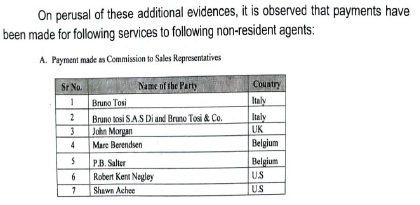
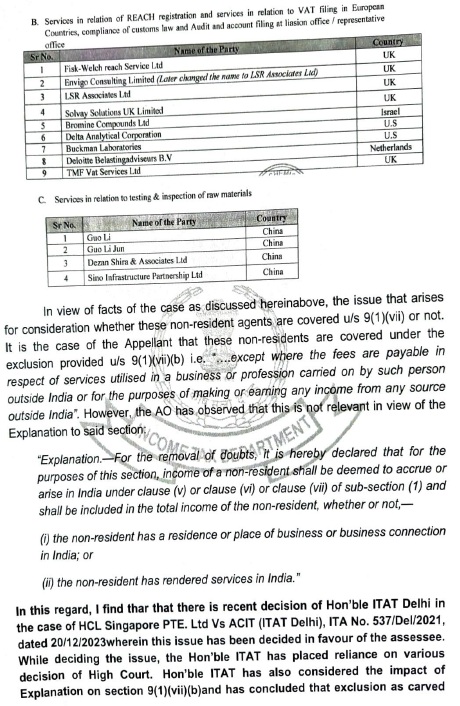
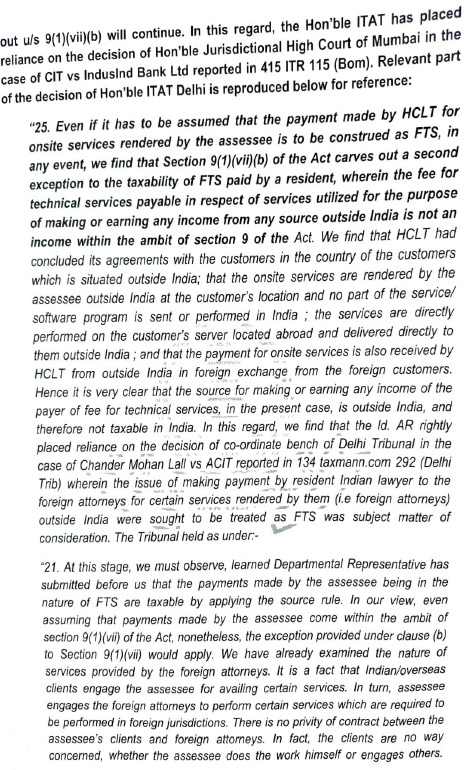
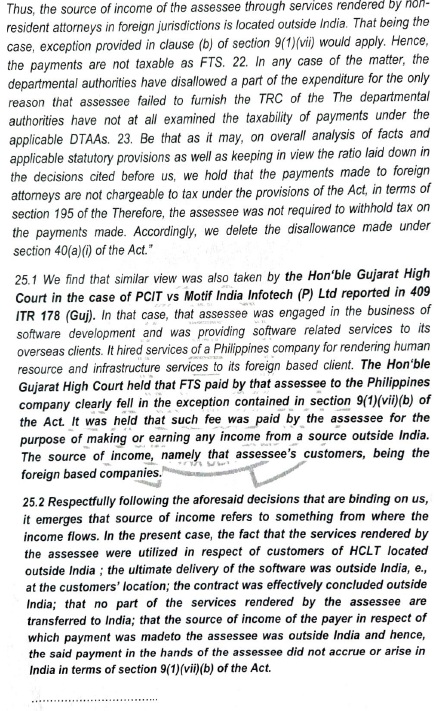
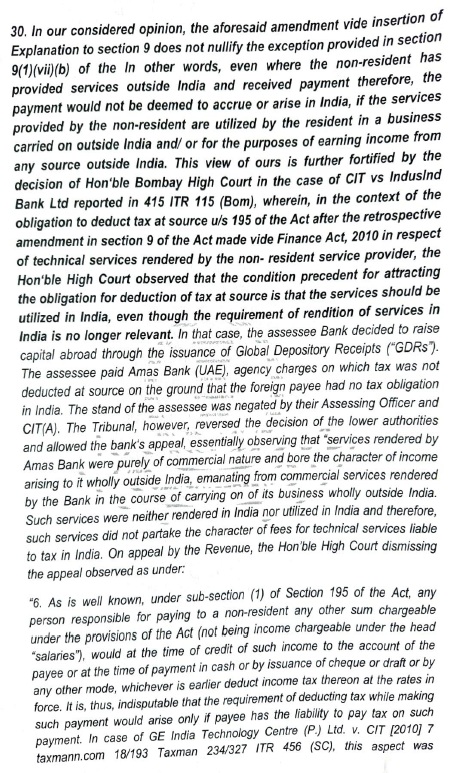
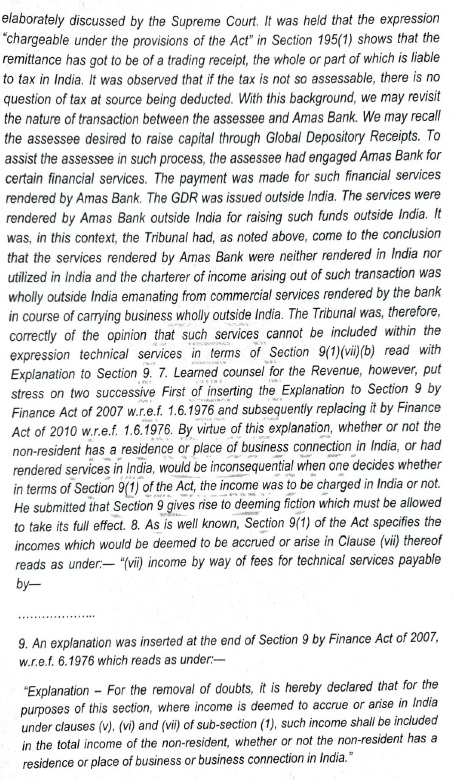
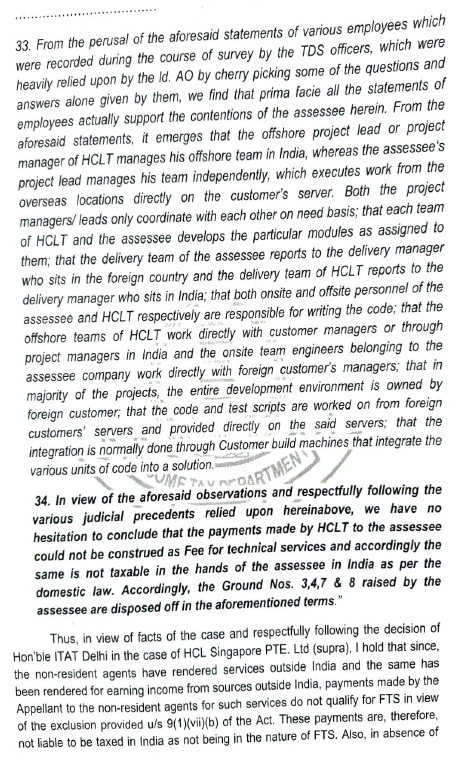
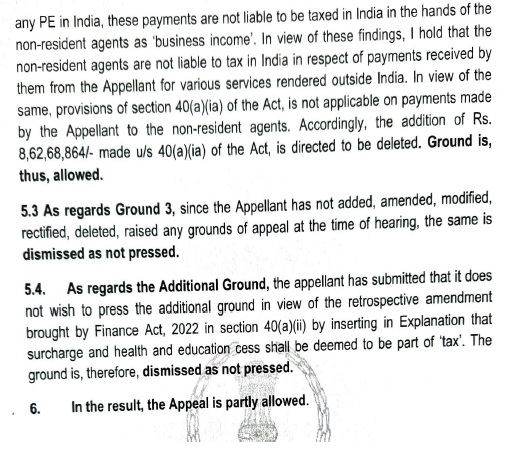
22. Ld.CIT(A) while deleting the impugned disallowance has only made discussion with regard to the payments made to non-resident agents having rendered services outside India. Ld.CIT(A) has not discussed the factual aspect about the Import Inspection as to whether they are connected with any services for earning income outside India because apparently these are payments made for Import Inspection for purchasing goods from outside India and secondly legal compliances payments made to Deloitte Belastinggadviseurs B.V. and other for the consultancy services, payments made for audit of the office at China, payments made to the representatives for services for obtaining REACH registration in Europe without examining the facts and nature of expenditure (FTS) and whether they squarely fall under the exception provided u/s.9(1)(vii)(b) of the Act. Otherwise whatever expenses incurred by an assessee outside India shall be claimed to have been incurred for the purpose of making or earning any income from any source outside India and the provisions of section 9(1)(vii)b) will become almost redundant. The exception provided u/s.9(1)(vii)b) of the Act are very specific and clearly indicates that only if a person carries on business outside India for example runs branch office or has taken registration in some other country and then some expenses have been paid by the resident for such business or profession, then deeming provisions will not apply. Similarly if the payments are made for earning any income from any source outside India like export of goods or services which basically show that the assessee will be earning foreign currency which is beneficial to the country and therefore any expenses towards Fees for Technical Services incurred in connection thereto, then only such Fees for Technical services payable by Resident Indian will fall under the exception.
23. From going through the above finding of ld.CIT(A), we find that so far as issue relating to disallowance u/s.40(a)(ia) on the expenditure incurred towards Export Commission and Designing Brochure and distribution to foreign customers is concerned, there is no dispute that these are incurred for getting export orders of the overseas customers and the commission has been paid and therefore it is clearly the expenses incurred for the purpose of making or earning income from any source outside India and therefore the exception carved out in section 9(1)(vii)(b) of the Act applies to this alleged payment of Rs.4,78,55,027/- made to non-residents having no Permanent Establishment in India and therefore to this extent finding of ld.CIT(A) needs no interference and the disallowance u/s.40(a)(ia) of the Act has rightly been deleted for the said sum.
24. So far as the expenditure relating to Import Inspection at Rs.44,67,680/- is concerned, we firstly find that the said payments clearly fall in the category of Fees for Technical Services for the purpose of rendering Managerial, Technical or Consultancy services. Import Inspection expenditure also needs technical expertise and legal compliance is clearly Consultancy services and they are covered in the definition of Fees for Technical services provided in Explanation 2 to section 9(1)(vii)(b) of the Act. However, import inspection expenditure by any stretch of imagination cannot be considered as an expenditure incurred for earning income from any source outside India because the assessee is paying for the import inspection and Goods imported may be used in the domestic market for selling, manufacturing or may be to a remote extent can be utilised for doing export business but certainly does not fall clearly in the category or making or earning of any income from any source outside India and therefore this being a payment for Fees for Technical services, clearly does not fall in the exception provided in section 9(1)(vii)(b) of the Act. The income of such nonresident is deemed to accrue or arise in India and thus call for deduction of tax at source. In absence thereof, finding of ld.CIT(A) on this issue is set aside and disallowance u/s.40(a)(ia) of the Act at Rs.44,76,680/- is sustained.
25. Next issue is the legal compliances expenses of Rs.3,39,46,157/-. We find that the alleged sum falls under Fees for Technical Services but ld.CIT(A) has not examined the facts of the case as to whether these legal compliance expenses are in connection to the Export business of the assessee or with regard to any other services rendered by such non-residents for any activity carried out by the assessee in India or for the purpose of importing goods. Ld.CIT(A) has given general finding and not dealt with the technical aspect. Even the Tax Resident Certificate of the non-resident vendors have not been submitted before the Assessing Officer. Under these given facts and circumstances, we deem it proper to restore this issue for examination of disallowance u/s.40(a)(ia) of the Act for the expenses incurred for legal compliances at Rs.3,39,46,157/- paid/payable to Ten Non-residents to the file of ld.CIT(A) for necessary examination to verify whether the case of the assessee falls under any exception provided u/s.9(1)(vii)(b) of the Act. We therefore conclude that the expenditure incurred for legal compliances falls in the category of Fees for Technical services for rendering Managerial, Technical or Consultancy services but the limited purpose of restoring the issue to ld.CIT(A) is to examine whether these are incurred for the purpose of making or earning any income from any source outside India. If needed, remand report may be called for from the ld. Jurisdictional Assessing Officer for any details filed for the first time before ld.CIT(A). Needless to mention that ld.CIT(A) shall provide reasonable opportunity to the assessee.
26. To conclude, out of the total disallowance of Rs.8,62,68,864/-made by ld. Assessing Officer u/s.40(a)(ia) of the Act, disallowance of expenditure incurred towards Export commission at Rs.4,78,55,027/-has rightly been deleted by ld.CIT(A), disallowance u/s.40(a)(ia) of the Act for the expenses incurred on Import Inspection at Rs.44,78,680/- is hereby sustained and the remaining amount of disallowance at Rs.3,39,46,157/- for expenses incurred towards legal compliances paid/payable to non-residents, the matter has been restored to the file of ld.CIT(A) for afresh adjudication. Grounds of appeal raised by the Revenue are partly allowed for statistical purposes.
27. In the result, the appeal of the Revenue is partly allowed for statistical purposes whereas the cross objection of the assessee is dismissed.