


Issue
Facts
-
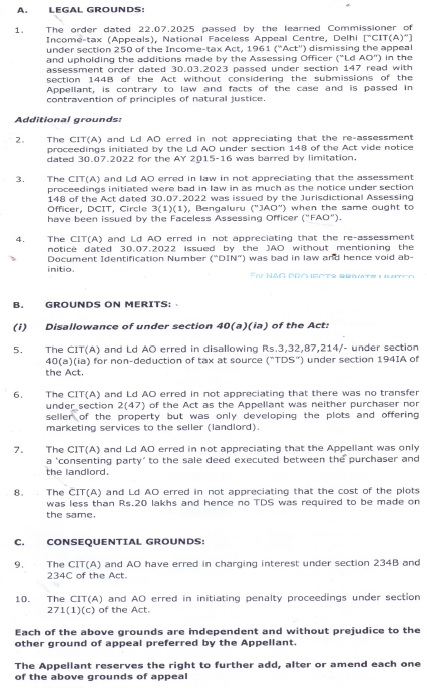
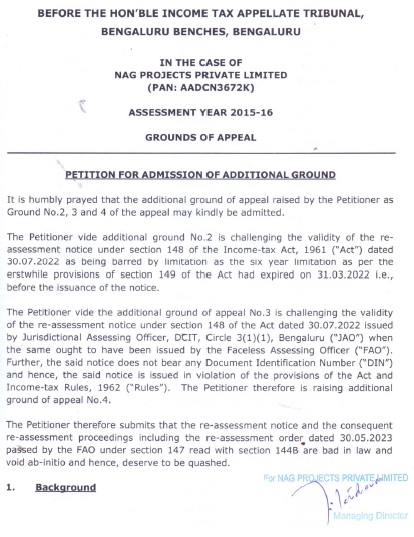
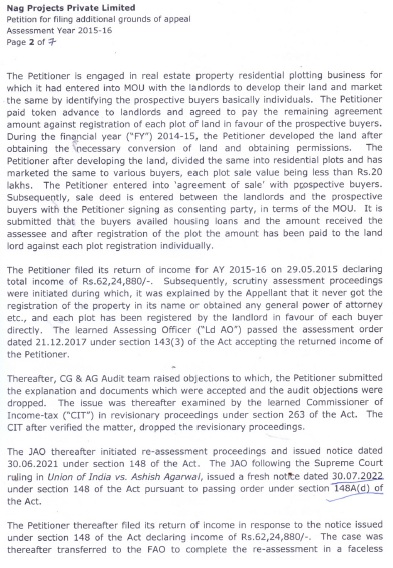
Original Return & Scrutiny: The assessee filed its return of income for AY 2015-16 on May 29, 2015, and the original assessment under Section 143(3) was completed accepting the returned income on December 21, 2017.
-
Initial Reassessment Attempt: Reassessment proceedings were initially initiated by issuing a notice under Section 148 on June 30, 2021.
-
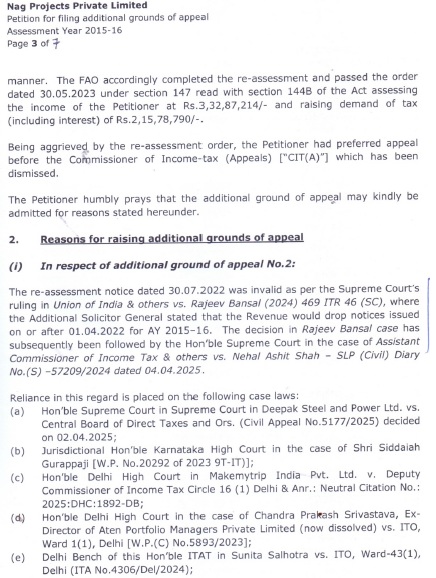
Ashish Agarwal Mechanics: Following the Supreme Court judgment in Union of India v. Ashish Agarwal, proceedings were modified and conducted under Section 148A.
-
Order & Reassessment Notice: The Assessing Officer passed an order under Section 148A(d) on July 30, 2022, and issued a fresh notice under Section 148 on the same day.
-
Completion of Reassessment: The Assessing Officer finalized the reassessment under Section 147 read with Section 144B on May 30, 2023, making a disallowance addition under Section 40(a)(ia).
Decision
-
Barred by Limitation: The Section 148 notice issued on July 30, 2022 for Assessment Year 2015-16 is barred by limitation under the first proviso to Section 149 of the Income-tax Act, 1961.
-
Exclusions Inapplicable: Exclusion periods under the fifth and sixth provisos to Section 149 and interim procedural modifications under Section 148A cannot revive an assessment year that has crossed the statutory time limit under the first proviso.
-
Quashing of Order: Consequently, the reassessment order passed under Section 147 read with Section 144B dated May 30, 2023, is legally invalid and quashed in favor of the assessee.
Key Takeaways
-
Strict Application of First Proviso: A notice under Section 148 cannot be issued for an assessment year if it has become time-barred under the unamended or primary limitation rules applicable under the first proviso to Section 149.
-
Procedural Safeguards via Ashish Agarwal: Compliance with Section 148A procedural steps following the Supreme Court’s directives does not automatically extend or grant an exemption from the outer statutory limitation period under Section 149.
-
Quashing of Time-Barred Reassessments: Any assessment finalized pursuant to an invalid or time-barred Section 148 notice is jurisdictionally defective and subject to total deletion.
and BALAKRISHNAN S., Accountant Member
[Assessment year 2015-16]
| Particulars | Date | Paper Book reference |
| Last date for issuing notice u/s. 148 under erstwhile section 149(1)(b) for AY 2015-16 (6 years from end of AY) | 31/03/2022 | NA |
| Issuance of Show cause notice u/s. 148A(b) | 25/03/2022 | 6 |
| Due Date/time provided to respond to the show cause notice issued u/s. 148A(b) as cited in the Notice u/s. 148A(b) | 01/04/2022 | 6 |
| Date of response by the Assessee | Not Filed | |
| Approval by Specified Authority- PCCIT (IT), Delhi as cited in the order u/s. 148A(d) | 08/04/2022 | 13 |
| Date of Order u/s. 148A(d) | 08/04/2022 | 10 |
| Issuance of Notice u/s. 148 | 08/04/2022 | 15 |
| (a) | if three years have elapsed from the end of the relevant assessment year, unless the case falls under clause (b); |
| (b) | if three years, but not more than ten years, have elapsed from the end of the relevant assessment year unless the Assessing officer has in his possession books of account or other documents or evidence which reveal that the income chargeable to tax, represented in the form of asset, which has escaped assessment amounts to or is likely to amount to fifty lakh rupees or more for that year: |
Provided that no notice under section 148 shall be issued at any time in a case for the relevant assessment year beginning on or before 1st day of April, 2021, if such notice could not have been issued at that time on account of being beyond the time limit specified under the provisions of clause(b) of sub-section (1) of this section,as they stood immediately before the commencement of the Finance Act, 2021:
Provided further that the provisions of this sub-section shall not apply in case, where a notice under section 153A, or section 153C read with section 153A, is required to be issued in relation to a search initiated under section 132 or books of account, other documents or any assets requisitioned under section 132A, on or before the 31st day of March, 2021:
Provided also that for the purposes of computing the period of limitation as per this section, the time or extended time allowed to the assessee, as per show-cause notice issued under clause(b) of section 148A or the period during which the proceeding under section 148A is stayed by an order or injunction of any court, shall be excluded:
Provided also that where immediately after the exclusion of the period referred to in the immediately preceding proviso, the period of limitation available to the Assessing Officer for passing an order under clause (d) of section 148A is less than seven days, such remaining period shall be extended to seven days and the period of limitation under this sub-section shall be deemed to be extended accordingly.
Explanation. – For the purposes of clause (b) of this sub-section, “asset” shall include immovable property, being land or building or both, shares and securities, loans and advances, deposits in bank account.
“45. The first proviso to Section 149(1)(b) provides thus:
“149. (1) No notice under section 148 shall be issued for the relevant assessment year, –
(a) If three years have elapsed from the end of the relevant assessment year, unless the case falls under clause (b);
(b) If three years, but not more than ten years, have elapsed from the end of the relevant assessment year unless the Assessing Officer has in possession of books of account or other documents or evidence which reveal that the income chargeable to tax, represented in the form of asset, which has escaped assessment amounts to or is likely to amount to fifty lakh rupees or more for that year:
Provided that no notice under section 148 shall be issued at any time in a case for the relevant assessment year beginning on or before 1st day of April 2021, if such notice could not have been issued at that time on account of being immediately beyond the time limit specified under the provisions of clause (b) of sub-section (1) of this section, as they stood immediately before the commencement of the Finance Act, 2021:”
46. The ingredients of the proviso could be broken down for analysis as follows: (i) no notice under section 148 of the new regime can be issued at any time for an assessment year beginning on or before 1 April 2021; (ii) if it is barred at the time when the notice is sought to be issued because of the “time limits specified under the provisions of” 149(1)(b) of the old regime. Thus, a notice could be issued under section 148 of the new regime for assessment year 2021-2022 and before only if the time limit for issuance of such notice continued to exist under section 149(1)(b) of the old regime.
47. In CTO v. Biswanath Jhunjhunwalla (SC)/[1996] 5 SCC 626 the Bengal Sales Tax Rules 1941 empowered the Commissioner to revise any assessment within four years from the date of assessment. Subsequently, the State Government issued a notification following the law to extend the time limit from four years to six years from the date of assessment. The extension of the time limit was challenged by the respondents on the ground that the assessments which had attained finality because of the expiry of the period of four years could not be reassessed. This Court observed that it was the clear intention of the notification to permit the Commissioner to revise any assessment made or order passed, provided the assessment had not been made before six years. It was held that if the legislative intention is clear and the language is unambiguous, full effect must be given to the legislative intention by reading the notification as applying not only to the incomplete assessments but also to assessments that had reached finality because of lapse of the earlier prescribed period. The principle that emanates from Biswanath Jhunjhunwalla (supra) is that the courts should give full effect to the legislative intention of granting reassessment powers to assessing officers unless the legislature, by express provision, states otherwise.
48. Notices have to be judged according to the law existing on the date the notice is issued. Section 149 of the old regime primarily provided two time limits: (i) four years for all situations and (ii) beyond four years and within six years if the income chargeable to tax which escaped assessment amounted to Rupees one lakh or more. After 1 April 2021, the time limits prescribed under the new regime came into force. The ordinary time limit of four years was reduced to three years. Therefore, in all situations, reassessment notices could be issued under the new regime if not more than three years have elapsed from the end of the relevant assessment year. For example, for assessment year 2018-2019, the four year period would have expired on 31 March 2023 under the old regime. However, if the notice is issued after 1 April 2021, the three year time limit prescribed under the new regime will be applicable. The three year time limit will expire on 31 March 2022.
49. The first proviso to Section 149(1)(b) requires the determination of whether the time limit prescribed under section 149(1)(b) of the old regime continues to exist for the assessment year 2021-2022 and before. Resultantly, a notice under Section 148 of the new regime cannot be issued if the period of six years from the end of the relevant assessment year has expired at the time of issuance of the notice. This also ensures that the new time limit of ten years prescribed under section 149(1)(b) of the new regime applies prospectively. For example, for the assessment year 2012-2013, the ten year period would have expired on 31 March 2023, while the six year period expired on 31 March 2019. Without the proviso to Section 149(1)(b) of the new regime, the Revenue could have had the power to reopen assessments for the year 2012-2013 if the escaped assessment amounted to Rupees fifty lakhs or more. The proviso limits the retrospective operation of Section 149(1)(b) to protect the interests of the assesses.
50. Another important change under section 149(1)(b) of the new regime is the increase in the monetary threshold from Rupees one lakh to Rupees fifty lakhs. The old regime prescribed a time limit of six years from the end of the relevant assessment year if the income chargeable to tax which escaped assessment was more than Rupees one lakh. In comparison, the new regime increases the time limit to ten years if the escaped assessment amounts to more than Rupees fifty lakhs. This change could be summarized thus:
| Regime | Time limit | Income chargeable to tax which has escaped assessment |
| Old regime | Four years but not more than six years | Rupees one lakh or more |
| New regime | Three years but not more than ten years | Rupees fifty lakhs or more |
51. Given Section 149(1)(b) of the new regime, reassessment notices could be issued after three years only if the income chargeable to tax which escaped assessment is more than Rupees fifty lakhs. The proviso to Section 149(1)(b) limits the retrospectivity of that provision with respect to the time limits specified under section 149(1)(b) of the old regime.
52. In Ashish Agarwal (supra), this Court held that the benefit of the new regime must be provided for the reassessment conducted for the past periods. The increase of the monetary threshold from Rupees one lakh to Rupees fifty lakh is beneficial for the assesses. Mr Venkataraman has also conceded on behalf of the Revenue that all notices issued under the new regime by invoking the six year time limit prescribed under section 149(1)(b) of the old regime will have to be dropped if the income chargeable to tax which has escaped assessment is less than Rupees fifty lakhs.
53. The position of law which can be derived based on the above discussion may be summarized thus: (i) Section 149(1) of the new regime is not prospective. It also applies to past assessment years; (ii) The time limit of four years is now reduced to three years for all situations. The Revenue can issue notices under section 148 of the new regime only if three years or less have elapsed from the end of the relevant assessment year; (iii) the proviso to Section 149(1)(b) of the new regime stipulates that the Revenue can issue reassessment notices for past assessment years only if the time limit survives according to Section 149(1)(b) of the old regime, that is, six years from the end of the relevant assessment year; and (iv) all notices issued invoking the time limit under section 149(1)(b) of the old regime will have to be dropped if the income chargeable to tax which has escaped assessment is less than Rupees fifty lakhs.
ii. TOLA can extend the time limit till 31 June 2021
54. The proviso to Section 149(1)(b) of the new regime uses the expression “beyond the time limit specified under the provisions of clause (b) of sub section (1) of this section, as they stood immediately before the commencement of the Finance Act, 2021.” Thus, the proviso specifically refers to the time limits specified under section 149(1)(b) of the old regime………………..”
“5. As rightly contended by the learned counsel for the petitioner, the material on record discloses that the impugned proceedings is relating to the Assessment Year 2015-16 in respect of the petitioner; however, it is an undisputed fact that the respondents issued impugned notice at Annexure-A2 under Section 148 of the I.T. Act on 01.04.2022, beyond the period of limitation and the same has already been held not to be permissible by the Apex Court in Rajeev Bansal’s case (supra), which reads as under:-
“19(e). The Finance Act, ([2021]) 431 ITR (St.) 52) substituted the old regime for reassessment with a new regime. The first proviso to Section 149 does not expressly bar the application of Taxation and Other Laws (Relaxation and Amendment of Certain Provisions) Act, 2020. Section 3 of Taxation and Other Laws (Relaxation and Amendment of Certain Provisions) Act, 2020 applies to the entire Income-Tax Act, including Sections 149 and 151 of the new regime. Once the first proviso to Section 149(1)(b) is read with Taxation and Other Laws (Relaxation and Amendment of Certain Provisions) Act, 2020, then all the notices issued between April 1, 2021 and June 30, 2021 pertaining to assessment years 2013-14, 2014-15, 2015-16, 2016-17, and 2017-18 will be within the period of limitation as explained in the tabulation below:
| Assessment year (1) | Within 3 years (2) | Expiry of limitation read with TOLA for (3) | Within six years (4) | Expiry of limitation read with TOLA for (4) (5) |
| 2013-2014 | 31-3-2017 | TOLA not applicable | 31-3-2020 | 30-6-2021 |
| 2014-2015 | 31-3-2018 | TOLA not applicable | 31-3-2021 | 30-6-2021 |
| 2015-2016 | 31-3-2019 | TOLA not applicable | 31-3-2022 | TOLA not applicable |
| 2016-2017 | 31-3-2020 | 30-06-2021 | 31-3-2023 | TOLA not applicable |
| 2017-2018 | 31-3-2021 | 30-06-2021 | 31-3-2024 | TOLA not applicable |
19(f). The Revenue concedes that for the assessment year 2015-16, all notices issued on or after April 1, 2021 will have to be dropped as they will not fall for completion during the period prescribed under the Taxation and Other Laws (Relaxation and Amendment of Certain Provisions) Act, 2020;
49. The first proviso to Section 149(1)(b) requires the determination of whether the time limit prescribed under Section 149(1)(b) of the old regime continues to exist for the assessment year 2021-22 and before. Resultantly, a notice under Section 148 of the new regime cannot be issued if the period of six years from the end of the relevant assessment year has expired at the time of issuance of the notice. This also ensures that the new time limit of ten-years prescribed under Section 149(1)(b) of the new regime applies prospectively. For example, for the assessment year 2012-13, the ten-year period would have expired on March 31, 2023, while the six-year period expired on March 31, 2019. Without the proviso to Section 149(1)(b) of the new regime, the Revenue could have had the power to reopen assessments for the year 2012-13 if the escaped assessment amounted to Rupees fifty lakhs or more. The proviso limits the retrospective operation of Section 149(1)(b) to protect the interests of the assesses.
6. Subsequently, in Nehal Ashit’s case (supra) also, the Apex Court reiterated the very same position and dismissed the appeal filed by the Revenue on the ground that the notice issued after 01.04.2022 was barred by limitation and the impugned proceedings are not permissible beyond period of limitation. In the instant case, it is an undisputed fact that the impugned proceedings is relating to the Assessment Year 2015-16, while the impugned notice under Section 148 of the Act dated 01.04.2022 was issued beyond/after 01.04.2021 which is impermissible in law and barred by limitation and consequently, the impugned orders/notices etc., deserve to be quashed.
7. In the result, I pass the following:-
‘ORDER
| (i) | Petition is hereby allowed. |
| (ii) | The impugned orders/Notices at Annexures-A1, A2, B, C1, D1 and E1 dated 01.04.2022, 01.04.2022, 15.03.2022, 09.03.2022, 27.08.2024 and 27.08.2024 respectively and subsequent orders/notices issued by the 1st respondent are hereby quashed.” |
“2. The petitioner in the subject petition calls in question an order passed by the 2nd respondent under Section 148A(d) of the Income Tax Act and consequent notices so issued to the petitioner under section 148 of the Income Tax Act, 1961. The notice reads as follows:
“Notice under section 148 of the Income-tax Act, 1961
Sir/Madam/M/s.
1. I have the following information in your case or in the case of the person in respect of which you are assessable under the Income tax Act, 1961 (here in alter referred to as “the Act”) for Assessment Year 2017-18
• information in accordance with the risk management strategy formulated in this regard
suggesting that income chargeable to tax has escaped assessment within the meaning of section 147 of the Act. Order under sub-section (d) of section 148A of the Act has been passed in such case vide DIN ITBA/AST/F/148A/2024-25/1064704419(1) dated 07/05/2024 and annexed herewith for reference,
2. I, therefore, propose to assess or reassess such income or recompute the loss or the depreciation allowance or any other allowance or deduction for the Assessment Year 2017-18 and I, hereby, require you to furnish, within a period of three months from the end of month in which this notice is issued, a return in the prescribed form for the Assessment Year 2017-18.
Note:- Please note that any return of income, required to be furnished by you under this section and furnished beyond the period allowed shall not be deemed to be a return under section 139 of the Act. (Proviso 3 to Section 148)
NITHAN RAJ T.N.
CIRCLE 7(1)(1), BANGALORE”
3. The notice itself indicates that it is issued for the Assessment Year 2017-18 and is admittedly issued on 7.5.2024. Learned counsel appearing for the petitioner submits that the notice is barred by limitation, as the limitation prescribed under Section 148 is for a period of six years from the date of end of the Financial Year of the Assessment Year. Admittedly, Financial Year of Assessment Year, 2017-18 comes to an end on 31.03.2018 and the limitation would cap at 31.03.2024.
4. Learned counsel for the petitioner would submit that the issue in the lis stands covered by the three Judge Bench of the Apex Court in the case of UOI v. Rajeev Bansal 469 ITR 46 (SC), in which the Apex Court at Paras 49, 53 and 60 has held as follows:
“49. The first proviso to Section 149(1)(b) requires the determination of whether the time limit prescribed under section 149(1)(b) of the old regime continues to exist for the assessment year 2021-2022 and before. Resultantly, a notice under Section 148 of the new regime cannot be issued if the period of six years from the end of the relevant assessment year has expired at the time of issuance of the notice. This also ensures that the new time limit of ten years prescribed under Section 149(1)(b) of the new regime applies prospectively. For example, for the assessment year 2012-2013, the ten year period would have expired on March 31, 2023, while the six year period expired on March 31, 2019. Without the proviso to section 149(1)(b) of the new regime, the Revenue could have had the power to reopen assessments for the year 2012-2013 if the escaped assessment amounted to rupees fifty lakhs or more. The proviso limits the retrospective operation of section 149(1)(b) to protect the interests of the assesses.
53. The position of law which can be derived based on the above discussion may be summarized thus: (i) Section 149(1) of the new regime is not prospective. It also applies to past assessment years; (ii) The time limit of four years is now reduced to three years for all situations. The Revenue can issue notices under Section 148 of the new regime only if three years or less have elapsed from the end of the relevant assessment year; (iii) the proviso to Section 149(1)(b) of the new regime stipulates that the Revenue can issue reassessment notices for past assessment years only if the time limit survives according to section 149(1)(b) of the old regime, that is, six years from the end of the relevant assessment year; and (iv) all notices issued invoking the time limit under section 149(1)(b) of the old regime will have to be dropped if the income chargeable to tax which has escaped assessment is less than rupees fifty lakhs.
ii. Taxation and Other Laws (Relaxation and Amendment of Certain Provisions) Act, 2020 can extend the time limit till June 31, 2021
60. The above principles can be applied as follows to the factual situation in the present appeals: (i) The Finance Act, 2021 ([2021] 432 ITR (St.) 52) substituted Sections 147 to 151 of the Income Tax Act with effect from April 1, 2021; (ii) sections 147 to 151 of the old law ceased to operate from April 1, 2021; (iii) after April 1, 2021, any reference to the Income Tax Act means the Income Tax Act as amended by the Finance Act 2021; (iv) the time limits prescribed for issuing reassessment notices under section 149 operate retrospectively for three years for all situations and six years in case the escaped assessment amounts to or is likely to amount to more than rupees fifty lakhs.”
5. The High Court of Delhi in two of the judgments has followed the said judgment of the Apex Court in Rajeev Bansal supra. In Sheetal International (P.) Ltd. v. Chief CIT (Delhi), it is held as under:
“1. Issue notice.
2. Learned counsel appearing for the respondents accepts notice.
3. The petitioner has filed the present petition, inter alia, impugning an order dated 01.05.2024 (hereafter the impugned order) issued under Section 148A(d) of the Income Tax Act, 1961 (hereafter the Act) for the assessment year (AY) 2017-18 as well as the notice dated 01.05.2024 issued under Section 148 of the Act.
4. The petitioner contends that the said notice was issued beyond the period of limitation as prescribed in first proviso to Section 149(1) of the Act.
5. The learned counsel appearing for the petitioner submits that the issue stands covered by the decision of this Court in Manju Somani v. Income Tax Officer 466 ITR 758 (Delhi): Neutral Citation: 2024:DHC:5411-DB.
6. It is also relevant to note that the Supreme Court in a recent decision of Union of India v. Rajeev Bansal: 2024 SCC OnLine SC 2693/ (SC) (SC) has observed as under:
“46. The ingredients of the proviso could be broken down for analysis as follows: (i) no notice under Section 148 of the new regime can be issued at any time for an assessment year beginning on or before 1 April 2021; (ii) if it is barred at the time when the notice is sought to be issued because of the “time limits specified under the provisions of” 149(1)(b) of the old regime. Thus, a notice could be issued under Section 148 of the new regime for assessment year 20212022 and before only if the time limit for issuance of such notice continued to exist under Section 149(1)(b) of the old regime.
49. The first proviso to Section 149(1)(b) requires the determination of whether the time limit prescribed under Section 149(1)(b) of the old regime continues to exist for the assessment year 2021-2022 and before. Resultantly, a notice under Section 148 of the new regime cannot be issued if the period of six years from the end of the relevant assessment year has expired at the time of issuance of the notice. This also ensures that the new time limit of ten years prescribed under Section 149(1)(b) of the new regime applies prospectively. For example, for the assessment year 2012-2013, the ten year period would have expired on 31 March 2023, while the six year period expired on 31 March 2019. Without the proviso to Section 149(1)(b) of the new regime, the Revenue could have had the power to reopen assessments for the year 20122013 if the escaped assessment amounted to Rupees fifty lakhs or more. The proviso limits the retrospective operation of Section 149(1)(b) to protect the interests of the assesses.”
7. In view of the above, the present petition is allowed. The impugned order dated 01.05.2024 as well as the notice issued under Section 148 in respect of the AY 201718 are set aside.”