JUDGMENT
Bhargav D. Karia, J.- Heard learned advocate Mr.B.S.Soparkar for learned advocate Mrs.Swati Soparkar for the respective appellants and learned Senior Standing Counsel Mr.Rutvij R. Patel for the respective respondents.
2. These Appeals are filed by the appellants-assessees being aggrieved by the order passed by the Income Tax Appellant Tribunal, Ahmedabad for Assessment Years 2004-05, 2005-06, 2006-07 and 2007-08, on the same issue of considering capital gains on sale of shares as income from business.
3. Tax Appeal Nos.1076 and 1418 of 2009 are admitted for consideration of the following substantial questions of law :
“(i) Whether, in the facts and circumstances of the case the Income Tax Appellate Tribunal was right in law in confirming the action of the respondent in taxing the transactions in shares/securities under the head ‘Income from Business or Profession’ instead of ‘Income from Capital Gains’?
(ii) Whether in the facts and under the circumstances of the case the Income Tax Appellate Tribunal was right in law in considering short term capital gains of Rs.11,28,736/- on account of sale of shares and on account of gains arising out of Portfolio Management Scheme (PMS) as Business Income instead of Capital Gains?”
4. Tax Appeal No.1325 of 2011 is admitted for consideration of the following substantial questions of law:
“1. Whether in the facts and circumstances of the case the Income Tax Appellate Tribunal was right in law in confirming the action of the respondent in taxing the transactions in shares/securities under the head Income from Business or Profession’ instead of Income from Capital Gains?
2. Whether in the facts and circumstances of the case, the Income Tax Appellate Tribunal was right in law in considering short term capital gains of Rs.7,51,452/-on account of sale of shares and on account of gains arising out of Portfolio Management Scheme (PMS) as Business Income instead of Capital Gains?”
5. Tax Appeal No.366 of 2017 is admitted for consideration of the following substantial question of law :
“Whether on the facts and in the circumstances of the case, the Tribunal was right in law and on the facts in upholding the order of the CIT(A) directing the Assessing Officer to treat the income from shares and securities trading as capital gain instead of business income?”
6. Tax Appeal No.1076 of 2009, arising out of the common Judgment and Order dated 19th December, 2008 passed by the Income Tax Appellate Tribunal (for short ‘the Tribunal’), Ahmedabad, Bench ‘C’ Camp at Baroda, whereby, the Tribunal disposed of the Appeals filed by the assessee and his wife, i.e. Shrimati Seema Ranka, is treated as a lead matter.
7. The brief facts of the case for Assessment Year 2004-05 in case of the appellant-assessee are as under :
7.1. The assessee filed Return of Income declaring income of Rs.40,87,973/-comprising of salary, income under the heads ‘Income from House Property’, ‘Capital Gains’ and income from other sources.
7.2. The Assessing Officer made adjustments in the income declared under the head ‘Capital Gains’ considering the Short Term Capital Gain of Rs.11,28,736/- and Long Term Capital Gain of Rs.49,51,633/- arising on sale of listed securities by treating the same as business income on the ground that the assessee had made several transactions in the securities market which indicated that the assessee was full fledged involved in trading in share market.
7.3. Being aggrieved, the assessee preferred an Appeal before the CIT (Appeals), who confirmed the action of the Assessing Officer by taxing the transactions in shares/securities under the head ‘Income from Business or Profession’ instead of ‘Income from Capital Gains’ by observing as under :
“2.3. I have considered the submissions of the counsel and facts of the case. Assessing Officer discussed the nature of transactions and the facts of the case on Page No.3 to 6 of his assessment order elaborately. However, he has not distinguished long term investment from regular trading activity. As per the submissions of the appellant, Rs.35,04,977/- long term capital gain was on account of sale of shares which were acquired in 1989, 1991, 1994 and 1996. These shares were held for more than five years and obviously cannot be put in the category of trading. The very fact that these shares were held for more than five years proves that these were long term investment of the appellant and therefore cannot be treated as stock-in-trade. The profit on account of such investment is definitely taxable in capital gain head. The volume and nature of transaction during the year will not determine their nature as trading, I therefore treat profit on sale of investment which has been held for more than one year as long term capital gain. None of the judicial decision or circular of the CBDT has treated such long term investment in business head The action of the Assessing Officer in this regard is not confirmed.
2.3.1. As regards long term capital gain of Rs.54,50,410/- bifurcated between appellant and his wife again the same were on account of sale of shares and mutual fund units invested in the year 2001 and 2002 out of the own funds as well the gift received from Seema Ranka, the same were sold in F.Y.2003-04 and as such held for more than a year. Clearly the motive for such purchase was keeping the investment for long term and not get the profit from market price movements. Since the purchases of these shares/units as per list given on Paper-12 of the paper-book has been made in earlier year and kept for more than 12 months, these are treated as investment and not share trading, since purpose of these transactions is not trading. Even the source of such transaction is mostly from gift received. In view of this, these transactions are also held to be long term investment and profit therefrom is long term capital gain as against business profit treated by the Assessing Officer.
2.3.2. As regards short term capital gain of Rs.50,20,941/- divided between the appellant and his wife Seema Ranka, the same is on account of mutual fund transactions, investment in equity shares and transaction in portfolio management scheme. The same are on account of large number of transactions either done by the appellant or done by portfolio manager on account of the appellant. The total number of transactions for ale as mentioned by the Assessing Officer are 212 and purchases are 615. Most of these transactions in effect are under PMS. Appellant’s argument is that he has given Rs.1 crore to PMS manager and withdrew the whole sum together with gain. What has not been mentioned by the appellant is that under the portfolio management scheme, the transaction are done on day to day basis for and on account if the PMS customer i.e. the appellant in this case. In the books of PMS Manager, the transactions are not recorded since they are done for the customer. It is like share broker doing the transaction on behalf of the client. The instruction for the types of shares and securities to be purchased and sold may be given in the beginning or the same may be at the discretion of the portfolio manager but the fact remains that all the transactions in PMS are of the customers and not of the PMS Manager. Therefore it is wrong on the part of the appellant to claim that the appellant has done only one transaction with the PMS Manager. All the transactions which run into hundreds have been done on account of the appellant.
The frequency, volume of transaction and the purpose of transaction are such that these can by no possibility be treated as investment. In the case of investment the purpose is to earn regular income from the same rather than to earn profit from price movement. All the transactions in PMS have been done with a clear motive to earn profit from trading. The number of transaction, frequency of trade, volume, etc. clearly prove that the transaction done on behalf of appellant in PMS are nothing but carried on by the appellant. In share trading business one need not to take decision of all purchases and sales. The same can be left to the discretion of an expert which is PMS Manager in this case. Therefore, I don’t agree with the appellant that the transactions were done by the PMS provider and not by the appellant.
It is also not correct on the part of the appellant to draw parity between transaction in PMS and investment: done in mutual fund. The most important difference is that in mutual fund the transactions are done for and on behalf of mutual fund. Mutual fund is the owner of all transactions whereas in tie case of PMS, PMS provider is not the owner but just a facilitator. Therefore, transactions done under PMS cannot be treated as mutual fund investment. It is also wrong on the part of the appellant to attribute a news item published in Times of India as press note issued by CBDT. From the reading of news item, it is clear that it is the expectation of the market and a write up by some market analyst rather than a press note by CBDT. Such kind of news report do not carry facts and at times misleading also. Appellant could not cite any instruction or authentic document from the CBDT or finance ministry wherein transactions in PMS are held to be investment subject to capital gain.
The CBDT circular No.4 of 2007 dated 15.06.2007 issued broad guidelines in this regard. As per that assessee can have stock held as capital asset as well as trading asset and the same is to be determined on the overall facts of the case. Since the long term investment of the appellant is already been held to be capital, it is clear that the circular of the CBDT is followed in letter and spirit. However, when part of the transactions are held to be investment, it is not necessary that other transactions with a clear motive of trading should also be treated as investment.
The decision of Hon. Apex Court in the case of
CIT v.
Associated Industrial Co., Pvt. Ltd. ,
82 ITR 586
and CIT v.
H Holock Larsen 160 ITR 67 have teen considered. It is wrong on the part of the appellant to argue that he is in full time employment and hence cannot deal in shares and securities. For anybody to be a dealer in securities, one need not be full time stock market player. The knowledge of share market is also not an essential prerequisite in share trading. The borrowed fund is also not requirement for share trading. The transactions done by the appellant in PMS are in hundreds and done with a view to make profit from market price movement and therefore income generated out of the same is nothing but business profit.
Another argument of the appellant is that it had earned dividend of Rs.56,89,914/-therefore the motive was also to earn dividend. I would like to mention here from the computation of income of the appellant that dividend received from mutual fund units were Rs.56,87,000/- and dividend from shares is hardly Rs.2,840/-which clearly shows that the transaction in mutual fund unit have been done with an intention to earn dividend but all the short term transactions in shares have been done with a clear intention to earn profit from market price movement. Considering this, the transactions in mutual fund are considered as investment and therefore the loss of RS.34,95,442/- is to be treated as short term capital loss bifurcated as Rs.9,21,389/- in the hands of the appellant and Rs.25,67,053/- in the hands of the Seema Ranka. Other profits from equity shares and transactions in PMS amounting to Rs.19,72,336/- and Rs.68,22,881/-are considered as business profit. The bifurcation of the same between appellant and Smt. Seema Ranka should be done by the Assessing Officer in the ratio of their investment.
In the nutshell, the long term capital shown by the appellant are held to be long term capital gain as against business profit treated by the Assessing Officer. As regards short term capital gain disclosed by the appellant, the mutual fund unit transactions are held to be investment and taxable in capital gain head. The transactions in shares and PMS are held to be business and the same are taxable in business head. Assessing Officer is directed to treat the income/loss from securities transaction accordingly.
2.3.3. As regards ground No.2 for allowing deduction u/s.88E of security transaction tax Assessing Officer should verify the appellant’s claim on the transactions treated as business profit and allow the same as per the provisions of section 88E.
2.3.4. As regards carry forward of losses, Assessing Officer is directed to rework the set-off and carry forward of losses in view of this order and pass necessary order allowing carry forward of the same.
7.4. Being aggrieved by the order of the CIT (Appeals), the assessee preferred an Appeal before the Tribunal, along with similar treatment being given in case of his wife-Shrimati Seema Ranka, by contending that income of the assessee and his wife was jointly out of the funds gifted by his wife and his own funds and the capital gains was bifurcated between the assessee and his wife in proportion to their respective investments in the following manner:
| Type of Gain |
Total Gain (Rs.) |
Bifurcated to Seema Ranka (Rs.) Ajay Ranka (Rs.) |
| Long Term Gain |
54,50,410 |
40,02,833 |
14,47,577 |
| Separate long term shares of Shri Ajay Ranka |
35,04,977 |
– |
35,04,977 |
| Total |
89,55,387 |
40,02,833 |
49,52,554 |
| Short Term Gains |
50,20,941 |
38,92,205 |
11,28,736 |
| Total |
1,39,76,328 |
78,95,038 |
60,81,290 |
7.5. For the capital gains of Rs.35,04,977/-, it was pointed out that the same relates to the shares purchased in the year 1991 and was held for more than ten years. For the Long Term Capital Gains of Rs.54,50,410/-, it was contended that the entire capital gains had arisen due to the investment in Templeton Income Growth Scheme which were held for more than two and half years whereas, Short Term Capital Gains was further divided into the transactions of units of mutual funds, shares through/non-discretionary Portfolio Management Service (for short ‘the PMS’) as under :
| Particulars |
No. of Transactions |
Gain / Loss (Rs.) |
Bifurcated to Seema Ranka Ajay Ranka (Rs.) (Rs.) |
| Mutual Funds |
15 |
(34,95,442) |
(25,67,053) |
(9,28,389) |
| Direct Equity Shares |
11 |
19,72,336 |
14,48,484 |
5,23,852 |
|
|
|
|
|
| PMS (effectively) Less: Expenses |
1* |
68,22,881 (2,78,834) |
– |
(2,78,834) |
| Total |
27 |
50,20,941 |
38,92,205 |
11,28,736 |
7.6. It was submitted by the assessee that though the PMS provider executed several transactions, only one transaction is done effectively by the assessee by investing Rs.1 Crore with PMS, which was withdrawn together with the accrued sum thereon, which was treated by the assessee.
7.7. The Tribunal, after considering the submissions of both the sides, upheld the order passed by the CIT (Appeals) by observing as under :
“We have carefully considered the rival submissions and the material on record along with the order of the tax authorities below. We have also gone through the case law as has been cited before us. We find that in the case of CIT (Central), Calcutta v. Associated Industrial Development Company (P) Ltd. (82-ITR-586), the Hon’ble Supreme Court has held as under:
“Whether a particular holding of shares is by way of investment or forms part of the stock-in-trade is a matter which is within the knowledge of the assessee who holds the shares and he should, in normal circumstances, be in a position to produce evidence from his records as to whether he has maintained any distinction between those shares which are his stock-in-trade and those which are held by way of investment.”
In the case of CIT, Bombay v. H Holek Larsen (160-ITR-67), the Hon’ble Supreme Court has held as under:
“In order to determine whether one was a dealer in shares or an investor, the real question was not whether the transaction of buying and selling the shares lacks the element of trading, but whether the later stages of the whole operation show that the first step – the purchase of the shares – was not taken as, or in the course of, a trading transaction. The totality of all the facts will have to be borne mind and the correct legal principles applied to these. If all the relevant factors have been taken into consideration and there has been-to misapplication of the principles of law, then the conclusion arrived at by the Tribunal cannot be interfered with because the inference is a question of law, if such an inference was a possible one, subject, however, that all the relevant factors have been duly weighed and considered by the Tribunal. the inference reached by the Tribunal should not be interfered with.”
In view of, the aforesaid decisions, we are of the view that whether the profit from the shares is a capital gain or business income will depend on the following factors:
| – |
|
Whether the shares are held by the assessee as investments on stock-in-trade – Whether the shares are purchased with an intention to keep them as investments; |
| – |
|
Whether the shares purchased with an intention to sell; |
| – |
|
Whether the shares were purchased with an intention to earn the profit in the Short Term; |
| – |
|
Whether the shares are held to maximize the return; |
| – |
|
Whether the shares have been purchased from the primary market; |
| – |
|
Whether the shares have been purchased from the secondary market; |
| – |
|
Whether the shares have been purchased by subscription to Public Issue; |
| – |
|
Whether the shares have been held for fairly long period; and -Whether the shares once sold have never been repurchased. |
So far as the capital gain on the sale of shares amounting to Rs.35,04,977l- is concerned, and the profit so earned, in our opinion, will be capital gain as the shares were fairly held by the assessee for the long period. Thus, the ground taken by the Revenue in this regard stands dismissed.
So far as the Long Term Capital Gain of Rs.54,50,410/- is concerned, these shares have been acquired by the assessec out of its own funds and invested during the year 2001-02. The same were sold in the Financial Year 2003-04. Thus, these were clearly held for more than one year. Thus, the shares were treated as investments. Therefore, we are of the view that the CIT(A) has rightly held the profit arising out of these transactions to be the Long Term Capital Gains and accordingly no interference is called for in the order of the CIT(A) in this regard.
Now coming to the Short Term Capital Gains of Rs.50.20,921/-divided between the assessee and his wife, this profit has arisen on account of mutual funds transactions, the transactions under equity shares and transactions carried out under the Portfolio Management Scheme. Most of the transactions are under the PMS. The transactions under the PMS Scheme are done on day to day basis for and on account of the assessee. These transactions are not recorded in the books of PMS Manager as they are done for the customers. It is just like the share broker doing the transactions on behalf of the assessee. The instructions for carrying out these transactions may be given either in the beginning or the same may be left at the discretion of the Portfolio Management but all these transactions belonged to the customer and the PMS Manager works on behalf of the customer, i.e. the assessee. It is not disputed that the transactions carried out though PMS for the sale are 212 and for the purchase are 615. The frequency and volume of the business and the purpose of transactions are such that this can by no possibility be treated as investment. In the case of investment, an objective is to earn the regular income from the investment while in the case of the business the objective is to earn the profit from the purchase and sale transactions. The transactions through PMS are being done with the clear objective of maximize the return from the purchase and sale transactions. It cannot be with the objective of holding the shares as investments. The learned AR could not bring to our notice any Circular or Instruction except the news item which, in our opinion, cannot be regarded to be the Circular or Instruction so that it cannot be binding on the Revenue. In our opinion, the C(A) has dealt with the issue extensively and has rightly decided dealing with each and every aspect of the arguments taken by the learned AR. The CIT(A) has rightly treated the transactions through PMS to be the income from business, and not as capital gains. We are accordingly of the view that no interference. is called for in the order of the CIT(A) in this regard and accordingly we confirm the order of the CIT(1) dismissing Ground Nos.1 and 2 in the appeal of Dr. Ajay Ranka, Ground Nos.1 and 2 in the appeal of Smt. Seema Ajay Ranka and also dismissing Ground Nos.1 and 2 taken by the Revenue in cases of both the assessees.”
8.1. Learned advocate Mr.B.S.Soparkar for the appellant-assessee submitted that both the CIT (Appeals) and the Tribunal have committed an error by considering the investments made by the assessee as business income, more particularly, investment made by the assessee with PMS provider.
8.2. It was submitted that the assessee has invested with PMS only once and thereafter, withdrawn the entire amount with the accrued profit thereon, which was offered to tax as Short Term Capital Gains and the same cannot be treated as business income of the assesee, merely because the PMS has entered into multiple transactions on behalf of the assessee.
8.3. In support of his submissions, learned advocate Mr.B.S.Soparkar referred to the overview on Portfolio Management Service by the Securities and Exchange Board of India (for short ‘the SEBI’) and pointed out that the PMS service refers to an investment service which allows for a highly customised investment approach tailored to individual risk tolerance, preferences and objectives. It was submitted that there are various kinds of PMS like Discretional, Non-Discretionary or Advisory, which provides for Customisation, Transparency and Higher Minimum Investment Threshold. It was further submitted that only the High-net-Worth Investors have availed the PMS services. It was submitted that the tax effect on such investment has to be considered as a capital gains under Section 45 of the Income Tax Act, 1961 (for short ‘the Act’).
8.4. In support of his submissions, reliance was placed on the decision of the Karnatka High Court in case of CIT v. Kapur Investments (P.) Ltd. (Karnataka) wherein, the Karnataka High Court held that investment through PMS, which may deal with the shares of the assessee so as to derive maximum profit cannot be termed as business of assessee but would only a case of more careful and prudent mode of investment, to be taxed as capital gains and not as business income.
8.5. Reliance was also placed on the decision of the Delhi High Court in case
Radials International v.
Asstt. CIT 106/
[2014] 367 ITR 1 (Delhi) wherein, the Delhi High Court held that PMS agreement is a mere agreement of agency and cannot be used to infer any intention to make profit and the intention of the assessee must be inferred on the fact that the assessee has made one time investment and therefore, the Income Tax Authorities were not justified in holding the transactions to be income from business or profession.
8.6. Learned advocate Mr.B.S.Soparkar therefore submitted that the CIT (Appeals) and Tribunal have committed an error in taxing the transactions in shares and securities under income from capital gains transaction arising out of the PMS as business income instead of capital gains.
9.1. On the other hand, learned Senior Standing Counsel Mr.Rutvij Patel for the respondent-Revenue submitted that by investing in the PMS, the assessee has entered into an agreement to carry on the business in share market by the PMS provider on behalf of the assessee and therefore, the CIT (Appeals) and the Tribunal have rightly held that that the profit earned by the assessee under the PMS Scheme is income from business as the day to day transactions carried out under the PMS scheme on behalf of the assessee are recorded in the account of the assessee and it is just like the share broker doing the transactions on behalf of its client.
9.2. It was submitted that instructions for carrying out the transactions by PMS provider are given either in the beginning or the same may be left at the discretion of the PMS provider, but all transactions belong to the assessee and PMS provider only works on behalf of the assessee.
9.3. It was submitted that there are about 212 transactions of sale and purchases, carried out by PMS service provider. It was therefore submitted that the frequency and volume of the business and the purpose of transaction are such that it cannot be treated as an investment made by the assessee as only objective was to earn profit from such transactions. Therefore, it was submitted that the questions of law may be answered in favour of the Revenue and against the assessee.
10. Having heard the learned advocates for the parties and having considered the facts of the case, it would be necessary to refer to the overview of PMS, as per the material placed on record by the assessee from the website of the SEBI, which reads as under :
“Portfolio Management Services
Portfolio Management Services (PMS): An Overview As investors increasingly explore diversified investment opportunities beyond traditional instruments such as fixed deposits, gold, and mutual funds, Portfolio Management Services (PMS) have emerged as a sophisticated investment solution. Designed primarily for high-net-worth individuals (HNIs), PMS offers personalized and professionally managed portfolios to help investors achieve their financial goals efficiently. Let’s understand about PMS, its types, features, benefits, and the regulatory framework governing it.
What is Portfolio Management Services (PMS)?
Portfolio Management Services (PMS) refers to an investment service where professional portfolio managers manage an individual’s investments to align with their financial goals. Unlike mutual funds where money of investment are pooled into shared fund, PMS provides direct ownership of stocks and other assets in the investor’s name. This allows for a highly customized investmeni approach tailored to individual risk tolerance, preferences, and objeclives.
Types of PMS
PMS in India is classified into three primary categories based on the degree of control and investor involvement:
1. Discretionary PMS
| • |
|
In this type of PMS services, the portfolio manager has complete autonomy to make investment decisions on behalf of the investor. |
| • |
|
This type is ideal for investors who prefer professional management with minimal involvement. |
2. Non-Discretionary PMS
| • |
|
In non-discretionary PMS, the portiolio manager provides recommendatir but the final decision to buy or sell rests with the investors themselves. |
| • |
|
This type of PMS is suitable for investors seeking expert advice while retain decision-making authority. |
3. Advisory PMS
| • |
|
In Advisory PMS, the portfolio manager offers investment advice, and the investor executes transactions independenty. |
| • |
|
This type of PMS is useful for experienced investors looking for guidance but wanting full control over their investments. |
Key Features of PMS
| • |
|
Customization: Investment strategies are personalized based on the investor’s goals, financial situation, and risk profile. |
| • |
|
Transparency: NAV helps investors track the performance of the mutual fund scheme, If the NAV increases over time, it indicates that the fund’s investments are growing in value. |
| • |
|
Higher Minimum Investment Threshold: When comparing per different mutual funds, investors often look at their NAVs. However, it: note that a higher NAV doesn’t necessarily mean a better performing percentage increase in NAV that matters. |
| • |
|
Active Portfolio Management: Some mutual funds distribute divia investors. NAV plays a role in calculating how much each investor share when dividends are distributed. |
Benefits of PMS
| 1. |
|
Expert Management: Professional portfolio managers leverage their expertia design and execute strategies that aim to deliver superior returns. |
| 2. |
|
Personalization: PMS adapts to individual goals and preferences, offering a bespoke investment approach. |
| 3. |
|
Diversification: By investing across various asset classes and sectors, PMS minimizes risk while Benefits of PMS optimizing relums. |
| 4. |
|
Tax Efficiency: Portfolio managers consider tax implications during investment decisions, potentially enhancing post-lax returns. |
Considerations Before Opting for PMS
| • |
|
Cost: PMS typically involves higher management and performance fees compared to mutual funds. |
| • |
|
Market Risks: Investments are subject to market volatility, necessitating a longterm investment horizon. |
| • |
|
Provider Evaluation: Assess the PMS provider’s track record, investment philosophy, and reputation before opting for PMS services |
Regulatory Framework for PMS in India
PMS in India comes under the purview of the Securities and Exchange Board of India (SEBI) to ensure transparency, accountability, and investor protection. Key regulations include:
| 1. |
|
Registration: All PMS providers must register with SEBI. |
| 2 |
|
Minimum Investment Requirement: SEBI mandates a 750 lakhs minimum investment, targeting high net worth investors capable of managing associated risks. |
| 3. |
|
Disclosure Obligations: PMS providers must regularly update investors performance reports, fees, and risk disclosures. |
| 4. |
|
Custodian Engagement: An independent custodian is required to hold investor assets to eliminate conflicts of interest |
| 5. |
|
Compliance Monitoring: Each PMS provider is required to appoint a compliance officer to ensure adherence to SEBI regulations. |
Risks Associated with PMS
While PMS offers numerous benefits, investors should consider associated risks before investing:
| • |
|
Market Risk: Exposure to market fluctuations and macroeconomic changes can impact portfolio performance. |
| • |
|
Concentration Risk: Focused portfolios may amplify risks if specific investments underperform. |
| • |
|
Liquidity Risk: Investments in less liquid assets, such as small-cap stocks, may face challenges during unfavourable market conditions. |
| • |
|
Managerial Risk: Portfolio performance depends significantly on the skill and expertise of the portfolio manager.” |
11. From the above overview of the PMS, it is discernible that the PMS have engaged a sophisticated investment solution designed for High-net-Worth individuals by offering personalised and professionally managed portfolios to achieve financial goals efficiently. There are different kinds of PMS, Discretionary, Non-Discretionary and Advisory. The basic objective of the PMS is only to provide investment opportunity to the High-net-Worth individuals. The Karnataka High Court in case of Kapur Investments (P.) Ltd. (supra) has held as under :
“11. In our opinion, investment through Portfolio Management Service, which may deal with the shares of the assessee so as to derive maximum profits cannot be termed as business of the assessee but would only be a case of a more careful and prudent mode of investment, which has been done by the assessee. Funds which lie with the assessee can always be invested (for earning higher returns) in the shares either directly or through professionally managed Portfolio Management Scheme and by doing so, it would not mean that the assessee is carrying on the business of investment in shares. Profits from such investment, either directly or through professionally managed firm, would still remain as profits to be taxed as capital gains as the same will not change the nature of investment, which is in shares, and the law permits it to be taxed as capital gains and not as business income.
12. As regards the second question of the assessee having taken loan and having invested borrowed funds in purchase of shares, we are of the view that the Income Tax Act does not prohibit the assessee from making investments in capital assets after using borrowed funds. The Tribunal has also considered this aspect of the matter and decided in favour of the assesssee and we see no reason to differ with such opinion of the Tribunal.
12. In case Radials International (supra), the Delhi High Court, after considering the various decisions as well as the Circular No.4 of 2007 issued by the CBDT has held as under :
“12. First, the three reasons provided by the ITAT merely convey that intention to hold shares as investment cannot be inferred from the agreement. However, the fact that no inference of an intention to invest can be made from the agreement does not translate to the intention to trade in shares for profit either. As was noted in Raja Bahadur KamakhyaNarain Singh v. CIT-Bihar, (1969)3SCC791 =
(1970) 77 ITR 253 (SC) :
“The surplus realised on the sale of shares, for instance, would be capital if the assessee is an ordinary investor realising his holding; but it would be revenue, if he deals with them as an adventure in the nature of trade. The fact that the original purchase was made with the intention to ITA No.485/2012 Page 8 resell if an enhanced price could be obtained is by itself not enough but, in conjunction with the conduct of the assessee and other circumstances, it may point to the trading character of the transaction. For instance, an assessee may invest his capital in shares with the intention to re-sell them if in future their sale may bring in higher price.
Such an investment, though motivated by a possibility of enhanced value, does not render the investment a transaction in the nature of trade.
13. As indicated here, while a transaction may be motivated by the intention to resell at an enhanced value, it would not be possible to evaluate whether the transaction was actually in the nature of trade, until the securities are actually resold. Moreover, in a discretionary PMS, it becomes all the more relevant and necessary to evaluate the intention of the assessee in conjunction with his conduct and other circumstances, since the intention of the assessee cannot be ascertained at the time of depositing the money in the investment, because the actual sale and purchase of securities happens at the hands of the portfolio manager, a mere agent.
14. Second, since the intention of the assessee cannot be ascertained, and the investments are made by the portfolio manager without the knowledge of the assessee/investor in a discretionary PMS, the manner in which the securities have been treated by the assessee can and ought to be evaluated only post the fact of investment, and not at the time of depositing the money. This proposition is supported by the judgment of the Supreme Court reported as CIT-Calcutta v. Associated Industrial Development ITA No.485/2012 Page 9 Company, AIR 1972 SC 445 =
(1971) 82 ITR 586 (SC), in which it was held that:
“.it was open to the assessee to contend that even on the assumption that it had become a dealer and was no longer an investor in shares the particular holdings which had been cleared and the sales of which had resulted in the profit in question had always been treated by it as an investment. It can hardly be disputed that there was no bar to a dealer investing in shares. But then the matter does not rest purely on the technical question of onus which undoubtedly is initially on the revenue to prove that a particular item of receipt is taxable. Whether a particular holding of shares is by way of investment or forms part of the stock-in-trade is a matter which is within the knowledge, of the assessee who holds the shares and it should, in normal circumstances, be in a position to produce evidence from its records as to whether it has maintained any distinction between those shares which are its stock-in-trade and those which are held by way of investment.
15. The assessee can only show that the holdings in question were always treated as an investment (despite having made a profit on clearing them) post the fact of investment. It would also be necessary to acknowledge that the characterization of a transaction, i.e as a portfolio management scheme or investment, itself is not determinative. It is settled law that nomenclature of a document or deed is not conclusive of what it seeks to achieve; the court has to consider all parts of it, and arrive at a finding in regard to its true effect (Ref. Puzhakkal Kuttappu v. C. Bhargavi & Ors AIR 1977 SC 105 and Faqir Chand Gulati, Appellant(
s) V. Uppal Agencies Pvt. Ltd 2008 (10) SCC 345). In the income tax law, the position is no ITA No.485/2012 Page 10 different, as can be seen from the judgment of the Supreme Court in CIT v. Motors & General Stores (P) Ltd.
(1967) 66 ITR 692 (SC), following Duke of Westminister (1935) 19 Tax Cas. 490 and Commissioner of Inland Revenue v. Wesleyan & General Assurance Society (1948) 16 ITR (Supp.) 101.
16. Lastly, the way in which the tests are to be applied was made clear in the CBDT Circular no. 4 of 2007, which states:
“8. The Authority for Advance Rulings(AAR) (288 ITR 641), referring to the decisions of the Supreme Court in several cases, has culled out the following principles :-
(i) Where a company purchases and sells shares, it must be shown that they were held as stock-in-trade and that existence of the power to purchase and sell shares in the memorandum of association is not decisive of the nature of transaction;
(ii) the substantial nature of transactions, the manner of maintaining books of accounts, the magnitude of purchases and sales and the ratio between purchases and sales and the holding would furnish a good guide to determine the nature of transactions;
(iii) ordinarily the purchase and sale of shares with the motive of earning a profit, would result in the transaction being in the nature of trade/adventure in the nature of trade;but where the object of the investment in shares of a company is to derive income by way of dividend etc. then the profits accruing by change in such investment (by sale of shares) will yield capital gain and not revenue receipt.
11. Assessing Officers are advised that the above principles should guide them in determining whether, in a given case, the shares are held by the assessee as investment (and therefore giving rise to capital gains) or as stock-in-trade (and therefore giving rise to business ITA No.485/2012 Page 11 profits). The Assessing Officers are further advised that no single principle would be decisive and the total effect of all the principles should be considered to determine whether, in a given case, the shares are held by the assessee as investment or stock-in-trade.
17. It was also held in P.M. Mohammed Meerakhan v CIT-Kerala, L1969)2SCC25 =
(1969) 73 ITR 735 (SC) :
“.it is not possible to evolve any single legal test or formula which can be applied in determining whether a transaction is an adventure in the nature of trade or not. The answer to the question must necessarily depend in each case on the total impression and effect of all the relevant factors and circumstances proved therein and which determine the character of the transaction.”
18. Therefore, it is legally untenable to focus singularly on the intention or motive of the assessee without looking at the substantial nature of the transactions, in terms of their frequency, volume, etc.
19. This Court thus concludes that:
a. The PMS Agreement in this case was a mere agreement of agency and cannot be used to infer any intention to make profit b. The intention of an assessee must be inferred holistically, from the conduct of the assessee, the circumstances of the transactions and not just from the seeming motive at the time of depositing the money c. Along with the intention of the assessee, other crucial factors like the substantial nature of the transactions, ITA No.485/2012 Page 12 frequency, volume etc. must be taken into account to evaluate whether the transactions are adventure in the nature of trade
20. Therefore the block of transactions entered into by the portfolio manager must be tested against the principles laid down, in order to evaluate whether they are investments or adventures in the nature of trade.
21. Coming to the facts of this case, it is not contested that the source of funds of the assessee were its own surplus funds and not borrowed funds. This Court notices from Annexure 4 (p. 90) that the following is the volume of transactions on the basis of holding period.
| Period of holding |
90 days |
90-180 days |
181-365 days |
365 days |
Total |
| Quantity of shares |
32,750 |
18,063 |
38.140 |
90.649 |
179,602 |
| Percentage to total quantity |
18.23% |
10.06% |
21.24% |
50.47% |
|
| Gain or loss |
236,121.8 7 |
803,149.68 |
2,446,125.84 |
2,217,955.77 |
5,723,353.16 |
| Percentage of CG/L to total CG/loss |
4.12% |
14.03% |
43.09% |
38.75% |
|
22. It is clear thus, that about 71% of the total shares have been held for a period longer than 6 months, and have resulted in an accrual of about 81% of the total gains to the assessee. Only 18% of the total ITA No.485/2012 Page 13 shares are held for a period less than 90 days, resulting in the accrual of only 4% of the total profits. This shows that a large volume of the shares purchased were, as reflected from the holding period, intended towards the end of investment. This Court is not persuaded by the argument of the Revenue that an average of 4-5 transactions were made daily, and that only eight transactions resulted in a holding period longer than one year. This is because the number of transactions per day, as determined by an average, cannot be an accurate reflection of the holding period/frequency of transactions. Moreover, even if only a small number of transactions resulted in a holding for a period longer than a year, the number becomes irrelevant when it is clear that a significant volume of shares was sold/purchased in those transactions.
23. This Court is thus of the opinion that the Ld. ITAT erred in holding the transactions to be income from business and profession. The order of the ITAT is consequently set aside and the appeal is answered in favour of the assessee.
13. With regard to the taxability of the investment made in the PMS, it would be necessary to refer to the objective of the PMS as under:
“Taxation is an important difference between PMS and mutual funds. In PMS, because the investor may directly own securities, tax events can arise whenever securities are sold in the investor’s portfolio. This means PMS taxation can be transaction-level and more complex. In mutual funds, tax is generally triggered when investors redeem, switch or transfer units. For equity-oriented fund units, the Income Tax Department states that short-term capital gains on transfers on or after July 23, 2024 are taxed at 20%, subject to conditions such as STT. Long-term capital gains under Section 112A on listed equity shares, units of equity-oriented funds and units of business trusts are taxed at 12.5% on gains above ?1.25 lakh for transfers on or after July 23, 2024. For specified mutual fund units acquired on or after April 1, 2023, Section 50AA provides that gains from transfer, redemption or maturity are deemed to be gains from a short-term capital asset.
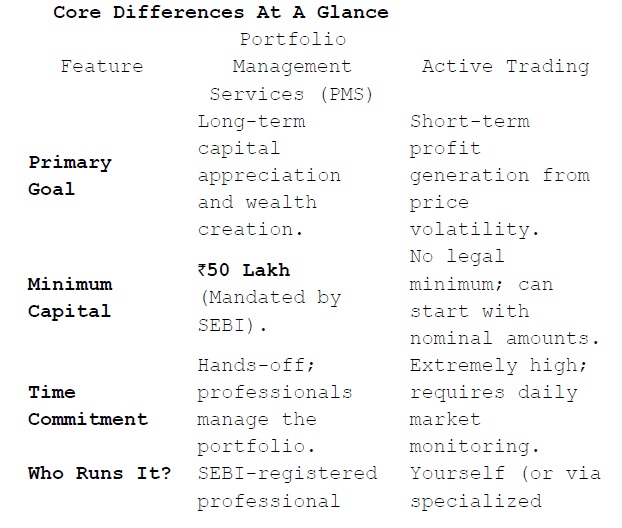
Therefore, Choosing between a Portfolio Management Service (PMS) and Active Trading depends on your available capital, time commitment, and market expertise.
PMS is a passive, professional wealth-creation tool for High-Net-Worth Individuals (HNIs), whereas trading is a hands-on, high-frequency activity aimed at capturing short-term market movements.
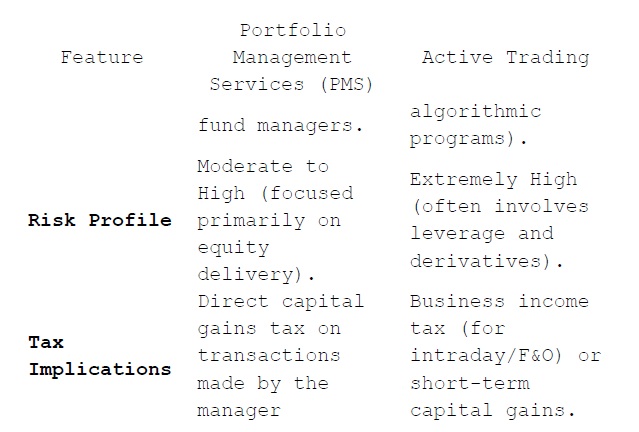
Core Differences At A Glance
The above analysis reveals that tax implication under option to invest in PMS would be capital gains and not income from business as it would be only in case of active trading for intra day trading and F&O investment.
14. So far as the questions of law with regard to Section 80IB of the Act are concerned, it would also be germane to refer to the decision of the Hon’ble Apex Court in case of Shital Fibers Ltd. v. CIT (SC), wherein, in similar facts, the Hon’ble Apex Court has held as under :
“20. Therefore, on plain reading of Subsection (9) of Section 80-IA, if a deduction of profits and gains under Section 80-IA is claimed and allowed, the deduction to the extent of such profits and gains in any other provision under the heading ‘C’ is not allowed. The deduction to the extent allowed under Section 80-IA cannot be allowed under any other provision under heading ‘C’. Therefore, if deduction to the extent of ‘X’ is claimed and allowed out of gross total income of ‘Y’ under Section 80-IA and the assessee wants to claim deduction under any other provision under the heading ‘C”, though he may be entitled to deduction ‘Y’ under the said provision, he will get deduction under the other provisions to the extent of (Y-X) and in no case total deductions under heading ‘C’ can exceed the profits and gains of such eligible business of undertaking or enterprise.
21. Sub-section (9) of Section 80-IA, on its plain reading, does not provide that when a deduction is allowed under Section 80-IA, while considering the claim for deduction under any of the provision under heading C, the deduction allowed under Section 80-IA should be deducted from the gross total income. The restriction under sub-section (9) of Section 80-IA is not on computing the total gross income. It restricts deduction under any other provision under heading ‘C’ to the extent of the deduction claimed under Section 80-IA.”
15. Thus, considering the above discussion and conspectus of law, we are of the opinion that the Tribunal has committed an error in holding that the transactions in shares and securities are to be taxed under the head ‘Income from Business’ and Short Term Capital Gains arising on account of Portfolio Management Service is to be treated as ‘Business Income’.
16. We, therefore, answer the questions of law in favour of the assessee and against the Revenue. The Appeals are accordingly allowed.