


 • Where the Internet Lives
 The students in the Technovation program learn to build technology solutions by following a structured process that transforms them from passive users into active creators. Here is how they approach coding and development:
- Identifying Real-World Problems: The core of their process is identifying a problem in their community that affects many people (2:29–2:38).
- Building from Scratch: Many participants start with no prior experience—some have never even used a computer before—but they are guided to build either a mobile app or an AI prototype from the ground up (2:42–2:51).
- Leveraging Advanced APIs: Students utilize professional-grade tools to make their apps functional. For example, Arvy, a 12-year-old student, developed a natural disaster rescue assistant that integrates with the Google Maps API to provide users with personalized emergency plans, hospital locations, and safe paths during crises (4:12–4:27).
- Mentorship and Iteration: Throughout the process, the girls receive support and guidance (3:06), allowing them to learn how to iterate on their designs and improve their prototypes over time (6:50–6:58).
- Cloud Infrastructure: The program relies on cloud computing, which provides the necessary backend power from data centers to host these applications, enabling a small nonprofit to have a global impact (5:59–6:21).
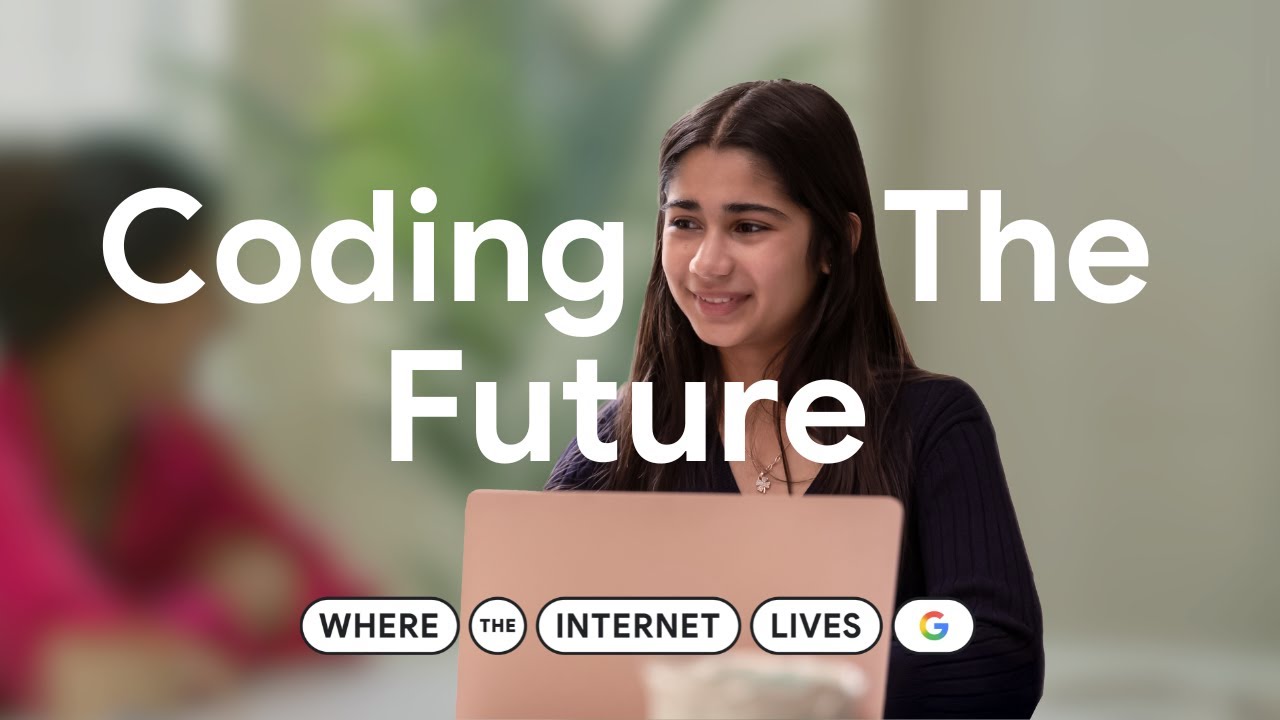
The phrase “Coding the future | Where the Internet Lives” often refers to the intersection of massive physical infrastructure and the software that drives it.
The “Internet” isn’t a cloud in the sky; it is a physical network of massive data centers, subsea cables, and millions of miles of fiber optics. Today, the “coding” part has shifted from just building websites to software-defined infrastructure, where AI and code manage the very hardware that keeps the world connected.
1. The Physical Heart: Data Centers
Data centers are the “warehouses” of the internet. They house thousands of server racks that process everything from your emails to AI model training.
-
Scale: Modern “Hyperscale” data centers are reaching massive capacities. For instance, a new Google AI Hub in Visakhapatnam is being developed with a planned capacity of 5 gigawatts (GW)—more than the total data center capacity of India just a year ago.
-
Cooling & Energy: Because servers generate intense heat, these facilities use advanced air-cooling, local climates (like in Ireland), or massive water storage tanks to stay operational. Many are now powered by adjacent solar or wind farms to meet sustainability goals.
2. Coding the Infrastructure
The “future” is being written in code because manual management of this scale is impossible.
-
Infrastructure as Code (IaC): Engineers use tools like Terraform to write code that automatically sets up servers, networks, and storage. This allows a company to “deploy” an entire data center’s logic in hours rather than months.
-
AI-Driven Operations: In 2026, AI has moved from a tool to the “operational core.” It now handles:
-
Fault Detection: Predicting when a hard drive or cooling pump will fail before it happens.
-
Energy Optimization: Adjusting power usage in real-time based on server demand.
-
Agentic Networking: Networks that can “sense” a fiber optic cut and reroute traffic around the world automatically.
-
3. Global Connectivity: Subsea & Satellite from Coding the future
The “Internet” lives under the ocean and increasingly in space.
-
Subsea Cables: Massive bundles of fiber optics on the ocean floor carry 99% of international data. New hubs (like the one in Vizag) are often positioned near coastal landing points to ensure ultra-low latency.
-
Satellite Convergence: The future involves a “hybrid” model where terrestrial fiber and satellite constellations (like Starlink) work together, ensuring that even remote areas stay connected to the global grid.
4. Why This Matters for the Future
As we move deeper into the era of Agentic AI and Vibe Coding, the demand for “compute” (AI brainpower) is skyrocketing. Between late 2025 and early 2026, global API throughput grew by 50% in just three months. To support this, the internet’s “home” must become smarter, more self-healing, and more sustainable.
Read more
55. Want a peek at Karo lG plans for Coachella? It starts with Google Search
56. Lyria 3 | Music Generation comes to Gemini
57. Farming for the future on Where the Internet Lives
58. Create with Flow to How to use Google’s AI Creative Studio
59. How to use split screen in google chrome
60. What does it take to hit the big shot? | Google + NBA
61. The Era of AI Innovation | Where the Internet Lives
62. Why is everyone talking about The Quad God? | Google + Team USA
for more refer Artificial Intelligence website click here
Your Queries solved
WhereTheInternetLives,
AI,
Data,
YouTube under Google,
Google logo shorts,
Google News facebook,
Google go to Shorts,
Facebook en Google,
Google trending facebook,
Google Facebook number,
Facebook dijiye google,
Farming for the future where the internet lives,
Google AI Mode video,
AI creative studio,