


Merchant Shipping Radiocommunication rules 2026 under Merchant Shipping ACT 2025

The Gazette of India
CG-DL-E-23052026-272822
EXTRAORDINARY
PART II—Section 3—Sub-section (i)
PUBLISHED BY AUTHORITY
No. 341] NEW DELHI, WEDNESDAY, MAY 20, 2026/VAISAKHA 30, 1948
MINISTRY OF PORTS, SHIPPING, AND WATERWAYS
NOTIFICATION
New Delhi, the 20th May, 2026
G.S.R. 376(E).— In exercise of the powers conferred by section 116, section 120, subsection (1) and clauses (a), (b), (e) and (h) of sub-section (2) of section 130, read with clause(a)
sub-section (2) Section 324 of the Merchant Shipping Act, 2025 (24 of 2025), and in
supersession of the Merchant Shipping (Distress and Safety Radiocommunication) Rules, 1995,
except as respects things done or omitted to be done before such supersession, the Central
Government hereby makes the following rules, namely:-
1. Short title and commencement.- (1) These rules may be called as Merchant Shipping
(Radiocommunication) Rules, 2026.
(2) These rules shall come into force on the date of their publication in the Official Gazette.
2. Application.- Unless otherwise specified, these rules shall apply to the following categories
of Indian vessels and vessels other than Indian Vessels operating in coastal waters, namely:-
(a) all passenger ships, and cargo ships of 300GT and above;
(b) high-speed crafts; and mobile offshore drilling units (MODUs);
(c) cargo ships less than 300GT to the extent and in respect of such provisions of these
rules as are expressly specified.
3. Exceptions.- Unless otherwise specified, these rules shall not apply to the following ships,
namely:-
(i) warships and troop ships;
(ii) State owned ships not engaged in commercial services:
The competent authority may enforce any provision, by general or special orders or
merchant shipping notices or circulars issued in writing, to the above categories of
vessels, subject to such conditions, exceptions and modifications as may be specified
therein.
4. Definitions.- (1) In these rules, unless the context otherwise requires,-
(1) ―Act‖ means the Merchant Shipping Act, 2025 (24 of 2025);
(2) ―AIS-SART‖ means an automatic identification system search and rescue transmitter
capable of operating on frequencies dedicated AIS (161.975 MHz (AIS1) and 162.025
MHz (AIS2));
(3) ―approved‖ means approved by the Nautical Advisor to the Government of India or by
the recognised organisation authorised by the Central Government;
(4) ―approved service station‖ means a facility approved by the Nautical Advisor to the
Government of India in order to carry out testing and servicing of radio and navigational
equipment and also perform survey onboard vessels required under these rules;
(5) ―bridge to bridge communications‖ means safety communication between vessels from
the position from which ships are normally navigated;
(6) ―coast station‖ means a land station in the maritime mobile service;
(7) ―coastal vessels‖ means vessels which ply from a port or place in India to any other port
or place in India and does not operate beyond 20 nautical miles from the nearest land;
(8) ―coastal waters‖ shall have the meaning as assigned in the Act;
(9) ―competent authority‖ means the Director-General for the purpose of implementing and
enforcing the provisions of these rules, and includes the Nautical Adviser;
(10) ―continuous radio watch‖ means that the radio and listening watch concerned shall not
be interrupted other than for brief intervals when the ship’s receiving capability is impaired
or blocked by its own communications or when the facilities are under periodical
maintenance or checks;
(11) ―convention vessels‖ means the vessels to which the SOLAS Convention applies;
(12) ―coordinated universal time (UTC)‖ means the primary international time standard
for civil timekeeping, maintained by the International Bureau of Weights and Measures
(BIPM) using highly precise atomic clocks and coordinated with rotation of the earth;
(13) ―digital selective calling (DSC)‖ means a technique using digital codes which enables
a radio station to establish contact with, and transfer information to, another station or
group of stations, and complies with the relevant recommendations of the International
Telecommunication Union Radiocommunication Sector (ITU-R);
(14) ―enhanced group call (EGC)‖ means the broadcast of coordinated maritime safety
information and search and rescue related information to a defined geographical area
using a recognised mobile satellite service;
(15) ―emergency position-indicating radio beacon (EPIRB)‖ means a transmitter
operating in the frequency band 406.0–406.1 MHz capable of transmitting a distress alert
via satellite to a rescue coordination centre and transmitting signals for on-scene locating;
(16) ―EPIRB-AIS‖ means a satellite EPIRB that operates on the 406.0–406.1 MHz and 121.5 MHz
frequencies and is also capable of transmitting on AIS-dedicated frequencies 161.975 MHz
(AIS1) and 162.025 MHz (AIS2);
(17) ―false distress‖ means an alert which has been sent inadvertently without the
knowledge of the master, radio operator or other personnel;
(18) ―general radiocommunications‖ means operational and public correspondence other
than distress, urgency and safety communications, conducted by radio;
(19) ―Global Maritime Distress and Safety System (GMDSS)‖ means a system that
performs the functions set out in SOLAS regulation IV/4;
(20) ―GMDSS identities‖ means maritime mobile service identity, the ship’s call sign,
Inmarsat identities, EPIRB or EPIRB-AIS hexadecimal identity, and serial number
identity which may be transmitted by the ship’s equipment and used to identify the ship;
(21) ―GMDSS radio operator‖ means a person who is qualified to perform GMDSS
functions on vessel as per the provisions of ITU radio regulations and STCW regulation
IV/2 Code A and B;
(22) ―high-speed craft‖ means a vessel which is capable of obtaining maximum speed, in
meters per second (m/s), equal to or exceeding: 3.7 ∇^0.1667, where: ∇ = volume of
displacement corresponding to the design waterline (m³), excluding craft the hull of
which is supported completely clear above the water surface in non-displacement mode
by aerodynamic forces generated by ground effect;
(23) ―IMSO‖ means the International Mobile Satellite Organization, an intergovernmental
body established by the organisation to oversee public satellite safety and security
communication services used in the GMDSS, and coordinator of the long range
identification and tracking (LRIT) system;
(24) ―INMARSAT‖ means Inmarsat Global Limited, a mobile satellite communication
system service provider recognised to provide maritime communication services in the
Global Maritime Distress and Safety System (GMDSS);
(25) ―INMARSAT Ship Earth Station‖ means a satellite communication equipment such
as Standard-C, Standard-M or Fleet ship earth station capable of: (i) transmitting and
receiving distress and safety communications using direct printing telegraphy; (ii)
initiating and receiving distress priority calls; (iii) maintaining watch for shore-to-ship
distress alerts including those directed to specifically defined geographical areas; and (iv)
transmitting and receiving general radiocommunications using either telephony or direct
printing telegraphy;
(26) ―Iridium‖ means Iridium Communications Inc., a global satellite company which
provides voice and data services anywhere on earth and is a recognized mobile satellite
service under GMDSS by the Organization;
(27) ―ITU-MARS‖ means the Maritime mobile Access and Retrieval System, a database
maintained by the International Telecommunication Union (ITU) containing details of
ship stations, coast stations, accounting authorities and other maritime
radiocommunication stations worldwide;
(28) ―locating‖ means finding the position of ships, aircraft, survival craft or persons in
distress;
(29) ―maritime mobile satellite service‖ means a mobile-satellite service in which mobile
earth stations are located on board ships, where survival craft stations and emergency
position-indicating radio beacon stations may participate;
(30) ―maritime mobile service‖ means a mobile service between coast stations and ship
stations, or between ship stations, or between associated onboard communication
stations, survival craft stations and emergency position-indication radio beacon stations;
(31) ―maritime mobile service identity (MMSI)‖ means a series of nine digits which are
sent in digital form over a radio frequency channel in order to uniquely identify ship
stations (assigned by the competent authority) and coast stations;
(32) ―maritime safety information (MSI)‖ means navigational and meteorological
warnings, meteorological forecasts and other urgent and safety-related messages
broadcast to ships;
(33) ―MODU‖ means a mobile offshore drilling unit, a vessel capable of engaging in
drilling operations for the exploration or for exploitation of resources beneath the seabed, such as liquid or gaseous hydrocarbons or sulphur;
(34) ―organization‖ means the International Maritime Organization (IMO);
(35) ―performance standards‖ means the performance standards of radiocommunication
and navigational equipment adopted by the IMO Assembly and Maritime Safety
Committee (MSC), as amended from time to time;
(36) ―RADAR SART‖ means a search and rescue transponder operating on radar
frequencies in the frequency band 9.2–9.5 GHz;
(37) ―radiocommunication‖ means telecommunication by means of radio waves;
(38) ―Radio Regulations‖ means the regulations adopted by the World
Radiocommunication conference (Geneva 1995) and includes every revision or
modification thereof which Government of India has ratified or accepted;
(39) ―radio station‖ means one or more transmitters or receivers or a combination of both,
including the accessory equipment, necessary at one location for carrying on a
radiocommunication service;
(40) ―recognized mobile satellite service (RMSS)‖ means any service which operates
through a satellite system and is recognised by the organisation, for use in GMDSS;
(41) ―Schedule‖ means schedule annexed to these rules;
(42) ―Sea Area A1‖ means an area within the radiotelephone coverage of at least one very
high frequency (VHF) coast station in which continuous DSC alerting is available;
(43) ―Sea Area A2‖ means an area, excluding Sea Area A1, within the radiotelephone
coverage of at least one MF coast radio station in which continuous DSC alerting is
available;
(44) ―Sea Area A3‖ means an area, excluding Sea Areas A1 and A2, within the coverage of
a recognized mobile satellite service (RMSS) supported by the ship earth station carried
on board, in which continuous alerting is available;
(45) ―Sea Area A4‖ means an area outside Sea Areas A1, A2 and A3 including polar areas;
(46) ―search and rescue radar transponder (SART)‖ means a radar transponder for use in
survival crafts by ships or aircraft;
(47) ―ship earth station‖ means a mobile earth station in the maritime mobile-satellite
service located on board a ship;
(48) ―ship station‖ means a mobile station in the maritime mobile service located on board
a vessel which is not permanently moored, other than a survival craft station;
(49) ―shore-based maintenance contract‖ means a document signed between owners of
the vessel and service provider authorised by the manufacturer of the particular make of
equipment as per the standards specified by the organisation;
(50) ―space radiocommunication‖ means any radiocommunication involving the use of
one or more space stations or the use of one or more reflecting satellites or other objects
in space;
(51) ―STCW‖ means the International Convention on Standards of Training, Certification
and Watchkeeping for Seafarers, 1978 as amended, which sets minimum qualification
standards for masters, officers, and watch personnel on seagoing merchant ships;
(52) ―terrestrial radiocommunication‖ means any radiocommunication other than space
radiocommunication or radio astronomy;
(2) Words and expressions used in these rules and not defined but defined in the Act or the
Safety Convention shall have the meanings respectively assigned to them in the Act or the
Safety Convention.
5. Distress Signals.- It shall be lawful for any ship, vessel, survival craft or person in distress to
use, in addition to the distress signals specified in the rule 37 and Annex IV of the International
Regulations for Preventing Collisions at Sea 1972 (COLREG), as amended from time to time,
any other means available to attract attention, make known their position, and obtain assistance.
The distress signal in radiotelephony consists of the word ―MAYDAY‖.
6. Exemptions.-(1) The competent authority may grant partial or conditional exemptions to
individual vessels, from certain requirements of these rules; provided that-
(a) such vessels comply with the functional requirements as specified in rule 7 at all
times while ship is at sea; and;
(b) the efficiency of distress and safety radiocommunication service towards the safety
of all vessels shall not be affected in any case or scenario.
(2) The exemptions may be granted under sub-rule(1),-
(a) if conditions affecting safety are such as to render full or partial application of the
carriage of equipment specified in rules 12 to 18, and Rule 26 to 28 as unreasonable
or unnecessary;
(b) in exceptional circumstances, for a single voyage outside the Sea Area or Sea Areas
as defined in clauses 42 to 45 of sub-rule (1) of rule 4 for which the ship is equipped.
7. Functional requirements.- (1) Every vessel, while at sea, shall be capable of performing the
following GMDSS functions, namely:-
(a) Distress and safety communicationsi) transmitting ship-to-shore distress alerts by at least two separate and independent
means, each using a different radiocommunication service;
ii) receiving shore-to-ship distress alert relays;
iii) transmitting and receiving ship-to-ship distress alerts;
iv) transmitting and receiving search and rescue coordinating communications;
v) transmitting and receiving on-scene communications;
vi) transmitting and receiving signals for locating;
vii) receiving MSI;
viii) transmitting and receiving urgency and safety communications; and
ix) transmitting and receiving bridge-to-bridge communications.
(b) transmitting and receiving general radiocommunications.
(2) Vessels performing GMDSS functions shall use the guidance for avoidance of false distress
alerts adopted by the Organisation through the Resolution MSC-514(105), ITU-R M.493, ITU
Res 349 (Rev WRC-19), and as may be specified by competent authority.
(3) The procedures for dealing with false distress alerts transmitted inadvertently from any
radiocommunication alerting devices shall be cancelled without delay as specified in
SCHEDULE-I.
8. GMDSS Satellite Providers.-The requirements specified by IMSO shall be applicable for
arrangements of the evaluation, recognition, review and oversight of the provision of recognised
mobile satellite services (RMSS) in the GMDSS pursuant to the provisions of these rules as set
out in the IMO Resolution A.1001 (25) and Resolution MSC.1/Circ.1414, as amended from time
to time.
9. Space and Terrestrial Services.- (1) The Central Government shall make available the
following shore-based facilities for the maritime mobile satellite service (Space
Radiocommunication) and maritime mobile service (Terrestrial Radiocommunication) in
pursuant to the recommendations of the Organisation, namely:-
(a) Recognized mobile satellite services;
(b) A satellite service on 406 MHz;
(c) The maritime mobile service in the bands between 156 MHz and 174 MHz;
(d) The maritime mobile service in the bands between 4000 kHz and 27500 kHz; and
(e) The maritime mobile service in the bands between 415 kHz and 535 kHz and
between 1605 kHz and 4000 kHz.
(2) The competent authority shall provide the Organization with pertinent information
concerning the shore-based facilities in the maritime mobile service and maritime mobile
satellite service, established for Sea Areas which it has designated off in its coasts.
(3) The competent authority shall provide the Organization with timely and adequate notice prior
to the planned withdrawal of any of these services or any particular shore-based facilities.
10. GMDSS identities.- (1) This rule shall apply to all vessels as specified in rule 2.
(2) The Central Government shall ensure that suitable arrangements are made for registering
GMDSS identities and for making information on these identities available to rescue
coordination centres (RCC) on a 24-hour basis.
(3) Where appropriate, the Central Government shall notify the assignment of identities
referred to in sub-rule (2) to the relevant international organisations, including the
International Telecommunication Union-Maritime Mobile Access and Retrieval System
(ITU- MARS), maintaining registries of such identities.
(4) The hexadecimal code of EPIRB or EPIRB-AISs and PLBs shall be registered with the
Indian National Mission Control Centre (INMCC), Bengaluru.
(5) On deletion of ships from the Indian registry, the ship’s EPIRB or EPIRB-AISs shall be
de-registered from the Indian National Mission Control Centre (INMCC), Bengaluru.
(6) The free form identities for AIS interfaced equipment like AIS-SART, EPIRB-AIS and
AIS-MOB are required to be registered with the agency concerned in the Central
Government.
11. Radio installation.- (1) Every vessel shall be provided with radio installations capable of
complying with the functional requirements specified in rule 7, throughout its intended voyage,
unless exempted under rule 6, and orders issued by the competent authority, comply with the
carriage requirements as specified in rule 12 to 18, and 26 to 28.
(2) Every radio installation shall be-
(a) located in such a way that no harmful interference of mechanical, electrical or other
origin affects its proper use, and that electromagnetic compatibility is ensured and
harmful interaction avoided with other equipment and systems;
(b) so located as to ensure the greatest possible degree of safety and operational
availability;
(c) protected against harmful effects of water, extremes of temperature and other adverse
environmental conditions;
(d) provided with reliable, permanently arranged electrical lighting, independent of the
main and emergency sources of electrical power, for the adequate illumination of the
radio controls for operating the radio installation; and
(e) clearly marked with the GMDSS identities, as applicable, for use by the radio
installation operator;
(f) so located that no magnetic compass lies within the stated compass safe distance of
the equipment.
(3) Control of the VHF (very high frequency) radiotelephone channels, required for
navigational safety, shall be immediately available on the navigation bridge convenient to
the conning position. Also, facilities shall be available to permit radiocommunications
from the wings of the navigation bridge. For this purpose, portable very high frequency
(VHF) equipment may be used.
(4) The installation, operation, and maintenance of radiocommunication equipment, including
satellite communication and positioning systems, shall, inter alia, comply with the
applicable provisions of the Telecommunications Act, 2023 (44 of 2023) , and rules made
or notifications issued thereunder.
12. General radiocommunication equipment requirement.- Every vessel shall be provided
with the general radiocommunication equipment as specified in
SCHEDULE-II.
13. Additional requirements for passenger ships and passenger high-speed crafts (HSCs).-
In addition to the requirements specified in rule 12, all the Passengers vessels and passenger
high-speed crafts (HSCs) shall comply with additional requirements as specified in
SCHEDULE-III.
14. Additional requirements for mobile offshore drilling units (MODU).- In addition to the
requirements specified in rule 12, all the MODUs shall comply with the requirements of
radiocommunication equipment mandated in MODU Code.
15. Radiocommunication equipment requirement for Sea Area A1.- In addition to
requirements specified in rule 12 and 13, every ship operating in Sea Area A1 shall be equipped
with a radio installation as specified in
SCHEDULE-IV.
16. Radiocommunication equipment requirement for Sea Area A2.- In addition to the
requirements specified in rules 12 and 13, every ship operating on voyages within Sea Area A2
shall be equipped with a radio installation as detailed in
SCHEDULE-V.
17. Radiocommunication equipment requirement for Sea Area A3.- In addition to the
requirements of rules 12 and 13, every ship engaged on voyages within Sea Area A3 shall be
equipped with a radio installation as specified in
SCHEDULE-VI.
18. Radiocommunication equipment requirement for Sea Area A4.- In addition to the
requirements of rules 12 and 13, every ship engaged on voyages within Sea Area A4 shall be
equipped with a radio installation as specified in
SCHEDULE-VII.
19. Radio watches.- (1) Every vessel, while at sea, shall maintain a continuous radio watch for
distress, urgency and safety communications purposes,-
(a) on VHF DSC channel 70;
(b) on DSC frequency 2187.5 kHz, if the ship, in accordance with the requirements of
clauses (a) and (b) of paragraph 1 of the SCHEDULE-V or clauses (b) and (c) of
paragraph 1 of the SCHEDULE-VI, is fitted with an MF radio installation;
(c) on DSC frequencies 2187.5 kHz and 8414.5 kHz and also on at least one of the DSC
frequencies 4207.5 kHz, 6312 kHz, 12577 kHz or 16804.5 kHz, appropriate to the
time of day and the geographical position of the ship, if the ship, in accordance with
the requirements of clause (b) of Paragraph 1 of the SCHEDULE VII, is fitted with
an MF/HF radio installation. This watch may be kept by means of a scanning
receiver; and
(d) for satellite shore-to-ship distress alert relays, if the ship, in accordance with the
requirements of clause (a) of Paragraph 1 of the SCHEDULE VI, is fitted with a
recognised mobile satellite service ship earth station.
(2) Every vessel, while at sea, shall maintain a radio watch for broadcasts of maritime safety
information (MSI) and search and rescue related information on the appropriate frequency
or frequencies on which such information is broadcast for the area in which the ship is
navigating.
(3) Every vessel, while at sea, shall maintain, when practicable, a continuous listening watch,
which shall be kept at the position from which the ship is normally navigated, on VHF
channel 16 and other appropriate frequencies for urgency and safety communications for the
area in which the ship is navigating. Channel 16 is to be utilised only for initial calling, for
further communication channel to be changed to another working channel. Care to be
exercised that the channel selected shall not be promulgated for urgency and safety
communication.
(4) Every vessel shall use international distress frequency 156.8 MHz (VHF Channel 16)
solely for distress communication only.
20. Sources of energy.- (1) While the ship is at sea, a supply of electrical energy shall be
available at all times sufficient to operate the radio installations and to charge any batteries used
as part of a reserve source or sources of energy for the radio installations.
(2) The details regarding various sources of electrical energy are outlined in the
SCHEDULE-VIII.
(3) The equipment required to be connected to the reserve source of energy is enlisted in
SCHEDULE IX.
21. Performance standards.- (1) All radiocommunication equipment to which these rules
apply, shall be type approved by the competent authority or any surveyor appointed under
section 9 of the Act. Such equipment shall conform to appropriate performance standards not
inferior to those adopted by the Organisation.
(2) For the purpose of obtaining ship station license for any radiocommunication equipment, the
master or owner of the vessel shall provide a list of all radiocommunication equipment approved
under sub-rule (1) to the Wireless Planning and Co-ordination (WPC) Wing, Department of
Telecommunications, Ministry of Communications, Government of India.
22. Manning requirements.- (1) Every Indian vessel to which these rules applies, as specified
under rule 2, shall be manned by certified personnel from the following categories of operators,
namely:-
Categories Maintenance Methods Type of Certificate Holder(s)
Sea Area- A3
and A4.
1. Duplication of equipment and
shore based maintenance
General Operator Certificate
2. Duplication of equipment and
at sea electronic maintenance
First Class or Second Class Radio
Electronic Certificate.
3. Shore based maintenance and
at sea electronic maintenance
First Class or Second Class Radio
Electronic Certificate.
Sea Area- A2. 1. Duplication of equipment, or General Operator Certificate
2. Shore based maintenance, or General Operator Certificate
3. At sea electronic maintenance First Class or Second Class Radio
Electronic Certificate
Sea Area- A1,
coastal vessels,
and other
vessels less than
300 GT
Duplication of equipment or
Shore based maintenance.
Restricted Operator Certificate or
General Operator Certificate.
Note: The engagement of certified operators shall be based on the selection maintenance
method.
(2) The certified personnel engaged exclusively as radio operators shall-
(a) carryout maintenance of the equipment as specified in the operating manual for
such equipment and carry out appropriate checks and tests specified in
SCHEDULE-X; and
(b) inform the Master where any of the radio installations are not in working order
and record the details of the same in the radio logbook.
(3) Where certified persons are not engaged exclusively as radio operators and persons are
required to carry out the duties of a radio operator in addition to their other duties (such as
deck officers with additional qualification), at least two officers with qualification as
specified in the table above shall be manned and one of them shall be nominated by the
Master to carry out the duties specified in clauses (a) and (b) of sub-rule (2).
23. Maintenance requirements.- (1) Equipment shall be so designed that the main units can be
replaced readily without elaborate recalibration or readjustment.
(2) Where applicable, equipment shall be so constructed and installed that it is readily
accessible for inspection and onboard maintenance purposes.
(3) Adequate information shall be provided to enable the equipment to be properly operated
and maintained, taking into account the recommendations of the Organisation.
(4) Adequate tools and spares shall be carried to enable the equipment to be maintained in
accordance with
SCHEDULE-XI.
(5) The competent authority shall ensure that radiocommunication equipment is maintained
to provide the availability of the functional requirements specified in rule 7 and to meet
the recommended performance standards of such equipment.
(6) The method of availability of radiocommunication equipment shall be ensured by using
following methods, namely :-
(a) duplication of equipment; or
(b) shore-based maintenance; or
(c) at-sea electronic maintenance capability.
(7) On vessels engaged on voyages in Sea Areas A1 or A2, the availability shall be ensured
by using at least one method as specified in sub-rule (6), as may be approved by the
competent authority.
(8) On vessels engaged on voyages in Sea Areas A3 or A4, the availability shall be ensured
by using a combination of at least two methods as specified in sub-rule (6), as may be
approved by the competent authority.
(9) Method of maintenance to be adopted with details of equipment and maintenance
capability shall be submitted to the competent authority, whose decision relating to the
manning requirement vis-à-vis method of maintenance in accordance with rule 22 shall
be final.
(10) For high-speed crafts operating solely between ports where adequate facilities for shorebased maintenance of the radio installations are available, and provided that no voyage
between two such ports exceed six hours, then the competent authority may exempt such
craft from the requirement to use at least two maintenance methods. For such craft, at least
one maintenance method shall be used.
(11)While all reasonable steps shall be taken to maintain the equipment in efficient working
order to ensure compliance with all the functional requirements specified in rule 7,
malfunction of the equipment for providing the general radiocommunications required by
clause (b) of sub-rule (1) of rule 7 shall not be considered as making a ship unseaworthy or
as a reason for delaying the ship in ports where repair facilities are not readily available,
provided the ship is capable of performing all distress, urgency and safety functions.
(12) EPIRB or EPIRB-AISs shall be-
(a) annually tested, either on board the ship or at an approved radio service station, for all
aspects of operational efficiency, with special emphasis on checking the emission on
operational frequencies, coding and registration, at intervals as specified below:
(i) on passenger ships, within three months before the expiry date of the passenger
ship safety certificate; and
(ii) on cargo ships, within three months before the expiry date, or within three months
before or after the anniversary date, of the Cargo Ship Safety Radio Certificate; and
(b) subject to maintenance at intervals not exceeding five years, to be performed at an
approved shore-based maintenance facility.
(13) The disposal of radiocommunication equipment, navigational equipment, batteries and
other such related equipment (E-waste) shall be carried out as specified in
SCHEDULE- XII.
24. Radio personnel.- (1) Every vessel shall carry qualified personnel for distress, urgency and
safety communication purposes to the satisfaction of the Standard of Training, Certifications and
Watchkeeping for Seafarers (STCW) Convention and competent authority. The personnel shall
be holders of the appropriate certificates specified in Section II of Article 47 of the ITU Radio
Regulation and in sub-rule (4). One designated personnel shall have exclusive primary
responsibility for communications during distress incidents.
(2) In passenger ships, at least one person qualified in accordance with sub-rule (1) shall be
assigned to perform communication duties during distress incidents.
(3) Every vessel shall be manned by radio personnel holding a valid certificate of proficiency
granted under ITU Radio Regulations by –
(i) the Wireless Planning and Co-ordination Wing, Department of
Telecommunications, Ministry of Communications, Government of India; or
(ii) the administration of any other country whose certificate of proficiency has been
recognised by the Central Government and has issued such holder an authority to
operate a radio installation on board an Indian ship.
(4) Certificate of proficiency for the following grades under GMDSS shall be granted by the
Wireless Planning and Co-ordination Wing, Department of telecommunications, Ministry
of Communications, Government of India, namely:-
(i) First class radio electronic certificate;
(ii) Second class radio electronic certificate;
(iii) General Operators’ Certificate; and
(iv) Restricted Operator’s Certificate.
(5) In addition to the requirements specified in sub-rule (4), every GMDSS radio operator
shall possess certificates of proficiency in five basic STCW courses, namely:-
(i) elementary first aid or medical first aid;
(ii) personal survival techniques or proficiency in survival craft and rescue boat;
(iii) fire prevention and firefighting or advance fire fighting;
(iv) personnel safety and social responsibility;
(v) proficiency in designated security duties.
25. Radio records.- (1) Every radio operator shall, when keeping radio watch, enter the
following in the radio logbook as they occur, together with the time of their occurrences,
namely:-
(i) a summary of communication relating to distress, urgency and safety;
(ii) the date and time shall be entered in Coordinated Universal Time (UTC);
(iii) a record of important incidents connected with radio service; and
(iv) where appropriate the position of the ship at least once a day;
(v) summary of communications exchanged between the ship station and other stations;
(vi) summary of all the tests, maintenance, repairs carried out, and malfunction of
equipment.
(2) The master or any other person responsible for the ship shall inspect and sign entries in
the radio logbook daily.
(3) All vessels shall carry radio records, documents, licenses, certificates and publications as
specified in
SCHEDULE-XIII.
26. Position updating through electronic position fixing system (EPFS).- (1) All fixed twoway radiocommunication equipment carried onboard vessels, shall be capable of continuously
and automatically updating position of the ship to all the relevant radiocommunication
equipment sending distress alerts.
(2) EPFS or radio navigational receiver shall be installed for automatic updating position of
the ship to the distress alerting devices i.e. DSC equipment and RMSS equipment. If
such automatic updating is interrupted, it is required to enter the position of the ship
manually into relevant GMDSS equipment at intervals not exceeding four hours
whenever the ship is under way, so that it is always ready for transmission by the
equipment.
(3) If the EPFS is connected to the GMDSS equipment, it shall (similar to the mandatory
GMDSS equipment) be supplied with energy from the reserve source of energy or
batteries.
27. Carriage requirement of radiocommunication equipment for convention vessels.- The
equipment required to be carried onboard convention vessels including all cargo ships of 300 GT
gross tonnage or above, all passenger ships and high-speed crafts is specified in
SCHEDULEXIV.
28. Carriage requirement of radiocommunication equipment for cargo ships less than 300
GT, coastal vessels, and port crafts.- (1) The vessels, operating in the Indian Coast within
twenty nautical miles from the nearest land, shall be required to carry radiocommunication
equipment as specified in SCHEDULE-XV.
(2) The equipment referred to in sub-rule (1) is applicable to cargo ships of less than 300 GT,
cargo ships between 300 GT and 3,000 GT operating in Indian coast, and port or harbour crafts
operating within harbour waters, as specified in SCHEDULE-XV.
(3) The provisions of sub-rules (1) and (2) shall not apply to passenger vessels and convention
vessels.
(4) Vessels less than 300 GT on international voyages shall carry radiocommunication
equipment in accordance with the requirements for convention vessels as specified in
SCHEDULE XV.
29. Radio service station.- (1) In accordance with rules 21 and 23, the testing and maintenance
of radiocommunication equipment shall be conducted at radio service stations approved by the
competent authority. These services shall be carried out by appropriately trained personnel using
suitable and calibrated test equipment to ensure compliance with required performance
standards.
(2) The radio service stations shall be established by Original Equipment Manufacturers (OEMs)
or firms authorised by OEMs to provide such services, and must be approved by the competent
authority.
(3) No entity in India shall engage in servicing, testing, and survey of radiocommunication
equipment onboard vessels without the approval of the competent authority.
(4) All approved radio service stations shall be staffed with adequately qualified personnel who
have received appropriate training from the respective OEMs, as per the standard operating
procedures specified by the competent authority.
(5) All approved radio service stations shall be equipped with the latest, valid and quality control
certified testing equipment.
(6) The procedures for approval of radio service stations, qualification of competent personnel,
addition or removal of such personnel, and modification or amendment of the Certificate of
Approval (CoA) are as specified in
SCHEDULE-XVI.
30. Fitment of radio installations and its plans.- The procedure and guidelines for fitment of
radio installations and respective plans onboard ships or vessels, as referred to in rule 2, are
specified in the schedules as below:
(a) GMDSS plan – SCHEDULE-XVII
(b) Cable wirings- SCHEDULE-XVIII
(c) Electromagnetic compatibility (EMC), screening of cables, and earthing of cables and
equipment- SCHEDULE-XIX.
31. Fees.- The fees for inspection, survey, approval, issuance of certificates, and other services
under these rules shall be as specified in SCHEDULE-XX.
32. Penalties.- (1) Any contravention of these rules or failure to comply with any requirement
thereof shall be liable to penalties as specified in the Act.
(2) Any person who operates any vessel in contravention of the provisions of these rules, and for
which no specific penalty is provided under sub-section (2) of section 281 of the Act, shall be
liable to penalty which may extend to fifty thousand rupees, and if the breach is a continuing
one, with further penalty which may extend to five thousand rupees for every day after the first
day during which the breach continues.
SCHEDULE-I
(See rule 7)
False distress alert:
Procedure for cancellation of false distress alerts as per rule 7(3): If a distress alert is
inadvertently transmitted, immediate steps shall be taken to cancel the distress alert activated
from following alerting devices.
VHF digital selective calling (DSC):
(1) Reset the equipment immediately;
(2) If the DSC equipment is capable of cancellation, cancel the alert;
(3) Set to channel 16; and
(4) Transmit a broadcast message to ―All Stations‖ giving the ship’s name, call sign and
maritime mobile service identity (MMSI), and cancel the false distress alert.
MF digital selective calling (DSC):
(1) Reset the equipment immediately;
(2) If the DSC equipment is capable of cancellation, cancel the alert.
(3) Tune for radiotelephony transmission on 2 182 kHz; and
(4) Transmit a broadcast message to ―All Stations‖ giving the ship’s name, call sign and
MMSI, and cancel the false alert.
HF digital selective calling (DSC):
(1) Reset the equipment immediately;
(2) If the DSC equipment is capable of cancellation, cancel the alert;
(3) Tune for radiotelephony on the distress and safety frequency in each frequency band in
which a false distress alert was transmitted (see Appendix 15); and
(4) Transmit a broadcast message to ―All Stations‖ giving the ship’s name, call sign and
MMSI, and cancel the false alert on the distress and safety frequency in each frequency
band in which the false distress alert was transmitted.
RMSS Ship Earth Station (SES):
Notify the appropriate rescue coordination centre that the alert is cancelled by sending a distress
priority message. Provide ship name, call sign and ship earth station identity with the cancelled
alert message.
SCHEDULE-II
(See rule 12)
General Radiocommunication equipment Requirement: Every ship shall be provided with
the general Radiocommunication equipment as follows:
1. A VHF radio installation capable of transmitting and receiving, for distress, urgency
and safety communications purposes:
(a) DSC on the frequency 156.525 MHz (channel 70). It shall be possible to initiate
the transmission of distress alerts on channel 70 from the position from which the
ship is normally navigated; and
(b) Radiotelephony on the frequencies 156.300 MHz (channel 6), 156.650 MHz
(channel 13) and 156.800 MHz (channel 16).
2. A radio installation capable of maintaining a continuous DSC watch on VHF channel
70 which may be separate from, or combined with, that required by sub- paragraph (1)
(a).
3. A RADAR SART or an AIS-SART, which-
(a) shall be so stowed that it can be easily utilised;
(b) for every cargo ship of 300 gross tonnage and upwards but less than 500 gross
tonnage shall be provided with at least one RADAR SART or AIS-SART.
4. For every passenger ship and every cargo ship of 500 gross tonnage and upwards shall
be provided with at least one RADAR SART or AIS-SART on each side of the ship.
5. The RADAR SARTs or AIS-SARTs shall be stowed in such locations that they can be
rapidly placed in any survival craft other than a life-raft. On ships carrying at least two
RADAR SARTs or AIS-SARTs and equipped with free-fall lifeboats;
(a) one RADAR SART or AIS-SART shall be stowed in a free-fall lifeboat; and
(b) the other shall be located in the immediate vicinity of the navigating bridge,
readily available for use on board and for transfer to any survival craft other than a
life-raft.
6. Portable two-way VHF requirement –
(a) Every cargo ship of 300 gross tonnage and upwards but less than 500 gross
tonnage shall be provided with at least two two-way VHF radiotelephone
apparatuses.
(b) Every passenger ship and every cargo ship of 500 gross tonnage and upwards
shall be provided with at least three two-way VHF radiotelephone apparatuses.
(c) The two-way VHF radiotelephone apparatuses may be portable or fitted in
survival craft. The portable apparatus may be stored on the bridge.
7. A receiver or receivers capable of receiving MSI and search and rescue related
information throughout the entire voyage in which the ship is engaged.
8. An EPIRBE or EPIRB-AIS which shall be-
(a) installed in an easily accessible position;
(b) ready to be manually released and capable of being carried by one person into a
survival craft;
(c) capable of floating free if the ship sinks and of being automatically activated
when afloat; and
(d) capable of being activated manually;
(e) with regard to location and installation, the EPIRB or EPIRB-AIS should be
installed in the vicinity of the navigation bridge. Access via a vertical ladder is not
acceptable. Installation on the top of the wheelhouse may be accepted to fulfil this
requirement, provided the location is accessible by stairs.
9. A radio installation capable of transmitting and receiving general
radiocommunications operating on working frequencies in the band between 156 MHz
and 174 MHz. This requirement may be fulfilled by the addition of this capability in the
equipment required by paragraph 1 of this SCHEDULE.
SCHEDULE-III
(See rule 13)
Additional requirements for passenger ships and passenger high-speed crafts (HSC) :
In addition to meeting the requirements of the rule 12, the passengers ships and passenger
high- speed crafts (HSC) shall comply with following additional requirements:
1. A Distress (Alert & Alarm) Panel shall be installed at the conning position, i.e. within
the range of the manoeuvring console in the front of the navigation bridge.
2. This panel may contain either one single button which, when pressed, initiates a distress
alert using all radiocommunication installation required on board for that purpose; or one
button for each individual radio installation which are installed.
3. Clearly and visually indicate whenever any button or buttons have been pressed.
4.The alert button or buttons shall be protected against inadvertent activation by use of a
spring-loaded lid or cover permanently attached by hinges in order to fulfil the requirement
of carrying out “at least two independent actions” when transmitting distress alert. (The
button or buttons shall be pressed for at least 3 seconds before the alarm is activated.)
5 If the installed EPIRB or EPIRB-AIS is used as the secondary (mandatory) means of
distress alerting and is not remotely activated from the distress panel, it shall be acceptable
to have an additional EPIRB or EPIRB-AIS (float-free or manual) installed on the
navigation bridge near the conning position.
6. Information on the ship’s position shall be continuously and automatically provided to
all relevant radiocommunication equipment to be included in the initial distress alert when
the button or buttons on the distress panel are pressed.
7. The distress alarm panel may be part of the distress panel and shall provide visual and
aural indication of any distress alert or alerts received on board and shall also indicate
through which radiocommunication service the distress alerts have been received.
8. The Distress (Alert & Alarm) Panel shall contain alerting buttons from the equipment in
accordance to sea areas as mentioned in the table below: –
Sea Areas Equipment
All Ships VHF DSC
A1 EPIRB or EPIRB-AIS
A2 MF DSC and EPIRB or EPIRB-AIS or RMSS
A3 MF DSC, RMSS and one of HF DSC or
EPIRB or EPIRB-AIS or second RMSS.
A4 MF DSC, RMSS and one of HF DSC or
EPIRB or EPIRB-AIS or second RMSS.
9. Every passenger ship shall be provided with means for two-way on-scene
radiocommunications for search and rescue purposes using the aeronautical frequencies
121.5 MHz and 123.1 MHz from the position from which the ship is normally navigated.
This equipment may be of a fixed or portable type and shall be marked with ship’s
identification (Ship name, call sign and any other identities). The primary battery shall be
marked with expiry date.
SCHEDULE-IV
(See rule 15)
Radiocommunication equipment requirement for Sea area A1:
1. In addition to meeting the requirements specified in rule 12, every ship engaged on voyages in
Sea Area A1 shall be provided with a radio installation capable of initiating the transmission of
ship-to-shore distress alerts from the position from which the ship is normally navigated,
operating either:
(a) through the satellite service on 406 MHz; or
(b) if the ship is engaged on voyages within coverage of MF coast stations equipped with
DSC, on MF using DSC; or
(c) on high frequency (HF) using DSC; or
(d) through a recognized mobile satellite service ship earth station.
2. The requirement of sub-paragraph 1(a) may be fulfilled by installing:
(a) The EPIRB or EPIRB-AIS specified in Paragraph 8 of SCHEDULE-II close to the
position from which the ship is normally navigated, but in a location whereby it can still
float free of the ship in an emergency; or
(b) The EPIRB or EPIRB-AIS specified in Paragraph 8 of SCHEDULE-II elsewhere on the
ship, provided that this EPIRB or EPIRB-AIS has a means of remote activation which is
installed near the position from which the ship is normally navigated; or
(c) a second EPIRB or EPIRB-AIS near the position from which the ship is normally
navigated.
SCHEDULE-V
(See rule 16)
Radiocommunication equipment requirement for Sea Area A2:
(1) In addition to meeting the requirements specified in rule 12, every ship engaged on voyages
within Sea Area A2 shall be provided with:
(a) An MF radio installation capable of transmitting and receiving, for distress, urgency and
safety communications purposes, on the frequencies 2 187.5 kHz using DSC and 2 182 kHz
using radiotelephony;
(b) A radio installation capable of maintaining a continuous DSC watch on the frequency 2
187.5 kHz which may be separate from, or combined with the equipment specified in the
above paragraph (1)(a) and,
(c) A secondary means of initiating the transmission of ship-to-shore distress alerts by a radio
service other than MF operating either:
(i) through the satellite service on 406 MHz; or
(ii) on HF using DSC; or
(iii) through a recognized mobile satellite service ship earth station.
(d) It shall be possible to initiate transmission of distress alerts by the radio installations
specified in paragraphs 1(a) and 1(c)(i) from the position from which the ship is normally
navigated.
(e) The requirement in sub-paragraph 1 (c)(i) may be fulfilled by installing the equipment as
specified in paragraph 8 of SCHEDULE-II.
(f) The ship shall, in addition, be capable of transmitting and receiving general
radiocommunications by either:
(i) a radio installation operating on working frequencies in the bands
between 1605 kHz and 4000 kHz or between 4000 kHz and 27500 kHz.
This requirement may be fulfilled by the addition of this capability in the
equipment required by paragraph 1(a) above; or
(ii) a recognised mobile satellite service ship earth station as per paragraph
1(c)(iii).
SCHEDULE-VI
(See rule 17)
Radiocommunication equipment requirement for Sea Area A3:
1. In addition to meeting the requirements specified in rule 12, every ship engaged on voyages
within Sea Area A3 shall be provided with:
(a) A recognized mobile satellite service ship earth station capable of:
(i) Transmitting and receiving distress, urgency and safety communications;
(ii) Initiating and receiving distress priority calls; and
(iii) Maintaining watch for shore-to-ship distress alert relays, including those
directed to specifically defined geographical areas.
(b) An MF radio installation capable of transmitting and receiving, for distress, urgency and
safety communications purposes, on the frequencies 2187.5 kHz using DSC and 2182 kHz
using radiotelephony;
(c) A radio installation capable of maintaining a continuous DSC watch on the frequency
2187.5 kHz which may be separate from, or combined with the equipment specified in
SCHEDULE-V paragraph 1(a) and (b) and,
(d) A secondary means of initiating the transmission of ship-to-shore distress alerts by a radio
service other than MF operating either:
(i) Through the satellite service on 406 MHz; or
(ii) On HF using DSC; or
(iii) Through a recognized mobile satellite service ship earth station.
2. It shall be possible to initiate transmission of distress alerts by the radio installations
specified in SCHEDULE-V paragraph 1(a), 1(b) and 1(d) from the position from which the
ship is normally navigated.
3. The requirement in paragraph (1)(d)(i) may be fulfilled by installing the equipment as
specified in paragraph 8 of SCHEDULE-II.
4. The ship shall, in addition, be capable of transmitting and receiving general
radiocommunications by either:
(i) A recognised mobile satellite service ship earth station; or
(ii) A radio installation operating on working frequencies in the bands between 1605 kHz
and 4000 kHz or between 4000 kHz and 27500 kHz.
5. The requirements in sub-paragraph 4(i) and 4(ii) may be fulfilled by the addition of this
capability in the equipment required by sub-paragraph 1(a) and 1(b) respectively.
SCHEDULE-VII
(See rule 18)
Radiocommunication equipment requirement for Sea Area A4:
1. In addition to meeting the requirements specified in rule 12, every ship engaged on voyages
within Sea Area A4 shall be provided with:
(a) An MF/HF radio installation capable of transmitting and receiving, for distress, urgency
and safety communications purposes, on all distress, urgency and safety frequencies in
the bands between 1605 kHz and 4000 kHz and between 4 000 kHz and 27500 kHz
using DSC and radiotelephony.
(b) Equipment capable of maintaining DSC watch on 2187.5 kHz, 8414.5 kHz and on at
least one of the DSC frequencies 4207.5 kHz, 6312 kHz, 12577 kHz or 16 804.5 kHz; it
shall be possible at any time to select any of these DSC frequencies for distress,
urgency and safety communications purposes. This equipment may be separate from, or
combined with, the equipment required by paragraph 1(a) and;
(c) A secondary means of initiating the transmission of ship-to-shore distress alerts through
the satellite service on 406 MHz.
(d) The ship shall, in addition, be capable of transmitting and receiving general
radiocommunications by a radio installation operating on working frequencies in the
bands between 1 605 kHz and 4 000 kHz and between 4 000 kHz and 27 500 kHz. This
requirement may be fulfilled by the addition of this capability in the equipment required
by sub-paragraph 1(a).
(e) It shall be possible to initiate transmission of distress alerts by the radio installations
specified in paragraph (1)(a) and (1)(c) from the position from which the ship is
normally navigated.
(f) The requirement in paragraph 1(c) may be fulfilled by installing the equipment as
specified in paragraph 8 of SCHEDULE-II.
SCHEDULE – VIII
[See rule 20(2)]
Sources of Electrical Energy:
As described in sub-rule (2) of rule 20, various supplies and sources of electrical energy to
operate radiocommunication equipment are as described below:-
While the ship is at sea, a supply of electrical energy shall be available at all times sufficient to
operate the radio installations and to charge any batteries used as part of a reserve source or
sources of energy for the radio installations.
(1) Main Source of electrical energy means the primary electrical power supply system of the
ship, commonly referred to as the ship’s mains, which provides continuous electrical power
under normal operating conditions to all essential shipboard systems, including
communication, navigation, safety, and propulsion equipment.
(a) It shall be independent, reliable, and capable of supplying power to all basic and
duplicated equipment simultaneously, including the battery charging arrangements
associated with reserve sources of energy.
(b) provision shall be made for an aural alarm and visual indication at the position from
which the ship is normally navigated, indicating an interruption of the ship’s main
source of electrical power supply, such alarm and indication —
(i) shall not be capable of being disabled;
(ii) shall be capable of being acknowledged and silenced manually; and
(iii) shall reset automatically upon restoration of the ship’s electrical power supply.
(2) Emergency source of energy means the independent electrical supply system, distinct from
the ship’s main source of electrical power, automatically available in the event of failure of
the main source within forty-five seconds, and –
(a) shall not be applicable to cargo ships of less than 500 GT;
(b) shall be capable of supplying electrical power for the operation of all GMDSS
communication equipment and other essential safety systems for the period of
eighteen hours on cargo ships and thirty six hours on passenger ships;
(c) shall automatically start upon failure of main source of electric supply and restore
the power to all the equipment, within forty five seconds.
(3) Reserve source of energy means a self-contained energy storage system, independent of the
main source of electrical power and the emergency source of electrical power, intended
exclusively for maintaining the continuous operation of the basic and duplicated
radiocommunication equipment and miscellaneous equipment for the specified period of
uninterrupted operation in the event of total failure of other power sources.
(a) A reserve source or sources of energy shall be provided on every ship, to supply energy
to radio installations, for the purpose of conducting distress, urgency and safety
communications, in the event of failure of the ship’s main and emergency sources of
electrical power. The reserve source or sources of energy shall be capable of
simultaneously operating all the equipment as specified in SCHEDULE- IX for a period
of at least: –
(i) One hour on ships provided with an emergency supply which is adequate to
operate the radiocommunication equipment for a period of eighteen hours on
cargo ships and thirty-six hours on passenger ships; or
(ii) Six hours on ships not provided with an emergency supply as specified in
paragraph (2).
(b) Where a reserve source of energy consists of a rechargeable accumulator battery or
batteries:
(i) a means of automatically charging such batteries shall be provided which
shall be capable of recharging them to minimum capacity requirements within
ten hours; and
(ii) the capacity of the battery or batteries shall be checked, using an appropriate
method, at intervals not exceeding twelve months, when the ship is not at sea.
(c) The reserve source or sources of energy shall be independent of the propelling power of
the ship and the ship’s electrical system.
(d) The siting and installation of accumulator batteries which provide a reserve source of
energy shall be such as to ensure:
(i) The highest degree of service;
(ii) A reasonable lifetime;
(iii) Reasonable safety;
(iv) That battery temperatures remain within the manufacturer’s specifications
whether under charge or idle; and
(v) That when fully charged, the batteries will provide at least the minimum
required hours of operation under all weather conditions.
(vi) Records related to maintenance and replacement of batteries shall be
maintained in battery logbook.
(4) Radio battery capacity.-(a) “minimum required battery capacity” means the battery capacity
determined by giving consideration to the expected extreme temperatures for the location of the
battery, reduction of its capacity during its lifetime, and the loads which are to be connected to it,
and the temperature range of the battery shall be wider than the expected temperature range of
the location where the battery is to be installed.
(b) The batteries shall have enough capacity to operate all the GMDSS Radiocommunication
equipment for the specific times outlined in Paragraph 3(a). The total load for the entire
radio installation shall be calculated prior to the installation of any radio batteries for the
reserve supply;
(c) Where the basic and duplicated radiocommunication equipment cannot be operated
simultaneously, the battery capacity shall be sufficient to operate the equipment with the
highest power consumption;
(d) Where the basic and duplicated Radiocommunication equipment are connected
simultaneously, the battery capacity shall be sufficient to meet the average consumption of
all connected equipment including any additional loads such as printers, displays,
emergency light etc.;
(e) If the capacity requirement of radio batteries is to be maintained over their normal life
cycle, an extra 40% capacity shall be added to the minimum calculated capacity;
(f) When calculating discharge time, the following guidelines may be of assistance:
(i) the capacity of a lead acid battery is normally quoted at twenty hours of discharge
at an operational temperature of 20°C;
(ii) the capacity at one hour discharge is approximately 50% of the capacity at twenty
hours discharge;
(iii) the capacity at six hours discharge is approximately 80% of the capacity at
twenty hours discharge; and
(iv) for batteries other than the lead acid type, the capacity at one hour discharge is
approximately 60% of the capacity at ten hours discharge and six hours discharge
will be approximately 92% of the capacity at ten hours discharge.
(g) An example of calculation shall be included. See Annexure-I.
(h) The capacity of the radio batteries shall be checked at intervals not exceeding twelve
months when the ship is not at sea. One method of checking the capacity is to fully discharge
and recharge the batteries using normal operation current over a period of ten hours.
Assessment of the charge conditions can be made at any time, but it shall be done without
significant discharge of the battery when the ship is at sea. Another method could be to
check the capacity by means of a battery tester, e.g. in connection with a radio survey.
(i) When determining the battery capacity, the following shall also be taken into
consideration:
(i) the battery is normally not fully charged;
(ii) reduction of capacity due to ageing;
(iii) reduction of capacity due to high or low temperatures; and
(iv) reduction of capacity due to rapid discharge.
(j ) The capacity calculation plan shall be as Annexure-I.
(5) Battery installation and construction requirements.-
(a) The batteries shall be properly marked with:
(i) type or construction;
(ii) rated capacity (capacity for one hour discharge “C1” and capacity for six
hours discharge “C6”); and
(iii) installation date.
(b) The marking shall be visible when the batteries have been installed and during their
lifetime.
(c) A label warning of explosion danger shall be displayed near the installed batteries.
(d) Any type or construction of batteries, including but not limited to lead acid, alkaline,
maintenance free, traction, and semi-traction, may be used as reserve source or sources of
energy, taking into consideration the environmental conditions of the location where they
are installed.
(e) The battery shall maintain its rated capacity when inclined at any angle up to 22 ½° in
any orientation.
(f) All battery units shall be securely braced so that they will not be dislocated by movement
of the ship.
(g) An instruction manual which contains all necessary specifications of the batteries shall be
available on board.
(h) The information in the manual shall include at least the following:
(i) capacity and temperature range within which the stated capacity is maintained
for the specific operation period, i.e. one hour or six hours;
(ii) charging voltage and current limits to keep batteries fully charged while
preventing overcharging;
(iii) actual specific gravity of the electrolyte and/or cell voltages or the voltage of
the fully charged battery;
(iv) guidelines on how to carry out a controlled discharge test, including the
location and identification of all breakers (or similar) required to be switched off
to ensure that the ship’s main and emergency sources of power are disconnected
from all GMDSS equipment, including the reserve battery charger, to ensure that
the controlled discharge is carried out using the reserve battery only;
(v) methods of determining the condition of charge of the battery, such as:
(A) check of specific gravity of electrolyte (acid density); or
(B) check of battery cell voltage/battery voltages using an accurate
measuring instrument in accordance with the battery manufacturer’s
specifications;
(C) requirement for ventilation; and
(D) requirement for maintenance.
(i) equipment requiring a lower voltage than the total voltage of the battery bank shall not be
connected to a part of the battery bank.
(j) the batteries shall be installed:
(i) In the upper part of the ship;
(ii) In an elevated position; and
(iii) As close to the Radiocommunication equipment as possible.
(k) An outdoor located battery case shall be avoided due to considerable temperature
variation.
(l) The location shall generally satisfy the manufacturers’ specifications with regards to
temperature tolerance and environmental strain in accordance with IEC 60945 or other
equivalent standards. Ideal location for the radio batteries is in a battery room with a
constant temperature of approximately 20°C.
(m)Batteries of different types, cell constructions, capacities or manufacturers shall not be
mixed in a battery bank.
(n) Batteries of different types and different cell constructions shall not be installed in the
same location if they can affect each other.
(o) Sufficient ventilation for batteries shall be provided, as required by the battery
manufacturer.
(p) Electrical installations, including battery chargers, located in the battery room shall be
intrinsically safe.
(q) Sufficient space between batteries or battery banks shall be provided to enable
inspections and maintenance.
(r) The cabling from the batteries shall be:
(i) protected against earth faults and short-circuits;
(ii) appropriately fused; and
(iii) installed according to recognized international standards (IEC 60092-101 and
IEC 60533).
(s) Battery cables shall have sufficient dimensions to prevent voltage reduction at peak
current consumption.
(6) Uninterruptable power supplies (UPSs).-
(a) A UPS is defined as a device which for a specific period of time supplies continuous
power to Radiocommunication equipment independent of any power failures in the ship’s
main or emergency source of electrical power.
(b) The UPS, installed as the reserve source or sources of energy, shall comply with the load
determined in sub-rule (3) of rule 20 and minimum Required Battery Capacity, shall also
comply with the following requirements:
(i) shall comprise of an automatic charger and rechargeable accumulator batteries;
(ii) suitable arrangements shall be provided for both aural alarms and visual
indications at the ship’s main navigating position to indicate any failure of the UPS,
these alarms shall warn if the UPS has any failure that is not covered by the alarms
required for its automatic charging system;
(iii) the UPS shall be operational within five seconds of switching on;
(iv) the UPS shall be designed to prevent damage due to battery disconnection or
short-circuiting of the battery connections, with automatic reset of electronic
protection upon clearance of the fault;
(v) a second UPS or means for directly supplying the radio installation from the
ship’s main or emergency supply shall be installed and be available permanently in
case of a failure of the UPS;
(vi) the changeover to the second UPS or to the ship’s supplies may be manual or
automatic, and shall not require manual re-initialization of connected equipment nor
result in loss of stored data;
(vii) if the UPS does not fulfil the requirements in accordance with SOLAS
Regulation IV/13, two separate UPS systems shall be installed: one for the basic
Radiocommunication equipment and one for the duplicated equipment.
(7) Automatic battery chargers.-
(a) The charger shall be capable of recharging the completely discharged accumulator
batteries to the minimum required capacity within ten hours.
(b) The charger shall be capable of keeping the batteries appropriately charged as specified
by the manufacturer for permanent charging.
(c) The supplied voltage and current shall always be within the tolerance limits specified by
the battery manufacturer, taking into account the environmental temperature of the
battery, likely to be experienced on a ship.
(d) A protection shall be provided against overcharging or discharging of batteries from a
possible fault in the charger. The automatic charger shall be provided with a visual
indication that it is switched on. An indication of the battery voltage and
charge/discharge current shall be available on the navigation bridge.
(e) Provisions shall be made for an aural alarm and visual indication at the position from
which the ship is normally navigated, indicating when the charging voltage or current is
outside the limits given by the manufacturer. It shall not be possible to disable this alarm
and indication, and it shall only be possible to acknowledge and silence the alarm
manually. Both the alarm condition and indication shall reset automatically when normal
charging condition has been restored. Failure of the alarm system shall not interrupt the
charging or discharging of batteries.
(f) The automatic charger shall be operational within five seconds of switching on or after a
power supply interruption.
(g) The automatic charger shall be so designed and constructed that it is protected against
damage resulting from disconnection of the batteries or, with the battery disconnected,
short-circuiting the battery connection. If this protection is provided by electronic means,
it shall automatically reset following removal of the open or short-circuit conditions.
(8) Protection of circuits for accumulator batteries.-
(a) Battery circuits (i.e. the cables from battery case/room) shall be protected against shortcircuit and overload. The protection device is to be installed as near as possible to the
batteries.
(b) When conductors from the batteries are not protected against short-circuit and overload,
they are to be installed so as to be proof against short circuit and earth faults. The
requirements for short-circuit protection also apply to charge current circuits.
(c) Equivalent solutions may be accepted, e.g. by using double-screened cables in the
battery room with explosion-proof fuses. The inner screen shall be treated according to
Ex-rules, but the outer screen can be treated according to what is necessary to achieve
good EMC-screening. The outer screen can, for example, be earthed at both ends to
protect against high frequency EMC-fields.
SCHEDULE – IX
[See rule 20(3)]
List of Radiocommunication equipment operating from reserve source of energy (RSE):
As described in sub-rule (3) of rule 20, list of radiocommunication equipment operating from
vessel’s Reserve Source of Energy (RSE) is as follows: –
Primary equipment:
1. VHF DSC/RT installation.
2. MF DSC/RT installation.
3. MF/HF DSC/RT installation.
4. Recognised Mobile Satellite Service (RMSS) installation.
5. NAVTEX
6. EPFS (GPS or GNSS).
7. Emergency light.
8. Distress panel.
Duplicated equipment:
1. VHF DSC/RT installation.
2. MF/HF DSC/RT installation, or
3. Recognised Mobile Satellite Service (RMSS) installation.
Additional Equipment:
1. AIS.
2. Printers.
3. EPFS (2nd set if any).
4. Gyro compass (if continuous heading information to the RMSS is required (Ch. IV Reg.13.8).
SCHEDULE-X
[See rule 22(2)]
Onboard Plan Maintenance of Radiocommunication Equipment:
The operational procedure of radiocommunication equipment in case of emergencies shall be
made available near to all the distress alerting equipment in English and in the working language
understood by the operator. The onboard plan maintenance or test of radiocommunication
equipment shall be carried out as per the following schedule: –
1. Daily tests:
(a) Self and loop test of VHF installations.
(b) Self-test of MF/HF installations.
(c) Performance verification test of satellite equipment.
(d) Reserve source battery voltage on/off load test.
(e) Printer test (if fitted).
(f) Emergency light for radio console.
(g) Any other devices as required by the regulation.
2. Weekly tests:
(a) MF or HF DSC external test with a coast radio station at least once a week. Where a
ship has been out of communication range of coast radio station for more than one week,
a test call shall be made on the first opportunity when the ship comes within
communication range of such coast radio stations.
(b) Emergency source of electrical power, supplied to the radiocommunication
equipment.
3. Monthly tests:
(a) EPIRB or EPIRB-AIS test without radiation to the satellites, shall be conducted at
least once a month along with checking towards battery expiry, visible signs of any
damage, Hydrostatic releasing unit (HRU) and mounting bracket, lanyard, operating
instructions, Hex ID, markings, IMO symbols, etc.
(b) SARTs: RADAR SART to be tested in conjunction with RADAR and
AIS -SART to be tested in conjunction with AIS, shall be conducted at least once a
month along with checking towards battery expiry date, visual signs of any damage,
operating instructions, lanyard, markings, IMO symbols, etc.
(c) Portable Survival craft radio operation shall be tested on channel 16 and 06 at least
once a month along with checks towards battery expiry, visual signs of any damage,
operating instructions, lanyard, markings, IMO symbols, etc.
(d) Portable on-scene radiocommunication (AERO-VHF) test(s) shall be conducted at
least once a month along with checks towards battery expiry, visual signs of any damage,
operating instructions, markings, IMO symbols, etc. if carried. (only for emergency
communication with aircraft).
(e) Antenna: Monthly checks shall be carried out towards cleaning, markings, insulators,
connectors, warning posters, radiation hazard displays, safety guard rails, earthing
connections, etc.
(f) Reserve source batteries: Monthly checks shall be carried out towards electrolyte
level, specific gravity of electrolyte, corrosion, terminal connectivity, cleanliness,
personnel protective gears, etc.
4. Annual tests:
(a) Every EPRIB or EPIRB-AIS and RADAR SART or AIS-SART and other life-saving
Radiocommunication equipment, as required by the Rules, shall be serviced by a
competent person approved by the competent authority. Such servicing may be carried
out on board without exposure to the satellite system.
(b) The capacity test of reserve source of energy (battery) shall be carried out while the
ship is not at sea.
SCHEDULE-XI
[See rule 23(4)]
Tools and spare parts:
As a minimum requirement, the ship shall have the following tools and spare parts readily
available on board:
(a) spare fuses for all Radiocommunication equipment, battery circuit and main fuses where
safety fuse (“melting” fuse) are used.
(b) reserve emergency lamps.
(c) tools necessary for simple servicing.
(d) acid specific density meter if the ship is fitted with lead acid accumulators and
(e) multi-meter.
(f) long wire antennas of approx. twenty meters.
(g) hydrometer.
(h) thermometer.
(i) personnel Protective Gears.
(j) any miscellaneous instrument, if any.
SCHEDULE – XII
[See rule 23(13)]
Disposal of radiocommunication equipment, Navigational Equipment and Batteries:
The disposal of Radiocommunication equipment, navigational equipment, batteries and other
such related equipment waste (e-waste) shall be governed by the rules made under the following
provisions of :-
(i) The Telecommunications Act 2023, (44 of 2023)
(ii) any executive orders or guidelines issued by the Ministry of Environment, Forest
and climate change and Ministry of Communications.
(iii) any executive orders or guidelines issued by the state pollution control board and;
other concerned Ministry’s or departments from time to time.
SCHEDULE- XIII
[See rule 25(3)]
Documents to be carried on Indian vessels:
All the Indian flag ships as mentioned in rule 2, shall carry following certificates, licenses,
logbooks, manuals, publications.
1. Certificates and licenses: –
(a) valid cargo ship safety radio certificate or passenger ship safety certificate.
(b) type approval Certificate of all radiocommunication equipment fitted onboard ship.
(c) valid Radio Operators Certificate and License to operate the Radiocommunication equipment
issued by the WPC Wing, Department of Telecommunications, Ministry of Communications
along with STCW certificate of competency endorsed by the competent authority.
(d) valid Shore based maintenance contract (SBMC) between ship-owner and the
OEM (original equipment manufacturer) or its authorised partner.
(e) valid Mobile ship station license issued by the Department of Telecommunications, Ministry
of Communications.
(f) EPIRB or EPIRB-AIS registration certificate.
(g) valid EPIRB or EPIRB-AIS shore-based maintenance and test certificates as per
MSC.1/Circ.1039 & 1040, as amended.
(h) annual performance test certificate for AIS-SART and RADAR SART as applicable.
(i) annual performance test certificate for AIS.
(j) global chart showing all the coast radio stations.
(k) GMDSS master plan.
(l) global SAR plan.
2. Radio records
(a) GMDSS logbook
(b) Reserve Source Battery logbook.
(c) Maintenance logbook.
The aforesaid logbooks shall be retained by the master of the vessel, whether in physical or
digital form, for a period of two years and may be disposed of thereafter.
3. Publications
(a) ITU publications (Manual for use by the maritime mobile and maritime mobile- satellite
services),
(b) List-V (List of Ship Stations)
(c) List-IV (List of Coast stations and special service stations)
(d) Safety of Life at Sea (SOLAS)
(e) Admiralty List of Radio Signals (ALRS) or Admiralty List of Digital Radio Signals
(ADRS).
4. Manuals
(a) Operational and maintenance manual of all the fixed and portable radiocommunication
equipment.
(b) GMDSS Manual.f
SCHEDULE-XIV
(See rule 27)
All cargo ships of gross tonnage 300 GT or above, all passenger ships, high-speed
crafts shall carry radiocommunication equipment and comply with the rule requirements
for each Sea Area as set out in the table below:
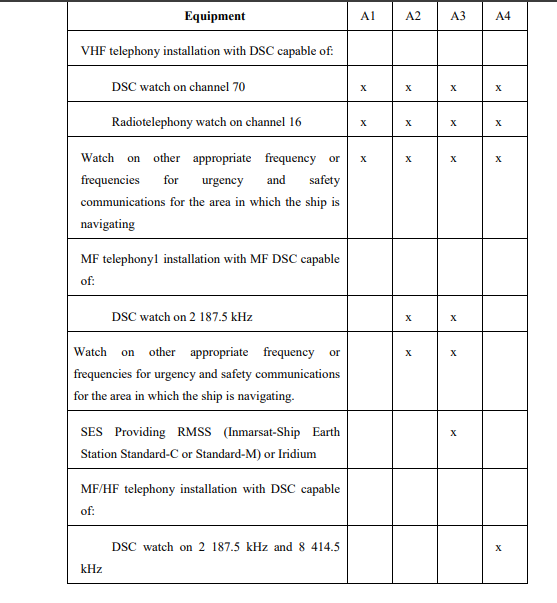
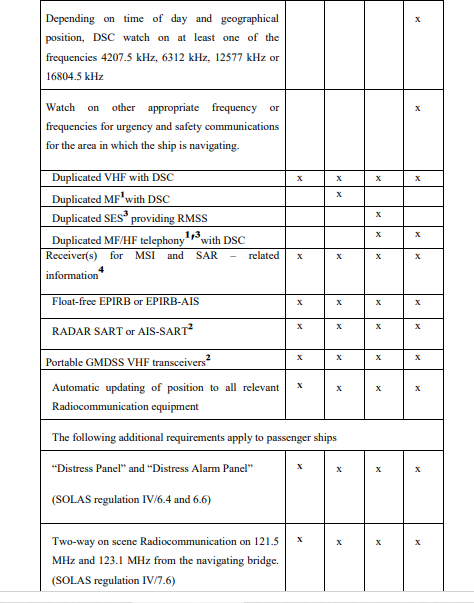
Footnote:
1. In place of MF radio installation, MF/HF radio installation is accepted. A single
MF/HF radio installation maybe accepted both as primary MF radio installation and
a duplicated MF/HF radio installation.
2. Number of portable radiocommunication equipment is to be carried in accordance
with Gross Tonnage of the ship.
3. For Sea Area A3, a ship may choose duplication either with complete MF/HF
installation or with RMSS-SES with coverage equal to or broader than the primary
RMSS for providing the required redundancy.
4. This may be either a combined SES and EGC receiver or separate pieces of
equipment.
3SCHEDULE- XV
(See rule 28)
Carriage requirement for vessels operating in Indian Coast within twenty nautical miles
from the nearest land;
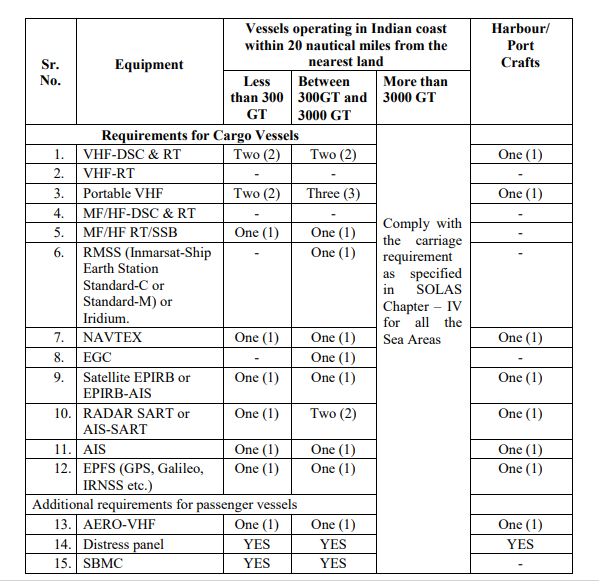
SCHEDULE – XVI
(See rule 29)
Radio Service Station:
Procedure/guidelines for approval and renewal of Radio Service Stations for ―Testing, servicing
& survey of EPIRB or EPIRB-AIS, RADAR SART or AIS-SART, AIS & other GMDSS
radiocommunication equipment‖.
(A).- The step-by-step procedure for the approval and/or renewal of a service station for the
Testing, servicing & survey of EPIRB or EPIRB-AIS, RADAR SART or AIS-SART, AIS &
other GMDSS radiocommunication equipment is outlined below.
Step-1:
Application process:
An application must be submitted to the competent authority detailing the current status of the
proposed service station, along with valid supporting documents. The minimum required
documents are as follows:
(a) Copy of the land/premises/building ownership deed or rental/lease agreement for the
service station.
(b) Experimental license issued by the Ministry of Communications.
(c) Dealer Possession Licence issued by the Ministry of Communications.
(d) Valid ISO certificate with a scope relevant to the services offered.
(e) Authorization certificates from at least two Original Equipment Manufacturers (OEMs)
for the service station.
(f) Duly filled checklists signed by the top management of the company, along with
supporting documents.
(g) Documents supporting the qualifications, experience, OEM authorizations, and training
of service engineers, as specified in Section (B).
(h) A self-declaration from the company confirming readiness for inspection by the
competent authority.
i) Proof of payment of the applicable processing fee made in favour of Directorate General
of Shipping via Bharatkosh. The transaction receipt must be submitted along with the
application.
Step-2: Upon scrutiny of the application and confirmation of the service station’s readiness,
the competent authority will instruct the jurisdictional MMD to carry out the inspection. The
applicable inspection fee shall be paid separately in favour of the Principal Officer or
Surveyor-in-Charge. The inspection must be completed within a maximum period of thirty
days.
Step-3: Upon completion of the inspection and receipt of a recommendation from the
Principal Officer of the jurisdictional Mercantile Marine Department (MMD), the Nautical
Advisor shall review, process, and issue the Certificate of Approval (CoA) for the service
station within fifteen working days.
(B) Eligibility and procedure for approval of service engineers for the initial approval (or)
addition and deletion of service engineers for the approved service station:
The service engineer shall have the basic qualification, experience, OEM authorization and
training as stipulated below towards approval.
(1) Basic qualification: The Service engineer shall be in possession of;
(a) a degree or diploma engineering in the discipline of electronics and
telecommunications, or electrical engineering.
(b) Indian GMDSS general operators certificate.
(2) Experience: The service engineer shall have at least one year experience in the maritime
field dealing with radiocommunication equipment.
(3) Authorization from OEM: The service engineer shall have authorization from at least two
OEMs for carrying out servicing and testing.
(4) Training: The service engineer shall have been trained by;
(a) the OEM, or
(b) the OEM trained service engineers which are accepted by the manufacturers.
(5) The aforementioned procedures shall also apply to any subsequent addition or removal of
service engineers from the CoA list.
(6) A processing fee shall be charged on a per-case basis for any alteration or change in the
CoA, including the addition or removal of service engineers from the CoA list.
(7) Verification & evaluation of performance by jurisdictional MMD:
Verification and evaluation of service engineers shall be conducted by the MMD surveyor
during the inspection of the service station. All service engineers must be physically
present at the time of inspection. Only those engineers who meet the qualification criteria
outlined in paragraphs 1 to 4 will have their names included in the Certificate of Approval
(CoA).
(8) A service engineer shall be permitted to perform servicing only on behalf of the service
station where he or she is employed full-time. Upon termination of employment, the
service engineer’s name shall be removed from the Certificate of Approval (CoA) issued
by competent authority.
(9) A service engineer shall be permitted to perform surveys on board ships only if he/she
meets the qualification criteria specified in paragraphs (1) to (4) and names are enlisted in
CoA.
SCHEDULE- XVII
[See rule 30(a)]
GMDSS PLAN:
Specified drawings (plans of the radio installation) shall be prepared well before the
work on a new building or reconstruction of ships or offshore units is started. For radio
installations, the following drawings shall be prepared:
1. Antenna drawing: – Antenna drawings shall show all antennas seen from fore or aft position,
the port or starboard position and aerial view. The antenna and radio arrangement drawings shall
at least be of size 1:50. This applies to the following antennas:
(a) all transmitting antennas including location of antenna tuner;
(b) all receiving antennas including electronic position fixing system (EPFS) antennas;
(c) radar antennas;
(d) AIS antennas;
(e) satellite communication antennas; and
(f) the location of float-free EPIRB or EPIRB-AISs.
2. Wheel-house arrangement plan: – This plan shall provide the location of the following
equipment
(a) controllers for transmitting distress alert;
(b) VHF radio installations, including any control units;
(c) MF or MF/HF radio installations, including any control units, printers, etc.;
(d) satellite communication equipment, including terminals, printers, etc.;
(e) receivers for keeping watch on VHF channels 16, 70, MF 2 187.5 kHz, and HF distress
channels in 4, 6, 8, 12 and 16 MHz bands;
(f) receivers for MSI and SAR related information services recognized by IMO;
(g) RADAR SARTs, AIS-SARTs and EPIRB or EPIRB-AISs along with IMO symbols (if
located on the navigation bridge);
(h) portable two-way VHF radiotelephone apparatus and their chargers along with IMO
symbols;
(i) emergency light powered from a reserve source of energy to illuminate the mandatory
radiocommunication equipment;
(j) battery charger (for the reserve source of energy);
(k) fuse or circuit breaker box.
(l) position of distress (alert and alarm) panel.
3. Wiring (Interconnection) diagram: – These drawings shall show the following connections:
–
(a) antenna connections.
(b) connections to telephone exchange (PABX), fax machine, etc.
(c) connections to the ship’s mains, emergency source of energy, the reserve source of
energy (batteries), and switching systems for all radiocommunication and radio
navigation equipment.
(d) radiocommunication equipment (including emergency light) being connected to each
power unit or source.
(e) AIS and its pilot plug.
(f) fuses or circuit breakers for all radiocommunication equipment.
(g) uninterruptable power supply (UPS) with all connections, circuit breakers and fuses, if
installed as power for mandatory radiocommunication equipment (block diagram
showing how the UPS operates, showing the circuit breakers, fuses and switch-over
connections to alternative power supplies, by-pass switches, etc.)
(h) any connections (interface connections) between EPFS and GMDSS
radiocommunication equipment.
(i) battery chargers for the reserve source of energy.
(j) connection of distress (alert and alarm) panel.
(k) connections to gyro (if applicable).
(l) type of cables used in the installation; and
(m) connections to VDR (if applicable).
4. List of all the radiocommunication equipment operating with reserve power source.
5. Reserve source battery capacity calculation plan as specified in Annexure-I.
SCHEDULE-XVIII
[See rule 30(b)]
Cabling and wiring:
(a) The cabling and wiring in the radio installation shall be designed so as to prevent
electrical interference to radio and navigational equipment.
(b) Cables shall have the correct dimension to prevent voltage reduction to
radiocommunication equipment when full load. The voltage reduction in copper
conductors is calculated as follows:
Voltage drop = 0.035 x length (m) x total load (A) divided by the cross section in squared
mm.
(c) In order to reduce interference, it is essential to have good separation between signal
cables and those cables carrying higher voltages.
(d) All cabling and wiring shall be of a type approved and suitable for use on board ships.
SCHEDULE-XIX
[See rule 30(c)]
1. EMC (Electro-Magnetic Compatibility), earthing and screening:
(a) All reasonable and practical steps shall be taken to ensure EMC between the equipment
concerned and other radiocommunication and navigational equipment carried on board.
In order to avoid interference, following shall be ensured: –
(b) Radio installations shall not cause harmful interference to other electronic, electrical or
navigational systems on board ships. However, other systems shall also not cause
harmful interference to the radio installation.
(c) In order to avoid electromagnetic noise interference, it is essential that manufacturers’
guidelines relating to EMC, screening and earthing are correctly followed.
2. Interference from LED lighting and other unintentional emitters: –
(a) In order to avoid unintentional electromagnetic interference, periodic EMC inspections
shall be carried out, especially after the installation of LED-equipped lighting or any
electrical system installed in proximity to antennas that are susceptible to such
interference.
(b) Appropriate checks shall be conducted to ensure that no harmful electromagnetic
interference (EMI) is experienced by any radiocommunication or navigation system. In
the event EMI is detected, remedial measures shall be taken, which may include the
removal of the identified source of interference, suppression of the interference at its
origin, or relocation of the affected antenna to a location where no harmful interference is
present. Such checks shall be carried out prior to the initial acceptance or flag-in of the
vessel and after any electrical or system modifications that may impact electromagnetic
conditions on board.
3. Screening and earthing of cables and equipment
In order to avoid interference, the following guidelines shall apply with regards to
screening of cables:
(a) Coaxial down leads shall be used for all receiving antennas and the coax screen shall be
connected to ground on at least one end.
(b) All cables within a distance of two meters from a transmitting antenna shall be screened
and the screen shall be properly earthed in a metal tube or duct.
(c) Earthing of radiocommunication equipment shall be carried out in accordance with
appropriate guidelines for earthing in maritime installations required in international
standards. Great care shall be taken in order to fulfil the following rules: –
Each unit of radiocommunication equipment shall have a separate earth connection.
(d) MF/HF antenna tuners shall be earthed with either a copper bar or copper band.
(e) The earthing bar or strap shall be as short as possible, shall not be more than one meter in
length, and shall be at least 60 mm in width.
(f) For earthing straps up to 5 meters in length, the width shall be at least hundred mm (may
be relevant on-board vessels made of wood or synthetic materials).
(g) It shall be noted that a long earthing strap or bar will act as an antenna and radiate
energy.
(h) Copper bars and straps shall be brazed to the steel bulkhead in order to eliminate
corrosion and vibration and make a good earth connection.
(i) Great care shall be taken when earthing radiocommunication equipment on ships with
aluminum superstructures in order to avoid galvanic corrosion. An approved and
acceptable method of earthing shall be used on such ships.
SCHEDULE-XX
[See rule 31]
Fees
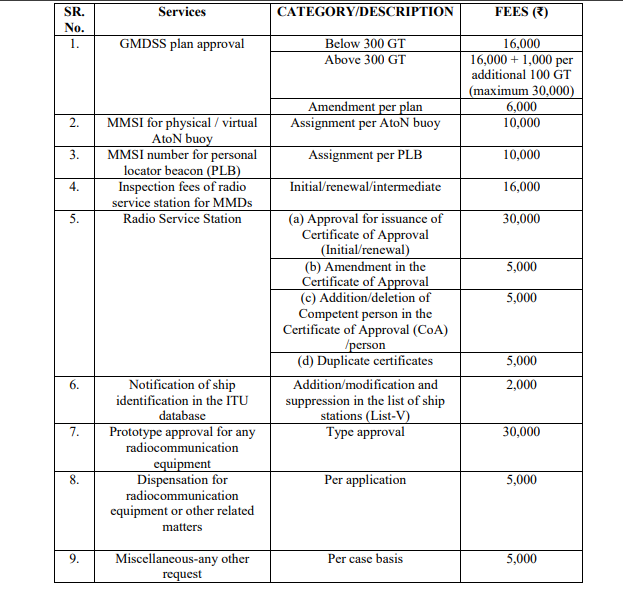
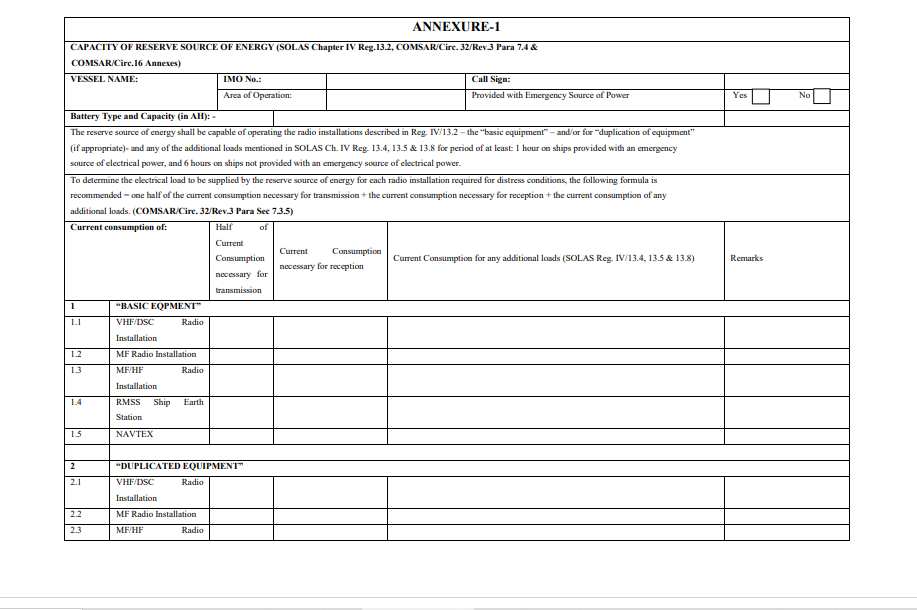
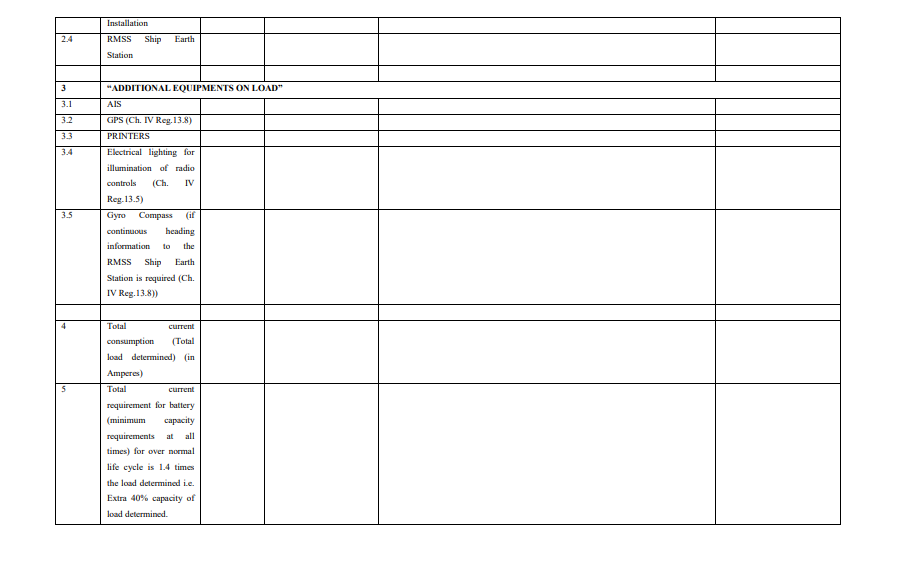
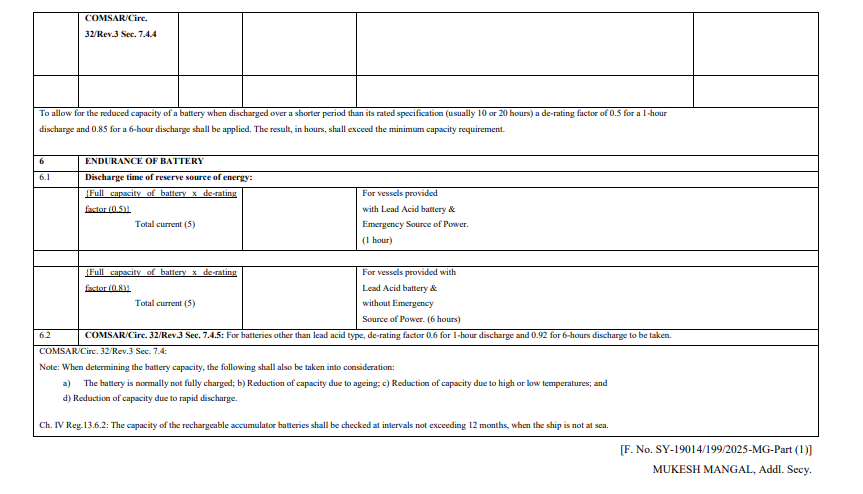
Download PDF click here
Read more
for more refer Gazette website click here
for more refer YouTube Subscribe website click here