


Designing emoji for the way we communicate today
Designing emoji for the way we communicate today
On World Emoji Day — a celebration of a language we all share — go behind the scenes of Noto 3D to learn how we reimagined almost 4,000 emoji with richer expressions, improved accessibility and a new 3D design built for modern communication.
The way we use emoji has changed. In the early days, we were literal: You sent a nail polish emoji (💅) because you were, in fact, getting your nails polished.
Today we lean on emoji to break down the barrier of our screens and inject a shrug, a wink or that highly specific “it’s fine but it’s actually not fine” subtext. They’re the language within the language that keeps a blunt message from accidentally killing the vibe.
On World Emoji Day, here’s a closer look at the evolution of our emoji (all 3,977 characters) and how they can add physical and emotional depth to how we communicate in the modern era.
Expression keeps evolving
We don’t just “laugh” anymore. We collapse, or internally scream. Modern internet culture has steadily moved from mild expressions to drama, hyperbole and overwhelm.
For years, “face with tears of joy” (😂) was the undisputed emoji king, according to Gboard Federated Analytics. But following a multi-year decline, it slipped down the charts by 2025.
Why? Because 😭 is a masterclass in modern vocabulary: It’s hilarious, it’s devastating and it captures absolute overwhelm. When we do laugh, our inclination for hyperbole demands it be unhinged, pushing “rolling on the floor laughing” (🤣) to the top of the chart. Even our expressions for heartbreak are shifting; data show a poetic migration in popularity from the broken heart (💔) toward the wilted flower (🥀).
Art informs innovation
This update brings our favorite emoji into a 3D future rather than leaving them behind. The brain processes emoji faster than text, so you can’t just slap on a design and call it a day. Touching something that billions of people use trillions of times a day requires more nuance.
Our emoji have always favored expression over hyper-realism and in this new 3D world it means our designs can have dimension without being photorealistic. They need a pulse and a soul — not the cold precision of industrial CAD models. Have you looked closely at a real kangaroo? They’re terrifying 🙀. We don’t need anatomical perfection. With the power of illustration, we can capture the true, playful vibe of a kangaroo.
We also ran large-scale user studies to evaluate how changing emoji could potentially mess with human connection. The research unmasked universal truths: Users overwhelmingly prefer full-body animals over floating heads; adding props hurts comprehension; and tiny tweaks (like swapping the direction of a wink) can turn mild confusion into accidental outrage.
While our design process still begins with 2D drawings, it no longer ends there. In an industry first, Noto Emoji 3D is entirely available as true 3D models.
Moving from flat pixels to a three-dimensional world forced us to resolve architectural questions we’d never considered. What does the back of a smiley face look like? Is it a concave mask, a solid bouncy ball or a flat piece of paper?
Because language is meant to be shared, our entire Noto portfolio is completely open source. We’re handing over raw .OBJ files to the community so they can use them to build immersive VR worlds, indie apps or weird memes.
Color meets contrast
Emoji with the darkest skin tones can be difficult to see in dark mode — a problem for anyone who sends or receives them. That’s why we built an AI-powered contrast tool that analyzes each emoji at the pixel level, flags when the contrast ratio is too low and suggests high-contrast solutions that are implemented by designers 💪💪🏻💪🏼💪🏽💪🏾💪🏿.
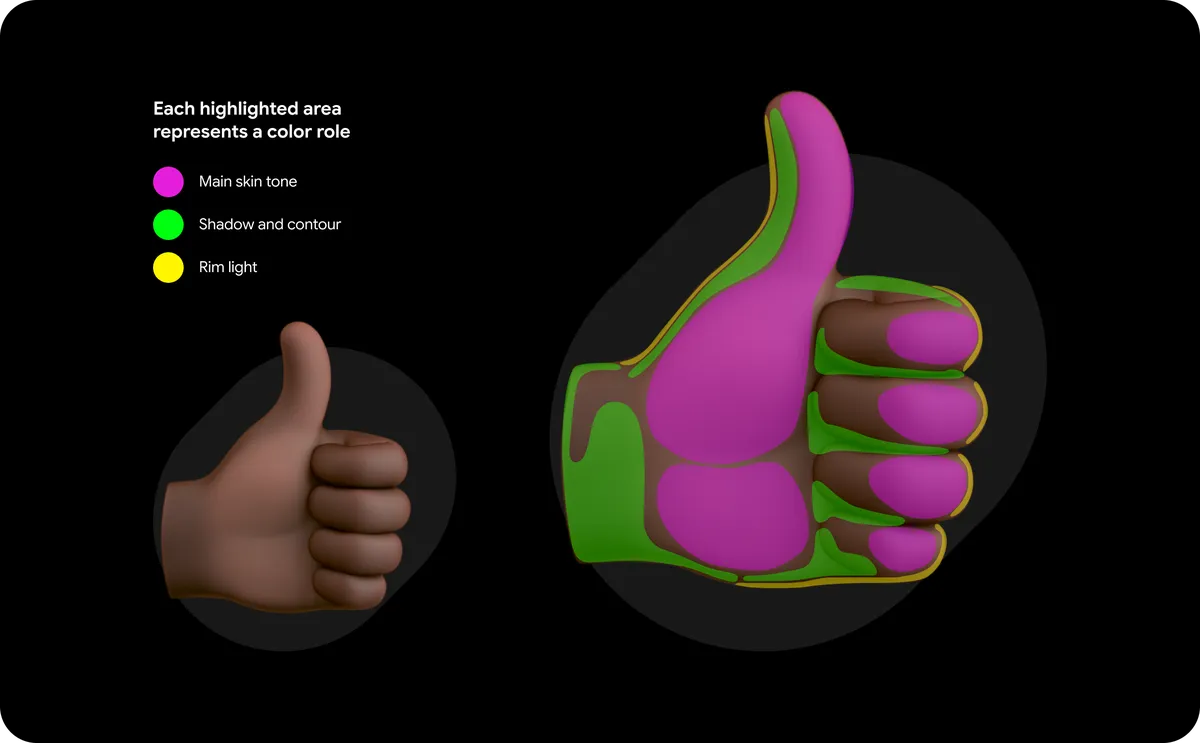
Language is for the people from Designing emoji
Now, Noto 3D emoji are yours. Remix them, break them and stretch them into shapes we never could have anticipated. Language only truly lives when we find new ways to use it. ⛲
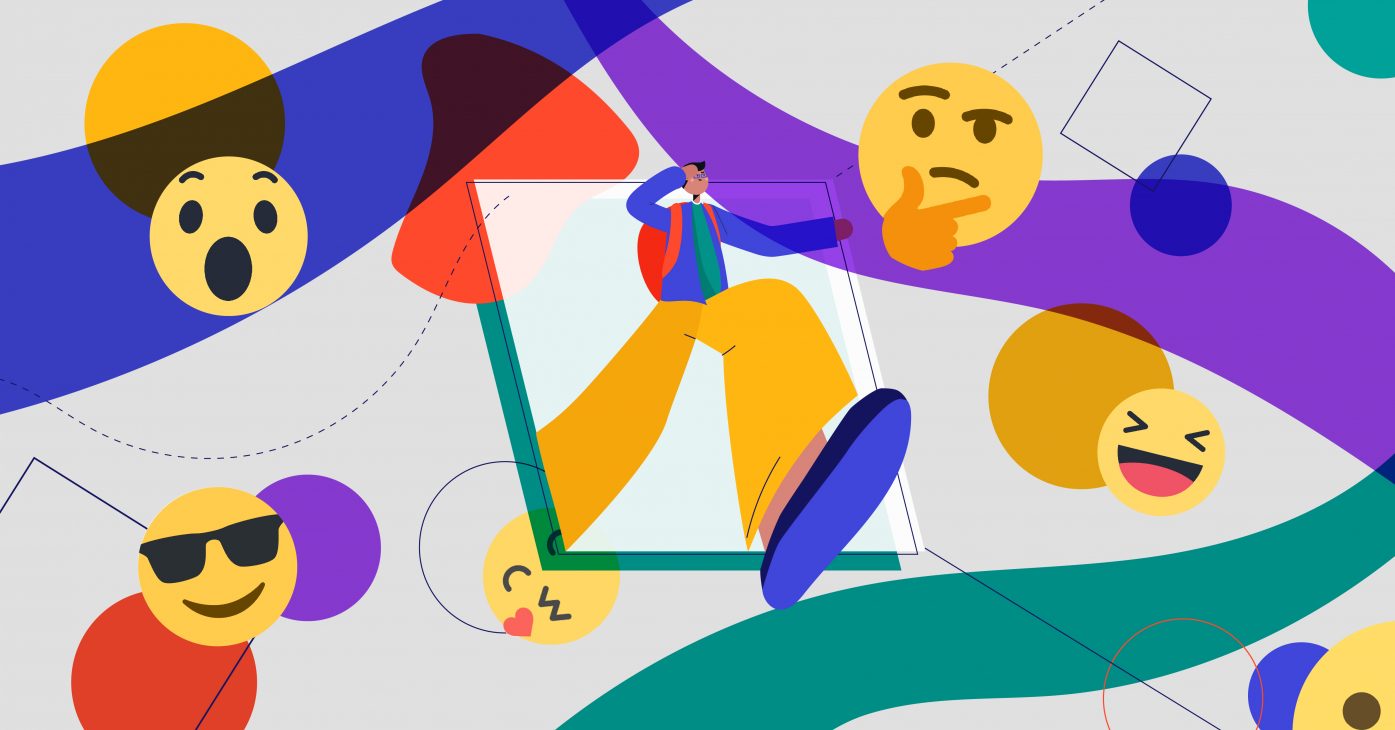
Designing emoji for modern communication is no longer just about making cute graphics; it’s about solving a linguistic and psychological challenge. Digital text lacks vocal tone, body language, and facial expressions. As text messages have grown shorter and sharper, emoji have evolved from literal representations to emotional context systems.
Modern design teams—such as Google’s Noto Emoji team, Apple, and Microsoft—have shifted their core design philosophies to match how people actually talk online today.
1. The Shift from Literal to Subtextual
In the early days of emoji, usage was literal: sending 💅 meant you were getting your nails done. Today, emoji serve as a “language within the language” that prevents blunt text from sounding overly harsh or killing the vibe.
-
Sarcasm and Subtext: A simple “Okay” can feel passive-aggressive. Adding 🙃 (upside-down face), 🫠 (melting face), or 💅 (nonchalance/smugness) injects tone that text alone cannot convey.
-
Hyperbole and Drama: Digital culture has steadily moved away from polite reactions toward dramatic expressions.
-
The traditional “Tears of Joy” (😂) has been eclipsed by “Loudly Crying Face” (😭) and “Rolling on the Floor Laughing” (🤣), which capture overwhelming feelings rather than just mild amusement.
-
Broken heart (💔) usage has shifted toward the wilted flower (🥀) for a more poetic expression of disappointment.
-
2. Dimensionality: The Move to 3D & Micro-Animations
While flat vector designs dominated the 2010s due to low screen resolutions and performance constraints, modern platforms are transitioning back to 3D and subtle motion.
+-----------------------------------------------------------------+
|                        EMOJI EVOLUTION                          |
|                                                                 |
|   1999–2000s          2010s                  2020s+             |
|  [Pixel/Grid]  --->  [Flat Vector]  --->  [3D Depth & Motion]   |
|   16x16 Grid          Flat Colors          Lighting & Tactile   |
+-----------------------------------------------------------------+
Designing emoji
-
Tactile Realism over Photorealism: Modern 3D redesigns focus on making characters feel physical and “alive” without making them look like cold industrial CAD models.
-
3D Architecture: Designing emoji as true 3D assets required teams (like Google’s open-source Noto 3D project) to answer spatial questions that never existed in 2D: What does the back of a smiley face look like? Is it a solid sphere, a concave mask, or a flat plane?
-
Micro-Animations: Variable fonts and vector animation engines allow emoji to react dynamically when sent—winking, shivering, or melting in real time.
3. Playful Character over Anatomical Perfection
A major discovery in modern emoji user research is that literal accuracy often harms communication.
-
Personality First: Real-world subjects (like a real-world kangaroo or spider) can look intense or even frightening. Designers lean on illustrative tropes so the emoji communicates the playful concept rather than anatomical reality.
-
Full-Body vs. Floating Heads: User studies show that people overwhelmingly prefer full-body animal depictions over floating heads, which can feel detached or ambiguous.
-
Prop Restraint: Adding props to glyphs (e.g., adding a raincoat or umbrella to a person) often reduces legibility at small sizes and hurts instant comprehension.
4. Dark Mode & Accessibility
With over 80% of mobile users utilizing Dark Mode at least part of the day, emoji faces and icons can easily lose contrast against dark gray or black backgrounds.
-
Contrast Outlines: Designers use dynamic outer strokes, adjusted lighting, and translucency layers so that dark-colored emoji (like 🖤 or 🐜) don’t disappear into dark interfaces.
-
Skin Tone Contrast in AI & Dark Mode: Systems use specialized color palettes to ensure all skin tone modifiers maintain clear separation and legibility regardless of system theme.
The Core Design Takeaway
Emoji aren’t illustrations—they are a visual font.
Because the brain processes visual symbols significantly faster than written text, even a tiny shift in Designing emoji design—like changing the angle of an eyebrow or the curvature of a smirk—can accidentally shift a message from friendly to sarcastic. today requires balancing artistic expression with strict psychological precision to ensure that what you meant to say is what the receiver feels.
Read more
. Google Meet now organizes your meeting notes, transcripts, and recordings in your Google Drive
. Create the perfect icebreaker on Google
. AI2027: Is this how AI might destroy humanity? – BBC World Service
. Reimagining higher education with the Waterloo Futures Lab
. NotebookLM is now Gemini Notebook-2
. How to create Slide presentations with Gemini
. Extending agentic Microsoft Dynamics 365 Sales with MCP
. View supporting calendar delegates in meeting guest list
. Official Highlights | Galaxy Unpacked July 2026 | Samsung
. 6 back-to-school shopping tricks every student should know
. Beach vibes and temporary wallpaper are trending for back-to-school season.
. How to create screen recordings with Google Vids at no cost
. Cases of Galaxy Z Fold 8 | Samsung
. Experience the legacy of Estadio Azteca on Google Earth.
. Google Workspace Weekly Recap – July 24, 2026
. Telepathic Wheelchair Control | Neuralink
for more refer Gemini website click here
for more refer Artificial Intelligence website click here