ORDER
Girish Agrawal, Accountant Member.- These two appeals are filed by both, the assessee and the revenue and the cross objection by the assessee, against the common order of ld. Commissioner of Income Tax, Appeal vide DIN: ITBA/APL/S/250/2024-25/1074469458(1) dated 13.03.2025,passed against the assessment order by the Assessment Unit of the Income-tax Department, Delhi u/s 143(3) r.w.s. 144B of the Income-tax Act (hereinafter referred to as the “Act”), dated 20.04.2021for the Assessment Year 2018-19.
2. Assessee has raised the following grounds of appeal:
Ground No 1: Disallowance of expenses incurred on completed projects to the extent of Rs. 1,08,77,906
On the facts and in the circumstances of the case and in law, the learned Commissioner of Income Tax (Appeals) 49 [‘ld. CIT(A)’] erred in confirming disallowance of expenditure of Rs. 1,08,77,906 incurred during the defect liability period in respect of completed projects, without granting adequate opportunity to the Appellant to furnish supporting details and documentation.
The Appellant, therefore, prays that the order of the Id. CIT(A) be set aside and the matter be restored to the file of the Id. CIT(A) for fresh adjudication after granting the Appellant an adequate opportunity of being heard.
The Appellant craves leave to add to, alter or amend, modify or delete, the aforesaid ground of appeal, if and when necessary.
2.1. Revenue has raised the following grounds of appeal:
| 1. |
|
On facts and circumstances of the case and in law, the CIT(A) has erred in deleting the addition of Rs. 2,19,99,037/- made by the Assessing Officer. |
| 2. |
|
On facts and circumstances of the case and in law, the CIT(A) has failed to appreciate that the claim of bad debts amounting to Rs. 2,19,99,037/- was neither made during the original assessment proceedings nor was any supporting documentary evidence furnished at that stage, and the same has been introduced for the first time at the appellate stage, thereby rendering the claim an afterthought. |
| 3. |
|
On facts and circumstances of the case and in law, the CIT(A) has erred in ignoring the principle of matching income with corresponding expenditure, and thereby allowed the deduction of prior period expenses in the current assessment year, resulting in the suppression of current year’s taxable income. |
| 4. |
|
On the facts and in the circumstances of the case, and in law, the Ld. CIT(A) erred in deleting the addition of Rs. 8,40,782/- made by the Assessing Officer under Section 36(1)(va) of the Income Tax Act, 1961, being the employees’ contribution to the Employees’ State Insurance (ESI) fund, which was not deposited by the assessee within the due date prescribed under the relevant statute. |
| 5. |
|
On the facts and in the circumstances of the case, and in law, the Ld. CIT(A) erred in deleting the addition of Rs. 8,40,782/-without considering the decision of Hon’ble Supreme Court in the landmark judgment of Checkmate Services Private Limited v. CIT [2022] 448 ITR 518 (SC), wherein it was unequivocally held that any delay in the deposit of employees’ contribution seven if subsequently paid-renders the amount ineligible for deduction under Section 36(1)(va). |
| 6. |
|
The appellant craves leave to add to alter, amend, modify and/or delete any or all of the above said grounds of appeal. The appellant reserves its right to file further submission in the appeal. |
2.2. Assessee has raised the following grounds in its Cross Objection:
Ground no. 1: Order of the Ld. CIT(A) allowing claim of Bad Debt written off totaling to Rs. 2,19,99,037
On the facts and in law, the Ld. CIT(A) was justified in allowing the assessee’s claim of bad debts written off totaling to Rs. 2,19,99,037
The Ld. CIT(A) being vested with plenary appellate powers, has rightly adjudicated the claim on the basis of material available on record; accordingly, the Ld. AO’s contention that the claim was an ‘afterthought’ is factually and legally untenable.
In view of the above, it is respectfully prayed that this Hon’ble Tribunal may dismiss the Ld. AO’s ground and uphold the order of the Ld. CIT(A) to this extent.
Ground no. 2 Order of the Ld. CIT(A) allowing the claim Bad Debt written off does not amount to allowing prior period expenses
On the facts and in the circumstances of the case, the allegation that the allowance of bad debts written off allowing as ‘prior period expenses’ being expenses incurred on completed projects in bad in law; insofar as the business of the assessee continues and only the particular project was completed, the conditions of section 36(1)(vii) read with section 36(2) are satisfied, and the deduction has rightly been allowed.
In view of the above, it is respectfully prayed that this Hon’ble Tribunal may dismiss the Ld. AO’s ground and uphold the order of the Ld. CIT(A) to this extent.
Ground no. 3: the Ld. CIT(A)’s order correctly upheld deletion of addition for employee contributions of Rs. 8,40,782
The Ld. CIT(A), after careful verification of records, rightly held that the employees’ contribution amounting to Rs.8,40,782 was duly paid within the prescribed due dates as mandated by law.
The contention that the Ld. CIT(A) erred in deleting the addition by ignoring the prescribed due date and the Hon’ble Supreme Court’s judgment in case of the Checkmate Services Pvt. Ltd. v. CIT is without factual and legal basis insofar as the ration of the Hon’ble Supreme Court is not applicable to the facts of the case.
In view of the above, the CIT(A) correctly applied the law to the facts and records before him, and hence the Ld. AO’s ground is devoid of merit and deserves to be dismissed.
The Appellant craves leave to add to alter or amend, modify or delete the aforesaid ground of appeal, if and when necessary.
2.3. Appeals by both, the revenue and the assessee are cross appeals and the cross objection filed by the assessee is in support of the relief granted by the ld. CIT(A). All these arise out of the common order of the ld. AO as well as of the ld. CIT(A) and therefore, are taken up together for adjudication by passing this consolidated order.
3. Brief facts of the case are that assessee is engaged in executing projects both in India and abroad and turnkey contracts including undertaking design, supply of material and providing technical services, mainly in the business of power generation, transmission, and distribution, water and wastewater, oil, gas and hydro carbon, railways, metals and minerals and quality services. Return of income was filed on 20.04.2021, reporting total income at Rs.123,62,85,510/-. While completing the impugned assessment under section 143(3) read with section 144B, ld. AO made the following disallowances:
| i. |
|
Disallowance on account of contractual provision – Rs. 3,16,35,781/- |
| ii. |
|
Disallowance under section 36(1)(va) read with section 2(24)(x) – Rs. 8,40,782/- |
3.1. Against the said disallowances, assessee went in appeal before the ld. CIT(A) who gave partial relief and thus, both revenue and assessee are in appeal before the Tribunal.
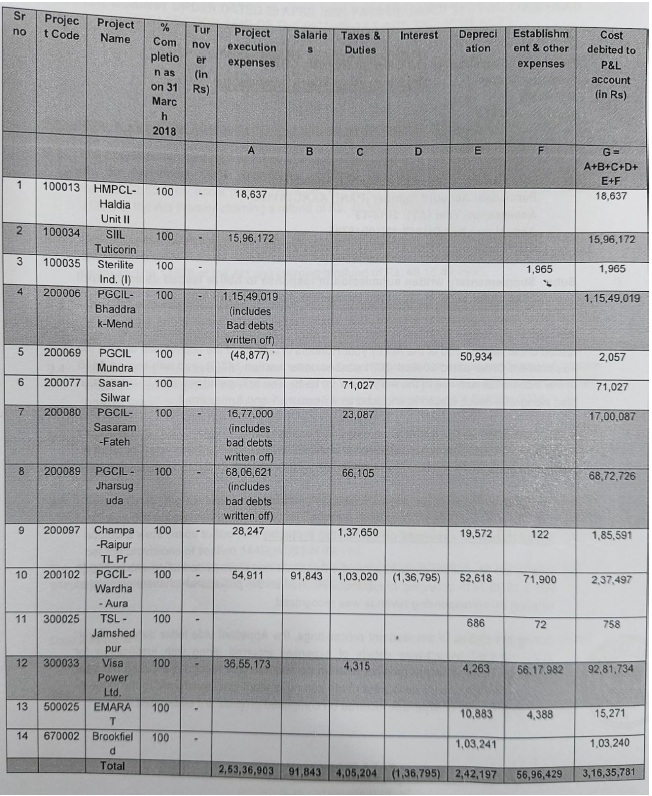
3.2. The disallowance made by ld. AO of Rs. 3,16,35,781/- comprises of two components i.e. Rs. 2,19,99,037/- which pertains to bad debts written off during the year and of Rs. 1,08,77,906/- which pertains to expenditure incurred during Defect Liability Period (DLP). Ld. CIT(A) gave relief for the claim of bad debts written off during the year against which revenue is in appeal before the Tribunal; whereas the disallowance of expenditure incurred towards DLP has been sustained against which assessee is in appeal before the Tribunal.
4. Details of entire expenditure of Rs. 3,16,35,781/- is extracted below in a tabulated form:
4.1. On the above, ld. AO held that assessee has claimed these expenses which relates to revenue stream of previous year since the projects in this regard had already been completed and relevant revenue was booked in the earlier years. According to him, allowing these expenses in the year under consideration violates the basic principle of accounting that is the „matching principle’ as there is no income offered on these projects in the year under consideration. He thus, treated the said claim of expenses as prior period expenses in absence of matching revenue and made the disallowance.
4.2. Contrary to this, contention of the assessee before the authorities below is that it had provided project-wise details of expenses incurred along with justification for the expenses so incurred, revenue of which was recognized over the duration of the projects in the preceding years. Assessee explained that in the line of business in which it is engaged, servicing of DLP forms integral part of construction contracts. Depending upon the nature of the project undertaken by it, any imperfections, defects, poor workmanship, etc. falling within the scope of work of the assessee is required to be rectified by it at its own cost. Such occasion arises upon completion of the projects for which revenue had already been booked in the earlier years. These expenses are claimed as legitimate business expenses as and when they are crystallized and in no way can be considered as prior period expenses. Assessee claims these expenses only when the liability crystallizes and payments are made to rectify the imperfection or defects as and when they arise within the contracted time period. According to the assessee, its business operation constitutes a continuous and ongoing activity. In the large turnkey projects of Engineering Procurement and Construction (EPC), execution is carried out simultaneously across multiple project sites involving several stages. Thus, its business is not compartmentalized into airtight blocks, capable of being closed. Year on year basis, certain projects get completed, however, overall business of the assessee continues. Assessee claimed deduction towards expenses incurred for DLP which are allowable under section 37(1). These are not contingent liabilities or mere provisions. For these expenses incurred in the year under consideration, no liability had arisen at the time of completion of the relevant project in the preceding years. Also, no amount could have been claimed in the preceding years which is alleged to be claimed now treating as prior period expenses. The liability to incur such expenditure accrues only when the defects are actually identified, falling within the scope of work of the assessee and were eventually rectified during the defined DLP.
4.3. Ld. CIT(A) has sustained the disallowance in this regard on the sole ground that assessee failed to provide relevant documentary evidence to demonstrate accrual of liability to incur such expenses during the DLP pursuant to DLP clause in the relevant contracts.
5. Before us, ld. Counsel for the assessee submitted that a very short notice was provided to the assessee by the ld. CIT(A)for making submissions in this regard and therefore, an effective representation could not be made to justify the claim so made. It was thus, submitted that the matter may be restored back to the file of ld. CIT(A) to consider the claim of the assessee by taking into account documentary evidence placed on record by ascertaining if the liability crystallized during the year orotherwise, so as to allow the claim of the assessee under section 37(1).
5.1. We note that assessee has placed on record relevant documentary evidence before us in the paper book. Assessee has explained its case before us to have a legitimate claim under section 37(1) for the expenses incurred by it during the course of its business to mitigate the defects arisen during the DLP after the completion of the relevant project. Having considered the facts and documentary evidences placed on record, we find it appropriate to accept the submissions of the ld. Counsel for the assessee to remit this issue back to the file of ld. CIT(A) for its meritorious adjudication by taking into account documentary evidence along with explanation given by the assessee so as to consider the same for its allowability under section 37(1). Needless to say, assessee be given reasonable opportunity of being heard and to make any further submission if so, required in this regard. We also direct the assessee to be diligent during the course of hearing fixed by the ld. CIT(A) for its expeditious and meritorious disposal.
5.2. Accordingly, grounds raised by the assessee in its appeal in ITA 3818/MUM/2025 are allowed for statistical purpose.
6. We now take up appeal by the Revenue for the disallowance of the component relating to bad debts written off amounting to Rs. 2,19,99,037/-. It was pointed out by the ld. Counsel that the said claim of deduction is not a new claim made by the assessee at the appeal stage but it was inadvertently grouped under the head Miscellaneous Erection Cost’ in the accounting system of the assessee. Assessee clarified this in the above tabulation to highlight the relevant amount which forms part of the total disallowance of Rs. 3,16,35,781/- made by the ld. AO. Assessee had furnished relevant documentary evidences as additional evidence before the ld. CIT(A) by applying Rule 46A of the Income-tax Rules, 1962 (the Rules) for which ld. CIT(A) called for a remand report from the ld. AO.
6.1. At the first appellate stage assessee had also raised additional ground challenging the validity of the assessment as ld. AO erred in not complying with the requirement of section 144B. Ld. CIT(A) had called for the remand report in this regard also. Ld. AO submitted his remand report dated 28.10.2024 which was only in respect of additional ground raised by the assessee before the ld. CIT(A). In the said report, he did not deal with the additional evidences filed by the assessee to support its claim towards bad debts written off which formed part of the total amount of disallowance made by the Ld. AO. Ld. CIT(A) took note of this lapse on the part of the Ld. AO and proceeded to decide the issue on the strength of his own examination and consideration of material placed on record. Ld. CIT(A) noted that as per section 36(2), deduction for bad debts is allowed only if the amount written off during the year has been offered to tax in the year of write off or any of the preceding years. In this regard, he took note of all the factual submission made by the assessee whereby it was demonstrated that these amounts claimed as bad debts now were offered as receipts in the earlier years. Since these amounts cannot be recovered from the relevant debtors, assessee has written them off as bad debts in the year under consideration. Assessee furnished the documentary evidences in the form of accounting entries passed by it in its books of account which forms part of the paper book placed on record. Relevant details in this regard as reference are extracted below:
Accounting Treatment at the time of recording the revenue
| Particulars |
Debit |
Credit |
| Power Grid Corporation of India Ltd. A/c . Dr |
59,29,386 |
|
| To Revenue from operations |
|
79,05,848 |
| To Revenue from operations |
|
-11,85,877 |
| To Revenue from operationa |
|
-7,90,585 |
Net Revenue recorded amounting to INR 59,29,386, Please refer page no. 733 and 734 of Factual Paperbook.
Accounting Treatment at the of occurrence of bad debts
| Particulars |
Debit |
Credit |
| Bad Debts A/c . Dr |
46,06,601 |
|
| To Power Grid Corporation of India Ltd. A/c. |
|
46,06,601 |
| Particulars |
Debit |
Credit |
| Profit & Loss A/c … Dr |
46,06,601 |
|
| To Bad Debts A/c … |
|
46,06,601 |
Occurrence of actual bad debts of INR 46,06,601 out of total receivable of INR 59,29,386
A bifurcation payment / bad debts vis a vis Revenue:
| Particulars |
Date |
Amount (In INR) |
| Receipt |
30-Apr-13 |
6,99,788 |
| Receipt |
01-Jun-16 |
6,22,996 |
| Credit Memo (Amount not received from Power Grid Corporation of India Ltd.) |
15-Dec-17 |
46,06,601 |
| Total |
|
59,29,386 |
Actual receipt amounting to INR 13,22,784 (INR 6,99,788 plus 6,22,996) and occurrence of bad debts amounting to INR 46,06,601. Please refer page no. 734 of Factual Paperbook
6.2. Reliance was placed on the decision of Hon’ble Supreme Court in the case of T.R.F Limited v. CIT 323 ITR 397 (SC) wherein Hon’ble Court held that under section 36(1)(vii), for the amount of any bad debt or part thereof, is necessary for assessee to establish that in fact, has become irrecoverable; irrecoverability of it in the books of accounts is enough, if the same is written off by the assessee. Reference was also made to the Circular no. 12 of 2016 dated 30.05.2016 by CBDT wherein Revenue had accepted the position settled by the Hon’ble Supreme Court in T.R.F Limited (supra). Ld.
6.3. CIT(A) after taking into account the factual position, documentary evidences and judicial precedents, factually concluded that these amounts were offered as receipts in the earlier years and had been written off as bad debts in the year under consideration. According to him, since the conditions laid down under section 36(1)(vii) and 36(2) are satisfied, claim of the assessee was allowed. Ld. CIT(A) has exercised his plenary appellate powers which are coterminus with those of the Assessing Officer while considering the additional evidences filed by the assessee for which remand report was called from the ld. AO who chose not to make any observation or comment in this regard in his remand report except for dealing with the additional ground raised at the first appellate stage.
7. Contention of the Revenue that it is a new claim made by the assessee at the appellate stage is also unfounded on the factual matrix, details of which are already tabulated above. This claim towards bad debt written off is embedded in the total disallowance made by the ld. AO, which assessee had inadvertently included in the cost incurred for completed project. Having considered the above detailed narration, we do not find any reasons to interfere with the finding arrived at by the ld. CIT(A).Grounds raised by the Revenue in this regard are dismissed.
8. Revenue has contested on another issue relating to claim of deduction made under section 36(1)(va) of Rs. 8,40,482/- towards employees’ contribution to PF/ESIC fund which according to the Id. AO was not deposited by the assessee within the due date prescribed under the relevant statute. Revenue has relied upon the decision of Hon’ble Supreme Court in the case of Checkmate Services Private Limited (supra).
8.1. In this regard, assessee had reported in its tax audit report, in clause 20(b) all the details relating to deposit of employees’ contribution to PF/ESIC which according to it, is within the due date prescribed under the relevant Act. Details in this regard is extracted below for ready reference:
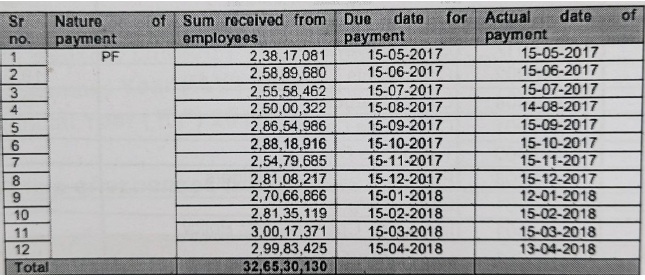
8.2. Assessee evidently demonstrated before the ld. CIT(A) that employees’ contribution to PF/ESIC were made on or before the due date prescribed under the relevant Act and therefore, there is no question of disallowing the same under section 36(1)(va) read with section 2(24)(x).In this regard, assessee furnished copies of bank statement highlighting the relevant payment made by it. Ld. CIT(A) after detailed verifications on the evidences on record, deleted the disallowance made by the ld. AO. Reliance placed by the Revenue on the decision of Checkmate Service limited (supra), it is not applicable in the present set of facts, since assessee deposited the employees’ contribution within the duedates prescribed under the respective Labour Laws which the ld. CIT(A) has duly verified and allowed the claim of the assessee on its merit.
8.3. Taking into consideration the factual matrix, details along with evidences on record and nothing contrary brought on record, we do not find any reason to interfere on the findings arrived at by the ld. CIT(A). In this regard, grounds raised by the Revenue are dismissed.
9. In the cross objection filed by the assessee, grounds raised are nothing but in support of the relief granted by the ld. CIT(A) contesting on the disallowance sustained at the first appellate stage. Since all these issues have already been considered and adjudicated upon by us in the appeals of both the revenue and the assessee in terms of above paragraphs, this cross objection does not need a separate adjudication and therefore, dismissed as infructuous.
10. In the result, appeal filed by the assessee is allowed for statistical purposes and appeal filed by the Revenue is dismissed. Cross Objection by the assessee is dismissed as infructuous.