


NOAA and Google Cloud collaborate to advance weather forecasting
NOAA and Google Cloud collaborate to advance weather forecasting.
Accurate weather forecasting saves lives and protects infrastructure, but predicting complex global atmospheric patterns requires immense computing power. NOAA (National Oceanic and Atmospheric Administration) is taking a major leap forward by selecting Google Cloud as the primary provider of high-performance computing (HPC) infrastructure for its Weather and Climate Operational Supercomputing System (WCOSS).
By transitioning to Google Cloud’s H4D virtual machines, NOAA becomes one of the first major global weather centers to move operational numerical weather prediction directly to the public cloud. This migration gives meteorologists and researchers unprecedented scale, speed, and AI capabilities to run massive simulations, refine prediction models, and issue faster, life-saving early warnings.
Read more on the Google Cloud blog.
Brent Mitchell
Vice President, Go-to-Market, Google Public Sector
The National Oceanic and Atmospheric Administration (NOAA) is embarking on a transformative journey to redefine how we understand and predict patterns in the Earth’s atmosphere that affect the weather we face every day. Today, we are proud to announce that Google Cloud was selected as the primary provider of high-performance computing (HPC) infrastructure for the Weather and Climate Operational Supercomputing System (WCOSS).
This program represents a pivotal shift for NOAA as it transitions from a more traditional, on-premises computing agency to cloud-first infrastructure—a major milestone as one of the first operational Numerical Weather Prediction (NWP) centers globally to move to the public cloud. By modernizing WCOSS on Google Cloud, NOAA is positioning the United States to lead global weather modeling through scale, speed, and reliability.
Google Cloud H4D VMs, powered by fifth-generation AMD EPYC™ processors, are serving as the primary computing backbone for NOAA on Google Cloud. Purpose-built for demanding, compute-intensive workloads like numerical weather prediction, H4D VMs provide the compute power and low-latency networking required to execute massive, tightly-coupled simulations.
To put this in perspective, if traditional computers are like a fleet of individual delivery vans navigating city traffic, H4D VMs operate like a synchronized convoy on a dedicated, multi-lane superhighway—sharing information instantly so they can work together as a single, massive engine. For the NOAA workforce, the move to cloud HPC provides a more streamlined, flexible environment, enabling meteorologists and researchers to quickly adapt future modeling innovations.
A foundation built on long-term collaboration
The partnership announced today is more than just a technological upgrade; it is the latest milestone in a long-term collaboration between NOAA and Google Cloud. For years, our teams have worked together to streamline and share petabytes of environmental data, track real-time wildfires, and advance marine conservation efforts. This work was anchored by the agency’s visionary leadership, which also drove a full transition to Google Workspace as its collaboration suite of choice in 2011.
The success of these early efforts paved the way for broader innovation. For example, NOAA Fisheries pioneered the development of a cloud compute accelerator pilot, giving scientists more flexible computing power they need, when they need it. NOAA also used Google DeepMind and Google Research’s WeatherNext model to predict Hurricane Melissa’s Category 5 landfall five days in advance, saving lives with early warnings and evacuations. These early pilot projects laid the groundwork for NOAA Fisheries to explore agentic AI applications powered by Gemini for Government.
As we look ahead, this collaboration is a testament to what is possible when government and industry align on a shared vision. By combining Google Cloud’s HPC capabilities with NOAA’s unparalleled scientific expertise, we can help improve forecast accuracy, positively impact public safety, and ensure that the United States remains at the forefront of global weather modeling for years to come.
Ready to see how cloud technology is transforming the public sector? Join us at the Google Public Sector Summit 2026 to hear more about how agencies like NOAA are advancing their missions.
💻 The Technology Backbone
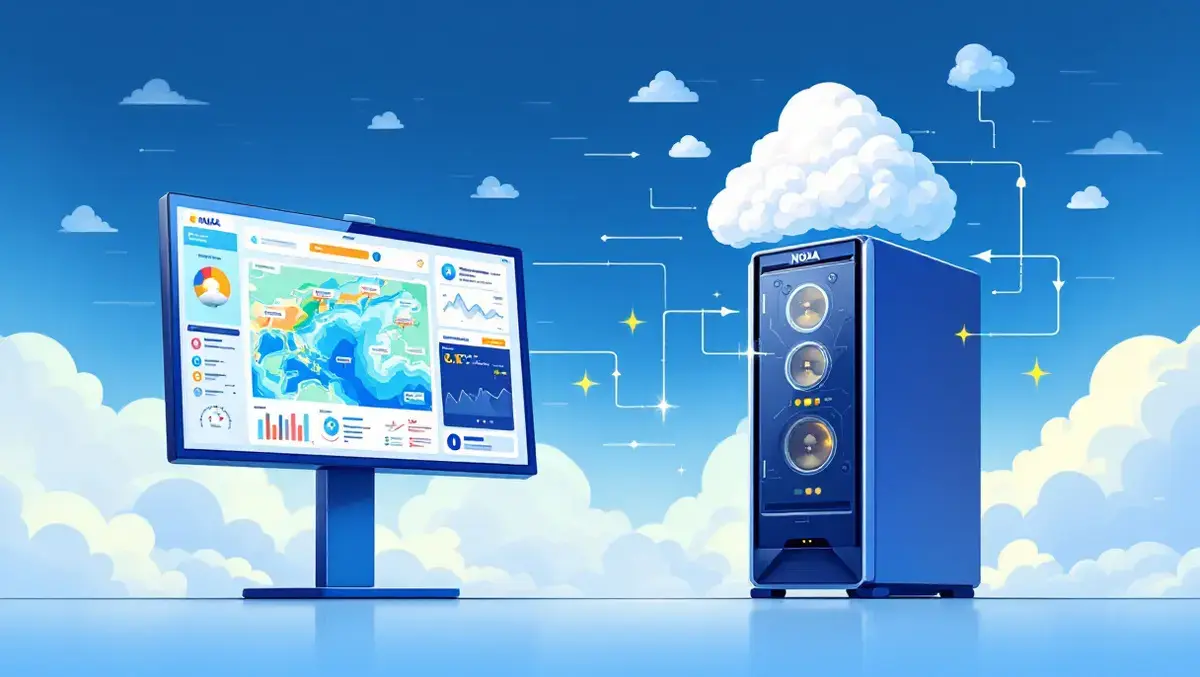
- Virtual Machines: NOAA will use Google Cloud H4D virtual machines. [1]
- Processors: The VMs are powered by fifth-generation AMD EPYC processors. [2]
- Networking: Google’s Cloud RDMA over Titanium network adapters handles tightly-coupled simulations. [3]
- Performance: Independent benchmarks showed cloud HPC generated forecasts in roughly half the time of on-premises runs. [3]
🚀 Key Improvements to Forecasting
- Elastic Scaling: Compute power can instantly ramp up during active tropical storm seasons.
- No Bottlenecks: Eliminates rigid on-premises hardware limitations to accelerate research into active operations.
- System Resilience: Cloud-first infrastructure minimizes downtime and shortens recovery periods.
- AI Integration: Integrates Google DeepMind technology to run NOAA’s new AI Global Forecast System (AIGFS).
- Efficiency Boost: The AIGFS model cuts required computer cycles by up to 99.7%, producing global forecasts in seconds instead of hours. [4, 5, 6, 7]
🗓️ Transition Timeline
Read more
. Updated options to better view Google Calendar on large monitors
. Create and import scatter charts with multiple x-series in Google Sheets
. Google Pixel 11 Pro | The Next Obvious Move
. How Gemini 3.6 Flash helped this dairy farmer run his business
. How to know if an image is AI generated or not
. Understanding the AI economy
. Apply now for the Google for Startups Gemini Startup Forum.
. Use Gemini in Google Forms to quickly create a new quiz
. Prevent accidental disclosures with new Reply All BCC warnings in Gmail
. Dilip Gavit Wins Gold & Mohammed Basil Wins Silver | Highlights | Commonwealth Games Glasgow 2026
. Play Points members and comic book fans can score exclusive rewards with Google Play
. Google is signing the EU AI Act Code of Practice on Transparency of AI-Generated Content
. Gemini Robotics 2 brings whole body intelligence to robots
for more refer Gemini website click here
for more refer Artificial Intelligence website click here