ORDER
Anadee Nath Misshra, Accountant Member.– (A) These appeals filed by two different assessees for the same assessment years against separate orders of learned CIT(A) dated 25.02.2026 in the case of Shri Manoj Kumar Singh, dated 16.08.2024 in the case of Shri Sanjay Kumar Singh. Therefore, these appeals were heard together and a common and consolidated order is being passed. The grounds of appeal are as under: –
ITA NO.153/VNS/2026
“1. Because the Ld. Assessing Officer has erred and acted illegally in treating the agricultural land situated much beyond the urban agglomeration area as non-agricultural and have hold that the sale proceeds against land is subject to Capital Gain Tax.
The Ld. Addl/Joint Commissioner of Income Tax (Appeal) Panaji has also erred and acted illegally in confirming the same.
2. Because the Ld. Assessing Officer has erred and acted illegally in confirming the addition of Rs.51,54,197/-.
The Ld. Addl/Joint Commissioner of Income Tax (Appeals Panaji has also erred and acted illegally in confirming the same.”
ITA NO.174/VNS/2024
1. Because the Ld. Assessing Officer has erred and acted illegally in treating the agricultural land situated much beyond the urban agglomeration area as non-agricultural and have hold that the sale proceeds against land is subject to Capital Gain Tax.
The Ld. Addl/Joint Commissioner of Income Tax (Appeal) Panaji has also erred and acted illegally in confirming the same.
2. Because the Ld. Assessing Officer has erred and acted illegally in confirming the addition of Rs.51,54,197/-.
The Ld. Addl/Joint Commissioner of Income Tax (Appeals Panaji has also erred and acted illegally in confirming the same.”
(B) In the case of Manoj Kumar Singh, assessment order dated 26.12.2019 was passed u/s 143(3) of the Income Tax Act, 1961 (“Act”, for short) whereby the assessee’s total income was determined at Rs.52,92,317/- (Rounded Off to Rs.52,92,320/-) as against returned income of Rs.1,38,120/-. In the aforesaid assessment order, an addition of Rs.51,54,197/- was made by the Assessing Officer (“AO”, for short) on account of Long Term Capital Gain (“LTCG”, for short) on sale of land. The assessee’s claim that the land was an agricultural land was rejected by the AO on the basis of field enquiry conducted by the Income Tax Inspector who took the photograph of the land and reported that the land was residential land and not an agricultural land. The Assessing Officer held that the land sold by the assessee was residential land and rejected assessee’s claim that it was agricultural land, by observing as under: –
“The report and photograph are self explanatory. However, the assessee has also filed a copy of khasara which is showing that the land was agricultural one and regular crops were grown on the land but the ITI report shows that the land was residential and no agricultural activity was being performed on the land from last many years and it was cordoned by a boundary wall. A letter was also written by me to the Tehsildar of Rajatalab and he was asked to furnish the actual report but he failed to furnish any report. The ITI of the office specially met with the concerning SDM and inform ed him the actual situation and requested to furnish an factual report, but the revenue authority could not furnish the factual report. Therefore, I am of the opinion that the assessee has managed the Kpasara, anyhow and the Khasara has been issued in a routine and casual way without keeping in view the involvement of huge revenue by the revenue authority.
Keeping |n view the above, the Khasara issued from the revenue deptt. cannot be accepted in this case. Further, the assessee has also not disclosed any agriculture income in his return of last two A.Y. also.”
(B.1) The assessee’s appeal against assessment order was dismissed by the Ld. CIT(A) vide impugned appellate order dated 25.02.2026. The relevant part of the order of the Ld. CIT(A) is reproduced as under: –
“7.0 There are four (04) grounds of appeal raised by the appellant which are adjudicated on the basis of merit of the case, facts, written submission filed by the appellant and information available on record as under:
“7.1 Ground no.01 raised by the appellant is related with the issue that whether the land sold was a capital asset within the meaning of section 2(14)(iii) which is adjudicated on the basis of facts of the case, merit and impugned assessment order as under:
Upon careful perusal of impugned assessment order and information available or record it is seen thatthe appellant has contended that the land sold was agricultural land situated in a village having population of less than ten thousand and therefore falls outside the definition of “capital asset” u/s 2(14)(iii).
Section 2(14)(iii) excludes from the definition of capital asset agricultural land in India which is not situated:
within the jurisdiction of a municipality or cantonment board having population of not less than ten thousand; or
within specified distance from such municipality depending upon population.
The AO has recorded categorical findings in the assessment order that:
The land was situated within the notified distance from the municipal limits.
The area falls within the prescribed aerial distance as per CBDT Notification issued in accordance with section 2(14)(iii)(b).
The population criteria was satisfied as per latest published census.
The appellant has not produced any cogent documentary evidence such as:
Certificate from competent revenue authority regarding exact distance measured aerially; Official census record establishing that the land was outside notified limits; Any notification demonstrating non-applicability of section 2(14)(iii).
It is settled law that the burden of proving that a particular asset does not fall within the definition of “capital asset lies upon the assessee.
In CIT v. Smt. Debbie Alemao, it was held that the nature and location of land must be established on evidence. Mere description in revenue records is not conclusive.
Similarly, in CIT v. Sarifabibi Mohmed Ibrahim, the Hon’ble Supreme Court held that the character of land and surrounding circumstances are relevant and factual determination is necessary.
Further, in CIT v. Madhukumar N. (HUF), it was held that where the land falls within the prescribed distance from municipal limits, it is a capital asset irrespective of agricultural operations.
In the present case, the AO has brought material on record establishing that the land falls within the notified distance. The appellant has failed to rebut the same with documentary evidence.
Therefore, the AO was justified in treating the land as a capital asset u/s 2(14).
Accordingly, ground no.01 raised by the appellant being devoid of merit is dismissed herewith.
7.2 Ground no.02 raised by the appellant is related with the issue that whether receipt of Rs.51,54,197/- was rightly treated as capital gainwhich is adjudicated on the basis of facts of the case, merit and impugned assessment order as under:
Upon careful perusal of impugned assessment order and information available or record it is seen that once the land is held to be a capital asset, any profit or gain arising from its transfer is chargeable to tax under section 45.
The appellant has not disputed:
The fact of transfer;
The quantum of consideration received (Rs.51,54,197/-);
The execution and registration of sale deed.
Section 45(1) clearly provides that any profits or gains arising from transfer of a capital asset shall be chargeable to income-tax under the head “Capital Gains”.
In CIT v. George Henderson & Co. Ltd., the Hon’ble Supreme Court held that the full value of consideration received on transfer is to be taken for computing capital gains.
Further, in CIT v. Attili N. Rao, it was held that once transfer is established, computation provisions follow automatically. PARTMEN
The appellant has failed to establish that the receipt was exempt or not liable to tax under any specific provision.
Therefore, the AO was correct in bringing Rs.51,54,197/- to tax under the head capital gains. Accordingly, ground no.02 raised by the appellant being devoid of merit is dismissed herewith.
7.3 Ground no.03 raised by the appellant is related with the issue that whether capital gain was computed properly under Chapter IV-Ewhich is adjudicated on the basis of facts of the case, merit and impugned assessment order as under:
Upon careful perusal of impugned assessment order and information available or record it is seen that the AO has computed capital gains after considering:
Full value of consideration;
Cost of acquisition as available on record;
Applicable provisions of section 48.
The appellant has not furnished:
Documentary evidence of higher indexed cost;
Evidence of improvement cost;
Proof of eligibility for exemption u/s 54B/54F or any other section.
The burden of proof regarding cost and deduction lies upon the assessee as held in K.P. Varghese v. ITO, wherein the Hon’ble Supreme Court emphasized that computation provisions operate based on evidence placed on record.
In absence of supporting documentary evidence, the AO cannot allow deduction merely on assertions.
The assessment order shows that the AO followed statutory computation mechanism under section 48. No computational error has been demonstrated by the appellant.
Therefore, the computation made by the AO is upheld. Accordingly, ground no.03 raised by the appellant being devoid of merit is dismissed herewith.
7.4 Ground no.04 raised by the appellant is related with the issue that assessment bad in law which is adjudicated on the basis of facts of the case, merit and impugned assessment order as under COME
DEPARTMENT
TAX Upon careful perusal of order and information available or record it is seen that this ground is general in nature and does not point out any specific legal infirmity.
The assessment has been framed u/s 143(3) after:
Issuance of statutory notices; Granting opportunity of hearing;
Considering replies filed by the appellant.
No violation of principles of natural justice is established. It is well settled that a general ground without specific pleading does not survive independently. Accordingly, ground no.04 raised by the appellant being devoid of merit is dismissed herewith.
8.0 In the result, the appeal filed by the appellant for the AY 2017-18 is dismissed herewith.”
(B.2) The present appeal vide ITA. No.153/VNS/2026 has been filed by the assessee (Shri Manoj Kumar Singh) against the aforesaid impugned appellate order dated 25.02.2026 of the Ld. CIT(A). In the course of appellate proceedings in Income Tax Appellate Tribunal (ITAT), a paper book containing the following particulars was filed from the assessee’s side:-
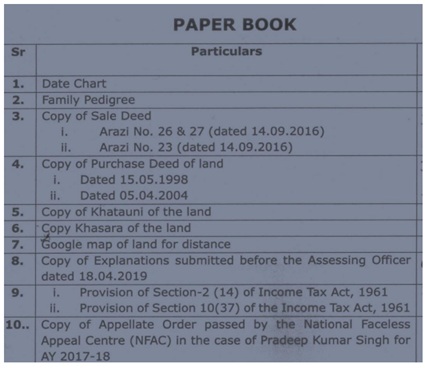
(C) At the time of hearing, the Ld. Counsel for the assessee placed reliance on the aforesaid paper book. He drew the attention of Bench to the copies of the Khasra and Khatauni records placed in the paper book and submitted that these documents clearly established that the land sold by assessee was agricultural land. He further submitted that even in the sale deeds dated 15.05.1998 and 05.04.2004, the property was specifically described as agricultural land. On the strength of these evidences, the Ld. Counsel contended that the land sold by the assessee was agricultural land and, therefore, the provisions relating to long-term capital gains were not applicable to the transaction. The Ld. Departmental Representative relied upon the assessment order as well as the impugned order passed by the Ld. CIT(A).
(D) We have heard both sides. We have perused the materials on records. We find on perusal of the assessment order that the Assessing Officer conducted a field enquiry through the Inspector, who submitted a report stating that the land sold by the assessee was residential in nature. It is also recorded in the assessment order that the Assessing Officer had made enquiries from the Government authorities, namely the offices of the Tehsildar and the SDM. However, no report from those authorities has been brought on record. Further, the Ld. CIT(A) observed that the Assessing Officer had brought material on record to establish that the land fell within the notified distance from the municipal limits and that the assessee had failed to rebut the same with documentary evidence. However, it is the consistent stand of the assessee that the land was situated beyond the notified distance from the municipal limits. As there is no clarity on facts, as to whether it is agricultural land and also whether it is within municipal limits; and as contradictory versions are claimed by the two sides (assessee and Revenue); we are of the view that the entire issue is required to be examined afresh to bring relevant fact on record in order to take an appropriate decision a disputed issue. Therefore, all the issues in dispute in the present appeal are restored back to the file of the AO with the direction to pass de novo assessment order in accordance with law, after making proper factual inquiry and after providing reasonable opportunity to the assessee. All the grounds of appeal are treated as disposed off in accordance with the aforesaid directions.
(E) The appeal before us in the case of Shri Sanjay Kumar Singh (ITA No. 174/VNS/2014) is in pari materia with that of Shri Manoj Kumar Singh. At the time of hearing, the Ld. Representatives of both sides fairly agreed that the decision rendered in the case of Shri Manoj Kumar Singh would apply mutatis mutandis to the case of Shri Sanjay Kumar Singh as well. Therefore, the consistent with the aforesaid view taken by us in the case of Shri Manoj Kumar Singh (in ITA No. 153/VNS/2026), we restore all the issues in dispute in the case of Shri Sanjay Kumar Singh also to the file of the Assessing Officer with the direction to pass de novo assessment order in accordance with law, after making proper factual inquiry and after providing reasonable opportunity to the assessee. All the grounds of appeal are treated as disposed off in accordance with the aforesaid directions.
(F) In the result, appeals vide ITA. No.153/VNS/2026 in the case of Shri Manoj Kumar Singh and ITA. No.174/VNS/2024 in the case of Shri Sanjay Kumar Singh are partly allowed for statistical purposes.



