ORDER
Manish Agarwal, Accountant Member. – The present appeal is filed by assessee against the order dated 26.09.2023 passed by Ld. Commissioner of Income Tax (Appeals), National Faceless Appeal Centre (“NFAC”), Delhi [“Ld. CIT(A)”] in Appeal No. CIT(A), Ghaziabad/11419/2019-20 u/s 250 of the Income Tax Act, 1961 [“the Act”] arising out of penalty order dated 24.03.2025 passed u/s 270A of the Act pertaining to Assessment Year 2017-18.
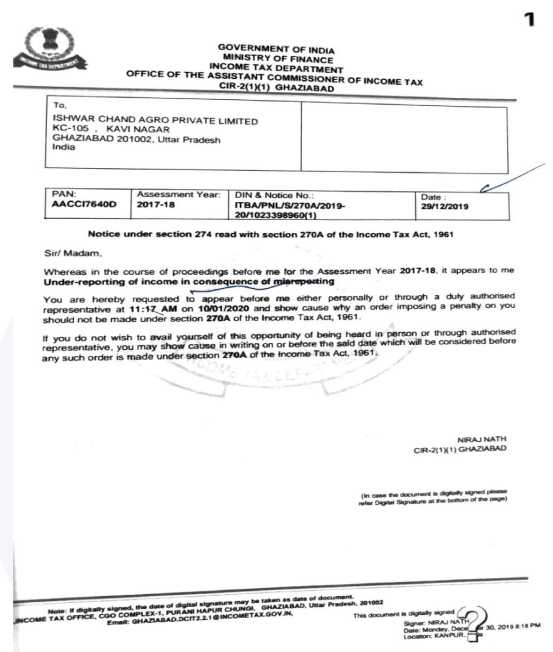
2. Brief facts of the case are that an addition on account of bogus purchases was made which has resulted into the reduction in the loss declared in the return of income filed. In first appeal, ld. CIT(A) has observed that since the order was rectified and instead of treating the addition as Income from Other sources, the same was held as business income which was admitted by the assessee and thus, dismissed the appeal of the assessee. In the assessment order, the AO recorded the satisfaction of initiation of the penalty proceedings u/s 270A for “under reporting” of income in consequence of misrepresentation. Thereafter, AO levied penalty u/s 270A of the Act of INR 4,63,500/- for “under reporting” by invoking the provision of section 270A(2)(g) of the Act.
3. Against the said order, assessee filed an appeal before Ld. CIT(A) who vide order dated 04.12.2025, dismissed the appeal of the assessee.
4. Aggrieved by the order of Ld. CIT(A), assessee is in appeal before the Tribunal by taking various Grounds of appeal mentioned in the appeal memo where all the grounds of appeal are with respect to the levy of penalty u/s 270A of the Act at INR 4,63,500/- thus, they all are taken together for consideration.
5. Before us, Ld. AR for the assessee submits that in the notice issued for initiation of penalty proceedings u/s 270A of the Act, AO has not specified the charge under which the penalty proceedings were initiated. He further submits that penalty proceedings were initiated for ‘under reporting of income in consequence of mis-reporting’ however, penalty was levied for ‘under reporting of income’. Since the AO has changed the charge from “mis-reporting” to “under reporting” without confronting the assessee and without recording the satisfaction of “under-reporting”, no penalty could be levied for different charge. Accordingly, Ld.AR requested for the deletion of the penalty so levied u/s 270A of the Act. The ld. AR also placed reliance on the following judgements:-
| – |
|
2026 (3) TMI 800 – Grand Legacy v. Dy. CIT [IT Appeal No. 229 (DDN.) of 2025, dated 12-3-2026] , ITAT Dehradun |
| – |
|
2026 (3) TMI 1611 Ashok Kumar Gupta v. Dy. CIT [IT Appeal No. 1882 (Delhi) of 2023, dated 27-3-2026] – ITAT Delhi |
| – |
|
2024 (3) TMI 1007 Jaina Marketing & Associates v. Dy. CIT (Delhi – Trib.)- ITAT Delhi |
| – |
|
2022(3) TMI 1295 Schneider Electric South East Asia (HQ) Pte. Ltd. v. Asstt. CIT (Delhi) – Delhi High Court |
| – |
|
2024 (11) TMI 811 Manish Manohardas Asrani v. INT Tax (Mumbai – Trib.) – ITAT Mumbai |
| – |
|
2025(8) TMI 1524 Snehalkumar Bhogilal Trivedi v. National Faceless Assessment Centre, Assessment Unit [2025] 214 ITD 426 (Ahmedabad – Trib.) – ITAT Ahmedabad |
6. On the other hand, Ld. Sr. DR for the Revenue supported the orders of the lower authorities and submits that assessee had accepted the additions made and further failed in appellate proceedings. Further since the loss claimed was reduced, therefore, it is the case of under reporting under clause (g) of section 270A(2) of the Act and thus the AO has rightly been levied. He prayed accordingly.
7. Heard the contentions of both parties and perused the material available on record. In the instant case, AO has initiated the penalty proceedings in terms of the notice issued u/s 274 r.w.s. 270A of the Act dated 29.12.2019 which is reproduced as under:-
8. Before going further, we first refer the provisions of section 270A of the Act herein below:
“270A. Penalty for under-reporting and misreporting of income.
| (1) |
|
The Assessing Officer or the Commissioner (Appeals) or the Principal Commissioner or Commissioner may, during the course of any proceedings under this Act, direct that any person who has under-reported his income shall be liable to pay a penalty in addition to tax, if any, on the under-reported income. |
| (2) |
|
A person shall be considered to have under-reported his income, if— |
| (a) |
|
the income assessed is greater than the income determined in the return processed under clause (a) of sub-section (1) of section 143; |
| (b) |
|
the income assessed is greater than the maximum amount not chargeable to tax, where no return of income has been furnished or where return has been furnished for the first time under section 148; |
| (c) |
|
the income reassessed is greater than the income assessed or reassessed immediately before such reassessment; |
| (d) |
|
the amount of deemed total income assessed or reassessed as per the provisions of section 115JB or section 115JC, as the case may be, is greater than the deemed total income determined in the return processed under clause (a) of sub-section (1) of section 143; |
| (e) |
|
the amount of deemed total income assessed as per the provisions of section 115JB or section 115JC is greater than the maximum amount not chargeable to tax, where no return of income has been furnished or where return has been furnishedfor the first time under section 148; |
| (f the amount of deemed total income reassessed as per the provisions of section 115JB or section 115JC, as the case may be, is greater than the deemed total income assessed or reassessed immediately before such reassessment; |
| (g) |
|
the income assessed or reassessed has the effect of reducing the loss or converting such loss into income. |
| (3) |
|
The amount of under-reported income shall be,— |
| (i) |
|
in a case where income has been assessed for the first time,— |
| (a) |
|
if return has been furnished, the difference between the amount of income assessed and the amount of income determined under clause (a) of sub-section (1) of section 143; |
| (b) |
|
in a case where no return of income has been furnished or where return has been furnishedfor the first time under section 148,— |
| (A) |
|
the amount of income assessed, in the case of a company, firm or local authority; |
and
| (B) |
|
the difference between the amount of income assessed and the maximum amount not chargeable to tax, in a case not covered in item (A); |
| (ii) |
|
in any other case, the difference between the amount of income reassessed or recomputed and the amount of income assessed, reassessed or recomputed in a preceding order: |
Provided that where under-reported income arises out of determination of deemed total income in accordance with the provisions of section 115JB or section 115JC, the amount of total under-reported income shall be determined in accordance with the following formula—
(A — B) + (C — D)
where,
A = the total income assessed as per the provisions other than the provisions contained in section 115JB or section 115JC (herein called general provisions);
B = the total income that would have been chargeable had the total income assessed as per the general provisions been reduced by the amount of underreported income;
C = the total income assessed as per the provisions contained in section 115JB or section 115JC;
D = the total income that would have been chargeable had the total income assessed as per the provisions contained in section 115JB or section 115JC been reduced by the amount of under-reported income:
Provided further that where the amount of under-reported income on any issue is considered both under the provisions contained in section 115JB or section 115JC and under general provisions, such amount shall not be reduced from total income assessed while determining the amount under item D.
Explanation.—For the purposes of this section,—
| (a) |
|
“preceding order” means an order immediately preceding the order during the course of which the penalty under sub-section (1) has been initiated; |
| (b) |
|
in a case where an assessment or reassessment has the effect of reducing the loss declared in the return or converting that loss into income, the amount of under-reported income shall be the difference between the loss claimed and the income or loss, as the case may be, assessed or reassessed. |
| (4) |
|
Subject to the provisions of sub-section (6), where the source of any receipt, deposit or investment in any assessment year is claimed to be an amount added to income or deducted while computing loss, as the case may be, in the assessment of such person in any year prior to the assessment year in which such receipt, deposit or investment appears (hereinafter referred to as “preceding year”) and no penalty was levied for such preceding year, then, the under-reported income shall include such amount as is sufficient to cover such receipt, deposit or investment. |
| (5) |
|
The amount referred to in sub-section (4) shall be deemed to be amount of income underreportedfor the preceding year in the following order— |
| (a) |
|
the preceding year immediately before the year in which the receipt, deposit or investment appears, being the first preceding year; and |
| (b) |
|
where the amount added or deducted in the first preceding year is not sufficient to cover the receipt, deposit or investment, the year immediately preceding the first preceding year and so on. |
| (6) |
|
The under-reported income, for the purposes of this section, shall not include the following, namely:— |
| (a) |
|
the amount of income in respect of which the assessee offers an explanation and the Assessing Officer or the Commissioner (Appeals) or the Commissioner or the Principal Commissioner, as the case may be, is satisfied that the explanation is bona fide and the assessee has disclosed all the material facts to substantiate the explanation offered; |
| (b) |
|
the amount of under-reported income determined on the basis of an estimate, if the accounts are correct and complete to the satisfaction of the Assessing Officer or the Commissioner (Appeals) or the Commissioner or the Principal Commissioner, as the case may be, but the method employed is such that the income cannot properly be deduced therefrom; |
| (c) |
|
the amount of under-reported income determined on the basis of an estimate, if the assessee has, on his own, estimated a lower amount of addition or disallowance on the same issue, has included such amount in the computation of his income and has disclosed all the facts material to the addition or disallowance; |
| (d) |
|
the amount of under-reported income represented by any addition made in conformity with the arm’s length price determined by the Transfer Pricing Officer, where the assessee had maintained information and documents as prescribed under section 92D, declared the international transaction under Chapter X, and, disclosed all the material facts relating to the transaction; and |
| (e) |
|
the amount of undisclosed income referred to in section 271AAB. |
| (7) |
|
The penalty referred to in sub-section (1) shall be a sum equal to fifty per cent of the amount of tax payable on under-reported income. |
| (8) |
|
Notwithstanding anything contained in sub-section (6) or sub-section (7), where underreported income is in consequence of any misreporting thereof by any person, the penalty referred to in sub-section (1) shall be equal to two hundred per cent of the amount of tax payable on under-reported income. |
| (9) |
|
The cases of misreporting of income referred to in sub-section (8) shall be the following, namely:— |
| (a) |
|
misrepresentation or suppression of facts; |
| (b) |
|
failure to record investments in the books of account; |
| (c) |
|
claim of expenditure not substantiated by any evidence; |
| (d) |
|
recording of any false entry in the books of account; |
| (e) |
|
failure to record any receipt in books of account having a bearing on total income; and |
| (f) |
|
failure to report any international transaction or any transaction deemed to be an international transaction or any specified domestic transaction, to which the provisions of Chapter X apply. |
| (10) |
|
The tax payable in respect of the under-reported income shall be— |
| (a) |
|
where no return of income has been furnished or where return has been furnished for the first time under section 148 and the income has been assessedfor the first time, the amount of tax calculated on the under-reported income as increased by the maximum amount not chargeable to tax as if it were the total income; |
| (b) |
|
where the total income determined under clause (a) of sub-section (1) of section 143 or assessed, reassessed or recomputed in a preceding order is a loss, the amount of tax calculated on the under-reported income as if it were the total income; |
| (c) |
|
in any other case, determined in accordance with the formula—(XY) where, |
X = the amount of tax calculated on the under-reported income as increased by the total income determined under clause (a) of sub-section (1) of section 143 or total income assessed, reassessed or recomputed in a preceding order as if it were the total income; and
Y = the amount of tax calculated on the total income determined under clause (a) of subsection (1) of section 143 or total income assessed, reassessed or recomputed in a preceding order.
| (11) |
|
No addition or disallowance of an amount shall form the basis for imposition of penalty, if such addition or disallowance has formed the basis of imposition of penalty in the case of the person for the same or any other assessment year. |
| (12) |
|
The penalty referred to in sub-section (1) shall be imposed, by an order in writing, by the Assessing Officer, the Commissioner (Appeals), the Commissioner or the Principal Commissioner, as the case may be. “ |
9. From the above, it is clear that for “under reporting of income”, the AO should satisfy the conditions defined in sub clause (a) to (g) of sub section (2) of section 270A of the Act. For “under reporting of income in consequence to misreporting of income” the conditions specify in clause (a) to (f) of sub section (9) of section 270A should be satisfied. In the instant case, it is observed that, the Ld. AO after having clearly analysed facts and circumstances of the case has dejectedly failed to identify or determined and then communicate either through assessment order or through notice, the specific circumstance or incidence i.e. specific clause (a) to clause (g) of s/s (2) of section 270 within which the case of the appellant falls so has to hold income as “under-reported” to trigger said penal provision. The failure continued further in identifying or determining and showcasing the specific action of the appellant in terms of clause (a) to clause (f) to sub-section (9) of section 270A within which such action of the assessee falls so as to jacket or categorise such “under-reported income in consequence of mis-reporting”.
10. Thus, non-identification or determination vis-a-vis communication of specific clause lineally from sub-section (2) or sub-section (9) would drastically obstruct an assessee from enforcing his right to dismantle the charge alleged against him, thus resulting into violation of principle of natural justice.
11. In the light of afore mentioned reasoning and discussion, we observed that, the notice initiating the penal proceedings is silent on the circumstance or incidence triggering the very initiation in this case. Further, the order of penalty did neither mention the circumstance or incidence nor make a mention of alleged action in reaching the final imposition.
12. Further from the perusal of the aforesaid notice, it is observed that AO has initiated the penalty proceedings for ‘under reporting of income in consequence of mis-reporting’ however, the penalty was finally levied u/s 270A of the Act for ‘under reporting of income’.
13. The Hon’ble Delhi High Court in the case of Schneider Electric South East Asia (HQ) Pte. Ltd. (supra) has dealt the issue of satisfaction recorded at the time of levying the penalty u/s.270A of the Act, wherein, the Hon’ble Court has held as follows:
“6. Having perused the impugned order dated 09 March, 2022 to contend that the Petitioner is not entitled to the benefit of immunity under Section 270A of the Act for misreporting of income is not only erroneous but also arbitrary and bereft of any reason as in the penalty notice the Respondents have failed to specify the limb – “underreporting” or “misreporting” of income, under which the penalty proceedings had been initiated.
7. This Court also finds that there is not even a whisper as to which limb of Section 270A of the Act is attracted and how the ingredient of sub-section (9) of Section 270A is satisfied. In the absence of such particulars, the mere reference to the word “misreporting” by the Respondents in the assessment order to deny immunity from imposition of penalty and prosecution makes the impugned order manifestly arbitrary.
8. This Court is of the opinion that the entire edifice of the assessment order framed by Respondent No.1 was actually voluntary computation of income filed by the Petitioner to buy peace and avoid litigation, which fact has been duly noted and accepted in the assessment order as well and consequently, there is no question of any misreporting.”
14. Reliance is also placed on the judgment of Co-ordinate Bench of Tribunal in the case of Grand Legacy (supra) wherein Co-ordinate Bench has deleted the penalty levied u/s 270A of the Act when it was for ‘Under reporting of income as a consequence of misreporting’ and levied for ‘under-reporting of income’.
15. Thus, by respectfully following the judgement of Hon’ble jurisdictional High Court in the case of Schneider Electric South East Asia (HQ) Pte. Ltd. (supra) and of the Co-ordinate Bench of Dehardun Tribunal in the case of Grand Legacy (supra), we are of the considered view that failure on the part of AO to identify and communicate the specific circumstance or incidence from clause (a) to (g) of sub-section (2) of section 270A or clause (a) to (f) of subsection (9) of section 270A was determinant before imposing the impugned penalty has rendered the entire proceedings invalid and thus untenable in the eyes of law. Consequently, the penalty imposed u/s 270A of the Act being bad in law deserves to be quashed, ergo we order accordingly. All the grounds of appeal of the assessee are thus, allowed.
16. In the result, the appeal of the assessee is allowed.