


Mechanical Approval Under Section 153D Without Application of Mind Invalidates Search Assessments
Issue
Whether an assessment order passed under Section 153C read with Section 143(3) is legally valid when the statutory approval required under Section 153D was granted in a mechanical manner without application of mind, and whether the curable-defect provisions of Section 292BC apply retrospectively to approvals granted prior to April 1, 2021.
Facts
-
Assessee & Assessment Years: The case involves search-related assessment proceedings under Section 153C of the Income-tax Act, 1961, for Assessment Years 2014–15 to 2016–17.
-
Statutory Requirement: The Assessing Officer (AO) completed the assessments under Section 153C read with Section 143 after obtaining prior administrative approval from the supervisory authority under Section 153D.
-
Non-Abated Year (AY 2015–16): For AY 2015–16, which was a non-abated assessment year, the AO made tax additions without relying on any incriminating material discovered during the search.
-
Absence of Search Material (AY 2014–15): For AY 2014–15, no incriminating material found during the search was actually relied upon; instead, additions were made purely on the basis of regular financial statements and a perusal of Form 3CD.
-
Mechanical Approval: The approving authority granted approval under Section 153D for these additions despite the lack of incriminating material, demonstrating a routine, mechanical exercise without independent evaluation.
-
Revenue’s Defense under Section 292BC: The Revenue sought to save the invalid approval by relying on Section 292BC (introduced by the Finance Act, 2021 w.e.f. April 1, 2021), which provides validation for certain procedural defects in approvals.
Decision
-
Approval Vitiated by Non-Application of Mind: The Tribunal/Court held that administrative approval under Section 153D is a statutory safeguard requiring conscious application of mind. Granting approval for non-abated years without incriminating material reflects mechanical approval, vitiating the entire assessment.
-
Non-Retrospectivity of Section 292BC: Section 292BC applies only to approvals granted on or after April 1, 2021, and cannot cure defective approvals granted prior to this cut-off date.
-
Assessments Quashed: Because the approval under Section 153D was invalid and Section 292BC offered no protection, the impugned assessment orders passed under Section 153C were quashed.
-
Outcome: Decided entirely in favor of the assessee.
Key Takeaways
-
Section 153D Is a Mandatory Guardrail: Approval under Section 153D is not a mere bureaucratic formality; supervisory authorities must independently examine the record to ensure search additions are grounded in seized incriminating material.
-
No Additions in Non-Abated Years Without Incriminating Evidence: For non-abated assessment years under Section 153C/153A, additions cannot be made based on regular tax audits or financial statements without seized incriminating material.
-
Temporal Scope of Section 292BC: Statutory provisions curing administrative defects in approvals (Section 292BC) do not apply retrospectively to validate flawed Section 153D approvals issued before April 1, 2021.
IN THE ITAT DELHI BENCH ‘A’
Soni Commercial Enterprises (P.) Ltd.
v.
Assistant Commissioner of Income-tax
ANUBHAV SHARMA, Judicial Member
and Sanjay Awasthi, Accountant Member
and Sanjay Awasthi, Accountant Member
ITA Nos. 6347 to 6349 (Del) OF 2025
[Assessment years 2014-15 to 2016-17]
[Assessment years 2014-15 to 2016-17]
JULY 30, 2026
Ms. Tanya, Rohit Tiwari, Deepesh Garg, Advs. and Rakesh Gupta, Sr. Adv. for the Appellant. Jitender Singh, CIT-DR for the Respondent.
ORDER
Anubhav Sharma, Judicial Member. – These appeals preferred by the Assessee against the order of the Ld. Commissioner of Income Tax (Appeals)-26, Delhi (hereinafter referred to as the First Appellate Authority or ‘the ld. FAA’ for short) in appeals filed before him against the orders of the ld. Assessing Officer (hereinafter referred to as the Ld. AO, for short) passed u/s 153C r.w.s 143(3) of the Income-tax Act, 1961 (hereafter referred to as ‘the Act’). Further details of the orders of the lower authorities are as under: –
| ITA No. & AY | Ld. FAA who passed the appellate order | Appeal No. & Date of order of the Ld. FAA | AO who passed the assessment order & Date of order |
| 6347/D/25 2015-16 | CIT(A)-26 Delhi | DIN & Order No : ITBA/APL/S/250/2025-26/1079349815(1) Dated: 06.08.2025 | ACIT, CC- 14 New Delhi Dated 31.12.2019 |
| 6348/D/25 2014-15 | CIT(A)-26 Delhi | DIN & Order No : ITBA/APL/S/250/2025-26/1079350311(1) Dated: 06.08.2025 | ACIT, CC- 14 New Delhi Dated 31.12.2019 |
| 6449/D/25 2016-17 | CIT(A)-26 Delhi | DIN & Order No : ITBA/APL/S/250/2025-26/1079351895(1) Dated: 06.08.2025 | ACIT, CC- 14 New Delhi Dated 31.12.2019 |
2. Heard and perused the record. At the time of hearing ld. Counsel as stressed for disposal of additional ground by which assessment order has been challenged on the basis that the approval granted u/s 153D of the Act was not in accordance with law, the same is reproduced below:
“1.1 That on the facts and circumstances of the case and in law, the assessment order dated 31.12.2019 passed u/s 153C read with section 143(3) of the Income Tax Act, 1961 is bad in law, void ab initio and liable to be quashed, as the approval granted u/s 153D of the Act by the Additional Commissioner of Income Tax, Central Range-4, New Delhi vide letter dated 29.12.2019 is mechanical, ritualistic and without independent application of mind to the seized material, satisfaction note, assessment records, replies filed by the appellant and the draft assessment order for the relevant assessment year.
1.2 That the Ld. CIT(A) erred in sustaining the assessment order without appreciating that valid approval us 153D is a mandatory jurisdictional requirement and not an empty formality. In the absence of proper, independent and year-wise approval u/s 153D, the assessment order passed u/s 153C r.w.s. 143(3) deserves to be quashed.”
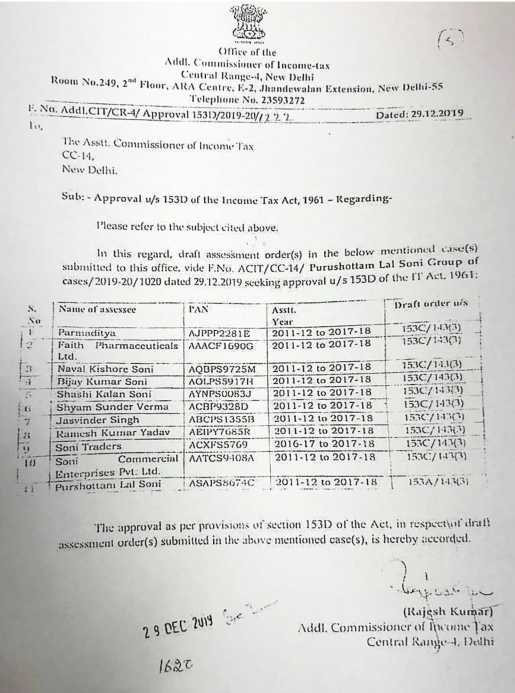
3. As for convenience we reproduce the impugned approval:
4. Apart from defending the approval on the basis that same sufficiently indicates application of mind and that being administrative in nature has been rightly granted, the Ld. DR has vehemently opposed the grounds submitting that Section 292BC has been introduced by way of amendment recently and the same holds that the approval is supervisory and administrative function and any deficiency in the reasons would not vitiate the approval. It was submitted that the provision is applicable retrospectively. It was submitted on behalf of the department that the date referred 01.04.2021 in the amendment brought with the introduction of Section 292BC of the Act has to be read in consonance to the date of hearing of the appeal and when the Tribunal hears this appeal on that day the amendment u/s 292BC should be looked into.
5. On appreciating the approval as granted we find that in case of as many as 11 different assesses for numerous years involved from AY: 2011-12 to 2017-18 the approval has been granted without there being any clue, if at all AO had forwarded the assessment records and incriminating materials which became foundation of additions. The approval as granted does not even reflect, as to if, ld. Competent authority was aware of the issues at any stage prior to 29.12.2019. As a matter of fact if we consider the issue involved for AY: 2015-16 which was a non-abated assessment the additions have not been made on the basis of any incriminating material and similarly for AY: 2014-15 no incriminating material found during the search has been actually relied. The additions are made on the basis of financial and on perusal of Form 3CD. When such is the state of affairs while granting approval if ld. Competent authority has not even take into consideration fundamental principles for making additions the approval as granted, thus, turnout to be a mechanical exercise and complete non application of mind.
6. The aforesaid, pointed out, facts do not indicate insufficiency of reasons, but mere mechanical manner in which approval is granted. The law in this regard is settled that such mechanical exercise of powers u/s 153D of the Act, vitiates the assessment order. Reliance can be placed on decisions in ACIT v. Serajuddin & Co. (Orissa)/2023 SCC OnLine Ori 992, Principal Commissioner of Income-tax (Central)-2 v. Anuj Bansal 466 ITR 251 (Delhi)/[ITA 368/2023]. The Co-ordinate Bench of the Tribunal while examining the similar issue in the case of SEH Realtors (P.) Ltd. v. ACIT [IT Appeal No. 2503 (Del) of 2017]/ITA No. 2503/Del/2017 and connected matters for Assessment Year 2013-14 vide order dated 23/07/2024, considered all the judicial pronouncements on the issue and has held as under: –
“8. We find as per the scheme of the Act, for framing search assessments, the Ld. AO can pass the search assessment order u/s 153A or u/s 153C of the Act only after obtaining prior approval of the draft assessment order and the conclusions reached thereon from the ld. JCIT, in terms of section 153D of the Act. This is a mandatory requirement of law. The said approval granting proceedings by the ld. JCIT is a quasi judicial proceeding requiring application of mind by the ld. JCIT judiciously. In order to ensure smooth implementation of the aforesaid provisions, in consonance with the true spirit of the scheme of the Act, it is the bounden duty of the Ld. AO to seek to place the draft assessment order together with copies of the seized documents before the ld. JCIT well in time much before the due date of completion of search assessment. The ld. JCIT is supposed to examine the seized documents, questionnaires raised by the Ld. AO on the assessee seeking explanation of contents in the seized documents, replies filed by the assessee in response to the questionnaires issued by the Ld. AO and the conclusions drawn by the Ld. AO vis- a-vis the said seized documents after considering the reply of the assessee. All these functions, as stated earlier, are to be performed by the ld. JCIT in a judicious way after due application of mind. Even though as vehemently argued by the Ld. CIT-DR, the ld. JCIT is involved with the search assessment proceedings right from the time of receipt of appraisal report from the Investigation Wing, still, the ld. JCIT, while granting the approval u/s 153D of the Act has to independently apply his mind dehors the conclusions drawn either by the Investigation Wing in the appraisal report or by the Ld. AO in the draft assessment order. The copy of the appraisal report submitted by the Investigation Wing to the Ld. AO and ld. JCIT are merely guidance to the Ld. AO and are purely internal correspondences on which the assessee does not have any access. Moreover, the Act mandates the Ld. AO to frame the assessment after getting prior approval from ld. JCIT u/s 153D of the Act. The ld. JCIT getting involved in the search assessment proceedings right from inception does not have any support from the provisions of the Act as no where the Act mandates so. The scheme of the Act mandates due application of mind by the Ld. AO to examine the seized documents independently dehors the appraisal report of the Investigation Wing and seek explanation/clarifications from the assessee on the contents of the seized documents. When the scheme of the Act provides for a leeway to both the Ld. AO as well as the ld. JCIT to even ignore the conclusions drawn in the appraisal report by the Investigation Wing and take a different stand in the assessment proceedings, the fact of ld. JCIT getting involved in the search assessment proceedings right from the receipt of copy of appraisal report, as argued by the Ld. CIT DR, has no substance. In other words, irrespective of the conclusions drawn in the appraisal report by the Investigation Wing, both the Ld. AO and the ld. JCIT are supposed to independently apply their mind in a judicious way before drawing any conclusions on the contents of the seized documents while framing the search assessments. As far as the argument of the Ld. CIT DR that the details were normally filed by the assessee at the last moment is concerned, the ld. AO has got every right to reject the said replies if not filed within the stipulated time. It is not the case of the revenue that the details were filed by the assessee in the instant case at the last moment. Even if it is so, as stated above, it is the prerogative of the ld. AO to accept the said letter containing details or reject the same as it was not filed within the stipulated time. On the contrary, if the ld. AO himself grants time to the assessee to furnish the details till the last moment, then no fault could be attributed to the assessee. In such circumstances, the only irresistible conclusion that could be drawn is that the ld. AO is not serious about the statutory deadlines provided in the Act. In our considered opinion, if the arguments of the Ld. CIT DR are to be appreciated that the ld. JCIT need not apply his mind while granting approval of the draft assessment orders u/s 153D of the Act as it is not provided in section 153D of the Act, then it would make the entire approval proceedings contemplated u/s 153D of the Act otiose. The law provides only the Ld. AO to frame the assessment, but, certain checks and balances are provided in the Act by conferring powers on the ld. JCIT to grant judicious approval u/s 153D of the Act to the draft assessment orders placed by the Ld. AO.
7. The contention on behalf of department that Section 292BC of the Act introduced by way of amendment by Finance Act, 2026 w.e.f from 1.04.2021 would be applicable in the case of present assessee also have not substance as we find that legislature has made the amendment applicable retrospectively w.e.f 01.04.2021 in regard to approvals granted after 01.04.2021. Thus, by no stretch of imagination we can accept the contention that because the matter is being heard subsequent to the amendment it becomes applicable to also in cases where approval was granted prior to 01.04.2021.
8. We thus sustain the additional ground in the appeals before us. The appeals of assesse are allowed. The impugned assessments are quashed.