


Reassessment Additions Unsustainable If Primary Reopening Grounds Do Not Result in Any Tax Addition
Issue
Whether an Assessing Officer can make tax additions on newly discovered issues during reassessment proceedings if no addition is made on the original issue that formed the basis for reopening the assessment.
Facts
-
Assessment Year: Assessment Year 2020–21.
-
Initiation of Reassessment: Reassessment proceedings under Section 148/148A were initiated against the assessee based on specific information suggesting escapement of income.
-
Procedural Context: The reassessment was initiated following a search and seizure action, wherein the procedure under Section 148A was dispensed with under the statutory proviso.
-
New Issues Identified: During the course of reassessment inquiries, the Assessing Officer (AO) gathered new material and identified separate issues not included in the original reopening notice.
-
Final Assessment Outcome: The AO made additions to the assessee’s income based solely on the new material gathered during the reassessment, but made zero additions on the original ground/information that formed the initial basis for reopening.
Decision
-
Scope of Reassessment: Once reassessment is validly initiated, the AO has the authority to assess or reassess other issues coming to notice during the proceedings alongside the original issue.
-
Mandatory Rider/Precondition: The AO’s power to assess new issues is strictly subject to the condition that an addition must be sustained on the primary ground that formed the basis of the reopening.
-
Applicability to Search Cases: This legal principle applies equally to reassessments triggered by search and seizure actions where Section 148A procedure was dispensed with.
-
Addition Invalidated: Because no addition was made on the initial information suggesting income escapement, additions made exclusively on newly discovered issues cannot be sustained in law.
-
Outcome: Decided entirely in favor of the assessee.
Key Takeaways
-
Primary Ground Addition Is Mandatory: The AO loses jurisdiction to make additions on secondary issues discovered during reassessment if the primary ground for reopening fails to yield an addition.
-
Equal Applicability to Search Reassessments: Dispensing with Section 148A procedures under search-related provisos does not exempt the Revenue from maintaining an addition on the original ground of reopening.
-
Jurisdictional Threshold: Material discovered during reassessment inquiries cannot independently salvage a reassessment order if the initial basis of reopening yields zero tax addition.
IN THE ITAT HYDERABAD BENCH ‘SMC’
Smt. Krishnaveni Vedula
v.
Deputy Commissioner of Income-tax
Ravish Sood, Judicial Member
and MADHUSUDAN SAWDIA, Accountant Member
and MADHUSUDAN SAWDIA, Accountant Member
IT Appeal Nos. 1759 & 1769 (Hyd) OF 2025
[Assessment years 2020-21]
[Assessment years 2020-21]
JULY 29, 2026
P. Murali Mohan Rao, CA for the Appellant. Laxmi Kanth, Sr. AR for the Respondent.
ORDER
Madhusudan Sawdia, Accountant Member.-These two appeals are filed by Smt. Krishnaveni Vedula and Shri Bhasker Rao Vedula (“the assessees”), feeling aggrieved by the separate orders passed by the Learned Commissioner of Income Tax (Appeals)-12, Hyderabad (“Ld. CIT(A)”) both dated 07.08.2025 for the A.Y. 2020-21. Since the issues involved in these two appeals are identical, for the sake of convenience, these two appeals were heard together and are being disposed of by this common and consolidated order.
ITA No.1759/Hyd/2025:
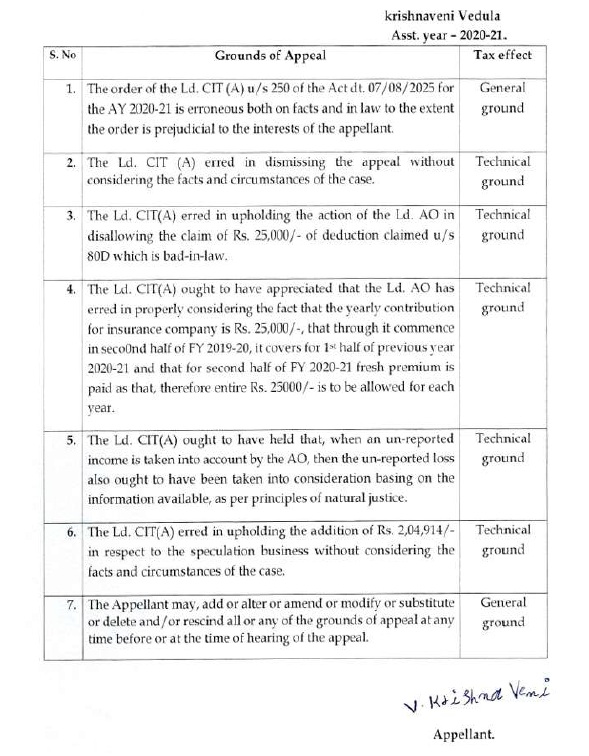
2. The assessee has raised the following grounds of appeal:
3. The assessee has also raised the following additional grounds before us:
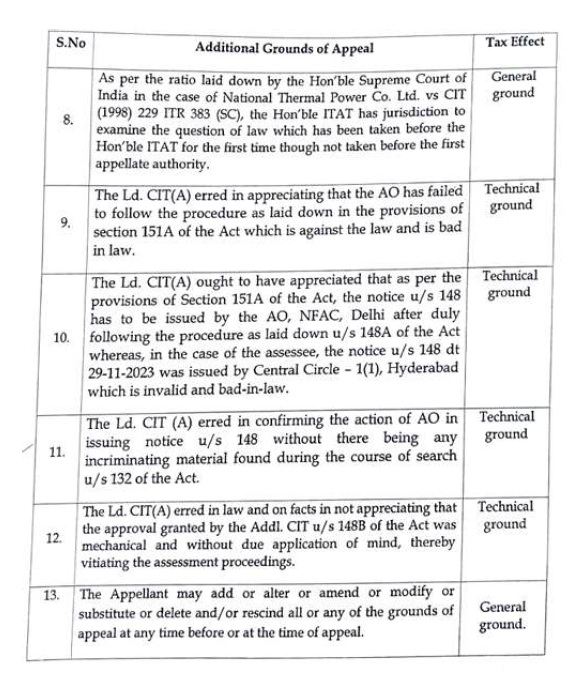
4. The Learned Authorized Representative (“Ld. AR”) submitted that additional grounds so filed are admissible in view of judgment rendered by the Hon’ble Supreme Court in the case of National Thermal Power Co. Ltd. v. CIT 229 ITR 383 (SC). The Learned Departmental Representative (“Ld. DR”) also did not raise any objection for admission of the additional grounds. The prayer for admission of additional grounds noted above which are not in memorandum of appeal are being admitted for adjudication in terms of Rule 11 of the Income Tax (Appellate Tribunal) Rules, 1963 owing to the fact that objections raised in additional grounds are legal in nature for which relevant facts are stated to be emanating from the existing records.
5. The brief facts of the case are that the assessee is an individual who filed her return of income for the assessment year 2020-21 on 29.12.2020 declaring total income of Rs. 4,72,570/-. Subsequently, a search and seizure operation under section 132 of the Income Tax Act, 1961 (“the Act”) was conducted on 18.01.2023 in the case of M/s. Oorjita Builders & Developers Pvt. Ltd. and its group entities. The case of the assessee was also covered under section 132 of the Act. Pursuant thereto, proceedings under section 147 of the Act were initiated in the case of the assessee and notice under section 148 of the Act was issued on 29.11.2023. In response to the said notice, the assessee filed return of income on 13.01.2025. Thereafter, the Ld. AO completed the assessment under section 147 of the Act vide order dated 06.03.2025 making the additions on account of Disallowance under section 80C of the Act amounting to Rs. 69,226, Disallowance under section 24(b) of the Act of Rs. 13,889, Disallowance under section 80D of the Act of Rs. 25,000 and Addition on account of speculative profit of Rs. 2,04,914. Accordingly, the total income of the assessee was assessed at Rs. 7,85,599/-.
6. Aggrieved by the assessment order, the assessee preferred an appeal before the Ld. CIT(A). The Ld. CIT(A) partly allowed the appeal of the assessee.
7. Aggrieved by the order of the Ld. CIT (A), the assessee is in appeal before this Tribunal. At the outset, the Ld. AR submitted that under Ground No. 11 of the additional grounds of appeal, the assessee has raised a legal issue challenging the validity of the additions made by the Ld. AO as the addition has been made by the Ld. AO without any incriminating material. Inviting our attention to the reassessment order, the Ld. AR submitted that none of the additions made by the Ld. AO are based on any material available with the Revenue at the time of initiation of reassessment proceedings. He submitted that all the additions have been made only on the basis of materials obtained and enquiries conducted by the Ld. AO during the course of reassessment proceedings. The Ld. AR further submitted that the Revenue has failed to demonstrate that any of the additions made by the Ld. AO were based on the information or material forming the basis of issuance of notice under section 148 of the Act. Accordingly, it was submitted that in the absence of any addition on the issue which formed the basis of initiation of reassessment proceedings, the additions made on other issues are unsustainable in law.
8. Per contra, the Ld. DR opposed the contention of the assessee. The Ld. DR submitted that after insertion of the new provisions of sections 147 and 148 of the Act with effect from 01.04.2021, there is no concept of restricting reassessment only to incriminating material. He submitted that once reassessment proceedings are validly initiated, the Ld. AO is empowered to examine other issues that come to his notice during the course of reassessment proceedings. The Ld. DR further invited our attention to the additions made by the Ld. AO and submitted that each of the additions was made on account of discrepancies noticed by the Ld. AO during assessment proceedings. Accordingly, it was contended that the legal ground raised by the assessee deserves to be rejected.
9. We have heard the rival submissions and perused the material available on record including the case law relied upon. The assessee has raised Ground No. 11 of the additional grounds of appeal challenging the validity of the additions made by the AO in the reassessment proceedings. The contention of the assessee is that none of the additions made by the Ld. AO are based upon the material available with the Revenue at the time of initiation of reassessment proceedings and all the additions have been made only on the basis of materials collected and enquiries conducted during the course of reassessment proceedings. Therefore, according to the assessee, such additions cannot survive in law. In this regard, we have gone through the Explanation to section 147 of the Act as applicable at the relevant point of time, which is to the following effect:
” 147. If any income chargeable to tax, in the case of an assessee, has escaped assessment for any assessment year, the Assessing Officer may, subject to the provisions of sections 148 to 153, assess or reassess such income or recompute the loss or the depreciation allowance or any other allowance or deduction for such assessment year (hereafter in this section and in sections 148 to 153 referred to as the relevant assessment year).
Explanation.—For the purpose of assessment or reassessment or recomputation under this section, the Assessing Officer may assess or reassess the income in respect of any issue, which has escaped assessment, and such issue comes to his notice subsequently in the course of the proceedings under this section, irrespective of the fact that the provisions of section 148A have not been complied with.]”
10. On perusal of the above, we find that it has been specifically provided under explanation to section 147 of the Act that for the purposes of assessment, reassessment or recomputation under section 147 of the Act, the Assessing Officer may assess or reassess income in respect of any issue which has escaped assessment and such issue comes to his notice subsequently during the course of proceedings under section 147 of the Act notwithstanding the fact that the provisions of section 148A of the Act have not been complied with in respect of such issue. We further find that the aforesaid Explanation has been analyzed by the Hon’ble Delhi High Court in the case of ATS Infrastructure Ltd. v. ACIT [2025] 473 ITR 595 (Delhi). The Hon’ble High Court, after analyzing the Explanation to section 147 of the Act inserted with effect from 01.04.2021 and comparing the same with Explanation 3 to section 147 of the Act which existed prior to 01.04.2021, has elaborately considered the issue in para nos. 25 to 32 of the judgment, which is to the following effect:
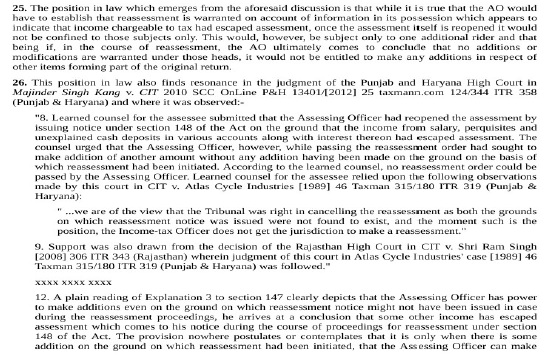
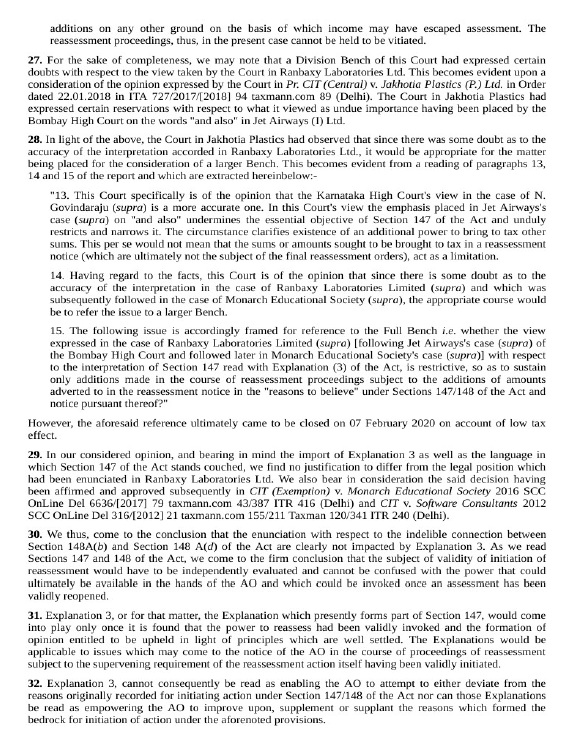
11. On perusal of the above, we find that the Hon’ble Delhi High Court has categorically held that once reassessment proceedings are initiated, the Assessing Officer is not confined only to the issue which formed the basis for reopening and may assess or reassess income in respect of other issues which come to his notice during the course of reassessment proceedings. However, the Hon’ble High Court has further held that such power is subject to an important rider. If ultimately no addition or modification is made in respect of the issue which formed the basis of initiation of reassessment proceedings, the Assessing Officer would not be entitled to make additions in respect of other issues which came to his notice subsequently during the reassessment proceedings. In other words, the Hon’ble High Court has held that if no addition is made on the basis of the material available with the Assessing Officer at the time of initiation of reassessment proceedings, no addition can be sustained merely on the basis of material gathered subsequently during the reassessment proceedings. We are conscious of the fact that the decision of the Hon’ble Delhi High Court in the case of ATS Infrastructure Ltd. (supra) was rendered in the context of reassessment proceedings initiated under section 148 of the Act after following the procedure prescribed under section 148A of the Act. The issue before the Hon’ble High Court was with regard to the scope of reassessment proceedings where the Assessing Officer had formed an opinion regarding escapement of income on the basis of specific information available with him while issuing notice under section 148 and thereafter passed an order under section 148A(d) of the Act. However, in our considered opinion, the ratio laid down by the Hon’ble Delhi High Court is equally applicable to the facts of the present case. Merely because the present case arises pursuant to a search and seizure action and the procedure prescribed under section 148A of the Act stood dispensed with by virtue of the proviso to section 148A of the Act, the foundational principle enunciated by the Hon’ble High Court does not cease to apply. The principle laid down by the Hon’ble High Court is that where reassessment proceedings are initiated on the basis of particular information suggesting escapement of income and ultimately no addition is made on the basis of such information, the addition cannot be sustained merely on the basis of issues which came to the notice of the Assessing Officer subsequently during the course of reassessment proceedings. In our view, the said principle flows from the scheme of section 147 of the Act itself and is not dependent solely upon compliance with the procedure prescribed under section 148A of the Act. Therefore, respectfully following the ratio laid down by the Hon’ble Delhi High Court in the case of ATS Infrastructure Ltd. (supra), we hold that the same is equally applicable to the facts of the present appeal.
12. Coming to the facts of the present case, we find that the Revenue has failed to demonstrate that any of the additions made by the Ld. AO were based upon the material available with him at the time of initiation of reassessment proceedings. The additions made by the Ld. AO relate to disallowance under section 80C of the Act amounting to Rs. 69,226/-, disallowance under section 24(b) of the Act amounting to Rs. 13,889/-, disallowance under section 80D of the Act amounting to Rs. 25,000/-and addition of Rs. 2,04,914/- on account of speculative profit. The Revenue has not been able to point out any material available prior to issuance of notice under section 148 on the basis of which the aforesaid additions have been made. On the contrary, it is evident from the assessment order that the additions have been made only on the basis of verification and enquiries carried out during the course of reassessment proceedings. The Ld. DR has also not been able to demonstrate before us that any addition has been made on the basis of the material which was in the possession of the Ld. A.O, before initiation of reassessment proceedings. Therefore, respectfully following the ratio laid down by the Hon’ble Delhi High Court in the case of ATS Infrastructure Ltd. (supra), we hold that the additions made by the Ld. AO solely on the basis of material gathered during the course of reassessment proceedings, without making any addition on the basis of the material available at the stage of initiation of reassessment proceedings, cannot be sustained in law. Accordingly, all the additions made by the Ld. AO are hereby deleted.
13. Since we have decided the issue in favour of the assessee on the basis of the legal ground raised by the assessee under Ground No. 11 of the additional grounds of appeal, we do not deem it necessary to adjudicate the remaining grounds raised by the assessee. Accordingly, the other grounds raised by the assessee are kept open and are not being adjudicated in the present appeal.
14. In the result, the appeal filed by the assessee in ITA No. 1759/Hyd/ 2025 is allowed.
ITA No. 1769/Hyd/2025:
15. The issues involved in the present appeal are identical to the issues involved in ITA No.1759/Hyd/2025. Accordingly, our observations and findings in ITA No.1759/Hyd/2025 shall mutatis mutandis apply to this appeal also. Accordingly, in the present appeal also, all the additions made by the Ld. AO are deleted.
16. In the result, the appeal filed by the assessee in ITA No.1769/Hyd/2025 is allowed.
17. To sum up, both the appeals of the assessees are allowed.