


Laundry Soap Bars Classifiable Under HSN 34011942 and Attract 18 Percent GST
Issue
What is the correct classification and applicable GST rate for laundry/washing soap (in bar or cake form) used for cleaning clothes and household items under Heading 3401, as per Notification No. 09/2025-Central Tax (Rate)?
Facts
-
Applicant Business: The applicant is a GST-registered manufacturer-trader engaged in producing washing and laundry soaps in bar or cake form.
-
Intended Usage: The products are designed specifically for cleaning clothes, apparel, and crockery, as well as imparting fragrance to garments.
-
Advance Ruling Request: The applicant sought an advance ruling to determine the correct classification, entry number, and applicable GST rate for its laundry/washing soap bars.
-
Commercial Characterization: The products are semi-detergent or detergent-based soaps intended for household/laundry cleaning rather than personal hygiene.
Decision
-
Rejection of Toilet Soap Classification: The Authority held that dictionary meanings and common parlance dictate that “toilet soap” is designed exclusively for personal hygiene. Definitions under statutory laws for other fields do not apply.
-
HSN Classification: Laundry or washing soap in bar/cake form falls under Sub-heading (HSN code) 34011942 of the First Schedule to the Customs Tariff Act, 1975.
-
Applicable GST Rate: The product falls under Entry No. 66 of Schedule-II of Notification No. 09/2025-Central Tax (Rate), dated 17-09-2025, and is taxable at 18% GST (9% CGST + 9% SGST).
-
Outcome: Decided in favor of the Revenue.
Key Takeaways
-
Common Parlance Prevails: Technical definitions from non-tax statutes cannot override the common parlance test when classifying consumer goods under GST tariff schedules.
-
End-Use Distinguishes Toilet vs. Laundry Soap: Products formulated and marketed for cleaning textiles or household items cannot be classified as toilet soaps, even if available in cake or bar forms.
-
Standardization Under HSN 34011942: Detergent or semi-detergent washing bars specifically manufactured for laundry use attract an 18% GST rate under HSN 34011942.
AUTHORITY FOR ADVANCE RULING , GUJARAT
Chehar Industry (P.) Ltd., In re
VISHAL MALANI, Member (Central Tax)
and SUSHMA VORA, Member (State Tax)
and SUSHMA VORA, Member (State Tax)
ADVANCE RULING NO. GUJ/GAAR/R/2026/28
AUGUST 4, 2026
Keyur S. Viradiya, Nikunj D. Paghdal and Bipinkumar Sutariya for the Applicant.
Proceedings
Brief facts:
1. M/s. Chehar Industry Private Limited, 94, Hinal Park Society, Ground Floor, Laskana Kamrej Road, Laskana, Surat, Gujarat – 395013, [for short – ‘applicant’], is registered under GST and their GSTIN is 24AALCC7578B1ZK.
2. The applicant is engaged in the manufacture and trading of Washing/Laundry Soap in bar/cake form used for washing clothes or for toilet purposes. The applicant has submitted that the GST rate and classification of these products have been revised vide Notification No.09/2025-Central Tax (Rate), dated 17.09.2025, effective from 22.09.2025 following the recommendations of the 56th GST Council Meeting and there exists ambiguity regarding whether laundry soap and toilet soap are treated under a common heading or separately, and what HSN code is applicable for each product type.
3. The applicant has further submitted that they intend to seek clarification regarding the classification and applicable rate of GST on Washing/Laundry Soap (in BAR or CAKE form) used for washing clothes or for toilet purposes, in view of Notification No.09/2025-Central Tax (Rate).
4. The applicant has raised the following question for Advance Ruling:
| (i) | What is the correct classification and applicable GST rate on Washing/Laundry Soap (in BAR or CAKE form) used for washing clothes or toilet purposes as per Notification No.09/2025-Central Tax (Rate), dated 17.09.2025 effective from 22.09.2025? |
| (ii) | Whether such Washing/Laundry Soap for clothes and crockeries falls under the same GST rate and classification as Toilet Soap or under a separate tariff heading? |
| (iii) | What are the applicable 8 digit HSN codes and Rate of GST for Washing Soap, Laundry Soap, Crockeries Soaps and Toilet Soap under GST law? |
5. Personal hearing was granted on 08.04.2026 wherein S/Shri Keyur S. Viradiya, Nikunj D. Paghdal and Bipinkumar Sutariya appeared on behalf of the applicant and reiterated the facts & grounds as stated in the application. During the course of personal hearing, the representatives of the applicant referred to Section 2, Sub-section (k) of Medicines & Toiletries Act, 1955. The Bench asked them to submit a copy of the same. The Bench further asked them to submit the composition of their products as well as photographs of their products at the earliest.
6. The applicant vide e-mail dated 05.05.2026 has submitted as under:
| ? | They are manufacturers of Detergent Soap Bars in various weights (ranging from 125 gms. To 300 gms.) marketed under the brand names “Chehar” and “Tavas” and fragrances include sweet flower, fancy flower, jasmine, lemon and mix flower; that these products are designed not only to remove stains but to provide long-lasting fragrance to apparel, which directly impacts the body hygiene and personal grooming of the wearer. |
| ? | To assist in the determination of the correct tax rate, they have attached: (i) photographs i.e. images of the soap bars and packaging for both Chehar and Tavas brands, (ii) detailed composition i.e. a breakdown of ingredients showing perfume content (in excel/PDF) and (iii) Legal precedent i.e. a clarification from the Kolkata Audit-I Commissionerate confirming that such laundry soaps are eligible for 5% GST rate. |
| ? | They have referred to Section 2(k) of the Medicinal and toilet Preparations (Excise Duties) Act, 1955, which defines “toilet Preparation” as: |
“…. “toilet preparation” means any preparation which is intended for use in the toilet of the human body or in perfuming apparel of any description or any substance intended to cleanse, improve or alter the complexion, skin, hair or teeth, and includes deodorants and perfumes.”
| ? | Since their soaps contain significant proportions of perfume and are specifically formulated to perfume apparel, they fall squarely within the broader definition of “toiletry” activities. The use of surfactants and builders in their composition ensures that the textiles worn against human skin are free from oils and bad smells, thus serving a hygienic purpose. |
| ? | Composition details: The typical chemical composition for their Semi-detergent oil base soap and Detergent soap are as under: |
1. Semi-Detergent Oil Base Soap (Sweet Flower):
| Ingredients | Composition (%) |
| Flavour | Sweet Flower |
| Perfume | 1.5 – 2 |
| Soda Ash | 15 – 20 |
| AOS | 3 – 4 |
| CBSX | 0.1 – 0.3 |
| Filler | 35 – 40 |
| Methyl Ester Sulfonate (Soap Base Noodles) | 10 – 15 |
| Pam Oil | 2 – 3 |
| Labsa | 5 – 10 |
| Silicate | 12 – 18 |
| Colour | As per Customer Requirement |
*Available in pack of 250gm, 220gm, 180gm, 170gm, 160gm, 150gm, 140gm, 125gm
2. Semi-Detergent Oil Base Soap (Fancy Flower):
| Ingredients | Composition (%) |
| Flavour | Fancy Flower |
| Perfume | 2 – 3 |
| Soda Ash | 15 – 20 |
| AOS | 1 – 2 |
| CBSX | 0.1 – 0.3 |
| Filler | 30 – 35 |
| Methyl Ester Sulfonate (Soap Base Noodles) | 10 – 15 |
| Pam Oil | 1 – 2 |
| Labsa | 7 – 15 |
| Silicate | 15 – 20 |
| Colour | As per Customer Requirement |
*Available in pack of 200gm, 180gm, 170gm, 160gm, 150gm, 140gm, 130gm, 120gm
3. Detergent Soap (Jasmine):
| Ingredients | Composition (%) |
| Flavour | Jasmine |
| Perfume | 1.5 – 2 |
| Soda Ash | 2 – 3 |
| AOS | 1 – 2 |
| CBSX | 0.2 – 0.3 |
| Filler | 55 – 60 |
| Methyl Ester Sulfonate (Soap Base Noodles) | 5 – 10 |
| Pam Oil | 1 – 2 |
| Labsa | 5 – 10 |
| Silicate | 20 – 25 |
| Colour | As per Customer Requirement |
*Available in pack of 200gm, 180gm
4. Detergent Soap (Lemon):
| Ingredients | Composition (%) |
| Flavour | Lemon |
| Perfume | 1 – 3 |
| Soda Ash | 2 – 3 |
| AOS | 2 – 4 |
| CBSX | 0.1 – 0.2 |
| Filler | 50 – 70 |
| Methyl Ester Sulfonate (Soap Base Noodles) | 3 – 7 |
| Pam Oil | 0.5 – 1.5 |
| Labsa | 5 – 10 |
| Silicate | 15 – 20 |
| Colour | As per Customer Requirement |
*Available in pack of 260gm, 250gm, 240gm, 230gm, 220gm, 200gm, 180gm, 140gm
5. Detergent Soap (Mix Flower):
| Ingredients | Composition (%) |
| Flavour | Mix Flower |
| Perfume | 1 – 3 |
| Soda Ash | 2 – 3 |
| AOS | 2 – 4 |
| CBSX | 0.2 – 0.3 |
| Filler | 60 – 70 |
| Methyl Ester Sulfonate (Soap Base Noodles) | 4 – 5 |
| Pam Oil | 1 – 2 |
| Labsa | 5 – 10 |
| Silicate | 15-20 |
| Colour | As per Customer Requirement |
*Available in pack of 300gm, 280gm, 260gm, 240gm, 230gm, 220gm, 200gm, 180gm, 125gm
| ? | Images of the products of the applicant are reproduced below: |
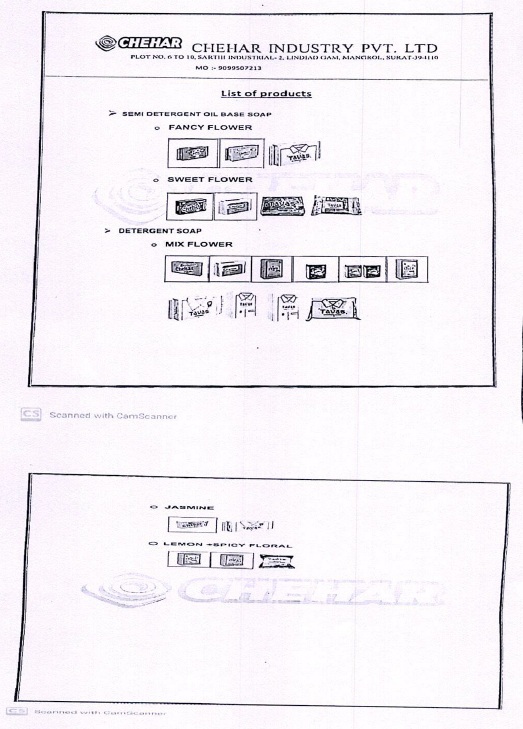
| ? | The Applicant maintains that the products under HSN 34011990 and 34011942 should attract a 5% GST rate; that this is supported by Notification No. 09/2025-Central Tax (Rate), dated 17.09.2025 which specifies that the tax rate on washing or laundry soap in the form of a bar or cake is 5%, effective from September 22, 2025. |
| ? | The Office of the Commissioner, CGST & C. Excise, Kolkata Audit_I, in a recent RTI clarification (Ref: 138/Kol Audit-I/RTI/2025-26) has explicitly stated that washing/laundry soap is taxable at 5% under Notification No.09/2025-Central Tax (Rate), dated 17.09.2025. |
| ? | The applicant has concluded his submission by stating that in light of the provided compositions, product photographs, and the prevailing tax notifications, they request the Hon’ble Authority to confirm that the products manufactured by the applicant are eligible for 5% CGST rate. |
Discussion and findings
7. At the outset, we would like to state that the provisions of both the CGST Act and the GGST Act are the same, except for certain provisions. Therefore, unless a mention is specifically made to such dissimilar provisions, a reference to the CGST Act would also mean a reference to the same provisions under the GGST Act.
8. We have considered the submissions made by the applicant in their application for advance ruling as well as the oral submissions made during the course of personal hearing. We have also considered the issue involved, the relevant facts & the applicant’s submission/views in respect of question on which the advance ruling is sought.
9. The applicant has submitted that they are engaged in the manufacture and trading of Washing/Laundry Soap in bar/cake form used for washing clothes or for toilet purposes; that Detergent Soap Bars are in various weights (ranging from 125 gms. To 300 gms.) marketed under the brand names “Chehar” and “Tavas” and fragrances include sweet flower, fancy flower, jasmine, lemon and mix flower; that these products are designed not only to remove stains but to provide long-lasting fragrance to apparel, which directly impacts the body hygiene and personal grooming of the wearer.; that the GST rate and classification of their products have been revised vide Notification No.09/2025-Central Tax (Rate), dated 17.09.2025, effective from 22.09.2025 following the recommendations of the 56th GST Council Meeting and there exists ambiguity regarding whether laundry soap and toilet soap are treated under a common heading or separately, and what HSN code is applicable for each product type; that they intend to seek clarification regarding the classification and applicable rate of GST on Washing/Laundry Soap (in BAR or CAKE form) used for washing clothes or for toilet purposes, in view of Notification No.09/2025-Central Tax (Rate). They have further submitted that to assist in the determination of the correct tax rate, they have attached: (i) photographs i.e. images of the soap bars and packaging for both Chehar and Tavas brands, (ii) detailed composition i.e. a breakdown of ingredients showing perfume content (in excel/PDF) and (iii) Legal precedent i.e. a clarification from the Kolkata Audit-I Commissionerate confirming that such laundry soaps are eligible for 5% GST rate.
10. The applicant has raised the following question for Advance Ruling:
| (i) | What is the correct classification and applicable GST rate on Washing/Laundry Soap (in BAR or CAKE form) used for washing clothes or toilet purposes as per Notification No.09/2025-Central Tax (Rate), dated 17.09.2025 effective from 22.09.2025? |
| (ii) | Whether such Washing/Laundry Soap for clothes and crockeries falls under the same GST rate and classification as Toilet Soap or under a separate tariff heading? |
| (iii) | What are the applicable 8 digit HSN codes and Rate of GST for Washing Soap, Laundry Soap, Crockeries Soaps and Toilet Soap under GST law? |
11. Since the applicant wants to know the correct classification and applicable GST rate on Washing Soap, Laundry Soap, Crockeries Soaps and Toilet Soap under GST law, we will be required to refer to the relevant Chapter notes, relevant tariff headings and HSN notes of the relevant tariff heading under the First Schedule to the Customs Tariff Act, 1975 (51 of 1975). We find that Chapter 34 of the First Schedule to the Customs Tariff Act, 1975 (51 of 1975) covers “Soap, organic surface-active agents, washing preparations, lubricating preparations, artificial waxes, prepared waxes, polishing or scouring preparations, candles and similar articles, modelling pastes, “dental waxes” and dental preparations with a basis of plaster.” We further find that soaps are covered under heading 3401 of Chapter 34 of the Customs Tariff. Therefore, we find it prudent to refer to Chapter Notes to Chapter 34, Tariff Heading 3401 as well as HSN notes to Tariff Heading 3401. The same are reproduced hereunder:
Chapter Notes of Chapter 34 of the First Schedule to the Customs Tariff Act, 1975 (51 of 1975)
CHAPTER 34
Soap, organic surface-active agents, washing preparations, lubricating preparations, artificial waxes, prepared waxes, polishing or scouring preparations, candles and similar articles, modelling pastes, “dental waxes” and dental preparations with a basis of plaster
NOTES:
1. This Chapter does not cover:
(a) edible mixtures or preparations of animal, vegetable or microbial fats or oils of a kind used as mould release preparations (heading 1517);
(b) separate chemically defined compounds; or
(c) shampoos, dentrifices, shaving creams and foams, or bath preparations, containing soap or other organic surface-active agents (heading 3305, 3306 or 3307).
2. For the purposes of heading 3401, the expression -soap applies only to soap soluble in water. Soap and the other products of heading 3401 may contain added substances (for example, disinfectants, abrasive powders, fillers or medicaments). Products containing abrasive powders remain classified in heading 3401 only if in the form of bars, cakes or moulded pieces or shapes. In other forms they are to be classified in heading 3405 as -scouring powders and similar preparations.
3. For the purposes of heading 3402, -organic surface-active agents are products which when mixed with water at a concentration of 0.5% at 20oC and left to stand for one hour at the same temperature:
(a) give a transparent or translucent liquid or stable emulsion without separation of insoluble matter: and
(b) reduce the surface tension of water 4.5 X 10⁻²N/m (45 dyne/Cm) or less.
4. In heading 3403, the expression -petroleum oils and oils obtained from bituminous minerals applies to the products defined in Note 2 to Chapter 27.
5. In heading 3404, subject to the exclusions provided below, the expression -artificial waxes and prepared waxes applies only to:
(a) chemically produced organic products of a waxy character, whether or not water-soluble;
(b) products obtained by mixing different waxes;
(c) products of a waxy character with a basis of one or more waxes and containing fats, resins, mineral substances or other materials, the heading does not apply to:
(i) products of headings 1516, 3402 or 3823, even if having a waxy character;
(ii) unmixed animal waxes or unmixed vegetable waxes, whether or not refined or coloured, of heading 1521;
(iii) mineral waxes and similar products of heading 2712 whether or not intermixed or merely coloured: or
(iv) waxes mixed with, dispersed in or dissolved in a liquid medium (headings 3405, 3809, etc.).
Tariff Heading 3401 as per the Customs Tariff:
3401 – SOAP; ORGANIC SURFACE-ACTIVE PRODUCTS AND PREPARATIONS FOR USE AS SOAP, IN THE FORM OF BARS, CAKES, MOULDED PIECES OR SHAPES, WHETHER OR NOT CONTAINING SOAP; ORGANIC SURFACE-ACTIVE PRODUCTS AND PREPARATIONS FOR WASHING THE SKIN, IN THE FORM OF LIQUID OR CREAM AND PUT UP FOR RETAIL SALE, WHETHER OR NOT CONTAINING SOAP; PAPER, WADDING, FELT AND NON-WOVENS, IMPREGNATED, COATED OR COVERED WITH SOAP OR DETERGENT
— Soap and organic surface-active products and preparations, in the form of bars, cakes, moulded pieces or shapes, and paper, wadding, felt and nonwovens, impregnated, coated or covered with soap or detergent:
3401 11 — For toilet use (including medicated products):
3401 11 10 — Medicated toilet soaps
3401 11 20 — Shaving soaps other than shaving cream
3401 11 90 — Other
3401 19 – Other:
— Bars and blocks of not less than 500 gm in weight:
3401 19 11 —- Industrial soap
3401 19 19 —- Other
3401 19 20 — Flakes, chips and powder
3401 19 30 — Tablets and cakes
— Household and laundry soaps not elsewhere specified or included:
3401 19 41 —- Household soaps
3401 19 42 —- Laundry soaps
3401 19 90 — Other
3401 20 00 – Soap in other forms
3401 30 – Organic surface-active products and preparations for washing the skin, in the form of liquid or cream and put up for retail sale, whether or not containing soap:
— For toilet use (including medicated products):
3401 30 11 —- Medicated toilet soaps
3401 30 12 —- Shaving cream and shaving gel
3401 30 19 —- Other
3401 30 90 — Other
HSN Notes of Tariff Heading 3401:
34.01- Soap; organic surface-active products and preparations for use as soap, in the form of bars, cakes, moulded pieces or shapes, whether or not containing soap; organic surface-active products and preparations for washing the skin, in the form of liquid or cream and put up for retail sale, whether or not containing soap; paper, wadding, felt and non-wovens, impregnated, coated or covered with soap or detergent.
– Soap and organic surface-active products and preparations, in the form of bars, cakes, moulded pieces or shapes, and paper, wadding, felt and non-wovens, impregnated, coated or covered with soap or detergent
3401.11 — For toilet use (including medicated products)
3401.19 — Other
3401.20 – Soap in other forms
3401.30 – Organic surface-active products and preparations for washing the skin, in the form of liquid or cream and put up for retail sale, whether or not containing soap
(I) SOAP
Soap is an alkaline salt (inorganic or organic) formed from a fatty acid or a mixture of fatty acids containing at least eight carbon atoms. In practice, part of the fatty acids may be replaced by rosin acids.
The heading covers only soap soluble in water, that is to say true soap. Soaps form a class of anionic surface-active agents, with an alkaline reaction, which lather abundantly in aqueous solutions.
There are three categories of soap:
Hard soaps, which are usually made with sodium hydroxide or sodium carbonate and comprise the bulk of the ordinary soaps. They may be white, coloured or mottled.
Soft soaps, which are made with potassium hydroxide or potassium carbonate. They are viscous and generally green, brown or pale yellow in colour. They may contain small quantities (generally not exceeding 5 %) of synthetic organic surface-active products.
Liquid soaps, which are solutions of soap in water, in some cases with a small quantity (generally not exceeding 5 %) of alcohol or glycerol added, but not containing synthetic organic surface-active products.
This part covers in particular:
(1) Toilet soaps frequently coloured and perfumed, which include: floating soaps and deodorant soaps, as well as glycerin soaps, shaving soaps, medicated soaps and certain disinfectant or abrasive soaps, as described below.
(a) Floating soaps and deodorant soaps.
(b) Glycerin soaps, which are translucent and are made by treating white soap with alcohol, glycerol or sugar.
(c) Shaving soaps (shaving creams fall in heading 33.07).
(d) Medicated soaps containing boric acid, salicylic acid, sulphur, sulphonamides or other medicinal substances.
(e) Disinfectant soaps, containing small quantities of phenol, cresol, naphthol, fonnaldehyde or other bactericidal, bacteriostatic, etc., substances. These soaps should not be confused with disinfecting preparations of heading 38.08 containing the same constituents, the difference lying in the proportions of the constituents (soap, on the one hand, and phenol, cresol, etc., on the other). The disinfecting preparations of heading 38.08 contain a substantial proportion of phenol, cresol, etc., and are liquid whereas disinfectant soaps are usually solid.
(f) Abrasive soaps, consisting of soap to which sand, silica, pumice powder, slate powder, sawdust or any similar product has been added. The heading covers abrasive soaps only in the form of bars, cakes or moulded pieces or shapes. Abrasive scouring pastes and powders, whether or not containing soap, fall in heading 34.05.
(2) Household soaps, which may be coloured or perfumed, abrasive or disinfectant.
(3) Rosin, tall oil or naphthenate soaps containing not only alkaline salts of fatty acids, but also alkaline resinates of heading 38.06 or alkaline naphthenates of heading 34.02.
(4) Industrial soaps, prepared for special purposes, such as those used for wire-drawing, for polymerising synthetic tubber, or in laundries.
Subject to the exception in paragraph 1 (f) above, the soaps of this heading are generally in the following forms: bars, cakes, moulded pieces or shapes, flakes, powder, paste or aqueous solution.
(II) ORGANIC SURFACE-ACTIVE PRODUCTS AND PREPARATIONS FOR USE AS SOAP, IN THE FORM OF BARS, CAKES OR MOULDED PIECES OR SHAPES, WHETHER OR NOT CONTAINING SOAP
This part includes toilet or washing products and preparations, in which the active component consists wholly or partly of synthetic surface-active agents (which may contain soap in any proportion), provided they are put up in the form of bars, cakes or moulded pieces or shapes, that is to say, the ordinary forms of soaps intended for the same uses.
This part also includes such products and preparations which have been rendered abrasive by adding sand, silica, pumice powder, etc., provided they are put up in the forms described above.
(III) ORGANIC SURFACE-ACTIVE PRODUCTS AND PREPARATIONS FOR WASHING THE SKIN, IN THE FORM OF LIQUID OR CREAM AND PUT UP FOR RETAIL SALE, WHETHER OR NOT CONTAINING SOAP
This part includes preparations for washing the skin, in which the active component consists wholly or partly of synthetic organic-surface active agents (which may contain soap in any proportion), provided they are in the form of liquid or cream and put up for retail sale. Such preparations not put up for retail sale are classified in heading 34.02.
(IV) PAPER, WADDING, FELT AND NONWOVENS, IMPREGNATED, COATED OR COVERED WITH SOAP OR DETERGENT
This part covers paper, wadding, felt and nonwovens, impregnated, coated or covered with soap or detergent, whether or not perfumed or put up for retail sale. These products are generally used for washing the hands or the face.
Apart from the exclusions referred to above, the heading excludes:
(a) Soap-stocks (heading 15.22).
(b) Products and preparations insoluble in water, which are “soaps, only in the chemical sense” such as calcium or other metallic “soaps” (Chapters 29, 30, 38, etc., as the case may be).
(c) Paper, wadding, felt and nonwovens, simply perfumed (Chapter 33).
(d) Shampoos and dentifrices (headings 33.05 and 33.06 respectively).
(e) Organic surface-active agents (other than soap), surface-active preparations and washing preparations (whether or not containing soap) and solutions or dispersions of soap in an organic solvent, of heading 34.02.
(f) Cellular plastics, cellular rubber, textile materials (other than wadding, felt and nonwovens) and metal pads, impregnated, coated or covered with soap or detergent (these generally fall in the heading appropriate to the supporting material).
12. We have gone through the Chapter notes of Chapter 34 of the First Schedule to the Customs Tariff Act, 1975 (51 of 1975), tariff heading 3401 as appearing in the Customs Tariff as well as HSN notes to tariff heading 3401. During the course of personal hearing, the applicant was asked to submit the manufacturing process of their products. We find that the applicant has, instead, submitted the typical chemical composition of their products i.e. semi-detergent oil base soaps and detergent soaps as well as the photographs of their products. We, therefore, proceed to decide the classification of the products of the applicant based on the details available on records. From the details submitted by the applicant, we find that the products manufactured by them are either semi-detergent oil base soaps (of sweet flower flavour and fancy flower flavour) OR detergent soaps (of jasmine flavour, lemon flavour or mix flower flavour) and none of the products are toilet soaps which indicates that the applicant is primarily involved in the manufacture of soaps in bar/cake form which do not prima facie appear to be toilet soaps. Despite this, we find that the applicant has asked for the classification and GST rate of ‘toilet soaps’ also. The applicant has also referred to Section 2(k) of the Medicinal and Toilet Preparations (Excise Duties) Act, 1955, which defines “Toilet Preparation” and has submitted that as per the said Act, “. “toilet preparation” means “any preparation which is intended for use in the toilet of the human body or in perfuming apparel of any description or any substance intended to cleanse, improve or alter the complexion, skin, hair or teeth, and includes deodorants and perfumes”. In this context, they have submitted that their soaps contain significant proportions of perfume and are specifically formulated to perfume apparel, hence they fall squarely within the broader definition of ‘toiletry’ activities and that the use of surfactants and builders in their composition ensures that the textiles worn against human skin are free from oils and bad smells, thus serving a hygienic purpose.
13. We find that the term ‘toilet soap’ is not defined under the CGST Act, 2017. We also find that the applicant is looking for definitions of ‘toilet soap’ in other Acts instead of referring to the definition of the said product as available in common parlance, to support his cause. This does not appear to be justifiable. It is a settled principle of law that definition of one statute cannot be made applicable in another statute. The Hon’ble Supreme Court in it’s judgement dated 27.11.2012 [2012 (286) E.L.T. 321 (S.C.) – 2012-VIL-04-SC-CE] in the case of appeal filed by the CCE v. Connaught Plaza Restaurant (P.) Ltd (SC)/(Civil Appeal Nos.5307-5308 of 2003 with [C.A.No.8097 of 2004] involving the classification of ‘soft serve’ served at the restaurant, has discussed the aspect of non-applicability of the definition of one statute in another statute as under: –
“43. We are unable to persuade ourselves to agree with the submission. It is a settled principle in excise classification that the definition of one statute having a different object, purpose and scheme cannot be applied mechanically to another statute. As aforesaid, the object of the Excise Act is to raise revenue for which various goods are differently classified in the Act. The conditions or restrictions contemplated by one statute having a different object and purpose should not be lightly and mechanically imported and applied to a fiscal statute for non-levy of excise duty, thereby causing a loss of revenue. [See; Medley Pharmaceuticals Limited v. Commissioner of Central Excise and Customs, Daman – (2011) 2 SCC 601 = 2011 (263) E.L.T. 641 (S.C.) – 2011-VIL-114-SC-CE and Commissioner of Central Excise, Nagpur v. Shree Baidyanath Ayurved Bhavan Limited – 2009 (12) SCC 419 = 2009 (237) E.L.T. 225 (S.C.) – 2009-VIL-19-SC-CE]. The provisions of PFA, dedicated to food adulteration, would require a technical and scientific understanding of “ice-cream “and thus, may require different standards for a goods to be marketed as “ice-cream”. These provisions are for ensuring quality control and have nothing to do with the class of goods which are subject to excise duty under a particular tariff entry under the Tariff Act. These provisions are not a standard for interpreting goods mentioned in the Tariff Act, the purpose and object of which is completely different.”
14. Applying the said analogy to the issue in hand, we find that the Medicinal and Toilet Preparations (Excise Duties) Act, 1955 is an Act that has been enacted for the levy and collection of duties of excise on medicinal and toilet preparations containing alcohol (narcotic drug or narcotic) and has nothing to do with the class of goods which are subject to GST under a particular tariff entry under the First Schedule to the Customs Tariff Act, 1975 (51 of 1975). These provisions are not a standard for interpreting goods mentioned in the Customs Tariff Act, the purpose and object of which is completely different. In view of the above discussions, we find that, rather than looking for meaning of the terms in other statutes, the meanings of such terms should be referred to, as available, in common parlance. As per the Merriam Webstar dictionary, ‘toilet soap’ is defined as “a mild soap, often perfumed and coloured, and stabilized with preservatives which is designed specifically for personal hygiene, such as washing the face, hands, and body, rather than for cleaning clothes or household items”. As per Oxford Learner’s dictionary, ‘toilet soap’ is defined as ‘the soap that you use to wash yourself, specifically for personal hygiene (washing the body, hands or face) rather than for laundry or household cleaning’. Further, the applicant has submitted that their soaps contain significant proportions of perfume and are designed not only to remove stains but to provide long-lasting fragrance to apparel, which directly impacts the body hygiene and personal grooming of the wearer, thus ensuring body hygiene through clean textiles. This obviously means that it is not designed specifically for personal hygiene such as washing the face, hands, and body. We, therefore, find that when taking into consideration, the definition of ‘toilet soaps’ as known in common parlance and comparing that with the use of the products as mentioned by the applicant i.e. semi-detergent OR detergent soaps, it can be safely assumed that these products do not get covered under the definition of ‘toilet soaps’.
15. In common parlance, soap is defined as a water-soluble sodium or potassium salt of fatty acids, typically produced through the saponification of natural oils or fats with an alkali (like sodium hydroxide for bars) and acts as a surfactant for cleaning and bathing with quality often determined by Total Fatty Matter (TFM). Further, toilet soaps generally have a higher Total Fatty Matter (TFM) of 60-80% compared to laundry soaps, which means they contain more skin-conditioning materials. The main difference between toilet / bathing and laundry / washing soap is that Toilet / Bathing soaps are typically potassium salts of fatty acids, making them softer, while washing soaps (laundry soaps) are sodium salts of fatty acids, resulting in a harder consistency, with the key difference stemming from the use of potassium hydroxide (KOH) for bathing soaps versus sodium hydroxide (NaOH) for washing soaps during their production. On going through the chemical composition of the semi-detergent and detergent soaps given by the applicant, we do not find the mention of the content of Total Fatty matter (TFM) contained therein nor do we find the presence of potassium hydroxide (KOH) or potassium carbonate. Thus, from this aspect also, we find that the applicant’s products do not fall under the definition of ‘toilet soaps’.
16. As is known in common parlance, Laundry soaps and detergents are surfactants used to clean clothes, remove stains, break down grease/oils, and deodorize textiles. Laundry soap is designed to clean fabrics with strong detergents and high alkalinity. Laundry soap has a high alkaline pH to break down dirt on fabrics and often contains bleaching agents, enzymes, and fillers (e.g., sodium silicate, borax). As per the submission of the applicant, they are engaged in the manufacture and trading in Washing/Laundry Soap in bar/cake form used for washing clothes or for toilet purposes, that their products are designed not only to remove stains but to provide long-lasting fragrance to apparel, which directly impacts the body hygiene and personal grooming of the wearer, thus ensuring body hygiene through clean textiles. Thus, even when examining the applicant’s products based on their uses, they get covered under the ambit of laundry soaps. Further, it can also be seen from the chemical constitution of the products of the applicant that they contain fillers ranging from 30 to 70%. Thus, from the above discussions, we find and conclude that the semi-detergent soaps as well as detergent soaps manufactured and traded by the applicant are nothing but laundry soaps classifiable under heading 3401 and specifically sub-heading 34011942 of the First Schedule to the Customs Tariff Act, 1975 (51 of 1975).
17. The applicant, in their question seeking advance ruling also wants to know the classification of toilet soaps, crockeries soaps, washing soaps and laundry soaps and their applicable GST rates. However, since we have already concluded that the soaps manufactured by the applicant are laundry soaps only, we are not inclined to give any reply/answer to the questions relating to the other soaps. Further, the applicant is also found to have referred to an RTI clarification given by the AC & CPIO of CGST & C. Ex Audit-I Commissionerate, Kolkata wherein it is mentioned that washing and laundry soaps in the form of bar/cake are liable to GST @ 5%. In this regard, we would like to mention here that such clarifications by AC/CPIO of individual CGST & Central Excise Commissionerates is provided under the RTI Act based on available information. Such information cannot be equated with decisions of higher judicial forum and hence, are not binding on us.
18. Having decided the classification of the products of the applicant, we need to find out the GST rate of the products for which a reference will be required to be made to Notification No.09/2025-Central Tax (Rate), dated 17.09.2025. Notification No.09/2025-Central Tax (Rate), dated 17.09.2025 reads as under:
GOVERNMENT OF INDIA
MINISTRY OF FINANCE
(DEPARTMENT OF REVENUE)
NOTIFICATION NO. 9/2025-Central Tax (Rate)
New Delhi, the 17th September, 2025
In exercise of the powers conferred by sub-section (1) of section 9 and sub-section (5) of section 15 of the Central Goods and Services Tax Act, 2017 (12 of 2017), and in supersession of the notification of the Government of India in the Ministry of Finance (Department of Revenue), No. 01/2017-Central Tax (Rate), dated the 28th June, 2017 published in the Gazette of India, Extraordinary, Part II, Section 3, Sub-section (i), vide number G.S.R. 673(E), dated the 28th June, 2017, except as respects things done or omitted to be done before such supersession, the Central Government, on the recommendations of the Council, hereby notifies the rate of central tax of-
| (i) | 2.5 per cent. in respect of goods specified in Schedule I; |
| (ii) | 9 per cent. in respect of goods specified in Schedule II; |
| (iii) | 20 per cent. in respect of goods specified in Schedule III; |
| (iv) | 1.5 per cent. in respect of goods specified in Schedule IV; |
| (v) | 0.125 per cent. in respect of goods specified in Schedule V; |
| (vi) | 0.75 per cent. in respect of goods specified in Schedule VI, and |
| (vii) | 14 per cent. in respect of goods specified in Schedule VII, |
appended to this notification (hereinafter referred to as the said Schedules), that shall be levied on intra-State supplies of goods, the description of which is specified in the corresponding entry in column (3) of the said Schedules, falling under the tariff item, sub-heading, heading or Chapter, as the case may be, as specified in the corresponding entry in column (2) of the said Schedules.
Schedule II – 9 %
|
Sl. No.
|
Chapter/ Heading/ Sub-heading/ Tariff item | Description of goods |
| (1) | (2) | (3) |
| 66 | 3401 | Soap; organic surface-active products and preparations for use as soap, in the form of cakes, moulded pieces or shapes, whether or not containing soap [other than toilet soap in the form of bars, cakes, moulded pieces or shapes]; organic surface active products and preparations for washing the skin, in the form of liquid or cream and put up for retail sale, whether or not containing soap; paper, wadding, fell and nonwovens, impregnated, coated or covered with soap or detergent. |
19. On going through the aforementioned Notification, we find that there is only one entry covering the product of the applicant, i.e. (i) Entry No.66 of Schedule-II of the said notification which reads as “Soap; organic surface-active products and preparations for use as soap, in the form of cakes, moulded pieces or shapes, whether or not containing soap [other than toilet soap in the form of bars, cakes moulded pieces or shapes]; organic surface active products and preparations for washing the skin, in the form of liquid or cream and put up for retail sale, whether or not containing soap; paper, wadding, felt and nonwovens, impregnated, coated or covered with soap or detergent.” Further, the said entry being in Schedule-II of the Notification No.09/2025-Central Tax (Rate), dated 17.09.2025, attracts GST rate of 18% (9% CGST + 9% SGST). We therefore conclude that the product namely “laundry soap” of the applicant is classifiable under sub-heading 34011942 of the First Schedule to the Customs Tariff Act, 1975 (51 of 1975), appears at Sr. No. 66 of Schedule-II of Notification No.09/2025-Central Tax (Rate), dated 17.09.2025 and is liable to GST at the rate 18% (9% CGST + 9% SGST).
20. In view of the above, we rule as under: –
RULING
Question-(i) What is the correct classification and applicable GST rate on Washing/Laundry Soap (in BAR or CAKE form) used for washing clothes or toilet purposes as per Notification No.09/2025-Central Tax (Rate), dated 17.09.2025 effective from 22.09.2025?
Answer-(i) Laundry Soap (in BAR or CAKE form) used for washing clothes is correctly classifiable under Sub-heading (HSN code) 34011942 of the First Schedule to the Customs Tariff Act, 1975 (51 of 1975). It is covered under Entry No. 66 of Schedule-II of Notification No.09/2025-Central Tax (Rate), dated 17.09.2025 and is liable to GST at the rate of 18% (9% CGST + 9% SGST).
Question-(ii) Whether such Washing/Laundry Soap for clothes and crockeries falls under the same GST rate and classification as Toilet Soap or under a separate tariff heading?
Answer-(ii) Not answered in light of the discussions in paras supra.
Question-(iii) What are the applicable 8 digit HSN codes and Rate of GST for Washing Soap, Laundry Soap, Crockeries Soaps and Toilet Soap under GST Law?
Answer-(iii) Already answered in (i) above. Not inclined to give answers with regard to HSN codes for washing soap, crockeries soap and toilet soap for reasons discussed in paras supra.