


Used Jute Gunny Bags Classifiable Under HSN 6305 Attracting 5 Percent or 18 Percent GST Based on Sale Value
Issue
What is the correct classification and applicable GST rate under Heading 6305 for the sale of used jute gunny bags (woven sacks without plastic coating) received during raw material procurement and sold as packing material?
Facts
-
Business Operation: The applicant, a cooperative federation, manufactures cattle feed at its Malampuzha plant.
-
Source of Bags: Raw materials for cattle feed production are procured in jute gunny bags (jute woven sacks without plastic coating).
-
Disposal Method: Used gunny bags are periodically disposed of through e-tender/auction to buyers who purchase them for reuse as packing bags.
-
Advance Ruling Request: The applicant sought an advance ruling on the applicable GST rate for selling these used gunny bags.
Decision
-
Not Classified as Scrap: The Authority held that used gunny bags disposed of in intact condition are not classifiable as scrap, but as reusable packing sacks/bags under Heading 6305.
-
Applicable GST Rates: Under Notification No. 09/2025-Central Tax (Rate), dated 17-09-2025, the applicable GST rates are:
-
5% GST (2.5% CGST + 2.5% SGST) if the sale value does not exceed ₹2,500 per piece.
-
18% GST (9% CGST + 9% SGST) if the sale value exceeds ₹2,500 per piece.
-
-
Scope Restriction: The ruling applies strictly to intact, reusable packing bags. Worn out, torn, or cut bags reduced to waste require separate classification as scrap.
Key Takeaways
-
Intact Condition Retains Packing Bag Status: Used packing containers or bags sold for reuse retain their original tariff classification under Heading 6305 and cannot be classified as process scrap.
-
Value-Based GST Slabs: Goods under HSN Heading 6305 attract a bifurcated GST rate structure depending on whether the sale value per piece crosses the specified monetary threshold (₹2,500).
-
Physical State Determines Classification: The physical integrity of the item dictates tax treatment; intact bags are treated as packing containers, whereas shredded or unusable bags are treated as industrial waste/scrap.
AUTHORITY FOR ADVANCE RULING , KERALA
Kerala Cooperative Milk Marketing Federation Ltd., In re
Jomy Jacob, Member (Central Tax)
and IRS Mansur M.I., Member (State Tax)
and IRS Mansur M.I., Member (State Tax)
ADVANCE RULING No. KER/03/2026
APRIL 28, 2026
Babuprakash K.V., Purchase Officer for the Applicant.
ORDER
1. The applicant, M/s KERALA COOPERATIVE MILK MARKETING FEDERATION LIMITED is registered as a Society/ Club/ Trust/ AOP having GSTIN 32AAAAK5375M6ZB.
2. In this Ruling, a reference hereinafter to the provisions of the CGST Act, Rules or the Notifications issued there under shall include a reference to the corresponding provisions of the KSGST Act, Rules or the Notifications issued thereunder.
3. The facts of the issue: The brief facts of the matter, as submitted by the applicant, are as follows.
3.1 Kerala Co-operative Milk Marketing Federation Limited (KCMMF) (“the Applicant”), popularly known as MILMA, is engaged in the manufacturing and supply of cattle feed and other dairy-related products through its various units in the State of Kerala. The present application pertains to the activities of its Cattle Feed Plant at Malampuzha, Palakkad, which was established in 1972 by the Animal Husbandry Department, Government of Kerala and later transferred to KCMMF in 1983 under Operation Flood II. The plant is engaged in the production of cattle feed and nutritional supplements using modern computerized systems, with a capacity of up to 300 metric tons per day, supplying products such as Milma Gomathi, Gomathi Rich, Gomathi Gold, Bypro feeds, MilmaMin and Ksheerasamrudhi to dairy farmers across multiple districts through cooperative networks.
3.2 In the course of its manufacturing operations, the applicant procures raw materials such as maize, de-oiled rice bran, coconut cake, cotton seed and similar agricultural inputs. These materials, particularly maize, are received from suppliers in gunny bags (jute woven sacks without plastic coating), while other materials are received in polypropylene (PP) bags. After consumption of the raw materials in the manufacturing process, the empty bags remain as used packing material.
3.3 The used bags, which are no longer required for manufacturing purposes, are periodically disposed of through separate e-tender/auction processes conducted by the applicant. The applicant submits that the buyers purchase such used gunny bags with the intention of reusing them, and that such bags are capable of being reused for packing agricultural produce such as maize and whole cereals. The auction notices specify the sale of such materials as used gunny bags or old PP bags, and the disposal of PP bags and gunny bags is undertaken through separate tenders.
3.4 The applicant submits that the used gunny bags are reusable in nature and are generally bundled together and sold in lots, typically in bundles of approximately 50 bags per bundle. These bags, originally used for packing agricultural raw materials, retain their essential character and utility as packing bags even after use. The applicant has also submitted sample sale invoices wherein such goods are described as “old gunny bags” and classified under HSN 630510, including instances where GST has been discharged at the rate of 5%.
3.5 The applicant further submits that used PP bags are treated and sold as scrap, classified under HSN 391590, attracting GST at 18%, and the applicant has no dispute regarding such classification. However, the contention in the present case is limited to used gunny bags without plastic coating, which, according to the applicant, are not sold as scrap but as reusable packing bags. In certain past tenders, GST at the rate of 18% had been applied on the sale value of such used gunny bags; however, bidders have contended that the applicable rate should be 5%. Due to this divergence of views and the resulting uncertainty regarding the correct classification and applicable rate of tax, the applicant, who is in the process of issuing fresh tenders for sale of used gunny bags, has approached this Authority seeking clarification on the appropriate HSN classification and GST rate applicable to such supplies.
4. Applicant’s Interpretation of Law and Position on Taxability are as follows.
4.1 The applicant submits that the used gunny bags sold by them are jute woven sacks which were originally used for packaging of agricultural raw materials such as maize and whole cereals, and even after re-sale are intended to be re-used for packaging.
4.2 The applicant further submits that such goods are classifiable under HSN 6305, which covers “sacks and bags, of a kind used for the packing of goods”, and more specifically under HSN 63051040, pertaining to jute sacks and bags used for packing goods.
4.3 As per Notification No. 1/2017-Central Tax (Rate) dated 28.06.2017, as amended from time to time, goods falling under Heading 6305 relating to jute sacks and bags used for packing agricultural produce attract GST at the rate of 5% (2.5% CGST + 2.5% SGST).
4.4 The applicant further references Explanatory Notes (2022) issued by the World Customs Organisation (WCO).
4.5 The applicant further submits that while used PP bags are treated and sold as scrap under HSN 391590 attracting GST at 18%, the used gunny bags without plastic coating are not sold as scrap but as reusable packing bags. Accordingly, it is their contention that such used gunny bags merit classification under HSN 6305 and should attract GST at 5%, and not be subjected to the higher rate applicable to scrap.
4.6 The applicant has also furnished photographic evidence (Figure 1) of the used gunny bags, showing that the bags are intact, bundled and capable of reuse as such. Further, a sample sale invoice (Figure 2) has been submitted wherein the goods are described as “old gunny bags” and supplied as identifiable packing material under HSN 6305. The applicant relies on these evidences to substantiate that the impugned goods are not waste or scrap but reusable packing bags retaining their original character and utility.
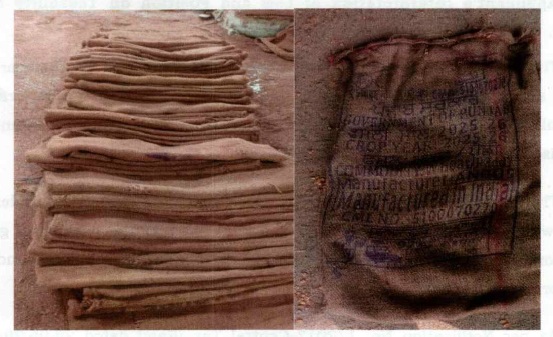
Figure 1
Further, the sample sale invoice submitted by the applicant describes the goods as “old gunny bags” and reflects their supply as identifiable packing material rather than waste or scrap, as given under.
4.7 The combined evidentiary value of the photographs and invoice substantiates that the goods retain their original form, structure and commercial identity as reusable packing bags.
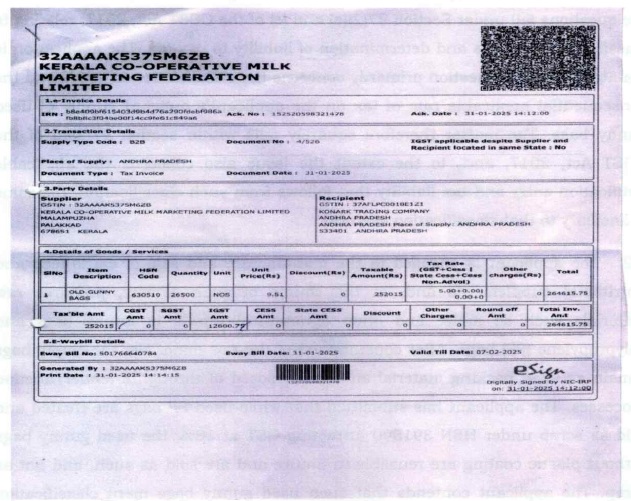
Figure 2
5. Comments of the Jurisdictional Officer
The application was forwarded to the jurisdictional officer in accordance with the provisions of Section 98(1) of the CGST Act. The jurisdictional officer has reported that the issue raised in the present application is neither pending nor decided in any proceedings under any provision of the Act.
6. Personal Hearing:
The applicant was granted an opportunity for a personal hearing on 26.02.2026. Mr. Babuprakash K.V., Purchase Officer represented for the applicant in personal hearing. In the hearing, he explained the nature of activity undertaken by the applicant and reiterated the contentions submitted in the written application.
7. Discussion and Findings:
7.1 . On review of the application, facts, and hearing submissions, it is found that the questions fall under Section 97(2)(a) and (e) of the CGST Act, 2017, relating to classification of goods and determination of liability to pay tax. The application is maintainable. The question primarily concerns the classification of goods and the consequential applicable rate of tax on the applicant’s outward supply of used gunny bags. The matter therefore squarely falls within section 97(2)(a) of the CGST Act, 2017, and, to the extent the issue also concerns the applicable notification entry and tax liability that follows from such classification, the same is ancillary to that classification exercise.
7.2 The applicant is engaged in the manufacture and sale of cattle feed and nutritional supplements and, in the course of such activity, procures raw materials such as maize and other agricultural inputs in gunny bags and polypropylene (PP) bags. After consumption of the raw materials, the empty bags remain as used packing material and are disposed of through e-tender/auction processes. The applicant has submitted that while used PP bags are treated and sold as scrap under HSN 391590 attracting GST at 18%, the used gunny bags without plastic coating are reusable in nature and are sold as such, and not as scrap. The applicant contends that such used gunny bags merit classification under HSN 6305 attracting GST at 5%.
7.3 The primary issue for consideration is whether the used gunny bags without plastic coating, arising after use in packing of raw materials and subsequently sold by the applicant, are to be classified as reusable packing bags under HSN 6305 or as waste/scrap under other headings, and the applicable rate of GST thereon.
7.4 In the present case, it is observed that the gunny bags in question were originally used for packing agricultural raw materials such as maize and whole cereals. Even after use, the applicant has demonstrated that such bags are reusable in nature, are sold in identifiable form as “old gunny bags”, and are capable of being reused for the same purpose of packing agricultural produce. The goods are not sold in shredded or unusable condition, but retain their essential character as sacks and bags.
7.5 In this regard, it is observed that the applicant has furnished photographic evidence of the impugned goods, which has been placed on record in Para 4.6 above (refer Figure 1). The images clearly show that the bags remain intact, bundled and capable of reuse without any further processing. Further, the sample sale invoice submitted by the applicant (refer Figure 2 in Para 4.7 above) describes the goods as “old gunny bags” and reflects their supply as identifiable packing material rather than waste or scrap. The combined evidentiary value of the photographs and invoice substantiates that the goods retain their original form, structure and commercial identity as reusable packing bags.
7.6 On the other hand, waste and scrap generally refer to goods that are no longer usable for their original purpose and are sold for recovery of material value. In contrast, in the present case, the used gunny bags continue to retain their functionality and are intended to be reused as packing material. This clearly distinguishes them from plastic waste such as used PP bags, which the applicant has classified under HSN 391590.
7.7 In this regard, reference may also be drawn to the definition of “scrap” under Section 206C of the Income Tax Act, which describes scrap as waste arising from manufacture or mechanical working that is not usable as such due to breakage, wear or similar reasons. Though this definition is not determinative for GST classification, it reinforces the general understanding that scrap consists of materials no longer usable for their original intended purpose.
7.8 It is a settled principle that classification must be determined based on the common parlance and commercial identity of goods, as held by the Hon’ble Supreme Court of India in Dunlop India Ltd. v. Union of India. Further, the Hon’ble Supreme Court in Atul Glass Industries (P.) Ltd. v. CCE 1986 (25) E.L.T. 473 (SC) held that the functional character and primary use of the goods are relevant in determining classification. In the instant case, the used gunny bags are supplied in usable condition, bundled as identifiable packing sacks, and intended for reuse in packing agricultural produce such as maize and whole cereals. Therefore, applying these settled principles of classification, such goods merit classification under Heading 6305 as reusable packing bags rather than under any heading relating to waste or scrap. The essential character of the goods at the time of supply remains that of packing bags, as they retain their form, structure and usability.
7.9 Furthermore, it is a settled principle of classification under the GST regime, aligned with the Customs Tariff, that goods are to be classified based on their essential character, condition at the time of supply, and intended use, and that classification must depend upon the commercial identity and use of the goods. In the present case, the used gunny bags retain their essential character as packing containers and continue to possess their original identity and utility. It is well established that goods do not become waste or scrap merely on account of prior use, so long as they retain their identity and functional utility. Waste and scrap arise only when goods lose their original utility and are fit solely for recovery of constituent material.
7.10 Now, for the purpose of classification under GST, reference is to be made to the Customs Tariff Act, 1975, along with the relevant Section Notes, Chapter Notes and the General Rules for the Interpretation of the Tariff. Heading 6305 of the Tariff covers “sacks and bags, of a kind used for the packing of goods”, and sub-heading 6305 10 specifically covers such sacks and bags made of jute or other textile bast fibres. Such classification is based on the essential character and functional use of the goods.
7.11 In addition to Heading 6305, other headings within Chapter 63, namely Heading 6309 (worn clothing and other worn textile articles) and Heading 6310 (rags and textile scrap), also provide for classification of used or worn textile materials. Accordingly, the applicability of these headings has also been examined in the present case, particularly in view of the possibility of classification as worn articles or scrap. As per the Explanatory Notes to Heading 6309, the heading applies to worn clothing and other worn textile articles, subject to specified conditions. However, the Notes specifically provide that ‘sacks and bags showing signs of wear’ are excluded from this heading and are to be classified under their respective headings. Therefore, even if the impugned goods show signs of prior use, they are expressly excluded from classification under Heading 6309. Heading 6310 covers rags, scrap twine, cordage and worn-out textile articles, which are required to be worn out, dirty, torn or in small pieces and generally fit only for recovery purposes such as extraction of fibres. In the present case, the goods are intact gunny bags and are not reduced to cuttings, fragments or unusable residue. They retain their identity as bags and are capable of reuse. Accordingly, they do not satisfy the conditions of Heading 6310.
7.12 It is noted that the goods are disposed of through auction platforms where they may be described as ‘scrap’ and sold in bulk quantities. However, it is a settled principle that nomenclature used in commercial or auction documents is not determinative of classification. Classification must be based on the nature, condition and identity of the goods at the time of supply. On the basis of the facts on record, it is found that the impugned goods are used gunny bags which remain intact, identifiable and capable of reuse as packing material. They are not in the nature of rags, cuttings or worn-out textile waste. In view of the Explanatory Notes to Heading 6309 and 6310, which respectively exclude sacks and bags showing wear and restrict coverage to worn-out textile materials fit only for recovery, the impugned goods cannot be classified under these headings. Accordingly, the goods merit classification under Heading 6305.
7.13 It is further observed that a distinction based on the transaction value per piece in respect of goods falling under Heading 6305 originates from the entries under the Customs Tariff Act, 1975, which have been adopted for GST rate purposes. The relevant tariff entries under Chapter 63 classify sacks and bags of a kind used for packing goods based on their sale value.
7.14 Further, as per Schedule I of Notification No. 9/2025-Central Tax (Rate) dated 17.09.2025 by Notification No., Sr. No. 390 – Other made up textile articles, sets, of sale value not exceeding Rs. 2500 per piece attract GST at the rate of 5% (2.5% CGST + 2.5% SGST), and where the sale value exceeds Rs. 2500 per piece attract GST at the rate of 18% (9% CGST + 9% SGST). The relevant entries are produced below:
Schedule I -2.5%
| Sl. No | Chapter / Heading/ Sub Heading/ Tariff Item | Description |
| (1) | (2) | (3) |
| 390 | 63 [other than 6305 32 00, 6305 33 00, 6309] | Other made up textile articles, sets, of sale value not exceeding Rs. 2500 per piece |
Schedule II -9%
| Sl. No | Chapter / Heading/ Sub Heading/Tariff Item | Description |
| (1) | (2) | (3) |
| 199 | 63 [other than 6309] | Other made-up textile articles, sets of sale value exceeding Rs. 2500 per piece [other than worn clothing and other worn articles; rags] |
8. In view of the above discussion and findings, it is held that the used gunny bags without plastic coating, sold by the applicant, being reusable packing bags retaining their essential character, are classifiable under Heading 6305 of the Customs Tariff Act, 1975 and attract GST at the rate of 5% where the sale value does not exceed Rs. 2500 per piece, and 18% where the sale value exceeds Rs.2500 per piece.
9. In the light of the facts and legal position as stated above, the following ruling is issued:
RULING
Question: What is the prevailing GST rate (CGST and SGST) for sale of Used Gunny Bags received during purchase of Raw materials for Cattle feed Manufacturing process and sold as Scrap?
Ruling- The used gunny bags (jute sacks without plastic coating) arising during the course of manufacturing and sold by the applicant are not classifiable as scrap, but as reusable packing bags under Heading 6305 of the Customs Tariff Act, 1975. Accordingly, the applicable GST rate is:
| • | 5% (2.5% CGST + 2.5% SGST) where the sale value does not exceed Rs. 2500 per piece; and |
| • | 18% (9% CGST + 9% SGST) where the sale value exceeds Rs. 2500 per piece, |
in terms of Notification No. 9/2025-Central Tax (Rate) dated 17.09.2025, as amended.
This ruling is applicable only to goods which remain intact and reusable as packing bags. It is clarified that where such bags are worn out, torn, or reduced to cuttings or waste, rendering them unfit for reuse as packing material, the classification may differ and would require independent examination.