


Ad hoc Disallowances, Form 26AS Additions, and Cessation Triggers Deleted; Flood Relief Expenses Remanded for Assessment
Issue
Whether ad hoc expense disallowances, section 40(a)(ia) penalties for non-compliance with section 194C(7), section 41(1) additions on outstanding trade advances, section 26AS interest adjustments without accrual, high repair expenses on leased property, infrastructure sharing payments, and section 43B customs duty claims are legally sustainable.
Facts
-
Flood Victims Relief (AY 2011-12): The assessee incurred costs constructing houses for flood victims under a Karnataka Government scheme and claimed deduction under section 37(1). The AO disallowed it as non-business, though High Court precedents treat such spend as allowable due to commercial expediency.
-
Ad Hoc Expense & Transportation Disallowances (AY 2011-12): The AO made ad hoc disallowances (10% on general expenses; 20% on transportation charges) citing lack of verification. The assessee had submitted detailed vouchers, PANs, tax audit certificates, and transporter confirmations.
-
TDS under Section 194C/40(a)(ia) (AY 2011-12): Transportation charges were paid without TDS under section 194C(6) as transporters furnished PANs. The AO disallowed payments under section 40(a)(ia) for failure to file forms under section 194C(7).
-
Form 26AS Interest Income (AY 2013-14): The AO taxed interest appearing in Form 26AS despite the assessee not receiving it due to uncertainty of recovery and offering it to tax in a subsequent year on receipt basis.
-
Repairs on Rented Premises & Infrastructure Charges (AY 2013-14): The AO disallowed ₹40 lakhs of ₹45.31 lakh repairs on rented property (rent paid ₹3.07 lakhs) as excessive, and disallowed ₹49.21 lakhs spent on a shared office space in Bangalore with full infrastructure.
-
Customs Duty & Unpaid Advances (AY 2013-14): The AO added outstanding overseas customer advances under section 41(1) due to export bans and disallowed customs duty paid partly before year-end and balance before the return filing due date.
Decision
-
Flood Relief Expenditure: Remanded to the AO to re-determine in light of the jurisdictional High Court precedent allowing such spend as business expenditure; any consequent profit enhancement of the 100% EOU remains eligible for section 10B deduction. [Matter remanded]
-
Ad Hoc Expenses & Transportation Charges: Disallowances deleted as the assessee produced complete invoices, PANs, and auditor certificates, and the lower authorities showed no proof of non-genuineness or inflation. [In favour of assessee]
-
Section 40(a)(ia) Disallowance: Deleted; once transporters provide their PANs under section 194C(6), no TDS obligation arises. Non-compliance with reporting under section 194C(7) cannot trigger disallowance under section 40(a)(ia). [In favour of assessee]
-
Form 26AS Taxability: Merely appearing in Form 26AS does not make income taxable if receipt is uncertain and un-accrued; TDS credit follows the year the income is actually offered to tax. [In favour of assessee]
-
Repairs & Shared Infrastructure Spending: Disallowances deleted; high repair costs on rented premises without creating a capital asset cannot be disallowed simply because rent is low, and shared office expenses supported by third-party returns are valid business spends. [In favour of assessee]
-
Section 41(1) & Section 43B Additions: Outstanding advances cannot be taxed under section 41(1) without express remission or written-off liability. Full customs duty paid before the return filing due date is completely deductible under section 43B. [In favour of assessee]
Key Takeaways
-
Ad Hoc Disallowances Prohibited: Assessing officers cannot make arbitrary percentage-based disallowances when taxpayers provide documentary evidence, PANs, and tax audit records without proving the expenditure non-genuine.
-
Form 26AS is Not Conclusive Proof of Income: Mismatches between Form 26AS and books do not automatically create taxable income when realization remains uncertain and accrual principles are not satisfied.
-
PAN Exemption under Section 194C: Submission of a transporter’s PAN completely exempts the payer from TDS under section 194C(6); procedural default under section 194C(7) does not trigger section 40(a)(ia) disallowance.
-
No Section 41(1) Addition for Active Liabilities: Outstanding trade advances or liabilities cannot be treated as income under section 41(1) unless there is clear evidence of write-off, remission, or statutory cessation of liability.
IN THE ITAT BANGALORE BENCH ‘A’
Kariganur Mineral Mining Industry
v.
Joint Commissioner of Income-tax
Prashant Maharishi, Vice President
and SOUNDARARAJAN K., Judicial Member
and SOUNDARARAJAN K., Judicial Member
IT Appeal Nos.1025 & 1026 (Bang.) of 2024
[Assessment years 2011-12 and 2013-14]
[Assessment years 2011-12 and 2013-14]
APRIL 27, 2026
B.S. Balachandran, Adv. and H. Siva Prasad Reddy, ITP for the Appellant. Smt. N. Hemalatha, CIT(DR) for the Respondent.
ORDER
Prashant Maharishi, Vice President.-Kariganur Mineral Mining Industry (100% EOU), the assessee/appellant, has filed two appeals concerning similar matters for the assessment years 2011-12 and 2012-13. Accordingly, both appeals are addressed and resolved through this consolidated order.
2. ITA No. 1025/Bangalore/2024 pertains to the assessment year 201112 and is filed against the appellate order issued by the National Faceless Appeal Centre, Delhi (NFAC) [ld. CIT(A)] dated 23 March 2024. In this order, the appeal submitted by the assessee challenging the assessment order under section 143(3) of the Income-tax Act, 1961 [the Act], dated 31 March 2044, as passed by the JCIT, Bellary Range, Bellary [ld. AO], was dismissed.
3. The assessee has raised the following grounds of appeal :-
“1. The impugned assessment order dated, 31-03-2014 passed u/s 143(3) of the Act is arbitrary and opposed to the facts of the case; and therefore, liable to be set aside as void.
NON-EOU ADDITIONS.
2. The learned AO erred in disallowing the expenditure of Rs. 3,79,79,550/- incurred by the assessee for construction of residential houses to the persons whose houses were destroyed during the unprecedented floods as per the appeal and scheme of Government of Karnataka.
3. The learned AO erred in disallowing 10% of vehicle hire and other expenses amounting to Rs. 43,96,173/
4. The learned AO erred in disallowing 20% of Transportation charges amounting to Rs. 68,33,314/
5. The learned AO erred in disallowing Transportation charges of Rs. 2,73,33,366/- applying section 40(a)(ia) of the Act.
100% EOU
6. The learned AO erred in disallowing the expenditure of Rs. 84,93,150/- incurred by the assessee for construction of residential houses to the persons whose houses were destroyed during the unprecedented floods as per the appeal and scheme of Government of Karnataka.
7. The learned AO erred in disallowing Transportation charges of Rs. 4,02,47,731/- applying section 40(a)(ia) of the Act.
8. The learned AO ought to have appreciated that the enhanced income of the 100% EOU consequent to the additions/disallowances made is eligible for exemption u/s10B of the Act.
GENERAL.
9. The assessee-Appellant craves leave to add or revise or amend, or substitute or delete any Ground at the time of the hearing before the Hon’ble Tribunal.
For these and further Grounds of Appeal that may be taken at the time of hearing, it is prayed that the Hon’ble Tribunal may be pleased to allow the appeal-in the interest of the equity and justice.”
4. The facts, in brief, indicate that the assessee, a partnership firm engaged in the business of trading iron ore, filed its return of income on 30 September 2011, declaring a total income of Rs. 21,92,86,600, which was subsequently selected for scrutiny. It has two units, one is normal trading/manufacturing unit and another is hundred percent export-oriented unit eligible for deduction under section 10 B of the income tax act. Following the issuance of notice under section 143(2) of the Act, an assessment order was passed, determining the total income of the assessee at Rs. 33,60,92,120.
5. The ld. AO has made the following additions to the total income of the assessee:-
| (i) | Disallowance of Rs. 3,79,79,550 being expenditure incurred by the assessee of social welfare. |
| (ii) | Addition of Rs. 43,96,173 being expenditure incurred by the assessee under the head spares and consumables, machinery & vehicle hire charges, loading charges, material shifting, travelling, salary, wages etc., being 10% of total expenditure considering it as excessive. |
| (iii) | Disallowance of 20% of transportation expenditure being excessive of Rs. 68,33,341. |
| (iv) | Disallowance u/s. 40(a)(ia) in respect of transportation charges by reducing the already disallowed sum of Rs. 68,33,341 amounting to Rs. 2,73,33,366. |
| (v) | Addition of Rs. 15,360 being interest on income tax refund. |
| (vi) | Disallowance of social welfare expenses of Rs. 84,83,150 out of 100% EOU. |
| (vii) | Disallowance of Rs. 4,02,47,731 u/s. 40(a)(ia) of the Act of 100% EOU. |
6. The assessee challenged the assessment order before the ld. CIT(A) wherein no relief was granted and appeal of the assessee was dismissed.
7. Before addressing the grounds of appeal, the learned Authorized Representative (AR) outlined the facts of the case. The assessee is a partnership firm engaged in manufacturing iron ore, utilizing Run of the Mines (ROM) purchased from associated entities and other sources as raw material. The assessee neither possesses any mining license nor owns any mines. Its books of account are audited pursuant to Section 44AB of the Act. The assessee operates two manufacturing units: Unit-1 produces saleable grade iron ore, while Unit-2 is a 100% Export Oriented Unit (EOU) eligible for exemption under Section 10B of the Act. The EOU has reported an income of Rs. 3,86,33,206, which has been claimed as exempt under Section 10B.
8. Assessment proceedings continued for both units, and the learned Assessing Officer (AO) made identical disallowances of certain expenditures in both the non-EOU and EOU units. The AR clarified that, in the case of a 100% EOU, the assessee’s income is eligible for deduction in computing profits and gains of business, with the deduction granted proportionally to the export turnover relative to total turnover. As the total turnover for the EOU is equivalent to its export turnover, any addition or disallowance made in the EOU unit would increase the business income of the assessee and consequently enhance the deduction amount under Section 10B. Within this context, various grounds were argued.
9. Ground No.1 of the appeal is general in nature, no specific arguments were advanced and therefore this ground is dismissed.
10. Ground No. 2 of the appeal pertains to the disallowance of Rs. 3,79,79,550 incurred by the assessee for the construction of residential houses for individuals whose homes were destroyed during the unprecedented flood, with expenditures made in accordance with the Scheme of the Government of Karnataka. Ground No. 6 of the appeal is similarly related, involving a one hundred percent export-oriented unit where a comparable disallowance of Rs. 8,493,150 was claimed as revenue expenditure during the flood. Therefore, Ground No. 2 concerns the normal unit and Ground No. 6 pertains to the EOU unit of the assessee; while both relate to the same assessee, they are challenged under two distinct grounds.
11. The brief facts show that assessee has debited a sum of Rs. 3,79,79,550 under the head social welfare expenses. The assessee was asked to explain the nature of such expenditure as well as the claim of allowability of the same. The assessee explained that during Sept. 2009 unprecedented floods and abnormal rain in North Karnataka destroyed around 5.41 lakh houses and claimed certain lives. At that time, the Hon’ble Chief Minister of Karnataka appealed to all industrialists and commercial houses to extend whole hearted support for rehabilitation. Large number of donors responded with considerable amount of assistance and therefore the assessee firm constructed houses in Sirguppa Taluk for rehabilitation of the people and claimed this expenditure u/s. 37(1) of the Act. The assessee also submitted that assessee constructed house along with its sister concerns in terms of MoU entered into between the Dy. Commissioner, Bellary and the assessee. The ld. AO on examination of the MoU held that the MoU have not been fully complied with by the assessee and no exemption certificate u/s. 80G of the Act has been obtained in respect of payment made by the assessee. The assessee’s claim u/s. 37(1) of the Act stating that the expenditure is made with good cause and intention to serve the community is not acceptable. The AO was of the view that since the above expenditure is not incurred for the purposes of business, same cannot be allowed. The expenditure is not at all related to the assessee’s nature of business. The AO further relied upon the decision of the Hon’ble Karnataka High Court in the case of CIT v. Infosys Technologies Ltd. (Karnataka)/[2013-TIOL-507- HC-KAR] wherein it has been held that any expenditure which is not a business or commercial expediency cannot be allowed as business expenditure u/s. 37 of the Act. As the assessee has incurred the total expenditure of Rs. 4,64,62,700 being amount of Rs. 3,79,79,549 contributed from non-EOU entity and a sum of Rs. 84,83,150 from EOU entity, he disallowed the sum while computing business income of tax exempt unit and ordinary unit.
12. The ld. CIT(A) confirmed the same echoing the same reasons as given by the ld. AO.
13. The ld. AR submitted that expenditure incurred by the assessee is based on the appeal of the Hon’ble CM of Karnataka in view of unprecedented flood. He submits that it is not the case that the expenditure incurred by the assessee are found to be not genuine or assessee has not incurred such expenditure. He referred to the MoU dated 15.5.2010 entered into by the assessee with the Dy. Commissioner, Bellary. According to that, assessee constructed 505 houses in flood affected areas. According to the MoUs, the recital shows that flood has flattened 5.41 lakh houses and the Government is facing huge challenge in restoring normalcy building more than 5.41 lakh houses. According to that, the State Govt. will provide some facility such as land, site for construction, approval of layout plans, exemption of sales tax, etc. Based on this, the assessee incurred a total expenditure of Rs. 4,64,62,700 (being a sum of Rs. 3,79,79,549 from non-EOU and a sum of Rs. 84,83,150 from EOU unit). Out of this sum, Rs. 2,14,67,500 was incurred through the assessee for construction of residential houses on turnkey basis for flood affected victims and further a sum of Rs. 2,53,67,700 was incurred for construction of residential houses destroyed in north interior Karnataka region. It was submitted that identical issue arose before the Hon’ble Karnataka High Court in the case of Kanhaiyalal Dudheria v. Jt. CIT [2019] 418 ITR 410 (Karnataka) wherein the Hon’ble High Court held that where the assessee entered into MoU with the State Govt., the assessee agrees to construct houses to rehabilitate flood victims, the assessee incurred this expenditure not only as a social responsibility but also keeping in mind the goodwill and benefit it would yield in the long run in earning the profit. There would be an expenditure in the realm of business expenditure allowable u/s. 37(1) of the Act. He therefore submitted that the above decision squarely covers the issue in favour of the assessee. It was further submitted that the Hon’ble High Court was concerned with identical question of law wherein the assessee incurred expenditure for construction of 169 houses and claimed such expenditure u/s 37 of the Act. Accordingly the expenditure disallowed by the ld. AO is not sustainable. He further stated that identical issue was also considered by the Hon’ble High Court of Karnataka in Tax Appeal No.100029/2023 in the case of Zeenath Transport Company dated 05.10.2023 wherein on identical facts the High Court allowed the claim of the assessee. He further referred to the decision of the coordinate Bench in Zeenath Transport Company v. Asstt. CIT (Bangalore – Trib.) wherein the claim of deduction was allowed u/s. 37(1) of the Act. Therefore the disallowance made by the ld. AO in EOU as well as non-EOU units cannot be sustained.
14. The ld. DR vehemently submitted that the expenditure incurred by the assessee are not at all related to the business of the assessee, but social welfare activity. The provisions of section 37(1) of the Act categorically provides that expenditure incurred by the assessee should be wholly and exclusively for the purposes of business. In this case, there is no relationship between the business and the purpose of expenditure incurred. It was further stated that the ld. AO has specifically relied upon the decision of Hon’ble Karnataka High Court in the case of Infosys Technologies Ltd. (supra) and therefore there is no infirmity in the orders of the ld. lower authorities in disallowing the above expenditure.
15. With respect to the claim of the assessee that disallowance made in the case of EOU unit will go to increase the profits of the assessee and therefore it will increase the deduction claimed u/s. 10B of the Act, he submits that the expenditure disallowed in the hands of the assessee cannot be considered as increase in the business income of the assessee.
16. We have carefully considered the rival contentions and perused the orders of the ld. lower authorities. We find that the Hon’ble Karnataka High Court in identical circumstances in the case of Kanhaiyalal Dudheria (supra) and in the case of Zeenath Transport Company (supra) has categorially discussed this issue and it is held in favour of the assessee that such expenditure is allowable u/s. 37(1) of the Act. The question of law before the Hon’ble High Court in that case was whether the assessee incurred expenditure of Rs. 1,61,30,480 towards construction of 169 houses for the villagers and claimed the same as deductible u/s. 37 of the Act in terms of MoU dated 2.7.2010 entered into with the Govt. of Karnataka. In that case assessee was carrying on the business of extraction of iron ore and also trading in iron ore. The Hon’ble High Court in para 29 held that when the assessee is carrying on business in iron ore day in and day out the assessee would be approaching the appropriate Govt. and its authorities for the grant of permits, licenses, etc. and assessee in its wisdom and as prudent businessman has entered into MoU and incurred expenditure for construction of those houses. It is not only social responsibility but also keeping in mind the goodwill and benefit it would yield in the long run in the ultimate object of conducting business. Thus this expenditure would be in the realm of business expenditure. Thus the orders passed by the lower authorities were set aside. In that case also, the AO, CIT(A) and the ITAT disallowed the above sum.
17. further in case of ITA No. 1000 29 of 2003 in case of Zeenath transport Co dated fifth day of October 2023 (NC:2023:KHC:11820_DB) the honourable Karnataka High Court held as under:-
” 8. As is clear from the aforesaid judgement of the division bench of this court, the expenditure incurred by the appellant towards construction of the house is for flood victims in north Karnataka as per direction of the state government would be entitled for deduction under section 37 (1) of the IT act and consequently the impugned order passed by the assessing officer, first appellate authority and income tax appellate authority deserves to be set aside and necessary directions are to be issued to the assessing officer to examine the claim of the appellant for deduction under section 37 (1) of the IT act in accordance with law and the substantial question of law referred to above deserves to be answered in favour of the appellant and the present appeal deserves to be disposed of in terms of the judgement of this Court in Kanhaiyalal’s case (supra). Accordingly the substantial question of law stands answered in favour of the appellant.”
18. The honourable High Court remitted the matter back to the assessing officer for reconsideration of afresh bearing in mind the observation made in those judgements as expeditiously as possible.
19. In view of the above facts, respectfully following the decision of the Hon’ble jurisdictional High Court, we allow ground No.2 of the appeal of the assessee, thereby direct the ld. AO to decide the issue afresh in terms of the direction of the honourable Karnataka High Court regarding disallowance of expenses of Rs. 3,79,79,550 made in the regular unit.
2 0. Identically ground No.6 of the appeal where the disallowance was made of Rs. 84,93,150 is also directed to be reconsidered. Even otherwise, the CBDT vide Circular No.37/2016 dated 02.11.2016 has held that Board has accepted the position that where there is disallowance made against which deduction has been claimed resulting in enhancing of profits, assessee is entitled to higher deduction, though above Circular was issued with respect to deduction claimed under Chapter VIA, but same principle also applies for deduction u/s. 10B of the Act.
21 . Accordingly ground No. 2 and 6 of the appeal of the Assessee are allowed as indicated above.
22 . Ground No.3 of the appeal is with respect to 10% disallowance of vehicle hire and other expenses amounting to Rs. 43,96,173 from nonEOU. Briefly stated the facts show that assessee has incurred various expenditure such as spares and consumables, machinery and vehicle hire charges, loading charges, material shifting, travel, etc. amounting to Rs. 4,39,61,731. The assessee was asked to furnish details of vouchers of the above expenditure. The AO noted that as the assessee failed to produce the same after giving several opportunities, the ld. AO held that 10% of such expenditure as being excessive and computed disallowance at Rs. 43,96,173. The assessee approached the ld. CIT(A), who confirmed the action of the ld. AO.
23. The ld. AR vehemently submitted that the AO disallowed the expenditure considering 10% of such expenditure as excessive whereas the ld. CIT(A) has confirmed the disallowance for want of proof. He referred to Vol.2 of the PB and submitted that assessee has submitting the statement showing the name of the party, bill no., bill date and amount along with the copies of the bill with respect to spares, consumables of Rs. 24,07,511 which are placed at page 24-254 of the PB. He further submitted that machine vehicle hiring charges paid of Rs. 2,23,82,080 was also produced at page 255-300 of the PB. With respect to loading charges of Rs. 30,28,603, material shifting charges of Rs. 88,90,021, travelling charges of Rs. 10,65,256 and with respect to salary, wages and bonus of Rs. 61,88,196, complete details starting from page 301 to 408 of PB were submitted. Despite this, the ld. AO has held that such expenditure are excessive. The ld. CIT(A) first confronted with all the details as per submission dated 10.3.2022 in the e-filing portal, but he confirmed the disallowance for want of proof. He submits that when complete details are available and submitted before the ld. lower authorities, the disallowance made on adhoc basis @ 10% of the total expenditure is unwarranted.
24. The ld. CIT(DR) supported the actions of the ld. lower authorities and submitted that assessee did not furnish the details before the AO as stated in the assessment order and the ld. CIT(A) confirmed the action of the AO, deserves to be confirmed.
25. Ground No. 4 of the appeal is against the disallowance of 20% of the transportation charges amounting to Rs. 6,833,340. The brief facts of the case shows that on verification of the profit and loss account of the non-export oriented unit of the Assessee the learned assessing officer found that Assessee has debited the transportation charges of Rs. 34,166,707/-. The Assessee was asked to furnish the bills and vouchers for having incurred the above expenditure as according to the learned assessing officer it appears to be on higher side. The Assessee did not respond to this query and therefore the learned assessing officer in absence of bills and vouchers to cover any possible inflation of the expenditure deemed it a reasonable to disallowed 20% of the total expenditure worked out at Rs. 6,833,341/-.
26. The learned CIT – A confirmed the same.
27. The learned authorized representative submitted the same arguments which were submitted for the disallowance of 10% of the expenditure of the total expenditure for want of proof. He further referred to page No. 409 of the paper book wherein he submitted the complete details of the statement showing details of transport charges showing the name of the transporter, his permanent account No., bill No. will date and amount. It was further submitted at page No. 410 – 431 being the copies of the bills and vouchers issued by the concerned transporter. He further referred to the paper book page No. 432 – 439 wherein the copies of the certificate issued by the auditors of the transporters confirming that the transporter charges paid by the Assessee have been taken into account and declared to tax in the return of income filed by them. It was the claim of the learned authorized representative that all the available details have been submitted by the Assessee before the learned CIT – F and therefore in spite of the above fact he confirmed the disallowance to the extent of 20% of such expenditure.
28. The learned CIT DR reiterated all the arguments made by him as made by him for ground No. 3 of the appeal.
29. We have carefully considered the rival contentions and perused the orders of the ld. lower authorities. It is apparent that as per the details submitted before us they are as under:-
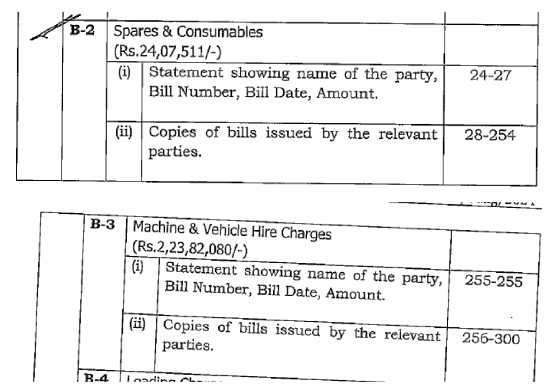
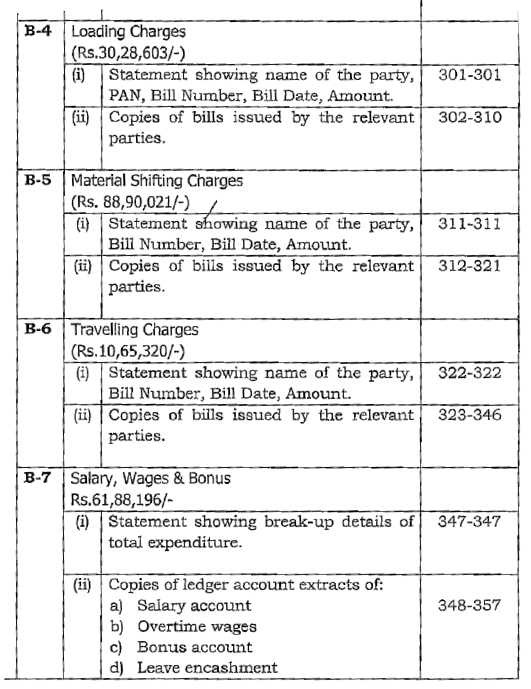
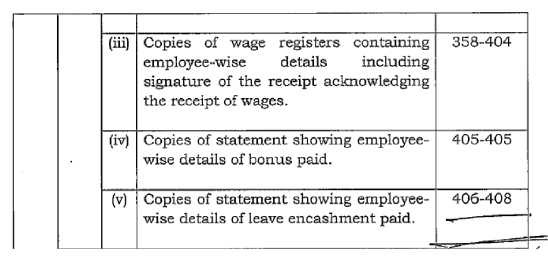
30. On the basis of examination of the above details, we find that where there are purchases concerned, assessee has submitted the bills along with the statement showing the amount of expenditure incurred. Where there are purchases being paid, the assessee has also submitted the details of the parties and the amount paid along with PAN. With respect to salary and wages, assessee has submitted the wage register containing the employee wise details along with the signature of the recipient acknowledging the respective wages. Some details are provided with respect to the payment of bonus and leave encashment paid. The lower authorities on examination of these details could not show that any of such expenditure either are not incurred for the purpose of business or are non-genuine. Even the ld. AO himself confirmed the allowance of 90% of such expenditure as business expenditure and disallowed only 10% of such expenditure as excessive. He did not give his opinion that how he reached at such a conclusion without comparing the expenditure of the assessee either in the previous year or subsequent year or comparing the annual accounts of the assessee with similarly placed business. The ld. CIT(A) confirmed the same not holding it to be excessive, but for want of proof. When the above details submitted by the assessee clearly show the statement of details, we fail to understand that what further details the assessee could have produced.
31. In view of the above facts, we find that disallowance made by the ld. AO and confirmed by the ld. CIT(A) cannot be sustained. In view of the submission of details by the assessee which remains uncontroverted so far as to the extent of expenditure incurred as well as the genuineness of expenditure, merely an estimation on adhoc basis, the disallowance made by the ld. lower authorities deserves to be deleted. Accordingly we direct the ld. AO to delete the disallowance of Rs. 43,96,173 out of various expenditure. Thus, ground No.3 of the appeal is allowed.
32. Regarding ground No. 4 of the appeal, it is observed that the Assessee has provided comprehensive details concerning transportation charges, including the names and permanent account numbers of transporters, bill numbers, dates, and amounts. Additionally, all relevant bills and vouchers issued by the transporters were submitted to the learned CIT (A). To substantiate the genuineness of the expenditure, the Assessee also produced certificates from the auditors of the transporters, confirming that the transportation charges received were duly accounted for and reported in their respective tax returns.
33. The learned Assessing Officer disallowed 20% of these expenses on the assumption of inflated charges. However, there is no evidence on record from the lower authorities to support the claim of inflated transportation expenses. Upon verifying the invoices, it is clear that the transportation charges were incurred for legitimate business purposes. Therefore, a disallowance based merely on presumption cannot be sustained unless the revenue provides concrete evidence indicating inflation of such expenditure.
34. In view of the above facts we do not see any reason to uphold the disallowance of Rs. 6,833,314/- made by the learned lower authorities on the basis of the exemption that the Assessee would have inflated such expenditure of transportation. Accordingly ground No. 4 of the appeal of the Assessee is allowed.
35 . Ground No. 5 is with respect to the disallowance of transportation charges of Rs. 27,333,366 from non-export oriented units annual accounts and a sum of Rs. 40,247,731/- from the books of accounts of the hundred percent export-oriented unit applying the provisions of section 40 (a) (ia) of the act.
36. The facts indicate that the Assessee, from its non-export-oriented unit, incurred transportation expenses totaling Rs. 34,166,707. The Assessing Officer observed that the Assessee did not deduct tax at source on these transportation charges, claiming exemption under section 194C(6) of the Income Tax Act. Consequently, the entire expenditure was disallowed since the Assessee failed to file quarterly TDS returns including the list of transporters with their Permanent Account Numbers (PAN) and the corresponding amounts.
37. The Assessee contended before the Assessing Officer that, in accordance with section 194C(6), withholding tax on transportation charges is not mandatory if the transporters provide their PAN. However, this argument was rejected as the Assessee had not obtained copies of the transporters’ PAN as required under section 194C(6), nor was any TDS deducted. Therefore, the Assessing Officer concluded that the Assessee was also required to comply with section 194C(7) read with Rule 31A(4)(v) of the Act. Accordingly, transportation expenses amounting to Rs. 27,333,366 were disallowed out of the total Rs. 34,166,707, as 10% (Rs.6,833,341) had already been disallowed on an ad hoc basis.
38. A similar disallowance was made for the Assessee’s 100% export-oriented unit division, where transportation charges of Rs. 40,247,731 were debited. Since there was no ad hoc disallowance for this division, the Assessing Officer disallowed the full amount.
39. The learned CIT – A confirmed the above disallowance holding that the provisions of section 194 (7) of the act read with rule 31A (4) (vi) of the act the disallowance was correctly made under section 40(a)(ia) of the act.
40 . The assessee, being dissatisfied with the decision of the lower authorities, has filed an appeal before this Tribunal. The learned Authorized Representative reiterated the arguments presented before the lower authorities and contended that the issue is directly covered in favor of the assessee by the decision of the coordinate bench in Addl. CIT v. Quippo Oil & Gas Infrastructure Ltd [2023] 201 ITD 47 (Delhi – Trib.). In that case, on similar facts, it was held that where the assessee obtained Permanent Account Numbers of the transporters and duly complied with the provisions of Section 194C(6), tax was not required to be deducted under Section 194C. Furthermore, mere violation of Section 194C(7) would not attract disallowance under Section 40(a)(ia) of the Act. Accordingly, it was submitted that no disallowance is warranted in the present case.
41. With respect to the disallowance made for the hundred percent export-oriented unit for non-deduction of tax it was submitted that the income and hence due to disallowance under section 40 (a) (ia) is to be considered as eligible profits while computing deduction under section 10 B of the act as held by the coordinate bench in case of Precision Camshafts Ltd. v. Asstt. CIT [2016] (Pune – Trib.)dated 10/11/2015. He further relied upon the decision of the coordinate bench in case of ITO v. Cerner Healthcare Solutions (P.) Ltd. (Bangalore – Trib.) wherein it has been held that where assessee was eligible for deduction under section 10 A, even disallowance made under section 40 (a) (i) would only go to enhance the profit derived by the assessee and on such enhanced profit deduction under section 10 A had to be allowed. Thus even otherwise the disallowance made by the learned assessing officer which is challenged by the assessee as per ground No. 7 of the appeal on this issue also not sustainable.
42. The learned departmental representative vehemently supported the orders of the learned lower authorities and submitted that as per the provisions of section 194C (7) of the act the person responsible for paying accrediting any sum to the person referred to in subsection 6 cell furnished to the prescribed income tax authority all the person authorized by it, such particulars in such form and within such time as may be prescribed under rule 31A (1) of the act. Unless the assessee fulfils this obligation, the disallowance is correctly made by the learned lower authorities.
43. After a review of the rival contentions and examination of the orders issued by the lower authorities, we note that the assessee has submitted auditor-issued certificates from the transporters. These certificates confirm that the transportation charges paid by the assessee have been accounted for and taxed in the transporters’ respective income tax returns. Additionally, the assessee provided a statement detailing transportation charges, transporter names, permanent account numbers, bill numbers, dates, and corresponding amounts, which were considered during our discussion regarding ground No. 4 of this appeal.
44. . The provisions governing tax deduction at source are outlined in section 194C of the Income Tax Act, particularly concerning payments made to contractors engaged in hiring or leasing goods carriages. As per section 194C(6), effective up to 1 June 2015, no deduction was required for sums credited or paid to such contractors if the permanent account number was furnished to the payer. Since the assessment year under consideration is 2011-12, possessing the permanent account number of these contractors eliminated the obligation to deduct tax at source. Consequently, no disallowance under section 40(a)(ia) could have been imposed on the assessee.
45. Furthermore, section 194C(7) imposes an additional filing responsibility on the payer, but it does not provide grounds for disallowance. This issue has been decided in favor of the assessee by the decision of the coordinate bench in Qippo Oil and Gas Infrastructure Ltd (supra), which established that where the assessee obtained the transporters’ permanent account numbers and complied with section 194C(6), tax deduction at source was not required, and no disallowance could be made. The coordinate bench also relied on another decision reported at Soma Rani Ghosh v. Dy. CIT (Kolkata – Trib.).
46. Considering these facts—specifically, the assessee’s submission of permanent account numbers and supporting statements on all transporters—the disallowances imposed by the assessing officer with respect to the 100% export-oriented unit and the non-export-oriented unit are deleted. Accordingly, grounds No. 5 and 7 of the appeal are allowed.
47. Ground No. 8 of the appeal pertains to the disallowance made in the hundred percent export-oriented unit, which, if disallowed, would have increased the profit of the export-oriented unit and consequently resulted in a higher deduction under section 10B of the Act. In light of various precedents cited before us, this issue is required to be decided in favour of the assessee. However, since the disallowance relating to ground No. 7 of the appeal has already been deleted on its merits, this ground is rendered infructuous.
48. Ground No. 9 of the appeal is general in nature and therefore dismissed.
49. In the result appeal filed by the assessee for assessment year 2011 -12 in ITA No. 1025/Bangalore/2024 is partly allowed.
50. ITA No. 1026/Bangalore/2024 is filed by the assessee for assessment year 2013 – 14 against the appellate order passed by the National faceless appeal Centre Delhi (the learned CIT – A) on 23rd of March 2024 wherein the appeal filed by the assessee against the assessment order under section 143 (3) of the act dated 28 March 2016 passed by the Asst Commissioner of income tax, circle – 1, Bellary was partly allowed.
51. The assessee is aggrieved with the same and is in appeal before us raising several grounds of appeal as under:-
| (a) | the impugned assessment order dated 28th of March 2016 passed under section 143 (3) racket of the act is arbitrary and opposed to the facts of the case and therefore liable to be set-aside is wide |
| (b) | the learned assessing officer erred in adding interest income of Rs. 554,025/- without appreciating that the assessee has recognized this income on cash basis in the subsequent assessment year as per provisions of section 145 of the act. |
| (c) | The learned assessing officer erred in disallowing a sum of Rs. 40 lakhs incurred by the assessee towards repairs and maintenance of building. |
| (d) | The learned AO erred in disallowing the custom duty of Rs. 1,539,827/- paid invoking the provisions of section 40 3B of the act. |
| (e) | The learned assessing officer erred in disallowing in frustrating expenditure amounting to Rs. 4,921,368/-. The learned assessing officer erred in adding a sum of Rs. 5,574,237/- under section 41 (1) of the act. |
| (f) | The learned assessing officer has erred in computing the total income of Rs. 39,556,600/- as against Rs. 39,024,951/-after raiding addition/disallowance to the returned income of Rs. 9,702,080/-. |
| (g) | The assessee appellant craves leave to add or revise or amend or substitute or delete any ground to the time of hearing before the tribunal. |
52. The brief facts of the case shows that the assessee filed its return of income for assessment year 2013 – 14 on 28th of September 2013 at a total income of Rs. 9,702,080. As stated above the assessee firm has two manufacturing units which is the normal unit and the second unit is hundred percent export-oriented unit which is eligible for exemption under section 10 B of the act. The assessee has claimed the total deduction under section 10 B of the act of Rs. 23,358,719/-. The case of the assessee was picked up for the scrutiny which resulted into an assessment order dated 29th of March 2016 passed under section 143 (3) of the act.
53. The addition has been made in the hands of the assessee on account of following items which were challenged before us. (1) accrued and unaccounted interest income of Rs. 554,025/-, (2) disallowance of repairs and maintenance expenditure of Rs. 40 lakhs, (3) disallowance under section 43B of the act of Rs. 1,539,827/-, (4) disallowance of infrastructure of sharing charges of Rs. 4,921,368 and (5) Addition under section 41 (1) of the act of Rs. 5,574,237/-.
54. The assessee preferred an appeal before the learned CIT – A wherein the above additions were confirmed whereas the other disallowance/addition made by the learned assessing officer were deleted which are not in dispute before us.
55. The ground No. 1 of the appeal is general in nature, no arguments were advanced, and therefore same is dismissed.
56. Ground No. 2 of the appeal is with respect to the addition of interest income of Rs. 554,025 made by the learned assessing officer. The brief facts of the case shows that as per form No. 26AS it was noticed by the learned assessing officer that assessee has received interest from state bank of India commercial branch of Rs. 554,025 whereas the assessee firm has not declared the above interest received from the state bank of India in its return of income. Rs. 554,025 as it would be offered to tax on cash basis and same was already offered for taxation for assessment year 2014 – 15.
57. The learned assessing officer rejected the contention of the assessee and stated that as the assessee is maintaining the books of accounts following the mercantile method of accounting, the above interest income is required to be included as total income of the assessee. Accordingly he made an addition of the above sum.
58. The learned CIT – A when contested this issue before him held that that the interest income from state bank of India should have been recognized by the assessee as revenue during the year under consideration as assessee firm is following the mercantile method of accounting. Therefore despite the above sum has already been disclosed and offered for taxation for assessment year 2014 – 15, he held that this income is rightly taxed as income by the assessing officer for assessment year 2013 – 14.
59. The assessee submitted that as per form No. 26AS the assessee has earned interest income of Rs. 554,025 on fixed deposits with state bank of India and the bank has also made a tax deduction at source of Rs. 55,403. He submitted that in the tax audit report in form No.3CD the assessee has categorically mentioned that assessee has not recognized the interest income on deposit made with state bank of India due to the non-availability of income details. The interest income would be recognized by the firm on receipt basis. Therefore he submitted that there is no certainty of receipt of the above sum and merely the tax deduction at source has been made, the above interest income could not have been recognized by the assessee as its income for the impugned assessment year 2013 – 14. It was further submitted that assessee went in the subsequent year assessment year 2014 – 15 received the above income, same wasn’t included as income in that year. Therefore it was submitted that when the assessee has already paid tax on the above income for assessment year 2014 – 15 and in view of the uncertainty about the receipt of ability of the above sum in assessment year 2013 – 14, this income could not have been added by the learned assessing officer.
60. The learned departmental representative vehemently supported the order of the learned lower authorities and submitted that the assessee has maintained its books of accounts on mercantile basis, assessee has also claimed the tax deduction at source as tax credit in its annual return about the tax deduction at source made on such income but has not disclosed the income for assessment year 2013 – 14. He submitted that income has accrued to the assessee for assessment year 2013 – 14 and therefore subsequently disclosure of the assessee of the same income would not change the position.
61. The learned authorized representative vehemently made an alternative proposal that as the assessee has already offered the above sum to tax for assessment year 2014 – 15, the learned assessing officer may be directed to grant the refund in the subsequent year as it amounts to double taxation.
62. Upon careful consideration of the parties’ arguments and review of the orders issued by the lower authorities, we conclude that simply listing income by the tax deductor in form no 26AS and the deduction of taxes does not, by itself, render the income attributable to the assessee for the relevant assessment year. In this instance, State Bank of India, Chennai Branch, deducted tax at source amounting to Rs. 55,403 on an interest income of Rs. 554,025. The assessee did not recognize this income due to uncertainty regarding its receipt; there was insufficient information confirming the availability of such income. Consequently, the assessee firm refrained from including the interest income in its accounts for this assessment year, as recoverability remained uncertain at the time the annual accounts were finalized.
63. There was no reasonable certainty regarding the receipt of the sum in question; thus, the income did not accrue to the assessee. The assessee subsequently disclosed the amount upon actual receipt in Assessment Year 2014-15. Although the partnership firm maintains its books on a mercantile basis, this principle does not imply that any income shown in tax deduction records [Form no 26AS] necessarily becomes the income of the assessee. The tax deductor must deduct tax as required by the provisions of the Income Tax Act, reflected in Form No. 26AS of the assessee. However, the mere appearance of income in Form No. 26AS does not automatically establish it as income of the deductee. Assessable income should be determined based on reasonable certainty of its accrual.
64. Given these facts and since the assessee has disclosed the relevant income in the subsequent year (Assessment Year 2014-15), the addition for the impugned assessment year is not warranted. Accordingly, we direct the learned Assessing Officer to delete the addition.
65. As per Section 199 of the Act, credit for tax deducted at source shall only be available in the year when the assessee offers the relevant income, namely Assessment Year 2014-15. The Assessing Officer is therefore instructed to remove the addition of Rs. 554,025 on account of interest income for Assessment Year 2013-14, withdraw the credit of Rs. 55,403 for that year, and grant the same credit to the assessee for Assessment Year 2014-15. Ground No. 2 of the assessee’s appeal is thus allowed.
66. Ground No. 3 of the appeal pertains to the disallowance of Rs. 40 lakhs for repairs and maintenance of buildings. The facts indicate that the assessee firm recorded an amount of Rs. 4,531,650 as repairs and maintenance expenses, which was charged to the profit and loss account. The firm operates its office from a rented building, for which an annual rent of Rs. 307,117 is paid; as it does not own the premises, the expenditure incurred for repairs and maintenance was claimed as a revenue expense.
67. The learned assessing officer determined that, since the assessee does not own any building, such substantial expenditure is questionable and therefore not allowable. The assessee argued that the repairs and maintenance were for the rented property and should not be considered capital in nature. It was further contended that renovations of leasehold premises are to be treated as revenue expenditures. The assessing officer noted that certain expenses, such as roof alterations and fencing, confer enduring benefits and are thus not revenue in nature. Additionally, considering the rent paid for the year (approximately Rs. 370,000), the repairs and maintenance costs appeared excessively high. The assessee failed to provide adequate details regarding the obligation to incur such expenses. Consequently, the assessing officer allowed Rs. 531,650, while the remaining Rs. 40 lakhs were disallowed on an ad hoc basis.
68. The assessee challenged the same before the learned CIT – A stating that the above expenditure are necessitated by commercial expediency to keep the building and good condition to facilitate the carrying on of the business and therefore same should be allowed as a revenue expenditure. The learned CIT – A confirmed the action of the learned assessing officer for the reason that assessee has paid rent of only Rs. 307,000 during the year. Aggrieved with the same the assessee is in appeal before us as per ground No. 3 of the appeal.
69. The authorized representative stated that there is no contention regarding the authenticity of the expenditure incurred by the assessee. The assessee incurred Rs. 4,528,650 on repairs and maintenance of the building, including the stockyard and export-oriented unit plant building, through enchor Constructions. Additionally, Rs. 3,000 was expended towards the repairs and maintenance of accommodation for Hussein Furniture, resulting in a total outlay of Rs. 4,531,650. Comprehensive details of these expenditures were provided to the assessing officer, who did not dispute their genuineness. However, only Rs. 531,650 was permitted as an allowable deduction, with an ad hoc disallowance amounting to Rs. 4,000,000. The assessee also submitted copies of the ledger account for Enchor Constructions, along with evidence of tax deducted at source for the aforementioned amount. Furthermore, it was noted that the Supreme Court decision in CIT v. Madras Auto Service (P.) Ltd. 233 ITR 468 (SC) supports the assessee’s position, and reference was made to several relevant judicial precedents.
70. The learned departmental representative vehemently supported the order of the learned lower authorities and submitted that assessee has taken on rent premises for which the total rent paid is Rs. 307,000 and has incurred an expenditure of Rs. 45 lakhs. Therefore such expenditure could not have been allowed to the assessee as a revenue expenditure.
71. We have carefully perused the parties’ arguments and the orders of the lower authorities. The assessee rented a property for Rs. 307,000 and spent Rs. 4,531,004 on repairs and renovations to make storage areas usable, without gaining any enduring benefit since the property is not owned by the assessee. The expenditure is properly evidenced with tax deducted at source, and payments and invoices have been shown. The high repair cost compared to the rent does not mean the expenses are excessive or capital in nature, as supported by the Hon. Supreme Court’s decision in Madras Auto Services Pvt. Ltd. (supra) The assessing officer did not classify the expenses as capital but found them excessive, which is unsupported given the documentation provided. We therefore direct the deletion of the Rs. 40 lakh disallowance, and ground no. 3 of the appeal is allowed.
72. Ground No. 4 of the appeal pertains to the disallowance of customs duty amounting to Rs. 1,539,827 under the provisions of section 43B of the Act. The facts indicate that the assessee recorded a total of Rs. 2,539,827 as customs duty in the profit and loss account. However, upon reviewing Schedule 3 of the balance sheet, which outlines expenses payable, it was observed that only Rs. 1,539,827 was shown under ‘custom duty payable.’ The assessee clarified that this liability had crystallized during the year, it was explained to the Assessing Officer that the Directorate of Revenue Intelligence had initiated an investigation into iron ore exports, resulting in a show cause notice demanding an additional customs duty of Rs. 2,539,827 due to grade differences.
73. Of this total, Rs. 1,000,000 was paid on 27 March 2013, while the remaining Rs. 1,539,827 was paid on 24 June 2013. Although the customs duty remained outstanding as of the balance sheet date, payment was made before the due date for filing the return under section 139(1) of the Act; hence, the assessee argued that no disallowance should apply.
74. Nevertheless, the Assessing Officer determined that the provision of Rs. 1,539,827 represented a contingent liability that it had not crystallized during the relevant financial year. As such, only the amount actually paid within the year—? 1,000,000—was allowed as a deduction on a payment basis, and the balance debited to the profit and loss account, neither having accrued nor been paid during the year, was disallowed while computing business profits. The Commissioner of Income Tax (Appeals) upheld the disallowance.
75 . The learned authorized representative submitted that the entire liability of Rs. 2,539,827 was crystallized during the financial year 2012 – 13 in itself when the demand was raised by the custom authorities vide email dated 5 December 2012. He further referred to the list of events stating that that the notice demanding the payment of Rs. 2,539,827 was raised on 19 December 2012 out of which on 27th of March 2013 the assessee has deposited the sum of Rs. 10 lakhs and further on 24 June 2013 the assessee has paid balance sum of Rs. 1,539,827. Therefore the whole liability of the custom is a definite liability on the assessee which arose on 19 December 2012 wherein the notice of demand was issued by the custom authorities. Further as the assessee has deposited the full sum before the due date of filing of the return of income, no disallowance could have been made in the hence of the assessee.
76. The learned departmental representative vehemently supported the orders of the learned lower authorities.
77. We have carefully considered the rival contention and perused the order of the learned lower authorities. We find that the liability of Rs. 2,539,827 was raised by the customs department by issuing the notice of recovery on 19 December 2012. In response to that the assessee has already paid Rs. 10 lakhs on 27 th of March 2013 before the close of the accounting year. The balance sum of Rs. 1,539,827 was paid by the assessee on 24th of June 2013. In view of the above facts as the demand of the above stated sum was raised by the customs department on 19 December 2012, the above said liability could not have been stated to be contingent in nature. The liability arose on the assessee during the assessment year itself. Accordingly we direct the learned assessing officer to delete the disallowance of Rs. 1,539,808 27 which is an accrued and definite liability of customs which was also deposited before the due date of filing of the return of income and therefore the same was a liability arising during the previous year and was also not hit by the provisions of section 43B of the act. Accordingly ground No. 4 of the appeal of the assessee is allowed.
78. Ground No. 4 of the appeal pertains to the disallowance of infrastructure sharing expenditure amounting to Rs. 4,921,368. The facts of the case indicate that the assessee recorded Rs. 4,921,368 under infrastructure sharing charges, which were paid to M/s Wahab Holdings Private Limited. The Assessing Officer determined that this payment was not incurred for the purposes of the assessee’s business activities. The assessee argued that there was no office in Bangalore and, due to substantial work required at various government institutes and among customers in Bangalore, the sum was paid as infrastructure sharing charges to the Wahab Trading Company. This payment covered manpower costs, rent, consultancy, and advocate fees for readily available infrastructure setup. It was further submitted that the expenditure was bona fide, incurred after paying applicable service tax and withholding taxes, and should be allowable under Section 37(1) of the Act, as it was wholly and exclusively for the business purposes. However, the Assessing Officer concluded that the expenditure did not qualify as a business expense and disallowed the claim. Upon appeal, CIT(A) upheld the Assessing Officer’s decision, affirming that the expenditure was not incurred for business purposes.
79. The learned authorized representative submitted that during the year under consideration the assessee has incurred a sum of Rs. 4,921,006 368 being the sum of Rs. 4,380,000 plus service tax at the rate of 12.36 amounting to Rs. 541,368 paid towards the infrastructure sharing charges to one Wahab holding private limited for the purpose of use of the Bangalore office of that entity. As the assessee is not having any of the said Bangalore but has a lot of work to be carried out at that particular place, the assessee was paying the above sum is infrastructure sharing charges. Wahab Holdings Private Limited comprises of having the skilled manpower, office building, legal and taxation work and accordingly the assessee for user of that services has paid a sum of Rs. 4,921,368. The above expenditure has been claimed by the assessee as revenue expenditure and incurred wholly and exclusively for the purposes of the business of the assessee. The assessee also submitted the copy of the invoice dated 31st of March 2013 raised by Wahab Holdings Private Limited.
80. The learned departmental representative supported the order of the learned lower authorities and submitted that assessee has incurred the above expenditure which is not wholly and exclusively for the purposes of the business.
81. We have thoroughly reviewed the rival submissions and examined the orders of the learned lower authorities. The facts establish that the assessee paid infrastructure sharing charges amounting to Rs. 4,380,000/- to M/s Wahab Holdings Private Limited, No. ^, Chambers, Cunningham Road, Bangalore 46, pursuant to invoice No. 236 dated 31st March 2013, which included service tax at 12.36% (Rs.541,368), bringing the total payment to Rs. 4,921,368. The assessee has disclosed that this payment was made for the use of a fully equipped annual office of the said entity, exclusively for business purposes.
82. It has been further clarified that the assessee did not maintain an office in Bangalore but required such a facility due to significant business operations in that location. Consequently, the assessee availed itself of a ready-made office with complete infrastructure and skilled manpower by paying the above sum to Wahab Holdings Private Limited. The assessee has also submitted the income tax return and audited accounts of Wahab Holdings Private Limited, reflecting the aforementioned sum as income.
83 . Given these circumstances, there is no basis to conclude that the assessee has not incurred the expenditure wholly and exclusively for the purposes of its business. It is undisputed that the assessee lacked an office in Bangalore yet had substantial work to be conducted there; the recipient entity could provide the necessary infrastructure and services. The genuineness of the expenditure is not in question.
84 . Accordingly, we see no justification for upholding the disallowance made by the learned lower authorities. We therefore direct the learned assessing officer to delete the disallowance of Rs. 4,921,368 towards infrastructure sharing charges incurred by the assessee for its business operations in Bangalore.
85 . Ground No. 6 of the appeal pertains to the addition of Rs. 5,574,237 under Section 41(1) of the Act. The facts indicate that the assessee firm has reflected, under the head “customers credit balance” in its balance sheet, amounts of Rs. 891,187 and Rs. 4,683,050 as payable to M/s Noble Resources Hong Kong Ltd and M/s Top Gain Minerals Macau, respectively. The learned Assessing Officer observed that these balances had been outstanding for an extended period and consequently requested the assessee to provide confirmation from the respective creditors.
86 . The assessee explained that these amounts represented advances received towards the export of iron ore; however, due to a sudden ban on exports, they remained credited in the assessee’s books. With the lifting of the ban, the assessee intends to adjust these credit balances against future export orders. It was asserted that these are genuine credit balances liable either to payment or adjustment to overseas customers. Nevertheless, the learned Assessing Officer was not satisfied with the explanation provided and concluded that the sum of Rs. 5,574,237 is taxable under Section 41(1) of the Act.
87 . The assessee appealed the decision to the learned CIT(A), who, in paragraph 10.3 of the appellate order, upheld the disallowance. CIT(A) noted that no additional documentary evidence was presented during the appellate proceedings, thereby placing the onus on the assessee to substantiate the claim that the advance received would be adjusted against future supplies. Consequently, the addition was confirmed.
88 . The authorized representative explained that the advances in question were received by the assessee for the purpose of exporting iron, which could not be completed due to a government-imposed ban. It was clarified that the assessee has not claimed these amounts as expenditures in the current or any prior assessment year, and therefore, the issue of treating them as a cessation of liability under section 41(1) of the Act does not arise. Furthermore, it was affirmed that the relevant parties are overseas buyers, to whom the assessee has made export sales; thus, the provisions of section 41(1) of the Act are not applicable, as there is no cessation of liability involved.
89 . The departmental representative strongly endorsed the decision of the lower authorities, asserting that the assessee received advances for the export of iron ore but did not carry out the exports. Consequently, there has been a cessation of liability, and the application of section 41(1) of the Act is appropriate in this case.
90 . We have thoroughly reviewed the opposing arguments and examined the orders issued by the learned lower authorities. It is noted that an amount of Rs. 4,883,050 remains outstanding from Top Grain Minerals, Macau, representing advances received by the assessee against export. Additionally, a sum of Rs. 891,187 was received from Noble Resources Hong Kong Ltd., Hong Kong as an advance against the export of goods. The assessee has furnished copies of the ledger accounts relating to the aforementioned parties. The facts indicate that these were advances received in prior years for the sale of iron ore; however, due to a government ban on the export of iron ore, supplies were not made to these parties. These funds were received via regular foreign exchange channels in compliance with Reserve Bank of India guidelines. Accordingly, liability continues to exist on the part of the assessee. Therefore, the provisions of Section 41(1) of the Act are not applicable to these amounts, as there has been no cessation of liability or any benefit availed by the assessee in previous years. Consequently, the lower authorities erred in taxing these sums under Section 41(1) of the Act. As a result, Ground No. 6 of the appeal is allowed.
91 . Ground No. 7 and 8 are general in nature, no arguments were advanced before us and therefore both are dismissed.
92 . In the result appeal filed by the assessee in ITA No. 1026/Bangalore/2024 for assessment year 2013 – 14 is partly allowed.
93 . In the result, the appeals by the assessee for both the years are partly allowed.