


Individual Beneficiary Cannot Claim Trust Loss Without Prior Determination and Verification of Income or Loss in Hands of Trust
Issue
Whether an individual beneficiary holding a determinate share in a private family trust can directly claim a proportionate share of the trust’s loss in his individual return when the trust itself has not filed a return and its income or loss has not been determined in accordance with the Act.
Facts
-
The assessee is an individual beneficiary holding a 70% determinate share in a private family trust named KSN Trust for Assessment Year 2018-19.
-
The assessee claimed his 70% share of the trust’s loss directly in his individual return of income.
-
The trust itself had not filed any return of income for the relevant assessment year, meaning the alleged loss was never examined, verified, or determined under the provisions of the Income-tax Act.
-
The Assessing Officer disallowed the claim of loss in the hands of the beneficiary.
-
On appeal, the Commissioner (Appeals) allowed the claim, holding that the beneficiary was eligible to claim his proportionate share of the trust’s loss in his individual assessment.
Decision
-
Held, Section 166 preserves the Revenue’s right to directly assess a beneficiary for income receivable on their behalf, but it does not do away with the legal requirement to determine the income or loss of the trust first.
-
Held, an individual beneficiary’s entitlement to claim a share of a trust’s loss arises only after the total income or loss of the trust is computed and verified in accordance with the law.
-
Held, in the absence of a return filed by the trust or a prior statutory determination, the beneficiary’s claim cannot be accepted merely based on a self-furnished computation.
-
Held, in the interest of justice, the matter was restored/remanded to the file of the Assessing Officer to first examine and determine the income or loss of the trust in accordance with the law before evaluating the beneficiary’s claim.
Key Takeaways
-
Prerequisite of Trust-Level Computation: A beneficiary cannot directly absorb or claim a trust’s loss without the underlying total loss being first determined and verified in the hands of the trust.
-
Scope of Section 166: Section 166 provides an option to assess either the representative assessee (trust) or the beneficiary directly, but it does not bypass the statutory process of computing the trust’s taxable income or loss.
-
Self-Computation Insufficient: A beneficiary cannot substitute an official tax return or assessment of the trust with a private or unverified computation of losses.
-
Remand for Procedural Compliance: Where trust-level loss verification is absent, appellate authorities will restore the matter to the Assessing Officer to establish the correct quantum of trust income/loss before granting proportionate relief to beneficiaries.
IN THE ITAT HYDERABAD BENCH ‘A’
Deputy Commissioner of Income-tax
v.
Smt. Indira Kamineni
VIJAY PAL RAO, Vice President
and MADHUSUDAN SAWDIA, Accountant Member
and MADHUSUDAN SAWDIA, Accountant Member
IT Appeal No. 2445 (Hyd) of 2025
[Assessment year 2018-19]
[Assessment year 2018-19]
JULY 3, 2026
Bala Murali Krishna Korrapati, Sr. AR for the Appellant. Poorna Chander Rao, CA for the Respondent.
ORDER
Madhusudan Sawdia, Accountant Member.- This appeal is filed by the Revenue, feeling aggrieved by the order passed by the Learned Commissioner of Income Tax (Appeals), National Faceless Appeal Centre (NFAC), Delhi (“Ld. CIT(A)”) dated 07.10.2025 for the A.Y.2018-19.
2. The Revenue has raised the following grounds of appeal:
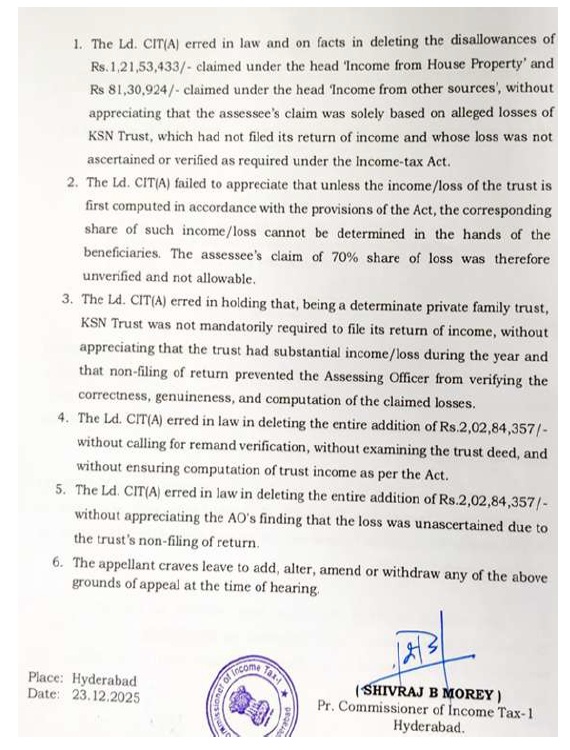
3. The brief facts of the case are that the assessee is an individual and one of the beneficiaries of a private family trust namely KSN Trust. The assessee filed its return of income for Assessment Year 2018-19 under section 139(1) of the Income-tax Act, 1961 (“the Act”) on 30.03.2019 declaring total income at Rs. Nil. The case of the assessee was selected for limited scrutiny through CASS. During the course of assessment proceedings, the Learned Assessing Officer (“Ld. AO”) observed that KSN Trust had incurred loss under the head “Income from House Property” amounting to Rs. 1,73,62,048/-and loss under the head “Income from Other Sources” amounting to Rs. 1,66,15,605/-. Since the assessee was entitled to 70% share in the said trust, the assessee claimed loss under the head “Income from House Property” amounting to Rs. 1,21,53,433/- and loss under the head “Income from Other Sources” amounting to Rs. 81,30,924/- in its individual return of income. The Ld. AO disallowed the aforesaid claim of loss of the assessee and completed the assessment under section 143(3) r.w.s. 143(3A) and 143(3B) of the Act vide order dated 18.03.2021.
4. Aggrieved by the assessment order, the assessee preferred an appeal before the Ld. CIT(A). The Ld. CIT(A) allowed the appeal of the assessee holding that KSN Trust was a determinate trust and the assessee, being entitled to 70% share therein, was eligible to claim the corresponding share of loss in its individual return of income.
5. Aggrieved by the order of the Ld. CIT (A), the Revenue is in appeal before us. At the outset, the Learned Departmental Representative (” Ld. DR”) submitted that only two issues arise for consideration in the present appeal. Firstly, the Ld. CIT(A) erred in allowing the claim of loss in the hands of the assessee despite the fact that KSN Trust had not filed any return of income for the year under consideration. It was submitted that in the absence of any return filed by the trust, the income or loss of the trust had never been determined in accordance with the provisions of the Act. Therefore, the assessee could not have been allowed to claim a share of such unverified loss in his individual return of income. Secondly, it was submitted that even assuming that the assessee was otherwise entitled to claim a share of the trust loss, the Ld. CIT(A) erred in allowing the same without examining the computation of loss in the hands of the trust and without calling for any remand report from the Ld. AO. Accordingly, it was prayed that the order of the Ld. CIT(A) be set aside and the matter be restored to the file of the Ld. AO for fresh examination.
6. Per contra, the Learned Authorized Representative (“Ld. AR”) supported the order of the Ld. CIT(A). It was submitted that KSN Trust is a non-discretionary trust and the shares of the beneficiaries are determinate and known. The assessee is entitled to 70% share in the trust. It was further submitted that under sections 161 and 166 of the Act, the income of a determinate trust can be assessed directly in the hands of the beneficiaries and, therefore, the assessee was justified in claiming his share of loss in his individual return of income. The Ld. AR further submitted that the Ld. CIT(A), after examining the facts of the case, rightly allowed the claim of the assessee and, therefore, no interference was called for in the impugned order.
7. We have heard the rival submissions and perused the material available on record. The undisputed facts are that KSN Trust is a private family trust and the assessee is entitled to 70% beneficial share therein. The assessee has claimed loss under the head “Income from House Property” amounting to Rs. 1,21,53,433/- and loss under the head “Income from Other Sources” amounting to Rs. 81,30,924/- being 70% share of the alleged losses incurred by KSN Trust. We have gone through the provisions of section 160 of the Act, which is to the following effect:
“Representative assessee.
160. (1) For the purposes of this Act, “representative assessee” means—
(i) in respect of the income of a non-resident specified in sub-section (1) of section 9, the agent of the non-resident, including a person who is treated as an agent under section 163;
(ii) in respect of the income of a minor, lunatic or idiot, the guardian or manager who is entitled to receive or is in receipt of such income on behalf of such minor, lunatic or idiot;
(iii) in respect of income which the Court of Wards, the Administrator- General, the Official Trustee or any receiver or manager (including any person, whatever his designation, who in fact manages property on behalf of another) appointed by or under any order of a court, receives or is entitled to receive, on behalf or for the benefit of any person, such Court of Wards, AdministratorGeneral, Official Trustee, receiver or manager;
(iv) in respect of income which a trustee appointed under a trust declared by a duly executed instrument in writing whether testamentary or otherwise [including any wakf deed which is valid under the Mussalman Wakf Validating Act, 1913 (6 of 1913),] receives or is entitled to receive on behalf or for the benefit of any person, such trustee or trustees;
(v) in respect of income which a trustee appointed under an oral trust receives or is entitled to receive on behalf or for the benefit of any person, such trustee or trustees.
Explanation 1.—A trust which is not declared by a duly executed instrument in writing [including any wakf deed which is valid under the Mussalman Wakf Validating Act, 1913 (6 of 1913),] shall be deemed, for the purposes of clause (iv), to be a trust declared by a duly executed instrument in writing if a statement in writing, signed by the trustee or trustees, setting out the purpose or purposes of the trust, particulars as to the trustee or trustees, the beneficiary or beneficiaries and the trust property, is forwarded to the Assessing Officer,—
(i) where the trust has been declared before the 1st day of June, 1981, within a period of three months from that day; and (ii) in any other case, within three months from the date of declaration of the trust.
(ii) Explanation 2.—For the purposes of clause (v), “oral trust” means a trust which is not declared by a duly executed instrument in writing [including any wakf deed which is valid under the Mussalman Wakf Validating Act, 1913 (6 of 1913),] and which is not deemed under Explanation 1 to be a trust declared by a duly executed instrument in writing. (2) Every representative assessee shall be deemed to be an assessee for the purposes of this Act
(iii) Explanation 2.—For the purposes of clause (v), “oral trust” means a trust which is not declared by a duly executed instrument in writing [including any wakf deed which is valid under the Mussalman Wakf Validating Act, 1913 (6 of 1913),] and which is not deemed under Explanation 1 to be a trust declared by a duly executed instrument in writing.
(2) Every representative assessee shall be deemed to be an assessee for the purposes of this Act.
8. On perusal of the provisions of section 160(1)(iv), we find that a trustee appointed under a trust declared by a duly executed instrument in writing is treated as a representative assessee. Further, the provisions of section 160(2) provides that every representative assessee shall, for the purposes of the Act, be deemed to be an assessee. In the present case, there is no dispute that KSN Trust has been constituted through a duly executed instrument in writing. Therefore, the trustees of KSN Trust are representative assessees and are deemed to be assessees for the purposes of the Act. We have also examined the provisions of section 161 of the Act which deal with the liability of a representative assessee, which is to the following effect:
“Liability of representative assessee.
161. (1) Every representative assessee, as regards the income in respect of which he is a representative assessee, shall be subject to the same duties, responsibilities and liabilities as if the income were income received by or accruing to or in favour of him beneficially, and shall be liable to assessment in his own name in respect of that income; but any such assessment shall be deemed to be made upon him in his representative capacity only, and the tax shall, subject to the other provisions contained in this Chapter, be levied upon and recovered from him in like manner and to the same extent as it would be leviable upon and recoverable from the person represented by him.
(1A) Notwithstanding anything contained in sub-section (1), where any income in respect of which the person mentioned in clause (iv) of sub-section (1) of section 160 is liable as representative assessee consists of, or includes, profits and gains of business, tax shall be charged on the whole of the income in respect of which such person is so liable at the maximum marginal rate :
Provided that the provisions of this sub-section shall not apply where such profits and gains are receivable under a trust declared by any person by will exclusively for the benefit of any relative dependent on him for support and maintenance, and such trust is the only trust so declared by him.
(2) Where any person is, in respect of any income, assessable under this Chapter in the capacity of a representative assessee, he shall not, in respect of that income, be assessed under any other provision of this Act”.
9. A plain reading of provisions of section 161(1) of the Act shows that where income is receivable by a trustee on behalf of or for the benefit of beneficiaries, such trustee is assessable in a representative capacity and tax is leviable and recoverable from him in the like manner and to the same extent as it would be leviable upon and recoverable from the person represented by him. Thus, section 161 of the Act contemplates assessment of the trustee in respect of the income or loss relatable to the trust in his representative capacity. We have further examined the provisions of section 166 of the Act, which is to the following effect:
“Direct assessment or recovery not barred. 166. Nothing in the foregoing sections in this Chapter shall prevent either the direct assessment of the person on whose behalf or for whose benefit income therein referred to is receivable, or the recovery from such person of the tax payable in respect of such income”.
10. On a careful consideration of the provisions of section 166 of the Act, it is evident that section 166 of the Act merely preserves the power of the Revenue to directly assess the beneficiary in respect of the income receivable on his behalf. However, the said provision does not dispense with the requirement of determination of the income or loss of the trust in accordance with law. Nor does section 166 of the Act provide that the representative assessee is absolved from the statutory obligations cast upon him under the Act. In the present case, admittedly, no return of income has been filed by KSN Trust for the year under consideration. Consequently, the alleged loss under the head “Income from House Property” amounting to Rs. 1,73,62,048/- and loss under the head “Income from Other Sources” amounting to Rs. 1,66,15,605/- have not been subjected to examination, verification or determination in accordance with the provisions of the Act. We find merit in the contention of the Revenue that before any proportionate share of loss is allowed in the hands of a beneficiary, the quantum of such loss in the hands of the trust must first be determined and verified. The impugned order of the Ld. CIT(A) proceeds on the legal proposition that the beneficiaries of a determinate trust can be assessed directly. However, the Ld. CIT(A) has not recorded any finding regarding the correctness, computation or quantification of the losses claimed to have been incurred by KSN Trust. No remand report was called for from the Ld. AO and no independent verification of the trust losses has been brought on record. In our considered view, the entitlement of the assessee to claim any share of loss can arise only after the income or loss of the trust is first computed and determined in accordance with the provisions of the Act. In the absence of such determination, the assessee’s claim cannot be accepted merely on the basis of a computation furnished by him. Accordingly, in the interest of justice, we set aside the impugned order of the Ld. CIT(A) and restore the matter to the file of the Ld. AO. The Ld. AO shall first examine and determine the income/loss of KSN Trust in accordance with law after affording adequate opportunity of being heard to the assessee. Thereafter, the Ld. AO shall determine whether and to what extent the assessee is entitled to claim any share of such loss in his individual assessment and decide the issue afresh in accordance with law.
11. In the result, the appeal filed by the Revenue is allowed for statistical purposes.