ORDER
1. Captioned seven appeals filed by the assessee, and one cross-appeal filed by the Revenue pertaining to Assessment Years, 2010-11 to 2016-17, are directed against the separate orders passed by the Commissioner of Income-tax (Appeals), Bhopal [hereinafter referred to as “the Ld. CIT(A)”] under section 250 of the Income-tax Act, 1961 (hereinafter referred to as “the Act”), which is turn arise out of separate assessment orders passed by the Assessing Officer under section 143(3) read with section 153A of the Act.
2. Since, the issue involved in these appeals are identical and similar, therefore, these appeals have been heard together and a consolidated order is being passed for the sake of convenience and brevity. The facts as well as grounds of appeal narrated in IT(SS)A No.1/Ind/2025 for AY 2011-12 has been taken into consideration for deciding these appeals en masse.
3. The concise and summarized ground raised by the Revenue in ITA No.423/Ind/2025 for AY 2016-17 are as follows:
“(i) The Ld. CIT(A) erred in deleting the following additions:
(a) Rs.6,00,000/- part of Rs.13,24,00,000/-, on account of cash found. retraction, which is after thought.
(b) Rs.5,10,00,000/- excess stock found during search, however, stock verification was conducted transparently, which is part of Rs.13,24,00,000/-.
(c) Addition of Rs.7,73,00,000/- (being Rs.3,30,00,000/- on account of LPS-1 and Rs.4,43,00,000/- on the basis of LPS-6, the reconciliation, was provided by the assessee in respect of unaccounted financial transaction, jottings in the loose paper sheet, both part of Rs.13,24,00,000/-.
(d) Addition of Rs.35,00,000/- (Difference Rs.65,00,000 – Rs.30,00,000), difference of surrender amount on account of miscellaneous issues to cover up tax liabilities on miscellaneous issues, which is part of addition of Rs.13,24,00,000/-.
(ii) Ld. CIT(A) erred in deleting the disallowance under section 14A of the Act, to the tune of Rs.2,42,50,528/-, as no dividend income is received by assesse-company, so Ld. CIT(A) deleted the addition.
4. Summarise and concise grounds raised by the assesse in various appeals are as follows:
| (i) |
|
The Ld. CIT(A) erred in sustaining the addition of Rs.75,99,005/- out of total additions of Rs.90,51,330/-. |
(This is ground No.01 in IT(SS)A No.1/Ind/2025, for AY 2011-12, Ground No.1 in IT(SS)A No.9/Ind/2025 for AY 2012-13, Ground No.1 in IT(SS)A No.10/Ind/2025 for AY 2013-14, Ground No.1 in IT(SS)A No.13/Ind/2025 for AY 2016-17, Ground No.1 in IT(SS)A No.12/Ind/2025 for AY 2015-16, Ground No.1 in IT(SS)A No.11/Ind/2025 for AY 2014-15).
| (ii) |
|
The Ld. CIT(A) erred in confirming the addition aggregating to a sum of Rs.68,53,673/-, without considering the material facts that on the date of initiation of the search under section 132, no assessment proceedings was pending in respect of the assessment year under consideration. |
(This is ground No.2 in IT(SS)A No.1/Ind/2025 for AY 2011-12, Ground No.1 & 2 in IT(SS)A No.2/Ind/2025 for AY 2010-11, Ground No.2 in IT(SS)A No.9/Ind/2025 for AY 2012-13, Ground No.2 in IT(SS)A No.10/Ind/2025 for AY 2013-14).
| (iii) |
|
The Ld. CIT(A) erred in confirming the addition of Rs.7,45,332/- in the assessee’s income by making disallowance of salary paid to Mr. Vijay Prasad Pappu, without considering the fact that the entire salary has been paid through account payee cheques only after making due TDS and recipient has duly has duly shown such salary as an income in his return of income. |
(This, is Ground No.3 (i) and 3 (ii) in IT(SS)A No.1/Ind/2025 for AY 2011-12, Ground No.3 (i) and 3 (ii) in IT(SS)A No.2/Ind/2025 for AY 2010-11, Ground No.3 (i) and 3 (ii) in IT(SS)A No.9/Ind/2025 for AY 2012-13), Ground No.3(i) and 3(ii) in IT(SS)A No.10/Ind/2025 for AY 2013-14, Ground No.2(i) and 2(ii) in IT(SS)A No.13/Ind/2025 for AY 2016-17, Ground No.2(i) and 2(ii) in IT(SS)A No.12/Ind/2025 for AY 201516, Ground No.2(i) and 2(ii) in IT(SS)A No.11/Ind/2025 for AY 2014-15).
| (iv) |
|
The Ld. CIT(A) erred in confirming the addition of Rs.6,82,583/- in respect of depreciation on truck. |
(This, is ground No.4 in IT(SS)A No.1/Ind/2025 for AY 2011-12, ground No.4 in IT(SS)A No.02/Ind/2025 for AY 2010-11, Ground No.5 in IT(SS)A No.9/Ind/2025 for AY 2012-13, Ground No.7 in IT(SS)A No.10/Ind/2025 for AY 2013-14, Ground No.4 in IT(SS)A No.13/Ind/2025 for AY 2016-17, Ground No.6 in IT(SS)A No.12/Ind/2025 for AY 2015-16, Ground No.4 in IT(SS)A No.11/Ind/2025 for AY 2014-15).
| (v) |
|
The Ld. CIT(A) erred in confirming the addition of Rs.61,71,090/- by disallowing the deduction under section 35D of the Act, when such addition was not based upon any incriminating material. |
(This, is ground No.5 in IT(SS)A No.1/Ind/2025 for AY 2011-12, ground No.5 in IT(SS)A No.02/Ind/2025 for AY 2010-11, ground No.6 in IT(SS)A No.9/Ind/2025 for AY 2012-13, Ground No.8 in IT(SS)A No.10/Ind/2025 for AY 2013-14, Ground No.5 in IT(SS)A No.11/Ind/2025 for AY 2014-15).
| (vi) |
|
The Ld. CIT(A) erred in confirming the addition of Rs.25,00,000/-, merely on presumption of payment by the appellant company towards conversion of its GDRs into shares on irrelevant and extraneous consideration and without properly appreciating the submissions of the appellant. |
(This, is ground No.4 in IT(SS)A No.9/Ind/2025 for AY 2012-13, Ground No.4 in IT(SS)A No.10/Ind/2025 for AY 2013-14).
| (vii) |
|
The Ld. CIT(A) erred in confirming the addition of Rs.26,301/- by making disallowance of interest expenses on belated payment of TDS. |
(This is Ground No.7 in IT(SS)A No.9/Ind/2025, for AY 2012-13.
| (viii) |
|
The Ld. CIT(A) erred in making addition of Rs.1,68,540/-, on the allegation of payment of commission by the assessee on accommodation entries allegedly taken from Mr. Kuldeep, especially in a circumstances when the entire addition of Rs.1,10,00,000/- in the appellant’s income on the alleged ground of acceptance of accommodation entries by the appellant from Mr. Kuldeep got deleted by the Ld. CIT(A). |
(This is Ground No.5 in IT(SS)A No.10/Ind/2025, for AY 2013-14.
| (ix) |
|
The Ld. CIT(A) erred in making addition of Rs.4,68,000/- on the basis of some rough jotting found made in a diary, BS-1, pertaining to one of the directors of the appellant company seized during the course of search, merely on guesswork, conjectures and surmises without properly considering and appreciating the submission of the appellant. |
(This is Ground No.6 in IT(SS)A No.10/Ind/2025, for AY 2013-14, Ground No.4 in IT(SS)A No.12/Ind/2025, for AY 2015-16, Ground No.3 in IT(SS)A No.11/Ind/2025, for AY 2014-15 (videBS-1, BS-2, BS-3).
| (x) |
|
The Ld. CIT(A) erred in making addition of Rs.36,81,573/-, on the allegation of payment of commission without considering the material fact that first of all, the appellant had neither made nor claimed any payment of commission and secondly, it had already taken into consideration the payments made by it towards non-genuine claim of reimbursement of expenses made by one of the employees, while furnishing its return of income under section 153A, for the assessment year under consideration and therefore, no further addition was warranted. |
(This is Ground No.3 in IT(SS)A No.13/Ind/2025 for AY 2016-17, Ground No.5 in IT(SS)A No.12/Ind/2025 for AY 2015-16).
| (xi) |
|
The Ld. CIT(A) erred in maintaining the addition of Rs.45,76,789/-, out of total additions of Rs.1,01,76,789/- made by the Ld. assessing officer in the appellant’s income, merely on the basis of a statement given in haste, of one of the directors of the appellant, without considering the material facts that such statement was subsequently retracted and the appellant had fully justified the reasons for retraction, along with the documentary evidences, before the Ld. assessing officer. |
(This is Ground No.3 in IT(SS)A No.12/Ind/2025, for AY 2015-16).
5. Facts of the group case.
The relevant material facts, as culled out from the material on record, are as follows. The assessee is a domestic company in which public is not substantially interested, incorporated under the provisions of Companies Act, 1956, and inter-alia engaged in manufacturing and trading of HDPE/pP/pVC Pipes. Search and seizure operations u/s 132 were carried out on the business as well as residential premises of the Texmo Group including the assessee along with other concerns/business associates on 23/09/2015. The case was centralized with this office alongwith other group cases vide order dated 05/04/2016 passed u/s 127 of Income Tax Act, 1961 (hereinafter referred as the Act) by the Pr. Commissioner of Income Tax-2, Indore. Since, there are common issues involved, this is a common order for assessment years 2010-11 to 2016-17 in the case of the assessee. The orders for assessment years 2010-11 to 2015-16 are being passed u/s.143(3) r.w.s 153A of the Act and order for 2016-17 is being passed u/s.143(3) of the Act. Since, the warrant of authorization u/s.132 was issued in the name of the assessee also, therefore, notices u/s.153A were issued to the assessee for assessment years 2010-11 to 2015-16 on 25/11/2016. In compliance to the notice u/s 153A, the assessee has filed the returns of income. The details of return filed u/s.139(1) and those filed in response to the notices issued u/s.153A are as under:
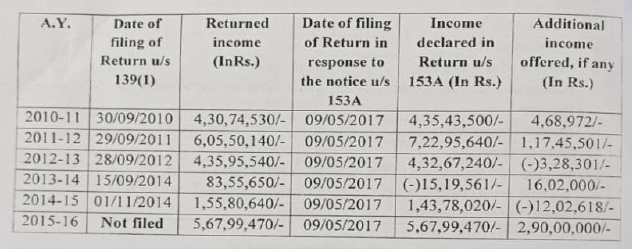
The return for the A.Y. 2016-17 was filed on 09/05/2017 u/s 139(1) declaring total income of Rs.8,38,29,190/-including undisclosed income of Rs.4,50,00,000/-. Shri Sanjay Kumar Agrawal admitted undisclosed income in the statement recorded on oath u/s 132(4)/131(1A) of the Act on 13/11/2015. The manner in which the undisclosed income earned was not disclosed during the search proceedings u/s 132(4) of the Act. The return for the A.Y. 2015-16 was filed on 09/05/2017 u/s 153A declaring total income of Rs.5,67,99,470/- including undisclosed income of Rs.2,90,00,000/-. Shri Sanjay Kumar Agrawal admitted undisclosed income in the statement recorded on oath u/s 132(4)/131(1A) of the Act on 13/11/2015. The manner in which the undisclosed income earned was not disclosed during the search proceedings u/s 132(4) of the Act. The return for the A.Y. 2011-12 was filed on 09/05/2017, u/s 153A declaring total income of Rs.7,22,95,640/- including undisclosed income of Rs.80,90,475/-. Shri Sanjay Kumar Agrawal admitted undisclosed income in the statement recorded on oath u/s 132(4)/131(1A) of the Act, on 13/11/2015. The manner in which the undisclosed income earned was not disclosed during the search proceedings u/s 132(4) of the Act. Considering the fact that while filing the return of income u/s 139(1) of the Act, the assessee has concealed the income which was unearthed during search proceedings. Notices u/s 143(2) for assessment years 2010-11 to 2015-16 were issued on 07/08/2017 and for A.Y. 2016-17 on 22/09/2017. Questionnaire along with notice u/s 142(1) was issued on 12/09/2017 and duly served upon the assessee. In response to the above notices, Shri Devendra Bansal and Shri Jayant Lodha, both, CA and Authorized Representative of the assessee, attended from time to time and furnished with supporting documents and submissions before the assessing officer. Then, after, assessing officer framed the assessment order for various assessment years, by making various additions, the facts of which will be discussed at the relevant ground of appeal.
6. Aggrieved, by the order of the assessing officer, on account of various additions, the assessee carried the matter in appeal before the learned CIT(A) who has deleted the addition on various issues, for which the revenue is in appeal before this Tribunal, and learned CIT(A), on various issues allowed the appeal of the assessee, partly or confirmed the addition made by the assessing officer fully, for which the assessee is in appeal, before this Tribunal. The facts of the concerned ground and findings of the ld. CIT(A) would be discussed, while adjudicating relevant ground of appeal.
7. Now, we shall take concise and summarised grounds of appeal raised by the revenue, one by one, as follows:
8. Concise and summarised ground No.1 raised by the revenue, is reproduced below, for ready reference:
(i) The Ld. CIT(A) erred in deleting the following additions:
(a) Rs.6,00,000/- part of Rs.13,24,00,000/-, on account of cash found, retraction, which is after thought.
(b) Rs.5,10,00,000/- excess stock found during search, however, stock verification was conducted transparently, which is part of Rs.13,24,00,000/-.
(c) Addition of Rs.7,73,00,000/- (being Rs.3,30,00,000/- on account of LPS-1 and Rs.4,43,00,000/- on the basis of LPS-6, the reconciliation, was provided by the assessee in respect of unaccounted financial transaction, jottings in the loose paper sheet, both part of Rs.13,24,00,000/-.
(d) Addition of Rs.35,00,000/- (Difference Rs.65,00,000 – Rs.30,00,000), difference of surrender amount on account of miscellaneous issues to cover up tax liabilities on miscellaneous issues, which is part of addition of Rs.13,24,00,000/-.
9. Brief facts qua the addition deleted by Ld. CIT(A) of Rs.13,24,00,000/-, are that during the course of search and post search proceedings, statement of Shri Sanjay Kumar Agrawal was recorded u/s. 132(4)/131(1A) of the Act. As per the assessing officer, in his statement, Shri Sanjay Agrawal admitted undisclosed income of Rs. 25,00,00,000/- over and above the regular income for various assessment years for the assessee- company and other group assessees. The assessing officer at page no. 6 & 7 of his assessment order has scanned the copy of the relevant statement of Shri Sanjay Agrawal. From the statement scanned at page no. 7 of the assessment order, Shri Sanjay Agrawal had made a declaration of undisclosed income of Rs.17,74,00,000/- for the A.Y. 2016-17 on behalf of the assessee- company. As per the findings given by the assessing officer at para (9.3) of his Order, out of the total declared amount of Rs. 17,74,00,000/-, the assessee had only declared additional income of Rs. 4,50,00,000/- [Rs. 3,50,00,000 (+) Rs. 70,00,000/- (+) Rs. 30,00,000/-] in its return of income filed post search and the balance income of Rs. 13,24,00,000/- was not declared by the assessee in its return of income for A.Y. 2016-17. Accordingly, on the basis of the statement of Shri Sanjay Agrawal, the assessing officer made an addition of Rs. 13,24,00,000/- in the hands of the assessee- company for the assessment year 2016-17. According to the assessing officer, the statement by Shri Sanjay Agrawal was given in his sound state of mind and without any coercion/threat. Further, according to the assessing officer, it is settled law that a disclosure made on oath cannot be retracted unless it has been obtained by undue pressure, threat, coercion etc. Furthermore, according to the assessing officer, it is a settled law that admission made by a person is a good piece of evidence, though not conclusive and the same can be used against a person who makes it. For such proposition, the assessing officer has placed reliance on the Coordinated Benches of the ITAT. Accordingly, on the basis of the statement of Shri Sanjay Agrawal, the assessing officer made an addition of Rs. 13,24,00,000/- in the hands of the assessee- company.
10. Aggrieved by the above addition, made by the assessing officer, the assessee carried the matter in appeal before the Ld. CIT(A) who has deleted the addition made by the assessing officer, on different issues, therefore, revenue is in appeal before this Tribunal. The relevant findings of the learned CIT(A) would be discussed along with the relevant ground of appeal.
11. We find that the Ld. CIT(A) has deleted the entire addition of Rs. 13,24,00,000/- by giving his elaborative findings from para (3.3.2) to para (3.3.9) of his Order for A.Y. 2016-17. The findings of Ld. CIT(A) is mentioned in “Para (3.3.2) to Para (3.3.9) of CIT(A) Order for A.Y. 2016-17 from page no. 25 to 29”.
Before us, the Counsel of the assessee-company vehemently argued that the addition has been made solely on the basis of statement of Shri Sanjay Agrawal which was made under pressure, in undue haste and under confused state of mind without appreciating the contents of the seized records, which has duly been appreciated by the ld. CIT(A) and accordingly, the Ground of the revenue deserves to be dismissed. As per the Ld. Counsel, the assessee- company, vide its letter placed at page no. 189 of its Paper Book, had duly submitted a detailed breakup along with the reasons of surrender before the assessing officer. According to the Counsel of the assessee, while furnishing the returns of income post search, the assessee had duly taken into consideration the correct amount of additional income as was emanating from the documents seized. It was further submitted that only in respect of those surrendered income, which were either based upon duplicacy of the seized documents or misinterpretation of seized records or misinformation given to Shri Sanjay Agrawal who made the statement, the assessee was neither required to disclose the additional income and nor it has so disclosed. It was explained that in respect of each and item of the variation in the amount of additional income surrendered vis-a-vis income shown in the return of income, the assessee had tendered its explanation before the assessing officer along with the documentary evidences and the assessing officer could not rebut any of the explanations of the assessee. It was further submitted that the assessing officer merely on the basis of the surrender made during the course of search, made the addition without properly appreciating the facts and circumstances of the case. The Ld. Counsel of the assessee argued that although admission of income during the search is a good piece of evidence but that by ipso facto, cannot become a basis for addition when the assessee with the documentary evidences explained that the surrender was not correct and was made under a wrong notion. The assessee brought our attention to the breakup of the income surrendered which is placed at page no. 233 & 234 of the Paper Book. The Counsel of the assessee also drew our attention to the relevant pages of the written submission which were filed by it before the ld. CIT(A). The copies of such submissions are placed at page no. 18 to 21 of the Paper Book of the assessee for A.Y. 2016-17. Further, the Counsel of the assessee also invited our attention to the various documents which were seized during the course of the search and based upon which the assessee made the surrender. The copies of such seized documents are placed at page no. 235 to 249 of the Paper Book.
12. Per Contra, Ld. DR for the Revenue, on the other hand, put forth his contentions that once Shri Sanjay Agrawal admitted the surrendered amount, then it was not open for him to retract back on his statements and accordingly, the addition so made by the assessing officer deserves to be upheld. According to the CIT(DR), the statement given by Shri Sanjay Agrawal was voluntary and further, the assessee has made the retraction of the statement only at the stage of filing of the return, thus there was a considerable delay on the part of the assessee- company in retraction. In such circumstances, according to the CIT(DR), the entire additional income admitted by the assessee was required to be disclosed by it in its returns of income filed after the search.
13. Having heard both the parties, we find that the surrender of Rs.17,74,00,000/-so made by Shri Sanjay Agrawal was made on as many as six issues. Accordingly, it would be apt to discuss and deliberate upon each of the issues in detail. As regard the first issue, we find that Shri Sanjay Agrawal has made a surrender of Rs. 3,30,00,000/- on the basis of some seized documents inventorized as ‘LPS-1, pg 1819’. Before us, the ld. Counsel of the assessee pointed out that Shri Sanjay Agrawal had made an aggregate surrender of Rs. 3,30,00,000/- on the basis of Page No. 18 & 19 of LPS-1, placed at page no. 235 & 236 of the assessee’s Paper Book, which in its turn, was comprising of a sum of Rs. 1,80,00,000/- found noted at the receipt side of the seized documents and a sum of Rs. 1,50,00,000/- on the payment side of the seized documents. The ld. Counsel of the assessee demonstrated that the page no. 19 of the LPS-1, as placed at page no. 235 of the Paper Book is the duplicate copy of the same paper seized and inventorized as page no. 8 of LPS-6, which is placed at page no. 242 of the Paper Book. Likewise, the page no. 18 of LPS-1 as placed at page no. 236 of the Paper Book is the duplicate of page no. 7 of LPS-6, as placed at page no. 243 of the Paper Book. The ld. Counsel submitted that based upon loose papers inventorized as page no. 18 & 19 of LPS-1, the assessee had surrendered additional income of Rs. 3,30,00,000/- and the same income got erroneously surrendered by Shri Sanjay Agrawal on the basis of LPS-6, Page 1 to 13. As per the counsel, as is evident from the statement of breakup of surrendered income, on the basis of LPS-6, Page No. 1 to 13, the assessee had surrendered 7,93,00,000/- viz. Rs. 4,00,00,000/- on account of income and Rs. 3,93,00,000/- on account of expenditure noted on same seized documents which were in the form of a cash book. Thus, according to the ld.Counsel the aforesaid amount of Rs. 7,93,00,000/- was comprising of income of Rs. 3,30,00,000/- which was already surrendered by the assessee on the basis of LPS-1, Page No. 18 & 19. 27. We find that the CIT(DR) before us, could not contravert or rebut the arguments made by the Counsel of the assessee as above. We have also gone through the seized documents being page no. 18 & 19 of LPS-1 and Page No. 7 & 8 of LPS-6, as placed at page no. 235,236,242 & 243 of the Paper Book filed by the assessee and upon careful examination of such documents we found substance in the contention of the assessee. Accordingly, in our considered view, the CIT(A) has not committed any error while deleting the addition of Rs. 3,30,00,000/- from the income of the assessee.
14. We find that the second issue concerns surrender of Rs. 7,93,00,000/- on the basis of seized document ‘LPS-6, pg no. 1-13’, against which the assessee has only declared a sum of Rs. 3,50,00,000/- in its return of income, as gathered from para (9.3) of the assessing officer’s order. Before us, the ld. counsel of the assessee submitted that Shri Sanjay Agrawal made the surrender of Rs. 7,93,00,000/- on the basis of LPS-6, Page No. 1 to 13, which is in the nature of a handwritten cash book, which contained jottings of both unaccounted receipts and unaccounted payments. As per the ld. Counsel for the assessee, Shri Sanjay Agrawal had inadvertently made the subject surrender on this issue by considering both the unaccounted receipts and unaccounted payments, without taking into account the material fact that it is only the peak of the unaccounted receipts or unaccounted payments which is liable to be disclosed as additional income. The ld. Counsel for the assessee drew our attention to a statement showing analysis of LPS-6, which is placed at page no. 250 to 259 of Paper Book for A.Y. 2016-17. Upon going through the contents of the aforesaid statement, we could observe that as per LPS-6, total unaccounted receipts worked out to be at Rs. 3,48,55,060/- and unaccounted payments worked out to be at Rs. 3,50,16,605/-. We further find that the ld. CIT(A), at para (3.3.3.) has given a categorical finding that the assessing officer has not disputed the figures or discrepancy in aforesaid computation which was also furnished by the assessee during the course of the remand proceedings. The sanctity and the accuracy of the statement referred hereinabove has also not been challenged by the counsel for the Revenue. Thus, we find sufficient substance in the submission made by the ld. Counsel of the assessee that Shri Sanjay Agrawal has made the surrender by taking into consideration both unaccounted receipts and unaccounted payments as against the peak of the two. In the instant case, the amount of unaccounted payments was at a higher side than the unaccounted receipts and therefore, higher of the two being a sum of Rs. 3,50,00,000/- (round off) was only required to be regarded as the undisclosed income of the assessee based upon such ‘LPS-6, page no. 1 to 13’. Thus, in our view, out of the total undisclosed income of Rs. 7,93,00,000/-, undisclosed income to the extent of Rs. 3,50,00,000/- was only required to be taken into consideration. We find that the assessee has already disclosed the aforesaid income of Rs. 3,50,00,000/- in its return of income for A.Y. 2016-17 and in respect whereof, the assessing officer has also granted credit to the assessee while making the addition. Accordingly, in our considered view, no further addition on the count of ‘LPS-6, page no. 1 to 13’ was warranted and consequently, no infirmity is found by us in the CIT(A)’s Order in deleting the addition to the extent of Rs. 4,43,00,000/-on this count.
15. We find that about the issue, regarding surrender made by Shri Sanjay Agrawal on account of cash of Rs.6,00,000/- found during the course of search. Before us, the Ld. Counsel for the assessee submitted that Shri Sanjay Agrawal, under a wrong notion, made such surrender of Rs. 6,00,000/-, which was not at all required as on the date of the search, as the assessee- company was showing a much higher cash balance of Rs. 22,39,602/- in its regular books of account. Accordingly, as per the Counsel of the assessee, there was no cash which was in the nature of unexplained and accordingly, no surrender was required to be made by Shri Sanjay Agrawal. In order to prove the availability of cash in the hands of the assessee-company on the date of the search, the Counsel drew our attention to the Cash Book of assessee company placed at page no. 260 of the assessee’s Paper Book for A.Y. 2016-17. Upon going through the contents of Cash Book, we find sufficient merit in the contention of the assessee’s counsel that on the day immediately before the date of the search i.e. on 22/09/2015, the assessee- company was maintaining a higher cash balance of Rs. 22,39,602/-, as against the total cash found during the course of search at Rs. 6,00,000/-. We thus find substance in the submission made by the ld counsel for the assessee that the surrender on account of unexplained cash has been made by Shri Sanjay Agrawal in a hurried manner without even referring to the books of accounts of the assessee -company. The ld. CIT(A), at para (3.3.4) has given his findings on this issue. Upon going through such findings, we find that the ld. CIT(A) noted that during the course of remand proceedings too, the assessing officer could not find any infirmity as to the exact position of the cash in hand as on the date of search vis-a-vis the cash found during the course of search. In such circumstances, we are inclined to accept the findings given by the ld. CIT(A) and accordingly, we hereby upheld the action of the ld. CIT(A) in deleting the addition of Rs. 6,00,000/- on this count.
16. We find that in respect of the surrender of income of Rs. 70,00,000/-, the assessee himself has shown the income in its return of income for A.Y. 2016-17 and in respect of such income disclosed in the return, the assessing officer has also given the due credit and therefore, there does not remain any controversy on this issue.
17. We further find that Shri Sanjay Agrawal made a surrender of Rs.5,10,00,000/- on the issue of excess stock, which was later retracted. The ld. CIT(A), while giving his findings at para (3.3.6) of his Order for A.Y. 2016-17 has deleted the subject addition of Rs.5,10,00,000/- on this count. Before us, the ld. counsel for the assessee, again, submitted that surrender of Rs. 5,10,00,000/- was made by Shri Sanjay Agrawal under a patently wrong notion, inasmuch, on the date of search i.e. on 23-09-2015 there was no material difference in the stock which was physically found by the search party and as found recorded in the regular books of accounts of the assessee-company. The counsel for the assessee submitted that on the date of search, the total value of entire stock physically found during the course of search was to the extent of Rs. 54,76,20,174/- , whereas, as per the regular Manufacturing and Trading Account for the period from 1-4-2015 till 23-09-2015 (i.e. date of search), the total closing inventory was to the extent of Rs. 54,62,83,969/-, thereby resulting into minor difference of Rs. 13,36,205/- only in the inventory actually found during the course of search and inventory found recorded in the books of account, which too, is attributable to the variation in rates applied for valuation. We have gone through the contents of the Valuation report submitted by ‘M/s. Lalit K. Jain & Co., Chartered Accountants’ as placed at page no. 145 to 160 of the assessee’s Paper Book for A.Y. 2016-17. As per such Valuation Report, the valuer has made the valuation of the Physical inventory found during the course of search at Rs. 54,76,20,174/-. As against such physical inventory, we find that as per the Manufacturing and Trading Account of the assessee for the period from 1-42015 to 23-09-2015, furnished by the assessee in its Paper Book at page no. 261, the value of closing stock as per the regular books of account worked out to be at Rs. 54,62,83,969/-. We find substance in the contention of the counsel for the assessee that such a minor variation of Rs. 13,36,205/- which is not even 0.25% of the total inventory can be said to be a result of the valuation of the inventory made by the valuer. We find that during the course of the remand proceedings, as has been captured by the ld. CIT(A) at para (3.3.6) of his order, the assessing officer could not contravene the aforesaid submissions made by the assessee. The ld DR for the Revenue, except pressing upon the surrender made by Shri Sanjay Agrawal, could not dispute the submissions made by the ld counsel for the assessee. Further, before us, the CIT(DR) has also not disputed the closing stock shown by the assessee in its books of account. In our considered view, the addition deleted by the ld. CIT(A) on this issue also deserves to be upheld.
18. Now, coming to the last issue of surrender of Rs. 65,00,000/- made by Shri Sanjay Agrawal, against which only a sum of Rs. 30,00,000/- was declared by the assessee- company in its return of income, we find sufficient merits in the submission of the ld. counsel for the assessee that initially such surrender of Rs. 65,00,000/- was made by Shri Sanjay Agrawal on overall and ad-hoc basis, but, after minutely observing the nature and category of loose papers, undisclosed income only to the extent of Rs. 30,00,000/- got emanated which was duly offered in the return of income. While dealing with the other issues supra, we could notice a common feature that the surrender made by Shri Sanjay Agrawal was not in line with the books of accounts or the correct interpretation of the seized records. The ld. CIT(A), at para (3.3.7) has also taken a similar view that the ad-hoc surrender of Rs. 65,00,000/- so made by Shri Sanjay Agrawal was not linked to any particular document or reason but it was merely an additional amount to cover up miscellaneous issues. Upon going through the order of the assessing officer, we find that the assessing officer has made the addition merely on account of retraction without making reference to any particular document or loose paper. We are of the considered view that any addition which is not based upon any cogent material or document is not sustainable in the eyes of Law. In such circumstances, we upheld the action of the ld. CIT(A) in deleting the addition of Rs. 35,00,000/- on the difference of the surrender on miscellaneous aspect.
19. From the above facts and findings of the learned CIT(A), we find that the entire addition of Rs. 13,24,00,000/- got made by the assessing officer was merely on account of the difference between the amount surrendered by Shri Sanjay Agrawal and the amount disclosed by the assessee- company in its return of income without brining on record any other corroborative evidence which could support the making of such addition. We find merit in the submission of the ld. Counsel for the assessee that a statement recorded u/s. 132(4) is a good piece of evidence, but, solely, in the absence of any other corroborative evidence, cannot be used against an assessee. We find that in the instant case, the assessee- company could be able to demonstrate the circumstances under which the surrender was made by Shri Sanjay Agrawal and the reasons for retraction there of, which have neither been disputed by the assessing officer during the course of the remand proceedings nor by the ld. DR for the Revenue. In such circumstances, we do not find any infirmity in the action of the ld. CIT(A) in deleting the additions of Rs. 13,24,00,000/- merely on account of difference between the amount surrendered and the amount shown in the return of income. Accordingly, the Ground Nos. 1 to 5 of the Revenue for A.Y. 2016-17 are hereby dismissed.
20. In the result, summarise and concise ground No.1 raised by the revenue, is dismissed.
21. The concise and summarise ground No.(ii) of the revenue is reproduced below for ready reference:
“(ii) Ld. CIT(A) erred in deleting the disallowance under section 14A of the Act, to the tune of Rs.2,42,50,528/-, as no dividend income is received by assesse-company, so Ld. CIT(A) deleted the addition.”
22. Brief facts qua the issue are that assessing officer, vide para (16) of his common assessment order, has made an addition of Rs. 2,42,50,258/- u/s. 14A r.w.s. 8D of the Income Tax Rules, 1962 in the hands of the assessee- company. The addition has been made by the assessing officer by giving a finding that on perusal of the balance sheet and Profit &Loss of the assessee, it got noticed that the assessee had made substantial investment in shares and huge amount has been claimed deductible as interest as per Profit and Loss Account, therefore, assessing officer made the addition to the tune of Rs. 2,42,50,258/- u/s. 14A r.w.s. 8D of the Income Tax Rules, 1962.
23. The ld. CIT(A) by giving his operative findings at para (3.6.5) of his order for A.Y. 2016-17 has deleted the entire addition made by the assessing officer u/s. 14A r.w.r. 8D of the Income Tax Rules, 1962, stating that there was no exempt income, hence addition should not be made in the hands of the assessee.
24. Before us, both, the ld. Counsel of the assessee and the Ld. DR for the Revenue put fort their arguments. The counsel of the assessee vehemently argued that during the year under consideration, the assessee- company has not derived any exempt income so as to warrant invocation of the provisions of section 14A of the Act. The Counsel for the assessee submitted that the Explanation to section 14A, inserted vide Finance Act, 2022 w.e.f. 1-4-2022, which provides that the provisions of section 14A shall still apply even if in any particular financial year the assessee has not earned any exempt income, is prospective in nature and has no application to the year under consideration. For such proposition, the ld Counsel for the assessee placed reliance on the decision of the Hon’ble Gujrat High Court in the case of Wiiliamson Financial Services Limited v. CIT (Gauhati)/ 2024 (9) TMI 1571 (GuHC). The ld. Counsel for the assessee, in support of his assertion that in absence of any exempt income earned or received during the year under consideration, the provisions of section 14A cannot be invoked and also to support his assertion that the Explanation to section 14A has no retrospective application, drew our attention of the judgment of the jurisdictional High Court of Madhya Pradesh in the case ofPCIT(Central) v. Keti Construction Ltd. [2025] 475 ITR 182 (Madhya Pradesh)/2024 (5) TMI 168 (MPHC), a copy whereof has been placed at page no. 288 to 296 of the assessee’s Paper Book. On the other hand, the ld DR of the Revenue also vehemently argued that the assessee has made huge investments in exempt income yielding assets and accordingly, the disallowance so made by the assessing officer u/s. 14A r.w.r 8D of the Income Tax Rules, 1962 deserves to be upheld.
25. We have carefully gone through the facts of the case. Undisputedly, during the year under consideration i.e. for A.Y. 2016-17, the assessee has not claimed to earn any exempt income. Such fact has duly been verified by us from the Computation of the total income of the assessee -company, placed at page no. 38 & 39 of the Paper Book and as also from Note No. 19 of Revenue from Operations and Note No. 20 of Other Income forming part of the audited financial statements of the assessee -company as placed at page no. 122. Thus, the only question which remains to be answered before us is that whether in the absence of earning or receiving any exempt income, the provisions of section 14A can be invoked, particularly in the light of the amendments made by the Finance Act, 2022 by way of insertion of Explanation to section 14A. We find that the answer to this question has already been addressed by the Jurisdictional High Court of Madhya Pradesh in the case of Keti Construction, wherein their Lordships were pleased to hold as under:
“15. From the perusal of the aforesaid, it is clear that though the affect of this amendment is such that the disallowance under Section 14 (A) of the Act shall be attracted, even if the exempt income is not earned during the year , but the amendment is itself applicable prospectively from assessment 01.04.2022 and not applicable to assessment year 2013-14, which is the subject matter in the present appeal. To further elaborate amendment in Section 14 (A) of the Act, the following paras of memorandum to finance bill, 2022 are worthy of reference:”
26. Thus, respectfully following the decision of the Jurisdictional High Court and also of various other judicial authorities, we are of the considered opinion that no disallowance u/s 14A of the Act can be made in a year when an assessee has not earned any exempt income. In such circumstances, we find no infirmity in the action of the ld. CIT(A) in deleting the addition so made by the assessing officer on this count. Accordingly, the Ground Nos. 6 & 7 of the Revenue for the A.Y. 2016-17 are dismissed.
27. In the result, concise and summarise ground No.(ii) of the revenue is dismissed.
28. Now, we shall take one by one the summarised and concise grounds of appeal raised by the assessee.
29. The summarised and concise ground No.(i) raised by the assessee, is reproduced below:
“(i) The Ld. CIT(A) erred in sustaining the addition of Rs.75,99,005/- out of total additions of Rs.90,51,330/-.
(This is ground No.01 in IT(SS)A No.1/Ind/2025, for AY 2011-12, Ground No.1 in IT(SS)A No.9/Ind/2025 for AY 2012-13, Ground No.1 in IT(SS)A No.10/Ind/2025 for AY 2013-14, Ground No.1 in IT(SS)A No.13/Ind/2025 for AY 2016-17, Ground No.1 in IT(SS)A No.12/Ind/2025 for AY 2015-16, Ground No.1 in IT(SS)A No.11/Ind/2025 for AY 201415)”.
The above summarised and concise ground No.1 of assessee, in various appeals are, general in nature, hence, do not require adjudication.
30. The summarised and concise ground No.(ii) raised by the assessee, is reproduced below:
“The Ld. CIT(A) erred in confirming the addition aggregating to a sum of Rs.68,53,673/-, without considering the material facts that on the date of initiation of the search under section 132, no assessment proceedings was pending in respect of the assessment year under consideration”.
(This is ground No.2 in IT(SS)A No.1/Ind/2025 for AY 2011-12, Ground No.1 & 2 in IT(SS)A No.2/Ind/2025 for AY 2010-11, Ground No.2 in IT(SS)A No.9/Ind/2025 for AY 2012-13, Ground No.2 in IT(SS)A No.10/Ind/2025 for AY 2013-14).
31. We have heard, both the parties and carefully gone through the submission put forth on behalf of the assessee as well as the Revenue along with the documents furnished and the case laws relied upon, and perused the fact of the case including the findings of the ld CIT(A) and other materials brought on record. However, we do not find any substance in the above ground so raised by the assessee. We find that in the case of the assessee a valid search u/s 132 of the Income Tax Act, 1961 was carried out in the business premises of the assessee and as also, in the residential premises of the directors of the assessee. We also find that during the course of the search, various incriminating documents were found and seized. We also find that the assessing officer in the body of the assessment order has taken recourse of the incriminating documents so seized. In our considered view, once during the course of search u/s. 132 of the Act any incriminating material or document is found and seized even in respect of one issue, then, in respect of the assessment year to which such incriminating document pertain, the assessing officer has the jurisdiction to assess or reassess the total income of the assessee in respect of those issues also for which no incriminating document was found and seized during the course of search. For such proposition, we find support from the decision of the Hon’ble Apex Court in the case of
Pr. CIT v.
Abhisar Buildwell (P.) Ltd. 454 ITR 212 (SC) in which the Hon’ble Court at para (14) has observed as under:
“14. In view of the above and for the reasons stated above, it is concluded as under:
(i) that in case of search under Section 132 or requisition under Section 132A, the assessing officer assumes the jurisdiction for block assessment under section 153A;
(ii) all pending assessments/reassessments shall stand abated;
(iii) in case any incriminating material is found/unearthed, even, in case of unabated/completed assessments, the assessing officer would assume the jurisdiction to assess or reassess the ‘total income’ taking into consideration the incriminating material unearthed during the search and the other material available with the assessing officer including the income declared in the returns; and
(iv) in case no incriminating material is unearthed during the search, the assessing officer cannot assess or reassess taking into consideration the other material in respect of completed assessments/unabated assessments. Meaning thereby, in respect of completed/unabated assessments, no addition can be made by the assessing officer in absence of any incriminating material found during the course of search under Section 132 or requisition under Section 132A of the Act, 1961. However, the completed/unabated assessments can be re-opened by the assessing officer in exercise of powers under Sections 147/148 of the Act, subject to fulfilment of the conditions as envisaged/mentioned under sections 147/148 of the Act and those powers are saved.”
In our considered view, the case of the assessee falls under clause (iii) of the aforesaid Order of the Hon’ble Supreme Court inasmuch, undisputedly, in the case of the assessee during the course of the search some incriminating documents were found and seized. In such circumstances, as per the ratio laid down by the Hon’ble Supreme Court, even in respect of the completed assessment years, the assessing officer has rightly assumed the jurisdiction to assess or reassess the total income of the assessee by taking into consideration incriminating material and as also, any other material available with him at the time of framing the assessment u/s. 153A of the Act.
32. In the result, summarised and concise ground No.(ii) raised by the assessee, is dismissed.
33. The summarised and concise ground No.(iii) raised by the assessee, is reproduced below:
(iii) The Ld. CIT(A) erred in confirming the addition of Rs.7,45,332/- in the assessee’s income by making disallowance of salary paid to Mr. Vijay Prasad Pappu, without considering the fact that the entire salary has been paid through account payee cheques only after making due TDS and recipient has duly has duly shown such salary as an income in his return of income.
(This, is Ground No.3 (i) and 3 (ii) in IT(SS)A No.1/Ind/2025 for AY 2011-12, Ground No.3 (i) and 3 (ii) in IT(SS)A No.2/Ind/2025 for AY 2010-11, Ground No.3 (i) and 3 (ii) in IT(SS)A No.9/Ind/2025 for AY 2012-13), Ground No.3(i) and 3(ii) in IT(SS)A No.10/Ind/2025 for AY 2013-14, Ground No.2(i) and 2(ii) in IT(SS)A No.13/Ind/2025 for AY 2016-17, Ground No.2(i) and 2(ii) in IT(SS)A No.12/Ind/2025 for AY 2015-16, Ground No.2(i) and 2(ii) in IT(SS)A No.11/Ind/2025 for AY 2014-15).
34. The brief facts qua the above issue are that assessing officer has dealt with this issue at para (8) to para (8.2) of his common assessment order passed for A.Y. 2010-11 to A.Y. 2016-17. The assessing officer noted that the assessee has claimed more salary in its books of account then actually paid to some Shri Vijay Prasad Pappu. The assessing officer at para (8.1) has drawn a table in which he has given the assessment year wise details of the salary claimed by the assessee in its books of account on monthly basis, actual salary paid on monthly basis, excess claim made on monthly basis and excess claim made for the entire assessment year. For making such addition, the assessing officer has placed reliance on ‘Page No. 19’ and ‘Page No. 22 to 26’ of the LPS-9 seized and inventorised as such during the course of the search. The assessing officer has also abstracted some part of the statement of Shri Sanjay Agrawal, a director of the assessee, in the body of the assessment order itself. The copies of the loose papers on which the assessing officer has relied upon have been filed by the assessee at page no. 141 to 148 of its Paper Book. The assessing officer made the addition in irrespective assessment years.
35. On appeal, the ld.CIT(A) confirmed the action of the assessing officer, therefore assessee is in further appeal before this Tribunal for respective assessment years.
36. We have heard, both the parties. Upon the insistence of the Bench during the course of the hearing, the assessee, vide its counsel’s submission dated 17/06/2026, has also furnished copies of all the statements of Shri Sanjay Agrawal recorded by the Search Party either during the course of search u/s. 132(4) or during the course of post search investigation u/s. 131(1A) of the Act. We find that the ld. CIT(A) vide para (3.3.2) of his Order for A.Y. 2010-11 has confirmed the addition made by the assessing officer. According to the CIT(A) once the documentary evidences are unearth during the search action from the premises of the assessee’s group and once, the same has been admitted by the CMD (Shri Agrawal) then it was very clear that such evidences gives proof of showing a higher amount of salary by the assessee-company.
37. We have carefully perused and gone through the seized documents as referred to by the assessing officer in the body of the assessment order. On a perusal of the LPS-19 and LPS-22 we find that such papers are handwritten with the caption ‘Salary Calculation’. We find that at such papers at the left hand side some figures, which appear to be salary recorded in books of account of the assessee for financial year 2010-11 and financial year 2011-12, have been mentioned. We find that at page no. 19 after jotting down ‘100000.00’ for F.Y. 2010-11, an amount of ‘18,108’, with the narration of ‘TDS’ has been made. Thereafter, by subtracting the figure of ‘18108’ from the figure of ‘100000.00’, figure of ‘81,892’ has been worked out and from such figure, the final calculation of the figure under the head ‘Actual’ jotted down at the right side of the same page at ‘37,899’ has been reduced and the remaining figure of ‘43,993’ has been jotted down as recoverable. Thus, at the first blush, it appears that the gross salary of Shri Vijay Prasad Pappu for each month was of Rs. 1,00,000/- only and as against such salary of Rs. 1,00,000/- claimed for A.Y. 2011-12, the actual amount of salary paid to Shri Vijay Prasad Pappu was of Rs. 37,889/- only thereby resulting in an excess monthly claim of salary of Rs. 62,111/-i.e. of Rs. 7,45,332/- for A.Y. 2011-12. We find that for A.Y. 2010-11 no document of the similar kind was seized but for other assessment years viz. A.Y. 2012-13 to A.Y. 2016-17, the documents of identical jottings were found and seized.
38. Before us, the Ld. Counsel for the assessee has argued that except having the seized documents, the assessing officer was not having any other corroborative material or evidence on his record for making the additions on the count of disallowance of salary to Shri Vijay Prasad Pappu. The ld. counsel argued that from the abstract of statement of Shri Sanjay Agrawal as reproduced at page no. 4 in the body of the assessment order one could gather that Shri Sanjay Agrawal had merely made a presumption as regard to refund of salary received from Shri Vijay Prasad Pappu and the statement was not given by him in the affirmative manner but only as a presumption and probable interpretation of the seized document to whom Shri Sanjay Agrawal was confronted. The Ld. Counsel also argued that during the course of the assessment proceedings, the assessing officer has not made any independent inquiry either from Shri Vijay Prasad Pappu or the cashier of the assessee- company. The Ld. Counsel further submitted that Shri Vijay Prasad Pappu with an aim to keep his savings set apart, used to handover a part of salary received by him every month to the cashier of the assessee- company and any such refund of the salary by Shri Vijay Prasad Pappu to the cashier of the assessee- company could have only been regarded as a matter of internal financial transaction between two personnel of the assessee- company and merely on the basis that Shri Vijay Prasad Pappu has refunded certain amount of his salary to the cashier of the assessee -company could not, ipso facto, be regarded as the excess claim of salary by the assessee -company to Shri Vijay Prasad Pappu. During the course of hearing before us, the assessee has also furnished one copy of letter of confirmation duly given by Shri Vijay Prasad Pappu affirming the fact that out of the receipt of salary, every month he used to deposit a certain sum with the cashier of the assessee company for the purpose of saving. In confirmation, Shri Vijay Prasad Pappu confirmed that the saving was made by him for the construction of a residential house for him and in the subsequent years, he had made investment for such purpose.
39. Further, the ld. counsel of the assessee also submitted that Shri Vijay Prasad Pappu was holding a key position in the assessee- company and the payment of salary of Rs. 1,00,000/- per month claimed to have been made is quite reasonable and commensurate with his education, qualification, experience and his job profile. It was further submitted that the entire payment for salary was made by the assessee company to Shri Vijay Prasad Papu through banking channels only and that too after making necessary deduction of Tax at Source and contribution for provident fund.
It was further submitted that by the ld. counsel for the assessee that in the case of Shri Vijay Prasad Pappu too, simultaneous search operations u/s. 132 were carried out and during the course of such search, no document giving even an iota of evidence of excess claim of salary by the assessee -company in respect of payment to Shri Vijay Prasad Pappu was found or recovered. The ld. counsel vehemently submitted that in pursuance of the search u/s. 132 in the case of Shri Vijay Prasad Pappu assessment proceedings u/s. 153A were initiated and in the returns of income furnished by Shri Vijay Prasad Pappu u/s 153A, he had shown the same salary income from the assessee- company as has been claimed by the assessee -company. He further submitted that the assessment orders in the case of Shri Vijay Prasad Pappu was passed by the same assessing officer u/s. 143(3) r.w.s. 153A of the Act for A.Y. 2010-11 to A.Y. 2015-16 and while framing the assessment in the case of Shri Vijay Prasad Pappu has duly accepted the salary income shown by Shri Vijay Prasad Pappu in his returns of income without any intervention or interference. Thus, according to the ld. counsel for the assessee, when the fact regarding receipt of income by some payee is accepted while framing assessment u/s. 143(3) of the Act of such payee, then correspondingly, in the hands of the payer too, it has to be necessarily presumed that the payer had made the corresponding payment.
40. On the other hand, the ld. CIT(DR) for the Revenue supported the findings given in the Orders of the authorities below and further submitted that the theory of the assessee as regard to the refund of salary for the purpose of his saving is farfetched and deserves to be discarded.
41. Having heard both the parties on the subject issue, we find that there is no quarrel to the proposition that Shri Vijay Prasad Pappu had refunded certain amount of salary, from month to month. However, from the copy of the statement of Shri Sanjay Agrawal abstracted in the body of the assessment order and copy of letter of confirmation duly given by Shri Vijay Prasad Pappu, we find that such refund of salary was made by Shri Vijay Prasad Pappu in his personal capacity to the cashier of the assessee- company. Further, from the copies of the bank statements of Shri Vijay Prasad Pappu placed at page no. 154 to 214 of Paper Book for A.Y. 2010-11, copy of Form No. 16 issued to Shri Vijay Prasad Pappu, copy of TDS certificate issued to Shri Vijay Prasad Pappu, copy of Form No. 3A filed by the assessee company with the PF Authorities, copy of the income tax return and assessment order relating to Shri Vijay Prasad Pappu, it can safely be concluded that the assessee- company has made the entire payment of salary to Shri Vijay Prasad Pappu as claimed in its books of account from year to year. Further, from the copy of the assessment order passed in the case of Shri Vijay Prasad Pappu, for A.Y. 2010-11 to A.Y. 2016-17, by the same assessing officer who passed the assessment orders in the case of the assessee, as placed at page no. 230 to 247 of the Paper Book, we find that the assessing officer although disputing the payment of salary in the hands of the assessee has accepted the entire receipt of salary in the hands of Shri Vijay Prasad Pappu. In our considered view, in respect of the same transaction, two different views cannot be taken one qua the payer and another qua the payee. Even otherwise, we find full substance in the submission of the ld. counsel for the assessee that the company and its directors and employees are distinct entities and even if any refund of salary by any employee was taken by any other employee or even by any of the directors of the company, behind the back of the assessee- company, even then since the assessee- company has incurred the full amount of expenditure for payment of salary, no disallowance deserves to be made and the same is wholly allowable under the provisions of section 37 of the Act.
42. However, as we have noted above that upon the insistence of the Bench during the course of the hearing, the assessee, vide its counsel’s submission dated 17/06/2026, has also furnished copies of all the statements of Shri Sanjay Agrawal recorded by the Search Party either during the course of search u/s. 132(4) or during the course of post search investigation u/s. 131(1A) of the Act and find that some of the statements and confirmations were examined by the assessing officer in right perspective, therefore, we are of the view that this matter should be restored back to the file of the assessing officer for examination of statements, confirmation and the material available on record along with seized material.For the reasons given above, we are of the view that the order of the CIT(A) on this issue requires to be set aside and the issue needs to be looked into afresh by the assessing officer in the light of the observations as set out above. We hold and direct accordingly. The assessing officer will afford opportunity of being heard to the Assessee before deciding the issue. The Assessee will also be at liberty to let in further evidence to substantiate it’s case. For statistical purpose, the following grounds of appeal of the assessee are treated as allowed:
| (a) |
|
Ground No.3 (i) and 3 (ii) in IT(SS)A No.1/Ind/2025 for AY 2011-12, |
| (b) |
|
Ground No.3 (i) and 3 (ii) in IT(SS)A No.2/Ind/2025 for AY 2010-11, |
| (c) |
|
Ground No.3 (i) and 3 (ii) in IT(SS)A No.9/Ind/2025 for AY 2012-13, |
| (d) |
|
Ground No.3(i) and 3(ii) in IT(SS)A No.10/Ind/2025 for AY 2013-14, |
| (e) |
|
Ground No.2(i) and 2(ii) in IT(SS)A No.13/Ind/2025 for AY 2016-17, |
| (f) |
|
Ground No.2(i) and 2(ii) in IT(SS)A No.12/Ind/2025 for AY 2015-16, |
| (g) |
|
Ground No.2(i) and 2(ii) in IT(SS)A No.11/Ind/2025 for AY 2014-15. |
43. The summarised and concise ground No.(iv) raised by the assessee, is reproduced below for ready reference:
“The Ld. CIT(A) erred in confirming the addition of Rs.6,82,583/- in respect of depreciation on truck.
(This, is ground No.4 in IT(SS)A No.1/Ind/2025 for AY 2011-12, ground No.4 in IT(SS)A No.02/Ind/2025 for AY 2010-11, Ground No.5 in IT(SS)A No.9/Ind/2025 for AY 2012-13, Ground No.7 in IT(SS)A No.10/Ind/2025 for AY 2013-14, Ground No.4 in IT(SS)A No.13/Ind/2025 for AY 2016-17, Ground No.6 in IT(SS)A No.12/Ind/2025 for AY 2015-16, Ground No.4 in IT(SS)A No.11/Ind/2025 for AY 2014-15).
44. Brief facts qua the above issue are that the ground relate to disallowance of depreciation on trucks claimed by the assessee in its returns of income from A.Y. 2010-11 to A.Y. 2016-17. The assessing officer has dealt with such issue from para (14.1) to para (14.5) of his common assessment order. The assessing officer instead of computing the W.D.V. from year to year and then computing the allowable amount of depreciation at the rate of 15%, on the recomputed opening W.D.V. for each assessment year, straight away halved the claim of depreciation made by the assessee in various assessment years. Such an exercise by the assessing officer has resulted into an excessive disallowance of claim of depreciation. On appeal, ld.CIT(A) confirmed the action of the assessing officer therefore, assessee is in appeal before this Tribunal.
45. We have heard, both the parties. We find that the assessee in its returns of income for various assessment years has claimed depreciation at the rate of 30% on Written Down Value of its Loading Trucks. We find that these Loading Trucks were being plied by the assessee for the transportation of its own goods and the same were not being used from carrying out truck plying or hiring business. We find that in respect of the Loading Trucks which were not being used for the business of plying or hiring, as per the schedule of depreciation provided under the Income Tax Rules, 1962, the assessee was eligible for claim of depreciation only at 15% of the opening Written Down Value from year to year. We find that in the instant case, after giving a finding that the assessee was eligible for claim of depreciation on its loading trucks only at the rate of 15% and not at the rate of 30% as claimed in the returns of income for various assessment years, the assessing officer instead of computing the W.D.V. from year to year and then computing the allowable amount of depreciation at the rate of 15%, on the recomputed opening W.D.V. for each assessment year, straight away halved the claim of depreciation made by the assessee in various assessment years. Such an exercise by the assessing officer has resulted into an excessive disallowance of claim of depreciation. In our considered view, the assessing officer was required to compute the amount of depreciation allowable to the assessee at the prescribed rate of 15% on the written down value as defined under section 43(6) of the Act. Accordingly, for the limited purpose of re-computing the depreciation in accordance with the provisions of the Act, we restore back this matter to the file of the assessing officer.
46. In the result, following grounds of appeal raised by the assessee are allowed for statistical and purposes, in above terms:
| (a) |
|
Ground No.4 in IT(SS)A No.1/Ind/2025 for AY 2011-12, |
| (b) |
|
Ground No.4 in IT(SS)A No.02/Ind/2025 for AY 2010-11, |
| (c) |
|
Ground No.5 in IT(SS)A No.9/Ind/2025 for AY 2012-13, |
| (d) |
|
Ground No.7 in IT(SS)A No.10/Ind/2025 for AY 2013-14, |
| (e) |
|
Ground No.4 in IT(SS)A No.13/Ind/2025 for AY 2016-17, |
| (f) |
|
Ground No.6 in IT(SS)A No.12/Ind/2025 for AY 2015-16, |
| (g) |
|
Ground No.4 in IT(SS)A No.11/Ind/2025 for AY 2014-15. |
47. The summarised and concise ground No.(v) raised by the assessee, is reproduced below for ready reference:
“(v) The Ld. CIT(A) erred in confirming the addition of Rs.61,71,090/- by disallowing the deduction under section 35D of the Act, when such addition was not based upon any incriminating material.
(This, is ground No.5 in IT(SS)A No.1/Ind/2025 for AY 2011-12, ground No.5 in IT(SS)A No.02/Ind/2025 for AY 2010-11, ground No.6 in IT(SS)A No.9/Ind/2025 for AY 2012-13, Ground No.8 in IT(SS)A No.10/Ind/2025 for AY 2013-14, Ground No.5 in IT(SS)A No.11/Ind/2025 for AY 2014-15)”.
48. Brief facts qua the issue are that the above summarised ground relates to disallowance of claim of deduction u/s. 35D of the Act made by the appellant for A.Y. 2010-11 to A.Y. 2014-15. The assessing officer has dealt with this issue at para (15.1) to para (15.4) of common assessment order. The assessee, in response to regular returns of income furnished by it u/s. 139 of the Act, assessment proceedings were completed u/s 143(3) of the Act in respect of A.Y. 2010-11 & A.Y. 2011-12. As per the findings given by the assessing officer at para (15.1), while passing the assessment orders for both the assessment years, out of the claim of the assessee for deduction u/s. 35D of the Act at Rs. 59,21,090/-, a sum of Rs. 54,21,090/- was disallowed for both the assessment years. As per para (15.2), the addition so made in the regular assessment orders had got confirmed even to the stage of the Hon’ble High Court and the Hon’ble High Court vide its Order dated 01/03/2016 had dismissed the appeal of the assessee against the disallowance of deduction made by the then assessing officer. Accordingly, the assessing officer by following the findings given in the assessee’s case, for A.Y. 2010-11 and A.Y. 2011-12 and considering the fact that such findings had got settled by the Hon’ble High Court made a disallowance of Rs. 54,21,090/- out of the deduction of Rs. 59,21,090/-claimed by the assessee for all the five assessment years i.e. A.Y. 2010-11 to A.Y. 2014-15 u/s. 35D of the Act.
49. Aggrieved by the above action of the assessing officer, the assessee carried the matter in appeal before the Ld. CIT(A), who has confirmed the action of the assessing officer. Therefore, assessee is in further appeal before This Tribunal.
50. We have heard, both the parties. We find that the ld. CIT(A) also at para (3.4.2) of his Order for A.Y. 2010-11, which has been followed for subsequent years too, has confirmed the addition so made by the assessing officer on the ground that the disallowance was made in the regular assessments and the disallowance so made got confirmed by the Hon’ble ITAT. We find that in the body of the assessment order, the assessing officer except stating that similar disallowance was made in the assessment orders passed for A.Y. 2010-11 and A.Y. 2011-12 which came to be confirmed to the level of the Hon’ble High Court has not brought on record the basis for making of the disallowance in the original assessment order. However, we find that the copy of the assessment order dated 28/03/2013 passed in the case of the assessee- company for A.Y. 2010-11 u/s. 143(3) of the Act and the copy of the assessment order dated 11-03-2014 for A.Y. 2011-12 u/s. 143(3) of the Act have been filed by the assessee in his Paper Book compilation at page no. 76 to 98 for A.Y. 2010-11 and page no. 89 to 108 for A.Y. 2011-12. Further, on the direction of the Bench, the assessee vide his counsel’s letter dated 17/06/2026 has also filed other relevant documents such as copies of the Orders passed by the then CIT(A), Orders passed by the Hon’ble ITAT, copies of the appeals filed by the assessee before the Hon’ble High Court of Madhya Pradesh u/s. 260A and copies of the Orders passed by the Hon’ble High Court of Madhya Pradesh.
51. We have noted the facts of the case relating to the disallowance u/s 35D of the Act from the copy of the original assessment order passed u/s 143(3) in the case of the assessee for A.Y. 2010-11 as placed at page no. 76 to 98 of the assessee’s Paper Book for A.Y. 2010-11. We find that during the course of the original assessment proceedings, the then assessing officer noted that for the purpose of public issue of shares, during the relevant previous year, the assessee had incurred expenditure aggregating to a sum of Rs. 6,26,86,912/- and in respect of such incurrence of expenditure on the basis of capital employed method, the assessee had made a claim of deduction under section 35D of the Act at Rs. 59,21,090/-, whereas, according to the assessing officer, the assessee was eligible for the deduction to the extent of Rs. 5,00,000/- only. The then assessing officer observed that the assessee had claimed such deduction under section 35D of the Act at Rs. 59,21,090/- , as per details given in Annexure B-1 to the Tax Audit Report of the assessee for that assessment year. The then assessing officer also observed that as per the working given in the Annexure B-1 of the Tax Auditors’ Report, while computing the qualified amount of expenditure on the basis of capital employed, the assessee had wrongly taken into consideration the share premium of Rs. 42,16,00,000/- received by it during the relevant previous year, whereas, according to the assessing officer, while computing the qualified amount of capital employed, the share premium ought not to have been taken into consideration in accordance with the sub-clause (i) of clause (b) of Explanation to sub-section (3) of section 35D of the Act, which specifically provides for issued share capital only. Thus, according to the assessing officer, in the case of the assessee, the capital employed was required to be computed only in respect of the fresh share capital issued through IPO i.e. of Rs. 5,00,00,000/- only upon which, the eligible amount for total deduction in accordance with proviso to sub-section (3) of section 35D of the Act, computed at the rate of five percent , works out to be at Rs. 25,00,000/- only. Thus, according to the assessing officer, in accordance with the provisions of section 35D (1) of the Act, for the assessment year under consideration and as also, for the subsequent four assessment years, the assessee was eligible for grant of deduction in respect of qualified amount of expenditure incurred by it for public issue of shares, at the rate of 1/5th of eligible amount of deduction, i.e. of Rs. 5,00,000/- only. Accordingly, while passing the assessment order under section143(3) of the Act in the case of the assessee on 28-03-2013, the then assessing officer restricted the claim of the assessee to the extent of Rs. 5,00,000/- only and accordingly, disallowed the remaining amount of claim under section 35D at Rs. 54,21,090/-. We find that against the disallowance so made by the assessing officer, the assessee preferred appeals before the then CIT (Appeals), but could not find any favour. The assessee also could not get any favour from the ITAT or the Hon’ble High court of Madhya Pradesh. The Order of the Hon’ble High Court of Madhya Pradesh is placed at page no. 166 of the supplementary submission dated 17-06-2026 filed by the assessee during the course of the hearing before us. On a perusal of the order of the Hon’ble High Court of Madhya Pradesh, we found that the Hon’ble High Court for dismissing the appeal of the assessee has placed reliance upon the decision of the Hon’ble Supreme Court in the case of Berger Paints India Limited v. CIT 393 ITR 113 (SC)/2017 SSC Online SC 285, wherein the Hon’ble Supreme Court has held that share premium amount received by an assessee is not capital employed in the business of a company and therefore, an assessee is not entitled to claim any deduction under section 35D in relation to the premium received by it from the shareholders.
52. However, from the audited balance sheet of the assessee for F.Y. 2009-10 relevant to A.Y. 2010-11 as placed at Page No. 55 of the Paper Book and Schedule 1 & 2 of the balance sheet as placed at Page No. 59 of the paper book, we note that during the relevant financial year, the assessee- company had issued 50,00,000 equity shares of face value of Rs. 10/- each at a share premium of Rs.80 /- each through a public issue. We further found that for such public issue, the assessee company had incurred expenditure to the extent of Rs. 6,26,86,972/- which have not been claimed by the assessee in its profit & loss account, but the same have directly been reduced from the share premium of Rs. 40,00,00,000/- received from the public issue. Thus, we find that in respect of such public issue expenditure, the assessee has not claimed any deduction in its profit & loss account. However, we find that while computing the taxable income, the assessee -company, solely based upon the computation made by its Tax Auditors at Annexure B-1 of the Tax Audit Report, has claimed deduction of Rs. 59,21,090/- under section 35D of the Act. From the relevant computation of the deduction, as worked out by the Tax Auditors in their report, which is placed at page No.38 of the assessee’s Paper Book for A.Y. 2010-11, we noted the tax auditors have duly furnished the details of expenditure incurred by the assessee- company for public issue at Rs.6,26,86,972/-. We find that at no stage, the incurrence of such expenditure has been disputed. We further find that as against such actual expenditure of Rs. 6,26,86,972/-, the tax auditors have computed maximum allowable expenditure at Rs. 2,96,05,448/- by following the capital employed method. After computing the maximum allowable expenditure of Rs. 2,96,05,448/-, the Tax Auditors computed the deduction under section 35D of the Act for the assessment year under consideration at the rate of 1/5th of such maximum allowable expenditure , which worked out to be at Rs. 59,21,090/-. We find that the Tax Auditors have computed the amount of maximum allowable deduction at the prescribed rate of 5% of the capital employed by the assessee- company for the relevant assessment year. We further find that the working of the capital employed has duly been given by the Tax Auditors at the aforesaid Annexure B-1 itself. From such Annexure, we noted that while computing the eligible amount of capital employed, the Tax Auditors have taken into consideration the amount of share capital and the gross amount of the share premium as getting reflected in the audited balance sheet of the company at Rs. 11,27,00,000/- and Rs. 42,16,00,000/-. After further adding the amount of borrowing at Rs. 5,78,08,959/-, the Tax Auditors computed the amount of capital employed at Rs. 59,21,08,959/- and on the basis of amount of capital employed at Rs. 59,21,08,959/- so worked out, the Tax Auditors determined the maximum allowable expenditure under section 35D of the Act at Rs. 2,96,05,448/-, i.e. 5% of Rs. 59,21,08,959/-.
53. We are of the considered view that the amount of deduction under section 35D so claimed by the assessee- company in its return of income at Rs. 59,21,090/- by taking into consideration the amount of share premium at Rs. 42,16,00,000/- as the part of the capital employed is not legally sustainable, more in view of the decision of the Hon’ble Supreme Court in the case of Berger Paints Limited (supra). However, during the course of the assessment proceedings, the counsel for the assessee, as an alternate plea, argued that for the purpose of computing the amount of capital employed, even if the amount of share premium was to be excluded, then as per the sub-clause (ii) of clause (b) of Explanation to section 35D of the Act, the amount of long term borrowings as shown on the last day of the relevant previous year in the audited balance sheet of the assessee- company i.e. as on 31-03-2010, was required to be taken into consideration. During the course of the hearing before us, the counsel of the assessee, vide his letter dated 15-06-2026, received by the Registry on 16-06-2026, furnished the revised working of deduction allowable under section 35D of the Act and as per such working, if for the purpose of computing the capital employed, the amount of borrowings is also taken into consideration, the total maximum allowable amount of deduction under section35D would work out at Rs. 1,46,03,664/- and accordingly, for each of the five assessment years commencing from A.Y. 2010-11 to A.Y. 2014-15, the assessee would be eligible for deduction at the rate of 1/5th of such maximum allowable amount of deduction i.e. of Rs. 29,20,733/- as against the same at Rs.5,00,000/- for each of the assessment years allowed by the assessing officers. The counsel for the assessee also submitted that for the purpose of determining the amount of capital employed, the long term borrowing, which is understood in the common parlance is not to be included but it is the long term borrowing which has separately been defined under clause (c) of Explanation to section 35D(3) of the Act which is required to be taken into consideration. Before examining the alternate plea of the assessee, it would be apt to take a note of the definition of the expression ”capital employed in the business of the company”, as contained in clause (b) of the Explanation to sub-section (3) of section 35D of the Act, which should be taken into account by the assessing officer.
54. Also, we find that for the purpose of arriving at the amount of capital employed as defined in clause (b) of Explanation extracted, the assessing officer will also be required to take a note of the definition of the expression “long-term borrowings” as used in the definition of the “capital employed in the business of the company”, which has been provided in clause (c) of Explanation to sub-section (3) of section 35D of the Act.
55. After going through the definition of the long-term borrowings, we find ourselves in agreement with the contention of the ld. counsel for the assessee that the long-term borrowings include any borrowing made by a company from the Government or the industrial financial corporation or specified financial institutions or any banking institutions and such definition does not prescribe the term of the borrowing and therefore, as per the specific definition of the long-term borrowings given in the Act, as aforesaid, all the borrowings , whether shown as short term borrowings or long-term borrowings, as on the last day of the financial year, in the audited financial statements of a company, is required to be taken into consideration for the purpose of computing the capital employed. For such proposition, the assessee placed reliance upon the decision of the Hon’ble High Court of Gujarat in case of
Dy. CIT v.
Core Healthcare Ltd. [2009] 308 ITR 263 (Gujarat).
56. We note that the assessee company in its audited balance sheet as on 31.03.2010, has shown share capital as well as borrowings. Accordingly, in our considered view, the claim of the assessee made before us that for the purpose of computing the deduction allowable to it under section 35D of the Act, and in turn for computing the amount of capital employed, the entire amount of borrowings as shown in its audited financial statements as on 31.03.2010, is required to be taken into consideration along with the amount of share capital in accordance with the provisions of clause (b) of Explanation to sub-section (3) of section 35D of the Act. In our considered opinion, the assessing officer has also committed an error inasmuch for the purpose of computing the amount of capital employed, while dislodging the claim of the assessee for inclusion of amount of share premium , he was legally required to include the amount of borrowings as getting reflected in the audited financial statements of the assessee- company as at the end of the relevant financial year in which the public issue of share was made i.e. on 31.03.2010. We do not find any substance in the contention of the ld. DR for the Revenue that such inclusion of borrowings in the amount of capital employed would tantamount to lodging of a fresh claim in a return filed under section153A of the Act which is not permissible. We find that in the returns of income furnished by the assessee under section153A of the Act for A.Y. 2010-11 to A.Y. 2014-15, the assessee had duly claimed the deduction under section 35D of the Act, although, computed on some wrong notion. Accordingly, any direction for computing the amount of deduction in accordance with law cannot result into acceptance of fresh claim of an assessee during the course of the assessment proceedings. Even otherwise, in our opinion, the Tribunal being last fact finding authority has all the powers to issue necessary directions for correcting the error committed by an assessing officer.
57. In the light of the above findings, we restore back the matter to the file of assessing officer for the purpose of verification of the claim of the assessee as regard to the borrowings and as also, for computing the allowable amount of deduction under section 35D of the Act for A.Y. 2010-11 to A.Y. 2014-15 in terms of the discussion made hereinabove.
58. In the result, following grounds of appeal are allowed for statistical purposes:
| (a) |
|
Ground No.5 in IT(SS)A No.1/Ind/2025 for AY 2011-12, |
| (b) |
|
Ground No.5 in IT(SS)A No.02/Ind/2025 for AY 2010-11, |
| (c) |
|
Ground No.6 in IT(SS)A No.9/Ind/2025 for AY 2012-13, |
| (d) |
|
Ground No.8 in IT(SS)A No.10/Ind/2025 for AY 2013-14, |
| (e) |
|
Ground No.5 in IT(SS)A No.11/Ind/2025 for AY 2014-15 |
59. The summarised and concise ground No.(vi) raised by the assessee, is reproduced below for ready reference:
The Ld. CIT(A) erred in confirming the addition of Rs.25,00,000/-, merely on presumption of payment by the appellant company towards conversion of its GDRs into shares on irrelevant and extraneous consideration and without properly appreciating the submissions of the appellant.
(This, is ground No.4 in IT(SS)A No.9/Ind/2025 for AY 2012-13, Ground No.4 in IT(SS)A No.10/Ind/2025 for AY 2013-14).
60. Brief facts qua the issue are that the addition amounting to Rs. 25,00,000/-and Rs. 2,72,85,000/- respectively for A.Y. 2012-13 and A.Y. 2013-14, aggregating to a sum of Rs. 2,97,85,000/- has been made by the assessing officer on the allegation of undisclosed payments made by the assessee towards conversion of Global Depository Receipts(GDRs) . The assessing officer has given his detailed finding on this issue from para (10.1) to para (10.18) of the common assessment order for A.Y. 2010-11 to A.Y. 2016-17. The assessing officer has given his findings running into 20 pages from page no. 11 to 30 (para 10.1 to para 10.18) but, for adjudicating the core issue on which the assessing officer has made the addition, only the findings given by the assessing officer at paras 10.8, 10.9, 10.11, 10.12 and 10.18 are germane and all other findings have no direct bearing on the allegation upon which the impugned additions have been made by the assessing officer. During the previous year relevant to A.Y. 2012-13, the assessee -company had come out with a public issue of 6,27,500 GDRs at a price of USD 15.93/- per GDR for a total consideration of 9.99 million USD . From the relevant audited financial statements of the assessee -company for the financial year 2011-12 as placed at page no. 86 to 121 of the assessee’s paper book for A.Y. 2012-13 and more particularly, Schedules of ‘Share capital’ and ‘Reserves & Surplus’, as placed at page no. 92, it is stated that each GDRs was having underlying 20 equity shares of face value of Rs. 10/- each and the same were allotted at a premium of Rs. 25/- per share . Accordingly, in its audited financial statements for F.Y. 2011-12, the assessee- company had shown receipt of share capital and share premium at Rs. 12,55,00,000/-and Rs. 31,47,27,000/-aggregating to a sum of Rs. 44,02,27,000/- through issuance of the aforesaid GDRs. From the Schedule of Reserves & Surplus, it can be noted that for issuance of the GDRs, the assessee -company has claimed expenses of Rs. 1,72,37,000/- which has directly been reduced from the amount of premium received from the issuance of the GDRs.
61. During the course of search proceedings under section 132 of the Act in the premises of the assessee -company, certain documents relating to the issuance of the GDR were found and seized. Copies of relevant seized documents have been scanned by the assessing officer in the body of the assessment order itself. On the basis of such seized documents, and more particularly, page no. 11 of LPS-15 and page no. 18 of LPS-15, as respectively scanned by the assessing officer himself at page no. 15 & 17 of the assessment order, the assessing officer reached to a conclusion that for the purpose of conversion of GDRs into shares, the assessee-company had made an aggregate payment of Rs. 2,97,85,000/- and the sources of such payment remained unexplained. Accordingly, for A.Y. 2012-13, the assessing officer made an addition of Rs. 25,00,000/- and for A.Y. 2013-14, made the addition for remaining amount of Rs. 2,72,85,000/-.
62. Aggrieved by the order of the assessing officer, the assessee carried the matter in appeal before Ld. CIT(A), for both assessment years, against the additions made by the assessing officer, however, the appeals of the assessee for both the years were dismissed by the Ld. CIT(Appeals) vide his findings given at paras (3.4) to (3.4.6) in the orders for both the assessment years.
63. We have heard, both the parties and carefully gone through the oral as well as written submission put forth on behalf of the assessee as well as the Revenue along with the documents furnished and the case laws relied upon, and perused the fact of the case including the findings of the ld. CIT(A) and other materials brought on record.
64. Learned Counsel for the assessee, argued that assessing officer in his body of assessment order has alleged that the entire issue of GDR is merely a sham transaction. However, while finally framing the assessment order, the assessing officer has not formed any adverse view as regard to the claim of the assessee as regard to receipt of GDR proceeds which were recorded in its regular books of accounts. The assessing officer has not doubted or disputed the entire GDR issue, otherwise, he would have made the addition of the entire sum of Rs. 44,02,27,000/-received by the assessee- company from GDR. However, assessing officer has not made any addition on the genuineness of the receipt from issuance of GDR shown by the assessee in its books of account. The assessing officer has only found that for conversion of the GDR, the assessee- company has made certain payments which were not accounted for in its books of account. The assessing officer has got himself heavily carried away with the Orders of the SEBI which have since been set-aside and thus, are not in force. The assessing officer has commented upon one Arun Panchariya, who was the lead manager of the GDR issue, but, such comments have no nexus or link with the final outcome of the finding given by the assessing officer. The addition made by the assessing officer is not based upon his findings on the lead manager or his companies. The assessing officer has taken the note of SEBI Orders which were passed against the Lead Manager of the GDR issue. In the body of the assessment order, the assessing officer has also referred various correspondences, hand written jottings and excel sheets found and seized during the course of search proceedings. These excel sheets and jottings are dump documents, as there is no signature of any party in these documents. Therefore, based on these dump documents, no addition should be made in the hands of the assessee.
65. Learned Counsel further submitted that in the instant case, the assessing officer has heavily harped upon a fact that GDRs were originating from pledged funds but, this fact has no bearing on the allegation of the assessing officer that the assessee company has parted with certain money for issuance of the GDRs. Any shortcoming or discrepancy committed in following the procedure as prescribed by the SEBI or other regulatory authorities by themselves cannot make the GDR issue as sham transactions, so long as the issuance of the GDR and receipt of sum through such GDR had not been doubted by the assessing officer himself. The substance in the submissions of the assessee that for conversion of GDRs into its underlying equity shares, no deployment of fund is required by any person. The assessing officer in his body of assessment order has made reliance upon one excel sheet seized and inventorized as page no. 11 of LPS-15, which has been scanned by the assessing officer at page no. 15 of the common assessment Order. From the caption given to the excel sheet, one can note that it is in the nature of some transaction statement of some Muk in the books of some NC and it nowhere contains the name of the assessee -company. The none of the directors of the assessee- company have the abbreviation of ‘Muk’ or ‘NC’. The assessing officer could not bring on record that either such sheet was prepared by the assessee- company or by anyone else on the instructions of the assessee -company. During the course of the assessment proceedings, the assessee had shown its disassociation with such excel sheet. The assessing officer based upon column no. (4) of such excel sheet i.e. page no. (11) of LPS-15, at para (10.14) of the assessment order, noted that the total of the transactions value of payments works out to be at Rs. 2,45,35,000/-. Therefore, learned Counsel for the assessee, contended that addition made by the assessing officer is based on guess work, and conjuncture, which should be deleted in the interest of justice.
66. On the other hand, ld. CIT-DR for the revenue, argued that GDR -issue is sham and colorable devices. The ld. DR stated that based on the excel sheet, undisclosed payments were made by the assessee-company towards conversion of Global Depository Receipts (GDRs). The assessing officer has given his detailed finding on this issue, which should be upheld. Therefore, Ld. DR for the Revenue has primarily reiterated the stand taken by the Assessing Officer, which we have already noted in our earlier para and is not being repeated for the sake of brevity. The Ld. DR for the Revenue also stated that this issue may be restored back to the file of AO for fresh examination.
67. We have considered submissions of both the parties and we find substance and merit in the contention of the Ld. Counsel for the assessee that from the subject excel sheet scanned by the assessing officer at page no. (15) of the impugned order, it cannot be gathered that (i) what was the objective of creation of such excel sheet; (ii) who has given cash in India and to whom the cash was given; (iii) whose GDR was converted into equity shares etc. Thus, in our opinion, merely on the basis of the entries made in the fourth column of the excel sheet, the total whereof works out to be at Rs.2,45,35,000/-, it cannot be conclusively said that such amount represents the amount paid by the assessee in conversion of the GDR. We find that the assessing officer in the body of the assessment order has himself asserted that Shri Mukesh Chauradiya and Shri Nimesh Chitaliya are the share brokers and they were connected with GDR- Issue. However, during the entire assessment proceedings, not even once, the assessing officer made any attempt to conduct any inquiry from aforesaid two persons or from Shri Nirmal Kotecha or for that matter, from Shri Arun Panchariya. We find that the whole theory of the assessing officer in making the additions is hinging upon only two excel sheets seized and inventorized as ‘Page No. 11 & Page No. 18 of LPS-15’ and except having such excel sheets, the assessing officer was not having any other corroborative evidence to establish his charge against the assessee- company that it has made cash payments for conversion of GDR. We find that besides placing a heavy reliance on page no. (11) of LPS-15, as discussed hereinabove, the assessing officer also placed heavy reliance on yet another excel sheet seized and inventorized as ‘Page no. 18 of LPS-15’. A copy of such excel sheet has also been scanned by the assessing officer at page no. 17 of the order. On a perusal of such excel sheet, we could gather that all the entries made at the upper part of the excel sheet seized and inventorized as ‘Page no. 11 of LPS-15’ as scanned by the assessing officer at page no.15 of the order, are also getting reflected in the excel sheet seized and inventorized as Page No. 18 of LPS-15 as scanned by the assessing officer at page no. 17 of the order.
68. In our view, from a perusal of the excel sheet inventorized as ‘Page No. 18 of LPS-15’, it has been gathered that in such excel sheet nowhere the name of the assessee- company or any of its directors or its functionaries is getting reflected. Further, even from such excel sheet, it cannot be inferred that the assessee- company had given any cash to any person. On the contrary, from the said excel sheet, one can infer that some person residing out of India had given some fund to some person in India. We are of the considered view that merely on the basis of some excel sheets found during the course of the search, without having any other corroborative evidences, no addition can be made. The Ld. Counsel in this regard relied on the judgement of the Hon’ble Apex Court in the case of Central Bureau of Investigation v. V. C. Shukla (SC)/(1998) 3 SCC 410 was pleased to hold that for placing any reliance on any document, first it has to be shown that it is a book of account regularly kept in the course of business. The Hon’ble Apex Court, in the said judgment, has held as under:
“17. From a plain reading of the section it is manifest that to make an entry relevant thereunder it must be shown that it has been made in a book, that book is a book of account and that book of account has been regularly kept in the course of business. From the above Section it is also manifest that even if the above requirements are fulfilled and the entry becomes admissible as relevant evidence, still, the statement made therein shall not alone be sufficient evidence, still, the statement made therein shall not along be sufficient evidence to charge any person with liability. It is thus seen that while the first part of the section speaks of the relevancy of the entry as evidence, the second park speaks, in a negative way, of its evidentiary value for charging a person with a liability. It will, therefore, be necessary for us to first ascertain whether the entries in the documents, with which we are concerned, fulfil the requirements of the above section so as to be admissible in evidence and if this question is answered in the affirmative then only its probative value need be assessed.
18. “Book” ordinarily means a collection of sheets of paper or other material, blank, written, or printed, fastened or bound together so as to form a material whole. Loose sheets or scraps of paper cannot be termed as ‘book’for they can be easily detached and replaced. In dealing with the work ‘book’ appearing in Section 34 in Mukundram v. Dayaram [AIR 1914 Nagpur 44], a decision on which both sides have placed reliance, the Court observed
“In its ordinary sense it signifies a collection of sheets of paper bound together in a manner which cannot be disturbed or altered except by tearing apart. The binding is of a kind which is not intended to the moveable in the sense of being undone and put together again. A collection of papers in a portfolio, or clip, or strung together on a piece of twine which is intended to be untied at will, would not, in ordinary English, be called a book.I think the term “book” in Section 34 aforesaid may properly’ be taken to signify, ordinarily, a collection of sheets of paper bound together with the intention that such binding shall be permanent and the papers used collectively in one volume. It is easier however to say what is not a book for the purposes of Section 34, and I have no hesitation in holding that unbound sheets of paper in whatever quantity, though filled up with one continuous account, are not a book of account within the purview of Section 34. “
We must observe that the aforesaid approach is in accord with good reasoning and we are in full agreement with it. Applying the above tests it must be held that the two spiral note books (Mr 68/91 and 71/91) and the two spiral pads (MR 69/91 and MR 70/91) are “books” within the meaning of Section 34, but not the loose sheets of papers contained in the two files (MR 72/91 and MR 73/91).
24. It cannot be gainsaid that the words ‘account’, ‘books of account’, ‘business’ and ‘regularly kept’ appearing in Section 34 are of general import. necessarily, therefore, such words must receive a general construction unless there is something in the Act itself, such as the subject matter with which the Act is dealing, or the context in which the words are used, to show the intention of the legislature that they must be given a restrictive meaning.
25. Indubitably, the Act lays down the rules of evidence to be applied and followed in all judicial proceedings in or before any Court including some Courts – martial. Keep in view the purpose for which the Act was brought into the statute book and its sweep, the words appearing in Section 34 have got to be given their ordinary, natural and grammatical meaning, more so, when neither the context nor any principle of construction requires their restrictive meaning. While on this point we may refer to Section 209 of the Companies Act, 1956 which expressly lays down what ‘books of account’ to be maintained thereunder must contain and, therefore, the general meaning of the above words under the Act may not be applicable there.
26. In Mukundram (supra) after dealing with the word ‘book’ (to which we have earlier referred) the Court proceeded to consider what is meant by a ‘book of account’ under Section 34 and stated as under:
“To account is to reckon, and I am unable to conceive any accounting which does not involve either addition or subtraction or both of these operations of arithmetic. A book which contains successive entries of items may be a good memorandum book; but until those entries are totalled or balanced, or both, as the case may be, there is no reckoning and no account. In the making of totals and striking of balances from time to time lies the chief safeguard under which books of account have been distinguished from other private records as capable of containing substantive evidence on which reliance may be placed. ” (Emphasis supplied)
We have no hesitation in adopting the reasoning adumbrated in the above observations. The underlined portion of the above passage supports the contention of Mr. Altaf Ahmed and rebuts that of Mr. Sibal that MR 71/91 is only a memorandum for the entries made therein are totalled and balanced. We are, therefore, of the opinion that MR 71/91 is a ‘book of account’ as it records monetary transactions duly reckoned.
27. Coming now to the word ‘business’, we need not search for its meaning in Black’s Law Dictionary, or words and Phrases for this Court has dealt with the word in a number of cases. InNarain Swadesh Weaving Mills v. The Commissioner of Excess Profits Tax, (1955) 1 SCR 952, a five judge bench of this Court held that the word ‘business’ connotes some real, substantial and systematic or organised course of activity or conduct with a set purpose’ and the above interpretation was quoted with approval in Mazagaon Dock Ltd. v. The Commissioner of Income Tax and Excess Profits Tax, (1959) SCR 848. Again in Barendra Prasad Ray v. ITO, (1981) 92 SCC 693 this court observed that the word ‘business’ is one of wide import ad it means an activity carried on continuously and systematically by a person by the application of his labour or skill with a view to earning an income. The activities of the Jain brothers, as sought to be projected by the prosecution now on the basis of the materials collected during investigation (detailed earlier) would, therefore, be ‘business’for they were being carried on continuously in an organized manner, with a set purpose (be it illegal) to augment their own resources. MR 71/91 is, therefore, a book of account kept in the course of business.
34. The rationale behind admissibility of parties’ books of account as evidence is that the regularity of habit, the difficulty of falsification and the fair certainty of ultimate detection give them in a sufficient degree a probability of trustworthiness (wigmore on evidence $ 1546). Since, however, an element of self interest and partisanship of the entrant to make a person – behind whose back and without whose knowledge the entry is made – liable cannot be ruled out the additional safeguard of insistence upon other independent evidence to fasten him with such liability, as has been provided for in Section 34 by incorporating the words such statements shall not alone be sufficient to charge any person with liability.
37. In Beni v. BisanDayal, AIR 1925 Nagpur 445 it was observed that entries in books of account are not by themselves sufficient to charge any person with liability, the reason being that a man cannot be allowed to make evidence for himself by what he chooses to write in his own books behind the back of the parties. There must be independent evidence of the transaction to which the entries relate and in absence of such evidence no relief can be given to the party who relies upon such entries to support his claim against another. In Hira Lal v. Ram Rakha, AIR 1953 Pepsu 113 the High Court, while negativing a contention that it having been proved that the books of account were regularly kept in the ordinary course of business and that, therefore, all entries therein should be considered to be relevant and to have been prove, said that the rule as laid down in Section 34 of the Act that entries in the books of account regularly kept in the course of business re relevant whenever they refer to a matter in which the court has to enquire was subject to the salient proviso that such entries shall not alone be sufficient evidence to charge any person with liability. It is not, therefore, enough merely to prove that the books have been regularly kept in the course of business and the entries therein are correct. It is further incumbent upon the person relying upon those entries to prove that the were in accordance with facts.
39. A conspectus of the above decisions makes it evident that even correct and authentic entries in books of account cannot without independent evidence of their trustworthiness, fix a liability upon a person. Keeping in view the above principles, even if we proceed on the assumption that the entries made in MR 71/91 are correct and the entries in the other books and loose sheets which we have already found to be not admissible in evidence under Section 34 are admissible under Section 9 of the Act to support an inference about the formers correctness still those entries would not be sufficient to charge Shri Advani and Shri Shukla with the accusations levelled against them for there is not an iota of independent evidence in support there of. In that view of the matter we need not discuss, deleve into or decide upon the contention raised by Mr. Altaf Ahmed in this regard. Suffice it to say that the statements of the for witnesses, who have admitted receipts of the payments as shown against them in MR 71/91, can at best be proof of reliability of the entries so far they are concerned and not others. In other words, the statements of the above witnesses cannot be independent evidence under Section 34 as against the above two respondents. So far as Shri Advani is concerned Section 34 would not come in aid of the prosecution for another reason also. According to the prosecution case itself his name finds place only in one of the loose sheets (sheet No. 8) and not in MR 71/91. Resultantly, in view of our earlier discussion, Section 34 cannot at all be pressed into service against him. “
69. On identical facts, we note that in the case of Common Cause (A Registered Society) v. Union of India 394 ITR 220 (SC)/(2017) 30ITJ197 (SC) 27, the Hon’ble Apex Court was pleased to hold that the entries in loose sheets are irrelevant and not admissible under section 34 of the Evidence Act. The finding of the hon’ble Court is reproduced below:
“16. With respect to the kind of materials which have been placed on record, this Court in V.C. Shukla’s case (supra) has dealt with the matter though at the stage of discharge when investigation had been completed but same is relevant for the purpose of decision of this case also. This Court has considered the entries in Jain Hawala diaries, note books and file containing loose sheets of papers not in the form of “Books of Accounts” and has held that such entries in loose papers/sheets are irrelevant and not admissible under Section 34 of the Evidence Act, and that only where the entries are in the books of accounts regularly kept, depending on the nature of occupation, that those are admissible.
17. It has further been laid down in V.C. Shukla (supra) as to the value of entries in the books of account, that such statement shall not alone be sufficient evidence to charge any person with liability, even if they are relevant and admissible, and that they are only corroborative evidence. It has been held even then independent evidence is necessary as to trustworthiness of those entries which is a requirement to fasten the liability.
18. This Court has further laid down in V.C. Shukla (supra) that meaning of account book would be spiral note book/pad but not loose sheets. The following extract being relevant is quoted hereinbelow :-
“14. In setting aside the order of the trial court, the High Court accepted the contention of the respondents that the documents were not admissible in evidence under Section 34 with the following words:
“An account presupposes the existence of two persons such as a seller and a purchaser, creditor and debtor. Admittedly, the alleged diaries in the present case are not records of the entries arising out of a contract. They do not contain the debits and credits. They can at the most be described as a memorandum kept by a person for his own benefit which will enable him to look into the same whenever the need arises to do so for his future purpose. Admittedly the said diaries were not being maintained on day-to-day basis in the course of business.
There is no mention of the dates on which the alleged payments were made. In fact, the entries there in are on monthly basis. Even the names of the persons whom the alleged payments were made do not find a mention in full. They have been shown in abbreviated form. Only certain ‘letters’ have been written against their names which are within the knowledge of only the scribe of the said diaries as to what they stand for and whom they refer to.”
xxxxxxxxxxxxxxx
17. From a plain reading of the Section it is manifest that to make an entry relevant thereunder it must be shown that it has been made in a book, that book is a book of account and that book of account has been regularly kept in the course of business. From the above Section it is also manifest that even if the above requirements are fulfilled and the entry becomes admissible as relevant evidence, still, the statement made therein shall not alone be sufficient evidence to charge any person with liability. It is thus seen that while the first part of the section speaks of the relevancy of the entry as evidence, the second part speaks, in a negative way, of its evidentiary value for charging a person with a liability. It will,therefore, be necessary for us to first ascertain whether the entries in the documents, with which we are concerned, fulfill the requirements of the above section so as to be admissible in evidence and if this question is answered in the affirmative then only its probative value need be assessed.
18. “Book” ordinarily means a collection of sheets of paper or other material, blank, written, or printed, fastened or bound together so as to form a material whole. Loose sheets or scraps of paper cannot be termed as “book” for they can be easily detached and replaced. In dealing with the word “book” appearing in Section 34 in Mukundram v. Dayaram a decision on which both sides have placed reliance, the Court observed:-
“In its ordinary sense it signifies a collection of sheets of paper bound together in a manner which cannot be disturbed or altered except by tearing apart. The binding is of a kind which is not intended to the moveable in the sense of being undone and put together again. A collection of papers in a portfolio, or clip, or strung together on a piece of twine which is intended to be untied at will, would not, in ordinary English, be called a book. I think
the term ‘book’ in Section 34 aforesaid may properly be taken to signify, ordinarily, a collection of sheets of paper bound together with the intention that such binding shall be permanent and the papers used collectively in one volume. It is easier however to say what is not a book for the purposes of Section 34, and I have no hesitation in holding that unbound sheets of paper, in whatever quantity, though filled up with one continuous account, are not a book of account within the purview of Section 34.”
We must observe that the aforesaid approach is in accord with good reasoning and we are in full agreement with it. Applying the above tests it must be held that the two spiral note books (MR 68/91 and MR 71/91) and the two spiral pads (MR 69/91 and MR 70/91) are “books” within the meaning of Section 34, but not the loose sheets of papers contained in the two files (MRs 72/91 and 73/91).
20. Mr. Sibal, the learned counsel for the Jains, did not dispute that the spiral note books and the small pads are “books” within the meaning of Section 34. He, however, strongly disputed the admissibility of those books in evidence under the aforesaid section on the ground that they were neither books of account nor they were regularly kept in the course of business he submitted that at best it could be said that those books were memoranda kept by a person for his own benefit. According to Mr. Sibal, in business parlance “account” means a formal statement of money transactions between parties arising out of contractual or fiduciary relationship. Since the books in question did not reflect any such relationship and, on the contrary, only contained entries of monies received from one set of persons and payment there of to another set of persons it could not be said, by any stretch of imagination that they were books of account, argued MrSibal. He next contended that even if it was assumed for argument’s sake that the above books were books of account relating to a business still they would not be admissible under Section 34 as they were not regularly kept. It was urged by him that the words “regularly kept” mean that the entries in the books were contemporaneously made at the time the transactions took place but a cursory glance of the books would show that the entries were made therein long after the purported transactions took place. In support of his contentions he also relied upon the dictionary meanings of the words ‘account’ and ‘regularly kept’.”
(Emphasis added by us)
19. With respect to evidentiary value of regular account book, this Court has laid down in V.C. Shukla, thus;
“37. In Beni v. BisanDayal it was observed that entries in books of account are not by themselves sufficient to charge any person with liability, the reason being that a man cannot be allowed to make evidence for himself by what he chooses to write in his own books behind the back of the parties. There must be independent evidence of the transaction to which the entries relate and in absence of such evidence no relief can be given to the party who relies upon such entries to support his claim against another. In HiraLal v. Ram Rakha the High Court, while negativing a contention that it having been proved that the books of account were regularly kept in the ordinary course of business and that, therefore, all entries therein should be considered to be relevant and to have been proved, said that the rule as laid down in Section 34 of the Act that entries in the books of account regularly kept in the course of business are relevant whenever they refer to a matter in which the Court has to enquire was subject to the salient proviso that such entries shall not alone be sufficient evidence to charge any person with liability. It is not, therefore, enough merely to prove that the books have been regularly kept in the course of business and the entries therein are correct. It is further incumbent upon the person relying upon those entries to prove that they were in accordance with facts.”
20. It is apparent from the aforesaid discussion that loose sheets of papers are wholly irrelevant as evidence being not admissible under Section 34 so as to constitute evidence with respect to the transactions mentioned therein being of no evidentiary value. The entire prosecution based upon such entries which led to the investigation was quashed by this Court.
21. We are constrained to observe that the Court has to be on guard while ordering investigation against any important constitutional functionary, officers or any person in the absence of some cogent legally cognizable material. When the material on the basis of which investigation is sought is itself irrelevant to constitute evidence and not admissible in evidence, we have apprehension whether it would be safe to even initiate investigation. In case we do so, the investigation can be ordered as against any person whosoever high in integrity on the basis of irrelevant or inadmissible entry falsely made, by any unscrupulous person or business house that too not kept in regular books of accounts but on random papers at any given point of time. There has to be some relevant and admissible evidence and some cogent reason, which is prima facie reliable and that too, supported by some other circumstances pointing out that the particular third person against whom the allegations have been levelled was in fact involved in the matter or he has done some act during that period, which may have co-relations with the random entries. In case we do not insist for all these, the process of law can be abused against all and sundry very easily to achieve ulterior goals and then no democracy can survive in case investigations are lightly set in motion against important constitutional functionaries on the basis of fictitious entries, in absence of cogent and admissible material on record, lest liberty of an individual be compromised unnecessarily. We find the materials which have been placed on record either in the case of Birla or in the case of Sahara are not maintained in regular course of business and thus lack in required reliability to be made the foundation of a police investigation.”
70. We find that ITAT Mumbai Bench, in the case of EI Resorts & Clubs (P.) Ltd. v. DCIT (Mumbai – Trib.) has taken a similar view that the additions made on basis of seized material in the form of excel sheets which was neither self-explanatory nor independently corroborated, could not be sustained. The relevant findings are given hereunder:
“41. We therefore hold that the Assessing Officer, in relying solely upon unverified excel sheet and uncorroborated statements, has traversed beyond the permissible confines of evidentiary inference. The seized excel sheet, as earlier discussed, are incapable of interpretation without contextual evidence, and the statements upon which reliance was placed stand nullified by valid retraction. The confluence of these infirmities absence of corroboration, failure to summon and cross-examine, and the intrinsic vagueness of the documents compels us to conclude that the additions made towards alleged capital gains and unexplained money are devoid of factual and legal foundation. In the result, the additions sustained under the head”Unexplained Investment U/s 69A/69B” amounting to 2,58,50,000 in the case of E I Resorts and ClubsPrivate Limited, and under section 69A/69B in AY 2012-2013 and Rs 133,98,747 for AY 202021 which has been confirmed in principle, cannot be upheld and are hereby deleted. The orders passed by the CIT[Appeals]are accordingly reversed.”
71. We find that the assessing officer as well as the Ld. CIT(Appeals) have made reference of some orders passed by the SEBI relating to the issuance of the GDR by the assessee -company . However, from the finding given by the CIT(Appeals) at para (3.4.6) of his order, we find that the orders passed by the SEBI have already got set-aside/cancelled. We find that the order dated 28/02/2023 passed by the Chief General Manager of SEBI in the case of the assessee- company and its directors has got set-aside/cancelled by the Securities Appellate Tribunal, at Mumbai vide its Order dated 24/10/2024, which is placed at page no. 223 & 224 of the assessee’s Paper Book for A.Y. 2012-13. For a ready reference, the copy of the Order of the SEBI Appellate Tribunal dated 24/10/2024 is reproduced below:
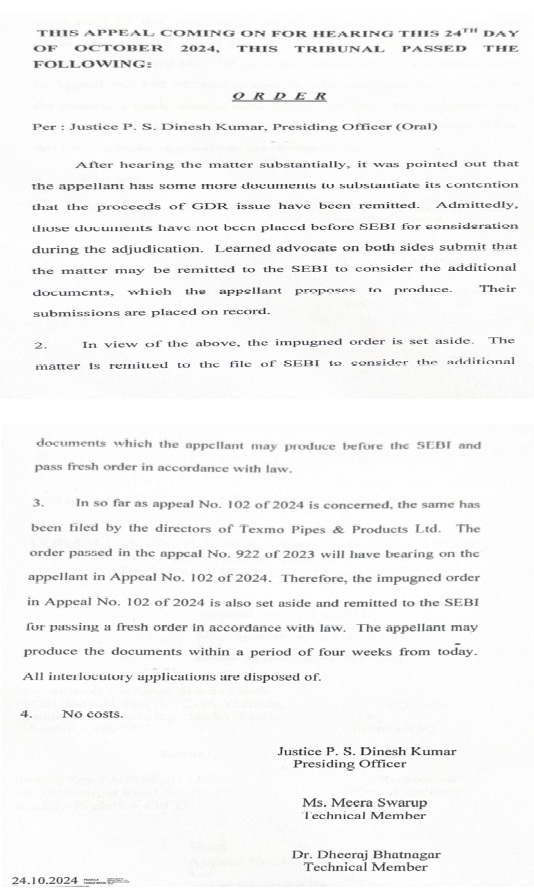
72. We also note from findings given by the assessing officer at para (10.12), we find that the assessing officer himself has averred that one entry in the excel sheet inventorized as ‘Page No. 18 of LPS-15’ relating to TT (Telegraphic transfer) of 40,000 USD, represents the TT transfer in the name of the assessee- company and the same was duly verified by the assessing officer and as per such verification, such TT was transferred from the bank account of some ‘Tapti Pipes and Products, FZE,’ a wholly owned foreign subsidiary of the assessee -company, to the bank account of the assessee- company. In our considered view, once one of the entries made in the excel sheets, which became the very basis of making additions in the hands of the assessee, relates to the receipt of funds by the assessee- company then, as a natural corollary, the other entries found made in the same excel sheets would also be necessarily required to be regarded of the same nature i.e. receipt of some sum by the assessee and it cannot be inferred other way round that these entries pertain to payment of some sum by the assessee. It is a settled law that any seized document has to be interpreted as a whole and two jottings made in the same seized document, written one after one, cannot be interpreted in two different ways on pick and choose basis. In our considered view, once any document is seized then it has to be interpreted as a whole and while making the interpretation if in the excel sheet some entry is found in the nature of receipt, then, the immediately next entry or entries or for that matter earlier entries written on the same excel sheet cannot be regarded as depicting any payment. For the proposition that any document has to be interpreted in a wholistic manner, we find support from the decision of the Hon’ble Gujarat High Court in the case of Glass Lines Equipments Co. Ltd. v. Commissioner of Income Tax [2002] 253 ITR 454 (Gujarat)/2001 (7) TMI 61, wherein it was held as under:
“In view of the settled legal position, it was not open to either the Commissioner of Income-tax (Appeals) or the Tribunal to ignore a part of the contents of the affidavit. We are conscious of the fact that the findings recorded by the Commissioner of Income-tax (Appeals) and the Tribunal are concurrent as regards the facts and evidence on record and but for the averments made in the affidavit which have been ignored, we would not have interfered with the said findings. It is a well settled canon of interpretation that a document has to be read as a whole: it is not permissible to accept a part and ignore the rest of the document.(para 9)”
73. Following the decision of the Hon’ble Gujrat High Court (supra), the Hon’ble ITAT Bench, Mumbai in the case of ACIT Central v. Priva Infracon 2026 (5) TMI 1409 was pleased to allow the deduction for expenditure from receipts by holding that once the Revenue accepted the seized material for bringing the receipts to tax, it could not reject the corresponding expenditure reflected in the same material merely because formal third-party particulars were not furnished. A similar view was taken by the Hon’ble ITAT Ahmedabad in the case of Asstt. CIT v. Rakeshkumar Mahendrakumar Shah 2025 (12) TMI 1222 – ITAT Ahmdabad.
74. In our considered view, the ld. CIT(A), at para (3.4.6) of his order, has rightly observed that the earlier order passed by the Chief General Manager of SEBI dated 28/02/2023 got set aside by the Appellate Authority of the SEBI only on the ground that the assessee wanted to file some additional submission and documents before the adjudicating authority. We find that the SEBI Appellate Tribunal has set aside the Orders of SEBI Authority way back in the year 2024 and the present status of the SEBI Order has not been brought on record either by the assessee or by the Revenue.
75. Therefore, in our considered view, merely from the excel sheets scanned by the assessing officer in the body of the assessment order, it cannot be inferred that the assessee had made any unaccounted cash payments for conversion of GDRs into equity shares. However, the facts on record establishes that on some issues related to the GDR, in past, SEBI inquiries were conducted. Although, none of the parties have brought on record before us the final outcome of the SEBI inquiries. In such circumstances, the Tribunal being the last fact finding authority cannot keep its eyes shut. Therefore, in our view, if in any subsequent order passed by the SEBI, it gets finally established that the assessee- company had made any cash payment for conversion of GDRs into equity shares, then beyond any doubt, such cash payments would necessarily be required to be held as unexplained expenditure u/s. 69C of the Act in the hands of the assessee for the assessment years in which the subject additions have been made and accordingly, additions would be required to be made.
76. Accordingly, for a limited purpose, we restore back the issue of unexplained expenditure incurred for issuance of GDR, for A.Y. 2012-13 and A.Y. 2013-14 to the file of the assessing officer with a specific direction that he would make inquiry from the office of the SEBI to the effect that whether or not the assessee- company was found to have incurred any expenditure in the form of cash for conversion of GDRs into equity shares. If, the assessing officer finds from the order of the SEBI that any such expenditure was actually incurred by the assessee then addition to such an extent (not exceeding the addition made in the assessment order before us) shall be made by the assessing officer u/s. 69C of the Act in the income of the assessee for the respective assessment years. We make it abundantly clear that the other issues regarding the GDRs having already attained finality, the assessing officer would examine the issue only in accordance with the directions given above viz. for the purpose to verify that whether or not the assessee company had incurred any cash expenditure for conversion of GDRs into equity shares. Accordingly, the issue of incurrence of cash expenditure for conversion of GDRs into equity shares is set aside to the file of the assessing officer. Consequently, the Ground No. 4 of the assessee -company for A.Y. 2012-13 as well as for A.Y. 2013-14 is allowed for statistical purpose only.
77. In the result, following grounds of the assessee, are allowed for statistical purposes:
| (a) |
|
Ground No.4 in IT(SS)A No.9/Ind/2025 for AY 2012-13, |
| (b) |
|
Ground No.4 in IT(SS)A No.10/Ind/2025 for AY 2013-14. |
78. The summarised and concise ground No.(vii) raised by the assessee, is reproduced below for ready reference:
“The Ld. CIT(A) erred in confirming the addition of Rs.26,301/- by making disallowance of interest expenses on belated payment of TDS.
This is Ground No.7 in IT(SS)A No.9/Ind/2025, for AY 2012-13″
79. Brief facts qua the issue are that during the course of the assessment proceedings, the assessing officer noticed that the assessee has claimed a sum of Rs. 26,301/- on account of interest on belated payment of TDS, which was disallowed by him. On appeal, the learned CIT (A) confirmed the action of the assessing officer, therefore, assessee in appeal before Tribunal.
80. Before us, the counsel for the assessee has submitted that the TDS amount on which the interest expenses had been incurred by the appellant did not represent the tax of the assessee- company, but, it was the tax of the party, on whose behalf the TDS was deducted and paid to the Government Exchequer. Thus, according to the assessee, any delay in the payment of TDS by the assessee-company cannot be linked to the income-tax of the assessee- company and consequently, the interest expenses on delayed payment of TDS cannot be considered as payment of tax as contemplated u/s. 40(
a)(
ii) of the Act. For such proposition, the ld. counsel for the assessee has placed reliance upon the decision in the case of
D.C.I.T v.
Rungta Mines Ltd 2018 (10) TMI 672
(ITAT Kolkata), Resolve Salvage & Fire India Pvt. Ltd. v.
DCIT 195 ITD 266 (Mumbai –
Trib.)/2022 (4) TMI 906 (ITAT Mumbai), STUP Consultants Pvt Ltd [2019 (1) TMI 1259 –
ITAT MUMBAI] and M.L. Realty v.
ACIT 2021 (9) TMI 877/2021 (9) TMI 877 (ITAT Mumbai) , which have held that if the assessee has deducted the tax on behalf of the third party and failed to remit the same within the due date , then any interest charged on the amount of TDS for belated payment can only be considered as compensatory in the nature. Accordingly, the interest paid on delayed payment of TDS u/s 201(1A) is an allowable deduction. On the other hand, learned DR for the revenue relied on the findings of the assessing officer.
81. We have considered submissions of both the parties. We respectfully following the judgments of the co-ordinate Benches, are inclined to hold that any interest paid by an assessee under section 201(1A) of the Act on the delayed deposition of TDS is not a part of the income tax but, the same is compensatory in the nature and therefore, the same qualifies for deduction as a business expenditure. Accordingly, we hereby delete the addition of Rs. 26,301/- made by the assessing officer, on account of disallowance of interest on TDS , for A.Y. 2012-13. Consequently, ground raised by the assessee is allowed.
82. In the result, Ground No.7 in IT(SS)A No.9/Ind/2025, for AY 2012-13, is allowed.
83. The summarised and concise ground No.(viii) raised by the assessee, is reproduced below for ready reference:
(viii) The Ld. CIT(A) erred in making addition of Rs.1,68,540/-, on the allegation of payment of commission by the assessee on accommodation entries allegedly taken from Mr. Kuldeep, especially in a circumstances when the entire addition of Rs.1,10,00,000/- in the appellant’s income on the alleged ground of acceptance of accommodation entries by the appellant from Mr. Kuldeep got deleted by the Ld. CIT(A).
(This is Ground No.5 in IT(SS)A No.10/Ind/2025, for AY 2013-14).
84. During the course of hearing, the above ground was not pressed by the assessee, therefore, we dismiss the above ground, as not pressed.
85. The summarised and concise ground No.(ix) raised by the assessee, is reproduced below for ready reference:
“(ix) The Ld. CIT(A) erred in making addition of Rs.4,68,000/- on the basis of some rough jotting found made in a diary, BS-1, pertaining to one of the directors of the appellant company seized during the course of search, merely on guesswork, conjectures and surmises without properly considering and appreciating the submission of the appellant.
(This is Ground No.6 in IT(SS)A No.10/Ind/2025, for AY 2013-14, Ground No.4 in IT(SS)A No.12/Ind/2025, for AY 2015-16, Ground No.3 in IT(SS)A No.11/Ind/2025, for AY 201415 (videBS-1, BS-2, BS-3).
86. Brief facts qua the issue are that the assessing officer vide para (12) of his common assessment order has made addition amounting to Rs. 4,68,000/-, Rs. 2,50,000/- and Rs. 15,00,000/- respectively for A.Y. 2013-14, A.Y. 2014-15 and A.Y. 2015-16. The additions are based upon certain documents found and seized during the course of the search u/s. 132 of the Act carried out in the premises of the assessee- company and its directors. On appeal, learned CIT(A) confirmed the addition made by the assessing officer, therefore, the assessee is in further appeal before this Tribunal.
87. We have heard, both the parties. We find that for A.Y. 2013-14, the assessing officer has made an addition of Rs. 3,70,000/- on the basis of a seized document inventorized as ‘Page No.2 of BS-1’; and Rs. 48,000/- on the basis of a seized document inventorized as ‘Page No. 5 of BS-1’; and Rs. 50,000/- on the basis of a seized document inventorized as ‘Page No. 9 of BS-1’, that is for an aggregate amount of Rs. 4,68,000/-. We find that neither during the course of the assessment proceedings nor during the course of the appellate proceedings before the ld. CIT(A) or before us, the assessee could offer any satisfactory explanation as regard to the contents of the subject seized documents. Further, the ld. counsel for the assessee before us, has not made the rebuttal of the statements given by Shri Sanjay Agrawal, CMD of the assessee -company. In such circumstances, we do not find any infirmity in the findings of the authorities below and accordingly, the addition of Rs. 4,68,000/- for A.Y. 2013-14 is hereby Confirmed.
88. Accordingly, the Ground No. 6 for A.Y. 2013-14 is Dismissed.
89. We further find that even in respect of A.Y. 2014-15, for which the assessing officer has made an addition of Rs.2,50,000/- on the basis of seized document inventorized as ‘Page No. 5 of BS-2’, and as also, on the basis of the statement of Shri Sanjay Agrawal, the assessee could not offer any satisfactory explanation as regard to the contents of the seized document at any stage. Therefore, in our considered view, the addition of Rs. 2,50,000/- for A.Y. 2014-15 deserves to be Upheld.
90. Accordingly, the Ground No. 3 for A.Y. 2014-15 is Dismissed.
91. However, for A.Y. 2015-16, we find that the assessing officer has made an addition of Rs.15,00,000/- on the basis of one document seized and inventorized as ‘Page No. 6 of BS-3’. According to the assessing officer, when Shri Sanjay Agrawal was confronted with the seized document, he had accepted that a sum of Rs. 15,00,000/- was to be recovered by the assessee- company from ‘KP’ (Kamal Parrek). According to the assessing officer, the assessee could not prove when the amount was given by the assessee- company to the above named ‘KP’. Further, according to the assessing officer, during the course of the assessment proceedings, the assessee made evasive reply that the seized document was not connected to Shri Sanjay Agrawal.
92. We find that the ld. CIT(A) has dealt with this issue at para (3.4.2) of his Order for A.Y. 2015-16. According to the ld. CIT(A), since, the assessee failed to give his explanation on the contents of the loose paper through its books of account, then, the addition deserved to be rightly made, as per ld. CIT(A).
93. We have gone through the findings of the assessing officer, CIT(A), oral and written submissions made by both the parties and documents placed on record, and arguments made by the learned DR for the revenue. We find that the assessee in its Paper Book filed for A.Y. 2015-16 has filed the relevant abstract of the statement of Shri Sanjay Agrawal in which the relevant entry as referred to by the assessing officer has been scanned. Such relevant abstract of statement of Shri Sanjay Agrawal is placed at page no. 244. We find that during the course of recording of statement of Shri Sanjay Agrawal, CMD of the assessee- company, through question no. (59), he was required to explain the jottings made at point no. (40) at which the names of some ‘Rathi’ and ‘KP’ were mentioned. We find that in response to such question, Shri Sanjay Agrawal had answered that the ‘KP’ means Kamal Parikh and the jotting is a sort of memorandum for amount of Rs. 15 Lakhs receivable from Shri Kamal Parikh. In our considered view, from the jotting found made in the seized document, it cannot be said that the sum of Rs. 15 Lakhs was given by the assessee- company only and not by Shri Sanjay Agrawal or any of his family members. Further, from the jotting, it can also not be ascertained that what was the nature of amount receivable and as also, in which particular year, the amount was given to Shri Kamal Parikh or became receivable from Shri Kamal Parikh. Thus, in our considered view, merely on the basis stray jottings, no adverse inference against the assessee-company deserved to be drawn. Accordingly, we hereby delete the addition of Rs. 15,00,000/- made by the assessing officer on the basis of seized document.
94. Accordingly, the Ground No. 4 for A.Y. 2015-16 is allowed.
95. The summarised and concise ground No.(x) raised by the assessee, is reproduced below for ready reference:
(x) The Ld. CIT(A) erred in making addition of Rs.36,81,573/-, on the allegation of payment of commission without considering the material fact that first of all, the appellant had neither made nor claimed any payment of commission and secondly, it had already taken into consideration the payments made by it towards non-genuine claim of reimbursement of expenses made by one of the employees, while furnishing its return of income under section 153A, for the assessment year under consideration and therefore, no further addition was warranted.
(This is Ground No.3 in IT(SS)A No.13/Ind/2025 for AY 2016-17, Ground No.5 in IT(SS)A No.12/Ind/2025 for AY 2015-16).
96. Brief facts qua the issue are that vide para (13) of the common assessment order, the assessing officer has observed that during the course of the search and seizure operations at the factory premises of the assessee- company, a notebook was found, seized and inventorized as ‘BS-1’ and some loose paper inventorized as ‘LPS-9’ were seized. The assessing officer further observed that on going through the various pages of BS-1 and LPS-9, it was seen that the assessee company had made cash payments to various employees of BSNL, M.P., and has shown the same cash payments as commission expenses. According to the assessing officer, on the basis of these documents, consequential search action was also conducted on General Manager of BSNL, Bhopal and as also, upon a Liasoning Agent. According to the assessing officer, from the loose paper seized and inventorized as page no. 8 of BS-1, and page no. 6 of BS-1, it was evident that for the purpose of receiving the payment against supply from BSNL of a sum of Rs. 28,01,27,809/-, the assessee-company had made a payment of Rs. 52,00,000/- as discernible from page no. 8 of BS-1. The assessing officer has further given a finding that besides making the payment of Rs. 52,00,000/- as aforesaid, the assessee has also made payment under the head Commission of an aggregate sum of Rs.11,04,542/- as per the details given at para (13.5) of the assessment order. From the narration made at list of commission expenses, the assessing officer assumed that the assessee- company must have made commission at the flat rate of 4% for expediting the billing process and for other miscellaneous works. On such assumption, the assessing officer by applying the rate of 4% on the total amount of Rs. 28,01,27,809/- received by the assessee from BSNL in two financial years viz. F.Y. 2014-15 and F.Y. 2015-16, estimated the payment of commission by the assessee of an aggregate sum of Rs. 1,12,05,112/- i.e. Rs. 75,23,539/- for A.Y. 2015-16 and Rs. 36,81,573/- for A.Y. 2016-17. According to the assessing officer, out of the sum of Rs. 75,23,539/-, the assessee itself had shown an additional income of Rs. 70,00,000/- in its return for A.Y. 2015-16, the assessing officer made addition for the balance amount of Rs. 5,23,539/- in the income of the assessee company for A.Y. 2015-16 and of the entire amount of Rs. 36,81,573/- for A.Y. 2016-17.
97. We find that the Ld. CIT(A) at para (3.5.2) of his Order for A.Y. 2015-16 has confirmed the additions so made by the ld. assessing officer.
98. Before us, the ld. counsel for the assessee vehemently argued that factually, neither the assessee -company was required nor it paid any commission to any liasoning agent or officer of BSNL which is an Undertaking of the Central Government. The assessee submitted that factually one of its employees namely, Shri Vijay Prasad Pappu had lodged a false claim of commission upon the assessee company under the garb of payment made to officers of BSNL and liasoning agent for expediting the billing processing and miscellaneous work. It was further submitted that Shri Vijay Prasad Pappu had submitted one statement for payment of commission to G.M. BSNL of a sum of Rs. 52,00,000/- which is evident from the subject statement of commission scanned by the assessing officer at para 13.3 of the Order. The ld. counsel further submitted that in addition to the claim for Rs. 52,00,000/-, Shri Vijay Prasad Pappu had further claimed expenditure under various heads of a sum of Rs. 11,04,542/- as per the list which has been scanned by the assessing officer himself at para (13.5) of the assessment order. Thus, according to the assessee, it had paid only a sum of Rs. 70,00,000/- to Shri Vijay Prasad Pappu and not of Rs. 1,12,05,112/- as estimated by the assessing officer in the body of the assessment order. According to the ld. counsel for the assessee, as per the settled law, every seized document should be interpreted in a holistic manner and no presumption or assumption or for that matter, extrapolation can be made to the notings made in seized documents. According to the assessee, merely on the basis that for a part of supply of Rs. 5,37,34,238/-, as mentioned in the list scanned by the assessing officer at para (13.5), the claim was made at the rate of 4%, the assessing officer was not correct in his approach that on the entire payment received by it against the supply of an aggregate sum of Rs. 28,01,27,809/-, the commission at the same rate of 4% was claimed or paid.
99. Per Contra, the Ld. CIT(DR) supported the Orders of the authorities below and argued that the seized documents clearly reveal payment of commission of Rs. 1,12,05,112/- by the assessee in two assessment years and since, against such payments, which are unaccounted in nature, the assessee had surrendered income amounting to Rs. 70,00,000/- only, the assessing officer was correct in his approach in making the remaining addition of Rs. 42,05,112/- in two assessment years.
100. We have gone through the findings of the assessing officer, CIT(A), oral and written submissions made by both the parties and documents placed on record. We find that although the assessing officer himself has given a finding that consequential search action was conducted in the premises of the General Manager, BSNL, Bhopal, whose name was found stated in the documents seized from the factory premises of the assessee, but, it is not the case of the assessing officer that during the course of the search in the premises of the General Manager any material or evidence supporting the allegation of the assessing officer as regard to payment of commission was found or recovered. It is also not the case of the assessing officer that the above General Manager, BSNL admitted receipt of any commission or any gratification from the assessee- company. In our view, if any discrepancy as regard to any payment of commission or gratification would have been found that the BSNL being an Undertaking of the Central Government, suitable action against the personnel of the BSNL would have been initiated the Prevention of Corruption Act, which is not a case here. Thus, we find merit in the submission of the assessee that it was only one of the employees of the assessee- company who has lodged a false claim of payment of commission to the officer of the BSNL or any liasoning agent. We further find that at page no. (8) of BS-1, as scanned by the assessing officer at para (13.3), the amount of false payment of commission has been stated at Rs.56,02,556/-only and further, at the list of expenses given by the assessing officer at para (13.5), the payment of commission to various persons have been claimed to be at Rs.11,04,542/- only. We find that as against such aggregate payments of Rs.67,07,098/-, the assessee himself has declared a higher income of Rs.70,00,000/-as its additional income in the return filed post search. In our considered view, merely on the presumption and assumption, the assessing officer was not correct in his approach to estimate flat rate of payment of commission at the rate of 4%. We find that the payment of commission at the rate of 4% has been stated only in respect of supply of Rs.5,37,34,238/- and not against the entire supply of Rs.28,01,27,809/. Thus, in our considered view, out of the payment of Rs.28,01,27,809/-, only in respect of payment of Rs.5,37,34,238/-, the claim of false commission by the employee of the assessee has to be computed at the rate of 4% i.e. at Rs.21,49,369/-and for balance amount of Rs.22,63,93,571/-, the claim of false commission by the employee of the assessee has to be computed at the rate of 2% i.e. at Rs.45,27,871/, as found stated at page no. 8 of BS-1, scanned by the assessing officer at para 13.3. Thus, we are of the considered view that the assessee company must have made unaccounted payments aggregating to a sum of Rs.66,77,240/- and if the amount of Rs.11,04,542/-, as per list at para (13.5) of the assessment order, the total unaccounted payment has to be estimated at Rs. 77,81,782/- and since, against such unaccounted payments, the assessee had already disclosed additional income of Rs. 70,00,000/- in its return of income for A.Y. 2016-17, the remaining payment of Rs. 7,81,782/- (77,81,782-70,00,000) is liable to be added in the income of the assessee-company u/s. 69C of the Act for A.Y. 2016-17. Accordingly, we hereby delete the addition of Rs. 5,23,539/- made by the assessing officer for A.Y. 2015-16 and of Rs. 28,99,791/- for A.Y. 2016-17 [being Rs. 36,81,573/- (-) Rs. 7,81,782/-]. Consequently, the Ground No. 5 of the assessee for A.Y. 2015-16 is fully allowed, whereas, Ground No. 3 of the assessee for A.Y. 2016-17 is partly allowed.
101. The summarised and concise ground No.(xi) raised by the assessee, is reproduced below for ready reference:
(xi) The Ld. CIT(A) erred in maintaining the addition of Rs.45,76,789/-, out of total additions of Rs.1,01,76,789/- made by the Ld. assessing officer in the appellant’s income, merely on the basis of a statement given in haste, of one of the directors of the appellant, without considering the material facts that such statement was subsequently retracted and the appellant had fully justified the reasons for retraction, along with the documentary evidences, before the Ld. assessing officer.
(This is Ground No.3 in IT(SS)A No.12/Ind/2025, for AY 2015-16).
102. Brief facts qua the issue are that para no. (9) of the common assessment order, the AO has made various additions in the hands of the assessee -company, in various assessment years, on account of surrender made by Shri Sanjay Agrawal during the course of recording his statements u/s. 132(4)/131(1A) of the Act. The AO has made addition amounting to Rs. 14,52,325/-, Rs. 101,76,789/- and Rs. 13,24,00,000/-respectively for A.Y. 2011-12, A.Y. 2015-16 and A.Y. 2016-17. For the purpose of making the addition, the AO has relied upon the admissions of undisclosed income of Rs. 25,00,00,000/- made by Shri Sanjay Agrawal over and above the regular income of the assessee- company and other group cases. According to the AO, out of the additional income so surrendered, as per the breakup provided by Shri Sanjay Agrawal, during the course of post search investigation, a sum of Rs. 22,61,19,589/-was surrendered on behalf of the assessee company. The AO at para (9.2) of the assessment order has given a table wherein, he has mentioned the assessment year wise and seized document wise breakup of Rs. 22,61,19,589/- which was furnished by the assessee- company itself during the course of post search investigation. According to the AO, out of the surrendered income of Rs. 22,61,19,589/-, the assessee in its returns furnished,(after the search) and has declared income and only and the balance amount of Rs. 14,40,29,114/- has not been declared by the assessee in any of its returns. According to the AO, a disclosure made on oath could not have been retracted by the assessee. Further, the AO observed that the retraction of the surrender so made was made by the assessee after a considerable delay. As per the AO, a statement given u/s. 132(4) is an evidence in itself and based upon such statement, addition can be made in the income of an assessee. Accordingly, the AO made the aforesaid additions for A.Y. 2011-12, A.Y. 2015-16 and A.Y. 2016-17.
103. Being aggrieved with the additions made by the AO, the assessee preferred separate appeals for all the three assessment years before the Ld. CIT(A). The ld. CIT(A), after giving his findings, out of the total additions of Rs. 14,40,29,114/-made by the AO for various assessment years, deleted the additions and only sustained the addition of Rs. 45,76,789/- pertaining to A.Y. 2015-16. The CIT(A), for confirming the addition of Rs. 45,76,789/-, has given his findings at para (3.3.3) of his Order for A.Y. 2015-16. Against the addition deleted by the CIT(A) for A.Y. 2011-12 and A.Y. 2015-16, the Revenue has not preferred any appeal before us. However, against the deletion of addition of Rs. 13,24,00,000/- for A.Y. 2016-17, the Revenue is in appeal which has been dealt in the Order. The ld. CIT(A) vide para (3.3.3) of his Order has given the finding for confirming the addition of Rs. 45,76,789/-.
104. We find that the AO vide item no. 9 of the table drawn by him at para (9.2) of the assessment order has given a finding that for A.Y. 2015-16, the assessee had made a surrender of Rs. 45,76,789/- on account of its unexplained investment in Mangal Murti Minerals. From the Order of the CIT(A) and the Paper Book filed by the assessee before us for A.Y. 2015-16, we find that the addition has been made by the AO on the basis of one Term Sheet dated 04/01/2014 duly executed by the assessee company with some Mr. Prakash Jain and Others for Private Equity Acquisition of stake in one partnership firm named and styled as ‘M/s. Mangal Murti Minerals’. Such term sheet was seized and inventorized as ‘LPS-3, Page 87 to 92’ during the course of the search. A copy of such seized document has been filed by the assessee at page no. 209 to 215 of the Paper Book for A.Y. 2015-16. From the clause (2) & clause (3) of the Term Sheet, we noted that the assessee company along with Shri Sanjay Agrawal had agreed to acquire 100% stake in the above named partnership firm for a total consideration of Rs. 91,56,789/-. We further noted that in the audited financial statement of the assessee- company for the financial year 2014-15, as filed by the assessee from page no. 94 to 129, in the Schedule-11 of Long Term Investments as filed at Page No. 115 of the Paper Book, the assessee-company as on 31/03/2014 and 31/03/2015 has shown ‘Investments in Partnership Firm – Mangal Murti Minerals’ amounting to Rs. 11.45 Lakhs and Rs. 46.90 Lakhs respectively. We noted that the Investment of 11.45 Lakhs as shown in the financial statements as on 31/03/2014 tallies with the amount stated in clause (3) of the Term Sheet. Thus, the veracity of the Term Sheet cannot be disputed or denied. We find that the assessee had claimed the original term sheet so executed on 04/01/2014 was subsequently modified on 01/02/2014. The assessee has filed a copy of the supplementary deed at page no. 216 & 217 of its Paper Book for A.Y. 2015-16. As per the revised Term Sheet, the acquisition consideration was re-stipulated at Rs. 45,80,000/- as against the original stipulated consideration of Rs. 91,56,789/-. We find full substance in the findings of the CIT(A) that the supplementary agreement so furnished by the assessee was not found during the course of the search and even Shri Sanjay Agrawal in his statement has not uttered a single word as regard to renegotiation of the Term Sheet. We find that the assessee could not discharge its onus to establish that the balance sum of Rs. 45,76,789/- was not paid by it for acquisition of investment in partnership firm titled as Mangal Murti Minerals. Therefore, we are of the view that the documents and evidences narrated above, should be examined in the context of the various statements, by the assessing officer, therefore, we restore this issue back to the file of the assessing officer for fresh adjudication.
105. In the result, ground No.3 in IT(SS)A No.12/Ind/2025, for AY 2015-16 is restored back to the file of the assessing officer, for statistical purposes, in above terms.
106. In the combined result, appeal of the revenue is dismissed, whereas, appeal of the assessee is partly allowed/allowed for statistical purposes, as per the terms indicated above, in the respective grounds of the assessee.



