ORDER
R. K. Panda, Vice President.- This appeal filed by the assessee is directed against the order dated 30.01.2026 passed u/s 143(3) r.w.s. 144C(13) of the Income Tax Act, 1961 (hereinafter referred to as ‘the Act’) by the ACIT, Central Circle 1(1), Pune relating to assessment year 2022-23.
2. Facts of the case, in brief, are that the assessee is a company engaged in the business of buying, selling, advertising, promoting baby and kids’ products and FMCG goods on a wholesale basis through various channels like franchises and retailers and the brand ‘FirstCry.com’. It offers baby and kids clothing, foot wear, toys, books and CDs, school supplies, birthday party supplies, baby gear and gifts. It filed its return of income on 29.11.2022 declaring total income at Nil. The said return was processes u/s 143(1) of the Income Tax Act, 1961 (hereinafter referred to as ‘the Act’) on 06.07.2023 determining the total income at Rs.30,45,31,560/-. The case was selected for scrutiny under CASS. Subsequently notice u/s 143(2) of the Act was issued and served on the assessee. Thereafter, notice u/s 142(1) of the Act along with a detailed questionnaire was issued and served on the assessee in response to which the assessee made submissions from time to time.
3. Since the assessee had entered into certain international transactions, the Assessing Officer made reference u/s 92CA(1) of the Act to the Transfer Pricing Officer (TPO) for computation of arms’ length price in relation to international transactions. Accordingly the TPO issued notice u/s 92CA(2) and subsequently notice u/s 92D(3) along with questionnaire to the assessee company to submit the details / explanations to support arm’s length price computed by it in the audit report. The assessee in response to the same filed the requisite details.
3.1 During the course of TP proceedings the TPO noted that the assessee has entered into the following international transactions with its Associate Enterprises (AEs):
| International Transaction (See Notes below) |
Method selected |
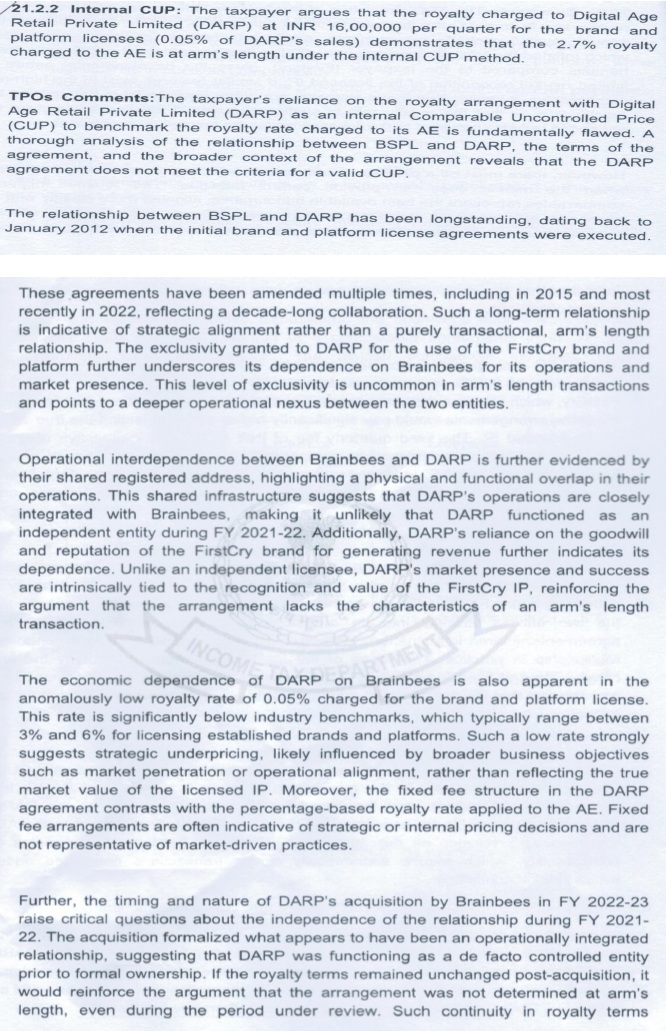
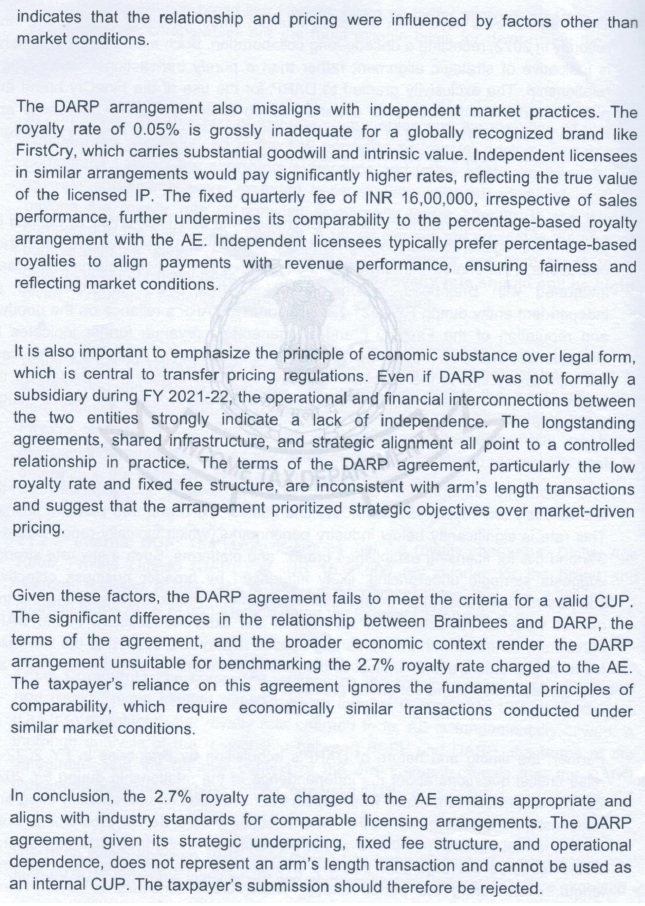
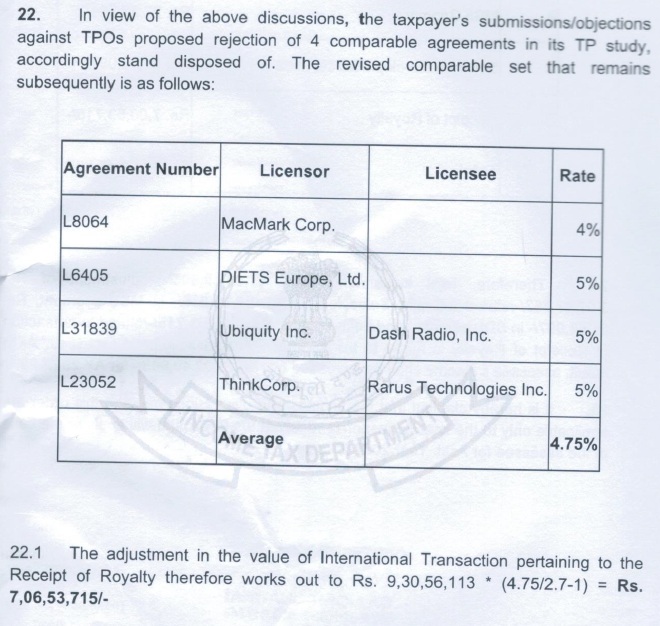
Tested Party |
Tested Party |
Comparable |
| Transfer Price (INR) |
Rate / margin |
Type of comparable data |
Arm’s Length Price / Margin/median |
Whether at arm’s length? |
| Sale of Trading goods |
RPM using GP/Sales as a PLI |
Firstcry Dubai Retail |
18,82,15,617 |
31.94 percent |
Gross margins earned by independent companies engaged in comparable business operations / activities in the MENA region |
7.20 percent to 39.69 percent with a median of 23.26percent |
Yes (Refer Note 2) |
| Provision of IT support services |
TNMM using OP/OC as a PLI |
BSPL |
5,00,69,310 |
17.00 percent |
Indian companies engaged in similar activities |
6.37 percent to 18.57 with a median of 13.07 percent |
Yes (Refer Note 2) |
| Provision of digital marketing support services |
TNMM using OP/OC as a PLI |
BSPL |
1,98,56,977 |
10.10 percent |
Indian companies engaged in similar activities |
5.55 percent to 15.13 percent with a median of 11.32 percent |
Yes (Refer Note 2) |
| Receipt of outsource and related services |
TNMM using OP/OC as a PLI |
Firstcry China |
4,19,05,378 |
6.86 percent |
Companies engaged in similar services in the APAC region |
5.05 percent |
Yes (Refer Note 3) |
| Receipt of royalty |
External CUP |
NA |
9,30,56,113 |
2.70 percent |
Third party comparable agreements |
2.5 percent to 5 percent with a median of 3.5 percent |
Yes (Refer Note 2) |
| Subscription to additional share capital ofAE |
Other method |
NA |
56,91,33,600 |
NA |
Valuation report obtained from an independent valuer |
56,91,33,600 |
Yes (Refer Note 4) |
4. From the various details furnished by the assessee the TPO noted that the assessee in its TP study has benchmarked the Trading segment and IT support & marketing support services segment by using TNMM method. However, the assessee has benchmarked the Receipt of Royalty using CUP method.
5. So far as the benchmarking of the Trading segment using TNMM method is concerned, he noted that the assessee in its TP study has reported international transactions in respect of sale of products for further distribution to AE in Firstcry General Trading LLC, Dubai. The taxpayer has reported international transactions in respect of Trading Segment. The ALP of the international transactions with AEs in this segment has been carried out by applying Resale Price Method (RPM) and taking the foreign AEs as the tested party. The TPO rejected the approach adopted by the taxpayer of taking RPM as the most appropriate method and foreign AEs as tested party due to the following reasons:
| (a) |
|
Legal Framework in India. According to him, Rule 10B specifies the method to determine the ALP and emphasizes selecting the tested party based on the availability of reliable data. |
Rule 10A(d) defines the term “Tested party” as “the entity for which data regarding comparable uncontrolled transactions can be reliably available.” In India, data for foreign entities is often challenging to obtain with the same reliability and detail as data for domestic entities.
In cases where a foreign AE is selected as the tested party, the availability, reliability and verifiability of financial data become crucial. Given that financial databases often lack adequate information about foreign entities and the audited annual reports are not available, selecting the foreign AE as the tested party may not meet the arm’s length standard under Indian rules.
| ii. |
|
Lack of Reliable and Verifiable Data for Foreign AEs |
India has limited access to financial databases that provide detailed, segmented information for foreign companies. Publicly available data for foreign companies generally lacks the granularity required for rigorous benchmarking. Further, the audited annual reports of foreign companies is not available in India.
Unlike Indian comparables, which are comprehensively documented in public databases and for audited annual reports are available on MCA, foreign data may be unaudited, lack transparency, or be subjected to varied accounting standards that complicate accurate comparisons.
| iii. |
|
Functional, Asset and Risk (FAR) Analysis of Tested Party |
The tested party should ideally be the entity that performs simpler functions, has lesser risk, and employs fewer unique assets, ensuring a straightforward comparison.
Indian regulations and the OECD guidelines suggest using the entity with simpler functional attributes as the tested party. In the present case, the Indian entity fulfills this role due to its primary operational involvement and simpler functional profile compared to the foreign AE (which are performing functions in multiple segments like LRD & EPC).
Selecting the foreign AI as the tested party can shift focus away from the activities and risks undertaken by the Indian entity, leading to an incomplete or potentially inaccurate assessment of the arm’s length nature of the transactions.
| iv. |
|
OECD Guidelines on the Selection of the Tested Party |
The 2022 OECD Transfer Pricing Guidelines emphasize that the tested party should be the entity “to which a reliable set of comparables can be identified.”
Given that Indian tax authorities have limited ability to verify or examine the financials and functional details of foreign entities, using a foreign AE as the tested party is discouraged as it lacks reliability.
The guidelines also indicate that an accurate delineation of the transaction is necessary. Using a foreign tested party can obscure the true economic substance of the transaction, especially if the foreign AE has functions, assets, or risks that differ significantly from comparable independent entities.
| v. |
|
Consistency with Indian Tax Jurisprudence |
Indian tax courts, including the jurisdictional Pune Income Tax Appellate Tribunal (ITAT) and hon’ble Mumbai High court, have in several cases disfavored foreign entities as the tested party due to the difficulties in obtaining reliable and comprehensive data.
| vi. |
|
Potential Manipulation of Results and Compliance with Indian TP Objectives |
Allowing foreign AEs as the tested party could open up avenues for taxpayers to manipulate financial outcomes due to limited availability of detailed foreign data to tax authorities.
The Indian transfer pricing regime is designed to prevent the erosion of the domestic tax base by ensuring accurate profit attribution. Using a foreign tested party can compromise this objective by limiting the Indian tax authority’s access to key data and reducing transparency.
6. He, therefore, held that use of a foreign AE as a tested party is neither advisable nor aligned with Indian transfer pricing regulations and OECD recommendations and therefore, he rejected the TP study. The TPO thereafter applied appropriate filters and selected fresh comparables. Rejecting the various explanations given by the assessee, the TPO made addition of Rs.3,07,17,957/- to the international transaction relating to the Trading Segment by considering the following 16 companies as comparables:
| Sr. No. |
Company Name |
Wt. Average OP/OC (%) |
| 1 |
Trent Ltd |
8.76 |
| 2 |
P GI Distributors Pvt. Ltd. |
9.14 |
| 3 |
Ajay Syntex Pvt. Ltd. |
10.21 |
| 4 |
Primarc Retail Stores Pvt. Ltd. |
10.27 |
| 5 |
Kachins Clothing Pvt. Ltd. |
10.78 |
| 6 |
Shree Shivam Attires Pvt. Ltd. |
11.77 |
| 7 |
Jade Blue Lifestyle India Ltd. |
13.2 |
| 8 |
Pokarna Fashions Pvt. Ltd. |
13.23 |
| 9 |
Bafna Ginning & Pressing Pvt. Ltd. |
14.98 |
| 10 |
Ace Men Engg. Works Ltd. |
15.38 |
| 11 |
Tropical Exim Intl Pvt. Ltd. |
15.66 |
| 12 |
Mafia Trends Ltd. |
16.74 |
| 13 |
Pothys Pvt. Ltd. |
18.01 |
| 14 |
Ecofarms (India) Ltd. |
18.04 |
| 15 |
D S Tailors & Readymades Pvt. Ltd. |
19.75 |
| 16 |
Vedant Fashions Ltd. |
54.11 |
|
|
|
|
|
11.77 |
|
|
14.11 |
|
|
15.66 |
6.1 So far as the benchmarking of the MSS and IT Support Service segment using TNMM method is concerned, the TPO after considering the various replies given by the assessee selected the following 18 comparables and made addition of Rs.27,20,236/- to the international transactions relating to MSS and IT Support
Service segment:
| S.No. |
Company Name |
Financial Year wise OP/OC (%) |
| 2021-22 |
2020-21 |
2019-20 |
Wt. Average |
| 1 |
Kamdar & Kamdar Associates Pvt. Ltd. |
26.39 |
12.4 |
17.82 |
19.16 |
| 2 |
B 2 B Software Technologies Ltd. |
24.68 |
14.44 |
3.83 |
19.94 |
| 3 |
Strudcom Consultants Pvt. Ltd. |
21.16 |
-0.22 |
41.74 |
21.16 |
| 4 |
Aakar Abhinav Consultants Pvt. Ltd. |
22.01 |
21.93 |
20.78 |
21.58 |
| 5 |
Xplorer Consultancy |
12.98 |
25.23 |
28.33 |
21.98 |
| 6 |
Qualcon Engineering Solutions (Pune) Pvt. Ltd. |
22.12 |
1.69 |
17.58 |
22.12 |
| 7 |
Gujarat Industrial & Technical Consultancy Organization Ltd. |
57.22 |
3.6 |
10.33 |
23.22 |
| 8 |
Indo Canadian Consultancy Services Ltd. |
16.48 |
29.57 |
5.27 |
23.33 |
| 9 |
Zipper Trading Enterprises Ltd. |
24 |
20.45 |
9.62 |
24.00 |
| 10 |
B MT Consultants (India) Pvt. Ltd. |
26.31 |
-20.84 |
-4.4 |
26.31 |
| 11 |
Transys Consulting Pvt. Ltd. |
29.01 |
26.4 |
26.06 |
27.2 |
| 12 |
Quanta Process Solutions Pvt. Ltd. |
32.72 |
35.78 |
12.53 |
27.76 |
| 13 |
Triburg Sportswear Pvt. Ltd. |
36.38 |
17.85 |
5.62 |
27.78 |
| 14 |
Likhami Consulting Ltd. |
30.3 |
48.57 |
8.7 |
30.3 |
| 15 |
Construma Consultancy Pvt. Ltd. |
55.27 |
32.08 |
28.97 |
37.45 |
| 16 |
Chlorophyll Brand & Communications Consultancy Pvt. Ltd. |
37.77 |
16.03 |
-3.34 |
37.77 |
| 17 |
D M R Hydroengineering & Infrastructures Ltd. |
36.29 |
50.63 |
40.35 |
41.36 |
| 18 |
M P S Tech Engg. & Consultancy (India) Pvt. Ltd. |
60.32 |
45.83 |
-2.48 |
54.01 |
|
|
|
|
|
|
|
35th Percentile |
|
|
|
23.22 |
|
Median |
|
|
|
25.16 |
|
65th Percentile |
|
|
|
27.76 |
6.2 So far as the IT Support segment is concerned, the TPO considered the following 14 companies as comparable and made addition of Rs.61,58,097/- to the international transactions relating to software development services segment:
| S.No. |
Company Name |
Wt. Average OP / OC % |
| 1 |
Rheal Software Pvt. Ltd. |
-0.59 |
| 2 |
Sagarsoft (India) Ltd. |
14.64 |
| 3 |
Rprocess Outsourcing Services Pvt. Ltd. |
21.86 |
| 4 |
Systango Technologies Ltd. |
22.65 |
| 5 |
Q S G Technologies Pvt. Ltd. |
25.19 |
| 6 |
Net4Nuts Ltd. |
25.73 |
| 7 |
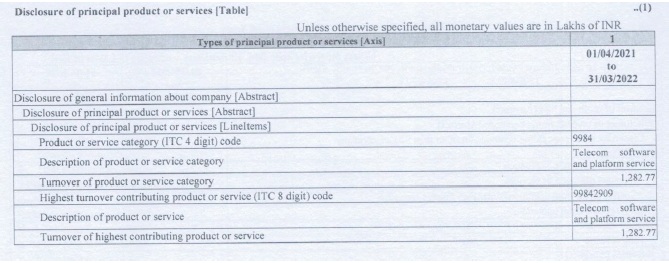
Aabsys Information Technology Pvt. Ltd. |
27.29 |
| 8 |
Savitriya Technologies Pvt. Ltd. |
35.48 |
| 9 |
C G-VA K Software & Exports Ltd. |
39.47 |
| 10 |
Bizsense Solutions Pvt. Ltd. |
46.57 |
| 11 |
Games2 Win India Pvt. Ltd. |
46.9 |
| 12 |
Aptus Software Labs Pvt. Ltd. |
48.97 |
| 13 |
Ezee Technosys Pvt. Ltd. |
62.35 |
| 14 |
Vivo Collaboration Solutions Ltd. |
85.67 |
|
|
|
|
35th percentile |
25.19 |
|
Median |
31.39 |
|
65th percentile |
46.57 |
7. So far as the issue of receipt of royalty is concerned, he noted from the 3CEB report that the taxpayer company has received a royalty amount of Rs.9.3 crores from its AE Firstcry Retail DWC-LLC. The rate at which royalty is received by BSPL is 2.70 percent on sales. He observed from the TPSR submitted by the assessee that the royalty has been made by AE for use of the technology platform ‘www.firstcry.com’, ‘www.firstcry.ae’ and brand name – ‘firstcry’. For benchmarking the international transaction of Royalty receipt the assessee has used ‘External CUP’ as the most appropriate method and arrived at a set of comparable agreements searched from Royalty Stat Database. The assessee in the TP study has considered 8 companies as comparables. Rejecting the various explanations given by the assessee the TPO proposed rejection of 4 comparables in its TP study and considered the following revised set of comparables:
| Agreement Number |
Licensor |
Licensee |
Rate |
| L8064 |
MacMark Corp. |
|
4% |
| L6405 |
DIETS Europe, Ltd. |
|
5% |
| L31839 |
Ubiquity Inc. |
Dash Radio, Inc. |
5% |
| L23052 |
ThinkCorp |
Rarus Technologies Inc. |
5% |
|
Average |
|
4.75% |
8. He accordingly made adjustment of Rs.7,06,53,715/- in value of international transactions pertaining to receipt of royalty by observing as under:
9. Thus, the TPO proposed an upward adjustment of Rs.11,02,49,805/-.
10. The assessee approached the Dispute Resolution Panel (DRP) who vide order dated 04.12.2025 gave certain directions to the Assessing Officer. The Assessing Officer in the final order accordingly made an upward adjustment of Rs.10,84,95,240/- the breakup of which is on account of trading segment at Rs.3,07,17,757/-, MSS segment at Rs.27,20,236/-, software development services at Rs.44,03,532/- and receipt of royalty at Rs.7,06,53,715/-.
11. The Assessing Officer in the draft assessment order also made addition of Rs.82,73,04,280/- on account of ESOP expenses. The relevant facts for the addition of the same are that during the course of assessment proceedings, the Assessing Officer noted that the assessee has claimed Rs.82,73,04,280/- towards ESOP expenses. According to the Assessing Officer ESOP expenses are notional expenditure, therefore, the same cannot be allowed under the Act. He, therefore, issued a show cause notice asking the assessee to explain as to why an amount of Rs.82,73,04,280/- should not be disallowed and added to the total income of the assessee. The assessee in response to the same relying on various decisions justified the allowability of ESOP expenses. The decision of the Ld. CIT(A) in assessee’s own case for assessment year 2015-16 was also brought to the notice of the Assessing Officer wherein the Ld. CIT(A) has allowed the deduction of ESOP expneses subject to verification of the quantum of ESOP expenses claimed. It was submitted that the Revenue has not challenged the decision of the Ld. CIT(A) by filing the appeal before the Tribunal.
12. However, the Assessing Officer was not satisfied with the arguments advanced by the assessee and made addition of Rs.82,73,04,280/- to the total income of the assessee by observing as under:
“5.3 The submission made by the assessee has duly been considered and not found acceptable. An ESOP is a type of employee benefit plan that allows employees to buy company stocks at a price below the market value, with the added benefit of ownership interest. Over time, employees can become equity shareholders in the company and benefit from its growth. ESOPs are typically granted to employees as an incentive at the end of the financial year.
A scheme of Employee Stock Option (‘ESOP’) is one such process where employers reward employees by making them partners/ rightful owners in wealth which they have built together by issuing shares in the entity at a discounted price which otherwise is available at higher price in the market due to various reasons such as market expecting to reap the reserves sitting in the books of accounts, goodwill generated by the Company in the market, expected discounted cash flow forecasts of the Company etc. ESOP is a plan wherein an option is provided by the employer to employee to opt for issue of shares in the company at the end of vesting period on satisfying specific conditions set in by employer at an agreed pre-determined discounted price against a commitment from the employee of provision of uninterrupted services to the company.
5.4 There is no specific section under which ESOP expenditure is allowable under the Income Tax Act 1961 (‘Act’). The only provision where a company can claim the expenditure is section 37 of the Act. Hence, it is pertinent to test the conditions mentioned in section 37 in order to conclude whether the expenditure is allowable?
Section 37 of the Act allows an assessee to claim expenditure if it fulfills the following conditions:
1. It should be an expenditure,
2. It should not be dealt in section 30 to 36,
3. It should not be a capital expenditure or personal expense of the assessee, and
4. It should be incurred or laid out wholly and exclusively for the purpose of business or profession.
5.5 As discussed above, the expense which is debited to profit and loss account (‘P&L’) is the difference between the market value of share as computed under the guidelines of SEBI and the value at which the share are issued to employees. The company is choosing to either receive securities premium of a lower amount or no securities premium when compared to that of which it would have received during a normal course of share issue. Hence there is no expenditure that the company is Incurring or laying out.
5.6 The issue of shares is also not crystallized till the date on which the employee exercises the option and hence any expenditure debited during the vesting period remains contingent in nature. The ESOP expense even if treated as expenditure is a capital expenditure since securities premium being a capital item. The views of various judicial courts on the above issue has supported the revenue view. The Delhi ITAT in the case of ACIT v. Ranbaxy Laboratories ITA No 2613 & 3871 has held that the ESOP expense debited to P&L is notional in nature since the assessee has neither laid out or expended any amount while choosing to receive no lesser securities premium. The alternative argument that this ITAT has supported is since the receipt of securities premium is not chargeable to tax being a capital receipt any short collection of securities premium should also be considered as capital outlay and cannot be allowed as expenditure.
5.7 The Delhi ITAT in the case of Ranbaxy (supra) has relied on the following court rulings which have held that shares issued against assets/ Technical knowhow contributed by shareholders cannot be claimed as revenue expenditure: Eimco K.C.P Ltd v. CIT
159 CTR 137 (Supreme Court) CIT v. ReinzTalbros Pvt Ltd
252 ITR 637 (Delhi HC). Further, there are different views within the rulings of hon’ble Supreme Court as to what constitutes an expenditure. These rulings Indian Mollasses Co Pvt Ltd v. CIT
37 ITR 66, CIT v. Nainital Bank Ltd
62 ITR 638 denotes expenditure in the normal course as ‘spending’, ‘paying out or away’ of money. The above views of Delhi ITAT in the case of Ranbaxy (supra) were also upheld subsequently by the following judicial courts
(i) Hyderabad ITAT in the case of Medha Servo Drivers Limited ITA No 1114/ Hyd/2008
(ii) Mumbai Tribunal in the cases of: DCIT v. Blow Plast Limited ITA No 512/Mum/2009.
(iii) Mahindra & Mahindra v. DCIT ITA No 8597/Mum/2010
(iv) M/s VIP Industries v. DCIT ITA No.7242/Mum/2008.
5.8 In view of the above discussion, the ESOP expenses of Rs.82,73,04,280/- is hereby disallowed and added to the total income Penal proceedings u/s 270A(9)(a) of the IT Act 1961 are hereby initiated for under reporting of income in consequence of misreporting of income in this respect & Penalty proceedings u/s 271AAD of the Act are also hereby initiated for a false entry in the books of accounts maintained by the assessee.”
13. The assessee challenged the above addition before the DRP but without any success.
14. The Assessing Officer in the final order, apart from making an upward adjustment on account of arm’s length price of the international transactions, made addition of ESOP expenses to the extent of Rs.82,73,04,280/-. He, thus, determined the total income of the assessee at Rs.93,57,99,520/-.
15. Aggrieved with such order of the Assessing Officer / TPO / DRP, the assessee is in appeal before the Tribunal by raising the following grounds:
On the facts and in the circumstances of the case and in law, the learned AO based on the Directions of Hon’ble DRP, has:
Validity of final order passed beyond timelines prescribed u/s 153 of the Act
1. erred on the facts, in circumstances of the case and in law in not passing the final assessment order within the time limit as provided under Section 153 of the Act i.e. the outer limit for passing of the final assessment order for AY 2022-23 would be 31 March 2025, thus making the assessment proceedings time barred and bad in law and thereby it should be quashed.
Prayer: The Appellant prays that the final assessment proceedings be considered as time barred and bad in law and thereby it should be quashed.
Notice issued under Section 143(2) not being as per the format prescribed by CBDT Instruction (F.No. 225/157/2017/ITA.II) dated 23 June 2017 is invalid.
2. erred in issuing notice under section 143(2) of the Act which is not in accordance with CBDT Instruction F.NO.225/157/2017/ITA-II dated 2306-2017 hence, the initiation of assessment proceedings including passing of the final assessment order dated 30 January 2026 is illegal and bad in law and thereby it should be quashed.
Prayer: The Appellant prays that the final assessment order be treated as illegal and bad in law and it should be quashed.
Ground of appeal for corporate tax
Erroneous disallowance of employee share-based payment expenses relating to stock options granted to employees
3. erred in disallowing employee share-based payment expenses amounting to INR 82,73,04,280 in respect of stock options granted to its employees
Prayer: The Appellant prays that the aforesaid addition of INR 82,73,04,280 made to the total income of the Appellant be deleted
Erroneous initiation of penalty under section 270A(9) of the Act
4. erred in initiating the penalty proceedings under section 270A(9) of the Act by considering the addition made of INR 82,73,04,280 in respect of employee share based payment expenses as under-reporting as a consequence of misreporting of income, though the same is not specifically covered in section 270A(9) of the Act.
Prayer: The Appellant prays that the penalty proceedings initiated as underreporting as a consequence of misreporting of income be dropped
Erroneous initiation of penalty under section 271AAD(1)(i) of the Act
5. erred in initiating the penalty proceedings under section 271AAD(1)(i) of the Act by considering the addition made of INR 82,73,04,280 as false entry in the books of accounts.
Prayer: The Appellant prays that the penalty proceedings initiated by treating the disallowance as a false entry in the books of account be dropped.
General ground of appeal for transfer pricing
6. erred in making an upward adjustment amounting to INR 7,06,53,715 to the value of international transaction pertaining to receipt of royalty, INR 3,07,17,757 to the value of international transaction pertaining to trading segment, INR 44,03,532 to the value of international transaction pertaining to provision of IT support services and INR 27,20,236 to the value of international transaction pertaining to provision of digital marketing support services by rejecting the analysis undertaken by the Appellant to determine the arm’s length price.
Prayer: The Appellant prays that the entire transfer pricing adjustment proposed by the learned AO be deleted.
Non-consideration of comparability analysis as documented in TP Study of the Appellant and carrying out fresh search to identity companies as comparable to the international transactions of the Appellant.
7. erred by not accepting comparability analysis documented in TP study report of the Appellant in accordance with the provisions of the Act read with Income-Tax Rules, 1962 (The rules”) and carrying out fresh search to identify companies as comparable to the international transactions of the Appellant.
Prayer, The Appellant prays that the comparability analysis documented in the TP study report be accepted.
Inappropriate modification of certain quantitative filters applied by Appellant in its transfer pricing documentation
8. erred in selecting/modifying the following inappropriate qualitative and quantitative filters for
• IT support services segment
– Rejection of companies having employee cost less than 25% of operating cost of the company.
– Rejection of companies having service income less than 75% of its operating revenue,
– Rejection of companies having different financial year ending (le not March 31,2022):
– Rejection of companies whose turnover is having turnover of less than Rs. 0.5006 Cr and more than Rs. 50.06 Cr for IT support services segment:
– Rejection of companies having export service income less than 75% of sales;
– Rejection of companies having diminishing revenue in last 3 years,
• Digital marketing support segment
– Rejection of companies having different financial year ending (i.e. not March 31, 2022):
– Rejection of companies whose turnover is having turnover of less than Rs.0.1988 Cr and more than INR 19.88 Cr for digital marketing support services segment;
– Rejection of companies having service income less than 75% of its operating revenue;
– Rejection of companies having more than 25% of related party transactions of the sales;
– Rejection of companies having employee cost less than 25% of turnover of the company;
Prayer: The Appellant prays that the selection/modification to the aforesaid quantitative and qualitative filters should be rejected.
Grounds of appeal in relation to receipt of royalty, trading segment, provision of IT support services and provision of digital marketing support services
Inappropriate rejection of certain comparable agreements by the learned TPO which were identified by the Appellant in relation to receipt of royalty in its TP study report for AY 2022-23
9. erred on the facts and in circumstances of the case and in law in rejecting following agreements as comparable agreements in relation to receipt of royalty:
– PT Kinerja Indonesia and Solarflex Corp
– Windward International LLC and Rostock Ventures Corp.
– Megachain.com Ltd and Greenchip Investments Pic
– Livecare Health Canada Inc and Isodiol International, Inc.
Prayer: The Appellant prays that the aforesaid agreements be accepted as comparable agreements.
Inconsistent approach followed by learned TPO in accepting following agreements as comparable agreements in relation to receipt of royalty by the Appellant even though the learned TPO has rejected similar agreements
10. erred on the facts and in circumstances of the case and in law in accepting following agreements as comparable agreements to the Appellant in relation to royalty (similar to agreements which are rejected by the learned TPO as given under grounds of appeal 9):
– MacMark Corp and Sport Supply Group, Inc.
– eDIETS Europe Limited and Tesco Irelant Ltd
– Ubiquity Ltd and Dash Radio Inc
– ThinkCorp AG. and Rarus Technologies Inc.
Prayer: The Appellant prays that the aforesaid agreements be rejected as comparable agreements following rule of consistency
Inappropriate rejection of foreign AE as tested party
11. erred on the facts and in circumstances of the case in rejecting foreign AE as tested party and there by rejecting the economic analysis undertaken for the trading segment of the Appellant.
Prayer, The Appellant prays that the approach of selection of foreign AE as tested party be accepted.
Inappropriate acceptance of certain companies by the learned TPO in relation to trading segment
12. erred on the facts and in circumstances of the case and in law in accepting following companies as comparable companies to the Appellant in relation to trading segment:
– Trent Limited
– PGI Distributors Private Limited
– Primac Retail Stores Private Limited
– Shri Shivam Attires Private Limited
– Jade Blue Lifestyle India Limited
– Pokama Fashions Private Limited
– Bafna Ginning & Pressing Private Limited
– Ace men Engineering Works Limited
– Tropical Exim International Private Limited
– Mafia Trends Limited
– Pothys Private Limited
– Ecofarms (India) Limited
– DS Tailors & Readymades Private Limited
– Vedant Fashions Limited
Prayer, The Appellant prays that the aforesaid companies should not be considered as comparable companies.
Inappropriate rejection of certain companies identified as comparable by the Appellant in its TP study report in relation to IT support service segment
13. erred on the facts and in circumstances of the case by rejecting the following comparable companies identified by the Appellant in its TP study Report for determining the arm’s length price of international transaction pertaining to provision of IT support service:
– Hurix Systems Private Limited
– Toxsl Technologies Private Limited
– I services India Private Limited
– Evoke Technologies Private Limited
– Microland Limited
– MAA Business Solutions Private Limited
– Orion India Systems Private Limited
– Great software laboratory Private Limited
– R Systems International Limited (Segmental)
Prayer: The Appellant prays that the aforesaid companies should be considered as comparable companies
Inappropriate selection of certain additional companies as comparable to Appellant’s IT support service segment
14. erred on the facts and in circumstances of the case and in law in selecting following additional non comparable companies in the final set of comparable companies in relation to provision of IT support service:
– Rprocess Outsourcing Services Private Limited
– QSG Technologies Private Limited
– Systango Technologies Limited
– Savitriya Technologies Private Limited
– Aabsys Information Technology Private Limited
– Bizsense Solutions Private Limited
– Games2Win India Private Limited
– Aptus Software Labs Private Limited
– Ezee Technosys Private Limited
– Vivo Collaboration Solutions Limited
– Net4Nuts Limited
– CG-Vak Software & Exports Limited
Prayer: The Appellant prays that the aforesaid companies should not be considered as comparable companies.
Inappropriate rejection of certain companies identified as comparable by the Appellant to its digital marketing support services
15. erred on the facts and in circumstances of the case by rejecting the following comparable companies identified by the Appellant in its TP study Report for determining the arm’s length price of international transaction pertaining to provision of digital marketing support services:
– India Tourism Development Corporation Limited (Segmental)
– Simulations Public Affairs Management Services Private Limited
– Concept Public Relations India Limited
– Cyber Media Research & Services Limited
– Quantum Consumer Solutions Private Limited
Prayer: The Appellant prays that the aforesaid companies should be considered as comparable companies.
Inappropriate selection of certain additional companies as comparable to Appellant’s digital marketing support services
16. erred on the facts and in circumstances of the case and in law in selecting following additional non comparable companies in the final set of comparable companies in relation to provision of digital marketing support services:
– Kamdar & Kamdar Associates Private Limited
– B2B Software Technologies Limited
– Strudcom Consultants Private Limited
– Aakar Abhinav Consultants Private Limited
– Xplorer Consultancy Services Private Limited
– Qualcon Engineering Solutions (Pune) Private Limited
– Gujarat Industrial & Technical Consultancy Organisation Limited
– Indo Canadian Consultancy Services Limited
– Zipper Trading Enterprises Limited
– BMT Consultants (India) Private Limited
– Transys Consulting Private Limited
– Quanta Process Solutions Private Limited
– Triburg Sportswear Private Limited
– Likhami Consulting Limited
– Construma Consultancy Private Limited
– Chlorophyll Brand & Communications Consultancy Private Limited
– DMR Hydroengineering & Infrastructures Limited
– MPS Tech Engg. & Consultancy (India) Private Limited
Prayer, The Appellant prays that the aforesaid companies should not be considered as comparable companies.
The Appellant craves leave to further add, alter, amend, substitute or withdraw all or any of the Grounds of Appeal herein and to submit such statements, documents and papers as may be considered necessary either at or before the appeal hearing to enable the Hon’ble Income Tax Appellate Tribunal to decide the issue according to law.
16. The assessee has raised the following additional grounds:
“Additional Ground of Appeal No. 17: Non consideration of Internal CUP method for benchmarking the receipt of royalty.
Additional Ground of Appeal No. 18: Inappropriate application of Profit Level Indicator (‘PLI’) for trading segment.
Additional Ground of Appeal No. 19: Inappropriate inclusion of Ajay Syntex Private Limited and Kachins Clothing Private Limited in the final set of comparables for Trading segment which were concluded as functionally noncomparable by the learned TPO.”
17. The Ld. Counsel for the assessee referring to the above additional grounds submitted that the facts pertaining to the above ground are already on record before the lower authorities and these are purely legal in nature which go to the root of the matter. Referring to the decision of Hon’ble Supreme Court in the case of
National Thermal Power Co. Ltd. v.
CIT 229 ITR 383 (SC) and in the case of
Jute Corpn. of India Ltd. v.
CIT [1991] 187 ITR 688 (SC) he submitted that the additional ground raised by the assessee should be admitted.
18. The Ld. DR, on the other hand, strongly objected to the admission of the additional grounds raised by the assessee.
19. After hearing both the sides and considering the fact that the additional grounds raised by the assessee are purely legal in nature and all material facts necessary for adjudication of the issue are already available on record and no new facts are required to be investigated, therefore, in view of the decision of Hon’ble Supreme Court in the case of the National Thermal Power Co. Ltd. (supra) and in the case of Jute Corporation of India Ltd (supra), the additional ground raised by the assessee is admitted for adjudication.
20. Ground of appeal Nos.1, 2, 4 and 6 were not pressed by the ld. Counsel for the assessee for which ld. DR has no objection. Accordingly, the above grounds are dismissed as ‘not pressed’.
21. Ground of appeal No.3 relates to the order of the Assessing Officer in disallowing ESOP expenses of Rs.82,73,04,280/-.
22. Ld. Counsel for the assessee submitted that the Assessing Officer disallowed the ESOP expenses on the ground that the same is not a Revenue expenditure and any expense/loss on account of issue of ESOP is towards raising of share capital and therefore Capital in nature. It is also his observation that, for claiming any deduction, it is necessary that the relevant expenditure should be incurred in connection with business only, i.e. it should not be in the nature of Capital or Personal expenditure. It is also the observation of the Assessing Officer that ESOP expenses is notional in nature and not an actual expenses of the assessee. Further, it has to be an ascertained provision for actual expenses. According to the Assessing Officer since the assessee has not purchased shares from market but exhausted own quota of issued capital, while issuing ESOP to employees, therefore, there is no monetary outgoing in its existing capital and thus no actual expenses. He submitted that although various decisions were cited before the ld. DRP however, the ld. DRP did not accept the contention of the assessee on the ground that the decisions of Hon’ble High Courts have been challenged by the Revenue before the Hon’ble Supreme Court and therefore to keep the matter alive, the ld. DRP dismissed the ground raised before it. The Assessing Officer in the final assessment order has made the addition.
23. Ld. Counsel for the assessee referring to the decision of Hon’ble Karnataka High Court in the case of
CIT v.
Biocon Ltd. [2020] 121 430 ITR 151 (Karnataka) submitted that the Hon’ble High Court in the said decision has held that discount on issue of ESOPs was allowable as a deduction under section 37(1) as primary object was not to waste capital but to earn profits by securing consistent services of employees. He submitted that the Hon’ble Karnataka High Court in the said decision has upheld the decision of Bangalore Special Bench of the Tribunal in the case of
Biocon Ltd. v.
Dy. CIT [2014] 144 ITD 21 (Bangalore –
Trib.).
24. Referring to the decision of Hon’ble Delhi High Court in the case of
PVR Ltd. v.
CIT (Delhi) he submitted that difference between price at which stock options were offered to employees of assessee company under ESOP and ESPS and prevailing market price of stock on date of grant of such options was allowable as revenue expenditure.
25. Referring to the decision of Hon’ble Madras High Court in the case of CIT v. PVP Ventures Ltd (Madras) he submitted that the Hon’ble High Court in the said decision has held that where assessee allotted shares to its employees under Employees Staff Option Plan and Employee Staff Purchase Scheme Guidelines, 1999, the difference between the market value of shares and the value at which shares were allotted was allowable as revenue expenditure. He accordingly submitted that since the issue is squarely covered in favour of the assessee therefore, the ld. DRP should have decided the issue in favour of the assessee instead of upholding the same merely on the ground that Revenue has challenged the decision of the Hon’ble High Courts. He also relied on the following decisions :
| a. |
|
Bajaj Finance Ltd. v. Dy. CIT [IT Appeal Nos. 1392 & 1393/PUN/2018, dated 29-8-2022] |
| b. |
|
Sandvik Asia (P.) Ltd. v. ACIT [IT Appeal Nos. 1841 & 1842/PN/2012, dated 31-12-2014 |
| c. |
|
iGate Computer Systems Ltd. v. Dy. CIT [IT Appeal No. 282(PN) of 2014, dated 6-6-2016] |
| d. |
|
PVR Ltd. v. Addl. CIT [IT Appeal No.2143 (Del) of 2011, dated 7-11-2023] |
26. Referring to the decision of the ld.CIT(A) for A.Y.2015-16 copy of which is placed at page 1297 to 1313 of the paper book, he drew the attention of the Bench to page 1312 and submitted that the ld.CIT(A), following various decisions, has held that ESOP expenditure is not a contingent liability but an ascertained one. He has further held that the same is not capital expenditure but revenue expenditure. Accordingly, he directed the Assessing Officer to verify the quantum and allow the same. He accordingly submitted that the order of the Assessing Officer be set aside and the ground raised by the assessee be allowed.
27. The ld. CIT-DR on the other hand heavily relied on the order of AO/TPO/DRP.
28. We have heard the rival submissions made by both the sides and perused the record. We find the Assessing Officer on the basis of the direction of the ld. DRP disallowed the claim of ESOP expenses on the ground that there is no specific section under which ESOP expenditure is allowable under the Income Tax Act, 1961. Only provision where a company can claim the expenditure is section 37 of the Act. According to the Assessing Officer, the company has not incurred any expenditure by issue of ESOP. Further, the issue of shares has also not crystallised till date on which the employee has exercised his option and hence any expenditure debited during the vesting period remains contingent in nature. While doing so, the Assessing Officer relied on the decision of the Delhi Bench of the Tribunal in the case of ACIT v. Ranbaxy Laboratories in ITA Nos.2613 & 3871/Del/, the decision of Hyderabad Bench of the Tribunal in the case of Medha Servo Drivers Ltd. v. ACIT [IT Appeal No. 1114 (Hyd.) of 2008, dated 30-12-2010] and the decisions of Mumbai Bench of the Tribunal in the case of Dy. CIT v. Blow Plast Ltd. [IT Appeal No. 512 (Mum.) of 2009, dated 26-11-2010], Mahindra & Mahindra Ltd. v. Dy. CIT (Mumbai)/ITA No.8597/Mum/2010 and in the case of VIP Industries Ltd. v. Dy. CIT [IT Appeal No. 7242 (Mum.) of 2008, dated 17-9-2010].
29. We find the ld. DRP upheld the action of the Assessing Officer in the draft assessment order by observing as under :
“19.3. Discussion of the Issue by DRP:
19.3.1 In this ground the applicant has objected to the addition of Rs. 82,73,04,280/-proposed by the AO by making a disallowance of deduction claimed in respect of ESOP (Employee Stock Option Plan) expenses.
19.3.2 The Ld. AO has disallowed the ESOP expense of Rs. 82,73,04,280/- by observing that the submission of the assesse is not acceptable on account of the following broad reasons:
(i) ESOP expense is not a revenue expense and any expense/ loss on account of issue of ESOP is towards raising of share capital thus capital in nature.
(ii) For claiming any deduction, it is necessary that the relevant expenditure should be incurred in connection with business only i.e. it should not be in the nature of capital or personal expenditure.
(iii) ESOP expense is a notional in nature and not an actual expense of the assesse.
(iv) For expenditure to be allowed, it has to be an ascertained provision for an actual expense. As assessee has not purchased shares from market but exhausted own quota of issued capital while issuing ESOP to employees. Thus, there is no monetary outgoing in its existing capital and thus no actual expense.
19.3.3 The applicant on the other hand as submitted that the claim of ESOP expenses as business expenses has been duly accepted by Hon’ble Karnataka High Court in the case of CIT v Biocon Ltd
[2021] 430 ITR 151, by Hon’ble Delhi High Court in the case of PVR Ltd v CIT (Del) and in PCIT v Lemon Tree Hotels Ltd (Del). The applicant has argued that ESOP expense is an actual ascertained liability and not a notional one affirmed by various other High Court decisions and by Hon’ble ITAT. According to the applicant, ESOP is a revenue expense and not capital expense which is purely for the business of the assessee and is not a personal expense. It is an expense even though any additional payment is not made to employees but there is an actual incurrence of loss/ expense while fulfilling obligation to issue ESOPs at a discount.
19.3.4 In this regard the Panel notes that Tax jurisprudence generally distinguishes between accounting recognition (as per Ind AS) and income tax treatment. The expense derived from the fair valuation of the ESOP discount, amortized over the vesting period, is inherently considered notional or equivalent to a capital contribution/foregone premium in the context of tax law concerning deductibility under Section 37(1).
At the very outset, it is clarified that the matter is a case of ESOP cross-charge, and not direct payment claim. For allotment of self-issued equity shares, the issuer company has not incurred any cost. The economic theory of “opportunity cost is not applicable to the case the transactions are on capital account, and that too at issue stage.
If at all the applicant would have issued the shares to public, the share capital would have been obtained as a capital sum, not income. Hence, the opportunity cost for such capital inflow is also a non-capital outflow. Such a notional transaction cannot be allowed as a revenue expenditure.
Further, CBDT Circular No. 9/2007 makes it mandatory for Department to disallow claims of deduction in regards to self-allotted shares as ESOPs:
“. Whether the fringe benefit arising on account of shares allotted or transferred under an ESOP is allowed as deduction in calculating the taxable income of the employer company?
Answer: In case where the employer purchases the shares and then subsequently transfers such shares to its employees, the expenditure so incurred is allowable as deduction in computing the taxable income of the employer company. However, if the shares are allotted to the employees from the share capital of the company, no deduction is allowable in computing the taxable income of the company since no expenditure has been incurred by it.”
But, the Panel notes that High Courts have ruled against Revenue on the matter and there is no supporting decision from the jurisdictional High Court. The decisions of Hon’ble High Courts are extremely significant and to be dealt with utmost respect.
The Panel finds that the issue involved is recurring in nature and is pending for adjudication before higher judicial forums for certain years. It is necessary to point out that for the year under consideration, only the assessee has a right to appeal against the final assessment order framed by the AO after incorporating the directions of the DRP and the Department does not have any such right of appeal. It is pertinent to point out that if the DRP for the year under consideration arrives at a conclusion. which is against the Department and in favour of the assessee, especially on a legal issue which has not yet attained finality in the jurisdictional Hon’ble High Court and Supreme Court, and if the said issue is eventually decided by the Hon’ble Supreme Court in favour of the Department, there will be no recourse available for collecting the revenue attributable to the said issue, since the Department’s appeal would not have been pending, as for the year under consideration, DRP orders cannot be appealed against by the Department.
The decision of the DRP is no longer appealable by the Department, apart from limited scenarios of cross-objection. Thus, if the contention of the applicant is to be accepted, the same would tantamount to pre-judging the issue and bringing finality to the issue pending before the Hon’ble High Court.
Further, for the Department it would also amount to giving up the issue, which is under Ingation before the Honourable Court.
The Panel hastens to observe here that the Hon’ble Hon’ble High Court of Bombay in the Writ Petition No. 1877 of 2013 in the case of Vodafone India Services Pvt. Ltd. v. Additional Commissioner of Income Tax (Bom.); wherein with regard to functioning of the DRP, the Hon’ble jurisdictional High Court of Bombay held that:
“47. The process before the DRP is a continuation of the assessment proceedings as only thereafter would a final appealable assessment order be passed. Till date there is no appealable assessment order. The proceeding before the DRP is not an appeal proceeding but a correcting mechanism in the nature of a second look at the proposed assessment order by high functionaries of the revenue keeping in mind the interest of the assessee. It is a continuation of the Assessment proceedings till such time a final order of assessment which is appealable is passed by the Assessing Officer. This also finds support from Section 144C(6) which enables the DRP to collect evidence or cause any enquiry to be made before giving directions to the Assessing Officer under Section 144C(5).”
Thus, the process before the DRP is a continuation of assessment proceeding as it is only the draft assessment order which is being challenged before it. The final assessment order is yet to be passed by the assessing officer. Hence, the DRP is not an proceedings. This view is fortified by the decision of the division bench of Hon’ble High appellate authority and the proceeding before the DRP is continuation of assessment Court.
As discussed earlier, the Department is contesting the above issue before a higher forum. The issue has not yet attained the finality and the possibility of the issue being decided in favour of revenue cannot be ruled out at this stage. However, at the stage when the issue attains the finality, it is likely that the remedial measures available to levy and collect tax on account of this issue, may not be available to the Revenue on account of limitation placed by the statute. In this regard, The Panel may refer to the decision of the Hon’ble Supreme Court of India in the case of Malabar Industrial Co. Ltd. v. Commissioner of Income Tax (SC) wherein it is observed that “The scheme of the Act is to levy and collect tax in accordance with the provisions of the Act and this task is entrusted to the Revenue.”
Further, the Revenue’s appeal against the judgment rendered in the case of Lemon Tree Hotels Ltd. (supra) has been admitted by the Hon’ble Supreme Court as reported in Lemon Tree Hotels (P.) Ltd (Supreme Court).
Therefore, with due respect to the decision of the Hon’ble Jurisdictional Tribunal and the Hon’ble High Courts; the DRP is of the considered opinion that the issue has to be kept alive in order to protect the interest of the revenue. Hence, The Panel affirm the approach of the Assessing Officer,
Most respectfully, it is held that:
(i) The issue of ESOPs do not give rise to any expenditure outflow
(ii) The equity transactions are on capital account, and not amenable to sub-section 37(1)
(iii) The valuation of the claim is not clear, nor verifiable
(iv) The issue of shares is also not crystallized till the date on which the employee exercises the option and hence any expenditure debited during the vesting period remains contingent in nature.
The Panel is of considered opinion that the deduction claimed by the applicant assessee for ESOPs is not allowable as deduction under sub-section 37(1) of the Income Tax Act, 1961. The action of the AO is upheld and the objection is rejected.
19.4. Directions of the DRP:
In view of the above discussion, the objection of the applicant is rejected.”
30. We find based on the above direction of the ld. DRP the Assessing Officer in the final order has made the addition. A perusal of the order of ld. DRP clearly shows that to keep the matter alive the ld. DRP rejected the claim made by the assessee. However, we find the Hon’ble Karnataka High Court, Hon’ble Delhi High Court and the Hon’ble Madras High Court have decided the issue allowing the claim of ESOP expenditure. We find the Bangalore Special bench of the Tribunal has already decided the issue by observing as under :
“6. We have considered the submissions made by learned counsel for the parties and have perused the record. The singular issue, which arises for consideration in this appeal is whether the tribunal is correct in holding that discount on the issue of ESOPs i.e., difference between the grant price and the market price on the shares as on the date of grant of options is allowable as a deduction under Section 37 of the Act. Before proceeding further, it is apposite to take note of Section 37(1) of the Act, which reads as under:
Section 37(1) says that any expenditure (not being expenditure of the nature described in sections 30 to 36 and not being in the nature of capital expenditure or personal expenses of the assessee), laid out or expended wholly and exclusively for the purposes of the business or profession shall be allowed in computing the income chargeable under the head, “Profits and Gains of Business or Profession”.
7. Thus, from perusal of Section 37 (1) of the Act, it is evident that the aforesaid provision permits deduction for the expenditure laid out or expnded and does not contain a requirement that there has to be a pay out. If an expenditure has been incurred, provision of Section 37(1) of the Act would be attracted. It is also pertinent to note that Section 37 does not envisage incurrence of expenditure in cash.
8. Section 2(15A) of the Companies Act, 1956 defines ’employees stock option’ to mean option given to the whole time directors, officers or the employees of the company, which gives such directors, officers or employees, the benefit or right to purchase or subscribe at a future rate the securities offered by a company at a free determined price. In an ESOP a company undertakes to issue shares to its employees at a future date at a price lower than the current market price. The employees are given stock options at discount and the same amount of discount represents the difference between market price of shares at the time of grant of option and the offer price. In order to be eligible for acquiring shares under the scheme, the employees are under an obligation to render their services to the company during the vesting period as provided in the scheme. On completion of the vesting period in the service of the company, the option vest with the employees.
9. In the instant case, the ESOPs vest in an employee over a period of four years i.e., at the rate of 25%, which means at the end of first year, the employee has a definite right to 25% of the shares and the assessee is bound to allow the vesting of 25% of the options. It is well settled in law that if a business liability has arisen in the accounting year, the same is permissible as deduction, even though, liability may have to quantify and discharged at a future date. On exercise of option by an employee, the actual amount of benefit has to be determined is only a quantification of liability, which takes place at a future date. The tribunal has therefore, rightly placed reliance on decisions of the Supreme Court in Bharat Movers supra and Rotork Controls India P. Ltd., supra and has recorded a finding that discount on issue of ESOPs is not a contingent liability but is an ascertained liability.
10. From perusal of Section 37(1), which has been referred to supra, it is evident that an assessee is entitled to claim deduction under the aforesaid provision if the expenditure has been incurred. The expression ‘expenditure’ will also include a loss and therefore, issuance of shares at a discount where the assessee absorbs the difference between the price at which it is issued and the market value of the shares would also be expenditure incurred for the purposes of Section 37(1) of the Act. The primary object of the aforesaid exercise is not to waste capital but to earn profits by securing consistent services of the employees and therefore, the same cannot be construed as short receipt of capital. The tribunal therefore, in paragraph 9.2.7 and 9.2.8 has rightly held that incurring of the expenditure by the assessee entitles him for deduction under Section 37(1) of the Act subject to fulfillment of the condition.
11. The deduction of discount on ESOP over the vesting period is in accordance with the accounting in the books of accounts, which has been prepared in accordance with Securities And Exchange Board of India (Employee Stock Option Scheme and Employee Stock Purchase Scheme) Guidelines, 1999.
12. So far as reliance place by the revenue in the case of CIT v. INFOSYS TECHNOLOGIES LTD. is concerned, it is noteworthy that in the aforesaid decision, the Supreme Court was dealing with a proceeding under Section 201 of the Act for non deduction of tax at source and it was held that there was no cash inflow to the employees. The aforesaid decision is of no assistance to decide the issue of allowability of expenses in the hands of the employer. It is also pertinent to mention here that in the decision rendered by the Supreme Court in the aforesaid case, the Assessment Year in question was 1997-98 to 1999- 2000 and at that time, the Act did not contain any specific provisions to tax the benefits on ESOPs. Section 17(2)(iiia) was inserted by Finance Act, 1999 with effect from 01.04.2000. Therefore, it is evident that law recognizes a real benefit in the hands of the employees. For the aforementioned reasons, the decision rendered in the case of Infosys Technologies is of no assistance to the revenue. The decisions relied upon by the revenue in Gajapathy Naidu, Morvi Industries and Keshav Mills Ltd. supra support the case of assessee as the assessee has incurred a definite legal liability and on following the mercantile system of accounting, the discount on ESOPs has rightly been debited as expenditure in the books of accounts. We are in respectful agreement with the view taken in PVP Ventures Ltd. And Lemon Tree Hotels Ltd. Supra.
13. It is also pertinent to mention here that for Assessment Year 2009-10 onwards the Assessing Officer has permitted the deduction of ESOP expenses and in view of law laid down by Supreme Court in Radhasoami Satsang v. CIT,
(1992) 193 ITR 321 (SC), the revenue cannot be permitted to take a different stand with regard to the Assessment Year in question.
In view of preceding analysis, the substantial questions of law framed by a bench of this court are answered against the revenue and in favour of the assessee. In the result, we do not find any merit in this appeal, the same fails and is hereby dismissed.”
31. We find the above decision of the Special Bench of the Tribunal has been upheld by the Hon’ble Karnataka High Court. We further find the ld.CIT(A) in assessee’s own case for A.y. 2015-16 has decided the issue in favour of the assessee by observing as under :
“7.5 Lastly in the case of Capgemini Technology Services Limited v. DCIT, , vide order dated 25.01.2018, the Hon’ble Tribunal Pune has once again followed the judgement of Hon’ble Bangalore Tribunal in the case of Biocon Ltd (supra), and decided the issue of ESOP expenditure in favour of the assessee.
7.6 The issue involved in the case of the appellant is identical to the issue decided by Hon’ble Jurisdictional ITAT, Pune in the above cases. Respectfully following the same, it is held that firstly the ESOP expenditure claimed by the appellant is not a contingent liability but an ascertained one, and secondly that it is revenue expenditure and not capital expenditure, and is therefore allowable. Accordingly, the AO is directed to verify the quantum of expenditure claimed by the appellant and allow the same. Ground No. 4 is Allowed with the above directions.
32. In the light of the above discussion and following the decisions of Hon’ble Karnataka High Court and Hon’ble Madras High Court cited (supra), we set aside the order of the Assessing Officer and direct him to allow the ESOP expenses of Rs.82,73,04,280/-. In our opinion, merely because the Revenue has not accepted the decisions of Hon’ble High Courts and has filed appeal before the Hon’ble Supreme Court cannot be a ground to sustain the addition unless such order has been stayed by the Hon’ble Supreme Court or any contrary decision of Hon’ble Supreme Court on this issue. Accordingly ground of appeal No.3 by the assessee is allowed.
33. Ground of appeal No.5 relates to deletion of penalty /s 271AAD(1)(i) of the Act which is premature at this point and hence, dismissed.
34. Ground Nos.9 and 10 and the additional ground No.17 relate to the TP adjustment on account of receipt of royalty.
35. The Ld. Counsel for the assessee submitted that Brainbees Solutions Limited (BSL) is the owner of platform and brand name in relation to which BSL grants right to AE to use the platform along with the brand name against which the royalty is charged by BSL @ 2.70% on sales.
36. Referring to pages 1651 to 1677 of the Factual Paper Book-I, he drew the attention of the Bench to the submissions made before the TPO against the adjustment in relation to the royalty charged to AE. Referring to pages 640 to 663 of the appeal memo, he submitted that the submissions made before the DRP against the adjustment in relation to the royalty charges to AE. Referring to pages 1678 to 1685 of the Factual Paper Book-I, he drew the attention of the Bench to the submissions made before the TPO for accepted agreements by the TPO wherein inconsistency approach of the TPO was pointed out.
37. The Ld. Counsel for the assessee referring to the decision of the Bangalore Bench of the Tribunal in the case of Brillio Technologies (P.) Ltd. v. Dy. CIT (Bangalore – Trib.) submitted that the Tribunal in the said decision has held that where the assessee placed evidence to establish that he had rendered similar type of services of software development to AE and non-AE in same countries and internal benchmarking was possible matter should be restored to Assessing Officer/TPO to re-examine the issue of determination of ALP in light of assessee’s contentions.
38. Referring to the decision of the Hyderabad Bench of the Tribunal in the case of
NTT Data Global Delivery Services Ltd. v.
Dy. CIT (Hyderabad –
Trib.), he submitted that the Tribunal in the said decision has held that where the assessee had undertaken transactions with both AEs and non-AEs and it had not only maintained segmental details of such transactions, but had also undertaken comparative analysis in its TP study, internal TNMM had to be adopted as most appropriate method for determining ALP.
39. Referring to the decision of the Mumbai (Third Member) Bench of the Tribunal in the case of
Tecnimont ICB (P.) Ltd. v.
Addl. CIT 138 ITD 23 (Mumbai), he submitted that the Tribunal in the said decision has held that net profit margin realized from a transaction with an AE cannot be taken as a comparable being internal comparable for computation of ALP of an international transaction with another AE even though said net margin from a transaction with AE is found and accepted at ALP.
40. Referring to the decision of the Hon’ble Delhi High Court in the case of CIT v. Birla Soft India Ltd. [IT Appeal No.44 of 2015, dated 15.04.2015], he submitted that the Hon’ble High Court in the said decision has upheld the decision of the Tribunal setting aside the adjustment directed by the AO / TPO where the Tribunal has opined that since the assessee was a service provider to its AE as well as other foreign customers or non-AEs, the suggestion that the non-AE transactions which reported lower margins and to be used for benchmarking the AE transactions were acceptable.
41. Referring to the decision of the Jaipur Bench of the Tribunal in the case of
Uttam Bharat Electricals (P.) Ltd. v.
Dy. CIT [2019] 112 (Jaipur –
Trib.), he submitted that the Tribunal in the said decision has held that where transaction of interest paid to unrelated parties was available on record and average effective rate of interest paid to unrelated parties was not in dispute, then internal CUP should be preferred as against external CUP as most appropriate method for determination of ALP. He submitted that the internal CUP in the instant case is available. Referring to para 21.1 of the order of the TPO, the Ld. Counsel for the assessee drew the attention of the Bench to the reasons given by the TPO for suggesting upward adjustment of the payment of royalty.
42. Referring to page No.365 of the appeal set he drew the attention of the Bench to the findings of the DRP where they have agreed with the findings of the TPO. Referring to page 1070 of the factual paper book, the Ld. Counsel for the assessee drew the attention of the Bench to the FAR analysis. Referring to page 1072 of the factual paper book, he drew the attention of the Bench to the function of Dubai entity which is very limited. Referring to page 1100 of the factual paper book, he drew the attention of the Bench to the reply given before the TPO, according to which the core method was considered as most appropriate method to undertake the analysis. Referring to the provisions of section 92A(2)(j) of the Act, he drew the attention of the Bench to the definition of AE according to which two enterprises shall be deemed to be an associated enterprise if, at any time during the previous year one enterprise is controlled by an individual, the other enterprise is also controlled by such individual or his relative or jointly by such individual and relative of such individual. He submitted that for the purpose of AE, both the provisions of section 92A(1) and 92A(2) have to be satisfied.
43. Referring to the decision of Hon’ble Karnataka High Court in the case of Pr. CIT v. Page Industries Ltd. 605/431 ITR 409 (Karnataka), he submitted that the Hon’ble High Court in the said decision has held that subsections (1) and (2) of section 92A of the Act are interlinked and have to be read together and in case the provisions of sub-section (1) and (2) of section 92A are read independently, one of the provisions would be rendered otiose which is impermissible in law. He submitted that the SLP filed by against the decision of the Hon’ble Karnataka High Court has been dismissed by the Hon’ble Supreme Court vide SPr. CIT v. Page Industries Ltd. [SLP (C) No. 11465 of 2021, dated 6.8.2021], copy of which is placed at page 3000 of the legal paper book.
44. Referring to the decision of Hon’ble Gujarat High Court in the case of Pr. CIT v. Veer Gems 264/[2018] 407 ITR 639 (Gujarat), he submitted that the Hon’ble High Court in the said decision has held that where the assessee firm purchased rough diamonds from firm ‘B’ controlled by close relatives, in view of fact that clauses (i), (j) and (I) of sub-section (2) of section 92A did not apply to assessee’s case, both firms could not be regarded as associated enterprises.
45. Referring to the decision of the Bangalore Bench of the Tribunal in the case of Page Industries Ltd. v. Dy. CIT 172/159 ITD 680 (Bangalore – Trib.), he submitted that the Tribunal in the said decision has held that where the assessee-company entered into licence agreement with a foreign company for sale of readymade garments under a particular brand name, since licencor company did not participate in capital and management of assessee-company as required under section 92A(1), both companies could not be regarded as AE of each other. He accordingly submitted that the addition made by the Assessing Officer on account of royalty should be deleted.
46. The Ld. DR on the other hand heavily relied on the orders of the AO / TPO / DRP.
47. We have heard the rival arguments made by both the sides, perused the orders of the AO / TPO / DRP and the paper book filed on behalf of the assessee. We have also considered the various decisions cited before us. We find the assessee in the instant case has received royalty of Rs.9.3 crores from its AE first.cry.com @ 2.70% on sales. We find the TPO rejecting the various comparables selected by the assessee in the TP study report and introducing new comparables worked out the average margins at 4.75% of the sales and accordingly made addition of Rs.7,06,53,715/-. We find after the DRP upheld the addition proposed by the TPO, the Assessing Officer made addition of the same in the final assessment order. It is the submission of the Ld. Counsel for the assessee that subsections (1) and (2) of section 92A of the Act are interlinked and have to be read together and in case the provisions of sub-section (1) and (2) of section 92A are read independently, one of the provisions would be rendered otiose which is impermissible in law. Further it is also his submission that non-consideration of internal CUP method for benchmarking the receipt of royalty makes the addition unjustified.
48. We find some force in the above arguments of the Ld. Counsel for the assessee. We find the Hon’ble Karnataka High Court in the case of Page Industries Limited (supra) has held that sub-sections (1) and (2) of section 92A of the Act are interlinked and have to be read together and in case the provisions of sub-section (1) and (2) of section 92A are read independently, one of the provisions would be rendered otiose which is impermissible in law. The relevant observations of Hon’ble High Court read as under:
“7. We have considered the submissions made on both sides and have perused the record. From perusal of the Memorandum of Finance Bill, 2002, it is evident that sub- Section (2) of Section 92A was amended with effect from 01.04.2002 to clarify that mere fact of participation by one enterprise in the management or control or capital of the other enterprise, or the participation of one or more persons in the management or control or capital of both the enterprises shall not make them associated enterprises, unless the criteria specified in sub-Seclion (2) are fulfilled.
8. Before proceeding further, it is apposite to take note of relevant extract of sub-Sections (1) and (2) of Section 92A of the Act which reads as under:
92A (1) For the purposes of this section and sections 92, 92B, 92C, 92D, 92E and 92F, “associated enterprise”, in relation to another enterprise, means an enterprise-
(a) which participates, directly or indirectly, or through one or more intermediaries, in the management or control or capital of the other enterprise; or
(b) in respect of which one or more persons who participate, directly or indirectly, or through one ore more intermediaries, in its management or control or capital, are the same persons who participate, directly or indirectly, or through one or more intermediaries, in the management or control or capital of the other enterprise.
(2) For the purposes of sub-section (1), two enterprises shall be deemed to be associated enterprises if, at any time during the previous year –
…….
(g) the manufacture or processing of goods or articles or business carried out by one enterprise is wholly dependent on the use of know-how, patents, copyrights, trade-marks, licences, franchises or any other business or commercial rights of similar nature, or any data, documentation, drawing or specification relating to any patent, invention, model, design, secret formula or process, of which the other enterprise is the owner or in respect of which the other enterprise has exclusive rights; or”
9. Thus, from perusal of the aforesaid provisions, it is evident that sub-Sections (1) and (2) of Section 92A of the Act are interlinked and have to be read together. In case the provisions of sub-Sections (1) and (2) are read independently, we are afraid that one of the provisions would be rendered otiose which is impermissible in law in view of the well settled rule of statutory limitation. Therefore, the requirement contained in sub-Sections (1) and (2) of Section 92A of the Act has to be complied with. It is also pertinent to mention here that the finding recorded by the Tribunal that the assessee has not complied with the provisions of sub- Section (1) of Section 92A of the Act, has not been assailed by the revenue.
10. In view of preceding analysis, the substantial question of law is answered against the revenue and in favour of the assessee.”
49. We find the Jaipur Bench of the Tribunal in the case of Uttam Bharat Electricals (P.) Ltd. v. Dy. CIT (Jaipur –Trib.) has held that where transaction of interest paid to unrelated parties was available on record and average effective rate of interest paid to unrelated parties was not in dispute, then internal CUP should be preferred as against external CUP as most appropriate method for determination of ALP.
50. We find the Bangalore Bench of the Tribunal in the case of Brillio Technologies (P.) Ltd. (supra) has held that where the assessee placed evidence to establish that he had rendered similar type of services of software development to AE and non-AE in same countries and internal benchmarking was possible matter should be restored to Assessing Officer/TPO to re-examine issue of determination of ALP in light of assessee’s contentions. The relevant observations of the Tribunal read as under:
“7. Having carefully examined the orders of lower authorities and the documents placed before us, we find that the assessee has placed the relevant evidence with respect to scope of work, nature of services rendered for AE and non-AE in the same countries. But these aspects were not examined by the TPO. Therefore, we set aside the order of the AO passed consequent to the order of the DRP and restore the issue to the AO/TPO to re-examine the issue of determination of ALP for international transactions in the light of the transactions made with non-AEs in the same countries. It is settled position of law that if internal benchmarking possible, the TPO should go with the internal benchmarking instead of going for external benchmarking by collecting various comparables from the database. In the instant case, since the assessee has placed the evidence to establish that the assessee has rendered similar type of services to AE and non-AE in the same countries, the internal benchmarking is possible. We therefore restore the matter to the AO/TPO to re-examine the issue of determination of ALP in the light of assessee’s contentions. If the assessee is able to establish that he has undertaken the similar international transactions with AEs and non-AEs in the same countries, the internal benchmarking will be done, otherwise the AO/TPO will act in accordance with the law.”
51. We find the assessee in the instant case has placed relevant evidence with respect to the work and nature of services rendered for AE and non-AEs in the same countries but these aspects were not examined by the TPO / DRP. Further, it is also the submission of the Ld. Counsel for the assessee that the TPO on the one hand has rejected the 4 comparable royalty agreements on account of them being in nascent stages of development whereas FirstCry platform and brand is highly recognized and established name. However, the TPO has not established the basis to consider IP under Rarus Technologies Agreement being as established and recognized a brand as FirstCry. It is also his submission that since the principle of consistency has not been followed Rarus Technologies Agreement should be rejected as well. It is his submission that in case the TPO accepts Rarus Technologies Agreement as comparable, then all the 4 comparable agreements rejected in the TP order should also be accepted as well. Therefore, considering the totality of the facts of the case and in the interest of justice, we deem it proper to restore the issue to the file of the TPO to re-examine the same and decide the issue as per fact and law after giving due opportunity of being heard to the assessee. While doing so, he shall keep in mind the decisions cited (supra). The grounds raised by the assessee on the issue of receipt of royalty are accordingly allowed for statistical purposes.
52. Grounds of appeal No.11 and 12 and the additional ground No.18 relate to rejection of certain comparables and acceptance of certain other comparables by the TPO in relation to trading segment.
53. So far as the additional ground No.18 is concerned, the Ld. Counsel for the assessee submitted that the assessee is engaged in the business of buying, selling, advertising, promoting baby and kids products on a wholesale basis through various channels like franchisees and retailers. It also sells kids and baby care products to AE which in turn sells to third party customers. As a part of this transaction, the assessee buys products from third party suppliers in India or outside India and sells it to AE for onward selling in their local market. The assessee is responsible for identification of vendors, warehousing, logistics till India port, etc. Referring to para 4.1 at pages 1053 to 1057 of factual paper book-1, he drew the attention of the Bench to the FAR analysis. Referring to para 5.1 at pages 1076 to 1083 of the factual paper book-1, he drew the attention of the Bench to the Economic analysis. He submitted that considering the fact that the assessee has undertaken distribution operations for the impugned international transaction of sale of goods to AE, the assessee argued before the TPO that the gross margins should be used as an appropriate PLI using ‘Other Method’ as the most appropriate method. He submitted that the gross margin of the assessee was 49.94%. However, the TPO rejected the comparables identified by the assessee and adopted certain new companies as comparables and made an upward adjustment of Rs.3,07,17,757/-.
54. Referring to the decision of the
Pune Bench of the Tribunal in the case of
A Raymond Fasteners India (P.) Ltd. v.
Dy. CIT [2022] 134 (
Pune –
Trib.), he submitted that the Tribunal in the said decision has held that where the assessee-company entered into international transaction of purchase of raw material from its AE and benchmarked the said transaction by taking two foreign AEs as tested parties, since neither foreign AEs were least complex entities nor could assessee place before the TPO relevant verifiable information of foreign AEs and comparables for enabling him to determine ALP of transaction, A.O. was fully justified in rejecting foreign AE as tested party and adopting assessee itself as a tested party.
55. Referring to the decision of the Bangalore Bench of the Tribunal in the case of
Toyota Kirloskar Motor (P.) Ltd. v.
Addl. CIT (LTU) (Bangalore –
Trib.)), he submitted that the Tribunal in the said decision has held that whereas gross margin on sales was accepted / used as the benchmarking margin under TNMM in a trading segment and the transaction was treated as at arm’s length where the tested party’s gross margin was within the permissible range of comparables.
Vedant Fashions Limited
56. Further, so far as rejection of certain additional comprables identified by the TPO are concerned, he submitted that Vedant Fashions Limited is engaged in manufacturing and trading but segmental information is not available. It is engaged in the sale of readymade ethnic wear for men, women and kids in India under the brand names of Manyavar, Mohey, Mebaz etc. He submitted that the DRP rejected the argument made by the assessee on the ground that the assessee is into the business of trading of baby and kids products which is functionally similar to the business being done by the comparable of sale of ethnic wear. He submitted that this action of the DRP which has been accepted by the Assessing Officer in the final order is uncalled for since a company which is engaged in the business of trading of baby and kids products cannot be compared to a company engaged in the business of sale of readymade ethnic wear for men, women and kids and further no segmental details are available. He accordingly submitted that Vedant Fashions Limited should be removed from the final set of comparables of the TPO for the international transaction pertaining to the sale of traded goods.
57. The Ld. DR on the other hand heavily relied on the orders of the AO / TPO / DRP.
58. We have heard the rival arguments made by both the sides, perused the orders of the AO / TPO / DRP and the paper book filed on behalf of the assessee. We have also considered the various decisions cited before us.
59. In our opinion, Vedant Fashions Limited cannot be considered as comparable with that of the assessee company. It is an admitted fact that Vedant Fashions Limited is engaged in manufacturing and trading of sale of readymade ethnic wear for men, women and kids in India and no segmental details are availalb.e The assessee is engaged in the business of trading of baby and kids products which cannot be compared as similar to that of Vedant Fashions Limited. Since the segmental details are not available and the line of the above business is entirely different, therefore, we hold that Vedant Fashions Limited cannot be compared with the assessee company. We, therefore, direct the TPO to exclude Vedant Fashions Limited from the final set of comparables.
Jade Blue Lifestyle India Limited (‘Jade Blue’)
60. The next comparable challenged by the assessee is Jade Blue Lifestyle India Limited. The Ld. Counsel for the assessee submitted that Jade Blue is engaged in manufacture and sale of different products viz. readymade Garments, Tailoring and trading of accessories. While trading segment is available but gross margin cannot be computed due to non-availability of relevant information. Further, during the impugned financial year there was amalgamation of J B Designers Private Limited with Jade Blue Lifestyle India Limited, w.e.f. 1 April 2021 as per the decision of the National Company Law Tribunal, Ahmedabad Bench vide order dated 30th March 2022, copy of which is placed at pages 3129 to 3131 of the legal paper book.
61. Referring to the following decisions, he submitted that Jade Blue Lifestyle India Limited should be excluded from the final set of comparables on account of extraordinary year of operation:
| (i) |
|
Hewitt Associates (India) (P.) Ltd. v. ACIT (Delhi – Trib.) |
| (ii) |
|
Agilent Technologies (International) (P.) Ltd. v. Asstt. CIT (Delhi – Trib.) |
62. Referring to the order of the DRP, he submitted that the DRP has retained the said company as comparable on the ground that the TPO has done a detailed FAR analysis to show that the company is mainly into purchase and resale of fashion apparel and accessories, has similar underlying asset base of tangible assets like storage facilities, transportation vehicles, office equipment etc and intangibles like brand value etc. Further, it also faces similar market risks related to consumer demand fluctuations, inventory risks, supply chain logistics etc. However, since the extra-ordinary event occurred during the impugned year, this company should be rejected from the final list of comparables.
63. The Ld. DR on the other hand heavily relied on the orders of the AO / TPO / DRP.
64. We have heard the rival arguments made by both the sides, perused the orders of the AO / TPO / DRP and the paper book filed on behalf of the assessee. We have also considered the various decisions cited before us. It is an admitted fact that an extraordinary event of amalgamation has taken place during the year on account of amalgamation of J B Designers Private Limited with Jade Blue Lifestyle India Limited w.e.f. 1st April 2021 as per the order of the National Company Law Tribunal, Ahmedabad Bench vide order dated 30th March 2022. We find the Delhi Bench of the Tribunal in the case of Hewitt Associates (India) P. Ltd. (supra) has held that where an extraordinary event in the form of acquisition took place in the year under consideration, the company cannot be considered as a suitable company and accordingly it was directed to exclude Jade Blue Lifestyle India Limited from the final set of comparables.
65. Similarly the Delhi Bench of the Tribunal in the case of Agilent Technologies (International) (P.) Ltd. (supra) has also taken a similar view. Since admittedly, the amalgamation has taken place during the year, therefore, we hold that J B Designers Private Limited cannot be considered as comparable. Accordingly, the TPO is directed to exclude this company from the final list of comparables.
D S Tailors & Readymades Pvt. Ltd.
66. So far as DS Tailors & Readymades Pvt. Ltd. is concerned, the Ld. Counsel for the assessee submitted that DS Tailors is engaged in sale of fabrics, readymade and tailoring. The company has also incurred significant employee benefit expenses and also significant electricity expenses which are available at page 3192 of the legal paper book. Further, a perusal of the audit report for the financial year 2021-22, copy of which is placed at page 3193 of the legal paper book shows that the company has reported its entire revenue under ‘Sale of manufactured goods’ and not under ‘Sale of traded goods’. He submitted that the DRP has upheld the action of the TPO on the ground that the said company is mainly into retail trading, has similar underlying asset base of tangible assets like retail outlets, warehouses etc and intangibles like brand value and trademarks etc. Further, it also faces similar market risks related to consumer demand fluctuations, inventory risks, supply chain logistics etc. Referring to the screenshot of the company, copy of which is placed at page 2209 of the factual paper book-II, he drew the attention of the Bench to the same and submitted that the said company is engaged in tailoring and selling readymade garments and fabrics for men, women and children.
67. The Ld. DR on the other hand heavily relied on the orders of the AO / TPO / DRP.
68. We have heard the rival arguments made by both the sides, perused the orders of the AO / TPO / DRP and the paper book filed on behalf of the assessee. We have also considered the various decisions cited before us. We find DS Tailors & Readymades Pvt. Ltd. is engaged in the business of sale of fabrics, readymade and tailoring whereas the assessee is engaged in the business of trading of baby and kids products which in our opinion cannot be considered as functionally similar. Further, this company has incurred significant expenditure on account of employee benefit expenses and electricity expenses. We, therefore, hold that this company cannot be considered as a comparable company. Accordingly, we direct the TPO to exclude this company from the list of comparables.
69. So far as the additional ground No.18 i.e. using gross margin as PLI for the international transaction pertaining to the sale of traded goods as appropriate PLI as the most appropriate method is concerned, we find an identical issue had come up before the Coordinate Bench of the Tribunal in the case of A Raymond Fasteners India Pvt. Ltd. (supra) where it has been held that where the assessee-company entered into international transaction of purchase of raw material from its AE and benchmarked said transaction by taking two foreign AEs as tested parties, since neither foreign AEs were least complex entities nor could assessee place before the TPO relevant verifiable information of foreign AEs and comparables for enabling him to determine ALP of transaction, A.O. was fully justified in rejecting foreign AE as tested party and adopting assessee itself as a tested party. The relevant observations of the Tribunal read as under:
“5.1. The next issue taken up on behalf of the assessee is that the TPO erred in rejecting the adoption of gross margins of the tested party and comparables for benchmarking. The ld. AR submitted that when the TPO rejected the selection of Foreign/AEs as tested parties and proceeded with the ALP determination under the TNMM, a request was made to him vide letter dated 12-10-2017 for adopting the gross margins as PLI for both the assessee as a tested party as well as the comparables. The TPO rejected such contention vide para 9.2 of his order by holding that the assessee was requesting to use Cost Plus method as most appropriate method in the guise of adoption of gross margins as PLI, which was not acceptable. He further noted that in the transfer pricing study report at page 35, the assessee had itself rejected Cost Plus method. He still further observed that in the calculation furnished by the assessee taking gross margin as the PLI, there was no uniformity in the type of costs included because in some cases freight was included while in others it was excluded. The DRP also did not allow any succour to the assessee.
5.2. We have heard both the sides and gone through the relevant material on record. The TPO accepted the TNMM as the most appropriate method, which was applied by the assessee also, but changed the tested party from Foreign/AEs to the assessee itself. He adopted four comparables as were given by the assessee for the second international transaction of ‘Sale offinished goods ” and determined the ALP by taking the assessee as the tested party. Now the question is whether the authorities were justified in rejecting the assessee “s request for adoption of gross margin ratio for benchmarking.
5.3. It is seen that the assessee took up the contention before the TPO that the gross margins should be considered as PLI. By making such a request, the assessee indirectly requested for adoption of “any other method” as the TNMM admits of taking operating profit margin in the formula for the ALP determination. At this juncture, it is relevant to note that rule 10AB of the Incometax Rules, 1962 refers to “any other method”, which has been inserted by the IT (Sixth Amdt. Rules, 2012 w.e.f. 1.4.2012, which reads as under: –
‘For the purposes of clause (f of sub-section (1) of section 92C, the other method for determination of the arms” length price in relation to an international transaction or a specified domestic transaction shall be any method which takes into account the price which has been charged or paid, or would have been charged or paid, for the same or similar uncontrolled transaction, with or between non-associated enterprises, under similar circumstances, considering all the relevant facts.”
5.4. Instantly we are concerned with the A.Y. 2014-15. As such, there is no legal embargo on adoption of this method. In support of the gross margins, the assessee furnished a detailed working, a copy of which has been placed at page 426 onwards of the paper book. In this working, the assessee calculated its gross margin and that of the four comparables by considering cost ofgoods sold, that is, the raw material cost and other direct costs. The contention now before the Tribunal is that the gross margins should be computed with reference to purchase cost of raw material only to the exclusion of other direct costs vis-a-vis the sale price of finished goods. A slight modification has been made by the assessee before the Tribunal urging that gross margins should be considered with reference to purchase cost of raw material only.
5.5. Rule 10AB permits taking recourse to any method which takes into account, inter alia, the price paid in an international transaction ‘considering all the relevant facts “. We need to delve into the relevant facts in the instant case. It is noticeable from the submissions made before the TPO that the assessee utilized only 11% of its capacity in Injection press moulding unit and 9% in Quick connector assembly unit. Consequence of this gross underutilization of capacity is that the fixed costs of production could not be properly recovered. Any two companies can be considered as comparable if they are not only functionally similar but also pass other tests of comparability including the capacity utilization. If a company purchases raw material at ALP but because of its working at a low capacity, the other direct costs are not fully recovered leading to low gross margin, can it be said that the purchase of raw material was not at ALP? The way forward is to allow capacity utilization adjustment in the profit margin of the comparables under the TNMM by considering the difference in the extent of capacity utilizations. That is the precise reason for allowing capacity utilization adjustment. However, to carry out capacity utilization adjustment, necessary data of the capacity utilization by the comparables must be available, without which no such adjustment can be granted. But the mere fact that the capacity utilization adjustment cannot be granted under the TNMM for lack of necessary data of comparables, a transaction of purchase of raw material, otherwise at ALP, does not cease to be so. In such a scenario, the assessee can validly adopt “any other method” by considering the purchase price of raw material alone de hors other direct expenses vis-a-vis the sale price of finished goods for computing the resultant gross profit margin of self and the comparables for making effective comparison. In the given facts when admittedly the capacity utilization figures of the comparables are not available and any other method as per rule 10AB is in vogue, there can be no difficulty in countenancing the assessee “s contention of the ALP determination with the gross margin only qua the raw material cost to the exclusion of other direct expenses.
5.6. The ld. AR furnished calculation of gross profit margins by taking only the figures of raw material purchases vis-a-vis the sale price of self and four comparables chosen by the TPO. Since such figures have not been examined by the authorities below, we cannot straight away take cognizance of the same. We, therefore, set aside the impugned order and remit the matter to the file of AO/TPO for re-determining the ALP under “any other method” as per Rule 10AB by considering purchase price of raw material vis-a-vis sale price of the finished goods of the assessee as well as the comparables.”
70. In light of the above decision of the Coordinate Bench of the Tribunal where the matter has been restored to the file of the Assessing Officer for re-determining the ALP under “any other method” as per Rule 10AB by considering purchase price of raw material vis-a-vis sale price of the finished goods of the assessee as well as the comparables, we restore the issue to the file of the AO / TPO for determination of gross margin as PLI for the international transaction pertaining to the sale of traded goods. The additional ground of appeal No.18 is accordingly allowed for statistical purposes.
71. Grounds of appeal No.13 and 14 relate to the provision of IT support services segment wherein the assessee has challenged the exclusion of certain comparables.
Toxsl Technologies Private Limited (‘Toxsl’)
72. The Ld. Counsel for the assessee submitted that under this segment, BSL carries out activities like adding additional features or user functionality on the online platform and software, application or product features on website, coordination with marketing team for designs of marketing campaigns on website, application, etc., analysing site performance, check site matrices, benchmarking and conducting environment study on the competitor’s website with Firstcry site. Referring to para 4.2 on pages 1057 to 1061 of the factual paper book-I, he drew the attention of the Bench to the FAR analysis. Referring to para 5.2 on pages 1083 to 1089 of the factual paper book-I, he drew the attention of the Bench to the Economic analysis. The Ld. Counsel for the assessee at the outset argued the inclusion of Toxsl Technologies Pvt. Ltd. which was rejected by the TPO on the ground that it fails qualitative filter of functional similarity. According to the TPO, NIC code of the product / service of this comparable is different from SDS NIC code of the product / service. Referring to page 790 and 791 of the appeal memo, he submitted that the NIC code mentioned in the Annual Financial Statement is 6209. He submitted that the DRP upheld the action of the TPO on the ground that the company is providing “other information technology and computer services with an NIC code different from the SDS NIC code.” The Ld. Counsel for the assessee submitted that Toxsl provides software development services which is discernable from page 2329 of the factual paper book -II. Referring to page 2329 of the factual paper book-II, he submitted that the said company earns 100% revenue from the software development services. He submitted that it satisfies all the filters applied by the TPO.
73. Referring to the following decisions, he submitted that the said company should be included as comparable:
| (i) |
|
Dotgo (p.) Ltd. v. Dy. CIT (Bangalore – Trib.) |
| (ii) |
|
Alepo Technology (P.) Ltd. v. Dy. CIT (Mumbai – Trib.)/ITA No. 532/MUM/2026 order dated 26.05.2026 for assessment year 2022-23 |
74. He accordingly submitted that this company should be included in the final list of comparables for the transaction pertaining to provision of IT support services segment.
75. The Ld. DR on the other hand heavily relied on the orders of the AO / TPO / DRP.
76. We have heard the rival arguments made by both the sides, perused the orders of the AO / TPO / DRP and the paper book filed on behalf of the assessee. We have also considered the various decisions cited before us. We find the TPO rejected Toxsl Technologies Pvt. Ltd. on account of its failure of qualitative filter of functional similarity. Further, NIC code of the product / service of this comparable is different from SDS NIC code of the product / service of the assessee. It is the submission of the Ld. Counsel for the assessee that Toxsl Technologies Pvt. Ltd. provides software development services and it earns 100% revenue from the software development services.
77. We find the Bangalore Bench of the Tribunal in the case of Dotgo (P.) Ltd. (supra) has observed as under:
| “18. |
|
So far as five (5) comparables are concerned included by the assessee and rejected by the TPO i.e. |
| i. |
|
Rate Gain Travel Technologies Ltd. |
| ii. |
|
Toxsl Technologies Pvt, Ltd., |
| iii. |
|
CES Ltd. (Segment Data of IT Services), |
| iv. |
|
Infomile Technologies Ltd and v. Bennett Technologies Pvt. Ltd; |
| 18. |
|
1 The assessee had provided the audited financials and functional profile of these comparables, and further raised that it was not the case that Ld. TPO did not find these comparables to be functionally dissimilar. All these comparables met the filters/criteria of the TPO. The Ld. TPO however rejected the same on the ground that it did not feature in his search result. Reliance in this regard is placed on the following decisions wherein the coordinate benches of the ITAT, Bangalore decided the issue favouring assessee. |
| 1. |
|
Autodesk India (P.) Ltd. v. ACIT (Bangalore – Trib.)) [ITAT Bang] [Pg 1 to 4 of the Legal PB] |
| 2. |
|
ContinuServe Softech India (P.) Ltd v. ITO (Bangalore – Trib.)) [ITAT Bang] |
| 3. |
|
Deliverhealth Solutions India (P.) Ltd. v. JCIT (Bangalore – Trib.)) [ITAT Bang] |
| 4. |
|
Microchip Technology (India) /(P.) Ltd. v. DCIT (Bangalore – Trib.)) [ITAT Bang] |
| 5. |
|
Continental Automotive Components India Pvt. Ltd. v. DCIT (Bangalore – Trib.)) [ITAT Bang] |
| 18.2 |
|
In view of the above, we hold that the reasoning provided by the Ld. TPO for rejecting the comparables is not valid. In transfer pricing analysis, the comparables should be excluded only when there is a lack of functional similarity. In this case, no such dissimilarity has been established. If comparables are functionally relatable, they cannot be dismissed solely because they do not appear in the results of a revised benchmarking search using specific filters. |
| 18.3 |
|
While it is permissible for the TPO to use updated financial data in a fresh benchmarking exercise, the mere fact that a comparable does not appear in the filtered search output is not sufficient ground for exclusion. The focus must remain on whether the comparable meets the required functional, asset, and risk (FAR) criteria. Accordingly, the five comparables in question are directed to be included for computing the Profit Level Indicator (PLI) after necessary verification as per law for determining the arm’s length price of the international transaction.” |
78. Similarly, the Mumbai Bench of the Tribunal in the case of Alepo Technology Pvt. Ltd. (supra) has directed the deletion of Toxsl Technologies Pvt. Ltd from the list of comparables by observing as under:
“11. So far as inclusion of Toxsl is concerned, we find that assessee sought to include this comparable on the basis of filters applied by TPO by way of additional evidence filed before DRP. We find that on the application of additional evidence and inclusion of additional comparable DRP sought remand report from TPO. In the remand report dated 23.05.2025, the TPO objected about admissibility of additional evidence on the ground that sufficient opportunity was allowed to the assessee and that the case of assessee does not fall under any subclause of Rule-46A of Income Tax Rule. In is without prejudice submission, the TPO stated that the assessee had carried out fresh benchmarking by including four new comparables companies. Such bench marking is carried out purposely by including four new comparable, so that profit margin fit in (+/-) 3% ranges. The new comparable are afterthought and picked up only to bypass the transfer pricing provisions in the hand of assessee. The comparable are functionally different. Thus, the TPO objected the inclusion of Toxsl. On perusal annual report of Toxsl, we find that this comparable is also into software development services and functionally similar with the business of assessee. We find that Pune Tribunal in Faurecia Interior Systems India (P) Ltd. v. ACIT (Pune–Trib.) also held that selection / rejection of comparable is allowed even before appellate bodies, leave alone before TPO / AO. Thus, when comparability is not in dispute as it qualified for filter applied by TPO, the DRP ought to have included this comparable. Hence, we directed the AO / TPO to include Toxsl in final set of comparable. In the result, ground no. 2 to 7 of appeal is allowed.”
79. In view of the above decisions, we direct the AO / TPO to include Toxsl Technologies Private Ltd. in the list of comparables.
I Services India Pvt. Ltd.
80. The next comparable is I Services India Pvt. Ltd. which was rejected by the TPO on the ground that the activities of the company are in the nature of IT enables services. The Ld. DRP upheld the action of the TPO on the ground that the company is providing routine ITeS services and is functionally different from the assessee who also provides software development services.
81. It is the submission of the Ld. Counsel for the assessee that I Services India Pvt. Ltd. is engaged in rendering routine IT enabled services such as business process outsourcing (BPO) services. It satisfies all the filters applied by the TPO. Therefore, it should be included in the final list of comparables of the TPO for the international transaction pertaining to the provision of IT support services.
82. The Ld. DR on the other hand heavily relied on the orders of the AO / TPO / DRP.
83. We have heard the rival arguments made by both the sides, perused the orders of the AO / TPO / DRP and the paper book filed on behalf of the assessee. We have also considered the various decisions cited before us. We find the TPO rejected I Services India Pvt. Ltd. on the ground that the activities of the company are in the nature of IT enabled Services. The DRP upheld the action of the TPO on the ground that the company is providing routine ITeS services and is functionally different from the assessee who also provides software development services. We find from the details furnished by the assessee that I Services India Pvt. Ltd. is rendering routine IT enabled services such as business process outsourcing (BPO) services and it satisfies all the filters applied by the TPO. We, therefore, are of the considered opinion that this company cannot be excluded from the list of comparables since the functions of the comparable are similar to that of the assessee company. The AO / TPO is therefore directed to include this company in the final list of comparables.
Microland Limited
84. The next comparable that has been challenged by the assessee is Microland Limited which was rejected by the TPO on the ground that this company is engaged in multiple operating segments and the revenue from ITES segment is negligible compared to Infra Management segment. The DRP upheld the action of the TPO on the ground that Microland Limited is a diversified company offering IT infrastructure management services and ITeS unlike the assessee’s business of providing IT support including software development.
85. It is the submission of the Ld. Counsel for the assessee that ITeS segment of Microland Limited has to be considered for the purpose of comparability. He submitted that the TPO and the DRP have accepted Aptus Software Labs Private Limited and Vivo Collaboration Solutions Limited as a comparable company even though these companies are engaged into infra management services. Therefore, in view of the rule of consistency, Microland Limited should also be accepted on a company-wide basis. Further, this company satisfies all the filters applied by the TPO.
86. We find an identical issue had come up before the Hyderabad Bench of the Tribunal in the case of Facebook India Online Services (P.) Ltd. v. Dy. CIT (Hyderabad – Trib.) where it has been observed as under:
“19. We have heard the rival contentions of both the parties and perused the material available on record. From the perusal of Page 841 of the paper book (financials of the Microland) under the head Revenue Recognition, it is clearly mentioned that this company only derives its revenue from Information Technology Services. Microland has divided its Information Technology Services into two parts namely, infrastructural management and IT enabled services. However, the fact remains that both were treated as Information Technology Services and it is further clear from para 2.6 reproduced hereunder :
“2.6 Revenue recognition Services
The company derives its revenues primarily from Information Technology (IT) services. Revenue from IT services on time-and material basis is recognized as the related services are rendered.
Revenue from fixed price contracts is recognized using the proportionate completion method, which is determined by relating the actual project cost of work performed to date to the estimated total project cost for each contract. Provision for estimated losses, if any, on incomplete contracts are recorded in the period in which such losses become probable based on the current contract estimates. Revenue from device management is recognized ratably over the period of the contract and is recognized on basis of devises serviced at the rate applicable for such respective devices.
Revenue from maintenance contract is recognized ratably over the period of the maintenance contract and is recognized on a straight-line basis over the specified period.
Unbilled revenue, disclosed in the financial statements under other current assets, represents earnings in excess of billings as at the balance sheet date. Unearned income, disclosed on the financial statements under other current liabilities, represents billings in excess of earnings.
Amount received towards services are reported as advances from customers under current liabilities until all the conditions of revenue recognition are met.
Provision for discounts is recognized on an accrual basis in accordance with contractual terms of agreements with customers. Revenue are stated net of discount.
Other Income
Interest is recognized using the time-proportion method, based on rates implicit in the transaction. Dividend income is recognized when the company’s right to receive dividend is established.”
20. Services rendered by Microland with respect to infrastructural management services were in the nature of IteS, albeit these pertain to infrastructural management, therefore, these infrastructural management services cannot be excluded being predominantly in the nature of IT enabled services.
21. From the perusal of various cases, it is clear that if a company is using the knowledge and advanced analytical skills while using the information technology for the purpose of catering to geographical information, human resources and engineering and design services etc., then it will be termed as KPO/ITeS. If we closely examine the services rendered by Microland, then it is clear that this company is providing only the IT enabled services in the infrastructural management services (geographical information and financial analytics), which in our view, falls within the IT enabled services. Therefore, the services rendered by Microland are similar to that of assessee which is also into the processing of various information as clear from the scope of customer support services and business support agreement. Therefore, both the assessee as well as Microland falls under same category. Hence, we find no error in the conclusion drawn by the lower authorities. Accordingly, the contention of the assessee to exclude the Microland is rejected. However, we may point out that there is a distinction between a company having verticals of ITeS and a company having various verticals including one as ITeS vertical. Admittedly, assessee is also having two ITeS verticals /segments namely, business support services and IT enabled services. Though, both have been clubbed together by the TPO / DRP under one head “ITeS” being inherently of same nature, however, the same was not objected to by assessee before us. Similarly, merely dividing one set (IteS) into two sub-sets (Infrastructural management services and IT enabled services) will not make the company as non ITeS. In view of the above, the contention of the assessee that Microland is not a comparable company is rejected.”
87. In view of the above discussion, we direct the TPO to include Microland Limited in the final set of comparables of the TPO for the international transaction pertaining to the provision of IT support services.
MAA Business Solutions Pvt. Ltd.
88. The next comparable that has been challenged by the assessee is exclusion of MAA business Solutions Pvt. Ltd. as a comparable.
89. The Ld. Counsel for the assessee submitted that the TPO rejected the above comparable on the ground that it is engaged in providing CRM operations, transcription, market research, data processing and litigation support, primarily involve utilizing existing software tools to deliver business process outsourcing (BPO) and ITeS. He submitted that the DRP observed that the company is providing business support services like ITeS unlike the assessee who is also providing software development services. The Ld. Counsel for the assessee referring to the financial statements of MAA Business Solutions Pvt. Ltd. do not have details / information on functionality or services provided by the company. He submitted that a perusal of the webside of MAA shows that the company is engaged in the business of data cleansing, verification and linkage, web and data mining, web-based research and profile building and inbound / outbound CRM. He submitted that the above company satisfies all the filters applied by the TPO. Therefore, MAA should be included in the final set of comparables of the TPO for the computation of the international transaction pertaining to the provision of IT support services.
90. The Ld. DR on the other hand heavily relied on the orders of the AO / TPO / DRP.
91. We have heard the rival arguments made by both the sides, perused the orders of the AO / TPO / DRP and the paper book filed on behalf of the assessee. We have also considered the various decisions cited before us. A perusal of the financial statements of MAA Business Solutions Pvt. Ltd. shows that it does not have details / information on functionality or services provided by the company. A perusal of the webside of MAA, copy of which is placed at page 2352 of the factual paper book-II shows that the company is engaged in the business of data cleansing, verification and linkage, web and data mining, web-based research and profile building and inbound / outbound CRM. It is the submission of the Ld. Counsel for the assessee that this company satisfies all the filters applied by the TPO as per the details available in page 2046 and 2047 of the factual paper book-I. Under these circumstances, we deem it proper to restore the issue to the file of the Assessing Officer with a direction to verify that this company satisfies the filters applied by him and thereafter, include the same in the final set of comparables.
92. In ground of appeal No.14 the assessee challenges the order of the TPO / DRP in introducing certain additional comparable companies.
Games2Win India Pvt. Ltd.
93. The first comparable that has been challenged by the assessee is Games2Win India Pvt. Ltd.
94. The Ld. Counsel for the assessee submitted that the TPO included this comparable on the ground that the company is engaged in the business of providing online entertainment space in the field of gaming. Further, the annual report of the company clearly shows that the company also engaged in Software Development Services and is a prominent casual gaming company specializing in the development and distribution of engaging mobile/pC gaming applications across multiple platforms. Referring to page 2408 of the factual paper book-II, he submitted that it has online paid and free games on its own website and partner websites. Further, this company is earning advertising revenue of approximately 92% and remaining from game licensing. Referring to pages 2408 to 2411 of the factual paper book-II he drew the attention of the Bench to the principal business activities of the said company and he drew the attention of the Bench to the details of revenue from different activities. He submitted that in view of the same, this company should be excluded from the list of comparables.
95. The Ld. DR on the other hand heavily relied on the orders of the AO / TPO / DRP.
96. We have heard the rival arguments made by both the sides, perused the orders of the AO / TPO / DRP and the paper book filed on behalf of the assessee. We have also considered the various decisions cited before us. A perusal of the financials of Games2Win India Pvt. Ltd., the relevant details of which are placed from pages 2406 to 2415 of the factual paper book-II shows that this company is engaged in the business of providing online entertainment space in the field of gaming. For the sake of clarity, we reproduce page 2408 of the factual paper book-II hereunder:
“BACKGROUND AND PRINCIPAL ACTIVITIES
Games2Win India Private Limited (the Company) is a private limited company, incorporates incorporated on March 21, 2006 registered with the Registrar of Companies, Maharashtra. The Company in engaged in the business of online entertainment space. It has online paid and free games on its own website and partner websites.
The Company carries out promotion and selling of media like internet and provides services in the field of multimedia. The Company also advises and consults in the field of gaming and development of games, which includes selling, marketing and technology consulting.”
97. A perusal of page 2409 of the factual paper book-II shows that the company has description of principal product or services category – Advertising and Games. Further, a perusal of the details shows that the company has earned advertising revenue of approximately 92% and the remaining from gaming licensing. A perusal of page 2413 shows that this company has also earned revenue from different activities the details of which are as under:
98. In view of the above, we are of the considred opinion that this company cannot be considered as a comparable company with that of the assessee. We, therefore, direct the Assessing Officer / TPO to exclude this company from the list of comparables.
Aabsys Information Technology Pvt. Ltd.
99. The Ld. Counsel for the assessee submitted that this company was considered as a comparable by the TPO on the ground that it is provider of GIS, CAD and AI-powered solutions alongside custom software services solutions. Its offerings including application development, maintenance and project-based IT solutions. The DRP held that this company is into providing IT support services which is functionally similar to the business being carried out by the comparable of providing GIS, CAD and AI-powered solutions alongside custom software services which align closely with the broader Software Development Services (SDS) segment. The Ld. Counsel for the assessee submitted that this company cannot be considered as a comparable since it is engaged in rendering Geographical Information Systems (GIS), Computer-aided Design (CAD) and other software services. A perusal of its website shows that it is a leading provider of Geographic Information Systems and Computer-Aided Design. Referring to page 2434 of the factual paper book – II, he drew the attention of the Bench to the same and submitted that it has earned revenue from Geographical Information Systems (GIS), Computer-aided Design (CAD) and other software services – domestic and GIS / CAD and other software services – exports. Therefore, this should be removed from the final set of comparables of the TPO.
100. The Ld. DR on the other hand heavily relied on the orders of the AO / TPO / DRP.
101. We have heard the rival arguments made by both the sides, perused the orders of the AO / TPO / DRP and the paper book filed on behalf of the assessee. We have also considered the various decisions cited before us. We find Aabsys Information Technology Pvt. Ltd. is engaged in rendering Geographical Information Systems (GIS), Computer-aided Design (CAD) and other software services and also is a leading provider of Geographic Information Systems and Computer-Aided Design. Therefore, in our opinion, this company cannot be compared with that of the assessee company. The website screenshot of Aabsys Information Technology Pvt. Ltd., copy of which is placed at page 2435 of the factual paper book-II shows that this company is a leading provider of Geographic Information Systems and Computer-Aided Design which is as under:
102. In view of the above, we are of the considered opinion that this company cannot be taken as a comparable. We, therefore, direct the AO / TPO to exclude this company from the final set of comparables.
Vivo Collaboration Solutions Limited
103. After hearing both the sides, we find the TPO included this company in the final set of comparables on the ground that the entire revenue is from Software Services. The DRP observed that its offerings include cloud-based services, video conferencing tools, and IT infrastructure management services, which require advanced software development, system integration, and network management skills which aligns closely with the broader Software Development Services (SDS). It is the submission of the Ld. Counsel for the assessee that this company is engaged in the business of rendering enterprise voice and data cloud telephony services, whereas the assessee is providing IT support services to its AE. A perusal of page 2386 of FPB II shows the disclosure of general information of the company which is as under:
104. We find in the notes to the Accounts, the said company has given the nature of its business which is as under:
105. Since the above company is engaged in engaged in the business of rendering enterprise voice and data cloud telephony services, whereas the assessee is providing IT support services to its AE, therefore, we are of the considered opinion that this company cannot be taken as a comparable. We, therefore, direct the AO / TPO to exclude this company from the final list of comparables.
Aptus Software Labs Pvt. Ltd.
106. This company was taken by the TPO as a comparable on the ground that it specializes in providing end-to-end IT infrastructure management, cloud services, and network operation. The DRP held that this company also offers customized software solutions, IT outsourcing, and support services tailored to client requirements which aligns closely with the broader Software Development Services (SDS) segment.
107. It is the submission of the Ld. Counsel for the assessee that Aptus Software Labs Pvt. Ltd. is engaged in provision of services, however the nature of services is not provided in the annual report. Referring to the following decisions, he submitted that Aptus has been rejected as comparable to the software development or IT support service segment of the assessee:
| (i) |
|
Wipro GE Healthcare (P.) Ltd. v. Dy. CIT (Bangalore – Trib.) |
| (ii) |
|
Emids Technologies (P.) Ltd. v. Dy. CIT (Bangalore – Trib.) vide IT(TP)A No. 2475/Bang/2024 order dated 02.07.2026 for assessment year 2021-22 |
| (iii) |
|
CAE Simulation Technologies Pvt. Ltd. vide [IT(TP)A No. 2494(Bang.) of 2024, dated 19.12.2025] for assessment year 2021-22 |
108. The Ld. DR on the other hand heavily relied on the orders of the AO / TPO / DRP.
109. We have heard the rival arguments made by both the sides, perused the orders of the AO / TPO / DRP and the paper book filed on behalf of the assessee. We have also considered the various decisions cited before us. We find the Bangalore Bench of the Tribunal in the case of Wipro GE Healthcare (P.) Ltd. (supra) has directed the TPO / AO to exclude Aptus Software Labs Pvt. Ltd. from the list of comparables by observing as under:
“Exclusion of Aptus Software Labs Pvt. Ltd.
27.15 The assessee, in response to the show cause notice issued by the TPO, submitted that Aptus Software Labs Pvt. Ltd. is engaged in infrastructure management, network operations, cloud computing, engineering and QA services, and therefore is not functionally comparable with the assessee, which is engaged in software development services. The TPO, however, relying on the annual report of the said company, held that the company is primarily engaged in software development services and derives major revenue from such activities, and accordingly retained it as a comparable. Hence the said comparable is functionally comparable.
27.16 Before the Ld. DRP, the assessee reiterated the same contentions. The Ld. DRP observed that the assessee had relied on website data to determine the functional profile, and further held, based on the annual report, that the company derives its revenue from rendering services and that its assets are predominantly related to computers and software. Accordingly, the Ld. DRP upheld the inclusion of the said comparable.
27.17 Before us, the Ld. AR submitted that both the TPO and the Ld. DRP erred in including the said company, as it is functionally different and primarily engaged in infrastructure management, network operations, cloud computing, engineering and QA services.
27.18 We have considered the submissions and perused the materials on record. From the documents placed at page 1087 of the factual paper book, it is evident that the said company is engaged in infrastructure management, network operations, cloud computing, engineering and QA services. On the other hand, the assessee is engaged in software development services. Considering the difference in functional profile, we find merit in the contention of the assessee. Accordingly, Aptus Software Labs Pvt. Ltd. is directed to be excluded from the list of comparables.”
110. We find the Bangalore Bench of the Tribunal in the case of CAE Simulation Technologies Pvt. Ltd. (supra) has directed for inclusion of Aptus Software Labs Pvt. Ltd. by observing as under:
“22. With respect to the Aptus Software Labs Private Limited, we find that the above company is engaged in the activities of infrastructure management, cloud computing, content management systems, network operations Centre, quality assurance services. These are activities which are different from the software development services carried out by the Assessee of merely Rs. 12.63 crores. Accordingly we hold that this company is functionally not comparable and deserves to be excluded.”
111. Similarly, we find the Bangalore Bench of the Tribunal in the case of Emids Technologies Pvt. Ltd. (supra) has directed the exclusion of Aptus Software Labs Pvt. Ltd. by observing as under:
“26. Aptus Software Labs Pvt. Ltd. The assessee has enclosed the functional profile of this company at Pages 122 to 125 of the Factual PB-l/. It shall be observed that, this company is engaged in several diversified businesses which vastly differ from those of the assessee, i.e. infrastructure management, cloud computing, content management systems, network operations center, quality assurance services such as functional testing, security testing, performance scalability reliability testing, test automation. The provision of such services differs greatly from the software development services provided by the assessee company. This company is thus not functionally comparable.”
112. In view of the decisions cited (supra), we hold that this company cannot be considered as a comparable. We, therefore, direct the AO / TPO to exclude this company from the list of comparables.
113. Grounds of appeal No.15 and 16 relate to the provision of digital marketing support services.
114. The Ld. Counsel for the assessee submitted that under this segment, BSL carries out activities like bidding with websites (Google, Facebook etc.) along with display ad dynamic ads and execution, provision of the outsourced marketing support activities, overall planning and execution for Facebook ads and internal ad campaigns, mails, SMS to customers for shopping site, offers and other Homepage activities, coupon creation, performance analysis, small Banners on website /app page, sending standard notifications to customers and/or notifications based on customer behaviour, product reviewed or added in cart, content writing for the procurements done by overseas subsidiaries from unrelated third parties. He submitted that certain comparables identified by the assessee in its TP study report for the international transaction pertaining to the digital marketing were rejected by the TPO which is not correct.
India Tourism Development Corporation Limited (Segmental)
115. So far as India Tourism Development Corporation Limited (segmental) is concerned, he submitted that the TPO rejected this company on account of functionality not similar. The DRP held that this company is not providing any kind of digital marketing support to any other entity. Further it also fails the turnover filter of the TPO.
116. The Ld. Counsel for the assessee submitted that this company is functionally comparable. He submitted that Ashok Events segment of India Tourism is engaged in managing events, conference and exhibitions and provides design and printing solutions. Referring to page 2464 of FPB II, he drew the attention of the Bench to the details of Ashok Events segment. Referring to page 2465 of FPB II, he drew the attention of the Bench to the overall segmental information. He accordingly submitted that India Tourism Development Corporation Limited (Segmental) should be included in the final list of comparables for the international transaction pertaining to the digital marketing support services.
117. The Ld. DR on the other hand heavily relied on the orders of the AO / TPO / DRP.
118. We have heard the rival arguments made by both the sides, perused the orders of the AO / TPO / DRP and the paper book filed on behalf of the assessee. We have also considered the various decisions cited before us. We find Ashok Events Segment of India Tourism is engaged in managing events, conference and exhibitions and provides design and printing solutions. The segmental details are also available in page 2465 of FPB-II. We, therefore, restore this issue to the file of AO / TPO with a direction to verify the details and once this company satisfies all the filters adopted by the TPO, then to consider this company in the final list of comparables.
Simulations Public Affairs Management Services Pvt. Ltd.
119. The Ld. Counsel for the assessee submitted that the TPO rejected this company on account of dissimilar functionality. The DRP observed that this company is not providing any kind of digital marketing support to any other entity. Therefore, they agreed with the TPO that it is functionally different. Further, it also fails the turnover filter of the TPO. The Ld. Counsel for the assessee submitted that Simulations is engaged in rendering public affairs. The principal business activity is public affairs management services. He accordingly submitted that this company should be included in the final list of comparables for the international transaction pertaining to the provision of digital marketing support services.
120. The Ld. DR on the other hand heavily relied on the orders of the AO / TPO / DRP.
121. We have heard the rival arguments made by both the sides, perused the orders of the AO / TPO / DRP and the paper book filed on behalf of the assessee. We have also considered the various decisions cited before us. We find this company was rejected by the TPO on account of dissimilar functions. The DRP while agreeing with the TPO observed that this company is not providing any kind of digital marketing support to any other entity. Further, it also fails the functional filter. It is the submission of the Ld. Counsel for the assessee that this company is engaged in rendering public affairs management services and hence it is functionally comparable to the digital marketing support services of the assessee. It is also his submission that this company satisfies all the filters applied by the TPO in the TP order for assessment year 2022-23. We, therefore, restore this issue to the file of AO / TPO with a direction to verify that this company satisfies all the filters adopted by him and upon satisfaction include this company in the list of comparables.
Concept Public Relations India Limited (‘Concept’)
122. After hearing both the sides, we find that this company was excluded by the TPO on account of different functionality. The DRP held that this company is not providing any kind of digital marketing support to any other entity and also had failed turnover filter. It is the submission of the Ld. Counsel for the assessee that Concept Public Relations India Limited is engaged in advertising and public relations services. A perusal of page 2473 and 2475 of FPB-II shows the principal business activity of the company according to which this company is engaged in service industry i.e. main business activity is advertising – press, television, radio, public relations etc. The revenue from operations has been shown at Rs.2681.16 lakhs. Even in earlier years also Concept Public Relations India Ltd. is engaged in similar activities and therefore, it is functionally comparable to the digital marketing support services segment of the assessee. Further this company satisfies all the filters adopted by the TPO for digital marketing support services segment. It is the submission of the Ld. DR that this company is functionally not similar since this company is engaged in advertising and public relations services. In our opinion, it is functionally comparable to the digital marketing support services segment of the assessee. We, therefore, direct the AO / TPO to include this company in the list of comparables.
Cyber Media Research & Services Limited
123. After hearing both the sides, we find this company was rejected by the TPO on the ground that it is not functionally similar. The DRP observed that this company fails employee cost filter and fails turnover filter. It is the submission of the Ld. Counsel for the assessee that Cyber Media Research & Services Limited is engaged in providing market research, analysis and marketing consultancy services and therefore, this company is functionally comparable and should be selected in the final list of comparables. Even in the preceding years also Cyber Media Research and Services Limited was engaged in similar activity and therefore, this company is functionally comparable. Further, it is also his submission that this company satisfies all the filters adopted by the TPO for digital marketing support services segment. Since this company is engaged in providing market research, analysis and marketing consultancy services and satisfies all the filters adopted by the TPO, therefore, this company is functionally similar to that of the assessee company. We, therefore, direct the AO / TPO to include this company in the list of comparables.
Quantum Consumer Solutions Pvt. Ltd.
124. After hearing both the sides, we find this company was excluded by the TPO on account of dissimilar functions. Since the DRP has given a finding that this company fails the turnover filter, we, therefore, restore this issue to the file of AO / TPO to verify that this company satisfies the filters adopted by the TPO and upon satisfaction, the include the said company in the list of comparables.
125. Ground of appeal No.16 relates to the rejection of certain comparables identified by the TPO in the TP order for the international transaction pertaining to the digital marketing support services.
Kamdar & Kamdar Associates Pvt. Ltd.
126. So far as inclusion of Kamdar & Kamdar Associates Pvt. Ltd. by the AO / TPO in the final list of comparables is concerned, we find the TPO included the same on the ground that it is engaged in providing consultancy services for claiming benefits under export promotion schemes as per foreign trade policy and procedures. The DRP observed that the assessee is into providing digital marketing support services which is functionally similar to the business being carried out by the comparable of providing business support services like engineering consultancy. The activities of the company pertain to back-office operations or support functions. The activities of the company share functional similarities with the business support services being provided by the assessee including comparable risk profile and infrastructure.
127. It is submission of the Ld. Counsel for the assessee that Kamdar & Kamdar Associates Pvt. Ltd. is engaged into business of consultancy services on foreign trade policy. The screenshot of this company, copy of which is placed at page 2574 of FPB II is as under:
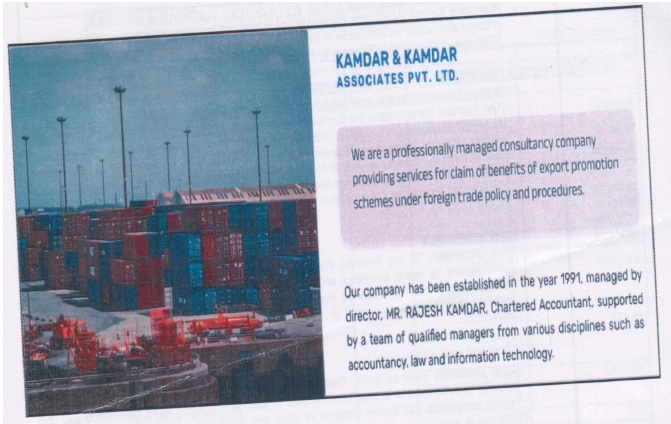
128. Since Kamdar & Kamdar Associates Pvt. Ltd. is engaged in providing business of consultancy services on foreign trade policy, therefore, this is entirely different from the services provided by the assessee being in the nature of digital marketing support services. We are of the considered opinion that this company is functionally dissimilar to the assessee and cannot be considered as a comparable to the provision of digital marketing support services segment of the assessee. Further, as per the third proviso to Rule 10CA(2) of the IT Rules, 1962, since the company becomes non-comparable for financial year 2021-22, it would also stands rejected for financial years 2020-21 and 2019-20. We, therefore, direct the AO / TPO to exclude this company from the list of comparables.
B2B Software Technologies Limited
129. After hearing both the sides, we find the TPO included this company on the ground that it is engaged in ITenabled services and marketing support. It utilizes standard office infrastructure and bears limited risks. The DRP agreed with the findings given by the TPO by observing as under:
“Observations of the Panel. The Panel notes that the assessee is into providing digital marketing support services which is functionally similar to the business being carried out by the comparable of providing business support services like ITeS. The activities of the company pertain to back-office operations or support functions. The activities of the company share functional similarities with the business support services being provided by the applicant assessee including comparable risk profile and infrastructure. In this case the benchmarking method used is TNMM, for which it is not mandatory that the two companies should be more or less identical. If the two companies are broadly functionally similar, the differences, if any, will even out at net profit margin level. Thus, we agree with the TPO and the objection of the applicant assessee is rejected.”
130. It is the submission of the Ld. Counsel for the assessee that B2B operates in a single segment and is engaged in providing information technology and related services. A perusal of the Management Discussion and Analysis in the FY 202122 annual report shows that B2B is engaged in providing IT services to its Healthcare and Microsoft divisions, consulting, software development and IT implementation services. We find before the DRP the assessee has stated that the TPO has not provided any explanation as to how IT enabled and marketing support services are comparable to the digital marketing support services rendered by the assessee. It is the submission of the Ld. Counsel for the assessee that B2B is engaged only in consulting, software and IT implementation services and there is no segmental information available in the annual report for the marketing support services as stated by the TPO. We, therefore, are of the considered opinion that due to non-availability of segmental details, this company cannot be considered as a comparable and we direct the AO / TPO to exclude this company from the set of comparables.
Strudcom Consultants Pvt. Ltd.
131. So far as Strudcom Consultants Pvt. Ltd. is concerned, we find the TPO included this company on the ground that it provides engineering and consultancy services including aspects of marketing and promotional support and operates on a low-risk profile with minimal assets. The DRP upheld the action of the TPO.
132. It is the submission of the Ld. Counsel for the assessee that this company is functionally not comparable since the core activity of Strudcom is structural engineering and related services. Further, a perusal of the website of the company shows that Strudcom provides architecture related services such as reinforced concrete design, structural steel design, composite structure design, seismic retrofitting and strengthening, pre-stress design, shuttering scaffolding design, structural audit and peer review consultancy. Further, the screenshot of the company reads as under:
133. In view of the above, it is evident that this company is principally engaged in structural consultancy services and neither the Annual Report nor the company’s website indicates presence of marketing / promotional support as contended by the TPO in the order. Further, the annual report of the company does not provide segmental financial information. We, therefore, hold that this company cannot be compared to a company engaged in provision of digital marketing support services as in the case of the assessee. Accordingly, this company is directed to excluded from the list of comparables.
Xplorer Consultancy Services Private Limited (‘Xplorer’)
134. After hearing both the sides, we find the TPO included this company in the final set of comparables on the ground that this company provides business and marketing consultancy services. Maintains a limited asset base and operates on a low-risk model. The DRP upheld the action of the TPO.
135. It is the submission of the Ld. Counsel for the assessee that from the company’s website it is seen that Xplorer has a diversified portfolio of civil engineering consulting assignments which significantly differs from the provision of digital marketing support services provided by the assessee. We find the website screenshot of the company shows that it is engaged in wide range of civil engineering related fields which are entirely different from the services provided by the assessee. We, therefore, hold that this company cannot be considered as a comparable to the assessee’s provision of digital marketing support services segment. We, therefore, direct the AO / TPO to exclude this company from the final set of comparables.
Qualcon Engineering Solutions (Pune) Private Limited
136. After hearing both the sides, we find the TPO included this company as comparable on the ground that this company offers engineering and related consultancy services with some marketing functions. Operates on a low-risk, costplus model. The DRP upheld the action of the TPO.
137. It is the submission of the Ld. Counsel for the assessee that the annual report of Qualcon does not provide brief description of the business. Further, after perusal of the website it is seen that it is engaged in providing quality management solutions engineered with focus on construction quality to its customers. Since Qualcon is engaged in diversified business and providing consultancy services other than provision of digital marketing support services provided by the assessee, we hold that this company cannot be considered as a comparable. Accordingly, we direct AO / TPO to exclude from the final set of comparables of the TPO for the international transaction pertaining to the provision of digital marketing support services.
Indo Canadian Consultancy Services Limited (‘Indo Canadian’)
138. After hearing both the sides, we find the TPO included this company in the final list of comparables on the ground that this company provides consultancy and liaison services including marketing related support services. Operates with a minimal-risk cost-plus remuneration structure. The DRP upheld the action of the TPO.
139. From the website of the company we find that Indo Canadian Consultancy Services Limited provides consultancy services in the field of hydro power plants in India, Nepal, Bhutan and Sri Lanka for major, medium, mini and micro-Hydel schemes covering engineering aspects from site assessment and identification, preliminary feasibility studies, feasibility study, detailed design & engineering and project management services. It has expertise in hydropower engineering, hydrology, hydraulics, geo-technical engineering, structural design, electromechanical and hydro-mechanical engineering project costing, project management and transmission line design. Therefore, it is clear that the company is engaged in engineering consultancy services in fields which are entirely different from the services provided by the assessee. We, therefore, hold that this company cannot be considered as a comparable to a company engaged in providing provision of digital marketing support services i.e. the assessee. We, therefore, direct the AO / TPO to exclude this company from the final set of comparables.
Zipper Trading Enterprises Limited (‘Zipper’)
140. After hearing both the sides, we find the TPO included this company in the list of comparables on the ground that this company is primarily involved in trading services but also performs marketing and promotional activities on a low-risk basis. The DRP upheld the action of the TPO.
141. From the various details furnished in the paper book, we find Zipper Trading Enterprises Limited is engaged in trading services and also performs marketing and promotional activities on low risk. Therefore, this company cannot be considered as a comparable to a company engaged in provision of digital marketing support services segment of the assessee. A perusal of the annual report for financial year 2021-22 shows that this company is engaged in the business of project and management consultancy. We, therefore, hold that this company is not functionally comparable to that of the assessee which is into provision of digital marketing support services segment and accordingly, direct the AO / TPO to exclude this company from the list of comparables.
BMT Consultants (India) Private Limited(‘BMT Consultants’)
142. After hearing both the sides, we find the TPO included this company in the final list of comparables on the ground that it provides consulting and support services in a low-risk capacity. Uses basic office infrastructure with no significant intangibles. The DRP upheld the action of the TPO.
143. A perusal of the company’s website shows that BMT Consultants provides consultancy services in the field of defense, environment, maritime designing, asset monitoring etc. Thus, it is clear that the company is engaged in consultancy services in fields which are entirely different from digital marketing services provided by the assessee. We, therefore, hold that this company cannot be considered as a comparable with that of the assessee company. Accordingly, we direct the AO / TPO to exclude this company from the list of comparables.
Quanta Process Solutions Private Limited (‘Quanta’)
144. After hearing both the sides, we find the TPO included this company in the list of comparables on the ground that it provides process optimization and consultancy services. Operates with limited risks and a support service profile. The DRP upheld the action of the TPO.
145. A perusal of the website of the company shows that Quanta provides concept-to-complete design engineering services and modular plant supplies to mainly to oil and gas, hydrocarbons and chemical process industries. Therefore, it is clear that this company is engaged in consultancy services in sectors such as oil and gas, hydrocarbons and chemical process industries which are different from the digital marketing services provided by the assessee. We, therefore, hold that this company cannot be considered as comparable to the assessee’s company. We, therefore, direct the AO / TPO to exclude this company from the list of comparables.
Likhami Consulting Limited (‘Likhami”)
146. After hearing both the sides, we find the TPO included this company as comparable on the ground that it delivers management and advisory services, uses minimal assets and bears limited risks and operates with a minimal-risk cost-plus remuneration structure. The DRP upheld the action of the TPO.
147. A perusal of the annual report of Likhami shows that it is inter alia engaged in the business of Consultancy, financial services and other allied service. Therefore, it is clear that Likhami is primarily engaged in business of financial consultancy services. We, therefore, hold that this company cannot be considered as a comparable with that of the assessee. We, therefore, direct AO / TPO to exclude this company from the final list of comparables being functionally noncomparable to the digital marketing support services of the assessee.
Construma Consultancy Private Limited (‘Construma’)
148. After hearing both the sides, we find the TPO included this company as comparable on the ground that it provides technical consultancy services and operates on a cost-plus basis with limited risks. The DRP upheld the action of the TPO.
149. A perusal of the annual report of Construma shows that it is inter alia engaged in the business of providing structural designing consultancy and allied services mainly to government sponsored infrastructure projects on Pan India basis. Thus, it can be concluded that Construma is mainly engaged in provision of architectural consultancy services which are entirely different from the design engineering services provided by the assessee. Further, this company does not satisfy employee cost filter of 25% applied by the TPO in the show cause notice. It earns revenue from structural designing consultancy and allied services mainly to government sponsored infrastructure projects on Pan India basis. These activities significantly differ from the provision of digital marketing support services segment of the assessee. We, therefore, direct the AO / TPO to exclude this company from the list of comparables.
MPS Tech Engg. & Consultancy (India) Private Limited (‘MPS Tech’)
150. After hearing both the sides, we find the TPO included this company as comparable on the ground that MPS Tech is engaged in the business of providing engineering and technical consultancy services mostly related with Industrial Construction. The DRP upheld the action of the TPO.
151. A perusal of the annual report of MPS Tech shows that this company is engaged in the business of providing engineering and technical consultancy services mostly related with Industrial Construction which are different than the provision of digital marketing support services provided by the assessee. We, therefore, hold that this company cannot be considered as a comparable. Accordingly, we direct the AO / TPO to exclude this company from the final list of comparables.
Aakar Abhinav Consultants Private Limited(‘Aakar Abhinav”)
152. After hearing both the sides, we find the TPO included this company as comparable on the ground that it is primarily an architectural consultancy firm but also performs liaison and digital marketing support services. Operates with a low-risk profile. The DRP upheld the action of the TPO.
153. A perusal of the annual report of Aakar shows that it is engaged in the business of providing various consultancy and project management services in the fields of architecture, traffic survey, transportation planning, urban infrastructure etc. Further, it is also engaged in providing management consultancy services. We, therefore hold that providing consultancy and project management services are different from the provision of digital marketing support services provided by the assessee.
154. We find the Delhi Bench of the Tribunal in the case of Organica Water Private Limited v. ITO vide ITA No. 577/Del/2022 has held that Aakar Abhinav is into diversified activities with no segmental information available in the annual report for financial year 2021-22. The relevant observations of the Tribunal read as under:
“11. It can be observed that companies included except DRA Consultants Ltd. have varied business interests. Since the assessee has the claim on segmental accounts the functionality test is a vital consequence. As assessee is operating in a very limited sphere of providing ecologically engineer wastewater treatment solutions the companies having diversified areas of interest and with nominal interest in wastewater treatment solutions cannot be said to passing the functionally test. Thus, the AO/TPO are directed to remove Mitcon consultancy and engineering services, Aakar Abhinav Consultants Pvt. Ltd, Feedback Infra Pvt. Ltd. and Mahindra Consulting Engineers Limited from the comparables and make a fresh adjustments. Accordingly, the ground is decided in favour of the assessee.”
155. In view of the above, we hold that this company cannot be considered as a comparable. We, therefore, direct the AO / TPO to exclude this company from the final set of comparables.
Gujarat Industrial & Technical Consultancy Organisation Limited (‘Gujarat Industrial’)
156. After hearing both the sides, we find the TPO included this company as comparable on the ground that this company is engaged in technical and marketing consultancy services. Operates on a low-risk model with a basic infrastructure profile. The DRP upheld the action of the TPO.
157. A perusal of the annual report of Gujarat Industrial & Technical Consultancy Organization Limited shows that the business description of the company is not available for the functional analysis of company. However, a perusal of the revenue from operations shows that the majority of the revenue pertains to ‘special study report fees’ and ‘project appraisal’. An analysis of the company’s website shows that Gujarat Industrial is engaged in providing a wide range of consulting services such as Techno-Economic Feasibility Study and Financial Restructuring, Industrial Market Surveys, Bid Management Services, Environment Management, Special Studies, Third Party Inspection and Monitoring Services Industrial Cluster Development, Valuation, Identification of New Business/project Opportunities, Technology Transfer and Energy Efficiency Initiatives to accelerate the grow industrial and services economy of Gujarat, which is significantly different from the digital marketing support services provided by the assessee. Since Gujarat Industrial is engaged in diversified business in providing the consultancy services other than the provision of digital marketing support services by the assessee, we hold that this company should be excluded from the final list of comparables. The AO / TPO is accordingly directed to exclude this company from the final list of comparables.
Transys Consulting Private Limited (‘Transys’)
158. After hearing both the sides, we find the TPO included this company in the list of comparables on the ground that this company offers management and technical consulting services and operates on a cost-plus model with a low-risk profile. The DRP upheld the action of the TPO.
159. A perusal of the annual report of Transys Consulting Pvt. Ltd. shows that it is engaged in construction activities. A perusal of the company’s website shows that Transys provides consultancy services such as design, field investigation, feasibility and detailed engineering studies, project management, financial modelling, contract and asset management mainly for the transportation sector especially traffic, highway and bridge engineering. Thus, it is clear that this company is engaged in consulting services which are different from the digital marketing support services by the assessee. We, therefore, hold that this company cannot be considered as a comparable to the digital marketing support services segment of the assessee. We, therefore, direct the AO / TPO to exclude this company.
Triburg Sportswear Private Limited (‘Triburg’)
160. After hearing both the sides, we find the TPO included this company as a comparable on the ground that this company is engaged in marketing support and liaison services for apparel exports and operates on a low-risk, cost-plus model. The DRP upheld the action of the TPO.
161. A perusal of the annual report of Triburg shows that the company has been set up to manufacture, fabricate, export, import, buy, sell and/or otherwise deal in readymade garments, hosiery, textiles, fabrics, yam, carpets, handicrafts, silk, antiques, pictures, spectacles, fancy goods, toys, woodwork, embroidery work, sewing works and precious stones. A perusal of the website of the company shows that they are working as apparel sourcing solutions provider. They also provide various services like design, product development, cost negotiations, manufacturing, quality, vendor training and logistics etc. In view of the above, it is evident that Triburg inter alia earns revenue from various services like design, product development, cost negotiations, manufacturing, quality, vendor training and logistics etc, and hence, should be excluded as functionally non-comparable to the provision of digital marketing support services segment of the assessee. Further, we find that this company provides a wide range of services, the annual report of the company neither provides the segmental break-up nor does it provide the revenue break-up from the various activities undertaken viz. commission, design and development and market research and development. Since segmental details are not available, therefore, on this ground also this company cannot be considered as a comparable. We, therefore, direct the AO / TPO to exclude this company from the final list of comparables.
Chlorophyll Brand & Communications Consultancy Private Limited (‘Chlorophyll’)
162. After hearing both the sides, we find the TPO included this company in the list of comparables on the ground that it is engaged in brand consulting and promotional support services and operates with low-risk and basic asset base. The DRP upheld the action of the TPO.
163. A perusal of the annual report of Chlorophyll shows that it earns revenue from consultation charges, artwork charges and other charges. Further, the complete details of nature of activities carried out by it are not available in the annual report. A perusal of the website of the company shows that it owns patented brand models and algorithm processes and is engaged in providing end to end brand and communications solutions for clients. Thus, it is evident that Chlorophyll earns revenue from consultation, artwork, branding and communication services which in our opinion is functionally not a comparable to provision of digital marketing support services segment. Further, segmental details are not available. Apart from this, this company owns intangibles which plays significant role in rendering of their services. We, therefore, hold that this company should be rejected from the final set of comparables. We, therefore, direct the AO / TPO to exclude this company from the final set of comparables.
D M R Hydroengineering & Infrastructures Limited (‘DMR’)
164. After hearing both the sides, we find the TPO included this company as comparable on the ground that it offers engineering consultancy services and operates with limited risks, using standard office infrastructure. The DRP upheld the action of the TPO.
165. A perusal of the annual report of DMR shows that this company is engaged in provision of variety of engineering consultancy services such as project viability studies, cost benefit analysis, design and analytical services related to structures, construction planning and scheduling, safety inspections etc. mainly for hydropower, dams, roads and railway tunnels. Further, the company’s website shows that DMR Hydro provides consultancy services in the infrastructure sector of Hydropower, dams, barrages & weirs, road and rail tunnels, mining and other infrastructures. We, therefore, are of the considered opinion that this company is engaged in design and engineering services which are entirely different from the provision of digital marketing support services provided by the assessee. We, therefore, hold that this company cannot be considered as a comparable to the provision of digital marketing support services segment of the assessee. We, therefore, direct the AO / TPO to exclude this company from the final list of comparables. The grounds raised by the assessee are accordingly partly allowed.