ORDER
Anadee Nath Misshra, Accountant Member.- This appeal has been filed by the assessee against the impugned appellate order of learned CIT(A)/National Faceless Appeal Centre (NFAC), Delhi vide order dated 30.06.2025 for the AY 2014-15. The assessee has raised the following grounds of appeal:
“1. That the learned Commissioner of Income-tax (Appeals) has erred in law and on facts in arbitrarily ignoring that the Assessing Officer has erred in law in failing to dispose of the objection raised by the assessee against reassessment proceedings by speaking order, in contravention of the law laid by the Hon’ble Supreme Court in GKN Driveshafts (India) Ltd. v. ITO; and the assessment order is void-ab-initio.
2. That the learned Commissioner of Income-tax (Appeals) has erred in law and on facts in arbitrarily upholding initiation of proceedings under section 147 of the I.T. Act, 1961 by the Assessing Officer, who did not have the requisite “reason to believe” that any income chargeable to tax has escaped assessment and the impugned assessment order is void ab initio.
3. Without prejudice to the Grounds of Appeal nos. 1 & 2, it is averred that the learned Commissioner of Income-tax (Appeals), NFAC has erred in law and on facts in failing to consider that the Assessing Officer has not allowed adequate opportunity of being heard to the assessee and passed the impugned assessment order u/s 144/147 of the I.T. Act, 1961.
4. Without prejudice to the Grounds of Appeal nos. 1 & 2, it is averred that the learned Commissioner of Income-tax (Appeals),NFAC has erred in law and on facts in failing to consider that the Assessing officer has arbitrarily upheld the addition of Rs.28,88,667 as unexplained investment, without providing proper opportunity to the assessee, and the addition was made merely presumptions and surmises.
5. Without prejudice to the Grounds of Appeal nos. 1 & 2, it is averred that the learned Commissioner of Income-tax (Appeals), NFAC has erred in law and on facts in failing to consider that the Assessing Office has arbitrarily upheld the addition of Rs.30,51,000 as income from other sources under section 56(2)(vii)(b)(ii) of the I.T. Act, 1961.
6. Without prejudice to the Grounds of Appeal nos. 1 & 2, it is averred that the learned Commissioner of Income-tax (Appeals),NFAC has erred in law and on facts in failing to consider that the Assessing Officer has not referred the matter to the Valuation Officer (for valuation of land) under section 50C(2); and the addition made solely on the basis of Stamp Valuation is illegal as such.”
(B) The present appeal has been filed beyond the time prescribed under section 253(3) of the Income Tax Act, 1961 (the Act). The assessee has filed application for condonation of delay in filing of the present appeal. The learned Departmental Representative expressed no objection to condonation of delay, as requested by the appellant assessee. In view of the reasons stated in the application, the delay in filing of the appeal is condoned under section 253(5) of the Act and the appeal is admitted.
(C) In this case, assessment order dated 21.12.2017 was passed by the Assessing Officer, whereby the assessee’s total income was determined at Rs. 59,39,670/- as against the returned income of Nil. In the assessment order, additions of Rs. 28,88,667/- and Rs. 30,51,000/- were made on account of a property jointly purchased by the assessee, in which the assessee’s share was 1/3rd. The addition of aforesaid amount of Rs. 28,88,667/- was made being 1/3rd share of the assessee in the sale consideration of the property as par the sale-deed. A further addition of the aforesaid amount of Rs. 30,51,000/- was made on account of 1/3rd share in the difference between value of property as per Stamp Valuation Authority and value as per sale deed. The assessee’s appeal was dismissed by the Learned CIT(A) vide impugned appellate order dated 30.06.2025. During the appellate proceedings before the Learned CIT(A), the assessee made detailed submissions regarding both the aforesaid additions of Rs. 28,88,667/- and Rs. 30,51,000/- made by the Assessing Officer. As regards the aforesaid addition of Rs. 28,88,667/-, vide letter dated 28/06/2017; and annexure thereto, the assessee fully explained the source of aforesaid amount of Rs. 28,18,667/-. Copies of the letter and annexure thereto have been filed in Paper book (pages 25 to 28).
(D) Further, in respect of the aforesaid addition of Rs. 30,51,000/-, the assessee made the following submissions before the Learned CIT(A):
“3.1 In this context it is most respectfully submitted that the property has been jointly purchased by three persons and during the course of assessment proceedings the Id. A.O. has treated 1/3 of the difference between stamp duty value of the Property (Rs.1,66,53,000/-) and the purchase consideration (Rs.75,00,000/-) i.e. 1/3 of Rs. 91,53,000/-amounting to Rs.30,51,000/- as taxable in the case of assessee-appellant by invoking the provisions of section 56(2)(vii)(b)(ii) of the I.T. Act, 1961.
3.11 In this regard, it is most humbly submitted that section 56(2)(vii)(b)(ii) of the I.T. Act, is consequential to section 50 C. According to section 50C(2) of the I.T. Act, where the assessee claims before the Assessing Officer that the value adopted by the Stamp Valuation Authority exceeds the fair market value, then the Assessing Officer may refer the valuation of the capital asset to the Valuation Officer.
A copy of the claim made vide letter dated 24-03-2017 is placed at pages 14 & 15 of the Paper Book. “
(E) However, the Learned CIT(A) did not accept the submissions made by the assessee, and confirmed both the aforesaid additions of Rs. Rs. 28,88,667/-and Rs. 30,51,000/-.
(F) The present appeal has been filed by the assessee against the aforesaid impugned appellate order dated 30.06.2025 of the Learned CIT(A). On merits of the aforesaid additions of Rs. 28,88,667/- and Rs. 30,51,000/- written submissions were made, relevant portion of which is reproduced below:
“2 .2 Your Honour, it may very kindly be observed that the Ld. A.O. has treated 1/3 of the difference between stamp duty value of the Property (Rs.1,66,53,000/-) and the purchase consideration (Rs.75,00,000/-) i.e. 1/3 of Rs. 91,53,000/- amounting to Rs.30,51,000/- as taxable as per provisions of section 56(2)(vii)(b)(ii) of the I.T. Act, 1961 which according to the Assessing Officer represented income that had escaped assessment
2. 3 In this context, it is most humbly submitted that the A.O. arbitrarily treated the difference of Rs.30,51,000/-as income escaping assessment without placing on record any evidence in support of his presumption that fair market value of the particular property was equivalent to the Circle rate adopted for Stamp Duty purposes. Such presumption cannot be treated “reason to believe” for invoking provision of section 147/148 of the I.T. Act, 1961.
In this regard reliance is placed on the squarely applicable decision of the Hon’ble Gujarat High Court in Mumtaj Haji Mohmad Memon v. ITO-Ward 6(1)(1) in R/Special Civil Application No. 21030 of 2017, wherein it was held that a reassessment notice under Section 147 cannot survive where the “reasons to believe” are based on incorrect fact and the impugned notice u/s 148 of the I.T. Act, has been quashed.
A copy of the decision is placed on pages 16 to 24 of the Paper Book.
2. 4 In this context, it is most respectfully submitted that for reopening u/s 147 the Assessing Officer cannot simply invoke Section 147 by citing Section 56(2)(vii)(b)(ii) as the core justification. The AO must posses tangible and specific material demonstrating that income had actually escaped assessment.
3. In Ground of Appeal no. 3, Without prejudice to the Grounds of Appeal nos. 1 & 2, it is averred that the learned Commissioner of Income-tax (Appeals), NFAC has erred in law and on facts in failing to consider that the Assessing Officer has not allowed adequate opportunity of being heard to the and passed the impugned assessment order u/s 144/147 of the I.T. Act, 1961.
4. In Ground of Appeal no. 4. it is most respectfully submitted, without prejudice to the Grounds of Appeal nos. 1 & 2, it is averred that the learned Commissioner of Income-tax (Appeals), NFAC has erred in law and on facts in failing to consider that the Assessing officer has arbitrarily upheld the addition of Rs.28,88,667 as unexplained investment, without providing proper opportunity to the assessee, and the addition was made merely presumptions and surmises.
4.1 In this context, it is most respectfully submitted that a perusal of the Bank of the assessee would reveal that cash amounting to Rs.2,00,000/- was withdrawn on 27-05-2013 and Rs.27,00,000 was paid through Demand Draft on 07-11-2013 through the bank account. The aggregate sum of Rs.29,00,000/- was utilized towards the assessee’s 1/3rd share consideration for the joint purchase of the property.
The bank account further reveals that the relevant credits between 18-10-2013 to 30-10-2013 were through NEFT/RTGS and fully verifiable as such from the copy of the bank account furnished before the Assessing Officer vide letter dated 28-06-2017 filed in response to notice u/s 142(1) dated 20-06-2017. Copies of the relevant letter and bank account are placed on pages 25 and 26 to 28 of the Paper Book, respectively
The Id. CIT(A) failed to consider the aforesaid bank account and confirmed the addition of Rs.28,88,667/- as income from undisclosed sources solely on the basis of presumption. The addition of Rs.28,88,667/- is therefore, not justifiable and liable to be deleted.
5. In Ground of Appeal no. 5. it is most respectfully submitted, without prejudice to the Grounds of Appeal nos. 1 & 2, it is averred that the learned Commissioner of Income-tax (Appeals), NFAC has erred in law and on facts in failing to consider that the Assessing Office has arbitrarily upheld the addition of Rs.30,51,000 as income from other sources under section 56(2)(vii)(b)(ii) of the I.T. Act, 1961.
5.1 In this context, it is most respectfully submitted that the property has been jointly purchased by three persons and, during the course of assessment proceedings the Assessing Officer treated 1/3rd of the difference between stamp duty value of the Property (Rs. 1,66,53,000/-) and the purchase consideration (Rs.75,00,000/-) i.e. 1/3 of Rs. 91,53,000/-amounting to Rs.30,51,000/- as taxable in the hands of the assessee-appellant by invoking the provisions of section 56(2)(vii)(b)(ii) of the I.T. Act, 1961.
5.2 In this regard, it is most humbly submitted that section 56(2)(vii)(b)(ii) of the I.T. Act, is consequential to section 50C. According to section 50C(2) of the I.T. Act, where the assessee claims before the Assessing Officer that the value adopted by the Stamp Valuation Authority exceeds the fair market value then the Assessing Officer may ma refer the valuation of the capital asset to the Valuation Officer.
A copy of the claim made vide letter dated 24-03-2017 is placed at pages 8 & 9 of the Paper Book.
5.3 It is most respectfully submitted that the Assessing Officer failed to follow the specific mandate referred above and, therefore, the impugned assessment order is unsustainable in law. Consequently, the addition of Rs.30,51,000/-is liable to be deleted in view of the decision of the Hon’ble ITAT (Agra Bench)’s decision in ITA NO. 342/Agra/2017 in Hari Om Garg v. ITO.
A copy of the decision is placed at pages 29 to 38 A copy of the Paper Book.
5.4 Further, It is most respectfully submitted that the Id.CIT(A) wrongly observed that no evidence regarding such request for reference Valuation Officer had been furnished and arbitrarily confirmed the action of the Assessing Officer in applying the deeming fiction under section 56(2)(vii)(b)(ii) of the I.T. Act.
6. In Ground of Appeal no. 6., it is most respectfully submitted, without prejudice to the Grounds of Appeal nos. 1 & 2, it is averred that the learned Commissioner of Income-tax (Appeals), NFAC has erred in law and on facts in failing to consider that the Assessing Officer has not referred the matter to the Valuation Officer (for valuation of land) under section 50C(2); and the addition made solely on the basis of Stamp Valuation is illegal as such.
6.1 Your Honour, it is most humbly submitted section 56(2)(vii)(b)(ii) of the I.T. Act, is consequential to section 50C. According to section 50C(2) of the I.T. Act, where the assessee claims before the Assessing Officer that the value adopted by the Stamp Valuation Authority exceeds the fair market value, the Assessing Officer may refer the valuation of the capital asset to the Valuation Officer.
A copy of the claim made vide letter dated 24-03-2017 is placed at pages 8 & 9 of the Paper Book.
6.2 It is most respectfully submitted that the Assessing Officer has failed to follow the specific mandate referred to above and, therefore, the impugned assessment order is illegal and unsustainable in law.
In view of the decision of the Hon’ble ITAT Lucknow Bench decision in ITA NO. 83/LKW/2024 in Nirmal Singh v. ITO.
A copy of the decision is placed at pages 39 to 55 of the Paper Book.
6.3 It is most respectfully submitted that the Id.CIT(A) wrongly observed that no evidence regarding such request for reference Valuation Officer had been furnished.”
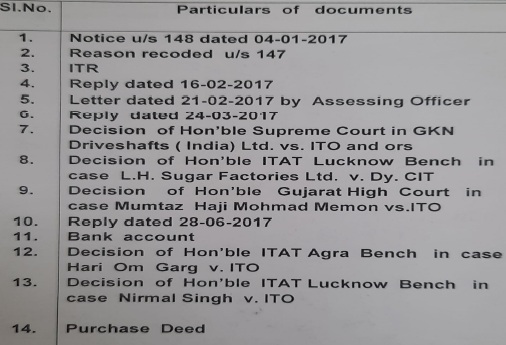
(F.1) A Paper book containing the following particulars was also filed from the assessee’s side during appellate proceedings in Income Tax Appellate Tribunal.
(F.2) Copies of letters dated 16.02.2017, 24.03.2017 and 28.06.2017 were also filed as part of Paper Book on the merits of the aforesaid additions of Rs. 28,88,667/- and Rs. 30,51,000/-.
(G) At the time of hearing, learned Counsel for the assessee placed reliance on aforesaid written submissions and Paper book referred to in foregoing paragraphs (C), (D), (F), (F.1) and (F.2) of this order. The assessee also placed strong reliance on order of Lucknow Bench of ITAT in the case of Nirmal Singh v. ITO (Lucknow – Trib.)/ITA No. 83/Lkw/2024 dated 10.010.2024 and order of Agra Bench of ITAT in the case of Hari Om Garg v. ITO [IT Appeal No. 342 (Agra.) of 2017, dated 31-5-2019]
(H) The Learned Counsel for the assessee also pleaded that the assessee’s case was squarely covered by various decision of Income Tax Appellate Tribunal, in assessee’s favour, including the following decisions:
| (1) |
|
Order of ITAT, Agra Bench in the case of Hari Om Garg (supra) |
| (2) |
|
Order of ITAT, Hyderabad Bench in the case of Asstt. CIT v. Lalitha Karan [IT Appeal No. 1130 (Hyd.) of 2015, dated 4-1-2017] |
| (3) |
|
Order of ITAT, Agra Bench in the case of Dr. Sanjay Chobey (HUF) v. ACIT [IT Appeal No. 140 (Agr.) of 2018, dated 2-7-2018] |
| (4) |
|
Order of ITAT, Amritsar Bench in the case of Dev Brat Sharma v. ITO [IT Appeal No. 493 (Asr) of 2018, dated 17-1-2019] |
| (5) |
|
Order of ITAT, Delhi Bench in the case of ITO v. Aditya Narain Verma (HUF) (Delhi – Trib.) |
| (6) |
|
Order of ITAT, Mumbai Bench in the case of Suresh C. Mehta v. ITO 144 ITD 427 (Mumbai)/I.T.A. No. 33/Mum/2011 |
(I) The Learned Departmental Representative for Revenue relied on the assessment order and on the impugned appellate order of the Learned CIT(A).
(J) Both sides have been heard. Materials on record have been perused. As far as the aforesaid addition of Rs. 28,88,667/- is concerned, vide assessee’s letter dated 28.06.2017 already referred to in foregoing paragraph (C) of this order); the assessee explained the source of investment in property amounting to the aforesaid addition of Rs. 28,88,667/-. In the written submissions and Paper book filed during appellate proceedings in Income Tax Appellate Tribunal, already referred to in foregoing paragraphs. The aforesaid letter dated 28.06.2017 also included, as enclosures, copies of Bank statements of the assessee, as an explanation for source of the aforesaid investment of Rs. 28,88,667/- in property. The Learned CIT(A) and the Assessing Officer have not given due consideration to the explanation furnished by the assessee. Even during appellate proceedings in Income Tax Appellate Tribunal, no material has been brought for our consideration to disbelieve the explanation furnished by the assessee, supported by documentary evidences. On perusal of the assessee’s explanation along with supporting documents, it is obvious that the assessee has fully explained the source of the aforesaid investment of Rs. 28,88,667/-. The Learned CIT(A) and the Assessing Officer in their respective orders, have rejected the assessee’s explanation based on whims, fancy and guesswork; without cogent materials and considered reasoning. In view of foregoing addition of Rs. 28,88,667/-, the addition is hereby deleted. As regards the aforesaid addition of Rs. 30,51,000/- being assessee’s 1/3rd share in difference between the sale consideration of the property as per Stamp Valuation Authority, it is obvious on perusal of the assessee’s letter dated 24.03.2017 and letter dated 16.02.2017 that the assessee had tendered explanation for lower value of sale consideration as per sale-deed as compared with value as per Stamp Valuation Authority. These letters have already been filed as part of paper book referred to in forgoing paragraphs (F.1) and (F.2) of this order. The perusal of the assessee’s letters also shows that the assessee had made specific request for referring the matter to the D.V.O. of the Department. However, the Assessing Officer neither accepted the assessee’s explanation nor referred the issue regarding valuation of the property to the D.V.O. The provisions of Section 50C(2) of the Act, and provision of Section 56(2)(vii)(b) of the Act mandate reference by the Assessing Officer to the D.V.O. when the assessee contended before the Assessing Officer that the value adopted by Stamp Valuation Authority exceeded the fair market value of the property on the date of transfer. It is not in dispute in the present case that the Assessing Officer failed to make reference to Valuation Officer, as mandated by the aforementioned provisions of law. In this regard, we find that the issue is squarely covered in favour of the assessee by order of Co-ordinate Bench of ITAT Lucknow in the case of Nirmal Singh (supra). Relevant portion of the order in the case of Nirmal Singh (supra) is reproduced as under:
“8…….. The provisions of Section 50C(2) of the Act as well as proviso to Section 56(2)(vii)(b) of the Act; mandate reference by the Assessing Officer to the Valuation Officer when the assessee claims before the Assessing Officer that the value adopted or assessed or assessable Stamp Valuation Authority exceeds the fair market value of the property as on the date of transfer. It is also not in dispute that the Assessing Officer failed to make reference to Valuation Officer, as mandated by the aforementioned provisions of law. In this regard, we find that the issue is squarely covered in favour of the assessee by order of Co-ordinate Bench of ITAT Delhi in the case of ITO v. M/s. Aditya Narain Verma (HUF) (supra). In this case, the request of the Departmental Representative that the matter may be set aside to the file of the Assessing Officer for referring the case to Valuation Officer, was rejected. The relevant portion of the order is reproduced as under: –
“4.1 On the very perusal of the provisions laid down under section 50C of the Act reproduced hereinabove, we fully concur with the finding of the ld. CIT (Appeals) that when the assessee in the present case had – claimed before Assessing Officer that the value adopted or assessed by the stamp valuation authority under sub section (1) exceeds the fair market value of the property as on the date of transfer, the Assessing Officer should have referred the valuation of the capital asset to a valuation officer instead of adopting the value taken by the state authority for the purpose of stamp duty. The very purpose of the Legislature behind the provisions laid down under sub section (2) to section 50C of the Act is that a valuation officer is an expert of the subject for such valuation and is certainly in a better position than the Assessing Officer to determine the valuation. Thus, non-compliance of the provisions laid down under sub section (2) by the Assessing Officer cannot be held valid and justified. The Hon’ble’ jurisdictional High Court of Allahabad in the case of Shashi Kant Garg (supra) has been pleased to hold that it is well settled that if under the provisions of the Act an authority is required to exercise powers or to do an act in a particular manner, then Bat power has to be exercised and the act has to be performed in that manner alone and not in any other manner. Similar view has been expressed by the other decisions cited by the Ld. AR in this regard hereinabove. The first appellate order on the issue is thus upheld. The grounds are accordingly rejected.”
9. Respectfully following the aforesaid order of Delhi Bench of ITAT of Delhi in the case of ITO v. M/s. Aditya Narain Verma (HUF) (supra), we hold that the additions made by the Assessing Officer amounting to Rs. 2,14,22,053/- and Rs.49,11,947/-, as aforesaid, without reference to the Valuation Officer as mandated by law, has no legs to stand and is unsustainable; having regard to applicable law as well as facts and circumstances of the present case before us. Accordingly, we set aside the impugned appellate order dated 03/01/2024 of the Ld. CIT(A) and we direct the Assessing Officer to delete the aforesaid additions of Rs. 2,14,22,053 and Rs. Rs.49,11,947/-.”
(K) Similar view has been taken by Delhi Bench of ITAT in the case of
Income Tax Officer v.
Aditya Narain Verma HUF (Order dated 07.06.2017 in ITA No. 4166/Del/2013), reported at
(Del-
Trib); and by Agra Bench of ITAT in the case of
Hari Om Garg v.
Income Tax Officer (order dated 31.05.2019 in ITA No. 342/Agra/2017).
Lucknow Bench of ITAT took the same view in the case of
Sanjeev Kumar Saxena v.
ITO (
Lucknow –
Trib.)/
(order dated 30/01/
2026 in ITA No. 99/Lkw/2025) . Moreover, the decisions relied upon by the Counsel for the assessee, as referred to in foregoing paragraph (H) of this order; also advance the case of the assessee. No precedent has been brought for our consideration in which a contrary view in favour of Revenue has been taken. Thus, the issue in dispute regarding the aforesaid addition of Rs. 30,51,000/- being squarely covered by numerous precedents as discussed earlier, the aforesaid addition of Rs. 30,51,000/- is hereby deleted. In view of the foregoing, ground nos. 4, 5 and 6 are allowed and both the aforesaid additions of Rs. 28,88,667/- and Rs. 30,51,000/- has been deleted. As we have already deleted the aforesaid addition of 28,88,667/-and Rs. 30,51,000/-, ground no. 1, 2 & 3 of appeal are merely academic in nature, hence not being decided.
(L) In the result, appeal of assessee is allowed.