ORDER
Beena Pillai, Judicial Member.- Present cross-appeals arise out of order dated 28/08/2025 passed by NFAC, Delhi [hereinafter referred to as “Ld.CIT(A)”] for A.Y. 2017-18, on the following grounds of appeal:-
ITA No. 8302/Mum/2025
“On facts and circumstances of the case and in law, the CIT(A) has erred in:
1. Ground No. 1: upholding disallowance under Section 40(a)(ia) of the Act in the Appellant’s case regarding withholding of tax on payments made towards winnings to players
1.1. The CIT(A) has erred in law and on the facts in invoking the provisions of Section 40(a)(ia) of the Act, in respect of winnings paid to players, which were not debited to P&L account but were reflected as a liability in the books of account and maintained in a designated bank account. It is submitted that such amounts do not constitute “expenditure” within the meaning of Section 40(a)(ia), and therefore, the disallowance made on this basis is unjustified and liable to be deleted.
1.2. The CIT(A) has erred in concluding that prize payouts or payments towards winnings, even if not routed through P&L, amount to expenses claimed by the Appellant and consequently attract disallowance for nondeduction of TDS under Section 194B and the Appellant respectfully submits that the payments made towards winnings represent a liability of the Appellant to the winners and do not constitute business expenses or costs . Therefore, the contention that these amounts are expenses is misplaced and legally untenable.
1.3. The CIT(A) has erred in invoking disallowance under Section 40(a)(ia) for short deduction of tax and thus, the disallowance is, therefore, unwarranted and liable to be deleted.
2. Ground No. 2: concluding that the Appellant has not complied with provisions of Section 194B of the Act regarding withholding of tax payments towards winnings to players
2.1 The CIT(A) has entirely misconstrued the provisions of Section 194B, in holding that in the present case that Section 194B is to be satisfied on an aggregate basis. The CIT(A) has failed to appreciate that the specific use of the words “at the time payment thereof” – mandates that the provisions of Section 194B attach to a payment, and, have to be complied with in relation to each individual payment.
2.2 The CIT(A) has also overlooked the language of proviso 2 to Section 194B, which specifically uses the words “in a case”. The use of the words “in a case” lends further legislative support to the interpretation that the provisions of Section 194B have to be satisfied in respect of “each payment”, and, “each case of payment”.
2.3 The CIT(A) is a creature of statute, and, was required to strictly follow, and, give effect to the plain language used by the legislature in framing Section 194B. The CIT(A) has failed to do so. Consequently, the Impugned Order is rendered unsustainable in law.
2.4 The CIT(A) has failed to appreciate, and, apply the settled position in law that taxing statues must be strictly interpreted as per the language used by the Legislature. It is impermissible to read into a taxing provision a condition which is not specified therein. The CIT(A) has erroneously sought to read in a condition of aggregation into Section 194B, which is impermissible in law.
2.5 The CIT(A) has erred in reading in the condition of aggregation into Section 194B. By reading in a condition of aggregation, the compliance with Section 194B is rendered uncertain, and, conjectural – as it is uncertain if, and, when the threshold of Rs 10,000 qua any payee will be crossed. Any interpretation which renders a provision uncertain, unworkable, and, conjectural is impermissible, and, bad in law.
2.6 The CIT(A) has erred in law and on facts, in upholding the action of the learned Assessing Officer (the ‘AO’) in making addition/disallowance (as stated above) under Section 194B of the Act, without appreciating that:
2.6.1 Section 194B applies net winnings above Rs. 10,000/- per game at the point of payment and not on aggregate winnings of a player in a financial year.
2.6.2 unlike sections such as 194C or 194J of the Act which expressly require aggregation, Section 194B does not contain any such aggregation language and therefore, Section 194B must be applied as per its plain and specific terms without importing aggregation concepts, rendering the AO’s and CIT(A)’s approach incorrect and liable to be set aside.
2.6.3 The Appellant had duly deducted TDS wherever net winnings per game exceeded Rs. 10,000/- per game and the interpretation adopted by the CIT(A) and the AO is contrary to the language of Section 194B, CBDT circulars and judicial precedents.
2.6.4 Had TDS indeed been computed on an aggregate basis, the resultant tax withheld would have been lower than the amount actually deducted by the Appellant, thereby ensuring no prejudice or loss to the exchequer.
2.6.5 The findings that Appellant failed to provide “player-wise data” is factually incorrect as requisite details and data files were furnished.
2.6.6 The CIT(A) erred in selectively relying on an isolated example from the excel files of winnings below Rs. 10,000 to hold that aggregate winnings for that user exceeded Rs. 10,000 and TDS was required, without considering that (a) the same player’s transactions appeared in other files as well which included winnings above Rs. 10,000; and (b) the player’s aggregate net result across all transactions was a loss at year end, so no withholding would have been due on an aggregate basis.
2.6.7 The CIT(A) has grossly erred in holding that the appellant either (i) falsely claimed winnings paid to players, or (ii) split winnings below Rs. 10,000/- to avoid TDS, without any substantive documentary evidence, thereby arriving at conclusions based on assumptions, conjectures, and unsustainable inferences.
2.6.8 The CIT(A) has erred in holding that non-deduction of tax defeats the purpose of tax collection and allows users to escape tax, without appreciating that the appellant exercised utmost diligence in complying with all withholding obligations as required under Section 194B by deducting tax wherever applicable and in good faith.
2.6.9 The CIT(A) has erred in rejecting the Appellant’s comparison with the horse racing business for the purpose of TDS threshold, without considering that both horse racing and online games are governed by the same statutory limit of Rs. 10,000/- under the Act, and can be said to be pari materia in this respect and the frequency or online nature of gaming does not warrant a different interpretation adversely affecting the appellant.
2.6.10 The CIT(A) has erred in relying on the recently enacted ‘Promotion and Regulation of Online Gaming Bill, 2025’ to uphold the addition for non-deduction of TDS on winnings, without appreciating that the primary objective of the Bill is to regulate and prohibit harmful online money gaming practices and protect citizens from addiction and financial distress. The Bill’s intent is unrelated to tax withholding provisions or the question of TDS deduction on per game or aggregate basis, and thus cannot be invoked to justify the impugned demand and applying legislative intent from a future law retrospectively to justify demand is erroneous and against principles of statutory interpretation.
2.6.11 The CIT(A) has erred in law, in placing reliance on the Circular No. 485 dated 27-5-1987 issued by the CBDT, without having regard to the settled law that any Circular which is contrary to a statutory provision, is non est in law.
2.6.12 The CIT(A) has erred in failing to appreciate the settled law that whilst the Circular is binding on a Tax Officer, a Circular is always capable of challenge by an assessee, on the ground that the Circular is contrary to the applicable statutory provisions.
2.6.13 The CIT(A) has erred in failing to appreciate that Circulars contrary to the settled law as declared by the Hon’ble Supreme Court are non-est in law.
2.6.14 That there is disparity at the department level with respect to the withholding on winnings on per day/per game/aggregate basis considering the AO focuses on single day the CIT(A) has focused on aggregation.
2.6.15 The CIT(A) erred in drawing adverse inference merely based on a statistical comparison with industry revenues, which has no relevance under Section 194B merely on the basis of assumptions, industry statistics, and conjecture without any corroborating material.
2.6.16 The CIT(A) applied the amendments introduced by the Finance Act 2023, to the subject AY without appreciating the fact that these amendments are prospective in nature and consequently, such amendments are not applicable to the AY under consideration and cannot be relied upon to justify the tax deduction demand in the impugned order. 3. Ground No. 3: Concluding that the Appellant has not complied with Section 194B of the Act regarding withholding of tax payments towards bonus and other credits (online promotional expenses) to players and thereby erred in making an addition under Section 40 (a)(ia) of the Act.
On facts and circumstances of the case and in law,
3.1 The CIT(A) erred in law and on facts in confirming the disallowance under section 40(a)(ia) for alleged non-deduction of taxes on “bonus/promotional expenses”, without appreciating that:
3.1.1 Such bonuses/cashbacks were in the nature of marketing expenditure and promotional incentives enhancing playability and are not payment of winnings to the players.
3.1.2 No specific TDS provision applied to such expenditure for the subject year under consideration
3.1.3 CIT(A) failed to identify any applicable TDS provision mandating deduction on such expenses.
3.2 The CIT(A) has erred in law, and, on facts by relying on the interpretation adopted by the GST Authorities to contend that once GST has been paid on bonus and credits, TDS is payable, without having regard to the settled position in law that, while interpreting the provisions of one statute, it is entirely impermissible to refer to the provisions of a distinct statute.
4. Ground No. 4: An unsigned assessment order is non-est and liable to be quashed
4.1 CIT(A) erred in law and on facts in upholding the validity of the assessment order, notwithstanding that the assessment order, demand notice, and computation sheet were neither digitally nor physically signed by the Learned AO .
4.2 The mere presence of a Document Identification Number (DIN) cannot substitute for the mandatory authentication by signature, rendering the order defective.
4.3 The CIT(A) has erred in placing reliance on the Hon’ble Supreme Court’s decision in CIT v. Brandix Mauritius Holdings Ltd.
(SC), which is only an interim stay granted on the Hon’ble Delhi High Court’s judgment in CIT v. Brandix Mauritius Holdings Ltd.
(Delhi). Further, the Supreme Court’s decision is limited to granting an interim stay and does not amount to a final ruling. Additionally, the absence of proper authentication in the present case vitiates the validity of the order.
The Appellant craves leave to add, to amend, to alter, to withdraw, to modify and/or to substitute any or all of the foregoing grounds of appeal and to submit such statements, documents and papers as may be considered necessary either at or before the appeal hearing.”
2. Brief facts of the case are as under:-
Assessee is a company and filed its return of income for year under consideration on 31/10/2017 declaring total income of Rs. 103,90,26,560/- under normal provision of the Act and book profit of Rs. 101,78,22,530/- under Section 115JB of the Act. The case was processed u/s 143(1) of the Act and was selected for scrutiny under Cass. As a consequence, notices u/s 142(1) and 143(2) of the Act was issued to the assessee calling for various details. In response, assessee filed replies and explanations which were examined by the Ld.AO.
2.1. The Ld.AO noted that the assessee is engaged in the business of online and mobile games of Rummy Circle, Teen Patti, and other card games, etc. The Ld.AO noted that assessee has paid to the participants towards the winning which were not routed through profit and loss account. It was noted that the assessee had only charged commission/service charges in respect of such games won by the participants that was taken in the P&L account. The Ld.AO noted that against the winning that was paid to the winning participants no TDS was deducted. Accordingly, a notice u/s 142(1) was issued on 05/12/2019 calling upon assesse to furnish details of withholding of taxes on the winning amount paid to the players and compliances of TDS on the said payments.
2.2. In response to the notice vide its reply dated 16/12/2019 submitted that assessee is in compliant with Section 194B provisions of the Act and the tax deducted (wherever applicable) on the winnings paid to the players has been duly deposited with the Government on or before the due date. The assessee contended that, TDS was duly accounted in respect of payments of Rs. 10,000/- and more to the winning players on the games offered by the assessee on the web/mobile platform. The assessee also furnished the data in respect of such winnings to the Ld.AO.
2.3. The Ld.AO was of the opinion that, the assessee did not place on record the total amounts on winnings played to the players that was not routed through P&L account irrespective of the winnings above Rs.10,000/-. The assessee was thus afforded an opportunity vide notice dated 20/12/2019 calling upon to furnish the quantum of the amount of total winning payouts during the year which were not routed to P&L account and the details of the wining payouts of Rs. 10,000/- and more on which TDS were deducted. The assessee was also called upon to explain as to why the TDS provisions are not applicable to those payouts which were less than Rs.10,000/. The assessee was also called upon to submit the bank statements reflecting the payouts that were not reflected through the P&L account. The assesse vide reply dated 20/12/2019 submitted following details:-
| 1. |
|
The total winnings paid out during the year which exceeds INR 10,000 on each game amounts to INR 25,18,84,437/-. |
| 2. |
|
As requested by your goodself, we are submitting herewith the following details in pen drive: Details of payments towards winnings, where the amount is equal to or less than INR 10,000. |
| 3. |
|
Details of payments by assessee towards winnings, where the amount is more than INR 10,000.” |
2.4. The assessee submitted that, insofar as the bank statements reflecting the winning pay-outs were concerned, once a player wins the game, the player has discretion either to withdraw the winnings or use the winnings to play another game. It was thus submitted that the bank statement would therefore only show the withdrawals made by the player during the year. The Ld.AO after considering the submissions of the assessee, was of the opinion that the assessee did not disclose the total quantum of winnings paid below Rs.10,000 and, instead, only explained/payments above Rs.10,000 where TDS had already been deducted (Rs. 25.19 crore approx.). According to the Ld.AO, the assessee merely referred to the data supplied in the pen drive and did not furnish a clear explanation or reasons regarding payouts below Rs.10,000 or why section 194B TDS was not applicable to such payments.
2.4.1. Ld.AO observed that the assessee’s explanation and data for non-deduction of TDS on winnings below Rs. 10,000 were not acceptable because the material furnished did not establish player- wise and transaction-wise linkage of winnings above and below Rs. 10,000, nor did it show how many games a player played on a day, whether single or multiple, and whether the threshold was crossed on a per-game/per-day basis. The Ld.AO noted that the assessee had only provided fragmented excel/soft-copy data and not a proper consolidated player-wise record or dashboard showing complete winnings/losses and TDS compliance. According to the Ld.AO, the assessee also failed to produce supporting TDS certificates issued to players, and the excel data relied upon did not correlate with the assessee’s written submissions. Hence, the Ld.AO concluded that the assessee had not discharged its onus of proving correct compliance with section 194B in respect of winnings both above and below Rs. 10,000.
2.5. Ld.AO thus, was of the opinion that, payment of Rs.2742, 57,62,413/- offered by the assessee towards winning from lottery or cross-word puzzle /card games by the assessee on its web and mobile platform against which no TDS was deducted is not in accordance with law and that the assessee failed to bring on record that it did not default in the compliance of TDS as per Section 194B. The Ld.AO was thus of the opinion that, Section 40(a)(ia) is squarely applicable on the winning payouts of Rs. 2742,57,62,413/- towards winning from lottery or cross-word puzzle/card games for non-deduction o0f TDS u/s 194B. The Ld.AO thus added Rs.817,37,28,723/- as disallowance u/s 40(a)(ia) of the Act, in the hands of the assessee.
2.6. Ld.AO further during the assessment proceedings, made another addition u/s 40(a)(i) on account of royalty in respect of the payment made to Facebook Ireland Ltd. for non-deduction of TDS. Aggrieved by the order of Ld.AO assessee preferred appeal before Ld.CIT(A).
3. Before the Ld.CIT(A), the assessee submitted that, to play a game of cards, such as Rummy, Teen Patti etc. on the platform of the assessee, every player has to register itself with such platform. Upon registration, the assessee assigns a Unique user id to each player. If the player desires to play cash games, he has to add money to his wallet account which is a closed system payment instrument. It was submitted that the money in such wallet is held in trust by the assessee is a specified bank account which is separate from the corporate account of the assessee. The assessee submitted that the players deposit cash using “add cash” facility with their wallet account online. It was submitted that at no point of time the assessee could claim any right on the money deposited by the players. The money deposited by the players in the wallet are used by the player to play games on the platform or withdraw money from the wallet as per the terms of policy. The assessee submitted that it earns a service fee ranging from 5% to 20% on the money brought from the wallet to the table account by the players on conclusion of each game.
3.1. It was also submitted that the assessee withholds taxes on the payments made to the winners at the end of each game that is when the funds are transferred to the wallet or in the game table account. In case of points, Rummy format and crediting the bank a/c of the players happens subsequently. The assessee further submitted that taxes are withheld only when the net payments towards wining exceeds Rs.10,000/- per game and the same is duly deposited with the Government on time. The assessee explained the said pattern by way of a flow chart of how the money is received in the wallet and its utilization:-
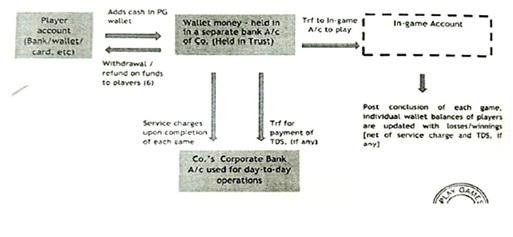
3.2. The assessee further submitted that, the players play on online platform among themselves by depositing required sum for participating in a game. It was submitted that the assessee do not have any right to claim such amount. It was further submitted that the assessee at no point of time engages itself in playing online games alongside its players and that the money added by the players to their wallet accounts is not merged with the corporate funds of the assessee or is used for its day to day operations. It was submitted that since the amount deposited for participating in the game does not form part of revenue of the assessee, such amount towards participation money is not routed through P&L account and the same is recognised as current liability in the balance sheet of the assessee.
3.3. The source of revenue for the assessee is the platform service fee which is calculated as a certain percentage is the range of 5% to 20 % of the money invested by the players to play the games and received by assessee on conclusion of each game. The assessee submitted that, the said service charges which is net of service tax collected is routed through the P&L account being revenue earned by assessee. The assessee submitted that the wallet standing in the name of the winner of each game/tournament amongst the players is credited with the winning post completion of the game and the amount of such winnings is out of the aggregate of the funds invested by such players. The assessee emphasised that the payments made by the assessee towards the winning to a winner of the game are out of the aggregate pool of all the participants in such game and is not an expense in the hands of assesse. Hence these credits to the winners’ wallet are not routed through the P&L account and is also not considered for deduction while computing the taxable income of the assessee.
3.4. The assesse submitted that the taxes withheld by it on the payment made towards winnings by the winner exceeding Rs.10,000/- at the end of each game i.e., when the funds are transferred to the wallet or made available to the player on the table in case of points format after completion of each game. It was submitted that at the conclusion of each game, each players balance is transferred to the wallet or on the table in case of point format after the completion of each game.
3.5. The assessee further submitted that it does not wait for the player to withdraw the money earned through winnings to its bank account to levy taxes and it withhold taxes when the game is concluded, the winner is decided, winnings are transferred to the wallet or table accounts in case of points form and most importantly the net winning must exceed Rs.10,000/- per game.
3.6. The assesse placed reliance on the conditions of Section 194B of the Act as applicable for the year under consideration wherein the taxes were required to be withheld only on the net income after allowing for the entire investment made by way of purchasing tickets i.e., in the instant case, participation amount of a particular game and service charge. It was submitted that the threshold of the amount payable exceeding Rs.10,000/- as provided in the Act for the relevant period for withholding of taxes needs to be determined at each time for each game when the winnings are declared. It was submitted that it is irrespective of losses in other games or different games played over a period of time, whether daily or weekly or in any other time-frame.
3.7. The assesse placed reliance on CBDT Circular No. 240 dated 17/05/1978 which was issued in respect of winnings of horse races regarding deduction of tax u/s 194BB of the Act in order to substantiate the submission. It also placed reliance on following decision which emphasised the which emphasised that the threshold limit for withholding of taxes is to be applied to each payment at the end of the game:
| • |
|
Royal Calcutta Turf Club v. Dy. CIT/ITO 76 ITD 237 (Calcutta) |
| • |
|
Delhi Race Club (1940) Ltd. v. Dy. CIT [2007] 17 SOT 39 (Delhi) |
3.8. The assesse submitted that language of Section 194B and 194BB are similar in principles outlined in the CBDT Circular No. 240, dated 1978 and the ratio of the decisions mentioned hereinabove support the contention of assessee that, the assessee was not under the obligation to deduct TDS on the payment towards the winning which does not exceed Rs.10,000/- per game as against aggregate winnings earned in multiple games as noted by Ld.AO.
3.9. Ld.CIT(A), after considering the submissions of assessee, observed and held as under:-
“5.5.3. On simple reading of section 194B of the Act, tax will be deducted if winning amount from any lottery/puzzle/card game/other game exceeds ten thousand rupees. However, it is not clarified that whether the winning amount pertains to per game or per day or during the Financial Year. But it is clearly mentioned that deduction of income tax at the applicable rate has to be made while making payment which exceeds ten thousand rupees.
5.5.4 On perusal of business operation of appellant company, it is seen that every user has to create an id on the platform and he/she will be given a virtual wallet on that platform where money can be deposited/withdrawn. To play any game, one has to add some money in this wallet and if he wins, money is deposited in this virtual wallet. However, at this stage the user can only use this money for further playing the game. To use this money for self purpose or any other purpose, the user has to transfer this money in his bank account by withdrawal money from wallet. It is pertinent to mention that the each winning is initially transferred to the wallet then it can be transferred to the bank account of user. Now, the amount is decided by the variants of the game as discussed above in para 5.4 of this order. It can be anything depending on the user choice or type of game. The appellant has submitted that it had deducted TDS towards winnings exceeding Rs. 10,000/- per game. However, the appellant company has not stated that it withhold taxes on payment of winnings exceeding Rs. 10,000/-aggregately. There is vast difference in both the statements. This can be understood with following example:
Let say if a person wins a game, he will get 100 Rs. in his wallet after deducting necessary fee. Now the person wants to play another game and win another Rs. 100 and the winning goes on and his wallet shows 11000 Rs. One day he wants to transfer his wallet money to his bank account. Then, as per the provisions of section 194B of the Act, the appellant is liable to deduct TDS on the same at the time of payment as it fulfills the following condition of section 194B of the Act:
| a. |
|
any income by way of winnings – YES |
| b. |
|
amount exceeding ten thousand rupees-YES |
5.5.5 On the contrary, the appellant company has stated that it had deducted TDS on winnings which are exceeding Rs. 10000 but as shown above, the appellant is liable to deduct TDS while making payment of winnings which is cumulatively exceeds rupees ten thousand.
…………………………………..
……………………………..
5.5.6 As from the above, the AO has clearly mentioned that the appellant did not furnish player wise data to ascertain that how many games were played by a particular player in a financial year and how many times it paid winning amount greater than ten thousand rupees to the player in a financial year. It is not ascertainable from the submission of appellant that how many times a particular game was played by a particular user. During the year, the appellant company has made following payments towards winnings to players:
| Particulars |
Amount (in INR) |
| Payment towards winnings exceeding INR 10,000 per game |
25,18,84,437 |
| Payment towards winnings not exceeding INR 10,000 per game |
27,42,57,62,413 |
| Total |
27,67,76,46,850 |
5.5.7 From the above data, it is clear that there is big difference in amount paid by the appellant to the users whose winnings are greater than Rs.10000 and below Rs. 10000. Further, during the appeal proceedings, the appellant has submitted certain excel files containing details of players whose net winnings below ten thousand and no TDS was deducted upon. These excel files carefully perused and it is found that there are number of players whose aggregate winnings in the relevant financial year are greater than ten thousand. For instance, following details of one user is being reproduced herein under:
| s_dat e |
user id |
first_name |
last_name |
trnmt id |
match id |
gam e_ty Pe |
fee |
winnin gs |
rev |
net_winn ings |
pan |
tds |
| 3112 2016 |
159744 8 |
NAGENDR A NAIDU |
MADENE NI |
9614009 8 |
4550888 86 |
1 |
0 |
963 |
17.8 5 |
963 |
AIUPN05 32E |
0 |
| 04 092016 |
159744 8 |
NAGENDR A NAIDU |
MADENE NI |
7714029 1 |
3696578 74 |
1 |
0 |
2693.6 |
66.6 |
2693.6 |
AIUPN05 32E |
0 |
| 16 022017 |
159744 8 |
NAGENDR A NAIDU |
MADENE NI |
1040668 35 |
4969790 90 |
1 |
0 |
6879.6 |
113. 4 |
6879.6 |
AIUPN05 32E |
0 |
| 17 052016 |
159744 8 |
NAGENDR A NAIDU |
MADENE NI |
6317918 3 |
3126688 99 |
1 |
0 |
3312.4 |
54.6 |
3312.4 |
AIUPN05 32E |
0 |
| 29122016 |
159744 8 |
NAGENDR A NAIDU |
MADENE NI |
9595458 2 |
4541125 48 |
1 |
0 |
810 |
30 |
810 |
AIUPN05 32E |
0 |
| 15 092016 |
159744 8 |
NAGENDR A NAIDU |
MADENE NI |
7879242 9 |
3765457 95 |
1 |
0 |
5605.6 |
92.4 |
5605.6 |
AIUPN05 32E |
0 |
| 23 042016 |
159744 8 |
NAGENDR A NAIDU |
MADENE NI |
6093930 0 |
3035390 08 |
1 |
0 |
180 |
10 |
180 |
AIUPN05 32E |
0 |
| 10 022017 |
159744 8 |
NAGENDR A NAIDU |
MADENE NI |
1030355 87 |
4915261 01 |
1 |
0 |
2584.4 |
51.1 2 |
2584.4 |
AIUPN05 32E |
0 |
From the above table, it is clear that one user named Nagendra Naidu Madeneni having PAN AIUPN0532E won total amount of Rs. 23028.60/-from playing game type one. However, no TDS was deducted upon on such winning.
5.5.8 In the Income Tax Act, 1961 the provisions relating to Tax Deduction at Source (TDS) play a significant role in tax collection as a substantial part of tax revenue is collected through TDS. It may be usefully noticed that the various provisions relating to TDS, placed in Chapter XVII ‘Collection and Recovery of Tax’ of the Act, also contain provisions to ensure that the requirements of various TDS provisions are met and complied with, while also providing for the consequences of default.
5.5.9 The liability to deduct tax at source under the provisions of Chapter XVII is mandatory. All the sections in Chapter XVII-B require a person to deduct the tax at source at the rates specified therein and deposit the amount in the Government account. The requirement in each of the sections is preceded by the word ‘shall’. The provisions are, therefore, mandatory. [P.M.S. Diesels v. CIT
[2015] 374 ITR 562 (P&H)] The term “shall” used in all these sections makes it clear that these are mandatory provisions and applicable to the sum contemplated under the respective sections. These sections do not give any leverage to the assessee to make the payment without making TDS. [CIT v. Crescent Export Syndicate (Cal)].
5.5.11 In the instant case, non deduction of TDS not only defeats the purpose of tax collection but also gives an easy escape to the users whose income may be greater than the taxable limit. In view of the above discussion, it is crystal clear that the appellant has failed to deduct TDS as per the 194B of the Act. TDS under section 194B will still apply if multiple winnings from the same source aggregate to more than Rs. 10,000 in a financial year.
5.5.12 Further, the appellant has submitted that the prize payout / payment towards winnings, except for ones sponsored by the Appellant are not routed through P&L Account and is accordingly, not considered for deduction while computing the taxable income of the Appellant. This contention of the appellant cannot be accepted as it will not make any difference because the appellant is offering only net income in ROI or P&L Account. It is automatically proved that the amount paid to the winners has been claimed as expenditure and no TDS was made on that in compliance of the section 194B of the Act.
5.5.13 Further, the appellant compared its business with the horse racing business and pleaded that no TDS is warranted upon it if winning amount is less than Rs. 10,000/-. This contention is also not acceptable as horse racing events are neither so frequent nor held online. Here in appellant’s case, a winner can play a number of times a particular game in a day.
Secondly, the CIRCULAR NO. 485 DATED 27-5-1987 of CBDT makes the picture crystal clear. The said circular is as under
SECTION 194B OF THE INCOME-TAX ACT, 1961 – DEDUCTION OF TAX AT SOURCE – WINNING FROM LOTTERY OR CROSSWORD PUZZLES – INSTRUCTIONS FOR DEDUCTION OF TAX AT SOURCE FROM WINNINGS FROM LOTTERY OR CROSSWORD PUZZLE OR HORSE RACE DURING FINANCIAL YEAR 1987-88 AT THE RATES SPECIFIED IN PART II OF FIRST SCHEDULE TO FINANCE ACT, 1987 CIRCULAR NO. 485 [F.NO. 275/42/87-IT(B)], DATED 27-5-1987 CLARIFICATION 1
1. I am directed to invite a reference to this Department’s Circular No. 467 [F.No. 275/69/86-IT(B)], dated 21-8-1986 and Circular No. 478 [F. No. 275/106/86-IT(B)], dated 14-1-1987 on the above subject, wherein the rates at which deduction of tax under sections 194B and 194BB to be made during the financial year 1986-87 from winnings from lotteries or crossword puzzles or horse races were communicated.
2. According to the provisions of section 115BB any income of a casual and non-recurring nature of the type of winnings from lotteries, crossword puzzles, races including horse races, etc., will be charged to Income-tax at a flat rate of 40 per cent. According to the provisions of sections 194B and 194BB, every person responsible for paying to any person, whether resident or non-resident, any income by way of winnings from lotteries or crossword puzzles or horse races in any amount exceeding Rs. 5,000 is required to deduct income-tax therefrom at the rates specified in this behalf in the Finance Act of the relevant year. In other words, no tax shall be leviable in respect of winnings from lotteries, crossword puzzles, horse races, etc., where the amount received from such winnings together with any sum received as casual and non-recurring receipt in the aggregate does not exceed Rs. 5,000 in a year. Where such winnings exceed Rs. 5,000, tax is to be deducted at source at the rate of 40 per cent on the gross winnings after treating Rs. 5,000 exempt under the provisions of section 10(3). The term “gross winnings” appearing herein means the payment received by the prize winners after deduction of the amount to be paid to commission agents.
Further, Hon’ble Cochin Tribunal in K.R. Syam kumar v. Income-tax Officer, Wd-4, Ernakulam
[2006] 100 ITD 500 by taking the reference of decision of the Hon’ble Apex court in
K.P. Varghese v.
ITO [1981] 131 ITR 597 and the Hon’ble Finance Minister’s Budget Speech held that-
5. …………….. For examining this aspect, we should ascertain the intention of the Legislature while introducing section 115BB of the Income-tax Act. Section 115BB was introduced into the statute by the Finance Bill, 1986 with effect from 1-4-1987. The relevant section reads as under:
“115BB. Tax on winnings from lotteries, crossword puzzles, races including horse races, card games and other games of any sort or gambling or betting of any form or nature whatsoever.
Where the total income of an assessee includes income by way of winnings from any lottery or crossword puzzle or race including horse race (not being income from the activity of owning and maintaining race horses) or card game and other game of any sort or from gambling or betting of any form or nature whatsoever the income-tax payable shall be the aggregate of—
| (i) |
|
the amount of income tax calculated on income by way of winnings from such lottery or crossword puzzle or race including horse race or card game and other games of any sort or from gambling or betting of any form or nature whatsoever, at the rate of forty per cent; and |
| (ii) |
|
the amount of income tax with which the assessee would have been chargeable had his total income been reduced by the amount of income referred to in clause (i).” |
In interpreting a section of the Act, as held by the Hon’ble Supreme Court in the case of K.P. Varghese v. ITO [1981] 131 ITR 5971, the Finance Minister’s Budget Speech could be relied upon to throw light on the object and purpose of particular provisions introduced in the Finance Bill. In the case of K.P. Varghese (supra), the Apex Court has held as follows:
“The speech made by the mover of the Bill explaining the reason for its introduction can certainly be referred to for the purpose of ascertaining the mischief sought to be remedied by the legislation and the object and purpose for which the legislation is enacted. This is in accord with the recent trend in juristic thought not only in western countries but also in India, that the interpretation of a statute being an exercise in the ascertainment of meaning, everything which is logically relevant should be admissible.”
Thus the intention of the Legislature for introducing this section into the statute can be ascertained from the Budget Speech of the Finance Minister. In the Budget Speech of the Minister of Finance for 1986-87 (on 28-2-1986) at para No. 102, the purpose of introducing this section has been mentioned. The relevant portion of the Budget Speech is reproduced below:
“There is at present tax deduction at source from out of winning derived from races and lotteries. I propose to tax these windfall profits at a flat rate of 40 per cent, of the gross receipts. The exemption from income of a casual and non-recurring nature will simultaneously be raised from Rs. 1,000 to Rs. 5,000. Income from any winnings from crossword puzzles, card games, other games of any sort or from gambling or betting of any form or nature whatsoever, races including horse races (other than income earned by owners of race horses by way of stake money) and winnings from lotteries will not be aggregated with other incomes. That is to say, losses, if any, from other business will not be allowed to be set off against winnings from races or lotteries.” [Emphasis supplied]
From the above Budget Speech the intention of the Legislature can be ascertained. It is crystal clear from the Budget Speech that the tax rate of 40 per cent on items mentioned in section 115BB of the Income-tax Act, is a flat rate on gross receipts.
In view of the above circular and intent of the Legislature, I find no force in the submission of the assessee that the threshold for withholding of taxes needs to be determined at the time of each game when the winnings are declared. Insofar as the binding nature of the departmental circular is concerned the legal position is quite settled.
5.5.15 Here, it is worthy to mention that Finance Act 2023 introduced a new provision to tax income earned from winnings from online gaming. This provision was exclusively introduced to tax such winnings from online gaming under section 194BA of the Income Tax Act, 1961 with effect from 01-04-2023. Also, it amended that the TDS shall be deducted on the net earnings without the threshold limit of Rs. 10,000/-. This further shows the intention of legislature particularly for online gaming companies as per which TDS is to be deducted on winning amount irrespective of threshold limit so that maximum number of eligible persons (whose income may cross the taxable income limit) can be brought in the tax net.
5.5.16 Moreso, India’s parliament recently passed Promotion and Regulation of Online Gaming Bill 2025 which prohibits “harmful” online money gaming services, advertisements and financial transactions related to them. This also shows the intention of legislature for safeguard of citizen’s financial condition. Hence, the intention of government is very clear on this issue. Here, in this case, the appellant has failed to match the legislative intention by not deducting TDS on aggregate income exceeding Rs. 10,000. Hence, in view of the above discussion and facts of the circumstances, it is held that the AO has rightly made of Rs. 817,37,28,723/- and the same is hereby confirmed. Accordingly, Ground No. 1 is dismissed.”
3.10. In respect of the disallowance of expenditure made to Facebook Ireland, the Ld.CIT(A) deleted the disallowance by following the decision of the co-ordinate Bench of this Tribunal in assessee’s own case for A.Y. 15-16 vide order dated 23.03.2022.
Aggrieved by the order of Ld.CIT(A) assessee is in appeal before this Tribunal.
4. The Ld.Sr.Counsel at the outset, submitted that against the impugned order dated 28/08/2025 assessee filed Writ Petition before Hon’ble Bombay High Court in W.P. (L) no. 35188 of 2025, challenging the order passed by Ld.CIT(A) to be ultra vires the provision of section 194B and Section 40(a)(ia) of the Act. It was contended that the said impugned order was passed without any authority of law and in excess of jurisdiction. He submitted that the Hon’ble Bombay High Court after considering the submissions of the petitioners noted that, the assessee had an efficacious alternated remedy by filing an appeal before this Tribunal u/s.253 of the Act, The Hon’ble High Court thus directed the petitioner to file their appeal before this Tribunal within a period of four weeks from 24/11/2025 and also ordered that if the appeal is filed within such period, this Tribunal shall entertain the said appeal on merits without raising any issue on limitation.
4.1. He submitted that accordingly the said appeal was filed before this Tribunal on 02/12/2025. He thus submitted that the said appeal therefore falls within the period granted by the Hon’ble High Court and the delay of 32 days in filing the present appeal before this Tribunal as per the Act may be excluded.
We have considered the submissions of both sides on this aspect. Respectfully following the directions of the Hon’ble High Court since the assessee has filed appeal before the Tribunal within the timeframe granted by Hon’ble High Court the said appeal is treated as admitted and is considered to be decided on merits.
5. The Ld.Sr.Counsel submitted that all the issues contested by the assessee is the present appeal arises out of the disallowance made by Ld.AO which is confirmed by Ld.CIT(A) in respect of applicability of TDS that is alleged to have been deducted on the winning amount irrespective of the threshold limit so that maximum number of eligible persons can be brought in the tax net.
5.1. The Ld.Sr.Counsel submitted that, it is an undisputed fact that, whenever the winnings payable to any player exceeds Rs.10,000/- the assessee complied with the withholding provisions u/s 194B of the Act. He submitted that it is an undisputed fact that the winning amount payable to the players is not routed through the P&L a/c and accordingly is not claimed as an expense. Before going into the details of various legal arguments, and in order to appreciate the legislative intent, the Ld.Sr.Counsel drew our attention to the provisions of Section 194B of the Act as it stood at the relevant time:-
Section – 194B, Income-tax Act, 1961 FA, 2016
Winnings from lottery or crossword puzzle.
194B. The person responsible for paying to any person any income by way of winnings from any lottery or crossword puzzle 1[or card game and other game of any sort] in an amount exceeding 2[ten thousand rupees] shall, at the time of payment thereof, deduct income-tax thereon at the rates in force:
[*]]**
[Provided [*] that in a case where the winnings are wholly in kind or partly in cash and partly in kind but the part in cash is not sufficient to meet the liability of deduction of tax in respect of whole of the winnings, the person responsible for paying shall, before releasing the winnings, ensure that tax has been paid in respect of the winnings.]**
5.1.1. He also drew our attention to the amendment that was subsequently introduced to Section 194B vide Finance Act, 2023 that reads as under:-
Section – 194B, Income-tax Act, 1961 – FA, 2023
[Winnings from lottery or crossword puzzle 93a[, etc.].
194B. The person responsible for paying to any person any income by way of winnings from any lottery or crossword puzzle [or card game and other game of any sort] [or from gambling or betting of any form or nature whatsoever, being the amount or the aggregate of amounts exceeding ten thousand rupees during the financial year] shall, at the time of payment thereof, deduct income-tax thereon at the rates in force :
[*]]**
[Provided [*] that in a case where the winnings are wholly in kind or partly in cash and partly in kind but the part in cash is not sufficient to meet the liability of deduction of tax in respect of whole of the winnings, the person responsible for paying shall, before releasing the winnings, ensure that tax has been paid in respect of the winnings:]**
2a [Provided further that nothing contained in this section shall apply to deduction of income-tax on winnings from any online game on or after the 1st day of April, 2023.
Explanation.—For the purposes of this section, “online game” shall have the meaning assigned to it in clause (iii) of the Explanation to section 115BBJ.]”
5.1.2. He also drew our attention to the amendment brought into the Section 194B vide Finance Act, 2025 that reads as under:-
“Section – 194B, Income-tax Act, 1961 – FA, 2025
[Winnings from lottery or crossword puzzle[, etc.].
194B. The person responsible for paying to any person any income by way of winnings from any lottery or crossword puzzle 20[or card game and other game of any sort] [or from gambling or betting of any form or nature whatsoever, being the amount [in respect of a single transaction] exceeding ten thousand rupees [*]] shall, at the time of payment thereof, deduct income-tax thereon at the rates in force :**
[*]]**
[Provided [*] that in a case where the winnings are wholly in kind or partly in cash and partly in kind but the part in cash is not sufficient to meet the liability of deduction of tax in respect of whole of the winnings, the person responsible for paying shall, before releasing the winnings, ensure that tax has been paid in respect of the winnings:]**
[Provided further that nothing contained in this section shall apply to deduction of income-tax on winnings from any online game on or after the 1st day of April, 2023.
Explanation.—For the purposes of this section, “online game” shall have the meaning assigned to it in clause (iii) of the Explanation to section 115BBJ.]”
5.2. The Ld.Sr.Counsel drawing a distinction between the language of Section 194B vide Finance Act, 2023 as well as the amendment brought in by Finance Act, 2025 submitted that, the language of Section 194B as it stood for the relevant year under consideration, as per Finance Act, 2016 makes it clear that, the threshold limit of Rs.10,000/- under the Section is to be monitored and applied in respect of each individual payment at the time of payment thereof. The Ld.Sr.Counsel thus submitted that provisions of Section 194B of the Act as amended by Finance Act, 2016 mandates that the compliance with the TDS obligation would occur “at the time of payment” of the relevant amount. He submitted that, Section 194B thus attaches an obligation to deduct TDS on each payment only when it crosses the threshold limit of Rs.10,000/-.
In support, he placed reliance on the following:-
| S. No. |
Particulars |
| 1. |
Circular No 240 dated 17-05-1978 issued by the Central Board of Direct Taxes |
| 2. |
Royal Calcutta Club (supra) |
| 3. |
Delhi Race Club (1940) Ltd. (supra) |
5.3. The Ld.Sr.Counsel submitted that, the taxation provisions must be strictly interpreted as per the plain language used by the legislature. He submitted that, on comparison of the amendments subsequently brought in by the legislature to Section 194 is clear enough to understand the intention that whenever the legislature wanted any TDS obligation under the Act to be discharged on an aggregate basis it has specifically legislated to this effect. The Ld.Sr.Counsel in order to support this contention drew our attention to Section 194C and Section 194J of the Act. He submitted that, Section 194C as per Finance Act, 2016, which is applicable to the relevant year under consideration, the TDS obligation was cast on an aggregate amount credited or paid or likely to be credited or paid during the relevant F.Y. upon exceeding the threshold limit and similar is the provision for Section 194J.
5.4. In respect of the disallowance made u/s 40(a)(ia) of the Act for not withholding the taxes u/s.194B, the Ld.Sr.Counsel submitted that the said section would be applicable only if assesse has claimed such expenditure in the P&L A/c. He submitted that in the present facts of the case that the winning amount paid to the players is never claimed as an expenditure and the same is not routed through the P&L A/c. The Ld.Sr.Counsel, relied on the following in support of his contentions:-
| S. No. |
Particulars |
| 1. |
CIT v. Health India TPA Services (P.) Ltd. (Bombay) |
| 2. |
CIT v. Dedicated Healthcare Services (TPA) India (P.) Ltd. 408 ITR 36 (Bombay) |
| 3. |
Pr. CIT v. Bharti Land Ltd. (Delhi)/[ITA 161/2025] |
| 4. |
Interactive Avenues (P.) Ltd. v. Dy. CIT 187 ITD 463 (Mumbai – Trib.) |
| 5. |
Sharma Kajaria & Co. v. Dy. CIT 50 SOT 282 (Kolkata) |
| 6. |
ITO v. Saat Rasta Properties (P.) Ltd. [IT Appeal No. 2464 (MUM) of 2024, dated 23-10-2024] |
5.5. On the contrary, the Ld.DR submitted that, the observations of Ld.CIT(A) in para 5.5.2 makes it clear that the money is kept in the wallet which is created by the assessee and as and when the winner demands the money is released. Referring to the chart under para 5.5.7, the Ld.DR submitted that, everything is under assessee’s control and therefore, assessee at all times has exceeded the threshold limit of Rs.10,000/- u/s194B of the Act. He thus submitted that the disallowance made u/s 40(a)(ia) of the Act for non deduction of TDS by assessee is the correct position under law.
5.6. In rebuttal, the Ld.Sr.Counsel submitted that the table considered by Ld.CIT(A) in para 5.5.7, only reflects winning amount of various dates over a period of preceding 2-3 FY. He submitted that, the withdrawal from the players account is never under the control of assessee as it is specific to each player and can be accessed only by the respective players. Further in respect of applicability of Section 40(a)(ia) of the Act it is not admitted position by the authorities below that assessee has not claimed the payouts to the players as expenditure in the P&L Account and thus referring to the decisions relied b him in the preceding paras, he submitted that provisions of Section 40(a)(ia) is not applicable.
We have perused the submissions advanced by both sides in light of the records placed before us.
6. We have heard the rival submissions, perused the orders of the authorities below and carefully examined the material placed before us. The controversy before us lies in a narrow compass, namely, whether for the assessment year under consideration, the assessee was under an obligation to deduct tax at source under section 194B by aggregating the winnings credited to a player’s account or whether the threshold prescribed under the said section was required to be examined with reference to each individual payment made to the winner.
6.1. At the outset, we note that there is no dispute on facts that wherever the winnings payable to a player in a single payment exceeded the prescribed threshold of Rs. 10,000, the assessee had duly deducted tax at source under section 194B of the Act. The dispute has arisen only in respect of those cases where individual payments did not exceed Rs. 10,000, but the aggregate winnings accumulated in the player’s wallet exceeded the prescribed monetary limit.
6.2. We find considerable force in the submissions advanced by the Ld.Sr.Counsel that the provisions of section 194B, as applicable to the year under consideration under the Finance Act, 2016, required tax to be deducted only where the person responsible for paying any income by way of winnings paid “an amount exceeding ten thousand rupees” and such deduction was to be made “at the time of payment thereof “. The provision, as it then stood, neither employed the expression “aggregate amount” nor contained any deeming fiction requiring multiple payments made during the financial year to be clubbed together for determining the applicability of the threshold.
6.3. We also find merit in the submission that the legislative amendments subsequently introduced clearly demonstrate the evolution of the statutory scheme. By the Finance Act, 2023, the legislature consciously inserted the words “the amount or the aggregate of amounts exceeding ten thousand rupees during the financial year” while dealing with winnings from gambling or betting. Thereafter, by the Finance Act, 2025, the legislature again substituted the said expression by providing that the threshold would apply “in respect of a single transaction.” These successive amendments are significant. They clearly indicate that whenever Parliament intended the threshold to operate on an aggregate basis, it expressly enacted so, and when it intended otherwise, it specifically reverted to the concept of a single transaction. Such legislative changes reinforce the principle that the language applicable during the relevant assessment year cannot be expanded by importing concepts which were consciously introduced only by subsequent amendments.
6.4. It is a settled principle of interpretation that taxing statutes, particularly provisions creating withholding obligations, are required to be construed strictly and no words can be added or substituted by implication. We also find substance in the argument of the assessee that wherever the legislature intended aggregation for the purposes of TDS, it has expressly incorporated such language in the statute itself. Sections 194C and 194J, as they existed during the relevant assessment year, specifically referred to the aggregate amount credited or paid or likely to be credited or paid during the financial year. The conspicuous absence of any such expression in section 194B cannot be treated as accidental nor can the Tribunal rewrite the provision by reading into it an aggregation mechanism which the legislature consciously omitted.
6.5. The interpretation canvassed by the assessee also finds support from CBDT Circular No.240 dated 17.05.1978, as well as the decisions in Royal Calcutta Turf Club (supra) and Delhi Race Club (1940)Ltd. (supra), wherein the provisions of section 194B have been understood with reference to each payment of winnings and not on the basis of cumulative winnings over a period. The Revenue has not brought to our notice any binding judicial precedent taking a contrary view in the context of the unamended provisions applicable to the year under consideration.
6.6. Coming to the reasoning adopted by the Ld. CIT(A), we are unable to persuade ourselves to concur with the conclusion that since the winnings remained in the electronic wallet maintained on the assessee’s platform, the threshold under section 194B stood exceeded at all times. The chart referred to by the Ld.CIT(A) merely reflects the accumulation of winnings over different dates spread across multiple transactions. Such accumulation by itself cannot substitute the statutory requirement contained in section 194B as it stood during the relevant assessment year. The assessee has consistently maintained that the wallet merely provided a technological platform for holding the balance and that withdrawals could be initiated only by the concerned player. The Revenue has not brought any material to demonstrate that the assessee had unilateral dominion over the funds so as to treat the accumulated wallet balance as a single payment for the purposes of section 194B. In our considered opinion, the existence of a wallet mechanism cannot enlarge the scope of the charging provision beyond what is expressly provided by the statute.
6.7. Even otherwise, we find merit in the alternative contention advanced by the assessee regarding the applicability of section 40(a)(ia). The undisputed factual position emerging from the record is that the winnings paid to the players were not debited to the Profit and Loss Account and were never claimed as deductible expenditure while computing the business income of the assessee. Section 40(a)(ia) merely provides for disallowance of expenditure otherwise allowable under sections 30 to 38 of the Act in cases where tax deductible at source has not been deducted or, after deduction, has not been paid. Where no deduction of the impugned amount has at all been claimed in computing the income, the machinery provision contained in section 40(a)(ia) cannot be invoked. This legal position is duly supported by the decisions of the Hon’ble Bombay High Court in Health India TPA Services (P.) Ltd. (supra), Dedicated Healthcare Services (TPA) India Pvt. Ltd. (supra), as well as the other judicial precedents relied upon by the assessee. The Revenue has not disputed the factual assertion that the impugned payouts were not routed through the Profit and Loss Account.
6.8. In light of the foregoing discussion, we hold that for the assessment year under consideration, section 194B, as it then stood, required the threshold of Rs. 10,000 to be examined with reference to each individual payment made to the winner at the time of payment and not on the basis of aggregate winnings accumulated in the player’s wallet. Consequently, the foundation on which the Assessing Officer proceeded to invoke section 40(a)(ia) fails. Furthermore, since the impugned payouts were admittedly not claimed as expenditure by the assessee, the provisions of section 40(a)(ia) were, in any event, not attracted.
6.9. We, therefore, hold that the disallowance made by the Assessing Officer and sustained by the Ld.CIT(A) is unsustainable in law. The same is directed to be deleted. Accordingly, the grounds raised by the assessee stand allowed.
Accordingly, the Ground Nos.2-3 raised by the assessee stands allowed.
6.10. Ground No.4, raised by the assessee is challenging the assessment order to be non-est and that it is liable to be quashed. As we have decided the issue on merits in favour of the assessee this issue is left open to be contested in appropriate circumstance. accordingly, Ground no. 4 raised by the assessee is dismissed as infructuous.
Coming to the Revenue’s appeal, the only issue raised is against the relief granted by the Ld.CIT(A) in respect of the disallowance made on payment to Facebook Ireland.
7. At the time of hearing, both sides submitted that the issue is covered against the Revenue by the order of the Co-ordinate Bench of the Tribunal in assessee’s own case for A.Y. 2016-17 in Dy. CIT v. Play Games 24×7 (P.) Ltd. [IT Appeal No. 7075 (Mum) of 2025, dated 10.4.2026], wherein an identical issue had arisen for consideration. It is observed that the Ld.CIT(A) granted relief to the assessee by following the order of the Tribunal in assessee’s own case for A.Y.2015-16. The relevant portion of the said order has been reproduced by the Ld.CIT(A) in para 5.6.1 of the impugned order, which has also been followed by the Co-ordinate Bench in assessee’s own case for A.Y. 2016-17 in para 5 to 5.1 at pages 7 to 10 of the Tribunal’s order, which is reproduced for ready reference:-
“7. We have heard both the parties and perused all the relevant material available on record. The assessee company is engaged in the business of providing a platform for online gaming, more particularly that of Rummy. The assessee company incurred advertisement expenses amounting to Rs.10,46,35,355/- for banner advertisement on the website of Facebook. It is pertinent to note that for the purpose of uploading the banner advertisement on Facebook the advertisement related information is put up at the interface provided by the Facebook, Ireland in the required format. Facebook, Ireland, after due verification of the advertisements, upload the advertisement on its server. While uploading the advertisement on Facebook it is an admitted position that the assessee company does not have any control over the functioning of the interface provided by the Facebook, Ireland. The entire operation and maintenance of the server while providing the advertisement platform is under the control of Facebook, Ireland. It is an admitted fact that the assessee company makes use of standard facility which is provided for displaying advertisement on the website of Facebook, Ireland which was also provided to its other global customers in the like manner. Equipment/installations are all owned by Facebook, Ireland and the assessee company does not have any role to play in either maintaining or involving into any managerial activities with the Facebook, Ireland. There is no dedicated equipment/installation/any portion of equipment/installation is earmarked/provided by the Facebook, Ireland by the assessee company. As per the payment agreement between the Assessee company and Facebook, Ireland, the assessee company does not have any economic or possessory right with regard to the server of the Facebook and the server is not at the disposal of the assessee company. The assessee company does not get any right to modify/deal with the server in any manner. The server through which the advertisement is uploaded is not at all located in India. Further, there is no role played by the Facebook India Online Pvt. Ltd. in assessee’s case and thus there is no element of permanent establishment of Facebook, Ireland in India. The assessee company during the assessment proceedings has provided the tax resident certificate of Facebook, Ireland and as well as copy of remittance of the certificate (form 15CB) to the Assessing Officer. The Assessing Officer has proceeded on the basis that as per the provisions of Section 195 of the Act any amount paid to nonresident will attract this provision and the assessee is liable to make TDS except as provided under Section 195(2) or under Section 197 where such deductee obtain nil deduction certificate from the Assessing Officer and furnish the same to the deductor before receiving the credit of such amount. In the present case, the relevant sub-section 2 to Section 195 has specifically stated that a person responsible for deducting any such sum chargeable under this Act who is a non-resident considers that the whole sum would not be income chargeable in the case of recipient the said person “may make an application” in such form and manner to the Assessing Officer to determine in such a manner as may be a prescribed. The said application though in the present case has not been made by the assessee cannot be treated as a mandate because the Section clearly states that such person “may make an application” as may be prescribed. In the present case, the assessee was very well aware that Facebook, Ireland is a non-resident and the advertisement payment made to Facebook, Ireland will not come under the purview of TDS and, therefore, has chosen not to deduct tax at source. The assessee has relied upon the decision of Uraban Ladder Home Decor Solutions Pvt. Ltd. – ITA No.615 to 620/Bang/2020 – order dated 17.08.2021, Google India Pvt. Ltd. – Karnataka High Court, M/s. Inception Business Services – ITA No.2674/Chny/2016 – order dated 18.02.2019, Carat Lane Trading (P) Ltd.,
as well as decision in the case of
ITO v.
Right Florist Pvt. Ltd. , 25 ITR (T) 639 (Kolkata Tribunal). All these decisions are though factually identical yet the observations made in these decisions are applicable in the present case. These decisions also highlight that advertisement expenses in respect of non-resident. It is pertinent to note that the assessee has given specific task of advertisement banner to the Facebook Ireland. The element of fees for technical services is determined if there is any technical aspect involved by providing services by the company from whom the services are rendered. As per letter dated 19.01.2015, Facebook Ireland stated that no servers that host the Facebook.com product are located in India. In the present case, the assessee has demonstrated before us that the assessee is taking the privilege of platform of Facebook, Ireland which is not either in the nature of royalty or technical services. The payment terms were specifically defined in the payment agreement with Facebook Ireland which clearly indicates that the Facebook Ireland will provide platform banner for advertisement to the assessee-company. Thus there is no element of fees for technical services or royalty is involved in this case. Thus, the Assessing Officer as well as the CIT(A) has totally ignored the actual fact of the present case without demonstrating that the services are coming under the purview of FTS or royalty. Therefore, the appeal filed by the assessee is allowed.”
7.1. Respectfully, following the aforesaid decision of the Coordinate Bench, we do not find any merit in the grounds raised by the Revenue.
Accordingly, the grounds raised by the Revenue stand dismissed.
In the result, the appeal filed by the assessee is allowed and the appeal filed by the Revenue is dismissed.



