ORDER
Amit Shukla, Judicial Member.- These bunch of appeals filed by the Revenue and the Cross Objections preferred by the assessee arise out of the consolidated appellate order passed by the learned Commissioner of Income Tax (Appeals), Central, Mumbai, pertaining to Assessment Years 2015-16 to 2023-24. Since the search action, the assessment proceedings, the material relied upon by the Assessing Officer, the statements recorded during the course of search, the seized documents, the digital evidences, the findings recorded in the assessment orders and the issues arising for our adjudication are substantially common and interconnected, all these appeals and Cross Objections were heard together and are being disposed of by way of this consolidated order. For the sake of convenience and because Assessment Year 2016-17 substantially encompasses the issues recurring in the remaining years, the facts are being discussed with reference to Assessment Year 2016-17 as the lead year and our findings shall apply mutatis mutandis to the remaining assessment years except to the extent of variation in figures or issues peculiar to any particular year.
2. The present litigation emanates from a search and seizure action conducted in the case of the assessee company and connected persons on 23.12.2023. Consequent to the search, assessments came to be framed for various years wherein the Assessing Officer made several additions principally on account of alleged non genuine consultancy expenditure, alleged profit embedded in unaccounted cash sales, unexplained expenditure under section 69C towards cash salary payments, unexplained expenditure in relation to land transactions, alleged liaisoning expenditure and unexplained money under section 69A. The learned CIT(A), after an elaborate examination of the statements recorded during search proceedings, seized material, digital evidences, projectwise records, books of account and the voluminous submissions of the assessee, granted substantial relief. Aggrieved by such relief, the Revenue is in appeal before us, whereas the assessee has preferred Cross Objections challenging certain legal and jurisdictional aspects of the assessments.
3. Since the additions made by the Assessing Officer and the relief granted by the learned CIT(A) span across nine assessment years and involve multiple issues recurring in different years, a consolidated summary of the issues involved in the Revenue’s appeals together with the corresponding amounts under dispute is reproduced hereunder for the sake of ready reference:
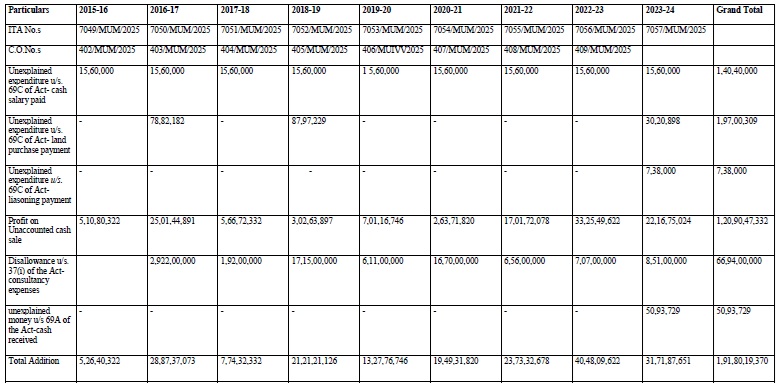
3.1. From the aforesaid chart, it would be seen that the principal controversies arising in these appeals relate to disallowance of consultancy charges under section 37(1), alleged profit from unaccounted cash sales, unexplained expenditure under section 69C on account of cash salary payments, unexplained expenditure in relation to land transactions, alleged liaisoning expenditure and unexplained money under section 69A. Since the factual foundation and evidences relating to each issue are distinct, we propose to deal with them issue-wise. We shall first take up the issue relating to disallowance of consultancy charges under section 37(1) of the Act, which arises in Assessment Years 2016-17 to 2023-24 and constitutes one of the principal grounds raised by the Revenue.
4. The controversy relating to consultancy expenditure forms an important limb of the larger case sought to be built up by the Assessing Officer in the aftermath of the search proceedings. The case of the Assessing Officer is not merely that certain expenditure claimed by the assessee lacked supporting evidence, but that the consultancy expenditure debited in the books of account was, in reality, a vehicle for routing alleged liaisoning and facilitation payments incurred in connection with Government and Public Sector contracts executed by the assessee under its EPC division. The assessment order proceeds on the premise that while the expenditure stood recorded in the books under the nomenclature of consultancy charges, the real nature of such payments was altogether different and that the consultants were allegedly used as intermediaries through whom funds were routed and subsequently utilised for liaisoning purposes. It is this allegation which ultimately led the Assessing Officer to disallow the entire consultancy expenditure claimed by the assessee in the various assessment years under consideration.
5. In order to appreciate the controversy, it would be relevant to briefly notice the basis on which the Assessing Officer proceeded to make the impugned disallowance. During the course of search proceedings, statements under section 132(4) of the Act were recorded from various persons associated with the assessee company, including Shri Anil Kumar, President of the EPC Division, Shri Ajay Jaisinghani and Shri Inder T. Jaisinghani. Certain WhatsApp communications were also extracted from digital devices and a few loose papers were found during search. The Assessing Officer sought to read all these materials together and inferred that consultancy expenditure incurred by the assessee represented embedded liaisoning expenditure. According to him, payments ostensibly made to consultants were not genuine consultancy fees but represented expenditure incurred for obtaining and executing Government contracts.
6. The Assessing Officer particularly referred to the consultancy charges claimed by the assessee in connection with various EPC projects undertaken across the country and observed that over the relevant years such expenditure aggregated to approximately Rs.77.62 crores. Proceeding on the assumption that liaisoning expenditure was embedded within such consultancy payments, he concluded that the expenditure did not satisfy the requirements of section 37(1). What is significant, however, is that although the assessment order repeatedly alleges that a component of liaisoning expenditure formed part of the consultancy payments, there is no exercise undertaken by the Assessing Officer to identify the precise amount allegedly representing such liaisoning expenditure, nor is there any project-wise, vendor-wise or year-wise determination of the alleged non genuine component. Nevertheless, the entire consultancy expenditure came to be disallowed.
7. The Assessing Officer further observed that the consultants engaged by the assessee allegedly acted as conduits through whom payments were routed and that cash was subsequently withdrawn and utilised for liaisoning purposes. However, the assessment order does not identify any particular consultant who admitted to such an arrangement. Nor does it bring on record any evidence demonstrating actual withdrawal of cash and its onward utilisation for the alleged purposes. No trail of money has been identified. No recipient of such alleged cash payments has been identified. No evidence showing return of money to the assessee or payment to any Government official or intermediary has been brought on record. The conclusion, therefore, rests essentially upon inferences sought to be drawn from the statements recorded during search proceedings and certain digital communications.
8. It is in the aforesaid background that the Assessing Officer proceeded to rely heavily upon the statements of Shri Anil Kumar, Shri Ajay Jaisinghani and Shri Inder T. Jaisinghani, certain WhatsApp communications and loose papers seized during search proceedings. Since the entire edifice of the disallowance rests upon these materials, it would be appropriate to examine each of them separately before adverting to the submissions of the assessee and the findings recorded by the learned CIT(A).
9. The principal statement relied upon by the Assessing Officer is that of Shri Anil Kumar, who at the relevant point of time was associated with the EPC division of the assessee company. The Assessing Officer has relied upon certain answers recorded during the course of search proceedings to infer that liaisoning expenditure was embedded in the consultancy charges paid by the assessee to various consultants. According to the Assessing Officer, Shri Anil Kumar had stated that, on an average, approximately 1.5 percent of the project value represented liaisoning expenditure and that such expenditure was built into the consultancy charges paid by the assessee. The Assessing Officer further inferred from certain answers that supporting details of consultancy charges were not readily available and, therefore, the expenditure itself lacked genuineness. Proceeding on this premise, the statement of Shri Anil Kumar became the starting point for the entire disallowance.
10. The assessee, however, explained before the learned CIT(A) as well as before us that the statement of Shri Anil Kumar had been read wholly out of context. It was pointed out that in answer to the relevant questions, Shri Anil Kumar had never stated that consultancy expenditure incurred by the assessee was non genuine or fictitious. On the contrary, the tenor of the statement itself showed that consultants were engaged in relation to Government projects and provided assistance in tendering, qualification, documentation and execution related activities. It was further submitted that in one part of the statement, Shri Anil Kumar had specifically acknowledged the existence of contracts with consultants and merely stated that the supporting records were not immediately available with him and could be obtained from the finance department. According to the assessee, this limited statement was misconstrued by the Assessing Officer as an admission that no supporting documents existed. The assessee further brought on record a detailed retraction affidavit filed by Shri Anil Kumar explaining the circumstances in which the statement was recorded and clarifying that consultancy payments represented genuine business expenditure supported by documentary evidence.
11. A very significant aspect which emerges from the record is that notwithstanding the central reliance placed upon the statement of Shri Anil Kumar, the Assessing Officer did not bring on record any corroborative material supporting the inference drawn by him. The learned CIT(A) has recorded a categorical finding that the statement was not based upon any incriminating material found during the course of search. It has also been noted that all digital devices and data available with Shri Anil Kumar were seized and examined by the Department during the search proceedings, yet no material was found demonstrating that consultancy payments represented fictitious expenditure or that cash payments were made in lieu thereof. Equally important is the fact that after the retraction affidavit was filed, no attempt was made by the Assessing Officer to independently verify the correctness or otherwise of the retraction. The retraction was simply rejected without any further enquiry.
12. The learned CIT(A) has further observed, and rightly so, that even assuming for the sake of argument that a part of the consultancy expenditure contained an element of liaisoning expenditure, the Assessing Officer was still required to determine the amount of such alleged expenditure. Strangely, while relying upon a statement that allegedly referred to a component of 1.5 percent embedded expenditure, the Assessing Officer made no attempt whatsoever to identify such component and instead proceeded to disallow the entire consultancy expenditure. This fundamental infirmity goes to the root of the addition because an allegation that a part of an expenditure is non genuine cannot automatically justify disallowance of the whole expenditure, particularly when the expenditure is otherwise supported by agreements, invoices, banking transactions and deduction of tax at source.
13. The Assessing Officer thereafter sought support from the statement of Shri Ajay Jaisinghani and certain WhatsApp communications recovered during the course of search proceedings. According to the Assessing Officer, these communications revealed that cash payments were being made to agents for liaisoning activities and that consultancy expenditure represented the medium through which such payments were routed. The statement of Shri Ajay Jaisinghani was thus relied upon as corroborative evidence supporting the inference drawn from the statement of Shri Anil Kumar.
14. The assessee, however, pointed out that Shri Ajay Jaisinghani had subsequently filed a retraction affidavit and had categorically clarified that the inferences sought to be drawn by the Assessing Officer were factually incorrect. It was further pointed out that Shri Ajay Jaisinghani himself had stated during the course of his examination that he was no longer associated with the EPC projects of the company and that such projects were being handled by his brother Shri Inder Jaisinghani. The assessee also demonstrated that many of the WhatsApp communications relied upon by the Assessing Officer were merely forwarded messages and did not contain any concurrence, acknowledgement or confirmation by Shri Ajay Jaisinghani. Neither Shri Anil Kumar nor Shri Inder Jaisinghani was confronted with these chats for confirmation. No independent verification was carried out. The assessee therefore contended that such communications lacked evidentiary value and could not be treated as proof of actual cash payments.
15. The learned CIT(A) examined the WhatsApp communications in detail and found considerable merit in the submissions of the assessee. One of the chats relied upon by the Assessing Officer pertained to the Bahraich project in Uttar Pradesh. The assessee demonstrated that consultancy expenditure relating to the said project had been incurred in Financial Years 2015-16 and 2016-17, whereas the WhatsApp communication relied upon by the Assessing Officer was of February 2023. Thus, there existed a complete disconnect between the period of consultancy expenditure and the communication relied upon by the Department. The learned CIT(A) therefore found that the WhatsApp communication had no nexus whatsoever with the consultancy expenditure disallowed by the Assessing Officer. Likewise, another communication relating to the GETCO project in Gujarat was examined. The assessee demonstrated that no consultancy expenditure relating to that project formed part of the disallowance under consideration. Thus, even if the communication was assumed to be genuine, it had no connection with the expenditure which had been disallowed.
16. On a careful examination of the record, the learned CIT(A) ultimately concluded that the WhatsApp communications relied upon by the Assessing Officer had no nexus with the consultancy charges under dispute. The communications neither referred to actual payment of cash nor established that any consultancy expenditure claimed by the assessee was non genuine. They merely constituted isolated messages devoid of supporting material. More importantly, no corroborative evidence was found during search proceedings to support the interpretation sought to be placed upon them by the Assessing Officer.
17. The third limb of the Assessing Officer’s case is founded upon the statement of Shri Inder T. Jaisinghani and certain loose papers seized during search proceedings, particularly pages 111 and 112 of Annexure A-2. According to the Assessing Officer, these papers reflected details of liaisoning expenditure and therefore corroborated the allegation that consultancy expenditure booked in the accounts represented non genuine payments. The statement of Shri Inder Jaisinghani was also relied upon in support of this inference.
18. The assessee, however, furnished a detailed explanation regarding the contents of these papers. Insofar as page 111 was concerned, it was explained that the paper merely contained estimated workings prepared in connection with a prospective project and represented tentative figures used for internal discussions. Significantly, the very document described consultancy at a percentage of the estimated project value, indicating that it was merely a projected working and not a record of actual expenditure. In respect of page 112, the assessee demonstrated that the figures appearing therein did not tally with the actual consultancy expenditure incurred in relation to the projects referred to therein. The assessee furnished project-wise details to show that the actual consultancy expenditure recorded in the books was substantially different from the figures appearing in the loose paper. It was therefore contended that the paper represented rough estimates or discussion notes and not actual transactions.
19. The learned CIT(A) accepted the aforesaid explanation after examining the details furnished by the assessee. He recorded a categorical finding that the figures appearing in the loose papers did not correspond with the actual consultancy expenditure claimed by the assessee. He further observed that except these loose papers, no other material had been found either from the premises of the assessee company or from the premises of its promoters demonstrating that cash payments were made for liaisoning activities. The statement of Shri Inder Jaisinghani also stood contradicted by the actual project-wise consultancy expenditure furnished by the assessee. Thus, the loose papers and the statement based thereon were found to be unsupported by any independent evidence.
20. Having dealt with the material relied upon by the Assessing Officer, it would now be appropriate to notice the broader factual explanation furnished by the assessee in support of its claim of consultancy expenditure. The assessee submitted that it undertakes large Engineering, Procurement and Construction projects spread across various States of India, predominantly for Government departments, public sector undertakings and institutions owned or controlled by Central and State Governments. Such projects involve an elaborate and time-consuming tendering process requiring extensive documentation, technical qualification, regulatory compliance, feasibility evaluation, co-ordination with multiple authorities and post award execution support. According to the assessee, engagement of consultants possessing local knowledge and specialised expertise is not merely a matter of convenience but a commercial necessity inherent in the nature of the business itself.
21. The assessee further explained that consultants are engaged for identifying tenders, preparation and submission of bids, understanding technical specifications, conducting feasibility studies, obtaining permissions and approvals, interacting with various stakeholders, assisting in documentation and ensuring smooth execution and completion of projects. Given the diversity of regulations and procedures applicable across different States, such services are indispensable for successful execution of large EPC contracts. The assessee therefore contended that consultancy expenditure constituted a legitimate and integral business expenditure incurred wholly and exclusively for the purposes of business.
22. In support of the expenditure, the assessee furnished extensive documentary evidence including agreements entered into with consultants, invoices raised by them, ledger accounts, project-wise details, GST compliant invoices and proof of payments made through banking channels. It was also demonstrated that tax had been deducted at source on the payments wherever applicable. Significantly, the Assessing Officer did not point out any discrepancy in these documents. He did not hold that the agreements were fabricated. He did not dispute the invoices. He did not dispute the banking transactions. He did not dispute deduction of tax at source. Nor did he record any finding that the recipients had denied rendering services.
23. Another important aspect highlighted by the assessee was the complete absence of any independent enquiry by the Assessing Officer. Despite making serious allegations regarding non genuineness of expenditure, no consultant was summoned. No statement of any consultant was recorded. No enquiry was conducted regarding the services rendered. No verification was carried out to ascertain whether the payments had been offered to tax by the recipients. No exercise was undertaken to establish that funds paid through banking channels had returned to the assessee in cash. According to the assessee, the entire disallowance rested solely upon statements recorded during search proceedings and not upon any independent investigation.
24. The assessee also emphasised that despite an extensive search operation, involving examination of digital devices, books of account, physical records and statements of various persons, no incriminating material was found showing that consultancy payments were fictitious. No cash trail was discovered. No unaccounted asset was found. No evidence showing actual payment of cash for liaisoning activities was unearthed. According to the assessee, the absence of such evidence assumes considerable significance because if consultancy expenditure of the magnitude alleged by the Assessing Officer was indeed being used as a conduit for cash payments, some corroborative material would inevitably have surfaced during the search proceedings.
25. The learned CIT(A), after examining the entire material on record, proceeded to analyse each component of the Assessing Officer’s case separately. In relation to the statement of Shri Anil Kumar, he found that the statement stood retracted and was unsupported by any incriminating material found during the course of search. He further observed that even according to the statement, only a component of liaisoning expenditure was allegedly embedded within consultancy charges, whereas the Assessing Officer had disallowed the entire consultancy expenditure without identifying or quantifying such component.
26. In relation to the statement of Shri Ajay Jaisinghani and the WhatsApp communications, the learned CIT(A) recorded a categorical finding that the communications relied upon by the Assessing Officer had no nexus with the consultancy expenditure disallowed by him. The Bahraich communication related to a different period altogether and the GETCO communication related to a project which did not form part of the disallowance. He also noted that the communications were merely forwarded messages and lacked any independent confirmation or corroboration.
27. In relation to the statement of Shri Inder Jaisinghani and the loose papers, the learned CIT(A) found that the figures appearing in the papers did not correspond with the actual consultancy expenditure incurred by the assessee. The papers were found to contain estimated figures and discussion notes rather than records of actual transactions. The learned CIT(A) further observed that no material was found during search proceedings supporting the allegation that cash payments had actually been made.
28. The learned CIT(A) also attached considerable importance to the documentary evidence furnished by the assessee. He noted that the consultancy expenditure was supported by agreements, invoices, ledger accounts and banking transactions. Tax had been deducted at source and payments had been made through recognised banking channels. The Assessing Officer had neither disputed the services rendered nor conducted any enquiry from the consultants. Thus, the documentary evidence remained wholly unrebutted.
29. After considering the entire material, the learned CIT(A) concluded that the disallowance could not be sustained merely on the basis of retracted statements and uncorroborated allegations. Since no corroborative evidence had been brought on record, the services rendered by the consultants were not disputed, the payments were supported by documentary evidence and no independent enquiry had been conducted, the consultancy expenditure was held to be genuine and the Assessing Officer was directed to delete the disallowance.
29.1. Before us, the learned CIT-DR relied heavily upon the assessment order and submitted that the search proceedings conducted in the case of Polycab India Ltd. had unearthed a modus operandi whereby the assessee claimed liaisoning expenses incurred for facilitating its projects across the country as consultancy charges in its books of account. It was contended that the consultancy payments were found to be non-genuine and this fact stood conclusively established from the statements recorded under section 132(4) of the Act from Shri Anil Kumar as well as the promoters of the company, who had admitted the true nature of such payments during the course of search. The learned DR further submitted that the subsequent retraction affidavits filed by Shri Inder Jaisinghani, Shri Ajay Jaisinghani and Shri Anil Kumar were merely an afterthought and lacked evidentiary value. It was argued that the Assessing Officer had duly examined the contents of the retraction affidavits and rejected the same through detailed communications dated 22.01.2025. In these circumstances, the disallowance of consultancy payments were justified.
30. We have carefully considered the rival submissions, perused the assessment orders, the detailed findings recorded by the learned CIT(A), the statements relied upon by the Assessing Officer, the retraction affidavits filed by the concerned persons, the seized material referred to by the Revenue and the extensive documentary evidences placed on record by the assessee. Having examined the matter in its entirety, we find ourselves in agreement with the ultimate conclusion arrived at by the learned CIT(A). At the outset, it must be borne in mind that the assessee is engaged in execution of large Engineering, Procurement and Construction projects spread across various States of India, predominantly for Government Departments, State instrumentalities and Public Sector Undertakings. Such projects are not confined merely to execution of engineering work but involve a complex chain of activities beginning from identification of tenders, evaluation of technical specifications, preparation and submission of bids, compliance with local regulatory requirements, obtaining approvals and permissions, interaction with multiple authorities, addressing technical and commercial queries and thereafter supervising implementation and execution of the projects. The assessee’s explanation that consultants possessing specialised expertise and local knowledge were engaged for these purposes appears to be entirely consistent with the nature of its business and has not been shown to be commercially improbable or inherently implausible.
31. What is equally important is that the existence of the projects themselves has never been disputed by the Revenue. The revenue generated from such projects has been accepted. The contracts awarded to the assessee have been accepted. The execution of the projects has been accepted. The only dispute raised by the Assessing Officer is with regard to the consultancy expenditure incurred in relation to such projects. Once the business activity itself is accepted and the necessity of obtaining specialised assistance for execution of such projects is neither disputed nor disproved, the burden shifts heavily upon the Revenue to demonstrate by cogent material that the expenditure claimed by the assessee is either fictitious, sham or not incurred for business purposes. In our considered opinion, such burden has not been discharged in the present case.
32. The record reveals that the assessee furnished agreements entered into with consultants, invoices raised by them, ledger accounts, project-wise details, details of services rendered, proof of payment through banking channels and evidence regarding deduction of tax at source. The payments were routed through normal banking channels. Tax was deducted wherever applicable. The consultants were identifiable parties. Significantly, the Assessing Officer has not recorded any finding that the agreements were fabricated, that the invoices were bogus, that the consultants were nonexistent, that the payments had returned to the assessee or that the recipients had denied rendering services. In fact, no discrepancy whatsoever has been pointed out in the documentary evidences furnished by the assessee. Once such primary evidences are placed on record, disallowance of expenditure cannot be sustained merely on the basis of suspicion or inference unless supported by positive material demonstrating falsity of the claim.
33. We further find considerable merit in the contention of the assessee that despite making serious allegations regarding non genuineness of consultancy expenditure, the Assessing Officer did not conduct any independent enquiry from a single consultant. No notice was issued calling upon the consultants to explain the nature of services rendered. No statement of any consultant was recorded. No effort was made to verify whether the consultancy receipts were reflected in their books of account or offered to tax. No enquiry was conducted regarding utilisation of funds received by them. Most importantly, no evidence was brought on record demonstrating that the payments made through banking channels had travelled back to the assessee or had been withdrawn and utilised for any alleged liaisoning activity. The complete absence of such enquiry assumes great significance because the entire disallowance has been made on allegations of non genuineness. Such allegations, howsoever serious, cannot substitute investigation and proof.
34. We also find that the Assessing Officer has placed overwhelming reliance upon the statements of Shri Anil Kumar, Shri Ajay Jaisinghani and Shri Inder T. Jaisinghani. However, all the three statements stand retracted. More importantly, the learned CIT(A) has recorded a categorical finding that these statements are not supported by any incriminating material found during the course of search. We find no reason to differ from this finding. It is a settled principle that while a statement recorded under section 132(4) constitutes a relevant piece of evidence, where such statement is subsequently retracted, the Revenue must establish its correctness through independent corroboration. In the present case, despite extensive search proceedings, seizure of digital devices, examination of records and scrutiny of transactions, no corroborative evidence has been brought on record demonstrating that consultancy expenditure represented fictitious expenditure or cash payments.
35. The assessee has repeatedly emphasised that all digital devices and records available with the concerned employees were seized and examined during search proceedings. Yet, no evidence of cash movement, no parallel accounts, no record of cash disbursement, no unexplained assets and no material evidencing return of funds from consultants to the assessee was discovered. This aspect assumes considerable importance because the case sought to be made out by the Assessing Officer is not of a minor procedural lapse but of a systematic arrangement involving crores of rupees. Had such an arrangement actually existed, one would reasonably expect some corroborative evidence to emerge from the extensive search proceedings. The complete absence of such material substantially weakens the foundation of the addition.
36. The reliance placed by the Assessing Officer on WhatsApp communications also does not carry the matter any further. The learned CIT(A), after examining the contents of the chats and their context, has recorded a factual finding that the communications relied upon by the Assessing Officer had no nexus with the consultancy expenditure disallowed in the assessment years under consideration. The Bahraich communication related to a period entirely different from the period in which consultancy expenditure for that project had been incurred. Similarly, the communication relating to the GETCO project pertained to a project which did not form part of the consultancy expenditure disallowed by the Assessing Officer. These findings have not been controverted by the Revenue through any material placed before us. In such circumstances, isolated WhatsApp messages, devoid of context, unsupported by corroborative evidence and lacking nexus with the expenditure under consideration, cannot be elevated to the status of substantive evidence capable of displacing regular books of account and documentary records maintained by the assessee.
37. Likewise, the loose papers found during the course of search do not advance the Revenue’s case. The learned CIT(A) has examined the figures appearing in pages 111 and 112 and has recorded a factual finding that the amounts reflected therein do not correspond with the actual consultancy expenditure incurred by the assessee. The assessee has furnished project-wise details demonstrating such mismatch. The Revenue has not been able to controvert this factual position. In the absence of supporting material establishing actual payment pursuant to such notings, the loose papers remain no more than rough workings or tentative estimates and cannot constitute conclusive evidence of actual expenditure.
38. Another aspect which, in our opinion, strikes at the very root of the assessment order is the complete absence of quantification. The entire foundation of the Assessing Officer’s case is that liaisoning expenditure was allegedly embedded within consultancy charges. Even assuming this allegation to be correct, the Assessing Officer was required to identify the amount of such expenditure and demonstrate the basis on which it represented non allowable expenditure. No such exercise has been undertaken. No project-wise analysis has been made. No consultant-wise analysis has been made. No year-wise determination has been made. Without undertaking any such exercise, the Assessing Officer proceeded to disallow the entire consultancy expenditure. Such an approach is fundamentally unsustainable both on facts and in law.
39. On an overall consideration of the material placed before us, we find that the consultancy expenditure claimed by the assessee is supported by substantial documentary evidence; the business necessity for incurring such expenditure stands established; the services allegedly rendered by the consultants have not been disproved; the documentary evidences have not been found to be false; no independent enquiry has been conducted by the Assessing Officer; the statements relied upon by the Revenue stand retracted; the WhatsApp communications lack nexus with the expenditure under dispute; the loose papers do not correspond with actual payments; and no corroborative evidence has been discovered during the course of search proceedings. These circumstances, when viewed cumulatively, leave little room for sustaining the disallowance.
40. We are therefore of the considered view that the learned CIT(A) was fully justified in holding that the disallowance could not be sustained merely on the basis of retracted statements, isolated WhatsApp communications and uncorroborated loose papers. The findings recorded by the learned CIT(A) are based upon a proper appreciation of facts and evidence and do not suffer from any infirmity warranting our interference. Accordingly, the order of the learned CIT(A) deleting the disallowance of consultancy expenditure is upheld and the grounds raised by the Revenue on this issue are dismissed.
41. We shall now take up the next and one of the major issues arising in all the assessment years, namely the addition made by the Assessing Officer on account of alleged profit embedded in unaccounted cash sales stated to have been made by the assessee to the Sunrise Group, also referred to in the assessment order and the submissions as the SP Group. This issue arises in Assessment Years 2015-16 to 2023-24. The addition has been made by the Assessing Officer by bringing to tax the average profit margin of the assessee, computed by him at 14.75 percent, on the alleged unaccounted sales of Polycab products to the SP Group. The year-wise amount of profit so added has already been reflected in the consolidated chart reproduced in the earlier part of this order and, therefore, the issue is being examined on the basis of common facts, with Assessment Year 2016-17 being taken as the lead year.
42. The entire foundation of the addition is the search action conducted in the case of the Sunrise/SP Group of distributors and the material found from their premises and digital devices. The Assessing Officer has extensively referred to the findings recorded in the case of the SP Group and has observed that during search proceedings, parallel books of account maintained in Tally under the names “Ka”, “Km” and “CN” were found. According to the Assessing Officer, these parallel Tally accounts contained details of unaccounted cash transactions, including alleged cash sales of Polycab products. The assessment order records that such parallel books were supported by WhatsApp chats and statements of employees and persons connected with the SP Group, including its accountant and other key persons, who allegedly confirmed that the transactions were recorded outside the regular books under the instructions of the controlling persons of the SP Group. The Assessing Officer further recorded that these transactions were deliberately kept outside the regular books and, therefore, represented unaccounted transactions.
43. The Assessing Officer has also placed reliance on the manner in which the parallel Tally data was allegedly camouflaged. It has been recorded that dates in the Tally data were shifted backwards by about eleven years and values were recorded at one hundredth of the actual figures. According to the Assessing Officer, once decoded, these entries reflected the true magnitude of unaccounted transactions carried out by the SP Group. Reliance was also placed upon the recovery and movement of the laptop and storage devices containing the parallel data, the alleged restricted access to such data through pen drives and passwords, and statements of various persons of the SP Group explaining the existence and ownership of such data. The Assessing Officer thus concluded that the parallel Tally accounts were not random or fictitious entries but represented an organised system maintained by the SP Group for recording unaccounted transactions.
44. The Assessing Officer further analysed the data contained in the parallel Tally accounts and observed that the entries were classified into cash sales, accommodation entries and cash loans. According to him, this structured classification itself showed that the parallel system was being regularly used for recording actual business transactions outside the regular books. The assessment order also refers to certain WhatsApp chats and loose papers allegedly matching with entries in the parallel Tally data. The Assessing Officer observed that the use of coded language, including expressions such as “Ram Ram”, the details of goods dispatched without invoices, adjustment of quantities between accounted and unaccounted transactions and matching of kachcha bills, lorry receipts and loose sheets with Tally entries established a complete trail of unaccounted transactions carried out by the SP Group.
45. After analysing the material found in the case of the SP Group, the Assessing Officer proceeded to connect the said data with the assessee company. In this regard, reliance was placed upon the statements of Shri Vijay Pahuja and Shri Mohanlal Pahuja, promoters/persons connected with the SP Group. The Assessing Officer recorded that the coding appearing in the Tally data was explained by them and that ledger accounts appearing in the names of “Shankarbhai”, “Shankarbhai 1”, “Shankarbhai 2” and “CKP” in the Tally data maintained under the company name “Ka” pertained to transactions of Polycab India Limited. The Assessing Officer also referred to certain abbreviations appearing in the Tally data which, according to him, were confirmed by Shri Ajay Jaisinghani, one of the promoters of the assessee company, and Smt. Manjari Modi, an employee of the assessee company, as belonging to or being relatable to them. Based on these statements and explanations, the Assessing Officer alleged that the said ledgers represented unaccounted purchases made by the SP Group from the assessee company.
46. On this basis, the Assessing Officer held that the SP Group had made unaccounted purchases from the assessee aggregating to Rs.980.15 crores over the relevant financial years. According to the Assessing Officer, out of the said amount, cash payments to the extent of Rs.432.27 crores were made to the assessee through one Shri Rashmikant Amin, who was described as a copper agent, and the balance amount of Rs.547.88 crores was allegedly handed over by the SP Group to various persons towards expenses of the assessee company across different financial years from Financial Year 2014-15 to Financial Year 2023-24. On the strength of these allegations, the Assessing Officer concluded that the assessee had made unaccounted cash sales of Rs.980.15 crores to the SP Group over the relevant years.
47. The Assessing Officer, recomputed the average profit margin of the assessee from its audited financial statements and worked out the average profit margin at 14.75 percent. The said margin was applied on the alleged unaccounted cash sales made to the SP Group and the resultant profit was brought to tax in the respective assessment years. Thus, the addition is not founded upon any unaccounted cash or undisclosed asset found from the assessee, but upon the inference that the assessee had effected unaccounted cash sales to the SP Group and had earned profit thereon.
48. Before the learned CIT(A), the assessee strongly contested the addition and submitted that the entire allegation was founded upon third party material found from the premises of the SP Group and statements of persons belonging to that group, which themselves stood retracted and were contradicted by subsequent clarification letters and affidavits. It was submitted that no material was found from the premises of the assessee to show that the assessee had made any unaccounted cash sales to the SP Group. The assessee pointed out that the Tally data found from the SP Group admittedly belonged to and was maintained by the SP Group. The ledgers relied upon by the Assessing Officer were not maintained in the name of the assessee, nor did they contain the name of the assessee or any of its promoters as beneficiary of the alleged cash receipts. The ledgers were in coded names such as “Shankarbhai”, “Shankarbhai 1”, “Shankarbhai 2” and “CKP”, and the entire connection with the assessee was sought to be established only through statements of third parties.
49. The assessee further submitted before the learned CIT(A) that after the search, the SP Group had issued a detailed clarification letter dated 17.04.2024, which was also submitted before the Investigation Wing, categorically denying that the assessee had any connection with the cash payments recorded in the Tally data found from the SP Group. In the said clarification, the SP Group stated that no cash sales were made by the assessee and that the name of the assessee was mentioned in the statements only under pressure and to bring closure to the search proceedings. The clarification further stated that cash payments aggregating to Rs.432.27 crores were made to one Shri Ashok Bagla through Shri Rashmikant Amin and that the balance amount of Rs.547.88 crores represented payments made by the SP Group for purchases from the open market. It was also submitted that Shri Mohan Pahuja and Shri Vijay Pahuja, by way of retraction affidavits, admitted that the unaccounted transactions pertained to their own dealings and that the entire scheme and flow of goods was arranged through Shri Ashok Bagla.
50. The learned CIT(A) examined this aspect in detail and found that the very foundation of the Assessing Officer’s allegation was materially shaken by the clarification letter and the retraction affidavits. The learned CIT(A) noted that the Assessing Officer had relied upon the original statements of the promoters of the SP Group to connect the assessee with the Tally data, but after the SP Group itself clarified that the assessee had no connection with the cash payments and that the transactions pertained to purchases made through Shri Ashok Bagla and from the open market, it was incumbent upon the Assessing Officer to carry out further enquiry. No such enquiry was carried out. The Assessing Officer did not examine Shri Ashok Bagla. He did not bring any material to rebut the clarification. He did not demonstrate that cash actually moved to the assessee. Thus, the learned CIT(A) held that the original statements and their subsequent retractions could not be looked at in isolation, but had to be evaluated along with corroborative evidence, and in the absence of such corroboration the addition could not be sustained.
51. The learned CIT(A) further observed that while the Tally data found from the premises of the SP Group may indicate unaccounted transactions of that group, there was no direct material to establish that such transactions represented unaccounted sales made by the assessee. The ledger accounts in the names of “Shankarbhai”, “Shankarbhai 1”, “Shankarbhai 2” and “CKP” did not bear the name of the assessee or any of its promoters as beneficiary. The Assessing Officer did not bring on record any document found either from the premises of the SP Group or from the premises of the assessee which could show that unaccounted money was paid to or received by the assessee. The learned CIT(A) thus held that merely because certain persons of the SP Group initially stated that the coded ledgers related to the assessee, the same could not be legally applied against the assessee in the absence of independent corroborative evidence, particularly when such statements were subsequently retracted and contradicted by the SP Group itself.
52. The learned CIT(A) also examined the search action conducted in the case of the assessee and recorded important factual findings. He noted that during the search conducted at the premises of the assessee, no documentary evidence was found which could establish cash sales by the assessee to the SP Group or receipt of unaccounted money from the SP Group. No undisclosed asset was found in the hands of the assessee relatable to the alleged cash sales. No discrepancy in stock was found during the search. The learned CIT(A) further observed that if unaccounted sales of such magnitude had actually been made by the assessee, there would ordinarily have been some corresponding discrepancy in stock, production, dispatch records, unaccounted purchases or unaccounted manufacturing activity. However, no such discrepancy was brought on record by the Assessing Officer.
53. The learned CIT(A) also accepted the assessee’s contention that the assessee is regularly subjected to various statutory and regulatory audits, including excise audits and other statutory audits, and no authority had ever found any discrepancy in the manufacturing records, production records, stock records or input-output ratio which could support the allegation of unaccounted production and sale of goods. The Assessing Officer did not bring any evidence to show that the assessee had made unaccounted purchases required for making alleged unaccounted sales. Nor did he bring any evidence of unaccounted manufacturing. No variation in the manufacturing ratio of input and output was pointed out. Thus, the learned CIT(A) concluded that the allegation of unaccounted sales by the assessee was not supported by the physical, manufacturing or statutory record of the assessee.
54. The learned CIT(A) further evaluated the statements recorded from persons connected with the assessee. Insofar as the statement of Shri Ajay Jaisinghani was concerned, the learned CIT(A) observed that the statement relied upon by the Assessing Officer did not indicate any unaccounted cash transaction with the SP Group. The statement merely referred to cash received for personal and household purposes and did not establish that the assessee had made unaccounted sales to the SP Group. The statement had also been subsequently retracted and, in any case, no corroborative material was found during the search conducted at his premises. Similarly, the statement of Smt. Manjari Modi, an employee of the assessee, was examined. The learned CIT(A) noted that she had also retracted her statement and that on going through her answers, it could not be inferred that she had accepted that the assessee was indulging in unaccounted cash sales to the SP Group. The learned CIT(A) also accepted the assessee’s submission that a person cannot be expected to decipher or confirm the contents of third party Tally data which was never maintained by her and which the third party itself later disputed.
55. The learned CIT(A) thereafter dealt specifically with the Assessing Officer’s reliance on the ledger account of “Rashmi Amin” and the alleged cash payments of Rs.432.27 crores and Rs.547.88 crores. In respect of the allegation that Rs.432.27 crores was paid through Shri Rashmikant Amin on behalf of the assessee, the learned CIT(A) examined the ledger account reproduced by the Assessing Officer and found that the ledger nowhere contained the name of the assessee as the beneficiary. It also showed payments to various unrelated parties such as Jayant Electricals, Bhakti Light House, Pappu Kandle and others. The Assessing Officer failed to establish how these payments were related to the assessee. Similarly, in respect of the alleged balance amount of Rs.547.88 crores stated to have been paid by the SP Group to various persons towards expenditure of the assessee company, the learned CIT(A) held that this finding too was based only on the statement of Shri Mohanlal Pahuja and no corroborative evidence had been brought on record. The Tally data itself did not mention that such payments represented expenditure incurred on behalf of the assessee. On the contrary, the Tally accounts indicated cash purchases made by the SP Group from various market parties, which contradicted the Assessing Officer’s allegation that purchases were made from the assessee.
56. The learned CIT(A), after analysing the entire material, held that the conclusion drawn by the Assessing Officer that the assessee had made unaccounted cash sales to the SP Group was not backed by any cogent or corroborative evidence other than statements of the promoters of the SP Group. Since there was no direct nexus between the transactions recorded in the Tally data of the SP Group and the assessee company, and since no material was found from the assessee’s premises showing unaccounted sales, unaccounted production, stock discrepancy, unaccounted money or undisclosed assets, the learned CIT(A) held that the addition of gross profit on alleged unaccounted cash sales was unsustainable and directed the Assessing Officer to delete the same.
57. Before us, the learned CIT-DR relied heavily upon the assessment order and submitted that the Assessing Officer had brought on record extensive material gathered during search proceedings in the case of the SP Group. It was submitted that the parallel Tally data, WhatsApp chats, statements of employees of the SP Group, decoding of encrypted data, chain of custody of the laptop, coded ledgers, loose sheets and corroborating statements of various persons clearly established that the SP Group was maintaining a parallel system of unaccounted transactions. According to the learned CIT-DR, once the promoters and employees of the SP Group had decoded the entries and connected the ledgers with the assessee, the learned CIT(A) was not justified in deleting the addition merely on the ground of subsequent retractions and absence of material from the assessee’s premises. The Revenue also relied upon the comments of the Assessing Officer and the Range Head, wherein it was stated that the incriminating material found during search in the case of the SP Group, when read with statements of key persons, established unaccounted cash sales of Polycab products.
58. Per contra, the learned Counsel for the assessee reiterated that the entire addition is founded upon third party material found from the premises of the SP Group and statements of third parties which stood retracted and were contradicted by subsequent clarification letter and affidavits. It was submitted that there is not a single document found from the premises of the assessee showing that it made unaccounted sales to the SP Group. No stock discrepancy was found. No unaccounted manufacturing was found. No evidence of unaccounted purchases was found. No cash trail was found. No undisclosed asset was found. No material was brought on record to show that cash was received by the assessee. The learned Counsel submitted that the SP Group itself had clarified that the alleged cash payments were made to Shri Ashok Bagla through Shri Rashmikant Amin and that the balance represented purchases from open market. In spite of this clarification, the Assessing Officer did not examine Shri Ashok Bagla or Shri Rashmikant Amin in a manner which could establish any nexus with the assessee. Further, the learned Counsel for the assessee pointed out that the assessment order passed in case of another distributor, copy of which was placed before us, the Assessing officer has relied upon the same ledger „Shankarbhai’ which is recorded in the tally data KA’, alleging that certain transactions recorded in the said ledger belong to the said assesse. Thus, learned counsel of the assesse pointed out that there is an inconsistency and contradiction by the department with regards to the actual beneficiary of the transactions recorded in the ledgers namely „Shankarbhai’ in the tally data. Accordingly, the said ledger cannot be considered to be related and pertaining to the assesse. It was therefore submitted that the learned CIT(A) rightly deleted the addition.
59. We have carefully considered the rival submissions, perused the assessment orders, the voluminous material relied upon by the Assessing Officer, the elaborate findings recorded by the learned CIT(A), the statements of the promoters and employees of the SP Group, the clarification letter dated 17.04.2024, the retraction affidavits, the digital evidence, the parallel Tally data and the statements recorded from the persons connected with the assessee company. At the very outset, we deem it appropriate to observe that for the purpose of examining the controversy before us, we are proceeding on an assumption most favourable to the Revenue, namely that the parallel Tally data recovered from the premises of the SP Group represents genuine unaccounted transactions of that group and that the extensive forensic exercise undertaken by the Investigation Wing regarding retrieval, decoding and interpretation of such data is accepted at its face value. The assessment order contains a detailed discussion regarding the recovery of laptops, pen drives and digital devices, the manner in which the data was allegedly encrypted, the shifting of dates by approximately eleven years, recording of values at one hundredth of their actual figures, restricted access through passwords and the decoding of such entries with the assistance of employees and persons connected with the SP Group. The Assessing Officer has also referred to statements of accountants, employees and key managerial persons of the SP Group who allegedly explained the coding system and confirmed maintenance of parallel books. Even if all these facts are accepted in their entirety, the question which still remains to be answered is whether the material discovered from the premises of the SP Group establishes, through cogent and legally admissible evidence, that the assessee company was the supplier of goods reflected in such records and the recipient of the corresponding cash consideration. In our considered opinion, it is precisely at this stage that the Revenue’s case encounters a serious evidentiary gap. The existence of unaccounted transactions in the hands of the SP Group may be one thing; attribution of those transactions to the assessee company is an entirely different matter. The issue before us is not whether the SP Group maintained parallel books of account but whether the Revenue has successfully established a direct nexus between such records and the assessee company.
60. The principal attempt made by the Assessing Officer to establish such nexus is through the coded ledger accounts appearing in the Tally data under names such as “Shankarbhai”, “Shankarbhai 1”, “Shankarbhai 2” and “CKP”. According to the Revenue, these coded names represented transactions of the assessee company and the explanation furnished by certain persons of the SP Group during search proceedings established that the entries related to Polycab products. However, when one examines the evidentiary foundation of this conclusion, it becomes apparent that none of these ledger accounts are maintained in the name of the assessee company. They do not contain the name of Polycab India Limited. They do not bear the PAN, GST registration number or any corporate identifier of the assessee. The entire linkage is therefore sought to be supplied through statements of third parties and not through any contemporaneous document. Further, we find that ledger account „Shankarbhai’ has been linked to another distributor by the same Assessing Officer. This again weakens the contention of the Assessing officer that the ledger accounts pertains of the assessee. The Assessing Officer has further relied upon kachcha bills, lorry receipts, loose sheets and WhatsApp communications allegedly matching with entries in the parallel Tally data. However, even these materials, at their highest, merely corroborate transactions recorded within the parallel accounting system of the SP Group. None of them demonstrate that the goods were dispatched by the assessee without invoices. None emanate from the records of the assessee. None show removal of goods from the assessee’s factories outside the regular accounting channel. There is no dispatch register, loading record, gate pass, delivery instruction, transport document or internal correspondence from the assessee evidencing clandestine removal of goods. Therefore, even if these materials establish the existence of parallel transactions in the hands of the SP Group, they do not by themselves bridge the evidentiary gap between the SP Group and the assessee company. Suspicion may arise from coded entries, but suspicion, however strong, cannot substitute proof of nexus.
61. A development of considerable significance, which in our view strikes at the root of the Revenue’s case, is the clarification letter dated 17.04.2024 and the retraction affidavits subsequently filed by Shri Mohanlal Pahuja and Shri Vijay Pahuja. The Assessing Officer has heavily relied upon the original statements recorded during search proceedings. However, these very persons subsequently furnished a detailed clarification before the Investigation Wing explaining that the assessee company was not connected with the alleged cash transactions recorded in the parallel books and that the earlier references to the assessee did not correctly represent the factual position. More importantly, the clarification was not vague or evasive. A specific alternative explanation was furnished. It was stated that cash payments aggregating to Rs.432.27 crores were made through Shri Rashmikant Amin to Shri Ashok Bagla and that the balance transactions represented purchases made from open market sources. Once such a specific explanation emerged from the very persons whose statements constituted the foundation of the assessment order, it became incumbent upon the Revenue to investigate the alternative explanation and establish through objective material that the original version alone represented the truth. However, the record does not indicate any meaningful enquiry capable of disproving the explanation furnished by the SP Group. No independent evidence has been brought on record to establish that the alleged cash payments actually reached the assessee company. Shri Ashok Bagla has not been shown to have been investigated in a manner which demolishes the explanation furnished by the SP Group, post such clarification. Thus, what remains on record are two competing versions emanating from the same source, one relied upon by the Revenue and the other ignored by it, without any independent material conclusively establishing which of the two versions represents the correct factual position.
62. The allegation relating to Shri Rashmikant Amin and the alleged cash payments of Rs.432.27 crores also does not withstand closer scrutiny. The Revenue seeks to portray Shri Rashmikant Amin as a conduit through whom cash was routed by the SP Group to the assessee company. However, the ledger account relied upon by the Assessing Officer does not identify the assessee as the beneficiary of the alleged payments. The learned CIT(A) has examined this ledger in detail and has recorded a factual finding that the ledger contains names of several independent parties wholly unconnected with the assessee. The Revenue has not demonstrated through any documentary evidence, cash trail, banking trail, statement or corroborative material that the monies allegedly routed through Shri Rashmikant Amin ultimately reached the assessee company. Likewise, the allegation that a further sum of Rs.547.88 crores was incurred by the SP Group towards expenses of the assessee rests almost entirely on statements recorded during search proceedings and not on any independent documentary evidence. The Tally data itself does not establish that such expenditure was incurred for or on behalf of the assessee. In fact, as noticed by the learned CIT(A), the very records relied upon by the Revenue indicate purchases from various market sources, which is broadly consistent with the subsequent explanation furnished by the SP Group and inconsistent with the Revenue’s allegation that all such transactions represented purchases from the assessee.
63. Another aspect which substantially weakens the Revenue’s case is the complete absence of evidence regarding unaccounted production, unaccounted purchases, stock discrepancies, clandestine removal of goods or irregularities in manufacturing records. The allegation levelled against the assessee is not of an isolated transaction but of unaccounted sales aggregating to approximately Rs.980 crores spread over several years. Such a massive volume of alleged sales necessarily presupposes corresponding production, procurement of raw material, storage, movement and delivery of goods. If such sales had in fact taken place outside the books, one would ordinarily expect discrepancies in stock records, abnormal consumption of raw material, unexplained shortages, variation in production figures, abnormal power consumption, transport evidence, dispatch records or discrepancies in statutory records maintained under indirect tax laws. However, despite extensive search proceedings and detailed scrutiny of the affairs of the assessee, no such discrepancy has been brought on record. Equally significant is the absence of any material demonstrating dispatch of goods by the assessee without invoices. No transport document originating from the assessee, no gate pass, no loading record, no dispatch register, no delivery instruction and no internal correspondence evidencing clandestine removal of goods has been brought on record. In a manufacturing concern of the scale of the assessee, allegations of unaccounted sales of nearly Rs.980 crores cannot ordinarily survive in complete isolation from the manufacturing, stock and dispatch records. The absence of such evidence therefore assumes decisive importance.
64. The search conducted in the case of the assessee itself further reinforces this conclusion. It is not a case where the Revenue seeks to implicate the assessee solely on the basis of material found from a third party. Simultaneous search operations were conducted in the case of the assessee. Digital devices were seized. Books of account and records were examined. Statements were recorded. Yet no parallel books were found from the premises of the assessee. No diary recording cash sales was discovered. No loose sheets reflecting unaccounted transactions were found. No cash corresponding to the alleged sales was detected. No undisclosed asset relatable to such sales was identified. No evidence demonstrating receipt of cash from the SP Group was unearthed. This aspect assumes even greater significance because in search assessments where searches have been conducted in both groups, the complete absence of corresponding incriminating material in the hands of the person sought to be implicated becomes a highly relevant factor while appreciating the evidentiary value of third party records. If unaccounted sales of the magnitude alleged by the Revenue had actually taken place, one would reasonably expect at least some trace of such activity in the assessee’s records, correspondence, digital devices or assets. The complete absence of such material substantially weakens the Revenue’s attempt to attribute the SP Group’s records to the assessee.
65. We are also unable to attach decisive evidentiary value to the statements of Shri Ajay Jaisinghani, Smt. Manjari Modi and various employees of the SP Group in the manner sought to be done by the Assessing Officer. The learned CIT(A) has examined these statements and recorded a finding that none of them contain any categorical admission establishing unaccounted sales by the assessee company to the SP Group. Further, with regards to the statement of Smt. Manjari Modi, it is pointed out by the assesse that she was a senior level employee and was involved in business analytics, sales data analysis and strategy functions and therefore, she was not involved in field level sales activities. Therefore, her statement with regards to alleged unaccounted cash sales is beyond her scope of her employment profile. Even assuming that the statements of employees and accountants of the SP Group establish maintenance of parallel records by the SP Group, they do not establish actual receipt of cash by the assessee or actual delivery of goods by the assessee outside its books. More importantly, the statements relied upon by the Revenue stand diluted by subsequent retractions and clarifications and are not supported by independent evidence in the form of stock discrepancies, transport documents, manufacturing records, dispatch records, cash trail or undisclosed assets. Statements, however relevant, cannot exist in a vacuum. Their evidentiary value depends upon the degree of corroboration available on record. In the present case, such corroboration is conspicuously absent.
66. We are conscious of the settled legal position that third party material can constitute a relevant piece of evidence and may legitimately form the starting point of an investigation. However, before such material can be used against another assessee, a clear and demonstrable nexus must be established between the material and the assessee sought to be implicated. In the present case, the Revenue’s case proceeds from parallel Tally data maintained by the SP Group to coded ledger accounts, from coded ledger accounts to statements of third parties, from such statements to an inference that the assessee was the supplier of goods and from that inference to a profit addition in the hands of the assessee. What is conspicuously missing is the crucial connecting evidence demonstrating that the goods actually emanated from the assessee and that the corresponding consideration actually reached the assessee. Even if the entire Tally data of the SP Group is accepted as genuine, the evidentiary gap between the SP Group and the assessee remains unbridged.
67. It is also pertinent to note that the Assessing Officer himself has not treated the alleged amount of Rs.980.15 crores as undisclosed sales liable to tax in entirety. What has ultimately been brought to tax is only an estimated profit element by applying an average profit rate of 14.75 percent. This itself demonstrates that the addition is founded not upon any direct discovery of undisclosed income in the hands of the assessee but upon an inferential assumption that certain entries in third party records represented unaccounted sales of the assessee. Once the foundational assumption itself remains unproved through independent evidence, the consequential estimation of profit thereon necessarily falls with it. Search assessments involving additions of this magnitude must rest upon cogent evidence and not on a chain of assumptions, however elaborate the investigative exercise may be.
68. On a cumulative consideration of the entire material on record, we find that while the Revenue may have demonstrated existence of unaccounted transactions in the hands of the SP Group, it has failed to establish through cogent and independent evidence that the assessee company was the source of the goods reflected in such transactions or the recipient of the alleged cash consideration. The coded ledgers are not maintained in the name of the assessee. The statements relied upon by the Revenue stand materially diluted by subsequent retractions and clarification letters. The alternative explanation identifying Shri Ashok Bagla and open market purchases has not been disproved. The alleged conduit transactions through Shri Rashmikant Amin remain unsupported by any evidence showing receipt of money by the assessee. No stock discrepancy, production discrepancy, manufacturing irregularity, dispatch evidence, transport evidence, cash trail or undisclosed asset has been found in the hands of the assessee. Thus, the Revenue’s case ultimately proceeds from suspicion generated by third party material to an assumption of nexus with the assessee, but the crucial evidentiary link necessary to convert such suspicion into proof is absent. We therefore find ourselves in complete agreement with the detailed and well reasoned findings recorded by the learned CIT(A). Accordingly, the deletion of the addition made on account of alleged profit from unaccounted cash sales to the SP Group is upheld and the grounds raised by the Revenue on this issue stand dismissed.
69. We shall now take up the next issue relating to the addition made under section 69C of the Act on account of alleged cash salary payments. This issue arises in Assessment Years 2015-16 to 2023-24 and stems from the allegation of the Assessing Officer that the assessee company was paying salary in cash over and above the salary recorded in the regular books of account and disbursed through banking channels. The entire addition originates from the statements recorded during the course of search proceedings from two individuals, namely Smt. Nisha Singh and Shri Ramesh Kundnani. According to the Assessing Officer, Smt. Nisha Singh stated that she was receiving Rs.30,000 per month in cash, whereas Shri Ramesh Kundnani stated that he was receiving Rs.1,00,000 per month in cash in addition to his regular salary. On the basis of these statements, the Assessing Officer computed alleged cash salary payments aggregating to Rs.1,30,000 per month, equivalent to Rs.15,60,000 annually, and treated the same as unexplained expenditure under section 69C. What is significant, however, is that this figure was not confined to any particular period or year but was uniformly extrapolated across all the assessment years from Assessment Year 2015-16 to Assessment Year 2023-24, resulting in recurring additions year after year.
70. The case of the Assessing Officer, therefore, rests almost entirely upon the aforesaid statements. The assessment order proceeds on the premise that once two employees admitted receipt of cash salary, the existence of unexplained expenditure in the hands of the assessee stood established. The Assessing Officer also observed that Smt. Nisha Singh had deposited part of the cash received by her into her bank account and, according to him, this lent support to the correctness of her original statement. The retraction affidavits subsequently filed by both employees were rejected and the Assessing Officer concluded that the statements recorded during search constituted sufficient evidence to invoke section 69C. Beyond these statements, the assessment order does not refer to any independent material showing maintenance of a parallel salary structure, existence of cash salary records, withdrawal of cash for salary purposes or any contemporaneous evidence demonstrating actual payment of salary outside the books.
71. Before the learned CIT(A), the assessee assailed the addition both on facts and in law. It was submitted that the entire addition was founded upon statements recorded during search and not upon any incriminating material discovered from the premises of the assessee. It was pointed out that despite an extensive search operation involving examination of books of account, payroll records, digital devices, employee records and financial data, no parallel salary register was found, no cash salary sheets were discovered, no employeewise cash disbursement record was recovered, no vouchers evidencing payment of cash salary were found, no internal approvals or authorisations were unearthed, no email correspondence was found suggesting payment of salary outside the books and no WhatsApp communication or digital record was discovered indicating existence of a parallel payroll system. The assessee emphasised that salary payments of its employees were made through an automated banking system and duly recorded in the books of account. In such circumstances, the allegation that the company was maintaining an unrecorded cash salary mechanism merely on the basis of statements of two individuals, without any supporting material whatsoever, was wholly unsustainable.
72. Insofar as Smt. Nisha Singh was concerned, a detailed explanation was furnished before the Assessing Officer and reiterated before the learned CIT(A). It was explained that she had subsequently filed a retraction affidavit clarifying that the amount of Rs.30,000 per month referred to in her statement did not represent cash salary received by her from the assessee company. According to her affidavit, the said amount related to the remuneration of her brother, Shri Vishal Singh, who was working on a part-time basis under a personal arrangement with Shri Inder Jaisinghani from 01.07.2023 and the amount was merely routed through her and deposited in her bank account. It was specifically pointed out that the cash deposited in her account, which the Assessing Officer treated as corroboration of his allegation, was entirely consistent with the explanation furnished in the affidavit. The assessee contended that once such a specific explanation had been furnished, the Assessing Officer was duty-bound to verify the same by examining Shri Vishal Singh or Shri Inder Jaisinghani and by bringing some material on record demonstrating that the payment actually originated from the assessee company. No such enquiry, however, was conducted and the explanation was rejected merely on conjecture.
73. In the case of Shri Ramesh Kundnani also, the assessee pointed out that he had filed a detailed retraction affidavit explaining the circumstances in which his statement was recorded. It was submitted that apart from the original statement, no evidence whatsoever existed showing that he received cash salary from the assessee company. No document was found from his premises. No cash salary record was found from the assessee. No voucher, payroll entry or cash disbursement record was brought on record. The assessee therefore submitted that the statement, having been retracted and remaining unsupported by any independent material, could not form the sole basis for an addition under section 69C.
74. The learned CIT(A), after examining the assessment order, the statements, the retraction affidavits and the submissions of the assessee, found considerable force in the assessee’s case. He noted that the entire addition had been made solely on the basis of statements of the two employees and that no corroborative evidence had been found during the course of search proceedings. He further noticed that in the case of Smt. Nisha Singh, a specific explanation had been furnished linking the amount of Rs.30,000 per month to the remuneration of her brother Vishal Singh under a personal arrangement with Shri Inder Jaisinghani and that the Assessing Officer had not brought any material on record to disprove such explanation. The learned CIT(A) also found that no enquiry had been conducted to verify the explanation furnished by either employee and that the Revenue had failed to establish the existence of any actual cash salary structure outside the books of account.
75. The learned CIT(A) thereafter proceeded to examine the legal requirement of section 69C and recorded a categorical finding that before invoking the said provision, the Revenue must first establish that an expenditure has in fact been incurred by the assessee and thereafter demonstrate that the source of such expenditure remains unexplained. According to him, neither of these conditions stood satisfied in the present case. The factum of expenditure itself remained unproved because there was no evidence beyond the retracted statements, and consequently the question of source did not arise. The learned CIT(A) therefore concluded that the addition under section 69C could not be sustained and directed the Assessing Officer to delete the same.
76. Before us, the learned CIT-DR strongly relied upon the assessment order and submitted that the statements of Smt. Nisha Singh and Shri Ramesh Kundnani constituted direct evidence of receipt of cash salary and that the learned CIT(A) erred in discarding such evidence merely because the statements were subsequently retracted. It was further submitted that the deposit of cash by Smt. Nisha Singh in her bank account lent support to the Revenue’s case and that the Assessing Officer had rightly rejected the retractions as an afterthought.
77. Per contra, the learned Counsel for the assessee reiterated that the entire addition was built on retracted statements unsupported by any corroborative evidence. It was submitted that despite extensive search proceedings, the Revenue had failed to discover any parallel payroll system, any cash salary records or any evidence of actual cash disbursement by the assessee company. It was further contended that the explanation furnished by Smt. Nisha Singh regarding Vishal Singh was never investigated and that the Revenue had not produced a single piece of material demonstrating actual expenditure by the assessee company. It was therefore argued that the learned CIT(A) had rightly deleted the addition.
78. We have carefully considered the rival submissions and examined the entire material available on record. At the outset, it would be appropriate to observe that the Revenue’s case, when reduced to its essential components, rests solely upon the statements of two employees recorded during the course of search proceedings. There is no dispute that no document evidencing payment of cash salary was found during the search. There is no dispute that no parallel payroll register was recovered. There is no dispute that no employeewise cash salary sheets were discovered. There is no dispute that no vouchers, approvals, authorisations, electronic communications, payroll records or cash disbursement statements were found. In other words, despite an extensive search operation conducted in the case of the assessee company, the Revenue has not brought on record a single contemporaneous document indicating existence of a parallel salary structure. This factual background assumes considerable importance because the addition sought to be made is not in relation to an isolated cash payment but on the premise that the assessee was maintaining a recurring system of salary payments outside its books of account.
79. We shall first deal with the statement of Smt. Nisha Singh. The Revenue seeks to rely upon her original statement to establish that she received Rs.30,000 per month in cash. However, the matter does not end with the original statement. The record reveals that she subsequently filed a retraction affidavit furnishing a specific and verifiable explanation. According to her, the amount in question pertained to her brother Shri Vishal Singh, who was working on a part-time basis under a personal arrangement with Shri Inder Jaisinghani, and the amount was routed through her and deposited in her bank account. Once such a specific explanation came on record, it became incumbent upon the Assessing Officer to examine its correctness. The Revenue could easily have verified the role of Shri Vishal Singh. It could have examined Shri Inder Jaisinghani. It could have brought material demonstrating that the amount actually emanated from the assessee company. None of these steps were taken. Instead, the explanation was rejected without investigation. In our considered view, rejection of a specific factual explanation without any enquiry cannot elevate the original statement into conclusive evidence against the assessee.
80. The case of Shri Ramesh Kundnani stands on an even weaker footing. Apart from his original statement, there is no material whatsoever supporting the allegation that he received cash salary from the assessee company. His statement also stands retracted. No document was found from his possession. No payroll record was found from the assessee. No cash payment voucher was recovered. No evidence of cash withdrawal corresponding to the alleged payment was brought on record. No independent witness or contemporaneous record corroborates the allegation. Thus, the Revenue seeks to convert a retracted statement into a recurring factual finding extending over multiple years without any supporting evidence. Such an approach, in our considered opinion, is wholly unsustainable.
81. Another aspect which substantially weakens the Revenue’s case is the complete absence of corroborative material discovered during search proceedings. The assessee is a large corporate entity employing thousands of employees and contractual workers. Salary payments are routed through a structured and automated banking mechanism. If the allegation of cash salary payment outside the books were part of an organised practice, one would reasonably expect some evidence in the form of parallel payroll records, employee-wise distribution sheets, internal instructions, unexplained cash withdrawals, approval notes, emails, messages or other contemporaneous material. Yet, despite a comprehensive search operation, no such evidence has been brought on record. The complete absence of supporting material is wholly inconsistent with the Revenue’s theory that cash salary payments were being systematically made outside the books of account.
82. We also find that the very foundation of section 69C is absent in the present case. The provision can be invoked only when the Revenue first establishes that an expenditure has actually been incurred by the assessee and thereafter demonstrates that the source of such expenditure remains unexplained. In the present case, the Revenue has not crossed even the first threshold. There is no evidence proving actual expenditure by the assessee company. The existence of expenditure is sought to be inferred solely from retracted statements. Once the factum of expenditure itself remains unproved, the question of examining its source does not arise. Therefore, the invocation of section 69C fails at the threshold itself.
83. We are also unable to approve the methodology adopted by the Assessing Officer in extrapolating the alleged cash salary payment across all assessment years from Assessment Year 2015-16 to Assessment Year 2023-24. Even assuming, for the sake of argument, that the statements recorded during search established payment of cash salary in a particular period, there is absolutely no material on record demonstrating that similar payments were made in every preceding and succeeding year. No year-wise evidence has been brought on record. No employee-wise evidence has been brought on record. No contemporaneous material pertaining to the earlier years has been found. The addition, therefore, rests not merely on an assumption but on a series of assumptions extending over nearly a decade. Such extrapolation, in the absence of supporting evidence, cannot be sustained.
84. We are further of the view that where a search has been conducted and the allegation concerns recurring cash expenditure spread over several years, the absence of corresponding incriminating material assumes heightened significance. In the present case, searches were conducted, records were examined and statements were recorded. Yet the Revenue has not been able to produce any evidence demonstrating actual cash expenditure by the assessee company. This complete absence of corroborative material substantially undermines the Revenue’s case and lends considerable support to the findings recorded by the learned CIT(A).
85. On an overall consideration of the facts and circumstances of the case, we find that the Revenue has attempted to build an addition under section 69C exclusively on the basis of two retracted statements, unsupported by any documentary or circumstantial evidence. The explanation furnished by Smt. Nisha Singh has not been disproved. The statement of Shri Ramesh Kundnani remains uncorroborated. No parallel salary records have been found. No evidence of cash outflow has been identified. No actual expenditure by the assessee company has been established. The very conditions precedent for invoking section 69C remain unsatisfied. We therefore find ourselves in complete agreement with the detailed and well-reasoned findings recorded by the learned CIT(A). Accordingly, the deletion of the addition of Rs.15,60,000 per annum made under section 69C on account of alleged cash salary payments is upheld and the grounds raised by the Revenue on this issue are dismissed.
86. We shall now take up the issue relating to addition made under section 69C of the Act on account of alleged cash payment for purchase of land. This issue arises in Assessment Years 2016-17, 2018-19 and 2023-24, wherein the Assessing Officer has made additions of Rs.78,82,182, Rs.87,97,229 and Rs.30,20,898 respectively, aggregating to Rs.1,97,00,309, by alleging that the assessee company had paid cash consideration over and above the registered sale consideration for purchase of lands at Halol. The Assessing Officer has worked out the alleged cash component by estimating the same at 20 percent of the agreement value of the relevant land transactions and has treated such estimated amount as unexplained expenditure under section 69C. The foundation of this addition is principally the statement of Shri Rakesh Talati recorded during search proceedings, certain WhatsApp communications found from his mobile phone and the inference drawn by the Assessing Officer that cash component is generally involved in such land transactions.
87. The case of the Assessing Officer, in substance, is that Shri Rakesh Talati, who was associated with the assessee, stated during search that in respect of land purchases at Halol, cash component was paid over and above the agreement value and that such cash component generally ranged between 15 percent to 20 percent of the recorded consideration. The Assessing Officer further referred to the alleged modus operandi narrated in the statement, according to which Shri Chirag Shah, an employee working at Unit 4 of the Halol plant, allegedly delivered cash to the land sellers. The Assessing Officer also referred to certain WhatsApp communications between Shri Rakesh Talati and Shri Dharendra Pathak, which according to him supported the allegation that part of the consideration in land transactions was discharged in cash. On this basis, instead of identifying any particular cash payment, the Assessing Officer applied 20 percent on the recorded value of land purchases and made the impugned additions under section 69C.
88. Before the learned CIT(A), the assessee strongly contested the addition and submitted that the entire case of the Assessing Officer was founded upon an uncorroborated and subsequently retracted statement of Shri Rakesh Talati. It was submitted that the statement did not identify any specific land parcel, survey number, seller, date of alleged cash payment, exact amount of cash payment or the person who allegedly received such cash. It was further submitted that no document was found during search evidencing payment of on-money. No cash trail was found. No seller had admitted receipt of cash. No employee had been found in possession of any cash delivery record. No books, loose papers, diary, electronic record, acknowledgement, receipt or noting was found either from the assessee or from any alleged recipient. Shri Rakesh Talati subsequently filed a retraction affidavit explaining that the statement recorded during search did not represent the correct factual position and that all land transactions were duly recorded, supported by registered documents and paid through regular banking channels.
89. The assessee also placed strong reliance on the registered sale documents and stamp duty valuation. It was submitted that the lands at Halol were purchased at values equal to or higher than the stamp duty/circle rate and the registered sale consideration was fully reflected in the books of account. Thus, there was no undervaluation in the registered documents and even the stamp authorities had accepted the declared values. The assessee submitted that when the registered consideration is not below the stamp valuation and the entire recorded consideration is discharged through banking channels, there cannot be any presumption of payment of additional cash consideration unless the Revenue brings cogent, direct and transaction-specific evidence on record.
90. The assessee further submitted that the most natural and necessary witnesses, namely the land sellers, were never examined by the Assessing Officer. If the allegation of the Department was that sellers had received cash consideration over and above the registered value, then the first enquiry ought to have been from the sellers themselves. However, not a single seller was summoned, not a single seller admitted receipt of cash, no seller’s books were examined, no seller’s bank account or asset position was investigated and no material was brought on record to demonstrate that any seller had received consideration outside the registered document. It was also submitted that the allegation that cash was sourced through Shri Inder Jaisinghani or routed through Smt. Parul Patel or delivered by Shri Chirag Shah remained wholly unsupported by any material discovered during search.
91. Insofar as the WhatsApp chats relied upon by the Assessing Officer are concerned, the assessee explained that the chats between Shri Rakesh Talati and Shri Dharendra Pathak did not evidence actual payment of cash. The chats did not record any completed transaction, did not contain any admission of cash payment, did not contain any acknowledgement by any seller, did not mention any actual amount paid in cash and did not establish movement of money. More importantly, it was specifically pointed out that the said chats pertained to a proposed land transaction at Valsad, whereas the addition made by the Assessing Officer was in respect of land purchases at Halol. No addition had been made by the Assessing Officer in respect of Valsad land. Thus, the electronic communication relied upon by the Revenue had no nexus with the land transactions forming subject matter of the addition.
92. The learned CIT(A), after examining the statement of Shri Rakesh Talati, the retraction affidavit, the registered land documents, stamp duty valuation, WhatsApp chats and submissions of the assessee, recorded a categorical finding that the addition was based on a general statement unsupported by any corroborative evidence. He found that the statement did not identify any specific transaction or seller and did not contain any actual particulars of cash payment. He further noted that the assessee had demonstrated that the registered values were equal to or higher than the stamp duty valuation and this factual position had not been controverted by the Assessing Officer. The learned CIT(A) also observed that no independent enquiry had been conducted with the sellers and no material had been brought on record to show that any cash consideration had been paid or received.
93. The learned CIT(A) further examined the WhatsApp chats relied upon by the Assessing Officer and found that they did not refer to any actual cash payment in respect of the Halol land transactions. At best, they indicated discussions in relation to a proposed land transaction at Valsad and therefore had no relevance to the additions made in respect of Halol. The learned CIT(A), therefore, held that the chats could not be treated as corroborative evidence. Since the addition was based on a retracted and uncorroborated statement, unsupported by any independent material found during search, and since the registered documents and stamp valuation supported the assessee’s case, the learned CIT(A) directed deletion of the additions.
94. Before us, the learned CIT-DR relied upon the assessment order and submitted that Shri Rakesh Talati had clearly stated during search that cash component was paid in land transactions and that such component generally ranged between 15 percent and 20 percent of the recorded value. It was submitted that the Assessing Officer had rightly adopted 20 percent of the agreement value as unexplained expenditure. The learned CIT-DR further relied upon the WhatsApp chats and the alleged modus operandi involving cash delivery through employees and submitted that the learned CIT(A) erred in deleting the addition merely on the ground of absence of further corroboration.
95. Per contra, the learned Counsel for the assessee reiterated that the addition is purely estimate-based and unsupported by any evidence of actual expenditure. He submitted that all land transactions were registered, recorded in the books, paid through banking channels and executed at values not lower than the stamp duty valuation. He further submitted that the statement of Shri Rakesh Talati was general, vague, retracted and unsupported by any seized material. No seller was examined, no seller admitted receipt of cash, no cash trail was found, no evidence of movement of funds was established and the WhatsApp chats relied upon by the Assessing Officer related to Valsad and not to Halol. It was, therefore, submitted that the learned CIT(A) had rightly deleted the additions.
96. We have carefully considered the rival submissions and perused the material placed before us. The entire addition under section 69C on account of alleged cash payment for purchase of land rests on a very narrow foundation, namely the statement of Shri Rakesh Talati and certain WhatsApp communications. If the statement of Shri Rakesh Talati is examined closely, it is evident that the statement is general in nature and lacks all essential particulars which are necessary for treating it as evidence of actual expenditure. The statement does not identify the specific land parcel in respect of which cash was allegedly paid. It does not identify the survey number. It does not identify the seller who allegedly received cash. It does not mention the exact amount paid in cash. It does not mention the date of payment. It does not identify the source from which the cash was generated. It does not identify the person who physically delivered the cash to the seller in relation to any particular transaction. Such a statement, at the highest, may give rise to suspicion and may justify further enquiry, but it cannot by itself constitute proof of actual expenditure incurred by the assessee.
97. The evidentiary weakness becomes more pronounced because the statement of Shri Rakesh Talati was subsequently retracted. It is true that a retraction by itself does not automatically wipe out an earlier statement; however, once a statement is retracted and the assessee contests the factual correctness of the alleged admission, the burden lies on the Revenue to corroborate the original statement through independent material. In the present case, the Revenue has not brought any such corroborative material. No document found during search supports the alleged cash payment. No loose paper records the payment. No diary, receipt, acknowledgement, cash flow statement or electronic record has been found. No evidence has been brought on record showing that cash was withdrawn or generated by the assessee for making such alleged payment. Thus, the retracted statement remains uncorroborated at every material stage.
98. The failure of the Assessing Officer to examine the land sellers is perhaps the most serious infirmity in the addition. Where the allegation is that the assessee paid cash consideration over and above the registered value, the most natural witness would be the seller of the land. If the allegation were correct, the seller would be the recipient of the alleged on-money. Yet, not a single seller has been examined. No seller has admitted receipt of cash. No statement of any vendor has been recorded. No enquiry has been conducted into the books, bank accounts, assets or conduct of the sellers. No document has been found from any seller indicating receipt of consideration outside the registered document. In the absence of examination of the alleged recipients of cash, the allegation remains one-sided and untested.
99. The registered sale documents and stamp duty valuation also assume great significance. The assessee has demonstrated that the lands at Halol were purchased at values equal to or higher than the stamp duty/circle rates. This factual position has not been rebutted by the Assessing Officer. The transactions were registered, the consideration was recorded in the books of account and payments were made through banking channels. When registered documents disclose consideration not below the statutory valuation adopted for stamp duty purposes, and no seller disputes the stated consideration, the Revenue cannot presume payment of additional cash merely on the basis of a general statement. The normal suspicion of undervaluation itself becomes weak in such circumstances. If despite this, the Revenue alleges payment of on-money, the allegation must be supported by direct and cogent evidence. That is completely absent here.
100. The WhatsApp chats relied upon by the Assessing Officer also do not advance the Revenue’s case. The learned CIT(A) has examined these chats and found that they do not contain any reference to actual payment of cash in relation to Halol land transactions. They do not record any completed payment. They do not contain any admission by the assessee or acknowledgement by any seller. They do not identify any amount paid in cash. They do not establish movement of money. More importantly, the chats pertain to a proposed land transaction at Valsad, whereas the additions have been made in respect of land purchased at Halol. No addition has been made in respect of Valsad. Therefore, even if the chats are accepted at their highest, they are evidentiary neutral for the purpose of the Halol land additions. A communication relating to one proposed transaction cannot be used to estimate cash payment in entirely different registered transactions without any connecting material.
101. The search perspective also supports the assessee’s case. The allegation concerns payment of cash consideration in land transactions. If such payment had actually been made, one would ordinarily expect some trace of it either from the assessee’s premises, from the employee allegedly involved, from the recipient seller or from the person alleged to have arranged or delivered the cash. However, no cash ledger, no on-money sheet, no seller acknowledgement, no loose paper, no payment trail, no cash flow record and no documentary evidence of any nature has been found. The alleged roles of Shri Chirag Shah, Shri Inder Jaisinghani and Smt. Parul Patel also remain unsubstantiated by any independent material. In a search assessment, where the Department has the benefit of seized records and statements, addition cannot be made merely by estimating a percentage on registered transaction value without first establishing the factum of actual cash payment.
102. The methodology adopted by the Assessing Officer in estimating 20 percent of the agreement value as unexplained expenditure is also legally unsustainable. No basis has been given for adopting 20 percent uniformly. No comparable transaction has been cited. No seller-wise material exists. No land-wise evidence exists. No year-wise evidence exists. The statement itself, even as relied upon by the Assessing Officer, refers to a general range of 15 percent to 20 percent and not to actual payment in any specific case. Estimation may have a role where the foundational fact of expenditure is proved and only quantification remains uncertain. Here, however, the foundational fact itself is unproved. Therefore, estimation cannot substitute evidence.
103. Section 69C requires three foundational conditions. First, there must be material to show that an expenditure has actually been incurred. Second, such expenditure must be shown to have been incurred by the assessee. Third, the assessee must fail to explain the source of such expenditure. In the present case, the Revenue has not crossed the first threshold itself. Actual cash expenditure has not been proved. Incurrence by the assessee has not been proved. The alleged recipient has not been identified through evidence. Once the expenditure itself is not established, the question of explaining its source does not arise. Therefore, the invocation of section 69C fails at the very threshold.
104. The learned CIT(A), in our considered opinion, has correctly appreciated the entire factual matrix. He has not deleted the addition merely because the statement of Shri Rakesh Talati was retracted. He has examined whether the original statement was supported by any corroborative material, whether the registered documents were below stamp valuation, whether the land sellers were examined, whether cash movement was established, whether the WhatsApp chats had any nexus with Halol transactions and whether the estimate adopted by the Assessing Officer had any factual basis. On all these aspects, the Revenue’s case was found wanting. These findings are borne out from the record and have not been displaced before us by any cogent material.
105. On cumulative consideration of the facts, we find that the addition is founded on a general and retracted statement, unrelated WhatsApp chats, absence of seller confirmation, absence of cash trail, absence of seized material, absence of any evidence of actual payment and an arbitrary estimation of 20 percent of registered value. Such an addition cannot be sustained under section 69C. We, therefore, uphold the order of the learned CIT(A) deleting the additions of Rs.78,82,182 for Assessment Year 2016-17, Rs.87,97,229 for Assessment Year 2018-19 and Rs.30,20,898 for Assessment Year 202324. The grounds raised by the Revenue on this issue are dismissed.
106. We shall now take up the next issue relating to the addition made under section 69A of the Act amounting to Rs.50,93,729 for Assessment Year 2023-24. This addition has been made by the Assessing Officer on the basis of a loose sheet found from the residence of Shri Ramesh Kundnani during the course of search proceedings and the statement initially recorded from him. According to the Assessing Officer, the said loose sheet contained notings of certain receipts and payments and, when confronted with the same, Shri Ramesh Kundnani allegedly stated that he had received cash from various persons on the instructions of the promoter of the assessee company for meeting cash expenses of the Daman office. The Assessing Officer further sought to interpret certain names, initials and notings appearing in the loose sheet as references to employees or persons connected with the assessee group and, on that basis, treated the amount of Rs.50,93,729 as unexplained money of the assessee under section 69A of the Act.
107. Thus, the entire case of the Assessing Officer on this issue rests substantially on two pieces of material, namely, the loose sheet found from the residence of an employee and the statement initially recorded from that employee during search proceedings. It is not the case of the Assessing Officer that any cash corresponding to the said amount was found from the assessee company. It is also not the case that the said loose sheet was found from the office premises, factory premises, registered office, books of account, digital records, official files, cash book, ledger or any place under the direct possession or control of the assessee company. The paper was found from the residence of Shri Ramesh Kundnani. Therefore, before such paper could be used to make addition in the hands of the assessee company, it was incumbent upon the Revenue to establish a clear, direct and demonstrable nexus between the notings appearing therein and the actual transactions of the assessee company. Such nexus cannot be presumed merely because the person from whose residence the loose sheet was found was associated with the assessee.
108. Before the learned CIT(A), the assessee strongly contested the addition and submitted that the loose sheet was nothing but rough jottings made by an employee for his own understanding and had no evidentiary value against the assessee company. It was specifically pointed out that the sheet did not contain the name of the assessee company; it did not contain the word “cash”; it did not indicate whether the figures mentioned therein represented receipts or payments; it did not contain dates of the alleged transactions; it did not identify the nature of the alleged expenses; it did not contain any narration linking the figures with the business of the assessee; it did not bear any signature, acknowledgment, approval, authorisation or endorsement of any director, promoter or authorised person of the assessee company; and it was not linked with any entry in the regular books, bank accounts, digital records or seized material of the assessee. It was thus submitted that an ambiguous and unauthenticated loose paper found from the residence of an employee could not be treated as evidence of unexplained money belonging to the assessee.
109. The assessee further submitted that the loose sheet itself suffered from serious internal infirmities. The figures mentioned therein were not accurate. One of the amounts written against the names Vijay and Mukesh was shown as Rs.75,00,000, whereas Shri Ramesh Kundnani himself clarified during the course of his statement that the amount had been wrongly written and that the correct figure was Rs.7,50,000. There was also mismatch in the totals appearing in the loose sheet. The notings did not clarify whether the figures were rough estimates, projections, tentative workings, receipts, payments or mere memory jottings. According to the assessee, if the very document relied upon by the Assessing Officer contained incorrect figures, ambiguous descriptions and arithmetical mismatch, the same could not be elevated to the status of reliable evidence capable of sustaining an addition under section 69A.
110. The assessee also submitted that Shri Ramesh Kundnani had subsequently retracted his statement and clarified that the answers given during search did not correctly reflect the factual position and that the loose sheet did not pertain to any unaccounted cash transaction of the assessee company. It was further submitted that once the statement stood retracted, the Assessing Officer was required to bring independent corroborative material on record. No such material was found. No other employee was examined to support the notings. No person whose name allegedly appeared in the loose sheet was examined. No cash trail was identified. No corresponding entry was found in the books, digital records, bank accounts or seized material of the assessee. No evidence was found from the premises of the assessee company, its factory, office, promoters or employees showing any receipt or payment relatable to the loose sheet. The assessee, therefore, contended that the addition had been made purely on surmises and presumptions.
111. The learned CIT(A), after examining the loose sheet, the statement of Shri Ramesh Kundnani, the subsequent retraction and the submissions of the assessee, recorded a categorical finding that the document was merely a loose paper found from the residence of an employee and was not supported by any corroborative evidence found from the premises of the assessee company. The learned CIT(A) noted that the statement of Shri Ramesh Kundnani had been retracted and that such statement was required to be examined in the light of surrounding circumstances and contemporaneous material. He further recorded that no other evidence had been found during search to substantiate the loose sheet. No person allegedly connected with the notings was independently examined. No supporting document was found from the assessee. No cash was found. No material was brought on record to show that any amount mentioned in the loose sheet represented money owned by the assessee company.
112. The learned CIT(A) also examined the loose sheet on its own terms and found that it did not inspire confidence. He noted that the paper did not contain any mention of the word “cash”. It did not clarify whether the figures represented receipts or payments. The amounts mentioned therein were also incorrectly recorded, as was evident from the clarification of Shri Ramesh Kundnani himself that the amount of Rs.75,00,000 written against Vijay and Mukesh was actually Rs.7,50,000. There was also mismatch in the totals. These errors were not merely clerical irregularities; they went to the root of the reliability of the document. The learned CIT(A), therefore, held that such a loose paper, containing ambiguous and incorrect notings and unsupported by any corroborative evidence, could not be treated as a valid basis for addition in the hands of the assessee.
113. Before us, the learned CIT-DR relied upon the assessment order and submitted that the loose sheet was found from the residence of an employee connected with the assessee and that the employee had explained the nature of the notings during the course of search proceedings. It was submitted that Shri Ramesh Kundnani had accepted that the sheet contained details of receipts and payments made for meeting expenses of the Daman office and that the Assessing Officer had rightly treated the amount as unexplained money under section 69A. The learned CIT-DR further submitted that the retraction was an afterthought and that the learned CIT(A) erred in discarding the statement and loose sheet without appreciating the circumstances in which the document was found.
114. Per contra, the learned Counsel for the assessee reiterated that the addition is wholly unsustainable because the loose sheet is, in substance, a dumb document, found from the residence of an employee, containing rough jottings without date, narration, reference to cash, clarity of receipt or payment, or any connection with the assessee company. He submitted that even if presumption under section 292C is invoked, such presumption can operate only in relation to the person from whose possession the document was found and, in any event, such presumption is rebuttable. The learned Counsel further submitted that no corroborative material was found from the assessee, no independent enquiry was conducted by the Assessing Officer, no cash or unexplained asset was found and the retracted statement of Shri Ramesh Kundnani could not be made the sole basis of an addition under section 69A.
115. We have carefully considered the rival submissions and perused the material placed before us. The first and foremost aspect which needs to be borne in mind is that the addition under section 69A has not been made on the basis of any cash found from the assessee or any money, bullion, jewellery or valuable article discovered in its possession. The addition rests on a loose sheet found from the residence of an employee. Such a document, before being used against the assessee company, must pass the test of relevance, reliability and nexus. It must be shown that the notings contained therein represent real transactions of the assessee; that the amounts mentioned therein belong to or are owned by the assessee; and that the same are not recorded in the books of account. In the present case, none of these requirements is satisfied.
116. The character of the loose sheet itself is wholly uncertain. It does not contain the name of the assessee company. It does not contain any narration explaining the nature of the entries. It does not mention that the amounts represent cash. It does not clarify whether the amounts are receipts or payments. It does not identify the nature of expenses or receipts. It does not bear any signature, approval, authorisation or acknowledgment from any person competent to bind the assessee company. It does not refer to any voucher, bill, ledger, cash book, bank account or project. Thus, on a bare reading, the document does not establish any transaction, much less an unexplained money belonging to the assessee. It is, at best, a rough and unauthenticated paper found from an employee, incapable of being treated as conclusive evidence without corroboration.
117. The reliability of the paper is further eroded by the admitted mistakes in the figures and the mismatch in totals. The amount written against Vijay and Mukesh was shown as Rs.75,00,000, whereas Shri Ramesh Kundnani himself clarified that the correct figure was Rs.7,50,000. Such an error is not insignificant. When the very amount appearing in the loose sheet is admittedly wrong and when the totals do not reconcile, the document cannot be treated as a reliable record of actual monetary transactions. A rough noting containing incorrect figures, unclear description and arithmetical mismatch cannot be made the foundation of an addition in the hands of the assessee company, particularly when no corresponding evidence is found from the assessee’s records.
118. The Revenue has sought to rely upon the initial statement of Shri Ramesh Kundnani to explain the loose sheet. However, that statement itself was subsequently retracted. It is trite that a statement recorded during search may be relevant, but where it is retracted and is not supported by any independent material, it cannot by itself sustain an addition. Here, the statement and the loose sheet are not independently corroborative of each other; rather, both suffer from the same infirmity. The loose sheet is ambiguous and the statement explaining it stands retracted. No further enquiry has been undertaken to verify the original version. The persons whose names allegedly appear in the loose sheet were not examined. No other employee was examined to support the notings. No cash movement was traced. No corresponding expenditure was identified. No entry in the books or seized digital record of the assessee was matched with the loose sheet.
119. The search perspective also assumes considerable significance. The assessee was searched. Its records were examined. Digital devices were seized. Statements were recorded. Yet no parallel cash book, no cash ledger, no voucher, no payment approval, no receipt, no expenditure sheet, no digital communication and no unexplained asset was found which could corroborate the loose sheet found from the employee. If the loose sheet had indeed represented cash received and spent by the assessee company, one would ordinarily expect some trace of such transaction in the assessee’s own records, especially when the alleged amount was being attributed to office expenses of the Daman office. The complete absence of corroborative material from the assessee’s premises substantially weakens the Revenue’s case.
120. The invocation of section 69A is also misconceived on these facts. Section 69A contemplates a situation where the assessee is found to be the owner of money, bullion, jewellery or other valuable article which is not recorded in the books of account and the explanation offered by the assessee regarding the nature and source thereof is not satisfactory. In the present case, no money was found. No cash was found. No asset was found. No material establishes that the amount mentioned in the loose sheet represented money owned by the assessee. Ownership is not established by mere existence of rough notings in a paper found from the residence of an employee. Therefore, the foundational condition for invoking section 69A is absent.
121. The presumption under section 292C also does not carry the Revenue’s case any further. The document was not found from the possession or control of the assessee company but from the residence of Shri Ramesh Kundnani. Even otherwise, the presumption under section 292C is rebuttable. It may permit an initial inference regarding the person from whose possession the document is found, but it cannot mechanically fasten ownership of money upon the assessee company without corroborative evidence. An ambiguous and defective loose paper cannot be converted into conclusive proof of undisclosed income merely by invoking a statutory presumption, especially when the contents of the paper are themselves uncertain and internally inconsistent.
122. We also find that the loose paper jurisprudence squarely supports the assessee’s case. Rough jottings, estimates, projections, incomplete notings or unauthenticated loose sheets, in the absence of independent corroborative evidence, cannot be treated as proof of actual transactions. Such documents may provide a starting point for enquiry, but they cannot substitute proof. The Assessing Officer was required to carry the enquiry further and establish, through reliable evidence, that the notings represented actual money belonging to the assessee. This has not been done. The addition, therefore, rests on an uncorroborated document and a retracted statement, both of which are insufficient to sustain an addition under section 69A.
123. The learned CIT(A), in our view, has correctly appreciated the evidentiary value of the loose sheet. He has not deleted the addition merely because the statement was retracted. He has examined the document itself and found that it did not mention cash, did not clarify whether figures represented receipts or payments, contained incorrect amounts, suffered from mismatch in totals and was unsupported by corroborative material. He also found that no independent evidence had been brought on record by the Assessing Officer to link the document with the assessee company. These are factual findings based on examination of the seized document and surrounding circumstances and the Revenue has not been able to demonstrate that such findings are perverse or contrary to record.
124. On cumulative appreciation of the facts and material on record, we find that the addition under section 69A is based on an unreliable loose sheet found from the residence of an employee, an initial statement which stood retracted, absence of corroborative material, absence of any cash found from the assessee, absence of any unexplained asset, absence of proof of ownership of money by the assessee, absence of any nexus between the rough notings and the books or transactions of the assessee company, and absence of any enquiry from the persons whose names allegedly appeared in the loose sheet. Such an addition cannot be sustained either on facts or in law. We, therefore, uphold the order of the learned CIT(A) deleting the addition of Rs.50,93,729 made under section 69A for Assessment Year 2023-24. The ground raised by the Revenue on this issue is dismissed.
125. We shall now take up the next issue relating to the addition of Rs.7,38,300 made under section 69C of the Act for Assessment Year 2023-24 on account of alleged cash expenditure incurred towards liaisoning activities and distribution of gifts during the Diwali period. The addition has been made by the Assessing Officer on the basis of a loose sheet found from the residence of Shri Ramesh Kundnani during the course of search proceedings and the statement initially recorded from him. According to the Assessing Officer, the said loose sheet contained details of expenditure allegedly incurred in cash at Daman during the financial year 2022-23 for liaisoning activities, distribution of gifts and other miscellaneous purposes. Relying upon the statement of Shri Ramesh Kundnani, wherein he is stated to have explained that such expenditure was incurred on the directions of the Chairman and Managing Director for smooth functioning of day-to-day operations, the Assessing Officer concluded that the assessee had incurred expenditure outside its regular books of account and accordingly invoked the provisions of section 69C.
126. The assessment order proceeds on the premise that the loose sheet represented actual expenditure incurred by the assessee company in cash and that the statement of Shri Ramesh Kundnani constituted sufficient evidence to establish such expenditure. According to the Assessing Officer, the expenditure related to liaisoning activities and distribution of gifts during Diwali and, since the same was not recorded in the regular books of account, the amount of Rs.7,38,300 was liable to be treated as unexplained expenditure under section 69C. The Assessing Officer did not identify any specific recipient of such expenditure, nor did he bring on record any supporting vouchers, acknowledgements, confirmations or contemporaneous documents evidencing actual incurrence of expenditure. The addition thus rests substantially on the loose paper and the statement of Shri Ramesh Kundnani.
127. Before the learned CIT(A), the assessee strongly challenged the addition and submitted that the entire case of the Assessing Officer was founded upon an uncorroborated loose sheet found from the residence of an employee and a statement which was subsequently retracted. It was submitted that the alleged document was not found from the premises of the assessee company, did not form part of its books of account and was not linked with any accounting, banking or financial records of the assessee. The assessee pointed out that the loose sheet merely contained rough notings and did not constitute evidence of actual expenditure. It was further submitted that the document did not contain any supporting narration demonstrating that expenditure had in fact been incurred, nor did it contain signatures, acknowledgements, approvals, bills, invoices or any other supporting material.
128. The assessee further submitted that Shri Ramesh Kundnani had subsequently retracted his statement and clarified that the answers recorded during search did not correctly reflect the factual position. It was contended that once the statement stood retracted, the Assessing Officer was required to bring independent evidence on record to substantiate the allegation of cash expenditure. However, no such evidence was found. No recipient of the alleged gifts was identified. No person receiving any alleged liaisoning payment was examined. No supplier of gifts was identified. No evidence was found showing purchase of gifts outside the books. No cash withdrawal corresponding to the alleged expenditure was brought on record. No employee was examined to corroborate the allegation. The assessee thus contended that the addition was made entirely on assumptions and presumptions.
129. The assessee also submitted that the very nature of the alleged expenditure remained uncertain. The loose sheet did not establish whether the figures represented actual expenditure, estimated expenditure, proposed expenditure or merely rough workings maintained by an employee. There was no date-wise break-up. The loose sheet contained multiple over-writings and alternations in quantities and amounts and even considering such overwritten figures, the total made on the loose sheet do not match. There was no evidence that any expenditure was actually incurred. The assessee therefore submitted that the document lacked both authenticity and evidentiary value and could not be used as the sole basis for invoking section 69C.
130. The learned CIT(A), after examining the assessment order, the seized document, the statement of Shri Ramesh Kundnani, the subsequent retraction and the submissions of the assessee, found considerable force in the contentions of the assessee. He noted that the addition had been made solely on the basis of the statement of Shri Ramesh Kundnani and the loose sheet found from his residence. He further observed that no corroborative evidence had been discovered during the course of search either from the premises of the assessee company or elsewhere. The learned CIT(A) also noted that no independent enquiry had been conducted by the Assessing Officer to verify whether any such expenditure had in fact been incurred.
131. The learned CIT(A) further found that the statement of Shri Ramesh Kundnani stood retracted and that the Assessing Officer had failed to bring any material on record to support the original version. No evidence was found showing actual purchase of gifts. No recipient of gifts was identified. No evidence of liaisoning payments was brought on record. No vouchers, bills, acknowledgements or supporting records were discovered. The learned CIT(A), therefore, held that the loose sheet and the retracted statement, unsupported by independent corroboration, could not form the basis of an addition under section 69C. Accordingly, he directed deletion of the addition.
132. Before us, the learned CIT-DR relied upon the assessment order and submitted that the statement of Shri Ramesh Kundnani clearly established that expenditure had been incurred in cash for liaisoning purposes and distribution of gifts. It was contended that the seized document contained details of such expenditure and that the learned CIT(A) erred in disregarding the statement merely because it was subsequently retracted. According to the learned CIT-DR, the surrounding circumstances and the contents of the document supported the conclusion drawn by the Assessing Officer.
133. Per contra, the learned Counsel for the assessee reiterated that the addition was founded exclusively on a retracted statement and a loose sheet found from the residence of an employee. He submitted that there was no evidence showing actual expenditure by the assessee company. He further submitted that section 69C could not be invoked unless the Revenue first established that expenditure had in fact been incurred by the assessee. In the present case, no such foundational fact had been established. The learned Counsel accordingly supported the order of the learned CIT(A).
134. We have carefully considered the rival submissions, perused the assessment order, the impugned appellate order, the seized material relied upon by the Assessing Officer, the statement of Shri Ramesh Kundnani, the subsequent retraction and the entire factual record placed before us. At the outset, it would be appropriate to observe that the addition under section 69C has been made on the allegation that the assessee incurred expenditure in cash for liaisoning activities and distribution of gifts during the Diwali period at Daman and that such expenditure remained outside the regular books of account. The entire case of the Revenue rests upon a loose sheet found from the residence of Shri Ramesh Kundnani and the explanation initially furnished by him during the course of search proceedings. There is no other primary evidence relied upon by the Assessing Officer. Therefore, the first question which arises for consideration is whether the seized document, read either independently or together with the statement of Shri Ramesh Kundnani, establishes that the assessee company had in fact incurred expenditure of Rs.7,38,300 outside its books of account. In our considered opinion, the answer must be in the negative.
135. A careful examination of the seized document reveals that it does not possess the characteristics of a document recording actual expenditure. The paper does not identify the recipients of the alleged gifts. It does not identify the persons to whom liaisoning payments were allegedly made. It does not contain addresses, acknowledgements, confirmations or receipts from any recipient. It does not indicate the date on which any payment was made. It does not contain details regarding the nature of gifts allegedly distributed. It does not identify the vendors from whom such gifts were purchased. It does not specify whether the figures appearing therein represent actual expenditure, proposed expenditure, estimated expenditure or rough calculations. It contains multiple over-writings and alternations. The document is bereft of all particulars which would ordinarily accompany a record of actual business expenditure. It is therefore difficult to accept the proposition that such a rough and incomplete paper, standing by itself, constitutes proof of actual expenditure incurred by the assessee company.
136. The learned CIT(A), in our view, correctly appreciated this fundamental deficiency in the Revenue’s case. He noticed that the document did not establish the factum of expenditure and that the Assessing Officer had proceeded on the assumption that every figure appearing in the loose sheet necessarily represented actual expenditure. Such an assumption is not supported by the document itself. A rough noting found from the residence of an employee may at best constitute a starting point for further investigation. However, before it can be converted into taxable expenditure in the hands of a corporate assessee, the Revenue must demonstrate through objective material that the expenditure was actually incurred and that it was incurred by the assessee. No such exercise appears to have been undertaken.
137. The complete absence of enquiry by the Assessing Officer further weakens the Revenue’s case. If the allegation was that gifts were distributed, the obvious course of investigation would have been to identify the recipients of such gifts. If the allegation was that liaisoning expenditure had been incurred, the recipients of such payments could have been identified and examined. If gifts had actually been purchased outside the books, the supplier or vendor could have been traced. If cash had been utilised, the source and movement of such cash could have been investigated. None of these elementary investigative steps have been undertaken. No recipient has been identified. No recipient has confirmed receipt of gifts. No recipient has admitted receipt of liaisoning payments. No supplier has been identified. No evidence of purchase of gifts outside the books has been brought on record. Thus, the very factual substratum necessary to sustain the addition is absent.
138. Equally significant is the fact that the statement of Shri Ramesh Kundnani, which constitutes the principal basis of the addition, does not exist in isolation from subsequent events. The statement was subsequently retracted. Once a statement is retracted, the Revenue is required to establish the correctness of the original version through independent corroborative material. The learned CIT(A) has correctly observed that no such corroboration exists on record. The Revenue has not brought any material demonstrating that the alleged expenditure was reflected elsewhere. No supporting documents have been found. No corroborative statements have been recorded. No contemporaneous records have been discovered. Thus, the original statement and the loose sheet merely seek to support each other, without any independent evidence lending credibility to either of them.
139. The search perspective also assumes considerable significance. The assessee company was subjected to extensive search proceedings. Its offices, records and digital devices were examined. Statements were recorded from various persons. However, despite such extensive search operations, no evidence was found showing maintenance of any parallel expenditure register. No cash book recording such expenditure was discovered. No vouchers evidencing distribution of gifts were found. No internal correspondence approving such expenditure was discovered. No digital communication was unearthed showing that gifts were purchased or distributed outside the books. No evidence was found indicating liaisoning payments outside the regular accounting framework. If expenditure of the nature alleged by the Assessing Officer had actually been incurred, one would ordinarily expect at least some supporting material to emerge during the course of search. The complete absence of such material lends considerable support to the conclusion reached by the learned CIT(A).
140. Another important aspect which merits consideration is the nature of the addition itself. The Assessing Officer has treated the amount appearing in the loose sheet as unexplained expenditure under section 69C. However, before section 69C can be invoked, the Revenue must first establish that expenditure has in fact been incurred. The provision does not authorise addition merely because a rough noting contains certain figures. The existence of expenditure is a foundational fact which must be proved. Only thereafter does the question arise whether the source of such expenditure has been satisfactorily explained. In the present case, the Revenue has not crossed the first threshold itself. There is no reliable evidence establishing that expenditure of Rs.7,38,300 was actually incurred by the assessee company. Once the foundational fact of expenditure remains unproved, the invocation of section 69C necessarily fails.
141. We also find that the reasoning adopted by the learned CIT(A) is firmly rooted in the factual record. The learned CIT(A) has not deleted the addition merely because the statement stood retracted. Rather, he has examined whether the statement was supported by independent material and whether the seized document itself established actual expenditure. Upon such examination, he found that the document was merely a loose sheet containing rough notings and that the Revenue had failed to establish actual expenditure through any corroborative evidence. These findings are factual findings arising directly from the record and the Revenue has not been able to demonstrate before us that such findings are either erroneous or contrary to the evidence available on record.
142. We are also unable to ignore the fact that the entire addition ultimately rests on inference and presumption rather than proof. The Revenue asks us to presume that the figures appearing in the loose sheet represent actual expenditure. It then asks us to presume that such expenditure was incurred by the assessee company. It further asks us to presume that the expenditure was incurred in cash and remained outside the books of account. However, none of these presumptions are supported by independent evidence. Taxation of unexplained expenditure under section 69C cannot rest upon a chain of assumptions unsupported by objective material.
143. The loose sheet jurisprudence is also relevant in this context. Courts have consistently held that rough jottings, incomplete notings, estimates, projections and unauthenticated loose papers, in the absence of independent corroboration, cannot by themselves establish actual transactions. Such documents may provide information warranting investigation, but they do not constitute conclusive evidence of expenditure. The Assessing Officer was required to carry the enquiry further and establish through reliable evidence that the figures represented actual expenditure incurred by the assessee. This has not been done.
144. On an overall appreciation of the facts and circumstances of the case, we find that the Revenue has failed to establish any of the essential links necessary to sustain the addition. The recipients of the alleged gifts remain unidentified. The recipients of the alleged liaisoning payments remain unidentified. No supplier of gifts has been traced. No supporting vouchers or bills have been found. No movement of cash has been established. No corroborative material has been discovered during search. The statement relied upon by the Revenue stands retracted. The loose sheet itself does not establish actual expenditure. Thus, the factual foundation of the addition remains wholly unsubstantiated.
145. Accordingly, on cumulative consideration of the entire material available on record, we find ourselves in complete agreement with the well-reasoned findings recorded by the learned CIT(A). The addition of Rs.7,38,300 has been made on the basis of a loose sheet and a retracted statement, unsupported by any independent evidence of actual expenditure. The essential conditions for invoking section 69C are therefore not satisfied. We accordingly uphold the order of the learned CIT(A) deleting the addition of Rs.7,38,300 and dismiss the ground raised by the Revenue on this issue.
146. We shall now take up the next issue relating to the addition made on account of alleged unaccounted sales to Nathani Group, which arises in Assessment Years 2021-22 to 2023-24. This issue is distinct from the earlier issue relating to alleged cash sales to the Sunrise/SP Group and, therefore, is being dealt with separately, though some of the broad principles relating to third-party material, retracted statements, absence of corroboration and absence of incriminating material found from the assessee’s premises would equally apply. The Assessing Officer has discussed this issue in the assessment order by referring to the search action conducted in the case of Nathani Group, one of the distributors of the assessee, and more particularly M/s Nathani Cables and Electricals. According to the Assessing Officer, during the search conducted in the case of Nathani Group, certain statements and WhatsApp communications were found which indicated that purchases of Polycab products were made by Nathani Group outside the regular channel and outside the books.
147. The Assessing Officer, while making the addition, placed reliance primarily upon the statement of Shri Vinay Nathani, partner/promoter of M/s Nathani Cables and Electricals. According to the Assessing Officer, Shri Vinay Nathani accepted that Nathani Group was indulging in cash transactions and that certain purchases of Polycab products were not routed through the regular online portal known as P-Connect. The Assessing Officer further relied upon WhatsApp chats found in the mobile phone of Shri Vaijinath Kulkarni, Area Manager of the assessee company at Aurangabad, and the communications between Shri Vinay Nathani and employees of the assessee company. From these materials, the Assessing Officer inferred that certain purchase orders were being sent personally to employees of the assessee instead of being routed through P-Connect and that, therefore, such transactions represented unaccounted sales of the assessee company.
148. The case of the Assessing Officer, therefore, is that whenever an order was not placed through the P-Connect portal but was sent through WhatsApp or directly to an employee, the corresponding sales were not recorded in the regular books of account. On this premise, he held that the assessee had made unaccounted cash sales to Nathani Group aggregating to Rs.42.54 crores during Financial Years 202021 to 2023-24. The Assessing Officer applied the same profit margin of 14.75 percent which had been adopted in the case of alleged unaccounted sales to the SP Group and brought to tax the profit element in the relevant years. Thus, the addition in the hands of the assessee is founded on the assumption that the purchases recorded or admitted by Nathani Group represented unaccounted sales made by the assessee and that the profit embedded therein was liable to be taxed in the hands of the assessee.
149. Apart from the statement of Shri Vinay Nathani, the Assessing Officer has also relied upon the statement of Shri Vaijinath Kulkarni, Area Manager of the assessee. According to the Assessing Officer, the statement of Shri Kulkarni and the WhatsApp communications found from his mobile phone supported the allegation that certain orders of Nathani Group were placed directly through employees and not through the prescribed portal. The Assessing Officer treated such nonrouting through P-Connect as an indicator of suppression of sales. However, no separate exercise appears to have been undertaken by the Assessing Officer to verify whether such orders, even if received through WhatsApp or other nonportal mode, were subsequently entered in the Oracle ERP system and recorded in the books of account of the assessee. No stock-wise, invoice-wise, transport-wise or payment-wise reconciliation has been brought by the Assessing Officer to establish that goods moved outside the books of account of the assessee.
150. The Assessing Officer ultimately concluded that the Nathani Group had made cash purchases from the assessee outside the regular system and, consequently, the assessee had effected corresponding unaccounted sales. The allegation is therefore built upon the search material found from Nathani Group, statements of persons connected with Nathani Group, statement of an employee of the assessee and WhatsApp chats showing placement of certain orders through modes other than P-Connect. The addition is not based on any cash found from the assessee, nor on any parallel sales register found from the assessee, nor on any stock discrepancy found from the assessee’s premises, nor on any seized document from the assessee showing dispatch of goods without invoices to Nathani Group.
151. The learned CIT(A), while dealing with this issue in his consolidated appellate order, examined the foundation of the Assessing Officer’s allegation separately from the SP Group issue. He noted that the allegation regarding unaccounted sales to Nathani Group was primarily based on the statement of Shri Vinay Nathani, partner/promoter of M/s Nathani Cables and Electricals, recorded during the course of search in the case of Nathani Group, and on the statement of Shri Vaijinath Kulkarni, Area Manager of the assessee company. The learned CIT(A) also noticed that the Assessing Officer had relied upon WhatsApp communications between Shri Vinay Nathani and employees of the assessee wherein certain orders were allegedly sent directly and not through the P-Connect portal. Based on these materials, the Assessing Officer had held that the assessee made unaccounted cash sales to Nathani Group and had applied profit margin of 14.75 percent on alleged sales aggregating to Rs.42.54 crores.
152. The learned CIT(A), however, found that the statement of Shri Vinay Nathani could not be read in isolation. During post-search proceedings, Shri Vinay Nathani clarified to the assessee that the instances of cash sales found at the premises of Nathani Group related to purchases made by them from third parties on commission basis and not from the assessee company. This clarification was also filed before the Investigation Wing. The learned CIT(A) recorded that the said clarification letter was not properly dealt with by the Assessing Officer and no further enquiry was conducted from Nathani Group thereafter to test or disprove the clarification. He further noted that the retraction affidavits dated 08.11.2024 filed by Shri Vinay Nathani and Shri Sandeep Nathani, partners of Nathani Cables and Electricals, categorically denied any cash transaction with the assessee and stated that the unaccounted cash purchases were through Shri Ashok Bagla. This specific alternative explanation was not investigated further by the Assessing Officer.
153. The learned CIT(A) also recorded that apart from the statement of Shri Vinay Nathani, no incriminating material was found from the premises of the assessee company to establish that the assessee had made unaccounted sales to Nathani Group. No document found from the assessee showed suppression of sales. No parallel books of the assessee were found. No unaccounted cash was found from the assessee. No undisclosed asset or incriminating record was found linking the alleged cash purchases of Nathani Group with unaccounted sales made by the assessee. The learned CIT(A) thus proceeded on the principle that a statement of a third party, particularly when subsequently retracted and contradicted by a specific clarification, cannot constitute conclusive evidence against the assessee unless supported by independent and corroborative material.
154. Insofar as the WhatsApp chats and the allegation regarding non-routing of orders through P-Connect were concerned, the learned CIT(A) accepted the explanation of the assessee that P-Connect was a standardised order placement system but not the only mode through which orders could be received from distributors. The assessee had explained that in the ordinary course of business, orders were also received through emails, WhatsApp messages, sales representatives and other commercial communication channels, and once such orders were received, they were entered into the Oracle ERP system and thereafter duly recorded in the books of account. The learned CIT(A) observed that merely because certain orders were not placed through P-Connect, it could not be inferred that the corresponding sales were unaccounted, especially when there was no evidence to show suppression of quantities or non-recording of such transactions in the books.
155. The learned CIT(A) further noticed that the assessee had demonstrated that quantities referred to in the WhatsApp chats were duly recorded in the books of account and supported by invoices. The assessee had also pointed out that orders from several reputed entities were received through modes other than P-Connect and such sales had not been disputed by the Assessing Officer. Thus, the learned CIT(A) found merit in the assessee’s contention that non-use of P-Connect, by itself, was not evidence of unaccounted sales. The learned CIT(A) further examined the statement of Shri Vaijinath Kulkarni and found that the explanation attributed to him related to cash dealings at the retailer level within Nathani Group and did not establish that the assessee company had made cash sales or received cash consideration.
156. The learned CIT(A) also found that no stock discrepancy, excess production, suppressed quantity, unaccounted dispatch or unaccounted receipt of cash was discovered from the assessee’s premises. In the absence of any such corroborative material, he concluded that the Assessing Officer’s inference that the assessee had made unaccounted sales to Nathani Group could not be sustained. The learned CIT(A), therefore, held that the addition made on account of profit element embedded in alleged unaccounted sales to Nathani Group was not backed by cogent evidence and directed deletion of the same.
157. Another important facet noticed by the learned CIT(A) was that the Assessing Officer had not carried out any independent verification after the retraction and clarification furnished by Nathani Group. If Nathani Group had subsequently stated that the cash transactions related to third-party purchases through Shri Ashok Bagla and not from the assessee, then it was incumbent upon the Assessing Officer to examine such explanation, call upon the concerned persons, verify the source and destination of goods and ascertain whether any material existed to connect such alleged cash purchases with the assessee. No such exercise was done. The learned CIT(A), therefore, held that the original statement could not be selectively relied upon while ignoring the subsequent clarification and retraction.
158. The learned CIT(A) finally concluded that the addition was based substantially on third-party statements and WhatsApp chats, without any independent corroboration in the hands of the assessee. Since the assessee had demonstrated that orders could be received through multiple modes and that such orders were recorded in Oracle ERP before dispatch, and since the Revenue had not established suppression of quantities, stock discrepancy, unaccounted manufacturing, cash receipt or unaccounted dispatch, the learned CIT(A) held that the addition could not survive merely on the allegation that some orders were not routed through P-Connect.
159. Before us, the learned Counsel for the assessee reiterated that the entire addition in relation to Nathani Group is based on material found from a third party and not from the assessee. It was submitted that Nathani Group may have been found to be indulging in cash sales or cash transactions in its own case, but there is no direct evidence to establish that such transactions represented unaccounted sales by the assessee. The assessee pointed out that no incriminating material was found from its premises despite a prolonged search action. There was no unaccounted stock, no undisclosed asset, no parallel books, no seized document and no evidence showing cash receipt from Nathani Group. It was submitted that the entire case has been built on the original statement of Shri Vinay Nathani, which stood contradicted by his subsequent clarification and retraction.
160. It was further submitted that when the assessee was confronted during post-search proceedings with the allegation of cash sales to Nathani Group, it sought clarification from Nathani Group. In response, Nathani Group categorically denied any cash purchases from the assessee and clarified vide letter dated 17.04.2024 that the impugned cash transactions related to third-party dealings carried out on commission basis. It was also clarified that the name of the assessee was mentioned during search under pressure and that all transactions with the assessee were duly recorded in the books of account. The said clarification was filed before the Investigation Wing. Thereafter, Shri Vinay Nathani and Shri Sandeep Nathani filed retraction affidavits dated 08.11.2024, denying any cash transactions with the assessee and explaining that the unaccounted purchases were through Shri Ashok Bagla. The assessee submitted that these clarifications and retractions were never investigated by the Assessing Officer.
161. The assessee also submitted that copies of statements were provided to them only towards the fag end of assessment proceedings and, after being confronted with those statements, the retractions were filed by the Nathani Group, copy of which was filed by assessee before AO. It was contended that reliance on such third-party statements, without providing effective opportunity of cross-examination and without independently verifying the retractions, violated principles of natural justice. The assessee further relied upon the settled principle that a retracted statement cannot by itself be the sole basis of addition and that a third-party statement has no evidentiary value against an assessee unless corroborated by independent material and subjected to cross-examination.
162. On the specific allegation that orders were not routed through P-Connect, the assessee submitted that the Assessing Officer had proceeded on an incorrect understanding of the business process. P-Connect was only one of the standardised channels for placing orders. Distributors could and did place orders through other modes including email, WhatsApp, telephone, sales representatives and commercial communications. Once an order was received, irrespective of the mode of receipt, it was entered into the Oracle ERP system, and only thereafter could the order be processed, invoiced and dispatched. The assessee submitted that no sale could be effected outside the ERP framework and no dispatch could take place without the same being recorded in the system.
163. The assessee further explained that in cases of bulk orders, where distributors sought prices lower than monthly pricing policy or required special pricing, Special Price Approval requests were made through various modes and were evaluated by the sales team in accordance with internal guidelines or approved by higher management. Thus, mere receipt of order through WhatsApp or direct communication with an employee could not, by itself, mean that the corresponding sale was outside the books. The assessee emphasised that all such orders were eventually recorded in the ERP system and duly reflected in the books of account.
164. The assessee also demonstrated that orders from various reputed customers, including large and well-known entities, were received through non-portal modes and yet such sales were never treated by the Department as unaccounted. Relevant instances of such sales were placed in the paper book. Thus, selectively treating orders of Nathani Group as unaccounted merely because the initial communication was through WhatsApp or a non-portal mode was arbitrary and unsupported by evidence. The assessee further submitted that Shri Vinay Nathani himself had explained in his retraction that orders were sent through WhatsApp to employees of the assessee only to speed up delivery and not for making unaccounted purchases.
165. The assessee placed strong reliance on its internal control framework, Oracle ERP integration, standard operating procedures and multiple layers of audit. It was submitted that the assessee is regularly audited by reputed statutory auditors, including large audit firms, and has consistently received unqualified audit reports. It was also submitted that audits under GST, income tax and other regulatory laws had not detected any irregularity in sales, stock, dispatch or revenue recognition. Therefore, in absence of stock discrepancy, unaccounted production, cash trail, transport evidence, unaccounted dispatch or unaccounted receipt, the allegation of large-scale unaccounted sales to Nathani Group was purely presumptive.
166. The assessee further submitted that the quantities mentioned in the WhatsApp chats with the employee Shri Malay Parekh were duly accounted in the books and corresponding invoices were enclosed with the retraction filed before the Assessing Officer. The copies of such invoices were placed in the paper book and no adverse comment had been made by the Assessing Officer on those invoices. Thus, the very chats relied upon by the Assessing Officer, when reconciled with the assessee’s books, supported the assessee’s case that the transactions were duly recorded rather than the Revenue’s allegation of suppression.
167. With regard to the statement of Shri Vaijinath Kulkarni, the assessee submitted that the statement pertained only to cash collections made by Nathani Group from its retailers and not to any cash received by or on behalf of the assessee. It was pointed out that there was no reference in the said statement to any cash being paid to the assessee company, any employee receiving cash on behalf of the assessee, or any unaccounted sales made by the assessee. Thus, the reliance placed upon this statement was wholly misplaced.
168. The assessee also submitted that the learned CIT-DR, in the written rebuttal filed during the course of hearing, had not made any specific factual submission on the Nathani Group issue beyond reiterating the assessment order. It was submitted that the Revenue had not pointed out any infirmity in the findings of the learned CIT(A), nor had it rebutted the central findings that no material was found from the assessee’s premises, that Nathani Group had given clarification and retraction, that the WhatsApp quantities were recorded in books and that the statement of Shri Vaijinath Kulkarni did not establish any cash receipt by the assessee.
169. The learned Counsel thus submitted that the entire addition is based on uncorroborated and retracted third-party statements, misinterpretation of WhatsApp chats, incorrect assumption regarding P-Connect, and complete absence of independent verification. It was submitted that the addition deserves to be deleted on the same broad principles which apply to the SP Group issue, but even more so because, in the Nathani issue, the specific quantities mentioned in the WhatsApp chats were shown to be accounted and supported by invoices.
170. The learned Counsel accordingly prayed that the order of the learned CIT(A) deleting the addition made on account of alleged unaccounted sales to Nathani Group be upheld and the corresponding grounds raised by the Revenue be dismissed.
171. We have carefully considered the rival submissions, perused the assessment orders, the findings recorded by the learned CIT(A), the statements of persons connected with Nathani Group, the statement of Shri Vaijinath Kulkarni, the WhatsApp communications relied upon by the Assessing Officer, the clarification letter and retraction affidavits filed by Nathani Group, the material placed in the paper book and the Revenue’s rebuttal. At the outset, we may observe that the Nathani Group issue stands on a narrower factual foundation than the SP Group issue. In the SP Group issue, the Revenue had relied upon parallel Tally data, coded ledgers and extensive third-party records. In the Nathani issue, the foundation is primarily the statement of Shri Vinay Nathani, WhatsApp communications regarding certain orders and the allegation that such orders were not routed through P-Connect. Therefore, the evidentiary question before us is whether these materials, either individually or cumulatively, establish that the assessee made unaccounted sales to Nathani Group and received unaccounted consideration. In our view, they do not.
172. The first and foremost infirmity is that the material relied upon by the Assessing Officer emanates substantially from Nathani Group and not from the assessee. The search in the case of the assessee did not yield any parallel sales register, unaccounted invoice, cash receipt, unrecorded dispatch document, stock discrepancy, unaccounted asset or any internal record showing cash sales to Nathani Group. It is one thing to say that Nathani Group may have been indulging in cash transactions in its own business. It is quite another to hold that such transactions necessarily represent unaccounted sales made by the assessee. The latter conclusion requires a direct nexus between the alleged cash transactions and the assessee’s books, stock, dispatches or receipts. Such nexus has not been established.
173. The statement of Shri Vinay Nathani, on which heavy reliance has been placed by the Assessing Officer, cannot be treated as conclusive evidence against the assessee in the facts of the present case. The same person subsequently clarified that the cash transactions found at the premises of Nathani Group pertained to third-party purchases on commission basis and not to purchases from the assessee. Further, retraction affidavits filed by Shri Vinay Nathani and Shri Sandeep Nathani categorically denied cash transactions with the assessee and attributed the unaccounted purchases to transactions through Shri Ashok Bagla. Once such a specific alternative explanation came on record, the Assessing Officer could not have simply ignored it. He was required to test the correctness of the original statement and the subsequent clarification by conducting further enquiry. No such enquiry has been shown to have been carried out.
174. The failure to investigate the alternative explanation is not a minor procedural lapse. It goes to the root of the evidentiary value of the original statement. If Nathani Group itself stated that its unaccounted transactions were through third parties and not through the assessee, and if it further stated that transactions with the assessee were duly recorded, then the Revenue was required to bring some independent material demonstrating that such clarification was false. It could have examined Shri Ashok Bagla, post such clarification. It could have verified the alleged third-party purchases. It could have matched the WhatsApp quantities with the assessee’s invoices. It could have examined the movement of goods, transport documents, stock records and payment trail. In absence of such exercise, the original statement remains uncorroborated and materially diluted by subsequent retraction.
175. The allegation regarding non-routing of orders through P-Connect also cannot sustain the addition. The Revenue appears to have assumed that P-Connect was the only legitimate route through which a distributor could place an order and, therefore, any order communicated through WhatsApp or directly to an employee must necessarily be outside the books. This assumption is not supported by the record. The assessee has explained that orders may be received through multiple modes, including P-Connect, email, WhatsApp, sales representatives and direct communications, but once received, they are processed through Oracle ERP and recorded in the books. The Revenue has not disproved this business process. It has not shown that any order referred to in the WhatsApp chats bypassed ERP. It has not shown any dispatch without invoice. It has not shown any suppressed quantity. Therefore, non-use of P-Connect at the stage of initial order communication cannot be equated with unaccounted sales.
176. The distinction between mode of communication of an order and accounting of sale is fundamental. A distributor may communicate an order through a portal, email, WhatsApp or directly through a sales representative for reasons of convenience, urgency, special pricing or delivery coordination. What is relevant for tax purposes is whether the sale was ultimately recorded in the books, invoiced, dispatched and accounted for. The assessee has specifically stated that all orders, irrespective of the mode of receipt, were entered into Oracle ERP before execution. The Assessing Officer has not brought any material to show that the ERP system was bypassed or that any dispatch was made without invoice. Therefore, the Revenue’s inference that non-P-Connect orders are unaccounted sales is an inference unsupported by evidence.
177. The assessee has further demonstrated that orders from other reputed entities were also received through modes other than P-Connect and such sales were not treated as unaccounted by the Department. This is an important factual circumstance because it shows that non-portal order placement was not an aberrant or clandestine mode but part of ordinary commercial practice. If the Department accepts non-portal orders as genuine in the case of other customers, it cannot selectively treat similar communications with Nathani Group as evidence of unaccounted sales without any additional material showing suppression.
178. The WhatsApp chats relied upon by the Assessing Officer also do not carry the Revenue’s case any further. Electronic communications may be relevant, but their evidentiary value depends upon context and corroboration. Here, the assessee has shown that quantities referred to in the WhatsApp chats with Shri Malay Parekh were duly accounted in the books and supported by invoices placed in the paper book. The Assessing Officer has not doubted those invoices. He has not shown that the quantities in the chats exceeded the invoiced quantities. He has not shown that any goods mentioned in the chats were dispatched outside the books. Thus, far from establishing suppression, the reconciliation of chats with invoices supports the assessee’s explanation that the communications represented accounted transactions.
179. The statement of Shri Vaijinath Kulkarni also requires careful appreciation. The statement, as explained by the assessee and as noticed by the learned CIT(A), pertained to cash collections made by Nathani Group from its retailers and dealings at the retailer level. It does not establish that any cash was received by the assessee or on behalf of the assessee. It does not identify any employee of the assessee receiving cash consideration for unaccounted sales. It does not show that goods were dispatched by the assessee without invoice. Thus, even if the statement is accepted at its highest, it may explain some aspect of Nathani Group’s internal cash dealings, but it does not prove unaccounted sales by the assessee.
180. The absence of corroborative material from the assessee’s premises is again crucial. If unaccounted sales of Rs.42.54 crores had been made by the assessee to Nathani Group over the relevant period, some corresponding evidence would ordinarily exist in the assessee’s stock records, dispatch records, transport documents, production data, ERP data, invoices, cash records or digital communications. No such material has been brought on record. No stock discrepancy has been found. No evidence of unaccounted production has been shown. No unexplained cash has been found. No unaccounted transport document has been identified. No cash trail from Nathani Group to the assessee has been established.
181. The allegation of unaccounted sales in the hands of a manufacturing company cannot be sustained in isolation from production and stock records. Sales of goods necessarily imply production or procurement, movement of goods, dispatch and receipt of consideration. In the present case, the Assessing Officer has not shown any excess production, excess raw material consumption, shortage of stock, mismatch in finished goods, clandestine dispatch or unaccounted receipt. In absence of such evidence, it would be unsafe to hold that the assessee made unaccounted sales merely because a distributor had cash transactions in its own books or because certain communications were not routed through one particular portal.
182. We also find that the learned CIT(A) was justified in giving weight to the clarification and retractions filed by Nathani Group. A retraction cannot be accepted mechanically, but it cannot be ignored mechanically either. When the original statement is the very foundation of the addition and the maker of the statement subsequently clarifies that the transactions did not relate to the assessee, the Revenue must bring corroborative material to prove that the original statement was true and the retraction was false. In the present case, the Revenue has not brought such material. The learned CIT(A), therefore, correctly held that the statement alone could not sustain the addition.
183. The principle applicable to third-party material also squarely applies here. Material found from Nathani Group may be relevant in the assessment of Nathani Group. It may justify enquiry. It may even raise suspicion. However, before it can be used to make addition in the hands of the assessee, the Revenue must establish a live nexus between the third-party material and the assessee’s actual transactions. Such nexus cannot be presumed merely because Nathani Group was a distributor of the assessee. It must be proved through invoices not recorded, goods dispatched without billing, cash received by the assessee, stock discrepancies or other direct evidence. None exists here.
184. It is also relevant that the Assessing Officer has not brought to tax the entire alleged unaccounted sales but has merely applied profit margin of 14.75 percent. This again shows that the addition is estimation-based. Estimation of profit may arise only when the foundational fact of unaccounted sales is first established. Where the very factum of unaccounted sales remains unproved, estimation of profit thereon cannot stand. The application of the same margin used for the SP Group issue does not cure the absence of evidence in the Nathani issue.
185. On a cumulative appreciation of the record, we find that the Revenue’s case on the Nathani issue rests on third-party statements, WhatsApp communications and an assumption regarding P-Connect. Against this, the assessee has shown that Nathani Group furnished clarification and retractions denying cash transactions with the assessee; the alleged cash purchases were attributed to third parties through Shri Ashok Bagla; orders may be received through multiple modes but are processed through Oracle ERP; quantities appearing in chats were supported by invoices; non-portal orders from other reputed customers were accepted as genuine; no stock discrepancy, cash trail, unaccounted production, unaccounted dispatch or incriminating material was found from the assessee. Viewed cumulatively, the evidentiary foundation necessary to sustain the addition is absent.
186. We therefore hold that the learned CIT(A) has correctly appreciated the facts and evidence while deleting the addition relating to alleged unaccounted sales to Nathani Group. He has not proceeded merely on the basis of retraction. He has examined the nature of the material relied upon by the Assessing Officer, the subsequent clarification furnished by Nathani Group, the absence of enquiry by the Assessing Officer, the business process relating to P-Connect and Oracle ERP, the accounting of quantities appearing in WhatsApp chats and the absence of corroborative material from the assessee’s premises. His findings are thus founded on a proper appreciation of facts.
187. In our considered opinion, the mere fact that some orders were communicated through WhatsApp or through an employee instead of being routed through P-Connect does not ipso facto establish unaccounted sales. The Revenue was required to demonstrate that such orders were not entered in ERP, not invoiced, not reflected in books and not supported by stock and dispatch records. This has not been demonstrated. On the contrary, the assessee has placed material to show that the relevant quantities were duly invoiced and recorded.
188. We further hold that the statement of Shri Vinay Nathani and the statement of Shri Vaijinath Kulkarni, in the absence of corroborative evidence and in the face of subsequent clarification and retraction, cannot constitute the sole basis for addition in the hands of the assessee. At best, the material found from Nathani Group may indicate unaccounted dealings of Nathani Group or dealings with third parties. It does not establish unaccounted sales by the assessee.
189. Since the foundational fact of unaccounted sales itself has not been established, the consequential estimation of profit at 14.75 percent also cannot survive. The addition is thus based on suspicion and inference rather than cogent evidence. Suspicion, however strong, cannot replace proof, particularly in a search assessment where the Revenue had the opportunity to examine the assessee’s stock, production, dispatch, ERP and financial records.
190. Accordingly, we uphold the order of the learned CIT(A) deleting the addition made on account of alleged profit from unaccounted sales to Nathani Group for the relevant assessment years. The corresponding grounds raised by the Revenue on this issue are dismissed.
191. Before we proceed to deal with the cross objections filed by the assessee, it would be apposite to briefly recapitulate the cumulative outcome emerging from the adjudication of the Revenue’s appeals. The controversy before us, arising out of a common search action and spanning Assessment Years 2015-16 to 2023-24, related to a diverse set of additions aggregating to Rs.1,91,80,19,370, comprising, inter alia, disallowance of consultancy expenditure, additions on account of alleged profit embedded in unaccounted cash sales through distributor entities such as SP Group, Sunrise Group and Nathani Group, additions towards alleged unexplained cash salary payments, alleged unexplained cash payments for acquisition of land, alleged liaisoning and gift expenditure and addition under section 69A based on loose papers and rough notings found during the course of search. Since each addition rested on distinct factual allegations, separate sets of seized material and different statements recorded during the course of investigation, we have examined every issue independently and in considerable detail by analysing the seized documents, digital evidence, WhatsApp communications, statements recorded during search, subsequent retractions and affidavits, documentary evidences placed on record, remand proceedings, findings recorded by the learned CIT(A) and the rival submissions advanced before us. Upon such comprehensive examination, we have found that the additions made by the Assessing Officer were largely founded on third-party statements, retracted depositions, loose papers, assumptions and inferential conclusions unsupported by cogent and independent corroborative evidence establishing undisclosed income or unexplained expenditure in the hands of the assessee. We have further found that no material evidencing unaccounted production, unaccounted sales, unexplained investment, unexplained expenditure, undisclosed asset, suppressed turnover or receipt of unaccounted cash was discovered from the premises of the assessee and that the explanations furnished by the assessee stood substantially supported by contemporaneous documentary evidence and remained largely unrebutted by the Revenue. Accordingly, for the detailed reasons recorded while adjudicating each issue separately, we have upheld the relief granted by the learned CIT(A) on all substantive additions and every ground raised by the Revenue on merits, for all the assessment years under consideration, stands dismissed. The findings recorded by the learned CIT(A) are, therefore, affirmed in their entirety.
192. We shall now advert to the cross objections filed by the assessee. In the cross objections, the assessee has challenged the validity of the reassessment proceedings on various legal and jurisdictional grounds, including the validity of reopening under sections 147/148, limitation prescribed under section 149, applicability of the first proviso thereto, validity of sanction under section 151, approval under section 148B and other connected grounds relating to the assumption of jurisdiction by the Assessing Officer. However, as discussed in detail while adjudicating the Revenue’s appeals, we have upheld the order of the learned CIT(A) on all substantive issues and have dismissed every ground raised by the Revenue on merits for all the assessment years under consideration. Consequently, none of the additions made by the Assessing Officer survives after our adjudication and the assessee continues to enjoy the complete relief granted by the learned CIT(A).
193. In these circumstances, adjudication of the legal grounds raised in the cross objections would be purely academic and would not result in any further relief to the assessee. We, therefore, refrain from expressing any opinion on the various jurisdictional and legal issues raised in the cross objections and leave all such questions expressly open to be considered in an appropriate case where adjudication thereof may become necessary. The cross objections are accordingly treated as infructuous in view of the relief sustained in favour of the assessee on merits.
194. In the result, all the appeals filed by the Revenue for Assessment Years 2015-16 to 2023-24 stand dismissed. The cross objections filed by the assessee for the corresponding assessment years, having been rendered infructuous in view of the relief sustained in favour of the assessee on merits, are accordingly dismissed as such.



